Foundations Course Session 3 Word Alone

The Greenhouse for Faith: What We Grow Here is Meant to be Planted in the World

There are four pillars that will be used in this greenhouse: Christ, Word, Faith, and Grace that help us understand the God who is our foundation. We talked in the previous session about how we come to know about God in Christ.

The second pillar is the Word. When we talk about the Word we are primarily talking about three things: the Word of God as Christ, the Word of God as the proclamation of scripture and preaching in the church, and the Word of God as scripture.

  • The Word always goes back to Christ. When we talk about the Word of God we are first and foremost talking about the Word of God as John’s gospel relates it:
    • In the beginning was the Word, and the Word was with God, and the Word was God. John 1:1
    • The Word who was with God, who was in the beginning and who was God is Christ. Christ is active in creation, throughout the life, death and resurrection of Jesus and continues to be active throughout our world.
  • The Word also goes back to scripture and proclamation. The Christ we talk about will also reflect the Christ we come to know through scripture and the preaching of the church.
    • Proclamation: We believe that God is active in the world and in the church, and particularly we believe that when a person from the community or the pastor both read and proclaim about scripture that God is active in that space. It is not that the pastor has the perfect words to say or that they are infallible, instead it is a trust and expectation that God and God’s Spirit are active in that time.
    • Scripture: Luther’s image of scripture being the manger where the Christ child is laid. Scripture is the source of where we come to know about God. We don’t believe that all scripture is equally valued, but instead it is that which presents Christ is the center of scripture. Christ is the key that unlocks everything else.

Reading scripture can be challenging. One of the challenges is the way we often approach scripture: We often go to scripture seeking answers, but scripture wants to give us wisdom. Scripture invites us to learn a way of life, a way of encountering the world, and an invitation to follow the God who we come to know in Christ.

A tool for reading scripture: Law and Gospel. This is one tool in the toolbox of how we approach scripture, but it is a good way to start. Scripture encounters us as Law: that which condemns us, shows us where we have fallen short and need God’s grace and ultimately should drive us back to God and help us reorient our lives on God. Scripture also encounters us as Gospel: that which sets us free, forgives us, renews us, and tells us about what God has done for us.

Questions for reflection:

  • Think of one of the passages from scripture you are familiar with. Identify both the Law and Gospel in that passage and share your thoughts.
  • Think of scripture that is problematic or hard to interpret. How does looking at this scripture through Jesus’s teachings change your interpretation?

Foundations Course: Session 4 The Gift of Faith

The Greenhouse for Faith: What We Grow Here is Meant to be Planted in the World

There are four pillars that will be used in this greenhouse: Christ, Word, Faith, and Grace that help us understand the God who is our foundation. We talked in the previous sessions about how we come to know about God in Christ and through the Word.

The third pillar is Faith. Faith is a word that is often used in churches but is rarely defined.

  • In many churches faith is the collection of beliefs which the person is expected to agree to or believe in. There is nothing wrong with good doctrine, but that is not the faith that we are talking about.
  • Faith for us goes back to God and it is a gift of God. God is the one who opens our eyes, our hearts, and our minds and gives us an openness to what God is doing in the midst of the world. This is one of the ways God is at work in the world continuing to create faith.

I am interested in seeing where God is already active in the world.

Faith allows us to see that we are both saint and sinner.

  • We can be honest about the times when we have missed the mark, where we have fallen short of God’s intent for our lives, where we have been caught up in sin. We can be honest about the brokenness in our lives and in our world.
  • Yet, it is primarily about what God has done in Christ and the gospel. God has forgiven, set us free, justified us and made things right between us and God. We as forgiven people are God’s saints set free to be a part of God’s work in the world.

Faith allows us to live in the tension of being saint and sinner. Therefore, I can rise us this day to live as a part of God’s kingdom.

Questions for reflection:

  • Does seeing faith as a gift from God impact other areas of your life?
  • How have you seen God being active within your own life?

Foundations Course: Session 5 It All Goes Back to the Grace of God

The Greenhouse for Faith: What We Grow Here is Meant to be Planted in the World

There are four pillars that will be used in this greenhouse: Christ, Word, Faith, and Grace that help us understand the God who is our foundation. We talked in the previous sessions about how we come to know about God in Christ and through the Word and how God’s gift of faith opens us to be a part of what God is doing in the world.

The final pillar is grace which brings us back to the God who we come to know in Christ, through the scriptures interpreted through the key of Christ, and through God’s gift of faith which opens us up and reveals to us the gracious God who we come to know in creation, in Christ’s redemption, and through God’s continuing presence in our lives and in the world.

What do we mean by grace? Grace is God’s love which we come to encounter most centrally in Christ. It is the forgiving love that even when it is rejected does not let go of those who rejected it. It is a love that is willing to suffer for those that it cares about. It is the love that is summed up in what Luther called the gospel in miniature in John 3:16 where (to paraphrase) God so loved the world that God sent that which was most precious to God, the Son, God’s very self, to the world that God loves so that we may know that God loves the world and God loves us.

We live in light of this grace. We have been set free to live in light of this grace.

We live in a tension as people who are set free but also also people who follow a gracious God who comes to serve. As Luther expressed it:

“A Christian is a perfectly free lord of all, subject to none.

A Christian is a perfectly dutiful servant to all, subject to all.” The Freedom of a Christian (1520)

If we follow Jesus we follow a Lord who reminds us that he came not to be served but to serve, and we as followers of Jesus live our lives in service to this world and the people that God loves.

Questions for reflection:

  • How would you describe Grace in your own words?
  • What are some of the tensions in your own life that you live with?
  • When is responding to God’s grace easy in your own life?  When is it hard?

Foundations Course: Session 6 A Life Lived for God’s Glory

The Greenhouse for Faith: What We Grow Here is Meant to be Planted in the World

This final session looks back on all the things that God has done for us and in light of that we consider how we are to live. We are ending where a lot of Christians begin.

  • Many communities of faith begin with what we need to do to be in a right relationship with God and how we need to live our lives to ‘get into heaven.’
  • We start with what God has done and that God is the primary actor in the world and in our faith. God is the foundation for all we do. God in Jesus Christ shows us what love is like. The word as we encounter it in both scripture and the proclamation of the church continually points us back to the love of God in Christ, the gracious God of our faith. Faith itself is a gift of God where God opens us to experience God’s love, forgiveness, and frees us to participate in what God is already doing in the world. Everything we have talked about points to the gracious God who refuses to give up on this world that God loves and the people that God created.

How then do we live? Here are five markers of what a well live life looks like:

  • We live in Gratitude: We say thank you to God for all God has done for us and for this world. We live in ways that give thanks back to God. All that we encounter is a gift: life is a gift, faith is a gift, and when we can encounter this day as a day that God has made, we can rejoice and be glad in it and respond with gratitude.
  • We live in Freedom and forgiveness: We do trust that we can rise up each day as a child of God who has been forgiven and set free. We can go into each day with trust, faith and hope and we can let go of the things that have bound us in the past.
  • We encounter the world and our neighbor in grace, love, and forgiveness: We lift people up when they need to be lifted up. We forgive when people believe they are unforgivable. Forgiveness is one of the hardest things that we do but it is also one of the greatest gifts of our faith. Forgiveness refuses to allow the past to determine the future.
  • We live in service to our neighbors and the world that God loves: We follow a Lord who came to serve, and in following Christ we will serve both the neighbors we encounter, and this world God loves. God sends that which God loves into this world to both put down roots and bear fruit, and we are a part of what God is sending to this world God loves.
  • We live solely for God’s glory:  When we baptize a person we say “let your light so shine before others that they may see your good works and give glory to your Father who is in heaven.” We pray that our life is a mirror that reflects the love, grace, and forgiveness that we have received from God. We live our lives so that God may be glorified. Our lives of gratitude, freedom, love, and service ultimately a lived to give glory to the gracious God who is at work in our lives and in our world.

Questions for reflection:

  • How do you define gratitude? What does it look like for someone to be gracious as an action instead of feeling it?
  • How does Christ’s example of gratitude inform your relationships?

Psalm 92:  Song of the Sabbath

Cedrus libani var. libani — Lebanon Cedars; old and sacred grove. In the Cedars of God nature preserve in the Mount Lebanon Range, North Lebanon. Photograph By Jerzy Strzelecki – Own work, CC BY-SA 3.0, https://commons.wikimedia.org/w/index.php?curid=3356425

Psalm 92

<A Psalm. A Song for the Sabbath Day.>
1 It is good to give thanks to the LORD, to sing praises to your name, O Most High;
2 to declare your steadfast love in the morning, and your faithfulness by night,
3 to the music of the lute and the harp, to the melody of the lyre.
4 For you, O LORD, have made me glad by your work; at the works of your hands I sing for joy.
5 How great are your works, O LORD! Your thoughts are very deep!
6 The dullard cannot know, the stupid cannot understand this:
7 though the wicked sprout like grass and all evildoers flourish, they are doomed to destruction forever,
8 but you, O LORD, are on high forever.
9 For your enemies, O LORD, for your enemies shall perish; all evildoers shall be scattered.
10 But you have exalted my horn like that of the wild ox; you have poured over me fresh oil.
11 My eyes have seen the downfall of my enemies; my ears have heard the doom of my evil assailants.
12 The righteous flourish like the palm tree, and grow like a cedar in Lebanon.
13 They are planted in the house of the LORD; they flourish in the courts of our God.
14 In old age they still produce fruit; they are always green and full of sap,
15 showing that the LORD is upright; he is my rock, and there is no unrighteousness in him.

The superscription of Psalm 92 indicates that it is a psalm for the Sabbath Day, and although the Sabbath is never mentioned in the text of the psalm there are several reasons for this being an appropriate psalm for the Sabbath. The name of God is mentioned seven times[1] in the psalm for the seventh day set apart as holy to the LORD. The psalm begins with praising God is thankfulness, song, and declaration and ends in scenes of peaceful rest. The Sabbath as a day of rest is due the great works of God in creation, in the deliverance of the people from slavery, and the continued provision for those who seek God’s ways. Both commandments on the Sabbath[2] point to a vision of life where the people can trust in God’s provision and protection and lay down their burdens and fears to celebrate a day of gratitude and rest.

To most modern people their assumptions about life rotate around ideas of ownership and self-sufficiency. The theology of the bible understands life rotating around stewardship of the gifts that God provides and dependance upon God’s continuing work and provision for God’s people. From this perspective the psalm declares that it is good to live a life of gratitude to God for the works God has done. That gratitude is expressed in song, declaration, prayer, and praise. The psalmist lives in the trust that God provides for those who seek God’s ways. As J. Clinton McCann, Jr. points out:

From the perspective of Psalm 92, the irony is that the more sophisticated and self-sufficient we think we are, the more stupid and insecure we actually are. A renewed sense of the greatness of God’s works, of the stunning depth of God’s design for the cosmos, and of the breadth of God’s sovereign claim upon humankind, is urgently needed (see vv. 5-9). (NIB IV: 1052)

The wicked may spring up like grass, evildoers may flourish, those who seek self-sufficiency apart for God may succeed for a time, but the faith of the psalmist sees their efforts as foolish. Their lack of insight into the true nature of the world and God’s activity upon it makes them dullards. Their actions may seek to oppose those who trust in God, but it is God who anoints them and makes them strong.[3] The wicked are like grass but the righteous are like palm or cedar trees which are planted in the house of God flourishing and enduring.

James L. Mays notes that the Mishnah Tamid in speaking about Psalm 92 indicates, “It is a psalm and a song for the era to come, for the day that will be entirely Sabbath for eternal life.” (Mays, 1994, p. 300) The perspective of the psalmist moves beyond the immediate observations of the present where those who seek their own self-sufficiency and security apart from God’s provision may spring up like grass. They look forward to a vision of God’s future where the righteous are rewarded with fruitful flourishing as they reside in God’s court. Sabbath as a time of rest and praise anticipates this reality. The actions of gratitude and praise are anticipations the times when the steadfast love and faithfulness of God strengthen the righteous ones and God is demonstrated to be the upright rock that the people can trust.

[1] In English translations of the Hebrew texts when LORD is placed in capital letters it indicates that the four consonants YHWH which comprise the name of God given to Moses in Exodus 3 are present in Hebrew.

[2] The explanation of the Sabbath commandments differs in Exodus 20 and Deuteronomy 5. In Exodus the justification for the seventh day is God’s creation of the world in six days and resting on the seventh, while in Deuteronomy the explanation is remembering that the people were slaves in Egypt and the LORD delivered them.

[3] Exalting one’s horn is an idiom for strength.

Psalm 91 Enfolded in God’s Protection

Golden Eagle Feathers (Aquila chrysaetos). Détail. Spécimen captif. Sud de la France from https://commons.wikimedia.org/wiki/Category:Accipitridae_feathers#/media/File:Aquila_chrysaetos_02_wing.jpg Shared under CC 3.0

Psalm 91

1 You who live in the shelter of the Most High, who abide in the shadow of the Almighty,
2 will say to the LORD, “My refuge and my fortress; my God, in whom I trust.”
3 For he will deliver you from the snare of the fowler and from the deadly pestilence;
4 he will cover you with his pinions, and under his wings you will find refuge; his faithfulness is a shield and buckler.
5 You will not fear the terror of the night, or the arrow that flies by day,
6 or the pestilence that stalks in darkness, or the destruction that wastes at noonday.
7 A thousand may fall at your side, ten thousand at your right hand, but it will not come near you.
8 You will only look with your eyes and see the punishment of the wicked.
9 Because you have made the LORD your refuge, the Most High your dwelling place,
10 no evil shall befall you, no scourge come near your tent.
11 For he will command his angels concerning you to guard you in all your ways.
12 On their hands they will bear you up, so that you will not dash your foot against a stone.
13 You will tread on the lion and the adder, the young lion and the serpent you will trample under foot.
14 Those who love me, I will deliver; I will protect those who know my name.
15 When they call to me, I will answer them; I will be with them in trouble, I will rescue them and honor them.
16 With long life I will satisfy them, and show them my salvation.

This poetic psalm of trust has been a source of comfort for both Jewish and Christian readers. This psalm provides the verses and the image for the chorus for Michael Joncas’ song “On Eagle’s Wings” and sections of this psalm appeared on amulets designed to ward of dangers. This is also the psalm that the devil quotes to Jesus when he takes him to the pinnacle of the temple in the temptation of Jesus. (Matthew 4: 6) These poetic words of trust in God’s ability to protect those who live under God’s shelter and shadow have encouraged the faithful for thousands of years. Like the psalms of trust throughout the psalter they speak of a trust in God’s faithfulness in the midst of a dangerous and scary world.

The psalmist is one living in the shelter of the Most High (Elyon) and abiding in the shadow of the Almighty (Shaddai) who speaks of their trust in the LORD the God of Israel being their refuge and fortress. Throughout the psalms God is a refuge and fortress who provides protection for those dwelling under God’s influence and shelter. This psalm combines the image of God as refuge or fortress with the protected one being enfolded under God’s wings[1] and God’s faithfulness providing a shield. Being covered by the pinions and wings of God may have originated in the practice of seeking sanctuary in the temple for those fleeing persecutors (NIB IV:1047) but if the winged cherubim on the ark of the covenant or in the temple[2] were the origin of the image, the poetic usage has moved beyond a temple setting.

Although some people may think of this psalm being primarily comforting it is important to realize that the images of protection and care are spoken in parallel to the dangers that the psalmist encounters. Psalm 90 and Psalm 91 are linked thematically and in many ways Psalm 91 provides an answer to the questions of Psalm 90. Psalm 90 begins by declaring that God has been a ‘dwelling place’ for the people of God for all generations and Psalm 91 uses the same word in verse nine to state because the people have made the most high their ‘dwelling place.’[3] The ending of Psalm 91 also answers the desire of Psalm 90 for God to make God’s works manifest among God’s people in their time of need and to deliver them. Trust in the psalms always involves an acknowledgement of the dangers that surround the people of God and here the litany of threats include traps laid by enemies, deadly disease, demonic or vengeful powers in the night, the arrows of war, things that threaten both in the night and in the middle of the day. We may not know the specific concerns of this psalmist, but any threat no matter how dangerous and malicious can overcome the protection provided by the God who wraps the faithful one in God’s wings. The overall effect is similar to Paul’s list of threats in Romans 8: 38-39:

For I am convinced that neither death, nor life, nor angels, nor rulers, nor things present, nor things to come, nor powers, nor height, nor depth, nor anything else in all creation, will be able to separate us from the love of God in Christ Jesus our Lord.

The words point to a defiant hope in God’s provision in the midst of a dangerous world. The words on their own are not sufficient. No poetic words written on an amulet, tattooed on skin, or spoken in the dark hours of night can accomplish what the psalm points to. These poetic words only resonate because the God who the psalmist points to is refuge and fortress, dwelling place and shield, and one whose wings and shadow provide protection. The lion and the adder are still dangerous creatures, and it is only in a world where God is active that the faithful one will not be overcome by the threats that surround them. If the hearer places one’s trust in guardian angels who watch over them or attempt to get God to demonstrate God’s protection by handling snakes or jumping off the pinnacle of the temple they have missed the point. Instead, it should center the hearer in the trustworthiness of God. As the psalm promises in God’s words at the end: when the one who lives in the shelter and shadow of God the Most High and Almighty calls the LORD who is refuge and dwelling place will answer them and honor them, show them salvation and satisfy them with long life.

[1] See also Ruth 2:12; Psalm 17:8, 37:7, 57:1, 63:7.

[2] Exodus 25: 17-22; 1 Kings 6: 23-28

[3] Both verses use the rarely used Hebrew word ma’on. (NIB IV: 1047)

The Book of Joel

The Prophet Joel painted by Michelangelo and his assistants for the Sistine Chapel in the Vatican between 1508 to 1512

Transitioning to the Prophet Joel

The Connection Between Humanity and the Earth in Scripture

Joel 1 The Locust as God’s Judgment on the People

Joel 2: 1-27 The Day of the LORD Averted

The Evolution of the Day of the LORD as Salvation or Judgment

Joel 2: 28-32 The Spirit Poured Out on All Flesh

Joel 3 God’s Judgment of the Nations

Joel 3 God’s Judgment of the Nations

Let us Beat Swords Into Plowshares, a sculpture by Evgeniy Vuchetich, given by the Soviet Union to the United Nations in 1959

Joel 3

1 For then, in those days and at that time, when I restore the fortunes of Judah and Jerusalem, 2 I will gather all the nations and bring them down to the valley of Jehoshaphat, and I will enter into judgment with them there, on account of my people and my heritage Israel, because they have scattered them among the nations. They have divided my land, 3 and cast lots for my people, and traded boys for prostitutes, and sold girls for wine, and drunk it down.

4 What are you to me, O Tyre and Sidon, and all the regions of Philistia? Are you paying me back for something? If you are paying me back, I will turn your deeds back upon your own heads swiftly and speedily. 5 For you have taken my silver and my gold, and have carried my rich treasures into your temples. 6 You have sold the people of Judah and Jerusalem to the Greeks, removing them far from their own border. 7 But now I will rouse them to leave the places to which you have sold them, and I will turn your deeds back upon your own heads. 8 I will sell your sons and your daughters into the hand of the people of Judah, and they will sell them to the Sabeans, to a nation far away; for the LORD has spoken.

9 Proclaim this among the nations:
Prepare war, stir up the warriors. Let all the soldiers draw near, let them come up.
10 Beat your plowshares into swords, and your pruning hooks into spears;
let the weakling say, “I am a warrior.”
11 Come quickly, all you nations all around, gather yourselves there.
Bring down your warriors, O LORD.
12 Let the nations rouse themselves, and come up to the valley of Jehoshaphat;
for there I will sit to judge all the neighboring nations.
13 Put in the sickle, for the harvest is ripe.
Go in, tread, for the wine press is full.
The vats overflow, for their wickedness is great.
14 Multitudes, multitudes, in the valley of decision!
For the day of the LORD is near in the valley of decision.
15 The sun and the moon are darkened, and the stars withdraw their shining.
16 The LORD roars from Zion, and utters his voice from Jerusalem, and the heavens and the earth shake. But the LORD is a refuge for his people, a stronghold for the people of Israel.
17 So you shall know that I, the LORD your God, dwell in Zion, my holy mountain.
And Jerusalem shall be holy, and strangers shall never again pass through it.
18 In that day the mountains shall drip sweet wine,
the hills shall flow with milk, and all the stream beds of Judah shall flow with water;
a fountain shall come forth from the house of the LORD and water the Wadi Shittim.
19 Egypt shall become a desolation and Edom a desolate wilderness,
because of the violence done to the people of Judah,
in whose land they have shed innocent blood.
20 But Judah shall be inhabited forever, and Jerusalem to all generations.
21 I will avenge their blood, and I will not clear the guilty, for the LORD dwells in Zion.

This final chapter of Joel may seem bloodthirsty and distasteful to many modern Christians who have grown up without the experience of war and famine devastating their land. The image of God as the divine warrior who humiliates the enemies of the people of God may seem like a remnant of a more violent time, but it also reflects our ability to trust in our own military might to secure our future rather than God being the defender of Israel (or any other nation). In the aftermath of the Babylonian exile the military power Israel or Judah could exert was shattered. Although we do not know much about the geopolitics of the fourth and fifth century BCE it is clear that Joel’s complaints against the other nations parallel the events listed in other prophets. The army of locusts which devastated the land in Joel 1-2 for a community which suffered a series of crises as it tried to regain its footing in the land must have seemed like the straw that broke the camel’s back. (Birch, 1997, p. 162) As Judah and Jerusalem imagine a hopeful future beyond the locusts and the evil inflicted on them by their neighbors in their troubled past it involves both the renewal of the agricultural prosperity of the land and the removal of the threat of their neighbors.

Although the United States has been involved in conflicts during the fifty years of my life, these conflicts have always taken place in some other land and have been conducted by a volunteer military whose experiences are not shared by the majority of the population. In contrast in Israel:

Every forty-four years out of the last four thousand, on average, an army has marched through it, whether to conquer it, to rescue it from someone else, to use it as a neutral battleground on which to fight a different enemy, or to take advantage of is as the natural route for getting somewhere else to fight there instead. (Wright, 1992, p. 3)

Especially at this juncture of history where Jerusalem and Judah are a weak client state of Persia surrounded by hostile neighbors, the people were scattered among the nations, the land was divided up after the conquest of Babylon and is only partially restored after Persia allows some of the people to resettle, and where slavery for men and women and even children is a recent memory their desire for justice on their oppressors is understandable. More critical in Joel’s vision is that the LORD has taken offense at the misuse of “my people and my heritage Israel.” The nations have taken advantage of Israel’s inability to protect itself through multiple crises and have profited off this weakness to obtain land, and to either be those who captured people to sell into slavery or served as markets where slaves were sold to other nations.

Human trafficking or slavery was an assumed part of conflicts in the ancient world. One of the bounties that armies marching through a land would take is from selling both the defeated enemy, but also captured civilians into slavery. Both the economic and the human capital of Judah and Jerusalem have been plundered and moved through the seaports of Tyre and Sidon and Philistia. Families cry out for their lost generations and God promises to return them home to Judea and to do to Phoenicia (Tyre and Sidon) and Philistia what they did to God’s people and inheritance. The silver and gold will be returned from their temples (or palaces)[1] and while the children of Israel were sold into slavery among the Greeks, the Sabeans in the south are the promised destination of the children of these nations.

In verse nine the text becomes more poetic as the LORD issues a challenge to the nations. It is important to note that the LORD is not telling Israel to prepare for war but throws down the gauntlet to challenge the nations to face God at the valley of judgment.[2] Although the famous image of Isaiah 2: 1-4 and Micah 4: 1-3 where the nations turn their swords into plowshares[3] and spears into pruning hooks (or knives) is reversed here so that the nations are invited to take up what weapons they can fashion if they choose to oppose the LORD who awaits their arrival as a divine warrior. The image of God treading the winepress echoes Isaiah 63: 1-6:

“Who is this that comes from Edom, from Bozrah in garments stained crimson? Who is this so splendidly robed marching in his great might?”“ It is I, announcing vindication, mighty to save.: “Why are your robes red, and your garments like theirs who tread the wine press?” “I have trodden the wine press alone, and from the peoples no one was with me; I trod them in anger and trampled them in wrath; their juice spattered on my garments, and stained all my robes. For the day of vengeance was in my heart, and the year for my redeeming work had come. I looked and there was no helper; I stared, but there was no one to sustain me; so my own arm brought me victory, and my wrath sustained me. I trampled down peoples in my anger, I crushed them in my wrath,and I poured out their lifeblood on the earth.

The God of Israel will not allow the oppression of God’s people and God’s inheritance to go on indefinitely and the wickedness of the world must be eliminated. The scene is violent and there is no way around the violence of the imagery, but the nations are invited to gather before the LORD and only their continued opposition to the LORD has brought about this bloody moment. The advent of God’s presence brings about a cosmic reaction as the sun and moon are darkened and the earth shakes. The imagery is similar to Amos 1: 1-2 but also reflects the common Jewish thought that the creation itself reacts to the divine presence drawing near.

The presence of God as the divine warrior and protector of the people ensures the safety of Zion. God’s presence sanctifies the land, but that sanctification for Joel also means the exclusion of the nations (Gentiles). (Collins, 2013, p. 28) Perhaps this is only the exclusion of political occupation, but as mentioned in the previous post Joel does not see this vision of God’s Spirit being poured upon all the people as including the nations. This restoration of safety by the exclusion of the nations and the punishment of those who had oppressed Israel probably stretches to the limit of the imagination of Joel. The later expansion of this vision in the early Christians would be a struggle documented in the book of Acts. It also echoes the renewal of agricultural prosperity from Joel 2: 18-27. The wine that had dried up in chapter one now drips from the mountains, the sheep and cattle who were dying of starvation now produce milk in the hills, and the creeks dried up in the drought now flow with water. In an image that echoes Ezekiel 47: 1-12, water now flows from the temple of God and flows out to provide water for the Wadi Shittim.

From the position of many Western Christians who have not experienced the oppression of an external enemy or the life-threatening environmental crisis of Joel these images of God may seem difficult to square with the God of love proclaimed in many churches. Yet, for Joel and most other Jewish and early Christians God judges because God cares about God’s people, God’s land, and God’s inheritance. For those who have lived in the shadow of terror where children have become the victims of human trafficking, where men and women of all ages are sold into slavery and where violence has ruled the land their hope is for a God who can and will defend them.

Prior to becoming a pastor, I served as an officer in the Army during the time the peacekeeping missions in Bosnia. The experience of Bosnia or Rwanda is probably closer to the experience of Judah and Jerusalem than the peaceful existence of the United States throughout my lifetime. Years ago, I encountered Miroslav Volf’s profound reflections on forgiveness in light of his experiences as a Croatian in the aftermath of the desolation of his country and people by the Serbians, and Exclusion and Embrace is one of the books I use frequently to inform how I encounter the God of the scriptures who comes to provide judgment on earth. As Volf states:

Most people who insist on God’s “nonviolence” cannot resist using violence themselves (or tacitly sanctioning its use by others). They deem the talk of God’s judgment irreverent, but think nothing of entrusting judgment into human hands, persuaded presumably that this is less dangerous and more humane than to believe in a God who judges! That we should bring “down the powerful from their thrones” (Luke 1: 51-52) seems responsible; that God should do the same, as the song of that revolutionary Virgin explicitly states, seems crude. And so, violence thrives, secretly nourished by belief in a God who refuses to wield the sword.

My thesis that the practice of nonviolence requires a belief in divine vengeance will be unpopular with many Christians, especially theologians in the West. To the person who is inclined to dismiss it, I suggest imagining that you are delivering a lecture in a war zone (which is where a paper that underlies this chapter was originally delivered). Among your listeners are people whose cities and villages have been first plundered, then burned and leveled to the ground, whose daughters and sisters have been raped, whose fathers and brothers have had their throats slit. The topic of the lecture: a Christian attitude toward violence. The thesis: we should not retaliate since God is perfect noncoercive love. Soon you would discover it takes the quiet suburban home for the birth of the thesis that human nonviolence corresponds to God’s refusal to judge. In a scorched land, soaked in the blood of the innocent, it will invariably die. And as one watches it die, one will do well to reflect about many other pleasant captivities of the liberal mind. (Volf, 1996, pp. 303-304)

These images may never be easy for many Christians to read, but they are an essential part of the hope of a people who are unable to defend themselves. God is their divine warrior who provides not only protection but prosperity and turns away the warring of the nations. In the language of Psalm 46:

Come, behold the works of the LORD; see what desolations he has brought on the earth. He makes wars to cease to the end of the earth; he breaks the bow, and shatters the spear; he burns the shields with fire. “Be still, and know that I am God! I am exalted among the nations, I am exalted in the earth.”    (Psalm 46: 8-10)

Only when we step away from our privileged and hear these words from the troubled world that Joel inhabits can we properly hear these words of hope that Joel speaks to this grieving community. There is no hope of a future that can be separated from physical safety for themselves and their children. I do think God calls on us for our imaginations to continue to expand as we envision a future for ourselves and our enemies, but it is also critical to understand that the prophets speak to a specific people with specific traumas that need to be healed. Perhaps for Joel it is only the nations mobilizing with their swords and spears that can finally bring them to the point that Isaiah and Micah can hope for where nations no longer train for war and the instruments of war are returned to implements of agriculture. For Joel forgiveness is not possible for the nations before justice (or retribution) for the wrong his people have suffered has been exacted by their God. Joel’s voice is not unique in scripture, but it is also not the only voice.

[1] The word in Hebrew can mean either temple or palaces. Likely this refers to the items taken from the temple of the LORD or from the household of the king since most people would not have access to large amounts of silver or gold.

[2] Jehoshaphat means the LORD judges.

[3] Or mattocks. As James D. Nogalski notes this probably refers to a mattock which is smaller than an animal pulled plowshare and would be turned into a short sword rather than what is often seen in sculptures. (Nogalski, 2023, p. 166)


Joel 2:28-32 The Spirit Poured Out On All Flesh

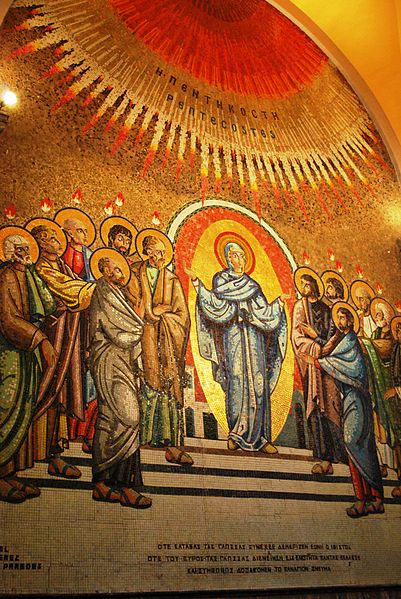
Mosaic Mural of Pentecost by Manuel Perez Paredes in Nuestro Senor del Veneno Temple, Mexico City

Joel 2: 28-32 (3:1-5 Hebrew)

28 Then afterward I will pour out my spirit on all flesh; your sons and your daughters shall prophesy, your old men shall dream dreams, and your young men shall see visions.
29 Even on the male and female slaves, in those days, I will pour out my spirit.
30 I will show portents in the heavens and on the earth, blood and fire and columns of smoke.
31 The sun shall be turned to darkness, and the moon to blood, before the great and terrible day of the LORD comes.
32 Then everyone who calls on the name of the LORD shall be saved; for in Mount Zion and in Jerusalem there shall be those who escape, as the LORD has said, and among the survivors shall be those whom the LORD calls.

This short portion of Joel is the best known among Christian readers because it is the scripture quoted by Peter to explain to the crowds what they were seeing at Pentecost. The final verse of this passage is also echoed by Paul in Romans 10:13 and may also influence Paul’s language in Galatians 3:28. Yet, it is important to hear this text both within its original context as well as these references in Acts and Romans. For Joel, this passage occurs within the context of the LORD turning the disaster of the locusts away and restoring the people to prosperity. Once the immediate needs of the people, the animals, and the land are met a prophetic vision of hope emerges.

Several prophets have a vision of God decisively turning the heart of the people around after the restoration of the covenant. For example:

The days are surely coming, says the LORD, when I will make a new covenant with the house of Israel and the house of Judah. It will not be like the covenant that I made with their ancestors when I took them by the hand to bring them out of the land of Egypt — a covenant that they broke, though I was their husband, says the LORD. But this is the covenant that I will make with the house of Israel after those days, says the LORD: I will put my law within them, and I will write it on their hearts; and I will be their God, and they shall be my people. No longer shall they teach one another, or say to each other, “Know the LORD,” for they shall all know me, from the least of them to the greatest, says the LORD; for I will forgive their iniquity, and remember their sin no more. Jeremiah 31: 31-34

I will sprinkle clean water upon you, and you shall be clean from all your uncleannesses, and from all your idols I will cleanse you. A new heart I will give you, and a new spirit I will put within you; and I will remove from your body the heart of stone and give you a heart of flesh. I will put my spirit within you, and make you follow my statutes and be careful to observe my ordinances. Ezekiel 36: 25-27

Just as the law is placed upon the hearts of the people and all know the LORD in Jeremiah, or the people are given a new heart and God’s spirit is placed within them in Ezekiel, now the LORD pours the Spirit of God on all flesh. It is likely that Joel understood ‘all flesh’ to be ‘all the remnant of Israel or Judah’ rather than ‘all humanity.’ Even the disciples at Pentecost probably understood this outpouring of the Spirit being to the faithful Jewish people and their remnant scattered among the nations, the book of Acts narrates this shift to accepting the Gentiles as a part of the community of faith. The radicality of Joel’s vision is that the recipients of God’s Spirit are both men and women, from young to old, and across social status.

Throughout the book of Joel, the day of the LORD has been reflected in an environmental disaster upon the earth. Locusts and drought were the armies that devastated the land, destroyed the crops and the pastures, and threatened the lives of both animals and humans. The day of the LORD continues to be reflected in the heavens. In language similar to the signs and wonders in Egypt and the experience of the exodus: the sun is darkened,[1] blood (like the Nile River turned to blood),[2] and a column of smoke becomes a visual representation of God’s presence.[3] New to Joel is the moon being turned to blood as a precursor of the day of the LORD. Yet, the day of the LORD is a time for repentance and calling on the name of the LORD. It is God who will allow the remnant to see the blessing on the other side of the great and terrible day of the LORD.

The words of Joel provide the scripture shaped language needed for Peter to describe the experience of God’s Spirit coming upon the disciples at Pentecost. The ability to speak in the tongues of the faithful from across the world becomes a new window into a vision when God pours out the Spirit generously upon the people. The early Christians would be shocked by the expansiveness of God’s vision as they are moved throughout the known world to share the gospel of Christ as they also see people of both genders, of every social class and age, and now from every nation brought into this new people of God who see visions and prophesy because they have received the gift of God’s Spirit.

[1] Exodus 10: 21-29
[2] Exodus 7: 14-25
[3] Exodus 13: 21-22

The Evolution of the Day of the LORD as Salvation or Judgment

Lamentations over the Death of the First Born of Egypt by Charles Sprague Pearce (1877)

The Evolution of the Day of the LORD as Salvation or Judgment

Joel, Amos, Obadiah, and Zephaniah all use the phrase ‘the day of the LORD’ to refer to a time where the LORD the God of Israel intervened in the life of Israel for salvation or judgment. Although this phrase is mainly used in these prophets, there are a number of similar phrases and ideas that pervade both the Hebrew Scriptures and the New Testament. The concept that the God of Israel intervenes in history is a central feature of the scriptures and probably originates for Israel in the memory of the deliverance of the people from their slavery in Egypt. Particularly at the critical moment in the story of Israel where the firstborn children of Egypt are struck down this is viewed as the critical day of God’s intervention for the people. Although the signs and wonders (or plagues as they are commonly referred) arrayed against the Egyptians unfold over an extended period of time, it is the final one that will be memorialized in the celebration of the Passover:

Remember this day on which you came out of Egypt, out of the house of slavery, because the LORD brought you out from there by strength of hand…You shall tell your child on that day, ‘It is because of what the LORD did for me when I came out of Egypt.’ Exodus 13: 1,8.

In Joshua, Judges, 1 and 2 Samuel there are often key ‘days’ when the LORD delivers an enemy into the hands of the people or an individual. For example:

On the day when the LORD gave the Amorites over to the Israelites, Joshua spoke to the LORD; and he said in the sight of Israel, “Sun, stand still at Gibeon, and Moon, in the valley of Aijalon.” And the sun stood still, and the moon stopped, until the nation took vengeance on their enemies. Joshua 10: 12-13.

Then Deborah said to Barak, “Up! For this is the day on which the LORD has given Sisera into your hand. The LORD is indeed going before you. Judges 4: 14.

This very day the LORD will deliver you (Goliath) into my (David) hand, and I will strike you down and cut off your head; and I will give the dead bodies of the Philistine army this very day to the birds of the air and the wild animals of the earth, so that all the earth may know that there is a God in Israel, and that all this assembly may know that the LORD does not save by sword and spear; for the battle is the LORD’s and he will give you into our hand. 1 Samuel 17: 46-47.[1]

Throughout these the image of God as the divine warrior who defends Israel and fights on their behalf in their wars is present. When Israel was unfaithful the LORD would not go out before them, and the results were disastrous[2] but God was not actively opposing Israel, merely withdrawing support for a time.

It is probably the prophet Amos who first utilizes the day of the LORD as a judgment. Amos’ ministry is during the time of King Uzziah (Azariah) of Judah (783-742 BCE) and King Jeroboam II of Israel (786-746 BCE)[3] when Jeroboam seems to be restoring the boundaries of Israel.  Amos is a shrill and unwelcome voice challenging the assumptions of the king of Israel and those religious leaders in the north who believed that God would always intervene for Israel. Amos’ dark vision of the day of the LORD as judgment begins:

Alas for you who desire the day of the LORD! Why do you want the day of the LORD? It is darkness and not light; as if someone fled from a lion and was met by a bear; or went into a house and rested a hand against the wall, and was bitten by a snake. Is not the day of the LORD darkness, not light, and gloom with no brightness in it. Amos 5: 18-20

Other prophets will follow Amos’ lead to talk about the day of the LORD as a day or wrath or punishment by Assyria, by Babylon,[4] or by environmental destruction by locusts and drought.[5] Sometimes the day of the LORD’s wrath will be directed at the nations or the enemies of Israel[6] but within the prophets the day of the LORD as wrath or judgment can often be paired with the day of the LORD as salvation.[7] These visions of the day of the LORD’s deliverance can move towards a utopian vision of divine closeness and prosperity for the people expressed in very poetic ways:

Then afterward I will pour out my spirit on all flesh; your sons and your daughters shall prophesy, your old men shall dream dreams, and your young men shall see visions. Even on the male and female slaves, in those days, I will pour out my spirit. I will show portents in the heavens and on the earth, blood and fire and columns of smoke. The sun shall be turned to darkness, and the moon to blood, before the great and terrible day of the LORD comes. Then everyone who calls on the name of the LORD shall be saved; for in Mount Zion and in Jerusalem there shall be those who escape, as the LORD has said, and among the survivors shall be those whom the LORD calls. Joel 2:28-32

On that day there shall not be either cold or frost. And there shall be continuous day (it is known to the LORD), not day and not night, for at evening time there shall be light. On that day living waters shall flow out from Jerusalem, half of them to the eastern sea and half of them to the western sea; it shall continue in summer as in winter. And the LORD will become king over all the earth; on that day the LORD will be one and his name one. Zechariah 14:6-9

The New Testament picks up these threads and weaves them into a new expectation of a coming day of God. The synoptic gospels (Matthew, Mark, and Luke) all share a common expectation of a day of judgment[8] as does Paul.[9] Yet, this time of the Son of Man’s return, the judgment of God, or the day of the Lord are now also times of expectation for the elect. It can be a great day of wrath[10] and the great day of God.[11]

The God of both Judaism and Christianity is a God who is engaged in the life of the world. Many in Christianity have reduced these concepts of the day of the Lord to refer only to the end of history and the establishment of the kingdom of God at some time in the future. The day of the Lord can refer to some type of establishment of God’s presence among the people in the future, but it may also refer to God’s judgment as it is being experienced or anticipated in the present or God’s deliverance expected or experienced. There is a poetic vision of hope that often expresses itself within the hope for the future, but that poetic side can also view the past and present through the dark lens of judgment. The gift and challenge of the bible is that it can use the same idea in multiple ways to remind the people of God’s continuing activity in the life of the people and the world. Sometimes people of faith understood the community’s life as having strayed from the will of God and God worked through the environment, through the nations, and through the prophets warning to call the people to return. Yet, for the people of faith, God’s intervention in history is often a hoped-for experience. The day of the Lord can be darkness or light, destruction or deliverance. Yet, God’s judgment is often followed by God’s renewed presence and recommitment to the people.

[1] See also 1 Samuel 3: 12, 4: 12-13, 24:10

[2] For example, the story of Achan son of Carmi taking some of the devoted things that God instructed the people to destroy in Joshua 7.

[3] This is the time of the rise of the Assyrian empire which will eventually capture Israel and Judah will be miraculously saved.

[4] Isaiah 13, Jeremiah 4:9, 25:33, Lamentations 1:12, Zephaniah 1: 7-10, 14

[5] Joel 1-2

[6] Jeremiah 50: 21, Obadiah 1: 15

[7] Isaiah 49:8, Jeremiah 39: 16, Joel 2: 18-27, Zephaniah 3: 8, 11, Zechariah 14:6-7.

[8] Matthew 11:22, 12: 36, 24:42,50, 25:31-45, Mark 13: 32, Luke 22-37

[9] Romans 2: 5, 16, 1 Thessalonians 5: 2-8

[10] Romans 2:5, Revelation 6:17

[11] Jude 1:6, Revelation 16:14