Jeremiah 23: 1-7: The Righteous Branch

1 Woe to the shepherds who destroy and scatter the sheep of my pasture! says the LORD. 2 Therefore thus says the LORD, the God of Israel, concerning the shepherds who shepherd my people: It is you who have scattered my flock, and have driven them away, and you have not attended to them. So I will attend to you for your evil doings, says the LORD. 3 Then I myself will gather the remnant of my flock out of all the lands where I have driven them, and I will bring them back to their fold, and they shall be fruitful and multiply. 4 I will raise up shepherds over them who will shepherd them, and they shall not fear any longer, or be dismayed, nor shall any be missing, says the LORD.
5 The days are surely coming, says the LORD, when I will raise up for David a righteous Branch, and he shall reign as king and deal wisely, and shall execute justice and righteousness in the land. 6 In his days Judah will be saved and Israel will live in safety. And this is the name by which he will be called: “The LORD is our righteousness.”
7 Therefore, the days are surely coming, says the LORD, when it shall no longer be said, “As the LORD lives who brought the people of Israel up out of the land of Egypt,” 8 but “As the LORD lives who brought out and led the offspring of the house of Israel out of the land of the north and out of all the lands where he had driven them.” Then they shall live in their own land.
Anyone who reads Jeremiah has to make educated guesses about the context that Jeremiah is writing to, especially when the time period is not made explicit. I see this as an extension of what comes before at the end of chapter 22 which is addressing the beginning of the exile (the first exile where the leadership is taken into exile but the people are left primarily in the land) in the time of Jechoniah and so this passage comes very late in the story of Jeremiah. The chapter verse delineations in scripture come much later and probably reflect an effort to highlight the messianic hope of this passage rather than see it buried at the end of a long chapter of judgment against the king, yet this passage probably belongs as an extension of chapter 22. Rabbi Lau has a different perspective, that it comes much earlier in the time of Josiah and contrasts between Josiah and the local leaders of his time (Lau, 2013, p. 28ff.) but this is an area where I think both Walter Brueggemann and Patrick Miller, who I have been reading as I have gone through Jeremiah, are correct. (Brueggemann, 1998, p. 205) (Elizabeth Actemeir, et. al., 1994, p. VI:744)
The themes of these verses are full of echoes throughout the prophets and in the gospels as well. The verses about the shepherds and the ways they have not been faithful is echoed in Ezekiel 34:
2 Mortal, prophesy against the shepherds of Israel: prophesy, and say to them– to the shepherds: Thus says the Lord GOD: Ah, you shepherds of Israel who have been feeding yourselves! Should not shepherds feed the sheep? 3 You eat the fat, you clothe yourselves with the wool, you slaughter the fatlings; but you do not feed the sheep. 4 You have not strengthened the weak, you have not healed the sick, you have not bound up the injured, you have not brought back the strayed, you have not sought the lost, but with force and harshness you have ruled them. 5 So they were scattered, because there was no shepherd; and scattered, they became food for all the wild animals. 6 My sheep were scattered, they wandered over all the mountains and on every high hill; my sheep were scattered over all the face of the earth, with no one to search or seek for them.
7 Therefore, you shepherds, hear the word of the LORD: 8 As I live, says the Lord GOD, because my sheep have become a prey, and my sheep have become food for all the wild animals, since there was no shepherd; and because my shepherds have not searched for my sheep, but the shepherds have fed themselves, and have not fed my sheep; 9 therefore, you shepherds, hear the word of the LORD:
10 Thus says the Lord GOD, I am against the shepherds; and I will demand my sheep at their hand, and put a stop to their feeding the sheep; no longer shall the shepherds feed themselves. I will rescue my sheep from their mouths, so that they may not be food for them. 11 For thus says the Lord GOD: I myself will search for my sheep, and will seek them out Ezekiel 34: 2-11
And is echoed in John chapter 10 where Jesus talks about being the good shepherd in contrast to the previous shepherd, or in Mark 6: 34 where the people are discussed as sheep without a shepherd. Here in Jeremiah at the end of verse four the promise is for a new and faithful shepherd who will come. After a long passage of judgment now comes the hope of the coming days.
Again the passage about the righteous branch has echoes in other places as well, for example in Isaiah 11:
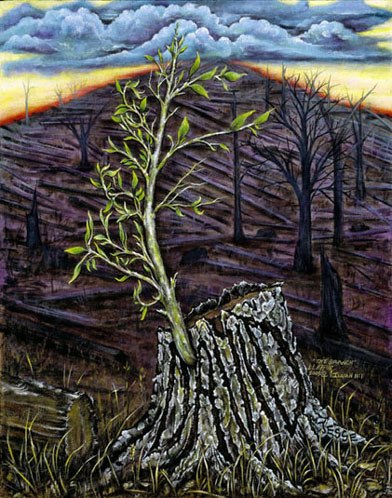
A shoot shall come out of the stump of Jesse, and a branch shall grow out of his roots. Isaiah 11:1
And the hope is that out of the defunct lineage of David which seems to be coming to an end that the God of Israel will maintain the commitment to the line of David and from that line will raise up a righteous branch who will live out of the vision of the Lord’s peace. And the renewal that the Lord will bring will make even the paradigmatic event of the Jewish people’s story, the Exodus, take second place to the new renewal that the Lord will do when the people are returned from exile. This is a story of hope for at least two sets of people: for the Jewish people it was a hope of renewal and return with a righteous and faithful king where God would gather from all the lands of the diaspora God’s people once again, and for Christians is also is an image of hope for from the story of Jesus we cannot help but hear that story in the hope of the righteous branch that arises out of the line of David. One passage can bring hope in two different ways, and hearing the hope of one another should also help us to see our dependence upon the Hebrew Scriptures to understand the life and ministry and hope of Jesus and his followers.
Jeremiah 23: 9-40: The Failure of the Prophets
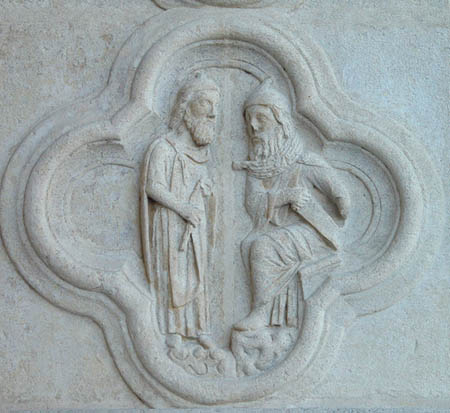
The Breaking of Jeremiah’s Yoke by Hananiah, Cathedral of Notre Dame, Amiens, France
9 Concerning the prophets:
My heart is crushed within me, all my bones shake;
I have become like a drunkard, like one overcome by wine,
because of the LORD and because of his holy words.
10 For the land is full of adulterers; because of the curse the land mourns,
and the pastures of the wilderness are dried up.
Their course has been evil, and their might is not right.
11 Both prophet and priest are ungodly;
even in my house I have found their wickedness, says the LORD.
12 Therefore their way shall be to them like slippery paths in the darkness,
into which they shall be driven and fall;
for I will bring disaster upon them in the year of their punishment, says the LORD.
13 In the prophets of Samaria I saw a disgusting thing:
they prophesied by Baal and led my people Israel astray.
14 But in the prophets of Jerusalem I have seen a more shocking thing:
they commit adultery and walk in lies;
they strengthen the hands of evildoers, so that no one turns from wickedness;
all of them have become like Sodom to me, and its inhabitants like Gomorrah.
15 Therefore thus says the LORD of hosts concerning the prophets:
“I am going to make them eat wormwood, and give them poisoned water to drink;
for from the prophets of Jerusalem ungodliness has spread throughout the land.”
16 Thus says the LORD of hosts: Do not listen to the words of the prophets who prophesy to you; they are deluding you. They speak visions of their own minds, not from the mouth of the LORD. 17 They keep saying to those who despise the word of the LORD, “It shall be well with you”; and to all who stubbornly follow their own stubborn hearts, they say, “No calamity shall come upon you.”
18 For who has stood in the council of the LORD so as to see and to hear his word?
Who has given heed to his word so as to proclaim it?
19 Look, the storm of the LORD! Wrath has gone forth, a whirling tempest;
it will burst upon the head of the wicked.
20 The anger of the LORD will not turn back
until he has executed and accomplished the intents of his mind.
In the latter days you will understand it clearly.
21 I did not send the prophets, yet they ran;
I did not speak to them, yet they prophesied.
22 But if they had stood in my council,
then they would have proclaimed my words to my people,
and they would have turned them from their evil way,
and from the evil of their doings.
23 Am I a God near by, says the LORD, and not a God far off? 24 Who can hide in secret places so that I cannot see them? says the LORD. Do I not fill heaven and earth? says the LORD. 25 I have heard what the prophets have said who prophesy lies in my name, saying, “I have dreamed, I have dreamed!” 26 How long? Will the hearts of the prophets ever turn back– those who prophesy lies, and who prophesy the deceit of their own heart? 27 They plan to make my people forget my name by their dreams that they tell one another, just as their ancestors forgot my name for Baal. 28 Let the prophet who has a dream tell the dream, but let the one who has my word speak my word faithfully. What has straw in common with wheat? says the LORD. 29 Is not my word like fire, says the LORD, and like a hammer that breaks a rock in pieces? 30 See, therefore, I am against the prophets, says the LORD, who steal my words from one another. 31 See, I am against the prophets, says the LORD, who use their own tongues and say, “Says the LORD.” 32 See, I am against those who prophesy lying dreams, says the LORD, and who tell them, and who lead my people astray by their lies and their recklessness, when I did not send them or appoint them; so they do not profit this people at all, says the LORD.
33 When this people, or a prophet, or a priest asks you, “What is the burden of the LORD?” you shall say to them, “You are the burden, and I will cast you off, says the LORD.” 34 And as for the prophet, priest, or the people who say, “The burden of the LORD,” I will punish them and their households. 35 Thus shall you say to one another, among yourselves, “What has the LORD answered?” or “What has the LORD spoken?” 36 But “the burden of the LORD” you shall mention no more, for the burden is everyone’s own word, and so you pervert the words of the living God, the LORD of hosts, our God. 37 Thus you shall ask the prophet, “What has the LORD answered you?” or “What has the LORD spoken?” 38 But if you say, “the burden of the LORD,” thus says the LORD: Because you have said these words, “the burden of the LORD,” when I sent to you, saying, You shall not say, “the burden of the LORD,” 39 therefore, I will surely lift you up and cast you away from my presence, you and the city that I gave to you and your ancestors. 40 And I will bring upon you everlasting disgrace and perpetual shame, which shall not be forgotten.
First the critique goes towards the ruling elite, the shepherds, the king but now it turn on the religious authorities and in particular the other prophets. There are several points in the book of Jeremiah where we hear about other prophets who are proclaiming a different message than Jeremiah is called to proclaim and the people hear different religious authorities proclaiming a very different message, or more likely they hear Jeremiah as a voice that is so different from the message others are saying that he goes unheard. In giving the people a false message they have prevented the people from having a realistic hope of turning. The narratives from the political and religious elites are going in the opposite direction of the proclamation given to Jeremiah. They proclaim an unconditional peace which serves the people rather than the covenantal shalom which calls the people to live in justice.
Perhaps these other prophets feel compelled to live into their roles, prophets are supposed to have a message from the Lord, dreams to dreams and visions to tell and so in the absence of these visions they have kept up the appearance, or perhaps the prophets have been coopted into the royal and priestly power systems to be additional mouthpieces for these authorities. Whatever the case they have failed in their calling, according to Jeremiah they are producing only lies and false visions and they are leading the people astray. They have become worse than the prophets of northern Israel which led Israel to worship Baal, for they perhaps are constructing a misleading image of the Lord. God’s judgment is on the prophets who have misled the people. Their condemnation will be harsher, everlasting disgrace and perpetual shame, and unlike the promise of a righteous branch that will arise out of the stump of Jesse, there is no promise for the prophets-they are also to be cast out of the city.