Author Archives: Neil

Exodus 8 The Insignificant Brings Low the Mighty

The god Khnum accompanied by Heqet, molds Ihy in a relief from the Mammisi (birth temple) at Dendra Temple complex

Exodus 8: 1-15: The Second Sign

Then the LORD said to Moses, “Go to Pharaoh and say to him, ‘Thus says the LORD: Let my people go, so that they may worship me. 2 If you refuse to let them go, I will plague your whole country with frogs. 3 The river shall swarm with frogs; they shall come up into your palace, into your bedchamber and your bed, and into the houses of your officials and of your people, and into your ovens and your kneading bowls. 4 The frogs shall come up on you and on your people and on all your officials.'” 5 And the LORD said to Moses, “Say to Aaron, ‘Stretch out your hand with your staff over the rivers, the canals, and the pools, and make frogs come up on the land of Egypt.'” 6 So Aaron stretched out his hand over the waters of Egypt; and the frogs came up and covered the land of Egypt. 7 But the magicians did the same by their secret arts, and brought frogs up on the land of Egypt.

 8 Then Pharaoh called Moses and Aaron, and said, “Pray to the LORD to take away the frogs from me and my people, and I will let the people go to sacrifice to the LORD.” 9 Moses said to Pharaoh, “Kindly tell me when I am to pray for you and for your officials and for your people, that the frogs may be removed from you and your houses and be left only in the Nile.” 10 And he said, “Tomorrow.” Moses said, “As you say! So that you may know that there is no one like the LORD our God, 11 the frogs shall leave you and your houses and your officials and your people; they shall be left only in the Nile.” 12 Then Moses and Aaron went out from Pharaoh; and Moses cried out to the LORD concerning the frogs that he had brought upon Pharaoh. 13 And the LORD did as Moses requested: the frogs died in the houses, the courtyards, and the fields. 14 And they gathered them together in heaps, and the land stank. 15 But when Pharaoh saw that there was a respite, he hardened his heart, and would not listen to them, just as the LORD had said.

The first sign which appeared in the previous chapter struck at the bleeding heart of Egypt and here in the second sign or warning, the plague of frogs takes the fertility of the land and now that fertility overwhelms the ability of the Pharaoh, his wise men and the magicians to control. These seems a strange sign and an odd display of power and yet the next three signs use things that on their own are weak and insignificant to bring the mightiest power of that time to the point of begging for Moses and Aaron to intercede for them. Frogs called up from the waters of Egypt will lead even Pharaoh to for a time acknowledge the LORD’s power in the land.

The Egyptian goddess Heqet, a goddess of fertility and childbirth

Frogs seems an odd choice and yet there is perhaps something to be seen in this choice. Frogs and the death of the first born in chapter eleven are the only signs where the language of plague is used (even though we are used to calling them the ten plagues).  Perhaps the connection goes back to fertility. In Ancient Egypt, the goddess Heqet, which is depicted as having a frogs head is one of the goddesses of fertility and seems to be the most ancient of these (since most of the other fertility images seem to be imported from other regions at later times). The association between Heqet, birth and fertility probably goes back to the frogs that would be common with the flooding of the Nile during the germination of the grain. Even midwives were known as servant of Heqet. The prolific presence of frogs at the controlled cultivation of the croplands probably sent a strong signal of fertility and life. Yet, here frogs instead of remaining in the places near the waters of Egypt move beyond their boundaries and cover the land and interfere with the life in the household, in the field and throughout the empire.

That which normally is received as a sign of blessing becomes a plague and fertility threatens to overwhelm that life which is already present. The magicians are able to replicate this sign, to demonstrate that they too can call up additional frogs-or perhaps that their powers to can be a plague. Regardless of their ability to add to the plague of frogs they cannot stem the amphibious infestation. Here Pharaoh for the first time acknowledge the impact of the LORD’s action in Egypt and ask Moses and Aaron to pray (or plead) to the LORD on behalf of Pharaoh. Moses’ prayers do lead to the elimination of the frogs and where once fertility threatened the households of Egypt now they are left with stinking piles of dead frogs.

Exodus 8: 16-19: The Third Sign

16 Then the LORD said to Moses, “Say to Aaron, ‘Stretch out your staff and strike the dust of the earth, so that it may become gnats throughout the whole land of Egypt.'” 17 And they did so; Aaron stretched out his hand with his staff and struck the dust of the earth, and gnats came on humans and animals alike; all the dust of the earth turned into gnats throughout the whole land of Egypt. 18 The magicians tried to produce gnats by their secret arts, but they could not. There were gnats on both humans and animals. 19 And the magicians said to Pharaoh, “This is the finger of God!” But Pharaoh’s heart was hardened, and he would not listen to them, just as the LORD had said.

The Egyptians were one of the first civilizations to be able to control and manipulate the land and the water to bring forth a regularly fertile land. Their control of the elements of creation has often led people to believe that they are now masters of their own destiny and, as in the story of the Tower of Babel in Genesis 11, how they will make a name for themselves. The Hebrew Bible (or Old Testament) loves to use irony and satire and like the Tower of Babel, which God has to come down and see (since even in their desire to reach up to the heavens is apparently isn’t visible from there) and confuses their language and thwarts their desire to make a name for themselves. Here it is in some type of small biting insect (can be translated as gnats, or lice or some other type of biting insect). Yet, here in the smallest of insects the magicians secret arts fail them.

Rabbi Jonathan Sacks is worth quoting at length here:

The Egyptians worshipped a multiplicity of gods, most of whom represented forces of nature. By their “secret arts” the magicians believed that they could control these forces. Magic is the equivalent in an era of myth to technology in an age of science. A civilization that believes it can manipulate the gods, believes likewise that is can exercise coercion over human beings. In such a culture the concept of freedom is unknown. (Sacks, 2010, p. 54)

The irony was that the Egyptian civilization which could harness the power of the Nile river and could build monuments to its leaders which stand even millennia later was shown powerless by a biting swarm of bugs. The magicians and wise men can realize their limits and acknowledge this is ‘the finger of God!’ Yet, in Pharaoh we have a leader whose heart (or will) is set, who knows the truth (even when all the facts contradict that perceived truth).

Chapter eight of Exodus is full of signs that are not lethal but inconvenient. The ecological disaster at this point while perhaps distasteful is not endangering the life or welfare of the people. Pharaoh’s entrenched resistance (whatever its source) allows the conflict between the LORD of Israel and the gods of Egypt to continue. Now for the first time the secret arts of the magicians has failed to replicate the finger of God. In the structure of the signs the third sign closes the first set but there is some wisdom to the way the chapter division occurs in our bibles. The frogs, gnats and flies all are ways in which the smallest and most inconsequential things manage to bring the might of Egypt to its knees.

Exodus 8: 20-31: The Fourth Sign

 20 Then the LORD said to Moses, “Rise early in the morning and present yourself before Pharaoh, as he goes out to the water, and say to him, ‘Thus says the LORD: Let my people go, so that they may worship me. 21 For if you will not let my people go, I will send swarms of flies on you, your officials, and your people, and into your houses; and the houses of the Egyptians shall be filled with swarms of flies; so also the land where they live. 22 But on that day I will set apart the land of Goshen, where my people live, so that no swarms of flies shall be there, that you may know that I the LORD am in this land. 23 Thus I will make a distinction between my people and your people. This sign shall appear tomorrow.'” 24 The LORD did so, and great swarms of flies came into the house of Pharaoh and into his officials’ houses; in all of Egypt the land was ruined because of the flies.

 25 Then Pharaoh summoned Moses and Aaron, and said, “Go, sacrifice to your God within the land.” 26 But Moses said, “It would not be right to do so; for the sacrifices that we offer to the LORD our God are offensive to the Egyptians. If we offer in the sight of the Egyptians sacrifices that are offensive to them, will they not stone us? 27 We must go a three days’ journey into the wilderness and sacrifice to the LORD our God as he commands us.” 28 So Pharaoh said, “I will let you go to sacrifice to the LORD your God in the wilderness, provided you do not go very far away. Pray for me.” 29 Then Moses said, “As soon as I leave you, I will pray to the LORD that the swarms of flies may depart tomorrow from Pharaoh, from his officials, and from his people; only do not let Pharaoh again deal falsely by not letting the people go to sacrifice to the LORD.”

 30 So Moses went out from Pharaoh and prayed to the LORD. 31 And the LORD did as Moses asked: he removed the swarms of flies from Pharaoh, from his officials, and from his people; not one remained. 32 But Pharaoh hardened his heart this time also, and would not let the people go.

The structure of the signs would indicate this is a new set. As mentioned previously the first sign of each set occurs in the morning as Pharaoh is outside, the second occurs after Moses speaks to Pharaoh inside and the third comes without a warning. With each set of signs the intensity of the damage increases as the pressure increases on the Egyptians to let the people of Israel go. Another distinction between the first three signs and the remaining signs is that now there is a distinction between the people of Israel and the Egyptians. The remaining signs will now not afflict the land where the Hebrews dwell, almost as if an invisible barrier is erected to keep out the flies and later afflictions.

After the frogs, had come upon the land the Pharaoh asks for Moses’ and Aaron’s intercession on behalf of him and his people offering to let the people go and worship but once there is a respite Pharaoh’s heart hardens and he forbids the people leaving to go and sacrifice. In a similar way, Pharaoh calls for Moses and Aaron and offers to let the Israelites worship and sacrifice within the land but now cultural differences get in the way. We don’t know exactly what these cultural differences are that the Egyptians would have stoned the people of Israel for. Perhaps it had to do with the animals the Jewish people would sacrifice (mainly sheep and goats which the Egyptians found distasteful, for example in Genesis Joseph warns his brothers not to say they were shepherds for the Egyptians found shepherds abhorrent (see Genesis 46: 34)). Regardless cultural and religious differences would ultimately make cohabitation impossible for the Jewish people in Egypt. As a religious and cultural minority, they felt unsafe within the broader Egyptian culture.

The ancient world was a pluralistic one where multiple religions did encounter one another and sometimes those cultures would live together peacefully. The people of Israel found a home in Egypt for several generations and were welcomed, yet the Exodus relates a time where they were a persecuted and oppressed group. Their present is now that of slaves and their future will be one of being refugees in search of a new home. The economic system of Egypt was built upon forced labor. Change frequently occurs only when the situation becomes so odious it can no longer be maintained. The people of Israel will be reluctant to leave Egypt behind and will long for it when things become challenging in the journey to the promised land. The people and leaders of Egypt are reluctant to let the people go because it means changing the way in which their society functions. In some respects, it is not surprising that Pharaoh continues here to harden his heart and defend the status quo and that only the continued pressure of these strange acts of God makes him even consider the possibility of temporarily granting the people a time to worship. Frogs, swarms of small biting bugs and flies continue to make life in Egypt unpleasant and continue to show

Exodus 7: The Conflict Begins

Ancient Egyptian Art Depicting Apep battling a Diety from the tomb of Inher-kha, Thebes

Exodus 7: 1-13 The Initial Challenge

The LORD said to Moses, “See, I have made you like God to Pharaoh, and your brother Aaron shall be your prophet. 2 You shall speak all that I command you, and your brother Aaron shall tell Pharaoh to let the Israelites go out of his land. 3 But I will harden Pharaoh’s heart, and I will multiply my signs and wonders in the land of Egypt. 4 When Pharaoh does not listen to you, I will lay my hand upon Egypt and bring my people the Israelites, company by company, out of the land of Egypt by great acts of judgment. 5 The Egyptians shall know that I am the LORD, when I stretch out my hand against Egypt and bring the Israelites out from among them.” 6 Moses and Aaron did so; they did just as the LORD commanded them. 7 Moses was eighty years old and Aaron eighty-three when they spoke to Pharaoh.

 8 The LORD said to Moses and Aaron, 9 “When Pharaoh says to you, ‘Perform a wonder,’ then you shall say to Aaron, ‘Take your staff and throw it down before Pharaoh, and it will become a snake.'” 10 So Moses and Aaron went to Pharaoh and did as the LORD had commanded; Aaron threw down his staff before Pharaoh and his officials, and it became a snake. 11 Then Pharaoh summoned the wise men and the sorcerers; and they also, the magicians of Egypt, did the same by their secret arts. 12 Each one threw down his staff, and they became snakes; but Aaron’s staff swallowed up theirs. 13 Still Pharaoh’s heart was hardened, and he would not listen to them, as the LORD had said.

The liberation of the people of Israel from their servitude to the Egyptians in not just a conflict between peoples, at its root it is a conflict between the LORD the God of Israel and the Egyptian gods. Moses becomes the vessel of the LORD’s work against the Egyptians and Pharaoh and the ‘wise men, the sorcerers and the magicians of Egypt’ line up on the other side. The central two characters, Moses and Pharaoh, both become representative or avatars of the divine power behind them. Moses here will be ‘like a God to Pharaoh, and your brother Aaron shall be your prophet.’ Pharaoh derives his authority from a divine claim that the Pharaoh is a ‘son of Ra’ the chief god of the Egyptian pantheon. Two conflicting views of creation (Ra is the chief god of not only the sun but creation for Egypt) and two conflicting views of the way that world should be structured are in play. Within Egypt, the superpower of that era, Pharaoh is all powerful and yet in this narrative Pharaoh plays a tragic character. Pharaoh will not listen to Aaron and Moses initially, but the conflict between competing sources of divine power will be seen not only by the individual players but also by both peoples (the Egyptians and the Hebrews). The end is that even the Egyptians will ‘know that I am the LORD,’ as the coming ecological disasters will testify to the power of the LORD over creation and the inability of Ra and those loyal to him to prevent this upheaval.

One of the places where translations don’t quite do justice to the original language is here with the language about the snakes that come from Aaron’s and what comes out of the Egyptians staffs. The word here in Hebrew is Tannin which is not the typical word for snake but rather for the serpent like chaos monster or dragon. Both sets of Tannin, from Aaron’s staff and the Egyptian magicians, are forces of war and destruction and chaos. Here chaos is unleashed symbolically in a struggle between the LORD of Israel and the lords of Egypt. Interestingly, to me at least, in Egyptian mythology the nightly struggle of Ra is against Apep (or Apophis) the snake like force of evil and chaos but now in matching the display of power by the LORD unleashing the forces of chaos even the emissaries of Pharaoh, son of Ra, must unleash their own forces of chaos. Ultimately it is the tannin released by Aaron which swallows the tannin released by the wise men of Egypt and this initial conflict foreshadows the chaos unleashed on creation that is to come. One of the things that begins here is the inability of the Egyptian wise men, sorcerers and magicians to undo what has been unleashed through Moses and Aaron. They may initially replicate what Moses and Aaron do but they cannot undo it. They can only add to the chaos which threatens to consume all of Egypt.

One of the aspects of this and the following passage to consider is the ‘hardening of Pharaoh’s heart.’ There are certain passages where Pharaoh himself is the one who hardens his heart and others where the heart of Pharaoh is hardened by God. For those looking for a definitive answer to the tricky question of divine determinism I am afraid you are likely to be disappointed. Many interpreters see within this, and each interpreter makes theological choices based on their understanding of God, for Pharaoh’s free will remaining intact and the responsibility for the choices remaining entirely on Pharaoh’s shoulders. Others take serious this hardening of Pharaoh’s heart by the LORD and see the enslaver losing his own free will and becoming the tool that once the enslaved Hebrew people were. The truth is probably subtler as the ancient writers of the Bible were not dogmatically rigid. Divine determinism and free will could coexist without any perceived conflict. Perhaps, as Rabbi Jonathan Sacks can state:

Pharaoh is in fact…a tragic figure like Lady Macbeth, or like Captain Ahab in Melville’s Moby Dick, trapped in an obsession which may have had rational beginnings, right or wrong, but which has taken hold of him, bringing not only him but those around him to ruin. (Sacks, 2010, p. 49)

Perhaps Pharaoh is merely trapped within a worldview that cannot imagine letting the Hebrew slaves go. Perhaps Pharaoh’s heart and mind receive some divine nudge to harden his resolve and will as the chaos unfolds around him and his people. Perhaps Pharaoh, who views himself as the king on the chess board is merely a pawn being played. Regardless Pharaoh, the son of Ra, will be unable to avoid being swallowed up by the chaos unleashed as he struggles against the LORD. The gauntlet has been thrown, the challenge has begun for the lives of both peoples. Warnings are unheeded, hearts are hardened and next the heart of Egypt will bleed.

The Roman Kiosk of Trajan (left) on Agilkia island in the Nile River, near Aswān, Egypt

Exodus 7: 14-25 The Bleeding Heart of Egypt

 14 Then the LORD said to Moses, “Pharaoh’s heart is hardened; he refuses to let the people go. 15 Go to Pharaoh in the morning, as he is going out to the water; stand by at the river bank to meet him, and take in your hand the staff that was turned into a snake. 16 Say to him, ‘The LORD, the God of the Hebrews, sent me to you to say, “Let my people go, so that they may worship me in the wilderness.” But until now you have not listened.’ 17 Thus says the LORD, “By this you shall know that I am the LORD.” See, with the staff that is in my hand I will strike the water that is in the Nile, and it shall be turned to blood. 18 The fish in the river shall die, the river itself shall stink, and the Egyptians shall be unable to drink water from the Nile.'” 19 The LORD said to Moses, “Say to Aaron, ‘Take your staff and stretch out your hand over the waters of Egypt– over its rivers, its canals, and its ponds, and all its pools of water– so that they may become blood; and there shall be blood throughout the whole land of Egypt, even in vessels of wood and in vessels of stone.'”

20 Moses and Aaron did just as the LORD commanded. In the sight of Pharaoh and of his officials he lifted up the staff and struck the water in the river, and all the water in the river was turned into blood, 21 and the fish in the river died. The river stank so that the Egyptians could not drink its water, and there was blood throughout the whole land of Egypt. 22 But the magicians of Egypt did the same by their secret arts; so Pharaoh’s heart remained hardened, and he would not listen to them; as the LORD had said. 23 Pharaoh turned and went into his house, and he did not take even this to heart. 24 And all the Egyptians had to dig along the Nile for water to drink, for they could not drink the water of the river.

 25 Seven days passed after the LORD had struck the Nile.

The Nile River, or to the ancient Egyptians simply the river, is the heart of the Egyptian empire. Egypt was shielded from other early civilizations by deserts on both sides and the Nile river delta provided for an agricultural abundance that allowed the people to focus on the construction of large public projects like the pyramids. The river is a source of food, transportation, and ultimately life. Without the Nile River, there is no Egyptian empire and even though the Nile never becomes a significant source of worship for the Egyptians, it is simply an assumed part of life. Yet, it is here that the LORD instructs Moses and Aaron to strike first. The heart of the Egyptian empire bleeds, life begins to end and an ecological disaster begins to unfold.

This begins a highly-structured telling of the signs and wonders that bring the people out of Egypt. In the three sets of three where the first in each set Moses speaks to Pharaoh outside in the morning, the second Moses speaks to Pharaoh inside in the palace and the third comes abruptly without a warning. Some would argue ecologically that one plague would naturally follow the others because of the ecological devastation, and while that may be true the narrative moves where the LORD is in control of each sign and wonder unfolding.

In Genesis 3, the end of the story of Adam and Eve, the disobedience by Adam and Eve which is supposed to result in their own deaths is ultimately born by the earth (see Genesis 3: 17). Here also it is the earth which bears the consequences of the disobedience of Pharaoh. Of the first nine signs, only the hail is fatal to humans and even then, Pharaoh and his people are warned to bring their people and animals into a secure place with a twenty-four-hour warning. Each sign seems designed to make the Egyptians aware that it is the LORD who is the God who has power over the creation and here the waters of Egypt are the first to bear the consequence of the refusal of Pharaoh to let the people go to worship the LORD.

Again, the magicians of Egypt, by their secret arts, are able to replicate this chaos with some of the uncontaminated water and yet they are unable to reverse or limit the effects. They can only contribute to the chaos. The river turns to blood, the fish die and the waters stink and are unable to drink. The lifeblood of Egypt is now biological waste and yet the people continue to find a way. Even though the river will be contaminated people are still able to dig for freshwater along the banks of the river. The ecological disaster forces the people to change their patterns and yet the Egyptians continue to find the water they need for life to continue. Pharaoh’s heart remains hardened and his will is resolved since his priests can apparently in some way replicate what the LORD is doing through Moses and Aaron. Perhaps, he is also shielded from the immediate effects since he would not dig for his own water, ultimately slaves or servants would do that for him. He retreats to his house without taking to heart the bleeding heart of his empire. He closes his eyes and his doors to the disaster beginning to unfold around him.

Communio: A Poem


 candle

There are times when the words and symbols spark
Lighting up our world, illuminating the dark
And in our mundane world magic appears
To strengthen resolve or to calm our fears
With a community of saints on holy ground
Where the remnants of ancient faith are found
 
In those rare times, you can almost feel
The mystery hiding behind the real
Where good and evil struggle and strive
And God and the devil are still alive
Where water and wine and flesh and stone
Unite us together. We are not alone
 
Where God’s presence has come to earth to dwell
And deep runs the water in the spiritual well
Where hope emerges from the pain
And the drought ends in heavenly rain
Where we see again the world made new
And the magic returns to me and to you

Exodus 6: God’s Response and Moses’ Heritage

Exodus 6: 1-13 A God Who Speaks and A People Unable to Hear

Then the LORD said to Moses, “Now you shall see what I will do to Pharaoh: Indeed, by a mighty hand he will let them go; by a mighty hand he will drive them out of his land.”

2 God also spoke to Moses and said to him: “I am the LORD. 3 I appeared to Abraham, Isaac, and Jacob as God Almighty, but by my name ‘The LORD’ I did not make myself known to them. 4 I also established my covenant with them, to give them the land of Canaan, the land in which they resided as aliens. 5 I have also heard the groaning of the Israelites whom the Egyptians are holding as slaves, and I have remembered my covenant. 6 Say therefore to the Israelites, ‘I am the LORD, and I will free you from the burdens of the Egyptians and deliver you from slavery to them. I will redeem you with an outstretched arm and with mighty acts of judgment. 7 I will take you as my people, and I will be your God. You shall know that I am the LORD your God, who has freed you from the burdens of the Egyptians. 8 I will bring you into the land that I swore to give to Abraham, Isaac, and Jacob; I will give it to you for a possession. I am the LORD.'” 9 Moses told this to the Israelites; but they would not listen to Moses, because of their broken spirit and their cruel slavery.

 10 Then the LORD spoke to Moses, 11 “Go and tell Pharaoh king of Egypt to let the Israelites go out of his land.” 12 But Moses spoke to the LORD, “The Israelites have not listened to me; how then shall Pharaoh listen to me, poor speaker that I am?” 13 Thus the LORD spoke to Moses and Aaron, and gave them orders regarding the Israelites and Pharaoh king of Egypt, charging them to free the Israelites from the land of Egypt.

The same message may be heard very differently in different circumstances. When Moses and Aaron relay a very similar message at the end of chapter four the people receive in hope, they bow down and they worship. After the abuse received in chapter five the supervisors have called for the LORD to judge between Moses and them. Oppression changes our ability to hope and believe that a change can happen. One of the dynamics of abuse is that the abused person often feels they have no choice because all their energy is expended on survival. Slavery continues to breed hopelessness among the people and as daily survival becomes harder imagining a change becomes both more essential and increasingly difficult. It will not be words or promises that will move the people of Israel or Pharaoh away from the oppressor/oppressed dynamic.

The upcoming plagues upon the land of Egypt will be harsh and there will be much to wrestle with in these sections as they come up, but here we are at the end of what words can do. Ultimately words, without some type of recognized power and authority behind them, short of their power to convince do not sometimes break through the hardened worldviews of opposing parties. Moses may not be a person who is confident in his speaking ability but we have seen previously he is a man who acts when he sees oppression. Yet, here, where his previous words seem only to have increased the suffering and oppression of the people he again appeals to his poor speaking ability. He is unable to engender with these words of the LORD hope within the people of Israel or fear within the person of Pharaoh.

We as people who hear these words in relative comfort can also hear something new in this moment of revelation, something perhaps Moses and the people could not hear in their oppression engendered deafness. The name of the LORD, revealed to Moses on the mountain in chapter three, we now learn has not been previously revealed. Others have known the LORD and called the LORD by other names (typically describing an attribute of God: God almighty, God who sees, etc.) but now Moses hears again the unique name of the LORD. Again, there are the promises of the land of Canaan, the promise to deliver, the covenant promise that the LORD will be their God and they will be the people of the LORD, these things will unfold as we journey through the Exodus narrative, and yet all these promises are unable to heard at this time. Ultimately it will be in retrospect that the people will be able to look back and in light of the commandments remember “I am the LORD your God, who brought you out of the land of Egypt, out of the house of slavery.” (Exodus 20:2)

We are moving from the time where the time of actions in the future will become the present of the narrative. If this were our story we would move directly into the confrontation between Moses and Aaron and Pharaoh, between the LORD the God of Israel and the gods of Egypt. Yet, there is one more pause before we move into this conflict. The LORD has revealed something of Godself in both name, heritage and promise and we have seen something of who Moses is in his actions. But for the people of Israel there is something else we need to know before we can move forward.

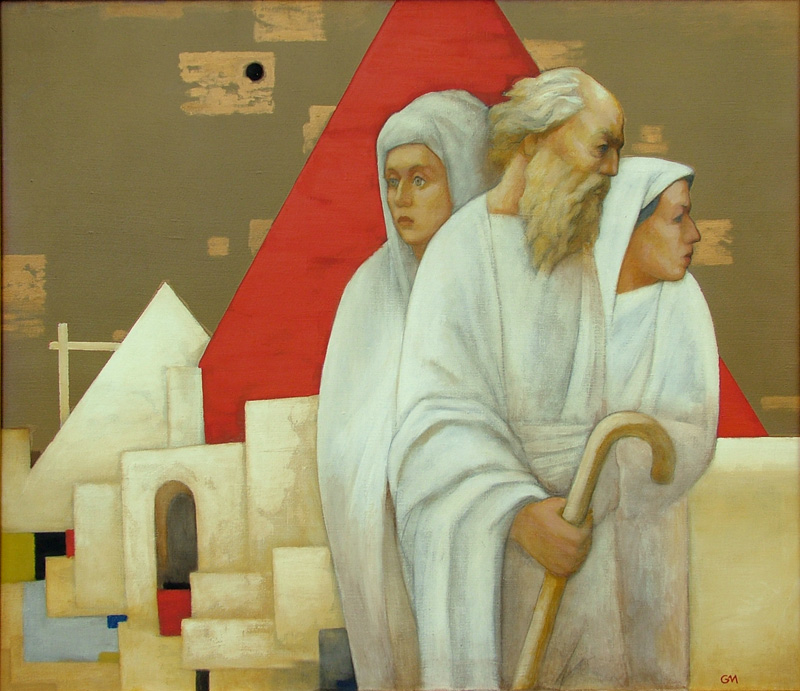
Theo van Doesburg, Moses (1906)

Theo van Doesburg, Moses (1906)

Exodus 6:14-30 Who are Moses and Aaron

 14 The following are the heads of their ancestral houses: the sons of Reuben, the firstborn of Israel: Hanoch, Pallu, Hezron, and Carmi; these are the families of Reuben. 15 The sons of Simeon: Jemuel, Jamin, Ohad, Jachin, Zohar, and Shaul, the son of a Canaanite woman; these are the families of Simeon. 16 The following are the names of the sons of Levi according to their genealogies: Gershon, Kohath, and Merari, and the length of Levi’s life was one hundred thirty-seven years. 17 The sons of Gershon: Libni and Shimei, by their families. 18 The sons of Kohath: Amram, Izhar, Hebron, and Uzziel, and the length of Kohath’s life was one hundred thirty-three years. 19 The sons of Merari: Mahli and Mushi. These are the families of the Levites according to their genealogies. 20 Amram married Jochebed his father’s sister and she bore him Aaron and Moses, and the length of Amram’s life was one hundred thirty-seven years. 21 The sons of Izhar: Korah, Nepheg, and Zichri. 22 The sons of Uzziel: Mishael, Elzaphan, and Sithri. 23 Aaron married Elisheba, daughter of Amminadab and sister of Nahshon, and she bore him Nadab, Abihu, Eleazar, and Ithamar. 24 The sons of Korah: Assir, Elkanah, and Abiasaph; these are the families of the Korahites. 25 Aaron’s son Eleazar married one of the daughters of Putiel, and she bore him Phinehas. These are the heads of the ancestral houses of the Levites by their families.

 26 It was this same Aaron and Moses to whom the LORD said, “Bring the Israelites out of the land of Egypt, company by company.” 27 It was they who spoke to Pharaoh king of Egypt to bring the Israelites out of Egypt, the same Moses and Aaron.

 28 On the day when the LORD spoke to Moses in the land of Egypt, 29 he said to him, “I am the LORD; tell Pharaoh king of Egypt all that I am speaking to you.” 30 But Moses said in the LORD’s presence, “Since I am a poor speaker, why would Pharaoh listen to me?”

This is not how we tell a story because we see the world differently than people in the ancient world. We live in a world where we construct our identities, we are who we are because of our choices and actions is the narrative we try to live our lives within. Yet, in the ancient world you inherited your identity: you are who you are because of your parents, grandparents, etc. This is why the Bible and most ancient texts take extended sections for genealogies. Often an ancient person’s telling of who they are would be a narrative of not only their name but their name within a list of the ancestors. You still see this in the Middle East where names, Osama bin Laden for a famous example, revolve around this pattern (Osama son of (bin) Laden). Here what is interesting to me about this genealogy is its incompleteness. It begins with a telling of the ancestry of the tribe (Reuben, Simeon and Levi) but before it can get to the remaining tribes it holds up within the tribe of Levi focusing both on the upcoming divisions of labor among the descendants of Levi as well as the priestly heritage of both Aaron and Moses. Here for the first time the parents of Moses and Aaron are named: Amram and Jochebed and presumably Aaron is the older son based upon how they are listed. There is a long series of exceptions where the LORD chooses the younger rather than the older son (Jacob and Joseph for example in Genesis) and here is one more of those incidents.

Another unusual piece of this genealogy is that Amram and Jochebed are related more closely than would be allowed in Leviticus (see Leviticus 18:12) and yet here they are a man and his aunt who are lifted up as the ancestors of Moses and Aaron: the great leader of Israel and its first high priest. Again, this is one of those places where a close reading of a genealogy often renders a few surprises in the family tree.

I have done enough work with Family Systems theory and have spent enough time observing families as a part of my ministry within a congregation to know that we are never truly the crafters of our own story. We inherit a lot of our identity, knowingly and unknowingly, from our parent and their parents. Many of our opportunities are opened by the position and standing of those who came before us. In our world, we may simply attempt to judge Moses and Aaron based upon their position and actions but perhaps there is some wisdom in these ancient stories that pause and remind us who are the ancestors of the people in our stories and where are the roots of their family trees. Now that we know where Moses and Aaron came from we are ready to follow them into the rest of the story.

Making Kylo Ren Believable Again

kylo-ren_fa163069

There were several things the first time I saw Star Wars: The Force Awakens that I struggled with, partially because I have enough of a science background that it bothers me when science fiction ignores the science component, but by the second viewing I was able to relax some of those concerns and enjoy the film a little more. Yet, one of the things that I remarked after seeing Star Wars: The Force Awakens for the first time when it was released in 2015 was that Kylo Ren, the central antagonist was a weak and ineffective villain. While there were elements of the character that I liked. I could appreciate the effort of trying to create a more complex villain than Darth Vader initially appeared in the original trilogy. Yet, the petulant and insecure Kylo Ren just didn’t feel like a figure that could be the type of leader and physical representation of the First Order that Darth Vader was for the Galactic Empire. Scenes where his temper would cause him to lose control and, for example, destroy a whole set of panels on a starship simply because he received news he didn’t want portrayed a person who shouldn’t be entrusted with the level of authority he was invested with. I had trouble believing in 2015 that anyone would give such an instable individual the type of control that Kylo Ren was given over people, resources and place him in a position of being a figurehead for a credible threat.  I need to admit that now in 2017 I was wrong, Kylo Ren became a compelling villain because in 2016 we put a leader in place who displayed many of the same characteristics.

Kylo Ren continually looks back upon an idealized past where his grandfather, Darth Vader, was the figurehead of a strong empire ruled over by a powerful and cruel emperor. The empire’s brand of peace and justice was carried out through military domination and two planet killer weapons of mass destruction ominously called Death Stars. Attempting to live into this legacy and turning away from the legacy of his parents and teachers he becomes a fallen but flawed character. Continually dominated by his emotions, occasionally effective but often erratic, he needs the continual guidance of the ominous Supreme Leader Snoak.

What seemed an unbelievable character in fiction two years ago is far too familiar now. Others may not have seen it during his campaign but I could already tell that Donald Trump did not possess the temperament for the unbelievably challenging task of leading the United States in a complex and evolving world. Yet, Trump too relied upon some idealized version of simpler past that never truly existed the way he imagined it (nor would he ever define when he thought America was great). If a small fractions of the leaks coming out of the White House are true then we can see the result of living with a leader who can react unpredictably to the slightest provocation and appears to be completely involved with his own image and problems unwilling to engage the difficult work of making policy except by twitter and the hastily crafted executive order. The only question remains who is the person behind the scenes attempting to manage the actions of this unpredictable leader-is it the shadowy Steve Bannon or is it the equally sinister Vladamir Putin or maybe Trump really is the wildcard who is uncontrollable and until he is stopped we will continue walking on eggshells wondering what the next day will bring. Regardless it has made one fictional villain more believable to me, perhaps a small consolation but one has to laugh where one can.

Exodus 5: The Oppression of the Israelites Increases

Benjamin West (1738-1820), Moses and Aaron Before Pharaoh

Benjamin West (1738-1820), Moses and Aaron Before Pharaoh

Exodus 5: 1-9: The Initial Audience with Pharaoh

Afterward Moses and Aaron went to Pharaoh and said, “Thus says the LORD, the God of Israel, ‘Let my people go, so that they may celebrate a festival to me in the wilderness.'” 2 But Pharaoh said, “Who is the LORD, that I should heed him and let Israel go? I do not know the LORD, and I will not let Israel go.” 3 Then they said, “The God of the Hebrews has revealed himself to us; let us go a three days’ journey into the wilderness to sacrifice to the LORD our God, or he will fall upon us with pestilence or sword.” 4 But the king of Egypt said to them, “Moses and Aaron, why are you taking the people away from their work? Get to your labors!” 5 Pharaoh continued, “Now they are more numerous than the people of the land and yet you want them to stop working!” 6 That same day Pharaoh commanded the taskmasters of the people, as well as their supervisors, 7 “You shall no longer give the people straw to make bricks, as before; let them go and gather straw for themselves. 8 But you shall require of them the same quantity of bricks as they have made previously; do not diminish it, for they are lazy; that is why they cry, ‘Let us go and offer sacrifice to our God.’ 9 Let heavier work be laid on them; then they will labor at it and pay no attention to deceptive words.”

The initial audience for Moses and Aaron with the Pharaoh makes matters worse instead of better for the Hebrew people. The authority that they can claim from the LORD is immediately met with the question from Pharaoh, “Who is the LORD?” I find it intriguing that the initial threat is on the Israelites, that if they do not go into the wilderness to sacrifice then pestilence and sword will fall on them, rather than the Egyptians. While the LORD has revealed Godself to Moses and Aaron, Pharaoh has not received any type of revelation yet. Pharaoh’s gods are very different from the LORD the God of Israel. Egypt’s gods are the gods that authorize the reign of Pharaoh and the enslavement of the people. Yet, the God of Israel has heard their cry and has called Moses and Aaron to carry to Pharaoh this initial plea to let the people go.

Pharaoh resorts to victim blaming. Although there is perhaps some vulnerability in the statement that, “Now they are more numerous than the people of the land” and the fear of what a day without their immigrants would look like, the Hebrew people are immediately scapegoated as lazy. Pharaoh uses the bureaucracy to separate himself from the suffering of the Hebrew people and to increase it mercilessly. Unlike the LORD, Pharaoh refuses to hear and see. There is no Sabbath rest for the people of Israel, only the iron hand of oppression. In laying before the people the impossible task of making bricks without straw and charging them to gather straw from the remnants of the field Pharaoh insures that they will continue to be less productive and ‘lazy’ in the eyes of the oppressor.

Exodus 5: 10-21: The Oppression Increases

 10 So the taskmasters and the supervisors of the people went out and said to the people, “Thus says Pharaoh, ‘I will not give you straw. 11 Go and get straw yourselves, wherever you can find it; but your work will not be lessened in the least.'” 12 So the people scattered throughout the land of Egypt, to gather stubble for straw. 13 The taskmasters were urgent, saying, “Complete your work, the same daily assignment as when you were given straw.” 14 And the supervisors of the Israelites, whom Pharaoh’s taskmasters had set over them, were beaten, and were asked, “Why did you not finish the required quantity of bricks yesterday and today, as you did before?”

15 Then the Israelite supervisors came to Pharaoh and cried, “Why do you treat your servants like this? 16 No straw is given to your servants, yet they say to us, ‘Make bricks!’ Look how your servants are beaten! You are unjust to your own people.” 17 He said, “You are lazy, lazy; that is why you say, ‘Let us go and sacrifice to the LORD.’ 18 Go now, and work; for no straw shall be given you, but you shall still deliver the same number of bricks.” 19 The Israelite supervisors saw that they were in trouble when they were told, “You shall not lessen your daily number of bricks.” 20 As they left Pharaoh, they came upon Moses and Aaron who were waiting to meet them. 21 They said to them, “The LORD look upon you and judge! You have brought us into bad odor with Pharaoh and his officials, and have put a sword in their hand to kill us.”

It is the supervisors, those from among the people who are placed in a position of

The Phillip Medhurst Picture Torah, Pharaoh Adds to the Work of the Israelites

The Phillip Medhurst Picture Torah, Pharaoh Adds to the Work of the Israelites

authority who will become those most directly impacted by Pharaoh’s words.  The people will fail at their impossible task, Pharaoh will continue to blame the supervisors and the people for being lazy and supervisors now find themselves beaten by the taskmasters. Even though the supervisors go and appeal to Pharaoh they have the request of Aaron and Moses thrown in their faces as evidence of their laziness. Their past loyalty to the king of Egypt does not count when they now find themselves bearing the people’s punishment. Perhaps this drives the supervisors back to being a part of the people rather than primarily aligning with the empire but in Pharaoh’s response they see that their positions of favor have changed to disfavor.

Egypt, as it is portrayed in Exodus, was an empire build upon the enslavement of an immigrant people. The Hebrew people are viewed as other, somehow lesser than the people of the land. Their forced labor allowed for the consolidation of wealth and power among the elite rulers and priestly members of their society. Systems of oppression to not change easily or willingly. There are often elaborate beliefs that are invisibly woven around one group’s privilege and another’s oppression. Even in modern times we are not free from systems where we blame the victim or where one group of people has an often unseen, perhaps obscured by systems of bureaucracy like in our narrative, set of privileges or benefits. In the United States, a country founded on a stated creed that ‘all men are created equal’ it took, for example, a civil war and then one hundred years of struggle (often overlooked) until the voting rights act could make it legal for African Americans to be able to vote and that struggle for voice and vote continues for people of color, women and many other groups.

One of the rhetorical moves of the Civil Rights movement was to take the Exodus narrative, which was so important in the founding of the United States, and recast it where now instead of white Americans being able to claim the mantle of the Hebrews entering the promised land, now it is the African Americans who are the chosen people and whites are recast in the role of Pharaoh and his taskmasters. Within the Civil Rights movement, like in the Exodus story, the oppression of the captive people became harsher before they earned a greater equality than what they had before. The Civil Rights leaders probably had several of their own people accuse them like the supervisors did to Moses and Aaron, for the struggle was not to be over in one day or one set of words. In Egypt, it will take an act of God for the people to leave their oppression. In our day, may our hearts not be so hardened as Pharaohs would be.

Exodus 5: 22-23: Moses’ Accusation of God

 22 Then Moses turned again to the LORD and said, “O LORD, why have you mistreated this people? Why did you ever send me? 23 Since I first came to Pharaoh to speak in your name, he has mistreated this people, and you have done nothing at all to deliver your people.”

Moses has some chutzpah. This will not be the last time Moses speaks boldly to God, nor will Moses be the only exemplar of this. The prophet Jeremiah’s words to God were often very direct and accusing, see for example Jeremiah 15 and Jeremiah 20. Many of the Psalms of lament, for example Psalm 10 or Psalm 22 accuse God of either hiding Godself in times of trouble or forsaking the Psalmist. One of the gifts of our scriptures is the direct way that the people of faith could appeal to God. Here Moses, the one who feared using his voice, can now lift his voice to God in protest God’s mistreatment of the people and sending him as a bearer of sorrow to them. God has not yet fulfilled his promise to deliver the people and as Moses can boldly state he has done nothing to deliver them yet. God will hear the cries of the people and will hear the words of Moses. I stated in an earlier chapter that perhaps one of the characteristics of Moses that God saw and chose was his inability to remain inactive in the fact of oppression. Now Moses lifts up to God the cries and accusations of the people. Unlike Pharaoh, the LORD will not remain unmoved.

Understanding the Constitution of the United States: Article II the Executive Branch

Image of the U.S. Constitution from http://wvconstitutionaladvocates.com/u-s-constitution/

Image of the U.S. Constitution from http://wvconstitutionaladvocates.com/u-s-constitution/

The second article of the Constitution of the United States is significantly shorter than the first article and processes of election and succession (in section 1) were modified by the twelfth and twenty-fifth amendments. The structure of the constitution does not allow for unchecked power by any of the branches of government. The executive branch is limited by the laws passed and their interpretation by the judicial branch. We are seeing this play out in the opening days of the Trump administration where executive orders cannot override existing laws and a federal judge can execute a stay or prevent enforcement of an executive order that contradicts other laws and the legislative branch has the authority to pass a law which would supersede an executive order. The Constitution can be viewed here among several other places. What follows is an explanation of this fairly short article.

Section 1: Vesting, Election and Succession

The Vesting Clause:

This first clause of the article has been viewed differently by different presidents about the amount of Executive Power that has been vested in the President of the United States. Certain privileges are reserved by the Legislature or the Supreme Court in Articles I or III, but ultimately the Executive Branch is charged with the execution and enforcement of the laws that are passed by the Legislative Branch. Each of the branches of government are vested with specified powers as a part of the constitution’s balance of power. The specified powers of the President of the United States are listed in Section 2 below. There is no reading of the U.S. Constitution that could support the statements made by Stephen Miller, an advisor to President Trump, who stated that “the powers of the president…are very substantial and will not be questioned.”

The remainder of Section 1 concerns the practical matters like:

– the process of election of a president (which was modified by the Twelfth Amendment after the 1800 election of Thomas Jefferson where he and his running mate received the same number of votes. The Twelfth Amendment establishes our current system of Electoral College election)

– the qualifications required to be a President: natural born citizen (since no one alive today was alive at the time of the adoption of the constitution, which is how the first Presidents were eligible), at least 35 years old and having lived as a resident of the United States for at least fourteen years.

-What to do in the case of the removal, death, resignation or inability of a president to fulfill their duties (modified by the Twenty Fifth Amendment to increase the specificity on how this process would unfold)

-Compensation for the President, currently $400,000 per year, and while the President serves they are not able to receive any other payment from either a state or the federal government.

-Finally the oath of office is outlined: “I do solemnly swear (or affirm) that I will faithfully execute the Office of President of the United States, and will to the best of my ability,  preserve, protect, and defend the Constitution of the United States.

Section 2: Powers of the President of the United States

The President is the Commander in Chief of the Armed Forces and has the power to employ the U.S. Military (Active, Reserve and when called into federal service the National Guard which when not federalized is controlled by the state governors). The President does not have the power to declare war, that is specifically reserved to the Legislative Branch (Article 1, Section 8) and the Legislative branch is the only branch that can authorize the funds for military action outside the budget but the President is charged with the execution of any use of the military.

May require (the Opinion) of any of the members of an Executive department. The cabinet, which oversees the various executive department, as well as organizations like the CIA, FBI, ATF, Secret Service, EPA, and many others ultimately report to the President.

May grant reprieves and pardons for federal offenses except in the case of impeachment. With the resignation of Michael Flynn, where he may still face prosecution the President could pardon (although that would raise a number of questions.) President Ford famously pardoned Richard Nixon on September 8, 1974 which he was able to do since Nixon resigned prior to impeachment proceedings.

Power to make treaties, with the advice and consent of the senate. The senate must ratify any treaties but the president and the executive branch negotiate the treaties.

Shall nominate, with advice and consent of the senate, ambassadors, public ministers and consuls, judges of the supreme court and all other officers of the United States. When President Obama nominated Merrick Garland to the supreme court the legislative branch exercised a very strong (and controversial) reading of the advice and consent clause in refusing to hear the nomination in an election year. There are a number of federal judgeships that do go unfilled because the nominees do not clear the senate.

President may fill all vacancies that happen during the recess of the senate by granting commissions that shall expire at the end of the next session.

Section 3: State of the Union and the Power of Recommendation

The first clause of this section is the origin of the annual State of the Union addresses that the President makes to Congress, and by extension to the American people.

The President does not make laws but does recommend to congress measures the president judges necessary, this is why the budget process often begins with the recommendations of the executive branch.

The President may convene both houses or either house in extraordinary occasions (like a declaration of war or the need for emergency legislation) and may, in a case where the congress cannot decide when to adjourn, adjourn the congress (a power no President has ever used).

As the person responsible for negotiating with foreign governments, the President will receive ambassadors and other public ministers.

He shall take care that the laws are faithfully executed. Ultimately this is the heart of the function of the executive branch.

Finally, the President shall commission all officers of the United States.

Section 4: Impeachment

President, Vice President and all civil officers of the U.S. shall be removed from office on impeachment for: Treason, bribery, or other high crimes and misdemeanors. The process of impeachment is laid out in Article I, Section 3.

Exodus 4: Divine Magic, Anger and The Return to Egypt

Burning Bush by Quirill at deviantart.com

Burning Bush by Quirill at deviantart.com

Exodus 4: 1-9- So That They May Believe

Then Moses answered, “But suppose they do not believe me or listen to me, but say, ‘The LORD did not appear to you.'” 2 The LORD said to him, “What is that in your hand?” He said, “A staff.” 3 And he said, “Throw it on the ground.” So he threw the staff on the ground, and it became a snake; and Moses drew back from it. 4 Then the LORD said to Moses, “Reach out your hand, and seize it by the tail”– so he reached out his hand and grasped it, and it became a staff in his hand– 5 “so that they may believe that the LORD, the God of their ancestors, the God of Abraham, the God of Isaac, and the God of Jacob, has appeared to you.”

 6 Again, the LORD said to him, “Put your hand inside your cloak.” He put his hand into his cloak; and when he took it out, his hand was leprous, as white as snow. 7 Then God said, “Put your hand back into your cloak”– so he put his hand back into his cloak, and when he took it out, it was restored like the rest of his body– 8 “If they will not believe you or heed the first sign, they may believe the second sign. 9 If they will not believe even these two signs or heed you, you shall take some water from the Nile and pour it on the dry ground; and the water that you shall take from the Nile will become blood on the dry ground.”

Moses’ second objection or clarification leads us to the first demonstrations of divine power in the form of magic. In our modern disenchanted world, we may have trouble trusting a narrative where God acts in concrete physical and magical ways within the world but to remove the magic from Exodus, or the Bible in general, is to remove from the story the active engagement of God in the liberation of the people of Israel. Personally, I have little interest in the enlightenment era portrayal of God as ‘the divine clockmaker’ or ‘the prime mover’ who stands unengaged and uninvolved in the world. The bible does speak to a world where ‘good magic,’ the magic which kept the forces of death and darkness at bay was the purview of the temples and churches. While many of the more fundamentalist churches have been troubled by the popularity of books like the Harry Potter series, The Magicians, and many other fantasy series involving magicians, witches, and a world that is somehow still enchanted I personally enjoy these books and believe in a world that is still more magical than our scientific disenchantment would encourage. To limit faith to that which is seen, observed and controlled is to transform faith into some sort of disenchanted dogmatism. There was wisdom when the council of Nicaea included in the Nicene Creed’s first article “We believe in One God, the Father, the Almighty, maker of heaven and earth, of all that is, visible and invisible.” (Emphasis mine)

These three magical signs are in response to Moses’ fear that they will not believe him or listen. Here with each of these signs the emphasis on believing is placed. The staff becomes a snake and then again, a staff so that they may believe. The hand becomes diseased and then healed and whole again in case they do not believe the first sign, they may believe the second.  This skin disease, probably not Hansen’s disease or what we know today as leprosy, was still a fearful thing in the ancient world and particularly for the purity concerns of the ancient Jewish people. Leviticus chapters thirteen and fourteen are entirely dedicated for how the people are to deal with those who have a skin disease like this, this type of disease would prevent a descendant of Aaron from participating in or receiving the benefits of the offerings and the temple (Leviticus 22:4) the book of Numbers will remind the people again that people with a skin disease are to be put outside of the camp (Numbers 5:2) and later Miriam, Moses’ sister, when she and Aaron challenge Moses’ leadership will also be afflicted with this or a similar skin disease. (Numbers 12) This type of skin disease must have occupied a central place of fear or disgust for the Hebrew people and here the LORD uses this disease as a demonstration of the God of Israel’s power over this feared ailment. Finally, a third sign is given but not demonstrated but it foreshadows one of the coming signs in the conflict between the God of Israel and the leaders (and by extension gods) of Egypt.

The gospel of John will later share a similar view of the signs that Jesus did so that his followers may believe. While that gospel can state that many other signs other than those recorded were done: “But these were written so that you may come to believe” (John 20:31). Yet, these demonstrations of power tend not to create a robust and long lasting faith. One of the continual struggles throughout the book of Exodus will be the people’s continual inability to trust in either Moses or the LORD despite the incredible actions that God will do to bring the people out of Egypt, to bring them across the Red Sea and to sustain them in the wilderness. Yet, these signs and the conflict with Moses and the magicians of Egypt will be an essential part of the way the LORD will triumph and bring about the liberation of the people.

Exodus 4: 10-17- Prophetic Resistance and Divine Anger

 10 But Moses said to the LORD, “O my Lord, I have never been eloquent, neither in the past nor even now that you have spoken to your servant; but I am slow of speech and slow of tongue.” 11 Then the LORD said to him, “Who gives speech to mortals? Who makes them mute or deaf, seeing or blind? Is it not I, the LORD? 12 Now go, and I will be with your mouth and teach you what you are to speak.” 13 But he said, “O my Lord, please send someone else.” 14 Then the anger of the LORD was kindled against Moses and he said, “What of your brother Aaron, the Levite? I know that he can speak fluently; even now he is coming out to meet you, and when he sees you his heart will be glad. 15 You shall speak to him and put the words in his mouth; and I will be with your mouth and with his mouth, and will teach you what you shall do. 16 He indeed shall speak for you to the people; he shall serve as a mouth for you, and you shall serve as God for him. 17 Take in your hand this staff, with which you shall perform the signs.”

Isaiah could proclaim he was a person of unclean lips, Jeremiah was only a boy too young to take up the calling God placed upon him, Gideon, Zechariah and countless others would wonder about their sufficiency for the task that God had entrusted to them. Moses has already asked, “Who am I that I should go to Pharaoh, and bring the Israelites out of Egypt?” (see 3:10) Now Moses claims he is slow of speech and slow of tongue (literally heavy of mouth and heavy of tongue). There is a parallel with the Apostle Paul who, particularly in his correspondence with the Corinthian churches, where his eloquence in person may not compare to the words of his letters. Yet he, like Moses,

“did not come proclaiming to you the mystery of God to you in lofty words or wisdom…My speech and my proclamation were not with plausible words of wisdom, but with a demonstration of the Spirit and of power,” 1 Corinthians 2: 1, 4

Moses’ proclamation of the message to the people of Israel and to Pharaoh will not depend upon his words but as demonstrated with the magical signs immediately before will predominantly be a display of God’s power working through Moses.  Yet, God also wants Moses to know that these words will come from God and that God can empower his mouth and tongue. Yet Moses persists in asking God to send someone else.

The anger of the LORD was kindled against Moses. This is a pregnant statement which may be connected to the strange interlude in verses 24-26, but the LORD’s anger about Moses’ unease at accepting this mantle does not prevent God from attempting to find an accommodation. Here Aaron enters the story as Moses’ previously unknown brother. Moses will not find a way out of the calling that the LORD has placed upon him but now there is the sharing of the mantle between the two brothers. Aaron will become the mouthpiece for Moses and Moses the mouthpiece for God. The words of God will now be doubly mediated but still effective. Aaron’s partnership with Moses will perhaps make the beginning of the process easier on Moses but there will come a time where Aaron and his sister Miriam will also become a challenge to Moses’ leadership of the community. (Numbers 12)

Exodus 4: 18-26- A Strange Interlude

 18 Moses went back to his father-in-law Jethro and said to him, “Please let me go back to my kindred in Egypt and see whether they are still living.” And Jethro said to Moses, “Go in peace.” 19 The LORD said to Moses in Midian, “Go back to Egypt; for all those who were seeking your life are dead.” 20 So Moses took his wife and his sons, put them on a donkey and went back to the land of Egypt; and Moses carried the staff of God in his hand.

 21 And the LORD said to Moses, “When you go back to Egypt, see that you perform before Pharaoh all the wonders that I have put in your power; but I will harden his heart, so that he will not let the people go. 22 Then you shall say to Pharaoh, ‘Thus says the LORD: Israel is my firstborn son. 23 I said to you, “Let my son go that he may worship me.” But you refused to let him go; now I will kill your firstborn son.'”

 24 On the way, at a place where they spent the night, the LORD met him and tried to kill him. 25 But Zipporah took a flint and cut off her son’s foreskin, and touched Moses’ feet with it, and said, “Truly you are a bridegroom of blood to me!” 26 So he let him alone. It was then she said, “A bridegroom of blood by circumcision.”

Moses returns to Jethro and requests his leave for the task the LORD has set before him and begins his journey back to Egypt with his wife and sons. The LORD is now speaking to Moses separate from the theophany at Mount Horeb giving him insight to both the situation back in Egypt and charging him to perform the acts of power he has been given. The dynamic of hardening Pharaoh’s heart will be a theme for much of the coming conflict between Moses and the LORD with Pharaoh. The charge to identify before Pharaoh that ‘Israel is my firstborn son’ serves multiple purposes. First, it demonstrated the close and intimate bond that the LORD has with the people of Israel and the vulnerability that the LORD experiences not only their suffering and oppression but also later the feeling of betrayal. Second, the phrase is connected in parallel to the foreshadowing of the final plague, the death of the firstborn sons in Egypt. Finally, it may be one of the textual insights into the strange interlude that comes immediately afterwards.

Detail of Ziporah from Boticelli's the Trials of Moses (1481-82)

Detail of Ziporah from Boticelli’s the Trials of Moses (1481-82)

Exodus 4: 24-26 is one of the strangest and most cryptic passages in all the bible. Generations of scholars have come at this passage and come away puzzled. Many scholars of a previous generation would have pointed to multiple sources that preceded the final composition of the book of Exodus and this portion being an inclusion from an ancient telling of this story but regardless of how we arrived at the canonical form of Exodus this story has survived any attempts at editing away the uncomfortable image of the LORD coming to kill the messenger. The Hebrew is ambiguous about whether the LORD is coming for one of Moses’ sons or for Moses himself and either argument can be made textually. If the LORD is coming for Moses it is due to the divine anger being kindled in 4: 14. If the LORD is coming for the first-born son of Moses it may be linked textually to the parallel Israel is my firstborn son/killing the firstborn son of Egypt, which may sound like a more stretched link but considering some of the discussion below about foreshadowing the Passover it at least needs to be considered. Regardless of the ambiguity the aggressor is clearly the LORD and the savior is clearly a woman.

One of the themes of the first portion of Exodus is the ways that women’s actions, often foreign women, led to the preservation of the children of the Israelites and particularly Moses. The midwives, Moses’ mother and sister, the daughter of Pharaoh and now Zipporah (the first one to receive a name) all have a part in the preservation of life and making possible the future liberation of the people. Perhaps due to her position as a daughter of Jethro, priest of Midian, she is aware of what is required in this type of encounter with the presence of the LORD. Even though the Israelites did not have women priestesses many Near Eastern cultures did use women in priestly roles. The quick circumcision of her son and then the touching of Moses’ feet (or genitals- feet is often a euphemism in the bible) combined with the unique proclamation of Moses being ‘a bridegroom of blood’ is enough to thwart the LORD’s attempt on Moses’ (or his son’s) life.

Some interesting things, at least to me, to reflect on: the LORD only tried to kill Moses. We have already seen that the LORD can make healthy skin instantly become diseased or turn water to blood and a staff into a snake and we are approaching a phenomenal display of divine power to bring the people out of Egypt, yet here the LORD is unable (or perhaps unwilling) to follow through on the threat to Moses’ life. Perhaps this is a place where Moses is learning that he will be called upon at times to stand up to the LORD, as he will both later in the book of Exodus and throughout the journey of the people of Israel to the promised land. Perhaps it has something to do with perception of uncleanness for Moses’ uncircumcised son (and perhaps self). Literarily the passage has a unique connection with the Passover as Carol Meyers can demonstrate when she says,

It foreshadows the way blood will save the firstborn Israelites from the final plague that God will visit upon the Egyptians (12: 7, 13, 22-23), and it anticipates the role of circumcision in defining the legitimate participants in the Passover (12: 43-49). (Myers, 2005, p. 66f.)

There are some similarities between this story and Jacob’s wrestling with God in Genesis 32: 22-32 and yet this story is unique in the LORD attempting to kill in this way. Perhaps the closest I can come to a resolution on this strange interlude begins in the description of Aslan in the Chronicles of Narnia by Mr. Beaver, “Who said anything about safe? ‘Course he isn’t safe. But he is good. He’s the king, I tell you.” The LORD is many things, but safe is not among them. Walter Brueggemann can speak of the passages witness to, “the deep, untamed holiness of God.” (Actemeir, 1997, p. 2:718) Moses’ entry into the role of mediating God’s presence is one that can be threatening to his very life, and not only by Pharaoh. It is an uncomfortable passage but one that resonates with many of the prophets who found their lives surrendered to God’s message. The God who can turn healthy skin into diseased or a staff into a snake or who will unleash the plagues that will bring the empire of the day to its knees is many things, but safe is not one of them. We can only believe that God in God’s deep untamed holiness is indeed good, the king, and that God’s entry into the ordinary space of our world will ultimately be a force for setting the captives free.

Exodus 4: 27-31 Moses, Aaron and the Israelites

 27 The LORD said to Aaron, “Go into the wilderness to meet Moses.” So he went; and he met him at the mountain of God and kissed him. 28 Moses told Aaron all the words of the LORD with which he had sent him, and all the signs with which he had charged him. 29 Then Moses and Aaron went and assembled all the elders of the Israelites. 30 Aaron spoke all the words that the LORD had spoken to Moses, and performed the signs in the sight of the people. 31 The people believed; and when they heard that the LORD had given heed to the Israelites and that he had seen their misery, they bowed down and worshiped.

At this point in the narrative Aaron is the primary mouthpiece and actor before the people of Israel. Moses’ taking the central role will come soon enough, but for now Aaron acts as the LORD allowed to Moses in 4:14. The words and the signs produce within the people a hopeful faith and they are able to worship knowing their misery and oppression has been seen and heard. Moses has survived his experience with God on the mountaintop and in the wilderness and together he and Aaron and Zipporah have returned to Egypt and the struggle for the people of Israel’s freedom is about to begin. The struggle between the God of the Israelites and Pharaoh of Egypt will unleash a power previously unknown by the people and will allow a captive people to emerge from the superpower of the age.

Exodus 3: The Calling of Moses and the Name of God

Burn by JustinChristenbery from deviantart.com

Burn by JustinChristenbery from deviantart.com

Exodus 3:1-12- Moses, the Mountain, the Burning Bush and the Voice of God

Moses was keeping the flock of his father-in-law Jethro, the priest of Midian; he led his flock beyond the wilderness, and came to Horeb, the mountain of God. 2 There the angel of the LORD appeared to him in a flame of fire out of a bush; he looked, and the bush was blazing, yet it was not consumed. 3 Then Moses said, “I must turn aside and look at this great sight, and see why the bush is not burned up.” 4 When the LORD saw that he had turned aside to see, God called to him out of the bush, “Moses, Moses!” And he said, “Here I am.” 5 Then he said, “Come no closer! Remove the sandals from your feet, for the place on which you are standing is holy ground.” 6 He said further, “I am the God of your father, the God of Abraham, the God of Isaac, and the God of Jacob.” And Moses hid his face, for he was afraid to look at God.

 7 Then the LORD said, “I have observed the misery of my people who are in Egypt; I have heard their cry on account of their taskmasters. Indeed, I know their sufferings, 8 and I have come down to deliver them from the Egyptians, and to bring them up out of that land to a good and broad land, a land flowing with milk and honey, to the country of the Canaanites, the Hittites, the Amorites, the Perizzites, the Hivites, and the Jebusites. 9 The cry of the Israelites has now come to me; I have also seen how the Egyptians oppress them. 10 So come, I will send you to Pharaoh to bring my people, the Israelites, out of Egypt.” 11 But Moses said to God, “Who am I that I should go to Pharaoh, and bring the Israelites out of Egypt?” 12 He said, “I will be with you; and this shall be the sign for you that it is I who sent you: when you have brought the people out of Egypt, you shall worship God on this mountain.”

Chapters three and four are the calling of Moses into his large task of being the leader, law bringer, prophet and teachers of the people of Israel. The call of Moses on the mountain with the burning bush, the angel of the LORD, the voice of God and Moses’ reluctance to take up the call is a very rich text densely condensed into the narrative we have handed on to us. Moses’ transition from tending the flock of his father-in-law to tending the people of the God of Abraham, Isaac and Jacob and the task of confronting the king of Egypt is a daunting one.

Moses’ father-in-law is here called Jethro instead of Reuel. There are multiple interpretations of why the name changes in this part of the story. One is that Jethro is a title, perhaps an honorary title given to a priest of Midian, while Reuel is the name of his father-in-law. Another theory comes from the source theory that was particularly popular in scholarly interpretations of the Pentateuch in the previous generation of scholars. Much as scholars in this vein would discern different source material behind the books of Genesis, Exodus, Leviticus, Numbers and Deuteronomy based on the way that the texts referred to God and their theology (the classic J-E-P-D, or Jehovah {or YHWH}, Elohist {primarily using the term Elohim to refer to God}, Priestly and Deuteronomist divisions that some may have learned in a bible class came out of this theoretical approach). According to this theory we see a seam where the compiler of the book of Exodus uses a different source to tell this part of the story. Regardless, in the narrative of Exodus we have Reuel and Jethro are referring to the same person, the father-in-law of Moses and the one out of whose household the LORD will call the leader to bring the Israelites out of Egypt.

Mountains in ancient literature are the typical places where a theophany (appearances of a divine being) occur, perhaps because of their proximity to the skies (the heavens) and perhaps because of their inaccessibility. Mount Horeb, Mount Sinai, the temple mount, the Mount of the Transfiguration or the mountain where the Sermon on the Mount and even Golgotha in its own way become places where the presence of the divine somehow encounters the people who are on the mountain when God appears. These mountaintop experiences of the immanent presence of the divine are both clarifying and terrifying. They often represent critical points within the communication of God with God’s people and so here, like in the giving of the law, God will set apart the people of Israel for a special purpose within the world and Moses for a special purpose with the people.

Many people of all ages are familiar with the story of the burning bush, where God speaks to Moses out of the fire but the story is more complex than that. Much as in the book of Genesis (example Genesis 22: 15) the angel of the LORD is the one who appears and speaks, and yet God’s voice is heard through this mediating messenger. The burning bush, which is not consumed by the fire, catches Moses’ attention. This magical moment is designed to lure Moses into this experience of the God’s words and call. The LORD is portrayed as watching for the moment when Moses is lured into this experience and encounters the fire and the angel of the LORD. Even though later in Exodus Moses will speak to God ‘face to face’ here the presence of God is mediated. Somehow the angel of the LORD is a messenger and yet an extension of the voice of God and here, even though mediated, the presence of God draws closer and makes this piece of mountainous property a holy place where God is present in a more immediate way. Much as the angel of the LORD will be the mediator of God’s presence to Moses, now Moses is being prepared to be the mediator of God’s presence to the people of both Israel and Egypt.

The fear of the LORD is the beginning of wisdom, and knowledge of the Holy One is insight” Proverbs 9:10 can state, and here Moses’ initial reaction to this intensified presence of the LORD is to hide his face and to fear.  Rabbi Jonathan Sacks has a fascinating discussion of ‘of what was Moses afraid?’ (Sacks, 2010, pp. 35-40) where he pulls on Rabbinic wisdom to draw several parallels in Moses’ life: Moses here hides his face and later the Israelites will see Moses’ face radiant after he talks with God and be afraid to approach him; he is afraid to look upon God here and later in Exodus he will see the form of God. And yet, why is the fear of the LORD the beginning of wisdom, or why is Moses afraid. Rabbi Sacks argument that to see the face of God is also to see ultimate justice of history and to understand why sometimes humans must suffer would be a wisdom whose price was too high. Whether these thoughts in any way parallel Moses’ thoughts we will never know but there is a perspective that we, no matter how broad minded we try to be, cannot see. Certainly, leaders at times must make choices that will cause pain for a portion of their followers to forward some greater good, or parents at times deny their children momentary pleasures for their health, security or well-being. Yet, we as people, while we can say with Martin Luther King, Jr. that ‘the moral arc of the universe is long, but it bends towards justice’ we still are, like Moses, called to become angry and upset about oppression and the injustice of this world. Moses is probably chosen because he could see the injustices, like those committed towards the Hebrew people or the daughters of Jethro in the previous chapter and felt compelled to act upon those injustices.

God has heard and seen the misery of the people and now God is going to act upon that observation. Moses will be the instrument that the LORD uses to bring the people from slavery to the promised land. God’s actions in the world often are mediated through the people God calls, indeed Israel as a people’s calling is to mediate God’s presence and blessing to the world. Being an instrument of God is both an incredible but also a fearful calling, perhaps this is one of the central reason why so often one of the first things said is ‘Do not be afraid’ but that is not said here. Instead the promise of God’s presence with Moses is to be the reassurance that he will need to boldly go before Pharaoh.

The land that the Israelites are to go to is here referred to for the first time as a land of milk and honey. As Carol Myers, can remind us this refers to, “The products of animal husbandry (represented by “milk”) and viticulture (represented by “honey,” or grape syrup) represent the productivity of a land that, in fact, has a difficult topography and chronic water shortages.” (Myers, 2005, p. 54) Honey in the bible is rarely bee honey, there are expectations like Judges 14 in the story of Samson, and mainly this fruit syrup. The land of milk and honey is only a productive land on the condition of the LORD of Israel granting fertility and rains at the appropriate time. It is not, like the American heartland, a comparatively easy place to grow crops and herds. The people’s prosperity, like their entire life will always be dependent upon the generative gift of the LORD their God.

Moses’ response to the call is one of self-doubt. It is easy to forget in the boldness that Moses will need to later embody before the people, before Pharaoh and before God that his initial response is one of self-doubt. Perhaps for most of us this is the natural response. We are unable to see within ourselves the very characteristics that God based God’s calling upon. The things that we may see as challenges, perhaps in Moses’ case his inability to see the injustices occurring without acting, may be the very characteristics that God sees as necessary for the calling we have. Moses will bargain with God here and in chapter four about Moses’ perceived insufficiencies and needs for reassurance and even when it may not be the way the LORD would prefer God accommodates Moses. Moses the man is critical to God’s work of liberation and even though he cannot see who he will become God sees within him the potential and the characteristics that God needs for him to be the instrument chosen for this task.

Hebrew Letters for the Name of God

Hebrew Letters for the Name of God

Exodus 3: 13-22 The Name of God

13 But Moses said to God, “If I come to the Israelites and say to them, ‘The God of your ancestors has sent me to you,’ and they ask me, ‘What is his name?’ what shall I say to them?” 14 God said to Moses, “I AM WHO I AM.” He said further, “Thus you shall say to the Israelites, ‘I AM has sent me to you.'” 15 God also said to Moses, “Thus you shall say to the Israelites, ‘The LORD, the God of your ancestors, the God of Abraham, the God of Isaac, and the God of Jacob, has sent me to you’:

This is my name forever, and this my title for all generations.

 16 Go and assemble the elders of Israel, and say to them, ‘The LORD, the God of your ancestors, the God of Abraham, of Isaac, and of Jacob, has appeared to me, saying: I have given heed to you and to what has been done to you in Egypt. 17 I declare that I will bring you up out of the misery of Egypt, to the land of the Canaanites, the Hittites, the Amorites, the Perizzites, the Hivites, and the Jebusites, a land flowing with milk and honey.’ 18 They will listen to your voice; and you and the elders of Israel shall go to the king of Egypt and say to him, ‘The LORD, the God of the Hebrews, has met with us; let us now go a three days’ journey into the wilderness, so that we may sacrifice to the LORD our God.’ 19 I know, however, that the king of Egypt will not let you go unless compelled by a mighty hand. 20 So I will stretch out my hand and strike Egypt with all my wonders that I will perform in it; after that he will let you go. 21 I will bring this people into such favor with the Egyptians that, when you go, you will not go empty-handed; 22 each woman shall ask her neighbor and any woman living in the neighbor’s house for jewelry of silver and of gold, and clothing, and you shall put them on your sons and on your daughters; and so you shall plunder the Egyptians.”

There is both power and necessity in a name. There is necessity in a name in being able to differentiate creatures, people, things and even God. Just as in Genesis 2: 19-20 where God brings Adam each of the different creatures to name, so there is a need to have a way to distinguish the God of Abraham, Isaac and Jacob from the gods of Egypt or Canaan. One of the things that people throughout the narrative of Genesis did was give names for the God they encountered (for example Hagar will name God ‘El-Roi’, Melchizedek will call God ‘El-Elyon’).  Here God is asked for what God’s name is and God’s response ‘I AM WHO I AM’ and its later four Hebrew Letter YHWH will be the one name that of God that is spoken rarely if ever among the Jewish people.

The divine name is behind the later commandment in Exodus 20:7 “You shall not make wrongful use of the name of the LORD your God, for the LORD will not acquit anyone who misuses his holy name.” Many Jewish people will not even write the word God, substituting G_d. Even in the translation of the Bible the name is not casually written. Only here is the name translated “I AM” and throughout the rest of the Hebrew Scriptures (or Old Testament) the four-letter name of God is translated LORD. A person reading in Hebrew would pronounce ‘Adonai’ the Hebrew word for Lord rather than Yahweh which is scholarship’s best guess at the proper pronunciation of the divine name.

In the fantasy series Eragon to know the true name of something is to have power over that item and magic was worked by knowing something’s true name. This is an ancient idea that Christopher Paolini picked up knowingly or unknowingly in those stories. For example, in an exorcism if one can call upon the name of the demon being exorcised it is a sign of power (an example of this is in the story of Jesus and the Gerasene demoniac in Mark 5: 1-20 and parallels). There is an entire tradition of Jewish mysticism based upon the names of God which have some resonance of magical power. Here the name of God is both necessary and powerful, in a certain sense God unveils a part of God’s identity in releasing this name. Yet, the name itself, “I AM,” has a certain veiling quality as well. Coming from the ‘to be’ verb of Hebrew it both reveals and refuses to reveal. The LORD says, “I exist” and perhaps I am behind all existence (which would fit with the Hebrew understanding of God as the creator of all things) and yet it is only four letters. Yet, those four letters would necessitate a commandment to prevent their misuse, the name of God is a powerful thing. This is also a dynamic that the Gospel of John uses in respect to Jesus’ numerous ‘I am’ sayings (I am the bread of life, I am the good shepherd, I am the gate, I am the way, the truth and the light, etc.)

God calls Moses to go and assemble the elders and then foreshadows much of what is to come in the remainder of Exodus through Joshua. The land to which they are going is now named as the land of the Canaanites, Hittites, Amorites, Perizzites, Hittites and Jebusites. The initial request is to go out for three days to sacrifice, a request that will be denied multiple times by Pharaoh. Also foreshadowed is the conflict between Pharaoh, and by extension the gods of Egypt, and the LORD. Finally, the Egyptians giving to the people of Israel as they begin their journey jewelry, wealth and clothing. God may see what is ahead for Moses and the people and yet Moses will still need to see some evidence from God how this may come about.


Star Wars, National Identity and the Seduction of the Dark Side

takeheraway-anh

I was five years old when Star War: The New Hope (or Episode IV) was released and as a child I watched it countless times. I anxiously awaited each new chapter in this space opera which would become for many one of the great American stories. I grew up wanting to be Luke Skywalker, being able to wield the force and fly in X-Wing Starfighters and I believe many of my peers wanted to be either Luke or Han Solo or Princess Leia. Yet, there has been a trend I am noticing more and more lately and I think it says something about our society. In a narrative about the fall and redemption of Anakin Skywalker there has become an increasing fondness for the fallen Anakin, or Darth Vader and the Empire which he serves.

I never reflected on this phenomenon until recently. Admittedly the Stormtroopers and Darth Vader had the cooler costumes with their skeletal look. Yet one of the reasons for portraying these soldiers in this manner was to reinforce the message of the Empire they served, one of fear. I enjoyed the occasional video of Darth Vader and his troopers dancing to M.C. Hammer as it combined pieces of my childhood. Yet, the movies continually presented the Galactic Empire and its forces, or the First Order in Episode VIII, as forces that needed to be rebelled against. Lucas intentionally or unintentionally tapped into the piece of the American narrative that rebelled against an English empire in the Eighteenth Century that was perceived by the colonists as oppressive. The movies wanted us to identify with the Rebellion for all their flaws. Yet, somehow in culture something shifted, at least partially.

The movies and the literature and other media they spawned, with all their successes and flaws, presented a worldview that many Americans embraced.  Yet, for at least a portion of the American audience there was the shift in alliances. Perhaps I should have noticed the increased use of the Imperial March with its brassy statement of power and control being used by high schools and colleges within football games and other sporting events. Perhaps the emergence of things like the 501st legion which was committed to cos-play using Stormtrooper, Sith Lord or Clone Trooper costumes should have been something I noticed. Yet, it wasn’t until last summer when Benjamin Burnley from the band Breaking Benjamin, who I knew was an avid fan of many pop culture items like the Star Wars series, launched into a praise of the First Order/Galactic Empire to play the imperial march that I began to wonder, “do we know what we are rooting for?”

Ultimately a rock musician loving the Imperial March or a bunch of people creating Stormtrooper costumes for fun is not something that I worry about too much. Yet, when we begin to embrace the ideals and policies behind the Galactic Empire it does become extremely worrisome. When Steve Bannon, Donald Trump’s chief advisor can remark, “Dick Cheney. Darth Vader. Satan. That’s power.” The peace and order throughout the galaxy in the movies was only achieved, temporarily, by the use of fear and military power that had no moral qualms with destroying entire worlds that disagreed with their policies or were merely inconvenient. Our current administration campaigned on the rhetoric of fear, and has continued to govern using that rhetoric. When a nation that has struggled throughout its life to become a place where “all men (and women) are created equal” begins to be governed in a way that appears increasing xenophobic (much as the Empire’s policies were portrayed) I worry about the image we are attempting to mold ourselves into.

I grew up in the 1970s and 80s, during a time when there was a fear of the Soviet Union and the Warsaw Pact which existed behind the iron curtain. It was a group of nations that had an enormous military and was equipped with a massive nuclear arsenal. Within the Soviet Union and the Warsaw Pact there was not the free press or the ability to protest that the United States and its NATO allies enjoyed. In the 80s it was easy to paint the Soviet Union as the ‘evil empire’ and at least for a young boy they became the concrete manifestation of the Galactic Empire within the Star Wars narrative. I still remember hearing Ronald Regan challenge Mikhail Gorbachev, “Mister Gorbachev tear down this wall!” When the Soviet Union collapsed and the Berlin Wall did fall, when former Warsaw Pact nations like East Germany and Poland as well as pieces of the former Soviet Union like Estonia and Latvia became a part of the NATO alliance I think we found ourselves at an identity crisis without the same type of massive enemy. Afghanistan and Iraq, where our forces have been deployed most recently, were no match conventionally for the United States military. When a nation with the best equipped military and an arsenal of weapons of mass destruction begins to use the rhetoric of fear on its own citizens as well as our allies throughout the world, when we begin to become the ones talking about building a wall, and when we begin to close ourselves off from others because of race or religion then our fragile American experiment is at risk of becoming a different vision.  When we American power comes from fear rather than projecting ‘certain unalienable rights’ that our founders claimed then we have lost our way. Darth Vader (as well as Satan) may represent power but not a power that I would be willing to align myself with.  If that is what our republic becomes then it will be indeed time for a rebellion to arise within our nation again. I, like many, hope that the rebellion if it occurs is done peaceable and through protest, mobilization, and voting. Again, this is one of those places where I pray that I am wrong, but through the stories of my youth and my faith I have a very different vision for this country than I fear our current administration does.