Author Archives: Neil

Song of Songs 2 Desire and Distance

Tulipa Agenensis, Israel. One of the possible botanical references for the Rose of Sharon photo by Zachi Evenor shared under Creative Commons Attributions-Share Alike 4.0

Song of Songs 2 

Bolded is the woman’s voice, the man’s voice is not bolded in the poem (my interpretation)

1 I am a rose of Sharon, a lily of the valleys.
2 As a lily among brambles, so is my love among maidens.
3 As an apple tree among the trees of the wood, so is my beloved among young men. With great delight I sat in his shadow, and his fruit was sweet to my taste.
4 He brought me to the banqueting house, and his intention toward me was love.
5 Sustain me with raisins, refresh me with apples; for I am faint with love.
6 O that his left hand were under my head, and that his right hand embraced me!
7 I adjure you, O daughters of Jerusalem, by the gazelles or the wild does: do not stir up or awaken love until it is ready!
8 The voice of my beloved! Look, he comes, leaping upon the mountains, bounding over the hills.
9 My beloved is like a gazelle or a young stag. Look, there he stands behind our wall, gazing in at the windows, looking through the lattice.
10 My beloved speaks and says to me: “Arise, my love, my fair one, and come away;
11 for now the winter is past, the rain is over and gone.
12 The flowers appear on the earth; the time of singing has come, and the voice of the turtledove is heard in our land.
13 The fig tree puts forth its figs, and the vines are in blossom; they give forth fragrance. Arise, my love, my fair one, and come away.
14 O my dove, in the clefts of the rock, in the covert of the cliff, let me see your face, let me hear your voice; for your voice is sweet, and your face is lovely.
15 Catch us the foxes, the little foxes, that ruin the vineyards — for our vineyards are in blossom.”
16 My beloved is mine and I am his; he pastures his flock among the lilies.
17 Until the day breathes and the shadows flee, turn, my beloved, be like a gazelle or a young stag on the cleft mountains.

The distance between the two lovers in the poem makes the woman yearn for her beloved’s presence. Many of the botanical references in this passage are not certain, even if their poetic use in English has achieved wide recognition. The rose of Sharon and the lily of the valleys are wildflowers that are native to the region, the ‘rose’ may be the tulipa agenesis (pictured above) or the tulipa montana a red flower native to the hills of the Middle East and the lily may be a crocus or the Madonna lily. (lilium candidum) Beyond the precise botanical designation is the poetic function of the self-declaration of the woman of her beauty and flattering response of the man. Her usage points to its ordinariness, she is a wildflower-something pretty but common. Her beloved counters that she is exceptional. She is set apart from the other maidens who may attempt to attract his attention. She is something special. She responds by describing her beloved, using botanical imagery again, this time as a fruit tree. Though apple trees are well known in our context there is the objection that they may not be native to Israel. As Ellen Davis can also insightfully state,

At any rate, wild apples are acid, not sweet. The apricot has been suggested as a substitute. The scientific issue remains uncertain, but the suggestion makes good poetic sense. A sun-ripened apricot is a sensual delight, being rich in color, scent, taste and even touch, as it almost literally melts in the mouth (“his fruit was sweet to my palate,” v. 3). (Davis 2000, 251)

The woman and man use natural imagery to describe one another. She is beautiful and stands out as extraordinary among all the other maidens like a beautiful flower among the prickly vines. Her beloved stands out among other men as a sweet fruit tree among all the other trees, yet only he produces the sweet fruit this ‘rose of Sharon’ desires.

The poem abruptly shifts from botanical references to a scene of a ‘banqueting house’ (literally ‘wine house’) where the man invites the woman. This is supposed to be a place where their love can be fully sated. Yet, even within this time of invitation we are aware that the desire of the woman has not been satisfied. Previously she wanted to taste the fruit that came from his tree upon her palate, now she asks for the fruit of the vine and the fruit of the tree to sustain her because she is faint with love. Her love and her desire are awakened, and these emotions are powerful and threatens to overwhelm her in her waiting. Yet, even in this invitation to a place where passions can be embraced we as the readers have to wait with the woman. She wants to be wrapped up in the embrace with her beloved with his left hand under her head and his right hand around her, but we are still waiting for that embrace to occur. She is present in the banqueting house at the invitation of the beloved, but he is not yet there.

We dwell in the anticipation of the two lovers. The beloved man may not be there yet, but he is close enough that his voice is heard, and his movements can be observed. The man is pictured as a gazelle or stag quickly bounding over mountains and hills to close the distance between himself and the woman. He is near to the house, but not inside it. Instead, we wait as he looks longingly in through the windows and peeks through the lattice for a glimpse of the woman. Something keeps him from crossing the threshold of the banquet house where she is and embracing her, perhaps someone is obstructing the consummation of their love for one another. Perhaps someone in his or her family is keeping them apart, or perhaps there is some societal expectation that make their love unable to occur in a public place. We are caught with the two lovers on opposite sides of the wall until the man’s voice beckons the woman to leave the house behind and come away.

In the man’s voice we hear an invitation once again into nature. The man may have brought the woman to the banqueting house, but the nourishment they both seek seems to occur away from the confines of the wall or city. This beloved man speaks in imagery of the natural world. The time of winter and of the rains has past and now is the time to be out in the world. In the earth’s awakening for spring and songs of the migrating birds, and in the fragrant flowers and figs comes the invitation to embrace among the beauty of the creation. There is an invitation to a secret, hidden place: a small cave in the rocks or a thicket among the cliffs. A place where the lovers can be away from all others and be with one another without the interference of others.

Verse fifteen with the invitation to catch the foxes which ruin the vineyard has received a wide variety of interpretations and can be heard from either the woman or the man. Some options for understanding this verse include: 1) It is another invitation from the man for the woman to come outside and join him in a joyous chase after these quick animals. 2) Cheryl Exum suggests that this is the woman’s response to the man and the meaning is that she wants to capture him so that she can have her as her own. 3) Ariel and Chana Bloch interpret the foxes as the woman’s brothers who are preventing the two lovers from being together. (Davis 2000, 216) My personal interpretation follows the direction of the third option, but without indicating those interfering with the two lovers. I feel that the woman, frustrated by the boundaries separating them is calling out to the man to capture and remove those who are obstructing and attempting to ruin their love. I agree that the woman wants her beloved for herself and is not satisfied with attempting to steal these moments where they can be together. Her love is in blossom and is ready to bear fruit, and now it is his responsibility to move beyond the walls that keep them apart.

The chapter closes with the woman’s famous words, “my beloved is mine and I am his,” and yet she beckons him to flee. Her beloved approached her like a stag or a gazelle and now he is told to flee in the same manner to the mountains. Their meeting continues to be delayed and shadows continue to lurk over their relationship. They belong to one another, but his inability to come into the house where she lies fainting for love needs to change. She doesn’t merely want to hear his voice or see him peeking in through the windows, she wants his arms to embrace her and to allow their love to grow. Her love is awake, and it causes her to ache, yet there is something the man must do to make their love possible. Perhaps this one who is ‘black and beautiful’ is unwilling to remain in the shadows any longer. If she is truly a lily among the brambles then she wants to be more than just one more pretty flower. She wants all of her beloved and so we are caught with her, waiting on his action to remove the barriers that obstruct their love.

Moving into the mystical and allegorical tradition of reading this portion of Song of Songs has traditionally viewed the believer in terms of the feminine character and God in terms of the masculine character. In this reading God is able to say to the believer that they are beautiful and exceptional and not merely ordinary. I find the almost playful and lovestruck image of God leaping like a gazelle or peeking in through the windows and looking through the lattice as an attractive image and far different from the classical portrayals of God. Perhaps just as critical in the poetry is the distance that needs to be bridged between the beloved one and the woman, and that bridging needs to occur by the action of the masculine character in the poem. Only this beloved one has the power to overcome the obstacles which separate them so that they can share in the intimate relationship they were created for. Within the Christian idea of grace (which emerges from the Hebrew idea of hesed– steadfast or covenant love) is the understanding that the distance in the relationship is something that God must overcome because the believer is unable to do that on their own. One of the powerful things about poetry is the way it can embrace multiple perspectives, and since Song of Songs is primarily written in a feminine voice, perhaps the roles traditionally assigned in the poem can also be reversed with God now occupying the feminine voice unwilling to be settle for pretty words, wanting to be desired above all other options and sending the beloved one out until they are willing to leave behind all else and cross the threshold of the banqueting house of God. God in this role would be unwilling for merely an admirer who watches through the lattice but wants God’s beloved to be fully God’s as God fully shows God’s covenant love to the beloved one. Poetry is language that reaches for metaphors to express meaning and it is a different way of expressing things than doctrine or story. Perhaps the gift that this poem can grant us is an expansive set of images that can help our imaginations see both the way our relationship with our human lovers should be and to give us words to point to the desire and distance within our relationship with God.

Song of Songs 1 An Embodied Desire

Virgin’s Monastery (Benedictine) Petropolis, Rio de Janeiro, Brazil by Claudio Pastro, photo by Eugenio Hansen, OFS shared under Creative Commons Attribution-Share Alike 3.0

Song of Songs 1

Bolded is the woman’s voice, the man’s voice is not bolded in the poem (my interpretation)

1 The Song of Songs, which is Solomon’s.
 2 Let him kiss me with the kisses of his mouth! For your love is better than wine,
 3 your anointing oils are fragrant, your name is perfume poured out; therefore the maidens love you.
 4 Draw me after you, let us make haste. The king has brought me into his chambers. We will exult and rejoice in you; we will extol your love more than wine; rightly do they love you.
 5 I am black and beautiful, O daughters of Jerusalem, like the tents of Kedar, like the curtains of Solomon.
 6 Do not gaze at me because I am dark, because the sun has gazed on me. My mother’s sons were angry with me; they made me keeper of the vineyards, but my own vineyard I have not kept!
 7 Tell me, you whom my soul loves, where you pasture your flock, where you make it lie down at noon; for why should I be like one who is veiled beside the flocks of your companions?
 8 If you do not know, O fairest among women, follow the tracks of the flock, and pasture your kids beside the shepherds’ tents.
 9 I compare you, my love, to a mare among Pharaoh’s chariots.
 10 Your cheeks are comely with ornaments, your neck with strings of jewels.
 11 We will make you ornaments of gold, studded with silver.
 12 While the king was on his couch, my nard gave forth its fragrance.
 13 My beloved is to me a bag of myrrh that lies between my breasts.
 14 My beloved is to me a cluster of henna blossoms in the vineyards of En-gedi.
 15 Ah, you are beautiful, my love; ah, you are beautiful; your eyes are doves.
 16 Ah, you are beautiful, my beloved, truly lovely. Our couch is green;
 17 the beams of our house are cedar, our rafters are pine.

Song of Songs, often called the Song of Solomon in many modern translations, may seem like a strange book to include within the wisdom literature of the bible. The name of the book, which is a long poem, is Song of Songs. The opening line serves the same purpose as the superscription on many of the psalms, and here it gives both the title and the attributed author. Song of Songs is a superlative declaring that what follows is the greatest of all songs or the ultimate song. Although it may be composed of poems that are collected together in some historical reconstructions the intended meaning of this title is not that it is a song made up of songs, but rather that here is a masterpiece that surpasses other songs. Although Solomon is mentioned in the title and occasionally is used as a description in the Song of Songs, many people who spend a lot more time with the Hebrew language than I do will tell you that the Hebrew represented by the Song of Songs is more recent than Solomon’s reign. Regardless of authorship, the text was collected and celebrated as a part of both the Jewish and Christian scriptures and it is both a source of strength and discomfort for both traditions.

When I began spending time delving deeply into the Hebrew scriptures, or Old Testament, I was amazed at how earthy they are. This collection of books has little concern about the afterlife which had dominated my early formation in faith and were concerned about a life lived on earth. These writings speak to the experience of being a human, with human needs and desires, in a covenant with a God of steadfast love and faithfulness who is jealous for their fidelity. Learning from these books have caused me to look at life and faith in an embodied way. Much of Christianity has viewed desire and passion suspiciously and in much Christian theology there is a schism between soul and body. This is not the view of the bible. The bible celebrates that way that we as humans are created to be and Song of Songs revels in the sensual and embodied poetry of attraction and desire as wisdom worth celebrating.

Song of Songs begins and is dominated by the female voice longing passionately for her beloved. The first three verses of the poem summon four of our five senses: touch (kiss me with the kisses of your mouth), taste (your kisses are better than wine), smell (your anointing oils are fragrant and metaphorically your name is perfume), and hearing (the unnamed name itself). Only sight is not immediately invoked, and that will come. Immediately we are brought into the intimate and passionate desire of the woman for her desired one’s kiss. In the language of metaphor love becomes better than wine, a loved name on the tongue is like a sweet smell in the nostrils. Others can see and recognize the desirability of the beloved, but the woman wants his attentions all for herself. She wants to touch, taste, hear, smell, and savor this lover who is like a king to her. Her lover may be royalty, or he may not, but in her eyes he rules every part of her.

Every culture in every time has expectations of beauty and the woman does not fit within what is expected. She is black and beautiful in her own words, and the word (Hebrew sehora) is not merely dark as some older translations would state but black. Skin color has often been an attribute that denotes privilege and which limits which relationships are acceptable. Even though she may not meet the societal standards of acceptability and beauty her response is one of affirmation of her body rather than rejection. Within her poetic response there is also the possibility that her references to her working in her brother’s vineyards and inability to keep her own vineyard may be a poetic way to state that she has not been able to safeguard her own virginity, which would also make her less desirable as a marriageable woman, Yet, if this is the case, the woman is able to accept her past along with her skin and declare that in spite of all of this she is black and she is beautiful.

Throughout the poem the woman will be seeking her beloved, and for the first time she asks where she can find him. She asks the one who her soul[1] loves where she can meet him when he pastures his flock and has some free time, presumably for her affections, in the middle of the day. She doesn’t want to waste her time having to seek him out and find him or having to remain veiled around others. She would rather spend her time in his presence. In response we hear the man speak for the first time not to answer where he will be but to encourage her to seek him out. The man in the Song of Songs may be elusive but the woman is determined and passionately persistent.

The man’s description of the woman highlights a very different set of metaphors. The first image is a militaristic one: a mare among the chariots. In the tactics of the ancient world sending a mare out among your enemies’ chariots, pulled by stallions, would make it challenging for the enemy to control their horses. In the metaphor the woman drives the man wild. Then the man begins to praise individual portions of her body. He begins with her cheek and her neck and also pays attention to the adornments which accentuate these features. The man desires to give her silver and gold to adorn herself and to highlight her already maddening beauty.

The woman has been seeking her beloved out in the pastures, but now the metaphor shifts again to being in the place of dining (meals were eaten reclining on the couch). The fragrance of nard could be the rich perfume imported to attract her lover (who is now a king instead of a shepherd) or it could be smells her own body is producing in anticipation of time spent passionately with her lover. The imagery becomes even more sensual as she inverts the man’s desire to give her adornments to now wear her beloved as an adornment between her breasts. He is that pleasant smelling thing that rests on this space unseen by all but her beloved. He is the flower that rests in the vineyard, which is probably a sexual allusion.  Verses 15-17 can be read as two voices (as I do) or as all in the woman’s voice. Verse 15 seems to me characteristic of the male voice in describing her attributes: you are beautiful, my love, your eyes are like doves. If I am reading this correctly the woman responds to her beloved that he also is beautiful, truly lovely. Poetry loves to mix metaphors and while the description of where they are can sound like a grand house the green couch and cedar beams and pine rafters may point to an encounter on the ground beneath the trees where two lovers are stealing some time for one another in the midst of nature.

On the one hand it is important to hear Song of Songs in a literal sense, as poetry between two lovers and its affirmation of the attraction and desire that humans were meant to experience. Yet I also believe there is something to the mystical and allegorical path that has dominated both Jewish and Christian appropriations to this book. The relationship between God and God’s beloved has often been one of passionate seeking. The woman whose role we take on in this reading may not fit societal standards of beauty or purity but remains lovely to God. Much of the path of the faithful is longing for a closer encounter with the beloved who is king and shepherd and beloved and yet still remains elusive and needs to be sought out. The gift of poetry is its expansiveness. It can playfully and passionately attempt to describe the object of its desire, and yet that language only highlights aspects of the beloved. Yet, even in his elusiveness the beloved one still lets the seeker know that they are seen as beautiful and valuable beyond treasure.

[1] Remember that the Hebrew idea of soul nephesh is much different from how many modern people think of soul. The Hebrew idea is closer to saying, “you whom every part of me loves.”

Transitioning into Song of Solomon

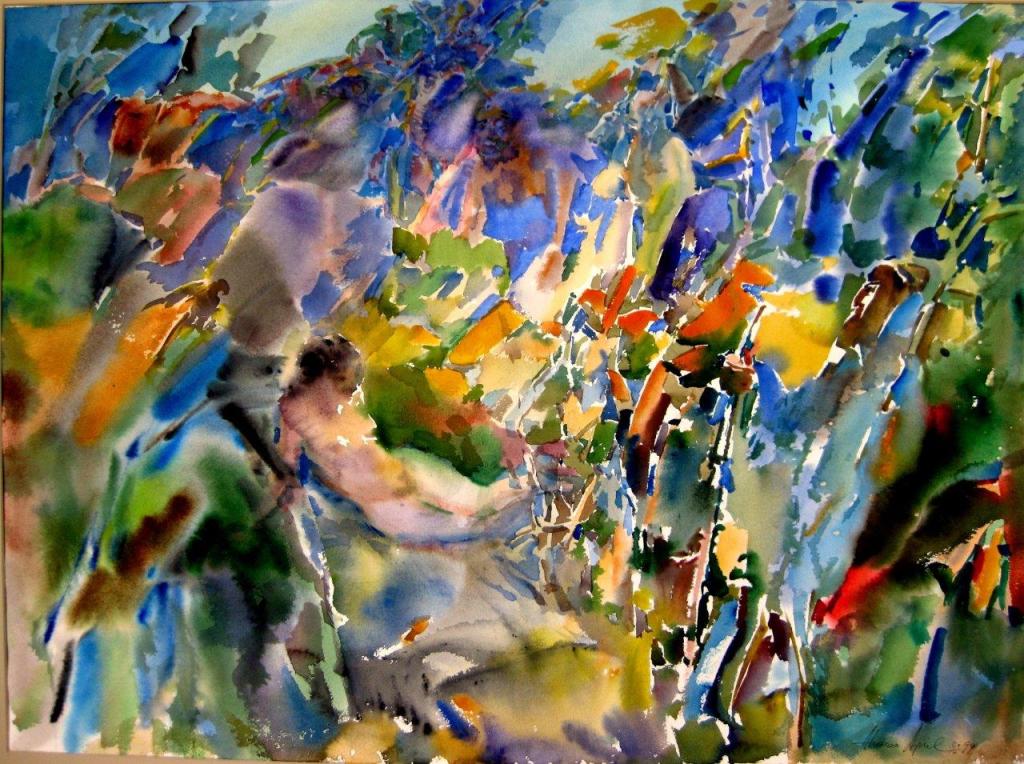
Aharon April, The Song of Songs-Last 2005 Shared under Creative Commons-SA 4.0 https://commons.wikimedia.org/wiki/Category:Song_of_Solomon#/media/File:Aharon_April_Song_of_Songs-Last.jpg

Psalm 62 may seem like a strange place to pause in the midst of the psalms, but there is a logic behind pausing here. The book of Psalms is subdivided into five books, with book two ending at Psalm 72. My pattern has been to do roughly 10 psalms between other books, and this sets me up to complete book two of the psalms following the next book I work through. I planned to work through Song of Solomon, or Song of Songs, prior to beginning Matthew but that project refused to wait. So now, after a long delay, I am finally turning to this strange love song which falls in the heart of the bible.

Song of Solomon has always been a controversial book within the scriptures. When our Jewish ancestors were debating which books would be included in their sacred scriptures opinions were sharply divided on this book. Ultimately its attribution to Solomon and the allegorical interpretation of the book’s poetry allowed Rabbi Akiba (ca. 50-135 CE) to defend it stating, “all the scriptures are holy, but the Song of Songs in the Holy of Holies.” (Paulsell 2012, 172) Within Medieval Christianity it was one of the most frequently read and written about book with over one hundred commentaries appearing by the year 1200. (Davis 2000, 231) Yet in modern times the Song of Solomon has fallen into disuse and many modern interpreters struggle once again to find an appropriate way of integrating this poem into the broader library of scriptures.

On the one hand, Song of Solomon is poetry about two lovers and their passionate desire for the other. Unique among the bible is the prevalence of the feminine voice throughout the poetry and it gives voice to a female perspective on desire in relationships in the bible. Like Esther, God is not mentioned in this book nor are there allusions to any religious traditions. On the other hand, the placement of this love poem within the scriptures assumes that it has something to speak about God, the world, relationships, and the people of God.  Within the organization of Christian scriptures, Song of Solomon is the final book of Wisdom Literature and like Ecclesiastes, which precedes it, it is not a religious or churchy type of wisdom.

Eighteen years ago, I was asked to give my senior sermon before the worshipping community at my seminary on a text from the Song of Solomon. I was struck then by the placement of this very unique book near the geometric center of the bible. I was fascinated by imagining God in the person of the lover leaping like a stag or looking through the lattice. (2:9) My intention as I go through this short book is to hold the sensual literal reading and the church’s historical reading alongside each other. I think there is wisdom in reading this book as simply a passionate poem of love and allowing it to rekindle some of the desire within us. Yet, I also believe that our own experiences of love at its best come from and in some way shape our understanding of God’s love for us as well. I’m curious to see where this unique book takes me over the next couple months.

Psalm 62 Truly Faith Surrounds My Troubles

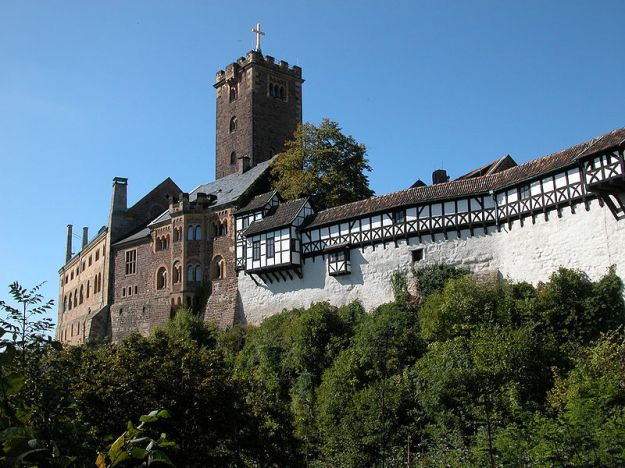
Wartburg Castle, Eisenach, Germany. Photo by Robert Scarth shared under creative commons 2.0

Psalm 62 Truly Faith Surrounds My Troubles

<To the leader: according to Jeduthun. A Psalm of David.>

1 For God alone my soul[1] waits in silence; from him comes my salvation.
2 He alone is my rock and my salvation, my fortress; I shall never be shaken.
3 How long will you assail a person, will you batter[2] your victim, all of you, as you would a leaning wall, a tottering fence?
4 Their only plan is to bring down a person of prominence. They take pleasure in falsehood; they bless with their mouths, but inwardly they curse. Selah
5 For God alone my soul waits in silence, for my hope is from him.
6 He alone is my rock and my salvation, my fortress; I shall not be shaken.
7 On God rests my deliverance and my honor; my mighty rock, my refuge is in God.
8 Trust in him at all times, O people; pour out your heart before him; God is a refuge for us. Selah
9 Those of low estate are but a breath, those of high estate are a delusion; in the balances they go up; they are together lighter than a breath.
10 Put no confidence in extortion, and set no vain hopes on robbery; if riches increase, do not set your heart on them.
11 Once God has spoken; twice have I heard this: that power belongs to God,
12 and steadfast love belongs to you, O Lord. For you repay to all according to their work.

In poetry structure can frequently be used to help those familiar with the medium understand the words at a deeper level. In this psalm there are a number of structural elements that are often missed in the English translations that help provide emphasis in the psalm of trust amidst trouble. The placement of this psalm between Psalm 61 and Psalm 63 (also psalms which declare the psalmist’s trust in God above all other things) also emphasizes this common theme. The “trilogy of trust” within the psalms, as J. Clinton McCann labels Psalm 61-63, (NIB IV:922) stand near the end of the petitions for help in this portion of the book of psalms. Even though the psalmist’s world is full of people who murder reputations with their duplicitous ways, the way of faith knows that God’s steadfast love will outlast the scheming of mortals.

Invisible to most English translations of this psalm is the repetition of the Hebrew ‘ak which begins verses 1,2,4,5,6 and 9. This word, translated ‘alone’ and ‘only’ in the NRSV, is used four times in relation to God and twice in relation to the working of humans. There is a strong emphasis on God ‘alone’ providing strength which thwarts the ‘only’ plans of those who are but a breath. In addition to this structural repetition is the nearly identical wording of verses 1-2 and 5-6. The complaints about the enemies who are assailing the psalmist and attempting to bring them down from prominence are structurally surrounded by God alone, who they wait for in silence. The psalmist may appear like a leaning wall or a tottering fence, but they are surrounded by their rock, salvation, and fortress. The faithful one can remain in silence while the wicked ones utter falsehoods for they know that this struggle takes place within the sheltering space of their God who will not allow them to be shaken. Even trouble is surrounded by faith and the deliverance from the ephemeral evils produced by the wicked rests in the hands of God who rescues not only life but also honor and reputation.

In verse eight the psalm transforms from personal trust to testimony. Now the psalmist takes on the role of the instructor to the people handing on the trust they have learned. What humans can do alone without God (in verse 9 this is the final time the Hebrew ‘ak occurs) is to be a breath or a puff of air. God alone can be salvation, rock, fortress, deliverance, and honor. Placing trust in human scheming, extortion, robbery, and even riches is foolishness. It is in God, not humans and their schemes, where power rests. It is God’s hesed (steadfast love) that is the guarantee of the future for the faithful. The actions of the faithful and the foolish are seen by God and the psalmist trusts that ultimately God’s steadfast love and power will lift up the righteous and bring down those who are working in falsehood to destroy the honor and perhaps even the life of the faithful ones.


[1] Although the Hebrew nephesh is often translated ‘soul,’ the Hebrew understanding of ‘soul’ is closer to ‘life’ than the Greek conception of soul most English speakers assume. The Hebrew idea is inseparable from the life of the individual.

[2] A more literal translation of the Hebrew rasah here would be ‘kill’ or ‘murder’ (NIB IV:923)

Three Metaphors at the Closing of a Book: Part 3 The Drink

As the sweetness and smoke of the story’s savor
Fades from your tongue and your thirst returns
Drink deeply my friend, for there is sure to be a story here
That will quench your thirst for a time, cool and sharp.
Perhaps you want something that burns as it goes down,
Or something to make you forget the troubles of your world
I’ve got just the thing for you, take a taste of this
Drink deeply my friend, it has been aging and waiting for you.
It needs to be shared, and tasted. Enjoy my friend.
And maybe one day the story we share will be the one
You are brewing in the dark corners of your imagination.

Three Metaphors at the Closing of a Book: Part 2 The New Map

With all endings come the possibility of new beginnings
A new tale waits to paint the opening brushstrokes
Of a new map in your mind as you take the difficult first steps
Out your door on a journey into the unknown without knowing the end
New companions to build relationships with that may befriend or betray.
Unknown lands with their peril and promise lie along the path.
Stenographer get out your pens, a new world awaits.

Three Metaphors at a Closing of a Story: Part 1 Diverging Paths

The story ends, as all stories eventually do
A door closes, a world comes to its conclusion
And I stand watching as the words that conjured it
Sink slowly into the deep sea of memories.
Its characters who became my companions on the road.
I have known their names, I have shared their dreams
I supped at their table and walked their winding way
But they now recede with their world as my path diverges
Their story ends and mine continues forward
And I have been changed on this journey through their world
Rarely do I walk out of a story unaltered by its magic
I’ve seen another world and talked with its denizens
Yet, other worlds beckon from the shelves invitingly
There is a beautiful, tearful, strange magic in these words
Which invoke such vivid reactions in my mind
It’s time to close the book, maybe someday I’ll return
To share this journey once again, to rekindle friendships lost
And rediscover the people and place in these pages.

Psalm 61 A Life Dependent on God

Wartburg Castle, Eisenach, Germany. Photo by Robert Scarth shared under creative commons 2.0

Psalm 61

<To the leader: with stringed instruments. Of David.>
1 Hear my cry, O God; listen to my prayer.
2 From the end of the earth I call to you, when my heart is faint. Lead me to the rock that is higher than I;
3 for you are my refuge, a strong tower against the enemy.
4 Let me abide in your tent forever, find refuge under the shelter of your wings. Selah
5 For you, O God, have heard my vows; you have given me the heritage of those who fear your name.
6 Prolong the life of the king; may his years endure to all generations!
7 May he be enthroned forever before God; appoint steadfast love and faithfulness to watch over him!
8 So I will always sing praises to your name, as I pay my vows day after day.

In C. S. Lewis’ classic parable, The Great Divorce, the experience of hell is a grey city where the inhabitants choose to live a life that is increasingly joyless and friendless as they move further and further away from their neighbors. An escape from this grey city is readily available if the people of the place let go of their own security and accept their reliance on God’s grace (which is both a painful and healing process in the dream that forms the book) but most sullenly either remain or return to this increasingly private hell which they choose instead of heaven. One of the paradoxes of our current time is that we live in a time in society where we have resources and comforts unavailable to people at any other time in history and yet as our affluence has increased our depression and anxiety have also increased. Perhaps this poem that the psalmist lifts up from the end of the earth has something to speak to a people who have lived in the anxiety of attempting to make meaning for oneself and finding, in the words of Ecclesiastes, that it is all vanity. That perhaps Augustine’s confession that ‘our heart is restless until it rests in you” may be the gospel we need to lead us back home.

This psalm is the appeal of an individual for God’s help in the midst their trouble. The psalmist cries to God from ‘the end of the earth’ which could be a geographical location, being far away from the temple, but more likely is a perception of the psalmist’s distance from God. In the midst of the trouble, they are experiencing they have found their own resources insufficient. They are in need of a place they can escape from the rising floodwaters. They are faint of heart and fading fast.[1] The appropriate place to turn in their distress is to their God who in a flourish of images of strength is the psalmist’s refuge, strong tower, tent to abide within, and wings to be sheltered under. The crisis of the psalmist has shaken them out of their self-reliance, demonstrated their distance from their God, and caused them to cry out to return to their God’s presence.

The psalm moves from trouble to trust. The God of the psalmist is one who hears their petitions and vows. The heritage, or inheritance, mentioned in verse five is often associated with the land that God has promised. In an agricultural society one’s security is intimately linked to the land and the provision of weather at the appropriate time. Yet, one’s security is also determined by the actions of the leaders of that land. The king, and here it would refer to a Davidic king, would provide the physical security for the land. But theologically the king is merely a means by which God provides for the covenant people and the military security of Israel is ultimately provided not by swords and spears but by God’s protection. Martin Luther captures this idea when expounding on the petition asking God for our daily bread in the Lord’s Prayer noting that it not only includes food and drink but also, “upright and faithful rulers, good government, good weather, peace, health, decency, honor, good friends, faithful neighbors, and the like.” (Luther 1978, 36) The psalmist realizes that the way of self-sufficiency is vanity and that their life is dependent upon God’s gracious provision which comes in many forms.

The psalm promises a grateful response to God’s act of provision. A skeptical reader may view this as an attempt to bribe God to get one’s way, but the psalms have stated in other places that God needs nothing that the psalmist can give.[2] As Walter Brueggemann and William Bellinger can state, “Israel, however, was not aware that the transaction could be reduced to a quid pro quo, an attempt to bribe YHWH.” (Brueggemann 2014, 272) The appropriate response to God’s provision is praise, thanksgiving, promising to serve one’s God with whatever one has to offer. Self-reliance has led to isolation from God and trouble. Repentance has allowed one to return to reliance upon God’s provision and a response of gratitude for God’s gracious protection, provision, and shelter.

[1] As Beth Tanner notes, the root Hebrew word translated faint demonstrates a serious distress and proximity to death. (Nancy deClaisse-Walford 2014, 511)

[2] For example Psalm 50: 8-13.