Monthly Archives: February 2026

2 Kings 23 The Reforms and Death of Josiah

2 Kings 23: 1-3 Attempting to Recreate the Covenant

1Then the king directed that all the elders of Judah and Jerusalem should be gathered to him. 2The king went up to the house of the LORD, and with him went all the people of Judah, all the inhabitants of Jerusalem, the priests, the prophets, and all the people, both small and great; he read in their hearing all the words of the book of the covenant that had been found in the house of the LORD. 3The king stood by the pillar and made a covenant before the LORD, to follow the LORD, keeping his commandments, his decrees, and his statutes, with all his heart and all his soul, to perform the words of this covenant that were written in this book. All the people joined in the covenant.

King Josiah responded to the rediscovered book of the law of Moses with repentance and seeking God’s will through the prophet Hulda. After learning that his understanding of the judgment that hangs over the people is confirmed by God and learning that God has seen and responded to the king’s action of mourning and repentance Josiah initiates his reforms by gathering the leaders and the people of Judah in an action to recommit the people to the covenant. The action echoes the creation of the covenant between God and the people by Moses (Exodus 24: 4-8), the recommittal to the covenant preceding Moses’ death (Deuteronomy 29:2-29)[1] and finally when Joshua renews the covenant in the promised land (Joshua 8:30-35). Throughout the narratives of the book of Judges, 1&2 Samuel, and 1&2 Kings this is the only instance of covenant renewal of this type. Other kings have attempted to renew the worship in the temple or the building of the temple, but only here in the time of kings are the people reconnected to the law in this manner.[2] This will also happen when the temple is rebuilt and the people are regathered in Jerusalem under the governor Nehemiah and the priest Ezra (Nehemiah 8). King Josiah seems to understand that his personal repentance may be enough for his own reign, but the only chance for the people lies in reestablishing the practices that were designed to make the people of Judah into the people of the LORD the God of Israel.

2 Kings 23: 4-14 Reforming the Practices in Judah

  4The king commanded the high priest Hilkiah, the priests of the second order, and the guardians of the threshold to bring out of the temple of the LORD all the vessels made for Baal, for Asherah, and for all the host of heaven; he burned them outside Jerusalem in the fields of the Kidron and carried their ashes to Bethel. 5He deposed the idolatrous priests whom the kings of Judah had ordained to make offerings in the high places at the cities of Judah and around Jerusalem, those also who made offerings to Baal, to the sun, the moon, the constellations, and all the host of the heavens. 6He brought out the image of Asherah from the house of the LORD, outside Jerusalem, to the Wadi Kidron, burned it at the Wadi Kidron, beat it to dust, and threw the dust of it upon the graves of the common people. 7He broke down the houses of the illicit priests who were in the house of the LORD, where the women did weaving for Asherah. 8He brought all the priests out of the towns of Judah and defiled the high places where the priests had made offerings, from Geba to Beer-sheba; he broke down the high places of the gates that were at the entrance of the gate of Joshua the governor of the city, which were on the left at the gate of the city. 9The priests of the high places, however, did not come up to the altar of the LORD in Jerusalem but ate unleavened bread among their kindred. 10He defiled Topheth, which is in the valley of Ben-hinnom, so that no one would make a son or a daughter pass through fire as an offering to Molech. 11He removed the horses that the kings of Judah had dedicated to the sun at the entrance to the house of the LORD, by the chamber of the eunuch Nathan-melech, which was in the precincts; then he burned the chariots of the sun with fire. 12The altars on the roof of the upper chamber of Ahaz that the kings of Judah had made and the altars that Manasseh had made in the two courts of the house of the Lord he pulled down from there and broke in pieces and threw the rubble into the Wadi Kidron. 13The king defiled the high places that were east of Jerusalem, to the south of the Mount of Destruction, which King Solomon of Israel had built for Astarte the abomination of the Sidonians, for Chemosh the abomination of Moab, and for Milcom the abomination of the Ammonites. 14He broke the pillars in pieces, cut down the sacred poles, and covered the sites with human bones.

The list of idolatrous images and practices that Josiah attempts to eradicate is encyclopedic in nature and paints the picture of the pervasive perversity of the people. Baal, Asherah, and the host of heaven have all been attractive alternatives for the leaders and people of Israel throughout their history as well as the worship at the high places by local priests and leaders who may not have been committed exclusively to the LORD. The ‘illicit priests’ (NRSVue) of verse seven is rendered ‘male prostitutes’ in many translations[3] and may indicate a linkage between some of these idolatrous religious practices and sexual practices. The list is similar to the list of abominable practices in the temple in Ezekiel 8 and it is likely that even during Josiah’s life many of these practices endured even if they were done in secret. Some of these idolatrous practices go back to the time of King Solomon (1 Kings 11: 1-13) and King Josiah forms a faithful contrast to Solomon. The actions of removing and destroying these idolatrous imagery and practices in a public and cultic manner is intended to purge these images from the practices of Judah. Josiah attempts to eradicate these practices, both long standing and recent, and attempt to recenter worship in a purged temple with administered by the priests who are faithful to the LORD in Jerusalem.

The reading of the covenant is not enough. Josiah seems to understand that only a complete abandonment of the idolatrous practices of his ancestors and the people may turn away the anger of the LORD. His work of purging the temple, the countryside, and the people is a model of what is expected in the law (Deuteronomy 12: 1-12), but despite the extreme actions to purge these images and practices from Judah the renewal will not survive his death. There is an optimism in the time of Josiah that is reflected in the prophet Jeremiah, but Jeremiah will also see that the reforms do not run deep enough and the people quickly return to the practices that Josiah attempted to eradicate.

2 Kings 23: 15-20 Reforming the Practices in Israel

  15Moreover, the altar at Bethel, the high place erected by Jeroboam son of Nebat, who caused Israel to sin—he pulled down that altar along with the high place. He burned the high place, crushing it to dust; he also burned the sacred pole. 16As Josiah turned, he saw the tombs there on the mount, and he sent and took the bones out of the tombs and burned them on the altar and defiled it, according to the word of the LORD that the man of God proclaimed when Jeroboam stood by the altar at the festival; he turned and looked up at the tomb of the man of God who had proclaimed these things. 17Then he said, “What is that monument that I see?” The people of the city told him, “It is the tomb of the man of God who came from Judah and proclaimed these things that you have done against the altar at Bethel.” 18He said, “Let him rest; let no one move his bones.” So they let his bones alone, with the bones of the prophet who came out of Samaria. 19Moreover, Josiah removed all the shrines of the high places that were in the towns of Samaria that kings of Israel had made, provoking the LORD to anger; he did to them just as he had done at Bethel. 20He slaughtered on the altars all the priests of the high places who were there and burned human bones on them. Then he returned to Jerusalem.

I intentionally separated this section from the previous section because the actions here are occurring in Northern Israel/Samaria. Jeremiah also indicates that during the time of Josiah there was a hope for a reunification of the two halves of Israel that had broken apart after Solomon (1 Kings 12). It is difficult to peer this far back into history since we have few historical witnesses from this point but it is plausible with Assyrian power in decline that Josiah may have had a window where he could assume control over portions of Northern Israel/Samaria and attempt to bring the people who now live there into the worship of the LORD. Bethel is mentioned, but the altar in Dan is not. However, the story takes us back to the strange story of the unnamed prophet who testifies against the altar at Bethel and foretells its destruction under Josiah and then is later buried in the city. (1 Kings 13) The method of defiling the altars that Josiah practices to bring about ritual uncleanness is not specifically outlined in the law, although contact with a dead body did bring about ritual uncleanness. The killing of the idolatrous priests, however, is consistent with the expectations of Deuteronomy 13: 13-19 for a man who has led people to follow other gods.

2 Kings 23: 21-23 Reestablishing the Passover

  21The king commanded all the people, “Keep the Passover to the LORD your God as prescribed in this book of the covenant.” 22No such Passover had been kept since the days of the judges who judged Israel, even during all the days of the kings of Israel and of the kings of Judah, 23but in the eighteenth year of King Josiah this Passover was kept to the Lord in Jerusalem.

Passover is the ritual that reminds the people of Israel of their identity, an identity that goes to the heart of the law. They are descendants of a people enslaved and liberated by the LORD’s powerful actions to deliver them from Egypt. This central festival in the life of the people of God is mentioned here for the first time in the books of 1 & 2 Kings and is not mentioned in Judges or 1 & 2 Samuel either. The last time the scriptures note the people celebrating the Passover prior to Josiah was in Joshua when the people celebrated at Gilgal.[4] There is an attempt to reconnect the people to their story through the renewal of the covenant, the removal of idolatrous alternatives, and the reinstatement of the rituals which help provide meaning. It is possible that Passover celebrations have continued through the story of Israel with or without royal institution, but I do believe that 2 Kings is attempting to show a drastic contrast between the loss of communal identity in the practices that surround the practice of the commandments, statutes, and ordinances of the law. Something central to the life of the people, in the view of 2 Kings, has been lost for many generations and for a brief window under Josiah there is the potential to rediscover the life the people were intended to live in the promised land.

2 Kings 23: 24-30 The Death of Josiah, a Final Word on both Josiah and Judah

  24Moreover, Josiah put away the mediums, wizards, teraphim, idols, and all the abominations that were seen in the land of Judah and in Jerusalem, so that he established the words of the law that were written in the book that the priest Hilkiah had found in the house of the LORD. 25Before him there was no king like him who turned to the LORD with all his heart, with all his soul, and with all his might, according to all the law of Moses, nor did any like him arise after him.
  26
Still the LORD did not turn from the fierceness of his great wrath by which his anger was kindled against Judah because of all the provocations with which Manasseh had provoked him. 27The LORD said, “I will remove Judah also out of my sight, as I have removed Israel, and I will reject this city that I have chosen, Jerusalem, and the house of which I said, ‘My name shall be there.’ ”

  28
Now the rest of the acts of Josiah and all that he did, are they not written in the Book of the Annals of the Kings of Judah? 29In his days Pharaoh Neco king of Egypt went up to the king of Assyria to the River Euphrates. King Josiah went to meet him, but when Pharaoh Neco met him at Megiddo, he killed him. 30His servants carried him dead in a chariot from Megiddo, brought him to Jerusalem, and buried him in his own tomb. The people of the land took Jehoahaz son of Josiah, anointed him, and made him king in place of his father.

Josiah’s actions to restore the nation of Judah to the expectations of the words of the law are shown in the book as an example of what a good king was expected to be. Yet all the works of Josiah are not enough to turn aside the anger of the LORD. They delay the anger and provide a window of perceived prosperity during the lifetime of this king but ultimately it seems that the wickedness of Manasseh have a greater impact on the future of the people than the reforms of Josiah. Josiah may be portrayed alongside Moses, Joshua, David, and Hezekiah as shining examples of leaders seeking God’s ways but ultimately these leaders were unable to undo the corruption among the people.

The prophet Jeremiah, when writing about the time of Josiah, shares the early optimism of what could be with this reformer king but quickly realizes that the reforms did not change the practices of the people. Josiah may be able to capture a hope of a reunification of Israel and a return to their previous relationship with their God but the rituals, the readings of the law, and the removal of the idols do not ultimately change the hearts of the people and the leaders who will follow him. Just as Hezekiah was followed by Manasseh, so Josiah will be followed by leaders who are unable or unwilling to continue his actions.

The Deuteronomic history and 2 Kings is written from the perspective of the exile of Judah and wants to understand how the people of Israel could fall from their pinnacle under David and Solomon to the moment where they are exiles in a foreign land. 2 Kings like the prophets Jeremiah and Ezekiel points to the wickedness of Manasseh but also a wickedness that goes back to Solomon’s betrayal under the influence of his wives. On the one hand, from the perspective of the narrator, the LORD has been incredibly patient with both Israel and Judah waiting for generations for them to live into their identity and willing to postpone God’s wrath for the sake of these moments of repentance. On the other hand, the narration of the unfaithful history of Judah and Israel in the words of 1 & 2 Kings helps to provide meaning and context for a people who have lost their land, their king, and their temple.

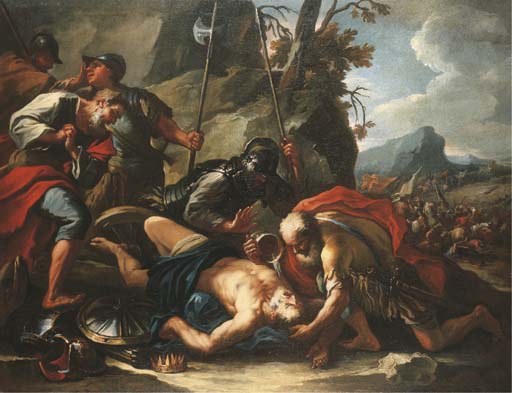
Josiah’s death occurs abruptly in the text and brings an end to this time of possibility. We can only hypothesize why Josiah would go out to meet Pharoah Neco at Megiddo. Assyria is in decline and by 610 BCE is beginning to lose ground to the Babylonians. Pharoah Neco at this time is a relatively new king and leads a force northward to help the Assyrians when Josiah meets him at Megiddo. Could Josiah be forming an alliance with Babylon against Assyria? It is possible. It is also possible that this king who has experienced success in regaining territory in Northern Israel to bring about the possibility of a reunited kingdom may view himself as divinely authorized to protect the land from any invasion even if Pharoah’s armies were only intending to pass through Judah on their way to the conflict in the north. Ultimately the critical reality is that Josiah dies at the hands of Pharoah Neco and this brings about the end of this final promising moment in the history of Davidic kings. Josiah is buried but ultimately does not die in peace as the prophet Huldah had stated and his death brings about the rapid descent of Judah towards its exile under Babylon.

2 Kings 23: 31-37 The Brief Reign of Jehoahaz and the Transition to Jehoiakim

  31Jehoahaz was twenty-three years old when he began to reign; he reigned three months in Jerusalem. His mother’s name was Hamutal daughter of Jeremiah of Libnah. 32He did what was evil in the sight of the LORD, just as his ancestors had done. 33Pharaoh Neco confined him at Riblah in the land of Hamath, so that he might not reign in Jerusalem, and imposed tribute on the land of one hundred talents of silver and a talent of gold. 34Pharaoh Neco made Eliakim son of Josiah king in place of his father Josiah and changed his name to Jehoiakim. But he took Jehoahaz away; he came to Egypt and died there. 35Jehoiakim gave the silver and the gold to Pharaoh, but he taxed the land in order to meet Pharaoh’s demand for money. He exacted the silver and the gold from the people of the land, from all according to their assessment, to give it to Pharaoh Neco.

  36
Jehoiakim was twenty-five years old when he began to reign; he reigned eleven years in Jerusalem. His mother’s name was Zebidah daughter of Pedaiah of Rumah. 37He did what was evil in the sight of the LORD, just as all his ancestors had done.

Jehoahaz, whose birth name seems to be Shallum[5] reigned for only three months before he was removed by Pharoah Neco and replaced by Jehoiakim as a more palatable leader to Egypt who now extends control over Judah and requires a heavy tribute[6] on the people. The death of Josiah has not only brought about an end to the reforms of his reign but has also changed the political situation of the people. We don’t know what Jehoahaz did in his three-month reign, which was evil in the sight of the narrator of 2 Kings, but his unfaithfulness is implied to be linked to the decline of the people as we move into the final two chapters of the narrative.

Jehoiakim, Josiah’s second born son, is chosen to succeed Jehoahaz by Pharoah Neco. This is an area where the chapter break would make sense to come two verses earlier since Jehoiakim’s story follows in the coming chapter. At this point it is worth noting the narrator’s judgment of Jehoiakim as one who did evil in the sight of the LORD and then end this discussion to resume his story in the following chapter.  


[1] The narrative setting of the book of Deuteronomy paints the book as a witness of Moses’ public restatement of the law before the people which the people assent to at the end of the book.

[2] Many biblical scholars from the historical critical and source critical schools would argue that the law as we have it in Genesis-Deuteronomy is a later document. Their arguments are cogent, but ultimately, I do think it is likely that even if Genesis-Deuteronomy will reach their final form in the time of exile there is some pre-existing collection of the commandments which is active here and earlier through the story of Israel and Judah.

[3] The Hebrew qesesim refers to ‘sacred males.’ “It is an open question whether these persons were or were not male “cult prostitutes.” (Cogan, 1988, p. 286)

[4] Joshua 5: 10-12. 2 Chronicles 30 mentions a celebration of Passover under King Hezekiah, but in the Deuteronomic History (Joshua-2 Kings) this is the first mention since the time of Joshua

[5] Jeremiah 22: 11-12. 1 Chronicles 3:15 indicates that he was Josiah’s fourth son.

[6] A talent is around 70 pounds, so a tribute of roughly 7,000 pounds of silver and 70 pounds of gold in the text.

2 Kings 22 King Josiah and the Rediscovery of the Law

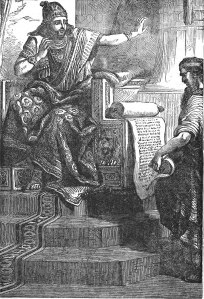
Josiah Hearing the Book of the Law (1873) Unknown author – The story of the Bible from Genesis to Revelation

2 Kings 22

 1Josiah was eight years old when he began to reign; he reigned thirty-one years in Jerusalem. His mother’s name was Jedidah daughter of Adaiah of Bozkath. 2He did what was right in the sight of the LORD and walked in all the way of his father David; he did not turn aside to the right or to the left.

  3
In the eighteenth year of King Josiah, the king sent Shaphan son of Azaliah son of Meshullam, the secretary, to the house of the LORD, saying, 4Go up to the high priest Hilkiah and have him add up the entire sum of the silver that has been brought into the house of the LORD that the keepers of the threshold have collected from the people; 5let it be given into the hand of the workers who have the oversight of the house of the LORD; let them give it to the workers who are at the house of the LORD repairing the house, 6that is, to the carpenters, to the builders, to the masons; and let them use it to buy timber and quarried stone to repair the house. 7But no accounting shall be asked from them for the silver that is delivered into their hand, for they deal honestly.”
  8
The high priest Hilkiah said to Shaphan the secretary, “I have found the book of the law in the house of the LORD.” When Hilkiah gave the book to Shaphan, he read it. 9Then Shaphan the secretary came to the king and reported to the king, “Your servants have melted down the silver that was found in the house and have delivered it into the hand of the workers who have oversight of the house of the LORD.” 10Shaphan the secretary informed the king, “The priest Hilkiah has given me a book.” Shaphan then read it aloud to the king.
  11
When the king heard the words of the book of the law, he tore his clothes. 12Then the king commanded the priest Hilkiah, Ahikam son of Shaphan, Achbor son of Micaiah, Shaphan the secretary, and the king’s servant Asaiah, saying, 13Go, inquire of the LORD for me, for the people, and for all Judah, concerning the words of this book that has been found, for great is the wrath of the LORD that is kindled against us, because our ancestors did not obey the words of this book to do according to all that is written concerning us.”
  14
So the priest Hilkiah, Ahikam, Achbor, Shaphan, and Asaiah went to the prophet Huldah the wife of Shallum son of Tikvah son of Harhas, keeper of the wardrobe; she resided in Jerusalem in the Second Quarter, where they consulted her. 15She declared to them, “Thus says the LORD, the God of Israel: Tell the man who sent you to me: 16Thus says the LORD: I will indeed bring disaster on this place and on its inhabitants—all the words of the book that the king of Judah has read. 17Because they have abandoned me and have made offerings to other gods, so that they have provoked me to anger with all the work of their hands, therefore my wrath will be kindled against this place, and it will not be quenched.’ 18But as to the king of Judah who sent you to inquire of the LORD, thus shall you say to him: ‘Thus says the LORD, the God of Israel: Regarding the words that you have heard, 19because your heart was penitent and you humbled yourself before the LORD, when you heard how I spoke against this place and against its inhabitants, that they should become a desolation and a curse, and because you have torn your clothes and wept before me, I also have heard you, says the LORD. 20Therefore, I will gather you to your ancestors, and you shall be gathered to your grave in peace; your eyes shall not see all the disaster that I will bring on this place.’ ” They took the message back to the king.

The thirty-one years of King Josiah’s reign in Jerusalem are a final window of hope for Judah. Even though as readers of 2 Kings we know that shortly after Josiah’s death we will reach the end of the story of the kings of the line of David and enter into the time of exile in Babylon, for the author of 2 Kings this is a moment of hope for a rediscovery of faithfulness, restoration of the temple, recommittal to the covenant, and even a hope for the reunification of Israel and Judah. The parallel telling of the story of the reign of King Josiah in 2 Chronicles 34-35 has the reformation of Josiah beginning in his twelfth year, but for 2 Kings the critical event is the discovery of the law in the eighteenth year[1] which initiates a period of repentance for the king and a recommittal to the covenant.

The characterization of King Josiah as one who ‘did not turn aside to the right or the left’ echoes the language of Deuteronomy calling for covenant obedience.[2] His obedience to the covenant links him to Moses, and then the text continues to link him to his ancestor David. Then the text takes us to the repair of the temple in language which parallels the actions of King Jehoash in 2 Kings 12: 1-16. In inquiring of the LORD through the prophet he, like his great-grandfather Hezekiah who sought God’s word through the prophet Isaiah. By his actions Josiah is shown embodying the actions of the good kings and leaders that have come before him. Although the prophet Jeremiah is not mentioned in this narrative, we also know that Jeremiah’s ministry begins in the thirteenth year of Josiah’s reign.[3]

The king sends Shaphan, the scribe or secretary, to the high priest Hilkiah[4] to instigate the utilization of the funds brought into the temple for the temple’s repair. As mentioned above, the narrative is similar to the rebuilding under Jehoash, but at this moment there is a critical discovery that is shared by Hilkiah with Shaphan and eventually with the king, the rediscovered book of the law. Shaphan reads this book to the king who responds by rending his garments in an act of mourning and repentance. Walter Brueggemann draws an insightful contrast between this action by Josiah and an opposite reaction by his son Jehoiakim:

Josiah, the good king, hears the scroll and tears his garment in a dramatic act of repentance (22:11). In Jeremiah 36:23, Jehoiakim, Josiah’s son who is a bad king, hears the scroll of Jeremiah and “cuts” the scroll and not his garments; that is, he does not repent but seeks to dispose of the troublesome scroll. (Brueggemann, 2000, p. 545)

Yet Josiah as a king who upon hearing the words of the law humbles himself and seeks God’s guidance is the model of what a good king is supposed to be.

The book of the law mentioned in this portion of 2 Kings has traditionally been thought of as Deuteronomy in some form. Deuteronomy is the only book among the torah[5] that specifically expects worship being concentrated in the city that God places God’s name upon. Deuteronomy also has lengthy sections of ‘curses’ that result from covenant disobedience. (Cogan, 1988, p. 294) We will never know whether the ‘law’ is Deuteronomy, the torah as a whole, or some proto-Deuteronomic document[6] but what 2 Kings wants us to understand is that Josiah received these words as the covenantal expectations of God and responded to them with the appropriate repentance and rigor.

The high priest Hilkiah, the scribe Shaphan, as well as Ahikam and Achbor are sent to the prophetess Hulda to seek God’s will. Ahikam, the son of Shaphan may be the son of the secretary and another advisor to the king, although some scholars are confused by Ahikam’s position in the list ahead of his father if they are related.[7] Ahikam son of Shaphan will be instrumental in preserving the prophet Jeremiah’s life during the reign of Jehoiakim.[8] In contrast Achbor’s son Elnathan will be charged with capturing the prophet Uriah and returning him to King Josiah for execution.[9] Like Josiah and Jehoiakim fathers and sons can take very different paths.

Hulda is the only woman prophet mentioned in either Israel or Judah, and yet she is trusted by the king and his men to speak the words of the LORD. Her message is ominous and hopeful. It is ominous because the king has heard the threats for covenant disobedience in the law correctly and the actions, particularly of Manasseh, have kindled an unquenchable wrath in God against the people. It is also hopeful because the actions of the king have been seen and appreciated by God. The king’s heart was penitent (literally soft in Hebrew) and tore his clothes and wept. God has postponed the disaster and held back the wrath during the reign of Josiah.

The humility and repentance of the king open the possibility for the repentance of the people. God’s judgment has been postponed, and there remains a hope that continued obedience can avert the disaster on the horizon. Jeremiah will continue to testify to the people after Josiah’s death to try to prevent the destruction that comes with this judgment enacted through the Babylonians. Yet Jeremiah will also see that the reforms enacted by Josiah will not change the heart of the people. Just as the people, in the narrative of 2 Kings, were quick to embrace the corruption of Manasseh the reforms of Josiah will unfortunately not survive his death. Yet 2 Kings wants to continue to celebrate this final good king who like Moses, David, Jehoash, and Hezekiah attempted to follow God’s will and to turn neither to the left or right.  


[1] King Josiah would be roughly twenty-six at the time of the discovery of the law in the text.

[2] Deuteronomy 5:32; 17:20; 28:14.

[3] Josiah would have been 21-22 at the call of Jeremiah, five years before the rediscovery of the book of the law. Jeremiah is portrayed as a young, ‘only a boy’ in the narrative of his call. Jeremiah 1:6.

[4] Hilkiah is also the name of the prophet Jeremiah, but Jeremiah’s father is a priest at Anathoth, and it is likely that he is the son of a different Hilkiah than the high priest in this story.

[5] Genesis, Exodus, Leviticus, Numbers, and Deuteronomy.

[6] Scholars of the source critical school popular in the middle 20th century were focused on trying to find the source material behind the text. They had some good insights but ultimately, they tended to divide up the text into sections rather than engage the text as it has been received.

[7] Age does normally grant a person higher respect and status in ancient cultures, but Ahikam may also be a contemporary and valued advisor to this king who began his reign as a young boy.

[8] Jeremiah 26: 24.

[9] Jeremiah 26:22.

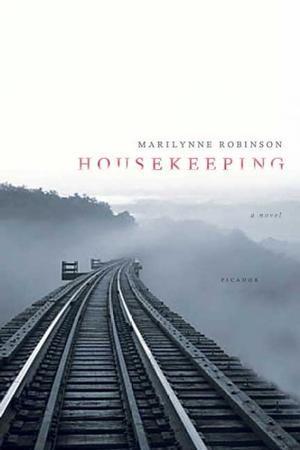
Review of Housekeeping by Marilynne Robinson (1981)

Time Magazine Top 100 Novels

Book 44: Housekeeping by Marilynne Robinson (1981)

This is a series of reflections reading through Time Magazine’s top 100 novels as selected by Lev Grossman and Richard Lacayo published since 1923 (when Time magazine was founded). For me this is an attempt to broaden my exposure to authors I may not encounter otherwise, especially as a person who was not a liberal arts major in college. Time’s list is alphabetical, so I decided to read through in a random order, and I plan to write a short reflection on each novel.

Marilynne Robinson use of the English language is artful and poetic. I read Gilead several years ago and when I began Housekeeping, I was immediately struck by the beautiful way in which she can write. The novel is told from the perspective of Ruth Stone, normally called Ruthie throughout the book, who is left at a young age with her grandmother, Sylvia Foster, along with her sister Lucille. Ruthie’s mother after leaving her daughters at their grandmother’s house drives into the lake and dies and for several years Sylvia cares for the two girls until her death. When Slyvia dies suddenly, she arranges for her sisters-in-law, Lily and Nona Foster, to come care for the girls but these older women are uneasy with the girls and eventually locate Sylvie Fisher, the girls’ aunt and their mother’s sister, to come to the home in Fingerbone, Idaho where their grandmother was raising them. Sylvie attempts to raise these two girls, but she is ill equipped for this responsibility, and the household slowly devolves into dysfunction from the perspective of the surrounding community.

Although the book never names it there is some type of mental illness that seems to pervade the family and impacts the generations of women who compose this dysfunctional home. From the suicide of Ruthie’s mother to the transient lifestyle of Sylvie and her lack of awareness of the needs of Ruthie and Lucille. In the end Ruthie also begins to exhibit the characteristics that Sylvie possesses. Hearing the innocent perspective of Ruthie, it is apparent that she and her sister live with an absence of attention and provision that children need. Yet Ruthie is also desperate to keep Sylvie close to her since she is the only adult, in age if not maturity, who shows her any attention.  

As mentioned above the use of the English language in this book is beautiful but it also seems at odds with the character who narrates the story. There is a chasm between the dysfunction and mental illness of the characters and their elevated language. As a father I struggled with the neglect and isolation of Ruthie and Lucille, but I also struggled with Ruthie as a believable narrator who speaks like a highly educated literary author but struggles to attend school and reflects on the experience of being a young girl and teenager. There were also times when the language prevented the story from moving, the narration became so struck with their thoughts that they lost track of their place in their story and their world. There was a disorientation to this book that reminded me of Caitlin Kiernan’s The Drowning Girl. Not as severe but reading Housekeeping gave the feeling of looking through the world through eyes and perceptions shrouded in some type of mental distortion.

2 Kings 21 The Wicked Reigns of Manasseh and Amon of Judah

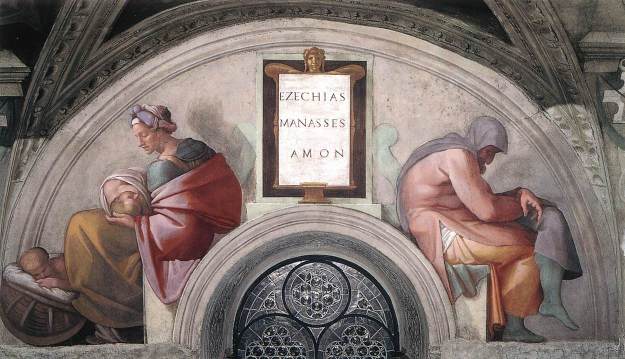
Hezekiah, Manasseh, and Amon, from the Sistine Chapel ceiling.

2 Kings 21: 1-18 The Wicked Reign of King Manasseh of Judah

  1Manasseh was twelve years old when he began to reign; he reigned fifty-five years in Jerusalem. His mother’s name was Hephzibah. 2He did what was evil in the sight of the LORD, following the abominable practices of the nations that the LORD drove out before the people of Israel. 3For he rebuilt the high places that his father Hezekiah had destroyed; he erected altars for Baal, made a sacred pole, as King Ahab of Israel had done, worshiped all the host of heaven and served them. 4He built altars in the house of the LORD, of which the LORD had said, “In Jerusalem I will put my name.” 5He built altars for all the host of heaven in the two courts of the house of the LORD. 6He made his son pass through fire; he practiced soothsaying and augury and dealt with mediums and with wizards. He did much evil in the sight of the LORD, provoking him to anger. 7The carved image of Asherah that he had made he set in the house of which the LORD said to David and to his son Solomon, “In this house and in Jerusalem, which I have chosen out of all the tribes of Israel, I will put my name forever; 8I will not cause the feet of Israel to wander any more out of the land that I gave to their ancestors, if only they will be careful to do according to all that I have commanded them and according to all the law that my servant Moses commanded them.” 9But they did not listen; Manasseh misled them to do more evil than the nations had done that the LORD destroyed before the people of Israel.
  10
The LORD said by his servants the prophets, 11Because King Manasseh of Judah has committed these abominations, has done things more wicked than all that the Amorites who were before him did, and has caused Judah also to sin with his idols, 12therefore thus says the LORD, the God of Israel: I am bringing upon Jerusalem and Judah such evil that the ears of everyone who hears of it will tingle. 13I will stretch over Jerusalem the measuring line for Samaria and the plummet for the house of Ahab; I will wipe Jerusalem as one wipes a dish, wiping it and turning it upside down. 14I will cast off the remnant of my heritage and give them into the hand of their enemies; they shall become a prey and a spoil to all their enemies 15because they have done what is evil in my sight and have provoked me to anger, since the day their ancestors came out of Egypt even to this day.”
  16
Moreover, Manasseh shed very much innocent blood, until he had filled Jerusalem from one end to another, besides the sin that he caused Judah to sin so that they did what was evil in the sight of the LORD.
  17
Now the rest of the acts of Manasseh, all that he did and the sin that he committed, are they not written in the Book of the Annals of the Kings of Judah? 18Manasseh slept with his ancestors and was buried in the garden of his house, in the garden of Uzza. His son Amon succeeded him.

Manasseh in 2 Kings is the paradigm of the wicked king. Not only is he articulated as the ultimate cause of the exile of the Judeans under Babylon in 2 Kings and Jeremiah[1]but he is placed in parallel with Ahab who was the king who opposed the prophet Elijah and led Israel astray. At the same time Manasseh has an exceptionally long reign, the longest of any of the Davidic kings. For the narrator of 2 Kings any events during this fifty-five-year reign are secondary to the practices of idolatry and violence that Manasseh led Judah to practice.

From Assyrian records we know that Manasseh was a vassal king and provided soldiers for Assyria’s campaign against Egypt. (Cogan, 1988, p. 265) Rabbinical sources highlight that Manasseh’s young age means he was born after Hezekiah’s illness and they speculate that Hezekiah did not have children before then. Yet Hezekiah would be age forty-two at that point and it is unlikely that Manasseh was his first born. It is more likely that Manasseh was selected at a young age to be amenable either to the Assyrian king or forces within Jerusalem. A twelve-year-old king would need support as his long reign begins.

When I read 2 King’s narration of the change between Hezekiah and Manasseh it makes me suspicious that something is rotten in Jerusalem for things to change so rapidly. Some commentaries connect the actions of Manasseh with the expectations of being a vassal of Assyria, but the actions that are listed are the practices of the surrounding Canaanites which have plagued Israel throughout its history. It is possible that Manasseh integrated some of the worship of Assyrian gods and certainly adopted Assyrian practices and morality, but Assyria is never mentioned in the text. Manasseh intensifies the practices of previous kings who did what was evil in the eyes of the LORD and even exceeded of the nations that were dispossessed from the land by God when they entered the promised land. (Deuteronomy 9:5) The entirety of the accusation against Manasseh combines the continual witness of prophets throughout the narrative of 2 Kings with the Deuteronomic prohibitions, particularly Deuteronomy 18: 9-14.

The result of this long period of practices abhorrent to the LORD brings a judgment against Judah. The language of making the ears tingle echoes the judgment on the house of Eli.[2]  To this is added the language of the plummet and measuring line[3] where now Judah becomes like Ahab, reaching the end of their dynasty. Finally, Jerusalem is wiped like a dish. The term rendered “wipe” in English is the verb for “blot out” or “exterminate” which carries far more force. (Brueggemann, 2000, p. 533) Although the language is rough, God is heartbroken by the actions of the people under Manasseh, heartbroken to the point where the relationship cannot continue without a break. God’s patience has finally come to a breaking point.

The main force of the judgment of 2 Kings against Manasseh is focused on the idolatry the king leads the nation into, but before closing it highlights the second accusation: the spilling of innocent blood. Innocent blood is an important theme in the law from Abel’s innocent blood calling out from the earth (Genesis 4:10) to Deuteronomy’s instructions on how to deal with an unsolvable murder (Deuteronomy 21:1-9). Innocent blood is frequently paired with the persecution of the vulnerable in the prophets.[4] The kings were supposed to prevent the shed of innocent blood, but as Micah can accuse:

9Hear this, you rulers of the house of Jacob
  and chiefs of the house of Israel,
 who abhor justice
  and pervert all equity,
10 who build Zion with blood
  and Jerusalem with wrong!
11 Its rulers give judgment for a bribe;
  its priests teach for a price;
  its prophets give oracles for money;
 yet they lean upon the Lord and say,
  “Surely the Lord is with us!
  No harm shall come upon us.” Micah 3:9-11

The innocent blood likely included the vulnerable and political opponents but also those who opposed Manasseh’s religious policies. Talmud states that the prophet Isaiah was killed under Manasseh’s instructions.

In 2 Kings Manasseh is wicked until the end and he is the only king whose sin is mentioned in the final summary of his reign. It is worth noting that in the parallel narrative in 2 Chronicles 33 Manasseh repents at the end of his life. Ultimately for the narrator of 2 Kings if there is any repentance it is too little and too late. In Rabbinic tradition Manasseh is one of three kings excluded from the afterlife, along with Jeroboam and Ahab. (Israel, 2019, p. 322)

2 Kings 21: 19-26 The Brief Reign of King Amon of Judah


  19Amon was twenty-two years old when he began to reign; he reigned two years in Jerusalem. His mother’s name was Meshullemeth daughter of Haruz of Jotbah. 20He did what was evil in the sight of the LORD, as his father Manasseh had done. 21He walked in all the way in which his father walked, served the idols that his father served, and worshiped them; 22he abandoned the LORD, the God of his ancestors, and did not walk in the way of the LORD. 23The servants of Amon conspired against him and killed the king in his house. 24But the people of the land killed all those who had conspired against King Amon, and the people of the land made his son Josiah king in place of him. 25Now the rest of the acts of Amon that he did, are they not written in the Book of the Annals of the Kings of Judah? 26He was buried in his tomb in the garden of Uzza; then his son Josiah succeeded him.

After the long and disastrous, in the eyes of 2 Kings, reign of Manasseh is the short but still wicked reign of his son Amon. The description of his two-year reign is consumed with relating the conspiracy which leads to the end of his life and his reign. The significant oscillation between the faithfulness of Hezekiah’s reign and the odious nature of Manasseh’s reign likely means that there are groups and beliefs competing for the loyalty of the people and in our story two groups, the servants of the king and the people of the land are mentioned. As Walter Brueggemann describes it, “Amon is yet one more victim of a deep and abiding dispute over the shape and character of Israel.” (Brueggemann, 2000, p. 540)The assassination of Amon and the anointing of the boy king Josiah allows the pendulum to swing once more to loyalty to the LORD the God of Israel and the covenant and a stay of the execution of God’s judgment.


[1] Jeremiah 15: 1-4; 2 Kings 23: 26-27; 24: 3-4.

[2] 1 Samuel 3:11, see also Jeremiah 19:3.

[3] Isaiah 34:11; Lamentations 2:8.

[4] See Jeremiah 7:6; 22:3; Ezekiel 22: 6-8, 25-27.