Tag Archives: Pilgrimage

Psalm 123 Appealing to the God whose Mercy Overcomes Contempt

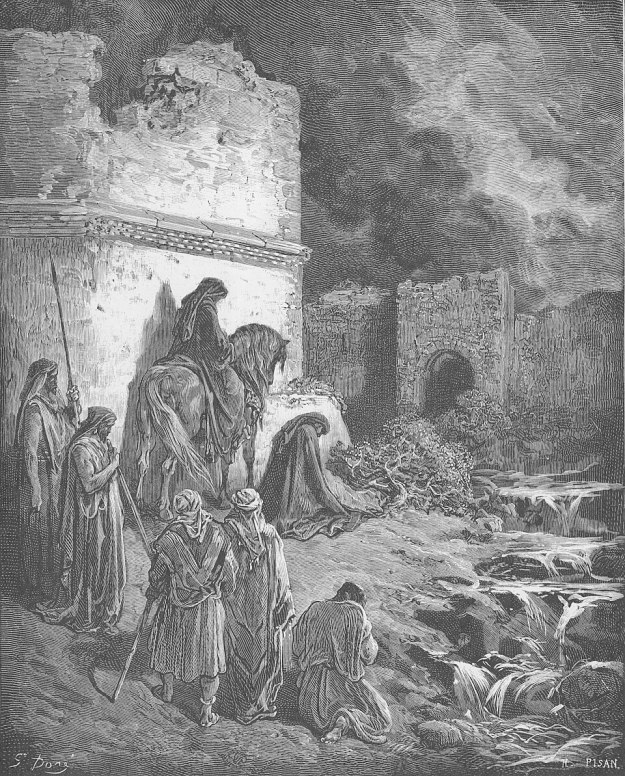
Nehemiah Views the Ruins of Jerusalem’s Walls (Neh. 2:1-20) Gustave Dore, Dore’s English Bible (1866)

Psalm 123

A Song of Ascents 

1To you I lift up my eyes,
  O you who are enthroned in the heavens!
2
As the eyes of servants
  look to the hand of their master,
 as the eyes of a maid
  to the hand of her mistress,
 so our eyes look to the LORD our God,
  until he has mercy upon us.

3
Have mercy upon us, O LORD, have mercy upon us,
  for we have had more than enough of contempt.
4
Our soul has had more than its fill
  of the scorn of those who are at ease,
  of the contempt of the proud.

Bolded words have notes on translation below.

If you read the psalms of ascent as a sequence, which scholars assume was a common practice during a pilgrimage to Jerusalem, there is a narrative that may underly the pattern. The psalmist begins in a place far from the city of peace surrounded by those who desire war (Psalm 120). The psalmist then departs on a journey lifting up their eyes to the hills (Mount Zion-Psalm 121). In the third song of ascent the psalmist arrives at their destination of Jerusalem (Psalm 122). Now in Jerusalem the pilgrim is joined by other pilgrims coming to the city of peace and they turn their eyes to God and lift up their complaint about the world they come from. They have left behind others in a land of people who seek conflict and speak with lying lips (Psalm 120) and now in the city of God they appeal for not only Jerusalem but the world the LORD stands in authority over.

The psalm begins with a solitary speaker lifting up their eyes to the LORD who sits on the seat of authority in heaven. The psalmist may imagine God presiding over the gods of the nations as in Psalm 82 as they address the LORD in this manner, and this may set the stage for the complaint that the people raise about the contempt and scorn they have received in the nations. The eyes of an individual pilgrim are joined by other servants and maids of the LORD their God look to their master for mercy. The Hebrew conception of the relationship between a servant or maid and their master or mistress envisions the master/mistress bearing responsibility for their subordinates. The subordinates are dependent upon their master for their provision and protection, but the expectations of the master in the psalm are conditioned by the merciful LORD their God who is master over the heavens and the earth. The identity of the LORD God as expressed by God in Exodus 34 is:

 “The LORD, the LORD,
a God merciful and gracious,
slow to anger,
and abounding in steadfast love and faithfulness,
7 keeping steadfast love for the thousandth generation,
forgiving iniquity and transgression and sin,
yet by no means clearing the guilty,
but visiting the iniquity of the parents upon the children
and the children’s children,
to the third and the fourth generation.” Exodus 34: 5-7.

And the blessing of the Aaronic priests in Numbers 6:22-27 echoes the ideas of God turning God’s face in graciousness towards those who lift up their eyes to the LORD:

 22The Lord spoke to Moses, saying, 23Speak to Aaron and his sons, saying: Thus you shall bless the Israelites: You shall say to them:
24
The Lord bless you and keep you;
25
the Lord make his face to shine upon you and be gracious to you;
26
the Lord lift up his countenance upon you and give you peace.
  27
So they shall put my name on the Israelites, and I will bless them.”

The pilgrim has joined other pilgrims within the city seeking mercy from the LORD their God and they lift up their eyes and their appeal. As Walter Brueggemann notes, “Our psalmist…dares to look to heaven, not because he is worthy but because he knows that the master to whom he looks is merciful.” (Bellinger, 2014, p. 533)

The character of the people of God is expected to match the God who they serve and this informs the view of what the kings, princes, and nobles of Israel were to be. The character of God is one of the reasons that subordinates can look to those in authority over them with the expectation of receiving mercy. This psalm made me reflect on leaders I have encountered in numerous settings who I was proud to serve under. They were leaders who were invested in those who they led and were dependable. Many of them saw the way they led as connected to their faith and it was reflected not only in their actions but in the response of their subordinates to their authority.

Psalm 123 is unusual because it ends in complaint rather than thanksgiving, but it may rely on the following psalm to complete the normal pattern. The pilgrim looks at the world of people of lying lips and who seek conflict and they dare to seek in their God, “the grace that overcomes the world.” (Mays, 1994, p. 396) Before they begin their complaint they have invoked God’s mercy three times. They need God’s mercy to overcome the contempt and scorn which have overwhelmed them. Nancy deClaissé-Walford notes on the translation of verse three and four:

The word translated overwhelmed (NRSVue have had more than enough/ its fill) is from the root ‘saba’, which means, literally, “eat one’s full, be sated, have enough.” And interestingly the word translated mockery (NRSVue scorn) is from the root la’ag, which beans literally, “speak with a stammering tongue.” (Nancy deClaisse-Walford, 2014, p. 904)

Their experience of conflict and lies in their communities have overwhelmed them. They have had more of mockery and scorn than they can take and the leaders in the communities they have come from leave them crying out for God’s mercy which can overcome the mockery and scorn which overwhelms them.

J. Clinton McCann, Jr. connects the language of this complaint to the post-exilic experience of the time of Nehemiah.

As several scholars observe, the situation certainly sounds like that of the post-exilic era (see, e.g., Neh 2:19, 4:4, where “ridiculed” and “despised” represent the same Hebrew root as “contempt” in Ps 123: 3-4, “scorn” in 123:4 also occurs in Neh 2:19; 4:1 as “mocked.” (NIB IV: 1187)

The post-exilic experience of returning to the remains of the once proud city of Jerusalem and being taunted by their neighbors is a reasonable backstory for the psalm, but the experience of being overwhelmed by contempt or scorn is a common experience. If the experience is tied to the experience of Psalm 120 that also is a common experience of people longing for peace and justice in an unjust world that seeks conflict. That is one of the reasons that the psalms continue to resonate thousands of years after their composition. They may have originally spoken to a specific crisis in the pilgrim’s life but now they speak to the community of the faithful raising their eyes to God and appealing for God’s mercy which can overcome the experiences and injustices which threaten to overwhelm them.

Psalm 122 Prayers of Peace for Jerusalem

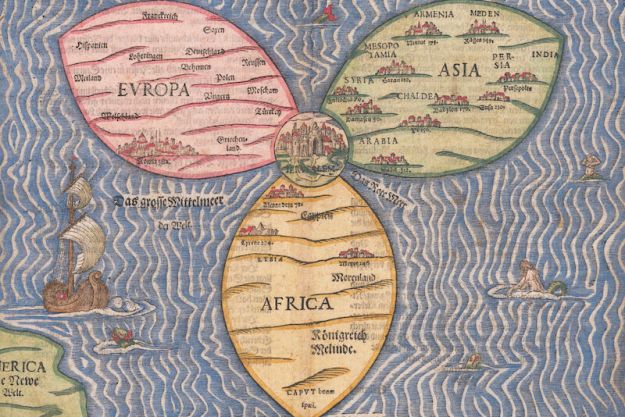
The Bünting Clover Leaf Map, by Heinrich Bünting, was published in 1581 and depicts Jerusalem as the center of the world.

Psalm 122

A Song of Ascents

1I was glad when they said to me,
  “Let us go to the house of the LORD!”
2
Our feet are standing
  within your gates, O Jerusalem.

3
Jerusalem—built as a city
  that is bound firmly together.
4
To it the tribes go up,
  the tribes of the LORD,
 as was decreed for Israel,
  to give thanks to the name of the LORD.
5
For there the thrones for judgment were set up,
  the thrones of the house of David.

6
Pray for the peace of Jerusalem:
  “May they prosper who love you.
7
Peace be within your walls
  and security within your towers.”
8
For the sake of my relatives and friends
  I will say, “Peace be within you.”
9
For the sake of the house of the LORD our God,
  I will seek your good
.

Bolded words have notes on translation below.

If we look at the first three songs of ascent in order (Psalm 120-122) there is a suggestive narrative. The psalmist begins in a place far from the city of peace surrounded by those who desire war (Psalm 120). The psalmist then departs on a journey lifting up their eyes to the hills (Mount Zion-Psalm 121). In this third song of ascent the psalmist arrives at their destination of Jerusalem. (NIB IV:1183) This song of thanksgiving upon arriving in the city of Jerusalem, the spiritual center of their world captures the joy of a pilgrim upon reaching their long-awaited destination.

Both Isaiah 2: 2-3 and Micah 4:1-4 envision Jerusalem as being the spiritual center of the world for Jews and Gentiles, where the nations see the people living in harmony with God’s will for the world and they come to the mountain of God seeking instruction. Jerusalem becomes the pivot for a complete reordering of power in the prophetic imagination as swords become plowshares and spears become pruning hooks. The city of shalom (Jerusalem) becomes a light on the hill that the nations are drawn to learn God’s ways of peace.

The psalm is structured around the two houses that reside in Jerusalem: the house of the LORD and the house of David. The house of David occupies the central verse of the poem structurally, and the royal house occupies an important role in providing judgment for people coming to the city. As James L. Mays can highlight:

Pilgrimage season was likely a time when conflicts and disputes unsettled in the country courts were brought to the royal officials and their successors in the postexilic period. The peace of the community depended on the establishment of justice. Pilgrimage is a journey in search of justice. (Mays, 1994, p. 393)

The house of David has a crucial role in making Jerusalem a place of shalom, but the psalm also places the house of the LORD as the bookends structurally of the psalm. The place of the house of the LORD at the beginning and end encompasses the authority of the house of David. (NIB IV: 1184) 2 Samuel 7 makes a similar point when the LORD informs David that he will build a house (lineage) for David rather than David building a house for the LORD.

The psalm begins with a joyous embrace of the traditional call to go up to the house of the LORD. There is some debate about whether the perspective of the psalmist is currently in Jerusalem (are) or whether it should be translated in past tense as the psalmist remembers Jerusalem in anticipation of a journey, but I have stayed with the NRSVue’s translation of Our feet are standing. From the perspective of the pilgrim, Jerusalem is a city bound firmly together. There is some Hebrew word play in the word for bound (Hebrew habar) which is never elsewhere used for construction and always refers to human alliances or covenants. (NIB IV:1184) The psalm imagines a time where the unified tribes of Israel gather in Jerusalem as a place of festival, worship, and ultimately peace making.

The language in verse six to seven centers around shalom (peace) and Jerusalem (yeru-shalom) and the structure in Hebrew makes this even clearer by the phonetic repetition of ‘sh’ and ‘l’ sounds. As Nancy deClaissé-Walford states:

Of the ten Hebrew words that make up vv. 6 and 7, six contain the letters sin and lamed: ask (sha’alu); well-being (twice) (shalom); Jerusalem (yerushalaim); may they be at ease (yishelayu); and tranquility (shalwa)—acoustically and visually emphasizing the theme of well-being. (Nancy deClaisse-Walford, 2014, p. 901)

Jerusalem is the city of shalom, the longed-for peace absent in Psalm 120. Peace is for the city of peace, for the walls that defend the city from hostility, and for the families who are present in the city or back home. Psalm 133 will later echo this hope for peace among relatives.

Walter Brueggemann and William H. Bellinger make an important point for this prophetic imagination of the people in the context of the exile. When there is no longer a city of shalom to seek where the houses of the LORD and David reside, how are the people to function? Brueggemann points to the prophet Jeremiah (Jeremiah 29: 4-10) when he states:

”seek the welfare of the city where I have sent you in exile, and pray to the LORD on its behalf, for in its welfare you will find your welfare.” The word “welfare” of course renders the Hebrew shalom; the prophet is exhorting the deportees to pray for the shalom of the city of Babylon. (Bellinger, 2014, p. 530)

In the absence of the city, the temple, and the Davidic king it was still possible to seek peace, but it involved seeking the shalom of the place where you find yourself transplanted. Even if Jerusalem is de-centered from the world, peace can still be found in the cities where the pilgrims sojourn.

Psalm 121 Vaya Con Dios

View from Badwater Basin in Death Valley shared by photographersnature under CC 3.0 https://en.wikipedia.org/wiki/Death_Valley#/media/File:Badwater_Desolation.jpg

Psalm 121

1I lift up my eyes to the hills—
  from where will my help come?
2
My help comes from the LORD,
  who made heaven and earth.

3
He will not let your foot be moved;
  he who keeps you will not slumber.
4
He who keeps Israel
  will neither slumber nor sleep.

5
The LORD is your keeper;
  the LORD is your shade at your right hand.
6
The sun shall not strike you by day
  nor the moon by night.

7
The LORD will keep you from all evil;
  he will keep your life.
8
The LORD will keep
  your going out and your coming in
  from this time on and forevermore.

Notes on the bolded words below.

One of my favorite farewells is the Spanish ‘vaya con dios’ which means ‘go with God.’ The English Godspeed is similar, which comes from the middle English ‘God spede you’ which means ‘may God prosper you.’ This short but well-loved psalm may have originated as a song for pilgrims making the journey to mount Zion to worship. The departing pilgrim receives a blessing from the one wishing God’s guarding presence upon the pilgrim. It may have originated as a ‘farewell liturgy’ as James Limburg identified this psalm, (NIB IV: 1180) but for many faithful people this has become a psalm of trust which encompasses the entire life of the faithful one guarded by the God who is both personally available and cosmically powerful.

The first two verses of the psalm are spoken by the pilgrim and is spoken in first person. The individual looks to the surrounding landscape to the hills, and likely to the destination of Zion, but their help for through the dangers of the coming journey do not come from the hills but from the LORD. The LORD is both ‘my help,’ one who is personally concerned for the fate of this pilgrim departing on the journey but also ‘the LORD who made heaven and earth.’ In a common duality seen in scripture God is both powerful and attentive, over all things and concerned about the life of the faithful one who places their life in God’s hand.

In verse three the voice now shifts to the one remaining behind as the pronouns are now second person. Within the final eight verses the word rendered ‘keep’ or ‘keeper’ in the NRSVue is the Hebrew samar. The Hebrew samar is a more active concept than ‘keep’ and has the active sense of guarding and watching over. (Nancy deClaisse-Walford, 2014, pp. 895-897) Within the movement of the psalm the God who guards will not slumber during his time of protecting and watching over the pilgrim. The LORD guards Israel and the LORD will guard the faithful one. The language continues and intensifies as the LORD guards and provides a shade (Hebrew sel) for the pilgrim. The word for shade (sel) is often used in the psalter in the phrase ‘the shelter (sel) of you wings’ and may reference the image of God extending God’s wing or cloak in protection and shelter in the journey through the wilderness. The sun and moon have sometimes been thought of mythologically as forces which oppose the pilgrim’s journey but this is not necessary for the psalm for a journey through desert on the journey to Jerusalem (or any other destination).

In the Lord’s prayer the petition ‘and deliver us from evil (or the evil one)’ taps into a consistent theme with the LORD guarding the pilgrim from evil and guarding their life. In a common Hebrew merism[1] the LORD watches over the totality of the pilgrim’s journey, their departures and their returning home for this journey and their entire life.

Psalm 121 has a rich use in the worship life of the church, and it is frequently used with both baptismal liturgies and funeral services. The psalm’s use in these two moments that form the bookends of the Christian life nicely encompass the belief that God guards the person of faith throughout the totality of their life. Martin Luther would have parents teach their children to “fear, love, and trust God above all things.” This psalm echoes the trustworthiness of the God who guards the life of the faithful one. It is a blessing for the entirety of the journeys of life as people of faith go with God. Our entire life is guarded and sheltered by the God who is both personally available and cosmically powerful.


[1] A merism is a literary device which denote the totality or completeness of something.