Tag Archives: Old Testament

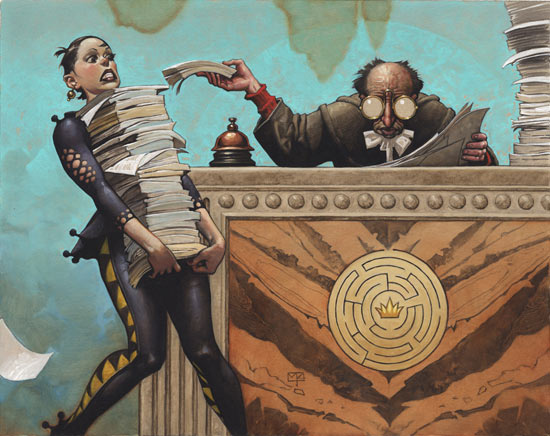
Bureaucracy in Action: Esther 8:9-14

bureaucracy1

Esther 8: 9-14

 9 The king’s secretaries were summoned at that time, in the third month, which is the month of Sivan, on the twenty-third day; and an edict was written, according to all that Mordecai commanded, to the Jews and to the satraps and the governors and the officials of the provinces from India to Ethiopia, one hundred twenty-seven provinces, to every province in its own script and to every people in its own language, and also to the Jews in their script and their language. 10 He wrote letters in the name of King Ahasuerus, sealed them with the king’s ring, and sent them by mounted couriers riding on fast steeds bred from the royal herd. 11 By these letters the king allowed the Jews who were in every city to assemble and defend their lives, to destroy, to kill, and to annihilate any armed force of any people or province that might attack them, with their children and women, and to plunder their goods 12 on a single day throughout all the provinces of King Ahasuerus, on the thirteenth day of the twelfth month, which is the month of Adar. 13 A copy of the writ was to be issued as a decree in every province and published to all peoples, and the Jews were to be ready on that day to take revenge on their enemies. 14 So the couriers, mounted on their swift royal steeds, hurried out, urged by the king’s command. The decree was issued in the citadel of Susa.

The bureaucracy springs into action, and perhaps like all bureaucracies this is the reason for the unexplainable delay, for the previous sections took place in the first month and now we are in the third month. Did Mordecai need to do a study, convene a committee, and enter into a debate with the Jews of Susa to come up with the right wording (I’m being snarky here). I don’t think that the Jews before would have been unable to defend themselves, but the edict with the force of Mordecai and the king’s authority with it puts them in a much stronger position, and perhaps, like in Nazi Germany, the new edict strips away the permission  to act out against the Jewish people and still to be following orders.

On the one hand, this gives the authority for a preemptive strike, to kill, destroy and annihilate anyone who might attack.  Now I wouldn’t want to go too far in this direction, remember the Jewish people are a small people in exile dependent on the favor of a powerful empire, but the edict and Mordecai’s force behind it does create fear. It is so easy for the oppressed to become the oppressor when the roles are reversed. This may be a story of reversals, but it is not a story of mercy.

Now for the Jewish people this is a story of triumph, what was to be a early Kristallnacht becomes a day of deliverance. God (although unmentioned) once again chooses the weak and the powerless and turns the tables on those who want to take advantage of them. Yet the violence of the end of the story does trouble me, yet it is the way of the story.

purple rose 01 by picsofflowers.blogspot.com

Dueling Edicts: Esther 8:1-8

Esther and Mordecai by Aertz de Gelder

Esther and Mordecai by Aertz de Gelder

Esther 8: 1-8

On that day King Ahasuerus gave to Queen Esther the house of Haman, the enemy of the Jews; and Mordecai came before the king, for Esther had told what he was to her. 2 Then the king took off his signet ring, which he had taken from Haman, and gave it to Mordecai. So Esther set Mordecai over the house of Haman.

3 Then Esther spoke again to the king; she fell at his feet, weeping and pleading with him to avert the evil design of Haman the Agagite and the plot that he had devised against the Jews. 4 The king held out the golden scepter to Esther, 5 and Esther rose and stood before the king. She said, “If it pleases the king, and if I have won his favor, and if the thing seems right before the king, and I have his approval, let an order be written to revoke the letters devised by Haman son of Hammedatha the Agagite, which he wrote giving orders to destroy the Jews who are in all the provinces of the king. 6 For how can I bear to see the calamity that is coming on my people? Or how can I bear to see the destruction of my kindred?” 7 Then King Ahasuerus said to Queen Esther and to the Jew Mordecai, “See, I have given Esther the house of Haman, and they have hanged him on the gallows, because he plotted to lay hands on the Jews. 8 You may write as you please with regard to the Jews, in the name of the king, and seal it with the king’s ring; for an edict written in the name of the king and sealed with the king’s ring cannot be revoked.”


The king lives a sheltered life, and even here at the end of the story he basically passes authority to Esther and Mordecai. They may write and seal it with the king’s seal. The king himself doesn’t take any more responsibility for the actions of Esther and Mordecai than he did for Haman. Even though these are irrevocable matters, they are still delegated. Much as in the story of Joseph, now Mordecai ascends to be in charge of everything and second only to the king, which makes him the person who really makes the decisions.

This makes me think a little of our own system of elected government where we may elect officials, but these officials may have to answer to groups and lobbyists who may be pulling the strings more than we want to admit. Granted, if the king decides to act on his own people have two choice, obey or assassinate the king while elected officials find themselves having negative adds financed against them, or members of their own party who try to take their seat in the next election cycle. I want to believe that the people we elect are there to make the best decisions on behalf of the American people, but the skeptical side sees way to many hands trying to craft their own policies to place under the signet ring of officials.

For the Jewish people in the story this turn of events is a very positive thing, now they have their own guy who bears the signet ring and can craft policy for their benefit. Maybe I am naïve to hope for a government that is better than this, a government that can move beyond what is good for one group or another and look at what is best for the population and even beyond that, the world. Don’t get me wrong, I think we’ve come a long way-but in our antagonistic and partisan world we can dream of something better.

One final note, I’ve highlighted several times that Mordecai wouldn’t bow to Haman, but this is apparently not a Jewish thing since Esther has no problem bowing before the king. We will never know the why behind Mordecai’s not bowing throughout the story, it could be a personal hatred, an ethnic dislike or any number of other things (and even here Mordecai doesn’t bow with Esther-although it may not be the time or place).

We are left with dueling decrees that cannot be revoked. One that will allow anyone to kill and loot Jewish families and one that allows the Jewish people to assemble and allow for their protection. Perhaps what is most important is not the edict but who has the power to enforce it.

purple rose 01 by picsofflowers.blogspot.com

Mechanisms Of Execution: Esther 7: 7-10

Rembrandt Harmenszoon van Rijn- Haman Begging the Mercy of Esther

Rembrandt Harmenszoon van Rijn- Haman Begging the Mercy of Esther

Esther 7: 7-10

 7 The king rose from the feast in wrath and went into the palace garden, but Haman stayed to beg his life from Queen Esther, for he saw that the king had determined to destroy him. 8 When the king returned from the palace garden to the banquet hall, Haman had thrown himself on the couch where Esther was reclining; and the king said, “Will he even assault the queen in my presence, in my own house?” As the words left the mouth of the king, they covered Haman’s face. 9 Then Harbona, one of the eunuchs in attendance on the king, said, “Look, the very gallows that Haman has prepared for Mordecai, whose word saved the king, stands at Haman’s house, fifty cubits high.” And the king said, “Hang him on that.” 10 So they hanged Haman on the gallows that he had prepared for Mordecai. Then the anger of the king abated.

 There is a scene in the 1990s movie Pretty Woman, at the end where the Philip Stukey, the character played by Jason Alexander attacks Vivian, the main character played by Julia Roberts, causing the Edward, the protagonist played by Richard Gere, to throw out his main advisor. A similar thing is happening here. The king storms out, furious (even though he is at least partially to blame for the circumstance), Haman realizes the game is up and his only chance at mercy is not from the king, but the queen and he throws himself at her at the time the king returns and a convenient solution is presented. Haman has assaulted the queen, that allows the king to act immediately and the attendants (silent throughout the scene) now suddenly appear visible. Haman moves from favored one to traitor to death in the span of three terse verses. Ultimately it is the designs of his own hatred that end up being the mechanism for his own execution.

The book of Esther is a story set in a world where the death penalty is not only acceptable, but used not just for murder. Some people critique Esther for not extending mercy, which is their right, but that misses the context of the story and what was considered just punishment. Even if Esther wanted to extend mercy to Haman, and I see little reason to believe she would be inclined to, she may feel that she has pushed the benevolence of the king to its limit asking for the salvation of her life and people. The story turns on poetic justice, but I don’t think we need to make this prescriptive for the justice we seek in our own society.

purple rose 01 by picsofflowers.blogspot.com

Endgame: Esther 7:1-6

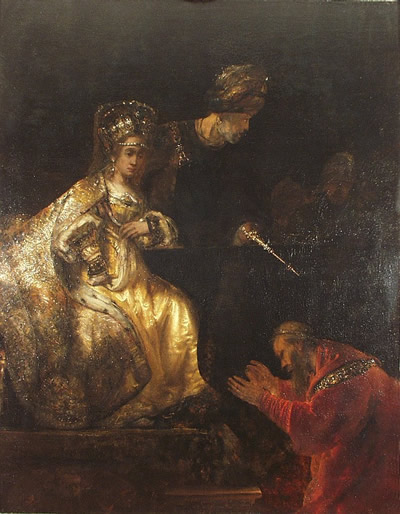
Rembrandt Harmensz van Rinj- Ahasuerus, Haman and Esther at the Feast of Esther

Rembrandt Harmensz van Rinj- Ahasuerus, Haman and Esther at the Feast of Esther

Esther 7: 1-6

So the king and Haman went in to feast with Queen Esther. 2 On the second day, as they were drinking wine, the king again said to Esther, “What is your petition, Queen Esther? It shall be granted you. And what is your request? Even to the half of my kingdom, it shall be fulfilled.” 3 Then Queen Esther answered, “If I have won your favor, O king, and if it pleases the king, let my life be given me– that is my petition– and the lives of my people– that is my request. 4 For we have been sold, I and my people, to be destroyed, to be killed, and to be annihilated. If we had been sold merely as slaves, men and women, I would have held my peace; but no enemy can compensate for this damage to the king.” 5 Then King Ahasuerus said to Queen Esther, “Who is he, and where is he, who has presumed to do this?” 6 Esther said, “A foe and enemy, this wicked Haman!” Then Haman was terrified before the king and the queen.

The plot has reached it’s decisive moment, Esther lays out her petition and what remains to be seen is how it will play out with the king. Esther has played well, she has patiently waited until the proper moment and this puts the king in a difficult situation for he, although perhaps through negligence and failing to investigate who the people he allowed Haman to consign to destruction, is the one behind the edict. It is his signet ring that marked the letters and decrees that went forth. The king has become so isolated from what is going on in his kingdom, so dependent upon his advisors that his own actions have placed his beloved queen at risk. Nobody knows that Esther is Jewish, or that Mordecai is her uncle but the king is furious.

Part of the appeal of Esther is it is the type of story that allows a veiled critique of whichever person is in power. Ahasuerus becomes a cipher for the king or governor that people want to laugh at, and are able to do it within the confines of the story even when they may be talking about another (and sometimes rather obviously). I am not sure if Purim (where the book of Esther is read) ever becomes a ritual of reversal, like Carnival, where the normal social rules are suspended for the duration of the festival and it becomes a time and space for the social rules to be suspended to express disapproval of the current state of affairs by a people who do not have the ability to change them. (See James C. Scott’s Domination and the Arts of Resistance: Hidden Transcripts for more about rituals of reversals. (Scott 1990, 172-182) )

The king may not be the sharpest nail in the toolbox, but ultimately action falls back to him. Ahasuerus is the one in the story who the buck stops with, and ultimately he must provide the solution to the problem. At stake is a decree and law which cannot be altered, and his own complicity in the action.

purple rose 01 by picsofflowers.blogspot.com

The World is About to Turn: Esther 6: 1-14

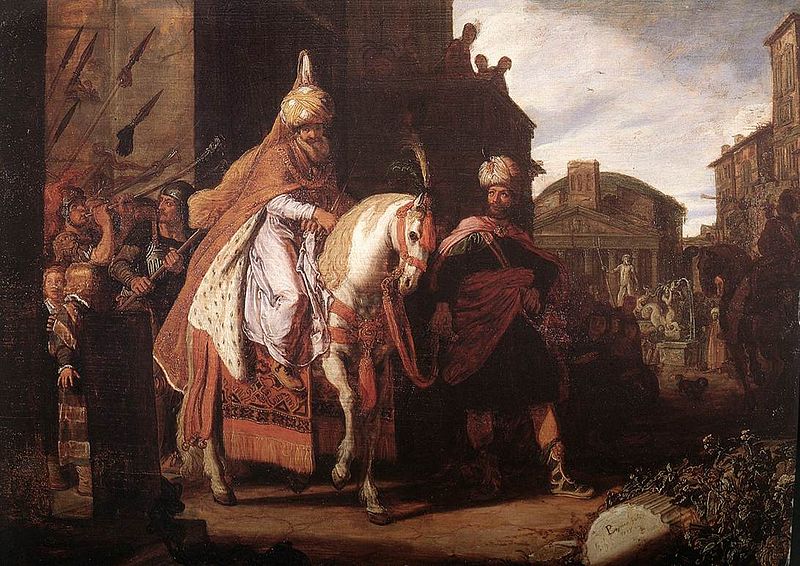
Pieter Lastman, The Triumph of Mordecai (1624)

Pieter Lastman, The Triumph of Mordecai (1624)

Esther 6: 1-14

On that night the king could not sleep, and he gave orders to bring the book of records, the annals, and they were read to the king. 2 It was found written how Mordecai had told about Bigthana and Teresh, two of the king’s eunuchs, who guarded the threshold, and who had conspired to assassinate King Ahasuerus. 3 Then the king said, “What honor or distinction has been bestowed on Mordecai for this?” The king’s servants who attended him said, “Nothing has been done for him.” 4 The king said, “Who is in the court?” Now Haman had just entered the outer court of the king’s palace to speak to the king about having Mordecai hanged on the gallows that he had prepared for him. 5 So the king’s servants told him, “Haman is there, standing in the court.” The king said, “Let him come in.” 6 So Haman came in, and the king said to him, “What shall be done for the man whom the king wishes to honor?” Haman said to himself, “Whom would the king wish to honor more than me?” 7 So Haman said to the king, “For the man whom the king wishes to honor, 8 let royal robes be brought, which the king has worn, and a horse that the king has ridden, with a royal crown on its head. 9 Let the robes and the horse be handed over to one of the king’s most noble officials; let him robe the man whom the king wishes to honor, and let him conduct the man on horseback through the open square of the city, proclaiming before him: ‘Thus shall it be done for the man whom the king wishes to honor.'” 10 Then the king said to Haman, “Quickly, take the robes and the horse, as you have said, and do so to the Jew Mordecai who sits at the king’s gate. Leave out nothing that you have mentioned.” 11 So Haman took the robes and the horse and robed Mordecai and led him riding through the open square of the city, proclaiming, “Thus shall it be done for the man whom the king wishes to honor.”

 12 Then Mordecai returned to the king’s gate, but Haman hurried to his house, mourning and with his head covered. 13 When Haman told his wife Zeresh and all his friends everything that had happened to him, his advisers and his wife Zeresh said to him, “If Mordecai, before whom your downfall has begun, is of the Jewish people, you will not prevail against him, but will surely fall before him.”

 14 While they were still talking with him, the king’s eunuchs arrived and hurried Haman off to the banquet that Esther had prepared.

One of the consistent themes throughout the bible, and particularly the New Testament is the theme of reversals, surprising reversals of the mighty being brought low and the lowly being raised high. Perhaps the most well known is Mary’s song (the Magnificat for those familiar with the Latin) in Luke 1: 46-55:

He (God) has shown the strength with his arm; he has scattered the proud in the thoughts of their hearts. He has brought down the powerful from their thrones, and lifted up the lowly; he has filled the hungry with good things; and sent the rich away empty Luke 1: 51-53

God is never mentioned in the book of Esther, and although the Septuagint (the Greek Translation of the Old Testament), Josephus (a Jewish historian who lived shortly after the time of Jesus) as well as the Rabbis all explicitely point to God’s involvement in the king’s insomnia, the Hebrew texts at best silently infer God’s participation. Yet, here is the outworking of the salvation of the people being played out in what seem like a series of well timed coincidences but may indeed be providence.

What better cure for insomnia that to read from the records of the proceedings, and yet in the midst of reading is the realization that an honor was not given for a great service. Honor is a big deal in the ancient world, and failing to honor someone who honor is due to is critical (hence the conflict between Mordecai and Haman). And yet it is Haman who is trapped here, whose ego believes that he is once again to be honored and gives what is an extremely high display of honor. Mordecai, by being publicly honored by the king, by becoming a benefactor of the king has become all but untouchable. Mordecai is publicly shamed (although unintentionally by the king who seems oblivious to what is going on just outside his court) among the officials who are watching to see how this conflict between Mordecai and Haman will play out. Haman’s friends and wife know that this is a bad omen and that the world is changing. Place have been reversed, Mordecai is lifted up as the one the king wishes to honor, and Haman covers his head and mourns. There is yet one more major pivot to the story but things are beginning to spiral out of control for Haman.

I’m going to close with Rory Cooney’s adaptation of Luke 1: 46-55, the Canticle of the Turning:

My soul cries out with a joyful shout that the God of my heart is great,
And my spirit sings of the wondrous things that you bring to the ones who wait.
You fixed your sight on your servant’s plight, and my weakness you did not spurn,
So from east to west shall my name be blest. Could the world be about to turn?
 My heart shall sing of the day you bring. Let the fires of your justice burn.
Wipe away all tears, for the dawn draws near, and the world is about to turn.
 
 Though I am small, my God, my all, you work great things in me,
 And your mercy will last from the depths of the past to the end of the age to be.
 Your very name puts the proud to shame, and to those who would for you yearn,
 You will show your might, put the strong to flight , for the world is about to turn.
 My heart shall sing of the day you bring. Let the fires of your justice burn.
 Wipe away all tears, for the dawn draws near, and the world is about to turn.
 
From the halls of pow’r to the fortress tow’r, not a stone will be left on stone.
Let the kings beware for your justice tears every tyrant from his throne
The hungry poor shall weep no more, for the food they can never earn;
There are tables spread, ev’ry mouth be fed for the world is about to turn.
My heart shall sing of the day you bring. Let the fires of your justice burn.
Wipe away all tears, for the dawn draws near, and the world is about to turn.
 
Though the nations rage from age to age, we remember who holds us fast:
God’s mercy must deliver us from the conqueror’s crushing grasp.
This saving word that our forebears heard is the promise which holds us bound,
Till the spear and the rod can be crushed by God, who is turning the world around.
My heart shall sing of the day you bring. Let the fires of your justice burn.
Wipe away all tears, for the dawn draws near, and the world is about to turn.
(Evangelical Lutheran Worship, 723)

purple rose 01 by picsofflowers.blogspot.com


Of Gallows and Egos: Esther 5: 9-14

Reconstruction of a Gallows-Style Gibbet at Caxton Gibbet in Cambridgeshire, England

Reconstruction of a Gallows-Style Gibbet at Caxton Gibbet in Cambridgeshire, England

Esther 5: 9-14

 9 Haman went out that day happy and in good spirits. But when Haman saw Mordecai in the king’s gate, and observed that he neither rose nor trembled before him, he was infuriated with Mordecai; 10 nevertheless Haman restrained himself and went home. Then he sent and called for his friends and his wife Zeresh, 11 and Haman recounted to them the splendor of his riches, the number of his sons, all the promotions with which the king had honored him, and how he had advanced him above the officials and the ministers of the king. 12 Haman added, “Even Queen Esther let no one but myself come with the king to the banquet that she prepared. Tomorrow also I am invited by her, together with the king. 13 Yet all this does me no good so long as I see the Jew Mordecai sitting at the king’s gate.” 14 Then his wife Zeresh and all his friends said to him, “Let a gallows fifty cubits high be made, and in the morning tell the king to have Mordecai hanged on it; then go with the king to the banquet in good spirits.” This advice pleased Haman, and he had the gallows made.

Pride goes before destruction, and a haughty spirit before the fall. Proverbs 16:18

Sidnie White Crawford in her commentary on Esther wisely points out that anyone reading the book with knowledge of wisdom literature and particularly the book of Proverbs knows that Haman’s fall is approaching. (Elizabeth Acthemeier, et.al 1999, 3:911f.) Indeed Haman’s arrogance is massive but we still need to ask the question, “What is up with Mordecai?” Mordecai has been restored to his position, and knows at least some of the game that is at stake, but he still continues to openly show his defiance to Haman even while Esther is playing her subtle game. What is it with the men in this story? Why must they play the fool? Why must Mordecai continue to enflame Haman’s hatred and put himself at risk even when the plot is afoot? Before Mordecai thought it beneath him to deal with Mordecai individually, but now Mordecai’s defiance is enough to rob him of the joy and honor of having dined with the king and queen.

Like the king, when he is perplexed he calls together his friends and his wife Zeresh, who proves to be the independent thinker among the group rather than the assembled men. In an honor shame society it wouldn’t be uncommon to refer back to one’s honors as a way of establishing one’s position (even if we might look at it and think this guy must be full of himself) and yet everything is no good so long as there is one who can defy him. Now from a psychological perspective we would probably say that Mordecai has a weak sense of his own self and requires the constant honor and attention to probably feel valued, but that would be putting a 20th Century midset on the story- honor and shame is at stake and honor is power. It is Zeresh who supplies the solution which all the other sycophant friends agree to, to construct a gallows (gallows to us seems to indicate hanging, but it probably  is referring to more of a gibbet, see the picture above, for impaling one’s enemy upon) that are outlandishly outsized (approximately 75 feet tall) designed to make  a statement, “this is what happens when you mess with Haman”. Much the same message that the Roman (and other) empires would make later when they crucified people they felt were their opponents.

Ultimately capital punishment is about more than ending a person’s life, it is about fear and making an example of the person who is executed. The idea of impaling someone upon a gibbet and letting their body decompose in the open may be revolting, but the exhibition and the denial of a proper burial also points to the powerlessness of the person’s allies and family.

purple rose 01 by picsofflowers.blogspot.com

A Game of Thrones: Esther 5:1-8

Game-of-Thrones-game-of-thrones-23883770-800x500

Esther 5: 1-8

On the third day Esther put on her royal robes and stood in the inner court of the king’s palace, opposite the king’s hall. The king was sitting on his royal throne inside the palace opposite the entrance to the palace. 2 As soon as the king saw Queen Esther standing in the court, she won his favor and he held out to her the golden scepter that was in his hand. Then Esther approached and touched the top of the scepter. 3 The king said to her, “What is it, Queen Esther? What is your request? It shall be given you, even to the half of my kingdom.” 4 Then Esther said, “If it pleases the king, let the king and Haman come today to a banquet that I have prepared for the king.” 5 Then the king said, “Bring Haman quickly, so that we may do as Esther desires.” So the king and Haman came to the banquet that Esther had prepared. 6 While they were drinking wine, the king said to Esther, “What is your petition? It shall be granted you. And what is your request? Even to the half of my kingdom, it shall be fulfilled.” 7 Then Esther said, “This is my petition and request: 8 If I have won the king’s favor, and if it pleases the king to grant my petition and fulfill my request, let the king and Haman come tomorrow to the banquet that I will prepare for them, and then I will do as the king has said.”

In George R.R. Martin’s book, The Game of Thrones,  there is a scene where Ned Stark reveals the knowledge that will eventually get him killed to Cercei who simply replies back to him, “When you play the game of thrones, you win or you die” which proved true for Ned and many others throughout the series of books. In Esther, Esther and Haman (unknowingly) are playing a game of thrones and while I don’t want to draw to close of a line between Esther and Cercei (who is a character despised by most readers of The Game of Thrones), she does understand the game she is playing and she plays her part very well here.

Much is at risk for her and her people here, and so she prepares carefully and plays cautiously. Unlike Vashti who refused to go to the wear the royal crown before the king, Esther adorns herself in royalty before approaching the king. It is not a fair world in which she must make her appearance and the image of the golden scepter would probably be rich territory for someone wanting to interpret this from either a feminist or Freudian position, but suffice to say the king’s authority compared to the queen’s is significantly different and the game she must play is real and dangerous (especially in a world where rulers have good reason to be paranoid, even of family). The king gives her leave to approach, let’s her know figuratively (no one really expects him to give up half his kingdom, and this also occurs in Mark 6:23 and parallels with Herod Antipas) but as a reassurance to make her request. The king realizes that Esther would not have risked approaching this way without a reason and so he attempt to reassure her.

In our world we would ask as soon as the possibility came, we are impatient for games-and we would not survive long with our impatience in the ancient Near East (and I would hazard a guess that this continues to be a problem with the interaction between Western and Middle Eastern societies where the rules of interaction are much different-in even modern Middle Eastern societies one never makes one’s major request right away). Esther invites the king and Haman to a banquet, and the king gladly attends giving indication that he is disposed to concede to Esther’s request. Once again, when he is once again drinking wine the king asks again what her request is, and Esther’s reply is indeed shrewd. If I have won your favor, fulfill this request (coming to a banquet with Haman tomorrow) and I will indeed know that I can safely lay my petition before you because you have truly shown me your favor. She has played her hand well in the game of thrones, in a matter of life and death for her people, and Haman is unaware (again the sign of a well played hand) that the game is being played in this way, indeed he views his presence as a sign of his increased honor, but he has just been played.

purple rose 01 by picsofflowers.blogspot.com

The Weight of the World on Her Shoulders: Esther 4: 9-17

Altas Sculpture on a building on Collins Street, Melbourne

Altas Sculpture on a building on Collins Street, Melbourne

Esther 4: 9-17

 9 Hathach went and told Esther what Mordecai had said. 10 Then Esther spoke to Hathach and gave him a message for Mordecai, saying, 11 “All the king’s servants and the people of the king’s provinces know that if any man or woman goes to the king inside the inner court without being called, there is but one law– all alike are to be put to death. Only if the king holds out the golden scepter to someone, may that person live. I myself have not been called to come in to the king for thirty days.”

 12 When they told Mordecai what Esther had said, 13 Mordecai told them to reply to Esther, “Do not think that in the king’s palace you will escape any more than all the other Jews. 14 For if you keep silence at such a time as this, relief and deliverance will rise for the Jews from another quarter, but you and your father’s family will perish. Who knows? Perhaps you have come to royal dignity for just such a time as this.” 15 Then Esther said in reply to Mordecai, 16 “Go, gather all the Jews to be found in Susa, and hold a fast on my behalf, and neither eat nor drink for three days, night or day. I and my maids will also fast as you do. After that I will go to the king, though it is against the law; and if I perish, I perish.” 17 Mordecai then went away and did everything as Esther had ordered him.

A young person is thrust into a life or death situation, and while I may disagree with Mordecai (and perhaps Esther might too) that she personally might have been able to avoid the ordered purge, the personal and emotional consequences of not speaking, of not acting would be high indeed. The risks are great and now the young person in a life or death situation has to muster their courage to act. Esther apparently is trying to let Mordecai know the reasons she shouldn’t go: she hasn’t been summoned for 30 days (her influence is small), the boundaries between even the king and the queen are great, and the consequences could involve death. The story revolves on the irony that one queen refuses to come when summoned and then for her act of rebellion is exiled and now the new queen must come when not summoned and risk death. Mordecai pushes her, through Hathach the messenger, that she must act but we see a transformation taking place: the once pliant Esther now gives orders, she will go but all the Jews are to fast for three days first. Mordecai goes and obeys, the one who raised her now must rely on her for action.

In contrast to the King and Hamath who feast while the city is confused around them, Mordecai and Esther fast. The King may end up being the one who provides a way for the salvation of the people, but ultimately it will depend upon who the king will listen to. Even though God is not mentioned there is an element of providence or fate in the story, and most readers know how the story will end, but one of Jesus’ proverbs plays itself out in this story: “For all who exalt themselves will be humbled, and those who humble themselves will be exalted” (in Luke’s gospel this occurs in Luke 14: 11 and 18:14, it also has a Matthean parallel)

purple rose 01 by picsofflowers.blogspot.com

Waiting on the World to Change: Esther 4:1-8

Job by Leon Bonnat (1880)

Job by Leon Bonnat (1880)

Esther 4: 1-8

When Mordecai learned all that had been done, Mordecai tore his clothes and put on sackcloth and ashes, and went through the city, wailing with a loud and bitter cry; 2 he went up to the entrance of the king’s gate, for no one might enter the king’s gate clothed with sackcloth. 3 In every province, wherever the king’s command and his decree came, there was great mourning among the Jews, with fasting and weeping and lamenting, and most of them lay in sackcloth and ashes.

 4 When Esther’s maids and her eunuchs came and told her, the queen was deeply distressed; she sent garments to clothe Mordecai, so that he might take off his sackcloth; but he would not accept them. 5 Then Esther called for Hathach, one of the king’s eunuchs, who had been appointed to attend her, and ordered him to go to Mordecai to learn what was happening and why. 6 Hathach went out to Mordecai in the open square of the city in front of the king’s gate, 7 and Mordecai told him all that had happened to him, and the exact sum of money that Haman had promised to pay into the king’s treasuries for the destruction of the Jews. 8 Mordecai also gave him a copy of the written decree issued in Susa for their destruction, that he might show it to Esther, explain it to her, and charge her to go to the king to make supplication to him and entreat him for her people.


John Mayer’s song ‘Waiting on the World to Change’ tells the story of a person who may see what is going on but feels powerless to change it (Mayer’s song is set in the context of post 9-11 America and a critique of American foreign policy that the artist feels powerless to change). Here is a part of the lyrics:

Now if we had the power to bring our neighbors home from war
They would have never missed a Christmas, no more ribbons on their door
And when you trust your television what you get is what you got
Cause when they own the information,oh, they can bend it all they want
That’s why we’re waiting, waiting on the world to change
We keep on waiting, waiting on the world to change
It’s not that we don’t care, we just know that the fight ain’t fair
So we keep on waiting, waiting on the world to change.

Mordecai is powerless to change what Haman has done, he finds himself with few options other than mourning and waiting on the world to change. God’s action is never mentioned in the book of Esther, nor is the word God or prayer ever mentioned, but to the Hebrew mind God is at work behind and through the nations as well as the Jewish people and God can be swayed by mourning and repentance, for example the people of Ninevah in the book of Jonah who put on sackcloth and ashes and God changes God’s mind about the disaster God planned to bring on them. Here God is not the instigator of the coming disaster, and yet perhaps in the wailing, rending of clothes and wearing sack cloth and ashes God might hear the distress of his people and respond (although the action is focused on Mordecai, we also learn that many of the Jews are also mourning publicly).

We also get a window into boundaries that are set around people in society, no one can enter the king’s gate in sack cloth. Esther, though she is literally writhing inside (the word translated deeply distressed) can not or will not risk going out to Mordecai who was like a father to her, but rather tries to alleviate his pain and bring him (properly clothed and cleaned up) inside the palace. The entire conversation is strained because it is not direct, messages are relayed back and forth by Hathach. One of the interesting notes is that both Esther and Mordecai are apparently literate (which would not be the norm ) because Mordecai is able to pass on the written decree for her to read (or perhaps some scribe would read it for her-but she has been a queen for five years, perhaps she has been taught).
Esther has been the obedient one throughout the story, obedient to Mordecai, obedient to Hegai the king’s eunuch, obedient to the king and now she as a young woman is at a point where she will have to make choices that will impact both her and potentially her entire people.

Since the book of Esther is the book that is read during the book of Purim, it is helpful to know what Purim is all about. It began at sundown yesterday and so there have been a number of helpful articles in the past week.  I have linked to Eitan Press’ helpful article in the Huffington Post ‘Purim: How to Get Drunk on God’. Here is another from Deborah Rosenbloom also in the Huffington Post ‘Purim: A Tale of Women’s Empowerment’

purple rose 01 by picsofflowers.blogspot.com

Bureaucracy and Collusion: Esther 3:12-15

Ring stone bearing the Aramaic name mirror-imaged Yishak bar Hanina, excavated from Zafar/al-Asabi/Yemen

Ring stone bearing the Aramaic name mirror-imaged Yishak bar Hanina, excavated from Zafar/al-Asabi/Yemen

Esther 3: 12-15

 12 Then the king’s secretaries were summoned on the thirteenth day of the first month, and an edict, according to all that Haman commanded, was written to the king’s satraps and to the governors over all the provinces and to the officials of all the peoples, to every province in its own script and every people in its own language; it was written in the name of King Ahasuerus and sealed with the king’s ring. 13 Letters were sent by couriers to all the king’s provinces, giving orders to destroy, to kill, and to annihilate all Jews, young and old, women and children, in one day, the thirteenth day of the twelfth month, which is the month of Adar, and to plunder their goods. 14 A copy of the document was to be issued as a decree in every province by proclamation, calling on all the peoples to be ready for that day. 15 The couriers went quickly by order of the king, and the decree was issued in the citadel of Susa. The king and Haman sat down to drink; but the city of Susa was thrown into confusion.

                 Genocide does not happen without collusion. The letters and orders can be given, but if nobody carries them out they are merely words on paper. The danger is that oftentimes people are all too willing to participate in the elimination of another people. A people may be scapegoated as the cause of every problem and demonized to be something less than human. People may hide behind the desire to ‘follow orders’ and yet without people following the order to kill and plunder, it does not happen. Haman and the king sit down to drink while the city that surrounds them is confused, “what’s going on, why the Jewish people?” The advisors may know, but most people appear to be caught off guard. Certainly some will pounce on the opportunity to destroy, kill and annihilate men, women and children and plunder their goods, others will merely stand aside, others may attempt to stand with the Jewish people, but the die is cast, the plan is set in motion, the danger is real. Genocide is set in motion by the hatred of one man, but will need the collusion (both of those who actively participate and who passively do not oppose)of many others to actually occur.

Somebody will need to do something to deliver the Jewish people, the exiles and wanderers in the midst of the empire of the day. Even in the midst of their assimilation they are singled out for extermination. The story is at its turning point, and the lives of the people will rely on the actions of a young queen and her uncle Mordecai.

This reminds me of Martin Niemőller’s quote from World War II Germany:

First they came for the Socialists, and I did not speak out–
Because I was not a Socialist.

Then they came for the Trade Unionists, and I did not speak out– 
Because I was not a Trade Unionist.

Then they came for the Jews, and I did not speak out– 
Because I was not a Jew.

Then they came for me–and there was no one left to speak for me.

  This from a man who was an outspoken critic of Adolf Hitler and Nazi Germany, who would spend seven years in a concentration camps but would still feel years later in 1964:

“Thus, whenever I chance to meet a Jew known to me before, then, as a Christian, I cannot but tell him: ‘Dear Friend, I stand in front of you, but we can not get together, for there is guilt between us. I have sinned and my people has sinned against thy people and against thyself

The quotes come from the website of the U.S. Holocaust Memorial Museum:

purple rose 01 by picsofflowers.blogspot.com