Tag Archives: King Zedekiah

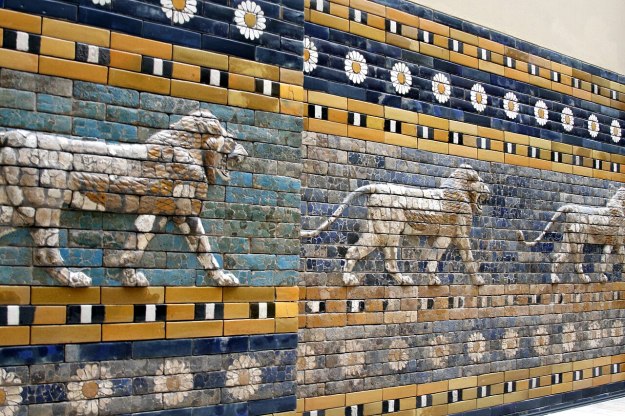
The Babylonian Empire

Most readers of the Bible do not have much exposure to the history of the region 2,600 years ago, but this time is critical for much of the Hebrew Scriptures (or Old Testament). One of my Hebrew Bibles professors used to joke that if you were taking an exam on the Hebrew Scriptures and did not know the answer that the Babylonian exile was a solid guess. This is the time period that the books of Jeremiah and Ezekiel address and it is where 2 Kings concludes the Deuteronomic History[1] and shortly before 2 Chronicles ends its narration.[2] This becomes a time of redefinition for the Jewish people where the stories and writings are collected together to form a unified tradition to hand on to their descendants away once the temple, Jerusalem, and the Davidic kings no longer reign.

When talking about the Babylonian Empire in relation to scripture, it is actually the Second Babylonian Empire or the Neo Babylonian Empire. The Babylonians were also known as Chaldeans in scripture and historical references, and you will occasionally see this time referred to as the Chaldean Empire. Babylon begins its rise after the coronation of King Nabopolassar in 626 BCE and the rise of Babylonian power coincides with the collapse of the Assyrian Empire in 612 BCE.[3] In 605 BCE King Nebuchadrezzar II (or Nebuchadnezzar II) succeeded his father Nabopolassar as king. Shortly before his father’s death Nebuchadrezzar II won a critical victory over Pharoah Neco II’s Egyptian Army at the battle of Carchemish ensuring Babylonian power over the Levant (the region bordering the Eastern Mediterranean Sea which includes Israel/Judah).

Neo-Babylonian_Empire_under_Nebuchadnezzar_II By IchthyovenatorSémhur (base map) – Own work, CC BY-SA 4.0, https://commons.wikimedia.org/w/index.php?curid=105732621

In 601 BCE Babylon marched into Egypt to counter rising Egyptian influence in the Levant and this campaign ultimately failed in 599 BCE but did end Egyptian power in the Levant. During this war King Jehoiakim (or Jehoiakim) in Judah allied his country with Egypt[4] and Nebuchadrezzar after leaving Egypt turned his forces towards Jerusalem. In 598/597 BCE Jerusalem surrenders to Babylon, King Jehoiakim is taken captive to Babylon along with many of the elites of the land. This is the exile that Ezekiel is experiencing as he prophesies, and this is also the setting at the beginning of the book of Daniel. King Zedekiah is left in charge of Jerusalem as a puppet king of the Babylonian empire.

Egypt continued to be a regional force and both Jeremiah and Ezekiel point to the influence of Egypt in the decision of King Zedekiah to refuse to pay tribute in 589 BCE. In 587 BCE Ammon, Edom, and Moab all come together to form a mutual alliance against Babylon, but in 586 Babylon responds. Jerusalem is destroyed, and the Kingdom of Judah ends in 586 BCE with the survivors being taken captive in Babylonia. After the defeat of Judah, Babylon would continue to be militarily active ensuring the submission of the region under Babylonian control and repelling Egyptian influence. The Babylonian Empire would maintain control over the region until they were conquered by Cyrus the Great and the Persian Empire in 539 BCE.

[1] The books starting in Joshua and running through 2 Kings in most Christian bibles (excluding Ruth) which called the Deuteronomic history by scholars because they theologically follow the book of Deuteronomy.

[2] 2 Chronicles has two final verses which point to the end of the Babylonian exile under the Persian King Cyrus.

[3] The Assyrian Empire is responsible for the capture of Samaria and the ending of the Kingdom of Northern Israel in 721 BCE.

[4] Jehoiakim had been appointed by Pharoah Neco II so Judah’s alliance with Egypt against Babylon is not surprising.

Ezekiel 21 God’s Sword Against Judah

Swords Hanging in my Office, the sword on the left is a U.S. Army Ceremonial (Dress) Saber, the one on the right is a replica 1860 cavalry saber.

Ezekiel 21: 1-7 The LORD’s Challenge of Israel

1 The word of the LORD came to me: 2 Mortal, set your face toward Jerusalem and preach against the sanctuaries; prophesy against the land of Israel 3 and say to the land of Israel, Thus says the LORD: I am coming against you, and will draw my sword out of its sheath, and will cut off from you both righteous and wicked. 4 Because I will cut off from you both righteous and wicked, therefore my sword shall go out of its sheath against all flesh from south to north; 5 and all flesh shall know that I the LORD have drawn my sword out of its sheath; it shall not be sheathed again. 6 Moan therefore, mortal; moan with breaking heart and bitter grief before their eyes. 7 And when they say to you, “Why do you moan?” you shall say, “Because of the news that has come. Every heart will melt and all hands will be feeble, every spirit will faint and all knees will turn to water. See, it comes and it will be fulfilled,” says the Lord GOD.

At the end of the previous chapter the prophet is told to set his face towards the south (Teman, Darom, and Negev)[1] but then is accused by the people of being a maker of allegories. The previous section and this one belong together. The references to south are made clear when the prophet is instructed to set his face toward Jerusalem, the sanctuaries, and the land of Israel. The previous three different word for south is now decoded as Jerusalem, the sanctuaries and the land of Israel. The forests of the Negev may allegorically refer to the House of the Forest of Lebanon, a part of the royal buildings built by Solomon. (1 Kings 7: 2-5) Yet, now that the allegories are stripped away it is clear that the focus is on the city of Jerusalem, the temple, and the land of Israel itself. The upcoming judgment of the LORD will focus on the city but encompass the entire region.

The figure of God as a divine warrior is a common one in scripture, but now the divine warrior which has protected Israel in the past challenges the people of Israel to a duel. The LORD is coming against them and will draw out the sword, and yet this is not a fight that Israel can win. The image of the LORD drawing his sword was probably expected by the people to be a positive image, an image that the LORD was ready to fight for the people. Ezekiel inverts this image to where God is no longer their protector but their adversary.

The threat to cut off both the righteous and the wicked again illustrates that the prophecies in Ezekiel are not always consistent but are meant to evoke a hearing. At several points Ezekiel has been careful to allow for a distinction between the righteous and the unrighteous before God’s judgment.[2] There is an echo of Abraham’s challenge to the LORD on the LORD’s journey to Sodom, “Will you indeed sweep away the righteous with the wicked?” (Genesis 18:23) Yet, as in Ezekiel 16: 44-58 it is clear that the LORD views the transgressions of Judah as greater than Sodom. This may just be a shocking rhetorical device to encompass the totality of the people and shake them out of their stupor. Yet, Ezekiel’s prophecy has been less about the expectance of repentance than describing the upcoming horror in a way that people can look back upon his words and see that Ezekiel was a true prophet among them. A sword once it is swung is likely to cause collateral damage and war once unleashed is impossible to restrain where only the wicked are punished. Yet, this sword now taken out to the scabbard will become the central image for the remainder of the chapter.

Ezekiel is called to moan publicly, and this becomes another sign-act to cause people to question what the prophet is doing. The prophet is informed about the coming disaster but has no power to avert the catastrophe. He can look ahead to the time when hearts melt, hands are feeble, and the loss of bowel control causes people to wet themselves.[3] The disaster will physically and psychologically overwhelm the people. The God who has delivered them in the only offers challenge. The sword is drawn, and now Ezekiel will continue to develop this image throughout the chapter.

Ezekiel 21: 8-17 The Song of the Sword

8 And the word of the LORD came to me: 9 Mortal, prophesy and say: Thus says the Lord; Say: A sword, a sword is sharpened, it is also polished;

10 it is sharpened for slaughter, honed to flash like lightning! How can we make merry? You have despised the rod, and all discipline.

 11 The sword is given to be polished, to be grasped in the hand; it is sharpened, the sword is polished, to be placed in the slayer’s hand.

 12 Cry and wail, O mortal, for it is against my people; it is against all Israel’s princes; they are thrown to the sword, together with my people. Ah! Strike the thigh!

 13 For consider: What! If you despise the rod, will it not happen? says the Lord GOD.

14 And you, mortal, prophesy; strike hand to hand. Let the sword fall twice, thrice; it is a sword for killing. A sword for great slaughter — it surrounds them;

 15 therefore hearts melt and many stumble. At all their gates I have set the point of the sword. Ah! It is made for flashing, it is polished for slaughter.

 16 Attack to the right! Engage to the left! — wherever your edge is directed.

 17 I too will strike hand to hand, I will satisfy my fury; I the LORD have spoken.

Although the overall intent of this section is clear, the individual phrases are difficult to translate. Daniel Block suggests that the problems reflect the “heightened emotions of the prophet, who appears mesmerized by the image of the flashing weapon.” (Block, 1997, p. 675) Block’s suggestion is plausible, but it is also plausible that Ezekiel is adapting an existing poem, song, or invocation over a weapon and adapting it to the current image. This deadly sword which is drawn from the divine scabbard becomes a deadly image of destruction for the people and a lament of the prophet.

The repetitive references to the sword being sharpened and polished give the section a lyrical quality and this has led some to speculate that it derives from a sword dance or invocation over a weapon to prepare it for battle. (NIB VI: 1298) Armies both ancient and modern have rituals to prepare mentally for the upcoming battle that involve chants, movement, dance, and the focus on the weapons used in conflict. Psalm 144 is a biblical example of a prayer or song of a warrior preparing for combat as seen in its opening lines:

Blessed be the LORD, my rock, who trains my hands for war, and my fingers for battle, my rock and my fortress, my stronghold and my deliverer, my shield in whom I take refuge, who subdues the peoples under me. Psalm 144: 1-3

Yet, the focus in this image is exclusively on the sword. The wielder of this weapon will be revealed in the coming section, but now the sword itself is sharpened for slaughter and honed to flash like lightning. The princes of Israel are the ones sword is directed against, and they and the people are unable to stand against it. The sword, even without a wielder strikes multiple times and appears at every gate. The gates of the city are where the people can flee for safety but throughout the bible the city gates are also where public business was transacted, and cases brought for judgment. The sword at the gates also precludes the possibility of escape from the surrounded city.

The sword is a metaphor for war, and as we will see in the following section it is the war of Babylon against Judah. The siege of Jerusalem, often prophesied in the first twenty chapters, cuts off the possibility of escape. To echo a line from the Battle Hymn of the Republic, God “has loosed the fateful lightning of his terrible swift sword,” but the sword is not loosed against the enemies of Judah but upon Judah herself.

Replica 1860 Cavalry Saber hanging on my office wall

I was a cavalry officer in the U.S. Army prior to going to seminary and becoming a pastor. On the wall of my office, I have two swords from my time in the military. One is a ceremonial saber which is light and would not endure in a fight, but the other is a replica 1860 cavalry saber known sometimes called a wrist breaker because of its weight. This saber comes from a different era and is different technology than swords in the ancient world (which are shorter and thicker). Swords are shaped for the type of combat they will be used in. A saber is used on horseback for swinging downward, a rapier is a thrusting weapon, etc. Swords are not the primary implement used in slaughter[4] because both their value in the culture (they are costly to make and own) and the fact that they dull quickly. Ancient swords had to be heavy to be effective in combat, and they didn’t have the focused weight of an axe.[5] Yet, swords were the weapon of kings and great warriors and metaphorically they are often used to talk of war and battle.

Ezekiel 21: 18-27 Nebuchadrezzar Wielder of the Sword

18 The word of the LORD came to me: 19 Mortal, mark out two roads for the sword of the king of Babylon to come; both of them shall issue from the same land. And make a signpost, make it for a fork in the road leading to a city; 20 mark out the road for the sword to come to Rabbah of the Ammonites or to Judah and to Jerusalem the fortified. 21 For the king of Babylon stands at the parting of the way, at the fork in the two roads, to use divination; he shakes the arrows, he consults the teraphim, he inspects the liver. 22 Into his right hand comes the lot for Jerusalem, to set battering rams, to call out for slaughter, for raising the battle cry, to set battering rams against the gates, to cast up ramps, to build siege towers. 23 But to them it will seem like a false divination; they have sworn solemn oaths; but he brings their guilt to remembrance, bringing about their capture.

24 Therefore thus says the Lord GOD: Because you have brought your guilt to remembrance, in that your transgressions are uncovered, so that in all your deeds your sins appear — because you have come to remembrance, you shall be taken in hand.

 25 As for you, vile, wicked prince of Israel, you whose day has come, the time of final punishment,

 26 thus says the Lord GOD: Remove the turban, take off the crown; things shall not remain as they are. Exalt that which is low, abase that which is high.

 27 A ruin, a ruin, a ruin — I will make it! (Such has never occurred.) Until he comes whose right it is; to him I will give it.

The wielder of this divine sword is now revealed as the king of Babylon, Nebuchadrezzar II. The imagery fits the geopolitics of the time leading up to the destruction of Jerusalem in 586 BCE.  King Zedekiah (referred to as prince throughout Ezekiel) along with Tyre, Ammon, Edom and Moab rebelled against the Babylonians in 587 BCE and Babylon responds by placing Jerusalem under siege. This image envisions the king of Babylon at a crossroads with his servants divining the path they are to take in the battle ahead, do they take the eastern road heading to Ammon and a western road going to Jerusalem. Three divinations are conducted, the first using belomancy or rhabdomancy which draws inscribed arrows like a lot, the second consulting the household gods (teraphim), and the third being hepatoscopy which involves examining the irregularities of the liver of a sacrificed animal. Hepatoscopy is well attested in the historical record, but less is known about the other two practices. (Block, 1997, pp. 686-687)  The three divinations all reveal the western road to Jerusalem, even though the king and his servants suspect it is a false divination since Zedekiah had previously sworn allegiance to the king of Babylon. Yet, this foreign leader using divination, practices forbidden among the Jewish people, is shown the will of the LORD through these practices and comes in force to Jerusalem.

Geographically the image fits Damascus as the crossroads, and once the armies of Babylon are in motion there is no choice for the Judeans except to retreat behind the walls of Jerusalem. Battles in the ancient world between equal armies could take place along the roads and away from cities, but in an unequal fight the only hope for the smaller force was to utilize the strategic advantages of a walled city and force the larger force into a costly and timely siege. That is what Nebuchadrezzar does with Jerusalem and the siege becomes a traumatic event for the people trapped in the city. King Zedekiah (here the vile prince of Israel) will be forced to remove the marks of his reign because things will not remain as they are.

The LORD is turning the world of the Judeans upside down. The word translated in the NRSV as ruin (‘awwa) is rendered by Daniel Block as topsy-turvy. (Block, 1997, p. 691) This triple repetition of topsy-turvy in combination with the low being made exalted and the high being abased is God’s action of inverting the order among Jerusalem. The God who had been the divine warrior protecting Israel has now become the adversary of the people. The sword of the LORD has been placed in the hands of the king of Babylon. The city, the Davidic line of kings, the temple, the land, and the alliances formed to resist the Babylonians will all fail. Ezekiel’s visions, which will prove to be accurate, undermine the foundations upon which people had built their lives. It is a topsy-turvy world that will remake the people. Yet, there is a future under one whose right it is to rule.

Ezekiel 21: 28-32 The Future Judgment of Ammon

 28 As for you, mortal, prophesy, and say, Thus says the Lord GOD concerning the Ammonites, and concerning their reproach; say: A sword, a sword! Drawn for slaughter, polished to consume, to flash like lightning.

 29 Offering false visions for you, divining lies for you, they place you over the necks of the vile, wicked ones — those whose day has come, the time of final punishment.

 30 Return it to its sheath! In the place where you were created, in the land of your origin, I will judge you.

 31 I will pour out my indignation upon you, with the fire of my wrath I will blow upon you. I will deliver you into brutish hands, those skillful to destroy.

 32 You shall be fuel for the fire, your blood shall enter the earth; you shall be remembered no more, for I the LORD have spoken.

Ezekiel has an entire section of the book devoted to the proclamations against the nations surrounding Judea which begins with the proclamation against Ammon in chapter twenty-five. Because of this section of oracles against the nations later in the book some have believed this continuation of the sword imagery against Ammon to be out of place, but a Tova Ganzel reminds us, “Jerusalem preceded Ammon, it did not replace it.” (Ganzel, 2020, p. 162) The initial divination by Babylon to take the western road to Jerusalem does not mean that they will not also punish the actions of the Ammonite leaders to align themselves with Jerusalem against the Babylonians. The LORD is not only the God of Israel but is also the God of all the nations and his actions through the Babylonians judge also the Ammonites here. The sword will only return to its scabbard when its actions are completed.

[1] These are the three Hebrew words in 20:46. In the NRSV they are rendered south, south, and Negev, in the NIV they are all translated as south.

[2] Ezekiel 9:4-6, 14:12-20, 18

[3] This is the meaning of all knees will turn to water. See note on Ezekiel 7:17.

[4] The Hebrew word tabah translated slaughter in verse 10 often means the slaughter of domestic animals but can also refer to a massacre.

[5] Which is why axes and later the guillotines were used for executions. Swords dull quickly when they are used to cut through flesh and bone.

Ezekiel 12 Judgment on the Leaders and People of Jerusalem

New, unlaid mudbricks in the Jordan ValleyWest Bank Palestine, (2011) By Whiteghost.ink – Own work, CC BY-SA 3.0, https://commons.wikimedia.org/w/index.php?curid=16303999

Ezekiel 12

Ezekiel 12: 1-16 Zedekiah’s End Enacted

1 The word of the LORD came to me: 2 Mortal, you are living in the midst of a rebellious house, who have eyes to see but do not see, who have ears to hear but do not hear; 3 for they are a rebellious house. Therefore, mortal, prepare for yourself an exile’s baggage, and go into exile by day in their sight; you shall go like an exile from your place to another place in their sight. Perhaps they will understand, though they are a rebellious house. 4 You shall bring out your baggage by day in their sight, as baggage for exile; and you shall go out yourself at evening in their sight, as those do who go into exile. 5 Dig through the wall in their sight, and carry the baggage through it. 6 In their sight you shall lift the baggage on your shoulder, and carry it out in the dark; you shall cover your face, so that you may not see the land; for I have made you a sign for the house of Israel.

7 I did just as I was commanded. I brought out my baggage by day, as baggage for exile, and in the evening I dug through the wall with my own hands; I brought it out in the dark, carrying it on my shoulder in their sight.

8 In the morning the word of the LORD came to me: 9 Mortal, has not the house of Israel, the rebellious house, said to you, “What are you doing?” 10 Say to them, “Thus says the Lord GOD: This oracle concerns the prince in Jerusalem and all the house of Israel in it.” 11 Say, “I am a sign for you: as I have done, so shall it be done to them; they shall go into exile, into captivity.” 12 And the prince who is among them shall lift his baggage on his shoulder in the dark, and shall go out; he shall dig through the wall and carry it through; he shall cover his face, so that he may not see the land with his eyes. 13 I will spread my net over him, and he shall be caught in my snare; and I will bring him to Babylon, the land of the Chaldeans, yet he shall not see it; and he shall die there. 14 I will scatter to every wind all who are around him, his helpers and all his troops; and I will unsheathe the sword behind them. 15 And they shall know that I am the LORD, when I disperse them among the nations and scatter them through the countries. 16 But I will let a few of them escape from the sword, from famine and pestilence, so that they may tell of all their abominations among the nations where they go; then they shall know that I am the LORD.

Ezekiel’s sign-acts are designed, by the nature of their strangeness, to garner attention. In a world before internet influencers who attempt to draw attention to themselves for fame and money, prophets like Ezekiel did outlandish and sometimes destructive acts to call attention to a message God wants the people to talk about and share. Especially for a message which will need to be transmitted (in a world without telephones, new reports, or even a newspaper or regular mail) from the exiles in Babylon to the people of Jerusalem requires it to be memorable and significant. Ezekiel’s action of preparing an exile’s baggage, digging a hole in the wall of his house, entering the house with the baggage through the hole he created and then exiting at night by the same whole leaves his curious neighbors seeking an explanation for these actions, an explanation that he communicates from the LORD.

Throughout the passage the contrast between sight and the lack of sight, light, and darkness, “presents a fascinating study in perception and blindness.” (Block, 1997, p. 365) Christian readers will be familiar with Jesus using identical language to Ezekiel’s description of Israel as those “who have eyes to see but do not see, who have ears to hear but do not hear.” This type of language occurs multiple times in the prophets and the psalms. Ezekiel’s older contemporary Jeremiah says in Jerusalem:

Hear this, O foolish and senseless people. Who have eyes, but do not see, who have ears, but do not hear. (Jeremiah 5:21)[1]

And in the psalmist’s protest against idols:

Their idols are silver and gold, the work of human hands. They have mouths, but do not speak; eyes, but do not see. They have ears, but do not hear; noses, but do not smell. Psalm 115: 4-6

Like Isaiah and Jeremiah, Ezekiel’s message attempts to reach people who are blind and deaf to the implications of these divine messages. Yet Ezekiel’s actions are audacious enough to attract the curiosity of his fellow exiles even if they do not lead to repentance. As stated when Ezekiel is called, when these audacious sign-acts and words come to fruition the people will know that a prophet has been among them whether they hear or refuse to hear. (Ezekiel 2:5)

Ezekiel prepares his exile’s baggage[2] and visibly places it on they outside of his house and then proceeds to dig a hole in the wall of his house.[3] The exiles may have interpreted his actions positively as an end to their exile and a return to their homes in Judah. Yet, Ezekiel’s actions of preparing his baggage, digging through the wall, placing his baggage on the inside, and then departing through the hole in the wall at night will be interpreted the next morning for those who are curious enough to see the prophet’s action and hear its interpretation.

The interpretation involves the people still in Jerusalem and in particular king Zedekiah. Zedekiah is never named in Ezekiel and is referred to here as prince (Hebrew navi) rather than king (Hebrew melek). Zedekiah is the target of prophecy for the first time in Ezekiel. Prior to this Ezekiel only referred to the exile of King Jehoichin and the elders acting unfaithfully in Jerusalem. The temple, the city of Jerusalem and the land have all received judgment, but now the appointed leader in Jerusalem is singled out. The prophet Jeremiah had extensive interactions with Zedekiah in Jerusalem (Jeremiah 32-34, 37-38) and narrates the ending of Zedekiah twice in the book of Jeremiah (Jeremiah 39, 52). 2 Kings shares an identical description of Zedekiah’s end:

Then a breach was made in the city wall; the king with all the soldiers fled by night by the way of the gate between the two walls, by the king’s garden, though the Chaldeans were all around the city. They went in the direction of the Arabah. But the army of the Chaldeans pursued the king, and overtook him in the plains of Jericho; all his army was scattered, deserting him. Then they captured the king and brought him up to the king of Babylon at Riblah, who passed sentence on him. They slaughtered the sons of Zedekiah before his eyes, then put out the eyes of Zedekiah; they bound him in fetters and took him to Babylon. 2 Kings 25: 4-7

The actions of Jeremiah foreshadow the actions of Zedekiah fleeing Jerusalem through a hole in the wall with the sword following him. Ezekiel’s prophecy indicates that the LORD is the one casting his net and setting a snare for Zedekiah and Babylon is merely the instrument.[4] The king does leave by a hole in the wall, is quickly captured, and then is taken to Babylon blinded. As the prophet indicates he is taken to Babylon, but he does not see it.

We live in an age where even many biblical scholars are skeptical of prophecy as prediction. Many scholars of the historical critical and source criticism school view prophesies which foretell later events as “prophecy after the fact” which are included in the compilation of the words of the prophets which may have occurred at a later date. This idea would have been foreign to the early readers of scripture who viewed the prophet as one who receives and transmits divine oracles in both word and action. The prophets’ predictions normally speak in generalities, but it is expected (as we will see in the resistance in the remainder of the chapter) that prophets would communicate coming events. Blinding captives was a widespread practice among the Babylonians, but believability based on common practices is not necessary for a prophet. A true prophet was a person who received a message or insight from God whose knowledge is not limited to the present and whose actions may include the actions through another nation as an instrument of God’s judgment or salvation.

Ezekiel 12: 17-20 Portraying a Traumatized People

17 The word of the LORD came to me: 18 Mortal, eat your bread with quaking, and drink your water with trembling and with fearfulness; 19 and say to the people of the land, Thus says the Lord GOD concerning the inhabitants of Jerusalem in the land of Israel: They shall eat their bread with fearfulness, and drink their water in dismay, because their land shall be stripped of all it contains, on account of the violence of all those who live in it. 20 The inhabited cities shall be laid waste, and the land shall become a desolation; and you shall know that I am the LORD.

In the next visual picture, the prophet demonstrates the traumatic nature of the events for those impacted by the LORD’s judgment of Jerusalem. One of the symptoms of prolonged stress and trauma is uncontrollable shaking, and in the public act of eating and drinking[5] and again the sign must be memorable enough to be communicated from Ezekiel’s position in exile to the remnant in Jerusalem. The judgment of the LORD echoes the covenant curses of Leviticus 26:43:

For the land shall be deserted by them, and enjoy its sabbath year by lying desolate without them while they make amends for their iniquity, because they dared to spurn my ordinances, and abhorred my statutes.[6]

Within Hebrew thought there is a connection between the people and the land, and the disobedience of the people has a negative impact on the land. In Leviticus the land is given a sabbath to recover from the damage incurred by the unfaithfulness of the people, but in Ezekiel the focus is on the impact on the people who will bear the fearful consequences of violence committed in the land.

Ezekiel 12: 21-28 The Time of Judgment is At Hand

21 The word of the LORD came to me: 22 Mortal, what is this proverb of yours about the land of Israel, which says, “The days are prolonged, and every vision comes to nothing”? 23 Tell them therefore, “Thus says the Lord GOD: I will put an end to this proverb, and they shall use it no more as a proverb in Israel.” But say to them, The days are near, and the fulfillment of every vision. 24 For there shall no longer be any false vision or flattering divination within the house of Israel. 25 But I the LORD will speak the word that I speak, and it will be fulfilled. It will no longer be delayed; but in your days, O rebellious house, I will speak the word and fulfill it, says the Lord GOD.

26 The word of the LORD came to me: 27 Mortal, the house of Israel is saying, “The vision that he sees is for many years ahead; he prophesies for distant times.” 28 Therefore say to them, Thus says the Lord GOD: None of my words will be delayed any longer, but the word that I speak will be fulfilled, says the Lord GOD.

Although the God presented throughout the book of Ezekiel is a God whose judgment will not be delayed much longer, the character of the God of Israel throughout scripture is a God who desires repentance. The patience of God in continuing to send prophets to warn the people of the consequences of their actions has continued to meet resistance from a people who no longer hear or see. The two proverbs that the LORD responds to in this final portion of the chapter speak to the belief among the speakers that the visions of the prophets come to nothing or they are for distant times. Unfortunately, what these proverb speakers fail to realize is that the time of judgment being delayed is closing and they will soon see these prophecies of doom fulfilled.

Throughout the bible, the patience of God has allowed an opportunity for the wicked to turn from their ways. This patience often has a cost for the righteous, the society, and as mentioned above even the land and God’s costly patience is not infinite. Prophets throughout the bible have encountered rejection[7] as well as dealing with false prophets[8] who often echoed royal or popular desires. The combination of divine patience and conflicting message made it difficult for the population to take the challenging message of Jeremiah and Ezekiel as seriously as they merited. This combination of factors has led to the illusion that God’s judgment will either not come or will be delayed for a future generation to deal with. Ezekiel attempts to communicate with a people who no longer listen with the urgency of the prophecy he has received.

[1] Similar language is used in Isaiah 6:9-10, 43: 8.

[2] Literally “container of exile.” Probably a sort of knapsack to carry the essentials for a long journey. This would be familiar to the exiles who prepared similar baggage for their journey from Jerusalem to Babylon.

[3] The Hebrew qir used here is the word for the wall of a house. Homa is the Hebrew word for a defensive wall. The act of digging through the wall is reasonable because most structures in Babylon used bricks made from dried mud. (Block, 1997, p. 370)

[4] The same claim will be advanced with nearly identical wording in Ezekiel 17: 20.

[5] Eating in the ancient world was normally a communal activity not a private one, and the LORD using this as a prophetic sign act implies an audience to observe the sign act.

[6] A similar stripping of the land will occur in 32:15 (referring to Egypt) and 33:28(referring to Judah). Zechariah 7:10 uses the image of a desolated land in a similar way, while Jeremiah uses the image of a desolate land as the place where God will in the future will know joy and prosperity (Jeremiah 33:10) as he narrates a hopeful future after the exile.

[7] For example, the man of God from Judah (1 Kings 13) the prophets killed by Jezebel (1 Kings 18:4) and later the threat to Elijah (1 Kings 19) Zechariah (2 Chronicles 24: 20-22)

[8] The prophets may have been aligned with other gods like the prophets of Baal in 1 Kings 18 or simply proclaim a message that did not come from the God of Israel like Hananiah in Jeremiah 28.

Jeremiah 38: The Officials, The Prophet, The Eunuch and the King

Jeremiah 38: 1-13 The Persecution and Rescue of the Inconvenient Prophet

Salvatore Rosa, Jeremie Tire De La Cistern, 3rd quarter of the 17th Century

Salvatore Rosa, Jeremie Tire De La Cistern, 3rd quarter of the 17th Century

Now Shephatiah son of Mattan, Gedaliah son of Pashhur, Jucal son of Shelemiah, and Pashhur son of Malchiah heard the words that Jeremiah was saying to all the people, 2 Thus says the LORD, Those who stay in this city shall die by the sword, by famine, and by pestilence; but those who go out to the Chaldeans shall live; they shall have their lives as a prize of war, and live. 3 Thus says the LORD, This city shall surely be handed over to the army of the king of Babylon and be taken. 4 Then the officials said to the king, “This man ought to be put to death, because he is discouraging the soldiers who are left in this city, and all the people, by speaking such words to them. For this man is not seeking the welfare of this people, but their harm.” 5 King Zedekiah said, “Here he is; he is in your hands; for the king is powerless against you.” 6 So they took Jeremiah and threw him into the cistern of Malchiah, the king’s son, which was in the court of the guard, letting Jeremiah down by ropes. Now there was no water in the cistern, but only mud, and Jeremiah sank in the mud.
                7 Ebed-melech the Ethiopian, a eunuch in the king’s house, heard that they had put Jeremiah into the cistern. The king happened to be sitting at the Benjamin Gate, 8 So Ebed-melech left the king’s house and spoke to the king, 9 “My lord king, these men have acted wickedly in all they did to the prophet Jeremiah by throwing him into the cistern to die there of hunger, for there is no bread left in the city.” 10 Then the king commanded Ebed-melech the Ethiopian, “Take three men with you from here, and pull the prophet Jeremiah up from the cistern before he dies.” 11 So Ebed-melech took the men with him and went to the house of the king, to a wardrobe of the storehouse, and took from there old rags and worn-out clothes, which he let down to Jeremiah in the cistern by ropes. 12 Then Ebed-melech the Ethiopian said to Jeremiah, “Just put the rags and clothes between your armpits and the ropes.” Jeremiah did so. 13 Then they drew Jeremiah up by the ropes and pulled him out of the cistern. And Jeremiah remained in the court of the guard.

                 This chapter of Jeremiah does a great deal to highlight the situation at the end of the kingdom of Judah in ways that are surprising. Jeremiah’s long call for what sounds to many of his listeners like a pro-Babylonian policy, where God has sided not with God’s chosen people but with the Chaldean invaders, and he is viewed by many of the ‘officials’ as a traitor. In honesty, imagining myself from my previous time as a soldier in a very different time and army, there was a time when I probably would have looked at someone talking the way Jeremiah does as a traitor as well. Perhaps it would be the easier and more natural reaction for me as well. The officials have bought into the idea that being the covenant people, having the holy city and the temple and the Davidic king guarantees their position. Even now when the siege of Jerusalem has dried up the city’s resources and there is no food left they hold on doggedly to their own positions and ideology, even though Jeremiah’s long message rings truer every day. Their pro-Egyptian alliance and policies have failed them, and perhaps they believe in their desperation that if they can quiet Jeremiah they can quiet the very real voices of dissent that must be emerging at this point. From later in the chapter we see that there are already those who have deserted the city and have either heeded Jeremiah’s words or seen the senselessness of dying of starvation behind the walls that will soon be crumbling. Jeremiah has been once taken out of the house of Jonathan the secretary and the king has offered him some protection, but now the ‘officials’ throw him into the mud-filled cistern to die of dehydration and starvation.

King Zedekiah also occupies a role that most people do not imagine with a king. Zedekiah does not wield total control of the people, in fact many of these officials seem to be the ones able to manipulate the course of how things will go. Zedekiah the son of Josiah, the devout king who attempted to lead the people of Judah back to trusting in the LORD, now finds himself powerless against these officials. Perhaps he is weak and ineffective, or perhaps he finds himself with a position without any real power with others who are skilled at operating the mechanisms of power pulling the strings. Regardless of how Zedekiah found himself in a weak position, here he stands caught between the coming onslaught of Babylon and those in his own government who have locked Jerusalem into a struggle it cannot win.

Finally into the scene enters the unlikely hero, Ebed-melech an Ethiopian eunuch. Not Jewish, not even a person who can enter into the temple, but a person who (unlike the officials) can see that persecuting the LORD’s prophet is wicked. In a scene that is full of compassion, Ebed-melech goes to the king and tells him what is going on. With the king’s approval he goes with three others and not only removes Jeremiah from this cistern where he was sentenced to die but thinks enough to bring padding to protect the abused prophet’s armpits as they lift him out of the pit. These Judean officials are thwarted by the actions of Ebed-melech and again Jeremiah is brought to the court of the guard.

It is a world in chaos with competing agenda and ideologies. Where in the chaos of collapse there are still those grasping for the seats of power on the sinking ship. Yet the prophet continues his impassioned plea to save the city and the temple and the people, in spite of all he has endured.


Jeremiah 38:14-28 The King and The Prophet

                14 King Zedekiah sent for the prophet Jeremiah and received him at the third entrance of the temple of the LORD. The king said to Jeremiah, “I have something to ask you; do not hide anything from me.” 15 Jeremiah said to Zedekiah, “If I tell you, you will put me to death, will you not? And if I give you advice, you will not listen to me.” 16 So King Zedekiah swore an oath in secret to Jeremiah, “As the LORD lives, who gave us our lives, I will not put you to death or hand you over to these men who seek your life.”
 17 Then Jeremiah said to Zedekiah, “Thus says the LORD, the God of hosts, the God of Israel, If you will only surrender to the officials of the king of Babylon, then your life shall be spared, and this city shall not be burned with fire, and you and your house shall live. 18 But if you do not surrender to the officials of the king of Babylon, then this city shall be handed over to the Chaldeans, and they shall burn it with fire, and you yourself shall not escape from their hand.” 19 King Zedekiah said to Jeremiah, “I am afraid of the Judeans who have deserted to the Chaldeans, for I might be handed over to them and they would abuse me.” 20 Jeremiah said, “That will not happen. Just obey the voice of the LORD in what I say to you, and it shall go well with you, and your life shall be spared. 21 But if you are determined not to surrender, this is what the LORD has shown me– 22 a vision of all the women remaining in the house of the king of Judah being led out to the officials of the king of Babylon and saying,
‘Your trusted friends have seduced you and have overcome you;
Now that your feet are stuck in the mud, they desert you.’
 23 All your wives and your children shall be led out to the Chaldeans, and you yourself shall not escape from their hand, but shall be seized by the king of Babylon; and this city shall be burned with fire.”
 24 Then Zedekiah said to Jeremiah, “Do not let anyone else know of this conversation, or you will die. 25 If the officials should hear that I have spoken with you, and they should come and say to you, ‘Just tell us what you said to the king; do not conceal it from us, or we will put you to death. What did the king say to you?’ 26 then you shall say to them, ‘I was presenting my plea to the king not to send me back to the house of Jonathan to die there.'” 27 All the officials did come to Jeremiah and questioned him; and he answered them in the very words the king had commanded. So they stopped questioning him, for the conversation had not been overheard. 28 And Jeremiah remained in the court of the guard until the day that Jerusalem was taken.

King Zedekiah is a tragic figure in this narrative, and I believe that Jeremiah has some compassion for him, if for no other reason than him being Josiah’s son. Jeremiah once again is summoned to meet with the king in ‘secret’ (although it is a secret that everyone knows occurs even if they don’t know the content of what is said). For those who have read George R.R. Martin’s Fire and Ice series (which the HBO series Game of Thrones gets its storyline) it is almost like in King’s Landing where there are the listeners employed by Cersei, Varus, and Littlefinger, all keeping track of everyone’s movements.  King Zedekiah also seems to at least respect Jeremiah, and maybe even believes his words (though he is unable to act on them). This is the last time Jeremiah will make this plea for the King to surrender and his life and the city will be saved. We learn from the king’s words that there are already Judeans who have defected to the Babylonians, and the king is afraid that in his surrender he would fall into their hands. We also know from the official’s words earlier in the chapter when the mention the soldiers ‘who are left’ that either many of the soldiers have fallen or some of them too have defected (very likely in my opinion). Jeremiah’s words again are for naught, the king does not act on them, but he does continue to protect Jeremiah and his excuse that he tells Jeremiah to tell the ears of the already curious eyes watching is a plausible one, ‘to keep him out of the house of Jonathan’ where Jeremiah has already been once and fears to go again. The time is short, Jeremiah’s days in the court of the guard are coming to an end and with them the city of Jerusalem is approaching its end.

Jeremiah 37: The People Who Do Not Hear

Jeremiah 37: 1-10 A Failure to Listen


Shema Yisrael at the Knessey Menorah in Jerusalem

Shema Yisrael at the Knessey Menorah in Jerusalem

Zedekiah son of Josiah, whom King Nebuchadrezzar of Babylon made king in the land of Judah, succeeded Coniah son of Jehoiakim. 2 But neither he nor his servants nor the people of the land listened to the words of the LORD that he spoke through the prophet Jeremiah.

 3 King Zedekiah sent Jehucal son of Shelemiah and the priest Zephaniah son of Maaseiah to the prophet Jeremiah saying, “Please pray for us to the LORD our God.” 4 Now Jeremiah was still going in and out among the people, for he had not yet been put in prison. 5 Meanwhile, the army of Pharaoh had come out of Egypt; and when the Chaldeans who were besieging Jerusalem heard news of them, they withdrew from Jerusalem.

 6 Then the word of the LORD came to the prophet Jeremiah: 7 Thus says the LORD, God of Israel: This is what the two of you shall say to the king of Judah, who sent you to me to inquire of me, Pharaoh’s army, which set out to help you, is going to return to its own land, to Egypt. 8 And the Chaldeans shall return and fight against this city; they shall take it and burn it with fire. 9 Thus says the LORD: Do not deceive yourselves, saying, “The Chaldeans will surely go away from us,” for they will not go away. 10 Even if you defeated the whole army of Chaldeans who are fighting against you, and there remained of them only wounded men in their tents, they would rise up and burn this city with fire.


For the Jewish people, their central command is to hear or listen. The Shema (Deuteronomy 6:4-Shema is the first word in this verse translated Hear) is to form the central practice of their lives

Hear, O Israel: The LORD is our God, the LORD alone. Deuteronomy 6: 4

Yet here, as throughout the ministry of Jeremiah where he speaks the word of the LORD nobody listens. Even now, in this time where Babylon has already conquered the Kingdom of Judah once and place on the throne Zedekiah in the place of Jeconiah, has taken the elites of the land into exile and has demonstrated that the words of so many of the other voices that contradicted Jeremiah’s voice were false, still nobody wants to listen to this inconvenient prophet. Yet, in this chapter here and in the next section we see in Zedekiah an acceptance of Jeremiah’s role if not his words. Zedekiah sends to Jeremiah for him to once again pray to the LORD our God (again echoing the language of the Shema) but we have heard again that Jeremiah is no longer to pray for this people.

The life of the king and the prophet and the people are also caught up in the geo-political events of the day and so as the great empire to the north (Babylon) hears of the movement of the armies of the empire to the south (Egypt) they move to engage the armies of Pharaoh. Much of the policies in this interim time between the first and second invasion of the armies of Chaldea (the forces of the Babylonian empire) have involved political maneuvering to place the Judean people in alliance with the Egyptians. These alliances will fail and Judea will be left alone to face the wrath of Babylon, but in Jeremiah’s view Judah has a more important enemy, the LORD their God. Jeremiah again prophesies what he has prophesied for years, there is no escape from the armies of Babylon, that even if their entire army was destroyed leaving only the wounded that would be enough for them to carry out their function in destroying Jerusalem.


Jeremiah 37: 11-21 Jeremiah Put in Prison


Salvatore Rosa, Jeremie Tire De La Cistern, 3rd quarter of the 17th Century

Salvatore Rosa, Jeremie Tire De La Cistern, 3rd quarter of the 17th Century

 11 Now when the Chaldean army had withdrawn from Jerusalem at the approach of Pharaoh’s army, 12 Jeremiah set out from Jerusalem to go to the land of Benjamin to receive his share of property among the people there. 13 When he reached the Benjamin Gate, a sentinel there named Irijah son of Shelemiah son of Hananiah arrested the prophet Jeremiah saying, “You are deserting to the Chaldeans.” 14 And Jeremiah said, “That is a lie; I am not deserting to the Chaldeans.” But Irijah would not listen to him, and arrested Jeremiah and brought him to the officials. 15 The officials were enraged at Jeremiah, and they beat him and imprisoned him in the house of the secretary Jonathan, for it had been made a prison. 16 Thus Jeremiah was put in the cistern house, in the cells, and remained there many days.

 17 Then King Zedekiah sent for him, and received him. The king questioned him secretly in his house, and said, “Is there any word from the LORD?” Jeremiah said, “There is!” Then he said, “You shall be handed over to the king of Babylon.” 18 Jeremiah also said to King Zedekiah, “What wrong have I done to you or your servants or this people, that you have put me in prison? 19 Where are your prophets who prophesied to you, saying, ‘The king of Babylon will not come against you and against this land’?

 20 Now please hear me, my lord king: be good enough to listen to my plea, and do not send me back to the house of the secretary Jonathan to die there.” 21 So King Zedekiah gave orders, and they committed Jeremiah to the court of the guard; and a loaf of bread was given him daily from the bakers’ street, until all the bread of the city was gone. So Jeremiah remained in the court of the guard.


Jeremiah’s words have not made him popular with the remaining leaders in Jerusalem, so when he sets out from Jerusalem during this break in the siege by the movement of the Chaldean army he is arrested and placed in a makeshift prison set up at the house of Jonathan the secretary. Jeremiah is beaten, imprisoned and in Jeremiah’s eyes left for dead. Surprisingly, it is King Zedekiah who sends for him in secret (and this probably drew the ire of many of the officials who were enraged at Jeremiah and had him beaten and imprisoned).  Zedekiah, son of Josiah the faithful king, once again seems to respect the role of the prophet Jeremiah and so asks again for a word from the LORD. Jeremiah answers again, probably not with the words the king wants to hear but with a message that is probably not surprising to the king. Unlike the other officials the king is not enraged by these words, perhaps even accepts the inevitability of them. Then surprisingly we hear the plea of Jeremiah, making his case that he is not a traitor or a liar, but rather the very prophets who spoke the words the officials wanted to hear have spoken lies and Jeremiah pleads to be rescued from his current situation in the house of Jonathan the secretary.  Jeremiah’s plea is heard and the king places him in the court of the guard (where Jeremiah 32 and 33 take place) which is apparently a more hospitable imprisonment where Jeremiah receives regular food until famine and the lack of food from the siege overtake the city. Even if the king cannot change the course of the city and the kingdom’s eventual destruction by Babylon, and even if he is unwilling (or perhaps unable-Zedekiah does not occupy the typical strong position we often imagine with kings) to surrender to Babylon, at least he is able to provide some protection for the prophet Jeremiah.

Jeremiah 34: A Broken Covenant

Zedekiah, last King of Judah before the destruction of the kingdom by Babylon, "Promptuarii Iconum Insigniorum" published by Guillaume Rouille (1518-1589)

Zedekiah, last King of Judah before the destruction of the kingdom by Babylon, “Promptuarii Iconum Insigniorum” published by Guillaume Rouille (1518-1589)

Jeremiah 34: 1-7: A Final Chance for Zedekiah?

The word that came to Jeremiah from the LORD, when King Nebuchadrezzar of Babylon and all his army and all the kingdoms of the earth and all the peoples under his dominion were fighting against Jerusalem and all its cities: 2 “Thus says the LORD, the God of Israel: Go and speak to King Zedekiah of Judah and say to him: Thus says the LORD: I am going to give this city into the hand of the king of Babylon, and he shall burn it with fire. 3 And you yourself shall not escape from his hand, but shall surely be captured and handed over to him; you shall see the king of Babylon eye to eye and speak with him face to face; and you shall go to Babylon. 4 Yet hear the word of the LORD, O King Zedekiah of Judah! Thus says the LORD concerning you: You shall not die by the sword; 5 you shall die in peace. And as spices were burned for your ancestors, the earlier kings who preceded you, so they shall burn spices for you and lament for you, saying, “Alas, lord!” For I have spoken the word, says the LORD.

6 Then the prophet Jeremiah spoke all these words to Zedekiah king of Judah, in Jerusalem, 7 when the army of the king of Babylon was fighting against Jerusalem and against all the cities of Judah that were left, Lachish and Azekah; for these were the only fortified cities of Judah that remained.


Like the previous chapters we are in the context of the invasion of Judah by Nebuchadrezzar of Babylon but unlike chapters 30-33 this is not a chapter of hope, this is focused on the immediate reality of the collapse of Judah, Jerusalem, and the Davidic dynasty. On the one hand this is a much kinder word than his predecessor Jehoiakim receives from Jeremiah, in many ways it is the exact opposite word (see Jeremiah 22: 18-19). As Rabbi Lau narrates this part of the story he sees Jeremiah looking at Zedekiah in a web far beyond his own control and that ultimately this crisis is not his fault. (Lau, 2013, p. 162) The defenses and all the alliances have failed as the fortified cities of Judah quickly fall. Zedekiah actually endures a much harsher punishment than what Jeremiah states here, and perhaps this is one final plea for Zedekiah and the forces of Jerusalem to surrender. The city will fall either way, there is no escape for Zedekiah but perhaps Jeremiah offers him one final chance for some mercy for the king and by extension the people in the face of the destruction.


Jeremiah 34: 8-22: A Broken Covenant

Roman collared slaves-Marble relief from Smyrna (Izmir, Turkey), 200 CE

Roman collared slaves-Marble relief from Smyrna (Izmir, Turkey), 200 CE

8 The word that came to Jeremiah from the LORD, after King Zedekiah had made a covenant with all the people in Jerusalem to make a proclamation of liberty to them, 9 that all should set free their Hebrew slaves, male and female, so that no one should hold another Judean in slavery. 10 And they obeyed, all the officials and all the people who had entered into the covenant that all would set free their slaves, male or female, so that they would not be enslaved again; they obeyed and set them free. 11 But afterward they turned around and took back the male and female slaves they had set free, and brought them again into subjection as slaves. 12 The word of the LORD came to Jeremiah from the LORD: 13 Thus says the LORD, the God of Israel: I myself made a covenant with your ancestors when I brought them out of the land of Egypt, out of the house of slavery, saying, 14 “Every seventh year each of you must set free any Hebrews who have been sold to you and have served you six years; you must set them free from your service.” But your ancestors did not listen to me or incline their ears to me. 15 You yourselves recently repented and did what was right in my sight by proclaiming liberty to one another, and you made a covenant before me in the house that is called by my name; 16 but then you turned around and profaned my name when each of you took back your male and female slaves, whom you had set free according to their desire, and you brought them again into subjection to be your slaves. 17 Therefore, thus says the LORD: You have not obeyed me by granting a release to your neighbors and friends; I am going to grant a release to you, says the LORD– a release to the sword, to pestilence, and to famine. I will make you a horror to all the kingdoms of the earth. 18 And those who transgressed my covenant and did not keep the terms of the covenant that they made before me, I will make like the calf when they cut it in two and passed between its parts: 19 the officials of Judah, the officials of Jerusalem, the eunuchs, the priests, and all the people of the land who passed between the parts of the calf 20 shall be handed over to their enemies and to those who seek their lives. Their corpses shall become food for the birds of the air and the wild animals of the earth. 21 And as for King Zedekiah of Judah and his officials, I will hand them over to their enemies and to those who seek their lives, to the army of the king of Babylon, which has withdrawn from you. 22 I am going to command, says the LORD, and will bring them back to this city; and they will fight against it, and take it, and burn it with fire. The towns of Judah I will make a desolation without inhabitant.


This event gives a window into some of the competing ideals that are at work in the time of Jeremiah. Slavery in this time was an economic arrangement where a person no longer able to pay their debts would become a slave to the debt holder. Leviticus 25: 10 (also Isaiah 61:1 and Ezekiel 46: 17 refer to this idea) places a limit on this time of servitude requires the release of lands and bonded servants and Deuteronomy 15 also talks about this regular practice of the remission of debts and the freeing of those under those debts and indentured slavery. In a time of military and political crisis the people fall back on to this practice under the leadership of Zedekiah. The cut a covenant with God, set those in slavery free. In the context of the invasion this is also the point where the approaching Babylonian armies have to turn aside to deal with an approaching Egyptian army. Quickly, once the threat of the approaching Babylonian army turns aside economic concerns begin to dominate again and the people recently freed are returned to their positions of servitude. Perhaps the people are beginning to mock Jeremiah’s words and believe that they have averted yet another crisis: the city and the temple and the Davidic king are all the guarantee they need rather than living out the covenant they have made with their God. The Lord is furious with this turnaround, this is one additional illustration of the unfaithfulness of the people to the covenant that they made with the Lord. The Lord’s words refer to the action of cutting a covenant, similar to the action narrated in Genesis 15 between God and Abraham, where the action of cutting apart an animal and passing through the center is used to mark the cutting of the covenant and also to symbolize the consequences of breaking that covenant. Now the people who have broken this covenant will become a corpse like the calf and be left for the wild animals. They were a people who could have been a blessing but they in their turning away have become a curse. The army of Babylon will not stay away, they will come and burn, kill and destroy.

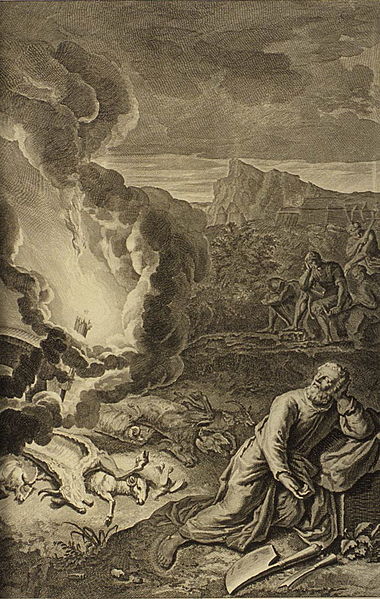
A Deep Sleep Came Upon Abraham and a Horror Siezed Him, as in Genesis 15: 12 from 1728 Figures de la Bible illustrated by Gerard Hoet (1648-1733)

A Deep Sleep Came Upon Abraham and a Horror Siezed Him, as in Genesis 15: 12 from 1728 Figures de la Bible illustrated by Gerard Hoet (1648-1733)

Jeremiah 24-Exile, Figs and Reversals

Baskets-of-good-and-bad-figs,-Jeremiah-24,-tb092506048-bibleplaces

1 The LORD showed me two baskets of figs placed before the temple of the LORD. This was after King Nebuchadrezzar of Babylon had taken into exile from Jerusalem King Jeconiah son of Jehoiakim of Judah, together with the officials of Judah, the artisans, and the smiths, and had brought them to Babylon. 2 One basket had very good figs, like first-ripe figs, but the other basket had very bad figs, so bad that they could not be eaten. 3 And the LORD said to me, “What do you see, Jeremiah?” I said, “Figs, the good figs very good, and the bad figs very bad, so bad that they cannot be eaten.”
4 Then the word of the LORD came to me: 5 Thus says the LORD, the God of Israel: Like these good figs, so I will regard as good the exiles from Judah, whom I have sent away from this place to the land of the Chaldeans. 6 I will set my eyes upon them for good, and I will bring them back to this land. I will build them up, and not tear them down; I will plant them, and not pluck them up. 7 I will give them a heart to know that I am the LORD; and they shall be my people and I will be their God, for they shall return to me with their whole heart.
8 But thus says the LORD: Like the bad figs that are so bad they cannot be eaten, so will I treat King Zedekiah of Judah, his officials, the remnant of Jerusalem who remain in this land, and those who live in the land of Egypt. 9 I will make them a horror, an evil thing, to all the kingdoms of the earth– a disgrace, a byword, a taunt, and a curse in all the places where I shall drive them. 10 And I will send sword, famine, and pestilence upon them, until they are utterly destroyed from the land that I gave to them and their ancestors.

This vision takes place in the time between the initial exile of 598 BCE and the final massive deportation of 587 BCE. In 598 BCE, when the Babylonians come and deal with the people of Judea and the city of Jerusalem without the Judeans being able to effectively oppose them they take the elite of the land into exile leaving Zedekiah to reign in place of the removed Jeconiah. For the elite taken into exile it seems like the ending of everything they know, but they are the basket of good figs. This is the same exile spoken of, for example, in the beginning of the book of Daniel:

3 Then the king commanded his palace master Ashpenaz to bring some of the Israelites of the royal family and of the nobility, 4 young men without physical defect and handsome, versed in every branch of wisdom, endowed with knowledge and insight, and competent to serve in the king’s palace; they were to be taught the literature and language of the Chaldeans. (Dan 1:3-4)

With the officials, the artisans and the smiths taken into exile with King Jeconiah, what remains to surround the newly appointed Zedekiah are those who have risen to fill the void of power left by the removal of the elite. As Binyamin Lau describes it:

Whereas the exiled leaders had the capacity for leadership, their replacements come from the dregs of society, seizing the leadership vacuum as an opportunity to accumulate power. Violence and aggression prevail as paupers become princes overnight. Might makes right. King Zedekiah, young, weak, and bankrupt, cannot control the situation. (Lau, 2013, p. 131)

To those in exile there is now a word of hope. With their homes, wealth, position and status gone now God will act on their behalf to bring them back, to plant and to give them a new heart. Perhaps in the exile they will again find what it means to be the people of God. But for those still in Judah, the new officials of Zedekiah, the city of Jerusalem and the people of the land the nightmare is not over. Zedekiah will be led once again into conflict with Babylon and Babylon’s answer will be decisive. At this time where the people remaining in the land probably look upon those in exile as cursed and themselves as blessed, Jeremiah points to the opposite reality. Their horror still remains to come, they are not yet ready to receive a word of hope. Their course will still rely upon Egypt rather than the Lord. Just as the Assyrians became the instrument of judgment for the northern kingdom of Israel according to the prophets of that time, Babylon is the instrument of God’s judgment for Jeremiah. To oppose Babylon is to oppose God’s will at this time. The baskets of figs, good and bad point to a reality that defies the reality the people are experiencing at the time. The first harvest of the people out of the land become the first-ripe figs and in Jeremiah’s world of absolutes those left on the tree have spoiled and the time when they are swept away is quickly approaching.

Jeremiah 21: The Kingdom Laid Low

stump_by_abstractmatter-d5c3key

Jeremiah 21

This is the word that came to Jeremiah from the LORD, when King Zedekiah sent to him Pashhur son of Malchiah and the priest Zephaniah son of Maaseiah, saying, 2 “Please inquire of the LORD on our behalf, for King Nebuchadrezzar of Babylon is making war against us; perhaps the LORD will perform a wonderful deed for us, as he has often done, and will make him withdraw from us.”

 3 Then Jeremiah said to them: 4 Thus you shall say to Zedekiah: Thus says the LORD, the God of Israel: I am going to turn back the weapons of war that are in your hands and with which you are fighting against the king of Babylon and against the Chaldeans who are besieging you outside the walls; and I will bring them together into the center of this city. 5 I myself will fight against you with outstretched hand and mighty arm, in anger, in fury, and in great wrath. 6 And I will strike down the inhabitants of this city, both human beings and animals; they shall die of a great pestilence.

 7 Afterward, says the LORD, I will give King Zedekiah of Judah, and his servants, and the people in this city– those who survive the pestilence, sword, and famine– into the hands of King Nebuchadrezzar of Babylon, into the hands of their enemies, into the hands of those who seek their lives. He shall strike them down with the edge of the sword; he shall not pity them, or spare them, or have compassion.

 8 And to this people you shall say: Thus says the LORD: See, I am setting before you the way of life and the way of death. 9 Those who stay in this city shall die by the sword, by famine, and by pestilence; but those who go out and surrender to the Chaldeans who are besieging you shall live and shall have their lives as a prize of war. 10 For I have set my face against this city for evil and not for good, says the LORD: it shall be given into the hands of the king of Babylon, and he shall burn it with fire.

                11 To the house of the king of Judah say: Hear the word of the LORD, 12 O house of David! Thus says the LORD:

Execute justice in the morning,

and deliver from the hand of the oppressor

anyone who has been robbed,

or else my wrath will go forth like fire,

and burn, with no one to quench it,

because of your evil doings.

                13 See, I am against you, O inhabitant of the valley,

                O rock of the plain, says the LORD;

you who say, “Who can come down against us,

or who can enter our places of refuge?”

14 I will punish you according to the fruit of your doings, says the LORD;

I will kindle a fire in its forest, and it shall devour all that is around it.

A little context helps to make sense of this passage. So many times people had not wanted to hear Jeremiah’s words but now the king sends Passhur, a different Passhur from the previous chapter, and Zephaniah to seek the prophet’s words. King Zedekiah was appointed in the time between the two exiles as a puppet king of the Nebuchadrezzar, a child of Josiah was left to rule over a bankrupt kingdom with most of its leaders taken into exile into Babylon after the first time the Babylonians conquered the city, and as Rabbi Lau paints the picture

Whereas the exiled leaders had the capacity for leadership, their replacements come from the dregs of society, seizing the leadership vacuum as an opportunity to accumulate power. Violence and aggression prevails as paupers become princes overnight. (Lau, 2013, p. 131)

In the nine years between 597 and 586 BCE the majority of the people of the land remain in Judea, but there are many who long for Judea’s former status as an independent nation. In 594 BCE there is a regional summit of the nations in the region in which the leadership sets a pro-Egypt and anti-Babylonian policy. When Judea begins to delay making its payments of dues to the Babylonian empire they are slow to respond, trying to resolve things diplomatically, but by 588 BCE it is clear to the Babylonians that more drastic measures are called for and they launch a punitive campaign against Judah. Every hope seems dashed, the support they desired from Egypt has not been delivered, the Babylonians are rolling over the fortified cities to the north of Jerusalem and nothing seems to be stopping their advance, so Zedekiah sends to Jeremiah in a last gasp of hope.

This is the time immediately before the final exile in 586 BCE the king and his entourage see the writing on the wall and hope for a rewrite, but God is not giving them the answer they seek. There is no undoing the bad decisions of the past, the ways they have trusted in their own strength or their alliances with other nations and not in God and no eleventh hour return is going to stay the consequences of their actions at this point. Even beyond surrendering the people to the consequences of their own actions, God is against the people at this point. The only way out the prophet gives is surrender, to abandon the city and beg for the mercy of the Babylonians. There is a way to life, but it leads through the death of all that is known before. The last sprout of the Davidic line of kings is about to be chopped down, the city left as a waste and the people of the land will soon be landless. They are entering the time of broken dreams and hopes were all that is to be seen in the immediate future is desolation and despair. This is not the end of the story, but it is the hell that the people and the prophet will endure in their immediate future and their only hope is that, as in ages past, their God will look down and see their oppression in a foreign land and bring them out once again with a mighty hand.

purple rose 01 by picsofflowers.blogspot.com