Church in a Risky Environment

Unstable environment

I had the privilege to be a part of a pair of lectures by Diana Butler Bass last weekend at my synod convention which really helped me get a better view of the spiritual climate change going on within the country. There has been a lot of press given to the decline of the mainline denominations, which includes the Evangelical Lutheran Church in America which I am a pastor within, and there have been a number of ‘self-help’ approaches to the problem trying to create better programming, better worship experiences, better outreach, better stewardship and the list can go on and on. It is not that the people doing ministry today are less skilled than people doing ministry in the 1950s and 1960s when many congregations were experiencing their peaks, but the reality is that they are trying to be church in a risky and changing environment. This first post will deal with some of the more depressing information, but be patient-I actually found a lot of hope in the midst of what I learned.

Over the past five decades the percentage of the population that identifies itself as Christian has gone from 97% to 73% with the largest drop being among white Protestant Christians, which have dropped from 66% of the population to 48% between 1960 and 2012. Most people would assume that when you split the Protestants into Mainline Protestants (typically more moderate to liberal including the United Methodist Church (UMC), Evangelical Lutheran Church in America (ELCA), Presbyterian Church USA (PCUSA), Episcopal Church, American Baptist Church, the United Church of Christ (UCC), Disciples of Christ and the Reformed Church USA) and into Evangelical Protestants (which are too numerous to mention but for the purposes of study included groups that identified as Evangelical, Fundamentalist, and Charismatic) were declining at the same rate. This seems counterintuitive since there are most mega-churches are evangelical in their leaning, but the reality is that they are predominantly absorbing members from other congregations. Another surprise was the fastest declining denomination was the Southern Baptists, which in the current culture should not be surprising, but nobody has been talking about the Evangelical decline until fairly recently. Catholics are holding steady, primarily because of immigration and black or Hispanic communities of faith are either holding their own or growing as a percentage of the population. This has also been the time where the ‘nones’ which include atheists, agnostics, nothing in particular and spiritual but not religious went from registering as roughly 1% of the population to 20%, 1 in 5.

One of the most common reactions to changes in the environment around any person or group is fear, and fear has definitely been a driving force for many Christian groups in the recent years. There is almost a militant reaction against the current culture by some of the more conservative religious organizations and individuals. Especially after the last Presidential Election Campaign was complete there was a lot of evidence (which I will share in the next presentation) that they no longer were the decisive block that could determine who would remain in power, and as they look at the manner in which their cohort is aging the news gets worse. Sometimes this has even turned to rhetoric claiming that they are being oppressed for their religious viewpoints because not everyone will concede that their viewpoint is correct, when the reality is that they are now one within a much more varied religious landscape where there is no clear majority and no one group has a monopoly on defining religion and spirituality within the current culture. For some people what I have shared today is incredibly bad news, as will be some of the information I share in some upcoming posts, but it also represents an incredible possibility to re-imagine the way we are church in a changing culture and how we have a dialogue about issues of faith in our culture.

purple rose 01 by picsofflowers.blogspot.com


Metaphors of Reality

Newton by William Blake (1795)

Newton by William Blake (1795)

One of the sets of vows that is commonly used when I do weddings includes the words “to better understand ourselves, the world and God.” One of the things we do as humans with our language to better understand ourselves, the world and God is we attempt to describe objects and actions and their interactions. All of these words, symbols and ideas are constructed within a system to give meaning and sense to them, for example in the world of mathematics 1 + 1 = 2, if the rules of the system were different 1 +1 could equal a different number, but the rules that the system works within allow 1 + 1= 2 to be the correct answer while 1 + 1= 3 would not make sense within the system. The systems we understand the world within are attempts to describe the reality we observe and know, and yet they are always metaphors or propositions of reality. As Jacob Bronowski states:

I believe that all the kind of scientific descriptions that we can make about one another are perfectly real. And yet, I believe that any theory that we as human beings make at any point in time is full of provisional decodings which to some extent are as fictitious as the notion of force in Newton. (Bronowski, 1978, p. 58)

As Bronowski alludes to, Newton’s description of force, particularly the force of gravity where “the gravitational attraction is proportional to the mass of the two bodies divided by the square of the distance between some point in each mass.” Or in the symbolic language of science:

G=  k ( m m’) / r2

Which as a description of reality worked well in a system of Newtonian based physics, but when Albert Einstein published his first paper on relativity in 1905 it demonstrated the flaw in the concept and proposed a new way of describing the reality,  and yet even Einstein’s theory is no longer held to be an ultimate description of reality- yet both the work of Newton and Einstein and countless other scientists (just to stay within the scientific realm of creativity) work well for describing reality as it is encountered and it is only when we find exceptions to the rule where we begin to wonder what might cause these anomalies, is the way we have constructed reality inaccurate in some manner and we begin to wonder if perhaps there is some new way to understand the world our senses observe and to describe it so that others can encounter the world in a new way.

Science is not the only discipline that works this way, think for example in the realm of religion. At various point in history different metaphors have served as a dominant metaphor for understanding God. For example, at the beginning of the enlightenment where the clocks and watches were one of the most complicated pieces of technology available that most people would encounter in their world there was the common image of God as the clockmaker who constructed the world and then allowed it to run. It is not coincidental that this was a time in which deism was the primary philosophical tool for talking about God and the deist view of God was a God that was for the most part uninvolved in the day to day undertakings of the world. This is not the dominant picture of God today and there are a number of problems with this image, but it was how many religious people of that time tried to make sense of God in a way they could imagine.

Here I think is where the mystical tradition of talking about God can help us out: on the one hand there is the cataphatic tradition which in a positive manner says that our language can point to God while, on the other hand, there is the apophatic tradition which states that our language is never adequate to describe God. Moving back to our world and ourselves there is a sense in which our language describes reality, for example I can say that I have hazel eyes or that I am around 6’2” tall but ultimately my descriptions, even of myself, will never be completely adequate to convey all of who I am. Our understanding of the world around us is also provisional or metaphorical, that doesn’t mean it is incorrect-but it may not be complete. I think the French language has a helpful construct here with its two words that we can translate into the English ‘to know.’ The French word savior refers to knowing a fact, knowing how to do something or to know something by heart. The French word connaître refers to knowing a person or being familiar with a person or thing. There is a sense where we can know about and describe individual things but people, for example, are not reducible to a set of facts. We can describe others, ourselves, the world and even God, but that sense of knowing is always based upon our relation to those things and is in its own way contingent on the systems we understand them within. Each of these systems are really theories about the nature of the world and there may be times where we find our own metaphors of reality are inadequate and need to be reexamined as we attempt to make sense of our relationship to the reality we encounter.

purple rose 01 by picsofflowers.blogspot.com

Creativity for Fun

Jay Silver’s fun little video is really about the joy of discovery and interacting in new and playful ways with the world around us. The creativity he shows in the video is from manipulating and combining things that normally don’t go together and just experimenting (which is often how many discoveries come). Something as simple as the Makey-Makey circuit allowed for others to take this basic circuit and use it in numerous ways. Sometimes the discoveries and uses were unexpected, like the dad who decided to use the circuit to help create a controller for his son with cerebral palsy-a very useful invention. Many were just for fun and the delight of trying to create music, sound and interactions in new and creative ways.

Play is an under recognized form of learning, but it is something that all mammals do to learn, experiment and interact with their world. There is a sense of joy with playfully interacting with the world around us and exploring and discovering. Sometimes in the midst of the journey we encounter a problem that we have never had to answer before and we have to rethink a solution based upon the tools that are available. Necessity often can become the mother of invention, but so can playfulness. Not to take away from the work, research and knowledge that goes into the process of creation, or the frustration of failures (which all to often deter people) but as when boundaries are pushed there is often a sense of wonder at the discoveries that are eventually made.

I’m going to bring in some of these discussions on creativity as I go along. Take your own lessons and wonder from them, and hopefully you can also have something playful sparked in your own life.

purple rose 01 by picsofflowers.blogspot.com

In The Beginning Was The Sentence

Creation by Selfish Eden (deviantart.com)

Creation by Selfish Eden (deviantart.com)

Human beings have an incredible sense of perseverance when you think about it. We will take complex tasks, think them through, experiment, learn and then try to be prepared for the next time we use things. Now, on the one hand, this can lead to some unhealthy behaviors of hoarding or becoming pack rats but, at the same time, we don’t discard a tool that has become useful like animals will do. A chimpanzee may realize that it works well, for example, to use a stick to poke into an ant mound but they don’t store sticks for this use, when the chimpanzee comes upon the need he finds a stick and the same way with other tool using animals. Humans are unique in their ability to predict a future need based upon a past need and within language this also is a crucial development. (Bronowski, 1978, p. 32f.)

Now it is possible that there have been breakthroughs in animal communication that I am unaware of, but the way Bronowski illustrates this breakthrough is the concept that animals communicate not in words but sentences or ideas. For example a chipmunk may has a different signal based on danger from a snake, danger from the air, or danger from a large ground animal, but you can’t deconstruct and recombine these signals into components of danger and the type of animal-they are one unit. They paint in a way a limited verbal picture of their environment and the immediate need they need to respond to. Yet human language is different, and the way our language is structured relying on words and not sentences as the building block of communication allows for the sharing of knowledge and imagination in ways not possible otherwise. For example “Jack loves Jill” and “Jill loves Jack” even though they share the same components do not mean the same thing. Language becomes an incredibly powerful tool for conveying and sharing images, thoughts and even worldviews, a picture may be worth a thousand words but only if it is done well and the person viewing the picture can understand what it is. It is not a coincidence that early languages began with characters that represented pictorially the ideas they were trying to express, but as ideas became more and more complex and the communication of thoughts and ideas contained more and more words language evolved to use letters to create words reflecting the sound of the word. For a word either read or heard to be transformed into a visual image is an act of imagination and it may evoke different images for different readers/hearers. For example if I say “bird” someone may think of a sparrow or an eagle or an ostrich, or perhaps even an obscene gesture, words on their own begin to paint the picture and then when combined within a sentence with actions and descriptions we refine the picture.

Imagination and creativity may help with survival and with creating new tools and ideas that help an individual, but if they are going to make any lasting impression they need to be able to be communicated. The evolution of language, first spoken and later written, has made it possible to pass on and build upon the ideas of others. But there is always a process of taking the information we receive in terms of letters and sounds and reconstituting them in our mind in terms of images (and these images are often moving images-videos if you will) as we translate representations into a mental vision.

purple rose 01 by picsofflowers.blogspot.com

The Image And The Imagination

New Era by Aeon Lux on deviantart.com

New Era by Aeon Lux on deviantart.com

Humanity practices both science and art, two incredibly unique and imaginative processes where we attempt to make sense of the world and our relationship to it. Both science and art rely on imagination and vision. Jacob Bronowski highlighted to me something in our language that is very illuminating about imagination when he says, “I want you to think of the following words: visual, vision, and visionary; and image, imagery and imagination….Almost all the words we use about experiences of the kind that go into visions or images are words connected with the sense of sight.” (Bronowski, 1978, p. 10) That somehow there is something to the way we visually interact with our world is an important part of imagination, since the word image is the root of the word. It is a word that comes from crafting and shaping and playing with images in our own mind. The way we interact with our world is, of course, mediated by our senses: vision, sound, touch, taste and smell and certainly for most of our interactions we rely heavily on vision and sound. Bronowski argues that there are essentially two types of art: those dominated by sight (painting and sculpture for example) and those dominated by sound (music for example) and I would argue that there are some that are reliant on the interaction of both senses (drama, movies, etc.). Science on the other hand is dominated by the visual sense, so we can speak of observations, which refers back to the art of seeing. So perhaps one of the most critical things to imagination is the ability to see, or to interpret the senses in a way that allows the person to make sense of their world and to see alternatives and interpret interactions with it.

The visual process itself is a process of decoding, since our eyes on their own apparently don’t just take a picture and project it into the brain like an old style camera projecting onto film, but rather if Bronowski is correct (and I’m now curious since this is an older work) it would be more like the process that goes on in a digital camera where individual rods and cones in our eyes develop a level of stimulation to the light it receives and sends all the signals back to our brain which then interprets all these signals and assembles the picture in a way that is far more accurate than the individual cellular receptors in the eyes are capable of making. The very process of seeing relies upon the visual part of the brain making inferences about the world it is seeing to make up for the shortcomings in the visual organs, and that compared to most other animals we have a phenomenal portion of our brain dedicated to the process of interpreting visual input.

Combined with this process of interpreting the visual input we receive from our eyes, our brains also allow us to imagine differently-to see alternatives and to attempt to predict based what we currently see and what we have seen before. Part of what makes us such curious animals is our ability to take the images we have and to imagine possible futures, alternatives if you will. In one sense the idea of free will goes back to the idea of “visualizing alternatives and making a choice between them.” (Bronowski, 1978, p. 18) There is a lot to unpack with this revelation that imagination is a function of the process of seeing and interpreting our world and imagining other possible worlds, and that will come but perhaps part of learning to imagine is learning to pay close attention to sight (as well as sound and the other senses) and attend to the images and the possibilities.

purple rose 01 by picsofflowers.blogspot.com

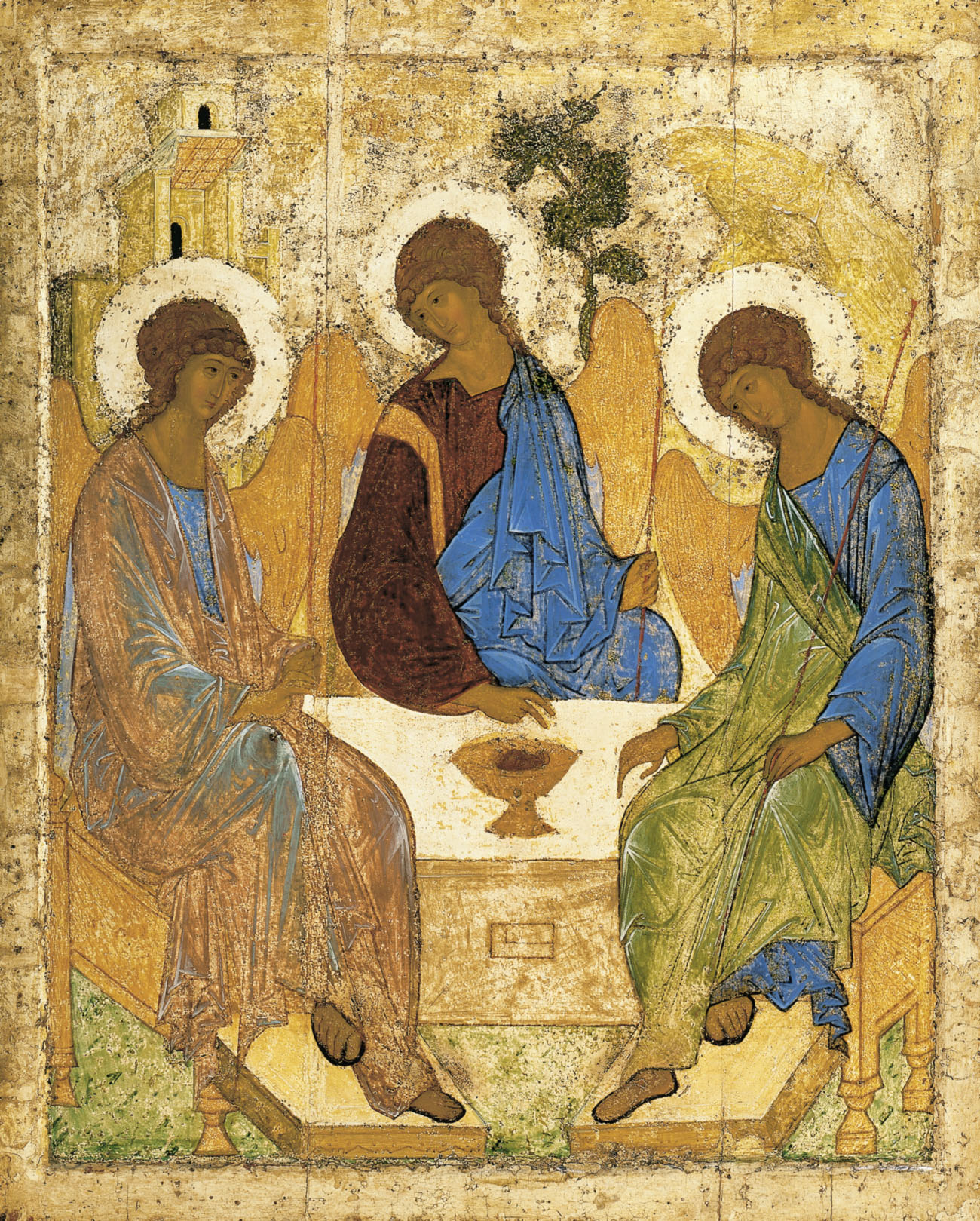
The God Who Meets Us-A Sermon for Holy Trinity Sunday

Rublev's Icon of the Holy Trinity

Rublev’s Icon of the Holy Trinity

If you had to describe what God is like to someone, how would you do it? Now I know that there is always a sense in which our words fail us and God is beyond description, but that doesn’t alleviate the need for us to talk about God and to try to say who God is and what God is about in the world. We need to understand who God is and how God acts as we try to make sense of the disasters, whether they are something huge like the tornado that devastated the city of Moore and parts of New Castle, Shawnee and Oklahoma City last week or whether they are the more personal disasters we may encounter in our lives. How do I talk about God in the midst of the ending of a marriage or the loss of employment, in having to move-where is God in the midst of these things and who is God in the midst of all of these things. We may argue with God, question God’s character, weep with God and yet I am becoming more and more convinced that we do our best to describe in some way the God we come to know in the midst of our lives-or the God we want to come to know in the midst of our crises and cries.

Today is Trinity Sunday, now every Sunday is a Sunday in which we attempt to talk about God and the way God interacts in the world, but on Trinity Sunday we come to talk about the God who meets us in the Father, the Son and in the Spirit and we celebrate a concept about God-a way of talking about God that the early church leaders felt was their best answer to give words to the experience of God they had experienced and the world had experienced. It is the picture of a God who is always coming down to be a part of the world and a part of the lives of God’s people. It is a mystery, we cannot adequately describe everything about God, but we try to use the language of the scriptures, tradition and our experience to give a frame of reference to talk about the God who creates, who renews, who enters into relationships and restores peace and the God who loves. Unlike most other stories of the ancient world, the Bible’s story of creation is not a story of a god who subdues and conquers an evil world but rather a God who speaks into being a good world that God loves, that God wants to be a part of. From the earliest stories of Adam and Eve we see God’s desire to come down and to be a part of the lives of Adam and Eve, of Abraham and Sarah, of Jacob and Leah and Rachael, of Moses and Aaron and Miriam, of Samuel and Solomon and of many others. God was not content to be separate and distant from their lives, no instead God chose to come down and interact with them. We see a God who loves the world for all its warts and worries. The entire purpose of the people of God building first a tabernacle and then under Solomon a temple was so that God could dwell in the midst of God’s people. God would continue to send God’s Spirit upon the prophets and priests and sometimes even kings to speak to the people. In the Book of Proverbs we hear about the wisdom of God which was there at the beginning of creation and the prophets can often talk about the Spirit of the Lord coming upon them, but at the same time somehow the LORD their God was one, and there was only one God. And yet they Jewish people used the language they had to try to talk about who their God was.

Yet God was not content to dwell in houses made of stone, to remain locked behind the walls of a temple or a tabernacle. God is many things, but never tame, never safe, God is good and loving but never safe. In the prophets we began to hear the hope for a new relationship God was creating with God’s people and who God’s people were was about to move beyond the boundaries of the Jewish people as God continued to love the world. In the words of the prophet Jeremiah:

31 The days are surely coming, says the LORD, when I will make a new covenant with the house of Israel and the house of Judah. 32 It will not be like the covenant that I made with their ancestors when I took them by the hand to bring them out of the land of Egypt– a covenant that they broke, though I was their husband, says the LORD. 33 But this is the covenant that I will make with the house of Israel after those days, says the LORD: I will put my law within them, and I will write it on their hearts; and I will be their God, and they shall be my people. 34 No longer shall they teach one another, or say to each other, “Know the LORD,” for they shall all know me, from the least of them to the greatest, says the LORD; for I will forgive their iniquity, and remember their sin no more. Jeremiah 31: 31-34


Or in the prophet Joel which we heard last week at Pentecost:

28 Then afterward I will pour out my spirit on all flesh;

your sons and your daughters shall prophesy,

your old men shall dream dreams,

and your young men shall see visions.

 29 Even on the male and female slaves,

 in those days, I will pour out my spirit. Joel 2: 28-29


At Christmas we celebrate this Word of God that was there in the midst of creation, that was with God and was God coming down, sharing our life, putting on flesh and living among us. This Jesus of Nazareth came and proclaimed the kingdom of God and in his healings, his words, his actions, his forgiveness of sins and his life people encountered something they hadn’t before. Somehow in the midst of this man people were encountering God. Somehow he was more than just a righteous and holy person and it was really after the resurrection at Easter that those who had been with him began to understand in a new way that this really was God dwelling and walking among us. And yet there was Jesus and there was the Father who Jesus had prayed to and somehow they were both God. The early church would wrestle with how exactly they were going to talk about this, but ultimately in both Jesus and the Father they had encountered God and they needed some way to give honor and praise to the God who had continued to come down and dwell among them.

At Pentecost we celebrate the Spirit coming down and the disciples and the people encountered a presence that was somehow undeniably of God. And yet this was the Spirit that was there throughout the ministry, it was the Spirit that also had moved over the waters of creation, the Spirit that had spoken through the prophets. And as the early church tried to make sense of this God they had encountered in Jesus, in the Father and in the Spirit they talked about God as Trinity. It was a way of giving language, words to the experience of the God who comes down, who loves the world and us so much that God cannot seem to help but want to be a part of our lives.

Yet wherever God the Father is active, when we look we find the Son and the Spirit, and when Jesus is active the Father and the Spirit are there, as Jesus can say to his followers :

12 “I still have many things to say to you, but you cannot bear them now. 13 When the Spirit of truth comes, he will guide you into all the truth; for he will not speak on his own, but will speak whatever he hears, and he will declare to you the things that are to come. 14 He will glorify me, because he will take what is mine and declare it to you. 15 All that the Father has is mine. For this reason I said that he will take what is mine and declare it to you. John 16: 12-15


The Spirit speaks what the Spirit hears, the Father and the Son share in this ministry. The Spirit bears witness to the Son and the Father. Sometimes people will talk about the Father being about creation, the Son about redemption, and the Spirit about the new life-but each are involved in all three, for example when Paul talks about redemption:


Therefore, since we are justified by faith, we have peace with God through our Lord Jesus Christ, 2 through whom we have obtained access to this grace in which we stand; and we boast in our hope of sharing the glory of God. 3 And not only that, but we also boast in our sufferings, knowing that suffering produces endurance, 4 and endurance produces character, and character produces hope, 5 and hope does not disappoint us, because God’s love has been poured into our hearts through the Holy Spirit that has been given to us.


That somehow this action involves all of God but we encounter God and Jesus and the Spirit all working at the same time to give us peace and pour love into our hearts. We are made a part of what God is doing in the world and as God suffers we also encounter the suffering that is a part of love. At some point it is probably simpler to say 1+1+1=3 and stick with pictures and diagrams of how God the Father and God the Son and God the Spirit interact and are related. This picture from the Church Center is just that, one of the traditional representations of three in one, yet ultimately this is not about a concept of God, it is about the God who loves the world and who we encounter throughout the story, throughout times and in the experience of our own lives, a God who loves and comes down to dwell with us. A God who we encounter in Jesus and the Spirit and in the God who is the creator of all things, and somehow they are all somehow God and yet we experience them in different times and different manners.

purple rose 01 by picsofflowers.blogspot.com

Creativity, Spirituality and Shame

creativity

As I embark on the thought experiment I call the creativity project which will not be in any way systematic, but a set of explorations from various perspectives around topics of creativity, spirituality, and imagination I am going to start in what many will initially think is an unusual place: shame. Brené Brown’s work on shame has been one of the most revealing perspectives in what limits or destroys our capacity for creativity. Shame as Brené defines it is:

Shame is the intensely painful feeling or experience of believing that we are flawed and therefore unworthy of acceptance or belonging. (Brown, 2007, p. 4)(emphasis author’s)

Shame is that emotion that tells us that we are unworthy, unloved or unloveable, it can allow an action or another’s perspective to define who we are in our own eyes. It shouldn’t be surprising that this incredibly powerful fear can dampen if not kill creativity for an individual or an organization and that it can also by extension powerfully effect spirituality.  In Brené Brown’s book I Thought It Was Just Me she makes this insightful comment which is well worth the two paragraphs it spans:

I did see important patterns and themes in terms of how women experienced their faith and spirituality. For example, the women who talked about feeling shame used the words church and religion more. The women who talked about resilience used the terms faith, spirituality and beliefs more. At first I wondered if there was a connection between “organized religion” and shame. I didn’t find one. At least half of the women who used the terms faith, spirituality, and beliefs attended church and were members of an organized religion.

What did become clear to me is this: It is the relationship that women have with God, their higher power or their spiritual world that often serves as the source of resilience. The essence of resilience, in a spiritual sense, is about relationship, spirit and faith. For many women, spiritual connection is essential to shame reliance. In fact, over half of the women, who, as children, experienced deep shame around religion developed shame resilience by forging new spiritual paths. They may have changed churches or their beliefs, but spirituality and faith remain an important part of their lives. Another pattern that emerged is the belief that faith is about nurturing our best selves and shame moves us away from that purpose. The sources of shame seem much more connected to earthly, man-made and interpreted rules and regulations and social-community expectations around religion (Do you go to church regularly? Are you loyal to your family religion? Are you raising your kids a certain way? Are you breaking rules that might shame the family or the community? Do you know your place as a woman?). (Brown, 2007, p. 259f)

Brené’s later two works, The Gift of Imperfection (Brown, 2010) and Daring Greatly (Brown, 2012) (which I blogged about in the posts Daring Greatly, Cultures of Scarcity, and Shame on You) she moves to the concept of vulnerability as the characteristic that people who feel loveable (and are able to move beyond their shame) share. This vulnerability allows people to be courageous, compassionate and connected with others. In contrast fear, disengagement and yearning for more courage may come out of an environment’s or an individual’s shame. For example when shame is a management style “engagement dies. When failure is not an option we can forget about learning, creativity and innovation.” (Brown, 2012, p. 14)

As we think about the type of community’s that will nurture creativity and spirituality for the coming generations we need to pay close attention to the ways shame, fear, manipulation and coercion are used. Do we have communities where people are valued for their conformity or for their individuality? Do we have communities where people feel they need to fit in (shame is the fear of being disconnected)? Can we be a place where not only failure but forgiveness is an option? Do churches begin to reflect the culture of scarcity we experience in the world around us or can we dare greatly and trust greatly in the abundance that is found in our own faith?

The reality is that many if not all communities and individuals have a long way to go in nurturing a climate of acceptance, connection, resilience and support, faith and spirituality. It is a journey that we must undertake if we are really going to be about helping people in their relationship with God and with one another. The likelihood is that on the journey there will be many failures, many times where we will need to be forgiven for returning to shame for motivation, and hopefully on the way we may all grow both more courageous and more vulnerable and more resilient to the shame which dampens our creativity and spirituality.

I’ve included another of Brené Brown’s talks and I love the comment she makes that “Faith-vulnerability=extremism, that faith is the vulnerability that flows between the shores of certainty…spirituality is inherently vulnerable.”

purple rose 01 by picsofflowers.blogspot.com


Tears in the Red, Red Clay

Severe Weather

They had heard the sirens moan before
Within the sleepy town of Moore
They had felt the pain and loss of a storm
And May of ninety nine they still mourn
But nobody was prepared for this day
When tears would fall upon red, red clay

In Oklahoma the wind is part of life
Normally passing without much strife
Even tornadoes are part of the spring
With their rumbling groaning songs they sing
But rare is the monster that ruled this day
When tears would fall upon red, red clay

In the aftermath of the evil wind
Laid homes and schools and those within
Many still living, too many lost
And all of us observing the cost
Of nature’s fury put on display
On a tear-filled day on the red, red clay

No words of mine can soothe the pain
Of those whose lives were torn in twain
But my thoughts and prayers go out the same
To the people of Moore who struck their claim
And weep and morn for children not at play
On the tear soaked ground of red, red clay

Neil White, May 21, 2013

for those who endured the tornado in Moore, Oklahoma May 20, 2013 and those who will help with the recovery

purple rose 01 by picsofflowers.blogspot.com


The Prophet Who Hears and The People Who Don’t: Jeremiah 7: 16-26

Martin_Luther_King_Jr_NYWTS

Jeremiah 7: 16-26

16 As for you, do not pray for this people, do not raise a cry or prayer on their behalf, and do not intercede with me, for I will not hear you. 17 Do you not see what they are doing in the towns of Judah and in the streets of Jerusalem? 18 The children gather wood, the fathers kindle fire, and the women knead dough, to make cakes for the queen of heaven; and they pour out drink offerings to other gods, to provoke me to anger. 19 Is it I whom they provoke? says the LORD. Is it not themselves, to their own hurt? 20 Therefore thus says the Lord GOD: My anger and my wrath shall be poured out on this place, on human beings and animals, on the trees of the field and the fruit of the ground; it will burn and not be quenched.

 21 Thus says the LORD of hosts, the God of Israel: Add your burnt offerings to your sacrifices, and eat the flesh. 22 For in the day that I brought your ancestors out of the land of Egypt, I did not speak to them or command them concerning burnt offerings and sacrifices. 23 But this command I gave them, “Obey my voice, and I will be your God, and you shall be my people; and walk only in the way that I command you, so that it may be well with you.” 24 Yet they did not obey or incline their ear, but, in the stubbornness of their evil will, they walked in their own counsels, and looked backward rather than forward. 25 From the day that your ancestors came out of the land of Egypt until this day, I have persistently sent all my servants the prophets to them, day after day; 26 yet they did not listen to me, or pay attention, but they stiffened their necks. They did worse than their ancestors did.


Now the audience shifts from Jeremiah speaking to those who listen at the temple gate to God speaking to Jeremiah. Jeremiah seems to have become the one who God can speak to when everyone else has stopped listening and now God tells Jeremiah not to intercede for the people anymore. God is tired of listening, God is at the point of giving up. God is tired of being patient, of waiting for the people to return. On the one hand we see a religious practice within the families that are putting a lot of effort into worshiping other gods as a household, on the other hand the cultic practice of the temple is lifted up as something that replaced obedience. Sacrifices and religious practice have replaced the central command to hear and listen.

The prophetic and the priestly voice are in direct contest to determine who will speak for God. Often this is the case, the priestly voice is the voice of the settled people where the prophetic is calling people back to obedience. The priestly voice is focused on maintaining an institution, while the prophetic is concerned with faithfulness to their calling. There is always the temptation within a priestly role to tell people what they want to hear, while prophets tend to say the things nobody wants to hear. Ideally an individual would be able to fulfill both callings, but the reality is that both find themselves in tension with one another.

Prophets are rarely appreciated in their own time and in their own lifetime, and sometimes even when they are recognized they are also de-fanged. For example, with Martin Luther King, Jr. we have all become familiar with his ‘I have a dream speech’ but much of his criticism of the war in Vietnam or economic injustices have been muted under the remembrance of him purely as a person who advocated for greater inclusivity of people of all races. I think something similar has happened with Jeremiah, select portions of Jeremiah have made it into the various lectionary systems and Jeremiah doesn’t have the memorable stories of Daniel or Jonah and so his protest is included, he is honored and his protest is forgotten.

purple rose 01 by picsofflowers.blogspot.com

The Spirit of Creativity-A Poem

holy-spirit-fire3

At play in the depths of chaos before time began
Dancing in the dangerous depths of the waters of creation
Playfully forming light and darkness, earth and sky
Throughout the ages bringing form to the formless
Giving substance to the wisdom and words of God
Delighting in bringing new and unusual forms of life
Shaping and creating with the molecules and elements of dust and the air
Over the eons you listened and danced and played
Giving birth to the world you delighted in
And it was good

From the smallest creature to the wisest person
Your breath fills our lungs and animates our bodies
You knit us together in our mother’s womb
Forming us each as unique masterworks enduring for a moment
Some of us have recognized the brushstrokes of your work
Others endure unaware of your wind blowing through the world
A few have breathed in deeply allowing you to possess them
While others have been brushed by your fingertips in a moment of inspiration
In the midst of it all you dance and play throughout time
Renewing life in the world you delighted in
And it was good

Never there to be controlled by any priest or king
Instead sometimes you would possess and prophesy
And young men would dream dreams and old men would see visions
The great and the small could all be caught up in the ecstacy of your movement
Never tamed for you are the breath of creation
The Spirit who can play with Leviathan and dance with the Behemoth
Yet sometimes you were content to rest in this dust and clay
Opening eyes, revealing truth and love and beauty
Giving gifts for service and building up the community
Dancing on the edges of dreams and playing with the prophets
Dreaming of the vision of a world renewed
Pointing to the life you dream for the world you delighted in
That it would be good

You came down to the world you created like a descending dove
Like a rushing wind, like tongues of fire, in visions and dreams
Always present yet never grasped and defying words to describe
Yet you move the mountains and shatter the power of fear
You are there pulling the wary disciples of all ages beyond their comfort
Beyond their homes to the ends of the earth and beyond
Interceding in words to deep for sighs and moaning in the brokenness
The wounded creation and a fearful people
Revealing the children of God, opening eyes and dreaming dreams
Moaning in the birth pangs of the new creation
Giving birth to that which is good

Breathe in us breath of God and renew our lives
As you playfully created throughout the eons
Now continue to mold and shape us to be the children of God
The world is longing for as it waits for redemption
In the midst of our own sighing may we hear your voice
And in the midst of brokenness may we hear the music you are dancing to
As you dream and sing a new creation in the midst of the old
Renewing and revitalizing, refreshing and recreating
Dancing and playing and singing and dreaming
For your delight is what enervates the dawning of the new age
And it is good

Neil White, 2013

purple rose 01 by picsofflowers.blogspot.com