Psalm 74 A Psalm When the World Collapses

Memorial to the Main Synagogue in Munich which was destroyed during Kristallnacht, November 10, 1938. Psalm 74:18 is used in the center of the monument.

Psalm 74

<A Maskil of Asaph.>
1 O God, why do you cast us off forever? Why does your anger smoke against the sheep of your pasture?
2 Remember your congregation, which you acquired long ago, which you redeemed to be the tribe of your heritage. Remember Mount Zion, where you came to dwell.
3 Direct your steps to the perpetual ruins; the enemy has destroyed everything in the sanctuary.
4 Your foes have roared within your holy place; they set up their emblems there.
5 At the upper entrance they hacked the wooden trellis with axes.
6 And then, with hatchets and hammers, they smashed all its carved work.
7 They set your sanctuary on fire; they desecrated the dwelling place of your name, bringing it to the ground.
8 They said to themselves, “We will utterly subdue them”; they burned all the meeting places of God in the land.
9 We do not see our emblems; there is no longer any prophet, and there is no one among us who knows how long.
10 How long, O God, is the foe to scoff? Is the enemy to revile your name forever?
11 Why do you hold back your hand; why do you keep your hand in your bosom?
12 Yet God my King is from of old, working salvation in the earth.
13 You divided the sea by your might; you broke the heads of the dragons in the waters.
14 You crushed the heads of Leviathan; you gave him as food for the creatures of the wilderness.
15 You cut openings for springs and torrents; you dried up ever-flowing streams.
16 Yours is the day, yours also the night; you established the luminaries and the sun.
17 You have fixed all the bounds of the earth; you made summer and winter.
18 Remember this, O LORD, how the enemy scoffs, and an impious people reviles your name.
19 Do not deliver the soul of your dove to the wild animals; do not forget the life of your poor forever.
20 Have regard for your covenant, for the dark places of the land are full of the haunts of violence.
21 Do not let the downtrodden be put to shame; let the poor and needy praise your name.
22 Rise up, O God, plead your cause; remember how the impious scoff at you all day long.
23 Do not forget the clamor of your foes, the uproar of your adversaries that goes up continually.

This is one of several places in scripture where poets and prophets wrestle, together with the rest of the people of God, over the loss of the temple and the transport into exile. Some of these reflections engage with the deep hurt and anger at the loss of their home, like Psalm 137. Others, like Jeremiah or 2 Kings, point to the unfaithfulness of the people in their relationship with God as being responsible for the disaster. Psalm 74 also attempts to make sense of the destruction and violence that has been encountered and wonders how long it will be before God acts to restore the people and fulfill God’s portion of the covenant. In the aftermath of a defeat at the hands of an enemy which has destroyed both their military resistance and the symbols of their faith the psalmist calls upon God to act and restore the people and the house where God’s name dwells.

The defeat of Jerusalem by Babylon and the destruction of the temple causes a crisis of identity for the people of Judah. The temple, more than just a building but a symbol of their faith, the Davidic king, promised to reign perpetually, and the land have all been taken away and those who have attempted to remain faithful to the covenant now have to reshape their identity without these central aspects of their life. Unlike in the prophets or in the narration of Israel’s history, there is no confession of guilt here. Perhaps the psalm comes from a place still too fresh for that type of reflection, or the psalmist may view that they and those around them have remained faithful. They do not question the justice of God’s action against the people of Judah, but they turn back to the covenant and God’s action to claim them as a people and ask for God’s restoration and forgiveness. The cause of their disaster is God’s anger and casting off of the people and their restoration can only be found in God’s turning back toward them.

The appeal is to God’s sovereignty. Although there is no confession of guilt and no declared acts of repentance the psalmist believes their enemy has gone too far. God’s anger should be kindled against them because they have burned the holy place, smashed, and vandalized the building, have placed their emblems and symbols in the places where only the name of God should dwell and have burned any place where the people could gather. The enemy’s triumph has caused not only the people of God to be scoffed, but God’s name to be dishonored. With no holy place or holy people to bear a message from God the people can only shout ‘how long’ and hope in the silence for a word from God to answer their question.

I believe that the enemies in this psalm are the Babylonians who conquered Jerusalem in 598 BCE and the language in the second half of the psalms reflects a polemic against the religion of the Babylonians that we are familiar with through the Enuma Elish where Marduk kills the great multi-headed dragon Tiamat (Leviathan) and sea monsters (dragons). In contrast it is the LORD, the God of Israel, who triumphed over the chaotic forces of the sea in the creation and who subdued the great monsters that threatened creation. This God who created the day and night, sun and stars, springs, and streams, and fixed the boundaries of the earth can act on behalf of this conquered people. The God who formed a covenant with the people in the Exodus and overcame Egypt can now overcome Babylon. The God who hears the poor and the vulnerable can now hear their cry from their oppression and will deliver. But if none of these reasons are suspicious, the psalmist calls upon God to defend God’s name from the impious who scoff at God’s power. The enemy who conquered the people has arrayed themselves against God and the people wonder aloud how long they will wait before they see God’s response to the adversaries of this generation.

Psalm seventy-four ends without a resolution and those speaking it enter into the space of waiting for God’s answer. Even in the midst of crisis the faithful ones continue the conversation with God and call upon God to act. The Babylonian exile does not end the crises that will arise for the faithful people, and this psalm has been a resource in times where national or personal identity has been challenged among the faithful. The picture above is from a memorial for the main synagogue in Munich, which was destroyed during Kristallnacht on November 10, 1938 and the center of the memorial uses Psalm 74:18 as the Jewish people would once again ask God, “how long” while an impious people in their actions destroyed the holy places of the people and in words and actions reviled the name of God.

Psalm 73 When Faith is Challenged

Love is Not a Victory March by Marie -Esther@deviantart.com

Psalm 73

<A Psalm of Asaph.>
1 Truly God is good to the upright, to those who are pure in heart.
2 But as for me, my feet had almost stumbled; my steps had nearly slipped.
3 For I was envious of the arrogant; I saw the prosperity of the wicked.
4 For they have no pain; their bodies are sound and sleek.
5 They are not in trouble as others are; they are not plagued like other people.
6 Therefore pride is their necklace; violence covers them like a garment.
7 Their eyes swell out with fatness; their hearts overflow with follies.
8 They scoff and speak with malice; loftily they threaten oppression.
9 They set their mouths against heaven, and their tongues range over the earth.
10 Therefore the people turn and praise them, and find no fault in them.
11 And they say, “How can God know? Is there knowledge in the Most High?”
12 Such are the wicked; always at ease, they increase in riches.
13 All in vain I have kept my heart clean and washed my hands in innocence.
14 For all day long I have been plagued, and am punished every morning.
15 If I had said, “I will talk on in this way,” I would have been untrue to the circle of your children.
16 But when I thought how to understand this, it seemed to me a wearisome task,
17 until I went into the sanctuary of God; then I perceived their end.
18 Truly you set them in slippery places; you make them fall to ruin.
19 How they are destroyed in a moment, swept away utterly by terrors!
20 They are like a dream when one awakes; on awaking you despise their phantoms.
21 When my soul was embittered, when I was pricked in heart,
22 I was stupid and ignorant; I was like a brute beast toward you.
23 Nevertheless I am continually with you; you hold my right hand.
24 You guide me with your counsel, and afterward you will receive me with honor.
25 Whom have I in heaven but you? And there is nothing on earth that I desire other than you.
26 My flesh and my heart may fail, but God is the strength of my heart and my portion forever.
27 Indeed, those who are far from you will perish; you put an end to those who are false to you.
28 But for me it is good to be near God; I have made the Lord GOD my refuge, to tell of all your works.

Several church communities I am familiar with have adopted the popular, “God is good all the time and all the time God is good” saying. While I do not disagree with the assertion that God is good, an honest reflection on the life of faith may question the experience of God’s goodness. One of the gifts of the psalter is that it includes prayers that wrestle with the experience of God’s goodness in a world where the wicked seem to prosper and the righteous suffer. The righteous ones in the psalms ask questions of God, speak openly of the things that make them question their way of life as they, “keep looking for truth in the midst of an imperfect world.” (Nancy deClaisse-Walford, 2014, p. 593)

What does it mean for God to be good to the upright and the pure of heart in a world where the wicked are at peace and the righteous suffer. The observation of a world where the immediate experience seems to contradict the promise of prosperity for those keep God’s covenant. In Hebrew the psalmist sees the shalom of the wicked (translated prosperity in the NRSV). Shalom indicates peace and prosperity. It is what is promised to the righteous but is now viewed by the psalmist as being received by the wicked. Their physical and emotional health is secure, they are well fed, they bear no consequences for their violent words and actions, their pride is viewed by others as a virtue. Their way of life seems to contradict the will of God and yet they seem to be rewarded in society for their self-centered actions. On a societal level this seems to have been the struggle of Israel, staying faithful to God when their neighbors seemed to prosper, and on an individual level the psalmist confesses that it nearly caused him to stray from the path and adopt the practices of these apparently successful wicked ones.

In contrast the ones who has kept their hearts clean and washed their hands in innocence have encountered suffering.   Whether their pain is physical or social, it causes them to question the efficacy of the way of life they have attempted to walk. They live in tension between their faithfulness to the circle of the faithful and their view of the peace and prosperity of the wicked. In the moment the world appears to be upside down with the wicked prospering and being commended while the righteous suffer and are excluded or taken advantage of. It is only by bringing this question to the community of faith and the place of worship that the psalmist is able to see beyond their perception of the moment.

The resolution of this psalm reminds me of the difference between climate and weather. Weather is the observation of the atmospheric conditions and their impact in a short window of time while climate looks at the compilation of individual weather observations to study the changes over time. The psalmist initially is observing the wicked within a short window of time but once they enter the sanctuary of God they see that this window of time is transitory. In the moment the wicked may experience shalom, but it is an evanescent experience that will vanish like a dream disappears upon waking. Indeed, the psalmist views the current prosperity of the wicked as an slippery slope that ultimately leads to their ruin. The psalmist confesses their own shortsightedness which caused them to question God’s goodness in the world and to consider the attractiveness of the ways of the wicked ones who lived well-fed and well-loved in their community.

The psalmist ends in a space of faith. The experience of the moment is transitory, but God is their rock that they can lean upon. God’s justice may not be experienced immediately, but the wicked will not find shalom forever, they will find that God can know and that their actions are seen. Yet, in pondering the prosperity of the wicked, the righteous one has found their treasure in being close to God. The process of questioning one’s experience has brought the poet closer to God. The prosperity of the wicked no longer seems as appealing since the psalmist desires nothing more than the presence of God. For the upright they come to know that God is good not in their experience of material prosperity but instead in God’s physical proximity.

The Book of Judges

Cracked pots, Picture taken by Enric from the Monestary of Sanahin, Armenia shared under creative commons 4.0

Transitioning into the Book of Judges

Judges 1 The Disposition of the People of Israel

Judges 2 The Pernicious Cycle of Disobedience

Judges 3 The First Three Judges

Judges 4 Deborah, Barak, and Jael

Judges 5 The Song of Deborah and Barak

Judges 6 The Calling of Gideon

Judges 7 The Collapse of the Midianite Threat

Judges 8 The Conclusion of the Gideon Narrative

Judges 9 The Brief Bloody Reign of Abimelech

Judges 10 A Brief Respite and the Pernicious Cycle

Judges 11 Jephthah and a Corrupted View of God

Judges 12 Jephthah’s Ignoble End and Three Minor Judges

Judges 13 The Birth and Calling of Samson

Judges 14 Samson and the Marriage at Timnah

Judges 15 Samson’s Fiery Vengeance

Judges 16 Samson, Delilah and a Crashing End

Judges 17 The Idol of Micah

Judges 18 A World Where Might Makes Right

Judges 19 The Levite, the Concubine, and the Violence of Gibeah

Judges 20 War Between the Tribes of Israel

Judges 21 A Tragic Conclusion

Resources on the Book of Judges

Reflections After Walking Through the Book of Judges


Reflections After Walking Through the Book of Judges

Cracked pots, Picture taken by Enric from the Monestary of Sanahin, Armenia shared under creative commons 4.0

The scriptures that both Christians and our Jewish ancestors have inherited are a deeply varied collection of works that attempt to make sense of the encounter between the people of God, the world around them, and the God who has called them. The reality that our scriptures include this violent, colorful, and disturbing book with a tragic ending is pretty exceptional because many people would attempt to hide a book that paints the tribes of Israel in an unflattering light, that contains several texts of terror, that presents Israel’s loss of identity so completely and its Judges as such flawed characters. This was a difficult book to look deeply at, not due to technical issues but because of its dark portrayal of the lawless world of this time between Joshua and the first kings of Israel.

The stories that are compiled in the book of Judges are ancient and their world is alien to us. It is hard not to impose modern ideas about civilization onto these stories, but in both technology and worldview this takes us to a very primitive place. The law as we see it outlined in the books of Exodus through Deuteronomy is absent and reading closely we see the patterns of worship often are indistinguishable from those of other communities like the Canaanites. I would agree with many modern scholars that the law probably reaches its final form much later than the events narrated in Judges, but I also am suspicious that there has been much lost from the time of Moses and Joshua where a common leader was able to unite the tribes. In a pre-literate society without a common set of leaders and where even the Levites fail to hand on the worship and the law of God we end up with a collection of tribes whose life and practices reflect the land of Canaan they live within.

The book of Judges is part of a larger pattern within the scriptures including 1&2 Samuel and 1&2 Kings which attempts to view history through a theological lens and make sense of the collapse of Israel and Judah. Many of the stories that make up Judges were probably well known and told for generations around campfires. They are stories that may point to a ‘heroic culture’ and ‘heroic individuals’ within a broader time of oppression. The narrator of Judges attempts to bring these stories in all their strangeness together into a common narrative which can point to a broader cultural disintegration among the tribes of Israel and prepare the people for the next stage in the history of the people, the time of kings. Samson, for example, struggles with his identity as a person set aside from birth for a particular calling and he does everything he can to deny this identity. Yet, Samson is reflective of Israel as a whole turning aside from their calling (in the narrator’s view) and the seemingly godforsaken world at the end of the book is reflective of Israel’s lack of faithfulness to the covenant.

I do think that the way our Jewish ancestors organized the Bible which includes Joshua through Kings as a part of the prophets (Nevi’im) rather than the writing (Ketuvim) is insightful to the purpose of this book. Instead of being a book of history which narrates the events, this is a theological telling of history to illustrate the consequence of covenant unfaithfulness for the people. The dark topics covered with the book are uncomfortable, but they have provoked some interesting and deep discussions both within the confines of these reflections and within my community. As distasteful as they may be, the texts of terror contained within the book demand a telling and my experience is that if we are unwilling to talk about them when others stumble upon them they will seek answers and not all those who talk about scripture among the broader church do it in a helpful manner.

I am glad to complete this journey. The book of Judges will probably never be one of my favorites, but I do feel like I have learned from this journey through the book. I have attempted to be sympathetic to the narrative and to as much as possible understand the stories in their context. I know my narration of this book is far less triumphal than some, and even the book of Hebrews (the one New Testament reference I’m aware of to the book) interprets it in a triumphal tone:

And what more should I say? For time would fail me to tell of Gideon, Barak, Samson, Jephthah, of David and Samuel and the prophets—who through faith conquered kingdoms, administered justice, obtained promises, and shut the mouth of lions, quenched raging fire, escaped the edge of the sword, won strength out of weakness, became mighty in war, put foreign armies to flight. (Hebrews 11: 32-34)

The book of Judges instead ends with the cry of abducted and traumatized women, the aftermath of tribes going to war with one another, and an Israel who looks more like Sodom than any vision of Zion. Just as dystopic literature can highlight the things that are wrong in our modern society, this theological exploration of this lawless and disunified time in Israel’s story helps to illuminate the dangers of the people losing their identity and conforming to the practices of the surrounding world. It may not be comfortable reading, but it can be enlightening.

Resources on the Book of Judges

This is a list of the major sources I used in this six-month excursion through the book of Judges. I picked each resource for a reason and below is a brief evaluation of each source. It is not a comprehensive evaluation of the literature on the book of Judges.

Hattin, Michael. Judges: The Peril of Possession. Jerusalem: Maggid Books, 2020.

When looking at books from the Hebrew Scriptures (Old Testament) I have tried to include a Jewish voice in the conversation, and I was introduced to the Maggid Studies in Tanakh when I was working on Jeremiah years ago. The Maggid Studies are a careful reading that are approachable without a background in Biblical Studies. Michael Hattin’s study of Judges has some keen insights from both his own readings and the Jewish history of interpretation into the reception of this unusual piece of scripture. The organization of the comments is more topical than textual and in combination with the other voices it was a valuable source.

Mobley, Gregory. The Empty Men: The Heroic Tradition of Ancient Israel. New York: Doubleday, 2005.

This is not a commentary but instead is a study into the stories of three individual judges (Ehud, Gideon, and Samson) from the perspective of ‘Heroic Culture’ and ‘Heroic Conventions.’ Looking more broadly at the literature of the ancient Middle East, Gregory Mobley attempts to provide a richer backdrop for hearing the narratives of the judges as hero stories. To me this is a useful resource to help place the book of Judges in a framework that is closer to its origins.


Olson, Dennis T. “The Book of Judges.” In New Interpreter’s Bible II: 721-888. 12 vols. Nashville: Abingdon Press, 1998.

The NIB (New Interpreter’s Bible) is a solid resource as a resource for preaching and teaching that covers the entire bible and goes into some textual issues, but it primarily is focused on giving a fuller context to the story. Dennis Olson’s contribution on Judges is very readable and much shorter than some of the other stand-alone resources on the book. It is not designed to be a textual commentary but does a good job in highlighting the structural linkages throughout the book.


Trible, Phyllis. Texts of Terror: Literary-Feminist Readings of Biblical Narratives. Philadelphia: Fortress Press, 1984.

Even though this only covers the stories of Jephthah’s daughter and the Levite’s concubine this is a must-read resource for thinking about the book of Judges. Phyliss Trible is a phenomenal reader of texts and her ability to rhetorically craft a sentence for impact is powerful. She brings both the tools of feminist criticism and literary criticism together and her careful exegesis of the Hebrew of these two stories (and the additional two stories that make up the volume from Genesis and 2 Samuel) is stunning.


Webb, Barry G. The Book of Judges. Grand Rapids, MI: William B. Eerdman’s Publishing Company, 2012.

Barry Webb’s mammoth commentary on Judges is a part of the New International Commentary on the Old Testament (NICOT) which is a rich historical and textual resource.  This was probably the resource I used the most but at over five hundred pages it is probably more than most people want to read on the book of Judges. For those who are interested in diving deeply into the Hebrew translation this is a great text, and it also does a great job at identifying parallels in the text of Judges but also throughout the Hebrew Scriptures.

Judges 21 A Tragic Conclusion

Benjaminites take the virgins of Jabesh-gilead, Gustave Dore 1865

Judges 21

Now the Israelites had sworn at Mizpah, “No one of us shall give his daughter in marriage to Benjamin.” 2 And the people came to Bethel, and sat there until evening before God, and they lifted up their voices and wept bitterly. 3 They said, “O LORD, the God of Israel, why has it come to pass that today there should be one tribe lacking in Israel?” 4 On the next day, the people got up early, and built an altar there, and offered burnt offerings and sacrifices of well-being. 5 Then the Israelites said, “Which of all the tribes of Israel did not come up in the assembly to the LORD?” For a solemn oath had been taken concerning whoever did not come up to the LORD to Mizpah, saying, “That one shall be put to death.” 6 But the Israelites had compassion for Benjamin their kin, and said, “One tribe is cut off from Israel this day. 7 What shall we do for wives for those who are left, since we have sworn by the LORD that we will not give them any of our daughters as wives?”

8 Then they said, “Is there anyone from the tribes of Israel who did not come up to the LORD to Mizpah?” It turned out that no one from Jabesh-gilead had come to the camp, to the assembly. 9 For when the roll was called among the people, not one of the inhabitants of Jabesh-gilead was there. 10 So the congregation sent twelve thousand soldiers there and commanded them, “Go, put the inhabitants of Jabesh-gilead to the sword, including the women and the little ones. 11 This is what you shall do; every male and every woman that has lain with a male you shall devote to destruction.” 12 And they found among the inhabitants of Jabesh-gilead four hundred young virgins who had never slept with a man and brought them to the camp at Shiloh, which is in the land of Canaan.

13 Then the whole congregation sent word to the Benjaminites who were at the rock of Rimmon, and proclaimed peace to them. 14 Benjamin returned at that time; and they gave them the women whom they had saved alive of the women of Jabesh-gilead; but they did not suffice for them. 15 The people had compassion on Benjamin because the LORD had made a breach in the tribes of Israel. 16 So the elders of the congregation said, “What shall we do for wives for those who are left, since there are no women left in Benjamin?” 17 And they said, “There must be heirs for the survivors of Benjamin, in order that a tribe may not be blotted out from Israel. 18 Yet we cannot give any of our daughters to them as wives.” For the Israelites had sworn, “Cursed be anyone who gives a wife to Benjamin.” 19 So they said, “Look, the yearly festival of the LORD is taking place at Shiloh, which is north of Bethel, on the east of the highway that goes up from Bethel to Shechem, and south of Lebonah.” 20 And they instructed the Benjaminites, saying, “Go and lie in wait in the vineyards, 21 and watch; when the young women of Shiloh come out to dance in the dances, then come out of the vineyards and each of you carry off a wife for himself from the young women of Shiloh, and go to the land of Benjamin. 22 Then if their fathers or their brothers come to complain to us, we will say to them, ‘Be generous and allow us to have them; because we did not capture in battle a wife for each man. But neither did you incur guilt by giving your daughters to them.'” 23 The Benjaminites did so; they took wives for each of them from the dancers whom they abducted. Then they went and returned to their territory, and rebuilt the towns, and lived in them. 24 So the Israelites departed from there at that time by tribes and families, and they went out from there to their own territories. 25 In those days there was no king in Israel; all the people did what was right in their own eyes.

An ugly ending to the tragic narration of the period of Israel’s history between the time of Joshua and the time of Samuel, Saul, and David. Once again a rashly spoken oath leads to violence against women but now instead of a single daughter losing her life an entire town is destroyed and at least six hundred women between Jabesh-gilead and the festival at Shiloh are pirated away from their homes and are viewed as a human peace offering for the tribe of Benjamin. The LORD remains silent to the accusation of the Israelites that God has caused this problem. God may have delivered Benjamin into their hand, but it is the Israelite men who went beyond Gibeah and destroyed the rest of the tribe’s homes and families.

Once again at Mizpah a tragic vow is spoken. Jephthah was appointed as a judge at Mizpah, and it is there he spoke his vow which resulted in his daughter’s sacrifice. Now it is the gathered tribes who have made the oath which cut Benjamin off from the other tribes and now in the aftermath of the war the remnant of Benjamin is six hundred fighting men with no prospect of a future beyond their generation. Benjamin still remains outside of Israel, and like the Canaanites the people are not to intermarry with them. Yet, in the aftermath this is a cause for mourning among the tribes. Yet, there is another tragic oath that is made at Mizpah which provides a part of the dark solution that the leaders of the tribes accept.

The second oath was to punish any group that did not join in the crusade against the Benjaminites. As Michael Hattin indicates there are similarities with this narrative and the war against Midian in Number 31: 1-20. (Hattin, 2020, p. 202) In both cases 12,000 Israelite combatants were sent and only the women who are young enough not to have slept with a man are spared the slaughter, but now the same treatment is used against a group of Israelites. The four hundred young and traumatized women are presented as a peace offering for the Benjaminites and as a way to bring the remnant of Benjamin back into the congregation of Israel. Yet, when there are still too few women the solution proposed by the leaders is to encourage the kidnapping of women participating in a festival to the LORD. A narrative that begins with the abuse, rape, and brutal dismemberment of one woman now has led us through the elimination of the women and children of one tribe and ends with the abduction and traumatization of at least six hundred additional women. “The Israelites seem unaware that kidnapping and rape violated basic covenant obligations more severely than any vow.” (NIB II: 886)

The book of Judges narrates a loss of covenantal identity for the people of Israel. The worship of the LORD has taken on the characteristics of the worship of the Canaanite deities. The tribes and families were never unified but they have now devolved into warring groups among themselves. At the beginning of the book women were named and were granted respect, at the end they are captives carried away, concubines raped and dismembered, the innocent casualties of a war spun out of control, nameless and voiceless. While I can appreciate the desire for inclusive language in the final verse of Judges, in the days where there was no king in Israel it is men (and in the Hebrew it is men) that do what is right in their own eyes. It is a dystopian portrayal of a time where rash vows are made and where the reestablishment of Benjamin as a tribe is to be done by the surviving virgins of Jabesh-gilead and the kidnapped dancers of the festival at Shiloh. Women are viewed as child bearers and a commodity to be traded for peace and their trauma and desires are immaterial to the narration of this final tragic story.

As Barry Webb highlights, at the end of the book of Judges the land of Canaan has not become the land of Israel. (Webb, 2012, p. 511) On the one hand the desperate events indicate the need for a different type of leadership to bring the individual tribes together and to create a different environment than the hellish one portrayed here. The Levites, the tribal and familial networks, and the judges have not enabled Israel to remain faithful to its covenant identity. Ironically the first king, King Saul, will be a Benjaminite from Gibeah and his first battle will be freeing Jabesh-gilead from Ammonite oppressors (1 Samuel 10-11).

Although the book of Judges ends on a tragic note to modern eyes, it is not the end of the story nor is it the only story. The short story of Ruth comes from the time of the Judges, and it is a story that illustrates some of what Israel was intended to be and it makes possible the later story of David. 1 Samuel follows the event of the Judges, and while the tribes will continue to struggle throughout the time of the kings to remain faithful, God does not allow this tragic ending to the be last word of the people of Israel. Despite the lack of faithfulness among the people God continues to provide an opportunity for the people to grow into their identity.

Review of Light in August by William Faulkner

Time Magazine Top 100 Novels

Book 49: Light in August by William Faulkner

This is a series of reflections reading through Time Magazine’s top 100 novels as selected by Lev Grossman and Richard Lacayo published since 1923 (when Time magazine was founded). For me this is an attempt to broaden my exposure to authors I may not encounter otherwise, especially as a person who was not a liberal arts major in college. Time’s list is alphabetical, so I decided to read through in a random order, and I plan to write a short reflection on each novel.

Light in August deploys a combination of poetic and banal language to tell an ugly story with a series of characters who for their own reasons are unable to exist within the confines of their society. There is something that reminds me of the writing of Flannery O’Connor in the way Faulkner uses beautiful language combined with the simple speech of the characters in his stories that is authentic to their education and station. There are many times where the language and the assumptions of the American South in the 1930s, when the novel is written and set, are jarring to the ears of a modern hearer, but the novel is historically situated in a time where the views on race, sex, religion, and society are very different from our current era. At times I could fall into Faulkner’s poetic use of prose, and he is truly gifted as a wielder of the English language, but each of the characters is unlovable in their own ways. Whether it is the indomitable Lena who refuses to give up her search for Lucas Burch/Joe Brown who is the father to the child she carries, Joe Christmas whose birth and life seems to be overshadowed by a questionable birth and lineage and a grandfather who views his divine calling as bringing about the destruction of his grandson, or Gail Hightower the disgraced minister who lives in the shadow of his grandfather who died in the Civil War.

Light in August is a work of art but like all art its reception is subjective. The world of the 1930s American South at times seems like an alien world for its strangeness and prejudices. There are times where the work seems dystopian and none of the characters, except perhaps Byron Burch, attempt to be heroic. For me the prose is gifted but the story is plodding and the characters seem to fit into a deterministic pattern based upon their inherited flaws. I can appreciate it as a classic but it was hard to hear the speech of the 1930s South, especially towards Black Americans, and not cringe at the way the derogatory terms for Black Americans continued to echo in my head even after putting the book aside. Perhaps it, like Flannery O’Connor’s work, present an uncomfortable mirror to the world of my grandparents whose prejudices echo in both spoken and unspoken ways in our own.

Judges 20 War Between the Tribes of Israel

The Levite of Ephraim, A.F.Caminade (1837)

Judges 20

Then all the Israelites came out, from Dan to Beer-sheba, including the land of Gilead, and the congregation assembled in one body before the LORD at Mizpah. 2 The chiefs of all the people, of all the tribes of Israel, presented themselves in the assembly of the people of God, four hundred thousand foot-soldiers bearing arms. 3 (Now the Benjaminites heard that the people of Israel had gone up to Mizpah.) And the Israelites said, “Tell us, how did this criminal act come about?” 4 The Levite, the husband of the woman who was murdered, answered, “I came to Gibeah that belongs to Benjamin, I and my concubine, to spend the night. 5 The lords of Gibeah rose up against me, and surrounded the house at night. They intended to kill me, and they raped my concubine until she died. 6 Then I took my concubine and cut her into pieces, and sent her throughout the whole extent of Israel’s territory; for they have committed a vile outrage in Israel. 7 So now, you Israelites, all of you, give your advice and counsel here.”

8 All the people got up as one, saying, “We will not any of us go to our tents, nor will any of us return to our houses. 9 But now this is what we will do to Gibeah: we will go up against it by lot. 10 We will take ten men of a hundred throughout all the tribes of Israel, and a hundred of a thousand, and a thousand of ten thousand, to bring provisions for the troops, who are going to repay Gibeah of Benjamin for all the disgrace that they have done in Israel.” 11 So all the men of Israel gathered against the city, united as one.

12 The tribes of Israel sent men through all the tribe of Benjamin, saying, “What crime is this that has been committed among you? 13 Now then, hand over those scoundrels in Gibeah, so that we may put them to death, and purge the evil from Israel.” But the Benjaminites would not listen to their kinsfolk, the Israelites. 14 The Benjaminites came together out of the towns to Gibeah, to go out to battle against the Israelites. 15 On that day the Benjaminites mustered twenty-six thousand armed men from their towns, besides the inhabitants of Gibeah. 16 Of all this force, there were seven hundred picked men who were left-handed; every one could sling a stone at a hair, and not miss. 17 And the Israelites, apart from Benjamin, mustered four hundred thousand armed men, all of them warriors.

18 The Israelites proceeded to go up to Bethel, where they inquired of God, “Which of us shall go up first to battle against the Benjaminites?” And the LORD answered, “Judah shall go up first.”

19 Then the Israelites got up in the morning, and encamped against Gibeah. 20 The Israelites went out to battle against Benjamin; and the Israelites drew up the battle line against them at Gibeah. 21 The Benjaminites came out of Gibeah, and struck down on that day twenty-two thousand of the Israelites. 22 The Israelites took courage, and again formed the battle line in the same place where they had formed it on the first day. 23 The Israelites went up and wept before the LORD until the evening; and they inquired of the LORD, “Shall we again draw near to battle against our kinsfolk the Benjaminites?” And the LORD said, “Go up against them.”

24 So the Israelites advanced against the Benjaminites the second day. 25 Benjamin moved out against them from Gibeah the second day, and struck down eighteen thousand of the Israelites, all of them armed men. 26 Then all the Israelites, the whole army, went back to Bethel and wept, sitting there before the LORD; they fasted that day until evening. Then they offered burnt offerings and sacrifices of well-being before the LORD. 27 And the Israelites inquired of the LORD (for the ark of the covenant of God was there in those days, 28 and Phinehas son of Eleazar, son of Aaron, ministered before it in those days), saying, “Shall we go out once more to battle against our kinsfolk the Benjaminites, or shall we desist?” The LORD answered, “Go up, for tomorrow I will give them into your hand.”

29 So Israel stationed men in ambush around Gibeah. 30 Then the Israelites went up against the Benjaminites on the third day, and set themselves in array against Gibeah, as before. 31 When the Benjaminites went out against the army, they were drawn away from the city. As before they began to inflict casualties on the troops, along the main roads, one of which goes up to Bethel and the other to Gibeah, as well as in the open country, killing about thirty men of Israel. 32 The Benjaminites thought, “They are being routed before us, as previously.” But the Israelites said, “Let us retreat and draw them away from the city toward the roads.” 33 The main body of the Israelites drew back its battle line to Baal-tamar, while those Israelites who were in ambush rushed out of their place west of Geba. 34 There came against Gibeah ten thousand picked men out of all Israel, and the battle was fierce. But the Benjaminites did not realize that disaster was close upon them.

35 The LORD defeated Benjamin before Israel; and the Israelites destroyed twenty-five thousand one hundred men of Benjamin that day, all of them armed.

36 Then the Benjaminites saw that they were defeated. The Israelites gave ground to Benjamin, because they trusted to the troops in ambush that they had stationed against Gibeah. 37 The troops in ambush rushed quickly upon Gibeah. Then they put the whole city to the sword. 38 Now the agreement between the main body of Israel and the men in ambush was that when they sent up a cloud of smoke out of the city 39 the main body of Israel should turn in battle. But Benjamin had begun to inflict casualties on the Israelites, killing about thirty of them; so they thought, “Surely they are defeated before us, as in the first battle.” 40 But when the cloud, a column of smoke, began to rise out of the city, the Benjaminites looked behind them — and there was the whole city going up in smoke toward the sky! 41 Then the main body of Israel turned, and the Benjaminites were dismayed, for they saw that disaster was close upon them. 42 Therefore they turned away from the Israelites in the direction of the wilderness; but the battle overtook them, and those who came out of the city were slaughtering them in between. 43 Cutting down the Benjaminites, they pursued them from Nohah and trod them down as far as a place east of Gibeah. 44 Eighteen thousand Benjaminites fell, all of them courageous fighters. 45 When they turned and fled toward the wilderness to the rock of Rimmon, five thousand of them were cut down on the main roads, and they were pursued as far as Gidom, and two thousand of them were slain. 46 So all who fell that day of Benjamin were twenty-five thousand arms-bearing men, all of them courageous fighters. 47 But six hundred turned and fled toward the wilderness to the rock of Rimmon, and remained at the rock of Rimmon for four months. 48 Meanwhile, the Israelites turned back against the Benjaminites, and put them to the sword — the city, the people, the animals, and all that remained. Also the remaining towns they set on fire.

The Israelites gather as an assembly to hear an accounting for the gruesome message they have received. The location of Mizpah is significant in the story of the Judges, it is where Jephthah lived and where his daughter’s coming out to meet him results in her sacrifice because of his promise to God. Here the story of the sacrificed daughter and the sacrificed concubine come together in this final tragic tale. The Levite shares his version of the narrative which simplifies the story and lays the blame on the ‘lords of Gibeah.’ This condensed retelling attempts to remove the question that lingered in the previous story about who killed the concubine and to portray the Levite in a more positive manner. The Levites words manage to convince the gathered assembly to act.

The gathered forces of Israel and Benjamin here in this final story of Judges is significantly different than the numbers reported generations earlier in the book of Numbers. As Barry Webb can highlight,

Assuming the ratio between the number of men eligible for call-up and the total population remains relatively constant, these figures indicate a decline of almost 30 percent in Israel’s population in the Joshua-Judges period. Despite the victories under Joshua, Israel has not prospered since its arrival. (Webb, 2012, p. 481)

While I do not want to put too much emphasis on the contrast between Numbers 26 and Judges 20, it is consistent with the narrative of Judges which has shown Israel as a divided and often oppressed community. The generations in the promised land have lost their identity as the people of God by adopting the practices of the Canaanites and other residents of the land and they have diminished as a people. Unlike the Christian demarcation of the Bible which includes Judges as a part of history, the Jewish demarcation views it as a part of the prophets and this narrative becomes an enactment of the cost of disobedience to God’s covenant way. The narration of the time of the Judges is viewed through the theology of the blessings and curses of Deuteronomy (see for example Deuteronomy 28) and the tragedy is a result of the lack of obedience to the way that Moses and Joshua handed on to the people. This final episode was brought about by a portion of Israel being indistinguishable from Sodom. Now the assembly of Israel has to reckon with how they will respond to the violence that has occurred in their midst.

There is an attempt at a peaceful solution when the Israelites ask the tribe of Benjamin to surrender the ‘scoundrels’[1] who have committed this action against the Levite and his concubine. Perhaps there is some skepticism of the Levite’s narrative where the perpetrators are the ‘lords of Gibeah’ but regardless there is an attempt at a solution that does not involve a war between the tribes of Israel. Yet, Benjamin remains defiant and mobilizes to defend Gibeah. Israel inquires of God whether they are to engage in conflict and the bloodletting in Israel begins. The Benjaminites are viewed as equivalent to the Canaanites, a point that is reinforced by the parallel of Judah being called to go first, just like in Judges 1:2 against the Canaanites.

The casualties in the first two days are catastrophic: ten percent of the gathered Israelite forces. The magnitude of slaughter is difficult to comprehend but the loss of 40,000 men is close to the casualties on both sides of the battle of Gettysburg (between 46-51,000) and that does not account for the Benjaminite losses on day three. The cry of the Israelites before the LORD after the two days of devastating losses causes them to ask if they are to continue this conflict, but through Phineas the grandson of Aaron they are instructed to go back for one final day of warfare. In the final day better tactics and God’s ‘handing over’ of the Benjaminites turns the tide and brings the tribe of Benjamin to the brink of collapse. Gibeah now becomes like the Canaanite town of Ai during the time of Joshua (Joshua 8: 19, 24) and is utterly destroyed and then once the fighting men of Benjamin are dispatched the same fate awaits the remaining towns. Benjamin is dedicated to destruction and only a small remnant of escaped soldiers remains of the tribe.

Violence has begat violence and death has called out for more death. The violent rape and murder of one woman has now resulted in the death of the women (and children, animals, and men) of an entire tribe. Israel’s loss of unity and identity has led to the near extinction of one of the tribes. Yet this morally ambiguous tale is not over. More women are impacted by the actions of men in the coming chapter. Unfortunately, at this point in Israel’s story it is not a safe place to be a woman. Israel has proven to be its own worst enemy. The actions of Gibeah demanded a response but one has to wonder if the blood of combatants and innocents also cry for a different way. One can hope that the numbers reflected here are hyperbole and read the narrative as a disconnected observer of a conflict between to military forces. Yet, the pernicious cycle of disobedience has led Israel to the brink. Without a leader to unify the people and reorient them to the ways of God we are left with a dystopian narrative of violent men, rivers of blood, and a story we would rather forget but its inclusion within our cannon demands our telling and reckoning with it. It is, to adopt Phyliss Trible’s term, a text of terror. It serves as a prophetic reminder that a world without leaders where everyone does what is right in their own eyes is the hellish opposite of the covenant vision for the people entering the promised land.

[1] This is again ‘sons of Belial’ as in the previous chapter

Judges 19 The Levite, the Concubine, and the Violence of Gibeah

The Levite of Ephraim, A.F.Caminade (1837)

Judges 19

 In those days, when there was no king in Israel, a certain Levite, residing in the remote parts of the hill country of Ephraim, took to himself a concubine from Bethlehem in Judah. 2 But his concubine became angry with him, and she went away from him to her father’s house at Bethlehem in Judah, and was there some four months. 3 Then her husband set out after her, to speak tenderly to her and bring her back. He had with him his servant and a couple of donkeys. When he reached her father’s house, the girl’s father saw him and came with joy to meet him. 4 His father-in-law, the girl’s father, made him stay, and he remained with him three days; so they ate and drank, and he stayed there. 5 On the fourth day they got up early in the morning, and he prepared to go; but the girl’s father said to his son-in-law, “Fortify yourself with a bit of food, and after that you may go.” 6 So the two men sat and ate and drank together; and the girl’s father said to the man, “Why not spend the night and enjoy yourself?” 7 When the man got up to go, his father-in-law kept urging him until he spent the night there again. 8 On the fifth day he got up early in the morning to leave; and the girl’s father said, “Fortify yourself.” So they lingered until the day declined, and the two of them ate and drank. 9 When the man with his concubine and his servant got up to leave, his father-in-law, the girl’s father, said to him, “Look, the day has worn on until it is almost evening. Spend the night. See, the day has drawn to a close. Spend the night here and enjoy yourself. Tomorrow you can get up early in the morning for your journey, and go home.”

10 But the man would not spend the night; he got up and departed, and arrived opposite Jebus (that is, Jerusalem). He had with him a couple of saddled donkeys, and his concubine was with him. 11 When they were near Jebus, the day was far spent, and the servant said to his master, “Come now, let us turn aside to this city of the Jebusites, and spend the night in it.” 12 But his master said to him, “We will not turn aside into a city of foreigners, who do not belong to the people of Israel; but we will continue on to Gibeah.” 13 Then he said to his servant, “Come, let us try to reach one of these places, and spend the night at Gibeah or at Ramah.” 14 So they passed on and went their way; and the sun went down on them near Gibeah, which belongs to Benjamin. 15 They turned aside there, to go in and spend the night at Gibeah. He went in and sat down in the open square of the city, but no one took them in to spend the night.

16 Then at evening there was an old man coming from his work in the field. The man was from the hill country of Ephraim, and he was residing in Gibeah. (The people of the place were Benjaminites.) 17 When the old man looked up and saw the wayfarer in the open square of the city, he said, “Where are you going and where do you come from?” 18 He answered him, “We are passing from Bethlehem in Judah to the remote parts of the hill country of Ephraim, from which I come. I went to Bethlehem in Judah; and I am going to my home. Nobody has offered to take me in. 19 We your servants have straw and fodder for our donkeys, with bread and wine for me and the woman and the young man along with us. We need nothing more.” 20 The old man said, “Peace be to you. I will care for all your wants; only do not spend the night in the square.” 21 So he brought him into his house, and fed the donkeys; they washed their feet, and ate and drank.

22 While they were enjoying themselves, the men of the city, a perverse lot, surrounded the house, and started pounding on the door. They said to the old man, the master of the house, “Bring out the man who came into your house, so that we may have intercourse with him.” 23 And the man, the master of the house, went out to them and said to them, “No, my brothers, do not act so wickedly. Since this man is my guest, do not do this vile thing. 24 Here are my virgin daughter and his concubine; let me bring them out now. Ravish them and do whatever you want to them; but against this man do not do such a vile thing.” 25 But the men would not listen to him. So the man seized his concubine, and put her out to them. They wantonly raped her, and abused her all through the night until the morning. And as the dawn began to break, they let her go. 26 As morning appeared, the woman came and fell down at the door of the man’s house where her master was, until it was light.

27 In the morning her master got up, opened the doors of the house, and when he went out to go on his way, there was his concubine lying at the door of the house, with her hands on the threshold. 28 “Get up,” he said to her, “we are going.” But there was no answer. Then he put her on the donkey; and the man set out for his home. 29 When he had entered his house, he took a knife, and grasping his concubine he cut her into twelve pieces, limb by limb, and sent her throughout all the territory of Israel. 30 Then he commanded the men whom he sent, saying, “Thus shall you say to all the Israelites, ‘Has such a thing ever happened since the day that the Israelites came up from the land of Egypt until this day? Consider it, take counsel, and speak out.'”

Israel stands on a razor’s edge. The action of a tribe of Israel has become indistinguishable from Sodom. It is an environment when women are surrendered to unspeakable physical and emotional torment, the expectation of hospitality is met with violence, and heroes and judges are absent. It is a time when men (and I do mean primarily males) do what is right in their own eyes and the ways of God are abandoned. Phyliss Trible named this as one of her ‘texts of terror’ and it is, “a story we want to forget but are commanded to speak.” (Trible, 1984, p. 65) This is an unpleasant story that is told unlike the countless untold stories of violence towards women in places where they should expect safety. A story of a woman without a name, without a voice, and with no agency to protect herself or guardian to shield her from those who claim her. The final story in Judges places Israel in a precarious position where a reckoning is needed to reclaim their identity as a covenant people and to be a place where women and men can live in safety.

The narrative begins with the ominous reminder of this being a time without a king and even though the second half of the refrain that, “everyone did what was right in their own eyes” is not repeated at the beginning of the story it emerges throughout the narrative and will be restated at the end. This story has a number of connections to the previous story of Micah’s idol and several other important stories throughout scripture. The narrator in crafting this retelling of this story has obviously wrestled deeply with its meaning in light of both its construction and its inclusion in the book of Judges and scripture. We wrestle with this story in remembrance of the unnamed concubine and the unnamed six hundred women who are taken from their families along with the countless women and children killed in the conflict later in the story. The story begins with a single relationship but will expand into a conflict which threatens to destroy one of the tribes of Israel.

A certain unnamed Levite and his unnamed concubine form the two primary characters of this initial chapter. The Levite is living in Ephraim, where the Levite of the previous story moves to initially in the story of Micah’s idol. There is not a direct connection between the two Levites, but the resonance links the two stories, especially when we learn the concubine is from Bethlehem, where the previous Levite came from. Both stories leave Bethlehem for Ephraim and encounter violence. To identify the woman as a concubine gives her a lower status than a wife. Previously we encountered a concubine in Abimelech’s mother, and she contrasted to his ‘many wives’ (9:31). The woman in our story likely had no choice in her relationship with the Levite and the language supports this when it says, “he took to himself a concubine from Bethlehem.” There are two textual possibilities which offer differing accounts for the woman’s departure from the Levite’s residence in the hill country of Ephraim to her father’s house in Bethlehem. This is reflected in the differing translations of the NIV, “she was unfaithful to him” and the NRSV, “became angry with him.[1] Regardless of who is to blame for the domestic conflict between the Levite and the concubine, the woman takes action and returns to her father’s house in Bethlehem, and it is only four months later that the Levite goes to, “speak tenderly to her[2] to encourage her to return to his household. Much like Samson returning to his aggrieved wife after an extended absence we have this Levite return home, but this time the concubine’s father welcomes him and shows him lavish hospitality.

Something that most English translations fail to convey is the ‘heart language’ of the Levite’s time in Bethlehem. The Levite hopes to ‘speak to her heart.[3]Fortify yourself” is literally “support/sustain your heart,” later in verse six “enjoy yourself” is “let your heart be good,” and in verse eight “fortify yourself” is once again “support/sustain your heart.” Heart makes a final appearance in the father’s appeal to “enjoy yourself” and five occurrences of ‘heart language’ in a condensed space should catch our attention. (Webb, 2012, pp. 458-461)  We are not given any insight into the father’s motives for continually attempting to delay the Levite’s departure with his daughter over the five days he showers him with hospitality but the text may be hinting that the father sees the ‘heart trouble’ that this Levite will soon exhibit towards his daughter. It is also noteworthy that the daughter is absent from this time the father spends with the Levite. The text may indicate that the Levite is viewed as a son-in-law, but he still may wonder if his heart is right towards his daughter. The differentiation between the father’s house and the Levite’s tent[4] in verse nine may also point to not only distinct levels of comfort but may also indicate the different hospitality that his daughter has experienced there. It is likely that the Levite did not live in a tent, but the change in language is suggestive that the situations are different between the two households.

The departure late on the fifth day creates a situation where it will be impossible to complete the journey home in one day, but the Levite takes his concubine and his servant and depart to escape the father’s delaying hospitality. In contrast to the voiceless woman, the servant does speak and tells the Levite they are near Jebus and need to stop for the night. The Levite indicates they will journey further trying to get as close to home as possible but also that they will not stay in a non-Israelite town. Ironically, everyone in this small party would have, “fared better with foreigners than with their fellow Israelites.” (NIB II: 876) The party arrives in the square in Gibeah looking for hospitality for the night.

The only person who offers hospitality in Gibeah is a man from the hill country of Ephraim working in the fields outside Gibeah. The Levite indicates that they can provide food for themselves and their animals and that they are on a journey from Bethlehem to the hill country of Ephraim, but the old man implores them not to stay in the square and to be welcome in his home and allow him to provide for them and their animals. Yet, things quickly turn dangerous when “men of the city, a perverse lot”[5]demand that the visitor be brough out so that they might “know him.” Most English translation correctly indicate that the demand is to know the man sexually, but it should also be clear that what they are after is rape and not consensual intercourse. This is about power and asserting dominance over the visitor and not primarily about sexual attraction. This is the opposite of the hospitality that the father of the concubine showed or that the old man has shown to this point. The story at this point clearly echoes the language of Sodom and Gomorrah (Genesis 19: 1-29) and the comparison between Gibeah and Sodom is damning. Like Lot in Sodom, the old man offers his virgin daughter but he also offers the Levite’s concubine to attempt to assuage these men of the city.[6] Missed in the English translation is the ominous return of the second half of the refrain when the old man tells the crowd, “Do with them (the two women) what is good in your own eyes.” (Webb, 2012, p. 468) Yet, there is no divine action here and ultimately it is the Levite who sends the concubine outside and surrenders her to the violent desires of this mob and then apparently goes to sleep as she is tormented outside the house.

The woman who endures the physical and emotional trauma in the hands of a violent mob survives the rape and abuse for a time and is able to crawl back to the door of the old man’s home and collapse. We do not know if she is alive or dead at this point, the text remains ambiguous, but when the Levite wakes in the morning and discovers her he shows no empathy for the situation he placed her in. He appears to view her as a possession, a violated possession, but like an animal she is expected to get up and accompany her master on his journey. When she is unable due to injuries, shock, or death, he places her on a donkey and completes his journey home. Then in a “final, ultimate violation of her personhood. She is denied even the dignity of burial.” (Webb, 2012, p. 472) In another important Hebrew echo that most English translations miss is the Levite takes “the knife” using language that is only found here and in Genesis 22:10 when Abraham takes “the knife” in preparation of sacrificing Isaac. The concubine becomes the second woman in Judges sacrificed by a man who was expected to protect her (the daughter of Jephthah in 11:34-39), and we are not even sure if she is dead or unconscious when the dismemberment begins. Her dismembered body is sent throughout the tribes like the ox that Saul will later slaughter and send throughout the territory to summon the Israelites (1 Samuel 11: 7). As Phyliss Trible memorably states, “Lesser power has no woman than this, that her life is laid down by a man.” (Trible, 1984, p. 81)

This is an ugly story that it would be easier to forget but like many of the dark stories in history the violence against the innocence cries out from the earth demanding that we hear the stories of these nameless ones who bore the desecration of violence. This will never be a story that taught in most churches, but its presence in scripture bears witness to the violence that comes from a world where, “men do what is right in their eyes.” When a town of the chosen people become indistinguishable from the inhospitable and violent Sodom of memory the people need to look long and hard into the mirror of what their actions show them to be so that they might repent and become a people of peace, righteousness, and hospitality. This story is unique to Israel, but its pattern of children of God becoming sons of Belial is not. It is present in the experience of slavery in the history of the United States, or the history of the treatment of Native Americans, it is present in the Tulsa race riots, or the Holocaust, or in those who attempted to suppress the Civil Rights Movement by violence. It is present in the countless untold stories of violence against women, children and the vulnerable. These dystopian stories may be hard to read and hard to understand, we may wish to forget them, but we are commanded to read and tell these stories so that we do not become like Gibeah. Even the old man in this story with his twisted view of ‘male hospitality’ where he can offer to sacrifice his own daughter and the Levites concubine to the crowd should make us uncomfortable. We are unsure whether the Levite is merely unempathetic or a murder, but he surely has something wrong in his heart. We who hear this dark narrative are called to look into our own hearts, to look at our actions, and where we find darkness to pray for changes in our hearts and our actions towards others.

[1] The Hebrew (MT) and the Syriac manuscripts claim that “his concubine played the harlot” while the Greek and Old Latin maintain “his concubine became angry with him.” (Trible, 1984, p. 66) and each translation gives a quite different initial impression of this unnamed concubine. Neither translation can justify the violence that will be done to her or the actions of the Levite towards her.

[2] Literally “speak to her heart” (‘al-libba) (Webb, 2012, p. 457)

[3] This was also used to describe the actions of Shechem to convince Dinah to marry him after he raped her in Genesis 34:3. (NIB II: 876)

[4] Also missed in most English translations.

[5] Literally “men, sons of Belial.” As Barry Webb can state the etymology of Belial (beliy’al) is uncertain but it is probably the poetic use of this term as a parallel of death and Sheol which helped this term become associated with a supernatural evil being (Belial or Beliar) in the New Testament and Intertestamental literature. (Webb, 2012, p. 466)

[6] In contrast Lot offers his two virgin daughters. Perhaps to parallel the story two women are offered but only one ‘belongs’ to the old man. It is a twisted version of ‘male hospitality’ that is at work here since as Phyliss Trible states, “the rules of hospitality in Israel protect only males.” (Trible, 1984, p. 75) Whether this is true in general or not it certainly is true in this story.

Judges 18 A World Where Might Makes Right

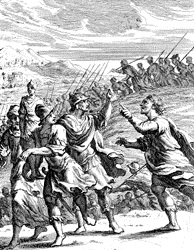
Micah and the Danites. Woodcut by Johann Christoph Weigel, 1695

Judges 18

In those days there was no king in Israel. And in those days the tribe of the Danites was seeking for itself a territory to live in; for until then no territory among the tribes of Israel had been allotted to them. 2 So the Danites sent five valiant men from the whole number of their clan, from Zorah and from Eshtaol, to spy out the land and to explore it; and they said to them, “Go, explore the land.” When they came to the hill country of Ephraim, to the house of Micah, they stayed there. 3 While they were at Micah’s house, they recognized the voice of the young Levite; so they went over and asked him, “Who brought you here? What are you doing in this place? What is your business here?” 4 He said to them, “Micah did such and such for me, and he hired me, and I have become his priest.” 5 Then they said to him, “Inquire of God that we may know whether the mission we are undertaking will succeed.” 6 The priest replied, “Go in peace. The mission you are on is under the eye of the LORD.”

7 The five men went on, and when they came to Laish, they observed the people who were there living securely, after the manner of the Sidonians, quiet and unsuspecting, lacking nothing on earth, and possessing wealth. Furthermore, they were far from the Sidonians and had no dealings with Aram. 8 When they came to their kinsfolk at Zorah and Eshtaol, they said to them, “What do you report?” 9 They said, “Come, let us go up against them; for we have seen the land, and it is very good. Will you do nothing? Do not be slow to go, but enter in and possess the land. 10 When you go, you will come to an unsuspecting people. The land is broad — God has indeed given it into your hands — a place where there is no lack of anything on earth.”

11 Six hundred men of the Danite clan, armed with weapons of war, set out from Zorah and Eshtaol, 12 and went up and encamped at Kiriath-jearim in Judah. On this account that place is called Mahaneh-dan to this day; it is west of Kiriath-jearim. 13 From there they passed on to the hill country of Ephraim, and came to the house of Micah.

14 Then the five men who had gone to spy out the land (that is, Laish) said to their comrades, “Do you know that in these buildings there are an ephod, teraphim, and an idol of cast metal? Now therefore consider what you will do.” 15 So they turned in that direction and came to the house of the young Levite, at the home of Micah, and greeted him. 16 While the six hundred men of the Danites, armed with their weapons of war, stood by the entrance of the gate, 17 the five men who had gone to spy out the land proceeded to enter and take the idol of cast metal, the ephod, and the teraphim. The priest was standing by the entrance of the gate with the six hundred men armed with weapons of war. 18 When the men went into Micah’s house and took the idol of cast metal, the ephod, and the teraphim, the priest said to them, “What are you doing?” 19 They said to him, “Keep quiet! Put your hand over your mouth, and come with us, and be to us a father and a priest. Is it better for you to be priest to the house of one person, or to be priest to a tribe and clan in Israel?” 20 Then the priest accepted the offer. He took the ephod, the teraphim, and the idol, and went along with the people.

21 So they resumed their journey, putting the little ones, the livestock, and the goods in front of them. 22 When they were some distance from the home of Micah, the men who were in the houses near Micah’s house were called out, and they overtook the Danites. 23 They shouted to the Danites, who turned around and said to Micah, “What is the matter that you come with such a company?” 24 He replied, “You take my gods that I made, and the priest, and go away, and what have I left? How then can you ask me, ‘What is the matter?'” 25 And the Danites said to him, “You had better not let your voice be heard among us or else hot-tempered fellows will attack you, and you will lose your life and the lives of your household.” 26 Then the Danites went their way. When Micah saw that they were too strong for him, he turned and went back to his home.

27 The Danites, having taken what Micah had made, and the priest who belonged to him, came to Laish, to a people quiet and unsuspecting, put them to the sword, and burned down the city. 28 There was no deliverer, because it was far from Sidon and they had no dealings with Aram. It was in the valley that belongs to Beth-rehob. They rebuilt the city, and lived in it. 29 They named the city Dan, after their ancestor Dan, who was born to Israel; but the name of the city was formerly Laish. 30 Then the Danites set up the idol for themselves. Jonathan son of Gershom, son of Moses, and his sons were priests to the tribe of the Danites until the time the land went into captivity. 31 So they maintained as their own Micah’s idol that he had made, as long as the house of God was at Shiloh.

Israel is in a precarious state. They have had judges who were able to rally individual tribes or groups of tribes to confront the crisis of the moment but there has not been a political leader who could unify the tribes since Joshua. The individual tribes have had very different experiences of this time, and the current story unfolds with Dan being a weak tribe without a territory. The religious landscape has also devolved to the point where the worship of the LORD is indistinguishable from the practices of the nations that the people of Israel live among. Israel is a group of unconnected tribes that may share some common stories of their path and may remember some aspects of the covenant faith of their God, but increasingly they have lost their identity as a people of the LORD.

The book of Judges begins with an overview of each tribe’s success in occupying the land promised to them. While several tribes are not completely successful in claiming their new homes, only the Danites are completely driven away by the Amorites in the area and forces to live in the hill country. The book of Joshua also points to the claiming of the city they will rename Dan in Joshua 19:47 and the two stories share a common background.[1] The sending of the spies also is similar to the sending of spies into the land of Canaan in Numbers 13, although the reaction to the spies’ report is different in this story. The five men take shelter in the house of Micah and recognize the young Levite. It is possible that they merely recognize the way he speaks as different from the native Ephraimites of the region but the identity of the Levite later in the narrative probably indicates that this Levite may have been well known and recognizable. The Levite’s explanation of his presence in Micah’s household as, “he hired me,” may indicate a different understanding than the “consecration” that Micah did for the priest in the previous chapter, but it also may reflect the reality that this wandering Levite had looked for work and Micah provided work that was fitting with his family and gifts. The shrine with its idol, ephod, and teraphim and, as we shall soon learn, a priest with a famous ancestor probably made the house of Micah a place of local prominence to seek the will of God (or the gods). The request for an oracle of God’s intention and the seeking of a divine blessing on their mission is sought and received as this priest sends the spies on their way.

The spies discover a city which is both prosperous and unprotected which becomes the target for this weak clan. The city may have some affiliation with Sidon, but they are geographically isolated from them and have no other alliances with groups like the Arameans who could provide them protection. There is no indication, other than the Levite’s blessing, that God has ordained this city for the Danites, but the spies present this as an appealing option for immediate action to their clan. Six hundred armed men,[2] along with the families that will resettle the land, depart the hill country in route to Laish.

This cluster of armed men stops at the house of Micah and seizes the idol, ephod, and teraphim and convinces the priest to come and minister to their group rather than remaining with Micah. There is no intertribal loyalty. In a time without a king, might seems to make right. The priest accepts the offer and departs with the group. It is possible that the Levite viewed the ministry to the Danites as an upgrade, but it is also possible that he viewed this as the way to survive the threat of violence. Regardless of motive the priest participates in the removal of the objects of worship from the house of Micah and sets off with the Danites. When Micah pursues the Danites with the men he can gather to try to reclaim his gods and his priest he is met with the threat of violence and retreats before a larger and more violent force. The corrupted religious practices and the employment of a Levite as priest have not led to Micah’s prosperity in the long term but instead to his humiliation.

The Danites conquer and raze the peaceful city of Laish and rebuild it as Dan. There is no indication of God’s activity on their behalf and the text remains neutral about the implications of this conquest. Yet, the text leaves space for one final bombshell. We learn that the Levite is a grandson of Moses and that they maintain a shrine in Dan until the exile under the Assyrians (734 BCE) even though the idol of Micah may have been removed after the house of God (tabernacle) at Shiloh fell in the eleventh century BCE. (Webb, 2012, p. 449) The shrine starts as a place of worship practices that seem very distant from the ideal laid forth in Exodus, Leviticus, Numbers, and Deuteronomy and continues to reflect the decentralized and disparate practices that future kings will struggle with (or embrace).

The identity of Israel as a people is in question. As Berry Webb can state, “In such a confused environment religion becomes merely a means of self-advancement, and provides fertile soil for a host of other evils to take root and flourish.” (Webb, 2012, p. 452) The lack of any type of moral center or covenant identity among the people lays the groundwork for the near dissolution of Israel that will occur in the final narrative of Judges. In a world where ‘might makes right’ the tribes of Israel are indistinguishable from any other group. They are violent and ‘hot-tempered’ men (and women) who are attempting to force their will on a violent world without the guidance or protection of their God. A world where ‘everyone does what is right in their own eyes’ and where the way of the LORD has been forgotten is a dangerous place for women and the vulnerable. Israel may have lost sight of their identity and may have forgotten its God, but in the view of Judges it is only by the steadfast love of God that Israel has any chance at a future beyond the violent present which they are creating.

[1] In Joshua 19:47 the town they fight against is Leshem instead of Laish but it is clear that this narrative in Judges is an expanded telling of the same beginnings of the territory the Danites occupy. As mentioned in the previous chapter the narrative of Micah, the Levite, and the Danites probably does not come chronologically after all the Judges but is placed thematically at the end to show the desperate situation of Israel prior to the time when the people ask for a king.

[2] Although the men are ‘armed for war’ it is important to differentiate that these are not professional warriors. There may be men who have experience as bandits and raiders but there is no organized military force in Israel at this time.