Bureaucracy in Action: Esther 8:9-14

bureaucracy1

Esther 8: 9-14

 9 The king’s secretaries were summoned at that time, in the third month, which is the month of Sivan, on the twenty-third day; and an edict was written, according to all that Mordecai commanded, to the Jews and to the satraps and the governors and the officials of the provinces from India to Ethiopia, one hundred twenty-seven provinces, to every province in its own script and to every people in its own language, and also to the Jews in their script and their language. 10 He wrote letters in the name of King Ahasuerus, sealed them with the king’s ring, and sent them by mounted couriers riding on fast steeds bred from the royal herd. 11 By these letters the king allowed the Jews who were in every city to assemble and defend their lives, to destroy, to kill, and to annihilate any armed force of any people or province that might attack them, with their children and women, and to plunder their goods 12 on a single day throughout all the provinces of King Ahasuerus, on the thirteenth day of the twelfth month, which is the month of Adar. 13 A copy of the writ was to be issued as a decree in every province and published to all peoples, and the Jews were to be ready on that day to take revenge on their enemies. 14 So the couriers, mounted on their swift royal steeds, hurried out, urged by the king’s command. The decree was issued in the citadel of Susa.

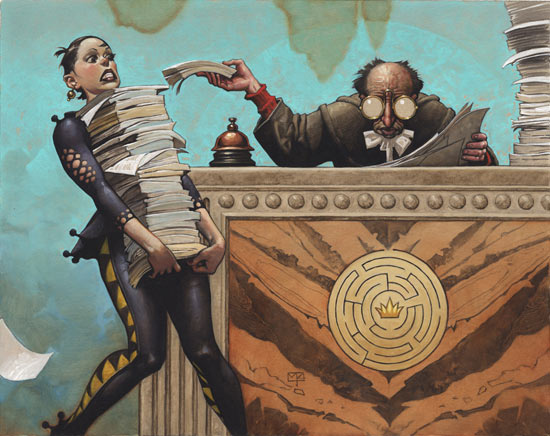
The bureaucracy springs into action, and perhaps like all bureaucracies this is the reason for the unexplainable delay, for the previous sections took place in the first month and now we are in the third month. Did Mordecai need to do a study, convene a committee, and enter into a debate with the Jews of Susa to come up with the right wording (I’m being snarky here). I don’t think that the Jews before would have been unable to defend themselves, but the edict with the force of Mordecai and the king’s authority with it puts them in a much stronger position, and perhaps, like in Nazi Germany, the new edict strips away the permission  to act out against the Jewish people and still to be following orders.

On the one hand, this gives the authority for a preemptive strike, to kill, destroy and annihilate anyone who might attack.  Now I wouldn’t want to go too far in this direction, remember the Jewish people are a small people in exile dependent on the favor of a powerful empire, but the edict and Mordecai’s force behind it does create fear. It is so easy for the oppressed to become the oppressor when the roles are reversed. This may be a story of reversals, but it is not a story of mercy.

Now for the Jewish people this is a story of triumph, what was to be a early Kristallnacht becomes a day of deliverance. God (although unmentioned) once again chooses the weak and the powerless and turns the tables on those who want to take advantage of them. Yet the violence of the end of the story does trouble me, yet it is the way of the story.

purple rose 01 by picsofflowers.blogspot.com

Living a Godly Life: A Sermon on Fasting

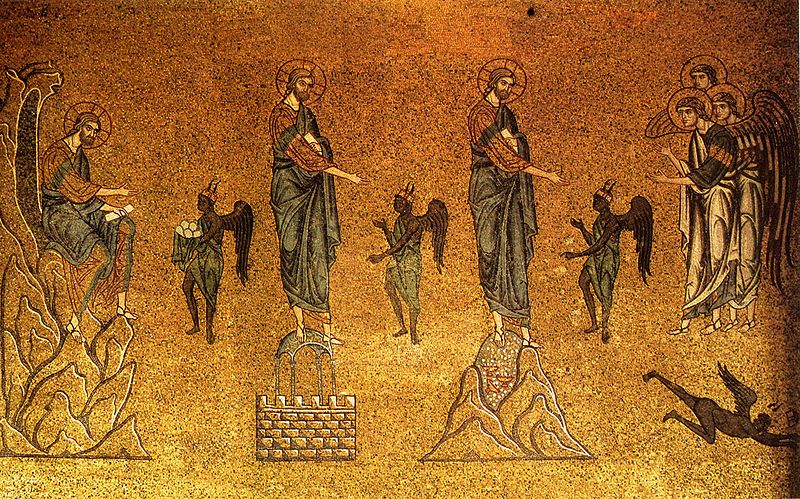
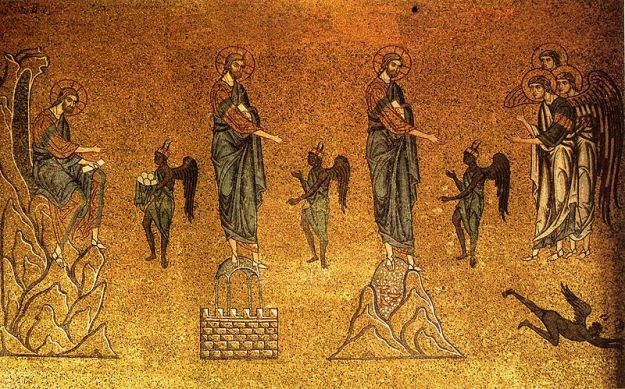
The Temptations of Christ, Mosaic in the Basilica of St. Mark, Venice

The Temptations of Christ, Mosaic in the Basilica of St. Mark, Venice

And whenever you fast, do not look dismal, like the hypocrites, for they disfigure their faces so as to show others that they are fasting. Truly I tell you, they have received their reward. But when you fast, put oil on your head and wash your face, so that your fasting may be seen not by others but by your Father who is in secret and your Fahter who sees in secret will reward you. Matthew 6: 16-18

Fasting is one of those practices that during my lifetime has not been very heavily practiced by most Christians I know, but it is beginning to make a comeback, especially among young spiritual seekers who are seeking real and gritty spiritual practices of how they might draw closer to God. You see, we do a lot in this church in most churches to make it very easy for people to come in, to be a part of what is going on. We try to make the music appealing and the experience enjoyable and the seats comfortable and the temperature correct for the bulk of people, but sometimes to go deeper we need to be taken out of our comfort zone. We may wonder if there is something more to this relationship with God, and the answer is yes indeed there is and so I’m going to talk about fasting tonight and I don’t believe you can talk about fasting without actually using fasting as a spiritual discipline and so yes I do fasted, and have over this Lenten period, and I share this not to say, “Hey, look at me and the great and holy things I am doing.” Because it is something that I struggle with, because I know the way I should be living, but often I fall into the very temptations that Jesus turned away from. Yet I don’t like being hungry, of being forced to slow down. I know I too often buy into the societies message that we shouldn’t do without anything and that depriving myself of something is not only unhealthy, it is un-American. “If you are a child of God you shouldn’t be hungry, make bread and eat.” Fasting for me is an act of confession that sometimes I have so much that I no longer value what I have, that the food begins to lose its taste or appeal, that no matter what I have that it is never enough. Now I’m a good cook, a very good cook even and if you have eaten at my table or tasted something I’ve made most people would agree with that, yet even after I’ve made a good meal for my son and I, and even right after I have eaten I can see an ad for Red Lobster, or Buffalo Wild Wings, or Olive Garden, or Applebee’s, or any number of other restaurants and I can be hungry not for what I just ate but what is being paraded before my screen that I should want.  Fasting is a confession that the food I eat sometimes looses its taste because I’m already full and I’m eating because the food is in front of me and so I eat. It is a confession that even though my spirit know s it is not true that I have bought into the illusion with my heart that having more is the way to happiness and by accepting less I am placing my practices and times and treasures where I hope my heart will someday follow. I confess that often I begin to believe that I am entitled to all the good things that are out there and that I no longer appreciate the things that are there. I fast as part of a confession that while I may know that I cannot serve God and money more often than not I am damn willing to give it a try. I know that I may not be worth mentioning in the same breath as Jesus and Paul, David and Moses, Elijah and Elisha, Daniel and Esther but they all fasted in the midst of their relationship with God and maybe just maybe they knew something. I know that in the Bible fasting is assumed, and it is not a coincidence that Jesus says “when you fast” rather than “if”. That there is something about the act of fasting as a spiritual practice that places us in a place where we might be able to draw close to God.

I’m going to invite you to consider something foolish with me, something I attempt to practice, which is in its own way an act of rebellion against the way things are.  And so perhaps the place to begin is a confession: I have fasted, not every day, but typically one day out of the week throughout lent-this is not the first, nor will it be the last time I have fasted, and rather than taking away from life it frees me for life. Now we live in a world with two competing realities: one is to fit in to the perfect image, and particularly for young women but increasingly for men as well, to try to fit into the image of the models in magazines and actresses on the big screen-I am not advocating fasting as a method to achieve a thinner body to achieve some ideal that most of us were never meant to obtain. But the draw of that image is powerful and real, and even I struggle against it. But there is another reality that I think tries to consume each of us, and that is the reality that calls us to consume. We are consumers and the only thing that makes us happy is consuming, or so we are told.

I refuse to be a consumer, for that to be the primary measure of who I am. I refuse to be a slave to my belly. I empty myself trusting that God might fill me, for as Mother Teresa said, “God cannot fill that which is already full.” In trying to follow Jesus, I humbly try to take some of the same paths he did, being willing to be guided by God into the wilderness to struggle against my own bodies desire to eat, not because eating or feasting is bad, but because there are times to feast and times to fast, and knowing the difference makes the feasting sweeter. I do it to enjoy life, not to deny life. I do it because it forces me to slow down for a day, to rest more and push less hard, it forces me into greater times of pause as I wait on God and listen. It reminds me of the injustices that are out there in the world and those who go to bed this night hungry, not because they choose to but because they have nothing while others have far too much.  In my hunger I am reminded that blessed are those who hunger and thirst for righteousness for they will be filled (Matthew 5.6) or even more haunting in Luke’s gospel in the 6th chapter blessed are those who are hungry now for they will be filled…but woe to those who are full now for they will be hungry.

Now this is a discipline that I take and use, it is not for everyone. I don’t fast if I’m sick or if I feel like I am struggling with my emotions. But like recovering after being sick and you realize how well you feel, eating after fasting allows you to savor that which is there. I long to draw closer to God, not to be taken away from the world-but so that I too might learn like God to love the world in its struggles and illusions.  One of the things I have realized is that God may call us away from the practices of the world so that we may be transformed to go back and point to the things that are good. To allow our eyes and ears to be opened to the places where the kingdom of God has indeed broken it.

It is only fair to acknowledge Bishop Michael Rinehart’s post on Why Fast? which made writing this sermon both easier and more challenging. Easier because he said many things I would want to say and said them very well, but more challenging because it was harder to find my own approach to this after he said it so well.

purple rose 01 by picsofflowers.blogspot.com

Creative Words: A Poem

Creation by Selfish Eden (deviantart.com)

Creation by Selfish Eden (deviantart.com)

A clever turn of phrase or a verbal picture
In the beginning come the words
And in their own Genesis they craft a new world
Painting with the spirit of imagination
Breathing new life where once only an abyss rested
The words emerge and join together
As bones and sinews
Muscles and skin
Life emerges from the bone yard of the void
Once they emerge they take their own form and have their own life
Each one its own character to be savored and relished
Evoking sights and smells
Sounds feelings and emotions
Recreating the past
Re-imagining the future
Each one has the potential to unearth memories long forgotten
Some use their indelible ink to tattoo themselves on the soul
The realities they create may be harsh and brutal
In their dystopic world we see the dark side of reality
The truths we would rather not see
The sins we would prefer remain buried
Words that rend the world and pierce the soul
Sometimes the poet and the prophet are one
Crying tears of sorrow over words that cannot be contained
And a people whose ears no longer hear and eyes no longer see
Yet words uttered from the same mouth may ache of passion and love
Calling us to hope
Lightening our darkness
Pointing to potentiality and power unimagined
And a future seen only through the hopes and dreams of faith
But they are never just words
They are echoes of the deep language that pours its magic into the world
They point to the real and imagined
They define and name
They build up and tear down
Words set loose on the world
Bearing the best and worst of humanity’s heart
Laying naked the mind and soul
A mirror showing the sacred and profane blended together
For the world the words create reflect the heart of their creator
They go forth to create
They rattle around in the eardrums and the imaginations
Of those who have eyes to see and ears to hear
For in the beginning the words come
The Genesis, the beginning of all the potential worlds they might create
And in the end, when their pneumatic inspiration ceases
Remains the apocalypse of new creation
Unveiled within our memory

Composed Neil White, 2013

purple rose 01 by picsofflowers.blogspot.com

Dueling Edicts: Esther 8:1-8

Esther and Mordecai by Aertz de Gelder

Esther and Mordecai by Aertz de Gelder

Esther 8: 1-8

On that day King Ahasuerus gave to Queen Esther the house of Haman, the enemy of the Jews; and Mordecai came before the king, for Esther had told what he was to her. 2 Then the king took off his signet ring, which he had taken from Haman, and gave it to Mordecai. So Esther set Mordecai over the house of Haman.

3 Then Esther spoke again to the king; she fell at his feet, weeping and pleading with him to avert the evil design of Haman the Agagite and the plot that he had devised against the Jews. 4 The king held out the golden scepter to Esther, 5 and Esther rose and stood before the king. She said, “If it pleases the king, and if I have won his favor, and if the thing seems right before the king, and I have his approval, let an order be written to revoke the letters devised by Haman son of Hammedatha the Agagite, which he wrote giving orders to destroy the Jews who are in all the provinces of the king. 6 For how can I bear to see the calamity that is coming on my people? Or how can I bear to see the destruction of my kindred?” 7 Then King Ahasuerus said to Queen Esther and to the Jew Mordecai, “See, I have given Esther the house of Haman, and they have hanged him on the gallows, because he plotted to lay hands on the Jews. 8 You may write as you please with regard to the Jews, in the name of the king, and seal it with the king’s ring; for an edict written in the name of the king and sealed with the king’s ring cannot be revoked.”


The king lives a sheltered life, and even here at the end of the story he basically passes authority to Esther and Mordecai. They may write and seal it with the king’s seal. The king himself doesn’t take any more responsibility for the actions of Esther and Mordecai than he did for Haman. Even though these are irrevocable matters, they are still delegated. Much as in the story of Joseph, now Mordecai ascends to be in charge of everything and second only to the king, which makes him the person who really makes the decisions.

This makes me think a little of our own system of elected government where we may elect officials, but these officials may have to answer to groups and lobbyists who may be pulling the strings more than we want to admit. Granted, if the king decides to act on his own people have two choice, obey or assassinate the king while elected officials find themselves having negative adds financed against them, or members of their own party who try to take their seat in the next election cycle. I want to believe that the people we elect are there to make the best decisions on behalf of the American people, but the skeptical side sees way to many hands trying to craft their own policies to place under the signet ring of officials.

For the Jewish people in the story this turn of events is a very positive thing, now they have their own guy who bears the signet ring and can craft policy for their benefit. Maybe I am naïve to hope for a government that is better than this, a government that can move beyond what is good for one group or another and look at what is best for the population and even beyond that, the world. Don’t get me wrong, I think we’ve come a long way-but in our antagonistic and partisan world we can dream of something better.

One final note, I’ve highlighted several times that Mordecai wouldn’t bow to Haman, but this is apparently not a Jewish thing since Esther has no problem bowing before the king. We will never know the why behind Mordecai’s not bowing throughout the story, it could be a personal hatred, an ethnic dislike or any number of other things (and even here Mordecai doesn’t bow with Esther-although it may not be the time or place).

We are left with dueling decrees that cannot be revoked. One that will allow anyone to kill and loot Jewish families and one that allows the Jewish people to assemble and allow for their protection. Perhaps what is most important is not the edict but who has the power to enforce it.

purple rose 01 by picsofflowers.blogspot.com

Ice Eagles: A Poem

eagles-on-ice-018

Strutting across the frozen waters of the Platte

The sky’s royalty resting from their hunt

Their power is coiled into their stout bodies

Even on the ground they are a study in majesty and power

Their resting spot is transformed into a spot where the lords of the sky have touched

Eagles on the ice, seen only in passing on a journey

Yet their nobility transforms the dull grey of winter into a polar wonderland

For the king of the air has graced his subjects with his presence

And though he only remained standing on the ice

Never spreading his wings to take flight

Never embarking into the air where he reigns supreme

The brief view of his magnificence gave my heart wings

And on this cold day allowed my imagination to soar

Composed Neil White, 2013

purple rose 01 by picsofflowers.blogspot.com

Mechanisms Of Execution: Esther 7: 7-10

Rembrandt Harmenszoon van Rijn- Haman Begging the Mercy of Esther

Rembrandt Harmenszoon van Rijn- Haman Begging the Mercy of Esther

Esther 7: 7-10

 7 The king rose from the feast in wrath and went into the palace garden, but Haman stayed to beg his life from Queen Esther, for he saw that the king had determined to destroy him. 8 When the king returned from the palace garden to the banquet hall, Haman had thrown himself on the couch where Esther was reclining; and the king said, “Will he even assault the queen in my presence, in my own house?” As the words left the mouth of the king, they covered Haman’s face. 9 Then Harbona, one of the eunuchs in attendance on the king, said, “Look, the very gallows that Haman has prepared for Mordecai, whose word saved the king, stands at Haman’s house, fifty cubits high.” And the king said, “Hang him on that.” 10 So they hanged Haman on the gallows that he had prepared for Mordecai. Then the anger of the king abated.

 There is a scene in the 1990s movie Pretty Woman, at the end where the Philip Stukey, the character played by Jason Alexander attacks Vivian, the main character played by Julia Roberts, causing the Edward, the protagonist played by Richard Gere, to throw out his main advisor. A similar thing is happening here. The king storms out, furious (even though he is at least partially to blame for the circumstance), Haman realizes the game is up and his only chance at mercy is not from the king, but the queen and he throws himself at her at the time the king returns and a convenient solution is presented. Haman has assaulted the queen, that allows the king to act immediately and the attendants (silent throughout the scene) now suddenly appear visible. Haman moves from favored one to traitor to death in the span of three terse verses. Ultimately it is the designs of his own hatred that end up being the mechanism for his own execution.

The book of Esther is a story set in a world where the death penalty is not only acceptable, but used not just for murder. Some people critique Esther for not extending mercy, which is their right, but that misses the context of the story and what was considered just punishment. Even if Esther wanted to extend mercy to Haman, and I see little reason to believe she would be inclined to, she may feel that she has pushed the benevolence of the king to its limit asking for the salvation of her life and people. The story turns on poetic justice, but I don’t think we need to make this prescriptive for the justice we seek in our own society.

purple rose 01 by picsofflowers.blogspot.com

Esther’s Crown: A Poem

A young flower freshly bloomed

Is harvested with all the other blooms in the garden

To set before the king for his pleasure

Most will be cast aside, forgotten and neglected

Destined to wilt in the vastness of his harem

Their beauty enjoyed, their perfume stolen

One of the many pieces of a bouquet whose beauty will never be enjoyed

Who will never be adored by another after being sampled and discarded by the monarch

Except the Hebrew Rose Hadassah, the orphan flower Esther

Delicate in a world of men, lifted up as the queen of the flowers

The crowning beauty of the garden of Susa

The rose that delighted the king is crowned with gold and adorned with jewels

Preserved to be displayed before an empire

And a nation celebrates in her triumph

And yet are all the other flowers mourned, the loss of their beauty missed

Or does life go on in the world of men scarcely noticing the flowers

Yet Esther is the bud the king could not set aside

Enthroned to be admired, adored and desired

Her path was never hers to choose, and yet she is the queen of flowers

Plucked from her roots and placed on display for the world to see her beauty

Composed Neil White, 2013

purple rose 01 by picsofflowers.blogspot.com

The Gryphon: A Poem

May_The_Gryphon_Be_With_You_by_rage1986

May the Gryphon Be With You, by rage1986@deviantart.com

Once I was viewed as an image of nobility and power itself

The king of the sky and the king of the jungle brought together into something far deadlier

Strong enough to rule the skies and deadly enough to stalk the beasts of the ground

Kings and armies emblazoned my image on their shield and castles for safe keeping

In a world where imagination and magic still existed

And children dreamed of magical beasts that prowled the dark places

Heroes and wizards came to seek my aid in their impossible quests

In a time before the modern world cast its own spell of certainty

And the wilderness of dreamland became tamed by roads of asphalt and concrete

And the dictatorial iconoclasts of plutocracy stripped the artistic from the halls of the world

When the gryphons, dragons and unicorns went the way of the dinosaur

Once I was the master of the earth and sky in another world, in another place and time

Now I don’t belong in the heavens or on the earth

For neither the eagles or the lions would have me

To them I am neither beast nor bird and my presence makes a mockery of both

So what am I?

Am I merely some projection of some alchemist’s desire

Am I the joining of two creatures noble in their own right

Into an unstable and unholy creature banished to live between worlds

On the edge of imagination in the whispers of dreams not yet quashed by the mechanistic drive of progress

Will there come a time when the magic returns and heroes come back to the world

When gryphons and dragons and unicorns can again dwell in the dreams of young and old

Or will they too be thrown into the furnaces of the disillusioned dreams and broken hearts

Of children grown too soon and adults who no longer sing songs

Composed Neil White, 2013

purple rose 01 by picsofflowers.blogspot.com

Endgame: Esther 7:1-6

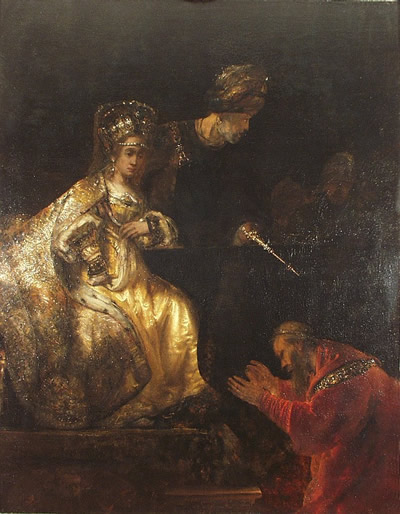
Rembrandt Harmensz van Rinj- Ahasuerus, Haman and Esther at the Feast of Esther

Rembrandt Harmensz van Rinj- Ahasuerus, Haman and Esther at the Feast of Esther

Esther 7: 1-6

So the king and Haman went in to feast with Queen Esther. 2 On the second day, as they were drinking wine, the king again said to Esther, “What is your petition, Queen Esther? It shall be granted you. And what is your request? Even to the half of my kingdom, it shall be fulfilled.” 3 Then Queen Esther answered, “If I have won your favor, O king, and if it pleases the king, let my life be given me– that is my petition– and the lives of my people– that is my request. 4 For we have been sold, I and my people, to be destroyed, to be killed, and to be annihilated. If we had been sold merely as slaves, men and women, I would have held my peace; but no enemy can compensate for this damage to the king.” 5 Then King Ahasuerus said to Queen Esther, “Who is he, and where is he, who has presumed to do this?” 6 Esther said, “A foe and enemy, this wicked Haman!” Then Haman was terrified before the king and the queen.

The plot has reached it’s decisive moment, Esther lays out her petition and what remains to be seen is how it will play out with the king. Esther has played well, she has patiently waited until the proper moment and this puts the king in a difficult situation for he, although perhaps through negligence and failing to investigate who the people he allowed Haman to consign to destruction, is the one behind the edict. It is his signet ring that marked the letters and decrees that went forth. The king has become so isolated from what is going on in his kingdom, so dependent upon his advisors that his own actions have placed his beloved queen at risk. Nobody knows that Esther is Jewish, or that Mordecai is her uncle but the king is furious.

Part of the appeal of Esther is it is the type of story that allows a veiled critique of whichever person is in power. Ahasuerus becomes a cipher for the king or governor that people want to laugh at, and are able to do it within the confines of the story even when they may be talking about another (and sometimes rather obviously). I am not sure if Purim (where the book of Esther is read) ever becomes a ritual of reversal, like Carnival, where the normal social rules are suspended for the duration of the festival and it becomes a time and space for the social rules to be suspended to express disapproval of the current state of affairs by a people who do not have the ability to change them. (See James C. Scott’s Domination and the Arts of Resistance: Hidden Transcripts for more about rituals of reversals. (Scott 1990, 172-182) )

The king may not be the sharpest nail in the toolbox, but ultimately action falls back to him. Ahasuerus is the one in the story who the buck stops with, and ultimately he must provide the solution to the problem. At stake is a decree and law which cannot be altered, and his own complicity in the action.

purple rose 01 by picsofflowers.blogspot.com

Not the end…A Poem

cemetary and snow

Standing at the graveside of a man I never met

In a garden of stone blanketed by snow

Growing only silken flowers coated in frost

Surrounded by the family and friends of the one lying in wait

As I stand, stationed between the gravestone and the coffin

My hands on the prow of the oaken ship

That will carry his body on its journey back into the earth

Standing between the living and the dead

Honoring the dead as I mock death

I christen the casket with the mark of the cross

Trusting a new journey has begun

Soon flowers plucked in the prime of their life

Will be the only escorts on the descent into a rose petal lined vault

Soon the body of the beloved of his family will no longer rest in repose in the cold

Instead it will be covered with a warm blanket of earth and snow

Warm in the womb of the earth

Awaiting the time when once again the breath of the creator enters his nostrils

And the touch of the spirit quickens his heart

For though you are a stranger to me, you are known

This is not the end

Composed Neil White, 2013

purple rose 01 by picsofflowers.blogspot.com