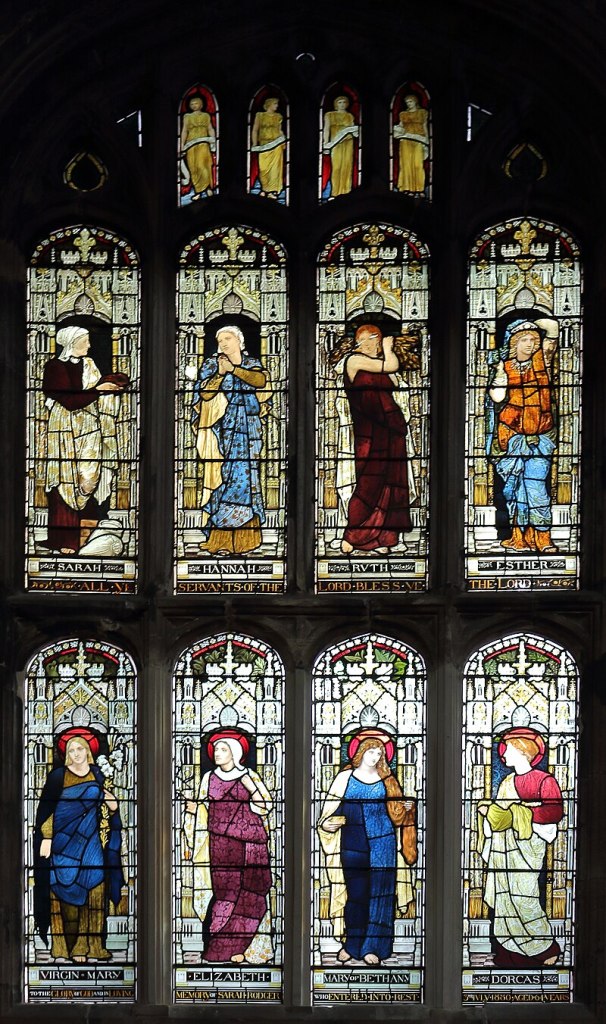
Window on the south wall of St Andrews just outside the Feilden chapel, by Henry Holiday and depicting Holy Women of the Old and New Testaments: Sarah, Hannah, Ruth and Esther in the top four panels and the Virgin Mary, Elizabeth, Mary of Bethany and Dorcas in the lower. By Rodhullandemu – Own work, CC BY-SA 4.0, https://commons.wikimedia.org/w/index.php?curid=73469366
Psalm 113
1Praise the LORD! Praise, O servants of the LORD; praise the name of the LORD. 2Blessed be the name of the LORD from this time on and forevermore. 3From the rising of the sun to its setting, the name of the LORD is to be praised. 4The LORD is high above all nations and his glory above the heavens. 5Who is like the LORD our God, who is seated on high, 6who looks far down on the heavens and the earth? 7He raises the poor from the dust and lifts the needy from the ash heap, 8to make them sit with princes, with the princes of his people. 9He gives the barren woman a home, making her the joyous mother of children. Praise the LORD!
The God of the songs and stories of Israel is a God who turns the world upside down. The LORD of Israel is the one who is high above all nations and lords yet this God raises up the “triad of the wretched” (Bellinger, 2014, p. 490) the poor, the needy, and the barren. This is the LORD on high who lifts up the lowly. Psalm 113 echoes this paradoxical reality in Hebrew thought: the LORD is high above all things, and the LORD looks down and sees the lowliest of all things.
Psalm 113 begins and ends with Hallelujah (NRSV Praise the LORD!). Unlike the previous two psalms it is not an acrostic, instead it is a short poem with two easily discerned parts. In the first four verses the praising and honoring of the LORD is the focus. Verse five forms pivot where the psalmist asks, “Who is like the LORD our God, who is seated on high.” The final four verses consider how this LORD who is seated on high cares for the lowly.
The praise of the LORD in the first four verses continually mentions the LORD and the name of the LORD as the focus of the praise of the servants of the LORD. The name of the LORD, enshrined in the commandment to “not make wrongful use the name of the LORD your God,” (Exodus 20:7, Deuteronomy 5:11) is critical to the proper reverence of the God of Israel. Names in the ancient world were powerful things and this God whose name is to be praised at all times (from this time on forevermore and from the rising of the sun to its setting) was due the reverence afforded to the name of the LORD.[1] This God who is above all things and whose name is worthy of reverence is seated on high.
The LORD on high lifting up the lowly is easily seen in the English translations, but when the Hebrew is rendered in a more literal translation[2] the parallel is even clearer as J. Clinton McCann Jr. shows:
A more literal translation captures the effect; God “makes God’s self high in order to sit,” (v.5b) “makes God’s self low in order to see,” (v. 6a) “causes the poor to arise” (v.7a), “makes exalted the needy…to cause them to sit with princes.” (NIB IV: 1139)
God intervenes in the life of the poor, the needy and the barren woman. God uses God’s position and power to lift up the lowly. This is the God of Sarah. Rebekah, and Rachel in the book of Genesis, these formerly barren women who became the joyous mothers of children. This is the God of the exodus who took a poor and needy people out of their captivity through the wilderness into the promised land. This is the God who hears the song of Hannah (1 Samuel 2) and Mary (Luke 1:46-55) which both share common themes with the second half of Psalm 113.
Psalm 113 in modern Jewish life is the first of the “Egyptian Hallel” psalms which are utilized in the Passover celebration. It is possible that this was the psalm that Jesus and his followers sang before they went out to the Mount of Olives after the Last Supper (Mark 14:26). The Psalm resonates strongly with many of the themes of the ministry of Jesus, just as it resonates with the story, songs, and the law. As Deuteronomy reminds the people:
For the LORD your God is God of gods and Lord of lords, the great God, mighty and awesome, who is not partial and takes no bribes, who executes justice for the orphan and the widow, and who loves the strangers, providing them with food and clothing. (Deuteronomy 10: 17-18)
This short psalm captures a central theme of the Hebrew and Christian scriptures: the paradox that the God who is high over all things sees and lifts up the lowly.
[1] The four letters of the divine name given to Moses in Exodus 3:14 are behind the English translation of LORD in all capitol letters. The practice of translating this LORD comes from the practice of using the vowel pointings for ‘Adonai” (Hebrew lord) on the consonants in Hebrew so that the reader knows not to utter the name of the LORD the God of Israel.
[2] Translators have to make a difficult choice when rendering a language into another of how to balance the literal meaning of the words with the different syntax and expectations of the language they are translating into. A “wooden” or “literal” translation is often difficult to read or understand because Hebrew sentences often do not include elements that most English readers are used to.
1Praise the LORD! Happy are those who fear the LORD, who greatly delight in his commandments. 2Their descendants will be mighty in the land; the generation of the upright will be blessed. 3Wealth and riches are in their houses, and their righteousness endures forever. 4They rise in the darkness as a light for the upright; they are gracious, merciful, and righteous. 5It is well with those who deal generously and lend, who conduct their affairs with justice. 6For the righteous will never be moved; they will be remembered forever. 7They are not afraid of evil tidings; their hearts are firm, secure in the LORD. 8Their hearts are steady, they will not be afraid; in the end they will look in triumph on their foes. 9They have distributed freely, they have given to the poor; their righteousness endures forever; their horn is exalted in honor. 10The wicked see it and are angry; they gnash their teeth and melt away; the desire of the wicked comes to nothing.
Psalm 112 and Psalm 111 share a lot of commonalities. Both are acrostic poems with each cola beginning with successive letters of the Hebrew alphabet. They share commonalities in vocabulary[1] with each other and with wisdom literature in general. If Psalm 111 is the beginning of wisdom then Psalm 112 would be a life lived in wisdom. The fear of the LORD[2] here leads to a delighting in the commandments of the LORD and a life that is authentic and in harmony with God, society, and the creation.
Like Psalm 111 and 113, the first word of the psalm is Hallelujah (NRSV Praise the LORD). The acrostic poem begins with the second word asre (NRSV happy) which is a common indicator of wisdom literature. Like Psalm 1, which also begins with asre we are examining the contrast between a righteous life in harmony with God’s will for the world and a wicked life in conflict with God’s will. The Hebrew asre often translated ‘happy’ or ‘blessed’ or even ‘contented’ but the concept in Hebrew thought is closer to ‘wholeness’ or ‘completeness.’ This integrated life is a life of shalom, itself a word that has a much larger function than the standard English translation of peace. The way of wholeness and completeness is the way of wisdom. Those who ‘fear’ the LORD greatly delight in the LORD’s commandments. This is not a burdensome set of commands but the boundaries which provide the safe space where an individual can live a whole and integrated life.
The blessings of this whole person reflect the ideals of Hebrew thought. Abraham when he begins his journey with God is promised descendants, a blessing, house, land and prosperity and through his household all the nations will be blessed. For the ‘happy’ ones who follow the way of wisdom their descendants are mighty, their generation is blessed, their households are prosperous, and their righteousness endures. The Hebrew scriptures trust that God will provide for the righteous ones who follow God’s ways. Those who fear, love, and trust the LORD above all things will find that they have enough and even an abundance beyond what they need.
These wise and righteous ones reflect the God who they worship and serve. In Psalm 111 the LORD’s righteousness endures forever, and in verse three now the righteousness of these ‘happy’ ones endures forever. In Psalm 111 God was characterized as gracious and merciful and now these ones who fear the LORD are also gracious, merciful, and righteous. They become the image of the LORD they fear, obey, and worship. They become a light that reflects the light of the LORD for the upright in the darkness of the world.
This life of faithfulness is a life of generosity. They do not hoard what they have but deal generously and lend. They distribute freely and give to the poor trusting that God will provide what they need. They conduct their affairs in justice/righteousness[3] and that justice/righteousness has a gracious and merciful character. Their practices remain constant throughout their lives and they are examples who are remembered of a life well lived. They trust in the LORD and even in evil/wicked times they remain secure in their trust. Their horn, which is reflective of power and status, is exalted in honor.
In classical wisdom literature duality these ‘happy’ ones are contrasted with the wicked. The wise and the wicked are opposing ways of life. The wise life is generous and merciful while the wicked one does not care for the poor, does not live generously, and may aggressively attempt to take advantage of both the vulnerable and the generous righteous ones. Yet, the anger and aggression of the wicked melts away before the sustaining power of the LORD that the wise ones fear. The desire of the wicked comes to nothing.[4]
The way of wisdom in the Hebrew scriptures is a way of life that lives in harmony with God’s commandments. The law and wisdom are connected in Hebrew thought. The law provides the vision of a society where the weak are protected and harmony and peace are possible. A way that is wise fears and reverences the LORD, the God of Israel and reflects the generous and merciful nature of that God. It trusts that even when the wicked seem to prosper that their foolish path will lead to their demise.
[1] Nancy deClaissé-Walford notes eleven key terms and phrases that occur in both relatively short psalms including: fear, delight in, upright, good, gracious, merciful, righteousness, remember, steady, give, and for all time. (Nancy deClaisse-Walford, 2014, p. 843)
[2] See the discussion of the Hebrew word yare translated fear in English in my notes on Psalm 111.
[3] The Hebrew tsaddik is a key idea in the Hebrew Scriptures. Both justice and righteousness emerge from the family of terms in Hebrew, like the Greek dikaios/dikaisune.
[4] This is the same word that ends Psalm 1, ‘abad which means to perish.
An Old Woman Reading, Probably the Prophetess Hannah by Rembrandt (1631)
Psalm 111
1Praise the LORD! I will give thanks to the LORD with my whole heart, in the company of the upright, in the congregation. 2Great are the works of the LORD, studied by all who delight in them. 3Full of honor and majesty is his work, and his righteousness endures forever. 4He has gained renown by his wonderful deeds; the LORD is gracious and merciful. 5He provides food for those who fear him; he is ever mindful of his covenant. 6He has shown his people the power of his works, in giving them the heritage of the nations. 7The works of his hands are faithful and just; all his precepts are trustworthy. 8They are established forever and ever, to be performed with faithfulness and uprightness. 9He sent redemption to his people; he has commanded his covenant forever. Holy and awesome is his name. 10The fear of the LORD is the beginning of wisdom; all those who practice it have a good understanding. His praise endures forever.
The next three psalms all begin with the word Hallelujah.[1]Psalms 111 and 112 are also acrostic poems with each cola[2] beginning alphabetically with the next letter of the Hebrew alphabet (after the initial Hallelujah). Most previous acrostic poems have been by verse, but here there are twenty-two cola after the initial word. The acrostic form was used in the book of Lamentations to provide a sense of order to the disordered world of the poet, but in the Psalms acrostic poems are often used to focus on wisdom, describing how life should be lived. For most Hebrew people the organizing center of wisdom is the law (torah) which will be the focus of the acrostic of acrostic poems, Psalm 119. For Psalm 111 the beginning of wisdom is the fear (see below) of the LORD and that is organized around the ‘works of the LORD’ and the ‘works of the people’ in response to the LORD.
A key word for the poem is ‘works’ (Hebrew ma’asim) which occurs in verses 2, 6, and 7 with the same root being used in 4 (NRSV wonderful deeds) and a synonym being used in verse 3. Then the same word is used in verse 8 and 10 (NRSV practice, perform) for the faithful ones responding to the work of the LORD. Wisdom here is recognizing the ‘works of the LORD’s hands’ which are established ‘forever and ever’ and ‘working’ in faithfulness and uprightness. The psalmist when referring to the ‘wonderful deeds’ of God likely has in mind the defining story of the Hebrew people, the exodus where God brings the people out of Egypt and into the promised land.[3] Yet, God’s provision of food, mindfulness to the covenant, demonstrating God’s power before the nations, and granting the people a heritage or inheritance from the nations is an ongoing action. God is known by what ‘works’ God has done, or as Philip Melanchthon would famously say in the 1500s, “that to know Christ is to know his benefits.” (Melanchthon, 2014, p. 24)
The best-known line of this psalm is “the fear of the LORD is the beginning of wisdom.” The Hebrew word for fear (yare’) encompasses a larger meaning than our English fear. As Nancy deClassé-Walford states it also means:
“awe, reverent, respect, honor.” It appears in Hebrew as a synonym for “love.” (‘ahab, Deut 10:12); “cling to” (dabaq, Deut 10:20); and “serve” (‘abad, Deut 6:13; Josh 24:14) (Nancy deClaisse-Walford, 2014, p. 841)
Knowing the ‘works’ of God and performing these works should lead to honor and awe, respect and honor, service and love. Wisdom that has good understanding can, to use Martin Luther’s explanation of the first commandment, “fear, love, and trust God above all things.” The ‘fear of the LORD’ leads the poet to ‘give thanks to the LORD with their whole heart.’ This is what a wisely practiced life looks like.
[1] ‘Praise the LORD” (NRSV). Hallelujah is a compound word of the verb to praise (hallel) and the first half of the name of God (yah from Yahweh). Some scholars believe that the final verse of Psalm 113 was originally the opening verse of Psalm 114 which would make four psalms which begin with Hallelujah, but as we have received the text we have three psalms beginning with Hallelujah and with Psalm 113 opening and closing with the word.
[2] Hebrew poetry breaks lines into cola. This is often reflected in the printing of poetic portions of scripture in how they are displayed. Psalm 111 in most bibles is easily divided this way because each on begins alphabetically with the next letter of the Hebrew alphabet (excluding verse 1a ‘Hallelujah’). In this poem the cola are marked by punctuation (comma, semi-colon, or period).
[3] Wonderful deed (Hebrew nipla’ot) is often used to refer to God’s works at that time (Exodus 3:20; 15:11; Psalm 77: 11, 14). (NIB IV:1133)
Farewell Melody by Ravil Akmaev Shared under the Creative Commons 3.0
Lamentations 5
1Remember, O LORD, what has befallen us; look, and see our disgrace! 2Our inheritance has been turned over to strangers, our homes to aliens. 3We have become orphans, fatherless; our mothers are like widows. 4We must pay for the water we drink; the wood we get must be bought. 5With a yoke on our necks we are hard driven; we are weary, we are given no rest. 6We have made a pact with Egypt and Assyria, to get enough bread. 7Our ancestors sinned; they are no more, and we bear their iniquities. 8Slaves rule over us; there is no one to deliver us from their hand. 9We get our bread at the peril of our lives, because of the sword in the wilderness. 10Our skin is black as an oven from the scorching heat of famine. 11Women are raped in Zion, virgins in the towns of Judah. 12Princes are hung up by their hands; no respect is shown to the elders. 13Young men are compelled to grind, and boys stagger under loads of wood. 14The old men have left the city gate, the young men their music. 15The joy of our hearts has ceased; our dancing has been turned to mourning. 16The crown has fallen from our head; woe to us, for we have sinned! 17Because of this our hearts are sick, because of these things our eyes have grown dim: 18because of Mount Zion, which lies desolate; jackals prowl over it. 19But you, O LORD, reign forever; your throne endures to all generations. 20Why have you forgotten us completely? Why have you forsaken us these many days? 21Restore us to yourself, O LORD, that we may be restored; renew our days as of old — 22unless you have utterly rejected us, and are angry with us beyond measure.
This final poem of Lamentations is the shortest of the five poems that make up the book and it has several differences from the preceding poems. It is one third of the length of the first three poems and half the length of Lamentations four. It also drops the acrostic[1] form but maintains the twenty-two lines that acrostic poems maintain. Yet more significant than the change in form and length is the change in voice and addressee. Previously there have been strong individual voices: daughter Zion, the narrator and the strong man, but now the voice of the poem becomes the communal ‘we.’ God has been a subject of the previous poems but was rarely addressed, now God is the direct addressee of this final poem. God has been absent and closed off throughout this book and yet the poet refuses to give up on God’s countenance returning to consider the plight of the people and acting upon that plight.
Most modern people of faith are used ideas of God inherited from philosophy that refer to God being omnipresent, omniscient, and all powerful. Yet, Hebrew thought doesn’t move in these patterns, nor would they care about a God who was all powerful and all seeing but did not act upon their world. The God of the Hebrew Scriptures is not an unmoved mover but a passionate and responsive God who may turn away in anger but whose steadfast love is unending. Yet, in this moment the people have experienced a God who in anger chooses not to see, hear, or respond to the people. This final poem, now in the voice of the people, once again calls upon their God to look at their situation, to see their troubles and their disgrace, and to act. In many ways the poem is echoes the protest psalms[2] which call upon God to remember the people and to deliver them from their turmoil.
The initial chapters of Jeremiah[3] utilize the metaphor of marriage between God and Jerusalem/Judah/the people, an image that is also utilized in Ezekiel 16 and is implied in the personification of daughter Zion in the initial two chapters of Lamentations. Now the image is reversed in this world where the inheritance of the people has been turned over to strangers and their homes to aliens. In a world where the people of Jerusalem and Judah have become orphans, the LORD is the absent father who has left their mothers to be like widows. God has abandoned the role of protector and provider for the people. Now the people are finding themselves as orphans in a world where nothing is provided. Water and wood must be purchased with hard labor. The joyous memory of childhood is forgotten under the hard labor and long days of their current bondage.
In verse six the people look in retrospect at the past alliances that they utilized to get the food they needed. They have relied upon Egypt and Assyria both for trade and for protection rather than trusting in their God. This reliance on God instead of military might, alliances, trade, and wealth has been a consistent theme in the law and the prophets but also was probably viewed as a naïve and unrealistic approach by many leaders of Israel and Judah. Yet, the poet looks upon the compromises of the past as evidence of the infidelity of the people to the LORD. They went to Egypt and Assyria to get bread in the past because they either did not fully rely on the LORD or were unfaithful to the covenant and therefore under judgment. By the time of Lamentations, Assyria was no longer a power in the world. Egypt continued to be relied on, even though they proved unreliable at the critical moment, by Judah until the collapse of Jerusalem. As the poet tries to make sense of the community’s current reality they look back to the sins of the past to explain the suffering of the present.
The poem describes an unsafe world that the people of Jerusalem now endure. The references may be to the time of the siege of Jerusalem or the entry into exile under Babylon. If the poem refers to the time of the siege of Jerusalem, the slaves that ruled over the people would come from Jerusalem. These would be the leaders left after the initial exile of leaders in 593 BCE when the Babylonians brought the king, many of the nobles and priests, and the best of the nation into Babylon. This is the background of the narrative beginning of the book of Daniel and the place where Ezekiel’s prophecies emerge from. Another alternative is that the ‘slaves’ are the servants of Nebuchadrezzar and the taskmasters who oversaw the removal of the people of Judah to their exile in Babylon. The witnesses of the siege of Jerusalem and the aftermath of the collapse both point to a treacherous time for the people. Providing for the daily needs of an individual or family in this chaotic time may have been a dangerous business. I’m reminded of the situation in Bosnia before U.N. Peacekeepers attempted to provide some stability, where men and women had to risk sniper fire to go to get groceries. Armed violent men could make even the simplest situations perilous. As mentioned in the previous poem, the nobles who had previously avoided having sunburned skin from working outdoors now have their fairer skin blackened by the sun and their fatness reduced by famine. Women are often the victims in times of conflict, and the poem does not shy away from the rape of both virgins and married women.
Elders and princes do not escape the punishment by the newly powerful ones. Being hung up by the hands is a form of torture and humiliation. It is probably not crucifixion, since that seems to emerge from the Persian empire, nor strappado which was a medieval punishment where the person is suspended by their hands being tied behind their back, used famously in Vietnam as a punishment for captured prisoners of war. Young men and old men both suffer in this moment. Young men carry the millstone, and the word for millstone (tehon) used here is not one of the regular words for this. A household millstone would be something a normal young man could easily bear, but perhaps this is something larger, and likewise carrying wood is something boys can do unless these are loads too heavy to bear. It is possible that these young men and boys are being asked to carry the loads that pack animals would normally carry and are being crushed under an unbearable weight. (Goldingay, 2022, p. 201)
The old men and the young men have ceased their normal activities. The music of the young and the gathering at the city gate by the old are now gone. The poem may intentionally echo the ceasing (NRSV are no more) of verse seven to indicate that the reason the music and gathering no loner happen is that the men are gone, they died in the conflict and the initial exile. Death hangs over the people and the remnant likely feel like they are ghosts of their former selves. They are heart sick, and their eyes have dimmed in their despair. Mount Zion, which they believed was established forever, is now the haunt of jackals.
The crisis for the people is the LORD’s inaction. They do not believe that the LORD is incapable of addressing their situation but rather that the LORD has forgotten and forsaken the people. The protest of this poet and the people lead them to cry to their God for restoration. Restore us, O LORD, that we may be restored. But the poem, and this collection of poems, ends surprisingly with a depressing possibility: the LORD has utterly rejected the people, and God whose steadfast love has always been stronger than God’s wrath is now angry beyond measure. The poet, based on the current situation of the people, holds this closing thought as a plausible reality. That they now live in a world where God has permanently turned away, where their prayers will never again be heard, when they will never again be the people of the LORD. It is almost like the poem ends with a shrug. If this is the way, then the orphaned people will have to learn how to live in the absence of their father. If the sins of their ancestors are unforgivable then they will have to learn to live in this dangerous world as the unforgiven.
Lamentations is an uncomfortable book. As Kathleen O’Connor eloquently states about the divine absence in the book:
There is only the blind God, the missing voice that hovers over the entire book. Lamentations is about absence…The experience of divine absence, blindness, and imperviousness to human suffering, expressed in countless ways by several speakers, is the book’s central subject. It is God’s absence from the poems, however, that creates space for the speakers to explore their momentous suffering, to move from numb silence and pre-literate groans to speech that is eloquent, beautiful and evocative and that gives form and shape to the unspeakable. (NIB VI: 1071)
The perception of God’s absence in moments of great suffering is a common experience in both individual and communal sufferings. The scriptures, particularly the Hebrew Scriptures, wrestle and protest God’s apparent absence at critical moments in the stories of the people and individual faithful ones. Lamentations voices a “daring, momentous honesty about the One who hides behind clouds, turns away prayers, and will not pay attention.” (NIB VI:1071) This is an audacious protest to God and is a model of a faithful poet, or poets, attempting to make sense of their place in a world where God seems absent and unwilling to see or hear.
Lamentations is one voice in the collection of voices that make up our scriptures. It is a voice from a time where the poet’s world has collapsed, and God appears absent. Yael Ziegler suggests that the book of Isaiah intentionally adopts some of the language of Lamentations to provide a new vision of hope for the people who survived the exile. (Ziegler, 2021, p. 478) Although the poems of Lamentations come to an end, the people who preserved these poems did not. There would be a time of renewed hope and a new beginning beyond this time of tragedy and heartbreak. Yet, they had to grieve before a new hope could be born. They would encounter this time of God’s wrath, silence, and abandonment before they would encounter a time where God would do a new thing in their midst. The book of Lamentations attempts to use words and structure to bring meaning and order to their grief and suffering. The reality that the community would continue to hand on these poems and later generations would continue to hold them as a part of their sacred writings even as God remains silent throughout the book testifies to their resonance with suffers from many generations.
[1] Acrostic poetry begins each line with a successive letter of the Hebrew alphabet.
The Siege and Destruction of Jerusalem by Romans Under the Command of Titus, A.D. 70 by David Roberts 1850
Lamentations 4
1How the gold has grown dim, how the pure gold is changed! The sacred stones lie scattered at the head of every street. 2The precious children of Zion, worth their weight in fine gold — how they are reckoned as earthen pots, the work of a potter’s hands! 3Even the jackals offer the breast and nurse their young, but my people has become cruel, like the ostriches in the wilderness. 4The tongue of the infant sticks to the roof of its mouth for thirst; the children beg for food, but no one gives them anything. 5Those who feasted on delicacies perish in the streets; those who were brought up in purple cling to ash heaps. 6For the chastisement of my people has been greater than the punishment of Sodom, which was overthrown in a moment, though no hand was laid on it. 7Her princes were purer than snow, whiter than milk; their bodies were more ruddy than coral, their hair like sapphire. 8Now their visage is blacker than soot; they are not recognized in the streets. Their skin has shriveled on their bones; it has become as dry as wood. 9Happier were those pierced by the sword than those pierced by hunger, whose life drains away, deprived of the produce of the field. 10The hands of compassionate women have boiled their own children; they became their food in the destruction of my people. 11The LORD gave full vent to his wrath; he poured out his hot anger, and kindled a fire in Zion that consumed its foundations. 12The kings of the earth did not believe, nor did any of the inhabitants of the world, that foe or enemy could enter the gates of Jerusalem. 13It was for the sins of her prophets and the iniquities of her priests, who shed the blood of the righteous in the midst of her. 14Blindly they wandered through the streets, so defiled with blood that no one was able to touch their garments. 15“Away! Unclean!” people shouted at them; “Away! Away! Do not touch!” So they became fugitives and wanderers; it was said among the nations, “They shall stay here no longer.” 16The LORD himself has scattered them, he will regard them no more; no honor was shown to the priests, no favor to the elders. 17Our eyes failed, ever watching vainly for help; we were watching eagerly for a nation that could not save. 18They dogged our steps so that we could not walk in our streets; our end drew near; our days were numbered; for our end had come. 19Our pursuers were swifter than the eagles in the heavens; they chased us on the mountains, they lay in wait for us in the wilderness. 20The LORD’s anointed, the breath of our life, was taken in their pits — the one of whom we said, “Under his shadow we shall live among the nations.” 21Rejoice and be glad, O daughter Edom, you that live in the land of Uz; but to you also the cup shall pass; you shall become drunk and strip yourself bare. 22The punishment of your iniquity, O daughter Zion, is accomplished, he will keep you in exile no longer; but your iniquity, O daughter Edom, he will punish, he will uncover your sins.
Grief, despair, and depression are natural responses to traumatic events, and the destruction endured by the people of Jerusalem would have shattered the foundational beliefs of this once proud citizens of Zion. They can look at the way the deprivations of the siege of Jerusalem stripped them of their humanity and made them act like animals. Society broke down under the strain of starvation. Death reigned in the city and now in the aftermath they are a broken people who look at themselves wondering what they have become. They grieve the city, the life, and the friends and family that they have lost. Their world looks hopeless, and the briefly summoned hope of the previous chapter has been swallowed by despair. There is an exhaustion to this fourth poem which is one third shorter than the previous three. It still attempts to maintain the orderly composition of the acrostic form, but now each letter has two lines instead of three. The intensification of the form in the previous poem now relapses into a gasping poem of diminishment. Things once beautiful have become ugly, the noble has become not only common but cruel, the hope of the future has been consumed by the needs of the present. As Yael Ziegler describes this poem,
Despair colors this chapter in dark hues; the lustrous gold, shining white, and rosy-cheeked vigor of Jerusalem’s bright past fade, giving way to dark tones, the shadowy color of despondency. Blackened by hunger and desiccated by thirst, people no longer recognize their fellows. Lack of recognition metaphorically suggests antisocial behavior; society breaks down as hunger predominates, and every individual seeks his or her own survival at the expense of another. (Ziegler, 2021, pp. 341-342)
Yet, the poet attempts to bring some order to their disordered world. To honestly assess the present and look for something to hold onto but in the end the only thing the poet finds is a hope for revenge.
The characteristic of gold is that it does not tarnish like most other metals, and that is one of the properties that makes it valuable. Yet, the opening image is of gold dimming and being transformed to have the properties of a common metal. Sacred stones, perhaps the impressive stones used in the construction of the temple, now litter the streets as rubble. Yet, the gold and the sacred stones are now metaphorically related to the children of Zion—once its most valuable possession but now thrown away like the commonest of pot. It is the fate of the children of Zion which forms one of the central concerns of this poem.
Something has happened to transform this people which prized their children above all things into a people unfavorably compared with jackals and ostriches. The language of the book of Job seems a natural place to search for language that voices the suffering of the poet and the people of Zion in general, and Job 39: 13-18 portrays the ostrich (although it uses a different Hebrew word for this bird) as an uncaring mother who delivers her eggs onto the sand but may just as carelessly step on them. Throughout the Hebrew scriptures jackals are the inhabitants of ruins[1]and jackals and ostriches often appear together in the metaphors for judgment.[2] Now the people have become less maternal than the jackal and the ostrich during and after the siege of Jerusalem and infants and children suffer hunger and thirst by adults unable to see past their own hunger and struggle.
Another unhappy parallel for Jerusalem is Sodom. In Ezekiel 16 the infidelity of Judah is compared with Samaria and Sodom, and she is found worse than both destroyed societies. Yet, Sodom with its destruction by the LORD for its sins[3] is now viewed as favorable to the punishment Jerusalem has received. The rapid destruction of Sodom in the Genesis narrative does not have the dehumanizing effect that the siege and starvation of Jerusalem has had on the people. Sodom may be the representation of both wickedness and judgment in scriptures and is frequently used by the prophets as a warning for Israel, Jerusalem, and the prophets who have failed to faithfully communicate God’s word.[4]
The poet of Lamentations likely came from the nobility and priests of Jerusalem. He may have been an unwelcome voice to the nobles, like Jeremiah was, but he still can see in the diminishment of the nobles the dimming of the people. Those who ate fine food now perish in the street, and those who wore scarlet (NRSV purple)[5] now cling to the ash heap. The city which provided their position and privilege now lies broken and burning, and without Zion they are nothing. Princes and nobles whose skin was fairer and their hair clean and black[6] and compared to the dark blue sapphire or lapiz lazuli now are described as similar to Job with blackened skin which has shriveled on their bones. (Job 30:30) For both Job and the nobles God is the cause of their desperate situation where they suffer with the people they were supposed to lead.
Death by violence seems a preferrable state than what the residents of Jerusalem were reduced to. The cannibalistic action of the compassionate women who boil their own children may be hyperbolic, but the subject of mothers eating their own children comes up multiple times in relation to sieges in the Hebrew Scriptures.[7] Being reduced to survival by eating one’s own child, perhaps that has already died of salvation, is a horrific and inhuman image. These compassionate women are no longer titled as mothers. They, and by extension the rest of the people, have been reduced to animalistic actions by their starvation and deprivation.
The pillars of the Zionistic hope: the Davidic king, the city, the temple, and the land have all been consumed in the fiery wrath of God’s action against the people. There is a belief that God will not abandon the temple, the city, or the Davidic king. Yet, those very things have been destroyed or taken into exile in shackles. The poet turns to the prophets and priests who failed the people. Priests and prophets in Jeremiah were willing to shed his blood, but ultimately the people judge he has done nothing worthy of death[8] and Jeremiah earlier makes an accusation that the “blood of the innocent” being spilled in this place (the temple) is one of the things that the people of Jerusalem must turn from.[9] Ezekiel can declare that Jerusalem has become “the bloody city” by its unjust and violent ways.[10] Both prophets would have agreed with Lamentations identifying the priests and prophets as being active contributors to the judgement of the city. Now these priests and prophets who are supposed to embody holiness for the people have been reduced to the uncleanness of lepers. “Away! unclean!” is what lepers are required to shout in Leviticus 13: 45.
The siege of Jerusalem takes place in the context of the plotting of the leaders of Jerusalem to align themselves with Egypt rather than Babylon. The help they await during the siege was expected to come from their ally Egypt, but Egypt was unable to break the siege or to successfully challenge Babylon. Jeremiah challenges the reliance on Egypt by the leaders in Jerusalem, and there seems to have been the hope of a regional alliance against Babylon. Yet, many of these nations who may have been a part of the ‘regional alliance’ seem to have betrayed Jerusalem and sided with Babylon, like Edom who will be mentioned as deserving God’s revenge at the end of the poem. The Babylonians and their allies overwhelmed the defenders of Jerusalem and made daily life under the siege unbearable. Even when nobles and others attempted to escape through breaches in the wall they were captured and imprisoned by the Babylonians.
The LORD’s anointed, the Davidic king, is mentioned for the first time in the poem. The psalms of enthronement[11] draw this anointed king into a close relationship with the divine, standing as the LORD’s representative on earth. The language of these psalms will later be used by the New Testament to speak of Jesus, and they helped form the expectation of a messiah in post-exilic Judaism, but here this poem uses the evocative phrase the breath (ruach) of our life. Elsewhere the ruach of life is the spirit, wind, or breath of God which animates both in creation and in Ezekiel 37. Now the removal of the Davidic king is like the removal from the air from the lungs of the people. They have lost many of the things that defined their community and the foundational images of their life and it may have felt like in combination with the presence of death seen in the starvation and conflict that their way of life was dying as well.
Ultimately, this fourth poem ends like the first and third poems calling for God to judge others as harshly as they have been judged. Now the target is Edom, who has earned the rancor of God in numerous prophets.[12] The entire book of Obadiah, only one chapter, is against Edom. Edom apparently took advantage of Jerusalem’s fall and abused the people and city at its lowest point. Now the poet asks for the punishment to pass to them and that they would know shame, here represented by Edom’s nakedness. In the cup passing to Edom there is a moment of hope for the poet that now Jerusalem’s judgment may come to an end, that the exile may be now longer as God’s anger is redirected at Edom.
Having worked through Jeremiah and Ezekiel there are significant sections dedicated to the desire for revenge upon the enemies of the people. It is important to realize that these are the words of defeated people with no power to act upon this desired revenge and the vengeance that would belong to the LORD. Much like the imprecatory psalms[13] they bring their anger and commit it into the LORD’s hands. Lamentations is not easy reading but one of the gifts of our faith is the ability to take all our emotions and bring them into our relationship with God.
[3] In Genesis the sins of Sodom are primarily sins of inhospitality, the way it abused strangers in its midst.
[4] In addition to Ezekiel 16, mentioned above, Isaiah 1:9-10; 3:9; 13:19; Jeremiah 23:14; Amos 4:11; and Zephaniah 2:9.
[5] Scarlet has the association with royalty that purple does which is probably why the NRSV switches to this better known correlation.
[6] Fairer skin and clean and dark indicates a lifestyle out of the sun and which was viewed as a sign of prosperity and attractiveness in the ancient world, hence the shame of the female speaker in Song of Solomon over her darkness from being forced to work the fields (Song of Solomon 1: 5-6).
[7] 2 Kings 6: 26-30 in the siege of Samaria and Ezekiel 5:10 about the siege of Jerusalem. Although this language may be for shock, it may also report the desperate actions that people took during starvation.
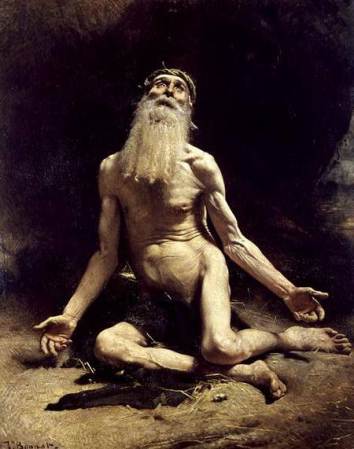
Job (oil on canvas) by Bonnat, Leon Joseph Florentin (1833-1922)
Lamentations 3
1 I am one who has seen affliction under the rod of God’s wrath; 2 he has driven and brought me into darkness without any light; 3 against me alone he turns his hand, again and again, all day long. 4 He has made my flesh and my skin waste away, and broken my bones; 5 he has besieged and enveloped me with bitterness and tribulation; 6 he has made me sit in darkness like the dead of long ago. 7 He has walled me about so that I cannot escape; he has put heavy chains on me; 8 though I call and cry for help, he shuts out my prayer; 9 he has blocked my ways with hewn stones, he has made my paths crooked. 10 He is a bear lying in wait for me, a lion in hiding; 11 he led me off my way and tore me to pieces; he has made me desolate; 12 he bent his bow and set me as a mark for his arrow. 13 He shot into my vitals the arrows of his quiver; 14 I have become the laughingstock of all my people, the object of their taunt-songs all day long. 15 He has filled me with bitterness, he has sated me with wormwood. 16 He has made my teeth grind on gravel, and made me cower in ashes; 17 my soul is bereft of peace; I have forgotten what happiness is; 18 so I say, “Gone is my glory, and all that I had hoped for from the LORD.” 19 The thought of my affliction and my homelessness is wormwood and gall! 20 My soul continually thinks of it and is bowed down within me. 21 But this I call to mind, and therefore I have hope: 22 The steadfast love of the LORD never ceases, his mercies never come to an end; 23 they are new every morning; great is your faithfulness. 24 “The LORD is my portion,” says my soul, “therefore I will hope in him.” 25 The LORD is good to those who wait for him, to the soul that seeks him. 26 It is good that one should wait quietly for the salvation of the LORD. 27 It is good for one to bear the yoke in youth, 28 to sit alone in silence when the LORD has imposed it, 29 to put one’s mouth to the dust (there may yet be hope), 30 to give one’s cheek to the smiter, and be filled with insults. 31 For the LORD will not reject forever. 32 Although he causes grief, he will have compassion according to the abundance of his steadfast love; 33 for he does not willingly afflict or grieve anyone. 34 When all the prisoners of the land are crushed under foot, 35 when human rights are perverted in the presence of the Most High, 36 when one’s case is subverted — does the LORD not see it? 37 Who can command and have it done, if the LORD has not ordained it? 38 Is it not from the mouth of the Most High that good and bad come? 39 Why should any who draw breath complain about the punishment of their sins? 40 Let us test and examine our ways, and return to the LORD. 41 Let us lift up our hearts as well as our hands to God in heaven. 42 We have transgressed and rebelled, and you have not forgiven. 43 You have wrapped yourself with anger and pursued us, killing without pity; 44 you have wrapped yourself with a cloud so that no prayer can pass through. 45 You have made us filth and rubbish among the peoples. 46 All our enemies have opened their mouths against us; 47 panic and pitfall have come upon us, devastation and destruction. 48 My eyes flow with rivers of tears because of the destruction of my people. 49 My eyes will flow without ceasing, without respite, 50 until the LORD from heaven looks down and sees. 51 My eyes cause me grief at the fate of all the young women in my city. 52 Those who were my enemies without cause have hunted me like a bird; 53 they flung me alive into a pit and hurled stones on me; 54 water closed over my head; I said, “I am lost.” 55 I called on your name, O LORD, from the depths of the pit; 56 you heard my plea, “Do not close your ear to my cry for help, but give me relief!” 57 You came near when I called on you; you said, “Do not fear!” 58 You have taken up my cause, O LORD, you have redeemed my life. 59 You have seen the wrong done to me, O LORD; judge my cause. 60 You have seen all their malice, all their plots against me. 61 You have heard their taunts, O LORD, all their plots against me. 62 The whispers and murmurs of my assailants are against me all day long. 63 Whether they sit or rise — see, I am the object of their taunt-songs. 64 Pay them back for their deeds, O LORD, according to the work of their hands! 65 Give them anguish of heart; your curse be on them! 66 Pursue them in anger and destroy them from under the LORD’s heavens.
This third poem in Lamentations intensifies the acrostic pattern exhibited in the first two poems. In Lamentations one and two each stanza, as noted by the verse numbers in those poems, begins with a successive letter of the Hebrew alphabet. In Lamentations three we jump from twenty-two to sixty-six verses because every line of the three-line stanzas begins with the appropriate letter. Three verses for aleph, three for bet, and through the Hebrew alphabet to tav. Although the poem is approximately the same length as the previous two poems the poet increases their reliance on form in a way only exceeded by Psalm 119 which has eight verses utilizing each starting letter as it moves through the acrostic pattern.
In poetry form matters. Acrostic is a form used to denote completion, and it brings an external order to a disordered world. Like the acrostic poem of Psalm 25, the poet attempts to reconcile the promises of the steadfast love (hesed) of God in a world where that love is challenged by the absence of God’s protection or the presence of God’s wrath. It is an act of faith that holds onto the language the poet learned throughout their life in a time where their life is turned upside down. Yet, here in this central poem of the book of Lamentations we do get a small glimmer of hope and as Kathleen O’Connor suggests, like Jeremiah 30–33, the placement of hope at the center may be intentional, yet that hope “remains muted at best.” (NIB VI: 1057)
In the first two poems there were two primary voices: the feminine voice of daughter Zion and the masculine voice of the witness reporting on daughter Zion’s experience of trauma, destruction, grief, and rage. In the second chapter of Lamentations this witness transforms into an advocate for daughter Zion unable to remain a passive observer. Yet, in this third chapter or third poem the voice throughout is that of a man. The first two poems have examined the impact of war and defeat on a feminine voice, but now the impact is viewed through a male lens. The NRSV overcorrects in its agenda for inclusive language when in the initial verse it translates “I am one.” The Hebrew geber may not mean warrior but it does have a definitively macho sense of standing up for oneself and others who are defenseless. The geber is a defender of women, children, and other non-combatants. In Job 38:3 and 40:7 this is the term utilized when Job is commanded by God to “Gird up your loins like a man (geber), I will question you and you shall declare to me.” The experiences of men and women are different and what they experience in this moment of defeat are different. Now this man, in the poem, who was supposed to provide security for the women and children of Judah stands, “injured, struck down, shot, pursued, captured, chained up, terrified, defeated, and taunted.” (Goldingay, 2022, p. 125) This man has lost two of the primary components of masculine identity traditionally understood. They have lost their ability to protect those under their protection and to provide for themselves and others.
Also in the first verse, the NRSV introduces that the man has suffered under the rod of God’s wrath, although God is not mentioned in the Hebrew at this point. Although from the first two poems as well as the later imagery of this poem we know that ultimately God is the one responsible for the suffering of the man and those around him, the one who causes the suffering is not explicitly named until verse eighteen when the LORD is finally named. Although it is the speaker’s God, the LORD of Israel, who is responsible for all the violent actions upon this man it may be that in the initial declaration of suffering it is difficult to voice that the LORD of steadfast love became the bringer of affliction and wrath in this moment.
Violent verbs drive the action that has broken this man into a world of darkness. This was not a single wound that the man can recover from, but his assailant has turned his hand against this once strong man again and again. Flesh, bone, and skin: the whole of his person is devastated and although he still lives and speaks in pain he is on the path to becoming a resident of the broken boneyard of Ezekiel 37. The language then moves to the language of siege and imprisonment. The people of Judah would have recently experienced the siege, and imprisonment was typically a political punishment in the Middle East rather than the default punishment for wrongdoings in became in Western societies.[1] Poetry does not need to be consistent to be powerful. On the one hand the man is surrounded and besieged, on the other he is isolated and alone. Ultimately the besieging and imprisoning presence has cut him off from world and most critically for the poet, from God’s steadfast love.
Martin Luther once spoke of the wrath of God as God’s alien work, while the grace of God was God’s proper work. Although still unnamed, it has become clear that the LORD has become like a dangerous animal[2] waiting to attack or an archer with this strong man in his sights. He has fallen from being a person worthy of respect to the laughingstock of the people. The good things have turned to bitterness, and wormwood a plant with a strong smell, bitter taste and reputation for toxicity (Goldingay, 2022, p. 134) utilized in the prophet Jeremiah’s writings,[3] becomes the unappealing drink provided. This once strong man now lies with his face and teeth on the ground among the gravel and cowering in ashes either in mourning or more likely in the aftermath of the destruction of Jerusalem. This man’s life (nephesh)[4] has been deprived of peace (shalom) and happiness (tob). Finally in verse eighteen we have the LORD named when all that the man had hoped from the LORD is gone. Reflection on his desperate and homeless situation only brings more bitterness.
Faith is not a straight path. Grief also is not a linear journey. This man has moved from bitterness to a remembrance of the faith he learned and the God he still trusts. The steadfast love of the LORD never ceases, his mercies never come to an end becomes a pivot point in this poetic reflection as the faith this man has learned is confronted by the reality of a life made bitter. The LORD is his inheritance and the one he can hope in. The good (happiness NRSV) that the man has forgotten is now emphasized as the starting word of the three ‘tet’ verses[5] which each begin with tob (good). Good is the LORD, good that one should wait, good that one should bear. The path of faithfulness that the man discerns is one of seeking God, staying silent and submissive, and bearing the suffering that is imposed, of bowing down and turning the other cheek. God will turn from wrath to grace because that is the character of the LORD of the man’s faith.
Verses thirty-four to thirty-six are translated as a question in most English translations, but the question form is not required in Hebrew. Another possible reading of these verses is that God does not see the way prisoners are crushed, and human rights are being violated, and justice is subverted. Yet, this also conflicts with the faith the man has learned where the LORD is responsible for everything both good and bad.[6] So the man turns inward to examine whether he individually and his people collectively have sinned testing and examining their ways. Ultimately the man’s verdict is that we have transgressed but also you have not forgiven. This final realization for the man forms a final pivot where the path of silence and submission is left aside for a final protest even more heated than the first. For this man the difference between the character of God represented by steadfast love and the experience of God as unforgiving requires him to raise his voice to attempt to pierce God’s obscuring anger.
The problem is that the God who sees and hears is shielding Godself from seeing and hearing. Wrapped in anger and a cloud no prayer can pass through God has abandoned the people. The poet digs into their humiliation and declares that God has made them filth and rubbish among the people. We open our mouths and God does not hear, but our enemies open their mouths, and we cannot help but hear them. Panic and pitfall, devastation and destruction[7] have come upon the man and his people and like both daughter Zion and the witness in the previous two psalms[8] his eyes flow an unceasing river of tears. Yet, these tears are now a part of this man’s protest to God. He can be broken in body and spirit, eating the dirt and covered in ashes, isolated and imprisoned, and caught up in a seemingly unending flood of tears if God will see. This man is able to remember God’s words from the past, “Do not fear!” the only words attributed to God in the book of Lamentations, but even these words come from the past. In repetitive fashion this poet calls on God as the ‘you’ who can act. Ultimately ‘You’ the LORD have heard their taunts and in the final verses this man asks for what daughter Zion cried for. Treat my enemies the way you have treated me. You have punished me for my transgressions, now punish them. I have known the anguish of the heart as I sit here in dust and ashes, the object of their taunt songs, let them know the impact of your curse on their lives. I have seen affliction under your wrath, turn your anger to them and destroy them. The poems of Lamentations attempt to make sense of a world that makes no sense. It is highly ordered by the poetic structure as it encounters a disordered world. It attempts to reconcile the faith in a God of steadfast love with the experience of God’s wrath. Their world, their home, their lives, and their relationship with their God is broken. They speak these words into the silence of the void waiting for an answer from their LORD which they have not received. This man, geber, is attempting to gird his loins like Job and stand before God and pierce the cloud of God’s wrath which seems to have silenced prayers. It is an act of audacity, but we inherited an audacious set of scriptures.
[1] There is no provision in the Torah for imprisonment. Jeremiah in Jeremiah 38 was imprisoned not because he broke no laws but because he was an annoyance to the leaders in Jerusalem.
[2] Bear and lion are paired as dangerous animals (Hosea 13;8; Amos 5:19) (Goldingay, 2022, p. 132)
[4] The Hebrew nephesh often translated soul in English is a very different concept than most modern conceptions of ‘soul.’ For Hebrew the nephesh is about life and not about something that is freed after death.
[5] Verses 25-27 which begin with the Hebrew letter ‘tet.’
1How the Lord in his anger has humiliated daughter Zion! He has thrown down from heaven to earth the splendor of Israel; he has not remembered his footstool in the day of his anger. 2The Lord has destroyed without mercy all the dwellings of Jacob; in his wrath he has broken down the strongholds of daughter Judah; he has brought down to the ground in dishonor the kingdom and its rulers. 3He has cut down in fierce anger all the might of Israel; he has withdrawn his right hand from them in the face of the enemy; he has burned like a flaming fire in Jacob, consuming all around. 4He has bent his bow like an enemy, with his right hand set like a foe; he has killed all in whom we took pride in the tent of daughter Zion; he has poured out his fury like fire. 5The Lord has become like an enemy; he has destroyed Israel. He has destroyed all its palaces, laid in ruins its strongholds, and multiplied in daughter Judah mourning and lamentation. 6He has broken down his booth like a garden, he has destroyed his tabernacle; the LORD has abolished in Zion festival and sabbath, and in his fierce indignation has spurned king and priest. 7The Lord has scorned his altar, disowned his sanctuary; he has delivered into the hand of the enemy the walls of her palaces; a clamor was raised in the house of the LORD as on a day of festival. 8The LORD determined to lay in ruins the wall of daughter Zion; he stretched the line; he did not withhold his hand from destroying; he caused rampart and wall to lament; they languish together. 9Her gates have sunk into the ground; he has ruined and broken her bars; her king and princes are among the nations; guidance is no more, and her prophets obtain no vision from the Lord. 10The elders of daughter Zion sit on the ground in silence; they have thrown dust on their heads and put on sackcloth; the young girls of Jerusalem have bowed their heads to the ground. 11My eyes are spent with weeping; my stomach churns; my bile is poured out on the ground because of the destruction of my people, because infants and babes faint in the streets of the city. 12They cry to their mothers, “Where is bread and wine?” as they faint like the wounded in the streets of the city, as their life is poured out on their mothers’ bosom. 13What can I say for you, to what compare you, O daughter Jerusalem? To what can I liken you, that I may comfort you, O virgin daughter Zion? For vast as the sea is your ruin; who can heal you? 14Your prophets have seen for you false and deceptive visions; they have not exposed your iniquity to restore your fortunes, but have seen oracles for you that are false and misleading. 15All who pass along the way clap their hands at you; they hiss and wag their heads at daughter Jerusalem; “Is this the city that was called the perfection of beauty, the joy of all the earth?” 16All your enemies open their mouths against you; they hiss, they gnash their teeth, they cry: “We have devoured her! Ah, this is the day we longed for; at last we have seen it!” 17The Lord has done what he purposed, he has carried out his threat; as he ordained long ago, he has demolished without pity; he has made the enemy rejoice over you, and exalted the might of your foes. 18Cry aloud to the Lord! O wall of daughter Zion! Let tears stream down like a torrent day and night! Give yourself no rest, your eyes no respite! 19Arise, cry out in the night, at the beginning of the watches! Pour out your heart like water before the presence of the LORD! Lift your hands to him for the lives of your children, who faint for hunger at the head of every street. 20Look, O LORD, and consider! To whom have you done this? Should women eat their offspring, the children they have borne? Should priest and prophet be killed in the sanctuary of the Lord? 21The young and the old are lying on the ground in the streets; my young women and my young men have fallen by the sword; in the day of your anger you have killed them, slaughtering without mercy. 22You invited my enemies from all around as if for a day of festival; and on the day of the anger of the LORD no one escaped or survived; those whom I bore and reared my enemy has destroyed.
Within these first two connected poems there are three primary figures: the narrator (or the poet), daughter Zion (Jerusalem personified) and the LORD who was once the divine protector of daughter Zion but has now become her humiliator and destroyer. In the first poem (Lamentations 1) the voice of the poem was split equally between the narrator (poet) and daughter Zion. The narrator in Lamentations one attempted to remain detached and narrate the plight of the broken relationship between daughter Zion and the LORD, while daughter Zion spoke out of the desolation of herself and her people. Ultimately throughout the poems of Lamentations the LORD remains an unspeaking figure, but that does not mean that daughter Zion’s words spoken to both the LORD and those she once believed as friends go unheard and her plight goes unobserved. In this second poem the narrator, once content with reporting on her fall, can no longer remain a detached observer. Her plight has undone him and now he steps into the space between daughter Zion and the God of Israel.
An important difference between the first and second poem is the way the narrator refers to the God of Israel. In English translations of the Hebrew Scriptures when the English word LORD is capitalized throughout the word[1] the four Hebrew consonants for the name of God (YHWH) given to Moses is behind the translation with the vowels pointed to tell the speaker to pronounce the word as ‘Adonai.’[2] Yet, if you look closely at your English translation you should notice that most of the occurrences of Lord in this poem are not capitalized throughout. There are six occurrences of the divine name, but every other time it is ‘Adonai’ which is normally translated Lord. This can be as simple as calling someone “Sir” or “master” in deference or it can be an indication of rank, but it is not the normal way the prophets, poets, and narrators of the Hebrew Scriptures refer to God. Combining this observation with the content of the poem there seems to be a gap introduced between the narrator and the LORD.
Perhaps to the poet this Lord who has become an enemy is no longer acting like the LORD the God of Israel is supposed to act. Previously this narrator pointed out the unfaithfulness of daughter Zion but looking upon her desperate plight he cannot remain silent. He is committed to raising his voice the Lord may hear him. Roughly half of the utilizations of the word ‘Zion’ in the book of Lamentations occur in this second poem. (Goldingay, 2022, p. 84) This narrator steps into the space between Zion and her Lord and demands the Lord to see the impact of his anger. Perhaps this mighty God does not realize the damage that has been done and so this poet in forceful verbs attempts to gain a hearing for daughter Zion who has been humiliated and thrown down from heaven to earth. Like a child throwing a tantrum Jerusalem (or the temple)[3] has been kicked about unremembered in the wrath of this God. This Lord has destroyed, broken down, and brought down to the ground. He cut down and removed his restraining hand from daughter Zion’s enemies, but rather than passively allowing her enemies to triumph the Lord has become her enemy, burning and consuming, drawing back his bowstring to strike, killing and pouring out his fury like fire. That which was supposed to stand forever has been carelessly dismantled like a booth or tent. Stronghold and temple, kings and priests, young and old, men and women, walls and dwellings all lay ruined. Yet, in the midst of all this devastation there is no word of the LORD coming to the prophets. God’s voice remains silent as God’s devastation leaves the elders of Zion and the young girls of Jerusalem sitting on the ground in silence. The elders and the young girls represent the two extremes of the population, and the poet wants us to see a shattered people reduced to sitting in the dust of the earth in sackcloth and mourning.
In Lamentations 1:20 daughter Zion stated that “her stomach churned within her,” and now this narrator forced to hear her plea and see her plight shares her emotional reaction. In verse eleven the poet reports that his eyes are spent with weeping; my stomach churns; my bile is poured out on the ground. The poet cannot stay detached in the face of this violence against his own people. He is one of them. The children who are dying are the future of his people. The suffering of these young children with nothing to eat and nothing to drink has turned his stomach. Mothers who are powerless to prevent the starvation of their own children fill their eyes with tears. His words may not be able to comfort daughter Zion, but perhaps they can rouse her Lord to pay attention to the damage his unrestrained wrath has done. Daughter Zion through the first poem was referred to by the narrator in third person, but now he sees, and she is now the ‘you’ of his direct address. Daughter Zion who in the previous poem was implied to be adulterous has become virgin daughter Zion, one who is suffering innocently.
The poet points to the prophets who failed by giving the people false visions that allowed them to persist in their disobedience. They covered over the failings in the relationship between the people and their God and perhaps worked against prophets like Jeremiah who attempted to speak the truth. Yet, these now silent prophets are replaced by enemies who gloat at the way they have destroyed Jerusalem. The poet knows that it is the Lord who opened his mouth and allowed this to happen. The enemies who waited for this day did not know they were participating in the premeditated act of destruction unleashed by the anger of their God.
The narrator calls for the walls of the city to cry out to the Lord as the poet himself is crying out. The identity of their God is one who sees and hears, and their only deliverance is in God turning from God’s action. This destroyed wall of Jerusalem becomes a ‘wailing wall’. (Goldingay, 2022, p. 113) The city and the poet refuse to remain silent amid their weeping and stomach-turning reality. They now stand together calling on their Lord to once again be the LORD who rescues, delivers, protects, and provides.
Kathleen O’Connor views the voice of the poem returning to daughter Zion in verse twenty (NIB VI: 1043) but the poem is not explicit about a voice change and for me retaining the entire poem in the narrator’s voice makes logical sense. This narrator who once stood observing both daughter Zion’s disobedience and punishment now has come to her side and asks the LORD (and it is the divine name used here) to look and consider if God’s actions are just or proportional. The question to whom have you done this is even more direct in Hebrew. Kathleen O’Connor indicated that even ‘who have you ever treated (‘alal) like this’ needs to be strengthened because ‘alal suggests affliction and abuse. (NIB VI: 1043) and the word for children (‘ol ale) parallels this word for affliction. Even in English the implication of the Lord being responsible for a starvation so vast that it forces women into cannibalism, creating a reality where priests and prophets are slain in the holy place of the temple and that young and old die indiscriminately is a bold claim, but it is also a claim that fits within the language of Jeremiah and the Psalms. The young men and young women have died in the streets, the future itself is dying, and it is the Lord’s fault. Instead of allowing the people to celebrate the festivals to the LORD, now it is the enemies who are invited to Jerusalem to celebrate. But the LORD, the protector, has transformed in his fury into the Lord who is now the enemy of daughter Zion, and by extension the narrator who speaks up for her.
These poems in Lamentations attempt to make sense of a reality turned on its head. Their world has collapsed. Jerusalem, the king, the priests and prophets, the temple, and the land have all been devastated. Children, men and women in their prime, and the elders have all fallen victim to starvation and the sword. As Kathleen O’Connor states eloquently:
They (the poems of Lamentations) create a rhetoric of fury, a swirling language of pain, distrust, and betrayal, both divine and human. In this language what is awry and causes unspeakable suffering is the way that God relates to humans, the way God has abandoned covenant mutuality and faithfulness. This causes profound rage. (NIB VI:1043)
Yet, even in this profound rage the poet and the city cry out to the Lord. The desire God to turn from God’s anger and see the devastation God has wrought and to repent. They may feel that God’s actions and anger have gone too far, that God has abandoned God’s covenant responsibilities just as they had done. This second acrostic poem is an exercise of attempting to bring order to a disordered world. Of utilizing words to speak of a suffering which surpasses what words can communicate. Their world, their home, their lives, and their relationship with their God is broken. They speak these words into the silence of the void waiting for an answer from their LORD which they have not received.
[1] Many printings of English bibles will use drop cap for this where the first L is in the normal font size and the ORD drops down one font size.
[2] In Hebrew the vowels were added later and are above and below the consonants. This is done to not casually pronounce the divine name in keeping with the commandment of not using the name of the LORD your God in vain.
[3] Footstool often is used to refer to the cover of the ark of the covenant and by extension the temple or Zion as a whole.
1How lonely sits the city that once was full of people! How like a widow she has become, she that was great among the nations! She that was a princess among the provinces has become a vassal. 2She weeps bitterly in the night, with tears on her cheeks; among all her lovers she has no one to comfort her; all her friends have dealt treacherously with her, they have become her enemies. 3Judah has gone into exile with suffering and hard servitude; she lives now among the nations, and finds no resting place; her pursuers have all overtaken her in the midst of her distress. 4The roads to Zion mourn, for no one comes to the festivals; all her gates are desolate, her priests groan; her young girls grieve, and her lot is bitter. 5Her foes have become the masters, her enemies prosper, because the LORD has made her suffer for the multitude of her transgressions; her children have gone away, captives before the foe. 6From daughter Zion has departed all her majesty. Her princes have become like stags that find no pasture; they fled without strength before the pursuer. 7Jerusalem remembers, in the days of her affliction and wandering, all the precious things that were hers in days of old. When her people fell into the hand of the foe, and there was no one to help her, the foe looked on mocking over her downfall. 8Jerusalem sinned grievously, so she has become a mockery; all who honored her despise her, for they have seen her nakedness; she herself groans, and turns her face away. 9Her uncleanness was in her skirts; she took no thought of her future; her downfall was appalling, with none to comfort her. “O LORD, look at my affliction, for the enemy has triumphed!” 10Enemies have stretched out their hands over all her precious things; she has even seen the nations invade her sanctuary, those whom you forbade to enter your congregation. 11All her people groan as they search for bread; they trade their treasures for food to revive their strength. Look, O LORD, and see how worthless I have become. 12Is it nothing to you, all you who pass by? Look and see if there is any sorrow like my sorrow, which was brought upon me, which the LORD inflicted on the day of his fierce anger. 13From on high he sent fire; it went deep into my bones; he spread a net for my feet; he turned me back; he has left me stunned, faint all day long. 14My transgressions were bound into a yoke; by his hand they were fastened together; they weigh on my neck, sapping my strength; the LORD handed me over to those whom I cannot withstand. 15The LORD has rejected all my warriors in the midst of me; he proclaimed a time against me to crush my young men; the LORD has trodden as in a wine press the virgin daughter Judah. 16For these things I weep; my eyes flow with tears; for a comforter is far from me, one to revive my courage; my children are desolate, for the enemy has prevailed. 17Zion stretches out her hands, but there is no one to comfort her; the LORD has commanded against Jacob that his neighbors should become his foes; Jerusalem has become a filthy thing among them. 18The LORD is in the right, for I have rebelled against his word; but hear, all you peoples, and behold my suffering; my young women and young men have gone into captivity. 19I called to my lovers but they deceived me; my priests and elders perished in the city while seeking food to revive their strength. 20See, O LORD, how distressed I am; my stomach churns, my heart is wrung within me, because I have been very rebellious. In the street the sword bereaves; in the house it is like death. 21They heard how I was groaning, with no one to comfort me. All my enemies heard of my trouble; they are glad that you have done it. Bring on the day you have announced, and let them be as I am. 22Let all their evil doing come before you; and deal with them as you have dealt with me because of all my transgressions; for my groans are many and my heart is faint.
Poetry can be used to speak to things that are at the edge of our ability to articulate. It can be utilized to speak to moments of profound joy, of awe and wonder, of emotions like love and happiness whose meanings seem to transcend our words. Yet poetic words can be utilized in our moments of heartbreak, depression, grief, and trauma as we attempt to make sense of a world which seems senseless. Lamentations is the work of a poet or poets attempting to make sense of their reality in the aftermath of the destruction of Jerusalem in 586 BCE. The poet has seen death from war and starvation, has seen the foundations upon which their life was built collapse, and the LORD who was supposed to protect Zion has turned away. The poet attempts to make sense of the loss of the home they knew, grieve the family and friends who did not survive the siege and the beginning of the exile, and to walk among a shattered people with shattered dreams into a previously unimagined reality.
The survivors of Jerusalem not only retained the words of the prophets who warned of this reality, but they also retained the words of the prophets and poets wrestling with God, attempting to reconcile their faith with the world they experience. They are living in a disordered world, and yet in their words they attempt to bring some order into the disorder. Kathleen O’Connor in her book Jeremiah: Pain and Promise talks about the way these works written in the time surrounding the exile invite not only the contemporary generation but also future generations to enter the process of being meaning-makers.
It not only reflects the interpretive chaos that follows disasters, when meaning collapses and formerly reliable beliefs turn to dust. Jeremiah’s literary turmoil is also an invitation to the audience to become meaning-makers, transforming them from being passive victims of disaster into active interpreters of their world. (O’Connor, 2011, p. 31)
Making sense of a traumatic world-changing event is not an overnight process. It is a journey through the dark shadows of grief and fear, depression and guilt, the struggle to survive as others surrender to the end. This first poem in the book of Lamentations attempt to bring some order to the disorder and give voice to the pain and humiliation felt by the people. They, like Jeremiah and Ezekiel, understand that the tragedy is a result of their own rebellion and disobedience which have broken their relationship with the LORD who protected them. They also understand that they have no future without the LORD looking, seeing, and considering the fate of this disgraced and displaced people.
The poem has two voices, a narrator and daughter Zion. The narrator is the primary speaker for the first half of the poem and attempts to relate the fate of daughter Zion as an observer of the fall of this city personified as a woman. The poem begins with the interrogative “How?” Although in English translations the word how is used primarily as an inquiry about the state of daughter Zion: How lonely, How like a widow. The word also inquires about the manner or way in which something comes to pass: How did it happen that lonely sits the city, How did she become like a widow? How did this place of honor among the nations become dishonored? How did the princess become the vassal? What has brought about this reversal for daughter Zion and those who made their home in this great city. Something has changed that has brought about the reversal of fortunes for the city and the people.
The narrator voice in the poem has a greater detachment from the suffering and events occurring to daughter Zion. Daughter Zion may weep, but the narrator reports. Yet, the narrator’s reports begin to allude to the reason why daughter Zion weeps. In a world where women were not to have lovers, they were to be faithful to their husband, now this one who has become like a widow[1] we learn is also abandoned by her lovers and friends. Something has gone wrong in the relationships that were supposed to provide support. The narrator slips out of the metaphor to narrate Judah’s entry into exile and the suffering that comes with her displacement from the promised land into the hostile nations. The exclamation that Judah found no resting place echoes the language of the curses for disobedience in Deuteronomy 28:65. As Lamentations, like Ezekiel and Jeremiah, make sense of the catastrophe of the Babylonian exile the utilize the theological perspective of Deuteronomy.
Now the roads that pass through Jerusalem mourn the loss of the pilgrim traffic to the festivals, and the priests who officiated at the festivals groan as the young women grieve. The young women here are teenage women of marriageable age. These may be the women at greatest risk of sexual violence from the enemy soldiers who have breached the city and who now escort them into exile. They also would be the women whose potential partners died in the defense of the city or in the aftermath of the breach. Daughter Zion now returns to the poem as one with a bitter lot, whose foes are now her master, whose enemies prosper. The reason is for the first time explicitly stated by the narrator: she is being made to suffer by the LORD for her transgressions. Jeremiah, Ezekiel, and Lamentations all share a common perspective on the disastrous events. The tragedy of the siege, destruction, and exile are all a result of Judah’s disobedience to God and the curses of Deuteronomy 28 echo throughout Lamentation’s poetic remembrance.
Yael Zigler has a powerful explanation of the poetic image of the princes being like stags which find no pasture:
The verse portrays the previously powerful leadership as drained of energy, unable to find pastures or the basic means of survival. If they cannot find pasture for themselves, they certainly cannot help their people, whose sufferings are compounded by their leaders’ impotence. (Ziegler, 2021, p. 92)
Nobles, priests, and elders all failed the people in this crisis, but now they are unable to even deliver themselves. Both Jeremiah and Ezekiel had harsh words for these leaders who failed to care for the people and who compounded the upcoming crisis, but now as the world is turned upside down the powerful in Jerusalem are now impotent.
As the image once again returns to Jerusalem personified as mourning over her past riches and glories. She is isolated among the nations. Lamentations adopt a similar image to Hosea 1-3, Jeremiah 2–4, and particularly the harsh language of Ezekiel 16. Jerusalem’s past actions have led those who once admired her to despise her. Like the imagery of Ezekiel 16:35-43, Jerusalem is like a woman who is shamed by having her clothing taken away as an act of humiliation. The language of uncleanness enters the poem for the first time, but the uncleanness is literally in her hems at the bottom of her clothing. Whether the poem imagines her walking through the uncleanness of the world around her and it clinging to the skirts or whether it utilizes the image of menstruation[2] (which will come up with uncleanness later in the poem) without rags to catch the blood. Regardless of how exactly her uncleanness is visualized in the imagery of the poem, from the narrator’s perspective her actions which took no thought of the future, are the reason for her humiliated state. Her fall from grace was appalling and former friends and lovers are distant as daughter Zion for the first time raises her voice in the poem calling out to the LORD to “look at my affliction, for the enemy has triumphed!”
The narrator concludes his portion of the poem with the enemies of Zion taking her precious things and invading her sanctuary. Nations that were not to be a part of the congregation of Israel in the law now stand in the center of the temple where even priests would not enter. The language behind invade, often rendered “come into,” often denotes sex in the Hebrew scriptures and the poetic intent of the imagery may be to communicate that this is both the pillaging and rape of Zion. (Goldingay, 2022, p. 67) Daughter Zion is stripped, humiliated, dishonored, and disgraced as her people struggle to find the food, they need for the strength to endure the ravages of the siege and now exile. For most of the first half of the poem the narrator has described her sorry state, but now she turns to the LORD and to those who see her and raises her voice to command people to look, see, and consider her.
Rather than cowering in her pitiful state, daughter Zion lifts her voice and demands to be seen. The first one she cries to is the LORD to see the state that the LORD’s fierce anger has left her in. Then she cries to those who pass by to look and see her sorrow. Former friends and lovers who pass by ashamed of her are commanded by daughter Zion to see her in all her suffering and to understand the reason for her suffering. Her betrayal of the LORD has resulted in the LORD’s actions. As Kathleen O’Connor narrates,
Using vivid, violent verbs; she relates Yahweh’s brutal treatment of her. He sent fire; he spread a net; he turned her back; he left her devastated. Divine attacks of the female body again serve as a metaphor for the destruction of the city. (NIB VI: 1033)
In addition to the violent verbs listed above, the transgressions become a yoke which daughter Zion bears. The harsh language of daughter Zion’s appeal may also be designed to call upon the LORD to again assume the protector role. She now is the vulnerable one who needs the protection of the LORD. Like in the Psalms, the LORD may be both the cause of their suffering and the only one who can end the suffering.
The warriors, young men, daughters, and children of Zion now bear the crushing weight of the defeat of Zion by her foes. Warriors and young men have been crushed in the crucible of war and starvation, and in an image that will resonate in Isaiah 63, Joel 3, and Revelation 14 now “girl daughter Judah” is treaded as in a wine press. Daughter Zion weeps, and there is no one to comfort her or wipe away her tears. Children, perhaps orphaned by war or the first to suffer from starvation, are a prime example of the vulnerable caught in situations they cannot control.
In verse seventeen the narrator interrupts daughter Zion’s cries. This narrator can describe her isolation where no one will comfort her because the LORD has commanded her neighbors to become her foes. Yet, even beyond foes Jerusalem has become a “filthy thing” among them. “Filthy thing” (NRSV) or “unclean thing” (NIV) translates the Hebrew term nidda which refers to a “menstrual rag.” As Kathleen O’Connor states daughter Zion, “is not only ritually unclean, but she is also repulsive and dirty.” (NIB VI: 1033) Yet, rather than refute the narrator’s claim daughter Zion proclaims, “the LORD is in the right.” The woman does not deny that her suffering is justified but she also cries out the peoples once again to look and see her sufferings. Her bowels churn and her heart is wrung and death reigns both in the house and in the streets.
The enemies of Zion have seen and heard but their reaction is one of joy. In one final appeal the woman asks for the LORD to judge these enemies. That they may be judged as she was judged. That their evil may come before the LORD as her own rebellion came before the LORD. The LORD has dealt fairly if violently with her, now dealing in a similar fashion with those who abuse and taunt her. With a groaning body and a faint heart, she appeals to God out of her desolation asking for her God to look, see, and consider her words.
This acrostic poem utilizes the voice of a narrator and daughter Zion to express the pain and desolation of the collapse of the world as the people of Jerusalem gives words to the trauma of the exile. Like reading Elie Wiesel’s Night it allows a reader to encounter a small part of the tragic reality that the author encounters. Its language may at times make us uncomfortable, but we should never feel comfortable looking into the courageous act of someone trying to use words to express the inexpressible depths of their pain, their attempts to reimagine the relationship between themselves and their God in the midst of an earthshattering tragedy, and their attempts to make sense in a senseless world. One appeal of the acrostic form is that it imposes order on a chaotic world.
Any time we engage with the scriptures it is helpful to remember that there is some distance between the worldview of the exiles of Jerusalem in 586 BCE and ourselves. To appreciate the courage of the poet in their attempt to make sense of the world with words does not require us to fully endorse the use of vivid, violent verbs against a metaphorical female body. Although I cannot speak with authority about the view of masculinity of this time, I do believe one of the intentional uses of this language is to invoke in the LORD, who plays the masculine role in this imagery here and throughout the prophets, the role of protector. Jeremiah, Ezekiel, and Lamentations do not shirk from the perspective that Jerusalem’s punishment is justified but that does not prevent Jeremiah, Lamentations, and the Psalms[3] from calling out to the LORD to look, see, consider and to respond in mercy.
The first poem of Lamentations may be able to articulate the pain of daughter Zion, but it is unable to resolve that pain. Even though the poet has worked through their crisis from aleph to tav, the acrostic poem has not brought about a complete expression of the pain. Perhaps that leads to the second poem which also speaks out of the pain of defeat, grief, and an uncertain future. These poems are steps on the way to healing. They are the articulation of the pain and loss of the people of Jerusalem. The loss of home, the loss of identity, the loss of meaning. Yet, in a strange way, these poems are a part of the rediscovery of faith. The LORD is the focal point of daughter Zion’s appeal. Daughter Zion hopes for a future beyond the anger of the LORD in this moment which has brought such devastation and disgrace.
[1] Widows in the bible are not only women who have lost their husbands but also people who have lost familial support and are therefore vulnerable. A person may be a widow and have a son or son-in-law to take her into her house, but widows as a vulnerable portion of the population (like orphans and strangers/resident aliens) would be those outside the familial support structure. (NIB VI: 1029)
[2] This may be a source of discomfort for modern readers, but menstruation occupies a significant place in the law in relation to cleanness and uncleanness. Similar language appears in the prophets.
[3] Ezekiel rarely appeals to the LORD for mercy. Ezekiel tends to value obedience to the LORD and rarely protests like his older colleague Jeremiah.
Jeremiah Lamenting the Destruction of Jerusalem by Rembrandt van Rijn 1630
I have intentionally worked my way through several books normally overlooked by Christian readers and leaders in our scriptures. The book of Lamentations for most of its history would qualify as an underutilized book within the scriptures we share with our Jewish Ancestors. Although there has been some recent scholarly interest in these five poems, for the average person of faith the name of the book is probably enough to scare the casual reader away. Yet, I do believe that we neglect the breadth of scripture to our own detriment. Over the thirteen years I’ve been writing on signoftherose I’ve gained a much greater appreciation for the wisdom of Hebrew poetry and the open and honest dialogue between God and God’s people that our scriptures capture.
Having worked through Psalms 1-110 and Song of Songs (or Song of Solomon) has given me a much greater appreciation of Hebrew poetry, and Lamentations is poetry. Lamentations is five poems, four of which are structured as acrostics[1] which move sequentially through the twenty-two letters of the Hebrew alphabet and the final poem’s twenty-two lines while not acrostic matches the twenty-two verse format of an acrostic. The acrostic form is often used to denote the completion of a thought, but due to the tragic event that evokes these poems it is also may be a tool to provide structure during a traumatic time.
Gwen Sayler and Ann Fritschel, my Hebrew Bible instructors twenty-five years ago at Wartburg Seminary used to joke that the answer to any question in the Hebrew Scriptures was likely to be the Babylonian exile. This event reshaped the Hebrew people when the Davidic king is sent into exile as well as the people. They mourn the loss of their land, the temple, and Jerusalem. Having worked through both Jeremiah and Ezekiel, which bracket Lamentations in the Christian arrangement of scriptures, has involved me dwelling in the writings of this period around 587 BCE. Lamentations current position after Jeremiah is due to the traditional attribution of these poems to Jeremiah.
The Hebrew name of this short book of poems is Eikha which comes from the first word of the first poem. Eikha is the elongated form of the word eikh which means “how?” How has this disaster happened to the people. This question would consume the two long prophetic books of Jeremiah and Ezekiel, the Deuteronomic historical retelling of the narrative of 1 & 2 Kings which climaxes at the exile at the end of the narrative, and several psalms most notably Psalm137. How has the relationship between God and God’s people come to this point where the central symbols of the people have collapsed: the Davidic monarchy, the city of Jerusalem (Zion), the land, and the temple built by Solomon. As the people find themselves as strangers in strange lands they have to rediscover what it means to be the people of the covenant.
Lamentations is a book with theological implications, but it is not attempting to be systematic. It is emotional, as it should be. Its voice is the voice of the wounded people of a lost city seeing through tear-filled eyes. It may be utilizing structure to help make sense of the chaotic, but it is a book shaped by grief and broken hearts. As John Goldingay states, “Lamentations is a “mandate to question.”” (Goldingay, 2022, p. 30) Theologically Lamentations assumes, like much of Hebrew literature, that the God of Israel is responsible for everything that occurs. Although Lamentations understands that the cause of the exile is the covenant unfaithfulness of Israel to their God, they protest and plead with God to change God’s mind and reverse the punishment they are receiving. Ultimately for the poet or poets of Lamentations their physical and emotional problems are a result of their relational problems with their God.
Resources Used For This Journey
Harvey Cox and Stephanie Paulsell, Lamentations and The Song of Songs. Belief Commentary on the Bible. Louisville: Westminster John Knox Publishing Company,2012.
The Belief Commentary series is a theological commentary written by theologians rather than biblical scholars. Harvey Cox did the Lamentations half of this commentary and uses Lamentations as a springboard into a wide range of theological topics. I read this commentary initially when I was working through Song of Songs.
John Goldingay, The Book of Lamentations. (New International Commentary on the Old Testament series). Grand Rapids: William B. Eerdman’s Publishing Company, 2022.
The NICOT series of commentaries have often been helpful textual commentaries, and when looking for a volume to assist with the language as well as the historical background these have often been helpful. John Goldingay is a scholar who has written extensively on Jeremiah and the literature associated with Jeremiah.
Kathleen M. O’Connor, “Book of Lamentations” in The New Interpreter’s Bible. Volume VI. Nashville, Abingdon Press, 1996.
The NIB is a solid all-around commentary on the entire bible and apocrypha. It is designed for pastors and those leading in congregations, so it does not normally engage the textual issues as deeply as the NICOT or Anchor Bible commentaries.
Ziegler, Yael, Lamentations: Faith in a Turbulent World. Maggid Studies in Tanakh. Jerusalem. Maggid Books, 2021.
When I can I attempt to utilize a Jewish scholar when reading the scriptures that we share. The Maggid Studies I have utilized in the past have been approachable but also provide a window into perspectives that most Christian scholars may not explore.
[1] Chapter three is acrostic but instead of one verse per letter there are three verses.