Category Archives: Biblical Reflections

Ezekiel 5 An Image of Jerusalem’s Destruction

Jerusalem is on Fire from the Art Bible (1896)

Ezekiel 5: 1-4

1 And you, O mortal, take a sharp sword; use it as a barber’s razor and run it over your head and your beard; then take balances for weighing, and divide the hair. 2 One third of the hair you shall burn in the fire inside the city, when the days of the siege are completed; one third you shall take and strike with the sword all around the city; and one third you shall scatter to the wind, and I will unsheathe the sword after them. 3 Then you shall take from these a small number, and bind them in the skirts of your robe. 4 From these, again, you shall take some, throw them into the fire and burn them up; from there a fire will come out against all the house of Israel.

An uncomfortable prophet becomes the embodiment of an uncomfortable message. The God of Israel has transformed from being the protector of Jerusalem to being actively engaged in the scattering and death of the people of Jerusalem. This culmination of the sign-act which through lying on one side, eating a restrictive diet, constructing a model of the siege and now the shaving of the prophet’s hair by a sword has deconstructed the identity of the prophet to demonstrate the destructive forces that are being unleased on Jerusalem. Ezekiel among the prophets has the greatest concern for ritual purity in relation to the Levitical understanding of a priest. Near the end of the book of Ezekiel he will note that priests are not to shave their heads (Ezekiel 44: 20) and this follows the prohibition of shaving bald spots on their heads or shaving the edges of their beards in mourning for all priests (Leviticus 21: 5, see also Deuteronomy 14: 1 where this practice is extended to all people). As before the command of the LORD pushes Ezekiel past the boundaries of what is expected of a priest and perhaps removes him from the role of the priesthood to serve as a strange prophet with a message that embodies the LORD’s disgust at what Israel has become.

Priests were prohibited from shaving their heads, even in the act of mourning but the use of a sharp sword as the instrument may point to the experience of shaving as a mark of dishonor or humiliation as part of a military defeat. Jerusalem is facing a military catastrophe as the continued image of the siege demonstrates. Ezekiel has already been instructed to cook his food in a way that violated his understanding of faithfulness to God’s law, and yet here Ezekiel does not protest. Ezekiel has been commanded to be obedient in contrast with the people. The implication is that the prophet does shave his head and beard, weighs his hair, and divides it in thirds according to the instructions. Two thirds of the city are represented destroyed either within or outside the city by the burning or striking of the representative thirds and the remnant remains under threat of God unsheathing the sword after them. Only a small number is bound to the prophet in order to remain safe.

Ezekiel 5: 5-17

5 Thus says the Lord GOD: This is Jerusalem; I have set her in the center of the nations, with countries all around her. 6 But she has rebelled against my ordinances and my statutes, becoming more wicked than the nations and the countries all around her, rejecting my ordinances and not following my statutes. 7 Therefore thus says the Lord GOD: Because you are more turbulent than the nations that are all around you, and have not followed my statutes or kept my ordinances, but have acted according to the ordinances of the nations that are all around you; 8 therefore thus says the Lord GOD: I, I myself, am coming against you; I will execute judgments among you in the sight of the nations. 9 And because of all your abominations, I will do to you what I have never yet done, and the like of which I will never do again. 10 Surely, parents shall eat their children in your midst, and children shall eat their parents; I will execute judgments on you, and any of you who survive I will scatter to every wind. 11 Therefore, as I live, says the Lord GOD, surely, because you have defiled my sanctuary with all your detestable things and with all your abominations — therefore I will cut you down; my eye will not spare, and I will have no pity. 12 One third of you shall die of pestilence or be consumed by famine among you; one third shall fall by the sword around you; and one third I will scatter to every wind and will unsheathe the sword after them.

13 My anger shall spend itself, and I will vent my fury on them and satisfy myself; and they shall know that I, the LORD, have spoken in my jealousy, when I spend my fury on them. 14 Moreover I will make you a desolation and an object of mocking among the nations around you, in the sight of all that pass by. 15 You shall be a mockery and a taunt, a warning and a horror, to the nations around you, when I execute judgments on you in anger and fury, and with furious punishments — I, the LORD, have spoken — 16 when I loose against you my deadly arrows of famine, arrows for destruction, which I will let loose to destroy you, and when I bring more and more famine upon you, and break your staff of bread. 17 I will send famine and wild animals against you, and they will rob you of your children; pestilence and bloodshed shall pass through you; and I will bring the sword upon you. I, the LORD, have spoken.

If you are making this journey with me through Ezekiel it quickly becomes uncomfortable to hear these harsh words of judgment from God directed at Jerusalem recorded in these first five chapters. This strange prophet’s declarations are unfamiliar to most people who are used to a less judgmental version of Christianity. As Katheryn Pfisterer Darr can state,

Ezekiel has a difficult time securing a place in mainstream Christianity. With a few well-known exceptions (e.g., the valley of dry bones vision in 37: 1-14), his oracles seldom make their way into lectionary readings and sermons, for they are deemed too severe, too complex, and too painful to set before our congregations and Bible study groups. And Ezekiel makes us uncomfortable—a sentiment we surely share not only with his original audience in exile, but also with two and a half millennia of his interpreters, both Jewish and Christian. Among the early rabbis, for example, we find the opinion that reading the book’s beginning and ending was too dangerous to be undertaken by anyone younger than thirty years of age. (NIB VI:1129)

This particular prophetic unit is, “one of the harshest that is delivered to the nation anywhere in Tanakh. It remains difficult to read, even as we are removed by so many generations.” (Ganzel, 2020, p. 54) Yet, even with the harshness and difficulty of reading Ezekiel I still believe it has something to teach us about a passionate God and a people who were once a treasured possession, a holy people, and a nation of priests (Exodus 19: 5-6) but now are viewed as impure and disgusting.

Jerusalem has ceased to be Zion, the home of God. Their privileged status has been forfeited at this time in their story with God, and Ezekiel is concerned with both pronouncing the change of status but also communicating the cause for this change. Throughout the first five chapters we have heard the charge that the people have rebelled against God’s statutes and ordinances. They were intended to be a witness to the righteousness of God revealed to them by the covenant. Instead, they failed to even live up to the righteousness of the nations[1] (ordinances of the nations in NRSV) and this is the root of the LORD’s anger with his people.

Ezekiel frequently uses the language of purity/impurity from the law, particularly Leviticus. Ezekiel uses the terms ‘detestable things’ (Hebrew shikkutzim) and ‘abominations’ (Hebrew to’evot) for the first of more than eighty uses throughout his prophecies. Detestable things typically refer to impure creatures which are forbidden as food, but in Ezekiel they normally refer to the idolatrous practices which have defiled the temple and the people. Abominations in the law are things that is, “hateful, disgusting, or worthy of condemnation.” (Ganzel, 2020, p. 51) and throughout Ezekiel these are the items that defile the bond between husband and wife, the land, the temple, Sabbath, and even God’s name. For Ezekiel these detestable things and abominations corrupt the people, the land, and even the temple making them impure and disgusting to God. The treasured possession is polluted, the holy people are unholy, and the nation of priests have become idolatrous.

The judgment echoes the language of the curses in the law[2] as well as what is found in other prophets.[3] It also remembers the cannibalism that is reported during the siege of Samaria under Ben-Hadad as referenced in 2 Kings 6: 24-41. Ezekiel adds to the reports of eating children or other residents with the reversal of children eating parents. The stress and starvation of siege warfare can make people abandon their humanity in the struggle to survive. Yet, for Ezekiel the Babylonians are not the primary oppressors of Jerusalem. The Babylonians are merely their God’s deadly arrows of famine and destruction.

The God presented by the prophets has a surprisingly human range of emotions from passionate love to anger. Years ago, when I was working through Jeremiah I realized this was the language of a broken-hearted God. God is grieving the loss of what could have and perhaps should have been with the people. Is God reacting rationally, absolutely not, God is reacting emotionally in Ezekiel. This is a painful text which causes us to ask difficult questions. What would cause God the heartbreak which leads to this rage? What actions cause God’s people to go from treasured possessions to detestable things and abominations? How do we explain the disasters within our lives, our churches, and our society and does God have a role in those disasters? What are the ‘idols’ that we trust instead of the God we claim to worship? What are the obligations of our identity as the people of God? All challenging questions without easy answers. The prophet finds himself caught between a rebellious people and a passionate God. He occupies that uncomfortable place of faithfulness is a time a judgment. Yet, even the prophet’s faithfulness may look like disobedience to the strict ideas of purity. There are no easy answers in Ezekiel. The first half of the book leads us unrelentingly to the destruction of Jerusalem, and it is only in the second half where the hope for the surviving remnant can be voiced.

[1] Hebrew mishpat haggoyim this would be a strong condemnation from the perspective of a law observant Hebrew. The righteousness of the Gentiles would be an oxymoron to the Jewish people who viewed themselves as the bearers of God’s vision of righteousness. Ezekiel argues they would not even maintain the standard of those outside the covenant.

[2] Leviticus 26: 29, Deuteronomy 28: 53-57

[3] Isaiah 9:20-21; 49:26 (although here it refers to Israel’s enemies); Jeremiah 19:9; Zechariah 11:9

  Ezekiel 4 The Siege of Jerusalem Portrayed

Jerusalem is on Fire from the Art Bible (1896)

Ezekiel 4

1 And you, O mortal, take a brick and set it before you. On it portray a city, Jerusalem; 2 and put siegeworks against it, and build a siege wall against it, and cast up a ramp against it; set camps also against it, and plant battering rams against it all around. 3 Then take an iron plate and place it as an iron wall between you and the city; set your face toward it, and let it be in a state of siege, and press the siege against it. This is a sign for the house of Israel.

4 Then lie on your left side, and place the punishment of the house of Israel upon it; you shall bear their punishment for the number of the days that you lie there. 5 For I assign to you a number of days, three hundred ninety days, equal to the number of the years of their punishment; and so you shall bear the punishment of the house of Israel. 6 When you have completed these, you shall lie down a second time, but on your right side, and bear the punishment of the house of Judah; forty days I assign you, one day for each year. 7 You shall set your face toward the siege of Jerusalem, and with your arm bared you shall prophesy against it. 8 See, I am putting cords on you so that you cannot turn from one side to the other until you have completed the days of your siege.

9 And you, take wheat and barley, beans and lentils, millet and spelt; put them into one vessel, and make bread for yourself. During the number of days that you lie on your side, three hundred ninety days, you shall eat it. 10 The food that you eat shall be twenty shekels a day by weight; at fixed times you shall eat it. 11 And you shall drink water by measure, one-sixth of a hin; at fixed times you shall drink. 12 You shall eat it as a barley-cake, baking it in their sight on human dung. 13 The LORD said, “Thus shall the people of Israel eat their bread, unclean, among the nations to which I will drive them.” 14 Then I said, “Ah Lord GOD! I have never defiled myself; from my youth up until now I have never eaten what died of itself or was torn by animals, nor has carrion flesh come into my mouth.” 15 Then he said to me, “See, I will let you have cow’s dung instead of human dung, on which you may prepare your bread.”

16 Then he said to me, Mortal, I am going to break the staff of bread in Jerusalem; they shall eat bread by weight and with fearfulness; and they shall drink water by measure and in dismay. 17 Lacking bread and water, they will look at one another in dismay, and waste away under their punishment.

Ezekiel has eaten and ingested the scroll that was given to him by the LORD and now he becomes the physical embodiment of the words of lament, morning, and woe. Previous prophets have used ‘sign-acts’ to convey a message. There is a societal expectation that prophets will do strange actions to convey a symbolic meaning: whether it is Ahijah the Shilonite tearing the new garment he was wearing into twelve pieces and handing ten to Jeroboam to indicate God was handing ten tribes to Jeroboam to reign over (1 Kings 11 29-39) or Zedekiah son of Chenaanah making horns of iron[1] (1 Kings 22: 11) Elisha having King Joash strike the ground with arrows to symbolize victory (2 Kings 13: 14-19), Isaiah walking around naked and barefoot for three years (Isaiah 20. Jeremiah burying and retrieving a loincloth, breaking an earthenware jug, or wearing a yoke[2] (Jeremiah 13: 1-11; 19: 1-13; 27) Hosea’s relationship with his wife becomes an enactment of God’s relationship with Israel (Hosea 1-3) or Zechariah’s creation of a crown to put on the high priest Joshua (Zechariah 6). Yet, Ezekiel makes this type of visual prophecy a central part of his ministry to the people. ‘Sign-acts’ are a part of the modus operandi of the prophet Ezekiel as he embodies the word of God he is given. The nature and duration of the acts assumes an audience. These actions are public actions which are designed to provoke reaction, discussion, and communication.

The actions as commanded by the LORD would take over the prophet’s life for over a year. As Ellen Davis writes, “The prophet so consumed the divine word that finally his life…was important only to illustrate it might well claim to speak for YHWH.” (Davis, 1989, p. 70) Ezekiel is going to feel the pain of his people in his body as he prefigures the action of the siege, the length of exile, and the meager rations that those remaining in Jerusalem will encounter. His strange actions will be observed by his fellow exiles, but they will ultimately be communicated through family, social, political, and religious networks to those in Judah. Although he is already in exile in Babylon and will not endure the siege like those in Jerusalem his actions will embody the pain that is coming upon the people as a result of their hardheaded and hard-hearted ways of resisting the LORD’s covenant.

Ezekiel and Jeremiah both are attempting to deconstruct the “four pillars upon which Judah’s (false) sense of security was built.” (Block, 1997, p. 162) Jeremiah was working among those still in Judah as Ezekiel began his work among the exiles. The four pillars centered on the LORD the God of Israel’s covenant with Israel, God’s commitment to the land, God’s commitment to Jerusalem and the temple, and finally God’s promises to David. The covenant that the LORD entered into with the people at Sinai provided divine protection but included the obligation of faithfulness to the commands and ordinances of the covenant. Although there is an understanding of God being the creator of the heavens and the earth there was also the expectation of their God as the sovereign tied to a specific land and having an interest in defending the territory of Israel. Frequently the Israelites used the framework of the surrounding nations view of their ‘territorial deities’ to shape their imagination of their LORD. Jerusalem and the temple were viewed as special because they were the place that was a residence for the name of God, and the turning away of Sennacherib and the Assyrian threat during the time of King Hezekiah and the prophet Isaiah had reinforced this belief of “Zion’s inviolability.” (Block, 1997, p. 163) Lastly there was the covenant with David in 2 Samuel 7 where the LORD would guarantee the Davidic dynasty. The message both Jeremiah and Ezekiel received demonstrated the fallacy of the trust the people placed on God’s protection of the people, the land, the city/temple, and the king because the people did not attend to the commandments and ordinances that were a part of the covenant. Due to the disobedience and rebellion of the people their LORD was oriented against them and was allowing the punishment to fall first on his prophet and then on the people.

Ezekiel’s sign-act begins with taking a presumably wet slate or brick of clay and inscribing a visual representation of Jerusalem upon it. Archeologists have unearthed similar tablets and bricks depicting other cities in this region of Babylon. (NIB VI: 1143) Then this representation of Jerusalem is placed under siege by building a siege wall to isolate the city, setting up ramps (most cities are built on hills and surrounded by walls thus requiring ramps to assault) encamping a representative army around it and placing battering rams around the city. Siege in the ancient world worked in a double fashion, it isolated the city from sources of food, water, supplies, and reinforcements and it actively worked to destroy the walls that protected the city and to hasten the end of the siege. The iron griddle or iron plate separates the prophet from the city, but also may indicate God’s separation from the city. The prophet can demonstrate the siege but is powerless to prevent its happening.

The prophet is then called to bear the iniquity or punishment of the people of Israel and Judah for a number of days representing the years of punishment. Ezekiel’s act of bearing the iniquities of the people does not serve an atoning function like the scapegoat on the Day of Atonement (Leviticus 16: 21) but instead becomes a demonstration of the consequence of the long-endured stubbornness of the people. The three hundred ninety days (representing three hundred ninety years) of punishment for Israel presents several questions for an interpreter: who is represented by Israel, when are the three hundred ninety years of disobedience and when does the judgment of Israel begin? Israel (Samaria) and Judah separated in 922 and Assyria conquers Northern Israel in 721 BCE (a period of two hundred years) so one may question if the Israel here refers to Samaria or some unified vision of Israel which includes Judah. Perhaps Samaria’s disobedience has continued until this time and that would bring it closer to the period of three hundred ninety years. 1 Kings would indicate from its perspective the northern kingdom of Israel was disobedient to the LORD from its foundation with no ruler who did what was right in the eyes of the LORD. This three hundred ninety years may also harken back to Israel’s history in Egypt and its eventual liberation, and Ezekiel may be imagining a new exodus event in the people’s future. The forty days of Judah is easier to relate to the experience of exile in Babylon, but it also follows the pattern of Israel’s history when the people wandered in the wilderness for forty years for their disobedience.

According to the number of days in which you spied out the land, forty days, for every day a year, you shall bear your iniquity, forty years, and you shall know my displeasure. Number 14: 34

The action of laying on the right side for three hundred ninety days bound in cords and then a further forty days on the left side sounds impossible to accomplish, but Ezekiel is physically putting his body on the line as an image for the people. It is worth remembering that at the end of the previous chapter Ezekiel We are not given the complete details of how the prophet enacted this, but this repeated action would attract curiosity from the exiles and would probably be communicated to the residents of Judah.

During this extended embodiment of Judah’s punishment, the prophet is on a highly restricted diet: roughly six hundred fifty grams of water a day and about one thousand calories of a bread-like cake. This is a nutrient and calorie poor diet which probably gave the prophet little energy to do anything beyond lying around in the warm climate of Babylon. This siege diet which represents “scraping the bottom of each of the storage barrels.” (Block, 1997, p. 184) creates a cake that a third century experiment recorded by the Babylonian Talmud (Erubin 81a) demonstrated that a dog would refuse. (NIB VI: 1148) Yet the only thing the prophet resists is the command to bake the cake over human excrement. This may go back to the provisions in Deuteronomy that required the people to bury their excrement outside the camp. (Deuteronomy 23: 12-13) This request for God to amend his command is the first time the prophet speaks in the book, and God grants the request to allow cow chips to be used instead. Other than this request it appears that Ezekiel obediently embodies God’s commands. He becomes a visual representation of the words of God and an image of a suffering servant bearing the punishment of his people.

Ezekiel used the language of the covenant to challenge the four pillars that the people of Jerusalem have placed their misguided belief in their safety from the Babylonians or any other invasion. The language of ‘the staff of bread’ echoes the language of Leviticus 26:26 where the result of disobedience results in a situation where bread is doled out by weight and those who eat are not satisfied. Ezekiel’s diet would put him in a significant caloric deficit until the end of his ordeal. The upcoming siege of Jerusalem will be an experience of extreme hunger and starvation for many in Jerusalem and they, like the prophet who is embodying this dark future, will waste away as the days crawl on and the food dries up.

[1] Zedekiah was a false prophet, but he illustrates the cultural expectations of a prophet.

[2] Hananiah breaking of Jeremiah’s yoke was also a ‘sign-act’ even though performed by a false prophet.

Ezekiel 3 A Consumed Word, A Commissioned Sentinel, and a Prophet Silenced

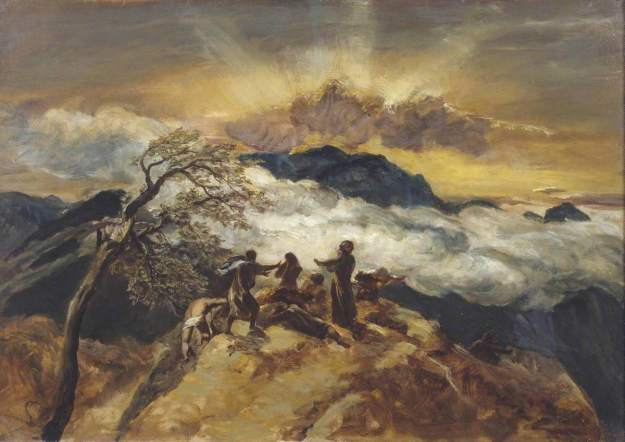
Poole, Paul Falconer; Sketch for ‘Vision of Ezekiel’; Tate; http://www.artuk.org/artworks/sketch-for-vision-of-ezekiel-201293

Ezekiel 3: 1-15

1 He said to me, O mortal, eat what is offered to you; eat this scroll, and go, speak to the house of Israel. 2 So I opened my mouth, and he gave me the scroll to eat. 3 He said to me, Mortal, eat this scroll that I give you and fill your stomach with it. Then I ate it; and in my mouth it was as sweet as honey.

4 He said to me: Mortal, go to the house of Israel and speak my very words to them. 5 For you are not sent to a people of obscure speech and difficult language, but to the house of Israel — 6 not to many peoples of obscure speech and difficult language, whose words you cannot understand. Surely, if I sent you to them, they would listen to you. 7 But the house of Israel will not listen to you, for they are not willing to listen to me; because all the house of Israel have a hard forehead and a stubborn heart. 8 See, I have made your face hard against their faces, and your forehead hard against their foreheads. 9 Like the hardest stone, harder than flint, I have made your forehead; do not fear them or be dismayed at their looks, for they are a rebellious house. 10 He said to me: Mortal, all my words that I shall speak to you receive in your heart and hear with your ears; 11 then go to the exiles, to your people, and speak to them. Say to them, “Thus says the Lord GOD”; whether they hear or refuse to hear.

12 Then the spirit lifted me up, and as the glory of the LORD rose from its place, I heard behind me the sound of loud rumbling; 13 it was the sound of the wings of the living creatures brushing against one another, and the sound of the wheels beside them, that sounded like a loud rumbling. 14 The spirit lifted me up and bore me away; I went in bitterness in the heat of my spirit, the hand of the LORD being strong upon me. 15 I came to the exiles at Tel-abib, who lived by the river Chebar. And I sat there among them, stunned, for seven days.

Throughout this introduction to the book of Ezekiel there are continuous reminders to the prophet that he is to be obedient. In contrast to the stubborn and rebellious nature of the people Ezekiel is almost passive in his response to this call, but that may not be from resistance as some commentaries suggest but instead a desire to be careful. Ezekiel’s call is to be faithful and to embody exactly the words that the LORD entrusts to him to the people. Ezekiel’s God is very precise with the commands and words for Ezekiel and silence is a more faithful response than adding anything to the words he receives.

At the end of the previous chapter Ezekiel is commanded to eat what is given to him and then the scroll is presented, now he is commanded to eat the scroll twice. Repetition is a common feature of Ezekiel’s prophecies, and it does not indicate any reluctancy on the prophet’s part, instead when he is commanded to eat the scroll he opens his mouth, and it is given to him to eat. Once the scroll is given, or perhaps already in his mouth, the second command to eat it and fill his stomach with it comes. This comes almost as an encouragement as the prophet is in the process of consuming the words of God and ingesting them. The words of God being ‘sweeter than honey’ also occur in two of the psalms that meditate on God’s law: Psalm 19:11 and Psalm 119: 103 and Revelation will echo this motif when John receives a scroll from an angel and ingests it in Revelation 10: 9-10.

The obedient prophet who receives and ingests the words of God is now sent to a people in exile but still in rebellion against their God. Although there are probably people from many nations who speak many languages in the region where Ezekiel and the exiles are placed by Babylon, Ezekiel’s focus is only on the house of Israel. God warns Ezekiel that he will be resisted as a bearer of the word of God because the people have repeatedly rejected their God. To enable the prophet to faithfully become the message for this stubborn people he will have to embody the meaning of his name Ezekiel, God hardens. His will be hardheaded like the hardest stone[1] even harder than flint. Ezekiel’s forehead of stone will come against the hard foreheads and hard hearts of the people of Israel.

Once again Ezekiel is lifted up by the ruach (spirit/wind) as the glory of the LORD departs. Now instead of focusing on the overwhelming visual scene the descriptions are primarily auditory. This is appropriate since the focus of Ezekiel is not about dwelling on the glory of God but upon the message he is given to carry. The focus has moved from the approach of the LORD to the call of the prophet as a bearer of the word. Ezekiel is not in control, instead he, like the living creatures, is animated by the spirit that lifts him up and bears him away.[2] By the time he arrives among the exiles at Tel-abib the sweetness of the scroll has been transformed into bitterness and heat in his spirit. If the consummation of the words of the scroll of God and the animation by the ruach of God were not enough to emphasize the prophet’s dependence upon the LORD for his words and actions, we are now informed that the hand of God is also strong upon him. He returns to the river Chebar a man overwhelmed by the divine presence and sits in a stunned silence for a week.

Daniel Block reads this week as a time where Ezekiel resists God’s call and he seems to believe the prophet is, “socially ostracized, physical exhausted, and emotionally disturbed.” (Block, 1997, p. 138) but I think this is reading too much into the scene. As we will see in future scenes, Ezekiel may not go out among the exiles, but he is actively sought out by the elders. Block will later comment on psychologists having a field day with Ezekiel (Block, 1997, p. 152) but perhaps instead of Ezekiel being emotionally disturbed he is in a period of grieving. He has been commanded to ingest a message of “lamentation, mourning and woe” for the house of Israel that he is to bear. Perhaps like Job’s friends he is sitting shiva, but now instead of mourning a friend he is mourning the disasters that await his people.

Ezekiel will become one hardened by God. He will be both the medium and the message which he “digested, internalized, incorporated, embodied, and lived.” (Block, 1997, p. 131) He becomes like the living creatures, animated by the spirit of God and a visible part of God’s often unseen movements. Words that were once sweet on the tongue will lead him on a path to bitterness and heat of spirit as he carries them with the hand of the LORD heavy upon him to a rebellious people of hard foreheads and hard hearts. Ezekiel may be strange to many Christians, but he is not a madman. The prophet is given a difficult task where obedience to the divine word is the only possible choice as the spirit moves him and the hand of the LORD rests upon him.

Ezekiel 3: 16-21

16 At the end of seven days, the word of the LORD came to me: 17 Mortal, I have made you a sentinel for the house of Israel; whenever you hear a word from my mouth, you shall give them warning from me. 18 If I say to the wicked, “You shall surely die,” and you give them no warning, or speak to warn the wicked from their wicked way, in order to save their life, those wicked persons shall die for their iniquity; but their blood I will require at your hand. 19 But if you warn the wicked, and they do not turn from their wickedness, or from their wicked way, they shall die for their iniquity; but you will have saved your life. 20 Again, if the righteous turn from their righteousness and commit iniquity, and I lay a stumbling block before them, they shall die; because you have not warned them, they shall die for their sin, and their righteous deeds that they have done shall not be remembered; but their blood I will require at your hand. 21 If, however, you warn the righteous not to sin, and they do not sin, they shall surely live, because they took warning; and you will have saved your life.

This rearticulation of Ezekiel’s role as a sentinel to the people of Israel echoes a similar passage in Ezekiel 33. The word for sentinel in Hebrew (sopeh) comes from the shofar (trumpet/horn) which the watcher would blow. Ezekiel’s warning to the wicked and even the righteous may not be heeded, but he is under an obligation to sound the alarm announcing God’s judgment regardless. Both Hosea and Jeremiah[3] have performed this role of sounding a trumpet in the land or acting as a sentinel before and even if the people do not heed the trumpet call. Yet the prophet’s calling is to raise the alarm even if the people ignore the sound.

The wicked and the righteous are a common polarity used throughout wisdom literature, and Ezekiel who likely grew up schooled to be a priest was likely familiar with this way of engaging the world. Ezekiel uses the term wicked (rasa) more than any prophetic book, but the character of God is to desire repentance even among the wicked. The prophet is not to judge the worthiness of the recipients of God’s alarm but to raise the sound that they may hear. Even those who were once righteous but who commit iniquity are not exempt from God’s judgment. The ‘stumbling block’ (miksol) is “not an occasion for sin but a cause of downfall and ruin.” (NIB VI: 1135) As Katheryn Pfisterer Darr states about Ezekiel’s task,

His life depends solely on his performance of the task; it does not hang on the people’s response. Lives may be saved as a result of his warning. But Ezekiel is not told to hold that possibility before his audience. (NIB VI: 1135)

Like his older contemporary Jeremiah[4] he is charged with bearing an unpopular message to a resistant people. Yet, as mentioned above the prophet is not in control. The words are not his words, he is animated by a spirit not his own, and God’s hand will be upon him. Any unfaithfulness of Ezekiel will not save the wicked or righteous, but they will endanger the prophet.

Ezekiel 3: 22-27

22 Then the hand of the LORD was upon me there; and he said to me, Rise up, go out into the valley, and there I will speak with you.23 So I rose up and went out into the valley; and the glory of the LORD stood there, like the glory that I had seen by the river Chebar; and I fell on my face. 24 The spirit entered into me, and set me on my feet; and he spoke with me and said to me: Go, shut yourself inside your house. 25 As for you, mortal, cords shall be placed on you, and you shall be bound with them, so that you cannot go out among the people; 26 and I will make your tongue cling to the roof of your mouth, so that you shall be speechless and unable to reprove them; for they are a rebellious house. 27 But when I speak with you, I will open your mouth, and you shall say to them, “Thus says the Lord GOD”; let those who will hear, hear; and let those who refuse to hear, refuse; for they are a rebellious house.

The binding and silencing of the prophet immediately after commissioning the prophet to be a sentinel and sound the trumpet for the wicked and lapsed righteous may at first seem contradictory and in the past many have argued that the previous section was an insertion which echoed Ezekiel 33. Yet, throughout these initial chapters of Ezekiel it has been clear that the prophet is not in control Once again the prophet is summoned to a meeting with God and it is made abundantly clear that when he shares a message with the people it will be coming from God through the prophet and will not be the prophet’s own words. The prophet will become the unmoving and unspeaking scroll awaiting the time when the LORD will release the tongue of the messenger.

The glory of the LORD appears once again to the prophet as he is compelled by the hand of the LORD to go into the valley. Ezekiel has yet to speak and now he is told he will be bound with cords and his tongue will cling to his mouth until God gives him a world to speak. It is unclear whether it is the exiles or the LORD who bind the prophet in his home and place him under a form of house arrest, but it is clear that it is God who is the agent silencing the tongue of the prophet. Yet, the public later in the book will seek the prophet out, so he is not socially ostracized. Throughout the remainder of the book there is no hint of the prophet engaging in a normal life among the exiles and when they do approach him it is in his house.

The tongue which clings to the roof of Ezekiel’s mouth may serve a second purpose which English translations do not capture. The word the NRSV translates as ‘reprove’ is the Hebrew mokiah whose meaning has been heavily debated within the context of Ezekiel. Katheryn Pfister Darr, following M. B. Dick, argues for the meaning of this being an arbiter instead of a reprover,

Ezekiel cannot perform the arbiter’s role, it precludes any possibility of his participation in a formal hearing in which both parties—Yahweh and Israel—might have their say. (NIB VI:1138)

If this is the correct interpretation, then God no longer wants the prophet to advocate for the people. The LORD is done listening. As with the scroll there is no room to add in the prophets’ words, God’s judgment is set. The prophet is to be the faithful articulator of these words when they are given. God is the primary actor; the prophet is merely the medium through which God is acting. His life is not his own, instead it is bound to go only where the spirit and the hand of God move him and speak only when God’s words pass his released tongue.

[1] Modern people may know that the hardest stone is a diamond, but as Daniel Block points out there is no reference to diamonds before 480 BCE almost a century later than Ezekiel is written. The Hebrew word samir here likely refers emery which would be the hardest known rock at the time. (Block, 1997, p. 129)

[2] This is similar to the way the Spirit in the gospel of Mark ‘drove’ (Greek ekballo, cast out or throw out) Jesus into the wilderness.

[3] Hosea 9:8, Jeremiah 4: 5, 19, 21; 6: 1, 17; 51:27

[4] As Daniel Block notes (assuming that the thirtieth year at the beginning of Ezekiel reflects his age) Jeremiah would begin his ministry about the time Ezekiel was born. (Block, 1997, p. 148) It is likely that Ezekiel may have grown up knowing Jeremiah’s voice or message and both prophets share the challenging job of dismantling the theology that had grown up around Jerusalem, the temple, and the Davidic kings. Both were probably never popular but proved to be essential voices to make sense of the destruction of Jerusalem and the temple by Babylon.

Ezekiel 2 A Prophet’s Call and a Message to be Consumed

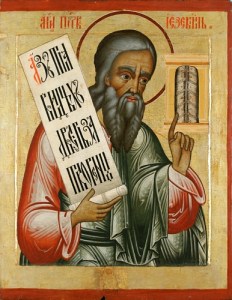
Russian icon of the Prophet Ezekiel holding a scroll with his prophecy and pointing to the “closed gate” (18th century, Iconostasis of Kizhi monastery, Russia)

Ezekiel 2

1 He said to me: O mortal, stand up on your feet, and I will speak with you.2 And when he spoke to me, a spirit entered into me and set me on my feet; and I heard him speaking to me.3 He said to me, Mortal, I am sending you to the people of Israel, to a nation of rebels who have rebelled against me; they and their ancestors have transgressed against me to this very day.4 The descendants are impudent and stubborn. I am sending you to them, and you shall say to them, “Thus says the Lord GOD.” 5 Whether they hear or refuse to hear (for they are a rebellious house), they shall know that there has been a prophet among them.6 And you, O mortal, do not be afraid of them, and do not be afraid of their words, though briers and thorns surround you and you live among scorpions; do not be afraid of their words, and do not be dismayed at their looks, for they are a rebellious house. 7 You shall speak my words to them, whether they hear or refuse to hear; for they are a rebellious house.

8 But you, mortal, hear what I say to you; do not be rebellious like that rebellious house; open your mouth and eat what I give you. 9 I looked, and a hand was stretched out to me, and a written scroll was in it. 10 He spread it before me; it had writing on the front and on the back, and written on it were words of lamentation and mourning and woe.

The narration of Ezekiel’s encounter with the LORD the God of Israel continues with this calling of the prophet as a messenger from the God of Israel to God’s rebellious people. In the midst of the bright and visually overwhelming living creatures, wheels, crystal dome, throne, and the fiery appearance of the LORD in a human like form combined with the sound like thunder and mighty waters the prophet has assumed the proper position of a mortal in the presence of the divine, prostrate on the ground. Ezekiel’s response reflects the practice of ancient royal courts where those summoned would prostrate themselves before the sovereign until they were commanded to rise when the sovereign is ready to address them. Ezekiel is cognizant of the distinction between himself as a mortal servant of the LORD and the overwhelming and powerful divine one who addresses him.

Ezekiel is referred to throughout the book as ‘son of man’ (Hebrew ben-adam, NRSV ‘mortal’). This is the primary way the prophet is addressed throughout the book, and it occurs ninety-three times. Adam in Hebrew is the general word for ‘man’ or ‘human’ and while Ezekiel is both a son of Adam, and a son of man, the NRSV and other translations that render this as ‘mortal’ do capture the way the term distinguishes Ezekiel from the LORD who is addressing him. This ‘son of man’ terminology will be used in a very different way in the book of Daniel (Daniel 7:13) and in the gospels by Jesus as a figure who is commissioned to come from heaven, but here it is a very mortal prophet who finds himself before the throne of God in a foreign land being commissioned as an emissary of God’s word to the people of Israel.

Ezekiel was a passive observer of the approach of the divine chariot in the previous chapter, and remains a passive if obedient vessel throughout this chapter of commissioning. When commanded to rise and stand on his feet, a ruach (spirit, wind, breath) enters into him and places him on his feet enabling the prophet to stand in the overpowering presence of the divine. It could be that a breath of God enters into the prophet, or a spirit of God, or a wind that lifts the prophet upon his feet, and the flexibility of the Hebrew allows for all of these senses to be true simultaneously. Yet, the action begins with the word and the ruach of the God of Israel who speaks and lifts up this son of man.

Ezekiel is commissioned to go to the people of Israel. Israel now refers to what remains of the people of Israel and Judah in the aftermath of the Assyrian dispersion of the Northern Kingdom of Israel (or Samaria), the portions of Judah still in the land around Jerusalem as well as the Judeans in exile in Babylon (where Ezekiel finds himself). It is likely that in the aftermath of the Northern Kingdom’s and Judah’s brief renaissance under Josiah that there was a reclamation of the identity of the people as the people of Israel as well as aspirations of reclaiming these lands that once belonged to the northern tribes. Yet this people of Israel at the time of Ezekiel is a nation (Hebrew goy) of rebels. The Hebrew word goy is normally used in a pejorative sense, the nations (or Gentiles) are the goyim. As Daniel Block highlights:

When the word is used of this nation, it tends to carry a pejorative sense, highlighting Israel’s indistinguishability from other nations and Yahweh’s rejection of Israel. Apart from faith in and fidelity to Yahweh, Israel is just another “heathen” nation. (Block, 1997, p. 118)

The nation of Israel is impudent (literally hard of face) and stubborn (literally hard of heart). Their external actions and the internal state of their heart and mind.[1] Later in Ezekiel 36:26 the remedy to this hardness of heart will be God’s action of placing within the people a ‘heart of flesh.’ For now, Ezekiel is warned that he is going to a people who have set their face and their will against their God and who continue in this rebellion. The people of Israel have become a house of rebellion and the renaming of Israel in this way recalls the way the eighth century BCE prophets Amos and Hosea renamed Bethel (house of God) to Beth-aven (house of iniquity). [2]

Ezekiel’s commission is not dependent on convincing this hard faced and hard-hearted people, but in faithfully delivering the messages that the LORD God hands on to him. When the words Ezekiel delivers come to pass the people will realize they have had a prophet in their midst. The prophets whose words are recorded in scripture were probably not well received as they delivered words of lamentation, mourning, and woe in their time, and it is only afterwards when their words proved true and the words of the prophets made sense of the experience of the people that they were accepted. Yet, within Deuteronomy, this is the only way to recognize a true prophet.

You may say to yourself, “How can we recognize a word that the LORD has not spoken?” If a prophet speaks in the name of the LORD but the thing does not take place or prove true, it is a word that the LORD has not spoken. The prophet has spoken presumptuously; do not be frightened by it. Deuteronomy 18: 21-22

It is only once a prophet’s words prove true that the people can recognize a true prophet has been in their midst, but they are still accountable for their response to these prophets who speak in the name of the LORD.

Ezekiel’s words will not be popular among the exiles or the remnant in Jerusalem and the only protection the prophet has will come from the God who sends him. The briers, thorns, and scorpions which surround the prophet are symbols of the prophet’s protection. Many scholars view the ‘scorpions’ introduced with the ‘briars and thorns’ as a mixed metaphor and wonder if the ‘scorpions’ refers to a ‘scorpion plant’ of thorny appearance or stinging quality. (Block, 1997, p. 121) But Katheryn Pfister Darr points to two incantations in Maqlȗ, a Babylonian series of rituals for warding off the effects of sorcery:

I am the spike of a thornbush; you cannot step on me! I am the stinger of a scorpion; you cannot touch me. Maqlȗ III. 153-154 (NIB VI: 1123)

Even though it may mix plant and animal imagery, the poetic sense of the prophets is elastic enough to encompass two elements like this to point to the divine protection which surrounds this prophet who delivers an unpleasant word to a rebellious people. This mortal who bears the divine word is not to be afraid of mortal words of looks.[3] The people have already rejected the LORD who sends the prophet, so the prophet should not expect a receptive audience for the words he is called to bear.

The elaborate description of the approach of the divine presence and the commissioning of this son of man to carry the message to the rebellious house of Israel have prepared us to approach the message itself. As mentioned above Ezekiel has been a passive recipient of the vision and this calling, but he (unlike Israel) has not actively resisted the LORD’s instructions. But immediately before receiving this message he is to bear, Ezekiel is warned not to be infected by the disease which the people he is sent to have, a refusal to listen and obey. The prophet Jeremiah received the word of God when the words were placed in his mouth:

Then the LORD put out his hand and touched my mouth; and the LORD said to me, “Now I have put my words in your mouth.” Jeremiah 1:9

Yet, for Ezekiel the words are written on a scroll he is given to eat. Katheryn Pfister Darr humorously remarks, “Yahweh’s touch bestows divine words that Jeremiah must proclaim. Yet one does not surmise that God literally stuffs words down his throat.” (NIB VI: 1124) But that is what will happen to the passive prophet who will soon open his mouth to receive that which is normally inedible. The scroll is full of writing, front and back, and there is no place to add or any ability for the prophet to modify the text of lamentation, mourning, woe.[4]

With the presented scroll something has changed in the nature of prophecy. Instead of a personal address by God the prophet is given a scroll to consume, and as Walther Zimmerli can state “It has become a book.” (NIB VI: 1125) The prophet who will be given this scroll to consume will become the written prophecy, and it is likely that many of Ezekiel’s recorded words may have been distributed in primarily written form. Ezekiel is a prophet in a new situation and time, he is separated from the temple and Jerusalem and charged with ministering to a people divided between Jerusalem and exile. Like the apostle Paul in the early Christian church many of his messages will have to be in a written form to minister to these two dispersed communities. Due to the identity of those taken into exile, being the notables of the land, there was probably a higher concentration of literate individuals. Yet, even messages that were directed to the remnant in Jerusalem would be primarily addressed to the priestly and ruling remnant in Jerusalem. I’m indebted to Ellen Davis for these reflections on the character of Ezekiel in her study of Ezekiel as a prophet navigating a new location by utilizing, “a style of prophecy which the immediate audience selected for him by Nebuchadnezzar’s army was especially qualified to understand, if not appreciate.” (Davis, 1989, p. 44) Writing is both a solution to communicating with a separated community, but now this prophet who will become the embodiment of the scroll he consumes will also recreate the content of the scroll he consumes as a written text that can remain a witness for a generation which can understand Ezekiel’s position as a prophet bearing God’s word who is finally ready to receive this word. As Ellen Davis can insightfully state, “Preserved as a text, God’s word is no longer frustrated by the intransigence of any generation; it can wait until such time as it may be heard.” (Davis, 1989, p. 61)

[1] In Hebrew though the heart is the organ of will and decision, not emotion. When someone’s heart is set on something it means they have set their will on gaining or following something. In Hebrew the emotions are the realm of the stomach and guts.

[2] See Amos 5:5-6 where the prophet still uses Bethel but condemns the injustice of the place and Hosea 4:15, 5:8, 10:5 where the name is intentionally changed. This can be confusing since Beth-aven also refers to a different location in Joshua 7:2; 18:12 and 1 Samuel 13:5; 14:23

[3] The idea of ‘looks’ from the people may refer to the idea of cursing a person with an ‘evil eye’. Words, rituals, and actions had a different significance in ancient cultures than we often grant them today, and a word or evil eye or other ‘looks’ were looked upon in ancient societies as powerful things.

[4] The three Hebrew words behind lamentation, mourning, and woe are qina “lament, dirge” which is often associated with funerals, hegeh an onomatopoeic expression of moaning and groaning, and hi which is only used here in scripture and may be another onomatopoeic expression for a cry of pain. (Block, 1997, p. 125)

Ezekiel 1 Ezekiel’s Experience of the Divine Chariot in Exile

Ezekiel as depicted by Michelangelo on the Sistene Chapel ceiling

Ezekiel 1: 1-3 Meeting Ezekiel the Prophet

1 In the thirtieth year, in the fourth month, on the fifth day of the month, as I was among the exiles by the river Chebar, the heavens were opened, and I saw visions of God. 2 On the fifth day of the month (it was the fifth year of the exile of King Jehoiachin), 3 the word of the LORD came to the priest Ezekiel son of Buzi, in the land of the Chaldeans by the river Chebar; and the hand of the LORD was on him there.

The book of Ezekiel begins with fixing the beginning of Ezekiel’s ministry as a prophet on the thirtieth year, the fourth month, and the fifth day of the month in modern day Iraq between the Tigris and the Euphrates. Yet, even for all this specificity one initial question is what is the designation of the thirtieth year marking from? There are two primary conjectures that scholars have made: the first is that it is thirty years after the high priest Hilkiah rediscovered the book of the law in the temple and presented it to King Josiah initiating Josiah’s attempt to reform the practice of the people of Jerusalem and Judah. (2 Kings 22-23) More likely is the explanation which goes back to Origen (185-253 CE) that the thirty years designates the thirtieth year of life for the prophet. (Block, 1997, p. 83) Although there is no way to be certain about the marker the thirty years counts forward from, the thirtieth year of life for a person from a priestly family would indicate the time they would begin to serve in the temple:

from thirty years old up to fifty years old, all who qualify to do work relating to the tent of meeting. (Numbers 4:3, this is for the Kohathites but the same provisions relate to the Gershonites and the Merarites (divisions within the Levite families with different tasks in the tent of meeting) see verses 23 and 30)

Ezekiel’s twenty-two-year ministry would roughly cover the ages from thirty to fifty years old of service for a person in the temple if the thirty years is counting Ezekiel’s age. In exile, Ezekiel who has lost the ability to serve in the temple is now granted an equivalent or perhaps higher (if more challenging) calling to be a prophet to the LORD.

The secondary time marker, the fifth year of the exile of King Jehoiachin, fixes the date. King Jehoiachin is exiled in 597 BCE along with princes, military leaders, skilled craftsmen, royal officials, and the elite members of Jerusalem. This first exile leaves much of the population behind and creates two centers for the Jewish people: the exiles in Babylon and the remnant in Judah. When Ezekiel sits beside the river Chebar it calls to mind the psalmist mourning the exile: By the rivers of Babylon—there we sat down and there we wept when we remembered Zion. (Psalm 137:1) Though Psalm 137 may reflect the second exile where the temple and city are destroyed, Ezekiel surely mourns like the psalmist as they attempt to navigate their exile away from their home and the temple. The river of Chebar is in the vicinity of Nippur, a city destroyed by Nebuchadrezzar’s father Nabopolassar and resettled with deportees from across the empire. (Block, 1997, p. 84) Into this place of displaced and mourning people the son of the priest Buzi experience the hand of the LORD upon him as he encounters God’s presence in this foreign land.


Ezekiel 1: 4-28 The Chariot of God

4 As I looked, a stormy wind came out of the north: a great cloud with brightness around it and fire flashing forth continually, and in the middle of the fire, something like gleaming amber. 5 In the middle of it was something like four living creatures. This was their appearance: they were of human form. 6 Each had four faces, and each of them had four wings. 7 Their legs were straight, and the soles of their feet were like the sole of a calf’s foot; and they sparkled like burnished bronze. 8 Under their wings on their four sides they had human hands. And the four had their faces and their wings thus: 9 their wings touched one another; each of them moved straight ahead, without turning as they moved. 10 As for the appearance of their faces: the four had the face of a human being, the face of a lion on the right side, the face of an ox on the left side, and the face of an eagle; 11 such were their faces. Their wings were spread out above; each creature had two wings, each of which touched the wing of another, while two covered their bodies. 12 Each moved straight ahead; wherever the spirit would go, they went, without turning as they went. 13 In the middle of the living creatures there was something that looked like burning coals of fire, like torches moving to and fro among the living creatures; the fire was bright, and lightning issued from the fire. 14 The living creatures darted to and fro, like a flash of lightning.

15 As I looked at the living creatures, I saw a wheel on the earth beside the living creatures, one for each of the four of them. 16 As for the appearance of the wheels and their construction: their appearance was like the gleaming of beryl; and the four had the same form, their construction being something like a wheel within a wheel. 17 When they moved, they moved in any of the four directions without veering as they moved. 18 Their rims were tall and awesome, for the rims of all four were full of eyes all around. 19 When the living creatures moved, the wheels moved beside them; and when the living creatures rose from the earth, the wheels rose. 20 Wherever the spirit would go, they went, and the wheels rose along with them; for the spirit of the living creatures was in the wheels. 21 When they moved, the others moved; when they stopped, the others stopped; and when they rose from the earth, the wheels rose along with them; for the spirit of the living creatures was in the wheels.

22 Over the heads of the living creatures there was something like a dome, shining like crystal, spread out above their heads. 23 Under the dome their wings were stretched out straight, one toward another; and each of the creatures had two wings covering its body. 24 When they moved, I heard the sound of their wings like the sound of mighty waters, like the thunder of the Almighty, a sound of tumult like the sound of an army; when they stopped, they let down their wings. 25 And there came a voice from above the dome over their heads; when they stopped, they let down their wings.

26 And above the dome over their heads there was something like a throne, in appearance like sapphire; and seated above the likeness of a throne was something that seemed like a human form. 27 Upward from what appeared like the loins I saw something like gleaming amber, something that looked like fire enclosed all around; and downward from what looked like the loins I saw something that looked like fire, and there was a splendor all around. 28 Like the bow in a cloud on a rainy day, such was the appearance of the splendor all around. This was the appearance of the likeness of the glory of the LORD.

When I saw it, I fell on my face, and I heard the voice of someone speaking.

To most modern readers the descriptions of Ezekiel that begin the book are some of the strangest and least understood imagery in scripture. The Puritan scholar Willian Greenhill described Ezekiel as, “full of majesty, obscurity, and difficulty.” (Block, 1997, p. 89) This obscurity and difficulty has led to numerous psychological and even extraterrestrial explanations, but the imagery as much as it stretches the ability of Ezekiel to put into words, would also be more familiar within the imagery of the temple and the world around Jerusalem at this time. Throughout these reflections I have attempted to approach each of these books from the perspective of trust and faith and with the assumption that each work has something to teach me. In that light I am crediting Ezekiel with attempting to report as honestly as he can about this experience with things beyond his ability to describe. Ezekiel’s descriptions will gain additional precision in chapter ten when he has language for the living creatures as cherubim, but for now we will encounter these creatures, wheels, and throne through the writing describing through analogy what this overwhelming experience was like.

Ezekiel has a far more detailed report of his encounter with the divine than Isaiah, or Jeremiah and part of that may be due to his situation. Previous prophets had all operated in the land of Israel and many may have had access to the temple in Jerusalem, but Ezekiel is the first prophet operating from the exile. As Ellen Davis can insightfully state, “As the first prophet to receive a vision outside of the land, he had to produce a fuller record in order to be believed.” (Davis, 1989, p. 30) Ezekiel has an intense interest in priestly matters and in particular the temple, so perhaps it is not surprising that the imagery that Ezekiel sees is connected with the imagery of the temple and is also comparable to images from the surrounding region. This visitation comes from the north in a great cloud of lightning or fire with a center like gleaming amber or molten metal. The closest analogy to what Ezekiel sees is the approach of the hailstorm as the seventh sign (plague) in Egypt (Exodus 9:23-24). Yet the quick description of this ‘stormy wind’[1]is often forgotten by most readers as they become confused by the description of the four living creatures, the wheels, the throne, and the one upon the throne.

Before delving into the individual descriptions, it is important to realize what the overall image is pointing to: a great chariot with God sitting on a throne or seat upon that chariot. Many artistic renderings of Ezekiel’s vision miss the forest for the trees and become focused on the components of the vision without any way to coherently put the images together as below.

Augsburger Wunderzeichenbuch — folio 15? „Vision des Hesekiel“

Throughout these descriptions Ezekiel provides us enough information for our imaginations to be stimulated but, as is demonstrated by the diversity of artistic interpretations, not enough to fully grasp what his eyes see. Ezekiel seems to be at the edge of his ability to describe. In Tova Ganzel’s words:

As the prophet’s description of the vision progresses, he gradually seems to lose his grasp of tangible expression. It grows increasingly difficult for him to describe what he is experiencing. See, for example, the pervasive use of the prepositional kaf (like), and the growing number of instances in which he refers to a demut (semblance or likeness): (Ganzel, 2020, p. 22)

Much like the descriptions of the tabernacle in Exodus 25-27, 35-39 or the temple in 1 Kings 5-7 can only give us a general idea of those structures, the description of Ezekiel can give us an idea of this chariot and its occupant. Although Ezekiel may be at the edge of what his language can describe, knowing some cultural references can help us to better understand the image from the world he inhabits.

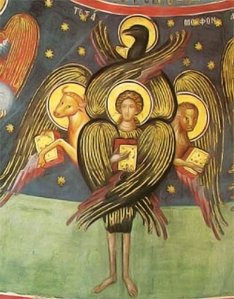
A tetramorph cherub, in Eastern Orthodox iconography 16th Century

Although the four faces of the four living creatures is a feature unique to Ezekiel’s description, much of the description of these creatures is similar to what scholars believe the cherubim on the ark of the covenant (Exodus 25: 10-22) and the temple (1 Kings 6:23-28). Most modern portrayals of the ark picture the cherubim as resembling humans with wings.

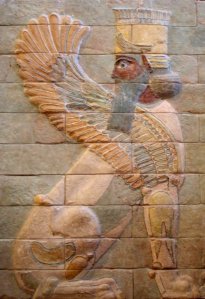
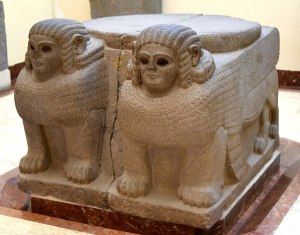
However, most representation of divine creatures in the surrounding world are sphinx like with both human and animal features.


Hittite sphinx. Basalt. 8th century BC. From Sam’al. Museum of the Ancient Orient, Istanbul.

Winged sphinx from the palace of Darius the Great during Persian Empire at Susa (480 BC)

Column base in the shape of a double sphinx. From Sam’al. 8th century BC. Museum of the Ancient Orient, Istanbul.

These living creatures as described in Ezekiel have both humanoid and animal features. The creatures are able to move in any direction without turning (as the spirit/wind/breath moves them) and there are both animate and inanimate characteristics to these creatures which are a part of the divine throne. The creatures seem to be animated by the wind and the electricity/lighting/fire that is in the midst of these creatures.

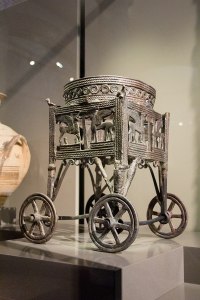
The wheels also have had lively interpretation in the artistic imagination, but functionally this is a four wheeled chariot. The chariot seems to have a life that flows between the living creatures and the wheels as they are moved by the spirit/wind. The wheels gleam like beryl or glowing metal and the eyes may be eye shaped precious stones that are of a piece of the wheel. (Block, 1997, pp. 100-101) Although the pictures which are a part of this post are meant to help bring some visual structure to Ezekiel’s vision from an ancient context, the prophet’s descriptions are still challenging to envision and likely were overwhelming for the prophet to experience.

An ivory from Tel Megiddo showing a king sitting on a throne which is supplicated by a sphinx-esque winged hybrid.

Wheeled stand for a cauldron, bronze, 12-11th century BCE. Probably from Kition, Larnaka district, Cyprus. Currently in the Neues Museum, in Berlin. IN : Misc. 8947.

Above this chariot is a dome to support the throne and the presence upon the throne. The scene describes an experience overwhelming to both the eyes and the ears. The crystal dome which supports the emerald or lapis lazuli throne on which seats something like a human form. Yet, the human form is enclosed with both a rainbow-like radiance and fire and brightness. Ezekiel is probably wise in limiting the description of the glory of the LORD, but the overwhelming scene prepares us for the end where the voice of the LORD speaks.

There are sound reasons for traditional limitation of the book of Ezekiel in Jewish circles to men over thirty as the strangeness of the book has inspired many strange and disparate interpretations. Ezekiel is strange to our ears, but it is easy to become lost in the initial descriptions and not pay attention to what the voice of the LORD has to say to Ezekiel. Four-faced, four-winged living creature and wheels within wheels with eyes are fascinating images but they are only to prepare us to hear the call of Ezekiel to his difficult ministry both to the exiles in Babylon and those remaining in Judah.

[1] Ruach se’ara in Hebrew. Ruach plays multiple roles in the Bible and in this passage: wind, breath and spirit are the most common meanings. Later in the chapter when it talks about the ‘wherever the spirit would go’ or ‘the spirit of the living creatures’ it is ruach behind each usage of spirit.

Introduction to the Prophet Ezekiel

Ezekiel as depicted by Michelangelo on the Sistine Chapel ceiling


Ezekiel will be the fourth of the prophetic books[1] I have approached in my studies on sign of the rose and the second major prophet[2] that I have engaged. Ezekiel is a book that has a significant impact on several later prophets and particularly the books of Zechariah and Daniel as well as the Christian book Revelation. The book of Ezekiel is a strange book full of evocative language which has inspired a plethora of odd interpretations. Jerome notes that Jews under thirty were forbidden from reading the beginning and ending of the book, yet it remained an important book for the rabbinical scholars. (Block, 1997, p. 44)

The Context of Ezekiel

Ezekiel son of Buzi began his prophetic ministry in exile in Babylon in the time between 597 and 586 BCE. This time period is between the first exile when King Nebuchadrezzar of Babylon crushes the rebellion of King Jehoiakim and the larger exile when the forces of Babylon return and destroy Jerusalem and the temple in 586 BCE. Ezekiel is among the group of elites who were taken to Babylon in 597 while the remnant of the people were left under Mattaniah (renamed Zedekiah, see 2 Kings 24:17). Ezekiel’s status is similar to what is narrated at the beginning of the book of Daniel for the titular character as well as well as Hananiah, Mishael, and Azariah (or as more commonly known by their Babylonian names: Shadrach, Meshach, and Abednego)[3]. Ezekiel has nothing positive to say about the Judeans who remained in Jerusalem between 597 and 587, and in Ezekiel’s mind the destruction of Jerusalem, the temple, and the severing of the Davidic line of kings is fully justified based on the unfaithfulness of the people to God’s covenant and their unwillingness to heed God’s words. (NIB VI: 1080) Ezekiel was the first prophet to operate in the Diaspora (the Judean people exiled among the nations). Ezekiel, like Jeremiah from inside Jerusalem, was deconstructing the beliefs that the people in Jerusalem had around the Davidic king, the land of Judea, the city of Jerusalem (Zion) and particularly the temple initially built by Solomon. Temple, land, and king all became symbols of God’s promise, but the prophets continued to call the people back to the covenantal nature of their relationship with God. The promise was dependent upon obedience to the laws, statutes, and ordinances of God and in Ezekiel’s view God’s judgment through Babylon was the just punishment for the lack of faithfulness to God’s laws and vision for the people.

Entering the Strangeness of Ezekiel

Ezekiel with his strange visions, passionate language, and symbolic actions seems like an alien work to most modern readers. The book’s visions attempt to describe things beyond description, the prophet’s actions as instructed by God seem out of step with the reality of his time or ours, and his language may offend our ears and sensibilities. Ezekiel’s language is supposed to be shocking to a complacent people who treated God’s covenant with Jerusalem as a guarantee of their security, and the first half of the book (like most of Jeremiah) is used to “debunk this illusory conviction.” (Block, 1997, p. 48) Yet, despite Ezekiel’s shocking words and performances he, nor his contemporary Jeremiah, is able to convince the people of Jerusalem to repent or change. As Tova Ganzel states:

Perhaps, then, we can see that Ezekiel’s prophetic mission at the time was not to call upon the people to mend their ways and repent, but rather to explain the significance of the events in Jerusalem, and thereby to lay the groundwork for the prophecies of rebuilding which came after the Destruction. (Ganzel, 2020, p. 16)

The Prophet of the Ruach

The prophet Ezekiel utilized the Hebrew word ruach throughout his book more than any other prophet. Ruach can mean “wind, breath, or spirit” and frequently, although translations have to focus on one meaning, there are shades of all three meanings. The living creatures are animated by the ruach, Ezekiel will be picked up and moved by the ruach, the ruach of the LORD will fall upon Ezekiel and cause him to prophesy, and his will prophesy to the ruach to reanimate the boneyard that represents Israel.

Resources Used on This Journey

As with my previous reflections I utilize the works of several authors who have spent their life studying this portion of scripture. I attempt to utilize various perspectives in all of these reflections to inform my own writing and reflections. Below are the works I am reading as I write my own reflections:

Block, Daniel I. The Book of Ezekiel: Chapters 1-24. (New International Commentary on the Old Testament series) Grand Rapids, MI: William B. Eerdmans Publishing Company, 1997.

_______. The Book of Ezekiel: Chapters 25-48. (New International Commentary on the Old Testament series) Grand Rapids, MI: William B. Eerdmans Publishing Company, 1998.

The NICOT series of commentaries have often been helpful textual commentaries, and when looking for a volume to assist with the language as well as the historical background these have often been helpful. Daniel Block is viewed as an evangelical scholar who is well versed in the literature of Israel and its neighbors in the ancient world.

Darr, Katheryn Pfisterer. “The Book of Ezekiel.” In The New Interpreter’s Bible. (New International Commentary on the Old Testament series) Grand Rapids, MI: William B. Eerdmans Publishing Company, 1997.Volume VI. Nashville, Abingdon Press, 1994.

The NIB is a solid all-around commentary on the entire bible and apocrypha. It is designed for pastors and those leading in congregations, so it does not normally engage the textual issues as deeply as the NICOT or Anchor Bible commentaries.

Davis, Ellen F. Swallowing the Scroll: Textuality and the Dynamics of Discourse in Ezekiel’s Prophecy. Sheffield, England: Almond Press, 1989.

Ellen Davis is one of the scholars who I attempt to read anything that they write. This is her doctoral dissertation, so it will probably be a denser read focused on a smaller set of issues than a commentary would be, but I trust it will prove insightful.

Ganzel, Tova. Ezekiel: From Destruction to Restoration. Maggid Studies in Tanakh. Jerusalem: Maggid Books, 2020.

When I can I attempt to utilize a Jewish scholar when reading the scriptures that we share. The Maggid Studies I have utilized in the past have been approachable, but also provide a window into perspectives that most Christian scholars may not explore.

The Book of Ezekiel is a long book of forty-eight chapters, and some of its chapters are quite lengthy. I anticipate this study taking all of 2024 and may stretch into 2025 depending on how my sabbatical later this year impacts my writing. Unlike Isaiah which is used frequently in preaching and Jeremiah which I have written on, Ezekiel has many sections which are relatively unfamiliar to me as I begin this study and as I walk into its strangeness I am curious what this journey will yield.

[1] As Christians organize the Bible, according to the Jewish organization of scriptures both Judges and 1 Kings would also be included in the prophetic writings while most Christians view these as historical narratives.

[2] Jeremiah is the other major prophet I wrote on in 2013-14 as I was beginning this site. The other major prophet is Isaiah. The differentiation of major vs. minor prophets has to do with the length of their ‘books.’ The minor prophets could all be contained on one scroll (the twelve) when texts were compiled that way while Isaiah, Jeremiah, and Ezekiel each required their own scroll.

[3] Daniel 1: 3-7

Psalm 100 Know the LORD is God and We are God’s

James Tissot, Solomon Decicates the Temple (1896-1902)

Psalm 100

<A Psalm of thanksgiving.>
1 Make a joyful noise to the LORD, all the earth.
2 Worship the LORD with gladness; come into his presence with singing.
3 Know that the LORD is God. It is he that made us, and we are his; we are his people, and the sheep of his pasture.
4 Enter his gates with thanksgiving, and his courts with praise. Give thanks to him, bless his name.
5 For the LORD is good; his steadfast love endures forever, and his faithfulness to all generations.

This short psalm of thanksgiving centers the actions of praise around the knowledge that the LORD is God and the peoples’ relation to their creator and shepherd. It echoes the concern of the Shema (Deuteronomy 6:4-5) and the first commandment (Exodus 20: 2-3, Deuteronomy 5: 6-7) that the people of Israel would know that the LORD is God alone and their role is to know, serve and belong to their God. The movement of the psalm is centered around seven imperatives: shout (NRSV make a joyful noise), serve (NRSV worship), come, know, come (NRSV enter), testify (NRSV give thanks), and bless. Poetically the repetition of come (obscured in the NRSV translation) focuses the hearer on what is bracketed in between: the command to know that the LORD is God and that the hearers are a part of his people. (Nancy deClaisse-Walford, 2014, p. 736) In response to the knowing the people are enabled to enter into the presence of God’s courts to bring praise and blessing.

Knowing is not just about knowledge of the LORD’s identity in Hebrew thought, it also involves acknowledgment that the community belongs to God and depends upon God. To be autonomous (one’s own law) in a Hebrew way of thinking is to be wicked. The statement that they are the LORD’s people and the sheep of his pasture focus the hearers on their God’s personal responsibility in overseeing the people of Israel. [1]  Although at times there may be an earthly king who rules on behalf of the LORD, when those kings prove to be unfaithful shepherds the LORD removes those shepherds and becomes their shepherd who guides, protects, and keeps them. Their maker and protector is good (echoing the language of creation in Genesis) and provides steadfast love (hesed) and faithfulness (emuna) two of the characteristics of God’s self-revelation to Moses.[2]

The life of praise is a life of service to the LORD. A person who comes to the courts of God is also expected to know that the LORD is their God, their creator and protector. The response to that knowledge is doxology (giving thanks). It is a life that acknowledges one’s dependance upon the LORD. Psalm 100 makes a bold claim for a life of praise, service, and thanksgiving to God in a world that seems to serve many gods. The psalmist points to a life centered on the knowledge of God and praise filled obedience to God’s ways.

[1] See for example Psalm 74:1, 79:13, 95:7, Jeremiah 23:1-4, Ezekiel 34:11-22

[2] Exodus 34: 6-7

Psalm 99 The Universal King Worshipped By A Particular People

The Temple by Radojavor@deviantart.com

Psalm 99

1 The LORD is king; let the peoples tremble! He sits enthroned upon the cherubim; let the earth quake!
2 The LORD is great in Zion; he is exalted over all the peoples.
3 Let them praise your great and awesome name. Holy is he!
4 Mighty King, lover of justice, you have established equity; you have executed justice and righteousness in Jacob.
5 Extol the LORD our God; worship at his footstool. Holy is he!
6 Moses and Aaron were among his priests, Samuel also was among those who called on his name. They cried to the LORD, and he answered them.
7 He spoke to them in the pillar of cloud; they kept his decrees, and the statutes that he gave them.
8 O LORD our God, you answered them; you were a forgiving God to them, but an avenger of their wrongdoings.
9 Extol the LORD our God, and worship at his holy mountain; for the LORD our God is holy.

Psalm 8 can wonder, “what are human beings that you are mindful of them, mortals that you care for them?” and Psalm 99 can focus that wonder on a particular place and people through whom the world comes to know the ruler of the heavens and earth. The LORD is the one before whom all nations tremble and the earth shakes, but whose universal sovereignty is focused on a particular place: the temple in Zion. The description of God being enthroned above the cherubim almost always refers to the ark of the covenant (1 Samuel 4:4, 2 Samuel 6:2, Psalm 80:1) and the references to Zion and holy mountain indicate that the psalm is pointing to the temple in Jerusalem. Even the notation of God’s footstool also refers to the temple as a resting place for the ark (1 Chronicles 28:2, Psalm 132:7). God presence and power becomes known through a particular place.

At the same time the psalm links the knowledge of God to a holy place, it also becomes known through holy people. Book four of the psalter began with Psalm 90, the only psalm attributed to Moses, and it is likely intentional that the final enthronement psalm references Moses once again. Moses and Aaron are lifted up as priests of God, and they are responsible for the construction of the ark where God’s presence is met. Samuel is the other figure lifted up in the psalm, who also harkens back to pre-monarchic Israel. Samuel opposed the people’s request for a king because for Samuel only the LORD is king, a sentiment echoed by Psalm 99. It is possible that Psalm 99 comes from a time after the re-establishment of the temple in Jerusalem after the exile, a time when the line of Davidic kings seems to have ended.

The paradox of the psalmist’s faith is that the LORD the God of Israel is the universal king over all the earth and peoples who has revealed Godself through a particular place (the temple in Zion) and through particular people (Moses, Aaron, and Samuel in the psalm). Yet, the psalm yearns for a universal realization that transcends the particularity of Israel. Israel has the privileged position of being the people to whom the Mighty King revealed not only himself but also the vision of justice and righteousness that God’s kingdom would involve. So, in response to the universal wonder of Psalm 8, Psalm 99 can give the particular wonder of a people who says, “Who are we that the Mighty King, the lover of justice who establishes equity throughout the earth dwells in the temple on our holy mountain, and spoke to use through Moses, Aaron, and Samuel, Israel that you care for us?”

Psalm 98 A Joyous Song of God’s Salvation

Statue of Watts, Abney Park Cemetery


Psalm 98

<A Psalm.>
1 O sing to the LORD a new song, for he has done marvelous things. His right hand and his holy arm have gotten him victory.
2 The LORD has made known his victory; he has revealed his vindication in the sight of the nations.
3 He has remembered his steadfast love and faithfulness to the house of Israel. All the ends of the earth have seen the victory of our God.
4 Make a joyful noise to the LORD, all the earth; break forth into joyous song and sing praises.
5 Sing praises to the LORD with the lyre, with the lyre and the sound of melody.
6 With trumpets and the sound of the horn make a joyful noise before the King, the LORD.
7 Let the sea roar, and all that fills it; the world and those who live in it.
8 Let the floods clap their hands; let the hills sing together for joy
9 at the presence of the LORD, for he is coming to judge the earth. He will judge the world with righteousness, and the peoples with equity.

Isaac Watt’s well known Christmas song “Joy to the World” is inspired by Psalm 98, (Mays, 1994, p. 312) although instead of heaven and nature singing as in “Joy to the World”, the seas and the nations sing in the text of the psalm. The appropriate response of the people of God, the nations of the earth, and the elements and residents of the waters to the victory (or salvation)[1] of God is the boisterous music of praise and worship. The vocal and instrumental music of humanity joins with the harmonic and percussive notes of the earth and the land. The approach of the LORD the God of Israel to judge the world with righteousness and the peoples of the earth with equity is a moment of celebration for all the earth. The faithful ones are the sentinels announcing to the peoples of the world that the time has come to join in the song of creation as the marvel and salvation of God.

The salvation of God and the reign of God’s righteousness is a moment of joyous expectation for all of creation. The house of Israel has experienced God’s steadfast love[2] and faithfulness, but all the nations of the earth also witnessed God’s salvation and the creation itself responds in joy. As Ellen Davis can state,

Judgment is the positive and passionate assertion of God’s will for the world, beginning with the deep foundation of God’s rule in the human heart; therefore, it gives no quarter to deception and self-delusion. (Nancy deClaisse-Walford, 2014, p. 728)

The faithful ones know the internal dimension of God’s reign in their lives and yearn for the revelation of God’s reign in the world seen across governments and nations. Yet, the longing of the faithful is also the longing of the creation for God’s judgement which brings God’s kingdom to earth, so the ways of steadfast love and faithfulness experienced in the heavens may be done on earth. The only response is the joyous song of lyre, trumpet and voice joining the collection of the sounds of the sea, the rains, and the hills. Nature joins the song of heaven and both the faithful and the wicked bear witness to the moment when heaven and nature sing along with the upraised voices of people throughout the world.

[1] The Hebrew verb ysh is typically translated salvation and it occurs in each of the first three verses (victory in NRSV’s translation).

[2] Hebrew hesed.

Psalm 97 The Righteous Reign of God

Supercell Thunderstorm over Chaparral, New Mexico on April 3, 2004

Psalm 97

1 The LORD is king! Let the earth rejoice; let the many coastlands be glad!
2 Clouds and thick darkness are all around him; righteousness and justice are the foundation of his throne.
3 Fire goes before him, and consumes his adversaries on every side.
4 His lightnings light up the world; the earth sees and trembles.
5 The mountains melt like wax before the LORD, before the Lord of all the earth.
6 The heavens proclaim his righteousness; and all the peoples behold his glory.
7 All worshipers of images are put to shame, those who make their boast in worthless idols; all gods bow down before him.
8 Zion hears and is glad, and the towns of Judah rejoice, because of your judgments, O God.
9 For you, O LORD, are most high over all the earth; you are exalted far above all gods.
10 The LORD loves those who hate evil; he guards the lives of his faithful; he rescues them from the hand of the wicked.
11 Light dawns for the righteous, and joy for the upright in heart.
12 Rejoice in the LORD, O you righteous, and give thanks to his holy name!

One of the losses of our modern, technology filled world is the patient hope of the psalmist and the prophets for the arrival of God’s kingdom. James L. Mays notes that Psalm 97 shares several key images and ideas with the portions of Isaiah most scholars attribute to Judah’s time in exile.[1] (Mays, 1994, p. 311) The psalmist’s proclamation of God’s reign causing the earth, Judah, and the righteous to rejoice were always contested claims. Israel and Judah lived in a world of multiple religious options and empires who exercised military, economic, and political might over Israel or Judah. Yet, the psalms and the prophets exhibit a persistent faith that despite the evidence to the contrary the God of Israel reigns over creation, is chief among the gods of the nations, and continues to sow joy and righteousness in the upright in heart. It is only through the eyes of faith that these poets can rejoice with the earth and the coastland because their vision has revealed to them that the LORD, the God of Israel and Judah, is king.

The vision of God in the psalms and the prophets may, as Brueggemann and Bellinger comment, retain the “remnants of a storm god.” (Brueggemann, 2014, p. 418) but as in Psalm 29 the use of the language of clouds and darkness, fire, lightning, and earthquake takes the primary language for the power of the Canaanite god Baal and now uses it to describe the power of the LORD the God of Israel. This imagery also resonates with the appearance of the LORD to the people at Mount Sinai in Exodus 19:16-19. The psalmist longs for the day for all the people to see what the eyes of faith trust: that the idols of the nations are worthless, that the kings of the earth and the gods of the nations are powerless before the LORD who is king, and that the power of the wicked over the faithful will end as God rescues them.

God’s righteousness and justice are the foundation of God’s throne, and they are also the foundation for the hopeful imagination of the psalmist. The heavens can proclaim God’s righteousness and the people of Judah can find reasons for rejoicing and gladness because of God’s judgments. Because God’s reign is based on righteousness it opens the possibility that people in Judah and beyond the borders of Judah can live as righteous ones rather than adopting the ways of the wicked. The response throughout the poem to the righteousness and justice of God is joy and gladness. The earth can rejoice, and the coastlands can be glad because the creation bears witness to the just reign of God. Zion can be glad, and the towns of Judah can rejoice because God judges with righteousness. The ones loving the LORD will hate evil[2] and God will guard their lives and sows[3] light and joy in these faithful ones of upright hearts. These righteous ones planted with light and joy in the rejoicing earth now join the earth’s joy at the celebration of God’s reign.

[1] See for example Isaiah 40: 5, 9-11; 42:17, and 52: 7-10

[2] In both the MT (Hebrew) and LXX (Greek translation) the direct translation is “The ones loving the LORD hate evil” as the NIV captures. The NRSV follows the translation of scholars who in their attempt to smooth our the translation change the subject to God, but there is no reason to make this change to the original text. (Nancy deClaisse-Walford, 2014, p. 724)

[3] Some change this word to a similar Hebrew word for ‘rise, shine’ (hence the NRSV translation) but the metaphor of sowing light fits with the imagination of the psalmist. (Nancy deClaisse-Walford, 2014, p. 724)