Category Archives: Gospel of Matthew

Matthew 15: 1-20 Piety and Righteousness Revisited

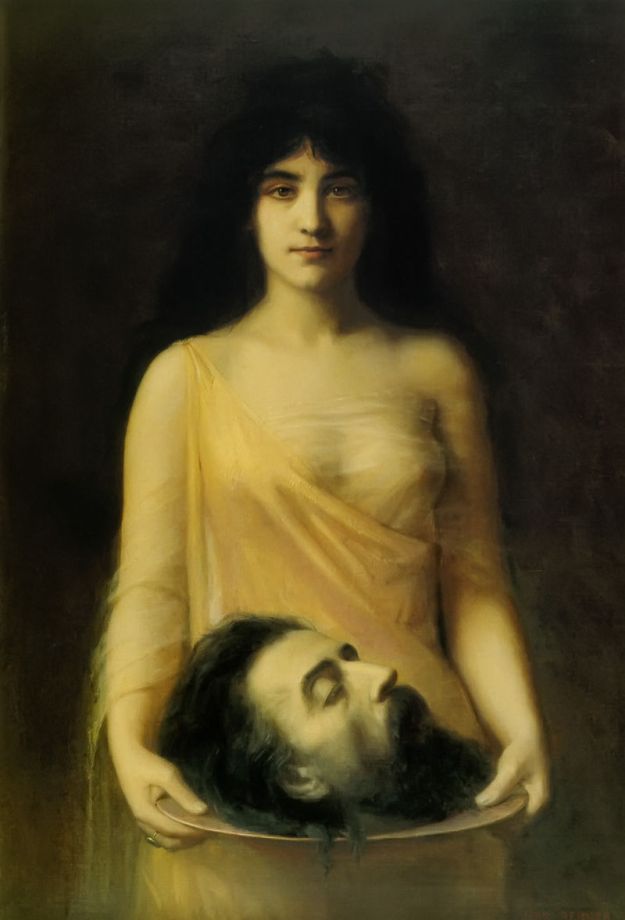
James Tissot, The Blind in the Ditch (1886-1894)

Matthew 15: 1-20

Parallel Mark 7: 1-23; Luke 11: 37-41; 6: 39

Then Pharisees and scribes came to Jesus from Jerusalem and said, 2 “Why do your disciples break the tradition of the elders? For they do not wash their hands before they eat.” 3 He answered them, “And why do you break the commandment of God for the sake of your tradition? 4 For God said, ‘Honor your father and your mother,’ and, ‘Whoever speaks evil of father or mother must surely die.’ 5 But you say that whoever tells father or mother, ‘Whatever support you might have had from me is given to God,’ then that person need not honor the father. 6 So, for the sake of your tradition, you make void the word of God. 7 You hypocrites! Isaiah prophesied rightly about you when he said:

8 ‘This people honors me with their lips, but their hearts are far from me; 9 in vain do they worship me, teaching human precepts as doctrines.'”

10 Then he called the crowd to him and said to them, “Listen and understand: 11 it is not what goes into the mouth that defiles a person, but it is what comes out of the mouth that defiles.” 12 Then the disciples approached and said to him, “Do you know that the Pharisees took offense when they heard what you said?” 13 He answered, “Every plant that my heavenly Father has not planted will be uprooted. 14 Let them alone; they are blind guides of the blind. And if one blind person guides another, both will fall into a pit.” 15 But Peter said to him, “Explain this parable to us.” 16 Then he said, “Are you also still without understanding? 17 Do you not see that whatever goes into the mouth enters the stomach, and goes out into the sewer? 18 But what comes out of the mouth proceeds from the heart, and this is what defiles. 19 For out of the heart come evil intentions, murder, adultery, fornication, theft, false witness, slander. 20 These are what defile a person, but to eat with unwashed hands does not defile.”

Jesus and the Pharisees and scribes, as presented here, have different points of reference as they enter this argument. The Pharisees in the gospel have had a growing list of complaints about the practices of Jesus and his disciples: they eat with the wrong people (9:11), they do not fast (9:14), they pluck grain on Sabbath when they are hungry (12:2), Jesus heals on Sabbath (12:10), in our current passage they don’t wash their hands before eating and in future readings will come questions of paying taxes to the Temple (17:24) and the emperor (22:17) (Case-Winters, 2015, p. 197) All of these visible practices which are not wrong or evil and may even be life giving in the right context (I’m writing on this passage on washing hands before eating in the context of the Covid-19 pandemic) also become ways of judging the righteousness of others or practicing one’s piety before others. These conflicts resonate strongly with Jesus’ words in the Sermon on the Mount which I will discuss below, but also highlight the difference between piety and righteousness.

The Pharisees and scribes that come to engage Jesus’ practices now come from Jerusalem, and this is the first time we have indication, since the very beginning of Jesus’ ministry when great crowds from Galilee, the Decapolis, Judea, Jerusalem and beyond the Jordan came to Jesus, (4:25) that Judea and Jerusalem and their authorities are aware of Jesus’ ministry predominantly in Galilee. Jesus’ practices, or at least the practices of his disciples in this instance, do not fit within the frame of what holiness practiced by visible actions that demonstrate one’s faithfulness, one’s piety, according to the practices of these Pharisees and scribes. There is a lack of openness to the works that Jesus is doing because they do not fit within the expectations of these leaders who have come to challenge the worker of the acts of power and the teacher of a different understanding of the relationship between the law and the tradition.

Jesus has very little interest in piety, and this is one of the reasons that most English translations of Matthew 6 of dikaisune as piety instead of righteousness misunderstand what Jesus is attempting to state. Jesus in Matthew 6: 1 stated, “Beware of practicing your righteousness (not piety) before others in order to be seen by them;” because the very practices that Jesus is being judged for here are the things that fail to produce changed hearts. Pietas (often translated piety from Latin) was an important Roman concept which the orator and statesman Cicero describes as that, “which admonishes us to do our duty to our country or our parents or other blood relations.” Jesus’ understanding of righteousness is not limited to ‘doing one’s duty’, particularly as it is viewed by others. Central to the language of the Sermon on the Mount were these practices of righteousness done in a way not to call attention to the individual’s practices. The actions of the community of the faithful may be visible, but the individual practices of the disciple will not be. Jesus may not look like he and his disciples are ‘doing their duty’ as viewed by the Pharisees but Jesus does not view them as faithful guides for how a community should practice righteousness.

The practice of washing hands comes from places in the law like Exodus 30: 19-21 (priests washing before entering the tent of meeting), Leviticus 15: 11 (washing after a bodily discharge) and Deuteronomy 21: 6 (where washing absolves the leaders of a community of responsibility an unsolved murder). The tradition of the elders mentioned here would be an expansion of the practices outlined in the law which only become troubling when they become standards for judging the holiness or acceptability of others. Jesus’ response goes directly back to the commandment and the justifications, often religious, that people might use to not fulfill their covenant responsibility to others. As I mentioned in the discussion of the commandment on honoring parents in both Exodus 20 and Deuteronomy 5, this commandment is not primarily about young children being obedient to parents but instead older children continuing to honor, respect, and care for elderly relatives. If this practice of dedicating wealth and property to the temple or to the priests in order to abandon one’s responsibility to a family member occurred, it would be masking unrighteousness in the appearance of socially respectable piety.

Jesus may bring about divisions in families and may call his followers to ‘let the dead bury their own dead’ or declare those who do the will of his Father in heaven are his ‘brother and sister and mother.’ But it is important for Matthew to continue to link Jesus as the fulfillment of the intent of the law. Jesus never declares that families do not have value and that family connections are not to be honored; they are simply not ultimate. The Pharisees who would practice this ‘dedication of one’s resources to God’ through the temple or the Pharisees, in lieu of caring for family probably felt they were making the same argument. Eyes opened to faith can see what is at the center of practicing righteousness and how faithfulness to Jesus takes a higher place than loyalty to temple or a religious community. The inability to distinguish between piety and righteousness leaves these Pharisees and scribes as blind guides leading the blind.

Hypocrites is a word that Matthew uses more than the rest of scripture, but its use here connects us both with its usage in the Sermon on the Mount (6:2, 6:5. 6:16, 7:5)  and Matthew’s frequent use of the term in the conflicts with the Pharisees in Jerusalem (22:18; 23: 13, 15, 23, 25, 27, 29; 24: 51).  As I mentioned when discussing 7:5, when righteousness becomes reduced to piety to demonstrate our own faithfulness or righteousness, we become like the one blind to the log in their own eye while trying to remove the splinter from another’s eye. Our expectations of what piety should look like allow us to pre-judge (where the term prejudice comes from) others and may make us blind to the ways our own practices may lead others astray.

Jesus, like the prophets before him, continually had to remind people that religious practices were not enough. Anna Case-Winters, picking up on the language of the Isaiah quotation, cleverly calls attention to reality that ‘lip-service” is not enough. A heart oriented on God and the way of life God calls God’s people to live is far more central and allows the right intentions to flow out of the mouth and to proceed from one’s hands (washed or unwashed). The Pharisees are scandalized (took offense, NRSV) according to the disciples but Jesus remains unconcerned by their judgments. He views them similarly to the weeds sewn among the wheat (13: 24-30) and as those who in their blindness are leading others in blindness. Like the Pharisees in John 9 who cannot accept the blind man who can now see and become spiritually blind, these Pharisees remain unable to see and participate with the reality of the Kingdom of Heaven’s work and presence in Jesus. Their prejudgment of Jesus makes them unable to properly see the road they are walking down which leads them and others who follow them into a pit.

The Pharisees are not the only ones who have trouble seeing and understanding what Jesus is saying, even the disciples have to ask for clarification. Peter, on behalf of the other disciples presumably, asks for clarification and Jesus explains that it is not what goes into a person, but what comes out of a person that defiles. A clean heart is more important than washed hands, and the actions which destroy community cause far greater harm than the practices of how or what one eats. Yet, Matthew also does not include Mark’s note in the parallel story that “Thus he declared all foods clean.” (Mark 7:19b) Matthew does not discard all the practices that the Jewish people practiced, and many in Matthew’s community may have refrained from eating foods traditionally declared unclean like pork or shellfish. But Matthew also does not allow these practices to give the disciples permission to prejudge others who practice their righteousness in a different way. There will be surprisingly faithful ones among those who were once considered Gentile dogs.
Matthew 14: 34-36 To Know Christ is to Know His Benefits

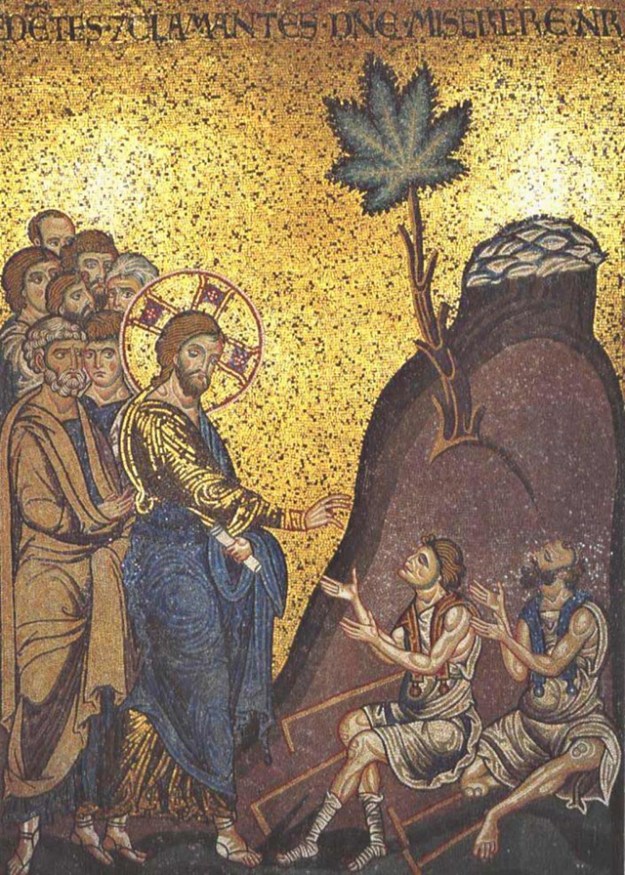
Jesus Healing the Blind From 12th Century Basilica Catedrale di Santa Maria Nouva di Monreale in Sicily.

Matthew 14: 34-36

Parallels Mark 6: 53-56

34 When they had crossed over, they came to land at Gennesaret. 35 After the people of that place recognized him, they sent word throughout the region and brought all who were sick to him, 36 and begged him that they might touch even the fringe of his cloak; and all who touched it were healed.

This short little transition may not seem to add much to Matthew’s narration, but Matthew (like most ancient writers) does not waste words. Even small additions to the narrative can point to important links and serve a structural point in oral storytelling. Matthew follows the pattern of Mark’s narration and slightly reduces the length of Mark’s narration, but Matthew’s decision to keep these transitional stories of healing is revealing.

The reformer Philip Melanchthon famously said, “To know Christ is to know his benefits.” As we compare this scene in Matthew to others in the gospel, I think this is a helpful frame to see some of the structure that underlays Matthew’s narration. At the end of the previous chapter (13: 54-58) the people of Jesus’ hometown knew Jesus’ family but they were unable to accept the wisdom he brought or to have faith in his ability to bring God’s kingdom to them and there were very few healings done there. In contrast in Gennesaret, which is close to Capernaum where Jesus has done many acts of power, the people come and they send word to the neighboring places to bring the ones who need healing. These demonstrations of the power of Jesus play an important part of understanding who Jesus is and a receptiveness to these acts point to the nature of faith and prepare the disciple to hear Jesus’ teaching. Matthew used a scene of healing many to prepare the reader to hear the Sermon on the Mount, (4: 23-25) and a description of the healing serves as an demonstration to John the Baptist’s disciples sent to inquire if Jesus is the one they are expecting. (11: 4-6) The neglecting of these demonstrations of power by Chorazin, Bethsaida and Capernaum have placed themselves below Tyre, Sidon and Gomorrah in the coming judgment (11: 20-24). The two other brief insertions of healing are both preceded by a miracle for an outsider (the healing of the Centurion’s servant/child before 8:14-17 and the healing of the Canaanite woman’s daughter prior to 15: 29-31—both possessing faith not seen in Israel). Structurally both this passage and 15: 29-31 are also bracketed by feeding miracles which also highlight Matthew’s organization (and by extension Mark’s organization since they share the structure of these chapters). One additional linkage that Matthew highlights is the healing of the woman with the flow of blood (9:20-22) who touches the fringe of his garment and hears that ‘her faith has made you well.’

These short readings highlight one of the primary ways that Matthew’s gospel wants us to understand what faith in Jesus looks like. Faith is an openness to the kingdom of heaven’s power at work in Christ, and to amend slightly Melanchthon’s wording: to know Christ is to remain open to his benefits or works. The crowd at Nazareth knows Christ primarily according to his family and are not open to his wisdom or works, the Pharisees, the scribes and soon the Sadducees in the narrative will judge Jesus’ works by their expectation of what the works should be, but those of faith are open to the works as they appear. They

trust that even the fringe of his garment, if touched, can heal/save (the Greek sozo translated healing means both) them completely.


Matthew 14: 22-33 Little Faith One

Extract of Herbert Boeckl’s fresco “Saint Peter’s rescue from the Lake Galilee” inside the cathedral of Maria Sall, Carinthia, Austria

Matthew 14: 22-33

Parallels Mark 6: 45-52; John 6: 16-21

22 Immediately he made the disciples get into the boat and go on ahead to the other side, while he dismissed the crowds. 23 And after he had dismissed the crowds, he went up the mountain by himself to pray. When evening came, he was there alone, 24 but by this time the boat, battered by the waves, was far from the land, for the wind was against them. 25 And early in the morning he came walking toward them on the sea. 26 But when the disciples saw him walking on the sea, they were terrified, saying, “It is a ghost!” And they cried out in fear. 27 But immediately Jesus spoke to them and said, “Take heart, it is I; do not be afraid.”

28 Peter answered him, “Lord, if it is you, command me to come to you on the water.” 29 He said, “Come.” So Peter got out of the boat, started walking on the water, and came toward Jesus. 30 But when he noticed the strong wind, he became frightened, and beginning to sink, he cried out, “Lord, save me!” 31 Jesus immediately reached out his hand and caught him, saying to him, “You of little faith, why did you doubt?” 32 When they got into the boat, the wind ceased. 33 And those in the boat worshiped him, saying, “Truly you are the Son of God.”

This is the story within Matthew that initiated some of my questions about the way that Matthew’s gospel had been translated and interpreted. This well known story with Matthew’s unique addition of Peter coming to Jesus upon the water is a common image on stained glass windows and paintings in churches, and while it is often an image of hope: of Jesus who rescues those sinking in the stormy waters. Yet, it also is often paired with a condemnation of Peter who doubts in the face of the strong wind. I never anticipated my discomfort with the traditional translation of ‘you of little faith’ in this scene becoming this project which became a much larger examination of the gospel as a whole and its history of interpretation, but often one question leads to many others.

Normally when Matthew takes a story present in Mark (assuming Mark as the first of the gospels written) he shortens it to quickly move us to the instruction by Jesus, which comprises many of the additions in Matthew’s gospel, but here Matthew adds and entire scene of Peter getting out of the boat and coming to Jesus. One of the things to pay attention to when there are parallel narrations of an event is the places where an author introduces new or unique elements because they often give critical insights into what the gospel writer wants to express about who Jesus is and the nature of following him. Matthew has structurally placed this narrative in roughly the middle of the gospel and almost doubled the length that Mark (and John) dedicate to this story. It is also worth remembering that this is the second time Jesus has done the incredible upon the sea and there are unique aspects in both stories in Matthew’s careful narration that invite us to hear this story and the story of Jesus calming the storm in Matthew 8: 23-27 together.

Jesus compels the disciples to get into the boat, presumably a boat owned by one of the disciples, and after the feeding of the 5,000 remains to dismiss the crowds. The Greek enagkasen is more forceful than the NRSV’s translation of ‘made’, Jesus compels or forces the disciples to embark on the boat and sends them on their own into the waters to travel to the other side while he dismisses the crowds. Jesus goes up a mountain to be alone in prayer, but in this time the situation of those on the boat changes. The disciples in Matthew 8: 23-27 felt alone in the midst of the storm while Jesus slept, but now they are isolated from Jesus as the wind become hostile towards them and the boat is tormented under the waves. The wind and waves become, in the narration, active entities working against the disciples on the sea and from evening until the fourth watch of night, traditionally 3 am-6 am, the disciples struggle on their own against the elements. I think it is helpful to notice in this narration that there is a significant time of struggle for the disciples and it takes time for Jesus to move from the mountain where he is praying to the shore and across the many stadia (great distance in the NRSV) that the disciples are out upon the sea.

In Mark’s narration of this story Jesus intends to pass the disciples by, which may be an allusion to God passing by Moses to reveal who he is, but Matthew removes this highlighting the destination of Jesus being these ones on the boat. There are plenty of hints that Matthew shares with Mark, and some unique to Matthew, that point to the identity of Jesus, but Matthew has the boat squarely in Jesus direction of movement as the disciple see him approaching. In the midst of struggling against the wind and waves for hours and seeing what they perceive is a phantom or a ghost (Greek phantasma) their response is to cry out in fear. Jesus’ response to ‘be of good courage, I am, fear not’ is crafted to again alert the reader that more is happening than meets the eye. The initial command to ‘be of good courage’ or ‘take heart’ is a normal response to the cry of fear, but the next two statements are theologically rich. I am (NRSV it is I) is the same language that John’s gospel uses in all the I am sayings (I am the bread of life, I am the good shepherd, I am the way, the truth, and the life, etc.)  and Jesus declaration that ‘I am’ in John 18: 6 causes the soldiers step back and fall to the ground when arresting Jesus. The phrase ‘I am’ recalls the name of God in Exodus 3:14 and while it can simply be the first person pronoun with the being verb in normal speech, in scriptures this frequently causes the hearer to ask about the person’s relationship to the LORD the God of Israel. In addition, this linked with the command ‘Fear not’ or as it is commonly rendered ‘do not be afraid’[1] is also commonly associated with a divine message either from an angel or directly from God.  As we wondered in Matthew 8, ‘what sort of man is this?’ we are now again directed to wonder about the identity of the one approaching his disciples upon the water. The wind and the waves are unable to prevent this one who proclaims ‘I am, fear not’ from approaching.

Matthew is the only gospel who includes the story of Peter approaching Jesus on the water, and this is where Peter begins to stand out among the disciples and be a major actor in the narrative. In the coming chapters Peter will become the one out of the twelve who speaks and acts in answer to Jesus questions and will become the one who represents in many ways the community. Peter moves down from the boat and towards Jesus upon the water, but he sees the strong wind which has been against the boat and he begins to sink. The word translated sink (Greek katapontizesthai) can also mean drown, so Peter in this narrative is experiencing true peril in the midst of his fear as he cries out “Lord, save me.” Just as the disciples in Matthew 8 cried out ‘Lord save us’ as they were in the windstorm on the sea, now Peter echoes this rich phrase with resonance between Israel and the people of God (see comments on 8:25) to Jesus as he finds himself overwhelmed by the wind, waves and water. Immediately Jesus responds by extending his hand and taking hold of him.

This is the third of five uses of oligopistos (NRSV ‘you of little faith’) in Matthew’s gospel, a phrase always used in relation to those following Jesus. Rendering this term ‘you of little faith’ while correct adds a negative connotation that doesn’t need to be there (try saying ‘you of little faith’ without it sounding judgmental) and I do believe that ‘little faith one’ is a better translation. Jesus in this narrative has moved directly toward the boat, told the disciples to be of good courage because of his presence, and told Peter to come to him in the midst of the wind and waves. I know I am pushing against the interpretive tradition of this phrase, but I do believe that Jesus is fond of his ‘little faith ones’ and in this particular story of Peter. Instead of castigating Peter for experiencing doubt, perhaps he is reassuring Peter (and ‘little faith ones’ throughout the ages) that he indeed is ‘God with us’ in the midst of the storm. This is reinforced by the use of the word diatazo here which is only used one other time in Matthew’s gospel, on the mountain in Galilee after the resurrection where the disciples doubt is paired with the encouragement “I am with you always, to the end of the age.”[2] Like the disciples on the mountain, who even in their doubt worship, so the disciples here worship saying “You are the Son of God.” As I mentioned when discussing the Son of’ titles for Jesus the Son of God title has relationship to the identity of Jesus being the Davidic King, but Matthew also pushes the boundaries of that title to include something greater in relation to the God of Israel. For Matthew, Jesus is one who is worthy of worship by the disciples, like the God of Israel.[3] The wind and the waves which threaten the disciples are stopped by his presence and we are invited beyond the wondering of ‘what sort of man is this’ the disciples voiced when Jesus calmed the storm before to the stance of worship this one who meets his little faith ones in their doubts and trouble and saves them.

[1] Anna Case-Winters notes that this is the fourth of seven significant texts with the message “do not be afraid” (1:20; 8:26; 10: 31; 14: 27; 17: 7; 28:5; 28:10). Note that all of these except 10:31 are in some manner a theophany (angel of the Lord appearing to Joseph in a dream, the two water narratives, the transfiguration and the resurrection. (Case-Winters, 2015, p. 194)

[2] Matthew 21: 21 in the NRSV “if you have faith and do not doubt” is the other place doubt occurs in English in the gospel, but the Greek word behind it is different: diakrino

[3] This is reinforced when you realize that Matthew uses proskuneo (to prostrate, worship) more than Mark and Luke combined and when you look at the thirteen times it is used (The Magi ‘paying homage’ 2:2, 8, 11; the women and disciples at the resurrection worshipping Jesus 28: 9, 17 and the temptation narrative where ultimately instead of worshipping Satan, Jesus quotes Deuteronomy 6:13 where one is to worship the Lord only. (Hays, 2016, p. 396 n. 52)

Matthew 14: 13-21 Bread in the Wilderness

Mosaic at the Church of the Multiplication of the Loaves and Fishes at Tabgha near the Sea of Galilee

Matthew 14: 13-21

Parallels: Mark 6: 32-44; Luke 9: 10b-17; John 6: 1-15

13 Now when Jesus heard this, he withdrew from there in a boat to a deserted place by himself. But when the crowds heard it, they followed him on foot from the towns. 14 When he went ashore, he saw a great crowd; and he had compassion for them and cured their sick. 15 When it was evening, the disciples came to him and said, “This is a deserted place, and the hour is now late; send the crowds away so that they may go into the villages and buy food for themselves.” 16 Jesus said to them, “They need not go away; you give them something to eat.” 17 They replied, “We have nothing here but five loaves and two fish.” 18 And he said, “Bring them here to me.” 19 Then he ordered the crowds to sit down on the grass. Taking the five loaves and the two fish, he looked up to heaven, and blessed and broke the loaves, and gave them to the disciples, and the disciples gave them to the crowds. 20 And all ate and were filled; and they took up what was left over of the broken pieces, twelve baskets full. 21 And those who ate were about five thousand men, besides women and children.

The rejection in Nazareth and the death of John the Baptist puts both Jesus and the crowds in motion and they both arrive in the wilderness. Jesus and his disciples get into a boat and come to an uninhabited place along the sea, and the crowds abandon the towns to follow him on foot. Matthew shortened version of this story (if Mark’s narration is the original) continues to invite the followers of Jesus to reflect upon his identity by echoing other portions of both Matthew’s narration of Jesus’ life and scriptures. The feeding of the five thousand men, plus women and children, is unique among the miracle stories of Jesus because it is the only one included in all four gospel accounts.

The wilderness was where John the Baptist began his story, where Jesus was baptized and where Jesus was tempted. People once came into the wilderness to see John the Baptist instead of Herod (see comments on 11: 7-15), but now the come seeking Jesus. Jesus has compassion on this large crowd and begins to heal those who are sick. Matthew drops Mark’s allusion to Ezekiel 34 where the crowd is like sheep without a shepherd, but the contrast with the compassion Jesus shows towards the crowd and the fear Herod Antipas shows highlights the contrast in relations between these ‘kings of Israel.’ Matthew also drops the teaching of the crowds, but since Jesus teaching the crowds in parables comprises the previous chapter this is not necessary to Matthew’s narration. Now in the absence of John the Baptist and instead of Herod Antipas, the large crowd journeys over land to meet Jesus in this wilderness place.

The defining story of the Hebrew people is the Exodus and central to the people’s journey through the wilderness is the provision of bread by God on that journey. In this wilderness the people are now fed by Jesus, he becomes the one who makes an excessive amount of bread in the wilderness. Like the woman who folded the yeast into three measures of flour (13: 33) he prepares a feast to this great crowd. This story also resonates with the final meal that Jesus will share with his disciples where again he will bless and break bread to be distributed (26:26-30). Matthew, following Mark’s structure, will have Jesus do two feedings of large crowds in the wilderness. (15: 32-39) In both feeding stories the disciples of Jesus in addition to distributing the bread are also invited to wonder about the one who can provide an abundant feast where all are satisfied in a wilderness place. Like God providing for the people in the Exodus or promising a great feast on the mountain of the Lord (Isaiah 25: 6-9) we are invited to consider who Jesus is in relation to God. He is more than a prophet like John the Baptist and more than a king like Herod even if those in his homeland cannot recognize it.

Matthew 14: 1-12 The Death of John the Baptist

By Jean Benner – [1], Public Domain, https://commons.wikimedia.org/w/index.php?curid=23152785

Matthew 14: 1-12

Parallel Mark 6: 14-29; Luke 9: 7-9

1 At that time Herod the ruler heard reports about Jesus; 2 and he said to his servants, “This is John the Baptist; he has been raised from the dead, and for this reason these powers are at work in him.” 3 For Herod had arrested John, bound him, and put him in prison on account of Herodias, his brother Philip’s wife, 4 because John had been telling him, “It is not lawful for you to have her.” 5 Though Herod wanted to put him to death, he feared the crowd, because they regarded him as a prophet. 6 But when Herod’s birthday came, the daughter of Herodias danced before the company, and she pleased Herod 7 so much that he promised on oath to grant her whatever she might ask. 8 Prompted by her mother, she said, “Give me the head of John the Baptist here on a platter.” 9 The king was grieved, yet out of regard for his oaths and for the guests, he commanded it to be given; 10 he sent and had John beheaded in the prison. 11 The head was brought on a platter and given to the girl, who brought it to her mother. 12 His disciples came and took the body and buried it; then they went and told Jesus.

Immediately after Jesus is not received in his hometown, Matthew narrates the death of John the Baptist. Herod Antipas may, like his father Herod the Great, want to be the ‘King of the Jews’ but his actions run contrary to the vision expressed in the law for how a king is supposed to be. He also is sharply contrasted with Jesus in the coming narrative: while Herod fears the crowd Jesus has compassion on them, while the death of one who came ‘neither eating of drinking’ occurs at a feast at Herod’s birthday party, Jesus will provide a banquet in the deserted place for thousands. This story of sex, intrigue and power demonstrates the nature of the kingdom of rulers like Herod. The kingdom that Jesus and John pointed to is an alternative to this Herodian tragedy.

Herod Antipas is the tetrarch, he ruled a quarter of his father’s former kingdom including Galilee. His brother Herod II, also known as Herod Philip, was the husband of Herodias not to be confused with Philip II the ruler of Trachonitis. We learned in Matthew 11:2 that John the Baptist was in prison and now we hear the reason that Herod Antipas took notice of this prophet. The divorce of Herod II and Herodias is also mentioned in Josephus and we know that eventually Herod Antipas married Herodias, but their marriage would have been a scandal among the people of Galilee. Unfortunately, rulers often feel above the law that their followers adhere to. Jesus will speak against divorce multiple times in Matthew and, like John, he wouldn’t have endorsed a brother marrying his brother’s wife serving as the king of the region where Jesus’ ministry begins.

Rulers making wild declarations which have lasting consequences are common characters throughout the bible and these rulers are bound by their words. Herod makes Herodias’ daughter a promise to give her what she asks for. Generations earlier Esther when given a similar opportunity by King Ahaseurus uses the opportunity to save the people and to bring about the death of Haman, the enemy of her people (Esther 5:3, Mark’s parallel telling of this uses identical language in Herod’s and Ahaseurus’ promises) but here the daughter of Herodias asks only for the death of the prophet. Herod Antipas is bound by his rash promise and the presence of those reclining at the table with him.

Herod expresses a belief that John the Baptist has been raised from the dead to his children (NRSV renders the word servants), which points to an understanding of the resurrection of the righteous which would have been an idea shared by the Pharisees and the followers of Jesus. I don’t believe that Herod Antipas would’ve considered himself a Pharisee, but he probably had enough in common with them for them to work together when it served their interests. This may lie behind the collaboration between Pharisees and Herodians in 22:16.

Matthew shortens Mark’s narration of the death of John the Baptist’s, but it does serve  important functions in Matthew’s narration of Jesus’ ministry. By coming immediately after the rejection in Jesus’ hometown it demonstrates the resistance to the kingdom of heaven and the cost that prophets and messiahs will pay. It also ends John the Baptist’s role in the story. In Matthew, Jesus and John share identical language in their proclamation but have different roles. Yet, we also will hear others understand Jesus in terms of John the Baptist (16:14). John’s disciples have come to Jesus before, and now they come to Jesus a final time with the news of John’s death, which sets Jesus in motion. Jesus will withdraw to a deserted place, perhaps to grieve and perhaps to avoid Herod Antipas. Herod will stay at his celebration with those who have seen Herodias’ daughter dance and John the Baptist beheaded with the crowds outside. Jesus in going to the deserted place will find the crowds coming and seeking him like sheep without a shepherd, or at least without a good shepherd.

Matthew 13: 54-58 Rejecting Wisdom

By Meister der Kahriye-Cami-Kirche in Istanbul – The Yorck Project (2002) 10.000 Meisterwerke der Malerei (DVD-ROM), distributed by DIRECTMEDIA Publishing GmbH. ISBN: 3936122202., Public Domain, https://commons.wikimedia.org/w/index.php?curid=155126

Matthew 13: 54-58

Parallels Mark 6: 1-6a; Luke 4: 16-30

54 He came to his hometown and began to teach the people in their synagogue, so that they were astounded and said, “Where did this man get this wisdom and these deeds of power? 55 Is not this the carpenter’s son? Is not his mother called Mary? And are not his brothers James and Joseph and Simon and Judas? 56 And are not all his sisters with us? Where then did this man get all this?” 57 And they took offense at him. But Jesus said to them, “Prophets are not without honor except in their own country and in their own house.” 58 And he did not do many deeds of power there, because of their unbelief.

The rejection of Jesus by those in his hometown or country (Greek patrida literally fatherland is behind both words in this narrative) fits within the overall flow of the gospel of Matthew’s structure which existed prior to the chapter divisions and this short narrative of the rejection in Nazareth combined with the death of John the Baptist set the stage for the next group of stories of Jesus’ power and reflections on faith. Throughout the parables we have been warned that many will not have ears to hear, eyes to see or hearts to understand. For the people of Jesus’ hometown familiarity with the relations of Jesus becomes the ‘stumbling block’ or ‘scandal’ (Greek skandalizo) which makes them unable to receive the wisdom that Jesus offers them, presumably in parables.

Earlier in response to the crowd, notably after the disciples of John the Baptist come to him. Jesus would say, “Yet wisdom is vinidicated by her deeds.” (11:19) Now the ones in his hometown recognize both wisdom and the deeds of power, and yet they are unable to receive him. Their unbelief (literally unfaith or lack of faith) it not due to the lack of justification for faith, the wisdom and deeds of power are known and demonstrated even here. There may not be a large number of deeds of power where ‘all the sick’ will be healed as in other places but that is because their lack of faith. As I argued in talking about faith in Matthew’s gospel, faith is an openness or awareness to what God is doing in the world through the presence of Jesus. They are in a synagogue, they can perceive the wisdom and even the deeds of power, but they are unable to connect those realities to the kingdom of heaven’s presence in this one whose father was a laborer (we may associate carpenters with craftsmen, but in this time the Greek tekton is merely a builder/laborer) whose mother and brothers they can name and whose sisters are known among them.

There may be many reasons that people reject wisdom, many stumbling blocks that can cause them to fall, but this is still a world in which the harvest will occur. The seed may fall on the path, or the rocky soil or among the thorns but the sower continues to sow. The weeds and the wheat will grow up together, the mustard seed is sown among the massive field, and the yeast is hidden among the three measures of flour. One discovers a treasure, one a pearl of surpassing value, others good and bad fish that need to be sorted. Yet, even in the midst of no faith Jesus is still able to do something according to Matthew. In a change from Mark’s language where the lack of faith in his hometown makes Jesus unable to do any deeds of power (except for healing a few sick people), in Matthew’s gospel Jesus doesn’t do deeds of power there and the reason is ambiguous. Perhaps it is by choice, why do deeds of power where hearts cannot understand, eyes cannot see and ears cannot hear, perhaps their lack of openness to the kingdom creates a resistance to God’s activity in that place. Regardless there are other fields to tend to and so Jesus and his disciples go where the people are ready to be fed.

Matthew 13: 44-53 Treasures Old and New

By Brocken Inaglory – Own work, CC BY-SA 3.0, https://commons.wikimedia.org/w/index.php?curid=2655938

Matthew 13: 44-53

44 “The kingdom of heaven is like treasure hidden in a field, which someone found and hid; then in his joy he goes and sells all that he has and buys that field.

45 “Again, the kingdom of heaven is like a merchant in search of fine pearls; 46 on finding one pearl of great value, he went and sold all that he had and bought it.

47 “Again, the kingdom of heaven is like a net that was thrown into the sea and caught fish of every kind; 48 when it was full, they drew it ashore, sat down, and put the good into baskets but threw out the bad. 49 So it will be at the end of the age. The angels will come out and separate the evil from the righteous 50 and throw them into the furnace of fire, where there will be weeping and gnashing of teeth.

51 “Have you understood all this?” They answered, “Yes.” 52 And he said to them, “Therefore every scribe who has been trained for the kingdom of heaven is like the master of a household who brings out of his treasure what is new and what is old.” 53 When Jesus had finished these parables, he left that place.

This final set of three parables with a bonus image wraps up this block of teaching the crowds and disciples in parables. The careful hearer will hear several resonances between these images, which are unique to Matthew’s gospel, and other teachings of Jesus earlier in the gospel. Those who are scribes trained for the kingdom of heaven (literally disciple scribes of the kingdom of heaven) have learned from both the wisdom of scripture and the teaching of Jesus and have a rich storehouse of wisdom to bring forth into their life. As I continue to sit with these images I am aware that many have been unearthing the treasures hidden here for almost 2,000 years but I still find a rich storehouse of treasures waiting the patient seeker.

The first two images contrast with the previous earthy images in the extravagant image that is likened to the kingdom of heaven. The previous images have been very earthy, related to fields and baking, but here we are dealing with the discovery of treasures and pearls. The kingdom of heaven is like a treasure or a storehouse of treasure hidden in a field which compels that person to sell all they have to possess. The image of treasure may remind the attentive disciple to the words of Jesus in Matthew 6: 19-21 about storing up treasures in heaven rather than treasures on earth and about one’s heart being where one’s treasures are or Matthew 19:21 where Jesus in conversation tells a rich young man to sell his possessions to have treasure in heaven. The person in the parable is completely invested in their decision to purchase the field and possess the treasure. They have given up what they have to live on to possess the treasure, and while we might naturally think of this person selling off the treasure to live more abundantly the story ends with the person owning the field, the treasure and nothing else.

In a similar way the image of the person purchasing a pearl of great value takes us into an extravagant image that most of the people in Jesus’ audience couldn’t imagine. There is no undisputed mention of pearls in the Hebrew scriptures (the NRSV translates Job 28: 18 ‘the price of wisdom is above pearls’ but the words translated pearls is the Hebrew p’ninim which means jewels), but Matthew has used the image of casting ‘pearls before swine’ in Matthew 7:6. Pearls are produced by a non-kosher animal but wouldn’t be forbidden to wear by Jewish people, the problem with pearls is at this time they are more valuable than any other ‘fine jewels.’ They were simply unavailable for the average person. They may never see a pearl except in depictions of the very wealthy, much less one of exceeding value. (Levine, 2014, pp. 146-148) In modern settings we normally anticipate a person who is a merchant purchasing something of high value in order to sell it at a high cost, but few of us can imagine risking everything on one high priced item that literally bankrupts us, but the parable again shows no interest in selling the pearl. The person who was a merchant now gives all to possess this pearl of exceeding value that is qualitatively different from any other pearl or gemstone. Both individuals who sell everything desire to possess the discovered treasure and find themselves willing to empty out their storehouses to make space for this one thing.

The third image, which is given with interpretation, returns to the familiar realm of most of the people around Jesus, the image of fishing. The net thrown into the sea is a dragnet, not the small circular net cast into the sea for targeted fishing indicated earlier in the gospel. It is a net pulled behind or between boats gathering everything indiscriminately that is not too small for the net.  Nor does the Greek indicate that it caught fish of every kind, instead it simply says ‘all kinds/races gathered together’ (pantos genous sunagagouse). We may hear the echo of Jesus’ call to Peter and Andrew when he told them he would have them fish for people in Matthew 4: 19 and the explanation of this final parable indicates that it is indeed people instead of fish being sorted. In the explanation the angels are the sorters who gather the good ones into vessels and the bad ones are cast out into the fire. I do believe that Matthew wants us to hear that there is a consequence for failing to be righteous instead of evil, good instead of bad, having one’s hearts and treasures not invested in the approaching kingdom of heaven. Even in their way parables both conceal and reveal they are intended for those with ears to hear to become scribes learning the ways of the kingdom of heaven.

Matthew unearths some of these treasures for us to see and conceals others for those who trained to hear the scriptures of Israel in light of the new reality of the kingdom of heaven’s approach in Jesus. Matthew is trying to train us how to read scripture in the light of Jesus’ teaching and wisdom and give us a map to the storehouse of treasure or the pearl of exceeding value. Scribes trained to marvel at the pearls of wisdom contained in some of these earthy tales of sowing, baking and fishing and to delight in the presence of the kingdom in unexpected ways in the midst of the world. Perhaps that is a part of the reason that patient seekers continue to unearth unexpected treasures in these parables 2,000 years later.

Matthew 13: 24-43 Parables of Weeds, Seeds and Leaven

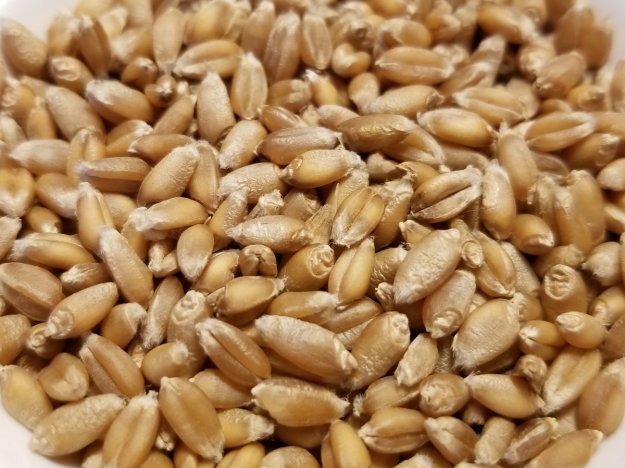
Close up view of Wheat, shared by user Bluemoose on Wiki Commons under Creative Commons 2.0

Matthew 13: 24-43

24 He put before them another parable: “The kingdom of heaven may be compared to someone who sowed good seed in his field; 25 but while everybody was asleep, an enemy came and sowed weeds among the wheat, and then went away. 26 So when the plants came up and bore grain, then the weeds appeared as well. 27 And the slaves of the householder came and said to him, ‘Master, did you not sow good seed in your field? Where, then, did these weeds come from?’ 28 He answered, ‘An enemy has done this.’ The slaves said to him, ‘Then do you want us to go and gather them?’ 29 But he replied, ‘No; for in gathering the weeds you would uproot the wheat along with them. 30 Let both of them grow together until the harvest; and at harvest time I will tell the reapers, Collect the weeds first and bind them in bundles to be burned, but gather the wheat into my barn.'”

31 He put before them another parable: “The kingdom of heaven is like a mustard seed that someone took and sowed in his field; 32 it is the smallest of all the seeds, but when it has grown it is the greatest of shrubs and becomes a tree, so that the birds of the air come and make nests in its branches.”

33 He told them another parable: “The kingdom of heaven is like yeast that a woman took and mixed in with three measures of flour until all of it was leavened.”

34 Jesus told the crowds all these things in parables; without a parable he told them nothing. 35 This was to fulfill what had been spoken through the prophet: “I will open my mouth to speak in parables; I will proclaim what has been hidden from the foundation of the world.”

36 Then he left the crowds and went into the house. And his disciples approached him, saying, “Explain to us the parable of the weeds of the field.” 37 He answered, “The one who sows the good seed is the Son of Man; 38 the field is the world, and the good seed are the children of the kingdom; the weeds are the children of the evil one, 39 and the enemy who sowed them is the devil; the harvest is the end of the age, and the reapers are angels. 40 Just as the weeds are collected and burned up with fire, so will it be at the end of the age. 41 The Son of Man will send his angels, and they will collect out of his kingdom all causes of sin and all evildoers, 42 and they will throw them into the furnace of fire, where there will be weeping and gnashing of teeth. 43 Then the righteous will shine like the sun in the kingdom of their Father. Let anyone with ears listen!

One of the dangers of attempting to interpret parables which are designed both to reveal and to conceal comes with the pinning down the imagery to a meaning. Like a butterfly collector which pins their captures where they can be displayed only to realize the now deceased insect loses the life it once demonstrated, it may still be beautiful but is no longer a dynamic thing. As I have worked through the gospel of Matthew I have attempted to provide a coherent and plausible reading, but the perspective I write from is not the only one and others will and have found other dynamic readings in these verbal portraits of Jesus’ life and teaching. Yet, there are a number of interpretations of both Matthew’s gospel in general and these parables in particular which are not helpful (and may even be toxic) or would not make sense to people in either Jesus’ or Matthew’s audience in the first century middle east. Perhaps these reflections can help us metaphorically see some readings which look like wheat but are really just weeds that occupy the field hiding the fruit of the wheat from us.

It is important to pay attention to structure for clues in how we are to hear these parables and I’ve tried to group these together in ways that make sense to helping us have ears to hear. Matthew likes patterns of three and this is highlighted here by the placement of three parables followed by an explanation of the first parable. Between the three parables and the explanation is another explanation of why Jesus speaks in parables. The joining together of the parables in a group of three points to an interconnection in the imagery and understanding of the stories. Even though Matthew only includes an explanation for the first parable in this group, it is placed there by Matthew to be a key not only for the first parable but for a way of hearing all three parables. Similarly, the first parable of the chapter also provides a window into hearing all the parables gathered together in this chapter.

The opening parable of good seed, weeds and a field again places hearers to the familiar world of sowing and agriculture, yet it introduces an almost comic element when an enemy is responsible for sowing weeds among the field. Anyone who has done any type of agriculture work from a personal garden to industrial farming knows that weeds come whether they are sown or not, no one needs to sow tares; yet, in the world of this story, an enemy does just that. The wheat and the weeds grow up together in the field and the removal of one may mean the uprooting of the other. The householder, or the master of the house, has their slaves wait until the harvest time where the reapers can gather both wheat and weeds separately for different locations.

Matthew’s interpretation points to a world where the children of the kingdom and the children of evil live together. Matthew’s gospel repeatedly references a time of sorting or judgment where the righteous and the unrighteous are separated and God (or those sent by God like the angels) are responsible for that sorting. The gospel of Matthew has pointed to a vision for a community that lives out of a merciful but demanding righteousness and the community the gospel was written for lived in a world where many outside the community followed different visions for what a faithful life looked like. Matthew’s community may have also experienced competing expectations for what righteousness within the community and this parable may have allowed them to accept that both the church and the world were a mixed body until God separates weed from wheat, or in a later images the good fish from the bad fish and the sheep from the goats. As the imagery of the salt and light from Matthew 5: 13-16 point to the individuals and community are called to live out there calling and not to concern themselves with the disposition of the world around them. While they will be recognizable when mature by the fruit they produce, in contrast to the tares, they are not in charge of the time of harvest or the harvest itself. Ultimately any ingathering and separation is the responsibility of God and not the disciples.

The second parable again has the image of sowing in a field but this time what is sown is a mustard seed. Unfortunately, many interpreters get caught up on the mustard seed as being something undesirable in the field but the evidence this claim is built upon is pretty flimsy. Often the connection is made to Pliny the Elder, a Roman naturalist and philosopher, who said of mustard: “It grows entirely wild, though it is improved by being transplanted; but on the other hand when it has been once sown it is scarcely possible go get the place free of it, as the seed when it falls germinates at once.” Often missed is when Pliny also states mustard is “extremely beneficial for health”, helpful for the treatment of “snake and scorpion bites, toothache, indigestion, asthma, epilepsy, constipation, dropsy, lethargy, tetanus, leprous sores” and other illnesses (Levine, 2014, pp. 175-177) Nor was mustard looked upon as a bad or non-kosher thing.  The word translated shrub by the NRSV (and many translations) is the Greek laxanon which is a vegetable or garden herb. Perhaps the rendering of this a shrub adds to the perception of it uselessness which, in the case of brassica nigra “black mustard” grows into a plant of eight to ten feet when properly cultivated. Matthew has the vegetable (laxnon) become a tree (dendron) which may point in a mocking manner to imagery of great trees that represented empires in Ezekiel 31 and Daniel 4 but this is probably not the primary image that the parable draws us to.

If the field continues to be the world and the sower continues to be the Son of Man, which the parallel imagery invites, then the small thing planted in the field is something of use to the entire world.  As Amy Jill-Levine can state:

the mustard plant offers more than a single person can use. The invitation to partake is a universal one, as the birds so neatly demonstrate. Instead of looking at the plant as a noxious weed, we might be better off seeing it as a part of the gifts of nature; something so small, allowed to do what it naturally does, produce prodigious effects. (Levine, 2014, p. 181)

Maybe instead of being the weed no one wants in the field maybe the mustard seed is that which gives rise to a plant which once it emerges grows prodigiously producing with both curative and flavor producing properties meant to be shared among the creation of God, both birds of the air and the people of the earth. Perhaps, like the trees on either side of the river of life in Revelation 22, this small seed emerges as something for feeding creation and healing the nations. Perhaps this is part of the reason faith the size of a mustard seed can move mountains for little faith ones (Matthew 17: 20)
Likewise the parable of the yeast has several unfortunate interpretations which misunderstand the place of leaven in Jewish culture. Amy Jill-Levine is again instructive here: “Leaven is not itself “impure”; if it were, Jews would not have to remove it from their homes at Passover, because they would never have used it in the first place.” (Levine, 2014) The cakes used on the altar  for the sacrifice of well-being were leavened (Leviticus 7: 13) and so leaven is not the ‘corrupting agent’ that sometimes interpretations make it out to be.

Leaven at this time is not the packets of yeast we think of in our time but a sourdough starter and the woman does not mix it into the flour, she hides it in the flower (Greek enkrypto where we get encryption or cryptology from). It is also helpful to realize that three measures of flour would be between forty and sixty pounds of flour, which again would be far more than one person could consume. There is a resonance with the story in Genesis 18 where Abraham encounters three men, who we learn to be a divine visitation, and instructs Sarah to make ready three measures of choice flour and proceeds with the bread and a calf, curds and milk to present a feast.  One of the images for the end of the age is of a great banquet, see for example Isaiah 55, and this woman in hiding the yeast in the three measures of flour is beginning the preparation for the feast to come.

In line with the previous two parables, if we want to move this towards an allegory, it would probably make sense to consider the flour the world with something hidden in it by a baker. If you want to proceed allegorically then the woman also represents the Son of Man, which may seem unsettling at first but we’ve already had Jesus adopt the character of Wisdom, and ultimately, as Anna Case-Winters can state,

It is interesting that many commentators and interpreters who work with these parables frequently draw an analogy between God and the male sowers in to of the parables (vv. 3 and 24) but do not draw an analogy between God and the female baker (v. 33) (Case-Winters, 2015, p. 180)

The position of this parable as the third in a series of three also invites us to see this is the image that Matthew has been moving us towards with the two previous parables.

Matthew also follows these parables by returning again to the reason for parables, which both reveal and conceal. As Frank Kermode observed, “Parable, it seems may proclaim a truth as a herald does and at the same time conceal truth like an oracle.” (Hays, 2016, p. 101) The dullness of the people, and the disciples even, may be tiresome and yet this may be the best way for the seed to be sown among those it can take root in.  Things hidden are proclaimed and yet they are proclaimed veiled in stories that require ears to hear and eyes to see and hearts to comprehend. They can continue to amaze and astonish as living things that fly just beyond our capture and demonstrate the beauty of the kingdom of heaven.

I believe these parables can continue to surprise and even delight us in their strange way of illuminating the kingdom of heaven’s place in our world. I’m hesitant to pin them down but perhaps I might point to some lessons that listening to these parables might teach us. First, they require patience, seed is allowed to grow until harvest, a seed grows to a bush and flour rises after leaven is added, none of which occur when we constantly unearth the seeds or disturb the flour. We may not always be directly involved in the state of the kingdom, if the Son of Man sows the seeds and hides the leaven we might just be observing something magical expanding in the world around us as a metaphor of the kingdom. But in the end the seeds and leaven, field and flour are all directed toward the final goal: harvests gathered into barns, bushes which produce flavorful and healing spices, and enough bread for a great celebration. We live in a world of good and evil living together and we may long for a time when all the “all causes of sin and all evildoers”(literally all scandals/causes of stumbling and the ones doing the works of this age) are removed and where the righteous ones shine like the sun but that rests in God’s time and judgment, but the world in which the parables are spoken, seeds are sown and flour rises to create bread for celebration requires the patience to live in a world where the kingdom of heaven emerges from the field of the world in unexpected ways.


Matthew 13: 1-23 Parable of the Sower

Red Clawson Wheat Seeds, image from https://greatlakesstapleseeds.com/products/red-clawson-wheat

Matthew 13: 1-23

Parallel: Mark 4: 1-20; Luke 8: 4-15

That same day Jesus went out of the house and sat beside the sea. 2 Such great crowds gathered around him that he got into a boat and sat there, while the whole crowd stood on the beach. 3 And he told them many things in parables, saying: “Listen! A sower went out to sow. 4 And as he sowed, some seeds fell on the path, and the birds came and ate them up. 5 Other seeds fell on rocky ground, where they did not have much soil, and they sprang up quickly, since they had no depth of soil. 6 But when the sun rose, they were scorched; and since they had no root, they withered away. 7 Other seeds fell among thorns, and the thorns grew up and choked them. 8 Other seeds fell on good soil and brought forth grain, some a hundredfold, some sixty, some thirty. 9 Let anyone with ears listen!”

10 Then the disciples came and asked him, “Why do you speak to them in parables?” 11 He answered, “To you it has been given to know the secrets of the kingdom of heaven, but to them it has not been given. 12 For to those who have, more will be given, and they will have an abundance; but from those who have nothing, even what they have will be taken away. 13 The reason I speak to them in parables is that ‘seeing they do not perceive, and hearing they do not listen, nor do they understand.’ 14 With them indeed is fulfilled the prophecy of Isaiah that says:

‘You will indeed listen, but never understand, and you will indeed look, but never perceive.15 For this people’s heart has grown dull, and their ears are hard of hearing, and they have shut their eyes; so that they might not look with their eyes, and listen with their ears, and understand with their heart and turn — and I would heal them.’

16 But blessed are your eyes, for they see, and your ears, for they hear. 17 Truly I tell you, many prophets and righteous people longed to see what you see, but did not see it, and to hear what you hear, but did not hear it.

18 “Hear then the parable of the sower. 19 When anyone hears the word of the kingdom and does not understand it, the evil one comes and snatches away what is sown in the heart; this is what was sown on the path. 20 As for what was sown on rocky ground, this is the one who hears the word and immediately receives it with joy; 21 yet such a person has no root, but endures only for a while, and when trouble or persecution arises on account of the word, that person immediately falls away. 22 As for what was sown among thorns, this is the one who hears the word, but the cares of the world and the lure of wealth choke the word, and it yields nothing. 23 But as for what was sown on good soil, this is the one who hears the word and understands it, who indeed bears fruit and yields, in one case a hundredfold, in another sixty, and in another thirty.”

In Matthew’s gospel we are almost at the midpoint of the gospel when we encounter this first block of parables. This is the third of the blocks of teaching in Matthew (previously we have encountered the Sermon on the Mount and the Mission Discourse) but now we encounter three groups of parables grouped together with explanations of why Jesus teaches the crowd in this manner and explanation to the group of disciples. This first parable and explanations is mainly shared between Mark, Matthew and Luke with Matthew adding the text alluded to in Mark.

Our word parable comes from the Greek prefix para (along-side, together with) combined with the verb balo (to cast, to throw) and in Greek they are stories that cast two things alongside one another metaphorically. They are related to a long practice within and outside the bible of mashal, short stories used in instruction and teaching. They are not necessarily allegories where individual items represent something else (although the parable of the sower and the parable of the weeds below are disclosed as allegories by the interpretation provided in the gospels). Most of the parables we encounter will stand on their own without interpretation often acting like metaphors placing two things alongside each other to either reveal (or perhaps conceal) something about what Jesus is saying.

Unlike the Sermon on the Mount or the Mission Discourse where the primary audience is the disciples, now the primary audience is the crowds which approach Jesus. The teaching takes place while the crowd stands on the shoreline in Matthew while Jesus, and presumably his disciples, sits on a boat. It is likely that Jesus, like most storytellers, probably used these stories on multiple occasions and that they were an important part of his method of addressing the crowds that sought him. As a reader of the parables we are invited into the role of the disciple who has been given to know the secrets (literally mysteries) of the kingdom of heaven rather than the crowds who stand on the shoreline and many of whom, in the words of this first parable, will not grow deep roots or will endure only while it does not provoke trouble or tribulation.

Vincent van Gogh, The Sower with a Setting Sun

In contrast to the other parables in this chapter the parable of the sower is not placed alongside the kingdom of heaven explicitly in its proclamation. The short story told to the crowd simply begins in the familiar picture of a person sowing seed in anticipation of an eventual harvest. Without jumping ahead to the explanations that the gospels provide let’s look at this short story on its own. Hand sowing is done for wheat, barley and other grains and would’ve reflected one of the primary means of farming in the Middle East. Many of the festivals of the Jewish people are oriented around the harvest times for these sown crops and they were essential for the diet of the people Jesus speaks to. Although modern farming attempts to remove some of the variables in the soil by introducing fertilizers, planting at a preset depth and field preparation, even modern farmers will see areas of a field underproduce while others produce abundantly. But the sower in this parable casts the seed upon the field and its surroundings indiscriminately and the seed falls both in areas expected to provide growth and those that would be typically avoided (hardened paths or areas of brambles and thorns). The reality of rocks and undesired plants growing in a field may have been unavoidable, and yet, the sowing in portions of the field that are not anticipated to be good earth is probably intended to be the portion of the parable which introduces the dissonance to normal, more careful practices of preserving one’s seed where harvest is most likely.

Following the parable are two sets of explanations to the disciples. The audience has changed and those who are in the presence of Jesus are the ‘little faith ones’ who continue to follow him through his work and proclamation. The disciples, even in Matthew which has a more positive evaluation of them than Mark’s gospel, hardly prove to be paragons of understanding and yet it fits within the paradoxical world that Jesus proclaims where the Father has, “hidden these things from the wise and revealed them to infants.” (Matthew 11: 25). These ‘little faith ones’ are given the mysteries of the kingdom of heaven. Matthew takes the allusion in Mark to Isaiah 6: 9-11 and makes it explicit. Isaiah 6: 9-11 is a part of the call of Isaiah which is less frequently heard where God says to Isaiah that paradoxically the lack of reception for Isaiah’s prophecy is a part of the divine plan. Here Isaiah and this first parable are brought together to speak to the reality of that God’s proclamation often falls upon dull hearts, closed ears and shut eyes. The call still goes for those who have ears to hear, eye to see and hearts to turn and yet even in the midst of places where the harvest is great, there will be surprising places where the word of the kingdom is not received, where faith is not found, or where the depth of understanding is shallow or where distractions or alternative values strangle the nascent faith.

The explanation of this parable as an allegory provides a key to understanding the parable. This may not be the only way that the parable was heard, but as readers we are invited to hear ourselves with the disciples as those who receive the mysteries of the kingdom of heaven. The seed becomes the word of the kingdom, the proclamation of Jesus or the proclamation done by his disciples, which goes out into the world. We have already seen times where Jesus’ message is received with hostility and resistance and this will continue to be a reality, including later in this chapter in Jesus’ hometown. For those who are charged with casting this word into a waiting world one of the gracious pieces of this parable is that reception is not their responsibility. They are not responsible for preparing the soil, they are merely sowers casting the seed into the receptive or unreceptive earth. Some of the proclamation may have no perceived effect and lay lifeless on the ground to be snatched away by the forces opposed to the kingdom, at other times there may be a joyous reception followed be dashed hopes as the shallowness of the faith is revealed as times become difficult, sometimes other persuasive alternatives will turn people away from the kingdom. I’ve always found the description of the thorny ground as ‘the cares of the world and the lure of wealth’ enlightening for I think many modern Christians who follow a prosperity understanding of the gospel would think that being wealthy and being engaged in the world are fertile soil rather than soil that grows strangling weeds. Nonetheless, there continues to be a harvest for the times the proclamation meets those receptive, who are people where the seed can germinate and bear fruit and continue to give life to the world around them. In our modern mechanical understandings of farming, which reflect our modern understandings of our world, the farmer would probably force the field to yield its harvest, but these artificial methods have their cost to the long-term health of the field. Perhaps we modern proclaimers have also tried to force a reception of the kingdom only to find it shallow, choked or non-existent. Perhaps, in this ancient wisdom there is a permission to a more cooperative approach where both the seed and soil must work together and the sower in not ultimately responsible for the harvest, for that lies in the hands of the Father. Like in the Mission Discourse the sower, when they find a field that is not receptive to the seed, is simply to shake off the dust and proceed on to another field where the seed may thrive.

Matthew 12: 46-50 Redefining Community

James Tissot, The Exhortation to the Apostles (between 1886 and 1894)

Matthew 12: 46-50

Parallel Mark 3: 31-35; Luke 8: 19-21

46 While he was still speaking to the crowds, his mother and his brothers were standing outside, wanting to speak to him.47 Someone told him, “Look, your mother and your brothers are standing outside, wanting to speak to you.” 48 But to the one who had told him this, Jesus replied, “Who is my mother, and who are my brothers?” 49 And pointing to his disciples, he said, “Here are my mother and my brothers! 50 For whoever does the will of my Father in heaven is my brother and sister and mother.”

Central to one’s understanding of identity throughout the ancient world was the family and not merely the nuclear family of father and mother, brothers and sisters. There is a reason that one of the ten commandments is dedicated to honoring the familial bonds and relationships and why Matthew spends seventeen verses at the beginning of the gospel narrating the genealogy of Jesus. Yet, within Judaism, there is always a higher calling to follow God than one’s family. This is particularly highlighted in the Abraham narrative which begins with Abram (later renamed Abraham) being separated from his family:

Now the LORD said to Abram, “Go from your country and your kindred and your father’s house to the land that I will show you. I will make of you a great nation, and I will bless you, and make your name great, so that you will be a blessing. Genesis 12: 1-2

Even the bond between father and the long-awaited son Isaac is to be secondary to Abraham’s commitment to the LORD his God.

He (God) said, “Take your son, your only son Isaac, whom you love, and go to the land of Moriah, and offer him there as a burnt offering on one of the mountains that I shall show you.” Genesis 22: 2

Throughout Matthew’s gospel we have seen Jesus insisting that following him is more central than one’s commitment to family. In fact the arrival of Jesus may bring conflict within those relationships: a disciple is to follow Jesus rather than burying his father (8: 18-22), family members may betray other family members over conflicting views of Jesus (10: 21-22) and the presence of Jesus will create strife within families but the followers of Jesus are to love Jesus more than familial relationships. (10: 35-37) The people hearing Matthew’s gospel may understand these broken familial relationships at a personal level, but here they also hear Jesus elevating them above the level of his own earthly family. If they have given up their family, the community of those gathered around Jesus has become their new brothers and sisters.

Others will attempt to define Jesus from his family relations:

“Is not this the carpenter’s son? Is not his mother called Mary? And are not his brothers James and Joseph and Simon and Judas? And are not all his sisters with us? Where then did this man get all this?” Matthew 13: 55-56

And while the community of family is important for Matthew it cannot be central, only Jesus can occupy that position. Jesus is not opposed to families, many of his miracles are requested by family members and one of his conflicts with the Pharisees and scribes will center around keeping the commandment to honor father and mother (Matthew 15: 1-20). Yet, Jesus also occupies a place that previously only the God of Israel could occupy. He is one who can ask those who follow him to be willing to leave family behind so that they can be blessing to the nations.  After the rich young man has gone away grieving his unwillingness to give up his possessions to follow Jesus, Peter asks: “Look, we have left everything and followed you. What then will we have?” and Jesus’ answer in addition to their positions judging Israel includes “And everyone who has left houses or brothers or sisters or father or mother or children or fields, for my name’s sake, will receive a hundred-fold, and will inherit eternal life” (19: 29)

Many Christians in Matthew’s time and beyond have experienced broken families and have needed the community of disciples to be mother and brothers and sisters. Here Jesus also embraces this community of disciples above those family relationships which cared for him. Jesus is creating a new family, a new Israel and like God’s call to Abram, there are times where Jesus’ call means leaving previously central relationships behind, but it also involves the formation of a new family network to support and care for one another.