
Jozsef Somogyi’s statue of the Tired Man in Mako, Hungary
Jozsef Somogyi’s statue of the Tired Man in Mako, Hungary
Readings: Acts 7: 55-60; Psalm 31: 1-5, 15-16; 1 Peter 2: 2-10 and John 14: 1-14
The reading from Acts is the stoning of St. Stephen which there are a number of images for, here are a couple:
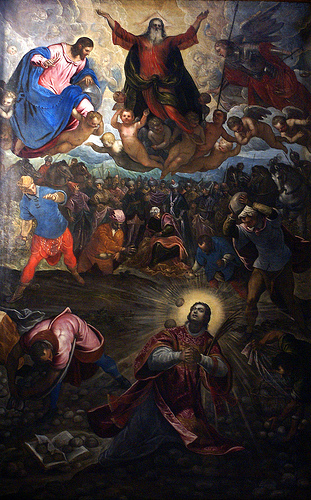
Stoning of St. Stephen, altarpiece of San Giorgio Maggiore, Venice

Paolo Uccello, Stoning of St. Stephen (1435)
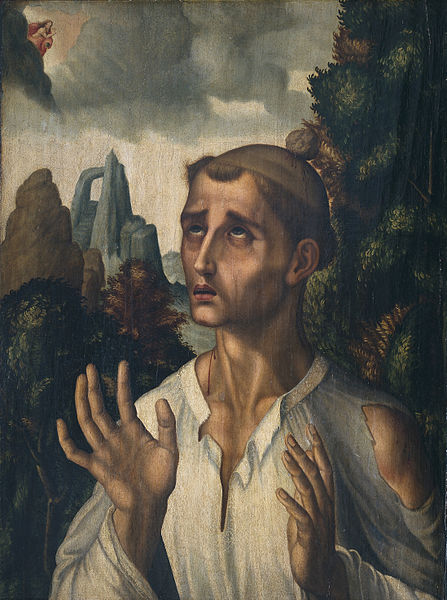
Luis de Morales, San Esteban (1575)
For the Gospel reading, like many John readings, which is more conceptual it is harder to find concrete images so here are some images that I found thought provoking:
This large piece of John’s gospel takes place in the setting of the Last Supper:
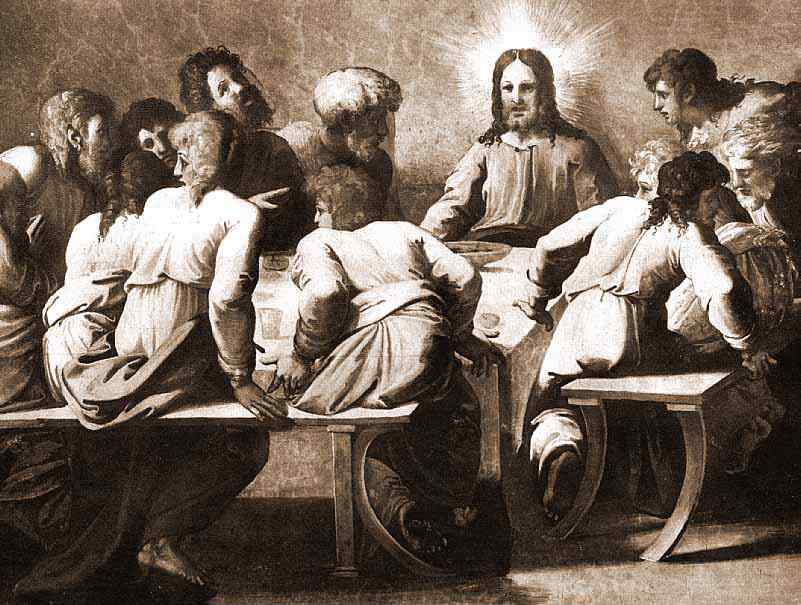
Raphael, Entretien de Jesus avec ses inteme

Heaven, by pokepetter@ deviantart.com
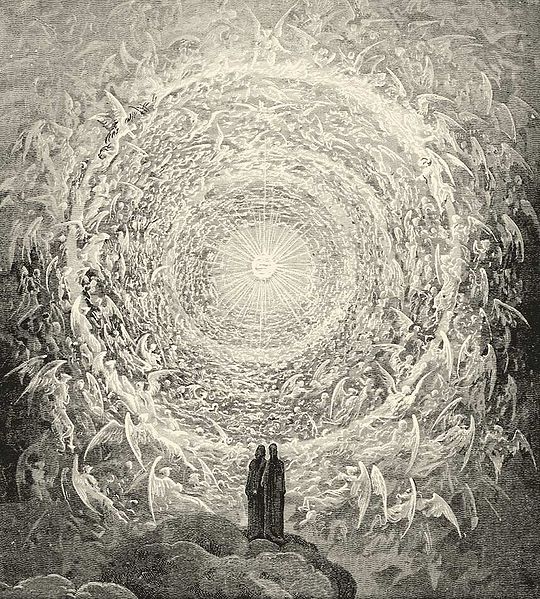
Gustave Dore, Rosa Celeste: Dante and Beatrice gaze upon the highest Heaven, The Empyrean (19th Century)
Although neither of these images directly reflect what Jesus is saying, the text is a natural connection to talk about Resurrection and Heaven.

Christ Pantokrator, 6th Century encaustic icon from St. Catherine’s Monastery, Mount Sinai
The iconography of this piece is designed to reflect the dual nature of Christ

James Tissot, The Address to Saint Philip (1886-1894)
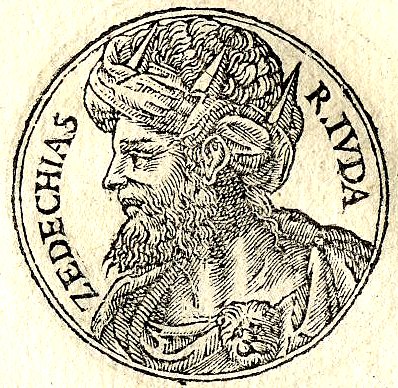
Zedekiah, last King of Judah before the destruction of the kingdom by Babylon, “Promptuarii Iconum Insigniorum” published by Guillaume Rouille (1518-1589)
The word that came to Jeremiah from the LORD, when King Nebuchadrezzar of Babylon and all his army and all the kingdoms of the earth and all the peoples under his dominion were fighting against Jerusalem and all its cities: 2 “Thus says the LORD, the God of Israel: Go and speak to King Zedekiah of Judah and say to him: Thus says the LORD: I am going to give this city into the hand of the king of Babylon, and he shall burn it with fire. 3 And you yourself shall not escape from his hand, but shall surely be captured and handed over to him; you shall see the king of Babylon eye to eye and speak with him face to face; and you shall go to Babylon. 4 Yet hear the word of the LORD, O King Zedekiah of Judah! Thus says the LORD concerning you: You shall not die by the sword; 5 you shall die in peace. And as spices were burned for your ancestors, the earlier kings who preceded you, so they shall burn spices for you and lament for you, saying, “Alas, lord!” For I have spoken the word, says the LORD.
6 Then the prophet Jeremiah spoke all these words to Zedekiah king of Judah, in Jerusalem, 7 when the army of the king of Babylon was fighting against Jerusalem and against all the cities of Judah that were left, Lachish and Azekah; for these were the only fortified cities of Judah that remained.
Like the previous chapters we are in the context of the invasion of Judah by Nebuchadrezzar of Babylon but unlike chapters 30-33 this is not a chapter of hope, this is focused on the immediate reality of the collapse of Judah, Jerusalem, and the Davidic dynasty. On the one hand this is a much kinder word than his predecessor Jehoiakim receives from Jeremiah, in many ways it is the exact opposite word (see Jeremiah 22: 18-19). As Rabbi Lau narrates this part of the story he sees Jeremiah looking at Zedekiah in a web far beyond his own control and that ultimately this crisis is not his fault. (Lau, 2013, p. 162) The defenses and all the alliances have failed as the fortified cities of Judah quickly fall. Zedekiah actually endures a much harsher punishment than what Jeremiah states here, and perhaps this is one final plea for Zedekiah and the forces of Jerusalem to surrender. The city will fall either way, there is no escape for Zedekiah but perhaps Jeremiah offers him one final chance for some mercy for the king and by extension the people in the face of the destruction.

Roman collared slaves-Marble relief from Smyrna (Izmir, Turkey), 200 CE
8 The word that came to Jeremiah from the LORD, after King Zedekiah had made a covenant with all the people in Jerusalem to make a proclamation of liberty to them, 9 that all should set free their Hebrew slaves, male and female, so that no one should hold another Judean in slavery. 10 And they obeyed, all the officials and all the people who had entered into the covenant that all would set free their slaves, male or female, so that they would not be enslaved again; they obeyed and set them free. 11 But afterward they turned around and took back the male and female slaves they had set free, and brought them again into subjection as slaves. 12 The word of the LORD came to Jeremiah from the LORD: 13 Thus says the LORD, the God of Israel: I myself made a covenant with your ancestors when I brought them out of the land of Egypt, out of the house of slavery, saying, 14 “Every seventh year each of you must set free any Hebrews who have been sold to you and have served you six years; you must set them free from your service.” But your ancestors did not listen to me or incline their ears to me. 15 You yourselves recently repented and did what was right in my sight by proclaiming liberty to one another, and you made a covenant before me in the house that is called by my name; 16 but then you turned around and profaned my name when each of you took back your male and female slaves, whom you had set free according to their desire, and you brought them again into subjection to be your slaves. 17 Therefore, thus says the LORD: You have not obeyed me by granting a release to your neighbors and friends; I am going to grant a release to you, says the LORD– a release to the sword, to pestilence, and to famine. I will make you a horror to all the kingdoms of the earth. 18 And those who transgressed my covenant and did not keep the terms of the covenant that they made before me, I will make like the calf when they cut it in two and passed between its parts: 19 the officials of Judah, the officials of Jerusalem, the eunuchs, the priests, and all the people of the land who passed between the parts of the calf 20 shall be handed over to their enemies and to those who seek their lives. Their corpses shall become food for the birds of the air and the wild animals of the earth. 21 And as for King Zedekiah of Judah and his officials, I will hand them over to their enemies and to those who seek their lives, to the army of the king of Babylon, which has withdrawn from you. 22 I am going to command, says the LORD, and will bring them back to this city; and they will fight against it, and take it, and burn it with fire. The towns of Judah I will make a desolation without inhabitant.
This event gives a window into some of the competing ideals that are at work in the time of Jeremiah. Slavery in this time was an economic arrangement where a person no longer able to pay their debts would become a slave to the debt holder. Leviticus 25: 10 (also Isaiah 61:1 and Ezekiel 46: 17 refer to this idea) places a limit on this time of servitude requires the release of lands and bonded servants and Deuteronomy 15 also talks about this regular practice of the remission of debts and the freeing of those under those debts and indentured slavery. In a time of military and political crisis the people fall back on to this practice under the leadership of Zedekiah. The cut a covenant with God, set those in slavery free. In the context of the invasion this is also the point where the approaching Babylonian armies have to turn aside to deal with an approaching Egyptian army. Quickly, once the threat of the approaching Babylonian army turns aside economic concerns begin to dominate again and the people recently freed are returned to their positions of servitude. Perhaps the people are beginning to mock Jeremiah’s words and believe that they have averted yet another crisis: the city and the temple and the Davidic king are all the guarantee they need rather than living out the covenant they have made with their God. The Lord is furious with this turnaround, this is one additional illustration of the unfaithfulness of the people to the covenant that they made with the Lord. The Lord’s words refer to the action of cutting a covenant, similar to the action narrated in Genesis 15 between God and Abraham, where the action of cutting apart an animal and passing through the center is used to mark the cutting of the covenant and also to symbolize the consequences of breaking that covenant. Now the people who have broken this covenant will become a corpse like the calf and be left for the wild animals. They were a people who could have been a blessing but they in their turning away have become a curse. The army of Babylon will not stay away, they will come and burn, kill and destroy.
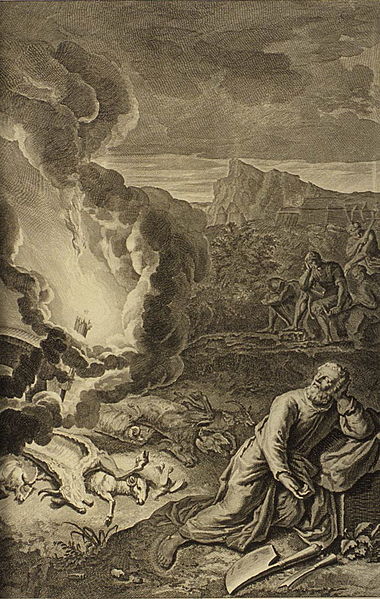
A Deep Sleep Came Upon Abraham and a Horror Siezed Him, as in Genesis 15: 12 from 1728 Figures de la Bible illustrated by Gerard Hoet (1648-1733)

Neil White, 2014

Folded Dreams by PORG at Deviantart.com
Readings: Acts 2: 42-47, Psalm 23, 1 Peter 2: 19-25 and John 10: 1-10. Frequently called ‘Good Shepherd’ Sunday since the gospel reading for the Fourth Sunday always comes from John 10 which is all images surrounding Jesus being the Good Shepherd paired with Psalm 23.
I think the Acts 2 reading about the life of the earliest church is worth paying attention to as well so a couple images that remind me of this reading about the earliest followers devoting themselves to the apostle’s teaching with breaking of bread and prayer and holding all things in common.
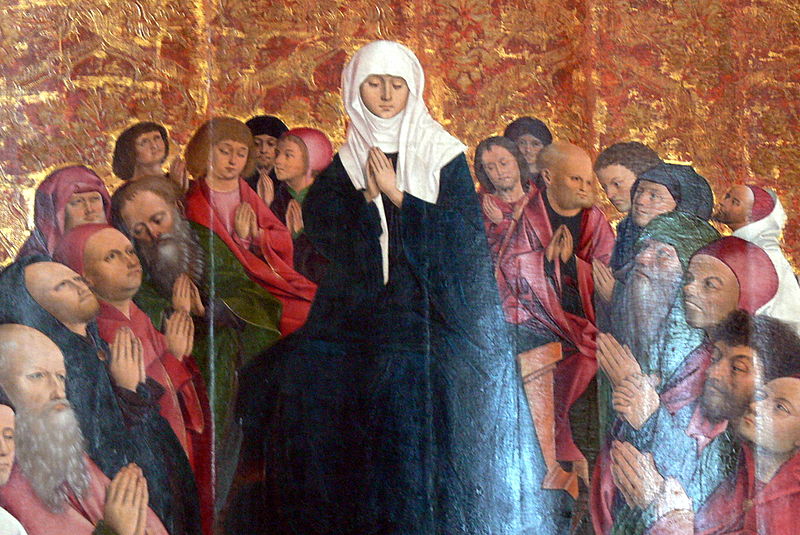
Virgin Mary at Pentecost in Our Lady Church, Grossgmain (Salzburg)
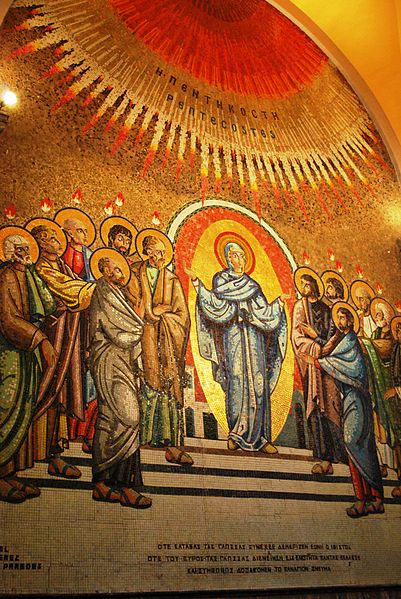
Mosaic Mural of Pentecost by Manuel Perez Paredes in Nuestro Senor del Veneno Temple, Mexico City
Now on to Good Shepherd Images:

Icon of the Good Shepherd
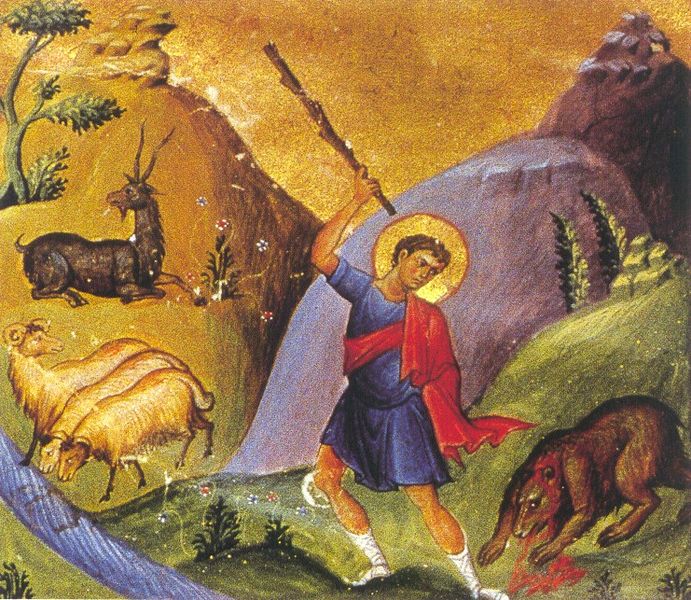
This is an image of David, but paired with the image of the gate (which is about protection) I think it makes sense. From Life of David, Psalter of Basil II, late 10th Century, Constantinople

Mosaic, Le Bon Pasteur, Ravenne Mausolee
 Sometimes I look back upon the paths I have taken and wonder about the paths turned aside
The possibilities, the different journeys and relationships and adventures
Each one full of its own love and pain, dreams accepted and denied
In each one the person I become is different because the world in which I walk changes
Sometimes I dwell for a moment in this imaginary me surrounded by the people who walked those paths
Never knowing if the way I imagine the journey down the untaken path reflect reality
Yet, I can’t help but wonder who I might have been
Not that I regret the path I have taken or the person I have been shaped to be
For in the crucible of the journey I have been on has shaped me to be the man I am
I don’t regret the lessons learned by the willingness to love and to lose
Nor do I regret the experiences learned by moving from place to place
Meeting so many new people, learning so many new towns
Yet, sometimes I think back on the friendships that were just beginning to grow
When yet again I was transplanted to some new soil to take root.
Perhaps it is the reflective nature of a poet’s soul to look upon the past and wonder
To imagine different possibilities and unseen futures
And as I look back on so many of the paths I may have never used those eyes to see any other world
And sometimes I wonder how much choice I had as I moved along the paths
Or how much was preordained and how many alternate paths were really choices
Would the man I was then have ever made any decision differently even knowing the pitfalls ahead?
Or would I have steadfastly held fast to the path that would have led me to where I stand today?
Neil White, 2014
Sometimes I look back upon the paths I have taken and wonder about the paths turned aside
The possibilities, the different journeys and relationships and adventures
Each one full of its own love and pain, dreams accepted and denied
In each one the person I become is different because the world in which I walk changes
Sometimes I dwell for a moment in this imaginary me surrounded by the people who walked those paths
Never knowing if the way I imagine the journey down the untaken path reflect reality
Yet, I can’t help but wonder who I might have been
Not that I regret the path I have taken or the person I have been shaped to be
For in the crucible of the journey I have been on has shaped me to be the man I am
I don’t regret the lessons learned by the willingness to love and to lose
Nor do I regret the experiences learned by moving from place to place
Meeting so many new people, learning so many new towns
Yet, sometimes I think back on the friendships that were just beginning to grow
When yet again I was transplanted to some new soil to take root.
Perhaps it is the reflective nature of a poet’s soul to look upon the past and wonder
To imagine different possibilities and unseen futures
And as I look back on so many of the paths I may have never used those eyes to see any other world
And sometimes I wonder how much choice I had as I moved along the paths
Or how much was preordained and how many alternate paths were really choices
Would the man I was then have ever made any decision differently even knowing the pitfalls ahead?
Or would I have steadfastly held fast to the path that would have led me to where I stand today?
Neil White, 2014

Out of the darkness and destruction comes a new beginning and a new light. Jeremiah is still in prison and the armies of Babylon surround the city. The deepest depths have not been reached yet, but in the midst of the darkness we continue to have the message of hope and reversals emerge. Finally the expected invasion from the previous 30 chapters has come, the devastation places the people into a place where they feel they have no future, no hope, no God they can turn to, and in this time life comes to a standstill. Men and women no longer marry, celebrations stop and those who remain are merely trying to survive. But the prophet now sees the long-expected judgment in the horizon of hope. That the death and destruction are not ultimate, that God’s steadfast love endures forever even as the judgment only lasts for a season. The people will be cleansed and made knew, the city becomes again a source of joy for God rather than a place that evokes God’s wrath. Where joy and mirth are absent, the time will come when they re-emerge. The land, one of the central symbols of identity for the people is again to be restored to the people as they in the future will regain their identity.

Model of the Second Temple at the time of Jesus
The theme of reversals continues as the agricultural losses of the invasion of Babylon are regained as they see the flocks again counted. In one of the better known pieces of Jeremiah to Christians because this portion is often read as a prefiguring of the Christ, it also stands as a promise to the people of Judah that the line of Davidic kings which seems to have failed. The priesthood which now has lost its place without the temple will also be restored and the traditional places of Levi and Judah will be restored. The one guaranteeing the continued line of kings and place for the priests is the Lord who states again that only if the basic orders of creation can be reversed will his promises come to an end. The exile in Babylon is not the ultimate reality, God will not forget God’s people.
Readings: Acts 2: 14a, 36-41, Psalm 116, 1 Peter 1: 17-23, and Luke 24: 13-35
The Luke reading is the ‘Walk to Emmaus’ text which is very familiar and very well represented in art. Here are some selections:

James Tissot, The Pilgrims of Emmaus on the Road (1886-1894)

Journey to Emmaus on the Cloister Monastery of Santo Domingo de Silos, Burgos, Castille-Leon Spain

Rousselin, Les pelerins d’ Emmaus, 19th Century
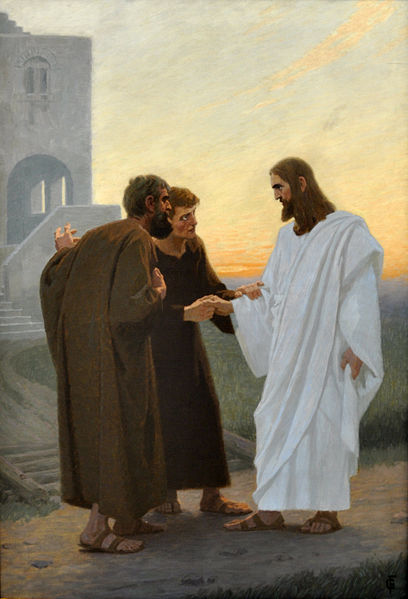
Gebhard Fugel, Jesus und der Gang nach Emmaus, turn of the 20th century, copyright holder released to public domain
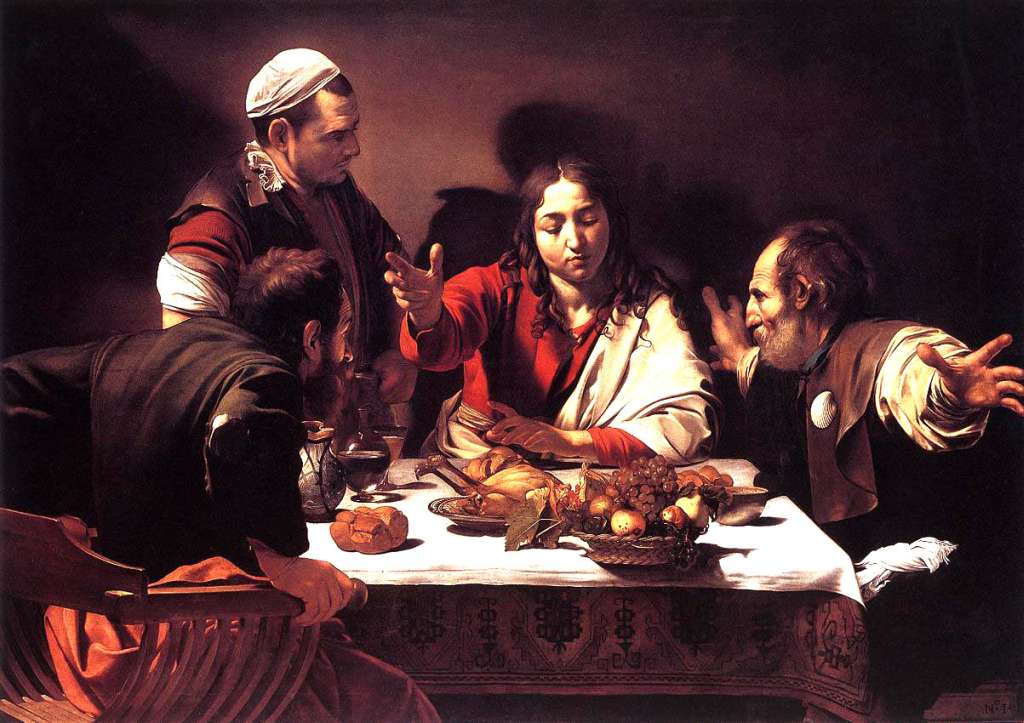
Caravaggio, Supper at Emmaus (1601-02)
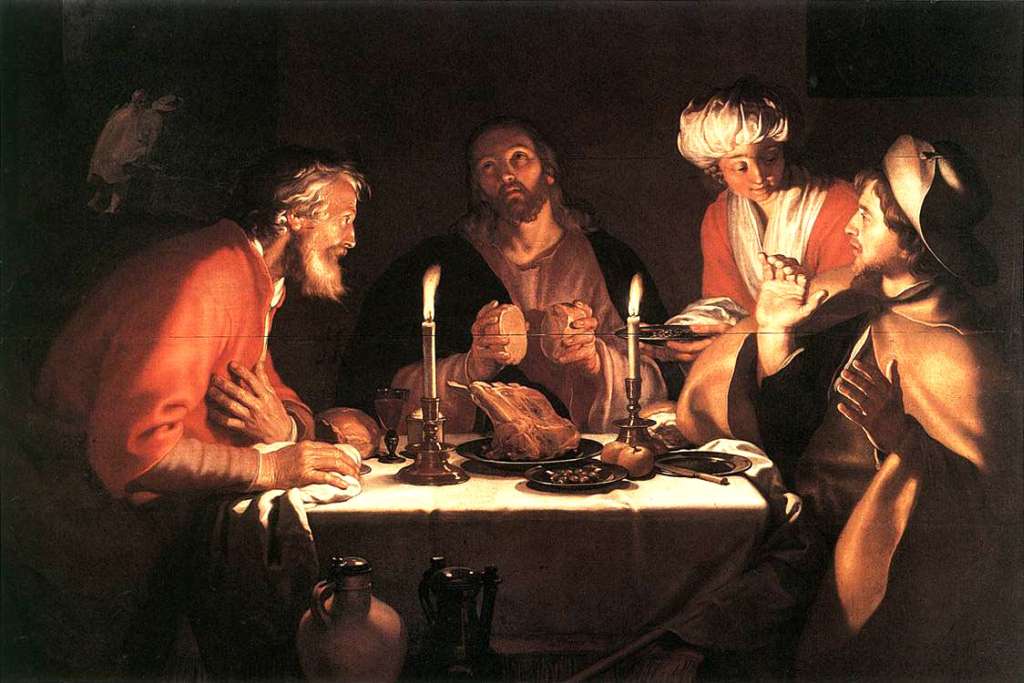
Bloemart, the Emmaus Disciples, 1622
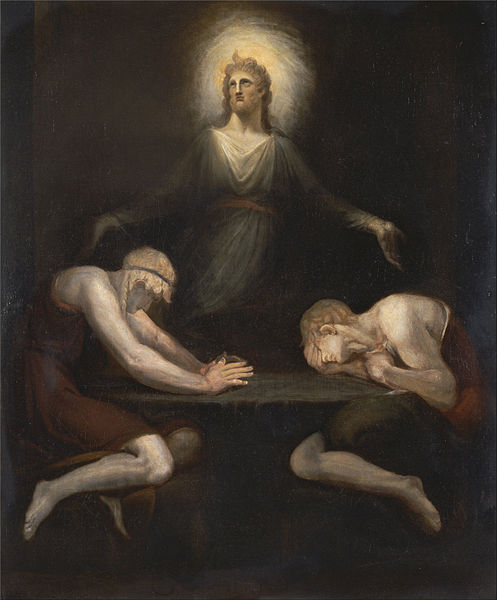
Henry Fuseli, Christ Disappearing at Emmaus (1792)Gebhard Fu


