Moses Speaks To His People at Moab, Charles Mosley, 1747
Deuteronomy 1: 1-8 Retelling the Story
These are the words that Moses spoke to all Israel beyond the Jordan– in the wilderness, on the plain opposite Suph, between Paran and Tophel, Laban, Hazeroth, and Di-zahab. 2 (By the way of Mount Seir it takes eleven days to reach Kadesh-barnea from Horeb.) 3 In the fortieth year, on the first day of the eleventh month, Moses spoke to the Israelites just as the LORD had commanded him to speak to them. 4 This was after he had defeated King Sihon of the Amorites, who reigned in Heshbon, and King Og of Bashan, who reigned in Ashtaroth and in Edrei. 5 Beyond the Jordan in the land of Moab, Moses undertook to expound this law as follows:
6 The LORD our God spoke to us at Horeb, saying, “You have stayed long enough at this mountain. 7 Resume your journey, and go into the hill country of the Amorites as well as into the neighboring regions– the Arabah, the hill country, the Shephelah, the Negeb, and the seacoast– the land of the Canaanites and the Lebanon, as far as the great river, the river Euphrates. 8 See, I have set the land before you; go in and take possession of the land that I swore to your ancestors, to Abraham, to Isaac, and to Jacob, to give to them and to their descendants after them.”
I was sitting with some of my colleagues earlier this week when someone asked, “Why do you write on things that can be gloomy or less interesting, you spent over a year going through Jeremiah and now you are going to do Deuteronomy. You are about to get married, why not write on something like Song of Solomon.” And my answer was simply I think there is wisdom in going back to these books that as Christians we don’t spend a lot of time in, that rarely appear, for example, in the Revised Common Lectionary, and that those who do spend time with them do it from a moralistic perspective and may be selectively choosing parts that fit their idea of what is important. I also think there is a need for understanding the God of covenant which is the background for the stories of the gospels and the New Testament as a whole. As a person who understands God primarily as a gracious and loving God I also need to be able to wrestle with the multiple pictures of God that are painted by the numerous authors of scripture. I think it is also important to walk with the God who is present in these stories because it is too easy for us as modern people to reduce God to ideas, God is love or God is the unmoved mover, or God is omnipotent, omnipresent, all knowing, etc. I think without continually going back to the narratives that we have we run the risk of falling quickly into H. Richard Niebuhr’s statements about American Christianity, “A God without wrath brought men without sin into a kingdom without judgment through the ministrations of Christ without a cross.” (Niebuhr, 1988, p. 193) I could easily write on the gospels or Paul’s letters but I also spend time here because it is a part of scripture I don’t know well and I trust that although it may not be the easiest place to engage the story of God, it remains important.
Also for our Jewish ancestors Deuteronomy is at the very heart of their understanding of God, one of the five books of the Torah, and in many ways a distillation of the books of Exodus, Leviticus and Numbers. It is a book which contains the central Jewish command, the Shema, which we will see in chapter 6. Going into the book of Deuteronomy requires me to step into another perspective and another time, and perhaps I like the Psalmist can learn to meditate on this ‘second law’ and find delight. As Psalm 1 states “but their delight is in the law of the LORD, and on his law they meditate day and night.” (Psalm 1.2) The word Deuteronomy comes from a mistranslation and the name literally means second law, and it is a second telling of the story and a highlighting of certain key portions of the law. The narrator of Deuteronomy places these words in the mouth of Moses as the people is almost ready to finally enter the promised land after their generation long sojourn in the wilderness. It is the end of Moses journey and the passing of the torch from Moses who led them out of Egypt to Joshua and the new generation who will move into the promise land.
Deuteronomy is not a neutral retelling of history, nor is any of scripture, but it is told in a way to make certain things clear. It is a book that talks about the faithful covenant God who has journeyed with the people from Egypt and will continue to journey with the people. It expounds and interprets history through the lens of God’s covenant faithfulness. Deuteronomy begins by telling the story of God and interpreting the people’s identity in light of that story. Deuteronomy narrates Israel’s identity at this crucial moment as they stand at the transition between sojourners and residents of the promised land, a generation ago they understood themselves as slaves in Egypt and that identity does not easily pass away, but now they are the chosen people called to live in a covenant with the God of Abraham and Isaac and Jacob. It is an identity that they have failed to live into in the past and it is an identity that they will not easily shoulder in the future but for Deuteronomy their lives and future are at stake as they place the people there in the valley hearing Moses tell about their past so that they may live into their present identity.
Deuteronomy 1: 9-18
9 At that time I said to you, “I am unable by myself to bear you. 10 The LORD your God has multiplied you, so that today you are as numerous as the stars of heaven. 11 May the LORD, the God of your ancestors, increase you a thousand times more and bless you, as he has promised you! 12 But how can I bear the heavy burden of your disputes all by myself? 13 Choose for each of your tribes individuals who are wise, discerning, and reputable to be your leaders.” 14 You answered me, “The plan you have proposed is a good one.” 15 So I took the leaders of your tribes, wise and reputable individuals, and installed them as leaders over you, commanders of thousands, commanders of hundreds, commanders of fifties, commanders of tens, and officials, throughout your tribes. 16 I charged your judges at that time: “Give the members of your community a fair hearing, and judge rightly between one person and another, whether citizen or resident alien. 17 You must not be partial in judging: hear out the small and the great alike; you shall not be intimidated by anyone, for the judgment is God’s. Any case that is too hard for you, bring to me, and I will hear it.” 18 So I charged you at that time with all the things that you should do.
Moses is characterized as the type of leader who takes everything on his shoulders and the people follow, but this type of leadership not only burns out the leader dealing with every issue that comes up but it also prevents the people from taking ownership for their own calling. Now in the ancient world where most people were not literate and relied on kings, priests, and judges to be not only the interpreters but the readers of the law it was crucial to have people entrusted to this. This may refer back to both Exodus 18 and Numbers 11 which refer to two separate events, but the character of Moses in the retelling is interesting. In Exodus 18 it is Jethro, Moses’ father-in-law, who sees Moses spending all his time adjudicating minor manners and says to him, “What you are doing is not good. You will surely wear yourself out, both you and these people with you. For the task is too heavy for you and you cannot do it alone.”(Exodus 11.18) and so it is at his father-in-laws urging that Moses appoints judges. In Numbers 11 the people are complaining and Moses reaches his breaking point saying, “Why have you treated your servant so badly?…I am not able to carry all this people alone, for they are too heavy for me.” (Numbers 11.11, 14) Now it is Moses who appeals to God from exhaustion, frustration and in desperation looking for assistance and God provides a portion of the spirit that is on Moses and give it to these seventy elders. In Deuteronomy Moses is the wise and trusted leader and Moses comes up with the idea and the people respond, “the plan you have proposed is a good one.” The story perhaps begins with the appointing of judges because of the critical nature having good judges will play in the story as it goes forward. Living justly requires a set of good and competent judges and a strong and impartial legal system which cares for the poor and the rich, the citizen and the immigrant is critical to living out their identity as the people of God.
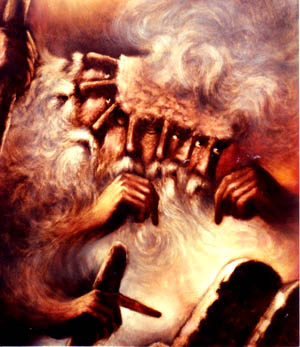
Moses by Victorvictori, permission granted by author through WikiCommons
Deuteronomy 1: 19-33
19 Then, just as the LORD our God had ordered us, we set out from Horeb and went through all that great and terrible wilderness that you saw, on the way to the hill country of the Amorites, until we reached Kadesh-barnea. 20 I said to you, “You have reached the hill country of the Amorites, which the LORD our God is giving us. 21 See, the LORD your God has given the land to you; go up, take possession, as the LORD, the God of your ancestors, has promised you; do not fear or be dismayed.”
22 All of you came to me and said, “Let us send men ahead of us to explore the land for us and bring back a report to us regarding the route by which we should go up and the cities we will come to.” 23 The plan seemed good to me, and I selected twelve of you, one from each tribe. 24 They set out and went up into the hill country, and when they reached the Valley of Eshcol they spied it out 25 and gathered some of the land’s produce, which they brought down to us. They brought back a report to us, and said, “It is a good land that the LORD our God is giving us.”
26 But you were unwilling to go up. You rebelled against the command of the LORD your God; 27 you grumbled in your tents and said, “It is because the LORD hates us that he has brought us out of the land of Egypt, to hand us over to the Amorites to destroy us. 28 Where are we headed? Our kindred have made our hearts melt by reporting, ‘The people are stronger and taller than we; the cities are large and fortified up to heaven! We actually saw there the offspring of the Anakim!'” 29 I said to you, “Have no dread or fear of them. 30 The LORD your God, who goes before you, is the one who will fight for you, just as he did for you in Egypt before your very eyes, 31 and in the wilderness, where you saw how the LORD your God carried you, just as one carries a child, all the way that you traveled until you reached this place. 32 But in spite of this, you have no trust in the LORD your God, 33 who goes before you on the way to seek out a place for you to camp, in fire by night, and in the cloud by day, to show you the route you should take.”
There is no identity without knowing one’s story. The book of Deuteronomy narrates again the story of the people at the edge of the promised land a generation ago in order to construct a different identity in this new generation. They are the children of those who did not trust the LORD at this crucial moment in the story and they have the opportunity to act differently than their ancestors. They are the children of the people who God, “who carried you, just as one carries a child” but still had not learned to trust in the God who journeyed with them. Perhaps learning to trust in the LORD who we don’t always see is one of the hardest things to learn, and even though I think Luther is correct to interpret the first commandment, “We are to fear, love and trust God above all things” (Luther, 1994) It is more difficult to live that ideal out in the realities of life and conflict. Moses can see and interpret reality to the people, that the LORD has given them possession of the land and that it is a good and prosperous land but people will always see the giants and the walled cities.
One thing I noticed about this is that there is a changed dynamic. In the previous section Moses made the suggestion about the judges and the people felt it was a good idea, but here the people make the suggestion of exploring the land and Moses felt the plan sounded good. Perhaps, without reading too much into this, this is one of the dangers that leaders face. Knowing when to listen to the people they lead and knowing when to stick with their own plan. The time of scouting out the land allows many of the doubts to return. The murmurs of the journey through the wilderness return. The people continue to misunderstand who the LORD is and the way they are to relate to this God who has led them or their journey. The people see the LORD’s absence while Moses sees the LORD’s presence and continually calls the people to trust in the LORD who has been present throughout the journey.
Deuteronomy 1: 34-45
34 When the LORD heard your words, he was wrathful and swore: 35 “Not one of these– not one of this evil generation– shall see the good land that I swore to give to your ancestors, 36 except Caleb son of Jephunneh. He shall see it, and to him and to his descendants I will give the land on which he set foot, because of his complete fidelity to the LORD.” 37 Even with me the LORD was angry on your account, saying, “You also shall not enter there. 38 Joshua son of Nun, your assistant, shall enter there; encourage him, for he is the one who will secure Israel’s possession of it. 39 And as for your little ones, who you thought would become booty, your children, who today do not yet know right from wrong, they shall enter there; to them I will give it, and they shall take possession of it. 40 But as for you, journey back into the wilderness, in the direction of the Red Sea.”
41 You answered me, “We have sinned against the LORD! We are ready to go up and fight, just as the LORD our God commanded us.” So all of you strapped on your battle gear, and thought it easy to go up into the hill country. 42 The LORD said to me, “Say to them, ‘Do not go up and do not fight, for I am not in the midst of you; otherwise you will be defeated by your enemies.'” 43 Although I told you, you would not listen. You rebelled against the command of the LORD and presumptuously went up into the hill country. 44 The Amorites who lived in that hill country then came out against you and chased you as bees do. They beat you down in Seir as far as Hormah. 45 When you returned and wept before the LORD, the LORD would neither heed your voice nor pay you any attention.
46 After you had stayed at Kadesh as many days as you did,
Can we learn from our past or are we somehow destined to repeat it? One of the things that the prophets of Israel will do over and over again is to take these central stories, like the story of the exodus and recast them to be heard again in their day. The will use the stories of the past to tell the people of their time the cost of their disobedience to their covenant with God. The God of the Bible does get angry, does show emotions, is become wounded by the disobedience of the chosen people. This time when Israel refuses to hear the word of the LORD leads to the LORD being unwilling to hear them. This is one of those times where the people missed their window of opportunity, and the LORD through Moses (even in the midst of God’s anger) tells Moses to warn the people not to go up, but the people strap on their equipment and proceed to walk into their own defeat.
This disobedience has consequences not only for the people but for Moses. The narrative places the blame for Moses’ inability to reach the promised land at the feet of the people. Their disobedience not only brings anger on themselves but on Moses, and even though Moses has stood in the gap between the people and God, now Moses finds himself caught between the people and the LORD.
One of things this makes me ponder is the God who refuses to hear. We often act as if God hears every prayer regardless of how we interact with the world God has made, and there may be some truth in this, but there is also truth in the view of the Deuteronomist where our actions and our lives matter to God. The LORD presented by Deuteronomy does care about the lives of the people who are supposed to represent God in the world. Yet there is a hope, it is not an immediate or cheap hope. God will not stay angry forever, there will be a time when God listens to the people again. It may be a generation later when the sons and daughters who grow up in the wilderness now are adults ready to enter the promise land but ultimately, for Deuteronomy, God will uphold God’s part of the covenant but not on a human timeline.
Perhaps in a later time, when all the books scholars like to label the Deuteronomic History (Deuteronomy, Joshua, Judges, 1&2 Samuel and 1&2 Kings) are brought together the people are looking back on their history trying to make sense of their world. They are trying to bring order to the chaos of living in the midst of the exile in Babylon. As they look back over their story they find meaning in who they are called to be and how they are called to live. Even without the land or the temple or a king they are still the people of the covenant and perhaps in this time of disobedience where a generation is lost in the wilderness they can find hope in their own lost generation in exile.