Tag Archives: Work

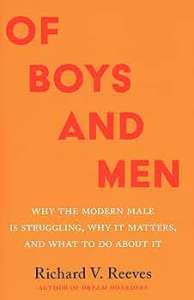
Reflection of Of Boys and Men by Richard V. Reeves

Reflections on Of Boys and Men: Why the Modern Male is Struggling. Why it Matters, and What to do about It. By Richard V. Reeves.

This is a part of a selection of readings I gathered to reflect on what a healthy approach to masculine identity would look like. I navigated my own journey into a version of manhood in my late teens and early twenties successfully, but now in middle age I see a lot of young men struggling to navigate this journey and for a variety of reasons failing to launch into life. I come to this with humility and curiosity seeking those who may be able to articulate more clearly the journeys that may lead young men to discover a fulfilling life of work and relationships and to help those moving into the space of elders to support and guide them in this journey.

Richard Reeves book Of Boys and Men was the first book that helped make sense of several intuitions I had about the way life had changed for men in relationships, in work, and in school. I initially listened to an audio version of the book in 2024 and then read and marked up a physical copy in 2025. One of the things I appreciate about Richard Reeves approach is that he continually reminds the reader that empathy is not a zero-sum game. We can be concerned about advancing equality for women and still acknowledge and address the ways men are struggling in education, relationships and the workforce and the fundamental changes in their roles in a relatively short period of time. Richard Reeves is also a person who thinks about policy and so the book not only identifies the struggles that many men face but also provides ideas for consideration in addressing the struggles.

In education at all levels men have fallen significantly behind women. Women are more likely to perform well in middle and high school, attend and graduate college, and go onto graduate level education. Part of the struggle that boys and men struggle with in education is biological. As Richard Reeves states:

Boys’ brains develop more slowly, especially during the most critical years of secondary education. When almost one in four boys (23%) is categorized as having a “developmental disability,” it is fair to wonder if it is educational institutions, rather than boys, that are not functioning properly. (8)

The lack of male educators in the school system impacts the ability of boys to learn, but it also leads to the pathologizing of normal adolescent behavior. Richard Reeves also suggests starting boys a year later in the educational progression to assist with the two to three year gap in development of key executive functions in brain activity between girls and boys, but also advocates for more male teachers, coaches, and other leadership roles within the educational system.

The workforce has fundamentally changed in recent generations and many of the jobs lost were traditionally masculine jobs that required physical strength, which has now been replaced by automation. Reeves notes that the significant effort to encourage women to be educated and work in STEM (Science, Technology, Engineering, and Mathematics) fields but the fastest growing job needs are in what Reeves labels as HEAL jobs: Healthcare, Education, Administration, and Literacy. As mentioned above he advocates for programs to encourage and fund men being trained in these HEAL jobs and notes the benefits that having men in these jobs would have for both men and women.

One of the other things I appreciated about Reeve’s attempt at balance was his willingness to criticize both the political left and right in their approach to the issue. The political right at least acknowledges that there is a problem, but their solution is to try to steer the world back to an earlier time when women were less involved in the workforce, college, and life outside the home. The political left has pathologized the problem as ‘toxic masculinity,’ viewed male problems as individual failings, been unwilling to acknowledge any biological basis for sex differences, and has been convinced that inequality can only run one way. An example of viewing the problem as individual failings would look like:

If men are depressed, it is because they won’t express their feelings. If they get sick, it is because they won’t go to the doctor. If they fail at school, it is because they lack commitment. If they die early, it is because they drink and smoke too much and eat the wrong things. For those on the political Left, then, victim-blaming is permitted when it comes to men. (109)

He also begins to reframe some of the traits that have been labelled ‘toxic’ in a more positive light. For example, the male psychology is more wired for risk, but it is also far more likely to take risks to save or protect others. He also highlights the erosion of the core institutions of work, family, and religion which guided common patterns of behavior for men and women.

I appreciate that Richard Reeves has not only provided a thoughtful approach to the problems that boys and men face but also continues to research and advocate for solutions. His work is one that several other authors are beginning to build upon and Of Boys and Men was one of the first books that attempted a balanced approach to the issues facing men. Of Boys and Men helped give me both a language to describe some of what I was seeing as well as prompting me to dig deeper and to want to know more. I found it helpful as we try to imagine a hopeful future for both men and women.

Reflections on The End of Men and the Rise of Women by Hannah Rosin

This is a part of a selection of readings I gathered to reflect on what a healthy approach to masculine identity would look like. I navigated my own journey into a version of manhood in my late teens and early twenties successfully, but now in middle age I see a lot of young men struggling to navigate this journey and for a variety of reasons failing to launch into life. I come to this with humility and curiosity seeking those who may be able to articulate more clearly the journeys that may lead young men to discover a fulfilling life of work and relationships and to help those moving into the space of elders to support and guide them in this journey.

There are some startling quotes in this book, but the one that stopped me in my tracks as we look at the future was this:

This script has played out once before in American culture. Starting in the 1970s, black men began leaving factory jobs; by 1987 only 20 percent of black men worked in manufacturing. The men who lived in the inner cities had a hard time making the switch to service jobs or getting the education needed to move into other sectors. (88)

There has been a lot of attention paid to the incarceration, unemployment, and the lack of young black men in raising children and the factors behind these men not being successful in society but when you expand the script to the plight of black men being predictive of the future of men as a whole that is bleak. I do believe that especially for men so much of their identity is tied to work and the loss of job opportunities for men without a college degree is a major factor in the failure of men in both the economy and life. Hannah Rosin’s book in 2012 was one the first one that I am aware of to notice the drastic changes occurring in the education and work space of America and she covers a wide range of impacts from the changes. From the changing dynamic of ‘hook-up culture’ in colleges, to the way the upper class still holds onto marriage as an economic advantage, the economic mobility of women and the economic stagnation of men, the drastic change in the makeup of college campuses, the increase in female violence, and the way women are breaking into the top of the job market.

I valued the combination of personal stories gained from interviews placed in the context of the seismic shift in the job and education market. As Hannah Rosin notes about the 2008-2009 Recession:

In the Great Recession, three-quarters of the 7.5 million jobs lost were lost by men. The worst-hit industries were overwhelmingly male, and deeply identified with macho: construction, manufacturing, high finance. (4)

I appreciated her candor in talking about the ‘hook-up culture’ on college campuses where women are also using it to avoid relationships which could derail their progression through college and into the workforce. Women are more educated and doing better economically in their late twenties than their male counterparts. Although college educated men and women were more likely to remain married and to ‘see-saw’ in their primary breadwinning roles, among men with only a high-school diploma the change was drastic. “In 1967, 97 percent of American men with only a high school diploma were working; in 2010, just 76 percent were.” (86) It has been common to note that this generation is not doing as well as the previous generation, but particularly for men:

In 2009, men brought home $48,000 on average, roughly the same as they did in 1969 after adjusting for inflation. In fact, as a recent report written by former White House economist Michael Greenstone discovered, the truth is even more dismal. Calling it stagnation fails to take into account the fact that fewer men are working full-time now or making any salary at all, and many more are incarcerated. If you add in those factors, the median income for men ages twenty-five to sixty-four has not only stagnated, but fallen sharply by almost $13,000 since 1969—a reduction of 28 percent. (125)

There is beginning to be an awareness of the change in the makeup of college classes, now dominated by women, but Hannah Rosin was one of the early voices who noted the vastly larger number of female applicants to college and the beginning of colleges attempting to balance the classes by giving preferential treatment to attract enough men.

What Hannah Rosin does a good job of doing is narrating the change that has occurred in society and how women have adapted while many men have failed to adapt. This is a story that need to be told, but it is also an uncomfortable story that undercuts one of the narratives I hear frequently where men are still assumed to be the ones with political and economic power. I have heard voices that refuse to believe that men are struggling, particularly from women who blazed the trail for the current generation. As Rosin states,

The closer women get to real power, the more they cling to the idea that they are powerless. To rejoice about feminist victories these days counts as betrayal. (272)

Women have made a lot of progress in my lifetime and that should be celebrated and there are still places where progress continues to be needed. Yet, we can want our young women to be successful and reach out to young men who are struggling to find a foothold in the rapidly changing geography of the job and education marketplace.

Dreams of Grandeur


Robert W. Buss, Dicken’s Dream an Unfinished Painting (1875)

The dreams of the person I could be
The image of the person my mind’s eye can see
Dreams of grandeur about things I might do
Leave me dissatisfied with that which comes true
And when my critical eye spots the smallest flaw
I become my very worst critic and harshest law
 
Yet, I’ve enough wisdom within to know
That dreams may come and dreams may go
My imagined working capacity
Doesn’t always match reality
And comparisons are rarely kind
Between lofty dreams and reality’s bind
 
Someday, perhaps I’ll dwell at peace
The most grandiose dreams I’ll release
Content with all I am able to do
The dreams and tasks I made come true
And the person within the mirror I see
Will be satisfied with the person I came to be

Ecclesiastes 4- The Things That Steal Our Peace

Ecclesiastes 4

1 Again I saw all the oppressions that are practiced under the sun. Look, the tears of the oppressed– with no one to comfort them! On the side of their oppressors there was power– with no one to comfort them. 2 And I thought the dead, who have already died, more fortunate than the living, who are still alive; 3 but better than both is the one who has not yet been, and has not seen the evil deeds that are done under the sun.

 4 Then I saw that all toil and all skill in work come from one person’s envy of another. This also is vanity and a chasing after wind.
 5 Fools fold their hands and consume their own flesh.
 6 Better is a handful with quiet than two handfuls with toil, and a chasing after wind.

 7 Again, I saw vanity under the sun: 8 the case of solitary individuals, without sons or brothers; yet there is no end to all their toil, and their eyes are never satisfied with riches. “For whom am I toiling,” they ask, “and depriving myself of pleasure?” This also is vanity and an unhappy business.

 9 Two are better than one, because they have a good reward for their toil. 10 For if they fall, one will lift up the other; but woe to one who is alone and falls and does not have another to help. 11 Again, if two lie together, they keep warm; but how can one keep warm alone? 12 And though one might prevail against another, two will withstand one. A threefold cord is not quickly broken.

 13 Better is a poor but wise youth than an old but foolish king, who will no longer take advice. 14 One can indeed come out of prison to reign, even though born poor in the kingdom. 15 I saw all the living who, moving about under the sun, follow that youth who replaced the king; 16 there was no end to all those people whom he led. Yet those who come later will not rejoice in him. Surely this also is vanity and a chasing after wind.

The Hebrew word shalom is only used in Ecclesiastes in the previous chapter in the contrast between war and shalom (peace). Yet, beneath all of the vanity and chasing after the wind is perhaps the search for this concept of shalom, which is far more than an absence of conflict. Shalom has the sense of harmony, balance, living at peace with God’s will for one’s life and world. It is a greeting and a wish for one’s friends and neighbors and for one’s own life and yet then and now it seemed illusive. Qohelet turns his wisdom to the things that rob us of the joy and shalom of how life should be. In the brief verses of chapter four he addresses in a form that moves towards proverbs the issues of oppression, comparison and competition, overwork, isolation and institutional incompetency.

Oppression robs us of our humanity, both the oppressed and the oppressor. For the oppressed it means living in a sick society where their lives and work seem to matter less than those who operate in a more privileged state. For the oppressor it often means unconsciously adopting the views of a sick society that have allowed them to prosper only at the (often unseen) expense of others. Wisdom has opened the eyes of the privileged author of Ecclesiastes and it sickens him. The reality of oppression makes death better than life for him because it is not simply that an oppression can be stated and once brought into the open it dies under the light of day. Oppression involves a lifetime of learned and observed behaviors that require patience, prayer, struggle and dis-ease if the disease is ever to be healed. Oppression can be learned in families, in economic structures and in political systems and they in their own way are demonic. They so weave their ways into the thoughts and actions of ordinary people that they become a part of us. When the demons speak through us they reveal the uglier side of our lives and the inability to see one another as a gift, but instead we begin to see others as people who are to be oppressed or are our oppressor.

In the United States there has been a long struggle among people of color, women and people who because of race, sexuality, economic status, religion (or lack of religion), manner of dress, or numerous other reasons have felt their voices and lives did not matter. While I hope that the struggles of the last several years may eventually lead to a society that moves towards greater equality, for now there is no one to console the tears of the oppressed or the comfort those in power as they deal with the ways privilege has stolen a piece of their humanity as well. Perhaps there may come a day when those who have not been born yet don’t have to wonder if black lives, to use one of the red hot points of struggle in our time, matter less than other lives. There are places where our society is sick and its disease has infected all of us making our lives less human and less worth living. The oppression has possessed the soul of our society in the way it allows us to demonize others and to not see or hear them. The conflict that oppression creates robs our lives and our society of the shalom that wisdom seeks. Ecclesiastes does not offer the cure, only the diagnosis of the thing that steals our joy and peace, both the privileged and the excluded.

Envy is what Ecclesiastes names the second element that steals our joy and peace. This seems to encompass the ways we compare and contrast ourselves with one another. One the one hand toil and skill in work come from learning from and measuring oneself from the work of others. The author of Ecclesiastes can find joy in his labor, yet it can also become a source of anxiety. If our lives are continually measured by the gifts, talents and abilities of others then we will rarely, if ever, be satisfied. Our gifts and talents are not another’s gifts and talents. There is joy in learning to do what one is able with one’s gifts and abilities, for seeking what excellence might look like with one’s talents. Yet, envy of another’s gifts can steal the joy we find in our skills and work.

In a transition it appears that Ecclesiastes pulls from some preexisting form of proverbs about laziness and overwork. There are reasonably close parallels within the book of Proverbs:

A little sleep, a little slumber, a little folding of the hands to rest, and poverty will come upon you like a robber, and want, like an armed warrior. Proverbs 24: 33-34

Do not wear yourself out to get rich, be wise enough to desist. Proverbs 23: 4

Which Amy Plantiga Pauw (Pauw, 2015, p. 162) points out as possible connections with Proverbs, but for the second I actually find Proverbs 17: 1 closer

Better a dry morsel with quiet than a house full of feasting with strife. Proverbs 17:1

Especially when one takes into account the following verse about the slave who deals wisely and the child who acts shamefully in the context of the end of chapter four.

Ecclesiastes looks at the contrast between overwork and strife on the one hand and laziness and poverty on the other. Neither pole holds the answer, the wisdom is to find the balance point in the middle. A person who only applies their wisdom and knowledge in the quest for goods, wealth, and the insatiable quest for more will have to face the injustice that others will use the goods and wealth they have acquired. Overwork leads to an inability to the enjoy the gift of joy that God grants to the worker in their toil. Idleness also leads to a different type of challenge when the person doesn’t have what they need to feel filled or fulfilled. In our society being busy is a mark of success and achievement, as if the work of business is the work of busy-ness. As Ellen Davis can highlight,

“We regard work as primary, while the rest of what we do is “time-off.” But it was the opposite in the ancient world. The Latin word for “business” is neg-otium, literally, “not leisure”; the time when one does not have to work is the norm by which other activities are measured.” (Davis, 2000, p. 191)

There is wisdom in the practice of Sabbath, the practice of resting from one’s labor and toil. There is wisdom in finding joy in one’s work and pleasure in one’s leisure and knowing the balance of both. The wisdom of not wearing oneself out to be rich, of knowing when to desist but also not folding one’s hands only to consume one’s own flesh.

Isolation can also be a source that can rob us of joy. Sharing our labor with another, being able to share in the triumphs and the travails is one of the joys of life. Isolation can take many forms in life, isolation in the home, at work, in our leisure time and in our public time. A life that is driven by competition and envy shatters our community with one another. We were built for lives of partnership in our various vocations to support, strengthen and renew one another. In a world of increasing connection through digital media we face the struggle of maintaining the physical and personal connections that once formed the communities of our ancestors. In an unfair and often unjust world we need our solidarity with one another so that together we might be a cord not easily broken by the injustices and oppression of the world.

Qohelet seems to have little faith in the institutional structures of his day to provide wise, fair and just governance and a place where a life of shalom comes naturally. We live in an age where people have also become wary of the institutional structures of government, religion, and economics. There are some who still wonder, like Jesus’ disciples, that if a rich young man cannot easily enter the kingdom of God, then who can be saved, for the wealthy and powerful were supposed to be the blessed and the wise. Too many times we have seen the wealthy act only out of self-interest, the powerful act foolishly, and those supposed to be righteous commit horrible acts. Wisdom still has its place, even without power or wealth or fame, to navigate the way of the world. In the midst of oppression to find those moments of peace and the solidarity of one another. From the blindness of being the oppressor to cherish those moments, as difficult as they may be, when one’s eyes are opened and we can perhaps see a different future. Wisdom finds the balance between idleness and overwork and can find satisfaction in one’s own abilities and accomplishments. Like all things of shalom, they are transient. The seasons continue to turn and times of conflict do arise. The quest for permanence, security, and a lasting name ultimately give way to mortality and the turning of the seasons. These evanescent moments may not last for long but they are the gift of God that gives meaning to the toil and the struggle.

Uninspired- A Playful Poem

I want to be productive and there is plenty I could do
It’s just that I don’t have the drive to start on something new
It’s not that I feel bad or sad or depressed or anything like that
But everything for this week is done and my inspiration is flat
The week’s tasks are through and my mind it wants to play
And yet the weekends is not here yet and so I try to work away
Perhaps the poem is a waste of time, perhaps a little fun
But nothing else is getting done until its path has run
I sure my inspiration will be back and perhaps sometime soon
Perhaps it only needs a little break and will be back this afternoon
Or perhaps it took a holiday, a little flight to sea
Wherever it went, the trip it took, I wish it would take me

 Neil White, 2015

Clocks by Azoz7 on Deviantart.com

Clocks by Azoz7 on Deviantart.com

Snow Day    

Snow day

The snow and the ice bring the wheels of civilization creaking to a halt
And for a day the factories and the machines enjoy a Sabbath
Yet, I in my imagined self-importance somehow feel propelled
To continue to work while others rest, to labor while others play
To allow that the snow and the ice afford an opportunity for others
Except me, that somehow I convince myself that there is no day of rest

And perhaps there is wisdom that one can only enter the mystery of the kingdom
If one can approach it as a child, one who can learn again to play where others see obstruction
To learn to delight in the world as it is and not to continually try to bend it to one’s will
Perhaps on these days where the roads are empty and sidewalks covered
We can learn again to rest and play, to restore and renew
And perhaps for myself somehow I can convince myself that there is a day of rest

Neil White, 2015

Gracefully Unfair

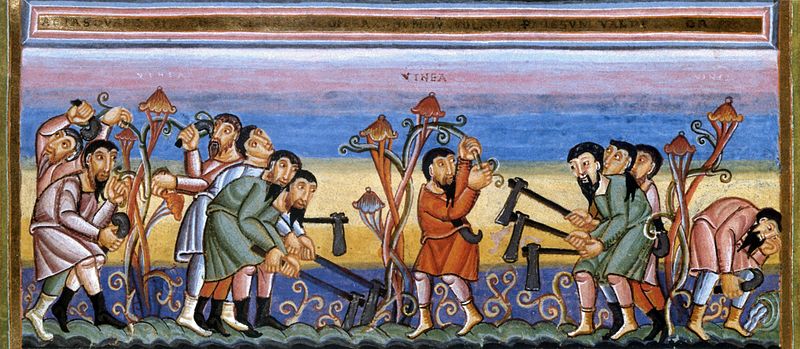
The Parable of the Workers in the Vineyard, Codex Aureus Epternacensis, 11th Century

The Parable of the Workers in the Vineyard, Codex Aureus Epternacensis, 11th Century

It’s not fair, this may be what I signed up for but it’s not fair
That in this crazy mixed up world of grace the last are first and the first last
Where a person can work from sunup to sundown laboring in the vineyard
Bearing the brutal rays of the sun beating down upon their backs
Getting up early to be the early bird that gets called out into the fields
Being the ant who works all day every day unlike those others
Those others who might look different, party different, act different, smell different
So that they get left behind among the other laborers, for it is about my skills
The sweat of my brow, the skill of my hands, the pain in my back from the harvest
And yet others work less, coming in later, leaving earlier, getting the same recompense
In a world of continually increasing worker productivity and efficiency
What is this inefficient master doing in the distribution of grace
Don’t I deserve more for my labor, for my conscientious and diligent striving
For I could manage the field better than this crazy master and the world would know no rest
For everyone would work as hard as I do or they would never work at all.
Yet maybe in this crazy and gracious world a new and strange master emerges
One who challenges the lords of commerce and time or wage and resource
One who sees the people left behind in the world of competition
Those in the market at 9 o’clock and noon and even at 3 or 5 o’clock
Those who no one sees or cares about, those who no one will hire
Those who wait all day in the hope that they too might enter into the fields
Perhaps in this crazy mixed up world of grace they are seen and valued and fed
They receive the same in some injustly and unfairly gracious manner
And why does my heart grow angry against those for whom the master’s heart breaks
Neil White, 2014

The Father’s We Seek

Saint Joseph the Carpenter, Georges de La Tour (1640)

Saint Joseph the Carpenter, Georges de La Tour (1640)

On Mother’s Day I wrote about women being more than mothers, and on Father’s Day I’m going to take a different angle because I think men struggle with a different issue and that is in society they are at best fathers only after they are whatever other role they have. To understand why this is I’m going to approach the male concept of shame, which is different than shame for women. For women shame comes from the inability to fit into the expectations of perfection defined first by looks and second by motherhood. Shame for women comes from how others view you and how you view yourself. Shame for men comes from being perceived as being weak or a failure. For men the societal expectations are: emotional control, primacy of work, pursuit of status and finally violence (the ability to take or protect that which is yours). Yet in relationships men are expected to put these things aside and be vulnerable, to share in the nurturing of children, to show restraint (it is very easy for a man to injure a child just due to the strength differential and the preponderance of rough play that is sought from fathers by boys and girls alike), and to enter into a world that is still defined by women’s expectations in the home. Just as women have struggled with the predominantly male expectations of the world of work, men have struggled with the very different set of expectations within the home.

Just as there was a time when a woman’s worth was tied to her ability to bear children, a man’s worth is still tied to his ability to provide security in terms of protection, shelter, food and comfort. Men are still primarily viewed as producers in society, and some of this is reflected in the way that employers view men taking time off for their family’s needs. Men do not give birth, but frequently they are expected to be back on the job within days of their wife or significant other giving birth. Men are looked upon as not having their work priorities straight if they take time off to be with a sick loved one, and this also  can extend to women as well-but the societal expectations are not as strong (although the expectations of perfection that women in the workplace put on themselves may be).

Mother’s Day and Father’s Day are important and should be celebrated, but I get the impression that of the two holidays Father’s Day is viewed as the lesser of the two. Perhaps this is because for men fatherhood is a secondary identity, second to their ‘real’ identity in the world of work. In the past couple generations while the role of men as fathers has changed the expectations in the working world have not decreased, nor has their compensation increased and like women they find themselves trying to live well between the worlds of word and home. As the workplace is learning to value women for who they are and the gifts they bring (and I understand that there is still a lot of work that needs to be done here), so in the world of the home as men become an increasing part of the world at home it will mean that the expectations in this world will need to begin to shift as well to be able to account for the gifts that men and women can bring.

I know I am leaving the issue of single parenthood unaddressed, which I definitely sympathize with being a single dad, but on Father’s Day I hope I was able to help us think about how we might help our young men be the fathers we hope they will be.

purple rose 01 by picsofflowers.blogspot.com