Tag Archives: Torah

Psalm 119 An Artistic Articulation of Life Under the Law

The Hebrew Alphabet. Hebrew reads right to left so it begins with Aleph and ends with Tet

Psalm 119

Introduction to Psalm 119

I’m going to modify my normal pattern of having the text first and then a reflection due to the length of Psalm 119 which is longer than several biblical books. Many readers find Psalm 119, “boring, repetitious, and without plot development.” (Bellinger, 2014, p. 519) Translations of this psalm lose the key organizational feature of Psalm 119 which its acrostic organization and that in combination with the length of the psalm makes it difficult for many readers to fully appreciate. Also hindering the hearing of this psalm dedicated to a “Torah piety” or “law piety” is a lingering stigma of legalism associated with Judaism. Yet, what this psalm advocates for in its language and organization is a joyful way of life organized around God’s guidance to God’s people.

I have spent far more time in Hebrew acrostic poetry in the past year than the average person spends in a lifetime having worked through Lamentations, Psalm 111, 112, and now 119 this year. Psalm 119 is the acrostic of acrostics intensifying the form to have eight lines begin with each letter of the Hebrew alphabet (from Aleph to Tav) for a total of 176 verses. The acrostic form is a way of indicating a complete poetic treatment of a topic, and the intensification of this psalm of an eight-fold acrostic is designed to convey a complete treatment of a life faithfully and joyfully lived in relation to God through the law. In addition to the eight-fold repetition of a common letter to start each group of lines are the eight synonyms for the law utilized throughout the poem: law, decrees (or statutes), ordinances, statutes, word, precepts, and promises. One of these synonyms occurs in every verse except verses 3, 37, 90 and 122. In the 176 verses there are five verses where two synonyms occur compared to the four where none occur. The repetition is intentional to reinforce the central position of the law in the relationship between God and the people.

Psalm 119 begins with the Hebrew asre (‘happy’ NRSV) which is a common word in wisdom literature, just as the acrostic is a common wisdom literature form. Psalm 1 and Psalm 19 are the other two psalms primarily associated with a ‘Torah piety’ and both psalms share both vocabulary as well as a common vision of what a wise life consists of. The similarities between Psalm 1 and Psalm 119, some of which will be noted below, were strong enough that Claus Westermann could suggest that they once formed the beginning and end of the psalter. (Bellinger, 2014, p. 520)

For the reflections below I will take each eight-verse portion of the acrostic as a unit for reflection. On the one hand the psalm is designed to be viewed as an entire unit held together by its acrostic organization and focal vocabulary. On the other hand, the psalm is daunting for its length, and I will follow the habit of many other scholars in attempting to look at the psalm in its components and then have some final reflections. Dietrich Bonhoeffer in 1939-1940 considered his work on Psalm 119 to be “the climax of his theological life.” (Bethge, 2000, p. 667) Yet even Bonhoeffer in his reflections only made it to verse twenty-one. For me this may be a high mountain to climb, but hopefully there are many more pinnacles in my life of reflection.

Aleph[1]

1 Happy are those whose way is blameless, who walk in the law of the LORD.

2 Happy are those who keep his decrees, who seek him with their whole heart,

3 who also do no wrong, but walk in his ways.

4 You have commanded your precepts to be kept diligently.

5 O that my ways may be steadfast in keeping your statutes!

6 Then I shall not be put to shame, having my eyes fixed on all your commandments.

7 I will praise you with an upright heart, when I learn your righteous ordinances.

8 I will observe your statutes; do not utterly forsake me.

As mentioned in the introduction there is a strong connection between Psalm 1, 19 and Psalm 119. They share a common vision of what leads to happiness or contentment (Hebrew asre) but they also share a common vocabulary. As J. Clinton McCann, Jr. notes, “every word of v. 1 occurs in either Psalm 1 or Psalm 19.” (NIB IV: 1168) Dietrich Bonhoeffer in his reflection on verse one uses the terms ““complete”, “whole,” undivided, unassailable” for the term the NRSV translates ‘blameless’ and he notes that Luther in his 1521 translation of the psalm says, “the wholly healthy ones.” (DBWE 15: 500) The Hebrew concept of ‘blameless’ or ‘without fault’ is not the legalistic perspective often (wrongly) attributed to Jewish thought. It is clear as you progress through the poem that the psalmist does not consider themselves without fault, and yet they desire to be steadfast in their adherence to God’s vision for the world. They are seeking a way of life in harmony with God’s will for the world, and they seek that harmony through God’s revealed will in the Torah.

Beth

9 How can young people keep their way pure? By guarding it according to your word.

10 With my whole heart I seek you; do not let me stray from your commandments.

11 I treasure your word in my heart, so that I may not sin against you.

12 Blessed are you, O LORD; teach me your statutes.

13 With my lips I declare all the ordinances of your mouth.

14 I delight in the way of your decrees as much as in all riches.

15 I will meditate on your precepts, and fix my eyes on your ways.

16 I will delight in your statutes; I will not forget your word.

Throughout the law there is a concern for passing on the practices from generation to generation. This is perhaps best illustrated in the verses that immediately follow the Shema in Deuteronomy 6:

Keep these words that I am commanding you today in your heart. Recite them to your children and talk abou them when your are at home and when you are away, when you lie down and when you rise. Deuteronomy 6: 6-7.

The book of Proverbs is also an attempt to pass on wisdom to the next generation. How are young people to keep their way pure, by remaining attentive to the word, commandments, statutes, ordinances, decrees, and precepts (all synonyms mentioned in this section). This shares a common vision with Matthew’s parable of the treasure found in the field[2] where the object (here the law) is to become the thing which the individual gives up all other things to possess and guard. It becomes the treasure of the heart, the words upon the lips, the delight of life, and that which is meditated on. The young person learns to center their life on God’s law and God’s word.

Gimel

17 Deal bountifully with your servant, so that I may live and observe your word.

18 Open my eyes, so that I may behold wondrous things out of your law.

19 I live as an alien in the land; do not hide your commandments from me.

20 My soul is consumed with longing for your ordinances at all times.

21 You rebuke the insolent, accursed ones, who wander from your commandments;

22 take away from me their scorn and contempt, for I have kept your decrees.

23 Even though princes sit plotting against me, your servant will meditate on your statutes.

24 Your decrees are my delight, they are my counselors.

For the first time the notes of lament make their way into the psalm. Living in attentive service to the way of God in the law does not guarantee a life free of struggle. Yet even in the midst of the struggle the psalmist remains focused on the ordinances of God and the way of life they outline. It is possible that Psalm 119 comes from the time of the exile where the person may have lived as an alien in the land of Babylon, but it also may come from a time where they feel alienated from the community. Even in the space where the psalmist is a stranger receiving scorn and contempt from those who have power in the land, they trust that the God who gave the law will continue to provide for this seeker after God’s decrees.

Daleth

25 My soul clings to the dust; revive me according to your word.

26 When I told of my ways, you answered me; teach me your statutes.

27 Make me understand the way of your precepts, and I will meditate on your wondrous works.

28 My soul melts away for sorrow; strengthen me according to your word.

29 Put false ways far from me; and graciously teach me your law.

30 I have chosen the way of faithfulness; I set your ordinances before me.

31 I cling to your decrees, O LORD; let me not be put to shame.

32 I run the way of your commandments, for you enlarge my understanding.

Dust, as J. Clinton McCann, Jr. notes, is elsewhere associated with death.[3] (NIB IV: 1169) The Hebrew word nephesh (NRSV soul) is not the Greek idea of a eternal soul that is separate from the physical body but rather the essence of life or center of life. Yet in a time where life is clinging to death God revives with the word. Life seeking understanding is the way of the psalmist. God can strengthen with the word, teach this student the law, and keep this seeker from shame. They know that life is found in these commandments of God, but they also seek for God to continue to enlarge their understanding of this gracious gift that God has bestowed to the people. The LORD is a God who can bring life from the dust, strength from sorrow, and honor from shame.

He

33 Teach me, O LORD, the way of your statutes, and I will observe it to the end.

34 Give me understanding, that I may keep your law and observe it with my whole heart.

35 Lead me in the path of your commandments, for I delight in it.

36 Turn my heart to your decrees, and not to selfish gain.

37 Turn my eyes from looking at vanities; give me life in your ways.

38 Confirm to your servant your promise, which is for those who fear you.

39 Turn away the disgrace that I dread, for your ordinances are good.

40 See, I have longed for your precepts; in your righteousness give me life.

The verbs that drive this section ask for the LORD to take control of the petitioner’s ways: teach, give, lead, turn the heart and eyes, confirm, and turn away from the things that lead to disgrace. The poet seeks right understanding, right willing (the heart as the seat of will), right seeing, a right practice of faith and life that leads to a wise path instead of the foolish path that leads to disgrace. The psalmist desires that which is life giving and yet knows that there are temptations which can turn the heart, eye, and mind to the path of the wicked. Yet, the psalmist desires to hold fast to the good that God has revealed to the people.

Waw

41 Let your steadfast love come to me, O LORD, your salvation according to your promise.

42 Then I shall have an answer for those who taunt me, for I trust in your word.

43 Do not take the word of truth utterly out of my mouth, for my hope is in your ordinances.

44 I will keep your law continually, forever and ever.

45 I shall walk at liberty, for I have sought your precepts.

46 I will also speak of your decrees before kings, and shall not be put to shame;

47 I find my delight in your commandments, because I love them.

48 I revere your commandments, which I love, and I will meditate on your statutes.

A note of lament returns with those who taunt the psalmist, but the dominant chord of this refrain is continued trust in God. A faithful life will always be lived in the midst of those who seek different sources of security. To those involved in the court of the king the psalmist’s trust in God’s ways may seem naïve in a world of politics and intrigue. Yet, the psalmist asks for their words of their mouth to be their LORD’s words of truth. They seek to fulfill the intention of Deuteronomy 17: 14-20 by becoming a living breathing law which continually is before the king reminding them of God’s way. This way of life, which reveres and meditates on the law is an act of love for the poet.

Zayin

49 Remember your word to your servant, in which you have made me hope.

50 This is my comfort in my distress, that your promise gives me life.

51 The arrogant utterly deride me, but I do not turn away from your law.

52 When I think of your ordinances from of old, I take comfort, O LORD.

53 Hot indignation seizes me because of the wicked, those who forsake your law.

54 Your statutes have been my songs wherever I make my home.

55 I remember your name in the night, O LORD, and keep your law.

56 This blessing has fallen to me, for I have kept your precepts.

This verse moves between the poet’s request for God to remember to the poet’s repeated remembering.[4] When God remembers in the Hebrew Scriptures it leads to God acting. For example, the story of Noah, when God sees the bow in the clouds God remembers (Genesis 9:16) or in Egypt when God hears the cries of the people God remembers (Exodus 20:8). The psalmist calls on God to remember as they are remembering God’s ordinances and God’s name. The second half of verse 54 reads literally, “in the house of my sojourning” (NIB IV: 1170) and may reflect a situation of displacement, perhaps in exile, of the psalmist. Yet, wherever the psalmist finds themselves they attempt to live a wise life which leads them into conflict with the wicked and arrogant in their midst. Perhaps in a time of exile and confusion they are attempting to hold on to the covenant while others are turning away from the way of God’s law. Yet, in the dark of the night this psalmist remembers and maintains their way of obedience.

Het

57 The LORD is my portion; I promise to keep your words.

58 I implore your favor with all my heart; be gracious to me according to your promise.

59 When I think of your ways, I turn my feet to your decrees;

60 I hurry and do not delay to keep your commandments.

61 Though the cords of the wicked ensnare me, I do not forget your law.

62 At midnight I rise to praise you, because of your righteous ordinances.

63 I am a companion of all who fear you, of those who keep your precepts.

64 The earth, O LORD, is full of your steadfast love; teach me your statutes.

It is likely that this psalm was written by a Levite, and the initial verse of this section which declares the LORD is the portion for this poet would recall the division of the land in Numbers and Joshua where the Levites do not have a share in the land, instead the LORD is their portion.[5] But if this psalm is written in exile, now the entirety of the people is left with the LORD as their portion. The poet again alludes to a situation where they need the LORD to act upon the covenant for their rescue, to remember as requested in the previous section. The poet is keeping the commandments, now they implore the LORD to do the same as they are ensnared by the cords of the wicked. The psalmist trusts the LORD and there are others who apparently share this trust, but the poem alludes to a world where the faithful are not the powerful and they are vulnerable to the actions of the wicked.

Teth

65 You have dealt well with your servant, O LORD, according to your word.

66 Teach me good judgment and knowledge, for I believe in your commandments.

67 Before I was humbled I went astray, but now I keep your word.

68 You are good and do good; teach me your statutes.

69 The arrogant smear me with lies, but with my whole heart I keep your precepts.

70 Their hearts are fat and gross, but I delight in your law.

71 It is good for me that I was humbled, so that I might learn your statutes.

72 The law of your mouth is better to me than thousands of gold and silver pieces.

The word ‘good’ (Hebrew tob) occurs six times[6] in these eight verses. The LORD is good and does good and deals well (good) with the servant of the LORD. In echo the servant desires to learn good judgment and the good law of God’s mouth and can even view it as good that they have been humbled. In contrast the arrogant have hearts that are gross and fat. Their words are lies instead of the good words of the law. This is the binary language of wisdom literature: good and wicked, faithful and foolish. Yet even the poet went astray and had to be humbled to find the good. The psalmist has not lived a perfect life and had to have a time of repentance. But now they keep the word and know the value of this treasure their LORD has provided.

Yodh

73 Your hands have made and fashioned me; give me understanding that I may learn your commandments.

74 Those who fear you shall see me and rejoice, because I have hoped in your word.

75 I know, O LORD, that your judgments are right, and that in faithfulness you have humbled me.

76 Let your steadfast love become my comfort according to your promise to your servant.

77 Let your mercy come to me, that I may live; for your law is my delight.

78 Let the arrogant be put to shame, because they have subverted me with guile; as for me, I will meditate on your precepts.

79 Let those who fear you turn to me, so that they may know your decrees.

80 May my heart be blameless in your statutes, so that I may not be put to shame.

The psalmist taps into the poetic imagery of the Hebrew scriptures of God not only as the creator of the heavens and the earth, but the craftsman or potter that fashioned each individual person. They as a creature are completely in God’s hands and even though their suffering may be at the hands of the wicked it is still tied into God’s judgments. Yet, the psalmist trusts in the attributes of God: God’s steadfast love (hesed) and mercy. The psalmist trusts that this moment where the arrogant are able to bring them shame will be reversed in God’s justice. They seek a place of leadership in the community, but they also seek a heart that is fixed on the statutes of God.

Kaph

81 My soul languishes for your salvation; I hope in your word.

82 My eyes fail with watching for your promise; I ask, “When will you comfort me?”

83 For I have become like a wineskin in the smoke, yet I have not forgotten your statutes.

84 How long must your servant endure? When will you judge those who persecute me?

85 The arrogant have dug pitfalls for me; they flout your law.

86 All your commandments are enduring; I am persecuted without cause; help me!

87 They have almost made an end of me on earth; but I have not forsaken your precepts.

88 In your steadfast love spare my life, so that I may keep the decrees of your mouth.

The perilous condition reaches its pinnacle in these eight verses as the psalmist wastes away.[7] The nephesh (NRSV soul)[8], the very life of the person and the vision of the psalmist are all failing. They wonder how much longer they can endure in this situation without God’s intervention on behalf of the faithful one. The poet needs God to act to counteract the actions of the wicked which threaten their life. The remain steadfast in their adherence to the commandments and throw themselves on the steadfast love (hesed) of their God.

Lamedh

89 The LORD exists forever; your word is firmly fixed in heaven.

90 Your faithfulness endures to all generations; you have established the earth, and it stands fast.

91 By your appointment they stand today, for all things are your servants.

92 If your law had not been my delight, I would have perished in my misery.

93 I will never forget your precepts, for by them you have given me life.

94 I am yours; save me, for I have sought your precepts.

95 The wicked lie in wait to destroy me, but I consider your decrees.

96 I have seen a limit to all perfection, but your commandment is exceedingly broad.

The poem transitions from its lowest point to its highest. The psalmist previously had been wasting away but now they turn their eyes to the eternal LORD. Their faith rests not on their own strength but the faithfulness of God and the goodness of God’s eternal law. The psalmist trusts that this law of God will provide them deliverance from the wicked who attempt to destroy them. The meaning of the word translated perfection in verse 96 (Hebrew tikla) is not entirely clear but the overall direction of the final verse is to compare the greatness of God’s commandments and ways to the transitory nature of the wicked.

Mem

97 Oh, how I love your law! It is my meditation all day long.

98 Your commandment makes me wiser than my enemies, for it is always with me.

99 I have more understanding than all my teachers, for your decrees are my meditation.

100 I understand more than the aged, for I keep your precepts.

101 I hold back my feet from every evil way, in order to keep your word.

102 I do not turn away from your ordinances, for you have taught me.

103 How sweet are your words to my taste, sweeter than honey to my mouth!

104 Through your precepts I get understanding; therefore I hate every false way.

The effusive language of these eight verses now focuses on the psalmist’s love of the law. Love is not a common word in the psalter, and it takes on a sensual tone with language similar to the Song of Songs in talking about the words being sweeter than honey. This zealous adherent to the law of God seeks to surpass their teachers and elders by focusing on God’s law as the center of their life. The psalmist may be a young person (v.9) and this may be the zeal of youth, but their direction focused in the right direction. Whatever their age, they are seeking ardently the wise way of God’s law.

Nun

105 Your word is a lamp to my feet and a light to my path.

106 I have sworn an oath and confirmed it, to observe your righteous ordinances.

107 I am severely afflicted; give me life, O LORD, according to your word.

108 Accept my offerings of praise, O LORD, and teach me your ordinances.

109 I hold my life in my hand continually, but I do not forget your law.

110 The wicked have laid a snare for me, but I do not stray from your precepts.

111 Your decrees are my heritage forever; they are the joy of my heart.

112 I incline my heart to perform your statutes forever, to the end.

This group of verses begins with the most well-known verse of the psalm, “Your word is a lamp to my feet and a light to my path.” The way or law of God is the guide for the psalmist’s life, but they remain imperiled by the actions of the wicked. Previously the LORD was lifted up as the heritage of the psalmist (NRSV portion) and now the decrees of God are the heritage of the poet. Yet even in this situation where the wicked imperil the poet they lift up an offering of praises and continue to incline their heart to the performance of God’s law. Praise and obedience continue even in threatening times.

Samekh

113 I hate the double-minded, but I love your law.

114 You are my hiding place and my shield; I hope in your word.

115 Go away from me, you evildoers, that I may keep the commandments of my God.

116 Uphold me according to your promise, that I may live, and let me not be put to shame in my hope.

117 Hold me up, that I may be safe and have regard for your statutes continually.

118 You spurn all who go astray from your statutes; for their cunning is in vain.

119 All the wicked of the earth you count as dross; therefore I love your decrees.

120 My flesh trembles for fear of you, and I am afraid of your judgments.

This section begins with the contrast between the hate of the ‘double-minded’ and the love of the law. The evildoers attempt to pull the faithful one away from the commandment, but God is the hiding place and shield, a frequent image in scripture. The psalmist fears God far more than the wicked who are valued as dross. The psalmist continues to trust that God’s judgment between the foolish/double-minded/wicked ones and themselves will come to pass.

Ayin

121 I have done what is just and right; do not leave me to my oppressors.

122 Guarantee your servant’s well-being; do not let the godless oppress me.

123 My eyes fail from watching for your salvation, and for the fulfillment of your righteous promise.

124 Deal with your servant according to your steadfast love, and teach me your statutes.

125 I am your servant; give me understanding, so that I may know your decrees.

126 It is time for the LORD to act, for your law has been broken.

127 Truly I love your commandments more than gold, more than fine gold.

128 Truly I direct my steps by all your precepts; I hate every false way.

The poet lifts us their justice (mishpat) and righteousness (tsedeq) and implores the LORD to do good (tob) and show steadfast love (hesed). Yet once again the eyes of the psalmist are in danger of failing as they watch in hope for God’s rescue and fulfillment of the promises of the law. But the psalmist cries to God that the time has indeed come to act on behalf of this one who treasures the law more than gold. Their life rests in the hands of the God of the law.

Pe

129 Your decrees are wonderful; therefore my soul keeps them.

130 The unfolding of your words gives light; it imparts understanding to the simple.

131 With open mouth I pant, because I long for your commandments.

132 Turn to me and be gracious to me, as is your custom toward those who love your name.

133 Keep my steps steady according to your promise, and never let iniquity have dominion over me.

134 Redeem me from human oppression, that I may keep your precepts.

135 Make your face shine upon your servant, and teach me your statutes.

136 My eyes shed streams of tears because your law is not kept.

The poet finds the commandments of God as wonderful, but they live in a time where the law is not kept. They are attempting to live as a faithful servant of God in an unfaithful time. They continue to long for and pant for God’s commandments and they trust that God will be faithful to them and redeem them from their trouble. Yet, they cry for the unfaithfulness of the world around them. They and perhaps a minority among the people continue to seek God’s way.

Tsadhe

137 You are righteous, O LORD, and your judgments are right.

138 You have appointed your decrees in righteousness and in all faithfulness.

139 My zeal consumes me because my foes forget your words.

140 Your promise is well tried, and your servant loves it.

141 I am small and despised, yet I do not forget your precepts.

142 Your righteousness is an everlasting righteousness, and your law is the truth.

143 Trouble and anguish have come upon me, but your commandments are my delight.

144 Your decrees are righteous forever; give me understanding that I may live.

God is righteous and God’s decrees are righteous, and this righteousness of God and God’s decrees is the repetitive image throughout this section. The servant of God may be small and despised but they are zealous for God’s ways. They continue to seek God’s righteous and good way and trust in God’s promise even though they may be insignificant. Their trust remains in the righteousness of God and God’s law.

Qoph

145 With my whole heart I cry; answer me, O LORD. I will keep your statutes.

146 I cry to you; save me, that I may observe your decrees.

147 I rise before dawn and cry for help; I put my hope in your words.

148 My eyes are awake before each watch of the night, that I may meditate on your promise.

149 In your steadfast love hear my voice; O LORD, in your justice preserve my life.

150 Those who persecute me with evil purpose draw near; they are far from your law.

151 Yet you are near, O LORD, and all your commandments are true.

152 Long ago I learned from your decrees that you have established them forever.

The psalm continues its movement from petition to trust as it oscillates through the experience of life where the faithful one is not surrounded by a community that practices the law. The ones who persecute this faithful poet are near to them but far from God’s law. The psalmist’s whole heart is crying out for God’s attention to the difference between the psalmist’s life and the lives of the ones who threaten them. Yet, ultimately, they trust in God and God’s law.

Resh

153 Look on my misery and rescue me, for I do not forget your law.

154 Plead my cause and redeem me; give me life according to your promise.

155 Salvation is far from the wicked, for they do not seek your statutes.

156 Great is your mercy, O LORD; give me life according to your justice.

157 Many are my persecutors and my adversaries, yet I do not swerve from your decrees.

158 I look at the faithless with disgust, because they do not keep your commands.

159 Consider how I love your precepts; preserve my life according to your steadfast love.

160 The sum of your word is truth; and every one of your righteous ordinances endures forever.

The psalmist continues to pray that God preserve their life. I like Nancy deClaissé-Walford’s translation of this phrase as cause me to live. (Nancy deClaisse-Walford, 2014, pp. 880-881) If God will look on their misery, rescue them, plead their cause and redeem them, then God will cause them to live according to the promises God has made. God’s mercy, justice, and precepts will cause this poet to live even in the face of their many persecutors and adversaries. The poet trusts that God’s word is truth that will triumph over the falsehoods of their oppressors.

Sin and Shin

161 Princes persecute me without cause, but my heart stands in awe of your words.

162 I rejoice at your word like one who finds great spoil.

163 I hate and abhor falsehood, but I love your law.

164 Seven times a day I praise you for your righteous ordinances.

165 Great peace have those who love your law; nothing can make them stumble.

166 I hope for your salvation, O LORD, and I fulfill your commandments.

167 My soul keeps your decrees; I love them exceedingly.

168 I keep your precepts and decrees, for all my ways are before you.

Although this penultimate group of verses begins with one final reminder of the powerful enemies who oppress the psalmist the bulk of this section is devoted to praise. Princes in a monarchical society were people with power, but the poet trust in God and God’s promises instead of princes. For the first time the word praise (hallel) occurs in the psalm. Seven times a day may reflect a regular pattern of praise or it may indicate a continual life of praise. Those who love the law have peace (shalom) and live their lives before God.

Taw

169 Let my cry come before you, O LORD; give me understanding according to your word.

170 Let my supplication come before you; deliver me according to your promise.

171 My lips will pour forth praise, because you teach me your statutes.

172 My tongue will sing of your promise, for all your commandments are right.

173 Let your hand be ready to help me, for I have chosen your precepts.

174 I long for your salvation, O LORD, and your law is my delight.

175 Let me live that I may praise you, and let your ordinances help me.

176 I have gone astray like a lost sheep; seek out your servant, for I do not forget your commandments.

The closing verse of this psalm which repetitively speaks of the psalmist’s obedience to the law is striking because of it using language used elsewhere to describe the wicked. (NIB IV: 1175) The word the NRSV translates as ‘lost’ (Hebrew ‘obed) has its root meaning in ‘perish.’ This final verse uses the familiar metaphor of God as a shepherd who seeks out the sheep. Yet, this one who has gone astray is the same one who seeks and does not forget the commandments. James L. Mays articulates the place of the poet well when he reminds us:

The word of God is given but never possessed…It is there, objectively available in all the forms of God’s communication. But it must be sought and constantly studied in prayer in order to be taught, to learn with the help of God to receive the gift of understanding. (Mays, 1994, p. 385)

This massive psalm which intensifies the acrostic form attempts to bring a sense of completeness to this treatment of life under the law, decrees (or statutes), ordinances, statutes, word, precepts, and promises of God. It is a life of seeking and learning that trusts God’s faithfulness in an unfaithful world. It is an act of faith transmitted through artistry for the purpose of teaching and worship. It is seeking the peace, the steadfast love, the mercy, and the rescue of God as the faithful one attempts to live in harmony with God’s will.


[1] I will follow the NIV’s practice of including the letter of the Hebrew alphabet which begins each of the eight verses in each section of the acrostic. I am using the NIV’s spelling for the letters of the Hebrew alphabet.

[2] Matthew 13:44.

[3] Psalm 22: 15, 29.

[4] The NRSV obscures this by translating v. 52  “When I think on your ordinances from of old” instead of  “I have remembered your ordinances.”

[5] Numbers 18:20; Joshua 15:13; 18:7; 19:9.

[6] ‘Dealt well’ in verse 65 and ‘is better to me’ in verse 72 are also the Hebrew tob. The NRSV translation is smoother, but it obscures this repetition.

[7] Languishes (v.81), fail (v. 82), made an end of me (v.87) are all the same word in Hebrew kalah which means waste away, fail, be finished, to be spent.

[8] See my comments on vv. 25-32 for additional reflections on the Hebrew idea of nephesh.

Psalm 112 An Authentic Life Shaped by Wisdom

The Presentation of the Torah By Édouard Moyse – Own work Musée d’art et d’histoire du Judaïsme, CC BY-SA 4.0, https://commons.wikimedia.org/w/index.php?curid=41893002

Psalm 112 

1Praise the LORD! Happy are those who fear the LORD, who greatly delight in his commandments.
2Their descendants will be mighty in the land; the generation of the upright will be blessed.
3Wealth and riches are in their houses, and their righteousness endures forever.
4They rise in the darkness as a light for the upright; they are gracious, merciful, and righteous.
5It is well with those who deal generously and lend, who conduct their affairs with justice.
6For the righteous will never be moved; they will be remembered forever.
7They are not afraid of evil tidings; their hearts are firm, secure in the LORD.
8Their hearts are steady, they will not be afraid; in the end they will look in triumph on their foes.
9They have distributed freely, they have given to the poor; their righteousness endures forever; their horn is exalted in honor.
10The wicked see it and are angry; they gnash their teeth and melt away; the desire of the wicked comes to nothing.

Psalm 112 and Psalm 111 share a lot of commonalities. Both are acrostic poems with each cola beginning with successive letters of the Hebrew alphabet. They share commonalities in vocabulary[1] with each other and with wisdom literature in general. If Psalm 111 is the beginning of wisdom then Psalm 112 would be a life lived in wisdom. The fear of the LORD[2] here leads to a delighting in the commandments of the LORD and a life that is authentic and in harmony with God, society, and the creation.

Like Psalm 111 and 113, the first word of the psalm is Hallelujah (NRSV Praise the LORD). The acrostic poem begins with the second word asre (NRSV happy) which is a common indicator of wisdom literature. Like Psalm 1, which also begins with asre we are examining the contrast between a righteous life in harmony with God’s will for the world and a wicked life in conflict with God’s will. The Hebrew asre often translated ‘happy’ or ‘blessed’ or even ‘contented’ but the concept in Hebrew thought is closer to ‘wholeness’ or ‘completeness.’ This integrated life is a life of shalom, itself a word that has a much larger function than the standard English translation of peace. The way of wholeness and completeness is the way of wisdom. Those who ‘fear’ the LORD greatly delight in the LORD’s commandments. This is not a burdensome set of commands but the boundaries which provide the safe space where an individual can live a whole and integrated life.

The blessings of this whole person reflect the ideals of Hebrew thought. Abraham when he begins his journey with God is promised descendants, a blessing, house, land and prosperity and through his household all the nations will be blessed. For the ‘happy’ ones who follow the way of wisdom their descendants are mighty, their generation is blessed, their households are prosperous, and their righteousness endures. The Hebrew scriptures trust that God will provide for the righteous ones who follow God’s ways. Those who fear, love, and trust the LORD above all things will find that they have enough and even an abundance beyond what they need.

These wise and righteous ones reflect the God who they worship and serve. In Psalm 111 the LORD’s righteousness endures forever, and in verse three now the righteousness of these ‘happy’ ones endures forever. In Psalm 111 God was characterized as gracious and merciful and now these ones who fear the LORD are also gracious, merciful, and righteous. They become the image of the LORD they fear, obey, and worship. They become a light that reflects the light of the LORD for the upright in the darkness of the world.

This life of faithfulness is a life of generosity. They do not hoard what they have but deal generously and lend. They distribute freely and give to the poor trusting that God will provide what they need. They conduct their affairs in justice/righteousness[3] and that justice/righteousness has a gracious and merciful character. Their practices remain constant throughout their lives and they are examples who are remembered of a life well lived. They trust in the LORD and even in evil/wicked times they remain secure in their trust. Their horn, which is reflective of power and status, is exalted in honor.

In classical wisdom literature duality these ‘happy’ ones are contrasted with the wicked. The wise and the wicked are opposing ways of life. The wise life is generous and merciful while the wicked one does not care for the poor, does not live generously, and may aggressively attempt to take advantage of both the vulnerable and the generous righteous ones. Yet, the anger and aggression of the wicked melts away before the sustaining power of the LORD that the wise ones fear. The desire of the wicked comes to nothing.[4]

The way of wisdom in the Hebrew scriptures is a way of life that lives in harmony with God’s commandments. The law and wisdom are connected in Hebrew thought. The law provides the vision of a society where the weak are protected and harmony and peace are possible. A way that is wise fears and reverences the LORD, the God of Israel and reflects the generous and merciful nature of that God. It trusts that even when the wicked seem to prosper that their foolish path will lead to their demise.


[1] Nancy deClaissé-Walford notes eleven key terms and phrases that occur in both relatively short psalms including: fear, delight in, upright, good, gracious, merciful, righteousness, remember, steady, give, and for all time. (Nancy deClaisse-Walford, 2014, p. 843)

[2] See the discussion of the Hebrew word yare translated fear in English in my notes on Psalm 111.

[3] The Hebrew tsaddik is a key idea in the Hebrew Scriptures. Both justice and righteousness emerge from the family of terms in Hebrew, like the Greek dikaios/dikaisune.

[4] This is the same word that ends Psalm 1, ‘abad which means to perish.

Review of The English Koren Tanakh: The Magerman Edition

The English Koren Tanakh: The Magerman Edition The Hebrew Bible in a New English Translation. Translated by Rabbi Jonathan Sacks, Rabbi Tzvi Weinreb, et. al. Jerusalem: Koren Publisher, 2021

The Magerman Edition of the English Koren Tanakh is a beautifully put together volume. This translation of the Hebrew Scriptures done by Rabbi Lord Jonathan Sacks, Rabbi Dr. Tzvi Hirsch Weinreb and several other distinguished Jewish scholars does a good job of capturing both the richness of the Hebrew language in an understandable English syntax. As a Christian reader who has some fluency in the Hebrew language it is a gift to have the loving work of this dedicated group of scholars. This is one of translations I now use when doing a close reading of a text.

One of the gifts of doing work on the scriptures that we share with our Jewish ancestors is being aware of some of the differences in form and structure between how Christian and Jewish interpreters have approached these holy books that we share. The Jewish organization of scripture divides the scripture into three sections: Torah (Genesis-Deuteronomy), Prophets (Joshua-Kings, Isaiah-Malachi excluding Daniel), and Writings (Wisdom literature, Ruth, Lamentations, Esther, Daniel, Ezra, Nehemiah, Chronicles, and Daniel).  The introductions also give several insights into how the scriptures are used in both personal devotion and corporate worship by our Jewish counterparts. The translations themselves capture balance the Hebrew syntax with English flow and readability and manage to capture the form of poetry and prose. The casual English reader will quickly realize that the names of individuals and places have been transliterated from the Hebrew rather than using the English traditional renderings of these names and places which date bank to the original English translations and are often significantly different than the Hebrew pronunciation. Even the layout of the text on the page is attractive to the eye and large enough to easily read. The maps, diagrams, and images at the end of the book are also very well done.

I’ve used several resources from Koren Publishers in the past and they have consistently been insightful and readable. I was given a copy of the Magerman Edition of the English Koren Tanakh to share an honest review of the resource and for those who are interested in a readable translation of the Hebrew Scriptures to inform their reading, devotions, and study I highly recommend this work.

Matthew 5: 13-20 A Visible Vocation Connected to Scripture

Sermon on the Mount by Carl Bloch (1877)

Matthew 5: 13-20

Parallel Mark 9:49-50 and 4:21, Luke 14: 35-35, 8: 16, 11:33 and 16: 16-17

Highlighted words will have comment on translation below

 13 “You are the salt of the earth; but if salt has lost its taste, how can its saltiness be restored? It is no longer good for anything, but is thrown out and trampled under foot.

14 “You are the light of the world. A city built on a hill cannot be hid. 15 No one after lighting a lamp puts it under the bushel basket, but on the lampstand, and it gives light to all in the house. 16 In the same way, let your light shine before others, so that they may see your good works and give glory to your Father in heaven.

17 “Do not think that I have come to abolish the law or the prophets; I have come not to abolish but to fulfill. 18 For truly I tell you, until heaven and earth pass away, not one letter, not one stroke of a letter, will pass from the law until all is accomplished. 19 Therefore, whoever breaks one of the least of these commandments, and teaches others to do the same, will be called least in the kingdom of heaven; but whoever does them and teaches them will be called great in the kingdom of heaven. 20 For I tell you, unless your righteousness exceeds that of the scribes and Pharisees, you will never enter the kingdom of heaven.

Both Mark and Luke have individual sayings from this portion of the Sermon on the Mount scattered throughout their gospels, but Matthew places them in a crucial place immediately after the opening of the Sermon to help frame the identity the community is to adopt and to connect it with the scripture. As mentioned earlier, Jesus probably used these sayings multiple times, but Matthew has given us a tightly woven net composed of these saying to capture men and women who are being called into the community of disciples. They have been called to choose the wisdom of the Sermon, to embrace the blessedness or happiness of the kingdom of heaven and now they are called to their vocation and connected with the gift and vocation of Israel.

Salt in the modern world is a seasoning, salt in the ancient world was a preservative and that is a critical distinction. Salt is not what keeps the world tasting better, followers of Christ were not called to be the spice of life for the world. Instead salt in a world before refrigeration was that which preserves the earth. They are not called to become salt, they already are. The throughout this section is plural so ‘all of you’ are the salt of the earth and the light to the world. Even though salt is primarily for preservation it does have a distinctive taste, it does make itself tasted with the rest of the meal that is to be consumed. The disciples and hearers are not given a choice of whether they will accept the vocation of being salt, but they can choose the foolish path of not living as salt. The word translated ‘lost its taste’ is the Greek world moraino which literally means to become foolish. This is the verbal form of the word we get the English moron from. As I mentioned in the previous discussion of the Beatitudes an underappreciated linkage of the Sermon on the Mount is to wisdom literature with its choices between the wise and foolish, righteous or wicked and here salt of the earth and foolish salt. There is a vocation in the kingdom of heaven for the sake of the world for the hearers of Jesus’ words who live according to them, but for those who take the path of becoming foolish there is no longer a use for them, they are not called to be salt for their own sake but for the sake of the earth. They, like Israel before them, were given their vocation to be a blessing to all the nations of the earth and if they choose to live in a way that is not distinctive from the earth that they serve then they are no longer good for anything.

Light is another frequent image in scripture for the vocation of the people of God. For example:

I am the LORD, I have called you in righteousness, I have taken you by the hand and kept you; I have given you as a covenant to the people, a light to the nations, to open the eyes of the blind, to bring out from the prison those who sit in darkness. (Isaiah 42: 6-7 emphasis mine)

he says, “It is too light a thing that you should be my servant to raise up the tribes of Jacob and to restore the survivors of Israel; I will give you as a light to the nations, that my salvation may reach to the ends of the earth. (Isaiah 49:6, emphasis mine)

We have already had Jesus identified as a great light (Matthew 4: 16 quoting Isaiah 9:2) and here the vocation of light is granted to those gathered around Jesus and hearing these words. In combination with the image of light is the image of the city on a hill which is meant to be visible. This also taps into Isaiah’s imagery of Jerusalem being a place where the nations are drawn to:

In the days to come the mountain of the LORD’s house shall be established as the highest of the mountains, and shall be raised above the hills; all the nations shall stream to it. May people will come and say, “Come, let us go to the mountain of the LORD, to the house of the God of Jacob; that he may teach us his ways and that we may walk in his paths.” For out of Zion shall go forth instruction, and the word of the LORD from Jerusalem. (Isaiah 2:2-3)

But now the mountain is not the temple mount in Jerusalem but the mountain of the Sermon on the Mount near Capernaum. The transition back to the choice of wisdom literature between wise and foolish is presented. The people do not have the choice to be light, but one can make the foolish choice to put a light under a bushel basket instead of on a light stand. As Dietrich Bonhoeffer would remind his students, “The followers are the visible community of faith: their discipleship is a visible act which separates them from the world—or it is not discipleship.” (DBWE 4:113) The community of disciples is to be light in the midst of the darkness, they are the light of the world and the city on the hill, they are visible to the world around them and their good works give glory to the God they serve.

One of the struggles that many Christians, myself included, wrestle with is the visible nature of their faith in a secular world. For people in the United States, faith has mainly been consigned to the private or spiritual realm, but it was never intended to be so. I know this is one of the things I struggle with as a private person and even as a pastor. As a pastor people do tend to watch my actions and words much closer than the average person of faith and I’m OK with that, but a salty, city on the hill, light of the world faith is much more visible than what I or my congregation often live. That type of faith will meet resistance and even persecution, and I’ve met that type of resistance in congregations I’ve served and from those in the community who disagreed with the hermeneutic of mercy that shapes my understanding of how we are to live our calling. I do struggle with the vanilla nature of the church as it actually exists, and while I’m not willing to embrace the model of some churches which pull away from society it is a challenge to continue to be salt and light in the midst of the world without being shuttered or made foolish. The Sermon on the Mount does not grant us a complete ethical system which can help us answer every question but it does, like all good wisdom literature and attempts to interpret scripture, point us toward the path of wisdom and help us begin to imagine what a life informed by the kingdom of heaven might look like.

The vocation of the hearers of the Sermon on the Mount relates to the vocation of the people of Israel. In being connected with the vocation of Israel the hearers are also connected with the scriptures of Israel. For Matthew it is critical for the reader to see the connection between Jesus and the scriptures, that is one of the reasons he continually alludes and quotes the scriptures to help us understand who Jesus is and what the vocation he calls us into looks like in the world. As we prepare to hear Jesus show us how to hear the scripture, we are not called to forget what came before but instead to hear and learn from it, to preserve and honor it, and to live lives that show forth a righteousness that is different from the scribes and Pharisees. Again we are framed with the question of wisdom literature in terms of the ones who breaks the commandments and teaches others (by words or actions) to do the same is the least while the one who keeps the commandments and teaches other to keep them is the greatest in the kingdom of heaven. This keeping of scripture will be a visible witness which brings glory to God but may also bring persecution to the one living this public faith.

Before we move into hearing Jesus interpreting scripture a brief pause to frame the way Jesus will read scripture. This is often heard as legalistic or pointing towards a type of moralistic perfection and the interpretation below will run counter to this path. A helpful question when approaching either the law in the Hebrew Scriptures or Jesus’ interpretation of it in the Sermon on the Mount is: What type of community/society are they trying to create/imagine? That doesn’t mean that what lies ahead is easy to live into, I struggle with it, but it does give us a different horizon to hear the law within. The law is about a society where my neighbor’s best life is possible. One of the key differences between the scribes and the Pharisees as they are represented in Matthew’s gospel and Jesus is mercy being a central part to understanding what righteousness is about. As we now enter Jesus’ interpretation of the law and prophets which are connected to our vocation may we apply that merciful and, dare I say, gracious hermeneutic to our neighbors and to ourselves.

Book of Deuteronomy

Grigory Mekheev, Exodus (2000) artist shared work under Creative Commons Attribution-Share Alike 3.0

These are my reflections on the book of Deuteronomy from February 2015 to April 2016. As a process of cleaning up my index and making posts more accessible.

Deuteronomy 1: Retelling The Story For A New Time
Deuteronomy 2: The Warrior God
Deuteronomy 3: Visions Of A Future Land
Deuteronomy 4: A Story Formed People And An Imageless God
Deuteronomy 5: The Ten Commandments Revisited
Deuteronomy 6: The Center Of The Faith
Deuteronomy 7: A People Set Apart
Deuteronomy 8: The Dangers Of Abundance
Deuteronomy 9: The Promise Of God And A Stubborn People
Deuteronomy 10: The Covenant Renewed
Deuteronomy 11: Blessings And Curses
Deuteronomy 12: Expounding On The Law
Deuteronomy 13: The Challenge Of Exclusivity
Deuteronomy 14: Boundary Markers And Celebrations
Deuteronomy 15: A Life Of Covenant Generosity
Deuteronomy 16: Celebrations, Remembrance And Justice
Deuteronomy 17: A Society Structured Around One Lord
Deuteronomy 18: Priests, Prophets And Forbidden Magic
Deuteronomy 19: Justice, Refuge And Grace
Deuteronomy 20: The Conduct Of War
Deuteronomy 21: Death, Rebellious Children, Captured Women And Inheritance
Deuteronomy 22: Miscellaneous Laws
Deuteronomy 23: Boundaries, Purity, Interest, Vows And Limits
Deuteronomy 24: Divorce, Purity And Justice
Deuteronomy 25: Punishment, Justice And The Enemy
Deuteronomy 26: Bringing The Story Into Liturgy
Deuteronomy 27: Preserving The Law
Deuteronomy 28: Blessings And Curses
Deuteronomy 29: A Final Address
Deuteronomy 30: Hope Beyond The Curse
Deuteronomy 31: Preparing For Life After Moses
Deuteronomy 32: The Last Song Of Moses
Deuteronomy 33: A Final Poetic Blessing
Deuteronomy 34: The Death Of Moses
Reflections From A Year Spent With Deuteronomy

Exodus 20- The Decalogue

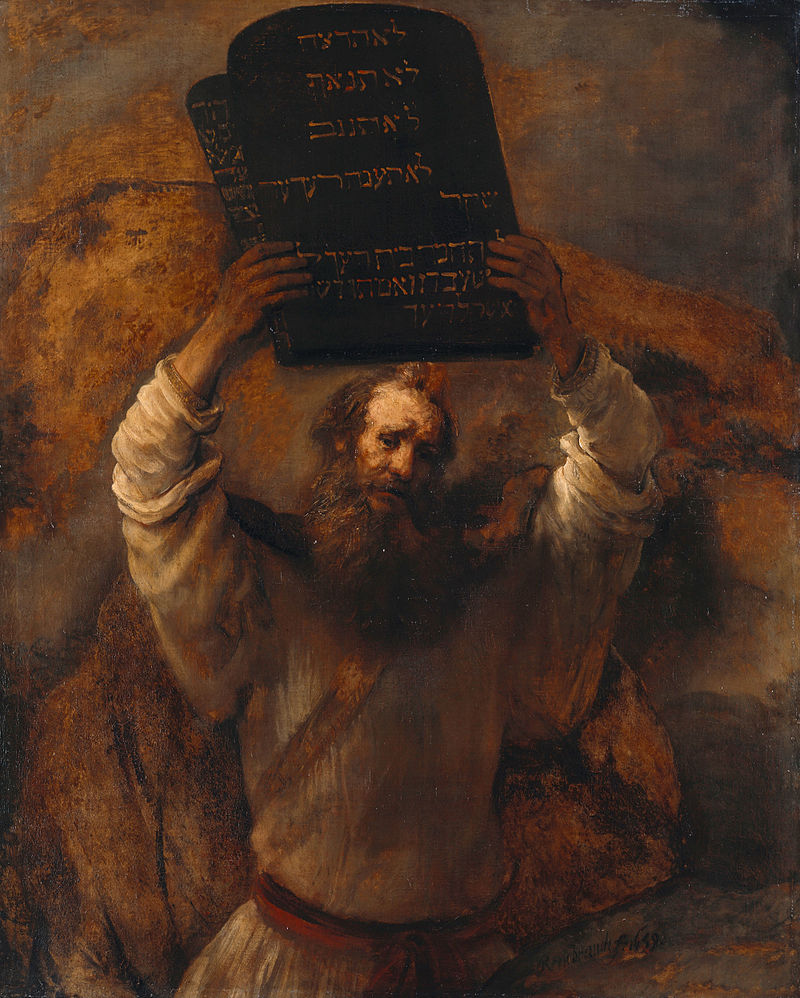
Rembrandt, Moses with the Ten Commandments

Exodus 20: 1-17 The Ten Words

 Then God spoke all these words:

 2 I am the LORD your God, who brought you out of the land of Egypt, out of the house of slavery; 3 you shall have no other gods before1 me.

 4 You shall not make for yourself an idol, whether in the form of anything that is in heaven above, or that is on the earth beneath, or that is in the water under the earth. 5 You shall not bow down to them or worship them; for I the LORD your God am a jealous God, punishing children for the iniquity of parents, to the third and the fourth generation of those who reject me, 6 but showing steadfast love to the thousandth generation1 of those who love me and keep my commandments.

 7 You shall not make wrongful use of the name of the LORD your God, for the LORD will not acquit anyone who misuses his name.

 8 Remember the sabbath day, and keep it holy. 9 Six days you shall labor and do all your work. 10 But the seventh day is a sabbath to the LORD your God; you shall not do any work — you, your son or your daughter, your male or female slave, your livestock, or the alien resident in your towns. 11 For in six days the LORD made heaven and earth, the sea, and all that is in them, but rested the seventh day; therefore the LORD blessed the sabbath day and consecrated it.

 12 Honor your father and your mother, so that your days may be long in the land that the LORD your God is giving you.

 13 You shall not murder.1

 14 You shall not commit adultery.

 15 You shall not steal.

 16 You shall not bear false witness against your neighbor. 17 You shall not covet your neighbor’s house; you shall not covet your neighbor’s wife, or male or female slave, or ox, or donkey, or anything that belongs to your neighbor.

The Ten Commandment, or the Ten Words (Decalogue) occur both here and in Deuteronomy 5 in slightly different forms. I highlight the differences in my discussion on Deuteronomy and here I will focus more on the commandments themselves and the role they have played within both Judaism and Christianity. One of the issues that has been wrestled with across time is how to divide the list into ten with different solutions based upon one’s theology. Is verse two the first commandment of a prologue to the list of commandments (many Jewish traditions), is verse three through six all one commandment (Catholic, Lutheran traditions) or is there a break between verse three and four (Reformed traditions). Ultimately the division into ten probably serves as an easy way to remember these central precepts that all the rest of the law will unfold from and regardless of how they are divided it is ultimately the way they become internalized and lived which will become the primary goal for these words.

When historical critical methods were the favored tool scholars loved to debate whether the Ten Words evolve over time or whether they borrowed from other law codes of the ancient near east (most notably the Code of Hammurabi has been noted for some parallels between what will follow in the next chapters). Ultimately historical questions reaching thousands of years back into history become incredibly difficult to answer and what we have are the Decalogue as they have been handed down in the books of Exodus and Deuteronomy as they are in their final form. For both Jews and Christians, they have served to both pass on the faith and to give some key principles to form their ethics and life from.

The initial statement at the beginning of these words take us back into the narrative of Exodus. The LORD makes a claim upon them, the LORD is their God and the LORD is known by what has occurred. The bringing out of the people from Egypt and God’s choice of them gives the LORD sole claim upon their allegiance and worship. The existence of other gods is not denied here, in the worldview of the time it is assumed and other nations served them (the prophets will later move towards a view we would recognize as monotheistic) but these other gods are not to be worshipped or followed by the people of Israel. The people have been redeemed out of Egypt and are in a covenantal relationship with the LORD their God.

The worship of the LORD is unusual in the ancient world. They are not to use images to represent the LORD their God, and this will be what is at stake in the incident of the golden calf in Exodus 32. The LORD is not to be reduced to the likeness of anything in the creation. The expounding on this prohibition below in verse 23 reinforces this. There will be beauty in the space that will be constructed to worship, but nothing within that space and no other item is to contain God’s image. Perhaps there is a remembrance of the creation narrative where humanity in some manner bears the image of God, but ultimately even humanity it not to be cast in metal and lifted up as a representation of God. The LORD is an impassioned God and does not enter this covenant easily or lightly. God’s vulnerability is highlighted using the term ‘jealous’ and while we may be uncomfortable with the language of punishment we will see that the breaking of this relationship, as will be seen in Exodus 32 and in prophets like Jeremiah and Hosea, brings out an intensely emotional side of God. The LORD presented in the Hebrew Bible is never some unmoved mover or unattached stoic grandfatherly god, the LORD is a God who desires to draw near but who also is vulnerable to being wounded by the unfaithfulness of the people.

The name in the ancient world is a powerful thing. As I discussed in Exodus 3 there is both necessity in a name but especially in the ancient world there was power. The four-letter name of God, transliterated as YHWH (or Yahweh- Jehovah was an old mispronunciation of these letters) is not said by the Jewish people in their worship in respect for keeping the name holy will always say Adonai (and the vowels, which are added above and below the consonants reflect the vowels for Adonai while the consonants are YHWH), in English this is why you see LORD in all caps (frequently with ORD in a smaller font if possible). The name of God was not to be used as a magical incantation, like some other cultures would do when they called upon the names of their gods, but was to be honored and respected.

Sabbath here is linked to creation and the rhythm of the LORD’s work being a model for human life. This is one of the unique portions of the Ten Commandments, since Sabbath is primarily about rest-not worship. It also is essential in the construction of a different type of society than the Egyptian society they came out of. In Egypt they were slaves, forced to work without brake for as long as their taskmasters demanded, but here children, slaves and even animals are commanded to rest. Ultimately, they were not to place their own ability to produce at the center of their lives but they were to learn to rest and trust that the LORD would provide for them and they were to rest with the LORD on this day that has been blessed and consecrated.

The command to honor father and mother, as I mention in Deuteronomy 5, is probably less about young children being obedient to parents and more about older children continuing to respect, honor and care for their parents in their older age. There will always be the temptation to look upon those who are past their prime as a burden to society but here they are commanded to be honored.

I once heard Rolf Jacobson, who teaches Hebrew Bible at Luther Seminary, state that the Ten Commandments are not about my best life now, they are about ‘my neighbor’s best life now.’ Murder, and although I grew up with the King James ‘thou shalt not kill’ the word murder is probably a better word for what is intended, prevents my needs from becoming more important than my neighbor’s life. There are times where the Scriptures do talk about capital punishment or serving in warfare and these may be viewed within the scriptures as times where the greater community is protected by the act of the one being killed or killing others but these actions are not to be the rule of life in the community, they are the exception. Adultery, which in our current culture portrays as a crime where no one gets hurt, is taken with the utmost seriousness. The punishment for those who commit adultery will be death and this may seem in our time overly harsh. Yet, in ancient times there was, “a severe rupture of trust in family trust and structure as well as in patterns of inheritance.” (Myers, 2005, p. 176) After working with couples for years as a pastor and my own personal experiences there is wisdom to learn from the seriousness cultures took adultery. I am not advocating a return to stoning or harsh punishment, but I’ve seen too often the damage that what a person thought was a simple act of pleasure does to their health, finances, to family and to their children. Adultery is one of those acts that can shatter the trust of a family and have profound and long consequences. Similarly stealing can have life threatening consequences in a culture where people are living at a subsistence level and even in our time. In a society where neighbors relied upon one another, theft could fracture the fabric of that community. When one’s home or automobile has been broken into it feels like a violation of one’s safety and security. In some cases, the loss of security may be greater than the physical loss. In other cases, where greed or theft on a large scale has endangered a person’s retirement accounts or even the money that a person needs to pay for food or medical expenses the theft can literally steal life from another person.

For a just society one of the essential elements is truthful speech. Bearing false witness, whether in a legal setting or in casual gossip can cause heavy damage to an individual. In an age where we can see the how gossip, intentional falsehoods, and cyber-bullying in personal relationships in addition to the erosion of trust in our public institutions I do think there is a longing for truthful speech, but also there is a desire for the salacious rumor and it sometimes becomes difficult to tell the two apart. Perhaps Martin Luther’s wisdom of “interpreting my neighbor’s action in the best possible light” may be helpful here as we wrestle with finding true words in a suspicious and distrusting time.

Finally coveting, and the word for coveting is more than just the natural desire of seeing someone or something one finds attractive. Chamada, the Hebrew word behind coveting is, “an intense desire, generated by passion that is not easily controlled.” (Myers, 2005, p. 178 quoting TDOT) The word for house is more than the physical building, it is one’s household which would include the other items listed behind household: spouse, servants, livestock, etc. This type of intense and open desire would erode the trust between neighbors.

Attempting to write about the Decalogue is a challenge, partially because almost every major figure in Judaism and Christianity at some point writes in detail about the commandments. They are a source of catechetical instruction in the basics of the faith for both traditions. Here I have been in more of an exegetical mode attempting to understand and compare what the commandments meant to their original audience and compare that to our time. At other points, if I was trying to instruct someone on how the commandments would impact their faith I would probably highlight different points.

Exodus 20: 18-21 Moses the Mediator

 18 When all the people witnessed the thunder and lightning, the sound of the trumpet, and the mountain smoking, they were afraid1 and trembled and stood at a distance, 19 and said to Moses, “You speak to us, and we will listen; but do not let God speak to us, or we will die.” 20 Moses said to the people, “Do not be afraid; for God has come only to test you and to put the fear of him upon you so that you do not sin.” 21 Then the people stood at a distance, while Moses drew near to the thick darkness where God was.

Moses by Victorvictori, permission granted by author through WikiCommons

The approach of the LORD is a powerful thing and the people are overwhelmed. Although there will be times where Moses’ role as a leader is challenged the people do not want to stand in Moses’ place before God. They desire someone to mediate the divine presence. Moses will spend his life as a person caught between God and God’s people. Even when God’s intention is to graciously draw close it can be terrifying and frequently people want a predictable and not too close God. Ultimately the God of Israel is a God who is not controllable or tame, who is passionate. Moses is somehow safer, more understandable and therefore God’s presence continues to be mediated by the messenger.

Exodus 20: 22-26 How to Worship the LORD

 22 The LORD said to Moses: Thus you shall say to the Israelites: “You have seen for yourselves that I spoke with you from heaven. 23 You shall not make gods of silver alongside me, nor shall you make for yourselves gods of gold. 24 You need make for me only an altar of earth and sacrifice on it your burnt offerings and your offerings of well-being, your sheep and your oxen; in every place where I cause my name to be remembered I will come to you and bless you. 25 But if you make for me an altar of stone, do not build it of hewn stones; for if you use a chisel upon it you profane it. 26 You shall not go up by steps to my altar, so that your nakedness may not be exposed on it.”

The worship of the LORD is both incredibly simple and very challenging. It is simple in the reality that they don’t need images of silver or gold to represent their God. It is challenging because the people will show that they desire some physical representation of their God they can focus on and can manipulate. Idolatry will be more than just worshipping other gods, it will also be any attempt to make an image of the imageless God of Israel. It will be any attempt to limit the ways in which God can present Godself or to even metaphorically limit God’s image to being something in heaven or on earth or in the sea. It is simple that the LORD does not require elaborate tables or structures to offer sacrifices, simply an altar of earth or unhewn stones that is not set above everyone else. The worship of the LORD is to be done at a level where the priests do not ascend above the people to offer sacrifices but stand at their level. It will be a challenge not to emulate the practices of other nations that place the divine above and have their priests ascend to offer sacrifices. It is the paradox of transcendence in the mundane parts of life. God’s desire is to come down to the people’s level and to dwell, but the desire of the people tends to be to send a representative up to mediate the space between God and themselves.

Psalm 19- Creation, the Law and a Faithful Life

James Tissot, The Creation (between 1896 and 1902)

James Tissot, The Creation (between 1896 and 1902)

Psalm 19

 <To the leader. A Psalm of David.>
1 The heavens are telling the glory of God; and the firmament proclaims his handiwork.
2 Day to day pours forth speech, and night to night declares knowledge.
3 There is no speech, nor are there words; their voice is not heard;
4 yet their voice goes out through all the earth, and their words to the end of the world.
  In the heavens he has set a tent for the sun,
5 which comes out like a bridegroom from his wedding canopy,
  and like a strong man runs its course with joy.
6 Its rising is from the end of the heavens, and its circuit to the end of them;
  and nothing is hid from its heat.
7 The law of the LORD is perfect, reviving the soul;
  the decrees of the LORD are sure, making wise the simple;
8 the precepts of the LORD are right, rejoicing the heart;
  the commandment of the LORD is clear, enlightening the eyes;
9 the fear of the LORD is pure, enduring forever;
  the ordinances of the LORD are true and righteous altogether.
10 More to be desired are they than gold, even much fine gold;
  sweeter also than honey, and drippings of the honeycomb.
11 Moreover by them is your servant warned; in keeping them there is great reward.
12 But who can detect their errors? Clear me from hidden faults.
13 Keep back your servant also from the insolent; do not let them have dominion over me.
  Then I shall be blameless, and innocent of great transgression.
14 Let the words of my mouth and the meditation of my heart be acceptable to you,
   O LORD, my rock and my redeemer.

Psalm 19 as a psalm of praise brings together the wonder and mysterious natural knowledge of God uttered in the unheard speech of creation and the revealed wisdom of the LORD in the gift of the Torah (the law). Like Psalm 8, the other psalm of praise we have encountered at this point in the book of Psalms, it reflects upon the majesty of creation from a sense of wonder and awe. It can look at the heavens above, the earth below and the seas in their vastness and be amazed at the creator God who has done all of these things. Here in the first verse the word for God is the generic El which can be either God, a god, or in plural gods, but it is not a name like will be used beginning in verse seven. Yet, the heavens and day and night and sun are all poetically personified in the psalm, speaking in words that are unheard and voices that human ears cannot perceive. Perhaps the psalmist, just straining, can barely hear the silent resonance of the Creator echoing through the creation. Perhaps they can perceive the God that stands behind the creation where others have taken the created parts of creation and deified them. In verses four and five, it is possible that the Psalmist makes use of an existing Akkadian/Summerian bilingual hymn that refers to the sun as a hero, warrior and bridegroom (Nancy deClaisse-Walford, 2014, p. 208) yet instead of leaving the sun as a deity in its right (like the surrounding cultures) now the sun becomes a rejoicing servant reveling in the course that the creator God has set for it.  The first half of the Psalm revels with the song of creation in the artistry and majesty of the creator and the Psalmist lifts up in their own way an audible voice for the unheard creation’s song.

It may seem unusual to bring together creation and the law in a poem, and perhaps these originated in two different places, but bringing these two together makes sense of the broader understanding of how God works with the Hebrew people. Creation is a gift of God for all the world, but the law (the Torah) is the special revealed gift for God’s chosen people. The God referred to initially only with the generic El now receives the revealed name YHWH (frequently pronounced Yahweh, anytime you see LORD in the Hebrew Scriptures (Old Testament) the proper name of God revealed to Moses is behind that, it is typically pronounced Adonai when read (translates to Lord) to not take the LORD’s name in vain). Together with Psalm 1 and the much longer Psalm 119, Psalm 19 praises the law of the LORD. The revealed will of God in the law becomes the nourishment, which revives the faithful, brings wisdom and purity and clarity and are a rich gift fit for a king. The ideal leader was to have the law always before them and to diligently observe and follow it all the days of their life. (see Deuteronomy 17: 18-20) If the king is the one lifting up this prayer the wonder of the cosmos is combined with the revealed wisdom of the Torah to keep them in obedience to God’s will for their life and God’s people.

The Psalm ends with a petition to be kept in this way revealed by the LORD in the midst of all the temptations that life brings forward. There is a humility in realizing that even though the law may reveal the human may conceal from themselves the faults of their hands and hearts. Even with the wisdom of Solomon one may fail to see the divergence in one’s life from the way of the covenant which coheres with God’s law. The Psalmist petitions their LORD to clear them of hidden faults, to keep them away from the insolent and foolish and to allow them to be blameless. God is their rock and their redeemer, the word for redeemer is go’el the kinsman redeemer who is able to, and is expected to, purchase their enslaved kin from slavery. Here the LORD is the one who is able to set the Psalmist free to live the life they are called to live: a life that can revel in God’s creation and delight in God’s law.

Deuteronomy 30 – Hope Beyond the Curse

Water original image from splashhttp://www.ripples.ca/

Water original image from splashhttp://www.ripples.ca/


Deuteronomy 30: 1-10 Returning to the LORD

1 When all these things have happened to you, the blessings and the curses that I have set before you, if you call them to mind among all the nations where the LORD your God has driven you, 2 and return to the LORD your God, and you and your children obey him with all your heart and with all your soul, just as I am commanding you today, 3 then the LORD your God will restore your fortunes and have compassion on you, gathering you again from all the peoples among whom the LORD your God has scattered you. 4 Even if you are exiled to the ends of the world, from there the LORD your God will gather you, and from there he will bring you back. 5 The LORD your God will bring you into the land that your ancestors possessed, and you will possess it; he will make you more prosperous and numerous than your ancestors.

 6 Moreover, the LORD your God will circumcise your heart and the heart of your descendants, so that you will love the LORD your God with all your heart and with all your soul, in order that you may live. 7 The LORD your God will put all these curses on your enemies and on the adversaries who took advantage of you. 8 Then you shall again obey the LORD, observing all his commandments that I am commanding you today, 9 and the LORD your God will make you abundantly prosperous in all your undertakings, in the fruit of your body, in the fruit of your livestock, and in the fruit of your soil. For the LORD will again take delight in prospering you, just as he delighted in prospering your ancestors, 10 when you obey the LORD your God by observing his commandments and decrees that are written in this book of the law, because you turn to the LORD your God with all your heart and with all your soul.

Deuteronomy 30 is one of those passages whose images will have a ripple effect in both the prophets, particularly Jeremiah, and later in the words of the apostle Paul. Whenever these words are spoken, they speak to the context of the Babylonian exile where the land, Judean king, and the temple which formed the central parts of the identity of the Jewish people prior to the exile are all lost. It is in the midst of this experience of desolation that the prophetic hope arises, but it is always a hope that is not easily won. It only comes after all the curses have been exhausted, or in the experience of the exile once the nation has been conquered multiple times and not only with the elite being carried off into exile but rather after continued rebellion and failed cheap solutions like those presented by false prophets like Hananiah in Jeremiah 28 which promised a quick and easy end to judgment. There is hope in the midst of what may seem like hopelessness. In exile there is the promise of return and the primary actor is the LORD.

The prophets will spend a lot of ink talking about the return from exile. Isaiah 40-55, Jeremiah 30-33, Ezekiel 36-37 and several of the minor prophets all address this. The poetic and prophetic hope emerges out of this place of desolation and destruction. The promise is again the land and prosperity and this becomes a central image for the people. Their lives and stories are linked to the land, but their prosperity in the land is linked to their ability to live out of the covenant. We are linked back to Deuteronomy 6:5 by the echo of loving the LORD with all of their heart and soul. If the people return to the LORD, then the words of Isaiah echo the sentiment of this passage:

Do not fear, I am with you, I will bring your offspring from the east, and from the west I will gather you; I will say to the north, “Give them up,” and to the south, “Do not withhold; bring my sons from far away and my daughters from the ends of the earth—everyone who is called by my name, whom I created for my glory, whom I formed and made.” Isaiah 43:5-7

The image of circumcision is now used metaphorically in relationship to the heart. Just as the physical act of circumcision became a mark of the covenant for the Jewish people, now the LORD circumcises the heart of the renewed people. In Deuteronomy 10: 16 the people are commanded to circumcise the foreskin of their hearts so that they would no longer be stubborn and would be receptive to the commandments of the LORD. Now in this period of renewal God is the primary actor and the one enabling the people to love the LORD with their heart and soul. In Jeremiah 4:4 this image re-appears in language similar to Deuteronomy 10, in the sense of a warning to turn towards the LORD prior to the experience of exile:

Circumcise yourselves to the LORD, remove the foreskin of your hearts, O people of Judah and inhabitants of Jerusalem, or else my wrath will go out like fire, and burn with no one to quench it, because of the evil of your doings. Jeremiah 4:4

But for the apostle Paul, who has to justify his ministry among the Gentiles before those who expect Gentiles to undergo physical circumcision, he is able to use these passages to reflect his ministry in a different light:

For a person is not a Jew who is one outwardly, nor is true circumcision something external and physical. Rather, a person is a Jew who is one inwardly, and real circumcision is a matter of heart—it is spiritual and not literal. Such a person receive praise not from others but from God. Romans 2: 28f.

The condition of exile, much like the captivity in Egypt, creates the space where the covenant can begin again and God hears the cries of the oppressed people. Just as in the exodus from Egypt, in the return from exile the primary actor will be God. Yet, in this condition where God has acted on behalf of the people, the people still have the obligation to live in obedience to the commands and decrees and that begins with loving and turning to the LORD their God with all their heart and soul.

Deuteronomy 30: 11-20 Obedience is Possible

 11 Surely, this commandment that I am commanding you today is not too hard for you, nor is it too far away. 12 It is not in heaven, that you should say, “Who will go up to heaven for us, and get it for us so that we may hear it and observe it?” 13 Neither is it beyond the sea, that you should say, “Who will cross to the other side of the sea for us, and get it for us so that we may hear it and observe it?” 14 No, the word is very near to you; it is in your mouth and in your heart for you to observe.

 15 See, I have set before you today life and prosperity, death and adversity. 16 If you obey the commandments of the LORD your God that I am commanding you today, by loving the LORD your God, walking in his ways, and observing his commandments, decrees, and ordinances, then you shall live and become numerous, and the LORD your God will bless you in the land that you are entering to possess. 17 But if your heart turns away and you do not hear, but are led astray to bow down to other gods and serve them, 18 I declare to you today that you shall perish; you shall not live long in the land that you are crossing the Jordan to enter and possess. 19 I call heaven and earth to witness against you today that I have set before you life and death, blessings and curses. Choose life so that you and your descendants may live, 20 loving the LORD your God, obeying him, and holding fast to him; for that means life to you and length of days, so that you may live in the land that the LORD swore to give to your ancestors, to Abraham, to Isaac, and to Jacob.

The people to this point in the story have not demonstrated that they have a mind to understand, or eyes to see, or ears to hear as Deuteronomy states in Deuteronomy 29: 4, yet for Deuteronomy obedience is not only possible, it is easily within the people’s reach. The Jewish people were not to view the law as a heavy burden but rather as Psalm 1 can state that for the faithful the law of the LORD is their delight. To live in accordance with commandments, decrees and ordinances is to choose life and to fail to do so is to choose death for the people. The earth, who we have seen at previous points, bears some of the consequences of the disobedience of the people of God is called to witness against them. The people are urged once more to choose life, just as at the end of the book of Joshua they will be charged to choose to serve the LORD (Joshua 24).

The apostle Paul in his letter to the Romans demonstrates how for the followers of Jesus the focus of this obedience changes. In Romans 10: 5-8 now Christ takes the place of this word that is near you and on your hearts.

Moses writes concerning the righteousness that comes from the law, that “the person who does these things will live by them.” But the righteousness that comes from faith says, “Do not say in your heart, ‘Who will ascend into heaven?'” (that is, to bring Christ down) “or ‘Who will descend into the abyss?'” (that is, to bring Christ up from the dead). But what does it say? “The word is near you, on your lips and in your heart” (that is, the word of faith that we proclaim); Romans 10: 5-8

Much as John’s Gospel can refer to Jesus as the Word of God (John 1) or Matthew’s Gospel can refer as Jesus as the fulfillment of the Law (Matthew 5: 17) it shows how this concept becomes completely transformed in a Christian worldview. Even though Jesus will echo the greatest commandment being Deuteronomy 6: 4-5 which comes down to loving the LORD with all the heart. These texts become transformed with now Jesus occupying the place of the law, and the righteousness of faith takes the place of the righteousness of the law. It is not surprising that Paul was frequently in trouble with other Jewish people over a transformation that affects such a central thing as the law, and that is probably why he spends much of Romans (in addition to Galatians) trying to re-interpret the scriptures in light of his experience of the risen Christ.

Deuteronomy 27-Preserving the Law

Moses by Victorvictori, permission granted by author through WikiCommons

Moses by Victorvictori, permission granted by author through WikiCommons

Deuteronomy 27: 1-8 An Enduring Word

1 Then Moses and the elders of Israel charged all the people as follows: Keep the entire commandment that I am commanding you today. 2 On the day that you cross over the Jordan into the land that the LORD your God is giving you, you shall set up large stones and cover them with plaster. 3 You shall write on them all the words of this law when you have crossed over, to enter the land that the LORD your God is giving you, a land flowing with milk and honey, as the LORD, the God of your ancestors, promised you. 4 So when you have crossed over the Jordan, you shall set up these stones, about which I am commanding you today, on Mount Ebal, and you shall cover them with plaster.

 5 And you shall build an altar there to the LORD your God, an altar of stones on which you have not used an iron tool. 6 You must build the altar of the LORD your God of unhewn stones. Then offer up burnt offerings on it to the LORD your God, 7 make sacrifices of well-being, and eat them there, rejoicing before the LORD your God. 8 You shall write on the stones all the words of this law very clearly.

Deuteronomy narrates a scene where Moses has dictated the law to the people in its completion prior to their entering into the promised land. We know that Moses is not going to cross over with the people and so in the remaining chapters we see the beginning of a massive transition in the leadership of the people. We live in a time where written texts are readily available and even if we don’t have a physical copy for many texts a digital copy is only a few keystrokes away. In the ancient world there are very few physical texts and a relatively small class who are able to read and create the written texts. Even something as central as the law was lost, intentionally or unintentionally, multiple times in the story of the people of Israel and Judah. For example, in the reign of King Josiah it is reported in 2 Kings 22: 8: “The high priest Hilkiah said to Shaphan the secretary, “I have found the book of the law in the house of the LORD.” When Hilkiah gave the book to Shaphan, he read it. Shortly afterwards the written text is read before the king and the king continues the work of reform.

Moses has been the mediator of the law between the LORD and the people, but with Moses about to leave his role as leader, judge, mediator and teacher there needs to be a way for the people to refer to this critical law he is leaving behind. Oral texts may survive a couple of generations intact, but ultimately for the law to survive it must become a textual document. Much like the recording of the words of the prophet Jeremiah in Jeremiah 36, where the prophet’s haunting and inconvenient words survive both the physical threat to the prophet as well as the burning by King Jehoiakim by being recorded again, now the critical exposition of the law in Deuteronomy 4-26 is to be put on plastered stones to be a visible witness to the people. This “furniture of the covenant” (Brueggemann, 2001 , p. 251) now is to be a manner in which future leaders can refer back to the law that Moses handed on. Moses now begins to step aside from being the teacher of the law to make space for the written law that future leaders and the people will be governed by.

Moses throughout his ministry has occupied a central role in the place between the people and God. Even with the elders and the tribal leaders and priest, ultimately he is the one who mediated the relationship between the people and their God, was the political leader, their chief judge and prophet, their lawgiver, and peacemaker. Yet, as Rabbi Kushner can state,

In the Jewish tradition, we speak of him as Moses Rabeinu—Moses, Our Teacher—not Moses, our Political Leader; not Moses, Who Freed the Slaves. Moses, Our Teacher. He dedicates himself to getting the people to embrace the ideas that they have to live by when he’s no longer around to remind them. (Thompson, 2014, p. 194)

Moses, throughout Deuteronomy has been working to equip the people to live in accordance with the commandments, statutes and ordinances outlined within the book. He has done this with catechetical practices within the home and with worship practices at the place where the LORD’s name will rest that reinforce their identity as the people of God. Here in the recording of the law and the building of an altar to celebrate and worship the LORD the narrative shows Moses preparing the people for a faithful practice of the covenant when he is no longer there to guide or intercede for them. And when the people fail to live out the covenant, then the stones themselves can testify very clearly against them.

Deuteronomy 27: 9-10 Hear One More Time

 9 Then Moses and the levitical priests spoke to all Israel, saying: Keep silence and hear, O Israel! This very day you have become the people of the LORD your God. 10 Therefore obey the LORD your God, observing his commandments and his statutes that I am commanding you today.

Moses, along with the priest, charges the people one final time with their identity and calling. Echoing the tone of the Shema in Deuteronomy 6: 4-5 he makes a final appeal for the people to hear. In an aural world they are to be silent and listen so they may remember who they are. They are the people of the LORD their God and therefore they are to be obedient. Their calling comes with blessing and challenges, and in their faithfulness they will be a witness to the nations and a blessing to the world. In their failing they will become the embodiment of the curses that will come in the following chapter.

Herny Fenn, Ruins on the Summit of Mount Gerazim, On the Site of the Samaritan Temple (between 1881 and 1884)

Herny Fenn, Ruins on the Summit of Mount Gerazim, On the Site of the Samaritan Temple (between 1881 and 1884)

Deuteronomy 27: 11-26 A Liturgy of Curses

 11 The same day Moses charged the people as follows: 12 When you have crossed over the Jordan, these shall stand on Mount Gerizim for the blessing of the people: Simeon, Levi, Judah, Issachar, Joseph, and Benjamin. 13 And these shall stand on Mount Ebal for the curse: Reuben, Gad, Asher, Zebulun, Dan, and Naphtali. 14 Then the Levites shall declare in a loud voice to all the Israelites:
 15 “Cursed be anyone who makes an idol or casts an image, anything abhorrent to the LORD, the work of an artisan, and sets it up in secret.” All the people shall respond, saying, “Amen!”
 16 “Cursed be anyone who dishonors father or mother.” All the people shall say, “Amen!”
 17 “Cursed be anyone who moves a neighbor’s boundary marker.” All the people shall say, “Amen!”
 18 “Cursed be anyone who misleads a blind person on the road.” All the people shall say, “Amen!”
 19 “Cursed be anyone who deprives the alien, the orphan, and the widow of justice.” All the people shall say, “Amen!”
 20 “Cursed be anyone who lies with his father’s wife, because he has violated his father’s rights.” All the people shall say, “Amen!”
 21 “Cursed be anyone who lies with any animal.” All the people shall say, “Amen!”
 22 “Cursed be anyone who lies with his sister, whether the daughter of his father or the daughter of his mother.” All the people shall say, “Amen!”
 23 “Cursed be anyone who lies with his mother-in-law.” All the people shall say, “Amen!”
 24 “Cursed be anyone who strikes down a neighbor in secret.” All the people shall say, “Amen!”
 25 “Cursed be anyone who takes a bribe to shed innocent blood.” All the people shall say, “Amen!”
 26 “Cursed be anyone who does not uphold the words of this law by observing them.” All the people shall say, “Amen!”

 The chapter ends with a series of twelve individual curses that the community is to place on anyone who violates particular actions. This sets the scene as well for the blessings and curses in chapter 28 where six tribes are on Mount Ebal for curses and six tribes are on Mount Gerazim for blessings. The two mountains are on the opposite sides of a valley and for the Samaritans Mount Gerazim would become one of their holy sites. Within Deuteronomy Mount Gerazim becomes the mountain of blessing while Mount Ebal is the mountain of curse, yet for Deuteronomy the tablets of the law and the altar are to be built on Mount Ebal rather than Mount Gerazim.

Many of these are covered earlier in Deuteronomy and rather than spend much time on those I will link you back to the discussion at the appropriate place in Deuteronomy, but a few are new. Verse 15 which concerns idols and images is talked about earlier in Deuteronomy 4: 15-20, and Deuteronomy 5:8-10 and is depending on how you number either part of the first commandment or the second commandment. Verse 16 also harkens back to the ten commandments with the commandment on honoring father and mother in Deuteronomy 5: 16 and is also expanded in Deuteronomy 21: 18-21 with the punishment for children who are rebellious and bring dishonor to their father and mother. Verse 17 concerns the moving of boundary markers which is addressed in Deuteronomy 19: 14. Verse 18 is the first new item on misleading the blind, but it follows in the concern that people care for the vulnerable and the weak in the society. Leviticus 19: 14 also addresses this when it states, “You shall not revile the deaf or put a stumbling block before the blind; you shall fear the LORD your God.” Caring for the vulnerable is a central part of living out of the covenant and one of the places where the prophets are called upon to point out the way the people have not cared for the vulnerable.  The next curse continues about those who oppress the representative triumvirate of the vulnerable, the widows, the orphan and the alien. The tithe, addressed in Deuteronomy 14: 29 and Deuteronomy 26: 12-13, the inclusion of the vulnerable in the festivals like outlined in Deuteronomy 16: 11, 14 the practice of allowing the remnant of the harvest and vine to be gleaned by the vulnerable in Deuteronomy 24: 19-22 are all concrete practices to help care for the vulnerable in their community. Verse 20 about lying with the father’s wife is covered in Deuteronomy 22: 30. The next three curses about forbidden sexual relations are new to Deuteronomy but fit within the ordered world of Deuteronomy 22:13-26 for the author of Deuteronomy’s view of sexual relations. Sexual relations with any animal, with a sister or a mother-in-law are forbidden and Deuteronomy doesn’t feel the need to explain these any further. The command in verse 24 about striking a neighbor in secret is new and it addresses disputes outside the purview of the community. For Deuteronomy the community and the elders are key to ensuring that disputes are resolved equitably. The curse about taking a bribe to shed innocent blood is addressed in the judicial context of Deuteronomy 16:19. Finally the last curse is general in nature referring to the entirety of the law and the need for obedience. This final curse may round it out to bring the final number of these individual curses to the representative twelve. Obedience is both an individual and communal responsibility, where the community holds the individual accountable. By placing these curses in the mouths of the people as they enter the land their own words hold them accountable to living in obedience to this law and covenant.


 Deuteronomy 21: Death, Rebellious Children, Captured Women and Inheritance

The First Funeral, Louis Ernest Barrias (1883)

The First Funeral, Louis Ernest Barrias (1883)

Deuteronomy 21: 1-9: Dealing with an Unsolvable Death

1 If, in the land that the LORD your God is giving you to possess, a body is found lying in open country, and it is not known who struck the person down, 2 then your elders and your judges shall come out to measure the distances to the towns that are near the body. 3 The elders of the town nearest the body shall take a heifer that has never been worked, one that has not pulled in the yoke; 4 the elders of that town shall bring the heifer down to a wadi with running water, which is neither plowed nor sown, and shall break the heifer’s neck there in the wadi. 5 Then the priests, the sons of Levi, shall come forward, for the LORD your God has chosen them to minister to him and to pronounce blessings in the name of the LORD, and by their decision all cases of dispute and assault shall be settled. 6 All the elders of that town nearest the body shall wash their hands over the heifer whose neck was broken in the wadi, 7 and they shall declare: “Our hands did not shed this blood, nor were we witnesses to it. 8 Absolve, O LORD, your people Israel, whom you redeemed; do not let the guilt of innocent blood remain in the midst of your people Israel.” Then they will be absolved of bloodguilt. 9 So you shall purge the guilt of innocent blood from your midst, because you must do what is right in the sight of the LORD.

The author of Deuteronomy is concerned that the people’s life in the land is not contaminated by bloodguilt and that they have a means for dealing with an unsolvable death in their land. Even though the death may not be solvable there still needs to be action on behalf of the community to atone for the wrong that has been done and to make things right. This issue also comes up in Deuteronomy 19: 1-13 when discussing the cities of refuge to ensure innocent blood is not spilled for an accidental killing. In Deuteronomy’s perspective there is a need to atone for the death that occurs and only blood can do that. The ritual involves the elders of the community and the Levites who come together to absolve the community of guilt.

The ritual itself involves assigning the responsibility to the nearest town, the giving up of something of high value to the community, declaration of innocence of the community, blessing and finally a ritual of surrendering responsibility. The role of the Levites in the judicial process laid out in Deuteronomy 17: 8-13 is now expanded here to involve any case of dispute and assault, but they also oversee the actions of the community to make things right with God. Once the responsibility is assigned to the elders of the town they bring a heifer, a cow that has not been used for agricultural purposes and has not born a calf, and identify a wadi, a ravine which must have running water, that is also not being used in agricultural purposes to conduct the ritual. Breaking the heifer’s neck kills the animal in a non-sacrificial way and unlike the sacrifices (talked about earlier in Deuteronomy 12, in relation to the festivals in Deuteronomy 16, and in relation to the priests in Deuteronomy 18) there is no mention of participating in eating the heifer that has been killed. This animal is lost to the community in the action of absolution. The washing of hands to absolve responsibility is a common practice, but here the elders of the community act on behalf of the community: declaring innocence both in action and in not covering up the crime and attempt to make things right between the community and God.

Deuteronomy is an ancient book and it is sometimes difficult to approach in our world, and one of the reasons I spend the time working through this publicly is there is not much that is available online that is not either using Deuteronomy as a classic case of how irrelevant the Bible and religion is or on the other side lifts up Deuteronomy (often individual verses or sections) as a methodology that we should embrace without reflection in all its harshness. Most Christian pastors, especially in the more liturgical traditions, spend very little time in Deuteronomy other than perhaps chapters 4-6. Yet, as I have moved through these sections of Deuteronomy that deal with interpreting the law for the people of Israel it has become for me a dialogue within and between scripture. Wanting to honor and find what wisdom Deuteronomy has and how its perspective on God’s relationship to God’s people might help our communal life as Christians even when we can’t always agree with either the rules or the perspectives contained within Deuteronomy.

Some passages, including some coming immediately after this one, we would not want to integrate into our life in our society, but in our litigious society there is no way to deal with an unsolved case. It simply remains unsolved unless, somewhere down the road, a new revelation makes the case solvable. In events where a public wrong has been done, like an unsolved murder, perhaps there would be wisdom in finding a way for community leaders and religious leaders to come together, to denounce the wrong that has been done, to ensure that they do not bear responsibility for the actions and to atone on behalf of the community. Perhaps these actions might begin the process of the community’s healing and bring together the community to protect and watch over the fellow members of the community so that this type of action does not occur in the future.

Deuteronomy 21: 10-14 The Female Captive

 10 When you go out to war against your enemies, and the LORD your God hands them over to you and you take them captive, 11 suppose you see among the captives a beautiful woman whom you desire and want to marry, 12 and so you bring her home to your house: she shall shave her head, pare her nails, 13 discard her captive’s garb, and shall remain in your house a full month, mourning for her father and mother; after that you may go in to her and be her husband, and she shall be your wife. 14 But if you are not satisfied with her, you shall let her go free and not sell her for money. You must not treat her as a slave, since you have dishonored her.

War in any time is hellish both for the soldiers involved in it but perhaps even more so for those who are the victims of the conflict. Women and children rarely had any choices when their cities or lands were captured. From a modern standard the idea of forcing a captive woman to marry a warrior of the army that has conquered their land seems abhorrent. Deanna Thompson argues that this passage is a “glimpse of restraint in the midst of the brutal realities of war.” (Thompson, 2014, p. 159) It does set limits on the injustices that (in theory) be committed on a captive of war by the warriors of Israel.

The author of Deuteronomy would not understand the questions that people from a postmodern secular word (or even earlier worldviews) would have with passages like this, it was simply the world they lived in. Even though there are parts of the bible that can be read as sympathetic with a feminist or egalitarian view of sexuality there are large portions, like this one, which simply come from a world that would be alien to us. In the world that Deuteronomy speaks to: polygamy is an accepted and encouraged practice (to quickly grow the nation of Israel), being a brought into the chosen people of God (through conquest) is a privilege that the vanquished should be thankful for (many Christians shared a similar perspective in the conquest of the Americas), and ultimately in a male centered society the feeling of the women doesn’t carry very much weight. In the United States we can joke that, “if mama ain’t happy, ain’t nobody happy” but assuming that type of worldview on the world of Deuteronomy is simply not true.

One of the gifts and challenges of wrestling through Deuteronomy is that it requires us to wonder how do utilize the wisdom and sometimes the wrongness (from a current perspective) of ancient scripture in our time. There isn’t a major calling for a wholesale adoption of the Deuteronomic and Levitical practices as a guide for life in our time, but I think the pieces of Deuteronomy that make me uncomfortable force me to think about questions like, “how then should women be protected in situations involving combat?” “How do we honor the scriptures and those who wrote them even when we disagree?” “Is there wisdom to be learned even in our disagreements?” “Are there places where the ancient scriptures challenged the world of their day?”

In the world of Deuteronomy, where women are looked upon as spoils that were treated however the captors chose: used while desired and then perhaps sold when no longer desired, Deuteronomy does place a restraint upon the power of the male head of the household. While the woman who is captured has no choice, once she is taken up into the household she does have some, albeit small protection. She is given a time to mourn, she is to lose hair and nails and fancy clothes that may have contributed to her being an object of attraction. She is given protection from being sold into slavery, even though being released does subject her to a significant economic challenge without a means of support. The reality is that she may be forced into begging or prostitution by the release but at least the releaser does not become the one to profit financially by this. Ultimately this is probably told in the hope that the one who releases would provide for the captive woman initially like the people of Israel receiving material wealth from the Egyptians prior to their leaving in the Exodus narrative. In its own harsh way I believe that Deuteronomy is trying to communicate a level of personhood and protection for the captured women. This provides a limit to the power over the booty outlined in Deuteronomy 20, not a sufficient limit for our time, but a limit nonetheless.

The reality of the plight of captive women in the ancient world, even within Deuteronomy’s system, forces them into marriages where they have no voice in the matter. The reality that in this world the woman has no choice over how her body is to be used may not be as far away as we would like to admit. Many women, and some men, in relationships may not feel freedom in how their body is used. Throughout history rape has been used as a part of the conquest of an area. Even today in combat zones throughout the world women’s bodies are not safe. As people of faith we need to be willing to answer the difficult questions of how we honor women and men and their bodies in relationship, in society and even in conflict.

Deuteronomy 21: 15-17 The Rights of the Firstborn

 15 If a man has two wives, one of them loved and the other disliked, and if both the loved and the disliked have borne him sons, the firstborn being the son of the one who is disliked, 16 then on the day when he wills his possessions to his sons, he is not permitted to treat the son of the loved as the firstborn in preference to the son of the disliked, who is the firstborn. 17 He must acknowledge as firstborn the son of the one who is disliked, giving him a double portion of all that he has; since he is the first issue of his virility, the right of the firstborn is his.

This is one of those interesting passages where the Biblical narrative, particularly as it relates to God’s freedom, comes into conflict with the ordered worldview of Deuteronomy. This passage places a limit on the freedom of the male head of household with respect to passing on the inheritance. A husband is not allowed to pick a younger son from a (currently) favored wife to inherit in preference to the eldest son. Matters of inheritance were serious business in the ancient world as possessions and land passed from one generation of men to the next. Yet, it is interesting the way that the narrative of the people of Israel comes into conflict with this fairly simple and common understanding of inheritance.

Throughout the book of Genesis there are stories of later sons inheriting the first born portion. Beginning with the story of Abraham and Sarah and Hagar, the first born son, Ishmael, is set aside for the child of promise, Isaac. In this story the argument could be made that Hagar was never the wife of Abraham so the promise wouldn’t flow to Ishmael but to Isaac. Yet in the very next generation there is the stories of Jacob and Esau where Jacob, by trickery, gets both the inheritance and the blessing. Joseph is favored by his father over his brothers because he is the first child of Rachel, the favored wife, and later Reuben, the firstborn, is passed over for Judah because of sleeping with his father’s concubine Bilhah. David is chosen by God to be king even though he is the youngest brother and in the political intrigue surrounding David’s impending death he appoints Solomon to reign instead of older brothers. There are many other examples that could be lifted up, but things are rarely as neat and orderly as Deuteronomy may want them to be.

Deuteronomy 21: 18-21 The Rebellious Son and the Community

 18 If someone has a stubborn and rebellious son who will not obey his father and mother, who does not heed them when they discipline him, 19 then his father and his mother shall take hold of him and bring him out to the elders of his town at the gate of that place. 20 They shall say to the elders of his town, “This son of ours is stubborn and rebellious. He will not obey us. He is a glutton and a drunkard.” 21 Then all the men of the town shall stone him to death. So you shall purge the evil from your midst; and all Israel will hear, and be afraid.

This portion of Deuteronomy links back to the commandment:

Honor your father and mother, as the LORD your God commanded you, so that your days may be long and that it may go well with you in the land that the LORD your God is giving you. Deuteronomy 5: 16

And attempts to legislate how families are to deal with children, particularly male children, who bring dishonor upon the household. Deuteronomy has a harsh view of justice and of honor and being a dishonor to one’s parents is lifted up as a capital offence. However, when you read closely to this passage there is a significant limit placed upon the familial authority. Families are not allowed to take matters into their own hands. The family is expected to be firm in their disciplining of their child but the threat, “I brought you into this world, I can take you out of it!” was not to be left to the discretion of the parents. The disciplining of the stubborn and rebellious son is left to the community, but must be initiated by the parents. Again the elders are expected to take upon themselves the role of judging for their community.

We wouldn’t sanction execution of children, even adult children, in our society for being stubborn and rebellious, being a glutton or a drunkard or refusing to obey parents. We as a society do set limits on what is acceptable for parents with respect to disciplining. Navigating the boundaries between discipline and abuse can be tricky at times but that is one of the decisions we make as a society for the protection of children. How we care for our elderly also is a part of this discussion as we create rules for a society and how their children are allowed to treat them, since the commandment on honoring parents probably primarily refers to how adult children care for their elderly parent as I discuss when talking about Deuteronomy 5. We may not always agree with Deuteronomy’s harsh stance on justice, and working through this part of the book can seem very legalistic, but the author of Deuteronomy is trying to construct a society that is living out of God’s covenant. In our society we also have to figure out how to advocate for rules that protect children and families, providing limits and unfortunately penalties for people who do not live in accordance with those laws.

Deuteronomy 21: 22-23 A Limit on Execution for the Sake of the Land

 22 When someone is convicted of a crime punishable by death and is executed, and you hang him on a tree, 23 his corpse must not remain all night upon the tree; you shall bury him that same day, for anyone hung on a tree is under God’s curse. You must not defile the land that the LORD your God is giving you for possession.

                 For Christians this is one of those rare portions of Deuteronomy that is well known because of its echo by Paul in his letter to the Galatians:

Christ redeemed us from the curse of the law by becoming a curse for us—for it is written, “Cursed is everyone who hangs on a tree”—in order that in Christ Jesus the blessing of Abraham might come to the Gentiles, so that we might receive the promise of the Spirit through faith. Galatians 3: 13-14

As Paul wrestles with the scandal of the cross among both Jewish and Greek audiences he alludes back to this piece of Deuteronomy and recasts it as a part of the language to explain the death of Christ. The passage does not have a problem with the execution, even hanging or crucifixion, but it does place a limit upon the way that body can be used.


Gladiators Crucified after the Third Servile War (73-71 BCE)

Gladiators Crucified after the Third Servile War (73-71 BCE)

In the ancient world executions had both a physical and a psychological dimension. Physically it killed the person who was executed but it also worked psychologically by making the person a public display of the cost of disobedience. Victims of crucifixion in many cultures were left out to both rot and be dismembered by animals as the executor destroyed not only the person but their honor. In cultures ruled by fear the executed one became a grotesque billboard proclaiming what happened to those who challenged the regimes in power. For the Hebrew people they were to treat the dead differently. As mentioned above in verses 1-9, and in Deuteronomy 19 there is the concept of blood guilt but here it is expanded to a curse upon the land for leaving a cursed person out in the elements. In the world of Deuteronomy the land and people are defiled by failing to deal properly with the dead.

This passage also may help shed some light on the crucifixion narrative in the synoptic gospels where Joseph of Arimathea requests the body of Jesus and buries it on the night of the crucifixion as well as John’s narrative in John 19: 31-37 where the Jewish leaders don’t want the bodies left on the cross. But for the Jewish people they were not to be a culture who relished in death, they were not to display dead bodies or skulls so that others would fear them: instead this would be a source of defilement for them. The prophet Ezekiel can lift up in the vision of the destruction of the armies of Gog, how the burial of the bodies of the vanquished horde will be a part of the cleansing of the land (Ezekiel 39: 11-20)