Tag Archives: Temple

Ezekiel 40 A New Temple for a New Beginning

Schematic of Ezekiel’s Temple drawn by Dutch architect Bartelmeüs Reinders, Sr. (1893–1979) released into public domain by artist.

Ezekiel 40:1-4 Beginning the Final Vision

1 In the twenty-fifth year of our exile, at the beginning of the year, on the tenth day of the month, in the fourteenth year after the city was struck down, on that very day, the hand of the LORD was upon me, and he brought me there. 2 He brought me, in visions of God, to the land of Israel, and set me down upon a very high mountain, on which was a structure like a city to the south. 3 When he brought me there, a man was there, whose appearance shone like bronze, with a linen cord and a measuring reed in his hand; and he was standing in the gateway. 4 The man said to me, “Mortal, look closely and listen attentively, and set your mind upon all that I shall show you, for you were brought here in order that I might show it to you; declare all that you see to the house of Israel.”

When looking at ancient manuscripts you can often tell what was important to the author and the community that continued to transmit the author’s work by the amount of space dedicated to the subject. In a world before printers and copiers where words were copied by hand it is clear that the description of sacred spaces is extremely important in the life of the community. Although it is not the last vision of Ezekiel by date[1] its position at the end of Ezekiel’s collected words is significant. It is also much longer than any of Ezekiel’s other visions. In a time of great disorder this vision of hope points to a perfectly ordered future.

This vision is given two reference points, the beginning of Ezekiel’s exile and the Destruction.[2] This is the only vision dated from the destruction of Jerusalem, and it is fourteen years after the remnant of Jerusalem and Judah arrived in exile in Babylon. Now as the nation is becoming accustomed to life in exile there emerges a vision of a new possibility beyond exile. In the disorienting reality of life as strangers in a strange land the prophet, in Katheryn Pfisterer Darr’s words,

describes a perfectly ordered homeland under the leadership of a perfectly ordered homeland under the leadership of a perfectly ordered priesthood serving in a perfectly ordered Temple complex. (NIB VI:1532)

The date of the vision, the tenth day of the first month, would coincide with the Passover celebration:

This month shall mark for you the beginning of months; it shall be the first month of the year for you. Tell the whole congregation of Israel that on the tenth of this month they are to take a lamb for each family, a lamb for each household. Exodus 12: 2-3

But as the people resided in Babylon it would also occur during the Babylonian akitu festival which celebrated the enthronement of Marduk. The religion of the conquerors may have been a powerful draw to many of the Judeans who felt their God had abandoned them. The danger of settling in the land of Babylon was adopting the practices and worship of their neighbors. Here the dual setting of the worship of Marduk and the promise of liberation by the God of Israel form a dramatic tension.

This final vision of Ezekiel has numerous parallels to the Torah attributed to Moses to order the society in their journey from slavery to becoming the people of God. Both the tabernacle and the temple were expected to be places where God’s presence could dwell among the people. Previously in chapter eight, the desecration of the previous temple was revealed, and now that temple lies in ruins and God’s presence abandoned that structure.[3] This new and perfectly ordered temple guarded from the abominable practices which cause the LORD’s fury once again provides a hope for God’s presence in the midst of the people.

The man, whose appearance shines like bronze or copper, is obviously an individual from the divine rather than the human realm. This unusual man functions both like the guide in chapter eight, but also is outfitted as a surveyor. Ezekiel now takes on the role of a recorder of measurements for this orderly structure at the center of a reordered world. Briefly mentioned is ‘a city to the south’  but this note is echoed at the end of the vision where the city is named  Yahweh Shammah (Yahweh is there). This vision is to be recorded and communicated to the people of Israel, a vision of hope in a hopeless time, a vision of order in disorder, a new future from shattered past. The new beginning begins with a new sacred space.

Ezekiel 40: 5-16 The Wall and Outer Gate

5 Now there was a wall all around the outside of the temple area. The length of the measuring reed in the man’s hand was six long cubits, each being a cubit and a handbreadth in length; so he measured the thickness of the wall, one reed; and the height, one reed. 6 Then he went into the gateway facing east, going up its steps, and measured the threshold of the gate, one reed deep. There were 7 recesses, and each recess was one reed wide and one reed deep; and the space between the recesses, five cubits; and the threshold of the gate by the vestibule of the gate at the inner end was one reed deep. 8 Then he measured the inner vestibule of the gateway, one cubit. 9 Then he measured the vestibule of the gateway, eight cubits; and its pilasters, two cubits; and the vestibule of the gate was at the inner end. 10 There were three recesses on either side of the east gate; the three were of the same size; and the pilasters on either side were of the same size. 11 Then he measured the width of the opening of the gateway, ten cubits; and the width of the gateway, thirteen cubits. 12 There was a barrier before the recesses, one cubit on either side; and the recesses were six cubits on either side. 13 Then he measured the gate from the back of the one recess to the back of the other, a width of twenty-five cubits, from wall to wall. 14 He measured also the vestibule, twenty cubits; and the gate next to the pilaster on every side of the court. 15 From the front of the gate at the entrance to the end of the inner vestibule of the gate was fifty cubits. 16 The recesses and their pilasters had windows, with shutters on the inside of the gateway all around, and the vestibules also had windows on the inside all around; and on the pilasters were palm trees.

Most modern readers will look at the description of the structure and either be overwhelmed by the description or those with engineering or construction backgrounds will be perplexed by the missing details that would be required to construct the temple. In a world where literacy was relatively rare and copying a document was a labor, resource, and time intensive process.[4] Yet, like the previous descriptions of the tabernacle and temple, there is nowhere near enough information to actually construct the temple Ezekiel is shown. Tova Ganzel speculates that the “opacity of the verses and the futility of trying to base the construction on them is deliberate” to prevent anyone from attempting to carry out the temple construction at any point in the future. (Ganzel, 2020, p. 361) At the same time it is important for the prophet to convey a vision of the temple that the people can envision to give specificity to this image of hope.
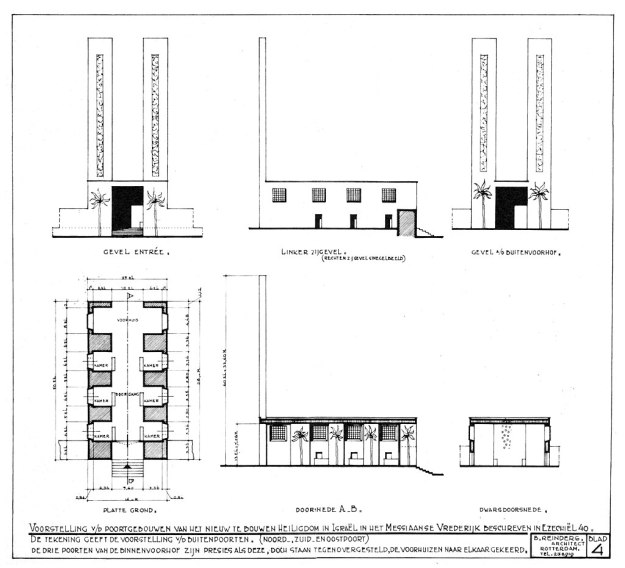
Gateways of Ezekiel’s Temple, as described in the Book of Ezekiel, drawn by the Dutch architect Bartelmeüs Reinders (1893–1979) released into public domain by artist.

The temple is oriented to the east, and this is a common practice across religions in temple construction (the temple faces towards the direction of the rising sun). It is surrounded by a ten-foot tall and ten-foot thick wall. The temple is walled off from the surrounding world and even the city to the south and much of the external structure is similar to what is expected in walled cities rather than temples. This eastern gate is a large structure, the gate opens to be roughly seventeen feet in width, but the gateway itself is about twenty-two feet wide. The width of the gate is later stated to be twenty-five feet. When you add the length of the gateways vestibules, pilasters which lead from the outside of the temple into the inner courtyard it is fifty cubits, or roughly eighty-six feet. Like ancient, fortified cities, the vestibules and ‘windows’[5] may be for defensive purposes.

This temple is created to be a place where God can dwell among the people in a reestablished relationship, and the creation of the temple is the setting aside of a holy space. In creating this holy space there is a need to separate it from the mundane space surrounding the temple, and this exterior wall forms an initial and likely guarded barrier between the people and God’s space at the center of the temple. Most Christian worship spaces have significantly reduced the space between the people and God, but for our Jewish ancestors this separation was essential. God was holy, the people were not. To defile God’s holy place was to invite God to abandon the people or to lash out at the defilement, as we have seen throughout Ezekiel. Now a new beginning begins with a new structure walled off and protected from the outside world’s interference.

Ezekiel 40: 17-27 The Outer Court

17 Then he brought me into the outer court; there were chambers there, and a pavement, all around the court; thirty chambers fronted on the pavement. 18 The pavement ran along the side of the gates, corresponding to the length of the gates; this was the lower pavement. 19 Then he measured the distance from the inner front of the lower gate to the outer front of the inner court, one hundred cubits.

 20 Then he measured the gate of the outer court that faced north — its depth and width. 21 Its recesses, three on either side, and its pilasters and its vestibule were of the same size as those of the first gate; its depth was fifty cubits, and its width twenty-five cubits. 22 Its windows, its vestibule, and its palm trees were of the same size as those of the gate that faced toward the east. Seven steps led up to it; and its vestibule was on the inside. 23 Opposite the gate on the north, as on the east, was a gate to the inner court; he measured from gate to gate, one hundred cubits.

24 Then he led me toward the south, and there was a gate on the south; and he measured its pilasters and its vestibule; they had the same dimensions as the others. 25 There were windows all around in it and in its vestibule, like the windows of the others; its depth was fifty cubits, and its width twenty-five cubits. 26 There were seven steps leading up to it; its vestibule was on the inside. It had palm trees on its pilasters, one on either side. 27 There was a gate on the south of the inner court; and he measured from gate to gate toward the south, one hundred cubits.

There are two additional outer gates that lead into the courtyard, one facing north and one facing south, of identical description to the eastern gate. There is no western gate, since the inner court of the structure is at the western edge of the complex and separated by the court and the wall from the surrounding people. As the temple sections become closer to the space where God’s presence is expected the elevation increases. The architecture ascending reflects the increasing holiness of this space and the closer proximity to the divine.  The thirty chambers which surround the outer court are not given any specific function here, but Jeremiah 35: 2-4 suggests that they were places for meeting, eating and drinking, and Nehemiah 13: 4-14 indicates they were to be used for storage of grain offerings, frankincense, and tithes of grain, wine, and oil.[6] Once a person passed the outer gates there was a separation of one hundred cubits (roughly one hundred seventy feet) from the outer gates to the inner gates.

Ezekiel 40: 28-47 The Inner Court

28 Then he brought me to the inner court by the south gate, and he measured the south gate; it was of the same dimensions as the others. 29 Its recesses, its pilasters, and its vestibule were of the same size as the others; and there were windows all around in it and in its vestibule; its depth was fifty cubits, and its width twenty-five cubits. 30 There were vestibules all around, twenty-five cubits deep and five cubits wide. 31 Its vestibule faced the outer court, and palm trees were on its pilasters, and its stairway had eight steps.

32 Then he brought me to the inner court on the east side, and he measured the gate; it was of the same size as the others. 33 Its recesses, its pilasters, and its vestibule were of the same dimensions as the others; and there were windows all around in it and in its vestibule; its depth was fifty cubits, and its width twenty-five cubits. 34 Its vestibule faced the outer court, and it had palm trees on its pilasters, on either side; and its stairway had eight steps.

35 Then he brought me to the north gate, and he measured it; it had the same dimensions as the others. 36 Its recesses, its pilasters, and its vestibule were of the same size as the others; and it had windows all around. Its depth was fifty cubits, and its width twenty-five cubits. 37 Its vestibule faced the outer court, and it had palm trees on its pilasters, on either side; and its stairway had eight steps.

38 There was a chamber with its door in the vestibule of the gate, where the burnt offering was to be washed. 39 And in the vestibule of the gate were two tables on either side, on which the burnt offering and the sin offering and the guilt offering were to be slaughtered. 40 On the outside of the vestibule at the entrance of the north gate were two tables; and on the other side of the vestibule of the gate were two tables. 41 Four tables were on the inside, and four tables on the outside of the side of the gate, eight tables, on which the sacrifices were to be slaughtered. 42 There were also four tables of hewn stone for the burnt offering, a cubit and a half long, and one cubit and a half wide, and one cubit high, on which the instruments were to be laid with which the burnt offerings and the sacrifices were slaughtered. 43 There were pegs, one handbreadth long, fastened all around the inside. And on the tables the flesh of the offering was to be laid.

44 On the outside of the inner gateway there were chambers for the singers in the inner court, one at the side of the north gate facing south, the other at the side of the east gate facing north. 45 He said to me, “This chamber that faces south is for the priests who have charge of the temple, 46 and the chamber that faces north is for the priests who have charge of the altar; these are the descendants of Zadok, who alone among the descendants of Levi may come near to the LORD to minister to him.” 47 He measured the court, one hundred cubits deep, and one hundred cubits wide, a square; and the altar was in front of the temple.

As Ezekiel is led further into the heart of the temple he continues to pass through large gates and ascends an additional eight stairs increasing the elevation of the inner court. The gateways into the inner court are also twenty-five by fifty cubits, the same dimensions as the outer gateways. These gateways separate the outer courtyard from the inner courtyard and presumably restrict access to only those set apart for the ministry in the temple. The temple’s function is to bring offerings to God, rather than a place of gathering like most modern worship spaces. In this gateway to the inner courtyard is a room for the preparation and offering of sacrifices. The description of the tables and pegs is functional and a person of priestly heritage, like Ezekiel, probably would be familiar with the proper layout of the temple, the proper preparation of offerings, and the utilization of this space.

The priests who have ‘charge’ of the temple and the altar are likely charged with guarding these spaces for their proper use by the proper people. The Hebrew word samar behind the English ‘charge’ is normally used in relation to guard duty or keeping watch over something in order to protect it. In chapter eight we saw the defilement of the temple by the elders of Judah, and now these priests are charged to ensure that the temple, particularly the inner court, remains a holy space undefiled by improper worship or idolatrous figures.

Ezekiel 40: 48-49 Entering the Temple

48 Then he brought me to the vestibule of the temple and measured the pilasters of the vestibule, five cubits on either side; and the width of the gate was fourteen cubits; and the sidewalls of the gate were three cubits on either side. 49 The depth of the vestibule was twenty cubits, and the width twelve cubits; ten steps led up to it; and there were pillars beside the pilasters on either side.

Although these final two verses of the chapter would fit better with the following chapter which focuses on the temple itself, I will keep with the chapter divisions and comment briefly on the entrance into the temple. Now the gate structure is twenty cubits total, fourteen cubit entry and three cubits on either side. The vestibule (room) is twenty cubits by twelve cubits[7] with an additional ten steps moving us up into a higher space (reflecting architecturally a holier space).  In addition to the pilasters (pillars built on the wall) there are two free standing pillars in the entry, probably copying the two bronze pillars, Jachin and Boaz, of Solomon’s temple mentioned in 1 Kings 7: 15-22. Any priest familiar with the design of Solomon’s temple would have noticed these large brass pillars in the past and they were likely a visible reminder of the opulence of the now destroyed temple. This vision of a new temple has not focused on the gold and other resources expended on the construction like 1 Kings, but this original temple likely shaped the imaginations of Ezekiel and his later readers.

[1] Ezekiel’s last by date prophecy begins in Ezekiel 29:17 (April 26, 571 BCE) two years after this date.

[2] The destruction of both Jerusalem and the temple.

[3] Ezekiel 10.

[4] One of my personal practices is hand copying the texts that I am working through (in English) just to accommodate myself to the reality of the transmission of these texts over thousands of years. Scrolls and later codices (ancient books) also would have used vellum, parchment, or papyrus rather than paper. These resources were much more expensive than modern paper. The preservation of a book like Ezekiel, which takes most of a modern 100 sheet composition book to write out, is a significant investment of time and resources in the ancient world.

[5] The ‘windows’ (Hebrew hallonot atumot) are the source of a lot of exegetical speculation. They may be ‘false windows’ with stones set in the relief, (Ganzel, 2020, p. 361) or slotted windows for archers, cupboards for utensils or tools for temple guards. (Block, 1998, p. 522)

[6] The controversy in Nehemiah is when one of these rooms is prepared as a room for Tobiah, which Nehemiah vehemently disapproves of.

[7] Roughly thirty-five feet by twenty-one feet.
Psalm 84 Better is One Day in the House of God

A Song Sparrow (Melospiza melodia) feeding on the ground. Photo taken with a Panasonic Lumix DMC-FZ50 in Caldwell County, North Carolina, USA. Photo by Ken Thomas, March 3, 2008. Image released by creator to public domain.

Psalm 84

To the leader: according to The Gittith. Of the Korahites. A Psalm.
1 How lovely is your dwelling place, O LORD of hosts!
2 My soul longs, indeed it faints for the courts of the LORD; my heart and my flesh sing for joy to the living God.
3 Even the sparrow finds a home, and the swallow a nest for herself, where she may lay her young, at your altars, O LORD of hosts, my King and my God.
4 Happy are those who live in your house, ever singing your praise. Selah
5 Happy are those whose strength is in you, in whose heart are the highways to Zion.
6 As they go through the valley of Baca they make it a place of springs; the early rain also covers it with pools.
7 They go from strength to strength; the God of gods will be seen in Zion.
8 O LORD God of hosts, hear my prayer; give ear, O God of Jacob! Selah
9 Behold our shield, O God; look on the face of your anointed.
10 For a day in your courts is better than a thousand elsewhere. I would rather be a doorkeeper in the house of my God than live in the tents of wickedness.
11 For the LORD God is a sun and shield; he bestows favor and honor. No good thing does the LORD withhold from those who walk uprightly.
12 O LORD of hosts, happy is everyone who trusts in you.

The journey to the temple is made in expectation of encountering God within the space. The temple, the dwelling place of the LORD of hosts, may indeed be beautiful but the expectation of encountering the divine presence in the experience of worship is what the pilgrim longs for. The temple in Zion is the sacred destination at the end of the pilgrim’s journey and they desire nothing more than to dwell in the house of the LORD forever. This beloved[1] space occupies a special place in the heart and desires of the faithful one who journeys from their daily home to the place where their soul[2] finds its dwelling place. This meaningful space where the divine can encounter the faithful one is where life finds its joyous culmination.

In the pilgrim imagines what life would be like if the extraordinary moment of approaching the temple became the everyday experience of dwelling in the temple. The sparrow and swallow who make their nest within the building have found their home. The priests who work in the temple are ‘happy’[3]in the psalmist’s vision because the dwell in proximity to God. Yet, the psalmist also finds ‘happiness’ in their own trust in God and the pull of their heart back to God’s dwelling place in Zion. The psalmist’s joyous song of their impending homecoming to their spiritual home and expectant encounter with the LORD of hosts.

Throughout this psalm the LORD the God of Israel is referred to as the LORD of hosts, or the LORD of armies.[4] This militaristic imagery is now paired with the imagery of the military might of God’s anointed king when the psalmist declares “Behold our shield, O God; look on the face of your anointed.” God has provided protection for this pilgrim. Perhaps this scene is a military homecoming from conflict to rejoice at the temple of God. Yet, for Israel their military might is always contingent upon the divine protection of their God and the psalmist continues to appeal to God to see these meager forces of the king of Israel and to protect both God’s temple and God’s people.

One day in the presence of God is worth a thousand elsewhere and this expected time of worship where God is encountered gives meaning to every other time. Being a ‘doorkeeper’ would probably be a position of honor among the Korahites and while the exact meaning of the Hebrew here is uncertain, I find the suggestion of ‘standing on the threshold’ (Nancy deClaisse-Walford, 2014, p. 652) poetically opposite to ‘dwelling in the tents’ of the wicked ones. The pilgrim would rather have the experience of not being fully allowed inside the house of God rather than the full inclusion in the tents of wickedness. The pilgrim psalmist is attempting to walk the path of wisdom that leads to the ‘happiness’ found in trusting in the LORD of hosts and encountering God in God’s house.

Psalm 84 refers to a sacramental understanding of reality in the temple of the LORD. It is a place where God promises to be present among the people. In the world of the psalmist the journey to the temple involves a pilgrimage that may only be made once annually, and so for this pilgrim they approach Jerusalem in joyous expectation. Many contemporary Christians whose churches believe in a sacramental reality where God approaches the gathered community in worship would occupy an incredibly privileged space to the psalmist, like the sparrow and swallows who dwell in the temple and the priests who minister there. Yet, I wonder if the relative ease of the journey to the threshold of the congregation has diminished the hopeful expectation of the faithful to encounter God’s presence within the space of worship. The ability to regularly worship may have dulled our joy at spending a day in this place that the psalmist claims is better than a thousand elsewhere.

[1] Hebrew yedidot translated by the NRSV as ‘lovely’ involves more than visual admiration. As J. Clinton McCann Jr. indicates: “the experience creates a bond between person and place that might be better expressed with the word “beloved.”” (NIB IV: 1013)

[2] Reminder that the Hebrew nephesh translated soul here is not the Greek conception of the ‘eternal soul’ differentiated from the physical body. The Hebrew idea of nephesh is better understood as the essence of life.

[3] Hebrew asre, an important word in wisdom literature. Can be translated ‘blessed’ or ‘happy.’

[4] Referring to God as the LORD of hosts is literally: ““YHWH of armies,” with the armies or hosts referring to angelic heavenly host, the heavenly hosts of sun, moon, and stars, or the hosts of Israel’s armies. The title suggests the great God of military might and victory, who is powerfully present in Zion.” (Brueggemann, 2014, p. 365)

1 Kings 5 The High Cost of Construction

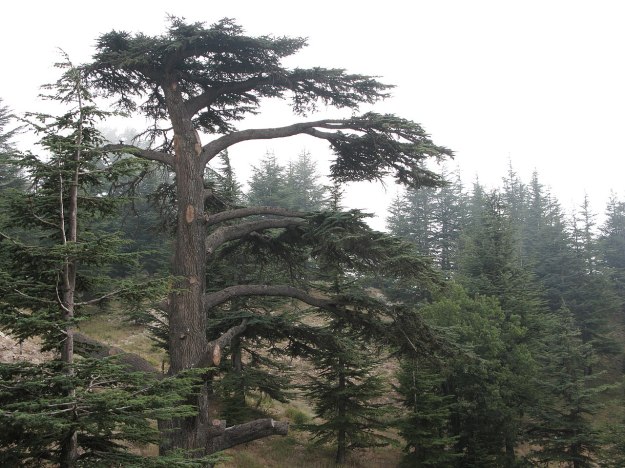
Cedar of Lebanon (Cedar of God), Lebanon By © Vyacheslav Argenberg / http://www.vascoplanet.com/, CC BY 4.0, https://commons.wikimedia.org/w/index.php?curid=92872076

1 Kings 5

1 Now King Hiram of Tyre sent his servants to Solomon, when he heard that they had anointed him king in place of his father; for Hiram had always been a friend to David. 2 Solomon sent word to Hiram, saying, 3 “You know that my father David could not build a house for the name of the LORD his God because of the warfare with which his enemies surrounded him, until the LORD put them under the soles of his feet. 4 But now the LORD my God has given me rest on every side; there is neither adversary nor misfortune. 5 So I intend to build a house for the name of the LORD my God, as the LORD said to my father David, ‘Your son, whom I will set on your throne in your place, shall build the house for my name.’ 6 Therefore command that cedars from the Lebanon be cut for me. My servants will join your servants, and I will give you whatever wages you set for your servants; for you know that there is no one among us who knows how to cut timber like the Sidonians.”

7 When Hiram heard the words of Solomon, he rejoiced greatly, and said, “Blessed be the LORD today, who has given to David a wise son to be over this great people.” 8 Hiram sent word to Solomon, “I have heard the message that you have sent to me; I will fulfill all your needs in the matter of cedar and cypress timber. 9 My servants shall bring it down to the sea from the Lebanon; I will make it into rafts to go by sea to the place you indicate. I will have them broken up there for you to take away. And you shall meet my needs by providing food for my household.” 10 So Hiram supplied Solomon’s every need for timber of cedar and cypress. 11 Solomon in turn gave Hiram twenty thousand cors of wheat as food for his household, and twenty cors of fine oil. Solomon gave this to Hiram year by year. 12 So the LORD gave Solomon wisdom, as he promised him. There was peace between Hiram and Solomon; and the two of them made a treaty.

13 King Solomon conscripted forced labor out of all Israel; the levy numbered thirty thousand men. 14 He sent them to the Lebanon, ten thousand a month in shifts; they would be a month in the Lebanon and two months at home; Adoniram was in charge of the forced labor. 15 Solomon also had seventy thousand laborers and eighty thousand stonecutters in the hill country, 16 besides Solomon’s three thousand three hundred supervisors who were over the work, having charge of the people who did the work. 17 At the king’s command, they quarried out great, costly stones in order to lay the foundation of the house with dressed stones. 18 So Solomon’s builders and Hiram’s builders and the Gebalites did the stonecutting and prepared the timber and the stone to build the house.

The reign of Solomon sets in motion dramatic changes for Israel. The mobilization to build the temple is a massive undertaking requiring international cooperation for materials. Traditionally most interpreters of these early portions of Solomon’s reign have viewed the preparation and the construction of the temple as examples of the wisdom and faithfulness of Solomon to the LORD. However, there are multiple perspectives related to the temple and the building projects of Solomon and that are woven together in the report of 1 Kings on this massive undertaking which dramatically changes the religious landscape of the people.

The tabernacle constructed during the journey from Egypt to the promised land was to be a place where God could dwell among the people, but it was a tent designed to travel with the people. Once the people entered the land of Canaan there were several worship sites throughout the land, but the worship of the LORD often was modeled after the worship of the deities of the surrounding peoples. From a perspective of unifying the worship of the LORD in a common place and with a common practice the temple has the potential to be a unifying place where the name of the LORD can dwell, and the priest can hand on the law and its interpretation to the people. Israel had never before had a permanent place to worship the LORD or a place to become a central symbol of God’s presence among the people.

Yet, even when King David wants to build the temple of God during his reign he is met with the response of a God who is flattered but who refuses to be confined to a permanent place. While God indicates that David’s son will eventually build a house of cedar for the LORD, there is a thread of discomfort within the passage about God’s presence not being able to move among the people (2 Samuel 7: 1-17). The compromise in the construction is that temple will be a house ‘for the name of the LORD my God’ and not a place where God’s presence is limited to. God’s freedom will continue to expand beyond the temple. God will deign to show God’s presence in this place, but God will not be limited to only being present in this place among the people.

In the construction of a place of worship the expectation is that people will contribute their best to the endeavor. This was the practice in the construction of the tabernacle and Moses was reported to have more than enough for the project by a freewill offering (Exodus 35). Now the temple is the first public project of the Solomon regime, and it is done by the mechanism of taxation and forced labor. The temple may be a great public good, but the question of cost is subtly raised here in the text along with the broader question of what type of nation Israel is becoming. The negotiations between King Hiram and King Solomon may be necessary to secure the materials and good relations to ensure peace during the construction of the temple. Yet, the project comes with an extremely high price tag.

King Hiram of Tyre provided lumber and people skilled in construction when David established his household in Jerusalem after he conquered it. There is no indication of the cost David paid the King of Tyre for these resources and craftsmen, but this trade agreement marks the entry of Israel onto a much broader stage. Now in negotiations with the new king, Hiram continues to provide lumber and craftsmen in exchange for the agricultural produce of the land. In addition to supplying the needs of the household of Solomon, now the land must support the burden of the household of King Hiram of Tyre. Choon-Leong Seow names this section “Shady Deals and Oppressive Policies” (NIB III: 56) and it is likely that the deal cut between Solomon and this Phoenician king well versed in international trade is more favorable to the King of Tyre than the people of Israel. Looking closely at the amount of wheat and oil given it quickly becomes apparent that the numbers here are large. Roughly twice the amount of grain collected for Solomon’s household is given annually to the King of Tyre, and if you follow the Hebrew (unlike the NRSV which follows the Greek Septuagint in its translation) the 2,000 cors (almost 7,000 gallons) of oil is a wealth of agricultural resources traded for the cedar. The cedars of Lebanon are often associated with affluence and their use by the people of Israel comes at a high annual price tag. It is possible that Israel enjoyed many years of great harvests that may have made the construction projects bearable but knowing the stresses on the population by the end of Solomon’s reign we can see the beginning of the internal strain within the nation.

In addition to the cost in agricultural production is the cost in conscripted forced labor. As mentioned earlier, the people of Israel were the forced labor for construction in Egypt and this new project which in the text mobilizes over one hundred eighty thousand men for log cutting and transport, stone cutting and transport, and construction is another strain on the population. It is possible that Judah is excluded from this conscription (NIB III: 58) like it is possible they were excluded from the provision for Solomon’s household in the previous chapter, but this is assuming a differentiation between Israel and Judah. It also is a return to the ways of Egypt where the king enslaves the people and wealth of the nation is owned by the ruler.

The construction of the temple will be a focal point for the reign of Solomon and for the worship of the southern kingdom of Judah after his death. The temple of Solomon will stand as a central fixture of Jerusalem for centuries and will be a symbol of the faith of the people. Yet, the process of construction sounds some ominous notes as it becomes a public work that is done by the taxation and forced labor of the people. The suspicious part of my mind wonders if this is like the public work projects throughout the former Warsaw Pact countries where beautiful train stations, government buildings, and public spaces were constructed while the majority of the population lived in deprivation. Solomon’s early reign is rapidly changing the city of Jerusalem and the manner in which the population of the nation is governed. This place created for the name of God will be a source of public focus for many generations, but we are primed to wonder about the cost that this great building will exact not only on the wealth of the people but also on their identity.

Psalm 48 God and Zion

Panorama of the Temple Mount from the Mount of Olives by Bienchido shared under Creative Commons 4.0

 Psalm 48

<A Song. A Psalm of the Korahites.>
1 Great is the LORD and greatly to be praised in the city of our God. His holy mountain,
2 beautiful in elevation, is the joy of all the earth, Mount Zion, in the far north, the city of the great King.
3 Within its citadels God has shown himself a sure defense.
4 Then the kings assembled, they came on together.
5 As soon as they saw it, they were astounded; they were in panic, they took to flight;
6 trembling took hold of them there, pains as of a woman in labor,
7 as when an east wind shatters the ships of Tarshish.
8 As we have heard, so have we seen in the city of the LORD of hosts, in the city of our God, which God establishes forever. Selah
9 We ponder your steadfast love, O God, in the midst of your temple.
10 Your name, O God, like your praise, reaches to the ends of the earth. Your right hand is filled with victory.
11 Let Mount Zion be glad, let the towns of Judah rejoice because of your judgments.
12 Walk about Zion, go all around it, count its towers,
13 consider well its ramparts; go through its citadels, that you may tell the next generation
14 that this is God, our God forever and ever. He will be our guide forever.

In the previous two psalms we have celebrated God as our refuge (Psalm 46) and God as King (Psalm 47) and now we see God’s Kingship occupying a specific place of refuge: the city of Jerusalem and the temple. The city of Jerusalem and the temple were two central signs of God’s promised protection and presence. Although I can understand the remark of Walter Bruggemann and William H. Bellinger, Jr. that the beginning and ending of the psalm in their symmetry and structure of, “nearly equating the God of the temple with the beauty and symmetry of it.” (Brueggemann, 2014, p. 224) I tend to view the message of the psalm in a more positive light appreciating the presence of God in a holy space. There is always a danger of identifying a structure or item designated for God’s worship and glory becoming an idol in the mind of the worshipper. Yet, we do seek places where God’s presence can be felt amid a world where God’s presence may be harder to identify and God’s refuge in a world that can feel fraught with dangers. The city, the mountain and the temple should all be spaces where the LORD is praised. At its best the beauty and security of the temple and city create a little piece of heaven on earth where God’s presence seems closer. Religious buildings, from the humblest to the most elaborate, attempt to create a safe and holy place for God’s people to come together and where God’s presence is felt and communicated.

Jerusalem as city is merely stone, wood, cloth and metal inhabited by the people who dwell in and around it. Yet, in the minds of the faithful it becomes something far greater. As J. Clinton McCann, Jr. can state, “Jerusalem is important because it is God’s place; thus it can serve as a witness to God’s character.” (NIB IV: 821) It becomes a place of hope and aspiration where in the words of the prophet Isaiah:

In the days to come the mountain of the LORD’s house shall be established as the highest of the mountains, and shall be raised above the hills; all the nations shall stream to it. Isaiah 2: 2

Nancy deClaissé-Walford points to how the psalm appropriates the language of the Canaanites that was used to worship Baal. God ss the one who ascends the mountain in the north instead of Baal, Zion replaces Zaphon as the place of sanctuary and the place from which the God of Israel reigns as King over all other gods and nations. (Nancy deClaisse-Walford, 2014, p. 435) Like Psalm 29, the people transformed the language of the surrounding culture to give worship and praise to the LORD of hosts. This serves both a polemical function, the LORD is God and King instead of Baal, but also reflects the process of trying to come up with language that can be used to talk about God and the willingness of the Jewish people to repurpose imagery that seemed appropriate for their LORD.

In contrast to the hope in Isaiah 2 where the nations stream to Zion seeking teaching and wisdom, we see the kings of the earth assembling to assault Jerusalem. Yet, like Psalm 2: 1-6, the conspiring of the kings of the nations only exposes their weakness. It is possible that Psalm 48 references the failed siege of King Sennacherib of Assyria in 701 B.C.E. (2 Kings 18-19) but the psalm may be independent of this experience of liberation in the memory of the Jewish people. The kings who sought to conquer in strength flee in panic and trembling. Kings who are pictured as masculine symbols of conquest are transformed in the psalm to women in childbirth, an image in the ancient world that was the opposite of strength. Although I would disagree with the use of a woman in childbirth as an image of weakness it was a common image in the ancient world because of the intense pain and the high risk of death for women during childbirth in the ancient world. Devastating winds in ancient Israel were east winds. In Exodus 14:21 it was an east wind which drove back the Red Sea and in Jeremiah 18:17 God promise to scatter Israel before their enemy “Like the wind from the east.”

The reality of God as the refuge for the people of Zion moves from being something handed down from previous generations to the experienced reality of the city of Zion. Once they had heard of God’s steadfast love, victory and judgements but now they can rejoice because they have experienced these things. The threat from the other nations has passed and they can walk around an examine both the physical walls and barriers that surround the city but also reflect upon the God who is the true refuge for the faithful people. They will now have their own experience of God’s faithfulness to share with future generations for their God will endure forever and ever.

For those of us who hear the words of this psalm in our own time we may wonder where we go to experience the presence and protection of God? What are times where we experienced God’s power so that we could speak of our own experience of God rather than the experience of our ancestors? What language do we use to talk about God and how has it changed from the language our parents or grandparents used? What places do we consider sacred or holy and why do we consider them to be sacred?

Exodus 26 The Tabernacle

Erection of the Tabernacle and Sacred Vessels by Gerard Hoet (1728)

Exodus 26

Moreover you shall make the tabernacle with ten curtains of fine twisted linen, and blue, purple, and crimson yarns; you shall make them with cherubim skillfully worked into them. 2 The length of each curtain shall be twenty-eight cubits, and the width of each curtain four cubits; all the curtains shall be of the same size. 3 Five curtains shall be joined to one another; and the other five curtains shall be joined to one another. 4 You shall make loops of blue on the edge of the outermost curtain in the first set; and likewise you shall make loops on the edge of the outermost curtain in the second set. 5 You shall make fifty loops on the one curtain, and you shall make fifty loops on the edge of the curtain that is in the second set; the loops shall be opposite one another. 6 You shall make fifty clasps of gold, and join the curtains to one another with the clasps, so that the tabernacle may be one whole.

 7 You shall also make curtains of goats’ hair for a tent over the tabernacle; you shall make eleven curtains. 8 The length of each curtain shall be thirty cubits, and the width of each curtain four cubits; the eleven curtains shall be of the same size. 9 You shall join five curtains by themselves, and six curtains by themselves, and the sixth curtain you shall double over at the front of the tent. 10 You shall make fifty loops on the edge of the curtain that is outermost in one set, and fifty loops on the edge of the curtain that is outermost in the second set.

 11 You shall make fifty clasps of bronze, and put the clasps into the loops, and join the tent together, so that it may be one whole. 12 The part that remains of the curtains of the tent, the half curtain that remains, shall hang over the back of the tabernacle. 13 The cubit on the one side, and the cubit on the other side, of what remains in the length of the curtains of the tent, shall hang over the sides of the tabernacle, on this side and that side, to cover it. 14 You shall make for the tent a covering of tanned rams’ skins and an outer covering of fine leather.1

 15 You shall make upright frames of acacia wood for the tabernacle. 16 Ten cubits shall be the length of a frame, and a cubit and a half the width of each frame. 17 There shall be two pegs in each frame to fit the frames together; you shall make these for all the frames of the tabernacle. 18 You shall make the frames for the tabernacle: twenty frames for the south side; 19 and you shall make forty bases of silver under the twenty frames, two bases under the first frame for its two pegs, and two bases under the next frame for its two pegs; 20 and for the second side of the tabernacle, on the north side twenty frames,21 and their forty bases of silver, two bases under the first frame, and two bases under the next frame; 22 and for the rear of the tabernacle westward you shall make six frames. 23 You shall make two frames for corners of the tabernacle in the rear; 24 they shall be separate beneath, but joined at the top, at the first ring; it shall be the same with both of them; they shall form the two corners. 25 And so there shall be eight frames, with their bases of silver, sixteen bases; two bases under the first frame, and two bases under the next frame.

 26 You shall make bars of acacia wood, five for the frames of the one side of the tabernacle, 27 and five bars for the frames of the other side of the tabernacle, and five bars for the frames of the side of the tabernacle at the rear westward. 28 The middle bar, halfway up the frames, shall pass through from end to end. 29 You shall overlay the frames with gold, and shall make their rings of gold to hold the bars; and you shall overlay the bars with gold. 30 Then you shall erect the tabernacle according to the plan for it that you were shown on the mountain.

 31 You shall make a curtain of blue, purple, and crimson yarns, and of fine twisted linen; it shall be made with cherubim skillfully worked into it. 32 You shall hang it on four pillars of acacia overlaid with gold, which have hooks of gold and rest on four bases of silver. 33 You shall hang the curtain under the clasps, and bring the ark of the covenant 1 in there, within the curtain; and the curtain shall separate for you the holy place from the most holy. 34 You shall put the mercy seat1 on the ark of the covenant 2 in the most holy place. 35 You shall set the table outside the curtain, and the lampstand on the south side of the tabernacle opposite the table; and you shall put the table on the north side.

 36 You shall make a screen for the entrance of the tent, of blue, purple, and crimson yarns, and of fine twisted linen, embroidered with needlework. 37 You shall make for the screen five pillars of acacia, and overlay them with gold; their hooks shall be of gold, and you shall cast five bases of bronze for them.

Constructing holy space is something every religious tradition has to think about and the way in which a tradition creates that space illuminates something about the people who worship there and the god or gods they attempt to worship. The tabernacle serves an unsettled people, a people who are still on their Exodus journey. It is designed to be transported across the wilderness and set up wherever the people dwell. It is a holy space for a God who is not associated with one particular place but rather a God that can move with the people and who desires to dwell among them. Even though there is the desire for a place where the LORD will dwell among the people there is still a need for zones of holiness. Paradoxically the God of Israel is viewed as being both unapproachable and yet approaching to dwell with the people. The tabernacle becomes a place to mediate the presence of the holy God.

The tabernacle is constructed out of the most valuable materials: Gold, silver and copper, acacia wood, died wool and tanned animal skins. Within the curtains, bars, bases and clasps used for the holiest regions the best material is used: gold and precious died wools in purple, blue and crimson. Wool, and in particular the three stated colors, may seem like an ordinary commodity in our time but in the ancient world purple, blue and crimson in particular are self-fixing colors that do not fade with the exposure to sun and water but are expensive to make because of the materials to make them being rare or dangerous to work with. (Myers, 2005, p. 235)  Purple was often a color associated with royalty precisely because of the cost of producing purple cloth. These curtains or sections are probably woven together and the cherubim designs are included as a part of the weaving. Each of these curtains is roughly forty two feet by six feet and a total of ten of these sections are made to enclose the most holy portion of the space. This is a space designed around the ark of the covenant described in the previous chapter that it will contain.

The worship space itself is big for a mobile structure, but it would not be big in terms of worship space that we would design for a modern congregation. Most of the people would never enter the tabernacle and certainly not the holy of holies with the ark, instead they would be outside the tabernacle while the priests would intercede, sacrifice and mediate the presence of the LORD to the waiting people. The curtains and bars and bases all set aside space and the ark, lampstand and table sit within the set aside space. It is the uncluttered worship space of an Exodus people.

Even when King David desires to build a temple (2 Samuel 7) there is resistance to the idea of transitioning from a tent and a tabernacle to a fixed temple. The LORD does not dwell in one specific place and within the construction of the temple there are some often unnoticed contrasts between the temple work and the tabernacle work. The tabernacle work comes from the voluntary offering of the people but the temple built under Solomon will involve conscripted labor and would be a part of the building projects that placed a heavy burden on the people and would eventually lead to the splitting of Israel away from Judah. Eventually the temple itself became such a focal point that it, the Davidic king and the city of Jerusalem became central for the identity of the people. During the Babylonian exile when Jerusalem, the king and the temple were lost the memory of God’s presence moving with the people in a mobile tabernacle may have been a source of comfort as they found themselves separated from their former home in a strange land and wondered how the LORD could be present.

Jeremiah 26 The Prophet, the Temple and the Elders

Jeremiah 26: 1-19 The Prophet, the Temple and the Elders

Ilya Repin, Cry of the Prophet Jeremiah on the Ruins of Jerusalem (1870)

Ilya Repin, Cry of the Prophet Jeremiah on the Ruins of Jerusalem (1870)

At the beginning of the reign of King Jehoiakim son of Josiah of Judah, this word came from the LORD: 2 Thus says the LORD: Stand in the court of the LORD’s house, and speak to all the cities of Judah that come to worship in the house of the LORD; speak to them all the words that I command you; do not hold back a word. 3 It may be that they will listen, all of them, and will turn from their evil way, that I may change my mind about the disaster that I intend to bring on them because of their evil doings. 4 You shall say to them: Thus says the LORD: If you will not listen to me, to walk in my law that I have set before you, 5 and to heed the words of my servants the prophets whom I send to you urgently– though you have not heeded– 6 then I will make this house like Shiloh, and I will make this city a curse for all the nations of the earth.

 7 The priests and the prophets and all the people heard Jeremiah speaking these words in the house of the LORD. 8 And when Jeremiah had finished speaking all that the LORD had commanded him to speak to all the people, then the priests and the prophets and all the people laid hold of him, saying, “You shall die! 9 Why have you prophesied in the name of the LORD, saying, ‘This house shall be like Shiloh, and this city shall be desolate, without inhabitant’?” And all the people gathered around Jeremiah in the house of the LORD.

                10 When the officials of Judah heard these things, they came up from the king’s house to the house of the LORD and took their seat in the entry of the New Gate of the house of the LORD. 11 Then the priests and the prophets said to the officials and to all the people, “This man deserves the sentence of death because he has prophesied against this city, as you have heard with your own ears.”

 12 Then Jeremiah spoke to all the officials and all the people, saying, “It is the LORD who sent me to prophesy against this house and this city all the words you have heard. 13 Now therefore amend your ways and your doings, and obey the voice of the LORD your God, and the LORD will change his mind about the disaster that he has pronounced against you. 14 But as for me, here I am in your hands. Do with me as seems good and right to you. 15 Only know for certain that if you put me to death, you will be bringing innocent blood upon yourselves and upon this city and its inhabitants, for in truth the LORD sent me to you to speak all these words in your ears.”

 16 Then the officials and all the people said to the priests and the prophets, “This man does not deserve the sentence of death, for he has spoken to us in the name of the LORD our God.” 17 And some of the elders of the land arose and said to all the assembled people, 18 “Micah of Moresheth, who prophesied during the days of King Hezekiah of Judah, said to all the people of Judah: ‘Thus says the LORD of hosts, Zion shall be plowed as a field; Jerusalem shall become a heap of ruins, and the mountain of the house a wooded height.’ 19 Did King Hezekiah of Judah and all Judah actually put him to death? Did he not fear the LORD and entreat the favor of the LORD, and did not the LORD change his mind about the disaster that he had pronounced against them? But we are about to bring great disaster on ourselves!”

This passage is traditionally linked with the ‘Temple Sermon of Jeremiah’ in Jeremiah 7 and into chapter 8 based on the dating and the circumstances lined out in the first lines. Jeremiah goes into the temple, the heart of the royal and priestly justification of the people’s favored status and compares the temple to Shiloh, which was an earlier site of the tabernacle site in the time of 1 Samuel. The prophet calls the people back to the two sided covenant of Deuteronomy, ‘If you will do these things, then you will be blessed, if you will not do these things you will be cursed.’ Since the construction of the temple by Solomon there has been a critique of the possibility of relying solely on the temple for maintaining the people’s status with God. For example when God answers Solomon’s prayer in 1 Kings 9, it relates the answer as this:

2 the LORD appeared to Solomon a second time, as he had appeared to him at Gibeon. 3 The LORD said to him, “I have heard your prayer and your plea, which you made before me; I have consecrated this house that you have built, and put my name there forever; my eyes and my heart will be there for all time. 4 As for you, if you will walk before me, as David your father walked, with integrity of heart and uprightness, doing according to all that I have commanded you, and keeping my statutes and my ordinances, 5 then I will establish your royal throne over Israel forever, as I promised your father David, saying, ‘There shall not fail you a successor on the throne of Israel.’

 6 “If you turn aside from following me, you or your children, and do not keep my commandments and my statutes that I have set before you, but go and serve other gods and worship them, 7 then I will cut Israel off from the land that I have given them; and the house that I have consecrated for my name I will cast out of my sight; and Israel will become a proverb and a taunt among all peoples. 8 This house will become a heap of ruins; everyone passing by it will be astonished, and will hiss; and they will say, ‘Why has the LORD done such a thing to this land and to this house?’ 9 Then they will say, ‘Because they have forsaken the LORD their God, who brought their ancestors out of the land of Egypt, and embraced other gods, worshiping them and serving them; therefore the LORD has brought this disaster upon them.'” (1Kings 9:2-9)

Yet in the time of King Jehoiakim this way of understanding the covenant with God is either forgotten or neglected. For the prophet claims of obedience to God’s law/Torah are more important than any human authority. This undercuts the certitude of not only Jehoiakim, but particularly here the priests in the temple where Jeremiah makes his proclamation. Their lives are invested in the maintaining of the centrality of the temple worship and the proclamation of the prophet threatens not only their temple with its words but their livelihood. The react quickly and harshly demanding the death of Jeremiah because he has spoken against the temple and the city and bring him before the leadership of the city. It is a tense picture painted where the priest and temple authorities and the crowd have surrounded the prophet and the city leaders quickly move to bring calm to the situation and hold judgment in the case of this troublesome prophet.

For his part, Jeremiah denies nothing that he is accused of and yet he claims his role as a prophet of God speaking on God’s behalf and still in the hope of both the prophet and God that the people will hear and turn from their ways. What the priests have heard as condemnation is from Jeremiah’s perspective a hope for turning and rescue by God, but the words have fallen on unreceptive ears.  Jeremiah knows that his life rests in these officials’ hands and yet he warns them that if they take his life they will be liable for innocent blood.

The elder’s rely on the precedence of Micah, one of the examples of intertextuality in the Bible. This instance refers back to the prophet Micah who a century earlier had spoken harsh words against the city, and yet Micah was not killed by the leadership then. The ‘elders’ override the ‘priest’ and the historical memory of prophetic witness and Torah piety hold out in this case and the elders too are able to see this as an opportunity for repentance rather than a certain doom. Unfortunately for the people the repentance does not come as the priestly and royal authority are hostile to this message that Jeremiah proclaim.

Jeremiah 26:20-24 The Risk of the Prophetic Challenge


                20 There was another man prophesying in the name of the LORD, Uriah son of Shemaiah from Kiriath-jearim. He prophesied against this city and against this land in words exactly like those of Jeremiah. 21 And when King Jehoiakim, with all his warriors and all the officials, heard his words, the king sought to put him to death; but when Uriah heard of it, he was afraid and fled and escaped to Egypt.22 Then King Jehoiakim sent Elnathan son of Achbor and men with him to Egypt, 23 and they took Uriah from Egypt and brought him to King Jehoiakim, who struck him down with the sword and threw his dead body into the burial place of the common people.

 24 But the hand of Ahikam son of Shaphan was with Jeremiah so that he was not given over into the hands of the people to be put to death.

King Jehoiakim is not receptive to Jeremiah’s message, and while Jeremiah apparently has some protection from Ahikam son of Shaphan another prophet, Uriah son of Shemaiah does not. The words of Uriah infuriate the king enough to send men into Egypt to capture, bring the prophet to the king and then to be killed by the king. This is not a welcome time for prophets and death and torture are real possibilities to ensure the message of King Jehoiakim is the dominant message heard.

The Place of Authority: A Brief History Part 2: King, Temple and the Prophetic Critique

David and King Saul, Rembrandt

David and King Saul, Rembrandt

 So Samuel reported all the words of the LORD to the people who were asking him for a king. He said, “These will be the ways of the king who will reign over you: he will take your sons and appoint them to his chariots and to be his horsemen, and to run before his chariots; and he will appoint for himself commanders of thousands and commanders of fifties, and some to plow his ground and to reap his harvest, and to make his implements of war and the equipment of his chariots. He will take your daughters to be perfumers and cooks and bakers. He will take the best of your fields and vineyards and olive orchards and give them to his courtiers. He will take one-tenth of your grain and of your vineyards and give it to his officers and his courtiers. He will take your male and female slaves, and the best of your cattle and donkeys, and put them to his work. He will take one-tenth of your flocks, and you shall be his slaves. And in that day you will cry out because of your king, whom you have chosen for yourselves; but the LORD will not answer you in that day.” 1 Samuel 8.10-18


At roughly 1,020 BCE a decisive change takes place and Israel enters the time of monarchy.  Power becomes consolidated briefly under King Saul.  Two men, King Saul and Samuel, whose title before had been that of a judge but functioned as a mouthpiece for God at this point, hold the religious and political authority.  Israel begins to act as a powerful actor in the region, constantly moving from one conflict to another, but internal conflict emerges when David emerges on the scene.  Without getting bogged down in the story or trying to parse out what happened historically  by 1000 David would unify his power as king and Israel became for a brief shining moment a power player on the world stage, Jerusalem becomes the capitol, and then perhaps decisively for this era the temple is established under Solomon.   Especially for the Southern Kingdom of Judah this is decisive because the monarchy and the temple become linked as the dominant secular/religious authority. There is a prophetic voice within that critiques the monarchy and temple, but for the most part the people give up a portion of their freedom for the relative security, power and identity of being a part of the unified kingdom of Israel.  That is not to say that family, clan and tribe have lost their power or authority, but that the people become much more linked to the kings and temple than at any previous point in their history.

This is probably a good point for a fun interlude, it is hard for us to imagine being bound in systems where our autonomy is defined so externally.  We don’t have any experience of a monarchical system and so our reaction might be somewhat like the peasants in this scene from Monty Python and the Holy Grail.  Even a romanticized king when we look from our perspective seems like a tyranny or despot.

Even though King David is often looked upon romantically like the King Arthur of legend, one of the incredible things is that the recorded memory of David includes many ugly situations, many family struggles, many times where he is at odds with the prophetic voice of the time.  The whole Bathsheba and Uriah episode (2 Samuel 10-12), incest within the royal family (2 Samuel 13) and eventually the usurpation of the throne by his son Absalom (2 Samuel 15-19) as well as other internal rebellions are a part of David’s roughly forty years of consolidated rule.  Even though the King amasses incredible authority previously unattainable in anyone’s imagination the constant warfare and internal struggles begin to wear on the people.  By the time Solomon, David’s son, ascends to the throne it is a relatively peaceful time but the energy is directed internally on large building projects, the temple, but also many houses and palaces for Solomon and his entourage. The temple becomes, at least for a large group of people, the central focus of worship, and yet again just like with the idea of consolidating power with a king there is a large amount of space dedicated to the critique of the temple

 King Solomon conscripted forced labor out of all Israel; the levy numbered thirty thousand men. He sent them to the Lebanon, ten thousand a month in shifts; they would be a month in the Lebanon and two months at home; Adoniram was in charge of the forced labor. Solomon also had seventy thousand laborers and eighty thousand stonecutters in the hill country, besides Solomon’s three thousand three hundred supervisors who were over the work, having charge of the people who did the work. At the king’s command, they quarried out great, costly stones in order to lay the foundation of the house with dressed stones. So Solomon’s builders and Hiram’s builders and the Gebalites did the stonecutting and prepared the timber and the stone to build the house.  1 Kings 5.13-18 NRSV

This is a huge commitment of people and resources which are directed internally.  In fact it is such a strain that immediately upon Solomon’s death when Rehoboam takes power the people come and plead for relief:

Your father made our yoke heavy.  Now therefore lighten the hard service of your father and his heavy yoke that he placed upon us and we will serve you. 1 Kings 12.4 NRSV

To which the narrative has Rehoboam reply three days later in our language, ‘you ain’t seen nothing yet, you think my father made things hard on you?  Well prepare to be screwed!’ Most translations clean this up significantly…but the little thing that is thicker than his father’s loins is probably not a finger (see 1 Kings 12: 6-15 particularly v.10) Things are not nearly as clean in the Bible as we sometimes want to make them.  The people are offended, the kingdom splits apart and now there are two kings, two places of worship, a prophetic voice that continues to grow louder…but even with this prophetic voice within the Kingdom of Judah in the South and the Kingdom of Israel in the North growing stronger the fate of both nations is linked to the actions of kings and the worship at the temple in Judah and the worship at various sites in the North.  Particularly for the Southern Kingdom of Judah, so long as there is a Davidic king and the Temple who they are as the people of God seems secure.  Yet this too will change….

purple rose 01 by picsofflowers.blogspot.com