Tag Archives: Psalms

Psalm 12-Save Us from Ourselves

Bible Paintings in Castra center, Haifa- David and Batsheva, David and Avshalom

Bible Paintings in Castra center, Haifa- David and Batsheva, David and Avshalom

Psalm 12

To the leader: according to The Sheminith. A Psalm of David.
1 Help, O LORD, for there is no longer anyone who is godly;
   the faithful have disappeared from humankind.
2 They utter lies to each other;
  with flattering lips and a double heart they speak.
3 May the LORD cut off all flattering lips,
   the tongue that makes great boasts,
4 those who say, “With our tongues we will prevail;
   Our lips are our own—who is our master?”
 5 “Because the poor are despoiled, because the needy groan,
   I will now rise up,” says the LORD;
  “I will place them in the safety for which they long.”
6 The promises of the LORD are promises that are pure,
   silver refined in a furnace on the ground,
   purified seven times.
7 You, O LORD, will protect us;
   you will guard us from this generation forever.
8 On every side the wicked prowl,
   as vileness is exalted among humankind.
 
The Psalm begins as a cry for help and while the cry may come from an individual the cry goes forth on behalf of a community that no longer is the place it was intended to be. What was dreamed to be a place of faithfulness and trustworthy people has turned into a place where tongues have been loosed, boasts have been made and community has been destroyed. The double-hearted nature of the community has broken the heart of the Psalmist and sent them into a search for hope in the midst of the empty words they see in a community that was meant to be something much different. In a toxic environment where the tongues of those who are seeking their own interests rule the day the community of the faithful is in mortal peril.

Many leaders of communities have known times where the community, through conflict or by the actions of a bully, devolves into the opposite of its original intent. Unfortunately, it is all too common for churches and places of worship which preach forgiveness to become unforgiving. Sometimes the message of justice becomes perverted into a message of just-us, and sometimes the boastful words overpower the quiet insistence of those trying to follow whole heartedly. It is from this experience of disillusionment that the Psalmist cries for help. In a feeling of isolation and desolation where the faithful have been replaced by the duplicitous, the powerlessness of the Psalmist on their own is overpowering.

Family Systems Theory can talk about a Karpmann Drama Triangle where people are stuck into roles as the victim, oppressor or hero. Claus Westermann noted that in many of the Psalms of Lament that Israel or the speaker find themselves in the role of the victim where the LORD becomes the liberator of the speaker or Israel from their adversaries. (Brueggemann, 2014, p. 74) With the speaker in the role of the victim in the midst of their adversaries they are reliant upon God as their deliverer from their adversaries. This is the nature of the relationship that the people of God have with their deliverer. However, the danger is that these same people can easily move into the role of the oppressor where now the LORD must stand with the oppressed ones over against them. Perhaps, this is something that the Psalmist feels is now happening among their community. That the empty words have allowed the people to deny the contingency of their existence that is based upon their living into the covenant they have with the God of Israel.

The Psalmist sees those around him denying reality and doing violence to others in that denial. They have arrogated themselves into the position of being their own gods who no one can judge. (Nancy deClaisse-Walford, 2014, p. 156) Their tongues have become the small member that boasts of great exploits, setting fire to the world around them. (See James 3: 1-12) In claiming this place they have denied the reign of God feeling free to craft their own dominions.  Yet, as so often is the case, when the powerful and the boastful feel free to create their own realities it comes at the expense of the poor and the vulnerable. Whether the Psalmist can claim a spot among the alien, the widow and the orphan (the classic way that the Hebrew bible speaks of the vulnerable) or not they are aware of the way in which the law, the commandments and the ordinances of God attempt to create a society where the oppressed are cared for. Yet, as the community moves away from its groundings and devolves into a place where unpleasant truths are denied at the expense of a more convenient illusion it also becomes a place that loses its understanding of hospitality and mercy.

The Psalm rests on the confidence that God will see and God will intervene even when the immediate evidence may point in the opposite direction. In a place where vileness is exalted among humanity and the poor are despoiled and the needy groan the Psalmist sees beyond the present moment to a hopeful future where God sees and acts. The Psalms understand, like the rest of the Bible, that God acts on behalf of the powerlessness and has an ear for the cries of the poor and oppressed.  It is in the LORD’s answer, “I will now rise up” that the Psalmist trusts. The LORD has acted in the past; the LORD’s promises are true and precious. In comparison to the dross the Psalmist hears spoken around him the promises of God to them are like pure silver. As Mary can sing in Luke’s gospel the time is coming when:

He has shown the strength with his arm; he has scattered the proud in the thoughts of their hearts.
He has brought down the mighty from their thrones, and lifted up the lowly;
He has filled the hungry with good things, and sent the rich away empty.
He has helped his servant Israel, in remembrance of his mercy,
according to the promise he made to our ancestors, to Abraham and to his descendants forever. (Luke 1: 51-55)


Psalm 11: Confident Faith in the Midst of Trouble

Giovanni Francesco Barberi (il Guercino), King David (1651)

Giovanni Francesco Barberi (il Guercino), King David (1651)

Psalm 11

To the leader. Of David.
1 In the LORD I take refuge; how can you say to me,
“Flee like a bird to the mountains;
 2 for look, the wicked bend the bow,
they have fitted their arrow to the string,
to shoot in the dark at the upright in heart.
 3 If the foundations are destroyed, what can the righteous do?”
 4 The LORD is in his holy temple;
the LORD’s throne is in heaven.
His eyes behold, his gaze examines humankind.
 5 The LORD tests the righteous and the wicked,
and his soul hates the lover of violence.
 6 On the wicked he will rain coals of fire and sulfur;
a scorching wind shall be the portion of their cup.
 7 For the LORD is righteous;
he loves righteous deeds;
the upright shall behold his face.

This is another Psalm where we do not know the threat that David (Psalm 11 is attributed to David) faces, yet the advice to flee like a bird to the mountains because of the strength of those opposing the speaker poetically evokes a mortal threat. Yet there is a defiance in the initial line which sets the tone for the rest of the Psalm, “In the LORD I take refuge.” The Psalmist trusts that, even in the midst of a life threatening situation, the LORD sees and will act. This Psalm, like many of the Psalms, revolves around the active move to take refuge in the LORD and to trust that the LORD will act. It means relinquishing control over one’s future and to stand in the trust that even in the midst of the speaker’s powerlessness that God can indeed act on behalf of the righteous and against the wicked.

This defiant stance, of trusting the LORD in the presence of danger, is a frequent theme of the Psalmist. For the writers of the Psalms they trust that God does see, act and judge. That God sustains the righteous and will in time punish the wicked. The author’s trust in God enables them to place themselves into the position of danger even when they may feel powerless. This poetic approach to faith that trusts in the midst of crisis has been a balm for many of the faithful across the generations. Luther’s ‘A Mighty Fortress’, which is inspired by Psalm 46 is an echo of this type of faith. Yet, the Psalms are poetic and not dogmatic and just because the poet is able to appeal to the LORD in the midst of their situation does not condemn a person who may flee in a different situation.

In 1527, during the early reformation at Wittenberg, a case of Bubonic plague was discovered. The students were sent home but Luther remained in the city and was busy with pastoral and practical care of the sick. Late in the year Luther wrote an open letter on ‘Whether One May Flee From A Deadly Plague’ where Luther can endorse the type of faith that is stated here in the Psalm, because in times of death someone must stay: doctors, nurses, preachers and others necessary to care for the afflicted. But Luther also allows that there will be those whose faith is not at this place and they should be allowed to flee and that those who are unnecessary may be acting on a natural tendency, implanted by God to flee death and save one’s life. (Luther, 1989, pp. 736-755) Luther’s caution was not to condemn those whose walk of faith allowed them to flee like a bird to the mountains nor those who for the sake of the neighbor walked into the place where death seemed to reign.

Psalm 2 – The LORD’s Messiah

  Psalm 2

Why do the nations conspire, and the peoples plot in vain?
 2 The kings of the earth set themselves,
and the rulers take counsel together,
against the LORD and his anointed, saying,
 3 “Let us burst their bonds asunder, and cast their cords from us.”
 4 He who sits in the heavens laughs; the LORD has them in derision.
 5 Then he will speak to them in his wrath, and terrify them in his fury, saying,
 6 “I have set my king on Zion, my holy hill.”
 7 I will tell of the decree of the LORD: He said to me,
“You are my son; today I have begotten you.
 8 Ask of me, and I will make the nations your heritage,
and the ends of the earth your possession.
 9 You shall break them with a rod of iron,
and dash them in pieces like a potter’s vessel.”
 10 Now therefore, O kings, be wise; be warned, O rulers of the earth.
 11 Serve the LORD with fear, with trembling
 12 kiss his feet, or he will be angry, and you will perish in the way;
for his wrath is quickly kindled. Happy are all who take refuge in him.
  

Psalms 1 and 2 introduce the Psalter and while Psalm 1 highlights one of the major foci of the Jewish people, God’s law the Torah, Psalm 2 focuses on the Messiah, the Davidic King.  Perhaps this Psalm was at one point used in coronations or in some other ritual setting within the nation of Israel or later the kingdom of Judah, and it reflects back upon some mystical time when Israel was an empire that ruled over vassal kings. There is an idealization of the dominion and power of the Davidic kingship which reached its peak under Solomon and would from that point forward be a small kingdom caught among the rise and falls of empires in Egypt, Assyria and Babylon. Even with the focus on the Lord’s anointed (literally the Lord’s messiah) the focus, as through out the Psalter, is taking refuge in the Lord.

For Christians this is one of the Psalms that has often been read through the image of Jesus, particularly verse 7 “You are my son; today I have begotten you” and while Christians should not forget that this Psalm originally refers back to a Davidic king part of the living witness of scriptures allows people to hear the words echoed in a new way in a new era. Yet if one is going to listen to this Psalm in terms of Jesus one does have to wrestle with the militaristic language of verse 9 (You shall break them with a rod of iron, and dash them in pieces like a potter’s vessel) and yet this is not that much different from some of the triumphal language lifted up by Paul and others in the New Testament.

Bible paintings in the Castra center, Haifa-Samuel Annointing David and David and Goliath

Bible paintings in the Castra center, Haifa-Samuel Annointing David and David and Goliath


Psalm 1 and 2 taken together lift up the Torah and the Davidic King as two of the foci of the way of life outlined within the meditations contained within the Psalter and yet both Torah and King are to point back to the LORD. The linkage at the beginning of Psalm 1 (Happy are those who do not follow the advice of the wicked) and the end of Psalm 2 (Happy are those who take refuge in him) joins the king and the law together as ways in which God establishes God’s rule among God’s people. As in many of the other Psalms the LORD will laugh at the movements of the nations and empires and for a nation that frequently found itself under duress from other kings and rulers perhaps this Psalm was its own revelation of God’s rule in, with and under the movements of the kings and empires around them. Perhaps like King Arthur for the Anglo-Saxon time it reflects back to the time of the once and future king, the one who was a ‘man after God’s own heart.’ To a simpler or perhaps better time. Perhaps it is a part of the imagination and story that allows the people to maintain their identity in the midst of dispersion and exile, of disillusioned hopes of rebuilding the temple and their loss of power and status in the world. Perhaps this was one more way in which they were able to see the shade pulled back and trust that the LORD was the one who was in control rather than the other gods and lords and powers. And perhaps it is wise to remember that the Psalter is poetry which attempts to express truth that transcends the situation that the people may have found themselves in. Or perhaps a more cynical approach would look at this as a form of self-aggrandizement of the Davidic kings, granting themselves divine authority and  granting themselves a position of ‘sons of God’ in a way that the Caesars in Rome would later do in a different way.

I choose to read this in a non-cynical way. I am certainly influenced by the post-modern hermeneutic of suspicion but at a certain level I have had to learn to trust. To let the words wash over and to listen deeply for the wisdom in the poetry. The God of the Hebrew people, the same God the Christian people would come to know, was deeply involved in the world. Politics and power were not separate things but a part of the engaged and sacred reality of their God who engaged the world.  A God who can laugh at the movement of armies and empires and who is their refuge and strength as Psalm 46 and other places will remind them. Who when the kings of the earth seem to be taking counsel against the chosen people in Zion or in all times and places throughout the world, who still reigns and holds those who rebel against God’s rule in derision. The one who reads and approaches and meditates on the Psalter as a way of understanding how God approached them in the earth find the blessedness (happiness) by taking refuge in this hope, this poetry and this narrative.


Living a Godly Life: Prayer

jesus praying

I listen to a lot of different types of music, and each type of music has its own set of emotions that they play to. For example, one of the emotions that rock and metal wrestle with is despair and depression, , rap tends to play towards defiance, popular music towards desire, and country, one of its many emotions is regret. It isn’t hard to come up with song after song in country that deals with regret, in fact there is a long standing joke about what happens when you play a country song backwards, that you get your wife back, your family back, your home back, etc…and often the regret is due to putting efforts into the wrong things, for a brief sampling this is one of George Strait’s older songs King of the Mountain:

I gave her that diamond she dreamed of

And I bought her a home with a view

I took her to the end of the rainbow

But all I left her was blue


Seems I never had time to love her

And now it seems time just stands still

I thought I was king of the mountain

But I was only a fool on a hill

Now I start out this way because one of the reasons we struggle with prayer is we tend to treat God like the fool in the song, if our prayers are mainly asking for things we are setting ourselves up for a relationship of regret. Sometimes I think we treat God in our prayers like Santa Claus, and Santa Claus is great for a lot of things: Dear Santa for Christmas I would like: a new computer, a PS4, Gift Cards to my favorite restaurants and shops so I can get something for me, these books, these CDs, these movies, an even bigger flatscreen TV…OK you get the picture, but let me let you in on a little secret, we don’t love Santa. Oh he’s cool, but we don’t love him and we’re never satisfied with what he brings, there’s no real relationship there-he grants my wishes and as soon as I am done opening gifts I may find myself thinking “what’s next?” George Schwanenburg was the pastor of the church I grew up in, and he used to call the prayers that many people would say, “Gimme” prayers, and by extension the people who prayed them were “Gimme pigs.” God gimme this, God gimme that-and while there is nothing wrong with asking God for what we want and need, prayer is much more than that. Other times the only prayers people send up are the “Help” prayers. God, OK I’ve really made a mess of this and if you bail me out now, well….”

So what is this prayer thing all about, and how does it really help be draw closer to God? How does it help me love God? You see God doesn’t seek a relationship with us that is just based on giving and receiving, but on being present and spending time listening. In the midst of a noisy and busy world, prayer is the time we set aside to listen. There is a story told of Mother Teresa, who would spend hours in prayer each day, when she was interviewed once by a reporter, who asked her, “What do you say to God in all the time you spend in prayer?” and she replied, “Mostly I just listen.” Perplexed the journalist went on to ask her, “So what does God say in all that time” to which she replied, “Mostly God just listens too.”

I love the image from Psalm 141, which I would sing several times a week in seminary:
let my prayers rise up as incense before you, the lifting up of my hands as an offering to you.

It is my offering from my busyness back to God some of my time to be there and listen. It’s not about me, certainly I benefit from the time probably far more than God does, but it is one of the gifts I try to give to the relationship. It’s not that we have to worry too much as Lutherans of people being impressed or dazzled by our prayers, but ultimately it is not about us. And yet I do have to admit I am often skeptical of overtly public forms of prayer that call more attention to the individual than God, particularly with athletes it is pretty easy to wonder are they doing this to call attention to themselves or God. Prayer doesn’t have to be poetic or artistic or beautiful, and yet I sometimes thing we place that expectations on ourselves. For example when I ask in a group for someone to pray, often the response I get is everyone looking down at their toes, thinking, “if I just don’t make eye contact he won’t pick me.”Or the often unspoken feeling that somehow Erik and I are somehow closer to God and God pays more attention to our prayers than the prayers of anyone else.

Maybe from the Lord’s prayer we can learn something of what prayer is all about, and we begin with the relationship, Our Father…to which Luther states, God wants us to come to him boldly and in complete confidence as loving children come to a loving father.  Prayer and all communication takes place in the context of a relationship and God desires to have that close relationship with us. The prayer begins and ends with the desire that God may be praised and honored, and the prayer is offered in a sense of gratitude. One of my practices I have begun is the practice of writing thank you notes, now there are many reasons for me not to write a thank you note: I have horrible penmanship, there will always be things trying to fill my time and well they may even be important things, but I’ve learned that learning to say thank you is important to both my own well being (it puts me in a far better emotional state) and to the valuation of the relationship.

We pray for God’s kingdom to come, and as Luther says, “God’s kingdom comes on its own without our prayer, but we ask in this prayer that it may also come to us.” It is taking the time to ask God, what are your hopes and dreams for the world, what do you desire of me, what do you love? It goes back to learning more and more about the beloved and we ask that God’s will may be done on earth, which is a dangerous prayer for we may find ourselves being drawn into doing God’s will as we are drawn closer to God. Yes, we do ask for what we need, we do ask for forgiveness and we desire to become more like God an become forgiving people

There is no one right way to pray, nor is there one right way to be in love-but it takes time to get to know the beloved and no amount of presents can make up for absence. Without setting aside the time to talk and listen with God we may look back on regret on the relationship we longed for being reduced to wish lists and panic moments when it can be so much more.

purple rose 01 by picsofflowers.blogspot.com

The Place of Authority: A Brief History Part 3a: The Exile, the Crisis of Collapse

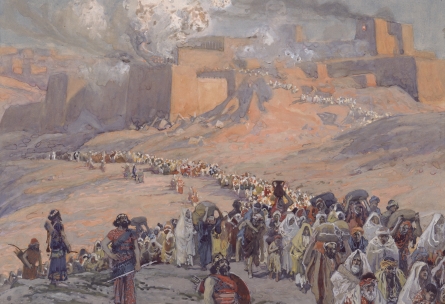
James Tissot, The Flight of the Prisoners

By the rivers of Babylon—there we sat down and there we wept when we remembered Zion. In the willows there we hung up our harps.For there our captors asked us for songs, and our tormentors asked for mirth, saying,

“Sing us one of the songs of Zion!”

How could we sing the Lord’s song in a foreign land? If I forget you, O Jerusalem, let my right hand wither! Let my tongue cling to the roof of my mouth, if I do not remember you,if I do not set Jerusalem above my highest joy. 

Remember, O Lord, against the Edomites the day of Jerusalem’s fall, how they said,

 “Tear it down! Tear it down! Down to its foundations!”

O daughter of Babylon, you devastator! Happy shall they be who pay you back what you have done to us! Happy shall they be who take your little ones and dash them against the rock!   Psalm 137 NRSV

In 721 BCE, after roughly 200 years of separation from the Southern Kingdom of Judah, the Northern Kingdom Israel falls to the Assyrian Empire (which has its origins in the Northwestern Part of modern day Iraq) and the Northern Kingdom is effectively absorbed into the Assyrian nation.  Somehow Judah holds on, even though it becomes completely surrounded by the Assyrian Empire.  Empires come and go, and power shifts to the Babylonian Empire (which has its origins in modern day Southern Iraq) without going into the bloody details: Jerusalem falls, the temple is destroyed, the Davidic monarchy effectively ends and the people of Judah are taken into exile or captivity in Babylon.  The loss of king and temple, as well as the land cause a crisis of authority which leads to one of the most constructive and important periods in Judaism.

The loss of home is catastrophic, it leads to a ton of questions about the future and there may not be any good answers at that point.  The closest cinematic example I could come up with was the loss of Anatevka in Fiddler on the Roof where families try to make the best of their coming exile, belittling what they are leaving behind-and yet families are broken apart, scattered across the world, many will never see each other again.

Something as catastrophic to not only the physical well-being but also to the communal consciousness can lead to several outcomes, many of which do emerge in this time. One response of the conquered is to assimilate with the conqueror, to align oneself with the victor, to adopt their values and practices and to set aside at least a portion of one’s previous identity to become a part of something different.  This is the perceived response of the Northern Kingdom by the Southern Kingdom-they stay on their land, intermarry with the Assyrians, and what emerges will be a hybrid people-no longer really Jewish, already separated from the Davidic monarchy and the temple hundreds of years before they become the other…the Samaritan (yes this is where those Samaritans that Jesus runs into in the New Testament come from).  But to be fair, a large number of the Judeans also assimilate into Babylon, only a small portion of the Judean people will return to their homeland at the end of the exile, most will remain dispersed throughout the nations.

In the lead up to the exile, the prophetic voice becomes very harsh in its critique of the monarchy, temple, the lack of economic justice within the nation, and the perceived idolatry of the shepherds of the nation.  This is the time where the first parts of Isaiah, much of Jeremiah and Ezekiel and many of the Minor Prophets become active in the memory of the people. The prophetic voice leads the way pointing to the ways in which kings and priests, throne and temple have not only failed as sources of authority but are at the very heart of the crisis viewed as a judgment from the LORD.  The prophets announce condemnation for the shepherds (the leaders, the authority in throne and temple) as one example among many:

The word of the Lord came to me: Mortal, prophesy against the shepherds of Israel: prophesy, and say to them—to the shepherds: Thus says the Lord God: Ah, you shepherds of Israel who have been feeding yourselves! Should not the shepherds feed the sheep? You eat the fat, you clothe yourselves with the wool, you slaughter the fatlings: but you do not feed the sheep. You have not strengthened the weak, you have not healed the sick, you have not brought back the strayed, you have not sought the lost, but with force and harshness you ruled them.  So they were scattered, because there was no shepherd: and scattered wandered over all the mountains and on every high hill; my sheep were scattered over the face of the earth, with no one to search or seek for them. Ezekiel 34.1-6 NRSV

 Instead of coming to believe that somehow their God is weaker than the gods of the Assyrians or the Babylonians, something amazing happens in the prophetic imagination (to use Walter Brueggemann’s keen words) and they begin to understand the transitions and the conflict around them as a part of God’s work—that behind Assyrian and Babylonian is the Lord of hosts (literally the Lord of armies-typically we think of this as heavenly armies, but I am beginning to think that in there is something more earthly to this term than often given credit). The coming destruction is a judgment particularly on the leaders, but also within all this death is the chance for something new: a fresh start, a redefinition, a chance to redefine and re-imagine what it means to be the chosen people.

The hand of the Lord came upon me, and he brought me out by the spirit of the Lord and set me down in the middle of the valley; it was full of bones.  He led me around them; there were very many lying in the valley, and they were very dry.  He said to me, “Mortal, can these bones live?” I answered, “O Lord God, you know.” Then he said to me, “Prophecy to these bones, and say to them: O dry bones, hear the word of the Lord. Thus says the Lord God to these bones: I will cause breath to enter you, and you shall live. I will lay sinews on you, and will cause flesh to come upon you, and cover you with skin, and put breath in you, and you shall live; and you shall know that I am the Lord. Ezekiel 37.1-6 NRSV

The prophetic voice will help the people re-imagine a new way forward, a way that is so critical to the way we understand things that we need to take some time with it.  Hope will not die, in fact it will be reborn in a new and powerful way and the people will understand themselves as a chosen people, but what that means takes a dramatic turn in the exile.  To that we shall turn next.

purple rose 01 by picsofflowers.blogspot.com