Tag Archives: Prophet Ezekiel

Ezekiel 33 The Beginning of Ezekiel’s Role After Jerusalem’s Fall

Poole, Paul Falconer; Sketch for ‘Vision of Ezekiel’; Tate; http://www.artuk.org/artworks/sketch-for-vision-of-ezekiel-201293

Chapter 33 of Ezekiel functions structurally as a hinge between the judgment of the previous thirty two chapters and the messages of hope that much of the remaining fourteen chapters involve. This chapter rearticulates numerous themes from throughout the early chapters but also helps to prepare us for the changed situation as the majority of the people find themselves in exile. Like the other biblical prophets, the movement to hope does not mean an abandonment of their message God’s desired repentance.

Ezekiel 33: 1-9 The Sentinel for the People

1 The word of the LORD came to me: 2 O Mortal, speak to your people and say to them, If I bring the sword upon a land, and the people of the land take one of their number as their sentinel; 3 and if the sentinel sees the sword coming upon the land and blows the trumpet and warns the people; 4 then if any who hear the sound of the trumpet do not take warning, and the sword comes and takes them away, their blood shall be upon their own heads. 5 They heard the sound of the trumpet and did not take warning; their blood shall be upon themselves. But if they had taken warning, they would have saved their lives. 6 But if the sentinel sees the sword coming and does not blow the trumpet, so that the people are not warned, and the sword comes and takes any of them, they are taken away in their iniquity, but their blood I will require at the sentinel’s hand.

7 So you, mortal, I have made a sentinel for the house of Israel; whenever you hear a word from my mouth, you shall give them warning from me. 8 If I say to the wicked, “O wicked ones, you shall surely die,” and you do not speak to warn the wicked to turn from their ways, the wicked shall die in their iniquity, but their blood I will require at your hand. 9 But if you warn the wicked to turn from their ways, and they do not turn from their ways, the wicked shall die in their iniquity, but you will have saved your life.

This rearticulation of Ezekiel’s role as a sentinel to the people of Israel echoes a similar passage in Ezekiel 3: 16-20. The word for sentinel in Hebrew (sopeh) comes from the shofar (trumpet/horn) which the watcher would blow. Ezekiel’s warning to the wicked and even the righteous may not be heeded, but he is under an obligation to sound the alarm announcing God’s judgment regardless. Both Hosea and Jeremiah[1] have performed this role of sounding a trumpet in the land or acting as a sentinel before and even if the people do not heed the trumpet call. Yet the prophet’s calling is to raise the alarm even if the people ignore the sound.

The wicked and the righteous are a common polarity used throughout wisdom literature, and Ezekiel who likely grew up schooled to be a priest was likely familiar with this way of engaging the world. Ezekiel uses the term wicked (rasa) more than any prophetic book, but the character of God is to desire repentance even among the wicked. The prophet is not to judge the worthiness of the recipients of God’s alarm but to raise the sound that they may hear. Even those who were once righteous but who commit iniquity are not exempt from God’s judgment. The ‘stumbling block’ (miksol) is “not an occasion for sin but a cause of downfall and ruin.” (NIB VI: 1135) As Katheryn Pfisterer Darr states about Ezekiel’s task,

His life depends solely on his performance of the task; it does not hang on the people’s response. Lives may be saved as a result of his warning. But Ezekiel is not told to hold that possibility before his audience. (NIB VI: 1135)

Like his older contemporary Jeremiah[2] he is charged with bearing an unpopular message to resistant people. Yet, as mentioned above the prophet is not in control. Ezekiel is called as a sentinel to the people, but his call does not come from the people. The words he is to speak are not his words, he is animated by a spirit not his own, and God’s hand will be upon him. Any unfaithfulness of Ezekiel will not save the wicked or righteous, but they will endanger the prophet.

Ezekiel 33: 10-20 The Justice of God’s Ways

10 Now you, mortal, say to the house of Israel, Thus you have said: “Our transgressions and our sins weigh upon us, and we waste away because of them; how then can we live?” 11 Say to them, As I live, says the Lord GOD, I have no pleasure in the death of the wicked, but that the wicked turn from their ways and live; turn back, turn back from your evil ways; for why will you die, O house of Israel? 12 And you, mortal, say to your people, The righteousness of the righteous shall not save them when they transgress; and as for the wickedness of the wicked, it shall not make them stumble when they turn from their wickedness; and the righteous shall not be able to live by their righteousness when they sin. 13 Though I say to the righteous that they shall surely live, yet if they trust in their righteousness and commit iniquity, none of their righteous deeds shall be remembered; but in the iniquity that they have committed they shall die. 14 Again, though I say to the wicked, “You shall surely die,” yet if they turn from their sin and do what is lawful and right — 15 if the wicked restore the pledge, give back what they have taken by robbery, and walk in the statutes of life, committing no iniquity — they shall surely live, they shall not die. 16 None of the sins that they have committed shall be remembered against them; they have done what is lawful and right, they shall surely live.

17 Yet your people say, “The way of the Lord is not just,” when it is their own way that is not just. 18 When the righteous turn from their righteousness, and commit iniquity, they shall die for it. 19 And when the wicked turn from their wickedness, and do what is lawful and right, they shall live by it. 20 Yet you say, “The way of the Lord is not just.” O house of Israel, I will judge all of you according to your ways!

This is the first time we have a confession of sin from the house of Israel in Ezekiel. The people have come a long way from when Ezekiel and other prophets were mocked for their words of doom that had not transpired. Now we hear, through Ezekiel, of a realization by the people that their actions have led to the deathlike state they inhabit.  They are weighed down by their sin and it has caused them to waste away[3] and they openly ask how they can live under the weight of their actions. This plaintive cry fits within the Hebrew tradition of lament to attempt to mobilize the God of Israel to bring about their deliverance from the deathlike state of exile. The answer that God grants through the prophet has a hopeful element to it that is often missed.

God’s response begins with the ‘oath of denial’ (NIB VI: 1446) “As I live” which places the trustworthiness of these words in connection with God’s life. The God of Israel immediately declares that God takes no pleasure in the death of the wicked and argues in a manner similar to Ezekiel 18. This may indeed be good news for people who are finally willing to accept responsibility for their previous actions and who are willing to turn from their past wickedness and embrace the way of righteousness. There is an opportunity for those who previously ignored their sentinel and continued in the ways of wickedness to turn and have their sins no longer remembered against them.

Throughout the book of Ezekiel the prophet has argued for the ‘justness’ of God. The current generation look at God’s patience with previous generations who continued to live in the land while they sinned and may have viewed their generation as bearing the judgment of their ancestors. Yet, for Ezekiel, God is just. God has repeatedly sent sentinels for the people, God has desired their repentance, and even now the judgment of God is not eternal. For Ezekiel the ways of God are simple: if the people turn from wickedness and live in righteousness there is a future. If they turn from righteousness to wickedness there is death. It is the classic pattern of wisdom literature in the bible.

Post Reformation Protestant readers often read scripture through the lens of God’s mercy, but the Hebrew Scriptures are probably better understood through being at the mercy of God. Both individuals and the people as a whole are dependent upon God for their protection and provision. There are times where they will protest the perceived injustice of God’s ways, but this is to provoke God to action rather than as a lack of faith. Ezekiel perceives the people’s future as dependent upon God’s action, and God’s action is tied to the people’s righteousness or wickedness.

Ezekiel 33: 21-29 The Fall of the City and Those Who Remain

21 In the twelfth year of our exile, in the tenth month, on the fifth day of the month, someone who had escaped from Jerusalem came to me and said, “The city has fallen.” 22 Now the hand of the LORD had been upon me the evening before the fugitive came; but he had opened my mouth by the time the fugitive came to me in the morning; so my mouth was opened, and I was no longer unable to speak.

23 The word of the LORD came to me: 24 Mortal, the inhabitants of these waste places in the land of Israel keep saying, “Abraham was only one man, yet he got possession of the land; but we are many; the land is surely given us to possess.” 25 Therefore say to them, Thus says the Lord GOD: You eat flesh with the blood, and lift up your eyes to your idols, and shed blood; shall you then possess the land? 26 You depend on your swords, you commit abominations, and each of you defiles his neighbor’s wife; shall you then possess the land? 27 Say this to them, Thus says the Lord GOD: As I live, surely those who are in the waste places shall fall by the sword; and those who are in the open field I will give to the wild animals to be devoured; and those who are in strongholds and in caves shall die by pestilence. 28 I will make the land a desolation and a waste, and its proud might shall come to an end; and the mountains of Israel shall be so desolate that no one will pass through. 29 Then they shall know that I am the LORD, when I have made the land a desolation and a waste because of all their abominations that they have committed.

Ezekiel reports the community in exile receiving the news of Jerusalem’s fall. The dating system makes the best sense if it follows the dating system referred to in Ezekiel 24, which follows the dating of 2 Kings and Jeremiah, rather than Ezekiel’s normal dating system. This allows the word to reach the exiles just under five months after the fall of Jerusalem, which seems like a long time for us, but if this is a person traveling with the first wave of new exiles traveling with families and animals by foot, the slow passage from Judah to Babylon is understandable. Travel in the ancient world was a slow and arduous process, especially when we are talking about moving entire communities. This confirmation of the destruction of the city now opens the possibility of Ezkiel opening his mouth to intercede for the people. Previously the prophet was not to intercede for the people, God no longer wanted to listen, but now the prophet’s mouth is opened.

Yet not all the inhabitants of Judah are deported. There is a remnant of people in the country and the poorest in the land. Now this remnant believes that they can now inherit the land, just as Abraham’s descendants did. This reference back to Abraham may involve a return to the story of the people, but the prophet’s words indicate that the actions of these remaining in Judah have not changed. The evocation of Abraham’s name has not brought about a reformation of practices. They still eat meat with blood in it, like the Gentiles, shed blood, and lift up their eyes to idols. The practices of the people have not changed. They depend on their ability to force their will by the sword, they commit the abominations that Ezekiel has protested throughout his time as a prophet, and they do not respect the boundaries of relations between neighbors. They have continued to practice wickedness and although they may have avoided punishment previously, their actions have not gone unseen by God. They stand under the same judgment that their neighbors enroute to Babylon or deceased in Judah endured. The evocation of Abraham’s name do not make them the heirs to the land.

If the people remaining in the land began appropriating the land, resources, and wealth left behind by the exiles and the dead they did not endear themselves to the exiles in Babylon or those enroute. Like the villainous Thenardiers couple in Les Misérables looting the corpses of the dead to ensure their prosperity, these remaining Judeans who benefited from the looting of Judah would likely be viewed in a similar way to the nations which took advantage of Jerusalem’s precarious position during and after the siege of the city. Ezekiel is one of our windows into this time in the life of the people of Judah, and we see a shattered and conflicted community. Sometimes the vultures picking over the corpse of the nation are not from outside the community, but those who see an opportunity for profiting off their neighbors’ misfortune.

Ezekiel 33: 30-33 The Toleration of the Prophet

30 As for you, mortal, your people who talk together about you by the walls, and at the doors of the houses, say to one another, each to a neighbor, “Come and hear what the word is that comes from the LORD.” 31 They come to you as people come, and they sit before you as my people, and they hear your words, but they will not obey them. For flattery is on their lips, but their heart is set on their gain. 32 To them you are like a singer of love songs, one who has a beautiful voice and plays well on an instrument; they hear what you say, but they will not do it. 33 When this comes — and come it will! — then they shall know that a prophet has been among them.

Even the people who now listen to Ezekiel’s words have not changed. The prophet may be the talk of the community, his words have not caused them to change. They like to listen to his words, they may have enjoyed his metaphors or sign actions, but they are entertained, not challenged to change. There will come a time when they understand this strange messenger is indeed a prophet among them, and many of Ezekiel’s words have come to pass. At this point, but for now the heart of the people has not changed. Their words may be kind or flattering. They may appreciate the prophet’s artistry, but they miss the point of the art.

[1] Hosea 9:8, Jeremiah 4: 5, 19, 21; 6: 1, 17; 51:27

[2] As Daniel Block notes (assuming that the thirtieth year at the beginning of Ezekiel reflects his age) Jeremiah would begin his ministry about the time Ezekiel was born. (Block, 1997, p. 148) It is likely that Ezekiel may have grown up knowing Jeremiah’s voice or message and both prophets share the challenging job of dismantling the theology that had grown up around Jerusalem, the temple, and the Davidic kings. Both were probably never popular but proved to be essential voices to make sense of the destruction of Jerusalem and the temple by Babylon.

[3] The Hebrew maqoq (NRSV waste away) is used elsewhere of gangrenous flesh. (Block, 1997, p. 246)

Ezekiel 31 Egypt as a Mighty Tree Cut Down

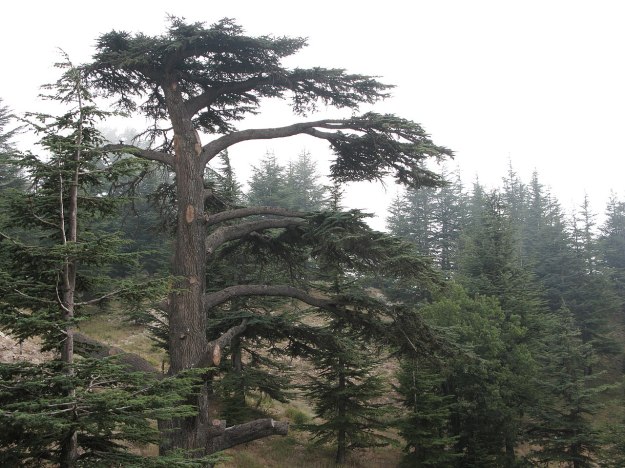
Cedar of Lebanon (Cedar of God), Lebanon By © Vyacheslav Argenberg / http://www.vascoplanet.com/, CC BY 4.0, https://commons.wikimedia.org/w/index.php?curid=92872076

Ezekiel 31

1In the eleventh year, in the third month, on the first day of the month, the word of the LORD came to me: 2Mortal, say to Pharaoh king of Egypt and to his hordes:
Whom are you like in your greatness?
3Consider Assyria, a cedar of Lebanon,
with fair branches and forest shade,
and of great height,
its top among the clouds.
4The waters nourished it,
the deep made it grow tall,
making its rivers flow
around the place it was planted,
sending forth its streams
to all the trees of the field.
5So it towered high
above all the trees of the field;
its boughs grew large
and its branches long,
from abundant water in its shoots.
6All the birds of the air
made their nests in its boughs;
under its branches all the animals of the field
gave birth to their young;
and in its shade
all great nations lived.
7It was beautiful in its greatness,
in the length of its branches;
for its roots went down
to abundant water.
8The cedars in the garden of God could not rival it,
nor the fir trees equal its boughs;
the plane trees were as nothing
compared with its branches;
no tree in the garden of God
was like it in beauty.
9I made it beautiful
with its mass of branches,
the envy of all the trees of Eden
that were in the garden of God.
10Therefore thus says the Lord GOD: Because it towered high and set its top among the clouds, and its heart was proud of its height, 11I gave it into the hand of the prince of the nations; he has dealt with it as its wickedness deserves. I have cast it out. 12Foreigners from the most terrible of the nations have cut it down and left it. On the mountains and in all the valleys its branches have fallen, and its boughs lie broken in all the watercourses of the land; and all the peoples of the earth went away from its shade and left it.
13On its fallen trunk settle
all the birds of the air,
and among its boughs lodge
all the wild animals.
14All this is in order that no trees by the waters may grow to lofty height or set their tops among the clouds, and that no trees that drink water may reach up to them in height.
For all of them are handed over to death,
to the world below;
along with all mortals,
with those who go down to the Pit.
15Thus says the Lord GOD: On the day it went down to Sheol I closed the deep over it and covered it; I restrained its rivers, and its mighty waters were checked. I clothed Lebanon in gloom for it, and all the trees of the field fainted because of it. 16I made the nations quake at the sound of its fall, when I cast it down to Sheol with those who go down to the Pit; and all the trees of Eden, the choice and best of Lebanon, all that were well watered, were consoled in the world below. 17They also went down to Sheol with it, to those killed by the sword, along with its allies, those who lived in its shade among the nations.
18Which among the trees of Eden was like you in glory and in greatness? Now you shall be brought down with the trees of Eden to the world below; you shall lie among the uncircumcised, with those who are killed by the sword. This is Pharaoh and all his horde, says the Lord GOD.

This fifth oracle against Egypt is like Ezekiel’s earlier oracle against the King of Tyre where the king is highlighted for their beauty and preeminent state among the garden of Eden.[1] Like that previous oracle the one who excels all others is brought low as they exceed their station as a creation of God. Although this oracle is directed against Pharoah and his hordes, it only mentions Pharoah or Egypt in the first and last verse, the rest of the oracle uses Assyria as an example for Egypt to heed. Assyria who was once the great empire in the north has collapsed and dragged all who allied themselves with her down to Sheol, and the same fate awaits proud Egypt in this oracle.

It is likely that Ezekiel is building upon Isaiah’s imagery in Isaiah 2:11-13 linking pride and great trees.

The haughty eyes of people shall be brought low, and the pride of everyone shall be humbled; and the LORD alone will be exalted in that day. For the LORD of hosts has a day against all that is proud and lofty, against all that is lifted up and high; against all the cedars of Lebanon, lofty and lifted up; and against all the oaks of Bashan;

Just as Daniel will probably utilize Ezekiel’s imagery in his own image in Daniel 4: 10-17 and Jesus alludes to this imagery in his parable of the mustard seed.[2] Yet, Ezekiel’s usage is the longest sustained use of this metaphor.

This oracle is dated almost two months after the previous one, June 21, 587 BCE. The city of Jerusalem is still besieged by Babylon, and it is possible that Babylon has already repulsed the Egyptian attempts to lift the siege. Egypt has been one of the significant powers in the ancient world throughout Israel’s history, and Egypt has continually exerted influence in the region around Israel. Now Egypt in this parable is told to look at a metaphor of Assyria. Assyrian was the great empire in the north prior to the emergence of the Babylonian empire. There are some translators who view Assyria’s presence here as a mistake, but thematically it makes sense to use a metaphor about Assyrian to demonstrate to Egypt that it too can fall from its great heights. Even though verses three through nine repeatedly refer to the beauty of this metaphorical tree and portray its majesty in an admirable light, like the earlier references to the King of Tyre, this is a case of prophetic satire. Although the kings of Assyria normally have the date palm as their image, the use of the cedar of Lebanon would be a well-known image of both size and strength, and a tree frequently used in royal and holy construction.

There are mythical elements in the background of this image, but they should not distract from the basic point that Pharoah and Egypt, according to the oracle, will share the same fate as Assyria. Although the waters nourished it and the deep made it grow tall, it will still fall when the prince of nations (King Nebuchadrezzar of Babylon) cuts it down. The waters and deep are the same Hebrew words used in Genesis 1:2 and this tree surpasses the trees of the garden of God (Eden) but ultimately, like the King of Tyre, its beauty, strength, and height cannot prevent its falling into the realm of the dead. The remnants of the tree fall on the mountains and valleys, just as the defeated ‘dragon’ in the next chapter will have its remains fall on the mountains, valleys, and waterways.[3] Now this great tree and all the lesser trees that inhabited the space under its branches find themselves in the Pit.

The very forces which once gave this great tree life now bury it in the depths. The rivers that flowed around it are now restrained and this once beautiful and living tree is now debris scattered upon the ground, or in other places brought down into the pit. The great tree and the empire it represents are now dead, and Egypt who is similarly a great tree is in danger from the same axe wielding prince of the nations. In the oracle Pharoah and all his armies cannot oppose God and God’s chosen instrument of vengeance King Nebuchadrezzar.

As mentioned before there are limited historical records from this period. We do know that Nebuchadrezzar does eventually turn his army to march on Egypt. Although the Babylonians have enjoyed multiple victories over Egypt, Egypt never becomes a part of the Babylonian empire. The great cedar tree which represents Egypt will stand at least for a time longer. Ezekiel interprets the actions of the king of Babylon and his forces as an extension of the will of the God of Israel. Even though Jerusalem is under siege, the LORD’s actions, in Ezekiel’s mind, are just. The LORD is not merely the God of Israel but is at work in the movement of empires to bring about the will of God.

[1] Ezekiel 28.

[2] Matthew 13: 31-32, Mark 4: 30-32, Luke 13: 18-19

[3] Ezekiel 32: 5-6.

Ezekiel 30: Oracles Against Egypt Continued

A stele dating to the 23rd regnal year of Amasis, on display at the Louvre

Ezekiel 30: 1-19 The Third Oracle Against Egypt: The Day of The LORD

1The word of the LORD came to me: 2Mortal, prophesy, and say, Thus says the Lord GOD:
Wail, “Alas for the day!”
3For a day is near,
the day of the LORD is near;
it will be a day of clouds,
a time of doom for the nations.
4A sword shall come upon Egypt,
and anguish shall be in Ethiopia,
when the slain fall in Egypt,
and its wealth is carried away,
and its foundations are torn down.
5Ethiopia, and Put, and Lud, and all Arabia, and Libya, and the people of the allied land shall fall with them by the sword.
6Thus says the LORD:
Those who support Egypt shall fall,
and its proud might shall come down;
from Migdol to Syene
they shall fall within it by the sword,
says the Lord GOD.
7They shall be desolated among other desolated countries,
and their cities shall lie among cities laid waste.
8Then they shall know that I am the LORD,
when I have set fire to Egypt,
and all who help it are broken.
9On that day, messengers shall go out from me in ships to terrify the unsuspecting Ethiopians; and anguish shall come upon them on the day of Egypt’s doom; for it is coming!
10Thus says the Lord GOD:
I will put an end to the hordes of Egypt,
by the hand of King Nebuchadrezzar of Babylon.
11He and his people with him, the most terrible of the nations,
shall be brought in to destroy the land;
and they shall draw their swords against Egypt,
and fill the land with the slain.
12I will dry up the channels,
and will sell the land into the hand of evildoers;
I will bring desolation upon the land and everything in it
by the hand of foreigners;
I the LORD have spoken.
13Thus says the Lord GOD:
I will destroy the idols
and put an end to the images in Memphis;
there shall no longer be a prince in the land of Egypt;
so I will put fear in the land of Egypt.
14I will make Pathros a desolation,
and will set fire to Zoan,
and will execute acts of judgment on Thebes.
15I will pour my wrath upon Pelusium,
the stronghold of Egypt,
and cut off the hordes of Thebes.
16I will set fire to Egypt;
Pelusium shall be in great agony;
Thebes shall be breached,
and Memphis face adversaries by day.
17The young men of On and of Pi-beseth shall fall by the sword;
and the cities themselves shall go into captivity.
18At Tehaphnehes the day shall be dark,
when I break there the dominion of Egypt,
and its proud might shall come to an end;
the city shall be covered by a cloud,
and its daughter-towns shall go into captivity.
19Thus I will execute acts of judgment on Egypt.
Then they shall know that I am the LORD.

This third oracle against Egypt is undated. It may come early (during the siege of Jerusalem) like the first oracle or late (after the failed siege of Tyre) like the second oracle. It is sandwiched between a late oracle and an early one and either situation can fit this declaration against the Egyptians. My best guess is that it follows the timeline of the immediately preceding oracle but ultimately it makes little difference to the interpretation of the prophet’s words of judgment.[1]

Ezekiel’s third oracle against Egypt taps into the thematic day of the LORD. As I mention in my longer discussion on the Evolution of the Day of the LORD, this has been used both as a phrase indicating both judgment for Judah and salvation. Here the terrifying direction of the day of the LORD is directed against Egypt, and by extension the nations. Much of the day of the LORD language is thematic and has resonances across the prophets regardless of the direction of the judgment it implies. Ezekiel echoes Zephaniah 1:15[2] storm imagery:

That day will be a day of wrath, a day of distress and anguish, a day of ruin and devastation, a day of darkness and gloom, a day of clouds and thick darkness.

Although the Hebrew Scriptures continually remind the reader that the LORD is the creator of the heavens and the earth, the LORD’s power is often depicted coming from the sky. But here the judgment from the sky is paired with the judgment by sword from approaching armies. The LORD is both the Lord of heaven and earth and the LORD of hosts[3]. The LORD is moving in judgment against Egypt and any who stand with them in this oracle.

One of the reasons that people have been fascinated with Egypt has been its wealth. The wealth of the nation unearthed from the tombs of the kings of Egypt draws both modern interest but also drew ancient interest as well. Egypt’s elite hoarded this wealth, and this was to be one of the distinctions between the ways of Egypt and the ways of the people of Israel. Now this wealth or horde, (Hebrew hamon) will be taken away by the sword. That which they stored in temples and tombs will now become the reward for the wielder of the sword which causes both death and destruction for this proud empire. This focus on the wealth of Egypt being carried away links this to the previous oracle when Egypt’s wealth is to be the payment to Nebuchadrezzar for the effort and resources he expended against Tyre.

Ethiopia, Libya (Put), Asia Minor (Lud), the Arabians (literally mixed hordes), and an unknown people (NRSV Libya)[4]  and “the sons of the land of the covenant” (NRSV people of allied lands) all find themselves in danger of this approaching sword and storm. The Egyptians, like most ancient armies, had fighters from many lands which formed their army. Some may have been mercenaries; others were allied or vassal kingdoms. A similar dynamic is at work in Ezekiel’s metaphor of Tyre where the men of Paras, Lud, and Put were in their army and men of Arvad, Helech, and Gamad were archers on their walls.[5] The interesting addition to this list is the ‘sons of the land of the covenant’ who were likely Judean soldiers serving Egypt. There are several ancient sources who list Judean mercenaries serving in Egyptian campaigns, and there are Judean settlements in Egypt at the time of Ezekiel’s ministry.[6] Now these Judeans both serving and residing in Egypt are warned of the coming sword (assuming Ezekiel’s missive traveled to these communities).

The terror of this coming sword penetrates the length of the Nile into Ethiopia. Egypt had endured conflict before, but the communities on the eastern and northern edge of Egypt absorbed the threat. Ethiopians at the southern end of the Nile could benefit from the economic advantages of the river while being relatively safe from an invader coming from the Middle East. But now even these places at the edge of the Egyptian empire were no longer safe in the oracle. The ‘hordes’ or ‘wealth’ of Egypt will end under King Nebuchadrezzar of Babylon. This force coming from the north is portrayed as the ‘most terrible of nations.’

The destruction of Egypt’s wealth and military are paralleled by the loss of both the cities and the ‘gods’ of Egypt. Just as the ‘signs and wonders’ that the LORD utilized to bring the people of Israel out of Egypt struck at both the reign of Pharoah and the Egyptian gods[7] now the ‘idols’[8] and ‘images’ are destroyed as well as the cities where the temples are located.

The actions of Nebuchadrezzar’ army are paired with the actions of the LORD against the land. Nebuchadrezzar may wield the sword, but the LORD is drying up the channels of the Nile. At Tehaphnehes the day becomes dark[9] as it is covered by a cloud, echoing the day of the LORD imagery at the beginning of the oracle. The LORD of the heavens and earth wields the natural powers of destruction while the LORD of hosts dispatches the Babylonians with the sword against the Egyptians.

Ezekiel 30: 20-26 The Fourth Oracle Against Egypt Disarming Pharoah

20In the eleventh year, in the first month, on the seventh day of the month, the word of the LORD came to me: 21Mortal, I have broken the arm of Pharaoh king of Egypt; it has not been bound up for healing or wrapped with a bandage, so that it may become strong to wield the sword. 22Therefore thus says the Lord GOD: I am against Pharaoh king of Egypt, and will break his arms, both the strong arm and the one that was broken; and I will make the sword fall from his hand. 23I will scatter the Egyptians among the nations, and disperse them throughout the lands. 24I will strengthen the arms of the king of Babylon, and put my sword in his hand; but I will break the arms of Pharaoh, and he will groan before him with the groans of one mortally wounded. 25I will strengthen the arms of the king of Babylon, but the arms of Pharaoh shall fall. And they shall know that I am the LORD, when I put my sword into the hand of the king of Babylon. He shall stretch it out against the land of Egypt, 26and I will scatter the Egyptians among the nations and disperse them throughout the countries. Then they shall know that I am the LORD.

For this fourth oracle we once again have a date, and the date helps provide a context for this message. April 29, 587 BCE would be almost four months after the initial oracle and roughly four months before the destruction of Jerusalem. Jeremiah 37: 5-10 indicates that Pharoah did come to Jerusalem’s aid causing a temporary removal of the siege while Nebuchadrezzar turned his forces to deal with the Egyptian incursion, and that likely set the background for Ezekiel’s first oracle against Egypt. We know that the Egyptian forces did not remain and either retreated or suffered a defeat before the Babylonians. The time period of this oracle makes sense in a time after Egypt has been forced to retreat without providing liberation to Jerusalem.

The broken arm of Pharaoh is likely his weakened state after his initial defeat by Babylon. Egypt has suffered defeats to Babylon in the region before, but now this metaphorical wound which weakens Pharoah will not be bound or bandaged and allowed to heal properly. Now a weakened Pharoah with one remaining arm is left to oppose a Babylon with two strong arms, but even before the battle the LORD breaks Pharoah’s other arm as the arm of the king of Babylon is made strong and the LORD’s swords placed in his hand for judgment. Pharoah, once mighty, has now been disarmed and Egypt is vulnerable to this warrior who comes to deliver the LORD’s judgment.

[1] Many historical critical interpreters viewed this portion of Ezekiel as a later introduction by a different author of the “Ezekiel school” due to the lack of date and the language. Although it is worth acknowledging the insight of these scholars, Ezekiel often does not include a date and Ezekiel’s language varies widely throughout the book.

[2] Joel 2: 2 also utilizes this imagery, but Joel is most likely at 4th Century BCE prophet and is echoing Ezekiel or Zephaniah.

[3] The host referred to here is a military host in this commonly used title.

[4] Put is modern day Libya. The Hebrew kub could be another North African nation, but we simply do not know.

[5] Ezekiel 27:10-11.

[6] Jeremiah 24:8, 44:1.

[7] See my comments on Exodus 711.

[8] Hebrew gillum, Ezekiel’s coarse image for foreign idols.

[9] Eclipsing the sun god ‘Ra.’

Ezekiel 29 Against Pharoah of Egypt

Nile Crocodile Eating a Wildabeast in the Masai Mara By Arturo de Frias Marques – Own work, CC BY-SA 4.0, https://commons.wikimedia.org/w/index.php?curid=34596035

Ezekiel 29:1-9a

1In the tenth year, in the tenth month, on the twelfth day of the month, the word of the LORD came to me: 2Mortal, set your face against Pharaoh king of Egypt, and prophesy against him and against all Egypt; 3speak, and say, Thus says the Lord GOD:
I am against you,
Pharaoh king of Egypt,
the great dragon sprawling
in the midst of its channels,
saying, “My Nile is my own;
I made it for myself.”
4I will put hooks in your jaws,
and make the fish of your channels stick to your scales.
I will draw you up from your channels,
with all the fish of your channels
sticking to your scales.
5I will fling you into the wilderness,
you and all the fish of your channels;
you shall fall in the open field,
and not be gathered and buried.
To the animals of the earth and to the birds of the air
I have given you as food.
6Then all the inhabitants of Egypt shall know
that I am the LORD
because you were a staff of reed
to the house of Israel;
7when they grasped you with the hand, you broke,
and tore all their shoulders;
and when they leaned on you, you broke,
and made all their legs unsteady.
8Therefore, thus says the Lord GOD: I will bring a sword upon you, and will cut off from you human being and animal; 9and the land of Egypt shall be a desolation and a waste. Then they shall know that I am the LORD.

The oracles against Egypt are equal in length to all the previous oracles against the nation, and this seventh nation mentioned now receives seven oracles against it. Six of the seven are given specific dates with this first oracle being the earliest. This oracle is dated January 7, 587 BCE which is roughly one year into the eighteen-month siege of Jerusalem. Jeremiah 44:30 indicates that Pharoah Hophra is the king of Egypt at this point who is referred to throughout this oracle. Tova Ganzel (Ganzel, 2020, p. 272)connects this prophecy with the actions of Jeremiah 37:5-10:

Meanwhile, the army of Pharaoh had come out of Egypt; and when the Chaldeans who were besieging Jerusalem heard news of them, they withdrew from Jerusalem. Then the word of the LORD came to the prophet Jeremiah: Thus says the LORD, God of Israel: This is what the two of you shall say to the king of Judah, who sent you to me to inquire of me: Pharaoh’s army, which set out to help you, is going to return to its own land, to Egypt. And the Chaldeans shall return and fight against this city; they shall take it and burn it with fire. Thus says the LORD: Do not deceive yourselves, saying, “The Chaldeans will surely go away from us,” for they will not go away. Even if you defeated the whole army of Chaldeans who are fighting against you, and there remained of them only wounded men in their tents, they would rise up and burn this city with fire.

Although Ezekiel, unlike Jeremiah, was already in exile in Babylon it is likely that he and his fellow exiles were following events around Jerusalem. Ezekiel and Jeremiah both viewed Nebuchadrezzar’s siege of Jerusalem as God’s punishment and viewed the actions of the Egyptians as interference. Now amid what others in Judah may have considered a hopeful moment, Ezekiel speaks against the Egyptians (who many in Jerusalem would have looked to for aid at this time).

Ezekiel uses metaphor again, this time Pharoah Hophra is a great crocodile (NRSV great dragon) lying in the Nile. The Hebrew word tannin which in this image is obviously a crocodile like creature is often used with mythological overtones throughout scripture (hence the NRSV’s translation of great dragon) as a great monster or force of chaos which must be overcome. It is sometimes linked with both Rahab and Leviathan, and Job’s similar image of Leviathan is worth considering:

“Can you draw out Leviathan with a fishhook, or press down its tongue with a cord? Can you put a rope in its nose, or pierce its jaw with a hook? Job 41: 1-2.

Now Pharoah is drawn out with a hook, and with it all the fish that are caught in its scales. It had considered itself immovable from its place in the channels of the Nile, but now it is removed from its place of dominance to the wilderness where it becomes prey for the animals and birds. As Katheryn Pfisterer Darr notes this would be the ultimate disgrace for an Egyptian Pharoah who expended enormous resources and wealth on constructing a royal tomb to ensure their passage to the afterlife. (NIB VI: 1405)

Egypt was one of the few nations which had the military resources to resist Babylon, but as I mentioned in Egypt’s Role in the Geopolitics of Israel/Judah During the Time of the Assyrian and Babylonian Empire they were often an unreliable ally. Both 2 Kings and Isaiah record Rabshakeh’s taunt about the unreliability of Egypt:

The Rabshakeh said to them, “Say to Hezekiah. Thus says the great king, the king of Assyria: on what do you base this confidence of yours? Do you think that mere words are strategy and power for war? On whom do you rely, that you have rebelled against me? See, you are relying now on Egypt, that broken reed of a staff, which will pierce the hand of anyone who leans on it. Such is Pharoah king of Egypt to all who rely on him. 2 Kings 18:19-21, Isaiah 36:4-6

Once again resorting to metaphor, to use Egypt as a crutch is to have it splinter in one’s shoulder and to lean on it for support makes the legs unsteady when it fails. Egypt’s support only causes more damage in the prophet’s view.

Ezekiel 29: 9b-16

Because you said, “The Nile is mine, and I made it,” 10therefore, I am against you, and against your channels, and I will make the land of Egypt an utter waste and desolation, from Migdol to Syene, as far as the border of Ethiopia. 11No human foot shall pass through it, and no animal foot shall pass through it; it shall be uninhabited forty years. 12I will make the land of Egypt a desolation among desolated countries; and her cities shall be a desolation forty years among cities that are laid waste. I will scatter the Egyptians among the nations, and disperse them among the countries.
13Further, thus says the Lord GOD: At the end of forty years I will gather the Egyptians from the peoples among whom they were scattered; 14and I will restore the fortunes of Egypt, and bring them back to the land of Pathros, the land of their origin; and there they shall be a lowly kingdom. 15It shall be the most lowly of the kingdoms, and never again exalt itself above the nations; and I will make them so small that they will never again rule over the nations. 16The Egyptians shall never again be the reliance of the house of Israel; they will recall their iniquity, when they turned to them for aid. Then they shall know that I am the Lord GOD.

This continues the first oracle against Egypt but instead it moves from a poetic rhythm to an explanatory tone. Now in response to the declaration of the Pharoah that, “the Nile is mine, and I made it,” the declaration is made that the entirety of Egypt from western border to the eastern border and to the border of Ethiopia to the south will be uninhabited. Egypt is sentenced to forty years of desolation in this oracle, devoid of both human and animals. The mighty empire of Egypt is to be a wasteland where nothing lives, but the sentence is for a generation and then the people and animals will return. But Egypt, in the oracle, will never be a power who extends its influence towards Israel. They will never appear to be a strength that Israel can turn to again in their troubles.

Egypt is never a wasteland depopulated of people or animals. Although there is some conflict between Babylon and Egypt that will be talked about more in the following section, Egypt never becomes a part of the Babylonian empire, and the population is never forced into exile. The oracle is unique among the seven nations in that it does have a future for Egypt (the other nations have no future in Ezekiel’s oracles) and it may be impossible for the prophet to imagine a world without Egypt occupying some role. Egypt existed long before Israel and had always been major power to the south. Yet, Egypt’s time of independence would come to an end with the advent of the Persian empire a generation later.

Ezekiel 29: 17-21

17In the twenty-seventh year, in the first month, on the first day of the month, the word of the LORD came to me: 18Mortal, King Nebuchadrezzar of Babylon made his army labor hard against Tyre; every head was made bald and every shoulder was rubbed bare; yet neither he nor his army got anything from Tyre to pay for the labor that he had expended against it. 19Therefore thus says the Lord GOD: I will give the land of Egypt to King Nebuchadrezzar of Babylon; and he shall carry off its wealth and despoil it and plunder it; and it shall be the wages for his army. 20I have given him the land of Egypt as his payment for which he labored, because they worked for me, says the Lord GOD.
21On that day I will cause a horn to sprout up for the house of Israel, and I will open your lips among them. Then they shall know that I am the LORD.

This is the second oracle and the latest of the oracles that receive a date. Ezekiel’s date places this oracle on April 26, 571 BCE, sixteen years after the oracle at the beginning of the chapter and twenty-two years after Ezekiel’s commission by the LORD. This oracle also marks a sharp departure from the oracles against Tyre in chapters 2628 since now Tyre remains unconquered and King Nebuchadrezzar’s men need payment for the thirteen years spent in siege of the city.

Ezekiel’s prophecies against Tyre are not fulfilled in the manner that Ezekiel declared. There may have been people among Ezekiel’s peers who wondered if that made him a false prophet. Both Ezekiel and Jeremiah would have been criticized for their pro-Babylonian messages (since both viewed Babylon as acting on the LORD’s behalf). Yet, Ezekiel’s words were preserved as a prophet and the LORD the God of Israel has changed God’s mind before and remains free to allow things to proceed according to God’s designs. Still this inclusion of Ezekiel 29:18 owns that the previous prophecies against Tyre did not occur as foreseen.

The prophesies of Ezekiel attempt to provide a theological framing to the events of the world and I think both the theological framing and the historical events can provide insight into how we approach these passages. Theologically the Babylonian empire is cast as a tool utilized by the LORD and since the Babylonians are doing God’s will they deserve to be rewarded. In the absence of a reward for cracking open the island fortress of Tyre the riches of Egypt are offered in exchange. Egypt remained both a rich nation with a powerful military and a large, fertile territory. Historically it is important to remember that military action in the ancient world was about economics. A thirteen-year long siege would have been costly both in material resources but also in reputation for the Babylonians. It is plausible that the king of Tyre reached an agreement to become a vassal state, but the baldness and rubbed bare shoulders likely refer to the hard work of the attempted siege.

Looking this far back into the historical record is difficult because there are very few sources. The Babylonians did invade Egypt unsuccessfully between 601 and 599 BCE but this points to a later invasion. There is a cuneiform text that refers to Nebuchadrezzar marching against Egypt in his thirty-seventh year (568 BCE) roughly three years after this oracle. (Block, 1998, p. 151) It is also known that Pharoah Hophra dies and Amasis takes his place.[1] It is plausible that Nebuchadrezzar sees this time of transition as an opportunity to attack a weakened Egypt. It is also likely that an incursion into Egypt taxed Babylon’s forces even further. Nebuchadrezzar would die in Babylon six years later and Egypt would remain unconquered. Although Babylon likely did extract some wealth and resources from this conflict any evaluation of the ‘successfulness’ of these actions[2] would require sources that we do not have. As I have stated before I am making educated guesses based on what we do know and what we understand about the world at this point in history.

Finally, there is the final line about a ‘horn’ sprouting up for the house of Israel and the prophet’s lips being opened among them. Horns in the bible are images of power. They can be utilized in both positive imagery[3] and negative imagery,[4] but in both uses it is a symbol of power. There will be a new power that will arise for the house of Israel. This may be a hope for a renewed line of David, as in Psalm 132, but that type of Davidic/kingly expectation is not explicit here. What is explicit is that the prophet will now have his lips opened by God to be a messenger of hope among the people and the people will know the LORD. God’s actions against the nations are a portion of Israel’s renewed knowledge of the LORD.

[1] Josephus indicates that Nebuchadrezzar slew Hophra while Herodotus indicates that his own general, Amasis, kills Pharoah Hophra.

[2] Success depends upon the criteria used. Nebuchadrezzar, and most ancient kings, would view success as continuing to bring wealth and resources to themselves and the empire. The bible’s evaluation of the kings of Israel is on a completely different basis. See my comments on 1 Kings 11.

[3] For example, Psalm 132:17, “There I will cause a horn to sprout up for David;”

[4] For example, the blasphemous horn of Daniel 8.


Ezekiel 28 Against the Rulers of Tyre, Sidon and a Renewed Hope for Israel

Tyre, Lebanon – rectangular theatre at Al Mina excavation area By Heretiq – Own work, CC BY-SA 2.5, https://commons.wikimedia.org/w/index.php?curid=555942

Ezekiel 28: 1-10 Against the “Prince” of Tyre

1The word of the LORD came to me: 2Mortal, say to the prince of Tyre, Thus says the Lord GOD:
Because your heart is proud
and you have said, “I am a god;
I sit in the seat of the gods,
in the heart of the seas,”
yet you are but a mortal, and no god,
though you compare your mind
with the mind of a god.
3You are indeed wiser than Daniel;
no secret is hidden from you;
4by your wisdom and your understanding
you have amassed wealth for yourself,
and have gathered gold and silver
into your treasuries.
5By your great wisdom in trade
you have increased your wealth,
and your heart has become proud in your wealth.
6Therefore thus says the Lord GOD:
Because you compare your mind
with the mind of a god,
7therefore, I will bring strangers against you,
the most terrible of the nations;
they shall draw their swords against the beauty of your wisdom
and defile your splendor.
8They shall thrust you down to the Pit,
and you shall die a violent death
in the heart of the seas.
9Will you still say, “I am a god,”
in the presence of those who kill you,
though you are but a mortal, and no god,
in the hands of those who wound you?
10You shall die the death of the uncircumcised
by the hand of foreigners;
for I have spoken, says the Lord GOD.

This continuation of the oracles against Tyre, now focusing on the ‘prince’ and ‘king’ of Tyre highlight the reality that there is much we do not understand about either the worldview of the prophet Ezekiel and, assuming his audience in the exile understood his words, the worldview of the people of Judah at the time of the exile. It is clear from working through scripture that there are myths and stories that inform the text that we no longer possess that we get a hint of at various points. This pair of oracles against the ‘leaders’ of Tyre give us some interesting hints and I will do my best to make educated guesses of how to interpret these sections, but at certain points there are merely educated guesses. As Daniel Block states:

Chapter 28 is at the same time one of Ezekiel’s most intriguing artistic creations and one of the most difficult texts in the entire book. The problems, many of which defy satisfactory scholarly solution, include the identification of the limits of the unit, the relationship between vv. 1-10 and 11-19, the relationship between the oracles concerning the king of Tyre and the foregoing messages about the city, numerous textual difficulties, perplexing hapax legomena[1] and phrases, the sources of the prophet’s ideological notions, the relationship between this text and biblical traditions (esp. the narratives of Gen. 1-3, as well as the Priestly material in Exod. 28, and the wisdom writings), the message the prophet is attempting to convey to his own people. (Block, 1998, p. 87)

Structurally verses 1-10 and 11-19 are two separate oracles and the marker of “the word of the LORD came to me” indicates the separation in these related oracles. Both have a story that they are likely pulling on which give a fuller meaning to the text that we as modern readers can only attempt to reconstruct. The overall meaning of the texts is clear without fully grasping the backstory as these leaders of Tyre who are given great wisdom and abilities become foolish in their heart[2] leading to their destruction. This leader of Tyre is like Solomon, given great wisdom and turns that wisdom to trade-yet in their prosperity they begin to believe they are more than what they are created to be.

Verses 1-10 address the “prince” of Tyre. Previously Ezekiel referred to King Zedekiah of Jerusalem as ‘prince’ rather than ‘king’ and a similar usage is probably occurring here. This also provides a contrast to the following oracle where the “king” of Tyre is addressed. This proud hearted ‘prince’ whose throne is in the heart of the seas has the audacity to claim they are on par with a god. They compare their heart with the heart of a god.[3] They have been prosperous, and their heart has become proud in their wealth, and again they compare their heart to the heart of a god. Their arrogance leads to their death in the heart of the seas.

This prince is as wise as Daniel. Many scholars believe this cannot refer to the biblical Daniel since the book of Daniel most likely comes from a period much later than Ezekiel.[4] These scholars believe there must be some other Dan’el who is a figure known for his wisdom in the stories of the region (see the discussion on Ezekiel 14:12-23), yet the Book of Daniel relates the story of a younger contemporary of Ezekiel in the exile who by his wisdom ascends to a position of authority in Nebuchadrezzar’s court. I find it plausible that the stories of Daniel are known to his fellow exiles and become a point of hope for the people attempting to navigate the exile. These stories of hope probably continued to be told and would be formalized into the book of Daniel later.

This prince of Tyre who is an equal in wisdom to Daniel and perhaps even Solomon turns his wisdom to acquisition. King Solomon’s story forms an interesting parallel to this prince of Tyre. Both are stories of men given wisdom and wealth and both are viewed, by the scriptures, as failed leaders.[5] Solomon followed the ways of King Hiram of Tyre, the Pharoah of Egypt, and the Queen of Sheba in the end rather than the ways of the LORD the God of Israel and this ultimately led to the fracture of Israel in the next generation. Great wisdom in trade has filled the treasuries of the prince of Tyre but it has deceived his heart into believing that he has the heart of a god when he is merely a mortal and no god.

Marvin Pope theorizes that behind these two oracles lies the Ugaritic myths of the older god El being banished from the Mount Zaphon by the storm god Ba’al to dwell in the heart of the rivers. (NIB VI: 1387) Although this is possible, the Canaanite religions seem to be an ever-present alternative throughout the narrative of scripture and one that the people seem acquainted with. It is also likely that Tyre’s location in the ‘heart of the sea’ is merely referring to the city being an island. Ezekiel highlighted this in the previous chapter with his ship metaphor. Particularly for this first oracle the mythic background is not as necessary. This heart proud ‘prince’ who rules Tyre looks upon his prosperity and security and compares his wisdom, which is great by worldly standards, with the divine proving his foolishness. The consequence of his foolishness in the oracle is that he will “die the death of the slain” (NRSV die a violent death) and “die the death of the uncircumcised.” The residents of Tyre, like the people of Judah, practiced circumcision so this final taunt probably resonates something like Greenberg’s paraphrase. “You will die like a dog.” (NIB VI: 1389)

Ezekiel 28: 11-19 Against the “King” of Tyre


11Moreover the word of the LORD came to me: 12Mortal, raise a lamentation over the king of Tyre, and say to him, Thus says the Lord GOD:
You were the signet of perfection,
full of wisdom and perfect in beauty.
13You were in Eden, the garden of God;
every precious stone was your covering,
carnelian, chrysolite, and moonstone,
beryl, onyx, and jasper,
sapphire, turquoise, and emerald;
and worked in gold were your settings
and your engravings.
On the day that you were created
they were prepared.
14With an anointed cherub as guardian I placed you;
you were on the holy mountain of God;
you walked among the stones of fire.
15You were blameless in your ways
from the day that you were created,
until iniquity was found in you.
16In the abundance of your trade
you were filled with violence, and you sinned;
so I cast you as a profane thing from the mountain of God,
and the guardian cherub drove you out
from among the stones of fire.
17Your heart was proud because of your beauty;
you corrupted your wisdom for the sake of your splendor.
I cast you to the ground;
I exposed you before kings,
to feast their eyes on you.
18By the multitude of your iniquities,
in the unrighteousness of your trade,
you profaned your sanctuaries.
So I brought out fire from within you;
it consumed you,
and I turned you to ashes on the earth
in the sight of all who saw you.
19All who know you among the peoples
are appalled at you;
you have come to a dreadful end
and shall be no more forever.

It is possible that there are mythic elements in the first oracle of the chapter, but in this second oracle for the king of Tyre they are undeniable. This chapter is a good example of the “openness, playfulness, and oddness” of the Jewish nature of the Hebrew Scriptures that Walter Brueggemann mentions in his Theology of the Old Testament. (Brueggemann, 1997, p. 111) This lamentation over the ‘king’ of Tyre which places this king in Eden and grants him the title of being an anointed cherub not only takes us back to the theophany scenes of Ezekiel 1 and 10 with the cherubim but into the stories of creation in Genesis 1-3. Yet, the presence of the ‘king’ of Tyre in this story may be playful, open, or odd to us modern readers but to Ezekiel it fit within his understanding of the world in which the LORD ruled over all creatures and the world of the divine is closer than our disenchanted world allows.

This lamentation is for the king (melek) rather than the prince of Tyre and the change in terminology is intentional. Either the king of Tyre is being looked on as a mythical figure, much like the Pharoah of Egypt was considered to either divine or connected to the gods of Egypt, or we are addressing the power behind the king of Tyre. In the ancient worlds the kings were often viewed as receiving their authority from the gods of their region and Melqart, the god of Tyre, whose name means “king of the city” may be in view here. The god of a region is sometimes addressed as representing the region itself, and although some scholars are resistant to this type of interpretation this is not uncommon in the bible where the God of Israel is portrayed as dominant over the gods of other cities or nations. If it is a god who is being addressed here, then their presence as a creation of the LORD in the garden of Eden and on the mountain of God makes more sense. This would resonate with the picture of the God of Israel taking his place at the head and judging the ‘gods’ at the divine council in Psalm 82.

Much as the prince of Tyre was wiser than Daniel, now the king of Tyre is the signet of perfection, full of wisdom and perfect in beauty. The indication of the king of Tyre as a signet of the LORD indicates that they are one who is a representative of God’s power on the earth. The precious stones listed are nine of the twelve stones listed for the breastplate of the high priest of Israel, and they may be worn as jewelry or a breastplate or in the creation of this ‘king’ they may be placed within him like in a sculpture. Ezekiel’s previous description of cherubim, particularly in Ezekiel 1, make them seem like living statues rather than normal fleshly creatures. Yet, Ezekiel insists that this ‘king’ and ‘cherub’ is a created being- a specially created being but a created being nonetheless. This anointed cherub occupies a position of privilege and power both in the garden of Eden and on the mountain of God walking among the stones of fire.[6]

Yet, like the prince in the previous oracle, this privilege and power end when iniquity is found in this king/cherub. Like humanity in the time of Noah, this king is ‘filled with violence’ and they sin. As a result they are cast out of the mountain of God to the ground and driven out by ‘guardian cherubs.’ This ‘cherub’s’ heart was proud, and their wisdom was corrupted. Their wisdom, as above, is turned to acquisition, their worship is turned towards wealth, and now the fire comes from within to consume this cherub.[7] This one who was once the signet of perfection, full of wisdom and perfect in beauty is now an appalling sight who comes to a dreadful end.

For many conservative Christians this lament for the king of Tyre has become something much different. Since the time of Origin (185-253) some Christians have equated the king of Tyre and Lucifer, and this lament becomes the tragic story of Lucifer’s fall. This interpretation comes out in Milton’s Paradise Lost and is influential. It is also not what Ezekiel was intending. Even with the mythic elements this is a part of Ezekiel’s collection of oracles against the city of Tyre and their leaders. Yet, the imagery in this section is odd portraying either the king of Tyre or the god of Tyre as a character alongside the God of creation in Eden and present with God as a figure of authority. For all its oddness, the primary intention of the lament is clear. It announces the LORD’s judgment against the city of Tyre and either its king or its god.

Ezekiel 28: 20-23 Against Sidon


20The word of the LORD came to me: 21Mortal, set your face toward Sidon, and prophesy against it, 22and say, Thus says the Lord GOD:
I am against you, O Sidon,
and I will gain glory in your midst.
They shall know that I am the LORD
when I execute judgments in it,
and manifest my holiness in it;
23for I will send pestilence into it,
and bloodshed into its streets;
and the dead shall fall in its midst,
by the sword that is against it on every side.
And they shall know that I am the LORD.

In sharp contrast to the previous oracles, the oracle against Sidon is both short and generic. As Daniel Block states compared to the earlier addresses:

this passage lacks vibrancy and luster…Except for the naming of Sidon as the addressee, the oracle could have been pronounced against any of the nations addressed earlier, as well as many that receive no attention in the book. (Block, 1998, p. 121)

Sidon, often listed together with Tyre, does not have the benefit of being an island nation. Sidon had once been the larger and more powerful of the two cities, but was conquered by Assyria’s King Sennachrib (704-681 BCE). Not much is known about any conflict with Sidon under Babylon, but Sidon’s king does appear as one of the captives at Nebuchadrezzar’s court. The oracle describes a similar fate for Sidon as Jerusalem suffered[8] which is plausible if Nebuchadrezzar’s armies came against it and laid siege to it. It is possible that this oracle against Sidon is included to bring the number of nations addressed to seven, one of the numbers of completeness in Hebrew. Sidon would have been an easier target as a land based port than the challenges of conquering an island stronghold like Tyre.

Ezekiel 28: 24-26 Hope for a Restored Israel


24The house of Israel shall no longer find a pricking brier or a piercing thorn among all their neighbors who have treated them with contempt. And they shall know that I am the Lord GOD.
25Thus says the Lord GOD: When I gather the house of Israel from the peoples among whom they are scattered, and manifest my holiness in them in the sight of the nations, then they shall settle on their own soil that I gave to my servant Jacob. 26They shall live in safety in it, and shall build houses and plant vineyards. They shall live in safety, when I execute judgments upon all their neighbors who have treated them with contempt. And they shall know that I am the LORD their God.

The biblical prophets frequently use the judgment of the other nations as a transition between the messages of judgment to Israel and a future hope[9] yet here at the midpoint of the judgment of the nations Ezekiel includes this moment of hope for Israel. This moment of hope acts almost like a hinge between the equal sized judgments on the first six nations and the equivalent space spent on the condemnation of Egypt. Yet, here is a hope for the end of the exile when the people are gathered from among the nations and returned to the land. Building houses and cultivating vineyards is a risky business in a time of conflict where enemies can either possess or burn, yet it also points to the ideal vision of life for the Hebrew people where everyone can rest under their own vine or fig tree. These actions for a time of peace, actions for a hopeful future much like Jeremiah’s purchase of a field was to indicate a future where the people would return to the land.[10] The LORD has not forgotten the people and from the remnant is committed to reestablishing the nation of Israel and living as their God.

[1] A hapax legomena is a word that only occurs once and because of this is difficult to translate with any certainty.

[2] “Heart” is a key word throughout this initial oracle occurring eight times. This is obscured by the NRSV which sometimes renders “heart” as “mind” which although it captures the Hebrew sense that the heart is the seat of will, decision making, and wisdom misses the emphasis in the text.

[3] This is a place where the NRSV changes the word from “heart” to “mind.” I have kept the Hebrew terminology to help give the rhythm of the text.

[4] Daniel is believed to be one of the last books of the Old Testament/Hebrew Bible written around the time of the Maccabean revolt (167-141 BCE) around four centuries after the prophet Ezekiel.

[5] See my comments on the foolishness of Solomon in 1 Kings 11: 1-13

[6] The stones of fire may relate to the fire in the middle of the cherubim in both Ezekiel 1 and 10. It is very different than the image in Exodus 24 where the elders of Israel see God and the floors are a pavement of sapphire stones.

[7] Perhaps again a reference to the image in Ezekiel 1 and 10.

[8] For example, Ezekiel 5.

[9] See comments at the beginning of Ezekiel 25.

[10] Jeremiah 32: 1-15.

Ezekiel 27 A Satirical Lament for Tyre

Tyre, Lebanon – columns of what is believed to be palaestra (athletes’ training area) at the Al Mina excavation area By Heretiq – Own work, CC BY-SA 2.5, https://commons.wikimedia.org/w/index.php?curid=555876

Ezekiel 27

1The word of the LORD came to me: 2Now you, mortal, raise a lamentation over Tyre, 3and say to Tyre, which sits at the entrance to the sea, merchant of the peoples on many coastlands, Thus says the Lord GOD:
O Tyre, you have said,
“I am perfect in beauty.”
4Your borders are in the heart of the seas;
your builders made perfect your beauty.
5They made all your planks
of fir trees from Senir;
they took a cedar from Lebanon
to make a mast for you.
6From oaks of Bashan
they made your oars;
they made your deck of pines
from the coasts of Cyprus,
inlaid with ivory.
7Of fine embroidered linen from Egypt
was your sail,
serving as your ensign;
blue and purple from the coasts of Elishah
was your awning.
8The inhabitants of Sidon and Arvad
were your rowers;
skilled men of Zemer were within you,
they were your pilots.
9The elders of Gebal and its artisans were within you,
caulking your seams;
all the ships of the sea with their mariners were within you,
to barter for your wares.
10Paras and Lud and Put
were in your army,
your mighty warriors;
they hung shield and helmet in you;
they gave you splendor.
11Men of Arvad and Helech
were on your walls all around;
men of Gamad were at your towers.
They hung their quivers all around your walls;
they made perfect your beauty.
12Tarshish did business with you out of the abundance of your great wealth; silver, iron, tin, and lead they exchanged for your wares. 13Javan, Tubal, and Meshech traded with you; they exchanged human beings and vessels of bronze for your merchandise. 14Beth-togarmah exchanged for your wares horses, war horses, and mules. 15The Rhodians traded with you; many coastlands were your own special markets; they brought you in payment ivory tusks and ebony. 16Edom did business with you because of your abundant goods; they exchanged for your wares turquoise, purple, embroidered work, fine linen, coral, and rubies. 17Judah and the land of Israel traded with you; they exchanged for your merchandise wheat from Minnith, millet, honey, oil, and balm. 18Damascus traded with you for your abundant goods — because of your great wealth of every kind — wine of Helbon, and white wool. 19Vedan and Javan from Uzal entered into trade for your wares; wrought iron, cassia, and sweet cane were bartered for your merchandise. 20Dedan traded with you in saddlecloths for riding. 21Arabia and all the princes of Kedar were your favored dealers in lambs, rams, and goats; in these they did business with you. 22The merchants of Sheba and Raamah traded with you; they exchanged for your wares the best of all kinds of spices, and all precious stones, and gold. 23Haran, Canneh, Eden, the merchants of Sheba, Asshur, and Chilmad traded with you. 24These traded with you in choice garments, in clothes of blue and embroidered work, and in carpets of colored material, bound with cords and made secure; in these they traded with you. 25The ships of Tarshish traveled for you in your trade.
So you were filled and heavily laden
in the heart of the seas.
26Your rowers have brought you
into the high seas.
The east wind has wrecked you
in the heart of the seas.
27Your riches, your wares, your merchandise,
your mariners and your pilots,
your caulkers, your dealers in merchandise,
and all your warriors within you,
with all the company
that is with you,
sink into the heart of the seas
on the day of your ruin.
28At the sound of the cry of your pilots
the countryside shakes,
29and down from their ships
come all that handle the oar.
The mariners and all the pilots of the sea
stand on the shore
30and wail aloud over you,
and cry bitterly.
They throw dust on their heads
and wallow in ashes;
31they make themselves bald for you,
and put on sackcloth,
and they weep over you in bitterness of soul,
with bitter mourning.
32In their wailing they raise a lamentation for you,
and lament over you:
“Who was ever destroyed like Tyre
in the midst of the sea?
33When your wares came from the seas,
you satisfied many peoples;
with your abundant wealth and merchandise
you enriched the kings of the earth.
34Now you are wrecked by the seas,
in the depths of the waters;
your merchandise and all your crew
have sunk with you.
35All the inhabitants of the coastlands
are appalled at you;
and their kings are horribly afraid,
their faces are convulsed.
36The merchants among the peoples hiss at you;
you have come to a dreadful end
and shall be no more forever.”

This lament or dirge that Ezekiel is commanded to compose has been viewed in several manners. Historians have looked upon the list of goods and locations as a witness to the trade networks of the Tyrians of this time. Like many lists of goods and locations it contains many words rarely used in the Hebrew Bible and scholars have attempted to designate which type of wood or which city or nation is being referenced. Yet, for all the detail in portraying Tyre metaphorically as a trading ship filled with agricultural and luxury goods from across the known world its accumulated wealth and beauty are wrecked in a simple line, the east wind has wrecked you in the heart of the sea. Tyre, wealthy city of traders, is lamented by those who participated in trade with her.

Extracted from its placement in Ezekiel it would be easy to read this passage as a genuine lament from the author’s point of view because Tyre was a city of great resources and was a trading hub for the Mediterranean. Yet, within its placement in Ezekiel it is in the middle of a set of oracles against Tyre it is clear the author’s intent is satirical. Even so, with the detailed list of trade and trading partners, there may be a sense of envy for the wealth of the city. If this is written close to the oracles of the previous chapter, it also would share the bitterness of Tyre still standing after the fall of Jerusalem.

The initial imagery of Tyre as a ship is bracketed by the statements, “I am perfect in beauty” and “they have made perfect your beauty.” Between these two statements is a list of the materials used to construct this metaphorical ship, the crew of the ship and the soldiers who protect this vessel. Without getting into the weeds of types of wood, these are high quality timbers used for purposes appropriate to their strengths. For example, the mast made of a tall cedar tree from Lebanon, oars made of hard wood. The practical use of these fine materials is also combined with luxury when the deck is also inlaid with ivory, the sail which also serves to identify the ship comes from finely embroidered material and the coverings for the deck are made with royal colors. The crew come from Phoenicia: Sidon, Arvad, Gebul (Byblos) all cities along the coast and allies with Tyre. The defense of the ship comes from across the world: soldiers from Paras (Persia?), Lud and Put (Asia Minor and Libya) as well as archers from Arvad, Helech and Gamad.[1]

The poetic metaphor of the beautiful ship is temporarily interrupted by a list of nations and their resources which are filling the ship. Perhaps Ezekiel viewed the ship as in port taking on goods and it is surprising that Ezekiel would have the knowledge of trade that a list like this would require. Yet, Ezekiel has in other places shown an eclectic array of knowledge. Tarshish, Jonah’s hoped destination in Jonah 1:3, is probably a Phoenician port in southern Spain at the edge of the Mediterranean Sea.[2]Juvan, Tubal and Meshech are listed as traders in both vessels of bronze but also slave trafficking. Slave trafficking was an accepted part of the commerce of the ancient world and there is no indication that Ezekiel is highlighting these three trading partners or Tyre for their participation in this trade. However, Joel 3:6 accuses the people of Tyre and Sidon of selling the people of Judah and Jerusalem as slaves to the people of Juvan.[3] Judah and Israel are in the middle of the list as vendors of agricultural goods, and the rest of the list comprises a mixture of luxury and agricultural goods from across the region.  As the list concludes the metaphor resumes with the ship weighed down from goods brought in by land and sea and stored in the ship holds.

The east wind in the Mediterranean Sea has a reputation for destruction in the bible. Psalm 48:7 has the east winds shattering the ships of Tarshish, and we have seen Ezekiel use the east wind twice previously in metaphors to dry up the vine of Israel.[4] Now this wind proves disastrous for the ship of Tyre heavily laden with both crew and the wealth of the nations. All Tyre has accumulated in the metaphor are gone in an instant and the people who traded with her mourn. Tyre had been a central hub in the trading of the region, and many had made their profits in her harbors, and in the metaphor those who were once her patrons are now appalled by the fate of this city. The metaphorical destruction of Tyre upsets not only the merchants and people of the coastlands, but even kings are horribly afraid. The fear of kings may relate to the perceived impregnability of Tyre, and if this island fortress can fall to Babylon what hope do they have before this unstoppable force.

Tyre functioned like New York or Los Angeles, bringing goods into port for distribution throughout the region and as a location where the goods of the region were sent to the Mediterranean. The trading network of this time is smaller than modern cross ocean trade, but Tyre’s trade network spread across North Africa, the Middle East, and Southern Europe as far a Spain. The city would be a rich treasure if captured by any army, but being an island nation, it also proved a difficult city to conquer. Historically we know that Babylon was easily able to capture the sister cities on land who provided the food that normally fed the city, but without a blockade Tyre was able to sustain itself during the siege. As mentioned in the previous chapter, Babylon never captures Tyre. They are reported to have the city under siege for thirteen years and at the end they take the king of Tyre into captivity, but the city remains, in terms of the metaphor, seaworthy. Ironically the lament for Tyre here, and the briefer lament in the previous chapter, provide a pattern for Revelation’s lament over Babylon in Revelation 18.[5]

[1] Arvad is mentioned above. Helech may be Cilicia and the location of Gamad is uncertain.

[2] Jeremiah 10:9 refers to beaten silver brought from Tarshish. (NIB VI:1378)

[3] NRSV translates this are Greeks in Joel 3:6. The Juvans were the Ionians, the Greeks of western Asia Minor.

[4] Ezekiel 17:10; 19:12.

[5] Babylon in Revelation is a cypher for Rome, but the irony of using a lament for a city besieged by Babylon as a model for the lament of Babylon remains.

Ezekiel 26 Against Tyre

Prophesied Destruction of Tyre By John Martin – -gF2vHlFlZ8p2A at Google Cultural Institute maximum zoom level, Public Domain, https://commons.wikimedia.org/w/index.php?curid=21880083

Ezekiel 26

1In the eleventh year, on the first day of the month, the word of the LORD came to me: 2Mortal, because Tyre said concerning Jerusalem,
“Aha, broken is the gateway of the peoples;
it has swung open to me;
I shall be replenished,
now that it is wasted,”
3therefore, thus says the Lord GOD:
See, I am against you, O Tyre!
I will hurl many nations against you,
as the sea hurls its waves.
4They shall destroy the walls of Tyre
and break down its towers.
I will scrape its soil from it
and make it a bare rock.
5It shall become, in the midst of the sea,
a place for spreading nets.
I have spoken, says the Lord GOD.
It shall become plunder for the nations,
6and its daughter-towns in the country
shall be killed by the sword.
Then they shall know that I am the LORD.
7For thus says the Lord GOD: I will bring against Tyre from the north King Nebuchadrezzar of Babylon, king of kings, together with horses, chariots, cavalry, and a great and powerful army.
8Your daughter-towns in the country
he shall put to the sword.
He shall set up a siege wall against you,
cast up a ramp against you,
and raise a roof of shields against you.
9He shall direct the shock of his battering rams against your walls
and break down your towers with his axes.
10His horses shall be so many
that their dust shall cover you.
At the noise of cavalry, wheels, and chariots
your very walls shall shake,
when he enters your gates
like those entering a breached city.
11With the hoofs of his horses
he shall trample all your streets.
He shall put your people to the sword,
and your strong pillars shall fall to the ground.
12They will plunder your riches
and loot your merchandise;
they shall break down your walls
and destroy your fine houses.
Your stones and timber and soil
they shall cast into the water.
13I will silence the music of your songs;
the sound of your lyres shall be heard no more.
14I will make you a bare rock;
you shall be a place for spreading nets.
You shall never again be rebuilt,
for I the LORD have spoken,
says the Lord GOD.
15Thus says the Lord GOD to Tyre: Shall not the coastlands shake at the sound of your fall, when the wounded groan, when slaughter goes on within you? 16Then all the princes of the sea shall step down from their thrones; they shall remove their robes and strip off their embroidered garments. They shall clothe themselves with trembling, and shall sit on the ground; they shall tremble every moment, and be appalled at you. 17And they shall raise a lamentation over you, and say to you:
How you have vanished from the seas,
O city renowned,
once mighty on the sea,
you and your inhabitants,
who imposed your terror
on all the mainland!
18Now the coastlands tremble
on the day of your fall;
the coastlands by the sea
are dismayed at your passing.
19For thus says the Lord GOD: When I make you a city laid waste, like cities that are not inhabited, when I bring up the deep over you, and the great waters cover you, 20then I will thrust you down with those who descend into the Pit, to the people of long ago, and I will make you live in the world below, among primeval ruins, with those who go down to the Pit, so that you will not be inhabited or have a place in the land of the living. 21I will bring you to a dreadful end, and you shall be no more; though sought for, you will never be found again, says the Lord GOD.

In contrast to the relatively brief oracles against Ammon, Moab, Edom, and Philistia, Tyre receives a sprawling collection of oracles only eclipsed by Ezekiel’s words against Egypt. Tyre and their partner Sidon had been present in the discussion of envoys in Jeremiah 27: 1-7 and continued to resist Babylon even after the fall of Jerusalem. Egypt and Tyre become the only two powers left to resist the Babylonians, and Tyre’s position as a major trading site made it an attractive but difficult target for the Babylonians.

If you visit Tyre in modern day Lebanon it is a peninsula, but at this point Tyre was an island roughly six hundred yards from the coastline. It has two ports, one facing north towards Sidon (twenty-five miles away) and one facing south towards Egypt and Africa. Tyre as a city has ancient origins but began its “golden age” under Hiram I (969-936 BCE). This coincided with the golden age of the Davidic monarchy under David and Solomon, and both partnered with Hiram I. Hiram provided material and masons to build David’s house (2 Samuel 5:11) and would later provide material and masons for Solomon’s ambitious building projects. (1 Kings 5) Solomon gained great wealth copying the practices of Tyre, but this also brought about Solomon’s demise as his adoption of the economic practices brought him into alliances by marriage and the adoption of the worship of his wives. Tyre would later form alliances with Samaria, most famously with King Ahab who marries the daughter of King Ethbaal of the Sidonians (whose throne was in Tyre).[1] Tyre often receives condemnation in the Bible for its commercial wealth, but they were often allied with Judah and Israel for trade.

The dating of this oracle against Tyre is incomplete and there is no straightforward way to resolve its intended date. In the date there is no month, and the fall of Jerusalem comes in the eleventh year of King Zedekiah in the fourth month on the ninth day.[2] Presumably this is a time close to the fall of Jerusalem, which fits with what we know about the beginning of Nebuchadrezzar’s siege of Tyre. If Daniel Block’s hypothesis that it is the first day eleventh month of the eleventh year (February 3, 585 BCE), then you can fix an exact date. (Block, 1998, p. 35) Yet, a date within a year of the fall of Jerusalem makes sense and is close enough for any reasonable attempt at dating, especially since the siege of Tyre lasts for thirteen years according to ancient sources.

Tyre’s offense is seeing an opportunity for profit in the aftermath of Jerusalem’s demise. Jerusalem is a central location for overland trade between Egypt and Africa in the south and Babylon, Cyprus, and Greece to the north and east. Although Jerusalem and Tyre had a mutually beneficial trading relationship in the past, Tyre may see the unrest on the overland routes in the countries along the Eastern Mediterranean as a boon to their maritime trading. Yet, for Ezekiel this schadenfreude exhibited by the residents of Tyre is the reason for the LORD’s condemnation of them.

Initially the opponent against Tyre is the LORD the God of Israel directly. God hurls the nations at Tyre like the sea breaking against the rock of the island. God personally scrapes the soil from the island making it a bare rock while the nations break down the walls and towers that protect the city. Tyre will become the plunder for the nations, and the ‘daughter-towns’ which are the land cities which provide the water and food the city requires are killed by the sword. The first oracle ends with the declaration that amid this destruction the people of Tyre will know that the one who has brought about their destruction in the LORD. The sovereignty of God is an important point for Ezekiel but throughout the book the nations are never streaming to the LORD in adoration, only in subjugation.

The second oracle begins with announcing the tool that the LORD will use in this judgment: Nebuchadrezzar. This is the first time the King of Babylon is mentioned by name. He brings his military might against the city. The description of siege warfare is detailed and reflective of practices of the day for assaulting a city on land. Yet, the issue is that Tyre is an island, and it is nearly impossible to set up a ramp against an island fortress or bring the battering ram to bear. In contrast to the expectations of Ezekiel, the siege of Tyre lasted for thirteen years but the city is never captured or destroyed. Nebuchadrezzar at the end of the siege deported the king of Tyre and exacted tribute, but the city would not be destroyed until Alexander the Great created a land bridge and captured the city in 332 BCE. The land bridge continued to gather deposits from the sea and now forms the peninsula that connects Tyre to the coast of Lebanon. Ezekiel acknowledges the failed siege of Tyre and promises Egypt as a payment to Nebuchadrezzar in Ezekiel 29: 17-20.

A lament for the city of Tyre begins in verse fifteen. The princes of the sea may be kings and rulers who traded with Tyre, or they may be merchants who made their living off the trade through their ports. The imagined removal of Tyre as a trading partner and a military power in the region causes the surrounding region to tremble and mourn. A similar tone is struck in Revelation 18 at the lament over Babylon (which is significantly longer than this short lament).

The final declaration of God in this chapter brings mythological language into the destruction of Tyre. God brings up the deep (Hebrew tehom) over them. Tehom is often used in scripture as the cosmic waters or chaos that can resist God or can be that which creation is pulled from, but here it becomes a tool like Nebuchadrezzar utilized for God’s judgment. After the deep comes over the city the residents go down to the Pit, the place of the dead. As a place of the dead, it is not necessarily a place of torment, like the much later notion of hell, but it is a place that separates the living from the dead. Here it is a ruin separated from the dwelling places of the living. The chapter closes with the first instance of “I will bring you to a dreadful end, and you shall be no more; though sought for, you will never be found again” which structurally helps provide a marker for these three chapters of words against Tyre. Tyre, like Ammon and Moab, is to be no more in this prophecy.

Like the previous chapter with its oracles against the nations surrounding Judah, this is the cry of a conquered people attempting to make sense of their place with God and the nations. Jerusalem and the temple are destroyed and yet the nations who taunt them seem to prosper. The only person they can turn to for vengeance in their humiliation is their God. These chapters are difficult as a modern reader. Troubling for some readers is the reality that the events described by Ezekiel do not occur as the prophet foresaw.  Other readers may be troubled by the portrayal of a vengeful God. Yet, our struggles with this text are miniscule compared to the struggle to reinterpret the faith of the people of Judah in the aftermath of the destruction of their society.


[1] Tyre and Sidon are often mentioned together and often the term Sidonians refers to both.

[2] 2 Kings 25:3, Jeremiah 39:3.

Ezekiel 25 Against Ammon, Moab, Edom and the Philistines

Kingdoms around Israel 830 BCE. *Oldtidens_Israel_&_Judea.svg: FinnWikiNoderivative work: Richardprins (talk)derivative work: Richardprins (talk) – Kingdoms_of_Israel_and_Judah_map_830.svg, CC BY-SA 3.0, https://commons.wikimedia.org/w/index.php?curid=10876701

Ezekiel 25: 1-7 Against Ammon

1The word of the LORD came to me: 2Mortal, set your face toward the Ammonites and prophesy against them. 3Say to the Ammonites, Hear the word of the Lord GOD: Thus says the Lord GOD, Because you said, “Aha!” over my sanctuary when it was profaned, and over the land of Israel when it was made desolate, and over the house of Judah when it went into exile; 4therefore I am handing you over to the people of the east for a possession. They shall set their encampments among you and pitch their tents in your midst; they shall eat your fruit, and they shall drink your milk. 5I will make Rabbah a pasture for camels and Ammon a fold for flocks. Then you shall know that I am the LORD. 6For thus says the Lord GOD: Because you have clapped your hands and stamped your feet and rejoiced with all the malice within you against the land of Israel, 7therefore I have stretched out my hand against you, and will hand you over as plunder to the nations. I will cut you off from the peoples and will make you perish out of the countries; I will destroy you. Then you shall know that I am the LORD.

Ezekiel is a book in the bible that has relatively few readers except for certain well-known passages, and within the book these chapters proclaiming judgment against other nations are probably the least likely to be read and dwelt upon. Yet, within many of the prophets there is a pattern of completing the judgment against Israel or Judah, turning to a judgment against the nations, and then the emergence of hope for a new beginning. Isaiah and Zephaniah follow this pattern and in its Septuagint arrangement Jeremiah does as well.[1] Ezekiel will highlight seven nations in these judgments: Ammon, Moab, Edom, Philistia, Tyre, Sidon, and Egypt. The section is structures with the first six nations receiving their judgments followed by a brief word of hope in Ezekiel 28: 24-26 followed by a judgment against Egypt which is equal in length to the first six nations’ judgments combined. (Block, 1998, p. 5) Although many readers may skim or pass these eight chapters of judgements against the nations, I am going to continue my pattern of working through the book sequentially and reflect upon these sections.

When peering back this far into history there are relatively few sources to help give a broader context to these words against Ammon, Moab, Edom and Philistia. All these nations are neighbors to Israel and have at various times been enemies and allies. Ammon and Moab, according to Genesis, have their origins with Lot, Abraham’s nephew.[2] It makes sense to begin with the judgment against Ammon since they were mentioned as the road not taken by the Babylonians in Ezekiel 21: 18-32 when they proceeded to Jerusalem. Jeremiah also mentions Ammon (along with Moab, Tyre, and Sidon) as the nations who convene with King Zedekiah to discuss forming an alliance against Babylon[3] (presumable with the support of Egypt). There is no way of knowing whether an alliance was formed or whether Ammon or the other nations worked in support of Jerusalem or against them in their conflict against Babylon. Both Jeremiah[4] and Ezekiel indicate that Ammon celebrates the destruction of the city. They shout “Aha” and clapped their hands and stamped their feet against them. Ezekiel had been commanded to clap his hands and stamp his feet against the abominations occurring in the temple (Ezekiel 6:11) and later God strikes God’s hands together against the people (Ezekiel 21: 14, 17; 22:13) but now in the aftermath of the destruction God has once again taken a protective stance towards the people.

Ammon’s judgment is here given to the ‘people of the east.’ These are probably nomadic raiders coming out of the Arabian desert. Josephus (writing shortly after the time of Jesus) states that five years after the destruction of Jerusalem Babylon would conquer both Ammon and Moab, but that is probably not what this prophecy refers to. Ultimately in the oracle Ammon disappears from the list of nations. The prophecy indicates destruction, but historically it seems that the Ammonites assimilated to and merged into the Babylonian, Persian, Greek, and finally Roman empires.

Ezekiel 25: 8-11 Against Moab

8Thus says the Lord GOD: Because Moab said, The house of Judah is like all the other nations, 9therefore I will lay open the flank of Moab from the towns on its frontier, the glory of the country, Beth-jeshimoth, Baal-meon, and Kiriathaim. 10I will give it along with Ammon to the people of the east as a possession. Thus Ammon shall be remembered no more among the nations, 11and I will execute judgments upon Moab. Then they shall know that I am the LORD.

Moab and Ammon share a common origin in Genesis and a common fate in this set of declarations against the surrounding nations. Like Ammon their judgment is left to the ‘people of the east’ and they are to be remembered ‘no more among the nations.’ It was also one of the nations who sent emissaries to King Zedekiah in Jeremiah 27 and who did not assist Jerusalem in the conflict with Babylon. The primary offense laid against Moab is their consideration of Judah like the other nations. Israel and Judah have frequently desired to be like the other nations, but they are not like other nations before God or in relation to the world. As mentioned above Josephus refers to the conquest of Moab by Babylon five years after the destruction of Jerusalem, but Moab, like Ammon seems to have assimilated into the Babylonian, Persian, Greek, and finally Roman empires. Moab receives an entire chapter in Jeremiah’s oracles against the nations. (Jeremiah 48)

Ezekiel 25: 12-14 Against Edom

12Thus says the Lord GOD: Because Edom acted revengefully against the house of Judah and has grievously offended in taking vengeance upon them, 13therefore thus says the Lord GOD, I will stretch out my hand against Edom, and cut off from it humans and animals, and I will make it desolate; from Teman even to Dedan they shall fall by the sword. 14I will lay my vengeance upon Edom by the hand of my people Israel; and they shall act in Edom according to my anger and according to my wrath; and they shall know my vengeance, says the Lord GOD.

Edom seems to have taken a more active role in the humiliation of Judah and Jerusalem. Edom biblically has its origins in Esau, Jacob’s older brother,[5] and the conflicted relationship of the brothers continued in the troubled relationship between the nations. Edom is not present at the discussions with King Zedekiah mentioned in Jeremiah 27. Their actions in this time evoke multiple reactions among scriptural writers. Psalm 137:7 records them crying out against Jerusalem:

Remember, O LORD, against the Edomites the day of Jerusalem’s fall, how they said, “Tear it down! Tear it down! Down to its foundations!”

While Obadiah’s vision is almost completely focused on the Edomites, and Jeremiah’s language for the Edomites is harsh, declaring that they will become an object of horror.[6] In a hopeful note for the people of Judah, they are once again declared ‘God’s people’ and are raised up to take an active role in the vengeance against Edom. Edom is later called Idumea, and this will be the area that Herod the Great and his ancestors hail from.

Ezekiel 25: 15-17 Against the Philistines

15Thus says the Lord GOD: Because with unending hostilities the Philistines acted in vengeance, and with malice of heart took revenge in destruction; 16therefore thus says the Lord GOD, I will stretch out my hand against the Philistines, cut off the Cherethites, and destroy the rest of the seacoast. 17I will execute great vengeance on them with wrathful punishments. Then they shall know that I am the LORD, when I lay my vengeance on them.

The Philistines were the long-time antagonists of Israel and are frequently mentioned in the stories of King Saul and King David. Yet, there is no knowledge of what role the Philistines took in the actions against Jerusalem. Ezekiel and Jeremiah 47 both indicate that the Philistines are to be destroyed and cut off. The Babylonians to conquer the area of the Philistines and take them into exile where they maintain an identity as men of Gaza or Ashkelon but between the Babylonian and Persian period they assimilate with the population between periods of exile and resettlement.

Ezekiel, unlike Jeremiah, is not in Jerusalem to witness any actions by Ammon, Moab, Edom, or the Philistines. His voice is one from a shattered people who have seen their nation humiliated and yet continue to believe that the God of Israel is also the God of the nations. If Judah’s actions have resulted in punishment, so will the actions of these nations who celebrated or participated in Judah’s humiliation. These chapters of judgment on other nations are always difficult to deal with since the other nations are not in a covenantal relationship with the God of Israel. Yet, the scripture spends far less time on these nations than they do on the condemnation of Judah or Israel’s unfaithfulness.

[1] The Septuagint is the Greek translation of the Bible. In English translations (following the Hebrew ordering) Jeremiah concludes his book with these judgments against the nations. (Jeremiah 47-51)

[2] Genesis 19: 30-38.

[3] Jeremiah 27: 1-7. Jeremiah’s focus is on God’s message to these envoys, not on the content or result of these conversations, which it is unlikely that Jeremiah had access to.

[4] Jeremiah 49: 1-6

[5] Genesis 36: 1-8.

[6] Jeremiah 49: 7-22.

Ezekiel 24 The Painful Judgment of God

By John Singer Sargent – This file was donated to Wikimedia Commons as part of a project by the National Gallery of Art. Please see the Gallery’s Open Access Policy., CC0, https://commons.wikimedia.org/w/index.php?curid=81473181

Ezekiel 24:1-14 The Boiling Pot

1 In the ninth year, in the tenth month, on the tenth day of the month, the word of the LORD came to me: 2 Mortal, write down the name of this day, this very day. The king of Babylon has laid siege to Jerusalem this very day. 3 And utter an allegory to the rebellious house and say to them, Thus says the Lord GOD: Set on the pot, set it on, pour in water also;
4 put in it the pieces, all the good pieces, the thigh and the shoulder; fill it with choice bones.
5 Take the choicest one of the flock, pile the logs under it; boil its pieces, seethe also its bones in it.
6 Therefore thus says the Lord GOD: Woe to the bloody city, the pot whose rust is in it, whose rust has not gone out of it! Empty it piece by piece, making no choice at all.
7 For the blood she shed is inside it; she placed it on a bare rock; she did not pour it out on the ground, to cover it with earth.
8 To rouse my wrath, to take vengeance, I have placed the blood she shed on a bare rock, so that it may not be covered.
9 Therefore thus says the Lord GOD: Woe to the bloody city! I will even make the pile great.
10 Heap up the logs, kindle the fire; boil the meat well, mix in the spices, let the bones be burned.
11 Stand it empty upon the coals, so that it may become hot, its copper glow, its filth melt in it, its rust be consumed.
12 In vain I have wearied myself; its thick rust does not depart. To the fire with its rust!
13 Yet, when I cleansed you in your filthy lewdness, you did not become clean from your filth; you shall not again be cleansed until I have satisfied my fury upon you.
14 I the LORD have spoken; the time is coming, I will act. I will not refrain, I will not spare, I will not relent. According to your ways and your doings I will judge you, says the Lord GOD.

Before addressing the content of this allegory or metaphor[1]it is necessary to address the dating of this portion of Ezekiel. If the dating is done according to the pattern of the rest of the dates of Ezekiel then the time from the beginning of the siege until Ezekiel is notified that the siege has ended is almost three years. We know that the siege of Jerusalem lasted roughly eighteen months and it is unlikely that it would have taken another eighteen months for the information about the fall of Jerusalem to reach Ezekiel. Yet, it is not surprising that the dating changes since the same date is referenced in both 2 Kings and Jeremiah.

And in the ninth year of his reign, in the tenth month, on the tenth day of the month, King Nebuchadnezzar of Babylon came with all his army against Jerusalem, and laid siege to it; they built siegeworks against it all around. So the city was besieged until the eleventh year of King Zedekiah. On the ninth day of the fourth month the famine became so severe in the city that there was no food for the people of the land. 2 Kings 25:1-3, see also Jeremiah 39: 1-3.

Whether Ezekiel changes his dating scheme based on the command to write down the name of the day by the LORD, or whether a later scribe corrects Ezekiel’s dating scheme to reflect the standard dating practice, the siege of Jerusalem begins in the ninth year of King Zedekiah’s reign in the tenth day of the tenth month of the year. The prophesied siege has finally begun. The words of Ezekiel are finally occurring in a way that the people can now see that there has been a prophet among them.

Ezekiel has frequently built upon previously used images and throughout this metaphor he pulls together the image of the pot previously used in chapter eleven and the bloody city from chapter twenty-two. There is a poetic quality to the image, and it is possible that Ezekiel is utilizing a cooking ditty that gets repurposed into this image, taking something familiar and using it in an uncomfortable manner to warp the preconceived notions of the hearer. But even if this is utilizing a song about a cooking pot, this is no ordinary meal being prepared. The copper pot indicates either a cultic use or court use because most people at this time would use clay pots.

The translation of the corruption of the pot as rust is problematic because copper does not rust. Copper when it oxidizes turns green and so if the corruption is with the pot then a better translation would be corruption that would need to be smelted away if the pot is to be clean. Yet, the more likely indication is that the meat is corrupted rather than the pot and that rather than the content of the pot being choice cuts of the choicest animal of the flock what they ended up with is putrid flesh. (Block, 1997, p. 777) This resonates with the imagery of chapter eleven where the leaders view themselves as the choice meat safe within the pot, while the LORD indicates that they are rotten.

Ezekiel, along with Jeremiah and others, has been challenging the Zion theology that viewed the temple and Jerusalem as guarantees of the LORD’s protection for the people. In this theology the exiles were the ones discarded while those remaining in the city were the choice cuts who are safe. Now with the beginning of the siege the pot which once offered safety is now heated until it glows. If this was being used for either consumption or cultic use the law would expect the blood of the sacrificed animal to be poured out on the ground, but the blood is in the pot and everything in the pot is heated to the point where the corruption is consumed. The blood still testifies to the violence committed in the city and there is no beginning without the contents of the pot being consumed. There can only be a new beginning once there is an ending. God has spoken and now those words are realized. It is only in retrospect that the people can understand that a prophet has been among them. It is only after the destruction of the city and in the time of exile that a new beginning can occur. For Ezekiel, the judgment of this time is just and yet this journey will take a difficult toll on him personally as well as any loss he may feel at the destruction of the city he grew up in and the temple he had been trained to serve in.

Ezekiel 24: 15-27 A Tragic Final Sign

15 The word of the LORD came to me: 16 Mortal, with one blow I am about to take away from you the delight of your eyes; yet you shall not mourn or weep, nor shall your tears run down. 17 Sigh, but not aloud; make no mourning for the dead. Bind on your turban, and put your sandals on your feet; do not cover your upper lip or eat the bread of mourners. 18 So I spoke to the people in the morning, and at evening my wife died. And on the next morning I did as I was commanded.

19 Then the people said to me, “Will you not tell us what these things mean for us, that you are acting this way?” 20 Then I said to them: The word of the LORD came to me: 21 Say to the house of Israel, Thus says the Lord GOD: I will profane my sanctuary, the pride of your power, the delight of your eyes, and your heart’s desire; and your sons and your daughters whom you left behind shall fall by the sword. 22 And you shall do as I have done; you shall not cover your upper lip or eat the bread of mourners. 23 Your turbans shall be on your heads and your sandals on your feet; you shall not mourn or weep, but you shall pine away in your iniquities and groan to one another. 24 Thus Ezekiel shall be a sign to you; you shall do just as he has done. When this comes, then you shall know that I am the Lord GOD.

25 And you, mortal, on the day when I take from them their stronghold, their joy and glory, the delight of their eyes and their heart’s affection, and also their sons and their daughters, 26 on that day, one who has escaped will come to you to report to you the news. 27 On that day your mouth shall be opened to the one who has escaped, and you shall speak and no longer be silent. So you shall be a sign to them; and they shall know that I am the LORD.

Even though the book of Ezekiel is one of the longer books in the bible we know very little biographical information about the prophet: we know that he was thirty years old at the time of his call[2], that he was a part of the initial group of exiles in Babylon, that he is a priest and the son of Buzi, and now we learn that he is married. Being a thirty year old male we may have assumed he was married but in this time of upheaval it is likely that many traditional markers in the personal life of individuals may be delayed. Now that we have learned that he has a wife described here as the delight of his eyes it helps provide some answers to how the prophet was able to become the living sign that God required him to be. Presumably when Ezekiel portrays the siege of Jerusalem with his body for over four hundred days it would be his wife who ministered to him and cared for him. Throughout the book of Ezekiel, the prophet has been obedient in contrast to the disobedience of the people and only protests when he is asked to do something that makes him unclean or when he feels that all of Israel is being destroyed. Now Ezekiel who has occupied the space between a heartbroken God and the disobedient people endures his own personal heartbreak with no set of listening ears to hear his grief. Ezekiel has often been a living sign for the people of Israel and his actions have cost him physically, but now his family becomes one final sign before the destruction of Israel, and he is unable to collapse in mourning because of the imperative of his mission from God.

Ezekiel is addressed as Mortal[3] and then told that with ‘one blow’ God is taking away his wife and he is not to mourn of weep. The term translated ‘one blow’ elsewhere has referred to death from a plague, but here it conveys the suddenness of the death. There was no indication that Ezekiel’s wife is sick before this announcement but in the span of a day his wife is dead. The lack of the standard actions associated with mourning is a noticeable departure from the expected activity and it makes people demand an explanation from the prophet. Throughout the book the prophet has been both the medium and the messenger, but one last time he is both the physical sign to the people and the one to explain the sign. Instead of mourning and covering the upper lip,[4] he is to dress and carry on in a normal manner. In Leviticus Aaron and his sons Eleazar and Ithamar were not allowed to mourn Aaron’s two sons who offered an ‘unholy fire’ before the LORD and were killed (Leviticus 10: 6-7) and later this becomes the expected practice for the high priest (Leviticus 21: 10-12). In the absence of the temple, now perhaps we are to see the prophet as the new high priest for the people. The ‘stronghold, joy, and delight of the people’ (the city and temple) in addition to their sons and daughters of the people are being taken away and the prophets will become the new center of faith at the beginning of a new era in Babylon.

Ezekiel embodies obedience throughout his ministry, and this has come at a high cost. This portion of Ezekiel’s life resonates with Abraham’s call to sacrifice his beloved son Isaac. Yet, unlike Abraham’s offering in Genesis 22 there is no lamb to take the place of the beloved one.  Ezekiel pays a steep price for the privilege of serving as God’s agent charged with carrying the difficult message of the judgment on Jerusalem, the leaders of Israel, the temple, and the land. Daniel Block argues that he pays a price higher than any other recorded prophet. (Block, 1997, p. 793)

Why does God ask such a high price from God’s most faithful people? This is a difficult question without one simple answer, but this is a question that any reading of the scriptures does prompt. Prophets like Ezekiel and Jeremiah often find themselves caught between the people who God loves and the God who the people have rejected, and they become living witnesses to the tension in this broken relationship. I’ve often told my community that “God sends God’s very best in the hope that the people God loves will return.” This thought is captured in Jesus’ parable of the wicked tenants (Matthew 21: 33-46, Mark 12: 1-12, Luke 20: 9-19) where the house master (NRSV landowner) continually sends servants to tenants who resist them, eventually sending the Son. This is an opportunity for the tenants, but it means that the servants (or slaves) of God suffer abuse. Some prophets have protested the treatment they have received, but Ezekiel throughout these twenty-four chapters that lead to the exile has demonstrated a quiet obedience to God’s will. The book of Ezekiel does not consider sharing the emotional struggle of the prophet worthy of space (and any speculations we make are merely speculations) in contrast to the essential task of communicating the word of God to a resistant people.

The first half of Ezekiel has been leading to this point where the consequences of the disobedience of the people of Israel occur in the siege of Jerusalem by Babylon. This is a difficult portion of scripture to read but the people valued these difficult words enough to preserve them as a continual witness to warn against the loss of the covenantal dimension of the relationship between the people of God and the God of Israel. Ezekiel will be an influence on several later prophets as well as the New Testament, particularly Revelation. As we continue in this book the focus shifts from Judah to the nations. The LORD the God of Israel is not merely the God of Israel. Ezekiel like many prophets will have messages for many other nations and as the next eight chapters of Ezekiel will concern Ammon, Moab, Edom, Philistia, Tyre, and Egypt. Now that the forces of Babylon are on the march these nations which conspired with Judah will not be exempt from the judgment of King Nebuchadrezzar (and by extension the LORD).

[1] This is the Hebrew masal which can be translated parable, proverb, allegory or metaphor.

[2] Presuming the initial dating of the thirtieth year is Ezekiel’s thirtieth year, see chapter one.

[3] Literally son of man, as throughout the book. This is God’s characteristic address to the prophet Ezekiel.

[4] Elsewhere in the bible this is a sign of shame (Micah 3:7) and perhaps communal mourning, but this passage assumes that this is also a common practice symbolizing bereavement.

Ezekiel 23 Oholah and Oholibah the Metaphor of Unfaithfulness Revisited


Ezekiel 23: 1-4 Jerusalem and Samaria as Unfaithful Women

1 The word of the LORD came to me: 2 Mortal, there were two women, the daughters of one mother; 3 they played the whore in Egypt; they played the whore in their youth; their breasts were caressed there, and their virgin bosoms were fondled. 4 Oholah was the name of the elder and Oholibah the name of her sister. They became mine, and they bore sons and daughters. As for their names, Oholah is Samaria, and Oholibah is Jerusalem.

Ezekiel returns to the metaphor of Samaria and Jerusalem as women utilized in chapter sixteen, but the imagery serves a different purpose than in the earlier chapter. In chapter sixteen the metaphor of infidelity was used primarily about the practice of worshipping other gods but now the issue is the alliances with other nations. The names Oholah and Oholibah both derive from the Hebrew ‘ohel which means tent. Oholah means her own tent and may be an allusion to the shrines in Bethel and other places where the Samaria worshipped after the split. Oholibah means my tent is in her and reflects the presence of the temple of the LORD in Jerusalem. This metaphorical narration of the story of Samaria and Jerusalem continues Ezekiel’s earlier narration (chapter 20) of Israel’s rebellion beginning in Egypt, now portrayed as women who are sexually active in a time prior to their marriage to the LORD. Both Samaria and Jerusalem are claimed by the LORD, and they bear children for their husband before both prove to be unfaithful women.

Ezekiel 23: 5-10 The Judgment of Oholah (Samaria)

5 Oholah played the whore while she was mine; she lusted after her lovers the Assyrians, warriors 6 clothed in blue, governors and commanders, all of them handsome young men, mounted horsemen. 7 She bestowed her favors upon them, the choicest men of Assyria all of them; and she defiled herself with all the idols of everyone for whom she lusted. 8 She did not give up her whorings that she had practiced since Egypt; for in her youth men had lain with her and fondled her virgin bosom and poured out their lust upon her. 9 Therefore I delivered her into the hands of her lovers, into the hands of the Assyrians, for whom she lusted. 10 These uncovered her nakedness; they seized her sons and her daughters; and they killed her with the sword. Judgment was executed upon her, and she became a byword among women.

Ezekiel’s portrayal of Oholah and Oholibah are shocking because of their departure from the expected role of women at this time. Oholah abandons the security of her relationship with the LORD for the Assyrians, portrayed as handsome and powerful warriors and leaders. The metaphor here is about the practice of Samaria, in this case, forming military and trade alliances with the Assyrians and putting their trust in them instead of the LORD. These partnerships also likely involved the leaders of Samaria adopting practices and attitudes of the Assyrians. Israel was always intended to be an alternative to the ways that the nations were governed, but the narration of Israel’s history in 1 and 2 Kings illustrates that most of the kings leading Samaria adopted both the practices of the nations they allied themselves with and frequently their worship of other deities. Ezekiel does not concretely link the metaphor to any specific event, but the memory of Samaria’s conquest by Assyria was to be a warning for Jerusalem about how they were to respond to the temptation to engage with other nations in this manner. Cast as infidelity in the metaphor Oholah becomes a proverb (or byword) spoken among the other women about how not to live. Her unfaithfulness cost her not only her children and her position but also her life in the image.

Ezekiel 23: 11-35 The Judgment of Oholibah (Jerusalem)

11 Her sister Oholibah saw this, yet she was more corrupt than she in her lusting and in her whorings, which were worse than those of her sister. 12 She lusted after the Assyrians, governors and commanders, warriors clothed in full armor, mounted horsemen, all of them handsome young men. 13 And I saw that she was defiled; they both took the same way. 14 But she carried her whorings further; she saw male figures carved on the wall, images of the Chaldeans portrayed in vermilion, 15 with belts around their waists, with flowing turbans on their heads, all of them looking like officers — a picture of Babylonians whose native land was Chaldea. 16 When she saw them she lusted after them, and sent messengers to them in Chaldea. 17 And the Babylonians came to her into the bed of love, and they defiled her with their lust; and after she defiled herself with them, she turned from them in disgust. 18 When she carried on her whorings so openly and flaunted her nakedness, I turned in disgust from her, as I had turned from her sister. 19 Yet she increased her whorings, remembering the days of her youth, when she played the whore in the land of Egypt 20 and lusted after her paramours there, whose members were like those of donkeys, and whose emission was like that of stallions. 21 Thus you longed for the lewdness of your youth, when the Egyptians fondled your bosom and caressed your young breasts.

22 Therefore, O Oholibah, thus says the Lord GOD: I will rouse against you your lovers from whom you turned in disgust, and I will bring them against you from every side: 23 the Babylonians and all the Chaldeans, Pekod and Shoa and Koa, and all the Assyrians with them, handsome young men, governors and commanders all of them, officers and warriors, all of them riding on horses. 24 They shall come against you from the north with chariots and wagons and a host of peoples; they shall set themselves against you on every side with buckler, shield, and helmet, and I will commit the judgment to them, and they shall judge you according to their ordinances. 25 I will direct my indignation against you, in order that they may deal with you in fury. They shall cut off your nose and your ears, and your survivors shall fall by the sword. They shall seize your sons and your daughters, and your survivors shall be devoured by fire. 26 They shall also strip you of your clothes and take away your fine jewels. 27 So I will put an end to your lewdness and your whoring brought from the land of Egypt; you shall not long for them, or remember Egypt any more. 28 For thus says the Lord GOD: I will deliver you into the hands of those whom you hate, into the hands of those from whom you turned in disgust; 29 and they shall deal with you in hatred, and take away all the fruit of your labor, and leave you naked and bare, and the nakedness of your whorings shall be exposed. Your lewdness and your whorings 30 have brought this upon you, because you played the whore with the nations, and polluted yourself with their idols. 31 You have gone the way of your sister; therefore I will give her cup into your hand. 32 Thus says the Lord GOD:

You shall drink your sister’s cup, deep and wide; you shall be scorned and derided, it holds so much.

 33 You shall be filled with drunkenness and sorrow. A cup of horror and desolation is the cup of your sister Samaria;

34 you shall drink it and drain it out, and gnaw its sherds, and tear out your breasts; for I have spoken, says the Lord GOD.

35 Therefore thus says the Lord GOD: Because you have forgotten me and cast me behind your back, therefore bear the consequences of your lewdness and whorings.

Now the image turns to Jerusalem (Oholibah) who failed to head the proverbs spoken about Samaria (Oholah). Jerusalem desires the same warriors and leaders that her sister Samaria did in the metaphor but sees images of the Chaldeans (Babylonians) and desires them. As in chapter sixteen, Jerusalem surpasses Samaria in her offensive practices and fails to heed the warning of the judgment of Samaria. Yet, when Oholibah (Jerusalem) summons the Babylonians and they come and defile her, and she recoils from them in disgust. Literally her nephesh[1] recoiled from than. She had invited the attentions of the Babylonians but something in the way in which they treated her evoked this disgust reaction. Elsewhere the imagery has been about two sisters with unfulfilled sexual desire who continually seek partners, but now there is something about the Babylonians which this sister finds repulsive.

When Oholibah turns away from the Babylonians she does not return to the LORD but instead turns to the Egyptians who were the sexual partners of her youth. The language to describe her Egyptian partners is graphic and shocking, but Ezekiel is intentionally using this imagery to shock. Yet, Oholibah has turned to the Assyrians, the Chaldeans/Babylonians, and the Egyptians. Everyone except the LORD who is the cuckolded husband in this metaphor. Oholibah has failed to attend to the previous experience of her sister Oholah when she was turned over to her previous partners.

As with Oholah, Oholibah is now turned over to her former lovers. Yet, for Oholibah the lovers she is handed over to are the ones she recoiled from in disgust. Pekod, Shoa, and Koa may refer to three Aramean tribes, but these words are similar to the Hebrew words for “perish,” “cry for help,” and “shriek.” (NIB VI: 1326) These warriors who were appealing in imagery are now terrifying as a threat. The punishments experienced by Oholah are now expanded in detail in the judgment of Oholibah. The imagery here includes facial mutilation (cutting off the nose and ears in the image) which was practiced by the nations in the region.

The metaphor of a cup of suffering or wrath is utilized in both Jeremiah 25: 15-29 and Habakkuk 2: 15-16. Now the cup that was formerly given to Samaria to consume is now handed on to Jerusalem with devastating consequences. It contains so much, but Jerusalem will drink it completely and gnaw at the shards of the cup looking for more. The disfigurement practiced by the Babylonians with facial mutilation is now matched by self-mutilation as the woman tears out her breasts.

The imagery of this chapter is similar to chapter sixteen, or Jeremiah 3: 15-16 or the beginning of Hosea. It was shocking then and remains shocking today. The image of marital infidelity is one of the most painful images in both the ancient world and our own. The image indicates by implication that God is the cuckolded husband reacting in anger to the unfaithfulness of their partner. This is the language of heartbreak, and the prophet stands between a wounded God and a wounding people. Unlike Jeremiah, in Ezekiel there is no romanticization of the past, Samaria and Jerusalem have always been unfaithful to God and in Ezekiel the penalty is harsher. In Jeremiah God is divorcing Israel, but here the handing over of Israel leads to mutilation and death. These are difficult and even offensive images but as mentioned above they are images that come out of the experience of heartbreak. I know this is not a section of scripture the most people will dwell on for very long because it is uncomfortable but perhaps for all its shocking imagery it demonstrates the impact of the behavior of the people on their God.

Ezekiel 23: 36-49 The Metaphor of Unfaithfulness Concluded

36 The LORD said to me: Mortal, will you judge Oholah and Oholibah? Then declare to them their abominable deeds. 37 For they have committed adultery, and blood is on their hands; with their idols they have committed adultery; and they have even offered up to them for food the children whom they had borne to me. 38 Moreover this they have done to me: they have defiled my sanctuary on the same day and profaned my sabbaths. 39 For when they had slaughtered their children for their idols, on the same day they came into my sanctuary to profane it. This is what they did in my house.

40 They even sent for men to come from far away, to whom a messenger was sent, and they came. For them you bathed yourself, painted your eyes, and decked yourself with ornaments; 41 you sat on a stately couch, with a table spread before it on which you had placed my incense and my oil. 42 The sound of a raucous multitude was around her, with many of the rabble brought in drunken from the wilderness; and they put bracelets on the arms of the women, and beautiful crowns upon their heads.

43 Then I said, Ah, she is worn out with adulteries, but they carry on their sexual acts with her. 44 For they have gone in to her, as one goes in to a whore. Thus they went in to Oholah and to Oholibah, wanton women. 45 But righteous judges shall declare them guilty of adultery and of bloodshed; because they are adulteresses and blood is on their hands.

46 For thus says the Lord GOD: Bring up an assembly against them, and make them an object of terror and of plunder. 47 The assembly shall stone them and with their swords they shall cut them down; they shall kill their sons and their daughters, and burn up their houses. 48 Thus will I put an end to lewdness in the land, so that all women may take warning and not commit lewdness as you have done. 49 They shall repay you for your lewdness, and you shall bear the penalty for your sinful idolatry; and you shall know that I am the Lord GOD.

Any English translation of this text is the translator’s best efforts at a text that Moshe Greenberg called, “incoherent, odd, and disconcerting.” (NIB VI: 1329) Yet, the overall direction of many of the images is clear as it concludes the metaphor of unfaithfulness. The actions of Oholah and Oholibah have turned the world upside down. The children born to the LORD were sacrificed to other ‘idols,’ the sanctuary is defiled, and the sabbath profaned. The imagery of chapters sixteen and twenty merge with the metaphor here and the idolatry of worshipping other gods now seems merged with the political unfaithfulness with other nations. Yet, for all their actions both Oholah and Oholibah seem to be unsatiable. The LORD hoped they would wear themselves out and change their ways but no change occurred. Jerusalem and Samaria have become like the woman dressed as a prostitute in Proverbs 7: 10-27, but with the added implication that the incense and oil mentioned are likely the incense designated for use in the temple and the oil designated for the temple offerings. Holy things have been used for unholy purposes. Women set aside for the LORD prostitute themselves to every nation. The wounded party is God. The children offered to these idols are God’s children, the sanctuary defiled is God’s sanctuary, the abominable things are done in God’s house, God’s holy things are misused. Ultimately the people have done this to God. God has waited and desired for both sisters to change but now in this disconcerting metaphor they finally bear the penalty, long delayed, for their actions.

[1] Nephesh is the Hebrew word often translated in English as ‘soul’ but the Hebrew idea of nephesh is the essence of life, not the Greek idea of a soul which is separate from the body.