Tag Archives: Esther

Endgame: Esther 7:1-6

Rembrandt Harmensz van Rinj- Ahasuerus, Haman and Esther at the Feast of Esther

Rembrandt Harmensz van Rinj- Ahasuerus, Haman and Esther at the Feast of Esther

Esther 7: 1-6

So the king and Haman went in to feast with Queen Esther. 2 On the second day, as they were drinking wine, the king again said to Esther, “What is your petition, Queen Esther? It shall be granted you. And what is your request? Even to the half of my kingdom, it shall be fulfilled.” 3 Then Queen Esther answered, “If I have won your favor, O king, and if it pleases the king, let my life be given me– that is my petition– and the lives of my people– that is my request. 4 For we have been sold, I and my people, to be destroyed, to be killed, and to be annihilated. If we had been sold merely as slaves, men and women, I would have held my peace; but no enemy can compensate for this damage to the king.” 5 Then King Ahasuerus said to Queen Esther, “Who is he, and where is he, who has presumed to do this?” 6 Esther said, “A foe and enemy, this wicked Haman!” Then Haman was terrified before the king and the queen.

The plot has reached it’s decisive moment, Esther lays out her petition and what remains to be seen is how it will play out with the king. Esther has played well, she has patiently waited until the proper moment and this puts the king in a difficult situation for he, although perhaps through negligence and failing to investigate who the people he allowed Haman to consign to destruction, is the one behind the edict. It is his signet ring that marked the letters and decrees that went forth. The king has become so isolated from what is going on in his kingdom, so dependent upon his advisors that his own actions have placed his beloved queen at risk. Nobody knows that Esther is Jewish, or that Mordecai is her uncle but the king is furious.

Part of the appeal of Esther is it is the type of story that allows a veiled critique of whichever person is in power. Ahasuerus becomes a cipher for the king or governor that people want to laugh at, and are able to do it within the confines of the story even when they may be talking about another (and sometimes rather obviously). I am not sure if Purim (where the book of Esther is read) ever becomes a ritual of reversal, like Carnival, where the normal social rules are suspended for the duration of the festival and it becomes a time and space for the social rules to be suspended to express disapproval of the current state of affairs by a people who do not have the ability to change them. (See James C. Scott’s Domination and the Arts of Resistance: Hidden Transcripts for more about rituals of reversals. (Scott 1990, 172-182) )

The king may not be the sharpest nail in the toolbox, but ultimately action falls back to him. Ahasuerus is the one in the story who the buck stops with, and ultimately he must provide the solution to the problem. At stake is a decree and law which cannot be altered, and his own complicity in the action.

purple rose 01 by picsofflowers.blogspot.com

The World is About to Turn: Esther 6: 1-14

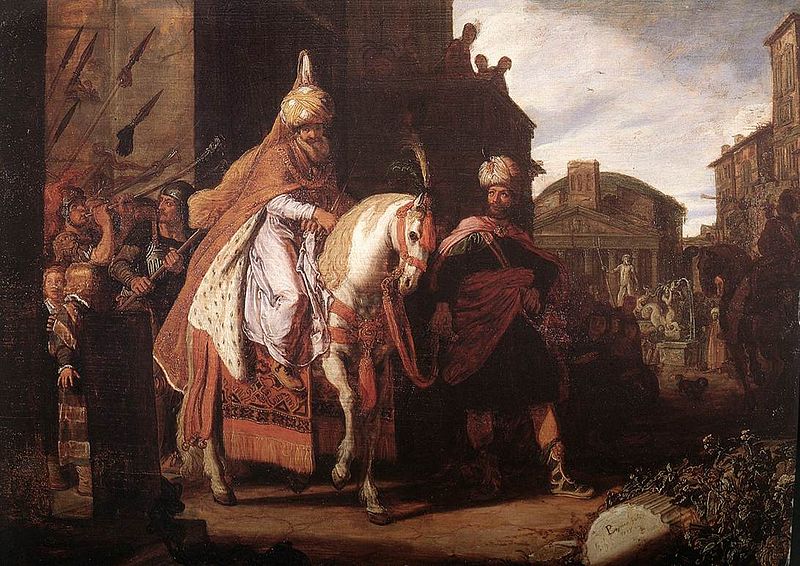
Pieter Lastman, The Triumph of Mordecai (1624)

Pieter Lastman, The Triumph of Mordecai (1624)

Esther 6: 1-14

On that night the king could not sleep, and he gave orders to bring the book of records, the annals, and they were read to the king. 2 It was found written how Mordecai had told about Bigthana and Teresh, two of the king’s eunuchs, who guarded the threshold, and who had conspired to assassinate King Ahasuerus. 3 Then the king said, “What honor or distinction has been bestowed on Mordecai for this?” The king’s servants who attended him said, “Nothing has been done for him.” 4 The king said, “Who is in the court?” Now Haman had just entered the outer court of the king’s palace to speak to the king about having Mordecai hanged on the gallows that he had prepared for him. 5 So the king’s servants told him, “Haman is there, standing in the court.” The king said, “Let him come in.” 6 So Haman came in, and the king said to him, “What shall be done for the man whom the king wishes to honor?” Haman said to himself, “Whom would the king wish to honor more than me?” 7 So Haman said to the king, “For the man whom the king wishes to honor, 8 let royal robes be brought, which the king has worn, and a horse that the king has ridden, with a royal crown on its head. 9 Let the robes and the horse be handed over to one of the king’s most noble officials; let him robe the man whom the king wishes to honor, and let him conduct the man on horseback through the open square of the city, proclaiming before him: ‘Thus shall it be done for the man whom the king wishes to honor.'” 10 Then the king said to Haman, “Quickly, take the robes and the horse, as you have said, and do so to the Jew Mordecai who sits at the king’s gate. Leave out nothing that you have mentioned.” 11 So Haman took the robes and the horse and robed Mordecai and led him riding through the open square of the city, proclaiming, “Thus shall it be done for the man whom the king wishes to honor.”

 12 Then Mordecai returned to the king’s gate, but Haman hurried to his house, mourning and with his head covered. 13 When Haman told his wife Zeresh and all his friends everything that had happened to him, his advisers and his wife Zeresh said to him, “If Mordecai, before whom your downfall has begun, is of the Jewish people, you will not prevail against him, but will surely fall before him.”

 14 While they were still talking with him, the king’s eunuchs arrived and hurried Haman off to the banquet that Esther had prepared.

One of the consistent themes throughout the bible, and particularly the New Testament is the theme of reversals, surprising reversals of the mighty being brought low and the lowly being raised high. Perhaps the most well known is Mary’s song (the Magnificat for those familiar with the Latin) in Luke 1: 46-55:

He (God) has shown the strength with his arm; he has scattered the proud in the thoughts of their hearts. He has brought down the powerful from their thrones, and lifted up the lowly; he has filled the hungry with good things; and sent the rich away empty Luke 1: 51-53

God is never mentioned in the book of Esther, and although the Septuagint (the Greek Translation of the Old Testament), Josephus (a Jewish historian who lived shortly after the time of Jesus) as well as the Rabbis all explicitely point to God’s involvement in the king’s insomnia, the Hebrew texts at best silently infer God’s participation. Yet, here is the outworking of the salvation of the people being played out in what seem like a series of well timed coincidences but may indeed be providence.

What better cure for insomnia that to read from the records of the proceedings, and yet in the midst of reading is the realization that an honor was not given for a great service. Honor is a big deal in the ancient world, and failing to honor someone who honor is due to is critical (hence the conflict between Mordecai and Haman). And yet it is Haman who is trapped here, whose ego believes that he is once again to be honored and gives what is an extremely high display of honor. Mordecai, by being publicly honored by the king, by becoming a benefactor of the king has become all but untouchable. Mordecai is publicly shamed (although unintentionally by the king who seems oblivious to what is going on just outside his court) among the officials who are watching to see how this conflict between Mordecai and Haman will play out. Haman’s friends and wife know that this is a bad omen and that the world is changing. Place have been reversed, Mordecai is lifted up as the one the king wishes to honor, and Haman covers his head and mourns. There is yet one more major pivot to the story but things are beginning to spiral out of control for Haman.

I’m going to close with Rory Cooney’s adaptation of Luke 1: 46-55, the Canticle of the Turning:

My soul cries out with a joyful shout that the God of my heart is great,
And my spirit sings of the wondrous things that you bring to the ones who wait.
You fixed your sight on your servant’s plight, and my weakness you did not spurn,
So from east to west shall my name be blest. Could the world be about to turn?
 My heart shall sing of the day you bring. Let the fires of your justice burn.
Wipe away all tears, for the dawn draws near, and the world is about to turn.
 
 Though I am small, my God, my all, you work great things in me,
 And your mercy will last from the depths of the past to the end of the age to be.
 Your very name puts the proud to shame, and to those who would for you yearn,
 You will show your might, put the strong to flight , for the world is about to turn.
 My heart shall sing of the day you bring. Let the fires of your justice burn.
 Wipe away all tears, for the dawn draws near, and the world is about to turn.
 
From the halls of pow’r to the fortress tow’r, not a stone will be left on stone.
Let the kings beware for your justice tears every tyrant from his throne
The hungry poor shall weep no more, for the food they can never earn;
There are tables spread, ev’ry mouth be fed for the world is about to turn.
My heart shall sing of the day you bring. Let the fires of your justice burn.
Wipe away all tears, for the dawn draws near, and the world is about to turn.
 
Though the nations rage from age to age, we remember who holds us fast:
God’s mercy must deliver us from the conqueror’s crushing grasp.
This saving word that our forebears heard is the promise which holds us bound,
Till the spear and the rod can be crushed by God, who is turning the world around.
My heart shall sing of the day you bring. Let the fires of your justice burn.
Wipe away all tears, for the dawn draws near, and the world is about to turn.
(Evangelical Lutheran Worship, 723)

purple rose 01 by picsofflowers.blogspot.com


Of Gallows and Egos: Esther 5: 9-14

Reconstruction of a Gallows-Style Gibbet at Caxton Gibbet in Cambridgeshire, England

Reconstruction of a Gallows-Style Gibbet at Caxton Gibbet in Cambridgeshire, England

Esther 5: 9-14

 9 Haman went out that day happy and in good spirits. But when Haman saw Mordecai in the king’s gate, and observed that he neither rose nor trembled before him, he was infuriated with Mordecai; 10 nevertheless Haman restrained himself and went home. Then he sent and called for his friends and his wife Zeresh, 11 and Haman recounted to them the splendor of his riches, the number of his sons, all the promotions with which the king had honored him, and how he had advanced him above the officials and the ministers of the king. 12 Haman added, “Even Queen Esther let no one but myself come with the king to the banquet that she prepared. Tomorrow also I am invited by her, together with the king. 13 Yet all this does me no good so long as I see the Jew Mordecai sitting at the king’s gate.” 14 Then his wife Zeresh and all his friends said to him, “Let a gallows fifty cubits high be made, and in the morning tell the king to have Mordecai hanged on it; then go with the king to the banquet in good spirits.” This advice pleased Haman, and he had the gallows made.

Pride goes before destruction, and a haughty spirit before the fall. Proverbs 16:18

Sidnie White Crawford in her commentary on Esther wisely points out that anyone reading the book with knowledge of wisdom literature and particularly the book of Proverbs knows that Haman’s fall is approaching. (Elizabeth Acthemeier, et.al 1999, 3:911f.) Indeed Haman’s arrogance is massive but we still need to ask the question, “What is up with Mordecai?” Mordecai has been restored to his position, and knows at least some of the game that is at stake, but he still continues to openly show his defiance to Haman even while Esther is playing her subtle game. What is it with the men in this story? Why must they play the fool? Why must Mordecai continue to enflame Haman’s hatred and put himself at risk even when the plot is afoot? Before Mordecai thought it beneath him to deal with Mordecai individually, but now Mordecai’s defiance is enough to rob him of the joy and honor of having dined with the king and queen.

Like the king, when he is perplexed he calls together his friends and his wife Zeresh, who proves to be the independent thinker among the group rather than the assembled men. In an honor shame society it wouldn’t be uncommon to refer back to one’s honors as a way of establishing one’s position (even if we might look at it and think this guy must be full of himself) and yet everything is no good so long as there is one who can defy him. Now from a psychological perspective we would probably say that Mordecai has a weak sense of his own self and requires the constant honor and attention to probably feel valued, but that would be putting a 20th Century midset on the story- honor and shame is at stake and honor is power. It is Zeresh who supplies the solution which all the other sycophant friends agree to, to construct a gallows (gallows to us seems to indicate hanging, but it probably  is referring to more of a gibbet, see the picture above, for impaling one’s enemy upon) that are outlandishly outsized (approximately 75 feet tall) designed to make  a statement, “this is what happens when you mess with Haman”. Much the same message that the Roman (and other) empires would make later when they crucified people they felt were their opponents.

Ultimately capital punishment is about more than ending a person’s life, it is about fear and making an example of the person who is executed. The idea of impaling someone upon a gibbet and letting their body decompose in the open may be revolting, but the exhibition and the denial of a proper burial also points to the powerlessness of the person’s allies and family.

purple rose 01 by picsofflowers.blogspot.com

A Game of Thrones: Esther 5:1-8

Game-of-Thrones-game-of-thrones-23883770-800x500

Esther 5: 1-8

On the third day Esther put on her royal robes and stood in the inner court of the king’s palace, opposite the king’s hall. The king was sitting on his royal throne inside the palace opposite the entrance to the palace. 2 As soon as the king saw Queen Esther standing in the court, she won his favor and he held out to her the golden scepter that was in his hand. Then Esther approached and touched the top of the scepter. 3 The king said to her, “What is it, Queen Esther? What is your request? It shall be given you, even to the half of my kingdom.” 4 Then Esther said, “If it pleases the king, let the king and Haman come today to a banquet that I have prepared for the king.” 5 Then the king said, “Bring Haman quickly, so that we may do as Esther desires.” So the king and Haman came to the banquet that Esther had prepared. 6 While they were drinking wine, the king said to Esther, “What is your petition? It shall be granted you. And what is your request? Even to the half of my kingdom, it shall be fulfilled.” 7 Then Esther said, “This is my petition and request: 8 If I have won the king’s favor, and if it pleases the king to grant my petition and fulfill my request, let the king and Haman come tomorrow to the banquet that I will prepare for them, and then I will do as the king has said.”

In George R.R. Martin’s book, The Game of Thrones,  there is a scene where Ned Stark reveals the knowledge that will eventually get him killed to Cercei who simply replies back to him, “When you play the game of thrones, you win or you die” which proved true for Ned and many others throughout the series of books. In Esther, Esther and Haman (unknowingly) are playing a game of thrones and while I don’t want to draw to close of a line between Esther and Cercei (who is a character despised by most readers of The Game of Thrones), she does understand the game she is playing and she plays her part very well here.

Much is at risk for her and her people here, and so she prepares carefully and plays cautiously. Unlike Vashti who refused to go to the wear the royal crown before the king, Esther adorns herself in royalty before approaching the king. It is not a fair world in which she must make her appearance and the image of the golden scepter would probably be rich territory for someone wanting to interpret this from either a feminist or Freudian position, but suffice to say the king’s authority compared to the queen’s is significantly different and the game she must play is real and dangerous (especially in a world where rulers have good reason to be paranoid, even of family). The king gives her leave to approach, let’s her know figuratively (no one really expects him to give up half his kingdom, and this also occurs in Mark 6:23 and parallels with Herod Antipas) but as a reassurance to make her request. The king realizes that Esther would not have risked approaching this way without a reason and so he attempt to reassure her.

In our world we would ask as soon as the possibility came, we are impatient for games-and we would not survive long with our impatience in the ancient Near East (and I would hazard a guess that this continues to be a problem with the interaction between Western and Middle Eastern societies where the rules of interaction are much different-in even modern Middle Eastern societies one never makes one’s major request right away). Esther invites the king and Haman to a banquet, and the king gladly attends giving indication that he is disposed to concede to Esther’s request. Once again, when he is once again drinking wine the king asks again what her request is, and Esther’s reply is indeed shrewd. If I have won your favor, fulfill this request (coming to a banquet with Haman tomorrow) and I will indeed know that I can safely lay my petition before you because you have truly shown me your favor. She has played her hand well in the game of thrones, in a matter of life and death for her people, and Haman is unaware (again the sign of a well played hand) that the game is being played in this way, indeed he views his presence as a sign of his increased honor, but he has just been played.

purple rose 01 by picsofflowers.blogspot.com

The Weight of the World on Her Shoulders: Esther 4: 9-17

Altas Sculpture on a building on Collins Street, Melbourne

Altas Sculpture on a building on Collins Street, Melbourne

Esther 4: 9-17

 9 Hathach went and told Esther what Mordecai had said. 10 Then Esther spoke to Hathach and gave him a message for Mordecai, saying, 11 “All the king’s servants and the people of the king’s provinces know that if any man or woman goes to the king inside the inner court without being called, there is but one law– all alike are to be put to death. Only if the king holds out the golden scepter to someone, may that person live. I myself have not been called to come in to the king for thirty days.”

 12 When they told Mordecai what Esther had said, 13 Mordecai told them to reply to Esther, “Do not think that in the king’s palace you will escape any more than all the other Jews. 14 For if you keep silence at such a time as this, relief and deliverance will rise for the Jews from another quarter, but you and your father’s family will perish. Who knows? Perhaps you have come to royal dignity for just such a time as this.” 15 Then Esther said in reply to Mordecai, 16 “Go, gather all the Jews to be found in Susa, and hold a fast on my behalf, and neither eat nor drink for three days, night or day. I and my maids will also fast as you do. After that I will go to the king, though it is against the law; and if I perish, I perish.” 17 Mordecai then went away and did everything as Esther had ordered him.

A young person is thrust into a life or death situation, and while I may disagree with Mordecai (and perhaps Esther might too) that she personally might have been able to avoid the ordered purge, the personal and emotional consequences of not speaking, of not acting would be high indeed. The risks are great and now the young person in a life or death situation has to muster their courage to act. Esther apparently is trying to let Mordecai know the reasons she shouldn’t go: she hasn’t been summoned for 30 days (her influence is small), the boundaries between even the king and the queen are great, and the consequences could involve death. The story revolves on the irony that one queen refuses to come when summoned and then for her act of rebellion is exiled and now the new queen must come when not summoned and risk death. Mordecai pushes her, through Hathach the messenger, that she must act but we see a transformation taking place: the once pliant Esther now gives orders, she will go but all the Jews are to fast for three days first. Mordecai goes and obeys, the one who raised her now must rely on her for action.

In contrast to the King and Hamath who feast while the city is confused around them, Mordecai and Esther fast. The King may end up being the one who provides a way for the salvation of the people, but ultimately it will depend upon who the king will listen to. Even though God is not mentioned there is an element of providence or fate in the story, and most readers know how the story will end, but one of Jesus’ proverbs plays itself out in this story: “For all who exalt themselves will be humbled, and those who humble themselves will be exalted” (in Luke’s gospel this occurs in Luke 14: 11 and 18:14, it also has a Matthean parallel)

purple rose 01 by picsofflowers.blogspot.com

Waiting on the World to Change: Esther 4:1-8

Job by Leon Bonnat (1880)

Job by Leon Bonnat (1880)

Esther 4: 1-8

When Mordecai learned all that had been done, Mordecai tore his clothes and put on sackcloth and ashes, and went through the city, wailing with a loud and bitter cry; 2 he went up to the entrance of the king’s gate, for no one might enter the king’s gate clothed with sackcloth. 3 In every province, wherever the king’s command and his decree came, there was great mourning among the Jews, with fasting and weeping and lamenting, and most of them lay in sackcloth and ashes.

 4 When Esther’s maids and her eunuchs came and told her, the queen was deeply distressed; she sent garments to clothe Mordecai, so that he might take off his sackcloth; but he would not accept them. 5 Then Esther called for Hathach, one of the king’s eunuchs, who had been appointed to attend her, and ordered him to go to Mordecai to learn what was happening and why. 6 Hathach went out to Mordecai in the open square of the city in front of the king’s gate, 7 and Mordecai told him all that had happened to him, and the exact sum of money that Haman had promised to pay into the king’s treasuries for the destruction of the Jews. 8 Mordecai also gave him a copy of the written decree issued in Susa for their destruction, that he might show it to Esther, explain it to her, and charge her to go to the king to make supplication to him and entreat him for her people.


John Mayer’s song ‘Waiting on the World to Change’ tells the story of a person who may see what is going on but feels powerless to change it (Mayer’s song is set in the context of post 9-11 America and a critique of American foreign policy that the artist feels powerless to change). Here is a part of the lyrics:

Now if we had the power to bring our neighbors home from war
They would have never missed a Christmas, no more ribbons on their door
And when you trust your television what you get is what you got
Cause when they own the information,oh, they can bend it all they want
That’s why we’re waiting, waiting on the world to change
We keep on waiting, waiting on the world to change
It’s not that we don’t care, we just know that the fight ain’t fair
So we keep on waiting, waiting on the world to change.

Mordecai is powerless to change what Haman has done, he finds himself with few options other than mourning and waiting on the world to change. God’s action is never mentioned in the book of Esther, nor is the word God or prayer ever mentioned, but to the Hebrew mind God is at work behind and through the nations as well as the Jewish people and God can be swayed by mourning and repentance, for example the people of Ninevah in the book of Jonah who put on sackcloth and ashes and God changes God’s mind about the disaster God planned to bring on them. Here God is not the instigator of the coming disaster, and yet perhaps in the wailing, rending of clothes and wearing sack cloth and ashes God might hear the distress of his people and respond (although the action is focused on Mordecai, we also learn that many of the Jews are also mourning publicly).

We also get a window into boundaries that are set around people in society, no one can enter the king’s gate in sack cloth. Esther, though she is literally writhing inside (the word translated deeply distressed) can not or will not risk going out to Mordecai who was like a father to her, but rather tries to alleviate his pain and bring him (properly clothed and cleaned up) inside the palace. The entire conversation is strained because it is not direct, messages are relayed back and forth by Hathach. One of the interesting notes is that both Esther and Mordecai are apparently literate (which would not be the norm ) because Mordecai is able to pass on the written decree for her to read (or perhaps some scribe would read it for her-but she has been a queen for five years, perhaps she has been taught).
Esther has been the obedient one throughout the story, obedient to Mordecai, obedient to Hegai the king’s eunuch, obedient to the king and now she as a young woman is at a point where she will have to make choices that will impact both her and potentially her entire people.

Since the book of Esther is the book that is read during the book of Purim, it is helpful to know what Purim is all about. It began at sundown yesterday and so there have been a number of helpful articles in the past week.  I have linked to Eitan Press’ helpful article in the Huffington Post ‘Purim: How to Get Drunk on God’. Here is another from Deborah Rosenbloom also in the Huffington Post ‘Purim: A Tale of Women’s Empowerment’

purple rose 01 by picsofflowers.blogspot.com

Bureaucracy and Collusion: Esther 3:12-15

Ring stone bearing the Aramaic name mirror-imaged Yishak bar Hanina, excavated from Zafar/al-Asabi/Yemen

Ring stone bearing the Aramaic name mirror-imaged Yishak bar Hanina, excavated from Zafar/al-Asabi/Yemen

Esther 3: 12-15

 12 Then the king’s secretaries were summoned on the thirteenth day of the first month, and an edict, according to all that Haman commanded, was written to the king’s satraps and to the governors over all the provinces and to the officials of all the peoples, to every province in its own script and every people in its own language; it was written in the name of King Ahasuerus and sealed with the king’s ring. 13 Letters were sent by couriers to all the king’s provinces, giving orders to destroy, to kill, and to annihilate all Jews, young and old, women and children, in one day, the thirteenth day of the twelfth month, which is the month of Adar, and to plunder their goods. 14 A copy of the document was to be issued as a decree in every province by proclamation, calling on all the peoples to be ready for that day. 15 The couriers went quickly by order of the king, and the decree was issued in the citadel of Susa. The king and Haman sat down to drink; but the city of Susa was thrown into confusion.

                 Genocide does not happen without collusion. The letters and orders can be given, but if nobody carries them out they are merely words on paper. The danger is that oftentimes people are all too willing to participate in the elimination of another people. A people may be scapegoated as the cause of every problem and demonized to be something less than human. People may hide behind the desire to ‘follow orders’ and yet without people following the order to kill and plunder, it does not happen. Haman and the king sit down to drink while the city that surrounds them is confused, “what’s going on, why the Jewish people?” The advisors may know, but most people appear to be caught off guard. Certainly some will pounce on the opportunity to destroy, kill and annihilate men, women and children and plunder their goods, others will merely stand aside, others may attempt to stand with the Jewish people, but the die is cast, the plan is set in motion, the danger is real. Genocide is set in motion by the hatred of one man, but will need the collusion (both of those who actively participate and who passively do not oppose)of many others to actually occur.

Somebody will need to do something to deliver the Jewish people, the exiles and wanderers in the midst of the empire of the day. Even in the midst of their assimilation they are singled out for extermination. The story is at its turning point, and the lives of the people will rely on the actions of a young queen and her uncle Mordecai.

This reminds me of Martin Niemőller’s quote from World War II Germany:

First they came for the Socialists, and I did not speak out–
Because I was not a Socialist.

Then they came for the Trade Unionists, and I did not speak out– 
Because I was not a Trade Unionist.

Then they came for the Jews, and I did not speak out– 
Because I was not a Jew.

Then they came for me–and there was no one left to speak for me.

  This from a man who was an outspoken critic of Adolf Hitler and Nazi Germany, who would spend seven years in a concentration camps but would still feel years later in 1964:

“Thus, whenever I chance to meet a Jew known to me before, then, as a Christian, I cannot but tell him: ‘Dear Friend, I stand in front of you, but we can not get together, for there is guilt between us. I have sinned and my people has sinned against thy people and against thyself

The quotes come from the website of the U.S. Holocaust Memorial Museum:

purple rose 01 by picsofflowers.blogspot.com

Rolling the Dice: Esther 3: 7-11

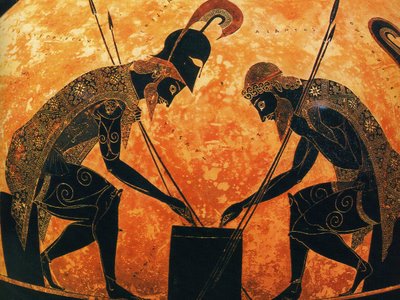
Achilles and Ajax Playing Dice, 6th Century BCE Greecian Pottery

Achilles and Ajax Playing Dice, 6th Century BCE Greecian Pottery

Esther 3: 7-11

 7 In the first month, which is the month of Nisan, in the twelfth year of King Ahasuerus, they cast Pur– which means “the lot”– before Haman for the day and for the month, and the lot fell on the thirteenth day of the twelfth month, which is the month of Adar. 8 Then Haman said to King Ahasuerus, “There is a certain people scattered and separated among the peoples in all the provinces of your kingdom; their laws are different from those of every other people, and they do not keep the king’s laws, so that it is not appropriate for the king to tolerate them. 9 If it pleases the king, let a decree be issued for their destruction, and I will pay ten thousand talents of silver into the hands of those who have charge of the king’s business, so that they may put it into the king’s treasuries.” 10 So the king took his signet ring from his hand and gave it to Haman son of Hammedatha the Agagite, the enemy of the Jews. 11 The king said to Haman, “The money is given to you, and the people as well, to do with them as it seems good to you.”

The dice are rolled, the lot is cast for the date that will come to be Purim. It will be a day of reversals, but at this point in the story it is foreshadowed as a date that will bring disaster to the Jewish people. The king once again receives bad advice from an advisor, advice that will have long lasting consequences and the king never once asks a question or attempts to probe Haman’s motives. The king trusts Haman and is willing for an enormous pile of money (a ridiculous sum, 375 tons of silver, this is roughly 2/3 of the annual Persian kings’ income) to put his authority behind it. Perhaps in both the ancient world and the modern world enough money seems to make something evil more appealing.

This last thought reminds me, in a way, of the plot of the movie the Box where a man and a woman are given a box with a button where if they push it they will receive one million dollars, but someone they don’t know will die and so they are entered into the ethical dilemma of whether their own very real monetary needs outweigh the life of a stranger. Now it is not the greatest movie, but the ethical question of the power of money to cause a horrible decision, especially when you don’t have to carry it out, more appealing. The king never carries out his decision, he is always insulated and while his ring may mark the life or death of many, he allows others to be the executioners.

The king not only takes the advice of Haman, he seems to compel it along even more so. The king’s authority is placed behind the plot of Haman. One man’s revenge now becomes imperial policy and the story’s crisis is set in motion. This is a strange story since the Persian empire was actually pretty benevolent as far as ancient empires go toward their subject people maintaining their own laws, religions and traditions so long as the empire is served (remember Cyrus, also a Persian emperor is lifted up as a ‘messiah’ in Isaiah 45 and the Jewish story is in general very favorable towards Persia). But this story turns on the conflict between Mordecai and Haman, and the plot is moving.

purple rose 01 by picsofflowers.blogspot.com

From Insult to Genocide: Esther 3:1-6

Persian and Median Soldier, Apadana Palace,Persopolis (Iran)

Persian and Median Soldier, Apadana Palace,Persopolis (Iran)

Esther 3: 1-6

After these things King Ahasuerus promoted Haman son of Hammedatha the Agagite, and advanced him and set his seat above all the officials who were with him. 2 And all the king’s servants who were at the king’s gate bowed down and did obeisance to Haman; for the king had so commanded concerning him. But Mordecai did not bow down or do obeisance. 3 Then the king’s servants who were at the king’s gate said to Mordecai, “Why do you disobey the king’s command?” 4 When they spoke to him day after day and he would not listen to them, they told Haman, in order to see whether Mordecai’s words would avail; for he had told them that he was a Jew. 5 When Haman saw that Mordecai did not bow down or do obeisance to him, Haman was infuriated. 6 But he thought it beneath him to lay hands on Mordecai alone. So, having been told who Mordecai’s people were, Haman plotted to destroy all the Jews, the people of Mordecai, throughout the whole kingdom of Ahasuerus.

Our villain is introduced in the story, Haman the Agagite and in the reading that would occur on Purim I understand that his introduction and place throughout the story is accompanied by boos and hisses. What comes to mind for me is if you go to see the Rocky Horror Picture Show at midnight in a theater and people jeer and throw popcorn and the audience becomes a part of what makes the story go, in fact the audience becomes a part of the telling and enacting of the story. But Haman is the villain, and his actions will drive the story from this point forward.  We don’t have a reason why Haman is promoted to the position of second only to the king, he is not lifted up as doing anything great like Mordecai has, but ultimately why and how he got in his position is not important. What drives the story is that he does have the king’s ear and is able to act with the king’s authority on his desires.

The next perplexing part of the story is why doesn’t Mordecai bow-is he just stubborn? Is there some other reason? Is it an interpersonal conflict-or does it reflect a blood feud a long standing ethnic hatred. Haman’s identity as an Agagite points this direction going back to King Saul and King Agag of the Amelikites in 1 Samuel 15: 8-33, but how would a person tell a descendent of Benjamin from Agag apart. Apparently, unlike Esther, Mordecai’s Jewishness becomes known, but why offend in this way when you are an exiled people in a foreign land.

It reminds me of an incident in the life of Dietrich Bonhoeffer which takes place on June 17, 1940. Dietrich, a Lutheran pastor who would later be executed for his part in an unsuccessful plot to assassinate Adolph Hitler, was sitting with his friend Eberhard Bethge in the garden café in Memel. While they were in the café the announcement came that France had surrendered, and the people in the café stood on their chairs and began singing ‘Deutchland, Deutschland über alles.’ Bonhoeffer stood and extended his arm in the Hitler salute, while Eberhard stood there in shock. Bonhoeffer whispered, ‘Raise your arm! Are you crazy?’ saying later ‘we shall have to run risks for very different things now, but not for that salute.’  (Bethge 1970, 2000, 681)  (Wind 1991, 139)

The reaction does not fit the offense, to take on Mordecai is beneath Haman and so his thought is like the Emperor in the Star Wars series, “wipe them out, all of them.” A personal offense is met by genocide. Perhaps, like so many other genocides some long simmering hatred comes to the surface when it is favorable for one party, like in Bosnia. Perhaps this may also point to the danger that can come even in the most assimilated populations, as the German Jews were prior to World War II and the Holocaust. Genocide is a very distasteful topic, but it rears its head here, as in many times in both ancient and modern history. There perhaps is some drive to set up insiders and outsiders, to protect the insiders and to destroy the outsider and you could make an argument that this is payback for the Jewish wiping out of the Amalekite people but at some point we need to understand that the oppression of another people based on race or ethnic group is evil.

purple rose 01 by picsofflowers.blogspot.com

A Young Girl in an Unfair World: A Sermon on Esther

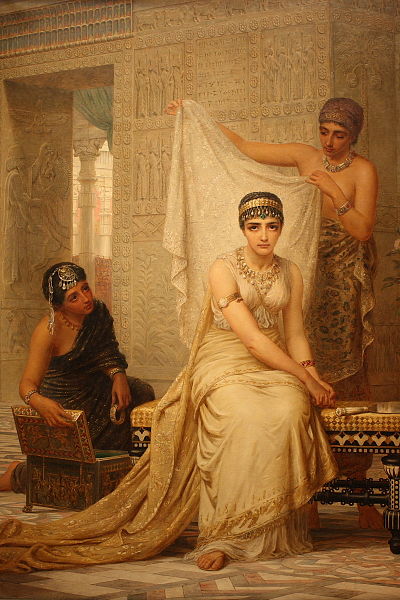
Esther Edwin Long

This is the written text, I kept hoping I would have time to bring in some of the spoken dialogue last week, and when I get the chance I will upload an audio version and attach it. Unfortunately the written text is not near as entertaining as what was spoken.

Martin Luther didn’t like the book of Esther, he wished it hadn’t been included in the Bible, which I find perplexing because even though the book of Esther never mentions God, or any specifically religious practice (even fasting when it is mentioned is a common practice across cultures of the ancient world) and yet for Luther it is the times where God seems most absent that God can indeed be most present. Now last week we heard about the remnant who returned home to Jerusalem, and even though they were a small people in a tiny province of the Persian empire, God desired to work through them and their gifts. God desired for them to build a temple and through the prophets Haggai and Zechariah encouraged the people to get on with that work and the people and leader listened and responded and through their work God was glorified. But if you remember last week only a small portion of the faithful people returned, and the rest remained behind, scattered throughout the nations. And yet even scattered among the nations, they found that God was active and working through them. This is one of the stories of how God worked through unexpected people to sway the events of the nations to ensure that God’s story and the story of God’s people would continue.

We all know life isn’t fair, we all know that sometimes we get put into situations we never asked for or we have to pick up the responsibility while others seem to be still going out and living it up, but hopefully the fate of an entire people never rests on our shoulders, especially when we are young-but that is what happens to Esther. Her story starts out simply enough, she is a young woman, an orphan and a foreigner living in a foreign land-thankfully she has her uncle to care for her like his own child, but she starts out life with three strikes against her of being someone who God can use to change the world. She has but one thing going in her favor, she’s easy on the eyes, but just because she’s hit the jackpot in the genetic lottery for looks doesn’t mean she has any chance to really change things and yet the world around her spins out of control and puts her into a position she never dreamed she would be in. You see the queen refused to come and appear before the king one day during a party while the king was drunk and all his friends were drunk too, so the king and his officials throw the ancient world’s equivalent of the Bachelor, except none of these women have a choice to participate, they are brought together, trained and then they get their one night to make the king happy, and then from this he’s going to choose a new queen. Esther excels, pleasing first those preparing and training her and then the king, and so she goes from little orphan Esther to Queen Esther.

Now her uncle happened to overhear a plot to assassinate the king, and passes it on to Esther who passes it on to the king, and once it is investigated the plot is foiled and nothing more is thought of it, but it will be important to the story later.

Now the king’s new number two man was a guy named Haman, and Haman is a bad dude who thought everyone should bow down before him, and apparently everyone did-everyone except Mordecai-why? We don’t really know, and I can’t go back and ask him, but Mordecai decides to take out his rage not just on Mordecai, not just on his family, but on the whole Jewish people and so Haman goes to the king and offers him a huge sum of money to wipe out this people who don’t abide by the same laws and are a danger to the kingdom, and the king gives him his signet ring and the plan and date are set in motion so that on one day at the end of February or the beginning of March of the coming year anyone who wants to can kill any Jewish person and take over any wealth and property that it theirs. Mordecai and the Jews throughout the empire and the city of Susa itself are thrown into turmoil by the proclamation, but Esther, apparently shielded in the palace is unaware. Mordecai mourns publicly, he rips his clothes, puts on ashes and sackcloth and sits outside the king’s gate. Esther sends a messenger with new clothes but he won’t put them on and sends her a copy of the decree and charges her to do something to save their people. The fate of the people rests on the small shoulders of this young woman who was thrust into being the queen, to go and risk her life and intercede before the king.

Esther 4: 9-16

9 So Hathach returned to Esther with Mordecai’s message.

10 Then Esther told Hathach to go back and relay this message to Mordecai:

11 “All the king’s officials and even the people in the provinces know that anyone who appears before the king in his inner court without being invited is doomed to die unless the king holds out his gold scepter. And the king has not called for me to come to him for thirty days.”

12 So Hathach gave Esther’s message to Mordecai.

13 Mordecai sent this reply to Esther: “Don’t think for a moment that because you’re in the palace you will escape when all other Jews are killed.

14 If you keep quiet at a time like this, deliverance and relief for the Jews will arise from some other place, but you and your relatives will die. Who knows if perhaps you were made queen for just such a time as this?”

15 Then Esther sent this reply to Mordecai:

16 “Go and gather together all the Jews of Susa and fast for me. Do not eat or drink for three days, night or day. My maids and I will do the same. And then, though it is against the law, I will go in to see the king. If I must die, I must die.”

After three days of fasting, and of the people fasting she risk the possibility of death by breaking the law and going to the king when she hasn’t been summoned, but the king is happy to see her, extends his scepter and asks her, “what is it Esther, name your appeal even up to half of the empire and it’s yours” and so she invites the king and Haman to dinner. Once again at dinner the king asks her for her appeal and once again she say, “if you will hear my request come once again to dinner tomorrow, you and Haman, and you will know my request.”

Haman starts home on top of the world, he was invited to not one but two dinners with the king and queen, and yet when he passes Mordecai and Mordecai doesn’t bow down he is furious, and after some advice from his wife and friend he builds a 75 foot tall gallows. But when he goes in to try to get the king’s approval to hang Mordecai, the king had a sleepless night so he went to the records and found out that Mordecai was never repaid for uncovering the assassination plot, and so instead of getting Mordecai’s head, instead he finds himself covering Mordecai in a royal robe and escorting him through the town square on the king’s horse while he has to shout, “thus will it be done to the one who the king is pleased with” then to make matters worse he can’t go home and mope because he is shortly summoned to the banquet with the queen.

At the banquet Esther pleads to the king for her life and the life of her people, the king, oblivious to what he allowed Haman to talk him into is now furious and storms out. Haman realizes his ship is sinking fast so he throws himself at Esther and when the king walks back in he has Haman hanged on the gallows he built, gives his position and property to Mordecai, and they all lived happily ever after (well except for Haman and his family, but they didn’t live beyond this point). With the king’s assistance what was to be a day of disaster for God’s people became a day of triumph. God had worked through a young woman, an orphan, an alien who thought she had nothing to offer and God can work through us. We may not be able to save an entire people, but maybe God has been preparing us for a moment such as this.

Over the last several weeks we’ve heard stories of people who had the courage to be faithful in the midst of challenges, whether is was Daniel, Shadrach,Mesach, and Abendigo or whether it was the remnant returning home and building the temple, or Esther going to the king to save her people…God was able to work through them to be a part of God’s story coming down to be a part of our story. We may not know what to say or do, we may feel like we have nothing to give, but can we learn to trust God in the midst of the things that may terrify us? When Jesus is talking to his disciples he tells them:

Matthew 10: 16-20

16 “Look, I am sending you out as sheep among wolves. So be as shrewd as snakes and harmless as doves.

17 But beware! For you will be handed over to the courts and will be flogged with whips in the synagogues.

18 You will stand trial before governors and kings because you are my followers. But this will be your opportunity to tell the rulers and other unbelievers about me.

19 When you are arrested, don’t worry about how to respond or what to say. God will give you the right words at the right time.

20 For it is not you who will be speaking– it will be the Spirit of your Father speaking through you.

As we learn to trust God and let God work through us we can have the courage to be in the places God places us. We don’t get to run away from the rest of the world, and one of the gifts of the story of Esther is that she is a young person trying to make her way completely surrounded not by a Jewish but the Persian culture. She had to figure out how she could be faithful in the midst of a world that was probably much different than the household she grew up in, and yet remain who she was in the midst of it. And even though God is not mentioned throughout the book, God is at work behind the scenes and works not just in temples or churches, but even in the harem of the king’s palace or the throne room of the king. And God is there in both the big moments, but also the smaller ones as well.

purple rose 01 by picsofflowers.blogspot.com