Tag Archives: destruction of the Temple

2 Kings 25 The End of the First Temple Era in Jerusalem

Ilya Repin, Cry of the Prophet Jeremiah on the Ruins of Jerusalem (1870)

2 Kings 25: 1-21 The Destruction of Jerusalem and the Second Group of Judeans Taken Into Exile

1And in the ninth year of his reign, in the tenth month, on the tenth day of the month, King Nebuchadnezzar of Babylon came with all his army against Jerusalem and laid siege to it; they built siegeworks against it all around. 2So the city was besieged until the eleventh year of King Zedekiah. 3On the ninth day of the fourth month, the famine became so severe in the city that there was no food for the people of the land. 4Then a breach was made in the city wall; the king with all the soldiers fled by night by the way of the gate between the two walls, by the King’s Garden, though the Chaldeans were all around the city. They went in the direction of the Arabah. 5But the army of the Chaldeans pursued the king and overtook him in the plains of Jericho; all his army was scattered, deserting him. 6Then they captured the king and brought him up to the king of Babylon at Riblah, who passed sentence on him. 7They slaughtered the sons of Zedekiah before his eyes, then put out the eyes of Zedekiah; they bound him in fetters and took him to Babylon.
  8
In the fifth month, on the seventh day of the month—which was the nineteenth year of King Nebuchadnezzar, king of Babylon—Nebuzaradan, the captain of the bodyguard, a servant of the king of Babylon, came to Jerusalem. 9He burned the house of the Lord, the king’s house, and all the houses of Jerusalem; every great house he burned down. 10All the army of the Chaldeans who were with the captain of the guard broke down the walls around Jerusalem. 11Nebuzaradan the captain of the guard carried into exile the rest of the people who were left in the city and the deserters who had defected to the king of Babylon—all the rest of the multitude. 12But the captain of the guard left some of the poorest people of the land to be vinedressers and tillers of the soil.
  13
The bronze pillars that were in the house of the LORD as well as the stands and the bronze sea that were in the house of the LORD, the Chaldeans broke in pieces and carried the bronze to Babylon. 14They took away the pots, the shovels, the snuffers, the dishes for incense, and all the bronze vessels used in the temple service, 15as well as the firepans and the basins. What was made of gold the captain of the guard took away for the gold and what was made of silver for the silver. 16As for the two pillars, the one sea, and the stands that Solomon had made for the house of the LORD, the bronze of all these vessels was beyond weighing. 17The height of the one pillar was eighteen cubits, and on it was a bronze capital; the height of the capital was three cubits; latticework and pomegranates, all of bronze, were on the capital all around. The second pillar had the same, with the latticework.
  18
The captain of the guard took the chief priest Seraiah, the second priest Zephaniah, and the three guardians of the threshold; 19from the city he took an officer who had been in command of the soldiers and five men of the king’s council who were found in the city; the secretary who was the commander of the army who mustered the people of the land; and sixty men of the people of the land who were found in the city. 20Nebuzaradan the captain of the guard took them and brought them to the king of Babylon at Riblah. 21The king of Babylon struck them down and put them to death at Riblah in the land of Hamath. So Judah went into exile out of its land.

The final chapter of 2 Kings brings the first temple period of Israel to its tragic conclusion. 2 Kings 24: 18-25:30 and Jeremiah 52 are mostly identical[1] and almost certainly share a common source. There is a long tradition connecting Jeremiah and the Deuteronomic history which narrates from Joshua through the end of 2 Kings, and they share a common theological perspective. Regardless author who compiled 2 Kings shared material with the individual who collected the sayings of both Isaiah[2] and Jeremiah and the compilation of these remembrances of the prophets and the narration of the story of the kings and prophets of Israel and Judah are a part of mourning the loss of Jerusalem, the temple, and the Davidic king as well as assigning meaning to the tragedy.

Zedekiah, originally named Mattaniah, was Josiah’s third son who was introduced in 2 Kings 24:17 and who foolishly, in the view of 2 Kings, rebels against King Nebuchadnezzar and Babylon. Jerusalem was again at the center of a coalition attempting to throw off their masters and there were prophets who encouraged this rebellion as we see in Jeremiah. Alex Israel summarizes the moment well:

Nebuchadnezzar had absented himself from the region, attending to other pressing campaigns in his far-flung kingdom. But the Akkadian rebellion against Nebuchadnezzar in 595-594 BCE aroused regional hopes of overthrowing Babylonian control. Yet, again Jerusalem was the center of a southern conspiracy in which the kings of Edom, Moav, Ammon, Tyre, and Sidon convened in Jerusalem during the fourth year of Zedekiah’s rule. (Jer. 27:9, 15-18; 28:3-4.) The kings were boosted by prophets who predicted the success of the rebellion and the return of the Temple vessels to Jerusalem. One such prophet, Hannania ben Azzur, even promises the imminent restoration of the exiled king Jehoachin to Jerusalem. Hope of independence runs high. (Israel, 2019, p. 362)

The prophet Jeremiah is a lone and often unpopular voice which speaks against this rebellion and is often viewed as a traitor by many of his fellow residents of Jerusalem. Zedekiah is portrayed in Jeremiah as a king who is sympathetic to Jeremiah and seeks God’s word through him but is unable to resist the other nobles and leaders who surround him. The removal of the elites in the first exile may have made the remaining leaders a less wise and more volatile group, but ultimately between the false prophets like Hananiah and the people surrounding King Zedekiah the city and the people find themselves in revolt against Babylon.

King Nebuchadnezzar of Babylon turns his forces towards the rebellious capital of Jerusalem and entrusts his captain Nebuzaradan with dealing with this troublesome nation. Nebuzaradan’s title in the Hebrew, rav tabbahim, literally means “the chief cook” but like Potiphar in Genesis 37:36 who shares this title it probably has little to do with cooking.  As Alex Israel can note about the Hebrew verb tbh, which is behind tabbahim, “can be translated as “cook” or as “slaughter”; as such Nebuzaradan has been seared into the Jewish memory as the “chief executioner.” (Israel, 2019, p. 365) Nebuzaradan initiates a siege which lasts from the tenth month of Zedekiah’s ninth year to the ninth month of Zedekiah’s eleventh year. Near the end of this almost two year long siege the situation in Jerusalem has become so desperate that Lamentations remembers it in these harsh words:

4The tongue of the infant sticks to the roof of its mouth for thirst;
the children beg for food,but there is nothing for them.
5
Those who feasted on delicacies perish in the streets;
those who were brought up in purple cling to ash heaps.
6
For the chastisement of my people has been greater than the   punishment of Sodom, which was overthrown in a moment,
though no hand was laid on it.
7
Her princes were purer than snow, whiter than milk;
their bodies were more ruddy than coral, their form cut like sapphire.
8
Now their visage is blacker than soot; they are not recognized in the streets. Their skin has shriveled on their bones; it has become as dry as wood.
9
Happier were those pierced by the sword than those pierced by hunger, whose life drains away, deprived of the produce of the field.
10
The hands of compassionate women have boiled their own children;
they became their food in the destruction of my people.

Lamentations 4: 4-10

In this moment Zedekiah attempts to flee, fighting his was free with the remaining soldiers and is captured by the Babylonians at the plains of Jericho. The remaining army scatters which provides a reason why there are captains of the forces who will come to Gedaliah in the following section.

Nebuzaradan may be thought of as the chief butcher in the memory of the Jewish people, and he is responsible for the destruction of the walls and the temple as well as the death of the king’s sons[3] and many of the remaining leaders. However, Jerusalem has been an unreliable vassal and at the center of the rebellion against the empire. He does eliminate the remaining power structure that led the city into rebellion: the king is taken into exile blind and without heirs, the leaders of the temple, the government officers near the king, and many of the ‘people of the land’ who exercised power in Jerusalem are executed, but after the riches remaining in the temple are cut up and carted off to Babylon he also razes the city and the temple. The razing of the capital indicates the Babylon has no interest in reorganizing Judah around this unfaithful center. (Cogan, 1988, pp. 323-324)

Both 2 Kings and Jeremiah spend more time cataloging the items removed from the temple than the disposition of the remaining people. This may be structural for book of Kings which begins with Solomon taking the throne and building the temple. Now that book closes with the destruction of the temple and the removal of all the items that Solomon created for the temple. It is also plausible that the catalog of the items removed is for a hopeful time when the treasures of the temple can be returned to the people for a new temple. Jeremiah 52:30 indicates that Nebuzaradan only takes into exile seven hundred forty-five people from Jerusalem and the surrounding territory, and this number seems incredible small.[4] The entirety of the people is not displaced. A diminished people who are, in 2 Kings narration, the poorest of the land are left to care for the fields and vineyards of what remains of Judah.

2 Kings 25: 22-26 The Appointment and Assassination Gedaliah the Governor


  22 He appointed Gedaliah son of Ahikam son of Shaphan as governor over the people who remained in the land of Judah, whom King Nebuchadnezzar of Babylon had left. 23 Now when all the captains of the forces and their men heard that the king of Babylon had appointed Gedaliah as governor, they came with their men to Gedaliah at Mizpah, namely, Ishmael son of Nethaniah, Johanan son of Kareah, Seraiah son of Tanhumeth the Netophathite, and Jaazaniah son of the Maacathite. 24 Gedaliah swore to them and their men, saying, “Do not be afraid because of the Chaldean officials; live in the land, serve the king of Babylon, and it shall be well with you.” 25 But in the seventh month, Ishmael son of Nethaniah son of Elishama, of the royal family, came with ten men; they struck down Gedaliah so that he died, along with the Judeans and Chaldeans who were with him at Mizpah. 26 Then all the people, high and low, and the captains of the forces set out and went to Egypt, for they were afraid of the Chaldeans.

Nebuzaradan appoints Gedaliah to be the governor over what remains of Judah. Gedaliah’s grandfather was the secretary in the time of Josiah (2 Kings 22:3) and his father Ahikam was sent along with his grandfather to the prophet Huldah seeking God’s guidance. Ahikam also had protected Jeremiah in the past (Jeremiah 26:24) and Jeremiah supported Gedaliah. Nebuzaradan was aware of Jeremiah’s stance on the war (Jeremiah 40:4) and it is conceivable that Nebuzaradan chose Gedaliah because of his proximity to Jeremiah.[5] The remaining leaders of fighting men came to Gedaliah and received an offer of clemency if they would serve the land and remain loyal to Babylon.

Jeremiah 4041 goes into a longer narration of the plot against Gedaliah. Johanan son of Kareah comes and informs Gedaliah that Ishmael son of Nethaniah is engaged with the Ammonite king in a plot to kill Gedaliah.[6] Johanan offers to kill Ishmael but Gedaliah refuses to believe the warning and is killed by Ishmael and his men. The remaining exiles view the murder of the governor as the final nail in the coffin of Judah as a nation and reverse the Exodus by fleeing to Egypt. Jeremiah informed the people not to flee, but Johanan and the commanders take the remaining people including Jeremiah into exile. (Jeremiah 4243)

2 Kings 25: 27-30 A Brief Note of Hope for the Line of David

  27In the thirty-seventh year of the exile of King Jehoiachin of Judah, in the twelfth month, on the twenty-seventh day of the month, King Evil-merodach of Babylon, in the year that he began to reign, released King Jehoiachin of Judah from prison; 28he spoke kindly to him and gave him a seat above the other seats of the kings who were with him in Babylon. 29So Jehoiachin put aside his prison clothes. Every day of his life he dined regularly in the king’s presence. 30For his allowance, a regular allowance was given him by the king, a portion every day, as long as he lived.

King Evil-merodach (aka Amel-marduk) was the son and successor of Nebuchadnezzar and at the beginning of his reign he shows favor to Jehoiachin. This is a small moment of hope at the ending of this tragedy. The English, released…from prison, misses some of the parallels in the Hebrew phrase that literally means “raised the head.” This is the same phrase used in the dreams of Pharoah’s servants in Genesis 40:13[7] and indicates assuming power and authority again. A generation later the grandson of Jehoiachin, Zerubbabel will be one of the leaders of the generation that returns to Jerusalem to rebuild the temple.[8]


[1] Jeremiah 52: 28-30 gives additional details about the people deported and omits the governorship and assassination of Gedaliah which Jeremiah deals with in more detail in Jeremiah 40-41.

[2] As mentioned above the crossover between 2 Kings 1819 and Isaiah 36-37.

[3] The murder of the king’s sons before blinding Zedekiah is intended as a torment where the last thing Zedekiah sees is the ending of his line.

[4] Jeremiah also has significantly smaller numbers for the initial exile. See Jeremiah 52:28-29.

[5] This is not explicit in Jeremiah, and it is also possible that Gedaliah was also known as a voice who opposed the war.

[6] Killing Gedaliah would destabilize the region and the Ammonite king may have seen this as an opportunity.

[7] The second servant does have his head raised up in being executed, but the situation of Jehoiachin parallels the first servant who returns to his office as the chief cupbearer.

[8] 1 Chronicles 3: 17-19 gives the lineage of Zerubbabel as the grandson of Jechoniah. Ezra 2:1 and Haggai 2:4 indicate that Zerubbabel is one of the leaders who return to rebuild the temple.
Psalm 79 Words of Pain and Hope in a National Crisis

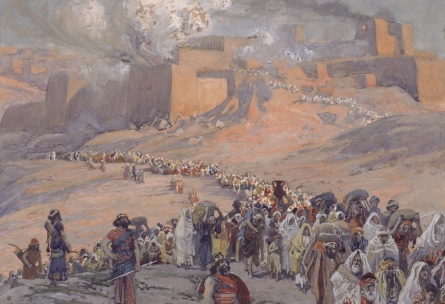
James Tissot, The Flight of the Prisoners

Psalm 79

<A Psalm of Asaph.>

1 O God, the nations have come into your inheritance; they have defiled your holy temple; they have laid Jerusalem in ruins.
2 They have given the bodies of your servants to the birds of the air for food, the flesh of your faithful to the wild animals of the earth.
3 They have poured out their blood like water all around Jerusalem, and there was no one to bury them.
4 We have become a taunt to our neighbors, mocked and derided by those around us.
5 How long, O LORD? Will you be angry forever? Will your jealous wrath burn like fire?
6 Pour out your anger on the nations that do not know you, and on the kingdoms that do not call on your name.
7 For they have devoured Jacob and laid waste his habitation.
8 Do not remember against us the iniquities of our ancestors; let your compassion come speedily to meet us, for we are brought very low.
9 Help us, O God of our salvation, for the glory of your name; deliver us, and forgive our sins, for your name’s sake.
10 Why should the nations say, “Where is their God?” Let the avenging of the outpoured blood of your servants be known among the nations before our eyes.
11 Let the groans of the prisoners come before you; according to your great power preserve those doomed to die.
12 Return sevenfold into the bosom of our neighbors the taunts with which they taunted you, O Lord!
13 Then we your people, the flock of your pasture, will give thanks to you forever; from generation to generation we will recount your praise.

Most of the Psalms of Asaph in this section are likely written in the aftermath of the devastation of Jerusalem and the destruction of the temple by the Babylonians in 587 BCE and emerge in a space of broken dreams and deep pain. The placement of this psalm immediately after Psalm 78, with its condemnation of Northern Israel and its belief that God’s love and protection focused on Judah and the sanctuary at Mount Zion, highlights the hopes that are now in pieces after the experience of the surviving the destruction caused after a long siege. The Davidic monarchy is shattered, the temple lies in ruins, the people are being forced into exile, and the land has languished under the violence of Babylon’s campaigns against Judah. The Babylonians have defiled the things the people of Judah believed would endure forever under God’s protection. In a space of national defeat and humiliation where God’s hand has not protected them the psalmist narrates the trauma of the survivors as they walk among unburied corpses in the shattered city calling on God for a response to the violence that has been done to them.

Prophets like Jeremiah had indicated that Babylon was God’s instrument of judgment, but the Asaph who narrates this psalm may have been one of those who would have considered Jeremiah’s words dangerous at best and traitorous at worst. Jeremiah and other prophets may have warned about the failure of the people to live according to God’s covenant with them and that their trust in the Davidic king and the temple were misplaced without this covenant faithfulness. One of the gifts of scripture is bringing together multiple voices and experiences around these critical times of crisis as the individuals and the people navigate who they are and how they are to live in the face of national disaster. This psalm comes from a place of shock, anger, and grief about the plight of the people and God’s apparent lack of action on their behalf.

The psalm tries to appeal to God’s honor and glory and the ways in which Babylon’s actions have defiled that. Instead of the peoples’ inheritance or the temple of Solomon the things that are broken are God’s. The corpse of God’s servant[1] is left unburied for the birds and wild animals to scavenge and with the imagery of the blood being poured out like water it is poetically like the Babylonians in their act of war have made a mockery of the sacrificial offerings of Judah. Now Israel itself has become the sacrifice laid upon the altar of the shattered stones of the city and no one is able to begin the process of undoing this desolation. Their situation is one of devastation and disgrace. Babylon made them an example of the cost of defiance of the might of their empire so that other nations might see and respond in fear.

Yet, the devastation has not turned the psalmist from their trust in God and it is to God they cry from their anguish. There is in the psalm an awareness that it is God’s anger that has allowed the devastation to occur and there is an awareness that God is justified in his anger over the sins of the past. Yet, in the psalmist’s view, the punishment far exceeds the crime and the license extended to the Babylonians has not brought dishonor not only to Israel but to God’s name. Moses used a similar argument after the golden calf to get God to turn away from God’s wrath towards the people, and here the psalmist appeals both to the nations’ perception of the God of Israel but also to the compassion of God that demonstrated when God responded to the cries of the oppressed in the past. They ask God to open God’s hearing to the cries of the prisoner[2] and to deliver the condemned[3] and to repay their enemies sevenfold[4] for the violence they have done and the dishonor they have done to God’s name.

The psalm ends in a place of hope where the broken people will praise God from generation to generation. Most of this psalm dwells in trauma and brokenness as the psalmist cries out in anger to God asking for vengeance but it does not end there. The hurt and pain eventually turn to praise, the deep wounds of the present heal, and the anger recedes as hope emerges out of the devastation. Times of national crisis change us. In my lifetime we thankfully have not experienced the depth of disaster that the Babylonian exile would have been, but September 11, 2001, the Covid Pandemic, the uncertainty of January 6, 2020, and many other events have caused me to cry out to God asking questions and wondering about my perception of God’s action or lack of action in these moments. Times of crisis force us to ask hard questions about our beliefs and to refine them. My instructor in Hebrew Bible two decades ago, Ann Fritschel, once said that the answer to almost any historical question in reference to the Hebrew scriptures was the Babylonian exile. That event caused both a great reconsideration of what the covenant faith in the LORD the God of Israel meant and a gathering and consolidation of the stories, poems, reflections, and words of the prophets to form the scriptures to ensure the tradition could be handed down. We stand as the inheritors of these voices that have come together to reflect upon the life of faith in both times of peace and times of conflict. These words spoken in trauma yet ending in hope may give words to our anger, grief, and mourning but they may also allow us to hope for a time when healing allows us to lift our voices in praise.

[1] This is singular in Hebrew. The Septuagint and most English translations make this plural, but it probably is used here like the servant in Isaiah which may refer collectively to Israel.

[2] Again, singular in Hebrew but also is probably used as a collective to refer to Judah.

[3] Literally the ‘sons of death’.

[4] Possibly an allusion to the words of God in protection of Cain in Genesis 4:13.

Psalm 74 A Psalm When the World Collapses

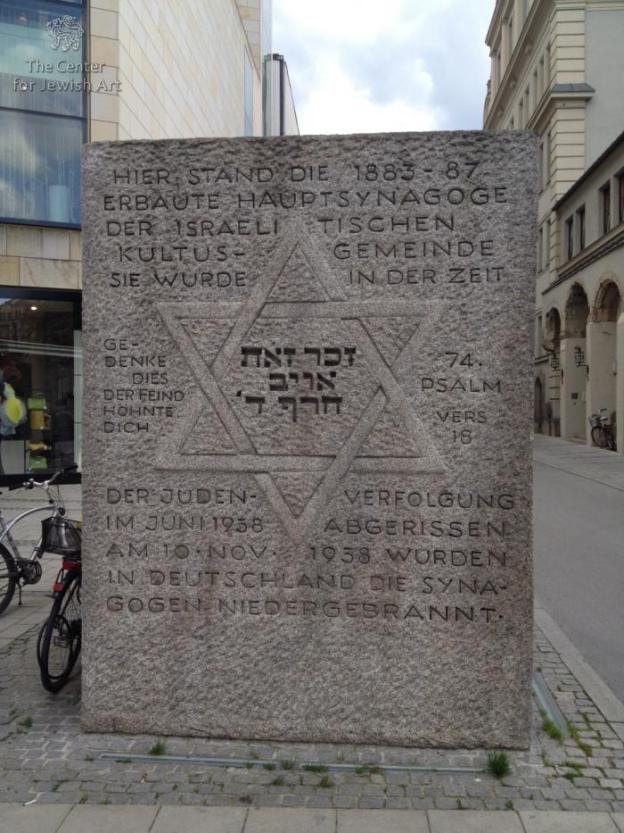
Memorial to the Main Synagogue in Munich which was destroyed during Kristallnacht, November 10, 1938. Psalm 74:18 is used in the center of the monument.

Psalm 74

<A Maskil of Asaph.>
1 O God, why do you cast us off forever? Why does your anger smoke against the sheep of your pasture?
2 Remember your congregation, which you acquired long ago, which you redeemed to be the tribe of your heritage. Remember Mount Zion, where you came to dwell.
3 Direct your steps to the perpetual ruins; the enemy has destroyed everything in the sanctuary.
4 Your foes have roared within your holy place; they set up their emblems there.
5 At the upper entrance they hacked the wooden trellis with axes.
6 And then, with hatchets and hammers, they smashed all its carved work.
7 They set your sanctuary on fire; they desecrated the dwelling place of your name, bringing it to the ground.
8 They said to themselves, “We will utterly subdue them”; they burned all the meeting places of God in the land.
9 We do not see our emblems; there is no longer any prophet, and there is no one among us who knows how long.
10 How long, O God, is the foe to scoff? Is the enemy to revile your name forever?
11 Why do you hold back your hand; why do you keep your hand in your bosom?
12 Yet God my King is from of old, working salvation in the earth.
13 You divided the sea by your might; you broke the heads of the dragons in the waters.
14 You crushed the heads of Leviathan; you gave him as food for the creatures of the wilderness.
15 You cut openings for springs and torrents; you dried up ever-flowing streams.
16 Yours is the day, yours also the night; you established the luminaries and the sun.
17 You have fixed all the bounds of the earth; you made summer and winter.
18 Remember this, O LORD, how the enemy scoffs, and an impious people reviles your name.
19 Do not deliver the soul of your dove to the wild animals; do not forget the life of your poor forever.
20 Have regard for your covenant, for the dark places of the land are full of the haunts of violence.
21 Do not let the downtrodden be put to shame; let the poor and needy praise your name.
22 Rise up, O God, plead your cause; remember how the impious scoff at you all day long.
23 Do not forget the clamor of your foes, the uproar of your adversaries that goes up continually.

This is one of several places in scripture where poets and prophets wrestle, together with the rest of the people of God, over the loss of the temple and the transport into exile. Some of these reflections engage with the deep hurt and anger at the loss of their home, like Psalm 137. Others, like Jeremiah or 2 Kings, point to the unfaithfulness of the people in their relationship with God as being responsible for the disaster. Psalm 74 also attempts to make sense of the destruction and violence that has been encountered and wonders how long it will be before God acts to restore the people and fulfill God’s portion of the covenant. In the aftermath of a defeat at the hands of an enemy which has destroyed both their military resistance and the symbols of their faith the psalmist calls upon God to act and restore the people and the house where God’s name dwells.

The defeat of Jerusalem by Babylon and the destruction of the temple causes a crisis of identity for the people of Judah. The temple, more than just a building but a symbol of their faith, the Davidic king, promised to reign perpetually, and the land have all been taken away and those who have attempted to remain faithful to the covenant now have to reshape their identity without these central aspects of their life. Unlike in the prophets or in the narration of Israel’s history, there is no confession of guilt here. Perhaps the psalm comes from a place still too fresh for that type of reflection, or the psalmist may view that they and those around them have remained faithful. They do not question the justice of God’s action against the people of Judah, but they turn back to the covenant and God’s action to claim them as a people and ask for God’s restoration and forgiveness. The cause of their disaster is God’s anger and casting off of the people and their restoration can only be found in God’s turning back toward them.

The appeal is to God’s sovereignty. Although there is no confession of guilt and no declared acts of repentance the psalmist believes their enemy has gone too far. God’s anger should be kindled against them because they have burned the holy place, smashed, and vandalized the building, have placed their emblems and symbols in the places where only the name of God should dwell and have burned any place where the people could gather. The enemy’s triumph has caused not only the people of God to be scoffed, but God’s name to be dishonored. With no holy place or holy people to bear a message from God the people can only shout ‘how long’ and hope in the silence for a word from God to answer their question.

I believe that the enemies in this psalm are the Babylonians who conquered Jerusalem in 598 BCE and the language in the second half of the psalms reflects a polemic against the religion of the Babylonians that we are familiar with through the Enuma Elish where Marduk kills the great multi-headed dragon Tiamat (Leviathan) and sea monsters (dragons). In contrast it is the LORD, the God of Israel, who triumphed over the chaotic forces of the sea in the creation and who subdued the great monsters that threatened creation. This God who created the day and night, sun and stars, springs, and streams, and fixed the boundaries of the earth can act on behalf of this conquered people. The God who formed a covenant with the people in the Exodus and overcame Egypt can now overcome Babylon. The God who hears the poor and the vulnerable can now hear their cry from their oppression and will deliver. But if none of these reasons are suspicious, the psalmist calls upon God to defend God’s name from the impious who scoff at God’s power. The enemy who conquered the people has arrayed themselves against God and the people wonder aloud how long they will wait before they see God’s response to the adversaries of this generation.

Psalm seventy-four ends without a resolution and those speaking it enter into the space of waiting for God’s answer. Even in the midst of crisis the faithful ones continue the conversation with God and call upon God to act. The Babylonian exile does not end the crises that will arise for the faithful people, and this psalm has been a resource in times where national or personal identity has been challenged among the faithful. The picture above is from a memorial for the main synagogue in Munich, which was destroyed during Kristallnacht on November 10, 1938 and the center of the memorial uses Psalm 74:18 as the Jewish people would once again ask God, “how long” while an impious people in their actions destroyed the holy places of the people and in words and actions reviled the name of God.

Images for the 26th Sunday After Pentecost (Lectionary 33C)

The primary text this week is Jesus talking about the destruction of the Temple, so there are a number of good temple related images:

The Temple by Radojavor@deviantart.com

The Temple by Radojavor@deviantart.com

Model of the Second Temple at the time of Jesus

Model of the Second Temple at the time of Jesus

James Tissot, Reconstruction of Jerusalem and the Temple of Herod, painted between 1886 and 1894

James Tissot, Reconstruction of Jerusalem and the Temple of Herod, painted between 1886 and 1894

The Disciples Admire the Buildings of the Temple, James Tissot

The Disciples Admire the Buildings of the Temple, James Tissot

The Siege and Destruction of Jerusalem by Romans Under the Command of Titus, A.D. 70 by David Roberts 1850

The Siege and Destruction of Jerusalem by Romans Under the Command of Titus, A.D. 70 by David Roberts 1850