Review of the Starless Sea by Erin Morgenstern

Five Star Book Review

Erin Morgenstern, The Starless Sea

For me a five-star book is something that either I want to read again or something that is so profound it makes an immediate impact. There are lots of ways that books can be compelling: a unique idea, an interesting set of characters, a complex plot, an artistic use of the English language and more. Reading is also a subjective experience, so what appeals to me as a reader may be very different for you. I read a lot for both pleasure and work but these short reviews are a way for me to show my appreciation for the work and the craft of the author of the reviewed work.

Erin Morgenstern is the author for two of my top ten all time books: The Night Circus and The Starless Sea. I read the Starless Sea when it came out in 2019, and this was my second journey through this incredible world. She writes in a way that is as beautiful as the magical worlds she describes in her two novels. The Starless Sea is not a book that everyone will love because it is like a nesting doll: stories within stories and worlds within worlds. If you can hold these multiple stories which all allude to the central storyline within your imagination and you want a journey to a fragile but magical world then this is the story to take you into a world where acolytes record the stories they hear buzzing in the air around them, keepers maintain and care for the world of stories on the harbor of the starless sea, and guardians attempt to guard the world. It is a world where fate falls in love with time, where the moon arrives in a great storm and interrupts the world of a lonely innkeeper, where a pirate in prison tells stories of sweet sorrows to a young woman who brings his food. The parliament of owls, bees, key collectors, swords of prophecy, a story sculptor, two lovers lost in time, and more surround the story of Zachery Ezra Rollins, the son of the fortune teller, and Dorian the former member of the Collectors Club as they are brought by doors painted by fate to the magical world of stories.

“To seeking” is the greeting of this world and the proper response is, “to finding.” This sentiment is appropriate for a book that invites you deeper and deeper into this magical world as you are invited into the experience of Zachery as he discovers the mysteries of the world at the end of its life and the dangers of those that attempt to defend it at all cost. It is a multi-tiered world of harbors along the sea full of stories and myths where lovers are torn apart and reunited. Is the book occasionally confusing as the characters attempt to muddle through the broken magic all around them, yes, but I also found myself content to linger as the strings of the plot from the various stories converge into the ending of a world and the beginning of a new possibility.

As one of the stories in the book tells us, this is a book, “For those who feel homesick for a place they’ve never been to. Those who seek even if they do not know what (or where) it is that they are seeking. Those who seek will find. Their doors have been waiting for them.” There is something spiritual in the Zachery’s quest into this world, and it is a world I want to continue to explore. Reactions to the Starless Sea seem to be polarized-some find it confusing and hard to finish and it is very different than most fantasy. It is a love story to stories and imagination and it is not your traditional linear story, but as a lover of stories and magic it was a beautiful journey into a place that I didn’t know I was homesick for. The harbor on the starless sea could be at times troubling, at times incredibly comfortable, but always with an edge of the unexplained and magic. The book is a door that opens into a magical world and if you choose to open it may what you are seeking find you.

Psalm 85 Waiting For God’s Kingdom to Come

Kiss of Peace and Justice by Laurent de La Hyre (1654) – The figures of Peace (burning the weapons of war) and Justice (holding a sword and scales) embrace in a quiet landscape. The Latin inscription under the antique urn reads “Justice and Peace kissed” (referring to an Old Testament verse, Psalms 85:11). The subject may have had political significance: the painting’s date coincides with the end of the Fronde, a period of civil war in France during which the parliament (courts of appeal) and the nobility sought—unsuccessfully—to limit the power of the monarchy, Taken in 2012, CC0, https://commons.wikimedia.org/w/index.php?curid=18176364

Psalm 85

<To the leader. Of the Korahites. A Psalm.>
1 LORD, you were favorable to your land; you restored the fortunes of Jacob.
2 You forgave the iniquity of your people; you pardoned all their sin. Selah
3 You withdrew all your wrath; you turned from your hot anger.
4 Restore us again, O God of our salvation, and put away your indignation toward us.
5 Will you be angry with us forever? Will you prolong your anger to all generations?
6 Will you not revive us again, so that your people may rejoice in you?
7 Show us your steadfast love, O LORD, and grant us your salvation.
8 Let me hear what God the LORD will speak, for he will speak peace to his people, to his faithful, to those who turn to him in their hearts.
9 Surely his salvation is at hand for those who fear him, that his glory may dwell in our land.
10 Steadfast love and faithfulness will meet; righteousness and peace will kiss each other.
11 Faithfulness will spring up from the ground, and righteousness will look down from the sky.
12 The LORD will give what is good, and our land will yield its increase.
13 Righteousness will go before him, and will make a path for his steps.

Throughout the psalms there is a rhythm that moves between the memory of God’s actions in the past, the crisis of the present, and a hopeful vision of the world that God brings when God acts on behalf of the psalmist and the people. God has acted in the past, God hears the cries of God’s people as they endure a time of judgment, but God’s anger will always yield to God’s steadfast love and faithfulness. The crisis which is a part of the people’s wanderings into a spiritual wilderness will be resolved by God’s shalom (peace) and righteousness which are united in embrace. The poetry of hope emerges out of the reservoir of memory which calls the people to return to the practices of faithfulness and to a life in covenant with the LORD.

The narrative of Israel is filled with times when the people turned from the ways of God and do evil in the sight of the LORD and then their God in anger abandons them to their enemies. From the construction of the golden calf and the reestablishment of the covenant (Exodus 32-34) to the pernicious pattern which repeats continually through the book of Judges, David’s betrayal with Bathsheba, Solomon’s adoption of the worship of other gods, and then the various kings of Israel and Judah who do evil and lead the people away from the way of the God of Israel there are numerous touchpoints in the people’s history where they can reflect on how God was anxious to receive their repentance. The LORD has proven that their God does forgive and pardon, does withdraw wrath and turn from hot anger, and does restore the people.

The petitioners ask for what their ancestors have received in the past. God’s anger may be justified but the people cannot endure it much longer. They present no argument for God’s restoration of the people other than God’s history of doing so. They appeal to the steadfast love of God to grant them the salvation they need and to overcome God’s indignation. Yet, the psalmist also desires more than a temporary return to the LORD’s ways. The poet trusts that God will speak shalom to the people. Yet, the end of verse eight in Hebrew is “but let them not return to stupidity.”[1]

The hoped for “renewal, restoration, and revival of the community is completely a gift from God.” (Brueggemann, 2014, p. 369) Poetry moves beyond a tame hope for the restoration of the past and leaps into a beautiful and lyrical vision of a world where the ways of God and the ways of the world unite. They trust that God’s salvation is at hand and that the longed-for reunion will occur after the desperate time of separation. God’s presence and glory will again dwell among the people. God’s hesed (steadfast love) meets with faithfulness among the people. Righteousness (living in the way of the law) and shalom[2] (God’s gift of peace and harmony) embrace in a kiss of reconciliation. Faithfulness grows like the grain from the earth while righteousness comes down like the sun and rain from the heavens. The reconciliation between God and God’s people doesn’t just mean peace for the people, but restoration for the creation as the land yields its increase. This is a beautiful lyrical imagination of what God’s kingdom arriving on earth as in heaven looks like through the poet’s words. Righteousness goes before God on the journey as God’s arrival with steadfast love and peace are at hand.

[1] The NRSV follows the Septuagint (LXX, the Greek translation of the Hebrew Scriptures) by stating “to those who turn to him in their hearts.” But as Beth Tanner points out the Hebrew (MT) is readable and there isn’t a compelling reason to adopt the LXX reading instead. (Nancy deClaisse-Walford, 2014, p. 656)

[2] Shalom is not just the absence of conflict. It also includes the idea of wholeness or harmony where people and creation live in comfort without fear. (Nancy deClaisse-Walford, 2014, p. 658)

Psalm 84 Better is One Day in the House of God

A Song Sparrow (Melospiza melodia) feeding on the ground. Photo taken with a Panasonic Lumix DMC-FZ50 in Caldwell County, North Carolina, USA. Photo by Ken Thomas, March 3, 2008. Image released by creator to public domain.

Psalm 84

To the leader: according to The Gittith. Of the Korahites. A Psalm.
1 How lovely is your dwelling place, O LORD of hosts!
2 My soul longs, indeed it faints for the courts of the LORD; my heart and my flesh sing for joy to the living God.
3 Even the sparrow finds a home, and the swallow a nest for herself, where she may lay her young, at your altars, O LORD of hosts, my King and my God.
4 Happy are those who live in your house, ever singing your praise. Selah
5 Happy are those whose strength is in you, in whose heart are the highways to Zion.
6 As they go through the valley of Baca they make it a place of springs; the early rain also covers it with pools.
7 They go from strength to strength; the God of gods will be seen in Zion.
8 O LORD God of hosts, hear my prayer; give ear, O God of Jacob! Selah
9 Behold our shield, O God; look on the face of your anointed.
10 For a day in your courts is better than a thousand elsewhere. I would rather be a doorkeeper in the house of my God than live in the tents of wickedness.
11 For the LORD God is a sun and shield; he bestows favor and honor. No good thing does the LORD withhold from those who walk uprightly.
12 O LORD of hosts, happy is everyone who trusts in you.

The journey to the temple is made in expectation of encountering God within the space. The temple, the dwelling place of the LORD of hosts, may indeed be beautiful but the expectation of encountering the divine presence in the experience of worship is what the pilgrim longs for. The temple in Zion is the sacred destination at the end of the pilgrim’s journey and they desire nothing more than to dwell in the house of the LORD forever. This beloved[1] space occupies a special place in the heart and desires of the faithful one who journeys from their daily home to the place where their soul[2] finds its dwelling place. This meaningful space where the divine can encounter the faithful one is where life finds its joyous culmination.

In the pilgrim imagines what life would be like if the extraordinary moment of approaching the temple became the everyday experience of dwelling in the temple. The sparrow and swallow who make their nest within the building have found their home. The priests who work in the temple are ‘happy’[3]in the psalmist’s vision because the dwell in proximity to God. Yet, the psalmist also finds ‘happiness’ in their own trust in God and the pull of their heart back to God’s dwelling place in Zion. The psalmist’s joyous song of their impending homecoming to their spiritual home and expectant encounter with the LORD of hosts.

Throughout this psalm the LORD the God of Israel is referred to as the LORD of hosts, or the LORD of armies.[4] This militaristic imagery is now paired with the imagery of the military might of God’s anointed king when the psalmist declares “Behold our shield, O God; look on the face of your anointed.” God has provided protection for this pilgrim. Perhaps this scene is a military homecoming from conflict to rejoice at the temple of God. Yet, for Israel their military might is always contingent upon the divine protection of their God and the psalmist continues to appeal to God to see these meager forces of the king of Israel and to protect both God’s temple and God’s people.

One day in the presence of God is worth a thousand elsewhere and this expected time of worship where God is encountered gives meaning to every other time. Being a ‘doorkeeper’ would probably be a position of honor among the Korahites and while the exact meaning of the Hebrew here is uncertain, I find the suggestion of ‘standing on the threshold’ (Nancy deClaisse-Walford, 2014, p. 652) poetically opposite to ‘dwelling in the tents’ of the wicked ones. The pilgrim would rather have the experience of not being fully allowed inside the house of God rather than the full inclusion in the tents of wickedness. The pilgrim psalmist is attempting to walk the path of wisdom that leads to the ‘happiness’ found in trusting in the LORD of hosts and encountering God in God’s house.

Psalm 84 refers to a sacramental understanding of reality in the temple of the LORD. It is a place where God promises to be present among the people. In the world of the psalmist the journey to the temple involves a pilgrimage that may only be made once annually, and so for this pilgrim they approach Jerusalem in joyous expectation. Many contemporary Christians whose churches believe in a sacramental reality where God approaches the gathered community in worship would occupy an incredibly privileged space to the psalmist, like the sparrow and swallows who dwell in the temple and the priests who minister there. Yet, I wonder if the relative ease of the journey to the threshold of the congregation has diminished the hopeful expectation of the faithful to encounter God’s presence within the space of worship. The ability to regularly worship may have dulled our joy at spending a day in this place that the psalmist claims is better than a thousand elsewhere.

[1] Hebrew yedidot translated by the NRSV as ‘lovely’ involves more than visual admiration. As J. Clinton McCann Jr. indicates: “the experience creates a bond between person and place that might be better expressed with the word “beloved.”” (NIB IV: 1013)

[2] Reminder that the Hebrew nephesh translated soul here is not the Greek conception of the ‘eternal soul’ differentiated from the physical body. The Hebrew idea of nephesh is better understood as the essence of life.

[3] Hebrew asre, an important word in wisdom literature. Can be translated ‘blessed’ or ‘happy.’

[4] Referring to God as the LORD of hosts is literally: ““YHWH of armies,” with the armies or hosts referring to angelic heavenly host, the heavenly hosts of sun, moon, and stars, or the hosts of Israel’s armies. The title suggests the great God of military might and victory, who is powerfully present in Zion.” (Brueggemann, 2014, p. 365)

Psalm 83 A Fearful Prayer for Deliverance

From Susan Harris Anger and art// A Rage to Paint https://www.susanharrisart.com/blog

 Psalm 83

<A Song. A Psalm of Asaph.>
1 O God, do not keep silence; do not hold your peace or be still, O God!
2 Even now your enemies are in tumult; those who hate you have raised their heads.
3 They lay crafty plans against your people; they consult together against those you protect.
4 They say, “Come, let us wipe them out as a nation; let the name of Israel be remembered no more.”
5 They conspire with one accord; against you they make a covenant —
6 the tents of Edom and the Ishmaelites, Moab and the Hagrites,
7 Gebal and Ammon and Amalek, Philistia with the inhabitants of Tyre;
8 Assyria also has joined them; they are the strong arm of the children of Lot. Selah
9 Do to them as you did to Midian, as to Sisera and Jabin at the Wadi Kishon,
10 who were destroyed at En-dor, who became dung for the ground.
11 Make their nobles like Oreb and Zeeb, all their princes like Zebah and Zalmunna,
12 who said, “Let us take the pastures of God for our own possession.”
13 O my God, make them like whirling dust, like chaff before the wind.
14 As fire consumes the forest, as the flame sets the mountains ablaze,
15 so pursue them with your tempest and terrify them with your hurricane.
16 Fill their faces with shame, so that they may seek your name, O LORD.
17 Let them be put to shame and dismayed forever; let them perish in disgrace.
18 Let them know that you alone, whose name is the LORD, are the Most High over all the earth.

One of the gifts of the book of psalms is the range of situations these poems address and the emotions they embrace. The potency of poetry can be uncomfortable, especially when it comes out of a space of fear or anxiety to call upon God to turn God’s power upon an enemy. Many of the psalms in book three of the psalter (Psalms 73-89) reflect the experience of suffering paired with the expectation of God’s response to the cry of the suffering one. The hope of the psalmist is for a God who can provide hope in the midst of the hopeless situation for the individual or the nation. This is the final Psalm of Asaph, a group of psalms which expect God to execute judgment on the situation of the individual or (as in this psalm) the nation. (Brueggemann, 2014, p. 360)

In the threatening situation that Israel encounters the psalmist asks for God’s silence to cease and for God not to be still. In contrast to the perceived silence of God there is the tumult[1] of Israel’s threatening enemies. Even beyond the threat to Israel, these enemies have raised themselves to oppose the God of Israel. The plans to wipe out Israel and take possession of the land are paired with the unusual action of making a covenant against God.[2] The situation in the poem is deadly serious with a group of enemies promising to destroy the population and the memory of Israel.

The enemies listed in the middle of the psalm geographically encircle Israel. Edom, Moab, Ammon and Amalek, Philistia and Tyre are all common opponents of the Israelites in the time of both judges and throughout the monarchy of Israel. Assyria may indicate a later date for the psalm since the Assyrian empire rises as a regional power that begins to impact Israel during the Omri dynasty in Israel[3] and a century later will defeat Israel[4] decisively. There is no known alliance of Assyria with the listed nations. Two nations are rarely mentioned: the Hagrites and Gebal. The Hagrites are mentioned in 1 Chronicles 5 as a group in the northern Transjordan, Gebal is associated with the city of Byblos on the coast of modern Lebanon. (Brueggemann, 2014, p. 361) Israel finds itself surrounded by a numerically and militarily superior enemy which is determined to destroy them so completely that not even their memory remains.

The mention of Assyria may indicate a later date for the psalm, but the history that the psalmist appeals to all occur in the time of Judges and early in the monarchy of Israel at the latest.. God’s action against Midian occurs through Gideon (Judges 6-8), Sisera and Jabin are the general and king that oppose Deborah as judge and Barak as the military leader of the Israelites (Judges 4-5). En-dor is mentioned twice in the Hebrew Scriptures: once when Saul consults a medium (1 Samuel 28) but the reference in the psalm is probably to the people of Manasseh taking possession of the land in Joshua 17:11.[5] Oreb and Zeeb are two of the captains of Midian killed when Gideon fought against the Midianites (Judges 7:25) and Zebah and Zalmunna are the final leaders of Midian pursued and killed by Gideon (Judges 8:1-21). The final psalm may build upon an early psalm which arose out of the experiences of the time of judges or early in the monarchy. Regardless of its history of composition the psalm echoes the experiences of God’s deliverance of the people in the past to cast a hopeful vision for God’s deliverance in the present.

Frequently psalms that call upon God to act against a military threat portray God as a divine warrior, but here the psalm calls upon God to be a force of nature. God is a wind that scatters their enemies like tumbleweeds, a consuming fire that consumes the forests and mountains, and a mighty storm that terrifies those who are in its path. Perhaps the psalmist expects the presence of God to be preceded by these things, like the wind, earthquake, and fire that precede the still small voice in 1 Kings 19.The experience of war is brutal and the language of this psalm expresses that brutality with the image of bodies littering the earth like fertilizer.[6] The psalmist does not anticipate that God acting as a force of nature will be painless for their enemies or that their oppressors will change their behavior without God’s forceful action. Yet, Israel here does not seem to embody the same genocidal tendencies of their oppressors. The desire is for the enemies to be shamed but with the ultimate goal of the enemies know that the LORD the God of Israel is the Most High over all the earth.

For people who are not the victims of oppression the idea of calling upon God to terrify and eliminate our enemies may seem uncomfortable. Psalm 83 is one of the imprecatory psalms[7] and these psalms are rarely used in the worship of the church. Yet, these psalms are a part of the honest dialogue of faith that emerges from those moments in life where enemies are oppressing the faithful and they ask for God’s response amidst the clamoring of their enemies. The gift of the psalter is its ability to contain the breadth of human emotions and bring those emotions into the dialogue with the promise of God hearing the concerns of God’s people. The God of the scriptures is not an uninvolved or detached God. The psalmist expects God’s silence to end and for God to be a force of nature which delivers God’s people from the violent enemies that surround them.

[1] Growling in Hebrew (Nancy deClaisse-Walford, 2014, p. 647)

[2] As Beth Tanner notes this is the only place in the Hebrew Scriptures where a covenant is made against a person or entity instead of with. (Nancy deClaisse-Walford, 2014, p. 647)Normally covenants bind individuals and peoples together, but the alliance made here is in aggression against both God and God’s people.

[3] Particularly in the time of King Ahab 869-850 BCE

[4] Israel here refers to the northern kingdom of Israel as opposed to Judah after the split of the nations in the time of Jeroboam and Rehoboam (1 Kings 12)

[5] Although the text seems to indicate that Dor and En-dor are cities that Manasseh were unable to take full possession of and that the Canaanites remained within. It is possible there is a memory of a victory that is not recorded in Joshua or Judges that is remembered in the psalm.

[6] This word in Hebrew is frequently used for bodies left on the ground (2 Kings 9:37, Jeremiah 8:2; 9: 22; 16:4; 25:33) but seems to be more associated with debris or fertilizer than dung which would be an offensive way to refer to the dead. (Nancy deClaisse-Walford, 2014, p. 646)

[7] Other psalms of this type include psalms 7, 35, 55, 58, 59, 69, 79, 104, and 137.

Psalm 82 The God Who Upholds Justice for the Vulnerable

Council of the Gods Giovanni Lanfranco (1582–1647), Galleria Borghese By Architas – Own work, CC BY-SA 4.0, https://commons.wikimedia.org/w/index.php?curid=70138442

Psalm 82

<A Psalm of Asaph.>
1 God has taken his place in the divine council; in the midst of the gods he holds judgment:
2 “How long will you judge unjustly and show partiality to the wicked? Selah
3 Give justice to the weak and the orphan; maintain the right of the lowly and the destitute.
4 Rescue the weak and the needy; deliver them from the hand of the wicked.”
5 They have neither knowledge nor understanding, they walk around in darkness; all the foundations of the earth are shaken.
6 I say, “You are gods, children of the Most High, all of you;
7 nevertheless, you shall die like mortals, and fall like any prince.”
8 Rise up, O God, judge the earth; for all the nations belong to you!

The vision of a council of gods presided over by the God of Israel seems strange to many modern readers who view the world through a secular lens. The activity of one God who remains active in the midst of the creation may seem difficult to imagine, much less numerous gods responsible for various regions or powers. Despite the distance between the ancient view of the world and our own this short poetic vision of a divine council reiterates the central Hebrew idea of justice and the role of God in ensuring justice for the vulnerable. The foundations of the creation are sunk into this justice for the weak and needy. The neglect of justice by these gods has undermined the foundations upon which the world rests.

Most modern readers of the bible assume that the Jewish monotheism meant that they did not believe the gods of the other nations existed, but throughout the Hebrew scriptures it assumes the existence of the gods of the nations while maintaining the superiority of the God of Israel. The signs and wonders[1] that the LORD the God of Israel used to bring the people out of Egypt are written in a way that demonstrates the LORD triumphing over the gods of Egypt. Elijah’s victory over the prophets of Baal likewise demonstrates the superiority of the LORD over Baal. Elijah may ridicule Baal for being busy or asleep, but Elijah never claims that Baal does not exist. There are moments where the Hebrew scriptures do move towards a monotheism where the idols of the nations are merely the work of human hands, but the faith of Israel grows in a polytheistic world where different nations worshiped a collection of gods and where the people of Israel continually struggled to maintain their trust in the LORD the God of Israel when these other gods were viewed as attractive alternatives.

Psalm 82 is a vision that presumes the superiority of the LORD, the God of Israel, over the gods. The God of Israel summons all these deities, asks them how long they will remain unjust and partial to the wicked, and charges them to maintain justice. For Israel The role of leaders in society was to be modeled on God’s role of protecting the vulnerable. As Brueggemann and Bellinger state:

The proper role, so defining for Israel’s faith and ethics, is to be guardian, protector, and guarantor of the vulnerable—the weak, the widow, the orphan, the lowly, the destitute—all those who lack the resources to sustain and protect themselves. (Brueggemann, 2014, p. 355)

Yet, one of the persistent dangers of religion and its proximity to power is to reimagine the ‘gods’ of the nations as authorizing the rule of the powerful. The gods, and by extension their servants in the nations, have served the powerful and those who have not upheld justice. Instead, these gods and their representatives on earth have become powers of oppression instead of justice. They have corrupted their calling and now they are called to judgment in the divine council.

In verse five the pronoun changes from second person plural to third person plural (you to they) and this may represent a change in tone or a change in voice. I am reading this as a change in voice, where we see the entrance of an unnamed accuser[2] who declares that these gods are so corrupted that they lack the knowledge to change. These gods exist in darkness unable to see how their unjust ways jeopardize the foundations of the creation. It is possible that the poet stays with the God of Israel speaking and changes the tone moving from charge to realization of the gods’ inability to embody the justice they are called to defend.

The voice shifts in verse six back to the God of Israel pronouncing judgment upon the assembled gods. They are all lifted up as children of the Most High, but they will not reign forever. Being ‘gods’ has not granted them immortality and they are told they will perish like mortals. They have been unfaithful in their administration and appear unable to change. Rather than continually imperiling the foundations of the earth and the practice of judgment their time they, and the systems they represent, will come to an end. Finally, another voice, perhaps the poet who has this vision revealed to them or a member of the LORD’s party, calls for the God of Israel to rise up and judge the earth and the nations in the ways of justice. The LORD is to establish justice for all the nations.

Neil Gaiman’s creative fantasy American Gods imagines the American landscape as a polytheistic space where the ‘old gods’ which the immigrants brought with them from their homeland come into conflict with the ‘new gods’ of technology and power. All of the gods in Gaiman’s story are interested in their own power and often stand behind the powerful and authorize their actions. The God of Israel has a ‘preferential option for the poor’ to use the famous phrase of Liberation theology. The biblical witness points to the God of Israel as the protector of the lowly and destitute and the one who brings down the might from their thrones when they become the oppressors of the vulnerable. Within this brief poem any religion whose gods authorize the oppression of the powerless by the powerful is a danger to the foundation of the earth and stands under God’s judgment.

[1] Most people refer to these as the plagues, but Exodus continually articulates these as being signs and wonders.

[2] This is the role of Satan in the book of Job, but it could be any member of the council of the LORD. This short poem leaves the figure unnamed and merely suggested.

Psalm 81 Hear! O People

The Temple by Radojavor@deviantart.com

Psalm 81

<To the leader: according to The Gittith. Of Asaph.>
1 Sing aloud to God our strength; shout for joy to the God of Jacob.
2 Raise a song, sound the tambourine, the sweet lyre with the harp.
3 Blow the trumpet at the new moon, at the full moon, on our festal day.
4 For it is a statute for Israel, an ordinance of the God of Jacob.
5 He made it a decree in Joseph, when he went out over the land of Egypt. I hear a voice I had not known:
6 “I relieved your shoulder of the burden; your hands were freed from the basket.
 7 In distress you called, and I rescued you; I answered you in the secret place of thunder; I tested you at the waters of Meribah. Selah
 8 Hear, O my people, while I admonish you; O Israel, if you would but listen to me!
 9 There shall be no strange god among you; you shall not bow down to a foreign god.
 10 I am the LORD your God, who brought you up out of the land of Egypt. Open your mouth wide and I will fill it.
 11 “But my people did not listen to my voice; Israel would not submit to me.
 12 So I gave them over to their stubborn hearts, to follow their own counsels.
 13 O that my people would listen to me, that Israel would walk in my ways!
 14 Then I would quickly subdue their enemies, and turn my hand against their foes.
 15 Those who hate the LORD would cringe before him, and their doom would last forever.
16 I would feed you with the finest of the wheat, and with honey from the rock I would satisfy you.”

The central commandment for Israel is for the people to hear:

Hear, O Israel: The LORD is our God, the LORD alone. (Deuteronomy 6:4)

Now within the event of a festal gathering and worship of the LORD the voice of God comes to the assembly asking them to hear the LORD’s appeal to them and to turn away from the foreign gods they have allowed to influence their life. The God who delivered their ancestors from Egypt is again ready to quickly subdue their enemies if they will listen and return faithfully to their God. This brief bit of poetry opens a window into the pained cry of a God whose people have chosen other gods or tried to combine the way of the LORD with the ways of other peoples and nations.

Psalm 80 implored the God of hosts to restore Israel in the midst of their trouble. Israel’s hope depended on God’s hearing the cry of the people and turning God’s face towards them. Now in Psalm 81 the gathered people are told to hear and turn their face once again toward God, and when they hear and listen and walk in the ways of God their enemies will be subdued and the storehouses of God’s abundant provisions will be opened. Israel’s future depends on God’s grace, but their God also desires their faithfulness. Grace and obedience are not mutually exclusive. Israel remains God’s people, yet God will not shield them as their stubborn hearts choose paths which lead away from the LORD.

This psalm begins within the context of a festival. It could be any of the major festivals in the year and scholars have argued for the Day of Atonement, Passover, Tabernacles, or the New Year. Regardless of the festival that the psalm occurs within it is a time of worship and song, a time where the people have gathered together to praise and probably sacrifice to the LORD. In this time of turning towards their God, God responds. Within the context of worship, perhaps through a priest or worship leader, God’s appeal to the people is heard and God’s broken heart is revealed.

The divine voice narrates that long-ago God heard the voice of the people in Egypt and how God responded by removing the burden from their shoulders. In liberating the people from slavery and leading them into the wilderness they were created as a new people. Instead of the people testing God at Meribah, the psalm indicates this as a time where God tested the people. Yet, the divine voice recalls the central memory of the people: the memory of God saving them from Egypt and providing for them in the wilderness in their sojourn to the promised land. In the context of this festival worship, they are called again to hear from the God who delivered them from Egypt, spoke to them at Sinai, and tested them at Meribah.

Israel is again called to hear! The shema[1] (Deuteronomy 6:4 referenced above) and the first commandment (Exodus 20:2, Deuteronomy 5: 6-7) form the background of this divine appeal. The people of God are not to worship the LORD alongside other gods, nor are they to give their allegiance to these foreign gods or their ways. The LORD has provided for their needs in the path and will continue to provide in the present if they will hear and remain faithful. The LORD’s plea comes because the people have not listened, nor have they remained faithful. The language of verse eleven is not merely that Israel did not submit to God, but they did not want[2] the LORD. The LORD speaks out of the pain of the rejection by Israel as they either wandered between the LORD and other gods or abandoned their God completely. God has cared passionately for the people and even after their rejection God still desires for the return of God’s people. Within this space of worship there is a divine invitation for those people to hear and return.

If the people hear and walk in the LORD’s ways then their God is waiting to subdue their enemies and provide the nourishment they need. Their wandering has consequences. God has passively allowed their stubborn hearts to lead them into their current crisis, but God is actively waiting and hoping for the return of the people of God. Those hating the LORD would realize their mistakes too late as the LORD becomes both the fearsome protector of Israel as well as the generous host providing the finest wheat and honey. God’s cry goes out to the people and their LORD desires for them to hear and return to the way of their God.

Eighteen years ago, the professor of preaching Richard Lischer stated:

The average American is subjected to approximately six thousand messages per day. Why should one of them called “gospel” stand out? What is one little message among so many? (Lischer, 2005, p. 13)

The number of messages that a contemporary person hears only seems to increase and the challenge of people hearing God’s message of grace and hope was not unique to the people of Israel. Yet in the sea of words and images that most people continue to be deluged by, the faithful are called to hear and attend to the divine words which call God’s people to return generation after generation. It is a call which sharply contradicts the consumeristic calls to create our own happiness and salvation. It opposes the radical independence that rests in our stubborn hearts and the numerous things that continually call for our allegiance and trust. Yet within the space of worship the people of God strain to hear the voice of God speak to them in the midst of the prayers and songs. Perhaps this time where the community of the faithful gathers is the last remaining space where the cacophony of the numerous other competing claims is silenced so that the God, so often rejected, may be heard by God’s people and their lives may be reoriented. Those with ears to hear will understand that God is both fearsome protector and generous host providing a world that is both safe and abundant and that the other forces which promise protection and prosperity are merely the idols we have created.


[1] Shema is the Hebrew word for “Hear” or “Listen” which begins Deuteronomy 6:4 (hence the passage is commonly known as the shema) and is behind the frequent occurrences of “hear” and ‘listen” throughout Psalm 81.

[2] The Hebrew verb ‘bh “has more of a meaning of “be willing to” or “want to” (Nancy deClaisse-Walford, 2014, p. 637)

Review of Ubik by Philip K. Dick

Time Magazine Top 100 Novels

Book 94: Ubik by Philip K. Dick (1969)

This is a series of reflections reading through Time Magazine’s top 100 novels as selected by Lev Grossman and Richard Lacayo published since 1923 (when Time magazine was founded). For me this is an attempt to broaden my exposure to authors I may not encounter otherwise, especially as a person who was not a liberal arts major in college. Time’s list is alphabetical, so I decided to read through in a random order, and I plan to write a short reflection on each novel.

Ubik is a strange novel which combines a science fiction future (as projected in the late 1960s) with a noir aesthetic in a world which combines time travel, space travel, a heavily commercialized future, psionic powers, and half-life (a way of preserving mental life by putting the person into a cryogenic state). The primary protagonist, Joe Chip, is a down on his luck tester of psionic abilities for the powerful Runciter corporation and a friend of the company’s owner Glen Runciter when a mysterious woman, Pat Conley, is brought to his residence by a talent recruiter to be tested. Joe quickly discovers that Pat Conley’s powers, her ability to manipulate time, would be an incredible asset for the Runciter corporation but would also pose an extreme threat to them as well. When presenting Pat Conley to Glen Runciter for potential employment the company is offered a job to deal with a psionic threat to a corporation at a moon base and Glen Runciter, Joe Chip, Pat Conley and nine ‘inertials’ (individuals with powers that can thwart the psionic powers of companies that the Runciter organization provides protection against). The mission leads to a disaster for all involved as the present and reality seem to unravel and the team begins to individually age rapidly while their world regresses to the late 1930s.

Reading science fiction from an earlier time period is a little disorienting, especially when the projected future is now thirty years in the past. The world of Ubik is a strange imagining of what the 1990s would be by a person in the 1960s complete with all manner of talking appliances and doors that are coin operated. The reality of rapid space travel, cryogenic half-life, psionic powers, and radically different geopolitics never occurred as the novel projected, but the reality twisting plot of the second half of the novel is interesting. The book gets its name from a substance called Ubik which is advertised at the beginning of each chapter and becomes a key need for the protagonists as they try to navigate a reality which is being pulled by opposing forces of degradation and preservation. It is a strange but imaginative plot with a mysterious ending.

The Book of 1 Kings

By Hans Holbein the Younger – Christian Müller; Stephan Kemperdick; Maryan Ainsworth; et al, Hans Holbein the Younger: The Basel Years, 1515–1532, Munich: Prestel, 2006, ISBN 9783791335803., Public Domain, https://commons.wikimedia.org/w/index.php?curid=5977456

Transitioning into 1 Kings
1 Kings 1 An Uneasy Transition from David to Solomon
1 Kings 2 Bloody Beginnings
1 Kings 3 The Wisdom of Solomon
1 Kings 4 A Prosperous Beginning of Solomon’s Reign
1 Kings 5 The High Cost of Construction
1 Kings 6 The Construction of Solomon’s Temple
1 Kings 7 The Halls of Solomon and the Furnishing of the Temple
1 Kings 8 The Dedication of the Temple
1 Kings 9 Solomon’s Second Vision and Continued Reign
1 Kings 10 The Queen of Sheba and the Golden King
1 Kings 11 The Foolish End of Solomon
1 Kings 12 A Divided Kingdom
1 Kings 13 A Man of God, the King, and a Prophet: A Strange Story
1 Kings 14 The End of Kings Jeroboam and Rehoboam
1 Kings 15: 1-31 Kings Abijam and Asa of Judah, King Nadab of Israel and the Unending Conflict Between the Two Nations
1 Kings 15: 32-16:34 Unrest in Israel
1 Kings 17 Elijah the Prophet Emerges
1 Kings 18 Elijah’s Showdown with the Prophets of Baal
1 Kings 19 Elijah Encounters the LORD at Mount Horeb and the Appointment of Elijah
1 Kings 20 King Ahab and the Conflict with Aram
1 Kings 21 Naboth’s Vineyard
1 Kings 22 The End of King Ahab
Resources on the Book of 1 Kings
Reflections After a Journey Through 1 Kings

Reflections After a Journey Through 1 Kings

By Hans Holbein the Younger – Christian Müller; Stephan Kemperdick; Maryan Ainsworth; et al, Hans Holbein the Younger: The Basel Years, 1515–1532, Munich: Prestel, 2006, ISBN 9783791335803., Public Domain, https://commons.wikimedia.org/w/index.php?curid=5977456

I have been reading scripture for much of my life, but it wasn’t until I was in my second year of seminary that I had any background to understand the narrative of 1 Kings. Over twenty years later it was still a portion of scripture I rarely utilized. I was aware of Solomon, the split between Israel and Judah in the time of Rehoboam and Jeroboam, and the conflicts between Elijah and King Ahab but there are always insights gained from the sustained reflection of working through a book. The world of scripture is far more ancient and alien to our world than most people realize and working through both Judges and 1 Kings has helped me peel back some of the modern assumptions I have placed on these books.

The story of Solomon forms a large portion of the book of 1 Kings. The reign of Solomon is the pattern that many later leaders will attempt to follow but from the theological perspective of 1 Kings Solomon is a failed king. Solomon from an external perspective, and in the view of many Christians, is a paragon of wisdom, the builder of the great temple to the LORD, a person whose policies of trade make Israel a significant and wealthy player on the world scene. Yet, Solomon’s wisdom is directed towards acquisition and Solomon’s policies begin to model the policies of the nations that Solomon becomes partners with. Solomon from the theological perspective of 1 Kings is one who ‘gained the world at the cost of his life.’ Throughout Solomon’s story there is a tension between who he is and the model king of Deuteronomy 17: 14-20. Solomon ultimately walks into the path of idolatry as he is influenced by his numerous wives who are a part of his policy of alliance building. Solomon’s aggressive concentration of power, wealth, and the heavily utilization of forced labor begin to look like Pharoah and set the conditions for the rebellion under his son.

Once the Northern tribes break away under Jeroboam the focus of the narrative moves with the northern tribes (or Israel) instead of Judah. Even though Rehoboam and Abijam will be judged as evil kings who reigned over Judah their transgressions will be passed over for the sake of David and their mentions in the narrative are brief. When Asa and Jehoshaphat bring reforms to help bring Judah a long period of stability and faithful leadership they also receive only passing mentions in the narrative. Although 1 Kings is compiled by an author from Judah, the focus throughout the first book is on Israel. The reason for this focus is both the idolatry of the kings of Israel, but also the emergence of the prophets as a major voice in the story. Although the book is named the Book of Kings, it could just as easily be the book of prophets. The kings of Israel are the primary markers of time while the prophets are the primary markers of meaning. The prophets, both named prophets like Elijah and Micaiah and the unnamed prophets, continue to enact the LORD of Israel’s guidance and often are key manipulators of the rising and falling of the dynasties of Israel.

1 & 2 Kings together narrate the journey from Israel at the height of its power when it has fully come into possession of the promised land to its split and then the long journey towards the loss of the promised land in Israel under Assyria and in Judah under Babylon. As a historical reflection it attempts to answer the question why Israel and Judah failed. It evaluates the kings from the perspective of covenant loyalty/faithfulness which is a perspective that the kings probably would not have considered central. Yet, it enables the editor of 1 & 2 Kings to answer the question by showing that Israel and Judah are eventually defeated because they were unfaithful to the LORD the God of Israel who brought them out of Egypt and into the promised land. This God of Israel continually sent messengers to warn the people to return to their ways and these messengers, even with their acts of power, rarely were able to achieve lasting change. As Elijah would say to God, “I am no better than my ancestors.” (1 Kings 19: 4) The prophets for all their strangeness will encounter numerous others claiming to be prophets of God (or a god) while representing the interests of the king of the time. Throughout 1 Kings, Judah still has the Levitical priests and the temple which maintain the connection between the people and their God, but in Israel the kings from Jeroboam to Ahab have set up other images, altars and sometimes have explicitly brought in prophets of the gods of other nations like Baal or Asherah.

Although it is an ancient story, 1 Kings narrates the struggle of remaining faithful to the LORD the God of Israel in a world of numerous alternatives. Israel and Judah struggled to maintain their distinctiveness among the nations and kings often influenced their people to follow the practices of the nations they traded and made alliances with. Even when the prophets, like Elijah, may be ready to give up on Israel the God of Israel continues to act through the slow working of history to remove the unfaithful kings and to give new leaders a chance to be faithful. Even in the midst of the failures that are a part of the story it narrates a God who is slow to give up on this people and who eagerly looks for repentance.


Resources on the Book of 1 Kings

This is a list of the major sources I used on this seven-month journey through the book of 1 Kings. I selected each resource for a reason and below is a brief evaluation of each source. It is not a comprehensive evaluation of the literature on 1 Kings, but it is a useful place to start for those interested in learning more about this book of scripture.

Brueggemann, Walter. 1 & 2 Kings. Macon, GA: Smith & Helwys Publishing Incorporated. 2000

Walter Brueggemann is one of the most prolific Christian writers on the Hebrew Scriptures and brings a wide breadth of knowledge on both the collection of scripture as whole. His writing is consistently readable and insightful and tends to explore challenging perspectives. The Smith & Helwys Bible Commentary series is a very attractive resource bringing together commentary and discussion with artwork, maps, and other visual resources. This resource is closer to the blogging format which I write in than many books. More of a thematic commentary which is useful for preaching and teaching.

Cogan, Mordechai. 1 Kings: A New Translation with Introduction and Commentary. New Haven and London: Yale University Press. 2001

Mordechai Cogan’s commentary on 1 Kings is a part of the Anchor Yale Bible Commentary which is primarily a textual commentary which focuses on the translation with some notes on historical context. This is the longest and most detailed of the works I used for this journey through 1 Kings. Very insightful about translation, structure, and context. This is a volume more directed to the specialist rather than the preacher or teacher and some knowledge of Hebrew is helpful in using this resource.


Israel, Alex. 1 Kings: Torn in Two. Jerusalem. Maggid Books. 2013
I have tried to consult at least one Jewish voice when examining the Hebrew Scriptures since it often opens avenues that Christian scholars have neglected since we share two different interpretation traditions. I received Alex Israel’s volume on 1 Kings as a review copy in 2014 and wrote a fuller review on the piece here. Rabbi Israel’s skill as a teacher is on display in this volume as he writes an approachable text which brings 1 Kings into dialogue with the historical context and rabbinic interpretation. A clear and insightful perspective on the people and events of 1 Kings.

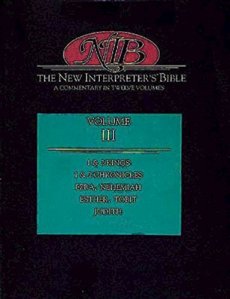
Seow, Choon-Leong. “The Books of 1 and 2 Kings.” In New Interpreter’s Bible III: 1-295.12 Vols. Nashville: Abingdon Press. 1999.

The NIB (New Interpreter’s Bible) is a solid resource as a resource for preaching and teaching that covers the entire bible and goes into some textual issues, but it primarily is focused on giving a fuller context to the story. Choon-Leon Seow’s contribution on the 1 and 2 Kings goes into a little more depth on translational issues than some other portions of this commentary set I’ve utilized, and this was a positive since it identified some interesting things to explore in the Hebrew text. This was another solid portion of the NIB and it is a resource worth having on the shelf for a pastor.