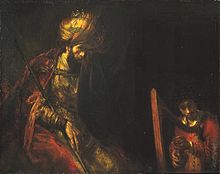
David and King Saul, Rembrandt
So Samuel reported all the words of the LORD to the people who were asking him for a king. He said, “These will be the ways of the king who will reign over you: he will take your sons and appoint them to his chariots and to be his horsemen, and to run before his chariots; and he will appoint for himself commanders of thousands and commanders of fifties, and some to plow his ground and to reap his harvest, and to make his implements of war and the equipment of his chariots. He will take your daughters to be perfumers and cooks and bakers. He will take the best of your fields and vineyards and olive orchards and give them to his courtiers. He will take one-tenth of your grain and of your vineyards and give it to his officers and his courtiers. He will take your male and female slaves, and the best of your cattle and donkeys, and put them to his work. He will take one-tenth of your flocks, and you shall be his slaves. And in that day you will cry out because of your king, whom you have chosen for yourselves; but the LORD will not answer you in that day.” 1 Samuel 8.10-18
At roughly 1,020 BCE a decisive change takes place and Israel enters the time of monarchy. Power becomes consolidated briefly under King Saul. Two men, King Saul and Samuel, whose title before had been that of a judge but functioned as a mouthpiece for God at this point, hold the religious and political authority. Israel begins to act as a powerful actor in the region, constantly moving from one conflict to another, but internal conflict emerges when David emerges on the scene. Without getting bogged down in the story or trying to parse out what happened historically by 1000 David would unify his power as king and Israel became for a brief shining moment a power player on the world stage, Jerusalem becomes the capitol, and then perhaps decisively for this era the temple is established under Solomon. Especially for the Southern Kingdom of Judah this is decisive because the monarchy and the temple become linked as the dominant secular/religious authority. There is a prophetic voice within that critiques the monarchy and temple, but for the most part the people give up a portion of their freedom for the relative security, power and identity of being a part of the unified kingdom of Israel. That is not to say that family, clan and tribe have lost their power or authority, but that the people become much more linked to the kings and temple than at any previous point in their history.
This is probably a good point for a fun interlude, it is hard for us to imagine being bound in systems where our autonomy is defined so externally. We don’t have any experience of a monarchical system and so our reaction might be somewhat like the peasants in this scene from Monty Python and the Holy Grail. Even a romanticized king when we look from our perspective seems like a tyranny or despot.
Even though King David is often looked upon romantically like the King Arthur of legend, one of the incredible things is that the recorded memory of David includes many ugly situations, many family struggles, many times where he is at odds with the prophetic voice of the time. The whole Bathsheba and Uriah episode (2 Samuel 10-12), incest within the royal family (2 Samuel 13) and eventually the usurpation of the throne by his son Absalom (2 Samuel 15-19) as well as other internal rebellions are a part of David’s roughly forty years of consolidated rule. Even though the King amasses incredible authority previously unattainable in anyone’s imagination the constant warfare and internal struggles begin to wear on the people. By the time Solomon, David’s son, ascends to the throne it is a relatively peaceful time but the energy is directed internally on large building projects, the temple, but also many houses and palaces for Solomon and his entourage. The temple becomes, at least for a large group of people, the central focus of worship, and yet again just like with the idea of consolidating power with a king there is a large amount of space dedicated to the critique of the temple
King Solomon conscripted forced labor out of all Israel; the levy numbered thirty thousand men. He sent them to the Lebanon, ten thousand a month in shifts; they would be a month in the Lebanon and two months at home; Adoniram was in charge of the forced labor. Solomon also had seventy thousand laborers and eighty thousand stonecutters in the hill country, besides Solomon’s three thousand three hundred supervisors who were over the work, having charge of the people who did the work. At the king’s command, they quarried out great, costly stones in order to lay the foundation of the house with dressed stones. So Solomon’s builders and Hiram’s builders and the Gebalites did the stonecutting and prepared the timber and the stone to build the house. 1 Kings 5.13-18 NRSV
This is a huge commitment of people and resources which are directed internally. In fact it is such a strain that immediately upon Solomon’s death when Rehoboam takes power the people come and plead for relief:
Your father made our yoke heavy. Now therefore lighten the hard service of your father and his heavy yoke that he placed upon us and we will serve you. 1 Kings 12.4 NRSV
To which the narrative has Rehoboam reply three days later in our language, ‘you ain’t seen nothing yet, you think my father made things hard on you? Well prepare to be screwed!’ Most translations clean this up significantly…but the little thing that is thicker than his father’s loins is probably not a finger (see 1 Kings 12: 6-15 particularly v.10) Things are not nearly as clean in the Bible as we sometimes want to make them. The people are offended, the kingdom splits apart and now there are two kings, two places of worship, a prophetic voice that continues to grow louder…but even with this prophetic voice within the Kingdom of Judah in the South and the Kingdom of Israel in the North growing stronger the fate of both nations is linked to the actions of kings and the worship at the temple in Judah and the worship at various sites in the North. Particularly for the Southern Kingdom of Judah, so long as there is a Davidic king and the Temple who they are as the people of God seems secure. Yet this too will change….