Category Archives: Historical Reflections

The Place of Authority 2-5: The Constantinian Revolution Part 1-The Rise of Power and the Crisis of Authenticity

The Baptism of Constantine, 1520-1524 by students of Raphael, Public Domain Art

Then the devil led him up and showed him in an instant all the kingdoms of the world. And the devil said to him, “To you I will give their glory and all this authority; for it has been given over to me, and I give it to anyone I please” Luke 6.5f NRSV

In 312 CE when Emperor Constantine adopts a favorable stance towards the church and ends roughly 150 years of various levels of persecution a major change takes place. Christianity moves from the position of powerless to powerful, from being viewed as atheistic to becoming the religion of the empire (although this move is not completed under Constantine, it begins here) from being a persecuted and scattered minority to being an institution able to build large buildings, gather and deliberate in public and to freely communicate back and forth. In short the world that the church knows is turned upside down and it raises a lot of questions then and now. For some the church sold its soul to the devil and aligned itself with Rome, was corrupted and would never be the same. For others this was the Church’s great triumph and it ushered in the new age for the Christian Church. Reality is probably somewhere between these two extremes, but this was an era of such remarkable change in the church’s identity and authority that we need to spend a little time here.

People flocked into the now suddenly popular church. Church buildings became large structures like the temples of other religions, priests and leaders who had previously dressed in common clothes began to wear formal dress, and even incense once the province of the Imperial court became an aspect of the church’s worship. There also is a sense in which the leaders began to model themselves after the Old Testament priesthood and to occupy more of a priestly role within the church and society. Those in the church who viewed the emperor’s favor as a positive thing began to look upon the emperor as the one anointed by God to bring both history and the empire to its apex. But this sudden rise was certainly not without its own set of crises and problems.

There was a major crisis of authenticity within the church. Many Christians had faithfully endured shame, suffering and in several cases death and had not renounced their faith-but others, including some leaders had under the pressure of interrogation or the threat of death sworn an oath of allegiance to Caesar, had handed over Christian scriptures or in some other way renounced their faith. Others had simply fled away from the persecution rather than to become a martyr for various reasons. Now that Christianity was no longer a persecuted religion it raised many new questions: “Do those members and leaders of the community who renounced their faith still have a place within the community?” “Does the work of leaders who renounced their faith still have a valid standing (for example does a person baptized by a leader who renounced the faith need to be re-baptized)?”  “How do we accept new members who have not had to go through the struggles we went through when we became Christians?” “Are these new converts to the faith doing this for reasons of social advancement or are they doing it because of a sincere devotion to God?” These were not questions answered easily or quickly.

One of the early controversies within this change has to do with leaders who failed to remain faithful through the persecution. The Donatist controversy, where the question of “did the faithfulness of the leader impact the efficacy of an act (like baptism or eucharist or forgiveness) or not?” Paired with this question was the secondary question of whether a lapsed or unfaithful leader could return to leadership within the church. Ultimately the church answered that the ministry they did was valid and that it was possible (although not necessarily automatic) that a leader who under pressure had renounced his faith (and it was almost always a male leader at this point) could return to an active role in the leadership of the church.  With this new members were welcomed and many quickly joined the Christian church now that it was no longer a persecuted minority. When in 380 CE Christianity becomes the official religion of the Roman Empire under Emperor Theodosius the church is still trying to sort through the effects of the transition to being the dominant religion.

For some this was a severe dilution of the holiness of the church and they would in many cases flee from the cities and attempt to live a holy life in isolation or in communities. This is not the beginning of Monasticism, where monks and nuns would retreat from the world around them in order to live holy lives, but it certainly marked an escalation in the number of people trying to pull away in order to be faithful.  In contrast to the regality that clergy and worship throughout the empire were beginning to adopt, the monks and nuns fled into the wilderness or out of the cities to practice a simpler and more constant devotion. These monks and nuns would provide one of the major institutions that would be important for the centuries to come. The monks and sisters would evolve into one of the major reforming voices in the church. Monks would both pose a challenge to the bishops and their sometimes very worldly lives and at other times they would find themselves called upon to be leaders of the church. The monks would also be responsible for preserving much of the knowledge that would otherwise be lost in the conflicts of the coming centuries.

Even with all of these challenges the position of the church had changed dramatically. With that change came the ability to focus internally on how it would determine what it would believe, to formalize its doctrine and its cannon, and to move towards becoming the authority the society would look to in the coming collapse. The authority of the church would not go unchallenged, but as the church addressed these challenges it would centralize its authority, its doctrine, and in this age of the theologian bishops two major authorities would hold power-the emperor and the council and it is to this reality that we will turn next.

purple rose 01 by picsofflowers.blogspot.com

The Place of Authority 2-4: The Practices of the Early Church

Baptism Fresco on the Catacombs of St. Marcellinus and Peter, Via Labicana, Rome, Italy

There are two ways, one of life and one of death, but a great difference between the two ways. The way of life, then, is this: First, you shall love God who made you; second, love your neighbor as yourself, and do not do to another what you would not want done to you. Didache (Chapter 1), 2nd Century Christian Writing

There are times I feel like Cuthbert Binns, the History of Magic Teacher from the Harry Potter series who one day falls asleep in the teacher’s lounge, dies and then as a ghost goes on teaching without seeming to realize the difference. I hope that unlike Cuthbert my approach to looking at authority within the history of Judaism and now Christianity is not incessantly boring, and is rather enlightening as we go back through time and examine the story of how we got where we are today. There are times where I want to take a shorter path, but I personally am learning a lot from going back and re-engaging material I haven’t studied since seminary-I have made some new connections that will impact some of my conclusions.

Practices are critical to the formation of identity and they help to shape what the people and any group come to believe. As Prosper of Aquitaine (390-455 CE), a Christian from a later era than I am currently discussing, memorably put it “the rule of prayer should lay down the rule of faith” (Pelikan, The Christian Tradition 1:339) and so the everyday practices of early Christians allowed them to make sense of the persecution they received from the Romans or the struggles they went through in their daily lives. It also gave them the basis of their community and bound them together with Christians across the empire and indeed across the world. Practices may not sound exciting to talk about, but their meaning will be discussed and debated for the millennia to come.

Love is the foundational idea that gets worked out in these practices, a love for neighbor and even for enemy that forms the basis for the actions of the early church. Certainly there will be many times where the early churches (like modern churches) will fail to live up to this ideal, yet in a society with no social safety net the vulnerable (the widows, orphans, immigrant and the elderly or disabled) were often taken in by many of the early churches and given identity and meaning. Certainly there were apologists and early thinkers like Justin Martyr or Origin who tried to make an intellectual case for Christianity, but most people came to Christianity through the example and witness of anonymous Christians, and they were invited into the journey of coming Christian by people who they encountered in the marketplace, their homes and their worksites.

With the persecution by the Roman Empire it was a dangerous thing to become a Christian, and early Christians wanted to make sure that potential converts were truly seekers and not spies. Often there would be a detailed process of catechesis, education in the faith, before a seeker would be admitted to the mysteries of the faith (baptism and then communion or Eucharist). Most of these communities were rather small, meeting in houses, cemeteries, catacombs  or in business places both because they could not have afforded a building dedicated for their meetings, but also for fear of being detected by authorities.

Baptism was the mystery of faith that led to identity with the church and mystically with Christ. A person in the waters was made clean, forgiven of sins, regenerated into a new person and received the Holy Spirit. Once a person was baptized they were a full participant in the life of the community, they could worship with all their new brothers and sisters in Christ, they could partake in the Eucharist. Even without any significant conflict the meaning of baptism was pretty much stabilized by the end of the second century with no real conflict over practice and thought (with one exception) until the time of the Reformation.

Eucharist, the Lord’s Supper or Communion was a community meal in which the people present celebrated their unity in Christ, remembered the actions of Jesus during the last week of his life and shared a meal that they understood having both spiritual and earthly realities. The precision of the debates that would emerge during the time of the reformation are not present, but the idea of the Eucharist having the power to transform the bodies of the early Christians from corruptible to incorruptible or they could call it the ‘flesh of Christ’ or even a sacrifice, but the fact that they didn’t nail down precisely what was happening did not stop them from trying to explain what it meant. It would take focusing in on Christology (who Christ was) before the early Church would have the language for the precision of later centuries.

 Around both of these realities was worship which focused on Jesus, eating together with the community, sharing their lives together and continuing to confess “Jesus as their Lord” even in the face of hardship. As the church moved into the third century it was still a persecuted group, the basics of structure had come into being (offices like bishop, presbyter and deacon were used-people set aside for helping the community function, but it was not a hierarchical as we are used to and there was not a specific class of clergy) and there was the beginning of movement towards what a canon would look like, what practices would be formational, and at least some commonality in what was to be believed, but a major change was on the horizon, a change that would transform the church from top to bottom. For some the early church was about to experience its triumph, for others it was making a deal with the devil, but in 312 CE the emergence of Constantine, an emperor favorably disposed to Christianity, the church would have to redefine itself yet again and ask itself the questions of authority that continually emerge.

purple rose 01 by picsofflowers.blogspot.com

The Place of Authority 2-3:The Early Church’s Identity Problem

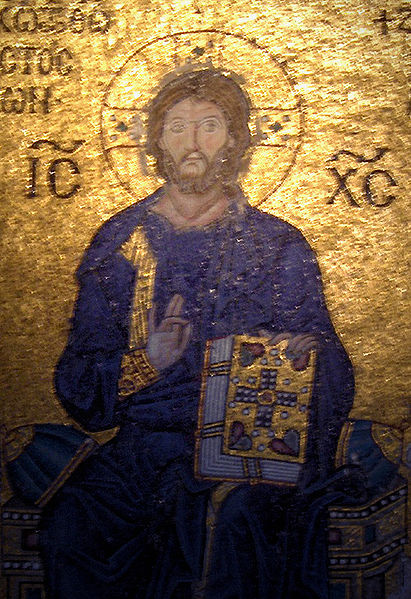
Image of Christ Pantocrator (Almighty or Lord of Hosts), Hagia Sopia, Istanbul, Turkey

When a movement is centered on one person who is no longer present in a corporeal (bodily) form that the members of that movement can continue to speak to and learn from eventually there will come an identity crisis where people begin to ask, “Are we following the right Jesus?” “Are we being faithful to his vision?” “Are we still following the God he pointed to?” As the church entered the second century it was dealing with heavy pressures from the empire around it and at the same time this early church had to figure out who it was from pressures from within.

It was still early in the church’s young life; the canon (the selections of works that would come to make up the bible) was not fixed. The four gospels, Matthew, Mark, Luke and John were in wide circulation as well as many of the letters associated with Paul, but depending where you went the Shepherd of Hermas or the Letters of Clement or the Didache may also be present (which would later be viewed a positive works but not held at the same level as scripture). The challenge to how to tell the story of being the people of Jesus arose from within and to react to this challenge the church adapted and changed.

One of Christianity’s greatest gifts was that it was not tied to one language or culture. As it spread across the known world at that time it would be quickly translated into Greek (the language of the Eastern half of the Roman Empire) and eventually into more and more languages and cultures. The reason that the books that are a part of the New Testament are in Greek, not Hebrew or Aramaic,  is that by the time the stories of Jesus are written down and as Paul and others wrote letters they were going to churches that primarily spoke Greek (at least as a second language). With this encounter with the Greek world and language also came an encounter with Greek thought which was much different from the Jewish or Hebrew worldview that Jesus and all the original apostles came out of. As Greek speaking and thinking individuals encountered Christianity and they translated the message they would both be changed by it and in their own way they would transform the message as well. The question has to emerge what is a valid transformation and what is not? Two long lasting assumptions that many Christians include as central to their thought: the immortality of the soul or the absoluteness of God are Greek ideas not Biblical ones and yet with the introduction of Greek culture they become a part of the thought of the early church.

One of the early challenges came from a wealthy Christian named Marcion. While Hebrew thought has no problem with contradictions and gaps, a Greek thinker like Marcion could not abide contradictions. Among other things, Marcion felt that the God of the Old Testament was not reconcilable with the God of Jesus. Marcion read how in the Old Testament that God called for wars which wiped out entire populations, called down judgments in a harsh and unforgiving manner and came to the conclusion that in combination with these things he read and the reality of suffering in the world that the creator must be evil and different from the God of Jesus. In contrast to almost every other church leader at the time, Marcion read Old Testament literally rather than allegorically. Marcion felt that the Old Testament should not be a part of the Christian scriptures and therefore it should be thrown out. In addition to this, in a Greek way of thinking that viewed sex, childbirth and the body in general as bad, Marcion could not accept that Christ was born of a woman-even if it was a virginal birth God could not be born of a woman. For the first time we begin to see in a very powerful way the emergence of theology more than narrative as formational for a way of thinking about God and Jesus. Marcion quickly identified the contradictions and the differences in the New Testament gospels that were being held in most churches, so he eliminated Matthew, Mark and John and seriously redacted Luke to try to remove anything “impure” to be put alongside of Paul’s letters (also purified of Jewish “interpolations”). These modifications were viewed to be unorthodox by the leaders of the church in Rome and in 144 CE he was expelled from the early church. Marcion became one of the earliest to try to put together a canon, a list of texts that would form the basis for the church’s authority and the church would continue to deal with his followers for decades.

Another threat to the view of who Christ was came from those often referred to as Gnostic Christians. Gnostics are so named because they believed that they had secret knowledge that others, including other Christians, did not have. I am not convinced that there is one direction among the groups and the scriptures that we might label Gnostic, in fact they seem to represent a wide range of things. We are the beneficiaries of the rediscovery of several of the Gnostic gospels at Nag Hammadi in 1945 which give us a window into what Gnosticism may have looked like. Some of these, like the Gospel of Thomas, are very similar to many of the sayings in Matthew and Luke and portray Jesus as a wisdom teacher. Others like the Gospel of Truth associated with the Gnosticism of the Valentinians develop a whole cosmology that put Jesus among many heavenly beings and looks very little like anything we would recognize as Christian. Like Marcion they held the body as bad and the soul as good (or divine spark would be a term you might see in Gnostic gospels) and the purpose of having the proper Gnostic knowledge is for that soul or divine spark to be liberated from the body.  Again the early church made the decision that this was not an accurate representation of the faith and the Gnostic gospels would not become a part of the canon.

Each time a crisis presented itself between a Greek way of thinking and a Jewish way of thinking the church attempted to remain with the Jewish way. At the same time, even while trying to remain close to the Jewish origins of the story, the questions that were being asked were no longer the questions of the Hebrew mind, they were the questions of the Greek world. The Bible began to be viewed in terms that were familiar to the Greek way of thinking, so God had to be omnipotent, omniscient and omnipresent (all powerful, all knowing and present everywhere) and this rather than the narrative became decisive for decisions. The biblical hope of a bodily resurrection at the return of Jesus, the participation in the new creation and all the images that populate the gospels and Paul’s letters began to be read in terms of the soul joining God in heaven. The story when it was read was often interpreted allegorically (there are gifts and challenges that come with this) and theology and a few common practices became the points where identity was formed for the early church. It is to these practices we will turn next.

purple rose 01 by picsofflowers.blogspot.com

The Place of Authority 2-2: Rome’s Christian Problem

Anti-Christian Graffito from the Paedagogium, part of the Imperial Palace on the Palatine Hill, Rome

On the 18th and 19th of July of 64 CE the city of Rome burned, and of the fourteen districts only four remained relatively untouched. Emperor Nero presented the Christians as scapegoats for the city’s destruction, and one of the reasons that may have made them a particularly good scapegoat was that the early Christians in Rome may have lived in the regions of the city that were not burned (Peter Lampe draws that conclusion in From Paul to Valentinus: Christians at Rome in the First Two Centuries,47) Tradition has it that both the apostles Peter and Paul will be martyred under emperor Nero. From 64 CE on the Christians are noticed in varying levels throughout the Roman Empire and they presented  a unique challenge to the authority of the Roman Empire.

All empires to varying extents impose their will on their population and upon their challengers by the promises of reward for good behavior and the consequences of negative behavior. For example, a person may know the consequences of speeding, but if they deem the consequences light enough they may choose to exceed the speed limit anyways. There are more consequential examples: the mere accusation of being a traitor may have devastating consequences in most societies. Empires are built upon a network of favor, wealth and power being exchanged and in most times and places the pain of challenging that network (which may result in the loss of power, arrest, torture and even death) is far too high a cost to seriously entertain. In Rome the gladiatorial arenas, crucifixions, and various other forms of public execution and torture work to maintain conformity and fear of the Romans and their designated local authorities. The Roman Empire was neither more evil nor harsher than empires that came before, but in these early Christians they found a unique challenge.

Most of the early Christians were not powerful individuals, they were a relatively small minority within the societies they found themselves scattered within and they were not organized into large churches. There was some organization as bishops and leaders began to emerge, but they did not set out to challenge the Romans Empire. Often referred to as ‘atheists’ because they would not participate in the adoration of emperors or gods (which also had the consequence of denying many of these early Christians access to meat and feasts that accompanied these celebrations-in a society where meat was a rare treat this is a big sacrifice) and this led to significant challenges for the minority of Christians who were of a higher standing in society. Most Romans found what little they understood of Christianity as puzzling-they worshipped a crucified person (a huge scandal), they refused to enjoy the benefits of the empire, they were sometimes accused of cannibalism (not surprising when you think about what the Eucharist must have sounded like to outsider ears) and yet no amount of persecution seemed to make these Christians go away, rather they seemed to multiply even quicker.

The severity and extent of the persecution of Christians by the Roman Empire varies through time and region. Most of the persecution is regional and there never seems to be an organized campaign to completely seek out every Christian, but the experience of persecution by many Christians was very real. At points where the persecution was the most visible, “Christians were part of a good day out; part of the entertainment; part of the show” ( Christopher Kelly, The Roman Empire, 78) and it is precisely at this point where they posed the greatest challenge to the empire. The gladiatorial games were not a gathering of the dregs of society, the elite and the good solid citizenry were there and the best seats were occupied by the leaders and elite of the society (the closest comparison we would have are the luxury boxes at many sporting events). Yet at the point where the Roman society demonstrated itself and its superiority on display Christians challenged the heart of the violence and order that stood at the center of the games. Take for example the writing of the second century Ignatius, bishop of Antioch:

Let there come upon me fire and the cross, and packs of wild beasts, lacerations, dismemberment, and dislocation of bones, the severing of limbs, the crushing of the whole body…Allow me to be an imitator the Passion of my God…Do not speak of Jesus Christ and still long for the world!

As a movement that refused to acknowledge the superiority of the emperor but rather worshipped a person who had been crucified on a Roman cross, who acknowledged Jesus as their Lord rather than Caesar, and who were not afraid of death this causes a lot of problems for the authority of the empire. How do you threaten a person who doesn’t fear torture and death (or at least does not view these things as more important than their allegiance to their God) and when a person views a shameful death (in the societies eyes) as the greatest honor how do you deal with that? In fact the more you persecuted these Christians publicly, the more their numbers seemed to grow.

In 312 the Roman Emperor Constantine would become the first to allow Christianity and this would dramatically altar both Rome’s and Christianity’s stories, but before that point Christianity would face its own challenges as it tried to figure out what was and was not Christianity. It had interacted with many new cultures, new languages and Christianity was not a centralized movement. There were leaders of the church in Rome, or Antioch, or Alexandria for example and many churches had collections of gospels, letters, and teachings in combination with the Hebrew Scriptures they inherited from Judaism but there was no central authority to say what was in and what was not. It is to this challenge we will turn next.

purple rose 01 by picsofflowers.blogspot.com

The Place of Authority Part 2-1: The Beginning of the Christian Story

Carl Heinrich Bloch, The Sermon on the Mount, Public Domain Image

Let the same mind be in you that was in Christ Jesus, who though he was in the form of God did not regard equality with God as something to be exploited, but emptied himself, taking the form of a slave, being born in human likeness. And being found in human form, he humbled himself and became obedient to the point of death—even death on a cross. Philippians 2.5-8

This project continues to evolve, and I have started a new major section with the beginning of the Christian story, so I have changed from a simple number (this would be number 6 I believe) to a combined number with a section and for lack of a better term a chapter. My intent was not to make a book, but we shall see how this continues to evolve.

The English New Testament Scholar N.T. Wright wisely states in his The New Testament and the People of God that, “it is impossible to talk about the origin of Christianity without being confronted with the question of God.” (Wright, 81) In Judaism the question of God was mediated throughout the time period we covered by temple or priest, prophet or king, judge or clan leader and yet in the very beginning of the Christian story we see things concentrated in one person like never before and within that early identity all of the previous sources of authority are at least re-evaluated if not completely redefined.

As movement Christianity has its origins in the ministry of Jesus of Nazareth and his message about God’s kingdom. In many respects it is a remarkable and unexpected story how a movement could be centered on an individual who was not wealthy, not one of the elites of the time, did not command armies or write any books. Instead Jesus lived a rather short life by our standards. Sometime in his thirties was taken prisoner by the Jewish religious authorities and the Jewish religious authorities in collusion with the Roman political authorities would have him crucified. Crucifixion was a scandalous death reserved for low class citizens and slaves.  An upper class citizen might have been beheaded for treason, but crucifixion was meant to be slow, painful and humiliating—the person was made into a dying billboard to be an example of what it means to mess with the powers that are in charge. Yet, there is something in this one Jewish man, among the thousands of Jews that will be crucified over the time of Roman rule that gave birth a movement that for 2,000 years has grown to become at points one of the major authorities of the western world. No person has probably had more written about him, has inspired more debate and devotion than Jesus of Nazareth.

I am not an unbiased in my examinations of this (and no one ever is really unbiased), I am a part of this movement some two millennia later. Even though I will not be spending much time on what happens in the movement from Good Friday where Jesus is crucified to Easter when his disciples come to accept he is alive and continues to be present with them, that doesn’t mean that this is not important. In fact, to me what is amazing is the way even at this time the followers of Jesus are either fit for the insane asylum or they are the bearers of a new message that will turn the world upside down.

Christianity has its beginnings in Galilee and Judea with the community that gathers around Jesus, who is understood by many following him initially as a prophet and at least by some as a potential king (the words Christ or Messiah both mean king). Jesus embodies for this community what his central message, the kingdom of God, is all about. For this community in the ministry and words of Jesus, “the kingdom of God has drawn near.” His message makes an impact, especially with the community that gathers around him that resonates long after his crucifixion. The community that gathered around him should have either died or found a new leader at that point, but somehow (and this is not the time or place to get into the debate of what happened and how it happened) his followers accepted that death for him was not the final answer, that he was alive and that he was somehow more than just another prophet and more than a ‘messianic pretender’ but that indeed titles like Lord, Son of Man, Son of God, Christ/Messiah, Immanuel and many more applied to him. Even more remarkable they began to see in Jesus a hope for what their lives might embody—that if death was not the final answer for him it was not the final answer for them either.

Post-Easter Jesus becomes even more central as a way in which these early followers of the Way (what the book of Acts reports the first Christians being called) centered their lives on Jesus. Their fellow Christians became their new family, displacing in many cases the authority of families they had grown up in (this was a huge scandal). The Jewish Scriptures (the Old Testament) began to be read through the lens of Jesus and his message and stories of Jesus began to supplement them. They viewed their authority to proclaim and enact this message as granted to them by God.

Then something else amazing happens, something probably present at least in a germinal form in the life and ministry of Jesus, these early followers move beyond the boundaries of the Jewish people. Partially through a sense of mission, partially through oppression and conflict, and somewhere in the midst of this with a sense of God’s design they spread out into the Gentile world. They began to negotiate what it would mean to be Christian and Jewish or Christian and Gentile. This was not an easy transition, there were struggles along the way, but it was a transition the early Christians made.  In the initial decades after Jesus’ crucifixion the community had two primary sources of authority, first was the apostles (those who had seen Jesus and had in some way been called and appointed by him) and the second was the scriptures (the Hebrew Bible or the Old Testament).

Beginning around the time of the Jewish war for very practical reasons the early Christian community began collecting the memory of what Jesus said and did into accounts to hand on the memory. The conflict between Rome and the heart of Judaism was one factor, Christianity had in that generation found itself on the outside of Judaism where it started and soon the Temple and Jewish homeland would be gone and the connection between the two would grow weaker. Second and probably the critical reason for recording the stories in the time between 70 and 120 CE was that the original witnesses would no longer be present to witness to and retell these stories.

Christianity began its journey into a strange new world, a world of Greeks and Romans and ‘Barbarians’ and within a generation (at least according to tradition) Christians would spread from modern day Spain to China and India, throughout Northern Africa and the Middle East, across the Roman empire and to the areas where Rome had not expanded.  It would encounter and both transform but also be transformed by each culture it encountered. It would be a minority movement of predominantly immigrants and slaves. It would not start out as something that would look like a threat to transform the most powerful empire of the day, but the level of authority its adherents would grant to Jesus would plant the seeds of a deep change coming.

 purple rose 01 by picsofflowers.blogspot.com

The Place of Authority: A Brief History Part 5: A New Crisis of Collapse in Judaism and a Summary of Authority to this Point

Detail of the Arch of Titus Showing the Sack of Jerusalem

Judea and Galilee have had the seeds of revolt planted in the popular memory of the Maccabees and in the practices that have held their identity as a Jewish people after the exile.  The memories of the Exodus and exile, the memories of past greatness and the desire for a new Davidic king, in addition to the very real burden of taxation felt by many of the people (and the consolidation of land/wealth by the elite) provided a volatile environment by the beginning of the Common Era.  Even a ruthless, yet effective, ruler like Herod the Great who is able to rule through force, fear and political intrigue only delays the coming firestorm. Herod may rebuild the temple in glorious fashion and may want to occupy the role of a Davidic king in the people’s imagination but there are two major factors against him and his offspring. First he is not of Jewish decent, he may be a practicing Jew, but he is not of a Jewish much less Davidic bloodline and second he is aligned with Rome. After Herod dies in 6 CE his reign divides between his sons (many also named Herod) and none of them, or the people Rome replaces them with are able to exercise the type of power of Herod the Great. In 66 CE the region explodes into revolt against the Romans, first in Galilee and spreading quickly to Judea.  The Romans respond quickly and decisively destroying the temple in 70 CE and performing mop-up operations for a couple of years.  When the Judean Jews revolted again in 132 CE, the Roman response was even harsher attempting to crush any hope of another uprising.  Judaism did not die, but it did transform-it would no longer be tied to a temple, there would no longer be a concentrated Jewish homeland, the hope for a messiah would remain but in the meantime the people got on with their lives and being Jewish became portable.  Rabbinic Judaism becomes the dominant expression of Jewish identity. Rabbinic Judaism is centered in the exposition of the Jewish Scriptures and oral traditions. Gathering in local tabernacles became the place where identity was formed.  In addition to the scriptures and tabernacle, the Jewish people continued to practice the actions and festivals that made them distinctively Jewish. The loss of a central authority did not destroy their identity, but rather finding themselves dispersed throughout the Roman Empire they evolved to become a community centered on scripture, tradition and practice.

Throughout this part of our journey we have seen authority rest in families, in king and temple, in narrative and practice.  With authority comes the access to wealth, military might, and most centrally to people of this time land. The people give up some of their autonomy (or at least the autonomy of their family, clan or tribe) for the greater security of monarchy-and yet even security has its limits. As we can see from the incident of Rehoboam the tribes and families may choose to go a different direction (as they did at the splitting between Israel and Judah). Even with the temple and monarchy at its strongest there is still a prophetic critique of both, and yet in the memory of the people as the monarchy goes (or the monarchy and the temple) so goes the people. The loss of power, land and military might leads to a process of re-evaluation, a process that draws on the prophetic imagination. The Hebrew people center in on their stories and practices and as much as possible attempt to remain true to their identity without assimilating into the dominant culture.  In trying to remain distinct there is a conflict between purity and assimilation the seeds of revolt are sewn.  Yet throughout a millennia of conflict, crisis, exile and return, revolt and repercussions Judaism adapts and evolves, it is never so dependent on one place of authority that it cannot re-center itself on what it means to be the chosen people in a new time and place.

One of my discoveries in re-reading in what lies before is the role of fear in the transfer of authority. The fear of the nations around them allows tribes and families to cede their authority to a centralized monarchy and temple.  Yet, too much consolidation of power (and wealth) by the monarchy leads many of these tribal leaders and families to rethink their authority and to appoint a king they find more favorable to their desires.  When monarch, land, temple and wealth are destroyed and the people find themselves in exile they fear assimilation and they bring together the stories and practices that allow them to maintain their identity in a world they perceive is hostile to their identity.  Even in the return to Judea there is a fear of the outsider, the gentiles, and purity becomes an overriding concern. Now certainly there are other issues that contribute to these transformations and yet where we place authority depend on a desire for security and stability in the midst of the chaos, real or perceived, a group of people find themselves within.

This is where we will leave one journey behind, Rabbinic Judaism continues across the world and has adapted to any number of challenges that have come its way.  The Romans were not the last to try to oppress them, force them to relocate, or even try to wipe them out.  That journey continues, but I am not the one to tell that story.  Instead we will begin the other story that emerges in this point out of the Jewish story…the story of Christianity and its own struggle to locate authority.

purple rose 01 by picsofflowers.blogspot.com

The Place of Authority: A Brief History Part 4: Re-establishment, Disillusionment and Germination

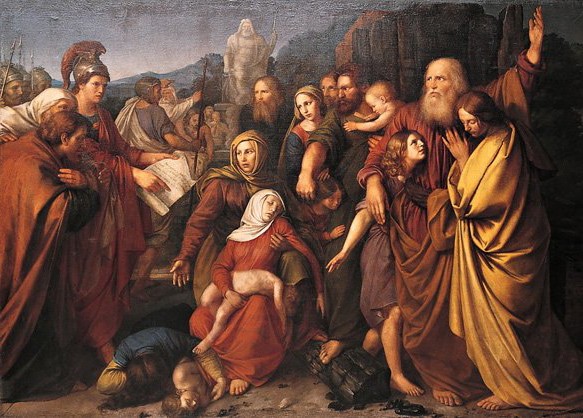
Wojceich Stattler, Machabeusze (Maccabbes) Public Domain Art

I think I need to be clear at this point that while I am doing a historical trek through Israel’s story, I am not trying to do a history of Israel at this point, or even of the Hebrew Scriptures.  I am intentionally trying to locate where authority rested within their story.  Within key transitions the places of authority do change and how the people react to that authority changes and see how that might inform our current questions of authority.  Hence, while it might be interesting to focus in greater detail on particular events, or to spend more time interpreting what is going on within a particular piece of scripture or what the theology of a particular author might be, that will have to be for another time and place as we continue on through the story.

A humorous illustration before we proceed. The Hebrew people remain deeply suspicious of external authorities which exercise authority over them, and so there will remain an antagonism between them and those who come to occupy their land.  In another Monty Python reference we have the scene of the French Castle where the French refuse to recognize Arthur’s authority. For this period the Hebrew people will stubbornly resist assimilation by the empires that they are a part of.

Beginning around 538 BCE, during the reign of Cyrus of Persia, there is the beginnings of the return to Jerusalem and Judea.  There are at least four major stages of the return which span a period of roughly 80 years, longer than the original period of exile, and even with the final return many of the people choose to remain settled and scattered throughout the empires of the day.  The diaspora (the dispersion) those Jewish people scattered throughout the empire continue to at various levels maintain their practices and stories that make them distinguishable from the nations around them, but I will be focusing in on the remnant that returns to the promised land since that is where the final pieces of the remembered story of the Hebrew Scriptures (or Old Testament) come from.

Over the eighty years of re-establishment, many of the people return and their first concern is the reclamation of their land (or perhaps in some cases the claiming of land for their family).Remember that in an agrarian society land is the primary source of wealth and power. It takes a great deal of effort by the leaders and prophets to get the people to focus on the effort to rebuild the temple, and even once it is rebuilt it cannot compete with the memory of the former temple.  In the memory of the people it is a shadow of the greatness of their past.  Even with the codification of the Torah (law-quite possibly Deuteronomy) by Ezra and the completion of the city wall under Nehemiah, Jerusalem and what remains of the former nation are completely dependent on the will of the nations around them.  The temple worship does regain some of its former status as one authority figure, but in the absence of a true monarch-temple authority that has the power to authorize the story of the people, the written and oral set of practices begin to take on a greater and greater role of what it means to be the chosen people.

Internal fault lines begin to emerge, not that they didn’t exist previously, but issues of purity and justice come into conflict with one another.  At least, in the remembered story it seems that in the time of re-establishment purity becomes the dominant issue, the removal of foreign influences—even when it means disbanding families—and being a ‘purer’ Hebrew people who worship the one Lord in holiness. This is the mark of a society intent on establishing and maintaining boundaries between the insider and the outsider—and I don’t mean this to sound as critical as it may sound—when one feels the world is out to destroy you it is natural for an us/them (or Jew/Gentile) dichotomy to emerge. Yet even though this seems to be the dominant voice a counter-voice emerges, the prophetic voice that never went away and attempts to refocus the central focus on justice.  Although there is a strong presence of the prophetic voice in the collected scriptures, it also never seems to gain the influence to reframe the story to create the type of society the prophets imagine.

Certainly within the prophetic voice, but also within the population there is disillusionment with the way things are.  Things are not the way people hoped they would be, the temple is a shell of its former self, different religious groups vie for power and influence among the people, various incarnations of leaders try to rally the people with varying levels of success-but the reality is that for most of this 500 year stretch they are a people under the rule first of the Persians, then briefly under Greece. When the Greek empire splits up into the Ptolemaic Empire (in the South) and the Seleucid Empire (in the North) Jerusalem will find itself firmly at the middle of the struggle for power.

A final defining moment comes in 167 BCE with the Maccabean revolt, an event commemorated by Hanukkah today and remembered in the books named Maccabees, where the pressure of the outside influence to conform to a Hellenistic (Greek) culture causes a religious revolt which for a brief moment grants Jerusalem its independence.  It is short lived, but it gives the people a memory of their practices defining themselves as a people who are willing to die for what they believe in.  Again this is not universal, there are certainly those willing to accommodate, but there are also those willing to revolt, and that fire will not go out again for some time.

Deep divisions continue to grow within Judaism. They will not be fully in control of their own destinies after the fall of the Maccabees , but the hope for a new king, a new David, a messiah will persist.  Religious authority will split between Saducees, who predominantly control the temple and accommodate with the kings like Herod, or whichever government official Rome places to govern Judea.  With Herod the Great (who rules from 40 BCE-6 CE) reconstructing the temple in magnificent fashion (at a magnificent cost) the Sadducees are able to operate from a position of privilege.  The Pharisees in contrast are more of a people’s movement focused on maintaining their identity through purity and right practice of the Torah. There are other groups, the Essenes who pull away and isolate themselves to remain pure, the zealots intent on driving the foreign influence from the promised land.  Herod and Rome have the military authority, the Saducees in partnership with the Roman authorities run the temple and all is in a state of tension at the turning of the ages.  We are approaching a great turning point in the story, from one group will emerge two-one that is new and one that will be completely reshaped.  It is to the turning of the ages that we turn next.

purple rose 01 by picsofflowers.blogspot.com

The Place of Authority: A Brief History Part 3b: The Exile, Reconstructing Identity-Narrative, Practice and Hope

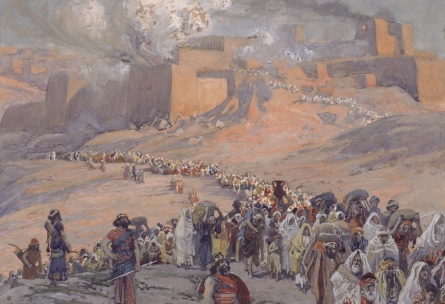
James Tissot, The Flight of the Prisoners

Thus says the Lord of hosts, the God of Israel, to all the exiles whom I have sent into exile from Jerusalem to Babylon: Build houses and live in them; plant gardens and eat what they produce. Take wives and have sons and daughters; take wives for your sons, and give your daughters in marriage that they bear sons and daughters; multiply there, and do not decrease.  But seek the welfares of the city where I have sent you into exile, and pray to the Lord on its behalf, for in its welfare you will find your welfare. Jeremiah 29. 4-7 NRSV

Even when the world as you know it ends, life still goes on, and we have to make sense of the conflict, the struggle and our place within it.  The communal memory becomes important, the stories parents have told their children, the history of families. In the midst of competing narratives what is the story that one can identify with? With the loss of the Davidic monarchy, the temple, the land of their ancestors the people did something amazing, they recast their identity.  They dug deep into their narrative, they began bringing together their stories, and in fact much of the Old Testament is brought together at this point. Stories of creation and exodus begin to be the patterns in which the present is made sensible and the community begins to come up with answers to the hardest question, “why did this happen?” They don’t come up with just one answer, they come up with many. They bring together their stories and the Torah (typically translated into English as law, but it is a term that is much more than what we understand as law in our context) begins to be center of their life.  Practice and story come together to bind together this community in exile.

This does not mean that everyone agrees, there is not a central authorizing authority for the narrative at this point, it is constructed mainly by the remnant of the elite (everyone else would have been illiterate at this point) from both the priestly and prophetic side. Some of the central ideas to emerge include:

Justice: a sense of living in harmony (shalom) with God’s desire for the way things are to be structured in society. This includes a strong sense of economic justice, compassion for the widows, orphan, immigrant, and the dispossessed. It is from this vision that many prophets operate out of, and this is a central image for the prophetic hope. The new Jerusalem, the new Israel is to be a place of justice where the nations around can look and say “Come, let us go up to the mountain of the Lord, to the house of Jacob; that he may teach us his ways and that we may walk in his paths” (Isaiah 3b, NRSV) and within God’s plan the nations will stream to Jerusalem.

Purity/Holiness: For us there is often a tension between Purity/Holiness and Justice, but it was not necessarily seen that way by the Jewish people.  Especially for priests there are practices that are to be done to prevent the contamination of unholiness from infecting them as a people and making them repulsive to the holiness of God. It also becomes a powerful way of distinguishing between themselves as a Hebrew people and the nations around them who are the Gentiles, the unclean ones.  This tends to be more of a priestly focus and there are conflicts between which will dominate going forward, but at the root both justice and holiness are practices which distinguish them from the hostile surrounding culture.

With these two distinctive directions emerges a new strand of a hope for a new beginning, a new temple, a New Jerusalem, a new anointed (and Davidic) king, a messiah.  Wrapped up within the memory of the stories of creation and the exodus of the people from Egypt hope springs forth of a return home and a new beginning:

Do not remember the former things, or consider the things of old. I am about to do a new thing: now it springs forth, do you not perceive it? I will make away in the wilderness and rivers in the desert. The wild animals will honor me, the jackals and the ostriches; for I give water in the wilderness, rivers in the desert, to give drink to my chosen people, the people who I formed for myself so that they might declare my praise. Isaiah 43.18-21

2nd Isaiah (Isaiah 40-55, which reflects the time of preparation for the return home, while Isaiah 1-39 deals with the time before the exile) in particular is full of this vibrant hope, along with other voices.  Empires rise and empires fall, and a generation later Babylon falls to Persia (modern day Iran) and Cyrus (who Isaiah interestingly calls Messiah/Christ-same word in Hebrew/Greek) makes possible the beginning of a return home.  Their stories and practices have maintained their identity and given them hope of a new beginning. With the return to Jerusalem, the land, and the possibility of reconstructing the temple comes yet another transition.  It is to that transition that we turn next.

purple rose 01 by picsofflowers.blogspot.com

The Place of Authority: A Brief History Part 3a: The Exile, the Crisis of Collapse

James Tissot, The Flight of the Prisoners

By the rivers of Babylon—there we sat down and there we wept when we remembered Zion. In the willows there we hung up our harps.For there our captors asked us for songs, and our tormentors asked for mirth, saying,

“Sing us one of the songs of Zion!”

How could we sing the Lord’s song in a foreign land? If I forget you, O Jerusalem, let my right hand wither! Let my tongue cling to the roof of my mouth, if I do not remember you,if I do not set Jerusalem above my highest joy. 

Remember, O Lord, against the Edomites the day of Jerusalem’s fall, how they said,

 “Tear it down! Tear it down! Down to its foundations!”

O daughter of Babylon, you devastator! Happy shall they be who pay you back what you have done to us! Happy shall they be who take your little ones and dash them against the rock!   Psalm 137 NRSV

In 721 BCE, after roughly 200 years of separation from the Southern Kingdom of Judah, the Northern Kingdom Israel falls to the Assyrian Empire (which has its origins in the Northwestern Part of modern day Iraq) and the Northern Kingdom is effectively absorbed into the Assyrian nation.  Somehow Judah holds on, even though it becomes completely surrounded by the Assyrian Empire.  Empires come and go, and power shifts to the Babylonian Empire (which has its origins in modern day Southern Iraq) without going into the bloody details: Jerusalem falls, the temple is destroyed, the Davidic monarchy effectively ends and the people of Judah are taken into exile or captivity in Babylon.  The loss of king and temple, as well as the land cause a crisis of authority which leads to one of the most constructive and important periods in Judaism.

The loss of home is catastrophic, it leads to a ton of questions about the future and there may not be any good answers at that point.  The closest cinematic example I could come up with was the loss of Anatevka in Fiddler on the Roof where families try to make the best of their coming exile, belittling what they are leaving behind-and yet families are broken apart, scattered across the world, many will never see each other again.

Something as catastrophic to not only the physical well-being but also to the communal consciousness can lead to several outcomes, many of which do emerge in this time. One response of the conquered is to assimilate with the conqueror, to align oneself with the victor, to adopt their values and practices and to set aside at least a portion of one’s previous identity to become a part of something different.  This is the perceived response of the Northern Kingdom by the Southern Kingdom-they stay on their land, intermarry with the Assyrians, and what emerges will be a hybrid people-no longer really Jewish, already separated from the Davidic monarchy and the temple hundreds of years before they become the other…the Samaritan (yes this is where those Samaritans that Jesus runs into in the New Testament come from).  But to be fair, a large number of the Judeans also assimilate into Babylon, only a small portion of the Judean people will return to their homeland at the end of the exile, most will remain dispersed throughout the nations.

In the lead up to the exile, the prophetic voice becomes very harsh in its critique of the monarchy, temple, the lack of economic justice within the nation, and the perceived idolatry of the shepherds of the nation.  This is the time where the first parts of Isaiah, much of Jeremiah and Ezekiel and many of the Minor Prophets become active in the memory of the people. The prophetic voice leads the way pointing to the ways in which kings and priests, throne and temple have not only failed as sources of authority but are at the very heart of the crisis viewed as a judgment from the LORD.  The prophets announce condemnation for the shepherds (the leaders, the authority in throne and temple) as one example among many:

The word of the Lord came to me: Mortal, prophesy against the shepherds of Israel: prophesy, and say to them—to the shepherds: Thus says the Lord God: Ah, you shepherds of Israel who have been feeding yourselves! Should not the shepherds feed the sheep? You eat the fat, you clothe yourselves with the wool, you slaughter the fatlings: but you do not feed the sheep. You have not strengthened the weak, you have not healed the sick, you have not brought back the strayed, you have not sought the lost, but with force and harshness you ruled them.  So they were scattered, because there was no shepherd: and scattered wandered over all the mountains and on every high hill; my sheep were scattered over the face of the earth, with no one to search or seek for them. Ezekiel 34.1-6 NRSV

 Instead of coming to believe that somehow their God is weaker than the gods of the Assyrians or the Babylonians, something amazing happens in the prophetic imagination (to use Walter Brueggemann’s keen words) and they begin to understand the transitions and the conflict around them as a part of God’s work—that behind Assyrian and Babylonian is the Lord of hosts (literally the Lord of armies-typically we think of this as heavenly armies, but I am beginning to think that in there is something more earthly to this term than often given credit). The coming destruction is a judgment particularly on the leaders, but also within all this death is the chance for something new: a fresh start, a redefinition, a chance to redefine and re-imagine what it means to be the chosen people.

The hand of the Lord came upon me, and he brought me out by the spirit of the Lord and set me down in the middle of the valley; it was full of bones.  He led me around them; there were very many lying in the valley, and they were very dry.  He said to me, “Mortal, can these bones live?” I answered, “O Lord God, you know.” Then he said to me, “Prophecy to these bones, and say to them: O dry bones, hear the word of the Lord. Thus says the Lord God to these bones: I will cause breath to enter you, and you shall live. I will lay sinews on you, and will cause flesh to come upon you, and cover you with skin, and put breath in you, and you shall live; and you shall know that I am the Lord. Ezekiel 37.1-6 NRSV

The prophetic voice will help the people re-imagine a new way forward, a way that is so critical to the way we understand things that we need to take some time with it.  Hope will not die, in fact it will be reborn in a new and powerful way and the people will understand themselves as a chosen people, but what that means takes a dramatic turn in the exile.  To that we shall turn next.

purple rose 01 by picsofflowers.blogspot.com

The Place of Authority: A Brief History Part 2: King, Temple and the Prophetic Critique

David and King Saul, Rembrandt

David and King Saul, Rembrandt

 So Samuel reported all the words of the LORD to the people who were asking him for a king. He said, “These will be the ways of the king who will reign over you: he will take your sons and appoint them to his chariots and to be his horsemen, and to run before his chariots; and he will appoint for himself commanders of thousands and commanders of fifties, and some to plow his ground and to reap his harvest, and to make his implements of war and the equipment of his chariots. He will take your daughters to be perfumers and cooks and bakers. He will take the best of your fields and vineyards and olive orchards and give them to his courtiers. He will take one-tenth of your grain and of your vineyards and give it to his officers and his courtiers. He will take your male and female slaves, and the best of your cattle and donkeys, and put them to his work. He will take one-tenth of your flocks, and you shall be his slaves. And in that day you will cry out because of your king, whom you have chosen for yourselves; but the LORD will not answer you in that day.” 1 Samuel 8.10-18


At roughly 1,020 BCE a decisive change takes place and Israel enters the time of monarchy.  Power becomes consolidated briefly under King Saul.  Two men, King Saul and Samuel, whose title before had been that of a judge but functioned as a mouthpiece for God at this point, hold the religious and political authority.  Israel begins to act as a powerful actor in the region, constantly moving from one conflict to another, but internal conflict emerges when David emerges on the scene.  Without getting bogged down in the story or trying to parse out what happened historically  by 1000 David would unify his power as king and Israel became for a brief shining moment a power player on the world stage, Jerusalem becomes the capitol, and then perhaps decisively for this era the temple is established under Solomon.   Especially for the Southern Kingdom of Judah this is decisive because the monarchy and the temple become linked as the dominant secular/religious authority. There is a prophetic voice within that critiques the monarchy and temple, but for the most part the people give up a portion of their freedom for the relative security, power and identity of being a part of the unified kingdom of Israel.  That is not to say that family, clan and tribe have lost their power or authority, but that the people become much more linked to the kings and temple than at any previous point in their history.

This is probably a good point for a fun interlude, it is hard for us to imagine being bound in systems where our autonomy is defined so externally.  We don’t have any experience of a monarchical system and so our reaction might be somewhat like the peasants in this scene from Monty Python and the Holy Grail.  Even a romanticized king when we look from our perspective seems like a tyranny or despot.

Even though King David is often looked upon romantically like the King Arthur of legend, one of the incredible things is that the recorded memory of David includes many ugly situations, many family struggles, many times where he is at odds with the prophetic voice of the time.  The whole Bathsheba and Uriah episode (2 Samuel 10-12), incest within the royal family (2 Samuel 13) and eventually the usurpation of the throne by his son Absalom (2 Samuel 15-19) as well as other internal rebellions are a part of David’s roughly forty years of consolidated rule.  Even though the King amasses incredible authority previously unattainable in anyone’s imagination the constant warfare and internal struggles begin to wear on the people.  By the time Solomon, David’s son, ascends to the throne it is a relatively peaceful time but the energy is directed internally on large building projects, the temple, but also many houses and palaces for Solomon and his entourage. The temple becomes, at least for a large group of people, the central focus of worship, and yet again just like with the idea of consolidating power with a king there is a large amount of space dedicated to the critique of the temple

 King Solomon conscripted forced labor out of all Israel; the levy numbered thirty thousand men. He sent them to the Lebanon, ten thousand a month in shifts; they would be a month in the Lebanon and two months at home; Adoniram was in charge of the forced labor. Solomon also had seventy thousand laborers and eighty thousand stonecutters in the hill country, besides Solomon’s three thousand three hundred supervisors who were over the work, having charge of the people who did the work. At the king’s command, they quarried out great, costly stones in order to lay the foundation of the house with dressed stones. So Solomon’s builders and Hiram’s builders and the Gebalites did the stonecutting and prepared the timber and the stone to build the house.  1 Kings 5.13-18 NRSV

This is a huge commitment of people and resources which are directed internally.  In fact it is such a strain that immediately upon Solomon’s death when Rehoboam takes power the people come and plead for relief:

Your father made our yoke heavy.  Now therefore lighten the hard service of your father and his heavy yoke that he placed upon us and we will serve you. 1 Kings 12.4 NRSV

To which the narrative has Rehoboam reply three days later in our language, ‘you ain’t seen nothing yet, you think my father made things hard on you?  Well prepare to be screwed!’ Most translations clean this up significantly…but the little thing that is thicker than his father’s loins is probably not a finger (see 1 Kings 12: 6-15 particularly v.10) Things are not nearly as clean in the Bible as we sometimes want to make them.  The people are offended, the kingdom splits apart and now there are two kings, two places of worship, a prophetic voice that continues to grow louder…but even with this prophetic voice within the Kingdom of Judah in the South and the Kingdom of Israel in the North growing stronger the fate of both nations is linked to the actions of kings and the worship at the temple in Judah and the worship at various sites in the North.  Particularly for the Southern Kingdom of Judah, so long as there is a Davidic king and the Temple who they are as the people of God seems secure.  Yet this too will change….

purple rose 01 by picsofflowers.blogspot.com