Category Archives: Book Reviews

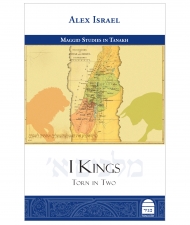
Review of 1 Kings: Torn in Two by Alex Israel

kings for web1 (1)

1 Kings: Torn in Two, by Alex Israel. Jerusalem: Maggid Books, 2013. Pp 350. $29.95 (Hardcover)

1 Kings is the second volume in the Maggid Studies in Tanakh series, and both works have proven to be clear written and insightful approaches to the portions of the Hebrew Scriptures that they address. Rabbi Alex Israel’s skillful opening of the book of 1 Kings provides the reader multiple frames to view the characters, events and historical context of this narrative which moves from the end of the reign of King David through the splitting of the nation of Israel in two and to the end of 1 Kings at the reigns of Jehoshaphat in Judah and Ahaziah in Israel. In a very easy to read style, Rabbi Israel narrates the struggle between kings and prophets, the uneasy relationship between the tribe of Judah and the tribes of Joseph, and with a sympathetic eye paints each of the kings and prophets as people caught within conflicting allegiances. 1 Kings: Torn in Two takes the theological narrative of the history of Israel in 1 Kings and tells it as a compelling story full of struggles and questions and invites the reader into a deeper engagement of the complicated story of the people of God.

1 Kings is roughly half of the original book of Kings, which we now have divided into both 1 and 2 Kings. The book of Kings looks back on the period of the First Temple and attempts to answer the question of what went wrong during this period that eventually led to the destruction of the temple and the people of both the northern Kingdom of Israel and the southern Kingdom of Judah being conquered by the Assyrians and Babylonians respectively. It is a spiritual evaluation of the era rather than a history book and it evaluates each ruler on how they either accelerated the nation of Israel’s path to destruction or reversed the tide by returning to God. The core problem that underlies the evaluation of the leaders in the Book of Kings is the spiritual issue of idolatry. (2)

1 Kings begin with the political intrigue caused by the approaching death of King David and the struggle for power between two of his sons, Adonijah and Solomon. Rabbi Israel skillfully narrates both a political and theological reading of this story of political intrigue. Through his close reading of the movements and alliances of each son of King David we see how both attempt to grasp for power at the end of David’s reign. In a time of uncertainty both groups attempt to consolidate their grasp on their reign through various methods, and ultimately when Solomon emerges the anointed king and consolidates his power it begins a new period of the time of Israel. A time of peace and prosperity begins the age of the first temple.

King Solomon’s reign will demonstrate a pattern of competing allegiances that will continue with all the kings that will follow him. Solomon’s reign and projects will demonstrate an openness to the world beyond the borders of the nation of Israel, even the construction of the temple is designed to spread the name of God beyond the Jewish people. (86) Yet, with this outward looking policy are sown the seeds of future conflicts. From Solomon’s marriage to the daughter of Pharaoh, as well as his other wives and concubines, to a policy of taxation to fund the building of the temple and many other houses which are all done in a time of peace and agricultural prosperity. It is a time of tension, as Rabbi Israel states it, “a tale of Solomon’s two conflicting loves—that of the Temple and that of Pharaoh’s daughter” It is an era that begins with the hope and promise of Solomon asking for wisdom to judge the people that transitions to that same wisdom being turned to become a source of revenue. The affluence of Solomon’s reign also begins to point to a spiritual decline as the accumulation of spices, wealth and building materials become more central to the narrative than the king’s ability to bring justice to the nation. Solomon’s reign of peace ends with his policies of taxation placing a huge internal strain on the already fragile bond between the tribes of Judah and the tribes of the rest of the nation and Solomon establishing a pattern of divided loyalties between the God of Israel and the Temple in Jerusalem and the his building worship sites for his foreign wives and his devotion to them. The end of Solomon’s reign sets the stage for a nation torn in two in his son’s reign.

When Rehoboam ascends to the throne the seam between Judah and the other tribes unravels. By the end of Solomon’s reign the resistance to the taxation policies of the king are already beginning to meet resistance and Jeroboam emerges as one of the challengers of Solomon and later to his heir Rehoboam. Rabbi Israel paints a nuanced portrait of both Jeroboam and Rehoboam where they are both faithful and unfaithful. Jeroboam’s revolt is portrayed as an anti-elitist, people-based movement where priestly service in the two new worship sites (Dan and Bethel) is opened up to all the people. While Jeroboam’s revolt receives divine sanction his institution of new worship sites and the use of images to mediate the people’s worship comes under condemnation of the book of Kings. In Judah, Rehoboam is willing to listen to the prophets that tell him not to go to war with the rest of Israel, however he too continues in the sin of idolatry of his father Solomon. The sin of idolatry is the one defining action that drives the evaluation of each king’s reign according to the book of Kings.

The time after the kingdom unravels is a time of numerous conflicts between Judah and Israel as well as turbulence as leadership as one dynasty is replaced by another. 1 Kings: Torn in Two narrates this complex time of interlocking reigns and conflict from both a northern and southern perspective and is able to highlight both the perspective of the author of 1 Kings on this time period but also brings in a historical and inter textual perspective, utilizing in particular the book of Chronicles to provide an additional voice on this time. Particularly in the North it is a time where different royal dynasties reign for a couple generations only to be replace by another dynasty when they are overthrown.

1 Kings conclude in the time of the Omri dynasty, Kings Omri and Ahab in the north. The reign of Kings Omri and Ahab in the north is one of economic prosperity but spiritual decline. King Omri and later his son Ahab base their foreign policy on an alliance with Phoenicia. This economic and political alliance with Phoenicia also bring Ball worship deep into the life of the Northern Kingdom. Particularly when King Ahab is married to Jezebel who become an ardent missionary of the religion of Phoenicia. (221) In a time where Ahab abandons God and his kingdom flourishes there seems to be no contradiction between his personal and national fortune and his religious orientation.

It is into this time of King Ahab and Jezebel and the continued influence of the religion and policies of Phoenicia that the prophet Elijah enters the story and the conflict begins for the spiritual identity of the Northern Kingdom. Rabbi Israel highlights several important readings of this story and how it reflects on both Elijah and God. In a more traditional reading Elijah is acting as God’s agent and God seems indifferent to the epidemic and famine caused by the three years of drought, but he also lifts up the position of Rabbi Samet in which God attempts to dislodge Elijah from his refusal to end the drought, and so finally in chapter 18 God orders Elijah to explicitly end the famine. (237) Ahab is also presented in a compassionate way as drawn between competing allegiances: after the events on Mt. Carmel where Elijah challenges the prophets of Baal and Ahab appears to return, briefly, to trusting the God of Israel, yet Jezebel continues to hold a strong sway over his policies and is able to threaten Elijah’s life immediately afterwards. The conflict between Elijah and Jezebel also demonstrates a conflict between two value systems: the democratic land culture of Torah and ancient Israel (where land remains in a family) and the monarchical Phoenician system where the king has the ability to take whatever the king wants. Yet even King Ahab, who has done more evil than any of the kings before him according to 1 Kings makes a sudden repentance at the end of the story and God enthusiastically accepts his repentance delaying any condemnation during his lifetime.

Rabbi Israel’s reading of the narrative of 1 Kings highlights the continuing pattern of competing allegiances that the leaders and people of Israel and Judah struggled with. His ability to tell the story in a compelling way allows the tensions of the time and the personalities of the leaders to come forward. The story points to the struggle that people live out our society between competing allegiances based on economic, political, relational and religious authorities. This is an illuminating journey into the time of the kings of Israel and Judah and resonates with themes and struggles found throughout the Hebrew Scriptures and in the relationship between God and God’s people.
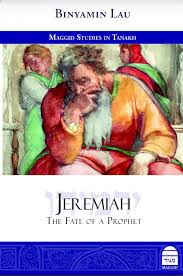

Review of Jeremiah: The Fate of A Prophet by Binyamin Lau

Jeremiah the Fate fo a Prophet

JEREMIAH: THE FATE OF A PROPHET, by Binyamin Lau. Translated by Sara Daniel. Jerusalem: Maggid Books, 2013. Pp.230.  $24.95 (hardcover)

The book of Jeremiah is one of the most challenging to approach in all of scriptures due to its enigmatic arrangement, wide historical context and challenging material. Rabbi Dr. Binyamin Lau does an incredible service in taking the book of Jeremiah and rearranging the chapters into sections that parallel the prophet’s life and placing the prophet’s words in the surrounding historical context. Set within this broader context we see the struggle of the prophet as he moves from soaring hope for the reunification of Israel and Judah through the disillusionment with the nationalistic struggles of Judah and eventually into the despair of the Babylonian exile. Rather than producing a commentary which deals with each chapter of Jeremiah, Rabbi Lau produces a narrative using: the text of Jeremiah, the recorded memory of the events in 2 Kings and 2 Chronicles in conversation with other historical sources and other prophets active at various points in Jeremiahs long career as well as the Rabbinic tradition of interpretation. The end result is a coherent and tragic narrative of a disparaged and disgraced prophet who tried desperately to eliminate the social injustices and corruption of his people and to save the Temple from its impending doom.

The introduction of the work argues that the modern context the prophet might be understood as the public intellectual who must summon all of their intellectual powers and persuasive skills to convince their audience of the truth of their words. Lau argues that prophecy does not depend upon being accepted and among the prophets only Jonah was able to fulfill his mission by convincing the people of Nineveh to see the error of their ways (xiv-xv). Yet the prophet must love the people enough to pay the personal price for their visions, and even be willing to be declared an enemy of the people. Jeremiah’s prophetic ministry, as the narrative will tell, will come at a high personal cost.

The book is divided between the three primary kings that Jeremiah’s prophetic ministry took place under: Josiah, Jehoiakim, Zedekiah. Part I begins by setting the stage with the story leading up to the time of Josiah by dealing with his predecessors. Briefly touching on the conflict between Samaria and Judah, in the context of the Assyrian domination of the Trans-Euphrates region, we see a picture of a divided people where savage wars between the nations of Judah and Israel overshadow the blood ties that once united them. (3) During the miraculous salvation of Jerusalem, in the time of Isaiah the prophet and the reign of King Hezekiah, we see the entry of Babylonia into the Judean world with Merodoch-Baladan’s delegation to Hezekiah. When Hezekiah’s son, Manasseh, ascended to the throne in 697 BCE he attempted to put the nation of Judah back on its feet but could not resist the lure of Assyrian culture and began to forfeit the cultural and religious heritage of Judah. It is within this context, after a brief reign by Amon, that Josiah becomes king in 640 BCE and the story of Jeremiah’s prophetic career begins.

Jeremiah’s prophetic calling occurs in the thirteenth year of Josiah’s reign, or 626 BCE, which is a time of great change in the region. This is the time when King Josiah has begun to cleanse and purify Jerusalem from Assyrian culture and worship. The young king is also sending envoys to Samaria to attempt to reunite the kingdoms of Judah and Israel. This grand dream of King Josiah to bring the people of Judah and Israel back to being one kingdom and worshipping the Lord only can be understood within the horizon of the crumbling of the Assyrian empire which is waging a war of attrition on its northern border. (10) Jeremiah’s ministry begins prophesying the unification of Israel and Judah, appealing to their shared ancestor Jacob. Jeremiah is captured by this vision and is convinced that God’s promise to rebuild after the destruction will soon be realized. Yet, as Jeremiah begins to yearn for this change he recognizes a discrepancy between the king’s attempted reforms and the other local leadership who still continue to represent the sinful generation of Manessah, yet Jeremiah believes that God is about to get rid of these shepherds and gather the scattered flock from Samaria. Jeremiah’s most optimistic words go out to the cities of Samaria, but in Judah and particularly in his own homeland of Benjamin Jeremiah witnesses a people “engrossed in their own land and wealth, wrapped up in everyday life, and awash in paganism.” (33) Throughout the remainder of the reign of Josiah and his attempts to reform Judah, Jeremiah will become increasingly distraught over the superficiality of these reforms among the leaders, priests and the people. “Jeremiah sees behind this façade and recognizes the falsity and the hypocrisy, the thin veneer of piety serving as a fig leaf for corruption and warped social values.”(49) When King Josiah dies in 609 BCE, while going out to confront Pharaoh Necho, Jeremiah’s observation of the shallowness of the reforms of Josiah bear their unfortunate fruit as the new king sets the nation on a very different course.

Part II deals with the reign of Johoiakim (609-598 BCE) and his pro-Egyptian regime. This is a time where Egypt experiences a renewal of power and influence. Egypt lays a heavy tariff on Judah, which Johoiakim passes onto the people of the land. “Jehoiakim strikes a winning combination: economic reliance on Egypt, spiritual and national reliance on the Temple, and a general atmosphere of compliance with the leader. What can go wrong?”(78) Jeremiah’s prophecy rails against all three of these items stating that reliance on Egypt will lead the king and his followers to their demise, that the temple is like the tabernacle at Shiloh that was destroyed by God after it was corrupted by the high priest’s sons, and the king and his loyalists will fall into the hands of Babylonia. Jeremiah finds himself struggling against the leaders of his nation, the priests and other prophets and is viewed as a traitor to the very people he is attempting to save from their coming doom. Jeremiah finds himself caught between the message of impending doom he feels compelled to pronounce and the persecution this pronouncement brings. The nation’s ability to rely on Egypt falters in 605 when Nebuchadnezzar begins his conquest, and Judah becomes subservient for three years, but in 601 when Egypt enjoys a brief resurgence Judah again sides with Egypt and rebels against Babylon. Jeremiah is able to see Babylon as the instrument of the Lord’s judgment and yet he still holds a single thread of hope that the people will repent and the terrible coming destruction of the Babylonians will be averted. Yet, in 597 Nebuchadnezzar in a brief campaign recaptures the rebellious cities of Judah the reign of Jehoiakim and the three month reign of his successor Jeconiah come to an end and the time between the two exiles begins under the Zedekiah, who was Josiah’s youngest son, after he swore loyalty to Babylon.

Binyamin Lau continues to masterfully tell the story of Jeremiah and the people of Judah in the time leading up to the destruction of Jerusalem and the final deportation of the Judean people as a punishment for breaching of their treaty with Babylon. King Zedekiah finds himself surrounded by those who have seized power in the leadership vacuum left by the Babylonians taking most of the previous leaders into exile in 597 BCE. When Babylon returns to the north in 594, Judah finds itself with the other nations in the area becoming a part of an Egypt led alliance. To the consternation of many of the leaders in the land as well as many other prophets, in particular Hananiah, Jeremiah continues to proclaim that the nation is to serve the King of Babylon and live and he passionately pleads for the city to turn from its course and avoid the destruction that is coming. Yet again the prophet’s words will fall on deaf ears. Even though King Zedekiah has some sympathy for Jeremiah and his prophesy the king finds himself powerless in the face of those who are leading the nation on a path of confrontation once again with Babylon. Even after Jeremiah’s words come true with the destruction of Jerusalem and the temple in 586 BCE, the people still refuse to pay attention to the prophet who for decades has tried to save the city and temple from this fate.

Jeremiah’s story is one of bitter disappointment. Throughout the story and prophecy of Jeremiah, Rabbi Lau is able to illuminate parallels in modern day Jerusalem. “The streets of Jerusalem still throng with false prophets who earnestly claim, ‘the tradition of our forefathers is in our hands; the Third Temple shall not be destroyed!’ Once again they seek to lull us into a sense of false security, to make us forget the grave responsibility we shoulder: to be worthy of this national home, the Jewish state.”(225) It is also very easy to make connections between the political and religious movements in modern day Israel and similar political and religious rhetoric in the United States. This is an insightful journey into the world of the prophet and illuminating in approaching not only Jeremiah but the world of the Hebrew Scriptures.

purple rose 01 by picsofflowers.blogspot.com