Category Archives: Book Reviews

Theological Influence: Miroslav Volf

One of the projects I have decided to do is to catalog in some small way the influence of

Miroslav Volf, Henry B. Wright Professor of Theology at Yale University

Miroslav Volf, Henry B. Wright Professor of Theology at Yale University

some of the major thinkers who have influenced my growth as both a Christian, a pastor and as an individual as I reengage some of their work in my reading. Since I just finished rereading After our Likeness by Miroslav Volf I will use him as the first, (well other than my beginning of a similar document of the work of Martin Luther). I have only met Professor Volf once in Tulsa, Oklahoma where he was speaking and yet as an author his works from the first one I picked up in my final year of seminary in 2004 (Exclusion and Embrace) have probably done more than any other modern theologian to challenge and shape me over the past twelve years. I have not read everything Volf has published but what I have read has been very fruitful and thought provoking.

after-our-likenessAfter our Likeness: The Church as the Image of the Trinity. (1998) This works started out as a Habilitationsschrift, one of the dissertations that Volf had to submit for his doctoral degree from the University of Tübingen. This is probably the hardest to read of Volf’s work and the most abstractly theological. He attempts to bring a Free church ecclesiology into conversation with a Roman Catholic and Orthodox ecclesiology represented by Cardinal (Joseph) Ratzinger, who would after the publication of this be elevated to be Pope Benedict XVI, from the Catholic Church and Metropolitan John D. Zizoulas from the Orthodox church.  Volf’s ambitious project attempts to deal with issues that deal with both the concrete forms of individual churches as well as the catholicity of the church. He begins his contribution to this dialogue with John Smyth’s position (based on Matthew 18:20) that where two or three or more saints are joined together that there is the church.  The individual church in his model is joined by the action of the Triune God to the church universal.

work-in-the-spiritWork in the Spirit: Toward a Theology of Work, (1991) This volume also evolved out of Volf’s doctoral studies, this one out of his dissertation evaluating Karl Marx’s understanding of work from a theological perspective. Within Work in the Spirit he takes this dialogue with both Karl Marx’s understanding of work and Martin Luther’s concept of vocation and tries to apply these to our context where work is far more dynamic than in Luther’s or even Marx’s time. Volf highlight’s the idea of charisms or gifts of the Spirit as a departure point to attempt to imagine a theological view of work that is not limited to Marx’s view of the alienation of work or Luther’s more static view of vocation. Because this flows out of his doctoral work this still is a little more formal than some of Volf’s later works.

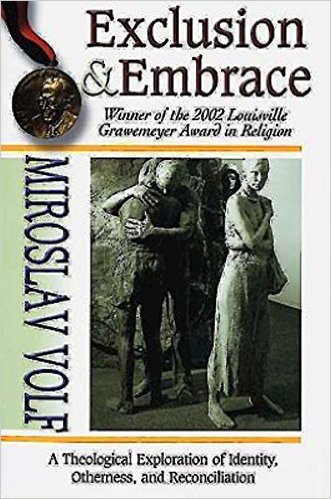
exclusion-and-embraceExclusion and Embrace: A Theological Exploration of Identity, Otherness, and Reconciliation (1996) This is the volume that introduced me to the work of Miroslav Volf and from the first page of the preface, where he lays out what is at stake in this theological exploration, through the final chapter on Violence and Peace it is a passionate and articulate formulation of a theology of the cross for our time. Volf is able to be both honest about the challenges of reconciliation while holding before the reader the dream and hope of embrace as the end for which we are called to work. He powerfully weaves together theology, scripture and personal experience into a work that I have gone back to multiple times in my own ministry.

free-of-chargeFree of Charge: Giving and Forgiving in a Culture Stripped of Grace (2005) This was written for a less academic audience but keeps Volf’s profound insight into the nature of forgiveness and his honest reflections about the struggle to forgive. Volf addresses many false views of both God and forgiveness in this beautiful little work that continues to delve into the vision of reconciliation he began in Exclusion and Embrace.

end-of-memoryThe End of Memory: Remembering Rightly in a Violent World (2006) Volf continues his reflections on reconciliation by exploring memory and the way our identities are formed by what we remember. Bringing together theology, psychology, sociology as well as personal experience and reflection into a cohesive reflection on how memory and forgiveness can live together. Another profound work that continues to work towards the goals of reconciliation laid out in Exclusion and Embrace.

against-the-tideAgainst the Tide: Love in a Time of Petty Dreams and Persisting Enmities (2010) This is a collection of short essays, many originally appearing as a column in Christian Century. Like all collections there is benefits and challenges: this is not a cohesive work like his other volumes but it is a collection that you can pick up a three-page reflection and then put down without losing a train of thought. There are some gems in this work and it probably would be best as more of a reflection type reading rather than a volume to read straight through.

captive-to-the-word-of-godCaptive to the Word of God: Engaging the Scriptures for Contemporary Theological Reflection (2010) I don’t remember this volume as well as many others of Volf’s. Like Against the Tide it is a collection of (longer) essays from a span of sixteen years on how to read the scriptures. Volf presents a way of not only reading scriptures theologically in a pluralistic world but also makes the point that ultimately theology should lead beyond a way of thinking to a way of living.

flourishing-volfFlourishing: Why We Need Religion in a Globalized World (2015) One of the things I love about Volf’s writing is that he asks good questions that need to be wrestled with. The question for this book is fairly simple: What is a life worth living? And what does religion (specifically but not limited to Christianity) have to contribute to the answer of this question? This is a measured and wise beginning of the answers to those questions. Volf engages both the ancient wisdom of books like Ecclesiastes and Job and the questions they prompt that still resonate in our lives.

Review of Reading Backwards by Richard B. Hays

download

READING BACKWARDS: FIGURAL CHRISTOLOGY AND THE FOURFOLD GOSPEL WITNESS, by Richard B. Hays. Waco, TX: Baylor University Press, 2014. 155pp $34.95

Richard B. Hays began his work of examining how the earliest followers of Jesus were interpreters of scriptures in 1989 with his work The Echoes of Scriptures in the Letters of Paul. Twenty five years later, after changing the dynamic of the way many people view Paul’s engagement with the Hebrew Scriptures Professor Hays now gives us a short introduction into what he states he hopes will be a much larger projects examining each of the evangelist’s engagement with the scriptures, but this short and provocative work should help continue the conversion of the imagination he challenged his readers to see in Paul now in the voice and words of the authors of Mark, Matthew, Luke and John. The book is the adaptation of the Hulsean Lectures presented at Cambridge University in the fall of 2013 and the spring of 2014 and is a work that will encourage its readers to understand the manner in which these early evangelists use the Hebrew Scriptures prefigure their experience of Christ.

The relationship of the Hebrew Scriptures to the New Testament is an important question for the church, but one that has often been overlooked. Richard B. Hays invites us into an exercise in learning to place ourselves in the evangelists’ places and see these scriptural texts that they used through their own eyes. Dr. Hays is convinced that “the Gospels teach us how to the OT, and –at the same time—the OT teaches us how to read the Gospels.”(4, emphasis author’s) Rather than seeing the evangelists as proof-texting pieces of the Hebrew Scriptures to make a certain points but rather invoke a set of rich and intertextual relations between the experience of the words of Jesus and the experience of his followers with the vision and world presented by the portions of scripture that the evangelists cite or allude to. The readings of each of the four gospels that are presented in Reading Backwards provide a rich and concise with the way in which each gospel distinctively uses scripture to paint its picture of Jesus.

The Gospel of Mark tells a story that is more suggestive and allusive in its narrative style and likewise many of Mark’s uses of the scriptures are allusive as well. Mark rarely quotes scripture but frequently uses language that alludes to how Jesus’ work and God’s work are mysteriously linked. Mark intimates that Jesus is, “in some way that defies comprehension the embodiment of God’s presence. Mark never quite dares to articulate this claim explicitly; it is too scandalous for direct speech. For Mark the character of God’s presence in Jesus is a mystery that can only be approached by riddle-like allusions to the OT.” (19f.) By looking at the way Mark creatively cites and alludes to scripture from the beginning of the story in Mark 1: 2-3 and running through the crucifixion narrative examining the way the larger context of the scriptural allusions to open the readers to the mystery of Jesus’ relationship with the God of Israel. Mark’s characteristic tension holds this identity in suspension as well, never overtly coming out and claiming Jesus’ identity but rather in a poetic way hides this answer in order that it might be revealed to those with eyes to see and ears to hear. Mark attempts to lead his readers into an exploration of the mysterious way in which Jesus is recognized as the embodiment of the God of Israel.

The Gospel of Matthew is much more explicit in its claims and the ways in which it uses scriptures. Matthew quotes scripture explicitly more than any of the other evangelists and from his first citation of Isaiah 7.14 in the birth narrative where Jesus is titled God is with us until the end of the gospel where all authority has been given to Jesus who will be with them forever Matthew presents, in a much more direct way, that Jesus is the presence of God among the people and the appropriate response is to worship the living presence of God who is present with them. Matthew uses a combination of scripture quotations as well as allusions to the Old Testament stories, like Herod in the slaughter of the innocents certainly would be heard as echoing Pharaoh’s decree in the Exodus narrative, to show how Jesus comes to embody not only God’s presence but also comes to be the fulfillment of the hopes of the law and the prophets. Where Mark encourages us to explore the mystery of the way divine presence of the God of Israel is present in Jesus, Matthew wants us to see this presence in order that we may worship God where God has now been found.

Luke reads the scriptures in a way that points to Jesus being the one who is the hope of Israel. From the prophecy of Zechariah, where God is praised for having “looked favorably on his people and redeemed them.”(Luke 1.68) to the journey with the two disciples on the way to Emmaus where these disciples, in their sadness, say, “But we had hoped that he was the one to redeem Israel.” (Luke 24. 21) Hays invites us to read again how Jesus might be seen in Moses and the prophets and how Luke might use the scriptures to help us see who Jesus is. Luke uses language and events that reflect the type of things that happened in the stories of the scriptures while never simply the same. The effect is to create a powerful but indistinct relation between the saving acts of God in the story of Israel and the liberating acts of fulfillment in the story of Jesus. (59)

For John’s gospel the fundamental hermeneutical claim is that the scriptures are the ones that bear witness to Jesus, but to understand those same scriptures one must first come to Jesus to receive life. This retrospective reading of Israel’s scriptures allows John to use a more visual set of images and figures from the narrative of the people where Jesus through verbal echoes and direct quotations link Jesus with both the wisdom of God as well as the images of the temple and sacrifice. Through these images John wants to illustrate that Jesus is not only the temple—but also the place where God’s presences comes to meet us and deliver us into union with the divine presence. (82) Since John understands Jesus as the Logos of God the entire narrative, the temple, sacrifice and the festivals of Judaism are a rich set of signs and symbols of God’s activity in the life and presence of Jesus.

In this short work with numerous illuminating explorations of the way the evangelists read their scriptures and the scriptures provide a fuller meaning to the telling of the story of Jesus, Richard B. Hays invites the reader to discover a gospel shaped hermeneutic. This, he argues, involves a complex poetic sensibility that pays attention to the narrative arc of the scriptures. Hays argues that the more we explore the way the evangelists explore the scriptures the more clearly it is apparent that each of the evangelists in their own unique portrayal point to Jesus being the embodiment of the God of Israel.  This short work, which continues Richard B. Hays long work with intertextuality and the art of reading scripture, is a very generative and helpful introduction to the deep question of how the evangelists became interpreters of the scriptures and how the experience of Jesus reframed their reading of scripture while scripture gave them the language and symbols to express the mystery of who Jesus is to their communities.

Review of David Lose’s Preaching at the Crossroads

preaching at crossroads

PREACHING AT THE CROSSROADS HOW THE WORLD AND OUR PREACHING IS CHANGING, by David J. Lose. Minneapolis: Fortress Press, 2013. Pp.112. (paperback)

Postmodernity, Secularism and Pluralism are three topics often discussed in relation to understanding the changes that have taken place in society and the lives of individuals in the last half of a century but they are rarely brought together. David Lose provides an incredibly useful introduction to three of the major influences that are shaping the world of the people both inside and outside of congregations and in a brief and helpful way illuminates the impact of these three massive shifts in the way the world is viewed and identity is constructed. In addition to being a descriptive book, where the nature of a postmodern, secular and pluralistic world is described, the book is also suggestive in responding to how a preacher might constructively engage each of the challenges and opportunities presented by our changing world.

Dr. Lose’s proposal in this book is that rather than looking at preaching through a list of problems that are described and solutions that are prescribed to look at the mystery of preaching and the questions of our age.  He invites the reader to enter into, “an ongoing, curious, and lively engagement with the questions that people living at particular times are asking” and then enter into the questions of the current age and understand those questions so as to speak from the mystery and wisdom of faith to those questions in a way that is helpful. (6) The structure of Preaching at the Crossroads deals with each of the three topics with two chapters, one descriptive and one suggestive. In each descriptive chapter the author describes the way each influence is seen in our daily lives and how it impacts the way the church has been able to interact with the world and the second chapter he presents some hopeful suggestions for the road ahead.

Postmodernity is the subject of the first two chapters of the book and in a very quick manner David Lose describes both postmodernity and its predecessor modernity (since postmodernity is a deconstruction of modernity). Modernity depended on rational verifiability as the standard of truth in an ordered world that was searching for certainty in rising scientific and technological revolutions that spanned several centuries. Postmodernism emerges from the disappointment with the costs of the modern age and as a skepticism about the ability of humanity to solve the crises of the world through reason, science, industry and technology. Where modernity sought some unified truth, postmodernity would say there is no unified reality or truth but rather truth has often been the values of the dominant culture. Postmodernity view language and culture are not merely descriptive of reality but are forces that are utilized in the construction of reality and instead of Francis Bacon’s famous dictum “knowledge is power” the postmodern philosopher Michael Foucault reverses this to “power is knowledge.” (18) In a postmodern world where all truth is at best penultimate and that the foundations which our truth and knowledge is based upon may need to be revised in the light of a more plausible alternative. The postmodern world is one of competing stories and narratives of which the Christian story is merely one possible narrative whose validity must be proven through interface with the hearer’s experiences and contact with other competing narratives. In a world where the certainties that humanity can save itself through continued progress and development are stripped away it calls for a different preaching that is willing to courageously wager about God’s engagement of the world and to see how that narrative is received in the experience of the postmodern hearer. Following Paul Ricoeur’s move of employing a hermeneutic of suspicion and trust simultaneously David Lose invites the preacher to consider a centered, communal, and humble approach to preaching.

Secularism is dealt with in chapters three and four of Preaching at the Crossroads. While postmodernity questions modernity’s assumption that humanity can save itself secularism represents a loss of confidence in the divine to allow humanity to escape from its crises. It is a world where the immanent has triumphed over the transcendent and the religious stories that once helped individuals look outward for their sources of meaning no longer have the same power forcing people to turn inward on their quest for meaning and identity. Where postmodernity presented the Christian faith with a crisis of authority secularism present that same faith a crisis of relevance. Many feel that with the triumph of the immanent that the transcendent no longer has a role to play in their lives. The triumph of the immanent over the transcendent has come at a high personal cost leading many to despair at the loss of meaning in their lives. This is where David Lose sees opportunity in the secularism that has come to dominate so many people’s lives, faith gains its relevance when it responds to the secular crisis of hope. In a world full of meaningless stories we are the bearers of an incredible story that does have the audacity to speak hope into hopelessness. Secularism has heightened our awareness of the mundane and ordinariness of life but particularly speaking from the perspective of vocation we have the ability to speak of the transcendent God who is present in the day to day tasks. Rather than restricting God’s activity to the realm of the church, Dr. Lose argues this frees us to point to the places God is at work in the lives of the people we encounter beyond the congregational walls.

Pluralism is the final topic tackled in the final two chapters of Preaching at the Crossroads. With pluralism the place of Christianity is no longer privileged as the one dominant story but is rather placed along with countless competing narratives: some religious, others may be centered on nationality, wealth, ethnicity or even the narratives used in advertising to place a product. This has been heightened by the rise of the digital age where a more robust variety of stories are instantly available at any one time. In light of the near unending choices available the culture has shifted from one of obligation to discretion. Now the center of identity is no longer inherited but rather constructed by the choices of what one affiliates with and which stories one values. We no longer live in a culture that values tradition but rather experience is the touchstone of value in this age. As with the previous shifts, David Lose points to the opportunity in this movement as well. In an age where identity is constructed we have the ability to ask the questions of how to “meet their deepest needs, construct meaningful identities and experience the living God”.(93) In a time where Christianity no longer benefits from the society reinforcing our story it is a chance to help people find themselves in the story again and to tell our story in a way that helps people make sense of their lives. David Lose ends these chapters with some suggestive ideas of how participatory preaching might provide a space for people to make sense of their lives in light of the biblical story.

David Lose’s book is a wonderful introduction to the interconnected movements of postmodernity, secularism and pluralism. It is a concise and quick summary that is helpful both for the preacher who has studied and lived with these swirling movements and for the student learning about preaching and wanting to understand the world that is changing around them. This was a book I wished I had years earlier but I am glad to have found as a helpful resource for today.


Review of 1 Kings: Torn in Two by Alex Israel

kings for web1 (1)

1 Kings: Torn in Two, by Alex Israel. Jerusalem: Maggid Books, 2013. Pp 350. $29.95 (Hardcover)

1 Kings is the second volume in the Maggid Studies in Tanakh series, and both works have proven to be clear written and insightful approaches to the portions of the Hebrew Scriptures that they address. Rabbi Alex Israel’s skillful opening of the book of 1 Kings provides the reader multiple frames to view the characters, events and historical context of this narrative which moves from the end of the reign of King David through the splitting of the nation of Israel in two and to the end of 1 Kings at the reigns of Jehoshaphat in Judah and Ahaziah in Israel. In a very easy to read style, Rabbi Israel narrates the struggle between kings and prophets, the uneasy relationship between the tribe of Judah and the tribes of Joseph, and with a sympathetic eye paints each of the kings and prophets as people caught within conflicting allegiances. 1 Kings: Torn in Two takes the theological narrative of the history of Israel in 1 Kings and tells it as a compelling story full of struggles and questions and invites the reader into a deeper engagement of the complicated story of the people of God.

1 Kings is roughly half of the original book of Kings, which we now have divided into both 1 and 2 Kings. The book of Kings looks back on the period of the First Temple and attempts to answer the question of what went wrong during this period that eventually led to the destruction of the temple and the people of both the northern Kingdom of Israel and the southern Kingdom of Judah being conquered by the Assyrians and Babylonians respectively. It is a spiritual evaluation of the era rather than a history book and it evaluates each ruler on how they either accelerated the nation of Israel’s path to destruction or reversed the tide by returning to God. The core problem that underlies the evaluation of the leaders in the Book of Kings is the spiritual issue of idolatry. (2)

1 Kings begin with the political intrigue caused by the approaching death of King David and the struggle for power between two of his sons, Adonijah and Solomon. Rabbi Israel skillfully narrates both a political and theological reading of this story of political intrigue. Through his close reading of the movements and alliances of each son of King David we see how both attempt to grasp for power at the end of David’s reign. In a time of uncertainty both groups attempt to consolidate their grasp on their reign through various methods, and ultimately when Solomon emerges the anointed king and consolidates his power it begins a new period of the time of Israel. A time of peace and prosperity begins the age of the first temple.

King Solomon’s reign will demonstrate a pattern of competing allegiances that will continue with all the kings that will follow him. Solomon’s reign and projects will demonstrate an openness to the world beyond the borders of the nation of Israel, even the construction of the temple is designed to spread the name of God beyond the Jewish people. (86) Yet, with this outward looking policy are sown the seeds of future conflicts. From Solomon’s marriage to the daughter of Pharaoh, as well as his other wives and concubines, to a policy of taxation to fund the building of the temple and many other houses which are all done in a time of peace and agricultural prosperity. It is a time of tension, as Rabbi Israel states it, “a tale of Solomon’s two conflicting loves—that of the Temple and that of Pharaoh’s daughter” It is an era that begins with the hope and promise of Solomon asking for wisdom to judge the people that transitions to that same wisdom being turned to become a source of revenue. The affluence of Solomon’s reign also begins to point to a spiritual decline as the accumulation of spices, wealth and building materials become more central to the narrative than the king’s ability to bring justice to the nation. Solomon’s reign of peace ends with his policies of taxation placing a huge internal strain on the already fragile bond between the tribes of Judah and the tribes of the rest of the nation and Solomon establishing a pattern of divided loyalties between the God of Israel and the Temple in Jerusalem and the his building worship sites for his foreign wives and his devotion to them. The end of Solomon’s reign sets the stage for a nation torn in two in his son’s reign.

When Rehoboam ascends to the throne the seam between Judah and the other tribes unravels. By the end of Solomon’s reign the resistance to the taxation policies of the king are already beginning to meet resistance and Jeroboam emerges as one of the challengers of Solomon and later to his heir Rehoboam. Rabbi Israel paints a nuanced portrait of both Jeroboam and Rehoboam where they are both faithful and unfaithful. Jeroboam’s revolt is portrayed as an anti-elitist, people-based movement where priestly service in the two new worship sites (Dan and Bethel) is opened up to all the people. While Jeroboam’s revolt receives divine sanction his institution of new worship sites and the use of images to mediate the people’s worship comes under condemnation of the book of Kings. In Judah, Rehoboam is willing to listen to the prophets that tell him not to go to war with the rest of Israel, however he too continues in the sin of idolatry of his father Solomon. The sin of idolatry is the one defining action that drives the evaluation of each king’s reign according to the book of Kings.

The time after the kingdom unravels is a time of numerous conflicts between Judah and Israel as well as turbulence as leadership as one dynasty is replaced by another. 1 Kings: Torn in Two narrates this complex time of interlocking reigns and conflict from both a northern and southern perspective and is able to highlight both the perspective of the author of 1 Kings on this time period but also brings in a historical and inter textual perspective, utilizing in particular the book of Chronicles to provide an additional voice on this time. Particularly in the North it is a time where different royal dynasties reign for a couple generations only to be replace by another dynasty when they are overthrown.

1 Kings conclude in the time of the Omri dynasty, Kings Omri and Ahab in the north. The reign of Kings Omri and Ahab in the north is one of economic prosperity but spiritual decline. King Omri and later his son Ahab base their foreign policy on an alliance with Phoenicia. This economic and political alliance with Phoenicia also bring Ball worship deep into the life of the Northern Kingdom. Particularly when King Ahab is married to Jezebel who become an ardent missionary of the religion of Phoenicia. (221) In a time where Ahab abandons God and his kingdom flourishes there seems to be no contradiction between his personal and national fortune and his religious orientation.

It is into this time of King Ahab and Jezebel and the continued influence of the religion and policies of Phoenicia that the prophet Elijah enters the story and the conflict begins for the spiritual identity of the Northern Kingdom. Rabbi Israel highlights several important readings of this story and how it reflects on both Elijah and God. In a more traditional reading Elijah is acting as God’s agent and God seems indifferent to the epidemic and famine caused by the three years of drought, but he also lifts up the position of Rabbi Samet in which God attempts to dislodge Elijah from his refusal to end the drought, and so finally in chapter 18 God orders Elijah to explicitly end the famine. (237) Ahab is also presented in a compassionate way as drawn between competing allegiances: after the events on Mt. Carmel where Elijah challenges the prophets of Baal and Ahab appears to return, briefly, to trusting the God of Israel, yet Jezebel continues to hold a strong sway over his policies and is able to threaten Elijah’s life immediately afterwards. The conflict between Elijah and Jezebel also demonstrates a conflict between two value systems: the democratic land culture of Torah and ancient Israel (where land remains in a family) and the monarchical Phoenician system where the king has the ability to take whatever the king wants. Yet even King Ahab, who has done more evil than any of the kings before him according to 1 Kings makes a sudden repentance at the end of the story and God enthusiastically accepts his repentance delaying any condemnation during his lifetime.

Rabbi Israel’s reading of the narrative of 1 Kings highlights the continuing pattern of competing allegiances that the leaders and people of Israel and Judah struggled with. His ability to tell the story in a compelling way allows the tensions of the time and the personalities of the leaders to come forward. The story points to the struggle that people live out our society between competing allegiances based on economic, political, relational and religious authorities. This is an illuminating journey into the time of the kings of Israel and Judah and resonates with themes and struggles found throughout the Hebrew Scriptures and in the relationship between God and God’s people.

Review of Jeremiah: The Fate of A Prophet by Binyamin Lau

Jeremiah the Fate fo a Prophet

JEREMIAH: THE FATE OF A PROPHET, by Binyamin Lau. Translated by Sara Daniel. Jerusalem: Maggid Books, 2013. Pp.230.  $24.95 (hardcover)

The book of Jeremiah is one of the most challenging to approach in all of scriptures due to its enigmatic arrangement, wide historical context and challenging material. Rabbi Dr. Binyamin Lau does an incredible service in taking the book of Jeremiah and rearranging the chapters into sections that parallel the prophet’s life and placing the prophet’s words in the surrounding historical context. Set within this broader context we see the struggle of the prophet as he moves from soaring hope for the reunification of Israel and Judah through the disillusionment with the nationalistic struggles of Judah and eventually into the despair of the Babylonian exile. Rather than producing a commentary which deals with each chapter of Jeremiah, Rabbi Lau produces a narrative using: the text of Jeremiah, the recorded memory of the events in 2 Kings and 2 Chronicles in conversation with other historical sources and other prophets active at various points in Jeremiahs long career as well as the Rabbinic tradition of interpretation. The end result is a coherent and tragic narrative of a disparaged and disgraced prophet who tried desperately to eliminate the social injustices and corruption of his people and to save the Temple from its impending doom.

The introduction of the work argues that the modern context the prophet might be understood as the public intellectual who must summon all of their intellectual powers and persuasive skills to convince their audience of the truth of their words. Lau argues that prophecy does not depend upon being accepted and among the prophets only Jonah was able to fulfill his mission by convincing the people of Nineveh to see the error of their ways (xiv-xv). Yet the prophet must love the people enough to pay the personal price for their visions, and even be willing to be declared an enemy of the people. Jeremiah’s prophetic ministry, as the narrative will tell, will come at a high personal cost.

The book is divided between the three primary kings that Jeremiah’s prophetic ministry took place under: Josiah, Jehoiakim, Zedekiah. Part I begins by setting the stage with the story leading up to the time of Josiah by dealing with his predecessors. Briefly touching on the conflict between Samaria and Judah, in the context of the Assyrian domination of the Trans-Euphrates region, we see a picture of a divided people where savage wars between the nations of Judah and Israel overshadow the blood ties that once united them. (3) During the miraculous salvation of Jerusalem, in the time of Isaiah the prophet and the reign of King Hezekiah, we see the entry of Babylonia into the Judean world with Merodoch-Baladan’s delegation to Hezekiah. When Hezekiah’s son, Manasseh, ascended to the throne in 697 BCE he attempted to put the nation of Judah back on its feet but could not resist the lure of Assyrian culture and began to forfeit the cultural and religious heritage of Judah. It is within this context, after a brief reign by Amon, that Josiah becomes king in 640 BCE and the story of Jeremiah’s prophetic career begins.

Jeremiah’s prophetic calling occurs in the thirteenth year of Josiah’s reign, or 626 BCE, which is a time of great change in the region. This is the time when King Josiah has begun to cleanse and purify Jerusalem from Assyrian culture and worship. The young king is also sending envoys to Samaria to attempt to reunite the kingdoms of Judah and Israel. This grand dream of King Josiah to bring the people of Judah and Israel back to being one kingdom and worshipping the Lord only can be understood within the horizon of the crumbling of the Assyrian empire which is waging a war of attrition on its northern border. (10) Jeremiah’s ministry begins prophesying the unification of Israel and Judah, appealing to their shared ancestor Jacob. Jeremiah is captured by this vision and is convinced that God’s promise to rebuild after the destruction will soon be realized. Yet, as Jeremiah begins to yearn for this change he recognizes a discrepancy between the king’s attempted reforms and the other local leadership who still continue to represent the sinful generation of Manessah, yet Jeremiah believes that God is about to get rid of these shepherds and gather the scattered flock from Samaria. Jeremiah’s most optimistic words go out to the cities of Samaria, but in Judah and particularly in his own homeland of Benjamin Jeremiah witnesses a people “engrossed in their own land and wealth, wrapped up in everyday life, and awash in paganism.” (33) Throughout the remainder of the reign of Josiah and his attempts to reform Judah, Jeremiah will become increasingly distraught over the superficiality of these reforms among the leaders, priests and the people. “Jeremiah sees behind this façade and recognizes the falsity and the hypocrisy, the thin veneer of piety serving as a fig leaf for corruption and warped social values.”(49) When King Josiah dies in 609 BCE, while going out to confront Pharaoh Necho, Jeremiah’s observation of the shallowness of the reforms of Josiah bear their unfortunate fruit as the new king sets the nation on a very different course.

Part II deals with the reign of Johoiakim (609-598 BCE) and his pro-Egyptian regime. This is a time where Egypt experiences a renewal of power and influence. Egypt lays a heavy tariff on Judah, which Johoiakim passes onto the people of the land. “Jehoiakim strikes a winning combination: economic reliance on Egypt, spiritual and national reliance on the Temple, and a general atmosphere of compliance with the leader. What can go wrong?”(78) Jeremiah’s prophecy rails against all three of these items stating that reliance on Egypt will lead the king and his followers to their demise, that the temple is like the tabernacle at Shiloh that was destroyed by God after it was corrupted by the high priest’s sons, and the king and his loyalists will fall into the hands of Babylonia. Jeremiah finds himself struggling against the leaders of his nation, the priests and other prophets and is viewed as a traitor to the very people he is attempting to save from their coming doom. Jeremiah finds himself caught between the message of impending doom he feels compelled to pronounce and the persecution this pronouncement brings. The nation’s ability to rely on Egypt falters in 605 when Nebuchadnezzar begins his conquest, and Judah becomes subservient for three years, but in 601 when Egypt enjoys a brief resurgence Judah again sides with Egypt and rebels against Babylon. Jeremiah is able to see Babylon as the instrument of the Lord’s judgment and yet he still holds a single thread of hope that the people will repent and the terrible coming destruction of the Babylonians will be averted. Yet, in 597 Nebuchadnezzar in a brief campaign recaptures the rebellious cities of Judah the reign of Jehoiakim and the three month reign of his successor Jeconiah come to an end and the time between the two exiles begins under the Zedekiah, who was Josiah’s youngest son, after he swore loyalty to Babylon.

Binyamin Lau continues to masterfully tell the story of Jeremiah and the people of Judah in the time leading up to the destruction of Jerusalem and the final deportation of the Judean people as a punishment for breaching of their treaty with Babylon. King Zedekiah finds himself surrounded by those who have seized power in the leadership vacuum left by the Babylonians taking most of the previous leaders into exile in 597 BCE. When Babylon returns to the north in 594, Judah finds itself with the other nations in the area becoming a part of an Egypt led alliance. To the consternation of many of the leaders in the land as well as many other prophets, in particular Hananiah, Jeremiah continues to proclaim that the nation is to serve the King of Babylon and live and he passionately pleads for the city to turn from its course and avoid the destruction that is coming. Yet again the prophet’s words will fall on deaf ears. Even though King Zedekiah has some sympathy for Jeremiah and his prophesy the king finds himself powerless in the face of those who are leading the nation on a path of confrontation once again with Babylon. Even after Jeremiah’s words come true with the destruction of Jerusalem and the temple in 586 BCE, the people still refuse to pay attention to the prophet who for decades has tried to save the city and temple from this fate.

Jeremiah’s story is one of bitter disappointment. Throughout the story and prophecy of Jeremiah, Rabbi Lau is able to illuminate parallels in modern day Jerusalem. “The streets of Jerusalem still throng with false prophets who earnestly claim, ‘the tradition of our forefathers is in our hands; the Third Temple shall not be destroyed!’ Once again they seek to lull us into a sense of false security, to make us forget the grave responsibility we shoulder: to be worthy of this national home, the Jewish state.”(225) It is also very easy to make connections between the political and religious movements in modern day Israel and similar political and religious rhetoric in the United States. This is an insightful journey into the world of the prophet and illuminating in approaching not only Jeremiah but the world of the Hebrew Scriptures.

purple rose 01 by picsofflowers.blogspot.com