Category Archives: Biblical Reflections

Revelation 22 Amen. Come, Lord Jesus

John Martin, The Celestial City and the River of Bliss (1841)

Revelation 22

1 Then the angel showed me the river of the water of life, bright as crystal, flowing from the throne of God and of the Lamb 2 through the middle of the street of the city. On either side of the river is the tree of life with its twelve kinds of fruit, producing its fruit each month; and the leaves of the tree are for the healing of the nations. 3 Nothing accursed will be found there any more. But the throne of God and of the Lamb will be in it, and his servants will worship him; 4 they will see his face, and his name will be on their foreheads. 5 And there will be no more night; they need no light of lamp or sun, for the Lord God will be their light, and they will reign forever and ever.

6 And he said to me, “These words are trustworthy and true, for the Lord, the God of the spirits of the prophets, has sent his angel to show his servants what must soon take place.”

7 “See, I am coming soon! Blessed is the one who keeps the words of the prophecy of this book.”

8 I, John, am the one who heard and saw these things. And when I heard and saw them, I fell down to worship at the feet of the angel who showed them to me; 9 but he said to me, “You must not do that! I am a fellow servant with you and your comrades the prophets, and with those who keep the words of this book. Worship God!”

10 And he said to me, “Do not seal up the words of the prophecy of this book, for the time is near. 11 Let the evildoer still do evil, and the filthy still be filthy, and the righteous still do right, and the holy still be holy.”

12 “See, I am coming soon; my reward is with me, to repay according to everyone’s work. 13 I am the Alpha and the Omega, the first and the last, the beginning and the end.”

14 Blessed are those who wash their robes, so that they will have the right to the tree of life and may enter the city by the gates. 15 Outside are the dogs and sorcerers and fornicators and murderers and idolaters, and everyone who loves and practices falsehood.

16 “It is I, Jesus, who sent my angel to you with this testimony for the churches. I am the root and the descendant of David, the bright morning star.”

17 The Spirit and the bride say, “Come.”
And let everyone who hears say, “Come.”
And let everyone who is thirsty come.
Let anyone who wishes take the water of life as a gift.

18 I warn everyone who hears the words of the prophecy of this book: if anyone adds to them, God will add to that person the plagues described in this book; 19 if anyone takes away from the words of the book of this prophecy, God will take away that person’s share in the tree of life and in the holy city, which are described in this book.

20 The one who testifies to these things says, “Surely I am coming soon.”

Amen. Come, Lord Jesus!

21 The grace of the Lord Jesus be with all the saints. Amen.

Revelation’s place at the end of the Christian scriptures places this final chapter as the final word among a collection of writings and experiences of God’s relationship with God’s people and the world. The story began with creation and in the second chapter of Genesis we encounter humanity in a utopian dream of a garden where there is adequate food and a harmony among the created order. We close the final chapter of the bible with a return to a utopian scene, but this time the garden is situated in the New Jerusalem combining both urban and rural elements. The tree of life, lost to humanity in the story of Adam and Eve, now returns in a scene that combines elements of a naturally occurring phenomenon of trees growing along a riverbank with the city planning of streets and the agricultural cultivation of an orchard. This new garden of Eden within the new Jerusalem which stands at the juncture of a new heaven and new earth closes the vision of Revelation. Cities are no longer a feature of a world that is east of Eden, or outside God’s description of the world should be. It is a city where the water of life and the fruit that will heal the nations flows out of the city itself in contrast to Rome where the riches and produce of the nation flowed inward to feed the Caesar and his empire. This image of a great city becomes the producer of the fruit and leaves that will feed and heal the nations rather than the consumer of the fruit and riches of the nations.

This vision in Revelation builds upon both the images of Genesis two and three and even more closely continues to follow Ezekiel’s vision of a renewed Jerusalem in Ezekiel 41-47. In Ezekiel’s 47th chapter we hear about the waters flowing from the temple flowing out towards the sea and renewing the waters of the sea and allowing them to be filled with fish and creatures. Along the banks of these waters are trees that produce food every month and their leaves have healing properties. Revelation’s vision expands the horizon of Ezekiel’s: Ezekiel hopes for the renewal of the people of Judah and Israel from the place of exile, Revelation expands this hope to encompass the nations. The new Jerusalem is for the countless multitude who bear the name of God on their foreheads and not only Israel is healed, but now the trees of life provide their fruit and healing to all the nations and the redeemed of all nations can drink from the waters of life.

The book of Revelation ends with a combination of injunctions from various speakers that take us back to the beginning of the book. In verse six we have an unidentified speaker confirming the trustworthiness of what the hearer has just heard. We know from the letters to the churches in chapters two and three that there were multiple people claiming the authority of prophecy to advance different interpretations of what faithfulness entails. Here we are taken back to the opening verses of Revelation one where the source of the vision is ultimately from Christ, but an angel was sent to bring the message to John to communicate to the seven churches, and by extension to the church.

We are reminded several times in this passage that Christ is coming soon. In the letters to the churches they were encouraged to persevere or repent because Christ was coming soon and here in this final chapter, we hear four separate times the refrain that Christ is coming soon. For the original hearers of the message undergoing persecution it may have reinforced their resolve to continue in the faithfulness of their calling. Churches in the centuries after Revelation have wrestled with this delay in multiple ways. Some have simply bypassed this, along with much of Revelation, and have continued to live out their faith in a way that makes sense in the expectations of the culture they are a part of. Other churches have constructed themselves around timelines and expectations where they believe their current generation are the ones that Revelation was written to and they are living in the last days and that they will soon see the destruction and hope of the book unfold. Throughout my ministry and throughout this reflection I’ve attempted to walk a middle path between these options. There is a story told about Martin Luther, who did believe the events of his time could be possibly signals of Christ’s return, about how he would respond if Christ was coming tomorrow. His response is told as, “I would plant a tree.” Now Luther probably didn’t say this, but it does reflect a way of looking at the world that is helpful—a life lived in the expectation and hope that Christ will come but not living in the panic and fear that seems to come with people who become focused on dates and timelines. I believe it is helpful to remember that for the early Christians the return of Jesus was looked upon as a hopeful time.

Revelation has been consistently focused on repentance, on people turning away from the places where they have trusted in idolatry or placing trust in the might and power of the Roman empire and returning to place their trust in God and Jesus. Keeping the words of this prophecy would be consistent with eliminating actions that, in Revelation’s view, compromise the faithfulness of the hearer. From the letters to the seven churches onward we have been called to choose the path of wisdom rather than foolishness, God rather than the promises of the empire. Yet, with all calls to repentance, the people who wash their robes may include people who previously would have been outside the community of the saints. Revelation’s hope is for a countless multitude from all nations gathered together in the city of God and the presence of God. Yet, there is a reluctant realism that the ‘evildoer will continue to do evil and the filthy will still be filthy.’ Ultimately, for the holy they are called to remain holy, the righteous are called to remain righteous, those who have washed their robes are to remain clean. Within God’s kingdom there is no place for the falsehood, idolatry and other vices that the people of God have encountered in the empire of Rome.

In the spirit of expectation, the book is not to be sealed, in contrast to Daniel’s visions which were to be sealed up until the end (Daniel 8:26 and 12: 4). For Revelation the time of the end is near and longed for. Revelation views itself as a final cry in the wilderness for the people to see, hear and turn to the Lord. The words of Revelation are to be read and acted upon and preserved. Here at the end of the book there is are several declarations of the authority of the book and a call for the hearer to respond. In the history of the church, Revelation has frequently been overlooked or left to the artists and musicians. Recently, Revelation’s position in some churches has shifted to become almost as important as the gospels.  Revelation may not be central for me as the gospels, Paul’s letters and even significant portions of the Hebrew Scriptures (or Old Testament) in my life and reflections of faith but it does deserve to be heard and wrestled with.

I finish this set of reflections at the beginning of the season of Advent in 2018, and I find that fitting. To end the book of Revelation with its repetitive call “Amen, come Lord Jesus!” when we as a church begin to look both backwards to the Incarnation and echo with our Jewish ancestors, “O Come, O Come, Emmanuel and ransom captive Israel that mourns in lonely exile here until the Son of God appears” but we also look forward to when our Lord returns with songs like the African American Spiritual “My Lord, What a Morning.” Revelation has a challenge a call and a hope for all readers: a challenge for there are many places where we also have compromised with the cultures that we inhabit and have trusted in the promises of our own nations and cities; a call to return to the Lord, our God who is gracious and merciful, to repent and hear the good news of the kingdom of God’s approach; and a hope that the world as we see it is not the end, that God still has a vision which stretches and expands beyond the point where my limited imagination can contain. Over the past year I have allowed Revelation to evoke and challenge me, I have attempted to understand the visions it has to offer. The danger of this type of reflection is that in my own ways I attempt to moderate or tame these visions or lock them into a time in the past. Yet, my hope is that I can stand with the Spirit, the bride, the hearers and the thirsty and join in the cry for Jesus to “come!”

Revelation 21 The New Jerusalem

Alonso Cano, Saint John the Evangelist’s Vision of Jerusalem (1636-1637)

Revelation 21

 1 Then I saw a new heaven and a new earth; for the first heaven and the first earth had passed away, and the sea was no more. 2 And I saw the holy city, the new Jerusalem, coming down out of heaven from God, prepared as a bride adorned for her husband. 3 And I heard a loud voice from the throne saying,
 
 “See, the home of God is among mortals. He will dwell with them;
they will be his peoples, and God himself will be with them;
4 he will wipe every tear from their eyes.
Death will be no more; mourning and crying and pain will be no more,
for the first things have passed away.”

5 And the one who was seated on the throne said, “See, I am making all things new.” Also he said, “Write this, for these words are trustworthy and true.” 6 Then he said to me, “It is done! I am the Alpha and the Omega, the beginning and the end. To the thirsty I will give water as a gift from the spring of the water of life. 7 Those who conquer will inherit these things, and I will be their God and they will be my children. 8 But as for the cowardly, the faithless, the polluted, the murderers, the fornicators, the sorcerers, the idolaters, and all liars, their place will be in the lake that burns with fire and sulfur, which is the second death.”

9 Then one of the seven angels who had the seven bowls full of the seven last plagues came and said to me, “Come, I will show you the bride, the wife of the Lamb.” 10 And in the spirit he carried me away to a great, high mountain and showed me the holy city Jerusalem coming down out of heaven from God. 11 It has the glory of God and a radiance like a very rare jewel, like jasper, clear as crystal. 12 It has a great, high wall with twelve gates, and at the gates twelve angels, and on the gates are inscribed the names of the twelve tribes of the Israelites; 13 on the east three gates, on the north three gates, on the south three gates, and on the west three gates. 14 And the wall of the city has twelve foundations, and on them are the twelve names of the twelve apostles of the Lamb.

15 The angel who talked to me had a measuring rod of gold to measure the city and its gates and walls. 16 The city lies foursquare, its length the same as its width; and he measured the city with his rod, fifteen hundred miles; its length and width and height are equal. 17 He also measured its wall, one hundred forty-four cubits by human measurement, which the angel was using. 18 The wall is built of jasper, while the city is pure gold, clear as glass. 19 The foundations of the wall of the city are adorned with every jewel; the first was jasper, the second sapphire, the third agate, the fourth emerald, 20 the fifth onyx, the sixth carnelian, the seventh chrysolite, the eighth beryl, the ninth topaz, the tenth chrysoprase, the eleventh jacinth, the twelfth amethyst. 21 And the twelve gates are twelve pearls, each of the gates is a single pearl, and the street of the city is pure gold, transparent as glass.

22 I saw no temple in the city, for its temple is the Lord God the Almighty and the Lamb. 23 And the city has no need of sun or moon to shine on it, for the glory of God is its light, and its lamp is the Lamb. 24 The nations will walk by its light, and the kings of the earth will bring their glory into it. 25 Its gates will never be shut by day — and there will be no night there. 26 People will bring into it the glory and the honor of the nations. 27 But nothing unclean will enter it, nor anyone who practices abomination or falsehood, but only those who are written in the Lamb’s book of life.

As we approach the conclusion of this long journey through Revelation, I’m going to begin with a story I’ve used several times in teaching and preaching. I believe the story originated with Kelly Fryer based on her experience in college, but the overall point is very insightful for the bible as a whole, and this passage in particular.

There once was a college class on theology where the students were being the way that college students can sometimes be: they were talking and not paying attention to the instructor, interacting with their phones and tablets instead of taking notes and just generally being a handful for the instructor. Unable to garner a lot of attention for the topic the instructor was trying to present he erased the writing on the board and drew a single arrow pointing downward. This change caught the attention of the students and the professor ended by saying, “This is what we will be talking about next time we gather for class. I will see you then.” He then dismissed the class. This perplexed the students and they talked about what the downward pointing arrow might mean: “It means that the standards of society have fallen,” “it means we are all going to fail,” or since it was a theology class “does it mean we are going to hell?” When the class resumed the professor asked the students what they thought the arrow might mean and they responded with several of their thoughts. The professor politely explained that their answers, while creative, were not what the arrow was communicating. The arrow stands for the message he hoped they would take away from his class, “God always comes down.”

The narrative throughout scripture is of a God who desires to dwell among God’s people, whether walking in the garden with Adam and Eve, in the tabernacle in the Exodus, or in the incarnation in the gospels, God’s desire is to descend to dwell among the people of the earth. Here in the final two chapters of Revelation we see this descent of God viewed in ways that taps into several images from the prophets. Within the narrative of Revelation, it also presents a stark contrast between two possible choices and futures, between a future where the people choose the ways of Babylon (Rome) with all its allures and the future presented here when the peoples choose the way of wisdom and find themselves observing the coming of the new Jerusalem. Throughout Revelation we have alternated between those who rejoice with the countless multitude in heaven and those who worship the beast and the reader has been encouraged to courageously endure with the saints the persecutions and struggles rather than being cowardly or faithless and embracing the values and practices of the empire.

The opening line of the chapter echoes Isaiah 65:17, which states that God is about to create a new heaven and a new earth after the devastation and suffering that the people of Israel suffered in their exile in Babylon. Now with the destruction of the ‘new’ Babylon and the forces behind it this promise is reimagined within the context of God’s final descent and victory. Revelation never pictures the earth being destroyed, other than the disasters and conflicts that are a part of Revelation’s story, but the new heaven and new earth are an extension of God’s faithfulness and love for the earth rather than an elimination of the old creation and a replacement by the new. The new heavens and new earth may also reflect the healing of memory from the trauma of the treatment the saints received during persecution and may echo Isaiah 43: 18-19 when it says, “Do not remember the former things or consider the things of old. I am about to do a new thing.”

Henry John Stock, God Shall Wipe Away all Tears from Their Eyes (1912)

The voice from the throne captures the hope of the passage by combining several images of hope together into a single statement. For the people of Israel, the hope of God’s dwelling among them goes back to the tabernacle where God dwelled with the people during their journey through the wilderness. This image gets reimagined in the prophets, notably Jeremiah and Ezekiel, where God’s covenant is renewed, and the people of Israel will again claim their identity as God’s people and God will renew God’s commitment to be their God. The language follows Ezekiel 37: 27, “My dwelling place shall be with them; and I will be their God, and they shall be my people.” God wiping away the tears of the people is one of my favorite lines in the passage and echoes Isaiah 25: 8 where after destroying the shroud that is cast over the nations and swallowing up death, God wipes away the tears from the faces of God’s people and removes their disgrace. John sees a time when the pain and suffering of the present are ended, and the renewed creation can be a place where God’s long-awaited presence and promises are fulfilled.

The one seated on the throne, God, speaks and commands that the words of God are recorded for those who will receive this recorded vision. The making of all things new recaptures what immediately proceeded by the voice from the throne and again echoes Isaiah 43: 18. The identity of the one on the throne as the Alpha and Omega is a recurring title we first encountered in Revelation 1:8, which uses the first and last letters of the Greek alphabet to encapsulate the statement that God is the beginning of all things and the ending of all things. God holds all the things of heaven and earth within God’s realm and power and the future depends upon God’s provision. God next promises the gift of the springs of the water of life, first mentioned in Revelation 7: 17 and will flow as a river from the throne of God in the following chapter. We are also brought back to a continual theme throughout Revelation when we are told ‘those who conquer’ will inherit. Conquering in Revelation is redefined in light of Christ’s conquest as remaining faithful despite persecution. Beginning with the letter to the church in Ephesus in Revelation 2: 1-7 and throughout the book we have been exhorted to conquer and promised a reward for remaining steadfast. Now that reward comes in the form of adoption and inheritance. The language moves the relationship of God from being “I will be their God and they will be my people” to the familial language, “they will be my sons and daughters (children)” With this kinship which is extended is also a share in the inheritance of God.

In contrast with those who conquer and inherit are those who do not conquer and receive a different inheritance. The list of vices in verse eight begins with the cowardly and the faithless and then continues with items that frequently occur on these types of list of vices that do not belong in God’s kingdom. Revelation, like wisdom literature in the Bible, presents us with a choice between what it considers wisdom and folly. To choose wisdom is to remain faithful to Christ and to turn away from the promises of prosperity offered by the Roman empire if they will compromise their values and accommodate some of the practices of the society. The choice of folly, in Revelation’s view, is the choice of accommodation. This is viewed as both cowardice, within the military metaphor of conquest, and idolatry, or faithlessness. This list of vices represents a different set of values than those embodied in this realized kingdom of God and there is no place within the city of God for things like murder or fornication or lies.

I intentionally waited to discuss the appearance of the New Jerusalem now metaphorically occupying the space of the bride of the Lamb since it is mentioned at the beginning of the chapter but is described in verses nine through twenty-seven. We are immediately reminded of the contrast between Babylon (Rome) who is portrayed as a harlot and the new Jerusalem decked out as a bride by the presence of the angel who had carried one of the bowls which contained the last plagues (Revelation 16). Previously these angels saw the rivers turned to blood, the sun to darkness and plagues of sores but now one of these angels points us to a city where there is the water of life, the light of God’s glory and healing for the nations. The description of the city touches on numerous images throughout scripture. For several of the prophets there was a hope for a rebuilt city of Jerusalem, the closest representation to our image would be the square city mentioned in Ezekiel with its twelve gates (Ezekiel 48: 30-35) but the city described here dwarfs anything imagined previously. The city is a cube of massive proportions, 1,500 miles in width, depth and height. For perspective, 1,500 miles is roughly the distance from Los Angeles to Houston, and the highest point on earth is roughly 5 ½ miles above sea level. The envisioned city is unimaginably large. This is a city imagined which could house all the nations of the earth and bring them into proximity with God. The walls are also incredibly thick, almost seventy-five yards, with twelve gates made of pearl guarded by twelve angels. Cherubim were described in Genesis as guarding the way to the tree of life, but here they stand at the gates that allow entrance to the city where these trees live, yet there is nothing left to threaten the city, the people or the trees. The foundations are built on stones that are similar to the list of the stones in the breastplate of the high priest (Exodus 28:17-20 and Exodus 39: 10-13) and many of these stones also appear in the lamentation over the king of Tyre in Ezekiel 28: 13, where the king is placed among God’s created things in the garden of Eden and covered with most of these precious stones. The size, the jewels, the golden streets and city all combine to stretch the imagination, yet the one thing not present in the city is a temple. The temple, and the tabernacle before it, brought a little bit of heaven to earth yet now heaven and earth seem to dwell together in the city for God dwells in it. There is no need for there to be a place to mediate the presence of God for God’s glory provides the illumination to the city and God has come down to dwell among God’s people.

Revelation 20 The Final Victory

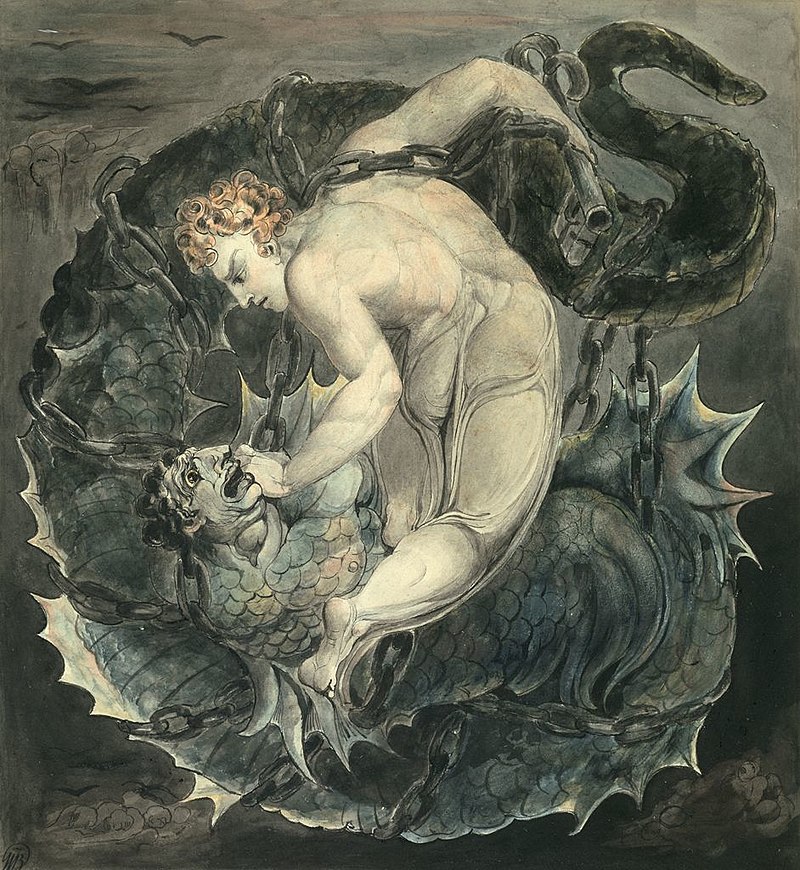
William Blake, The Angel Binding Satan (1805)

Revelation 20

1 Then I saw an angel coming down from heaven, holding in his hand the key to the bottomless pit and a great chain. 2 He seized the dragon, that ancient serpent, who is the Devil and Satan, and bound him for a thousand years, 3 and threw him into the pit, and locked and sealed it over him, so that he would deceive the nations no more, until the thousand years were ended. After that he must be let out for a little while.

4 Then I saw thrones, and those seated on them were given authority to judge. I also saw the souls of those who had been beheaded for their testimony to Jesus and for the word of God. They had not worshiped the beast or its image and had not received its mark on their foreheads or their hands. They came to life and reigned with Christ a thousand years. 5 (The rest of the dead did not come to life until the thousand years were ended.) This is the first resurrection. 6 Blessed and holy are those who share in the first resurrection. Over these the second death has no power, but they will be priests of God and of Christ, and they will reign with him a thousand years.

7 When the thousand years are ended, Satan will be released from his prison 8 and will come out to deceive the nations at the four corners of the earth, Gog and Magog, in order to gather them for battle; they are as numerous as the sands of the sea. 9 They marched up over the breadth of the earth and surrounded the camp of the saints and the beloved city. And fire came down from heaven and consumed them. 10 And the devil who had deceived them was thrown into the lake of fire and sulfur, where the beast and the false prophet were, and they will be tormented day and night forever and ever.

11 Then I saw a great white throne and the one who sat on it; the earth and the heaven fled from his presence, and no place was found for them. 12 And I saw the dead, great and small, standing before the throne, and books were opened. Also another book was opened, the book of life. And the dead were judged according to their works, as recorded in the books. 13 And the sea gave up the dead that were in it, Death and Hades gave up the dead that were in them, and all were judged according to what they had done. 14 Then Death and Hades were thrown into the lake of fire. This is the second death, the lake of fire; 15 and anyone whose name was not found written in the book of life was thrown into the lake of fire.

In a book full of images, metaphors and declarations that have inspired a plethora of theological interpretations and have divided interpreters perhaps none has been as divisive in recent theological movements as the image of the millennium of peace where the devil is confined that we encounter in this chapter of Revelation. The image of the millennium has often been linked, as I will discuss briefly below, to expectations of the advent of an utopian era brought about either by the spreading of the gospel to the ends of the earth, or by the continued social progress toward equality, or by the inbreaking of God’s reign bringing about the long awaited peaceful kingdom imagined in places like Isaiah 2: 2-4. Yet, Revelation is remarkably terse in its description of this time, it is an extended pause between the defeat of the beast from the previous chapter and the binding of Satan here and the final handing over of the Devil, Death and Hades into the lake of fire. In a strange set of visions this is a strange chapter which, like the rest of the book, is permeated with images from scripture recast here in a new form.

The history of the interpretation of this chapter can fill pages in a detailed commentary and would be tedious for all but the most determined readers, yet some appreciation of how the church wrestled with this passage is highly beneficial. Many early interpreters did anticipate some manner of futuristic millennium, whether Irenaeus view of six thousand years of creation followed by a millennium of rest (based on the seven days of creation) or Victorinus futuristic interpretation where the New Jerusalem of the next chapter would descend, and the nations would serve the saints in a time of incredible bounty. Most interpreters from Tyconius in the middle of the fourth century onward assumed the millennium was the present age of the church. As Christianity was now the dominant religion in the Roman empire it was increasingly viewed that Christ in his life, death and resurrection had bound Satan, and though there were still struggles, the church was now an extension of Christ’s reign. There was a great diversity in spiritual interpretations of what the passage means, but in general the age of the church was viewed as a time where the church reigned without a massive life or death struggle with the forces of the devil. Most of the reformers of the Protestant reformation in the sixteenth century rejected belief in a future millennial kingdom. Luther believed that the conflicts of his time were the final struggles before God brought about the final judgment and that the forces of the papacy and the Turkish armies were the Gog and Magog mentioned in verse seven. Calvin, Bullinger and Cranmer all rejected a future millennial kingdom. By the eighteenth century the idea of a future millennial kingdom was popular, but with the optimism of the time, the Christians of Europe and America believed they would bring about this kingdom through the spread of the gospel. By the nineteenth century the term postmillennialism was given to the idea that the millennium would begin once the ideals that would lead to this time were accomplished. For example, reformers like Alexander Campbell (founder of the Disciples of Christ) and Charles Finney tried to bring about social changes like control of alcohol abuse and the abolition of slavery in addition to the continuing spread of the gospel as tools to bring about the millennial age. At the same time, in contrast with the optimistic view of history proposed by the postmillennials, a view known a premillennialism emerged where the conditions on earth would become worse until Christ returns inaugurating the conflict that will lead to the millennial age. This view would give birth to traditions like the Seventh-day Adventists and the Jehovah’s Witnesses but would also reach its most popular reception in the approach of John Nelson Darby. Darby’s schema views Revelation, in combination with several other portions of scripture, laying out a path which leads to the end of the age at Armageddon, with is understood as a literal battle, and afterward when Satan is bound the Jewish people accept Christianity and people live long and prosperous lives. The above discussion is heavily indebted to the much longer and more detailed examination of Craig R. Koester in his commentary on Revelation. (Koester, 2014, pp. 741-750)

The chapter begins by locking the Devil in the abyss, an action that looks back to two earlier portions of Revelation. In chapter nine a star, likely referring to an angel, is given the key to unlock the abyss. Here the angel is given the key to lock the abyss again and to seal the devil inside it. This also continues the fall of the devil which what narrated in chapter twelve as Michael cast the devil from heaven to the earth. The devil, who has been the force behind the beast and all its conspirators, is finally exposed, bound and removed from its place as a tormentor of the earth and a threat to creation. No reason is given for the thousand-year limit on the devil’s confinement other than the statement at the end ‘he must be let out for a little while.’

In the devil’s absence those who God has judged favorably now reign. As Revelation 3: 21 promised the hearers in Laodicea, “To the one who conquers I will give a place with me on my throne, just as I myself conquered and sat down with my Father on the throne.” In another of Revelation’s great reversals those who received a negative judgment from God’s opponents, judgments that may have resulted in their execution, now receive a positive judgment from God by sharing in God’s reign. In the imagery of Revelation this is a first fruits of a larger resurrection that occurs at the end of the imagined millennium, but those who are highlighted here have already conquered and Death, Hades and the Devil (all personified here) have no power over them.

Revelation pulls imagery from throughout the Hebrew Scripture (or Old Testament as many Christians know the first two thirds of their scriptures) but the prophet Ezekiel continues to be a source of images that are echoed here in Revelation. Ezekiel 38-39 introduces us to Gog, the land of the prince Magog who attacks Israel and is overthrown by God and here Revelation takes both Gog and Magog and turns them into nations or groups from the four corners of the earth that one final time come to threaten the saints under the influence of the devil. In a military metaphor they surround the camp of the saints to make war upon them but, like the previous battle against the beast in Revelation 19, the saints do not fight, and God consumes these forces and then the devil is thrown into the lake of fire.

After the casting of Satan into the lake of fire comes the resurrection of all the dead. In a courtroom like scene the dead once raised are judged by how they have lived but also entirely by God’s standards. As Craig Koester states:

Revelation presents a tension: People are judged according to their works, yet they are saved by the favor connoted by the scroll of life (Boring; Harrington). Judgment is not a purely human affair in which those whose good deeds outnumber their evil deeds are saved and the rest condemned. Neither does God simply redeem some and condemn others. (Koester, 2014, p. 792)

Revelation, like most of scripture, dwells with the paradox that how one lives matters and the final sovereignty of God to determine any judgment that people would receive. The scope of God’s redemption may be wider than the limits that humans would place upon it. Throughout Revelation the hearers have been encouraged to resist the evil in the society around them and to repent when they fail. Yet, there is an acknowledgment in Revelation of the allure of the society and perhaps the multitude of people may eventually see and wash their robes so that they too may take their place among the uncountable multitude. Even with this image of final judgment, the hope of Revelation is to lead its hearers to repentance rather than resignation.

Many people come to Revelation searching for certainty, attempting to divine the exact path of the future and this has led to multiple conflicts and divisions in the church. I’m not comfortable with any of the premillennial/postmillennial patterns of interpretation nor the view of living within the millennium of many earlier Christians for various reasons. Trying to lock down history and say that this is the age where the Devil and the force of evil are imprisoned does not seem to reflect the reality of the pain and suffering in the world, and while Revelation simply assumes the reality of suffering and persecution it does imagine an ending to it. I can’t share the optimism of many seventeenth- and eighteenth-century Christians who felt that they could bring about the millennial age by evangelism and social change, nor can I embrace the pessimism and persecution complex of many postmillennial interpreters. Yet, perhaps there is wisdom in attempting to step back from the trees to see the forest. Revelation as a book was designed to bring hope to its hearers in a time of persecution and struggle and here, at the end of the struggle, is a time of peace and hope. They could hope, as we do, for a time when God’s kingdom would come, and God’s will would be done on earth as in heaven. To paraphrase Martin Luther’s explanation of the Lord’s Prayer, in fact God’s kingdom comes and God’s will comes about without our work and our prayers, but we pray that that kingdom and that work may come about in and among us. However, the ending of the age unfolds, as a Christian I believe that falls within God’s hands. God’s judgment will not be by my standards and yet, God’s will in its own time and manner will be done. When evil can at times seem so pervasive or powerful, I can find hope that God has not abandoned or forgotten the world. Ultimately, Revelation points the faithful to lives of repentance not resignation, hope instead of hopelessness, and to yearn for the promised resurrection and the healing of the world which we get to imagine in the coming chapters.

Revelation 19 Celebration and Conflict

Henry John Stock, The Angel Standing in the Sun (1910)

Revelation 19: 1-10 Heavenly Jubilation

1 After this I heard what seemed to be the loud voice of a great multitude in heaven, saying,

“Hallelujah! Salvation and glory and power to our God,
2 for his judgments are true and just;
he has judged the great whore who corrupted the earth with her fornication,
and he has avenged on her the blood of his servants.”

3 Once more they said,

“Hallelujah! The smoke goes up from her forever and ever.”

4 And the twenty-four elders and the four living creatures fell down and worshiped God who is seated on the throne, saying,

“Amen. Hallelujah!”

5 And from the throne came a voice saying,

“Praise our God, all you his servants, and all who fear him, small and great.”

 6 Then I heard what seemed to be the voice of a great multitude, like the sound of many waters and like the sound of mighty thunderpeals, crying out,

“Hallelujah! For the Lord our God the Almighty reigns.
7 Let us rejoice and exult and give him the glory,
for the marriage of the Lamb has come, and his bride has made herself ready;
8 to her it has been granted to be clothed with fine linen, bright and pure” –
for the fine linen is the righteous deeds of the saints.

 9 And the angel said to me, “Write this: Blessed are those who are invited to the marriage supper of the Lamb.” And he said to me, “These are true words of God.”10 Then I fell down at his feet to worship him, but he said to me, “You must not do that! I am a fellow servant with you and your comrades who hold the testimony of Jesus. Worship God! For the testimony of Jesus is the spirit of prophecy.”

In the previous chapter we had three groups of mourners: the kings of the earth who made alliances with the great city, the merchants who brought the fine things of the nations to the great city, and the seafarers, sailors, shipmasters and those who trade upon the sea. This group of three mourners for the desolation of Babylon (Rome) and now matched by three groups who are lifting up praise and admiration for the Lord’s action against the city and for the saints of God: the great multitude in heaven, the twenty-four elders and the four living creatures and finally all of God’s servants. These passages of worship, praise and joy are often overlooked and overshadowed in Revelation by the focus many people place upon the dynamic images and the devastating pictures of judgment and yet they are central to the message of the book. For the initial hearers of Revelation, the central reminder was that God was in control and they are invited to hear the distant song of the multitude celebrating the coming triumph of God. Those who have trusted in the powers and promises of the empire will soon weep because its power will fail. Its prosperity has been built on the exploitation of the nations, its peace has been built upon violence, and it has the blood of the saints upon its hands; with all these things God’s action cannot be long in coming from Revelation’s perspective.

The first word uttered by the great multitude gives us a key to hear this section: Hallelujah. Hallelujah is a transliterated Hebrew word meaning ‘praise God’ but it is also used prominently throughout the Psalms, both at the beginning and end. The Psalms are powerful because they, like much great music, are willing to deal with the spectrum of emotions. They give incredible freedom of expression to emotions of joy and anger, anguish and triumph, they allow a space for desires of revenge to be spoken and reconciliation to be hoped for. The bible frequently allows very human desires to be voiced before God and the trust is that God will hear these desires and act upon them in God’s own way.

The multitude in heaven begins the praise in a triumphal refrain of victory. Praise is due to God who has acted justly, who has avenged the suffering of God’s people upon the great whore (metaphorically referring to the great city-Babylon/Rome for more on this metaphor see Revelation 17). After the suffering they endured there is a desire for vengeance, and yet the refrain and the second answer about smoke going up forever are fairly short. The transition moves quickly from focusing upon God’s vengeance to focusing on God’s power and the upcoming marriage celebration which metaphorically points to the final two chapters of Revelation and the hope they bring.

Marriage as a metaphor for the relationship of God’s people with God is used in several places throughout scripture. Prophets like Isaiah, Jeremiah, Ezekiel, and Hosea could use the image of God as husband to Israel as a way of highlighting the depth of their unfaithfulness (see for example Jeremiah 2 and 3, Jeremiah 31: 32, Ezekiel 16) but also an image of hope for the future (Isaiah 54 and Isaiah 62). The parables of Jesus portray him as the bridegroom (Mark 2: 19-20 and parallels) and Paul could metaphorically talk about his ministry in Corinth as preparing them to be presented as a bride to Christ (2 Corinthians 11: 2). Finally, a wedding feast could be used to talk about as a time for salvation and the arrival of God’s kingdom (Matthew 22: 1-14 and its parallel in Luke 14: 15-24). The angel’s exclamation that, “Blessed are those who are invited to the marriage supper of the Lamb” in addition to the use of the language of the metaphor of the ‘marriage of the Lamb’ picks up these threads and now points the hearer to the image of coming closeness of God to God’s people.

Yet, the wedding feast will be delayed in the narrative since there are still forces arrayed in opposition to God’s kingdom. The remainder of chapter nineteen and twenty will form an interlude between the invitation to the wedding and the actual celebration of being invited into the home of God. The Lamb and the followers of the Lamb are called away to a final conflict with the gathered forces of the beast and its allies. The story that began in Revelation twelve when the dragon and his angels were cast out of heaven will end in this and the following chapter with the beast and its prophet and ultimately the dragon itself dealt with.

The final thing to highlight in this section is the mistake of John in worshiping a fellow servant of God and the correction he receives. John is caught up in things that are at the edge of his ability to grasp and the revealed power of even the angels of God has been incredible. John mistakes the messenger for the one the message refers to, he is overwhelmed and he, like those who will become ensnared by the power of the beast or the harlot, places his worship in the wrong place. Yet, the angel knows its place and is willing to correct John in a way that is both direct and gentle. The angel, unlike the beast, acknowledges that it is only a servant and that its role, like John’s, is to direct worship to God.

Gerhard Fugel, Bilder zur Apokalypse

Revelation 19: 11-21 The Defeat of the Beast

11 Then I saw heaven opened, and there was a white horse! Its rider is called Faithful and True, and in righteousness he judges and makes war. 12 His eyes are like a flame of fire, and on his head are many diadems; and he has a name inscribed that no one knows but himself. 13 He is clothed in a robe dipped in blood, and his name is called The Word of God. 14 And the armies of heaven, wearing fine linen, white and pure, were following him on white horses. 15 From his mouth comes a sharp sword with which to strike down the nations, and he will rule them with a rod of iron; he will tread the wine press of the fury of the wrath of God the Almighty. 16 On his robe and on his thigh he has a name inscribed, “King of kings and Lord of lords.”

17 Then I saw an angel standing in the sun, and with a loud voice he called to all the birds that fly in midheaven, “Come, gather for the great supper of God, 18 to eat the flesh of kings, the flesh of captains, the flesh of the mighty, the flesh of horses and their riders — flesh of all, both free and slave, both small and great.” 19 Then I saw the beast and the kings of the earth with their armies gathered to make war against the rider on the horse and against his army. 20 And the beast was captured, and with it the false prophet who had performed in its presence the signs by which he deceived those who had received the mark of the beast and those who worshiped its image. These two were thrown alive into the lake of fire that burns with sulfur. 21 And the rest were killed by the sword of the rider on the horse, the sword that came from his mouth; and all the birds were gorged with their flesh.

Until this point there has been a level of divine restraint that left space for repentance but now the time for testimony is over, those who remain with the beast and its allies have aligned themselves against God and the end is swift. The description of the rider on the white horse has some parallels to the rider in the first seal as I discuss in Revelation 6, but it is the differences that highlight that this rider is another image for Christ. The lion of Judah in Revelation 5 was reveled to be the Lamb of God, who had been sacrificed, but here the Lamb is revealed to be the final conqueror who will shepherd (the word behind rule) the nations with an iron rod and has a sharp sword which comes from his mouth. The judgment is quick, almost anticlimactic, showing the vast difference in power between the beast and its allies and the rider called Faithful and True.

The description of the white horse and the rider is the place where John spends a lot of time and the details communicate many overlapping messages. In warfare it is unwise for leaders to draw attention to themselves in a way that makes them easily distinguishable upon the battlefield and a white horse would do that, even though the armies of heaven are all riding white horses. A white horse was typically used in processions or other events where the person riding it is safe and does not need to worry about being targeted. None of the riders of heaven are wearing armor or noted as carrying any weapons, instead they are wearing white linen (which is suited for worship or a wedding feast but not the muddy and bloody work of war). Christ is wearing a robe dipped in blood, presumably his own blood since it is not the blood of those he is riding towards. He is pictured wearing many small crowns which indicates his rule over the nations. The image of the rider on the white horse is blended with the image of the shepherd king and the vintner treading the wine press from Revelation 14. Names also figure prominently in the description, some which are descriptors (like Faithful and True), some which are titles (like Word of God, King of kings and Lord of lords) and one which is unknown. Names are important in ancient literature and there is a reason for the commandment not to use the Lord’s name in vain. Many ancient people believed that knowing the true name of a person or a deity gave a person some power over that individual. There is an unknown name of God or unknown name for Jesus that is only seen but not spoken here and no one has power over him.

Many Christians struggle with the militaristic images here and the death that is a part of this scene. Additionally, many may struggle with the broader image of God as a warrior. I’ve wrestled with this several places and there are limits to this and every metaphor, however for the early Christians and their Jewish ancestors the image of a God who would fight on their behalf was an image of great hope. Ultimately there will be forces that refuse to acknowledge the sovereignty of God and one of the powerful pieces of the image that Revelation presents to us is that the armies of heaven are not the ones who will fight alongside Christ. Ultimately vengeance belongs to God and only God can put an end to the resistance of the forces that ally themselves with the beast. There are people from the powerless to the mighty who have chosen to gather with the beast to oppose God’s oncoming reign and to make war against the rider. The beast and the false prophet (Rome and the Emperor cult) are quickly captured and taken alive into the lake of fire in this description. The closest precedent to this is the story of Korah and his followers who rebel against Moses and are swallowed by the earth in Numbers 16. The lake of fire will ultimately become the final place of judgment for devil as well in the next chapter.

The images in Revelation 19: 17-21 are difficult. The invitation for the birds to come and feed upon the fallen opponents of the rider on the white horse reflects the reality of a conflict where many lives are lost, and the bodies are left upon the field. It would be an image familiar to those who had seen the devastation of warfare in any time. Revelations images are meant to shock us and to cause us to choose a side. From the perspective of Revelation to choose to ally oneself with the forces of Rome is to ally oneself with the beast (and by extension the devil). Even some among John’s initial readers would have struggled with this portrayal. Here I find Christopher Rowland’s words helpful:

But it (Revelation) is a vision, not a prescription. It is more a warning of what to avoid than a manual of what to do. It shocks and disconcerts us so that we might begin to assess reality afresh. (NIB XII, 701)

John, the author of Revelation, does not dwell on this judgment in great detail. More attention is paid to describing the rider of the white horse than the aftermath of devastation. More time is spent in worship than in warfare. Instead John, in writing, falls in line with the correction he receives from the angel. He is told not to focus on the destructive power that the angel wields but instead to worship God. I am reminded of the ending of Psalm 46 where the Psalmist writes:

Come, behold the works of the LORD; see what desolations he has brought on the earth.
He makes wars to cease to the end of the earth; he breaks the bow, and shatters the spear;
he burns the shields with fire.
“Be still, and know that I am God! I am exalted among the nations, I am exalted in the earth.”
(Psalm 46: 8-10)

For the Psalmist and for John they believed that God is their refuge and their strength, that God would help them in their trouble. God’s power was not safe and those who opposed God would ultimately be overthrown. For their hearers they wanted them to learn to trust in God’s power and strength and to know that the forces arrayed against God’s kingdom will not endure.

Revelation 18: The Lament over Babylon

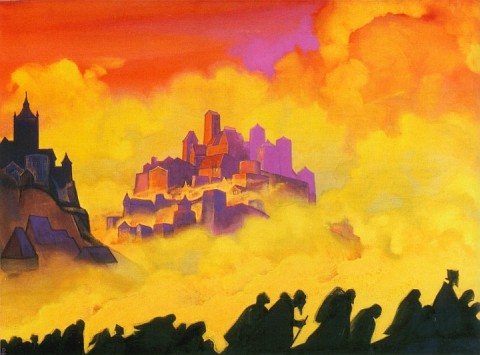
Nicholas Roerich, Armageddon (1935-36)

Revelation 18

1After this I saw another angel coming down from heaven, having great authority; and the earth was made bright with his splendor. 2 He called out with a mighty voice,

“Fallen, fallen is Babylon the great! It has become a dwelling place of demons, a haunt of every foul spirit, a haunt of every foul bird, a haunt of every foul and hateful beast. 3 For all the nations have drunk of the wine of the wrath of her fornication, and the kings of the earth have committed fornication with her, and the merchants of the earth have grown rich from the power of her luxury.”

4 Then I heard another voice from heaven saying,

“Come out of her, my people, so that you do not take part in her sins, and so that you do not share in her plagues; 5 for her sins are heaped high as heaven, and God has remembered her iniquities. 6 Render to her as she herself has rendered, and repay her double for her deeds; mix a double draught for her in the cup she mixed. 7 As she glorified herself and lived luxuriously, so give her a like measure of torment and grief. Since in her heart she says, ‘I rule as a queen; I am no widow, and I will never see grief,’ 8 therefore her plagues will come in a single day — pestilence and mourning and famine — and she will be burned with fire; for mighty is the Lord God who judges her.”

9 And the kings of the earth, who committed fornication and lived in luxury with her, will weep and wail over her when they see the smoke of her burning; 10 they will stand far off, in fear of her torment, and say,

“Alas, alas, the great city, Babylon, the mighty city! For in one hour your judgment has come.”

11 And the merchants of the earth weep and mourn for her, since no one buys their cargo anymore, 12 cargo of gold, silver, jewels and pearls, fine linen, purple, silk and scarlet, all kinds of scented wood, all articles of ivory, all articles of costly wood, bronze, iron, and marble, 13 cinnamon, spice, incense, myrrh, frankincense, wine, olive oil, choice flour and wheat, cattle and sheep, horses and chariots, slaves — and human lives.

14 “The fruit for which your soul longed has gone from you, and all your dainties and your splendor are lost to you, never to be found again!”

15 The merchants of these wares, who gained wealth from her, will stand far off, in fear of her torment, weeping and mourning aloud,

16 “Alas, alas, the great city, clothed in fine linen, in purple and scarlet, adorned with gold, with jewels, and with pearls! 17 For in one hour all this wealth has been laid waste!”

And all shipmasters and seafarers, sailors and all whose trade is on the sea, stood far off 18 and cried out as they saw the smoke of her burning,

“What city was like the great city?”

19 And they threw dust on their heads, as they wept and mourned, crying out,

“Alas, alas, the great city, where all who had ships at sea grew rich by her wealth! For in one hour she has been laid waste.”

20 Rejoice over her, O heaven, you saints and apostles and prophets! For God has given judgment for you against her.

21 Then a mighty angel took up a stone like a great millstone and threw it into the sea, saying, “With such violence Babylon the great city will be thrown down, and will be found no more;22 and the sound of harpists and minstrels and of flutists and trumpeters will be heard in you no more; and an artisan of any trade will be found in you no more; and the sound of the millstone will be heard in you no more; 23 and the light of a lamp will shine in you no more; and the voice of bridegroom and bride will be heard in you no more; for your merchants were the magnates of the earth, and all nations were deceived by your sorcery. 24 And in you was found the blood of prophets and of saints, and of all who have been slaughtered on earth.”

What is good news for some may be a tragedy for others. What for the recipients of Revelation would be view as God’s action to finally set them free and to set the world right; but would be viewed by those who benefited from their position in the empire as their world being turned upside down. The story of Exodus was good news for the Hebrew people and not for the Egyptians, and with the Exodus story being the defining story of the Jewish people they viewed the Lord their God with the expectation of a God who does see, does act, and does at times turn the world upside down. This expectation carries over into the beginning of Christianity where the expectation of God’s action would change fundamentally the relationships between the people of the world. Luke’s gospel reminds us of this in the beginning of the gospel with the song of Mary, commonly called the Magnificat,

He (the Lord) has shown the strength of his arm; he has scattered the proud in the thoughts of their hearts. He has brought down the powerful from their thrones, and lifted up the lowly; he has filled the hungry with good things, and sent the rich away empty. He has helped his servant Israel, in remembrance of his mercy, according to the promise he made to our ancestors, to Abraham and his descendants forever.  Luke 1: 51-55

For those saints who have suffered exclusion, persecution and even death at the hands of the empire the fall of Babylon is God giving justice to the world. The empire of Babylon (referring to the Roman empire) and the great city (Rome) had forged their empire through bloodshed and now they are given blood to drink. The language here echoes the wounded language lashing out from the pain of exile in Jeremiah 50-51 proclaiming a judgment against Babylon. Like Babylon in Jeremiah 50:39-40, now Rome becomes a place where only foul beast and birds reside amid the devastation. Like Babylon in Jeremiah 51: 7, now Rome has made all the nations drunk on her promises and splendor. In a strong echo of these chapters at the end of Jeremiah the people are commanded to come out of Babylon (Rome) so not to share her punishment. (see Jeremiah 51:6) Like the people of Judah during the Babylonian Exile, (587-538 BCE) the early Christians in the late first century felt powerless before the Roman empire. Yet, these early Christians believed in a Lord who would judge the unfaithfulness of their oppressors and that their world was about to turn. In the words of Rory Cooney’s interpretation of Mary’s Magnificat titled the ‘Canticle of the Turning,’

(Verse 3) From the halls of pow’r to the fortress tow’r, not a stone shall be left on stone. Let the king beware for you justice tears ev’ry tyrant from his throne. The hungry poor shall weep no more for the food they can never earn; there are tables spread, ev’ry mouth be fed, for the world is about to turn.

(Refrain) My heart shall sing of the day you bring. Let the fire of your justice burn. Wipe away all tears, for the dawn draws near, and the world is about to turn.

(Verse 4) Though the nations rage from age to age, we remember who holds us fast: God’s mercy must deliver us from the conqueror’s crushing grasp. This saving word that our forebears heard is the promise that holds us bound, till the spear and rod can be crushed by God, who is turning the world around.

For another perspective to understand what is happening here comes from the dystopian fiction series of novels, The Hunger Games by Suzanne Collins. In this fictional dystopic future, the United States is replaced by a set of districts held under the military oppression of a capitol district. All the resources of the districts stream into the capitol district making its residents wealthy at the expense of the residents of the rest of the districts who live in enforced service and struggle to survive. John’s portrayal of Rome in Revelation is similar to this, where the wealth of the empire is concentrated in the great city. The kings of the earth have benefited from their alliance with Rome and the merchants, sailors and seafarers who brought in their cargo from across the empire mourn at the loss of their trading partner. As Christopher Rowland can state,

the wealth of Babylon has been gained at the expense of millions. Luxury items here gravitate to the center to supply an insatiable need….The beauty, sophistication, and splendor of its culture, arts, social life, and technology may be great, but it is in a condition of death…Babylon and the kings and the mighty have committed fornication; great lengths have been taken in order to achieve wealth, status and power. (NIB XII: 696)
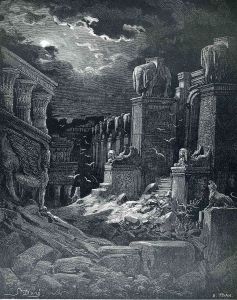
Gustave Dore, Babylon Fallen (1866)

To many within the empire they may not have seen the cost of their affluence, but within the worldview of Revelation the trade and accumulation of wealth are seen theologically as being intimately related to the promises, actions and beliefs of the Roman empire and its worship of the emperor. The imagery of the previous chapter portrays Rome as a harlot shamelessly flaunting its wealth and splendor to attract her suitors and even some early Christians would find the alluring possibilities of wealth and power a strong draw to compromise and participate in some of the public acts of religious patriotism expected in the cities and the trade associations.

For the early Christians the worship of the emperor as divine in combination with the plethora of religious options present in most Roman cities was viewed as idolatry. The people of the empire attributed to the Roman emperor and the various deities worshipped throughout the empire things that only come for the Lord. But within the lament of the merchants we see another way in which the commercial enterprise of bringing the riches of the empire may have been seen as idolatry as well. To illustrate this, it is helpful to lay the things highlighted in verses 11-13 next to the offering for the tabernacle in Exodus 25: 3-7:

This is the offering that you shall receive from them: gold, silver, and bronze, blue, purple and crimson yarns and fine linen, goats’ hair, tanned rams’ skins, fine leather, acacia wood, oil for the lamps, spices for the anointing oil and for fragrant incense, onyx stones and gems to be set in the ephod and for the breastpiece. Exodus 25: 3-7

cargo of gold, silver, jewels and pearls, fine linen, purple, silk and scarlet, all kinds of scented wood, all articles of ivory, all articles of costly wood, bronze, iron and marble, cinnamon, spice, incense, myrrh, frankincense, wine, olive oil, choice four and wheat, cattle and sheep, horses and chariots, slaves—and human lives. Revelation 18:12-13

The things, with a few exceptions, are the things that are parallel to what God commanded to be used for the building of the Tabernacle, or for the practice of sacrifice that took place in the Tabernacle or Temple. The exceptions come at the end of the list in Revelation: horses and chariots, slaves—and human lives. This points to the false nature of the Roman promises for what is brought in is the sources of, in their day, military power, economic power and fear. From a Jewish perspective the law placed a limit on royal authority in accumulating this type of military power:

Even so, he (the king) must not acquire many horses for himself, or return to Egypt in order to acquire many horses, since the LORD has said to you, “You must never return that way again.” Deuteronomy 17: 16

The slave ownership in the Roman empire was a sign or wealth and prestige even if the slave trade and slave traders were viewed with ambivalence. Some slave traders kidnapped people, others would traffic in the people conquered by the Roman military expansion. The manner of slavery would vary from young women and men sold into sexual slavery, to those who would be used as laborers, or some may find work as household slaves or managers. What Revelation wants us to understand is that the slave trade traffics in human lives, that they are selling ‘souls.’ In addition to the slave trade the human lives may also refer to entertainment of gladiatorial games and other events of brutal entertainments that were a part of the Roman world. Like the fictional analogy of the Hunger Games, the author of Revelation wants us to see behind the glamour of Rome to those who have suffered for its opulence. As Craig Koester can state, referencing the grave stele of a first century slave trader:

The text (Revelation)—like the grave stele—shows that the luxury of the few (Rev. 18:3) comes from the enslavement of the many (18:13). By analogy, readers are not to be beguiled by the empire’s promises of wealth. Instead, they must ask who has paid the cost. (Koester, 2014, p. 722)

As we conclude this chapter we here the funeral dirge of the people mourning the collapse of Rome as symbolically an angel throws a millstone into the sea to demonstrate the suddenness of Rome’s impending collapse. For the kings of the earth, the merchants and seafarers this is an image of great sadness and economic loss. Yet, for the community of the faithful who have been among those who have paid the cost of the empire’s promise of wealth we are about to hear their song of victory. Much like the story of the Exodus where the judgment of Egypt leads to the creation of the people of Israel and a new story for them. Here as God’s judgment comes upon the great city we see the beginning of God’s victory against the Beast, the great Dragon and all those forces that have oppressed and deceived God’s creation. We are nearing the end of this long journey and the fires of God’s justice are burning. For these early followers of Jesus the song has begun as their tears will soon be wiped away, for the dawn draws near and God is about to make the world turn.
Revelation 17 Unmasking Babylon

Revelation 17

1 Then one of the seven angels who had the seven bowls came and said to me, “Come, I will show you the judgment of the great whore who is seated on many waters, 2 with whom the kings of the earth have committed fornication, and with the wine of whose fornication the inhabitants of the earth have become drunk.” 3 So he carried me away in the spirit into a wilderness, and I saw a woman sitting on a scarlet beast that was full of blasphemous names, and it had seven heads and ten horns. 4 The woman was clothed in purple and scarlet, and adorned with gold and jewels and pearls, holding in her hand a golden cup full of abominations and the impurities of her fornication; 5 and on her forehead was written a name, a mystery: “Babylon the great, mother of whores and of earth’s abominations.” 6 And I saw that the woman was drunk with the blood of the saints and the blood of the witnesses to Jesus.

When I saw her, I was greatly amazed. 7 But the angel said to me, “Why are you so amazed? I will tell you the mystery of the woman, and of the beast with seven heads and ten horns that carries her. 8 The beast that you saw was, and is not, and is about to ascend from the bottomless pit and go to destruction. And the inhabitants of the earth, whose names have not been written in the book of life from the foundation of the world, will be amazed when they see the beast, because it was and is not and is to come.

9 “This calls for a mind that has wisdom: the seven heads are seven mountains on which the woman is seated; also, they are seven kings, 10 of whom five have fallen, one is living, and the other has not yet come; and when he comes, he must remain only a little while. 11 As for the beast that was and is not, it is an eighth but it belongs to the seven, and it goes to destruction. 12 And the ten horns that you saw are ten kings who have not yet received a kingdom, but they are to receive authority as kings for one hour, together with the beast. 13 These are united in yielding their power and authority to the beast; 14 they will make war on the Lamb, and the Lamb will conquer them, for he is Lord of lords and King of kings, and those with him are called and chosen and faithful.”

15 And he said to me, “The waters that you saw, where the whore is seated, are peoples and multitudes and nations and languages. 16 And the ten horns that you saw, they and the beast will hate the whore; they will make her desolate and naked; they will devour her flesh and burn her up with fire. 17 For God has put it into their hearts to carry out his purpose by agreeing to give their kingdom to the beast, until the words of God will be fulfilled. 18 The woman you saw is the great city that rules over the kings of the earth.”

The language here is potent, and the subject matter below may be difficult for some readers, particularly those who would be triggered by imagery of sexual violence and the metaphorical use the word whore. Rhetorically this is a powerful use of satire to subvert many of the images of strength and piety that were a part of the portrayed identity of Rome. Interpreters across the generations have used this passage as a basis for satire in their own time. For example, Lucas Cranach the Elder in his initial edition of illustrations for Revelation portrayed the woman on the beast wearing a papal tiara, which visually reinforced that for many followers of Luther in their time they viewed the pope and the Roman catholic church as a reading of the text for their time. In later editions Cranach would modify the woodcut to have a simpler crown and a less political reading. Even though the initial readers of Revelation would have seen the imagery pointing satirically to the Roman empire of their day instead of the Roman catholic church, the understanding of the satirical intent of the text has been consistent.

Lucas Cranach the Elder, The Whore of Babylon

The Roman empire portrayed itself as a virtuous, strong and benevolent empire. The peace of Rome, while it may have been a bloody peace as mentioned in earlier chapters, was enforced through the might of the legions, the alliance with local powers and in some cases the use of fear and terror to keep populations in line. The Romans did not invent crucifixion, for example, but they did perfect it as a tool to shame those who were crucified as they died a slow painful death exposed for the rest of the population to see. I have frequently heard people say that John in writing Revelation was encoding his message so that the Roman empire would not understand what he is saying but this is simply not true. To his readers the images he used would be as readable as most political cartoons in a newspaper would be today. For example, Rome was commonly known as a city on seven hills, or mountains, and by explaining the details of the seven heads being seven mountains and seven hills where the woman would be clear to any reader of the time who he was referring to. Especially when Roman coinage of the time portrays Rome the city as a goddess reclining upon the seven hills. The satire begins by taking the Roman image of their virtue and reversing it: Rome the goddess becomes instead personified as the whore dressed in opulence. As Craig Koester can state:

Such transparent allusion to Rome means that John does not use imagery to conceal his message but to reveal the opulence, arrogance, violence and idolatry of the world’s ruling power. (Koester, 2014, p. 690)

Auction coins from http://www.icollector.com showing a Sestertius from 69-70 with Vespasian on the front and the goddess Rome reclining on seven hills on the back

The emperor cult in the Roman empire was often embraced willingly by the people of the empire. Patrons would compete for the ability to dedicate a temple or a structure to the empire to show their loyalty and to curry favor. Since to many people the ruler cult was popular, even early Christians appeared to look for how they could participate in the economic and social benefits as we learned in the letters to the seven churches in Revelation two and three, and in the image the angel has to tell John not to be amazed by the portrayal of Rome. The people of Rome who actively participated in the emperor cult had either become numb to the violence of the empire, kept themselves distant from it or had become intoxicated with it themselves. John wants us to understand that the power behind Rome is not the God of Israel or any benevolent god, but instead by placing the woman on the beast we met in Revelation thirteen John wants his readers to understand that the empire is instead a beast created in the image of the great dragon, Satan, and a “demonic counterpart to the slain and living Lamb.” (Koester, 2014, p. 687)

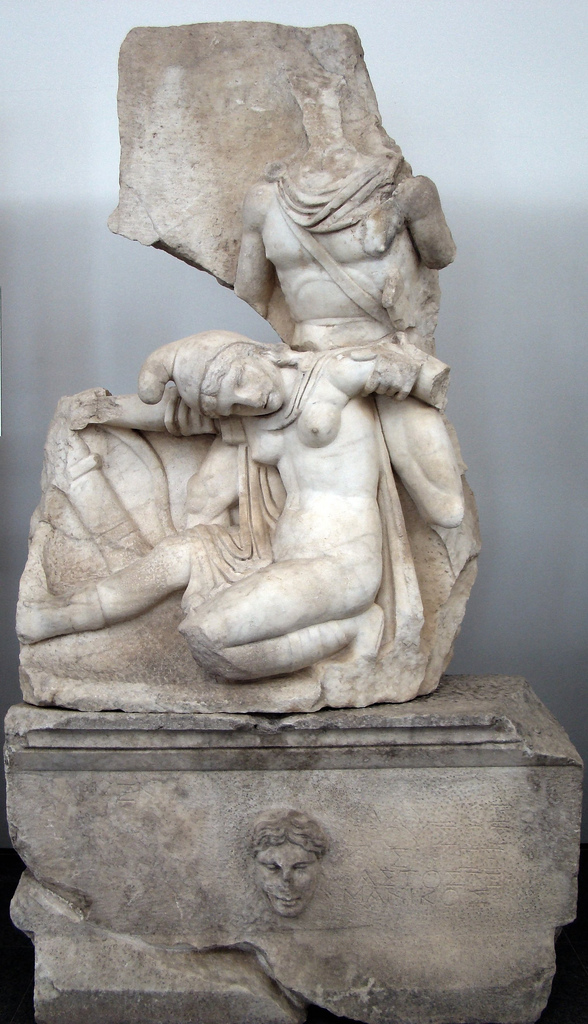
For all the Roman empire’s talk of piety, they had no trouble using images of women being abused or raped by the emperor in military garb as a metaphor for the military conquest of nations. For example, in the excavations at Aphrodisias we can see in two reliefs emperor Claudius conquering Britain and Nero conquering Armenia portrayed as a soldier who is overpowering a woman.

Emperor Claudius Portraying the Conquest of Brittanica in AD 43 as the Rape of a Woman from Aphrodisias Excavations Sebasteion South Building http://aphrodisias.classics.ox.ac.uk/sebasteionreliefs.html#prettyPhoto

Emperor Nero portrayed conquesting Armenia rom Aphrodisias Excavations Sebasteion South Building http://aphrodisias.classics.ox.ac.uk/sebasteionreliefs.html#prettyPhoto


The imagery of Rome as the conquering and overpowering essence of masculinity is now reversed as Rome becomes the prostitute who will be torn apart by the very ones that she has given her favors to. This imagery is similar to the end of Jeremiah four where the woman, representing Judah, prepares herself to receive lovers:

 30 And you, O desolate one, what do you mean that you dress in crimson,
that you deck yourself with ornaments of gold,
 that you enlarge your eyes with paint?
In vain you beautify yourself.
Your lovers despise you; they seek your life.
 31 For I heard a cry as of a woman in labor,
anguish as of one bringing forth her first child,
the cry of daughter Zion gasping for breath, stretching out her hands,
“Woe is me! I am fainting before killers!”

Much as the imagery of Rome the conqueror shows that conquering soldiers in this time did not pay for a prostitute but instead took women against their will, now Rome itself is torn apart by the very powers that once paid it homage and honor. Revelation understands that the forces aligned against God are indeed a house divided and they will devour one another even before Christ arrives. The violence that created the empire will become its undoing in John’s vision.


Revelation 16 The Final Cycle of Judgment

Ruins atop Tel Megiddo, Israel. The modern highway to Haifa is visible in the background. Photo by Joe Freeman, Shared under Creative Commons Attribution ShareAlike License 2.5

Revelation 16

1 Then I heard a loud voice from the temple telling the seven angels, “Go and pour out on the earth the seven bowls of the wrath of God.”

2 So the first angel went and poured his bowl on the earth, and a foul and painful sore came on those who had the mark of the beast and who worshiped its image.

3 The second angel poured his bowl into the sea, and it became like the blood of a corpse, and every living thing in the sea died.

4 The third angel poured his bowl into the rivers and the springs of water, and they became blood. 5 And I heard the angel of the waters say,

“You are just, O Holy One, who are and were, for you have judged these things;
6 because they shed the blood of saints and prophets, you have given them blood to drink.
It is what they deserve!”

 7 And I heard the altar respond, “Yes, O Lord God, the Almighty, your judgments are true and just!”

8 The fourth angel poured his bowl on the sun, and it was allowed to scorch them with fire; 9 they were scorched by the fierce heat, but they cursed the name of God, who had authority over these plagues, and they did not repent and give him glory.

10 The fifth angel poured his bowl on the throne of the beast, and its kingdom was plunged into darkness; people gnawed their tongues in agony, 11 and cursed the God of heaven because of their pains and sores, and they did not repent of their deeds.

12 The sixth angel poured his bowl on the great river Euphrates, and its water was dried up in order to prepare the way for the kings from the east. 13 And I saw three foul spirits like frogs coming from the mouth of the dragon, from the mouth of the beast, and from the mouth of the false prophet. 14 These are demonic spirits, performing signs, who go abroad to the kings of the whole world, to assemble them for battle on the great day of God the Almighty. 15 (“See, I am coming like a thief! Blessed is the one who stays awake and is clothed, not going about naked and exposed to shame.”) 16 And they assembled them at the place that in Hebrew is called Harmagedon.

17 The seventh angel poured his bowl into the air, and a loud voice came out of the temple, from the throne, saying, “It is done!” 18 And there came flashes of lightning, rumblings, peals of thunder, and a violent earthquake, such as had not occurred since people were upon the earth, so violent was that earthquake. 19 The great city was split into three parts, and the cities of the nations fell. God remembered great Babylon and gave her the wine-cup of the fury of his wrath. 20 And every island fled away, and no mountains were to be found; 21 and huge hailstones, each weighing about a hundred pounds, dropped from heaven on people, until they cursed God for the plague of the hail, so fearful was that plague.

The final cycle of judgments begins with the seven bowls held by the seven angels. There are many similarities in this scene with the seven seals in Revelation 6-8:4 and the seven trumpets in Revelation 8:5-11:13 which I explore in greater depth in the exploration of Revelation 6, but with this cycle there are several parallels with the signs and wonders, or plagues as they are commonly known, from Exodus 7-12. The Exodus is the defining narrative of the Hebrew people and one thing we have seen from Revelation is John’s deep familiarity with the Hebrew scriptures. As I mentioned when I wrote about the plagues in Exodus and as I have mentioned throughout this exploration of Revelation one of the often-unnoticed portions of these passages is the divine restraint that is exercised. Throughout Revelation there has been a desire for repentance, for those who have allied themselves with the forces opposed to God and creation to change their allegiance. Revelation operates under the prophetic hope that every knee will bow, and every tongue confess that God is the Lord and master of the earth. But here, echoing the language of Jesus with Nicodemus in the gospel of John we will find that ‘this is the judgment, that the light has come into the world, and people loved darkness rather than the light because their deeds were evil.” (John 3: 19)

The pouring of libations as an offering to a god was practiced by cultures throughout the Greco-Roman world including in Jewish worship at the temple, but here we see the practice inverted: instead of the faithful devotees of a deity pouring out wine or blood to appease a deity now it is the God of Israel who has the angels of God pour out the wine of God’s wrath upon God’s adversaries on earth. In chapter fourteen God trod the winepress of the harvested grapes and what came forth was blood, now we will see the harvest of the earth returned to the earth. The angel of the sea will proclaim that God is just for what God is doing, and those in the altar can also celebrate the long-awaited justice as the final bowls are poured and God’s judgment is finally ended.

The first bowl causes those who have the mark of the beast to have a painful sore. Much like the boils of Exodus 9: 8-12, the plague is painful but not fatal and still allows people a time to change their allegiance. There is time for repentance and in both Jewish and Greco-Roman cultures the expectation would be that plagues like the ones throughout this chapter would be divine judgment and the proper response would be to seek out how to reconcile oneself with the offended deity.  As Craig Koester can state about this first bowl:

Yet there is a divine restraint. Those who received the beast’s mark seemed to escape the threat of death under the beast, while those who refused the mark were to be killed (13:15). God’s plague is not a simple reversal of this practice. Painful though it is, the sore that God inflicts on the followers of the beast is less severe than the death that the beast inflicts upon the followers of the Lamb. (Koester, 2014, p. 654)

The second and third bowls cause the waters of the earth (first the sea and then the streams and springs) to become blood. There is a sense of justice that those who have poured out the blood of the saints and martyrs are now forced to drink blood from their own wells. Their own actions which forced the creation to drink up the blood of the fallen now sees the creation returning to the people the drink which the soil has drunk on the field of war or from sites of execution and coliseums throughout the empire. The Hebrew people often associated angels with being associated with elements like fire, water, thunder and here the angel of the water proclaims the justice of the command of God to cause bloody waves to come upon the shore and bloody rivers and springs to provide an additional sign of God’s judgment. Yet, even here there is not death. Much like the transformation of the Nile River to blood (Exodus 7: 14-25) there is a chance for life to continue and for repentance to occur. Yet, God has heard the suffering of God’s people and God is now judging those who have oppressed the people and the creation.

The fourth angel’s bowl being poured upon the sun does not have a parallel among the signs and wonders in Egypt, but it continues the use of the creation as an instrument of God’s judgment. Yet, even this fiery wrath does not bring about repentance, in fact it brings about the opposite. Those who remain aligned with the beast and with Satan will not change their allegiance at this point so instead of pleading for God’s forgiveness or mercy they curse God. Similarly, the darkness which plunges the empire of the beast into darkness may cause people to gnaw their tongues in agony (a phrase with a similar meaning to gnashing of teeth) and for a second time to curse God. In the signs and wonders in Egypt darkness was the penultimate sign and it showed the powerlessness of the Egyptian gods (particularly Ra) to oppose the Lord, the God of Israel (Exodus 10: 21-29). Here the beast and the forces of the beast are also powerless in comparison to God’s might.

Like Egypt gathering its forces for a decisive elimination of the people of God after the signs and wonders in the Exodus, the first six bowls cause the forces opposed to God to assemble for a final conflict. The drying up of the Euphrates can allow the people of God to remember how God would allow the people of God to pass through the Red Sea under Moses (Exodus 14), the Jordan River under Joshua, (Joshua 3), or how Elijah and Elisha could pass through the Jordan in 2 Kings 2. Another level of memory may associate the Euphrates with the Assyrian and Babylonian empires who conquered Israel and Judah respectively, since both empires were based along the Euphrates. Finally, the Euphrates formed a barrier between the Roman empire and the Parthians empire to the east. The kings from the east may refer to the fear that the Parthian empire would someday invade Rome, or it may refer to a tradition that emperor Nero would return with a large force from the Parthians were some believed he had fled to, or it could refer to the idea of a great gathering of the kings of the earth for a final war to end all wars against each other and the forces of God.

The frog like demonic spirits which come from the mouth of the dragon, the beast and false prophet and speak with their words to deceive in opposition to God. On the one hand, the frog like spirits link this passage with the frogs of Exodus 8:1-15 but these take a much more active role in the movement towards the final conflict. In Revelation they are the response of the adversaries of God in response to the judgment being poured out upon the kingdom of the beast. They rally those loyal to the beast to remain unified in their opposition to the reign of God. To the early Christians the military might of the empire must have seemed to be an indomitable force and yet, amid the assembling of military might we are reminded that Christ is coming at a time when we do not expect. Christ breaks in like a thief in the night and these followers of Christ are to remain faithful even when they may appear to be powerless.

Armageddon, or Harmegedon, most likely links the Hebrew word for hill or mountain (har) with Megiddo. Megiddo is located on the Jezreel plain on the route linking Egypt with Syria and is a place of several conflicts in the scriptures including Deborah’s victory over Sisera and the Canaanites (Judges 5: 19) and it is the region where King Ahaziah (2 Kings 2: 27) and King Josiah of Judah (23:29) die in battle.  The connection with Revelation, particularly by the spelling and content, is most likely Zechariah 12: 11 where God intervenes to provide victory against an enemy who is threatening the people of Judah:

On that day the mourning in Jerusalem will be as great as the mourning for Hadad-rimmon in the plains of Meggido.

As Zechariah continues to move towards its climax the nations will gather against Jerusalem and as half of the city is cut off God finally intervenes and goes forth to fight against the nations. John frequently joins multiple passages together in Revelation’s imagery and here the mountains probably come from the invasion of the forces of Gog and Magog, which will be referenced in Revelation 19.

Regardless of geography or scriptural references the progression of the narrative is easy to follow: in response to the actions of God in judgment the forces opposed to God’s reign unite in a common location for a final stand. The dragon, who was already thrown out of heaven in Revelation 12, and his allies prepare for a final act of defiance against God’s will.

With the final bowl poured out and the declaration of the completion of the cycle the earth and skies react in judgment against the city and the forces opposed to God. The metaphorical telling of the judgment of Babylon (Rome) will continue in Revelation 17-18, but here in a hailstorm far more violent than the lethal thunder and hail of Exodus 9: 13-35 and an earthquake unlike any the world had recorded the power of God’s among the creation is unleashed and the great city along with the cities of the nations fell. The disasters in the vision would be rightly called ‘acts of God’ showing God’s judgment upon those who continue to hold to the dragon and the beasts in their allegiance. Yet, unlike Pharaoh who can declare after the hailstones, “This time I have sinned; the LORD is right, and I and my people are in the wrong.” (Exodus 9: 27), the people who have received the mark of the beast curse (literally blaspheme) God for a third time in the chapter. With the nations assembled for war the time of waiting is finally ended. Those who still resist the oncoming reign of God now have come to the end of God’s restraint. It is a time of great reversals, which reminds me of the language of the extended judgment of Babylon in Jeremiah 50-51, particularly:

Flee from the midst of Babylon, save your lives, each of you!
Do not perish because of her guilt, for this is the time of the LORD’s vengeance;
he is repaying her what is due.
Babylon was a golden cup in the LORD’s hand, making all the earth drunken;
the nations drank of her wine, and so the nations went mad. Jeremiah 51: 6-7

Now Babylon, the beast, the dragon and all the other forces opposed to God have gone mad and now they must drink the cup of God’s fury, the justice of the slain. In the following two chapters as Babylon falls and the princes and merchants mourn for her they will, in the language of Jeremiah 51: 8-9 find that there is no balm that can heal the fallen city. The cry for her judgment has reached the ears of God, the harvest of their actions has been turned into the bloody waters they drink, and their opposition to God is leading them to their destruction.

Revelation 15 A Song Before the Wrath

York Minster, Great East Window, 4a, The Plague Angels and the Harpers (1405-1408)

Revelation 15

1 Then I saw another portent in heaven, great and amazing: seven angels with seven plagues, which are the last, for with them the wrath of God is ended.

2 And I saw what appeared to be a sea of glass mixed with fire, and those who had conquered the beast and its image and the number of its name, standing beside the sea of glass with harps of God in their hands. 3 And they sing the song of Moses, the servant of God, and the song of the Lamb:

“Great and amazing are your deeds, Lord God the Almighty!
 Just and true are your ways, King of the nations!
4 Lord, who will not fear and glorify your name? For you alone are holy.
All nations will come and worship before you, for your judgments have been revealed.”

5 After this I looked, and the temple of the tent of witness in heaven was opened, 6 and out of the temple came the seven angels with the seven plagues, robed in pure bright linen, with golden sashes across their chests. 7 Then one of the four living creatures gave the seven angels seven golden bowls full of the wrath of God, who lives forever and ever; 8 and the temple was filled with smoke from the glory of God and from his power, and no one could enter the temple until the seven plagues of the seven angels were ended.

Chapter fifteen provides a transition into the final cycle of plagues and a metaphorical telling of the collapse of the forces opposed to God’s will. The seven angels with the seven bowls should remind us of the seven angels with the seven trumpets in Revelation 8:6-11:13 and the seven seals in Revelation 6:1-8:5. Since the seven bowls are actually poured out in the following chapter I’ll look at the parallels between the bowls, trumpets and seals as well as the similarities with the plagues in Exodus at that point. For this brief chapter I’ll focus on this brief pause to worship prior to the unveiling of the judgment of God upon the earth.

Throughout Revelation there is this pause and restraint that interrupts the descent into judgment. While these portions of Revelation may not occupy the imaginative space of the horsemen of the apocalypse, the great dragon, the beasts and the numerous other images of the book of Revelation they are important to the rhythm and understanding of the book. Amid all the chaos that appears to be unleashed upon the earth they are continual reminders to the faithful that God is in control and that their faithful witness is how they will conquer the seemingly unconquerable forces that are arrayed against them. They will stand with Moses and the faithful of all ages proclaiming the praise of God and the Lamb.

The sea of glass follows the image of the rivers of blood up to the horse’s bridle, and as the faithful gather to sing the song of Moses and the song of the Lamb we are reminded of when Moses and Miriam and the people of God sang on the far side of the Red Sea as Pharaoh and his armies were submerged in the sea in Exodus 14. The song which the faithful sing is not the song of Moses, recorded in Exodus 15, even though it reflects some similar themes but instead the song of Moses and Lamb. The Lamb is joined to the messenger of God who told the people how to celebrate the first Passover. In the story of Exodus there is an extended pause for worship and ritual prior to the final judgment on Egypt. Here the faithful gather around the glass sea to sing songs of praise before the seven golden bowls are distributed.

The song reflects the most hopeful vision of the prophets where all nations will come and worship before God. Texts like Isaiah 2: 2-4, Isaiah 66: 23, Jeremiah 16:19 and Zechariah 8:22 all point hopefully to the time when all the earth realizes the Lordship of the Creator. A time when no one worships the beast or the dragon or any other idol, but all can realize that God alone is holy.

In Revelation 8: 3-5 the prayers of the saints are offered up with incense to God and earlier in Revelation 6:9-11 when the fifth seal was opened the martyrs had cried out “how long will it be before you judge the earth.” God sees, hears and now responds to this earlier offering. God’s wrath at those who have oppressed not only God’s people, but God’s creation will no longer be contained. Earlier the prayers of the faithful were offered on the altar, now from the temple come the seven bowls filled with God’s wrath.

The language of the temple of the tent of witnesses also harkens back to the tabernacle created for the journey through the wilderness. While earlier we have heard the temple referenced we now are referred to the central portion of a heavenly tabernacle. The tabernacle was built on a model given to Moses in the book of Exodus and many Jewish people believed it was an earthly model of God’s heavenly temple. Yet it is also the place of worship for a people and a God on the move and as the movement of Revelation continues we will see that God is on the move to have God’s kingdom dwell on earth. The tabernacle on earth and the tabernacle in heaven are temporary structures to serve until the time when there is no longer a need for a temple in the city of God for God dwells in the midst of the city.


Revelation 14 The Harvest of God

Wine Press in Shivta, photo by Avishai Teicher file licensed under Creative Commons Attribution 2.5

 Revelation 14

1 Then I looked, and there was the Lamb, standing on Mount Zion! And with him were one hundred forty-four thousand who had his name and his Father’s name written on their foreheads. 2 And I heard a voice from heaven like the sound of many waters and like the sound of loud thunder; the voice I heard was like the sound of harpists playing on their harps, 3 and they sing a new song before the throne and before the four living creatures and before the elders. No one could learn that song except the one hundred forty-four thousand who have been redeemed from the earth. 4 It is these who have not defiled themselves with women, for they are virgins; these follow the Lamb wherever he goes. They have been redeemed from humankind as first fruits for God and the Lamb, 5 and in their mouth no lie was found; they are blameless.

6 Then I saw another angel flying in midheaven, with an eternal gospel to proclaim to those who live on the earth — to every nation and tribe and language and people. 7 He said in a loud voice, “Fear God and give him glory, for the hour of his judgment has come; and worship him who made heaven and earth, the sea and the springs of water.”

8 Then another angel, a second, followed, saying, “Fallen, fallen is Babylon the great! She has made all nations drink of the wine of the wrath of her fornication.”

9 Then another angel, a third, followed them, crying with a loud voice, “Those who worship the beast and its image, and receive a mark on their foreheads or on their hands, 10 they will also drink the wine of God’s wrath, poured unmixed into the cup of his anger, and they will be tormented with fire and sulfur in the presence of the holy angels and in the presence of the Lamb. 11 And the smoke of their torment goes up forever and ever. There is no rest day or night for those who worship the beast and its image and for anyone who receives the mark of its name.”

12 Here is a call for the endurance of the saints, those who keep the commandments of God and hold fast to the faith of Jesus.

13 And I heard a voice from heaven saying, “Write this: Blessed are the dead who from now on die in the Lord.” “Yes,” says the Spirit, “they will rest from their labors, for their deeds follow them.”

14 Then I looked, and there was a white cloud, and seated on the cloud was one like the Son of Man, with a golden crown on his head, and a sharp sickle in his hand! 15 Another angel came out of the temple, calling with a loud voice to the one who sat on the cloud, “Use your sickle and reap, for the hour to reap has come, because the harvest of the earth is fully ripe.” 16 So the one who sat on the cloud swung his sickle over the earth, and the earth was reaped.

17 Then another angel came out of the temple in heaven, and he too had a sharp sickle. 18 Then another angel came out from the altar, the angel who has authority over fire, and he called with a loud voice to him who had the sharp sickle, “Use your sharp sickle and gather the clusters of the vine of the earth, for its grapes are ripe.” 19 So the angel swung his sickle over the earth and gathered the vintage of the earth, and he threw it into the great wine press of the wrath of God. 20 And the wine press was trodden outside the city, and blood flowed from the wine press, as high as a horse’s bridle, for a distance of about two hundred miles.

The triumphant tone of this chapter can be both jubilant and unsettling. For those who have undergone suffering and who are awaiting God’s decisive action they perhaps hear the distant refrain of the new song of the 144,000 proclaiming the victory of the lamb and an end to their tribulations. Yet, the image of a bloody harvest and the trampling of the great wine press of the wrath of God highlights the destructive power of God. The chapter has a militant tone which echoes in the lyrics of Julia Ward Howe’s “Battle Hymn of the Republic”

Mine eyes have seen the glory of the coming of the Lord
He is trampling out the vintage where the grapes of wrath are stored
He hath loosed the faithful lightning of his terrible swift sword
His truth is marching on

There are a number of contrasts between this vision and the vision that immediately precedes it in Revelation 13: while the dragon may stand upon the seashore the lamb stands upon the high ground of Mount Zion; while those who worshipped the beast were marked with its number the followers of the lamb bear the name of God upon their foreheads; the previous chapter showed the social cost of not conforming to the demands of the beast (or the empire) while here conformity’s cost is revealed as drinking the undiluted wine of God’s wrath. The chapter also looks forward to remaining chapters of Revelation and tells through one set of images the judgment of Babylon (Rome) what will be developed in two additional sets of images in chapters 15-16 and chapters 17-18 respectively. Much like the dragon’s defeat in heaven foreshadows the final defeat in Revelation 20, here Rome’s derivative rule will be announced here but told through the story of the harlot and the beast in Revelation 17-18. For those who have waited for God’s action the time of their waiting has ended and the time open to the possibility of repentance is quickly closing as well.

The one hundred and forty-four thousand, introduced in chapter seven, are reintroduced here. The number is a number of completeness, twelve times twelve thousand, where every tribe of Israel is sealed. They are purchased or redeemed out of humanity as a first fruit of the larger harvest that is expected and which will happen metaphorically below. As chapter seven remined us they will eventually be a part of the multitude beyond counting of every language, tribe, nation and people. These one hundred forty-four thousand are described as male virgins who have no family commitments and are free to follow the lamb wherever he goes. The old nursery song is now reversed where instead of Mary having a little lamb who follows wherever she goes the Lamb of God has these men who follow it regardless of where it goes. The virginity of these first fruits of humankind may be literal representing people unencumbered by familial ties but it also may be metaphorical referring to those who have not compromised their relationship with God or indulged in practices which Revelation views as immoral. There is a parallel with how Jeremiah uses bridal imagery for Israel in Jeremiah 2: 2-3

Go and proclaim in the hearing of Jerusalem, “Thus says the LORD: I remember the devotion of your youth, your love as a bride, how you followed me in the wilderness, in a land not sown. Israel was holy to the LORD, the first fruit of his harvest. All who ate of it were held guilty; disaster came upon them.

The figures of the one hundred forty-four thousand as chaste males also contrasts them strongly with not only those who have compromised in their faith but also sets them diametrically against the way Revelation views Rome (Babylon). Now in a striking use of language reminiscent of Jeremiah 2, the one hundred forty-four thousand represent an Israel that has remained faithful and now instead of Israel ‘playing the whore’ it is Rome (Babylon) who has made the nations drink the ‘wine of her fornication.’ This also contrasts with the public image that post-Augustan Rome tried to craft for itself being a nation of piety and law. Revelation continues to unmask the true character of Rome from the perspective of the early followers of Christ.

Three angels come announcing an eternal gospel. While many people are used to the word gospel being used to describe books out of the bible or its typical English translation of ‘good news’ the Greek word euangellion which we translate as gospel typically in Roman culture a ‘gospel’ is a proclamation on behalf of the emperor. There were gospels proclaiming the celebration of a victory (proclaiming to a people conquered their liberation by the forces of Imperial Rome) or to celebrate a birth or birthday or assumption of power related to the emperor. The language of the early Christians is full of political implications but they are people whose allegiance is to Christ, which means Messiah or King, and not to Caesar. The gospel proclaimed here is truly good news for those whose allegiance has been to Christ and who have resisted accommodating to the ways of the empire, but for those whose allegiance rests with the beasts, wittingly or unwittingly, it is the announcement of judgment. The purpose of Revelation is to encourage those who are among the faithful to continue in their perseverance even in the midst of persecution and to trust that the time of God’s action is approaching. Here the faithful have their reward and rest announced while those who have allowed the beast to have their allegiance and worship must drink the cup that has been prepared for them.

Talking about the judgment of God or the wrath of God has become unpopular in many churches and yet it is an essential, if uncomfortable, thing for Christians and the church to wrestle with unless we also want to, often unwittingly and unthinkingly, proclaim a God who either is unable to help people in the midst of their struggles or who always stands on the side of the oppressor. Christianity and Judaism before it has always believed that God takes sides, that God acts, and that God expects certain things from those who become covenant partners with God. For me one of the passages that reoriented how I think about Revelation comes from Miroslav Volf’s Exclusion and Embrace

Most people who insist on God’s “nonviolence” cannot resist using violence themselves (or tacitly sanctioning its use by others). They deem the talk of God’s judgment irreverent, but think nothing of entrusting judgment into human hands, persuaded presumably that this is less dangerous and more humane than to believe in a God who judges! That we should bring “down the powerful from their thrones” (Luke 1: 51-52) seems responsible; the God should do the same, as the song of that revolutionary Virgin explicitly states, seems crude. And so, violence thrives, secretly nourished by belief in a God who refuses to wield the sword.

My thesis that the practice of nonviolence requires a belief in divine vengeance will be unpopular with many Christians, especially theologians in the West. To the person who is inclined to dismiss it, I suggest imagining that you are delivering a lecture in a war zone (which is where a paper that underlies this chapter was originally delivered). Among your listeners are people whose cities and villages have been first plundered, then burned and leveled to the ground, whose daughters and sisters have been raped, whose fathers and brothers have had their throats slit. The topic of the lecture: a Christian attitude toward violence. The thesis: we should not retaliate since God is perfect noncoercive love. Soon you would discover it takes the quiet suburban home for the birth of the thesis that human nonviolence corresponds to God’s refusal to judge. In a scorched land, soaked in the blood of the innocent, it will invariably die. And as one watches it die, one will do well to reflect about many other pleasant captivities of the liberal mind. (Volf, 1996, pp. 303-304)

The harvest image that concludes this chapter and foreshadows the narrative of the coming chapters. The first harvest can be read as either a positive or negative image. On the positive side the harvest of wheat, barley and other grains, which were typically harvested by the sickle, indicate the end of the growing season and the gathering of the long-awaited harvest into the barns. There is no indication of the sifting of the wheat away from the tares, only the ingathering of the grain. However, the two harvests can be read together as a common bloody harvest. The images do pair the Son of Man image from Daniel 7:13 with the language of the harvest of grain and the winepress in Joel 3: 13:

Put in the sickle, for the harvest is ripe. Go in, tread, for the wine press is full.
 The vats overflow, for their wickedness is great.

Yet, I do read the first harvest as a positive image. The first reaping brings together the harvest from across the earth. The second reaping comes from the temple, which in the next chapters will be a place where judgment will come from. Although grapes are not typically harvested with a sickle, Revelation continues the metaphor to describe the harvest of the vintage of the earth. The image ends with the winepress of the wrath of God and blood flowing for two hundred miles to the depth of a horse’s bridle. On first reading it is easy to think of the God who treads this winepress as a blood thirsty God and more like the beasts than the Lamb, and while those who have undergone oppression may want to see the blood of those who shed their blood I don’t believe that vengeance is the primary function of this image, instead it is unveiling the way things are. The image of God treading the winepress echoes the beginning of Isaiah 63: 1-6

“Who is this that comes from Edom, from Bozrah in garments stained crimson?
Who is this so splendidly robed marching in his great might?”
“It is I, announcing vindication, mighty to save.:
“Why are your robes red, and your garments like theirs who tread the wine press?”
“I have trodden the wine press alone, and from the peoples no one was with me;
I trod them in anger and trampled them in wrath; their juice spattered on my garments,and stained all my robes.
For the day of vengeance was in my heart, and the year for my redeeming work had come.
I looked and there was no helper; I stared, but there was no one to sustain me;
so my own arm brought me victory, and my wrath sustained me.
I trampled down peoples in my anger, I crushed them in my wrath,
and I poured out their lifeblood on the earth

As violent as this passage is, I always imagine tears in the eyes of the personified figure of the LORD treading the wine press alone, abandoned by the world. Anger and grief are frequently close cousins and the prophets often portray an image of a grieving and wounded God seeing the state of the world or the people of God and desiring a solution. I also think it is important to pay attention to the construction of the metaphor. Ultimately, I believe this passage, like several other places in Revelation are not about prophesying some horrific scene of judgement but rather about revealing the reality of the bloodshed already present in the world. God does not transform the juice of the grapes into something it was not but rather in the press shows what the harvest of the world is in contrast to the harvest of Christ that has been brought into the barns.   As Craig Koester can insightfully state:

This scene, as in 19: 11-21, envisions an end to the injustice that has plagued the world (cf. sec. 39 COMMENT). The river of blood, which flows as high as horse’s bridle, show the magnitude of the violence that has been done on earth (14:20). It reveals why divine justice cannot be delayed indefinitely. As Christ tramples the grapes, the amount of blood that is squeezed out shows how full of brutality the world has become. From this perspective the question is not, “Why is God’s judgment so severe?” Rather, if one sees the earth as a vineyard already filled with blood, the question is like that of the martyrs: “Why has God not judged the wicked sooner?” (6:10) (Koester, 2014, pp. 630-631)

God may have desired a different harvest from the vineyard than the bloody one which was reaped, God may have desired not to tread the winepress alone and yet, the bloodshed of the earth was present even when it was not unveiled. The cry of the martyrs, “How long, O Lord” has remained unanswered until this point in Revelation. From this chapter onward the answer of the Lord is, “I will wait no longer, the time of harvest has come.” And the eyes of those watching will see the glory and the terror of the coming of the Lord, for the glory of God reveals and confronts the terror of the way things are on the earth and will soon put an end to those who have used their power to oppress and destroy the earth.

Revelation 13 Rome Portrayed as a Beast

Emperor Claudius Portraying the Conquest of Brittanica in AD 43 as the Rape of a Woman from Aphrodisias Excavations Sebasteion South Building http://aphrodisias.classics.ox.ac.uk/sebasteionreliefs.html#prettyPhoto

 Revelation 13: 1-10 The Beast from the Sea

1 And I saw a beast rising out of the sea, having ten horns and seven heads; and on its horns were ten diadems, and on its heads were blasphemous names. 2 And the beast that I saw was like a leopard, its feet were like a bear’s, and its mouth was like a lion’s mouth. And the dragon gave it his power and his throne and great authority. 3 One of its heads seemed to have received a death-blow, but its mortal wound had been healed. In amazement the whole earth followed the beast. 4 They worshiped the dragon, for he had given his authority to the beast, and they worshiped the beast, saying, “Who is like the beast, and who can fight against it?”

5 The beast was given a mouth uttering haughty and blasphemous words, and it was allowed to exercise authority for forty-two months. 6 It opened its mouth to utter blasphemies against God, blaspheming his name and his dwelling, that is, those who dwell in heaven. 7 Also it was allowed to make war on the saints and to conquer them. It was given authority over every tribe and people and language and nation, 8 and all the inhabitants of the earth will worship it, everyone whose name has not been written from the foundation of the world in the book of life of the Lamb that was slaughtered.

9 Let anyone who has an ear listen:
10 If you are to be taken captive, into captivity you go;
if you kill with the sword, with the sword you must be killed.
Here is a call for the endurance and faith of the saints.

The scene begins at the conclusion of Revelation 12 where the dragon stands upon the shore of the sea and then we enter our chapter with the first beast arising out of the sea, the second member of an unholy trinity opposed to the will of the Creator and an agent of the destruction of creation. These scenes are meant to be an unmasking of the powers, to use the title of Walter Wink’s book, but for many people unfamiliar with the rich tapestry of interweaving echoes and allusions present the beasts become an obfuscation of a simple message in John’s time: Rome’s power is not benevolent or divinely bestowed but rather is demonic and derives from the power of the devil. This is where there is a prophetic bite to the words of Revelation and where it becomes undeniably a reference to the Roman empire that seven churches in Asia found themselves living within. In contrast to the imperial claims of piety and security John uses metaphor to parody the seemingly unstoppable power of Roman might by proclaiming it is a savage beast subservient to the dragon who is the Devil and Satan.

From the Roman side the beast in particular embodies many traits that allude to Rome generally and to Emperor Nero (who will appear frequently in the explanations of this and coming chapters) in particular. John writes in the time after Nero’s death, but for the message John writes in Revelation Nero is the embodiment of the true character of the empire. In addition to the seven heads (which alludes to the seven hills around Rome and seven emperors) and the ten crowns (although emperors did not wear crowns the kings that ruled provinces on behalf of the Roman empire often did) as a representation of the empire (see also Revelation 17: 9-13) it is also helpful to know that the Jewish word for the Romans, the Kittim, also refers to people who come from the sea. The Kittim as they are mentioned in the book of Jeremiah (Jeremiah 2:10) and Ezekiel 27:6 are the people of Cypress, an island people who came across the sea but by the time of the New Testament the Kittim is a way of referring to the Romans. The head who received the death wound is almost certainly a reference to Nero who either committed suicide or was killed by a knife to the throat but rumors would persist of his remaining alive because few had seen his body.

Even some Greco-Roman authors could refer to Nero’s reign as that of a beast as Craig R. Koester can illustrate by quoting Philostratus saying,

“as for this beast, generally called tyrant, I have no idea how many heads it has,” but “its nature is wilder than the beasts of the mountains or forests” because “this beast is incited by those who stroke it” so that flattery makes it even more savage. (Vit. Apoll. 4.38.3; cf. Sib. Or. 8:157) (Koester, 2014, pp. 568-569)

Nero’s reign is also famous for the great fire that consumed much of Rome. Many believe that Nero was responsible for the blaze desiring to rebuild Rome in his own vision and even in Revelation it will be this Nero-like beast that will destroy its own city with fire (Rome as the harlot is burned by the beast in Revelation 17: 16). After the fire in 64 CE, Nero deflected criticism away from him by burning the Christian community in Rome. Tacitus records the persecution of the Christians by saying:

“Accordingly, and arrest was first made of all who pleaded guilty; then, upon their information, an immense multitude was convicted, not so much of the crime of firing the city, as of hatred against mankind. Mockery of every sot was added to their deaths. Covered with the skins of beasts, they were torn by dogs and perished, or were nailed to crosses, or were doomed to the flames and burnt, to serve as a nightly illumination, when daylight expired…it was not, as it seemed, for the public good, but to glut one man’s cruelty, that they were being destroyed. (Tacitus, Ann. 15.44) (Koester, 2014, p. 586)

Even though the churches in Asia were not on the receiving end of the persecution that occurred in Rome in 64 CE it probably remained a continual reminder of their vulnerability in the midst of the empire. Revelation wants its readers to understand that the Empire is not a benevolent and benign force but rather a beast whose trues character is revealed in its persecution of the people of God. In contrast to Christ who conquers through the cross the beast conquers through violence. Although the beast may inspire awe and fear by its military strength so that people may say, “Who is like the beast, and who can fight against it?” the early church know that they serve the Lord who has cast the great dragon out of heaven and Rome’s power is derivative from this already beaten Devil.

Those familiar with the book of Daniel will also hear a number of echoes from this book as well. Daniel and Ezekiel seem to provide the background for many of the images of Revelation and here we have a modification of the four beasts of Daniel 7, a chapter that has already appeared multiple times in our reading of Revelation. The relevant portion for our current discussion is Daniel 7: 1-8:

1In the first year of King Belshazzar of Babylon, Daniel had a dream and visions of his head as he lay in bed. Then he wrote down the dream: 2 I, Daniel, saw in my vision by night the four winds of heaven stirring up the great sea, 3 and four great beasts came up out of the sea, different from one another. 4 The first was like a lion and had eagles’ wings. Then, as I watched, its wings were plucked off, and it was lifted up from the ground and made to stand on two feet like a human being; and a human mind was given to it. 5 Another beast appeared, a second one, that looked like a bear. It was raised up on one side, had three tusks in its mouth among its teeth and was told, “Arise, devour many bodies!” 6 After this, as I watched, another appeared, like a leopard. The beast had four wings of a bird on its back and four heads; and dominion was given to it. 7 After this I saw in the visions by night a fourth beast, terrifying and dreadful and exceedingly strong. It had great iron teeth and was devouring, breaking in pieces, and stamping what was left with its feet. It was different from all the beasts that preceded it, and it had ten horns. 8 I was considering the horns, when another horn appeared, a little one coming up among them; to make room for it, three of the earlier horns were plucked up by the roots. There were eyes like human eyes in this horn, and a mouth speaking arrogantly.

In Revelation the aspects of the four beasts (which represent four empires in Daniel) are combined into the image of the beast of the sea integrating the lion, leopard, bear, ten horns all into one chimera-like combination of animals into one monster. Now instead of a single horn uttering blasphemous names all seven heads have blasphemous names in addition to the mouth uttering blasphemous things. The blasphemous names refer to the claims of divinity that were made for the emperors and the worship they received through the emperor cult. The Roman Emperors, from a Jewish or Christian perspective, were claiming titles that were reserved for God alone and in their persecution of the early Christians placed them in opposition to the coming kingdom of God and the Lamb. Just like the beasts of Daniel’s dream, the time when this beast would be destroyed was coming quickly in the vision.

Emperor Claudius portrayed astride allegories of the land and sea from
the Aphrodisias Excavations Sebasteion, south building. Image from http://aphrodisias.classics.ox.ac.uk/sebasteionreliefs.html

Revelation 13: 11-18 The Beast from the Land

11 Then I saw another beast that rose out of the earth; it had two horns like a lamb and it spoke like a dragon. 12 It exercises all the authority of the first beast on its behalf, and it makes the earth and its inhabitants worship the first beast, whose mortal wound had been healed. 13 It performs great signs, even making fire come down from heaven to earth in the sight of all; 14 and by the signs that it is allowed to perform on behalf of the beast, it deceives the inhabitants of earth, telling them to make an image for the beast that had been wounded by the sword and yet lived; 15 and it was allowed to give breath to the image of the beast so that the image of the beast could even speak and cause those who would not worship the image of the beast to be killed. 16 Also it causes all, both small and great, both rich and poor, both free and slave, to be marked on the right hand or the forehead, 17 so that no one can buy or sell who does not have the mark, that is, the name of the beast or the number of its name. 18 This calls for wisdom: let anyone with understanding calculate the number of the beast, for it is the number of a person. Its number is six hundred sixty-six.

I mentioned in the section above how the two beasts and the dragon form an unholy trinity opposed to the will of the Creator and bent upon the destruction of the creation. The beast from the land becomes the third member of this alliance deriving its power both from the beast from the sea and, by extension, from the dragon who stands behind the first beast. Where the first beast represents Rome, the second beast represents the cult of the emperor and the forces that proclaimed the message of Rome. The image of a beast that in many ways resembles a lamb but speaks like a dragon points to the reality that it is a wolf in sheep’s clothing-it may appear to be harmless but it is not. This metaphor of a beast like a lamb with a dragon’s voice causes those who resist its proclamation of the first beast to be put to death. The ruler cult here is placed in opposition to the people of God. Using several resonant images combined it unmasks the destructive character of the forces at work in economic, religious and social pressures designed to make people conform to the desires of the empire.

On the one hand the two beasts may allude to Leviathan and Behemoth, great chaos creatures from the land and sea that appear as threatening beasts to the ancient people and who appear as figures in the poetic imagery in the Psalms and Isaiah. A stronger correlation in Jewish tradition would be the traditions about false prophets who lead people astray and here the beast is a false prophet who leads people to deify the beast and turn away from the King of kings. Yet, even stronger for me, is the resonance with two familiar stories from the book of Daniel (as mentioned above Daniel and Ezekiel seem to provide background images that many of the images of Revelation resonate with). The first story in Daniel is from Daniel 3 when King Nebuchadnezzar has a golden statue erected and declares, “Whoever does not fall down and worship shall immediately be thrown into a furnace of blazing fire.” (Daniel 3:6) and the heroes of our story, three Jewish exiles renamed in Babylon Shadrach, Meshach and Abednego, refuse to worship the golden statue. A central to Jewish (and later Christian) faith was the statement that there are no gods that are to be worshipped before the LORD the God of Israel and in keeping with this central portion of their faith they refuse and are cast into the flaming furnace. Shadrach, Meshach and Abednego are rescued by God in the midst of the fiery furnace and the people are reminded to remain steadfast in their faith in the midst of the oppression of Babylon. Later in the book of Daniel (Daniel 6) the current king, Darius, is tricked into making a proclamation that all must pray to him for thirty days. Daniel knows the document has been signed and is the law and yet he continues to pray to God. Daniel is cast into the lions’ den, but God closes the mouth of the lions and Daniel is safe while those who accused Daniel, along with their families, are thrown into the lions’ den and are consumed by the lions. Both of these stories helped people of faith remain faithful during times of persecution and to trust that God would ultimately deliver them from the empire of the day and the claims made on behalf of rulers.

The action of the second beast to make others worship the first beast is accompanied by violence, false signs, and social and economic pressures. Violence is used against those who do not comply, who will not worship the emperor and by extension Rome. For these false prophets there is to be no alternative gospel. There was no freedom of the press nor separation of church and state in the ancient world and the imperial cult, as well as most other religions in the empire, were viewed as being in service of the state. The gospel of Rome may have fashioned itself as the Pax Romana, the peace of Rome, but it was a bloody peace spoken with a dragon’s voice and enforced through the violence of both the legions and the local authorities. While we are not aware of any miracles claimed by the imperial cult there is the continual demonstration of the power and might of Rome and as mentioned in the previous section, ‘Who can fight against it.’ Finally, is the social and economic pressure particularly highlighted by the mark of the beast.  Being a part of the imperial cult could bring a feeling of belonging, but it also allowed people the ability to participate in commercial opportunities. The mark may have been an allusion to the requirement to be a part of a trade organization, many of whom may have required people to demonstrate their allegiance to the emperor, or it may refer to Roman coinage, who many Jewish and early Christians viewed as containing blasphemous messages even though it was the medium of trade for the empire, or it may have referred to other types of pressures that Christians felt to demonstrate they were loyal.

The number of the beast which is a number for a person. In the ancient world gematria, adding up the numerical values of a word, was commonly used. Most historical readers assumed the name would have been known to John’s audience and the most common reading is Nero. Nrwn Qsr, as it is written in Greek (the language of the New Testament) is 666. When transliterated into Hebrew it comes to be 616 which is a common alternative to 666 in some ancient manuscripts. The number has been used to represent many individuals by different interpreters across time, but Nero was probably the individual that the first readers of John’s letter were to hear in this number.

Finally, a brief word about a word that does not appear in Revelation but is commonly linked with this chapter: Antichrist. The Antichrist appears as an opponent in 1 & 2 John which replace the true faith with a faith that is, from the author of the Johannine Epistles perspective, false. Matthew, Mark and Luke can mention false messiahs and 2 Thessalonians develops a theme from the book of Daniel about ‘the man of lawlessness’ who receives power from Satan but it is only in 1 & 2 John where the word Antichrist is used. The term is helpful in thinking about Revelation in the understanding that the second beast is in many ways the opposite of Christ and against Christ (what the anti- prefix means). But historically there is a desire to locate in one figure the role of an Antichrist: so, for Luther the pope could be the Antichrist, others would point to figures like Hitler or Stalin as the Antichrist or look for some futuristic figure. While I am uncomfortable when people use the term as an absolute title, searching for the Antichrist, as an adjective I find it is helpful. Is a concrete person acting in a way that is the opposite or opposed to Christ? Then the adjective can be illustrative. Yet, I still wouldn’t throw it around casually. Nor would I commonly refer to someone as a beast, as Revelation does, yet metaphor has its power. Revelation uses images both for illustration and parody, it wants its readers to see the world in the way that John is being enabled to see but it also wants to demonstrate the difference between the claims of, in this case, the Roman empire and its servants and its reality. Revelation continues to be powerful because its metaphors and parodies continue to resonate for people in multiple times, places and experiences to make sense of the reality of their world and to be reminded that whatever savage beasts that they are facing, no matter the bellow of the dragon and its servants that their God is ultimately able to allow them to persevere no matter the oppression they may experience.