Category Archives: Gospel of Matthew

Matthew 8: 14-17 Jesus Takes our Infirmities and Bears our Diseases part 3

John Bridges, Christ Healing the Mother of Peter’s Wife (1839)

Matthew 8: 14-17

Parallels Mark 1: 29-31, Luke 4: 38-39

14 When Jesus entered Peter’s house, he saw his mother-in-law lying in bed with a fever; 15 he touched her hand, and the fever left her, and she got up and began to serve him. 16 That evening they brought to him many who were possessed with demons; and he cast out the spirits with a word, and cured all who were sick. 17 This was to fulfill what had been spoken through the prophet Isaiah, “He took our infirmities and bore our diseases.”

Matthew places the healing of Peter’s mother-in-law in the final position of this trio of healing stories. The final position of this story fits the pattern of the following groups of healing stories where the final story involves an expansion of the people’s awareness of Jesus’ authority and power. As I’ve alluded to in the previous two stories, the quotation of Isaiah 53: 4 interprets the meaning of the healing stories for Matthew’s readers. Jesus is cast in the role of the suffering servant and the healing and exorcisms will be interpreted through the lens of the first half of Isaiah 53:4, the broader passage will continue to resonate particularly as we approach the crucifixion.

In Mark this story comes before the healing of the person with a skin disease (leper) but theologically needs to because in Mark’s narration Jesus is no longer able to enter town after the healed individual spreads the word. Matthew is a careful narrator and without the ‘Messianic secret’ motif of Mark is able to structurally use the coming of people in the evening for healing as an expansion of the awareness of Jesus’ power and authority. Jesus has returned to Capernaum and now enters the house of one of the fishermen he called before the Sermon on the Mount. Upon seeing Peter’s mother-in-law lying in bed he touches and heals her and she responds by rising up and serving him. Jesus will latter claim that he came, ‘to serve, and not to be served’ (Matthew 10:28) and Peter’s mother-in-law in her own way embodies what the stance that Jesus models for all his disciples. The Greek word diakonia which is translated serve is the word that the office of deacon comes from and this ecclesiastical office is a reminder of the call of all followers of Jesus to serve.

Jesus has healed three by both touch and word, and now many are brought to be healed or to have demons cast out. Words and cures are given for all who are brought to the house and the kingdom of heaven’s power emanates from this foothold in Capernaum. Jesus brings a healing and wholeness that neither Israel nor Rome could offer. Jesus has already crossed many of the boundaries that separated groups of people, clean and unclean, Gentile and Jew, male and female and I do believe the type of community envisioned in the Sermon on the Mount is a place where healing can happen. The healings point to the nature of the kingdom of heaven and prepare us again to examine the nature of discipleship in light of the kingdom’s advent.

Matthew 8: 5-13 Jesus Takes our Infirmities and Bears our Diseases part 2

Paolo Veronese, Jesus Healing the Servant of the Centurion (16th Century)

Matthew 8: 5-13

Parallel Luke 7: 1-14

5 When he entered Capernaum, a centurion came to him, appealing to him 6 and saying, “Lord, my servant is lying at home paralyzed, in terrible distress.” 7 And he said to him, “I will come and cure him.” 8 The centurion answered, “Lord, I am not worthy to have you come under my roof; but only speak the word, and my servant will be healed. 9 For I also am a man under authority, with soldiers under me; and I say to one, ‘Go,’ and he goes, and to another, ‘Come,’ and he comes, and to my slave, ‘Do this,’ and the slave does it.” 10 When Jesus heard him, he was amazed and said to those who followed him, “Truly I tell you, in no one in Israel have I found such faith. 11 I tell you, many will come from east and west and will eat with Abraham and Isaac and Jacob in the kingdom of heaven, 12 while the heirs of the kingdom will be thrown into the outer darkness, where there will be weeping and gnashing of teeth.” 13 And to the centurion Jesus said, “Go; let it be done for you according to your faith.” And the servant was healed in that hour.

This is the second in a trio of interconnected healing stories which will be interpreted in the final story with the quotation from Isaiah that “He took our infirmities and bore our diseases.” As Jesus is compared to the suffering servant from Isaiah by Matthew, this narrative invites us to consider the span of the ‘our’ that Jesus will take infirmities and bear diseases for. Early in Matthew’s gospel we saw an openness to the Gentiles expressing worship for Jesus and understanding what the leaders in Jerusalem did not (Matthew 2: 1-12) and here we have the first request for healing from a Gentile, an action that will demonstrate surprising faith from an unexpected character. Jesus returns home to Capernaum and an emissary of the empire meets him asking for what the empire cannot give him. In contrast to Rome’s claims to heal a sick world, a Roman officer approaches Jesus for what the kingdom of heaven can offer.

There are two translational issues that significantly shape how I believe this passage is intended to be heard that are obscured by most translations. The first issue is the translation of the person needing healing: the Greek word pais normally means child and the masculine article would indicate a son. While in some cases the word can mean servant, its translation here as servant is attempts to harmonize this story with Luke’s version where he translates the Greek doulos as slave or servant. Matthew understands the distinction and uses doulos in verse nine to refer to a slave who the centurion can order to ‘do this’ and the slave does it. If the one needing healing is a son it heightens the connection to the centurion and creates a linkage to the other narrative of surprising faith in Matthew when a Canaanite woman approaches Jesus to heal her daughter. (Matthew 15: 21-28)

The second translational issue is that the initial response of Jesus to the Centurion is structured in Greek as a question: “Am I to come heal him?” Like the Canaanite woman there is a barrier that is present and the question of who Jesus has come for is brought forward. Is this officer in a different empire to be a beneficiary of the kingdom of heaven’s approach? Even though modern readers know that Jesus does heal the Centurion’s child, the initial response does not guarantee it and the petitioning centurion now is placed in the position of answering Jesus’ query. Like the Canaanite woman, the centurion meets this reluctance or resistance with a demonstration of faith that amazes Jesus and is contrasted to the expressions of faith he has encountered among the people of Israel. Jesus does not have to come and heal the child, but only speak the word and it will be done. The centurion uses his experience of earthly authority as a model for the authority of Jesus.

Faith for the centurion, and throughout Matthew’s gospel, is not a solely intellectual thing. Often faith in churches is a type of intellectual assent to beliefs or doctrines about who Jesus or God is, but although the identity of Jesus is an important theme for Matthew faith seems to be trust in what Jesus, or God, can do. The centurion does use his understanding of authority to reason that Jesus can heal by simply saying the word, but that doesn’t mean that the centurion or others seeking healing from Jesus understand who Jesus is (as Matthew is attempting to illuminate through a combination of stories, scriptural references, conflicts and teaching). Nor has the centurion committed to the way of life outlined in the Sermon on the Mount and we don’t have any indication that the centurion’s interactions with Jesus will go beyond this one meeting. Yet, the centurion is able to see what many both opponents and followers of Jesus are unable to see at this time: that Jesus has the authority to do what he says. Yet, as highlighted in the previous story, the address of Jesus as Lord indicates this is a story where there is an attribution of faith. Even if the centurion may intend this as a polite address to authority, Matthew is continually inviting us as hearers to reflect on who Jesus is who has the authority to do these things.

Matthew also uses this narrative as a way to reinterpret the ‘our’ of the hope that . Matthew takes the hope of texts like Psalm 107: 2-3 and Isaiah 43: 5-7 which speak of the regathering of the people of Israel:

Let the redeemed of the LORD say so, those he redeemed from trouble and gathered in from the lands, from the east and the west, from the north and the south. Psalm 107: 2-3

Do not fear, for I am with you; I will bring your offspring from the east, and from the west I will gather you; I will say to the north, “Give them up,” and to the south, “Do not withhold; bring my sons from far away and my daughters from the end of the earth—everyone who is called by my name, whom I created for my glory, whom I formed and made. Isaiah 43: 5-7

Now instead of those coming from east and west being the regathered heirs of the kingdom, now the Gentiles are included in this regathering for the banquet with Abraham, Isaac and Jacob and some of those in Israel will not be included. This is a part of Matthew’s inclusion of the Gentiles in the kingdom of heaven, but the receptions by the Gentiles will not be universal as we see in future stories. Faith will be found within and beyond Israel and the kingdom will be for Jews and Gentiles, men and women, parents and children, centurions, lepers and more.  Even for those serving other empires, they are not beyond the reach of healing and redemption. Centurions can demonstrate faith unseen in Israel, Jesus can heal by saying the word and a child’s distress can be relieved in the hour of Jesus’ declaration that it is done according to the centurion’s understanding of faith.

Matthew 8: 1-4 Jesus Takes our Infirmities and Bears our Diseases part 1

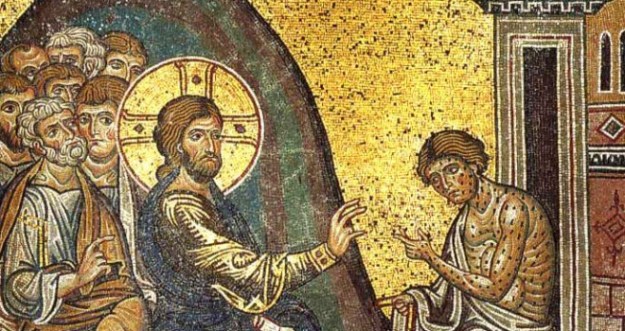
Mosaic, Cathedral of the Assumption in Monreale, Sicily (12-13th Century)

Matthew 8: 1-4

Parallels (Mark 1: 40-45, Luke 5: 12-16)

1 When Jesus had come down from the mountain, great crowds followed him; 2 and there was a leper who came to him and knelt before him, saying, “Lord, if you choose, you can make me clean.” 3 He stretched out his hand and touched him, saying, “I do choose. Be made clean!” Immediately his leprosy was cleansed. 4 Then Jesus said to him, “See that you say nothing to anyone; but go, show yourself to the priest, and offer the gift that Moses commanded, as a testimony to them.”

Jesus comes down the mountain after the Sermon on the Mount and we see the kingdom of heaven in conflict with the forces that keep people enslaved in the world. In chapters eight and nine of Matthew’s Gospel we see three patterns of three stories each separated by some manner of conflict with those hearing the message and some explanation of what we are seeing. It has been noted that like Moses participating in God’s liberation of the people from Egypt with the ten signs and wonders in Exodus 7-12, there are in these two chapters a total of ten acts of healing, exorcism or miracles, (Case-Winters, 2015, p. 125) and while I would agree there is a strong Moses typology in Matthew’s gospel that both places Jesus in comparison and in contrast to Moses these ten signs that announce the kingdom of heaven’s approach. There is also resistance from the forces of the world to the approach of the kingdom of heaven which occur each time Jesus descends a mountain in Matthew’s Gospel. In Matthew eight and nine at the end of each set of three stories there is an expansion of the effect of the individual acts to the many or crowds that are brought into the sphere of influence of the kingdom’s activity.

The first healing in Matthew’s gospel is a person rendered unclean by a skin disease, and while this probably isn’t leprosy, or Hanson’s disease as we have long translated this term, it is for the people of Israel a disease that rendered a person unclean and forced them to live isolated from the community. Skin diseases were a significant concern among the people and the priests are given the role of properly identifying this as a disease that makes one unclean and excluding and reuniting the person with the community. Leviticus 13-14 give the details of how the priest is to diagnose, proclaim unclean, and if the person recovers to ritually declare the person clean again. This type of uncleanness was viewed as a punishment by God, for example Numbers 12 with Miriam, and many diseases in this time were viewed as either an affliction by God or the act of some demonic corrupting force. Yet, I do think it is interesting to note in comparison with Moses that the second sign God gives Moses is turning his hand diseased (leprous in most translations) before Moses goes to witness to Israel. Here Jesus reaches out his hand and touches an unclean man with an affliction of the skin and makes it clean. Matthew in narrating Jesus’ story moves this story ahead of the healing of Peter’s mother-in-law in Mark’s Gospel and perhaps he alludes this connection early in Moses’ ministry.

Regardless of allusions, the issues of what righteousness and the relationship to the law which were important to the Sermon on the Mount are immediately brought into concrete expression as Jesus encounters one who is ritually unclean and acts in ways both contrary and in concert with the law. The law would declare the person unclean and untouchable and there is a view that uncleanness is contagious and because it not only was there a fear of contagion but a fear that the inclusion of the unclean one impacted the purity of the community in its standing before God. Yet, in the kingdom of heaven cleanness is contagious and can be transmitted. Jesus in many of the healings and exorcisms that occur in the next two chapters will cross a barrier to inclusion created by disease, possession, bleeding, being a Gentile, and even being dead. Jesus exercises the authority to make the unclean now clean, unlike the derivative authority of the priest which can only declare that which God has made clean as clean. Something greater than the law is at work here and yet there is still the insistence to offer the gift commanded by Moses as testimony to the priest.

Matthew removes the secrecy motif which is a part of Mark’s narration of this story. In Mark the cleansed leper is commanded not to tell anyone but spreads the word freely which prevents Jesus from being able to enter town. In Mark’s telling there is a great reversal where the formerly unclean leper goes into town telling the message he was to keep silent and Jesus now becomes unable to enter town but now people come from everywhere to touch him. In Matthew the narrative ends after the command to offer the gift to the priest. Matthew also places this story before the healing of Peter’s mother-in-law later in the chapter which has him entering the town of Capernaum. Another key portion of Matthew’s narration is the title people use to address Jesus. Here, and frequently in stories with positive attributions of faith in Matthew, Jesus is referred to as Lord instead of ‘teacher’ (often when faith is questioned) or ‘son of God’ (normally demons but also the Centurion at the cross) or ‘son of David’ (those who are blind but see what others cannot). Lord may simply be a polite address of authority, like ‘sir’ in English, but it also has a strong connection with how the people of Israel referred to the God of Israel (using Adonai, translated LORD instead of the name of the God of Israel). Matthew has already demonstrated a propensity for using language and vocations reserved for the God of Israel to talk about Jesus, so the frequent use of the term Lord in a positive light may point to the nature of faith seeing in Jesus the God who is with us. This is also highlighted by the action of the unclean one kneeling before Jesus in a stance that is appropriate to worship. The act of kneeling could be a stance giving honor to Jesus, but Matthew probably intends for the reader to see in this act the appropriate stance of giving worship to the Lord.

The Imperfect Church and the Kingdom of Heaven

The Ruins of Holyrood Chapel by Louis Daguerre (1824)

One of the tensions in any type of interpretation of scripture that embraces a communal perspective is the distance between the church or whatever type of community of faith the individual is a part of and the vision of community outlined in the Sermon on the Mount and Matthew’s gospel as a whole. The church in all of its forms: the local congregation and the various denominational (and even non-denominational assemblies) are communities in need of reconciliation, healing, forgiveness, reform, compassion, grace, and as institutions they often are as invested in the kingdom of the world as they are in the kingdom of heaven. This is a place where I think a greater familiarity with scripture helps me to live with this tension. The people of God have always struggled to live into their vocation: from Israel’s call to be a treasured possession, a priestly kingdom and a holy nation (Exodus 19: 5-6 )to the quick transition in the early church from a community where the believers hold everything in common, distribute to any in need and eat with glad and generous hearts (Acts 2: 44-45; 4: 32-33) into communities like Corinth, Galatia, and the seven churches mentioned in Revelation. This familiarity can lead to a pessimism about the human potential to embody these seemingly utopic visions of community, and there are times where even a person who loves the church may consider walking away after encountering the brokenness that is a part of many church and religious communities but I believe the scriptures also offer us another perspective that is a reason for hope. The God who the scriptures point to is the reason I still think speaking, dreaming and imagining the kingdom of heaven among people who are ensnared by the lures of wealth and the cares of the world still makes sense.

Learning from Israel’s Relationship with the LORD the God of Israel in Scriptures

Israel’s relationship with God that we see in the scriptures is complicated, and yet God and those called to speak for God to the people (and to God on behalf of the people) refuse to abandon the covenant people. Israel’s God desires for Israel to be an alternative to the models of acquisition and accumulation of power practiced by Egypt, Canaan, Assyria, Babylon, Persia, Greece, Rome and the rest of the nations that they will encounter, but frequently Israel (despite the witness of the Law, prophets and wisdom literature) turned to these attractive alternatives practiced by their neighbors or (in some cases) masters. The bulk of the Hebrew Scriptures lives in this tension between “the LORD, the LORD, a God merciful and gracious, slow to anger, and abounding in steadfast love and faithfulness keeping steadfast love for the thousandth generation, forgiving iniquity and transgression of sin,” and “yet by no means clearing the guilty, but visiting the iniquity of the parents upon the children, and the children’s children, to the third and fourth generation.” (Exodus 34: 6-7) God is a God who is merciful, gracious, abundant love, steadfast faithfulness and forgiveness and God is a God who refuses to be taken for granted, to live with continued disobedience, to allow the way things are because of human greed, destruction and idolatry to continue unchecked. Moses stands between faithless community and the God who desires faithfulness. The prophets also are called to stand between a community that has forgotten or misused their identity and the God who desires them to return to their calling.

Yet, God is for the people of Israel a God of hope. God’s anger at their failure will not endure forever. God can take the desolate boneyard of their failures and knit them together and breath new breath into them and make them a new people. God can take their hearts of stone and turn them into soft, malleable hearts and even write God’s law upon their hearts so that it may order their lives. God can take the brokenness of their community in their exile and give them a vision of homecoming and return where once again God brings life out of death and hope out of humiliation. God has chosen to be a God merciful and gracious, slow to anger, and abounding in steadfast love and faithfulness keeping steadfast love for the thousandth generation, forgiving iniquity and transgression of sin. Even in the community’s failures God’s steadfast love and faithfulness remains.

Learning from the ‘little faith ones’ and the ekklesia in the New Testament

In Matthew’s gospel the disciples are not portrayed as paragons of unwavering faithfulness, or even people of great faith. The disciples are the ‘little faith ones’ as I render the translation of oligopistos throughout this reading. They misunderstand Jesus, fail to act in line with Jesus teaching, abandon Jesus at the critical moment of betrayal and still these ‘little faith ones’ are the ones that Jesus chooses to embody Israel and to carry on the ministry once Jesus is done. Matthew is kinder to the disciples than Mark’s unrelentingly negative portrayal of these followers drawn into the close circle around Jesus, but they are still fallible and yet they are the foundation for the community to come.

Ekklesia is the Greek word often translated church in the New Testament. Matthew is the only gospel to use this term and to talk about the ekklesia.[1] While the term means assembly, in the New Testament it is often the community of believers and so bearing a common vocation with the church. Even though the early communities of Christians would seem strange to those who have worked and lived with almost two thousand years of church growth and tradition, they like Israel before them, struggled to embody the vocation they were called to. Peter, Paul, James and John were not able to establish communities of faith able to easily embody the kingdom values of Jesus and yet, I believe that God has not abandoned or forgotten either Israel or the church in all their imperfections.

The theological tradition that shaped me as a follower of Christ focused on God’s grace in Christ instead of the human ability to faithfully embody God’s commandment. Maybe it is my own deeply ingrained Lutheran theological identity that embraces the paradox that I can be at the same time justified (to use a Pauline term) and a sinner[2], and that the church is filled with these justified sinners and sinners who continue to rely upon God’s forgiveness and mercy. Luther once said, when explaining the petition of the Lord’s prayer about the coming of God’s kingdom, “God’s kingdom comes on its own without prayer, but we ask in this prayer that it may also come about in us.” (Luther, 1978, p. 34)

I do think there is a vision in the Sermon on the Mount of the kind of community that God calls his followers to embody. God has a dream or a vision for us, and it is a vision for life instead of destruction, of wholeness instead of brokenness. We may be ‘little faith ones’ caught between the kingdom of God’s approach and the kingdoms of this world, and yet I do think that in some way God is at work in these words bringing this kingdom of heaven into being among us. Going into Matthew’s gospel and the rest of scripture and seeking the wisdom it offers does change us and perhaps we become the salt and light that (albeit imperfectly) preserve the community and the world around it and shine a light into the darkness of the world. Yet, the kingdom of heaven’s approach is based on the steadfast love and faithfulness (or to use the New Testament’s favored term grace) of God instead of the perfect righteousness of God’s followers at any particular time and place.

[1] Matthew 16: 18 where Jesus declares to Peter “on this rock I will build my ekklesia (church) and Matthew 18:17 in the context of attempting reconciliation with a brother or sister who is unrepentant, “and if the member refuses to listen to them, tell it to the  ekklesia (church); and if the offender refuses to listen even to the ekklesia (church), let such a one be to you as a Gentile and a tax collector. The other two times the NRSV uses church (18:15 and 21) the term is adelphos, literally brother and commonly rendered in the NRSV inclusively as brother and sister unless context dictates the referenced individuals are male.

[2]  Martin Luther’s famous paradox referring to Christians as simul justus et peccator, popularly simultaneously saint and sinner, literally simultaneously justified and sinner.

Matthew 7: 13-29 Choosing the Way of Christ

Fra Angelico, Fresco in the Cloister of Mark in Florenz (1437-1445)

Matthew 7:13-29

Parallel Luke 13: 23-24, Luke 6: 43-46, 13: 25-27, Luke 6: 47-49, Mark 1: 21-22

13 “Enter through the narrow gate; for the gate is wide and the road is easy that leads to destruction, and there are many who take it. 14 For the gate is narrow and the road is hard that leads to life, and there are few who find it.

15 “Beware of false prophets, who come to you in sheep’s clothing but inwardly are ravenous wolves. 16 You will know them by their fruits. Are grapes gathered from thorns, or figs from thistles? 17 In the same way, every good tree bears good fruit, but the bad tree bears bad fruit. 18 A good tree cannot bear bad fruit, nor can a bad tree bear good fruit. 19 Every tree that does not bear good fruit is cut down and thrown into the fire. 20 Thus you will know them by their fruits.

21 “Not everyone who says to me, ‘Lord, Lord,’ will enter the kingdom of heaven, but only the one who does the will of my Father in heaven. 22 On that day many will say to me, ‘Lord, Lord, did we not prophesy in your name, and cast out demons in your name, and do many deeds of power in your name?’ 23 Then I will declare to them, ‘I never knew you; go away from me, you evildoers.’

24 “Everyone then who hears these words of mine and acts on them will be like a wise man who built his house on rock. 25 The rain fell, the floods came, and the winds blew and beat on that house, but it did not fall, because it had been founded on rock. 26 And everyone who hears these words of mine and does not act on them will be like a foolish man who built his house on sand. 27 The rain fell, and the floods came, and the winds blew and beat against that house, and it fell — and great was its fall!”

28 Now when Jesus had finished saying these things, the crowds were astounded at his teaching, 29 for he taught them as one having authority, and not as their scribes.

The conclusion of the Sermon on the Mount brings together several contrasting choices between wise and foolish choices, encouraging the hearer to follow the right way, recognize true prophets, and to enact right actions. This would be familiar to hearers familiar with the pattern of wise and foolish choices that Proverbs, Psalms, and the prophets often use as a rhetorical framework to encourage a wise course of action. These short but vivid images attempt to capture the weight of the decision to live out these words that Jesus articulates. The road to obedience may be challenging, there may be others who proclaim an easier less costly way but what Jesus has been presenting is a way that leads towards life and away from destruction. The Jesus we meet in Matthew’s gospel is merciful and yet does expect his followers to be obedient. Jesus, in the Sermon on the Mount, is inviting his followers to be a part of a community that embodies these teachings. The people of Israel were called into a life of obedience to the Law and there were blessings if they remained obedient and consequences for being unfaithful. Jesus reinterprets the Law to this new community and this is the way of living in the covenant of the kingdom of heaven. The path does involve wisdom, holding mercy and obedience together, discerning between Jesus’ authority and those of other teachers, and the commitment to hearing these words and acting on them.

The translation of the Greek hodos as road, while proper obscures that throughout most of the New Testament this word is translated as way. A frequent theme of Mark’s gospel of Jesus being ‘on the way’ and in Acts we learn that Jesus’ earliest followers were referred to as belonging to ‘the Way.’ (Acts 9: 2) Just as critical for Matthew would be the numerous linkages with how ‘the way’ is used to call the  people of God to be attentive to God’s way in the law, wisdom literature and the prophets. In Deuteronomy, for example, we see the basic pattern of blessing for obedience to the commandments and curses for turning from the way commanded:

the blessing, if you obey the commandments of the LORD your God that I am commanding you today;  and the curse, if you do not obey the commandments of the LORD your God, but turn from the way that I am commanding you today, to follow other gods that you have not known. Deuteronomy 11: 27-28 (see also Deuteronomy 9: 12, 16)

For I know that after my death you will surely act corruptly, turning aside from the way that I have commanded you. In time to come trouble will befall you, because you will do what is evil in the sight of the LORD, provoking him to anger through the work of your hands.” Deuteronomy 31:29

The linking of obedience to the metaphor of a way or a road occurs in several places in Psalms and Proverbs and throughout the prophets, a couple of examples include

for the LORD watches over the way of the righteous, but the way of the wicked will perish. Psalm 1:6

Their feet run to evil, and they rush to shed innocent blood; their thoughts are thoughts of iniquity, desolation and destruction are in their highways. The way of peace they do not know, and there is no justice in their paths. Their roads they have made crooked; no one who walks in them knows peace. Isaiah 59: 7-8

And to this people you shall say: Thus says the LORD: See, I am setting before you the way of life and the way of deathJeremiah 21: 8 

False prophets are a concern throughout the Hebrew Scriptures and within the early church as well. Again, this echoes Deuteronomy with how to determine if a prophet is an authentic process.

If a prophet speaks in the name of the LORD but the thing does not take place or prove true, it is a word that the LORD has not spoken. The prophet has spoken it presumptuously; do not be frightened by it. Deuteronomy 18: 22

Like the community of Israel after Moses, Matthew’s community is having to learn how to live without the immediate presence of Jesus. Like Moses, Jesus now is setting up the community to continue once he is no longer present to speak with them. Just as the disciples have been called to a whole or complete life, so those who speak on behalf of Jesus or God will have good fruits that reflect that life.

Mere confession of Jesus as Lord is insufficient for Matthew, this confession must be linked with obedience to the law as Christ articulates it and the practices of righteousness and mercy. Hearing and even speaking words ultimately do not prove an adequate foundation for the life and community Jesus wants to build. The words which are heard must ultimately be acted upon for a life that will resist the storms that come. The Sermon on the Mount is designed to create a community which is modeled by Christ and faithful to the vision of the kingdom of heaven. It is a community that is visible by its distinct practices of mercy, reconciliation, and righteousness and it exists for the sake of the world.

Jesus takes up the mantle of Moses, and unlike the scribes whose authority is derivative and who cannot go beyond what was given to Moses, Jesus will take what was said in the law and with his own authority reframe, extend and reshape what the law states. Jesus speaks in the language of the law, and yet one greater than Moses is here speaking to the crowds. Jesus speaks in the language of wisdom, and yet one greater than Solomon is sharing the wisdom of the kingdom of heaven. The crowds are astounded because either Jesus has transgressed the boundaries of what is accepted by the interpreters of the law or he has the authority to speak a new way of relating to God and the community into being. Jesus has invited the hearers of his words to become doers who wisely choose that way of life instead of the way of destruction. Even though I’ve moved away from framing this in terms of moralistic perfection, obedience is still a part of the complete life that the disciples are called into as a part of the community. Matthew’s gospel is concerned about establishing a community where the disciples can live this life of peace and reconciliation, of righteousness and mercy, of obedience and trust and any interpretation of Matthew should be judged by its fruits: by how it helps communities of disciples build their lives by acting on these words of Jesus.

Matthew 7: 7-12 Seeking God and Right Relationships

James Tissot, The Lord’s Prayer (1896-1894)

Matthew 7: 7-12

Parallels Luke 11: 9-13, Luke 6: 31

7 “Ask, and it will be given you; search, and you will find; knock, and the door will be opened for you. 8 For everyone who asks receives, and everyone who searches finds, and for everyone who knocks, the door will be opened. 9 Is there anyone among you who, if your child asks for bread, will give a stone? 10 Or if the child asks for a fish, will give a snake? 11 If you then, who are evil, know how to give good gifts to your children, how much more will your Father in heaven give good things to those who ask him!

12 “In everything do to others as you would have them do to you; for this is the law and the prophets.

The vision of the Sermon on the Mount relies upon the fundamental assumption that God is trustworthy. Asking God for what the petitioner needs assumes that God is trustworthy in providing daily bread and all the petitioner needs. The rhythm of ask, seek, knock each followed by a positive answer to the action and then the second restating of everyone who asks, searches and knocks receiving, finding and having the door opened reinforces this view of God’s trustworthiness. The Father that Jesus has encouraged his disciples to pray to will give what is needed to those who ask of him.

Throughout the Hebrew Scriptures there are continual calls for the people of Israel to ask or seek the LORD their God, and the God we meet in the scriptures desires for God’s people to ask and seek. Sometimes this is stated in terms of promise, for example:

Ask of me and I will make the nations your heritage, and the ends of the earth your possession Psalm 2:8

Other times, it indicates an openness to repentance, that even once the relationship seems broken that God is open to reforming the covenant if they people if they will seek God.

From there (the places where you are scattered) you will seek the LORD your God, and you will find him if you search after him with all your heart and soul. Deuteronomy 4: 29

Ultimately the way of wisdom is to continue to be in a relationship with God and to continue to ask, seek and knock, as in 1 Chronicles

Seek the LORD and his strength, seek his presence continually. 1 Chronicles 16: 11 (this is also Psalm 105:4)

Yet, the strongest resonance with Matthew 7 comes from Isaiah where God desires to be sought and asked but the people do not seek or ask

I was ready to be sought out by those who did not ask, to be found by those who did not seek me. I said, “Here I am, here I am,” I held out my hands all day long to a rebellious people, who walk in a way that is not good, following their own devices. Isaiah 65:1-2

The Sermon on the Mount is continuing to restate important themes in different ways to attempt to communicate what righteousness looks like in practice. Followers of Jesus in Matthew 6: 5-15 are instructed in what asking God looks like in the context of prayer. Seeking first the kingdom of God[1] and God’s righteousness are now reinforced as things that the seeking one will find. God knows what the asking one needs, desires to be sought by those who are willing to ask and seek, to open the door for those who are willing to knock, to give good gifts to God’s children like earthly parents who love their children do for their own.

A right relationship with God is tied with a right relationship with others. As in Matthew 22: 37-38 where the two greatest commandments are loving God with all one’s heart, mind, soul and strength and the neighbor as oneself, so here asking and seeking God is tied to the golden rule in relation to one’s neighbor. The law and the prophets are summed up here by Jesus as doing to others as you would have them do to you. Some form of the golden rule occurs in most religious traditions including Judaism, Islam, Hinduism, Buddhism, Sikhism and Confucianism.  Most religious traditions have realized the wisdom of this practice of treating others as one would like to be treated. This way of living in relation to others is not dependent on how others act towards you, but instead the follower of Jesus is to act towards the other in a way that models the righteousness they would desire to receive.

[1] Even though the NRSV in Matthew 6:33 begins “But strive first for the kingdom of God” the word translated strive in Matthew 6 is translated by the NRSV as seek here obscuring the parallel language and themes in Matthew 7:7-8

Matthew 7: 1-6 Nonjudgmental Righteousness

Sermon on the Mount by Carl Bloch (1877)

Matthew 7: 1-6

Parallels Mark 4: 24-25; Luke 6: 37-42

1 “Do not judge, so that you may not be judged. 2 For with the judgment you make you will be judged, and the measure you give will be the measure you get. 3 Why do you see the speck in your neighbor’s eye, but do not notice the log in your own eye? 4 Or how can you say to your neighbor, ‘Let me take the speck out of your eye,’ while the log is in your own eye? 5 You hypocrite, first take the log out of your own eye, and then you will see clearly to take the speck out of your neighbor’s eye.

6 “Do not give what is holy to dogs; and do not throw your pearls before swine, or they will trample them under foot and turn and maul you.

There is a rhythm that underlies the Sermon on the Mount where the individual pieces, which are so often broken apart, attempt to flow together to form a linguistic and thematic resonance. There is a necessity to the practice of addressing things in smaller pieces but I do think it is important to hear the resonance of “Do not judge, so that you may not be judged” with “blessed are the merciful, for they will receive mercy” or the imperatives of reconciliation and peacemaking outlined in the interpretation of the commandments and the imperative in the Lord’s Prayer to “forgive us our debts, as we also have forgiven our debtors” and its restatement on forgiving trespasses and finally doing to others as you would have them do to you. This has the rhythm of wisdom literature which tells us to make the wise, or perhaps the whole/complete/authentic choice, in contrast to the hypocritical/inauthentic/self-righteous or pious choice. The Sermon on the Mount, and Matthew’s Gospel in general, is a tightly composed unit that needs to be heard and practiced together.

Matthew uses the terms hypocrite, hypocrites and hypocrisy more than the rest of the Bible combined, we saw it used three times in chapter six and again here. This is an important term for Matthew since it differentiates the practice Jesus is calling his disciples to in contrast with the practices of other groups. In the Sermon on the Mount the focus is on righteousness as it is practiced in the community, but within the individualistic way of hearing scripture most modern people use it is easy to transform communal practices of righteousness into individual acts of piety and instead of being those who hunger and thirst for righteousness who will be filled (see Matthew 5: 6) we attempt to become those whose practices of piety fill ourselves with our own self-righteousness. When righteousness is reduced to piety we find ourselves among those who Jesus has previously called hypocrites (see chapter 6) and here when we judge others by the standards we set we may be unaware (willfully or unwilfully) of out own failure to seek justice and righteousness.

When we talk about not judging so that we are not judged, we are not negating everything that has been discussed previously. We know that unreconciled anger, uncontrolled sexuality, broken relationships, untrue speech, violence and love for a limited group of people and excludes enemies are contrary to the kingdom of heaven. Exchanging piety for righteousness or attempting to secure our own future instead of trusting in God’s providence are contrary to the wisdom which is offered in these words. On the one hand there is truth to scholars who make this passage about not placing ourselves in the place of God and condemning a person or group as outside of the kingdom of heaven, but my worry about this type of interpretation is that it limits the way refraining from judging is not only about salvation/damnation matters. Matthew’s Sermon on the Mount is about imagining a community where relations are key to righteousness.

The parable of the person with a log in their eye also points to the reality that we often judge others most harshly in the areas we are least secure. Judgment is often a tool people use to compare themselves to another and to prop us their own insecurity as the critique another. Like Luke’s parable of the Pharisee and the tax collector where the Pharisee compares himself to the other by saying, “God, I thank you that I am not like other people: thieves, rogues, adulterers, or even like this tax collector.” (Luke 18: 11)which is lifted up as an example of how the disciples are not to trust in their own practices, this humorous visual of a person with a log in their eye is used to highlight the lack of self-awareness of the situation of the judging one.  Instead of comparison we are invited throughout the Sermon on the Mount to practice forgiveness and reconciliation, to value even those who we may have called enemies previously, and to learn to value the other person as a worthy part of the community.

Yet, a certain type of judgment, or perhaps better discernment, is necessary in our relations with others. The kingdom of heaven that the Sermon on the Mount proclaims encounters the kingdom of the world, not completely eliminating it. The individuals in the community may have those who label them as enemies or dangers. The community may love, pray and forgive others but it also doesn’t place the holy and precious among those who will reject or destroy it. The righteousness the community is to practice is not only practiced in a perfect world free from those who practice different values. How to be the salt of the earth and the light of the world in among others who may not value that role calls for wisdom among the people of God.

Matthew 6: 19-34 Wealth, Anxiety and Righteousness

Evelyn De Morgan, The Worship of Mammon (1909)

Matthew 6: 19-34

Parallel Luke 12: 33-34, Luke 11: 34-36, Luke 16: 13, Luke 12: 22-32

19 “Do not store up for yourselves treasures on earth, where moth and rust consume and where thieves break in and steal; 20 but store up for yourselves treasures in heaven, where neither moth nor rust consumes and where thieves do not break in and steal. 21 For where your treasure is, there your heart will be also.

22 “The eye is the lamp of the body. So, if your eye is healthy, your whole body will be full of light; 23 but if your eye is unhealthy, your whole body will be full of darkness. If then the light in you is darkness, how great is the darkness!

24 “No one can serve two masters; for a slave will either hate the one and love the other, or be devoted to the one and despise the other. You cannot serve God and wealth.

25 “Therefore I tell you, do not worry about your life, what you will eat or what you will drink, or about your body, what you will wear. Is not life more than food, and the body more than clothing? 26 Look at the birds of the air; they neither sow nor reap nor gather into barns, and yet your heavenly Father feeds them. Are you not of more value than they? 27 And can any of you by worrying add a single hour to your span of life? 28 And why do you worry about clothing? Consider the lilies of the field, how they grow; they neither toil nor spin, 29 yet I tell you, even Solomon in all his glory was not clothed like one of these. 30 But if God so clothes the grass of the field, which is alive today and tomorrow is thrown into the oven, will he not much more clothe you — you of little faith? 31 Therefore do not worry, saying, ‘What will we eat?’ or ‘What will we drink?’ or ‘What will we wear?’ 32 For it is the Gentiles who strive for all these things; and indeed your heavenly Father knows that you need all these things. 33 But strive first for the kingdom of God and his righteousness, and all these things will be given to you as well.

34 “So do not worry about tomorrow, for tomorrow will bring worries of its own. Today’s trouble is enough for today.

Following three practices of righteousness (acts of mercy or giving alms, prayer and fasting) we encounter a set of interconnecting proverbs connecting the relationship of the disciple to wealth and the anxiety encountered around possessions. From the very beginning of the Sermon on the Mount we’ve seen an emphasis on possessions, giving to those who beg and not refusing those who want to borrow and doing acts of mercy in this kingdom of heaven where the poor in spirit can be blessed. This kingdom of God that the disciple is to seek depends upon the abundance of God’s provisions rather than the disciple’s ability to accumulate wealth, power and property to secure their own future. Their treasure rests with the God they serve and their trust in God’s provision frees them from the anxiety produced by the cares of the world and the lures of wealth.

Martin Luther’s explanation of the first commandment where the disciple is to, “fear, love and trust God above all things” (Luther, 1978, p. 13) taps into the same wisdom as these sayings in the Sermon on the Mount. Love and trust in God are bound together and placing trust in something other than God, like wealth, interferes not only with the trust in God but also the disciples’ ability to love God. If the kingdom of heaven is approaching, like the Sermon on the Mount assumes and Jesus’ practice of sharing the table anticipates, then images like the image of the banquet in Isaiah 55 probably shape the imagination of Jesus’ hearers. As Isaiah can state:

Ho, everyone who thirsts, come to the waters; and you that have no money, come, buy and eat! Come, buy wine and milk without money and without price. Why do you spend your money for that which is not bread, and you labor for that which does not satisfy? Listen carefully to me, and eat what is good, and delight yourselves in rich food. Isaiah 55:1-2

I’m convinced that the great idol in the United States is security. People are told to attempt to secure the future for their retirement, for their health, and entire industries are engaged in helping people achieve this illusory security they seek. Yet this displacement of joy and happiness to a future time, or the inability to secure one’s own security is a source of anxiety for many people. The accumulation of wealth on earth can provide moments of happiness and treasures and wealth are not bad things, unless they are placed in a position of prominence where they become the meaning of our life, the thing that we serve. Yet, there is a note of hope in this passage because how we use our wealth can help lead us to the life we desire to live. As Mark Allan Powell can state,

Jesus does not want us to give from the heart. He wants us to give according to where we believe our hearts should be, to give according to where we hope our hearts will someday be. Give of your treasure and let your heart catch up. (Powell, 2004, p. 140)

The proverb about the eye being the lamp of the body may seem out of place in between two proverbs talking about treasures or wealth, but when paired with the other two proverbs (and the longer saying about anxiety and possessions) we can see the orientation of the eye towards wealth or possessions is the darkness spoken of here. The culminative effect of this group of sayings is to encourage the disciple to make the wise choice of looking (or seeking) first for the kingdom of God. In contrast to the kingdom of God which is light, seeking the ways of this world is the unwise way of darkness.

Jesus is calling his disciples to trust in God and not to have divided loyalties. As he will later share in the Parable of the Sower those who are ensnared by the cares of the world and the lure of wealth will choke the word that has been sowed among them and make them yield nothing. (Matthew 13: 22) One can trust in wealth or one can trust in God. The NRSV translates mammon as wealth, and while this is correct it misses the way in which the text personifies wealth into an entity which is able to possess and demand allegiance. Mammon becomes an alternative, and an attractive one for many people, to trusting in God to provide security.

After these three proverbs which point to the wisdom of trusting and serving God rather than attempting to secure our own security by hoarding or serving ‘wealth’ we are told therefore not to be anxious about our life and the things we need.  The Greek merimnao which is translated worry by the NRSV has the meaning of anxiety or even obsession about the object of concern. (Allen, 2013, p. 77)  Food, drink and clothing can become objects of this anxiety when one begins to adopt the worldview of providing one’s own security and provision. God takes care of the birds of the air, the grass of the field and the righteous will be provided for as well. In a world which seeks to ensnare the righteous in its snares and the lure of mammon the disciple of God is called to trust that God has given them enough, that God will provide daily bread and drink and clothing. They are to be different than the nations, to embody a different relationship with the fruit of their labor. The disciples do not abandon sowing or working, but instead this sowing and working is a part of their life before God instead of their own struggle to secure their own future. The future will bring worries of its own, but the God who is faithful today will also be faithful in the future. They live seeking righteousness knowing that they will be filled with the bread and drink of the banquet of God’s kingdom. They seek the security and wealth of the kingdom of God even though they may be the poor in spirit or those persecuted for righteousness sake.

One final translation note that I think is important to hearing Matthew in a less judgmental way. In verse thirty we have the first use of the Greek word oligopistos which is almost universally translated ‘You of little faith’ which is a proper English rendering of this adjective which always appears in the second person form (mostly plural but once as a singular form because it is addressing Peter). This term occurs four additional times throughout Matthew[1], always addressing either a disciple or disciples. My struggle with the traditional translation is the statement, ‘You of little faith’ in English implies a biting and condescending tone. The more I’ve listened to Matthew’s gospel, the more I’ve read this term as ‘little faith ones,’ a term of endearment or compassion. Instead of upbraiding the disciples who are listening for not having enough faith or trusting enough, perhaps Jesus here, and throughout the gospel is encouraging his little faith ones who are gathered around him, encountering the struggle of seeking the kingdom of God while the snares of the world are still present.

A part of this translation of oligopistos as ‘little faith ones’ goes to the heart of my struggle with the way the Sermon on the Mount is often presented. If Jesus is the embodiment of the judgmental God who is setting an unrealistic perfectionistic standard, then being derided as ‘You of little faith’ makes sense within this context. Yet, I am an heir of the Lutheran reformation which began with one man’s search for a gracious God, and I know that informs my view of Jesus who we meet in the scriptures. It is a part of my search for a way of reading the Sermon in a way that goes beyond an individualistic and moralistically perfectionist reading. I understand this reading is going against the grain of established scholarship, but it is also done for the little faith ones, like myself, who go to the scriptures seeking wisdom and seek the kingdom while still struggling with: the anxieties of the world, having both treasures and hearts in the right place, having eyes turned toward the kingdom of heaven and feeling the pull of two opposing masters.

[1] Matthew 8: 23-26; 14: 28-31; 16: 5-10; 17: 18-20

Matthew 6: 16-18 Exploring Fasting and Righteousness

Ivan Kramskoy, Christ in the Desert (1872)

Matthew 6: 16-18

16 “And whenever you fast, do not look dismal, like the hypocrites, for they disfigure their faces so as to show others that they are fasting. Truly I tell you, they have received their reward. 17 But when you fast, put oil on your head and wash your face, 18 so that your fasting may be seen not by others but by your Father who is in secret; and your Father who sees in secret will reward you.

The third practice of righteousness that Jesus lifts up is fasting. Fasting, like prayer, is often considered in terms of personal piety but most of the discussion of fasting in the scriptures, like here, pushes against a public demonstration of piety. The disciple again acts in private, but their actions related to the community are to embody the justice they are to live. Much of the discussion of fasting in the Hebrew Scriptures comes in the prophets as they criticize the way fasting is done by other members of the community and attempt to reunite fasting with the practices of righteousness.

Both Jeremiah and Isaiah have the LORD rejecting the fasting of the people because of the wider practices of unrighteousness. This stark language from God in Jeremiah will draw protest from Jeremiah for the people’s sake:

The LORD said to me: Do not pray for the welfare of this people. Although they fast, I do not hear their cry, and although they offer burnt offering and grain offering, I do not accept them; but by the sword, by famine, and by pestilence I consume them. Jeremiah 14: 11-12

Even though the LORD commands Jeremiah to no longer pray for the people, Jeremiah does exactly that to intercede on their behalf. The prophet is still in a person where the words and actions are seen and heard by God for the people, but the practices of the people cannot be separated from either fasting or offering sacrifice. In a similar way the prophet Isaiah criticizes the disconnection of religious practices from practices of righteousness in his familiar critique:

Shout out, do not hold back! Lift up your voice like a trumpet! Announce to my people their rebellion, to the house of Jacob their sins. Yet day after day they seek me and delight to know my ways, as if they were a nation that practiced righteousness and did not forsake the ordinance of their God; the ask of me righteous judgments, they delight to draw near to God. “Why do we fast, but you do not see? Why humble ourselves, but you do not notice?” Look, you serve your own interest on your fast day, and oppress all your workers. Look, you fast only to quarrel and to fight and to strike with a wicked fist. Such fasting as you do today will not make your voice heard on high. Is such the fast I choose, a day to humble oneself? Is it to bow down the head like a bulrush, and to lie in sackcloth and ashes? Will you call this a fast, a day acceptable to the LORD? Is not this the fast I choose: to loose the bonds of injustice, to undo the thongs of the yoke, to let the oppressed go free, and to break every yoke? Is it not to share your bread with the hungry, and to bring the homeless poor into your house; when you see the naked, to cover them, and not to hide yourself from your own kin?  Isaiah 58: 1-7

I’ve quoted Isaiah at length because this understanding of fasting also connects with final teaching of Jesus in Matthew’s gospel where the righteous are those who fed the hungry, gave drink to the thirsty, clothed the naked, welcomed the stranger, cared for the sick and visited the imprisoned. (Matthew 25: 31-46)

Fasting is an appropriate practice of righteousness as a practice of repentance (see for example Joel 1: 13-18; 2: 12-17; Jonah 3: 5-9) and is practiced by the followers of John the Baptist (Matthew 9: 14-15) and Jesus’ followers are criticized for their lack of fasting in comparison with the Pharisees and the followers of John the Baptist. Fasting is appropriate to times and seasons, but it is also to be a practice which doesn’t exempt the disciple from their normal manner of interacting with the community. Fasting is not an excuse for oppressing workers or quarreling and fighting. Instead fasting is to be an act seen by God and is to be instead of a mournful act a joyful act for the kingdom. As the prophet Zechariah can state:

The word of the LORD of hosts came to me, saying: Thus says the LORD of hosts: The fast of the fourth month, and the fast of the fifth, and the fast of the seventh , and the fast of the tenth, shall be seasons of joy and gladness, and cheerful festivals for the house of Judah: therefore love truth and peace. Zechariah 8: 18-19

Matthew 6 is read in churches that follow a lectionary at the beginning of the season of Lent where fasting is one of the practices that Christians may choose to practice in this time of forty days. Fasting can be a challenging discipline to practice but it does not exempt the disciple choosing to fast from engaging in the life of the community or the world around them. The community which practices fasting and righteousness will be seen, even when the individual disciple’s fast is not. They will be seen by the way they loose the bonds of injustice and their fasting allows them to hunger and thirst for righteousness. Fasting may be an occasion for repentance but should also be practiced in joy, for such seems to be the fast that the Jesus chooses for his disciples.

Matthew 6: 5-15 Exploring Prayer, Forgiveness and Righteousness

James Tissot, The Lord’s Prayer (1896-1894)

Matthew 6: 5-15

Parallels : Mark 11: 25-26, Luke 11: 1-4

5 “And whenever you pray, do not be like the hypocrites; for they love to stand and pray in the synagogues and at the street corners, so that they may be seen by others. Truly I tell you, they have received their reward. 6 But whenever you pray, go into your room and shut the door and pray to your Father who is in secret; and your Father who sees in secret will reward you.

7 “When you are praying, do not heap up empty phrases as the Gentiles do; for they think that they will be heard because of their many words. 8 Do not be like them, for your Father knows what you need before you ask him.

9 “Pray then in this way:
Our Father in heaven, hallowed be your name.
10 Your kingdom come. Your will be done, on earth as it is in heaven.
11 Give us this day our daily bread.
12 And forgive us our debts, as we also have forgiven our debtors.
13 And do not bring us to the time of trial, but rescue us from the evil one.

14 For if you forgive others their trespasses, your heavenly Father will also forgive you; 15 but if you do not forgive others, neither will your Father forgive your trespasses. 

This second practice of righteousness is prayer, but the prayer is between the disciple and their heavenly Father and is not done to either impress the surrounding community or God with their piety or eloquence. As mentioned above, the righteousness that we are encountering in Matthew has little to do with the way we often think of religious piety. Instead it is based upon the security of the individual and the community in their covenant with their heavenly Father. The disciple’s actions may be done in secret, but the community who trusts in God’s provision and attention will be visible.

Jesus, like the law, the prophets and psalmists, viewed the relationship between the people and God as founded on their righteousness as practiced in mercy toward their neighbors and prayer is an important part of maintaining that relationship. As Samuel Ballentine when writing about prayer in the Hebrew Scriptures can state:

prayer is a principal means of keeping the community bound to God in an ongoing dialogue of faith. I suggest that the church is summoned to a ministry that both promotes and enables this dialogue. (Ballentine, 1993, p. 275)

Prayer is, in Ballentine’s language, “a service of the heart” which breaks into the mundane reality of daily life with the presence of the sacred. (Ballentine, 1993, p. 274) Prayer can happen in the public places, the synagogue and the street corners for example, and prayer led in the community has a long-standing place within the community’s worship. Yet, the community is made up of disciples who can also have the private and unseen places interrupted as the language of the heart encounters the heavenly Father who knows the needs of the heart.

Instead of prayer being fashioned around rubrics and phrases that are piled one upon another, prayer for the followers of Jesus is simple because it lifts up to God what God already knows. One is not in prayer to appease a god with one’s eloquence or to impress the divine with one’s piety, for with the heavenly Father one’s righteousness is already seen. It is not for public display and recognition, but this wise prayer recognizes and honors the already existing relationship between the disciple and their God who sees.

The Lord’s Prayer, as given in the gospels, is slightly different than most Protestant Christians learned through worship. The most notable difference is the deletion of the final phrases about “the kingdom and the power and the glory” being God’s. Ultimately this change comes from the tools available to scholars and translators that were not available when the influential King James Version, and other early English translations were produced. The King James version of the Bible used a simple majority of early texts to determine what was translated, while later translations (like the NRSV which I’m using as a basis for this reading) are able to use technologies like carbon dating to determine the age of a manuscript and privilege the oldest manuscripts. It appears that the addition of the phrases attributing glory to God appear later and are then incorporated into later copies of the gospels, perhaps reflecting an already existing practice in the early church.

The language of this prayer is familiar to most Christians, addressing God as the heavenly Father and asking God to make holy the name of God. From a scriptural perspective there is the commandment that the people of God are not to profane the name of God, but the relationship also allows the one praying or in dialogue with God to declare than an action by God would bring God’s name dishonor. For example, during the dialogue between God and Moses after the construction of the golden calf by Israel, Moses’ appeal to God not to destroy the people hangs upon this understanding:

Moses appeals to God’s own character by reminding God that God has already taken an oath (v. 13: nisba’ta lahem bak, “You have sworn to them by your own self”), the violation of which would jeopardize trust in the divine character. (Ballentine, 1993, p. 138)

The book of Psalms and Jeremiah also frequently uses this tactic in appealing to God to act in accordance with maintaining the sanctity of God’s name and honor.

The prayer continues with the prayer for the coming of the kingdom of heaven where God’s will is done on earth as well. The community and the disciple trust in God for the provision of the things they need. Like the people of Israel in the wilderness, where God provided mana, now the followers of Jesus can trust that God will provide the bread they need, even when their physical ability to provide resources is unable to sustain the crowds that gather around Jesus (see for example Matthew 14: 13-21 and Matthew 15: 32-39).

Forgiveness is lifted up within the prayer and immediately following the prayer and in both occurrences divine forgiveness and the practice of forgiving others is linked.  The link with the Apocryphal book of Sirach (sometimes called the Wisdom of Sirach or Ecclesiasticus) is often noted:

Forgive your neighbor the wrong he has done, and then your sins will be pardoned when you pray. (Sirach 28:2)

While Jesus and Matthew may or may not have been familiar with the book of Sirach, both are pulling on a long tradition of wisdom literature interpreting both law and righteousness to the hearer, and here the wise and righteous one forgives the neighbor in the context of prayer and in their actions. The practice of forgiving debts goes back to the practice of remitting debts every seventh year (see Deuteronomy 15: 1-18). Additionally, it is important to note that in Matthew both the practice of forgiving economic debts (see also Matthew 18: 23-35) and trespasses (wrongdoing or sin, see also Matthew 18: 21-22 where a question about forgiving sin is answered with a parable about economic justice). Both cases, economic and trespasses link the disciple’s forgiveness with their reception of divine forgiveness. This is a community where justice is practiced, but the merciful receive mercy (Matthew 5:7). Ultimately a community where reconciliation is practiced, and anger is addressed will need to be a community of forgiving disciples.

Finally, the prayer concludes with a prayer not to be brought to the time of testing and deliverance from the evil one. The disciple’s life rests in their heavenly Father’s hands and it is God who can deliver them in the times when their trust in God is tested. Following Jesus may involve suffering, but that does not mean that one prays for that suffering to enter one’s life. The presence of the evil one is assumed throughout Matthew. The devil and those who are actively or passively working for him will resist the approach of the kingdom of their heavenly Father.  Ultimately God is the one who can deliver from both temptation and the evil one.

Prayer and forgiveness, along with acts of mercy (almsgiving) are all ways in which righteousness is practiced for the individual within the community of the faithful. It is a community where thoughts and prayers are also surrounded by actions of justice and personal piety involves commitment to the good of the neighbors in the community. It is a place where the kingdom of heaven approaches the community of the faithful and God’s will is done in these places where earth and heaven meet. Prayer and forgiveness are practiced as a part of the relationship between the God of the disciples and the community they share. Everything is done in the confidence of God’s provision for the needs of the community as a whole and the disciples as individuals. The heavenly Father is the one they trust to rescue them from the temptation and persecution they will encounter.