This is a part of a selection of readings I gathered to reflect on what a healthy approach to masculine identity would look like. I navigated my own journey into a version of manhood in my late teens and early twenties successfully, but now in middle age I see a lot of young men struggling to navigate this journey and for a variety of reasons failing to launch into life. I come to this with humility and curiosity seeking those who may be able to articulate more clearly the journeys that may lead young men to discover a fulfilling life of work and relationships and to help those moving into the space of elders to support and guide them in this journey.
There are some startling quotes in this book, but the one that stopped me in my tracks as we look at the future was this:
This script has played out once before in American culture. Starting in the 1970s, black men began leaving factory jobs; by 1987 only 20 percent of black men worked in manufacturing. The men who lived in the inner cities had a hard time making the switch to service jobs or getting the education needed to move into other sectors. (88)
There has been a lot of attention paid to the incarceration, unemployment, and the lack of young black men in raising children and the factors behind these men not being successful in society but when you expand the script to the plight of black men being predictive of the future of men as a whole that is bleak. I do believe that especially for men so much of their identity is tied to work and the loss of job opportunities for men without a college degree is a major factor in the failure of men in both the economy and life. Hannah Rosin’s book in 2012 was one the first one that I am aware of to notice the drastic changes occurring in the education and work space of America and she covers a wide range of impacts from the changes. From the changing dynamic of ‘hook-up culture’ in colleges, to the way the upper class still holds onto marriage as an economic advantage, the economic mobility of women and the economic stagnation of men, the drastic change in the makeup of college campuses, the increase in female violence, and the way women are breaking into the top of the job market.
I valued the combination of personal stories gained from interviews placed in the context of the seismic shift in the job and education market. As Hannah Rosin notes about the 2008-2009 Recession:
In the Great Recession, three-quarters of the 7.5 million jobs lost were lost by men. The worst-hit industries were overwhelmingly male, and deeply identified with macho: construction, manufacturing, high finance. (4)
I appreciated her candor in talking about the ‘hook-up culture’ on college campuses where women are also using it to avoid relationships which could derail their progression through college and into the workforce. Women are more educated and doing better economically in their late twenties than their male counterparts. Although college educated men and women were more likely to remain married and to ‘see-saw’ in their primary breadwinning roles, among men with only a high-school diploma the change was drastic. “In 1967, 97 percent of American men with only a high school diploma were working; in 2010, just 76 percent were.” (86) It has been common to note that this generation is not doing as well as the previous generation, but particularly for men:
In 2009, men brought home $48,000 on average, roughly the same as they did in 1969 after adjusting for inflation. In fact, as a recent report written by former White House economist Michael Greenstone discovered, the truth is even more dismal. Calling it stagnation fails to take into account the fact that fewer men are working full-time now or making any salary at all, and many more are incarcerated. If you add in those factors, the median income for men ages twenty-five to sixty-four has not only stagnated, but fallen sharply by almost $13,000 since 1969—a reduction of 28 percent. (125)
There is beginning to be an awareness of the change in the makeup of college classes, now dominated by women, but Hannah Rosin was one of the early voices who noted the vastly larger number of female applicants to college and the beginning of colleges attempting to balance the classes by giving preferential treatment to attract enough men.
What Hannah Rosin does a good job of doing is narrating the change that has occurred in society and how women have adapted while many men have failed to adapt. This is a story that need to be told, but it is also an uncomfortable story that undercuts one of the narratives I hear frequently where men are still assumed to be the ones with political and economic power. I have heard voices that refuse to believe that men are struggling, particularly from women who blazed the trail for the current generation. As Rosin states,
The closer women get to real power, the more they cling to the idea that they are powerless. To rejoice about feminist victories these days counts as betrayal. (272)
Women have made a lot of progress in my lifetime and that should be celebrated and there are still places where progress continues to be needed. Yet, we can want our young women to be successful and reach out to young men who are struggling to find a foothold in the rapidly changing geography of the job and education marketplace.
Review of D-Day:June 6, 1944: The Climactic Battle of World War II by Stephen Ambrose (1994)
For me a five-star book is something that either I want to read again or something that is so profound it makes an immediate impact. There are lots of ways that books can be compelling: a unique idea, an interesting set of characters, a complex plot, an artistic use of the English language and more. Reading is also a subjective experience, so what appeals to me as a reader may be very different for you. I read a lot for both pleasure and work, but these short reviews are a way for me to show my appreciation for the work and the craft of the author of the reviewed work.
Stephen Ambrose’s phenomenal telling of D-Day accomplishes the daunting task of bringing together the first-person experiences of both allied and axis soldiers, placing the experiences together with the units and locations within the overall plan and execution of the D-Day invasion of Normandy. This is like a mosaic where the author takes a variety of perspectives on the invasion and places them together into a coherent picture which still conveys the chaos the soldiers often felt on the beaches. The first third of the book examines the preparations for the invasion. Stephen Ambrose is able to narrate the personalities and styles of both Eisenhower and Rommel who were the respective commanders on D-Day as well as the command structures they operated within. The D-Day invasion was involved a mammoth effort of logistics and construction to mount and the author walks the reader through the construction of the landing craft, the planning of the invasion and the disinformation campaigns designed to keep German forces away from the landing site, and the training of the soldiers, sailors, and coast guardsmen who would conduct the landing and axis construction and forces designated to repel the invasion. The preparation was critical, and it both made the invasion possible and saved lives, but the book demonstrates all the ways that the plans for the invasion could not account for the reality the soldiers on the beach or who were dropped behind the beach encountered. Moving from west to east he narrates the individual experiences of the battle beginning with the experiences of the 82nd and 101st Airborne Divisions in their night drop and ending with the British 6th Airborne Division on the eastern edge of the battlefield. Particularly with the airborne landings and the 16th and 116th Regiments landing on Omaha beach, the author does an excellent job of portraying the chaotic environment that soldiers found themselves in. The battle in these spaces often relied on junior officers and non-commissioned officers rallying any soldiers they could gather and the training these soldiers received. The book does a good job of combining the epic scale of the invasion with the narrow experiences of the individuals who were a part of this. It was readable and comprehensive at the same time, and I greatly appreciate the dedication and devotion that went into this massive narration of one of the critical days of World War II.
The miracle at the grave of Elisha. (Jan Nagel, 1596)
2 Kings 13:1-13 The Reign of Jehoahaz and Jehoash (Joash) of Israel
1In the twenty-third year of King Joash son of Ahaziah of Judah, Jehoahaz son of Jehu began to reign over Israel in Samaria; he reigned seventeen years. 2He did what was evil in the sight of the LORD and followed the sins of Jeroboam son of Nebat that he caused Israel to sin; he did not depart from them. 3The anger of the LORD was kindled against Israel, so he gave them repeatedly into the hand of King Hazael of Aram, then into the hand of Ben-hadad son of Hazael. 4But Jehoahaz entreated the LORD, and the LORD heeded him, for he saw the oppression of Israel, how the king of Aram oppressed them. 5Therefore the LORD gave Israel a savior, so they escaped from the hand of the Arameans, and the people of Israel lived in their homes as formerly. 6Nevertheless, they did not depart from the sins of the house of Jeroboam that he caused Israel to sin but walked in them; the sacred pole also remained in Samaria. 7So Jehoahaz was left with an army of not more than fifty horsemen, ten chariots, and ten thousand footmen, for the king of Aram had destroyed them and made them like the dust at threshing. 8Now the rest of the acts of Jehoahaz and all that he did, including his might, are they not written in the Book of the Annals of the Kings of Israel? 9So Jehoahaz slept with his ancestors, and they buried him in Samaria; then his son Joash succeeded him. 10In the thirty-seventh year of King Joash of Judah, Jehoash son of Jehoahaz began to reign over Israel in Samaria; he reigned sixteen years. 11He also did what was evil in the sight of the LORD; he did not depart from all the sins of Jeroboam son of Nebat that he caused Israel to sin, but he walked in them. 12Now the rest of the acts of Joash and all that he did, as well as the might with which he fought against King Amaziah of Judah, are they not written in the Book of the Annals of the Kings of Israel? 13So Joash slept with his ancestors, and Jeroboam sat upon his throne; Joash was buried in Samaria with the kings of Israel.
One of the struggles many readers of 2 Kings have in this, and the surrounding chapters is that the names are often reused by different leaders. In this chapter alone we have a King Jehoash/Joash of both Judah and Israel as well as King Hazael naming his son Ben-hadad, the name of the king he murdered in Aram. It is also worth noting briefly that the math for the time period of the reigns of these two kings in Samaria do not add up: If Jehoahaz begins his reign in the twenty-third year of King Joash of Judah and his son King Jehoash begins his reign in the thirty-seventh year of King Joash of Judah he would reign fourteen years, not seventeen as indicated by 2 Kings. There can be reasons, like a co-regency for three years, that can cause the math to work out. I’m not going to dwell on this because it is ultimately not the focus of the narrative, but it is worth noting.
Jehoahaz and Jehoash of Samaria are descendants of Jehu who in his bloody revolution wiped out the worship of Baal in Samaria but, in the view of 2 Kings, Jehu and his descendants did not go far enough to return Northern Israel to the right worship of God. The sins of Jeroboam son of Nebat are the golden calves which the first king of Northern Israel placed in shrines at Bethel and Dan (1 Kings 12: 25-33) to represent the God of Israel and to prevent the people of Northern Israel from returning to Jerusalem to worship in Solomon’s temple. There is also an Asherah (NRSVue sacred pole) in Samaria. The term refers both to the goddess Asherah and the sacred pole utilized in her worship. These worship sites and practices anger the God of Israel and are a cause for the continued victories of Aram over the kings of Israel in the view of the narrator.
Hazael and later his son Ben-hadad of Aram continue to gain territory from Israel and to humiliate the kings of Israel militarily. King Jehoahaz being left with an army of fifty horsemen, ten chariots, and ten thousand footman points to an army whose maneuver units (horsemen and chariots) have been decimated. Ten thousand footmen is a significant force, but they are vulnerable to the much faster moving horse mounted or pulled forces. Likely this transformed the army of Jehoahaz into a defensive force rather than one that has the speed and maneuverability to be an effective raiding and attacking force. Yet, Israel was never to be a military power and Jehoahaz finally appeals to the LORD from the oppression of the people and the LORD hears.
The narration of this flow where the kings did what was evil in the sight of the LORD causing the LORD to be angry with the people but then crying out to the LORD and the LORD providing deliverance is the basic pattern of the book of Judges. Here King Jehoahaz entreats the LORD, the LORD sees the oppression of the people and sends a deliverer/savior. Yet, this narration is unusual because it never identifies the deliverer. As Choon-Leong Seow can state:
Whereas the “savior” is typically named in the analogous depictions from Israel’s early history (it was typically the next ruler), however, he is not explicitly identified here (v.5). Scholars have variously suggested that the allusion is to a third-party aggressor whose pressure on the Arameans brought a reprieve for Israel (such as the Assyrian king Adad-nirari III or even Zakkur of Hamath), another Israelite king like Joash or Jeroboam (II), or Elisha. (NIB III: 236)
Although there are geopolitical events, like the rise of Assyria, which weaken the Arameans I do think that the likely candidates for the text are King Jehoash or the Prophet Elisha (see below) since Jehoash will recapture the land lost to the Arameans after his meeting with the dying Elisha.
2 Kings 13: 14-20 The Death of Elisha
14Now when Elisha had fallen sick with the illness of which he was to die, King Joash of Israel went down to him and wept before him, crying, “My father, my father! The chariots of Israel and its horsemen!” 15Elisha said to him, “Take a bow and arrows,” so he took a bow and arrows. 16Then he said to the king of Israel, “Draw the bow,” and he drew it. Elisha laid his hands on the king’s hands. 17Then he said, “Open the window eastward,” and he opened it. Elisha said, “Shoot,” and he shot. Then he said, “The LORD’s arrow of victory, the arrow of victory over Aram! For you shall fight the Arameans in Aphek until you have made an end of them.” 18He continued, “Take the arrows,” and he took them. He said to the king of Israel, “Strike the ground with them”; he struck three times and stopped. 19Then the man of God was angry with him and said, “You should have struck five or six times; then you would have struck down Aram until you had made an end of it, but now you will strike down Aram only three times.” 20So Elisha died, and they buried him. Now bands of Moabites used to invade the land in the spring of the year. 21As a man was being buried, a marauding band was seen and the man was thrown into the grave of Elisha; as soon as the man touched the bones of Elisha, he came to life and stood on his feet.
Elisha’s approximately fifty-year ministry comes to an end as he nears his death, yet the text records two final miraculous actions to the prophet. The first involves the deliverance of Israel from its oppression under the Arameans. King Joash/Jehoash of Israel comes to the prophet’s deathbed mourning. It is conceivable that the king has come to seek the prophet’s guidance as he marches to war with Aram. As Mordechai Cogan and Hayim Tadmor note,
Prophets were regularly consulted prior to the departure of the army to battle (cf. e.g. 1 Kgs 22); Elisha even accompanied Jehoram on the Moabite campaign (see above 3:11) Might not Joash have sought the advice of the dying Elisha, just as Israel was setting off to attack Aram? (Cogan, 1988, p. 150)
It is also worth noting that Elisha has been a thorn in the Aramean side before by informing the king of Israel where the Aramean forces would be. (2 Kings 6: 8-23) For the narrator of 2 Kings prophets often have more power than kings to deliver the people.
The phrase, “The chariots of Israel and its horsemen!” first appeared at the ascension of Elijah into heaven and its presence here may link Elisha with his famous predecessor. It appears visually in 2 Kings 6: 8-23 when the eyes of the servant of Elisha is opened to see the horses and chariots of fire which surrounded and protected Elisha and the sons of the prophets. Yet here it may also allude to the reality that Israel no longer has horsemen and chariots after their humiliation by the Arameans. Elisha’s presence may be the necessary replacement for the military inadequacy of King Joash/Jehoash of Israel’s forces and now the prophet is on his deathbed.
Elisha does two sign acts with a bow and arrow.[1] First an arrow is drawn and shot out the east facing window which becomes the LORD’s arrow of victory over Aram. Then the king is instructed to take the arrows and strike the ground with them. The prophet is angered that the king only strikes the ground three times which portends three victories over Aram rather than five or six which would have eliminated Aram as a threat, yet in the text the instructions of the prophet do not indicate the expectation of striking the ground multiple times. Yet, the ways of prophets are often inscrutable to those who seek their counsel and the words of the prophet give immediate hope to a beleaguered people and their king.
After Elisha dies and is buried we hear of another conflict involving the Moabites. This may be a story from a later time, but it also may occur in the continued conflict between Aram and Israel where Moabites take advantage of the instability to raid. Ultimately the conflict is not the primary point of the narrative. Rather, the continuing power of the prophet Elisha is whose bones are enough to bring a dead man back to life are the focal point of the story. Elisha had once brought the son of the Shunammite woman back to life and now even in death his bones continue to bring life in a time of death.
2 Kings 13: 22-25 The Conflict Between Israel and Aram
22 Now King Hazael of Aram oppressed Israel all the days of Jehoahaz. 23 But the LORD was gracious to them and had compassion on them; he turned toward them because of his covenant with Abraham, Isaac, and Jacob and would not destroy them, nor has he banished them from his presence until now. 24 When King Hazael of Aram died, his son Ben-hadad succeeded him. 25 Then Jehoash son of Jehoahaz took again from Ben-hadad son of Hazael the towns that he had taken from his father Jehoahaz in war. Three times Joash defeated him and recovered the towns of Israel.
The narrator of 2 Kings views the occurrences in the story of Israel and Judah through a theological lens where the LORD the God of Israel is responsible for both the good and the bad that occurs to the people. Even with the actions of Israel that cause the LORD to be angry the LORD still responds to their entreaties in a gracious manner because of the promises made to Abraham, Isaac, and Jacob. The combination of the story of Elisha’s action with the defeat of Aram by Jehoash son of Jehoahaz illustrate the faithfulness and patience of God with the people. Yet, the narrator of 2 Kings knows that this patience of God will not last forever, and the story is told from the perspective of the exile of Northern Israel by Assyria and Judah by Babylon, hence the ominous “until now” in verse 23.
From a historical perspective this is a time where the Aramean threat is tempered by the rise of Assyria. Northern Israel is still a militarily vulnerable kingdom whose practices continue to, from the perspective of 2 Kings, anger the LORD their God. The prophet Elisha who had been a deliverer of the people in many times is now dead and the promised four generations of Jehu on the throne in Samaria has now halfway to its completion. There are storms brewing to the north of Israel and within the kingdom of Samaria that will break forth in the coming years and chapters.
[1] In Ezekiel 21:21 shaking arrows is used by the Babylonians as a means of divination, but with the prophets of Israel and Judah these are sign acts which enhance the prophet’s words.
The coronation of Jehoash of Judah (c.1840), by Francesco Hayez
2 Kings 12: 1-3
1In the seventh year of Jehu, Jehoash began to reign; he reigned forty years in Jerusalem. His mother’s name was Zibiah of Beer-sheba. 2Jehoash did what was right in the sight of the LORD all his days because the priest Jehoiada instructed him. 3Nevertheless, the high places were not taken away; the people continued to sacrifice and make offerings on the high places.
Jehoash, or Joash, is one of the kings of Judah regarded positively but there is a qualification to that assessment and when one looks closely at this narrative and the more critical parallel in 2 Chronicles 24 it leaves some questions about the totality of the reign of this king. The NIV renders the judgment of Jehoash’s reign. ”Joash did what was right in the eyes of the LORD all the years Jehoida the priest instructed him.” The NIV appears to harmonize its translation with the narrative of 2 Chronicles (see below) but even within the narrative of 2 Kings there is enough to give pause. Yes, there is a qualification that the high places are not removed but looking closely at the end of 2 King’s description of Jehoash’s reign there are enough things revealed to indicate there may be some trouble below the surface of the narration.
Jehoash’s mother is named as Zibiah of Beer-sheba. Beer-sheba would be on the southern border of Judah and geographically distant from the influence of Northern Israel which had led to the turmoil of the previous chapter. There are numerous examples of queen mothers exercising significant power in both positive and negative manners. The influence of a Jezebel or Athaliah to corrupt both Israel and Judah are matched by a queen mother like Bathsheba who uses her influence to get Solomon in anointed rather than Adonijah.
2 Kings 12: 4-16
4Jehoash said to the priests, “All the silver offered as sacred donations that is brought into the house of the LORD—the census tax, personal redemption payments, and silver from voluntary offerings brought into the house of the LORD 5let the priests receive from each of the donors, and let them repair the house wherever any need of repairs is discovered.” 6But by the twenty-third year of King Jehoash the priests had made no repairs on the house. 7Therefore King Jehoash summoned the priest Jehoiada with the other priests and said to them, “Why are you not repairing the house? Now therefore do not accept any more silver from your donors but hand it over for the repair of the house.” 8So the priests agreed that they would neither accept more silver from the people nor repair the house. 9Then the priest Jehoiada took a chest, made a hole in its lid, and set it beside the altar on the right side as one entered the house of the LORD; the priests who guarded the threshold put in it all the silver that was brought into the house of the LORD. 10Whenever they saw that there was a great deal of silver in the chest, the king’s secretary and the high priest went up, cast the silver that was found in the house of the LORD into ingots, and counted it. 11They gave the silver that was weighed out into the hands of the workers who had the oversight of the house of the LORD; then they paid it out to the carpenters and the builders who worked on the house of the LORD, 12to the masons and the stonecutters, as well as to buy timber and quarried stone for making repairs on the house of the LORD, as well as for any outlay for repairs of the house. 13But for the house of the LORD no basins of silver, snuffers, bowls, trumpets, or any vessels of gold or of silver were made from the silver that was brought into the house of the LORD, 14for that was given to the workers who were repairing the house of the LORD with it. 15They did not ask an accounting from those into whose hand they delivered the silver to pay out to the workers, for they dealt honestly. 16The silver from the guilt offerings and the silver from the sin offerings was not brought into the house of the LORD; it belonged to the priests.
King Jehoash was probably involved in a number of important decisions and moments throughout his forty-year reign, but for 2 Kings the central event of his positively assessed reign is the repair of the temple. I’ve noted earlier that much of the book of Kings could have easily been the book of prophets, but it is also worth noting that the narrative of the book of Kings begins with Solomon’s construction of the temple (1 Kings 5-8) and ends with its destruction (2 Kings 25). In the ancient world the construction and maintenance of the temple and the worship in that temple was an expected part of royal piety, and while we can debate the proper balance between proper worship and faithful execution of the law both have been recently missing in Judah. As Alex Israel notes the temple is one hundred and fifty years old (Israel, 2019, p. 184) and 2 Chronicles makes explicit the damage that Athaliah has done:
7For the children of Athaliah, that wicked woman, had broken into the house of God and had even used all the dedicated things of the house of the LORD for the Baals. 2 Chronicles 24:7
Between the age of the structure and the misuse of the building it was likely in serious need of repair to be a structure worthy of the name of the LORD.
We do not know when in his reign Jehoash commanded that the taxes, payments, and specific offerings would be utilized for the repair of the temple. Jehoash began to reign at age seven and would have been heavily influenced by the priest Jehoida and others who advised him, but in his twenty-third year of his forty-year reign he is thirty years old and confronts Jehoida and the other priests about the lack of progress. There are multiple theories that have nothing to do with corruption that have plausibly explained the lack of progress: from the expectations of the priests to be the fundraisers for these taxes, payments, and offerings and limiting their appeal to their family groups, to inability of the priests to properly determine the scope of the work and effectively carry out the repairs. 2 Kings does not indicate that corruption was a part of the problem, although this is possible, nor does it indicate that the collected funds are not available. It gives Jehoash and Jehoida credit for creating a workable solution. While it is possible that the NRSVue’s translation which indicates that the process included taking the donated items and smelting them into ingots occurred at this time, the Hebrew only indicates they tied it up. The physical structure is the recipient of the repairs rather than creating the implements for the conduct of worship, and in light of the upcoming note on King Jehoash’s reign it is probably an important note. The text on the repair of the temple ends with a note that the priests still had a source of income from the guilt and sin offerings.
2 Kings 12: 17-18
17At that time King Hazael of Aram went up, fought against Gath, and took it. But when Hazael set his face to go up against Jerusalem, 18King Jehoash of Judah took all the votive gifts that Jehoshaphat, Jehoram, and Ahaziah, his ancestors, the kings of Judah, had dedicated, as well as his own votive gifts, all the gold that was found in the treasuries of the house of the LORD and of the king’s house, and sent these to King Hazael of Aram. Then Hazael withdrew from Jerusalem.
King Hazael, first mentioned in chapter eight, captures Gath, one of the Philistine cities and then orients his forces on Jerusalem. Jehoash decides that he does not have adequate forces to resist Hazael’s force and so sets out with the treasures of Jerusalem to make peace. Military conflict in the ancient world is an economic matter and if a leader can gain a significant tribute, like the one mentioned above, without having to expend the cost and trouble of a military siege they will often take it. King Asa (1 Kings 15:18) utilized the temple resources to buy off the forces of Aram under King Ben-hadad (who Hazael later assassinated and assumed his role) and so it is only the gifts given under Jehoshaphat, Jehoram, and Ahaziah that remain in the temple.
King Jehoash’s decision to bribe King Hazael not to attack may have been a wise one, but its narration in 2 Kings is ambiguous. The people of Judah were never a great military power but there is no indication that Jehoash seeks God’s will in this decision or that he trusts in God’s deliverance. This decision also probably brings the repair of the temple to an end, at least for a time. Military conflict and siege warfare create problems not just for the king but the entire population, yet many probably viewed this move as a sign of weakness and this may contribute to King Jehoash’s assassination by his servants in the next section.
2 Kings 12: 19-21
19Now the rest of the acts of Joash and all that he did, are they not written in the Book of the Annals of the Kings of Judah? 20His servants arose, devised a conspiracy, and killed Joash in the house of Millo, on the way that goes down to Silla. 21It was Jozacar son of Shimeath and Jehozabad son of Shomer, his servants, who struck him down, so that he died. He was buried with his ancestors in the city of David; then his son Amaziah succeeded him.
King Jehoash’s (or Joash) forty-year reign ends with his assassination by two subordinates: Jozacar son of Shimeath and Jehozabad son of Shomer. These men may have been slaves in the household of the king (the word translated servant has the primary meaning of slave) but whether they are servants or slaves it is an indication of a conspiracy[1] in the palace to end the reign of Jehoash. Brueggemann notes that in the 2 Kings narrative it could be a conspiracy by those who were faithful to Baal and the ways of Athaliah (Brueggemann, 2000, p. 423) but the 2 Chronicles 24: 17-22 telling of the end of Jehoash’s reign is very different and leads to the NIV translation noted in the beginning of the chapter:
17 Now after the death of Jehoiada the officials of Judah came and did obeisance to the king; then the king listened to them. 18 They abandoned the house of the Lord, the God of their ancestors, and served the sacred poles and the idols. And wrath came upon Judah and Jerusalem for this guilt of theirs. 19 Yet he sent prophets among them to bring them back to the Lord; they testified against them, but they would not listen. 20 Then the spirit of God took possession of Zechariah son of the priest Jehoiada; he stood above the people and said to them, “Thus says God: Why do you transgress the commandments of the Lord, so that you cannot prosper? Because you have forsaken the Lord, he has also forsaken you.” 21 But they conspired against him, and by command of the king they stoned him to death in the court of the house of the Lord. 22 King Joash did not remember the kindness that Jehoiada, Zechariah’s father, had shown him but killed his son. As he was dying, he said, “May the Lord see and avenge!”2 Chronicles 24: 17-22
If 2 Chronicles is accurate in its narration of the end of Jehoah’s reign it could have been out of loyalty to the LORD and the temple that these servants conspired against their king. It is plausible that 2 Kings wanted to narrate the reign of Jehoash in an overall positive manner without delving into the murky ending that 2 Chronicles narrates. If 2 Chronicles narrative is correct then Jehoash becomes a lesser version of Solomon: Solomon builds the temple and Jehoash repairs the temple, Solomon’s reign begins in wisdom, but later Solomon is led astray by his wives and Jehoash is led away by the officials of Judah. Ultimately, we only have the sources of 2 Kings and 2 Chronicles to bear witness to this time in the story of Judah, and we can do our best to place the narratives in the world the inhabited but all of our reconstructions involve some level of educated guessing.
[1] The word translated “conspiracy” here is rendered as treason in 11:14. (Brueggemann, 2000, p. 422)
1Now when Athaliah, Ahaziah’s mother, saw that her son was dead, she set about to destroy all the royal family. 2But Jehosheba, King Joram’s daughter, Ahaziah’s sister, took Joash son of Ahaziah and stole him away from among the king’s children who were about to be killed; she put him and his nurse in a bedroom. Thus she hid him from Athaliah, so that he was not killed; 3he remained with her six years, hidden in the house of the LORD, while Athaliah reigned over the land.
4But in the seventh year Jehoiada summoned the captains of the Carites and of the guards and had them come to him in the house of the LORD. He made a covenant with them and put them under oath in the house of the LORD; then he showed them the king’s son. 5He commanded them, “This is what you are to do: one-third of you, those who go off duty on the Sabbath and guard the king’s house 6(another third being at the gate Sur and a third at the gate behind the guards), shall guard the palace, 7and your two divisions that come on duty in force on the Sabbath and guard the house of the LORD 8shall surround the king, each with weapons in hand, and whoever approaches the ranks is to be killed. Be with the king in his comings and goings.” 9The captains did according to all that the priest Jehoiada commanded; each brought his men who were to go off duty on the Sabbath, with those who were to come on duty on the Sabbath, and came to the priest Jehoiada. 10The priest delivered to the captains the spears and shields that had been King David’s, which were in the house of the LORD; 11the guards stood, every man with his weapons in his hand, from the south side of the house to the north side of the house, around the altar and the house, to guard the king on every side. 12Then he brought out the king’s son, put the crown on him, and gave him the covenant; they proclaimed him king and anointed him; they clapped their hands and shouted, “Long live the king!”
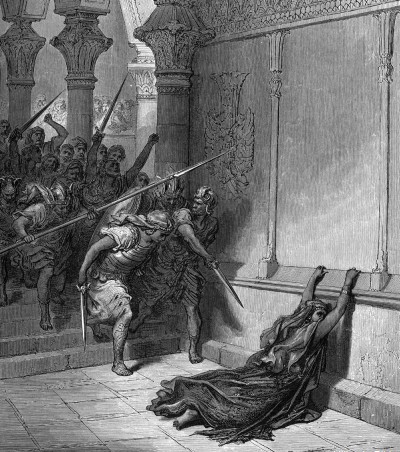
13When Athaliah heard the noise of the guard and of the people, she went into the house of the Lord to the people; 14when she looked, there was the king standing by the pillar, according to custom, with the captains and the trumpeters beside the king, and all the people of the land rejoicing and blowing trumpets. Athaliah tore her clothes and cried, “Treason! Treason!” 15Then the priest Jehoiada commanded the captains who were set over the army, “Bring her out between the ranks and kill with the sword anyone who follows her.” For the priest said, “Let her not be killed in the house of the Lord.” 16So they laid hands on her; she went through the horses’ entrance to the king’s house, and there she was put to death. 17Jehoiada made a covenant between the LORD and the king and people, that they should be the LORD’s people; also between the king and the people. 18Then all the people of the land went to the house of Baal and tore it down; his altars and his images they broke in pieces, and they killed Mattan, the priest of Baal, in front of the altars. The priest posted guards over the house of the LORD. 19He took the captains, the Carites, the guards, and all the people of the land; then they brought the king down from the house of the LORD, marching through the gate of the guards to the king’s house. He took his seat on the throne of the kings. 20So all the people of the land rejoiced, and the city was quiet after Athaliah had been killed with the sword at the king’s house. 21Jehoash was seven years old when he began to reign.
The final remaining figure of the Omri dynasty is not in Israel but in Judah. Jehu’s bloody revolt in Israel has eliminated both the ruling line in Samaria as well as Ahaziah, the king of Judah, who was linked to the line of Ahab by his mother Athaliah. Jehoram, son of king Jehoshaphat, the father of the recently murdered King Ahaziah was married to Athaliah the daughter of Ahab. Athaliah who holds power in Judah for seven years is not listed in the line of Davidic kings because she is not of the Davidic line. Aside from her violent actions the problem with Ahaziah is not primarily that she is a woman but instead that she is of the line of King Ahab and Jezebel and apparently brings the religious and moral practices of Tyre into Jerusalem.
Athaliah seizes power in the aftermath of her sons death attempting to wipe out any other claimants to the throne. As a person with a tenuous grip on power the elimination of potential claimants to the throne is coldly logical in a world where political power is seized in often bloody manners. To use the logic of George R.R. Martin’s Game of Thrones “when you play the game of thrones (power) you either win or you die.” Although Athaliah is not viewed favorably in either 2 Kings or the parallel telling of this story in 2 Chronicles 22, her seizure of power is likely less bloody than Jehu’s in Samaria. Yet, unlike Jehu her seven years on the throne in Jerusalem pull the people further from the worship of the LORD the God of Israel and she ends up being the only woman in the bible, “to be awarded the moniker: “the Wicked”” in 2 Chronicles 24:7. (Israel, 2019, p. 178) And as Choon-Leong Seow states accurately, “Athaliah is to Judah what Jezebel was to Israel…Like the ruthless Jezebel, Athaliah is willing to commit murder in order to have her way.” (NIB III: 228) She is a mother who seizes power by killing the royal family which likely contains her own children and grandchildren.[1]
Yet, Athaliah’s plot to wipe out the line of David is thwarted by her sister Jehosheba who hides young Joash. 2 Chronicles 22: 10-12 states that Jehosheba is the wife of Jehoida the priest that will play a dominant role in the protection of Joash and the elimination of Athaliah. Yet, 2 Kings does not give us Jehosheba’s motive in saving this child, but she like many of the women in Exodus,[2] are responsible for thwarting the murderous intentions of a ruler. Joash will be hidden and raised in the house of the LORD.
The plot to place Joash on the throne begins in the seventh year of Athaliah’s occupying the throne in Jerusalem. The priest Jehoida summons summons the Carites, which may be the Cherethites mentioned elsewhere as body guards and soldiers of David or a different armed group, and the guards to both swear loyalty to the new king and to act as protection for the moment of the revelation of the king to the people. The exact details of the deployment of these troops may be a challenge for translators to render in an exact format but the overall intent is clear. The full complement of soldiers will be armed and ready in key positions on the day when young Joash is anointed publicly and acclaimed as king.
The king is crowned, anointed and either given an insignia or a covenant document. As Walter Brueggemann states of the term that can be rendered emblem/insignia or covenant,
The term here is not very clear. It may refer to insignia of office. Or it might more precisely refer to a scroll, a written charter delineating both the prerogatives and requirements of power, a document that situates royal power in something like a constitutional frame of reference that precludes royal arbitrariness. (Brueggemann, 2000, p. 409)
If it is a covenant, it probably reflects an understanding of the expectations of a king similar to Deuteronomy 17: 14-20.
14“When you have come into the land that the Lord your God is giving you and have taken possession of it and settled in it, and you say, ‘I will set a king over me, like all the nations that are around me,’ 15you may indeed set over you a king whom the Lord your God will choose. One of your own community you may set as king over you; you are not permitted to put a foreigner over you, who is not of your own community. 16Even so, he must not acquire many horses for himself or return the people to Egypt in order to acquire more horses, since the Lord has said to you, ‘You must never return that way again.’ 17And he must not acquire many wives for himself or else his heart will turn away; also silver and gold he must not acquire in great quantity for himself. 18When he has taken the throne of his kingdom, he shall write for himself a copy of this law on a scroll in the presence of the Levitical priests. 19It shall remain with him, and he shall read in it all the days of his life, so that he may learn to fear the Lord his God, diligently observing all the words of this law and these statutes, 20neither exalting himself above other members of the community nor turning aside from the commandment, either to the right or to the left, so that he and his descendants may reign long over his kingdom in Israel.
This anointed and crowned king now receives the vocal acclamation from the guards and priests, “Long live the king.”
Athaliah hears the commotion and discovers the plot underway. The young king is standing by the pillar, perhaps the pillars at the front of the temple or in the position where Ezekiel envisions the king supervising the offerings. (Ezekiel 48: 2-8)[3] Athaliah echoes the words of Joram, “Treason! Treason!”[4] but like Joram her realization of the plot afoot is too late to save her life. She is brought out of the temple and killed with the sword. Then the covenant is renewed between the LORD, the king, and the people. The people then destroy the house of Baal, possibly built under Athaliah’s instructions, and Mattan the priest of Baal is also killed. The verbs in 2 Kings on the destruction of the temple of Baal echo the instructions of Deuteronomy 12: 2-3:
2“You must demolish completely all the places where the nations whom you are about to dispossess served their gods, on the mountain heights, on the hills, and under every leafy tree. 3Break down their altars, smash their pillars, burn their sacred poles with fire, and cut down the idols of their gods, and thus blot out their name from their places.
In contrast to Jehu’s revolution, the coup enacted by the priest Jehoida is much less violent. Only Athaliah and Mattan are killed and then the city was quiet. As Brueggemann notes about the final phrase about the city being quiet,
The assertion that the “city was quiet” is more important than the simple phrasing might suggest (11:20). The term “quiet” (shaqath) is the same term used in the book of Judges in the recurring phrase “the land had rest” (Judg 3:11, 30; 5:31; 8:28) (Brueggemann, 2000, p. 413)
Joash, or Jehoash, begins his long reign at the age of seven. He is under the influence of Jehoida and yet his reign will be one of the times that 2 Kings views favorably. The covenant between God, the king, and the people is restored, the land has rest, and there is a chance for renewal in Judah after the decline of the house of David over the past two kings.
[1] There were probably other children of Jehoram by wives other than Athaliah as well as others in the line of David.
[3] Ezekiel’s words come in the time immediately after the time of the kings and the temple, but his visions are likely informed by his familiarity with the temple practices before its destruction.
Part of the gift-bearing delegation of King Jehu, Black Obelisk, 841–840 BCE.
2 Kings 10: 1-14
1 Now Ahab had seventy sons in Samaria. So Jehu wrote letters and sent them to Samaria, to the rulers of the city, to the elders, and to the guardians of the sons of Ahab, saying, 2 “Since your master’s sons are with you and you have at your disposal chariots and horses, a fortified city, and weapons, 3 select the son of your master who is the best qualified, set him on his father’s throne, and fight for your master’s house.” 4 But they were utterly terrified and said, “Look, two kings could not withstand him; how then can we stand?” 5 So the steward of the palace and the governor of the city, along with the elders and the guardians, sent word to Jehu, “We are your servants; we will do anything you say. We will not make anyone king; do whatever you think right.” 6 Then he wrote them a second letter, saying, “If you are on my side and if you are ready to obey me, take the heads of your master’s sons and come to me at Jezreel tomorrow at this time.” Now the king’s sons, seventy persons, were with the leaders of the city, who were charged with their upbringing. 7 When the letter reached them, they took the king’s sons and killed them, seventy persons; they put their heads in baskets and sent them to him at Jezreel. 8 When the messenger came and told him, “They have brought the heads of the king’s sons,” he said, “Lay them in two heaps at the entrance of the gate until the morning.” 9 Then in the morning when he went out, he stood and said to all the people, “You are innocent. It was I who conspired against my master and killed him, but who struck down all these? 10 Know, then, that there shall fall to the earth nothing of the word of the Lord that the Lord spoke concerning the house of Ahab, for the Lord has done what he said through his servant Elijah.” 11 So Jehu killed all who were left of the house of Ahab in Jezreel, all his leaders, close friends, and priests, until he left him no survivor. 12 Then he set out and went to Samaria. On the way, when he was at Beth-eked of the Shepherds, 13 Jehu met relatives of King Ahaziah of Judah and said, “Who are you?” They answered, “We are kin of Ahaziah; we have come down to visit the royal princes and the sons of the queen mother.” 14 He said, “Take them alive.” They took them alive and slaughtered them at the pit of Beth-eked, forty-two in all; he spared none of them.
There is no avoiding the violence of this text. Jehu and those around him are blunt instruments removing the cancer of both the Omri dynasty and the cancer of Baalism from Israel. Back when I was working through the book of Esther, I did a short reflection on Violence and the Bible, but I still think most modern readers and interpreters find the bloody transition from the heirs of king Ahab to Jehu disconcerting.
The world of the bible was violent as was the ancient world that it was set within. It may not be quite the grimdark world of some recent fantasy made popular in George R.R. Martin’s Game of Thrones, since the world of the bible does assume there is a higher moral power involved in it, but as far as the shocking violence I think this, and the previous chapter, compete with almost anything written by modern authors. There were no bloodless coups in the ancient world. For the necessary transition to happen in both Israel and Judah drastic actions are required (in the view of 2 Kings).
Alex Israel in his writing on Jehu’s overthrown of the Omri dynasty believes that the detail provided is a critique of Jehu’s violence:
Kings is no stranger to military coups, yet not one of these mutinies revel in the explicit gore and detailed descriptions of murder that we find with Jehu. The narrative’s detail communicates Jehu’s barbarism. (Israel, 2019, p. 168)
Although Hosea 1:4 does view Jehu’s violence as excessive, I don’t believe that the narrator of 2 Kings does. Even though the other mention of seventy sons[1] being killed belongs to Abimelech in Judges 9, a story that has several connections with 2 Kings 10, Jehu’s actions are viewed in a positive light in 2 Kings. The violence does not all occur at Jehu’s hands as we will see as the narrative progresses, but Jehu’s evaluation is not tainted by his violent methods in overthrowing the Omri dynasty and the practices of Baal worship but instead that Jehu didn’t go far enough in removing the false worship practices from Northern Israel.
Jehu’s actions at the beginning of this chapter challenge the people with power in Samaria to choose one of the heirs of Ahab to rally behind and to prepare to meet him in battle. Jehu’s rule will never be secure as long as there is another line that can make a claim on the throne, but he does grant the leadership in Samaria the opportunity to make a fight for these heirs of Ahab. We don’t know how the line of Ahab was viewed within Samaria, and the text only mentions the terror of the leaders about this military commander’s ability to conquer whatever resistance they offer. These leaders entreat Jehu for peace and Jehu responds with the command to bring the heads of the seventy sons of Ahab. These leaders of will also have blood on their hands at the conclusion of the coup, but it may not have been necessary for them to directly participate in the bloodshed. As Choon-Leong Seow states on the Hebrew wordplay:
The word “heads” (ra’sim) is ambiguous, for it could refer literally the anatomical heads or figuratively to leaders. The officials assume the literal meaning and decapitate the remaining descendants of Ahab. (NIB III: 223)
There was a time when the leaders could have claimed innocence in this bloody transition since it was Jehu who killed the kings of Israel and Judah as well as Jezebel the queen mother, but now with the seventy heads of the sons of Ahab in baskets they share in this overthrow. Their hands are just as bloody as Jehu’s. Yet, for the narrator of 2 Kings, this bloody event is the fulfillment of the words of Elijah spoken against Jehu in Jezreel. (1 Kings 21)
Finally in this section there is the slaughter of the relatives of Ahaziah. These travelers from Judah seem completely unaware of the situation they walked into as they travel to visit Jezebel and the royal princes of Israel. These kin of Ahaziah are linked by marriage to Ahab’s line and in slaughtering these relatives Jehu weakens the remnants of the house of Ahaziah in Jerusalem. As we will see in the following chapter the remaining child of Ahab, his daughter Athaliah, will violently attempt to hold onto power in Jerusalem.
2 Kings 10: 15-36
15When he left there, he met Jehonadab son of Rechab coming to meet him; he greeted him and said to him, “Is your heart as true to mine as mine is to yours?” Jehonadab answered, “It is.” Jehu said, “If it is, give me your hand.” So he gave him his hand. Jehu took him up with him into the chariot. 16He said, “Come with me and see my zeal for the Lord.” So he had him ride in his chariot. 17When he came to Samaria, he killed all who were left to Ahab in Samaria, until he had wiped them out according to the word of the Lord that he spoke to Elijah.
18Then Jehu assembled all the people and said to them, “Ahab offered Baal small service, but Jehu will offer much more. 19Now therefore summon to me all the prophets of Baal, all his servants, and all his priests; let none be missing, for I have a great sacrifice to offer to Baal; whoever is missing shall not live.” But Jehu was acting with cunning in order to destroy the servants of Baal. 20Jehu decreed, “Sanctify a solemn assembly for Baal.” So they proclaimed it. 21Jehu sent word throughout all Israel; all the servants of Baal came, so that there was no one left who did not come. They entered the temple of Baal until the temple of Baal was filled from wall to wall. 22He said to the keeper of the wardrobe, “Bring out the vestments for all the servants of Baal.” So he brought out the vestments for them. 23Then Jehu entered the temple of Baal with Jehonadab son of Rechab; he said to the servants of Baal, “Search and see that there is no servant of the Lord here among you but only servants of Baal.” 24Then they proceeded to offer sacrifices and burnt offerings. Now Jehu had stationed eighty men outside, saying, “Whoever allows any of those to escape whom I deliver into your hands shall forfeit his life.” 25As soon as he had finished presenting the burnt offering, Jehu said to the guards and to the officers, “Come in and kill them; let no one escape.” So they put them to the sword. The guards and the officers threw them out and then went into the citadel of the temple of Baal. 26They brought out the pillar that was in the temple of Baal and burned it. 27Then they demolished the pillar of Baal and destroyed the temple of Baal and made it a latrine to this day. 28Thus Jehu wiped out Baal from Israel. 29But Jehu did not turn aside from the sins of Jeroboam son of Nebat that he caused Israel to commit: the golden calves that were in Bethel and in Dan. 30The Lord said to Jehu, “Because you have done well in carrying out what I consider right and in accordance with all that was in my heart have dealt with the house of Ahab, your sons of the fourth generation shall sit on the throne of Israel.” 31But Jehu was not careful to follow the law of the Lord the God of Israel with all his heart; he did not turn from the sins of Jeroboam that he caused Israel to commit.
32In those days the Lord began to trim off parts of Israel. Hazael defeated them throughout the territory of Israel: 33from the Jordan eastward, all the land of Gilead, the Gadites, the Reubenites, and the Manassites, from Aroer, which is by the Wadi Arnon, that is, Gilead and Bashan. 34Now the rest of the acts of Jehu, all that he did, and all his power, are they not written in the Book of the Annals of the Kings of Israel? 35So Jehu slept with his ancestors, and they buried him in Samaria. His son Jehoahaz succeeded him. 36The time that Jehu reigned over Israel in Samaria was twenty-eight years.
Jehu now meets Jehonadab son of Rachab. The two men are loyal to one another but also share a zeal for the LORD. The descendants of Jehonadab son of Rechab will be the Rechabites that the prophet Jeremiah encounters in Jerusalem who do not drink wine or grow vineyards in obedience to their ancestor’s way. (Jeremiah 35) Now this ancestor of the Rechabites and Jehu move with cunning against the entrenched worship of Baal in Samaria.
In the ancient world the political and religious realms are interconnected, and it would not be surprising for a new ruler to pay for a sacrifice to the gods worshipped in the land. Jehu’s religious connections may not be well known in Samaria, and the prospect of having the new king as a patron would be enticing to the cult of Baal in the land. Yet, Jehu is acting with ‘cunning.’[2] Many modern readers may be confused by the dishonesty of Jehu’s actions, but 2 Kings views these actions positively. After attempting to ensure that only worshippers of Baal are present Jehu orders his guards to slaughter those participating and not to allow any to escape. Jehu in this action eliminates the worship of Baal during his reign and in the view of 2 Kings this causes God to grant him the longest running dynasty in the Northern Kingdom.
Yet the final evaluation of Jehu is negative not because of his violence or dishonesty but because he didn’t go far enough. He allowed the shrines at Bethel and Dan to remain. One the one hand it would be difficult for Jehu to remain in control in Samaria if people had to return to Jerusalem to worship, but in the view of the narrator of 2 Kings this is evidence of idolatry. Northern Israel is slowly losing control of its border to Hazael’s forces out of Damascus, but Jehu and his sons will maintain control in Samaria for four generations.
[1] Seventy is one of the ‘representative’ numbers in Hebrew which may be literal or may represent a large number. Typically multiples of three, seven, and twelve have a connotation of completeness in Hebrew thought.
[2] The Hebrew word for cunning is ‘aqob. This is also the name Jacob. Jacob’s original name and his character in Genesis is that of one who acts with cunning. The trickery here by Jehu is not evaluated in a negative light.





 Sign of the Rose