Yearly Archives: 2016

Thinning

When did my hair get so thin
That it no longer protects my scalp skin
Yet it never lays flat
After wearing a hat
Oh how wonderfully vain I have been

Several days behind now in the Intro to Poetry prompts, but this was a fun one. To take an imperfection as the prompt and then to attempt to put it into a limerick. And while I am still glad to have as much hair as I do at almost 44 (especially with the men on both side losing much more) there isn’t as much as there once was.

IMG_0751

Ecclesiastes 7-The Lonely Path of the Seeker

Isaak Asknaziy, Vanita vanitatum et omnia vanitas (19th Century)

Isaak Asknaziy, Vanita vanitatum et omnia vanitas (19th Century)

Ecclesiastes 7: 1-10 The Cost of Wisdom

1 A good name is better than precious ointment, and the day of death, than the day of birth.
 2 It is better to go to the house of mourning than to go to the house of feasting; for this is the end of everyone, and the living will lay it to heart.
 3 Sorrow is better than laughter, for by sadness of countenance the heart is made glad.
 4 The heart of the wise is in the house of mourning; but the heart of fools is in the house of mirth.
 5 It is better to hear the rebuke of the wise than to hear the song of fools.
 6 For like the crackling of thorns under a pot, so is the laughter of fools; this also is vanity.
 7 Surely oppression makes the wise foolish, and a bribe corrupts the heart.
 8 Better is the end of a thing than its beginning; the patient in spirit are better than the proud in spirit.
 9 Do not be quick to anger, for anger lodges in the bosom of fools.
 10 Do not say, “Why were the former days better than these?” For it is not from wisdom that you ask this.

There is a joy that is a gift of God but that joy will not be present in every season and often it is the times of grief where wisdom is refined and tested. Ecclesiastes has no place for the masks of happiness that people often feel constrained to wear. Wisdom, we find here, does not drive the teacher to a life of prosperity, rich relationships, easy decisions or universal popularity. It is the road that is less traveled and engages the moments of joy and sadness, pain and pleasure, life and death.

There is a certain kind of wisdom that is only learned through the process of grief and loss and perhaps this is a part of what these proverbs that begin this section point to. Ecclesiastes’ search for wisdom is not a quest that only takes him to the places that are isolated from pain and suffering, instead wisdom often means wrestling with the more challenging parts of life and death. Even though the quest for a lasting legacy of name may be vanity they still seem better than the sweet smelling oils that spoil even more quickly. A person’s life can only begin to be measured at its completion for when the person is present we often take their contributions for granted and can easily focus upon their failures. There is also the hard wisdom of sitting Shiva with those who are mourning and the value that comes not from the cheap pithy sayings but in the long silence of presence. The wisdom that comes from inhabiting the house of mourning may not be a popular wisdom but it is wisdom nevertheless.

In our social media age where we can surround ourselves with an echo chamber of like-minded people we may find it almost impossible to hear the rebuke of the wise if they disagree with our opinions. Yet, that rebuke and cognitive dissonance is an essential part of wisdom. Wisdom and knowledge only grow when they are challenged and pulled. Too often we settle for the quick flash of the thorns which catch fire easily but produce little heat rather than the coals that actually can bring about warmth and can provide the heat needed for the essential task of transforming a dough into a cake or cooking the meat for a meal.

The gift (bribe), impatience, anger and nostalgia become the traps on the path of wisdom as well. Oppression was discussed in chapters four and five and it becomes one of the things that blocks our enjoyment of life and it can also be a roadblock to wisdom. There are certainly those who rise above what may seem impossible circumstances to phenomenal heights but most of those who are oppressed will remain trapped within that oppression. As Ellen Davis can state, “Evil must be remembered but never romanticized; every period of great oppression produces some heroism and much more madness among its victims.” (Davis, 2000, p. 201) The gift, or a bribe, which turns a person aside from the path of wisdom or justice is also a corruption of not only justice but the character of the person. When we change our actions for the sake of another person’s gift (and this may be something as simple as their approval) we have left the path of wisdom. The path of wisdom is not the quick or easy path, it is a path that needs patience. Anger may be an essential part of life and there is a time for righteous anger, but becoming quickly angered is the way of the foolish. Finally nostalgia tries to walk into the future looking backwards. There are gifts to be learned by the study of the past, but trying to recreate the past or romanticizing it often bankrupts both the present and the future. When our memories of the past become larger than our dreams for the future we become trapped in the pain of nostalgia rather than being open to the potential gift of today and tomorrow.


Ecclesiastes 7: 11-21 Wisdom and Ambiguity

 11 Wisdom is as good as an inheritance, an advantage to those who see the sun.
 12 For the protection of wisdom is like the protection of money, and the advantage of knowledge is that wisdom gives life to the one who possesses it.
 13 Consider the work of God; who can make straight what he has made crooked?
 14 In the day of prosperity be joyful, and in the day of adversity consider; God has made the one as well as the other, so that mortals may not find out anything that will come after them.
 15 In my vain life I have seen everything; there are righteous people who perish in their righteousness, and there are wicked people who prolong their life in their evildoing. 16 Do not be too righteous, and do not act too wise; why should you destroy yourself? 17 Do not be too wicked, and do not be a fool; why should you die before your time? 18 It is good that you should take hold of the one, without letting go of the other; for the one who fears God shall succeed with both.
 19 Wisdom gives strength to the wise more than ten rulers that are in a city.
 20 Surely there is no one on earth so righteous as to do good without ever sinning.
 21 Do not give heed to everything that people say, or you may hear your servant cursing you; 22 your heart knows that many times you have yourself cursed others.
 
Wisdom is better than foolishness and it may even provide some protection and advantage but one person’s wisdom cannot make everything crooked in the world straight. This passage about not being too righteous or too wicked might seem a little Machiavellian but wisdom knows that the complex world rarely falls into absolutes. Life can bring about many border situations where the line between what is right and what is wrong becomes blurred by the ambiguity of the situation. One can apply wisdom and knowledge to the best of one’s ability, one can attempt to be righteous but ultimately in the life lived before God what wisdom we have is incomplete and short lived. There may indeed be times where for the sake of another we might incur guilt or violate what we once believed to be absolutes. Dietrich Bonhoeffer in his Ethics, written in the time when Adolf Hitler was in power in Germany, struggles with many of these border situation and how ethically the Christian was to respond. Eventually his struggle would lead him to take a role within the resistance plot to assassinate Hitler. Shortly before his imprisonment in Christmas of 1942 Dietrich Bonhoeffer wrote, “The ultimate question for a responsible man to ask is not how he is to extricate himself heroically from the affair, but how the coming generation is to live. It is only from this question, with its responsibility towards history, that fruitful solutions can come, even if for the time being they are very humiliating.” (Bethge, 2000, p. 797)

Whether we live life in the position of authority having to use our wisdom on behalf of a community or whether in our private lives attempting to use wisdom in our relationship we never eradicate the evil in ourselves or in society. We live in the paradox of the ending of the Lord’s prayer. In the prayer we pray for the forgiveness of our sins as well as the ability to forgive the sins of others, that we would not be lead into temptation and that we would be delivered from evil. Even our best actions often have unintended harmful consequences and sometimes out of great evil some good can emerge. We are never completely the saint or irreconcilably the sinner and we cannot rely upon our own righteousness nor should we want to immerse ourselves completely into wickedness. We live in times of prosperity and adversity and both come from the same God. 

Ecclesiastes 7: 23-29: The Loneliness of the Seeker

 23 All this I have tested by wisdom; I said, “I will be wise,” but it was far from me. 24 That which is, is far off, and deep, very deep; who can find it out? 25 I turned my mind to know and to search out and to seek wisdom and the sum of things, and to know that wickedness is folly and that foolishness is madness. 26 I found more bitter than death the woman who is a trap, whose heart is snares and nets, whose hands are fetters; one who pleases God escapes her, but the sinner is taken by her. 27 See, this is what I found, says the Teacher, adding one thing to another to find the sum, 28 which my mind has sought repeatedly, but I have not found. One man among a thousand I found, but a woman among all these I have not found. 29 See, this alone I found, that God made human beings straightforward, but they have devised many schemes.

In Ecclesiastes 4: 9-11 the Teacher reflected on the benefit of companionship but here, in what may be a personal reflection, he reflects upon the loneliness of the seeker. Whether he was unsuccessful in love and in developing friendships we will never know, but the nature of the quest that he has embarked on is not one that is likely to endear him with those content with a less questioning existence. Perhaps, like many who perhaps are more introverted and reflective, he simply never mastered (and perhaps never cared to master) the social niceties and small talk that seem to come so easily to others. Perhaps he never moved beyond his quest where women and men, slaves and concubines and singers became anything more than delights of the flesh. (Ecclesiastes 2: 8) There is a loneliness for a companion who is truly able to share in the seekers quest, to delight in the wisdom they can share together. Perhaps in his time, where women were not considered equal, he couldn’t see someone who could be his equal in conversation and reflection, yet even among men this is exceedingly rare. Humanity and the challenge of the human political game perhaps becomes the area where the seekers gifts in wisdom seemingly fail him and leave him unable to partake in the joy of true companionship.

Vacation

So often the journey of life is told like an epic tale
Where we go out to conquer the monsters that haunt our world
Yet, sometimes a trip can be merely an adventure
Or a time to retreat from the constant cares of the life of labor
A time to encounter a forest of firs and ferns and pines
To climb a mountain only to see the view of the sunrise on the ocean
Seeking out the beauty of the waterfalls and the lakes
Cruising out on the ocean to see creatures the size of leviathan
Playing in the cold water of the seas among the krill and plankton
Rafting down the river and resting in the summer sun
Eating from the bounty of the sea or simply enjoying a campfire smores
A story where no monsters haunt the garden of Eden
That for a short time we get to inhabit and to dine on its harvest

The Intro to Poetry challenge, day 4 is to write a poem about a journey using a simile

Picture from one of our treks near Bingham, Maine from our vacation this June

Picture from one of our treks near Bingham, Maine from our vacation this June

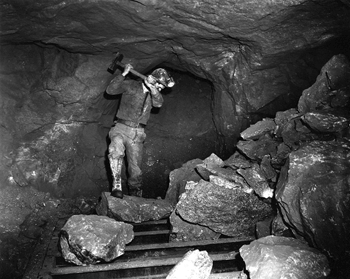
Debtor

For years I’ve struggled and fought tooth and nail
Sacrificing the possible pleasures of the day to pay
Every time I think that I have almost overcome
The mountain I have been tunneling through
Another landslide places several feet more of iron
Between myself and the light at the end of the tunnel
Sometimes I feel trapped within the mine
A slave continuing to excavate gold and jewels
Indentured into servitude by the cost of living
Perhaps if I had some expensive habit to give up
If I had gambled or drank away my salary
Or enjoyed some grand series of trips or experiences
I might take some solitude from the memory of those times
Or find strength in the turning away from the bad habits
Yet, it is merely the cost of responsibility that hangs over my head
The cost of being a father, of bearing the burdens that life has given
So I know nothing more to do than to grasp the pick again
To apply my strength and sweat to the bedrock that lies in my path
Determined not to be overwhelmed by the mountain above
To continue to clear the tunnel for that elusive other side

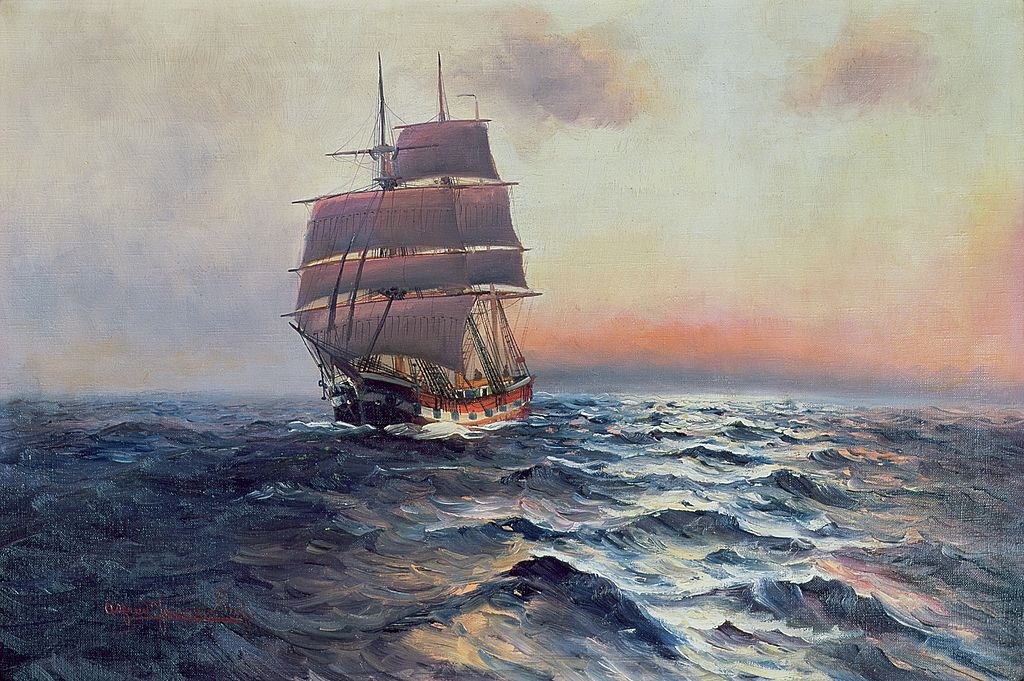
Long Lost

By Alfred Jensen (1859-1935) - The Bridgeman Art Library, Object 225483, Public Domain, https://commons.wikimedia.org/w/index.php?curid=24979280

By Alfred Jensen (1859-1935) – The Bridgeman Art Library, Object 225483, Public Domain, https://commons.wikimedia.org/w/index.php?curid=24979280

At the time we were inseparable, two mates encountering life
But time has its way of pulling apart and placing an ocean between
Colleagues and friend braving the stormy seas of life
Divided as the four winds blew our sails differently
Every now and again I look back across the seas of time
For friends who traveled with me for a part of my journey
Going along as we sailed the currents for the time allotted
However currents shift and winds pull and times separate
I’ve had so many friends in the various ports I’ve called home
Journeying like a merchant marine through my life’s journey
Kindness encountered and given from one friend to another
Long lost except in our memories and recollections of the journey

This is a part of the intro to poetry posts, day 3 where the prompt is friend and the challenge is to use an acrostic (line beginning with a progression of letters either to spell something or like above alphabetically)

What Lies Beneath

IMG_0751

There is a kindness in the smile that reflects the big heart that lies within
Where tenderness and tenacity together toil to transform the world in little ways
For there is a fiery resolve that refuses to release its hopes and dreams
There is a curiosity in the eyes that are continually seeking and wondering
And the ears that sometimes hear a little too clearly bringing in the sights and sounds
Of the world to the quick mind that lies beneath, continually trying to make sense
Of the experiences of the day and the wisdom of the ages, taking into itself
The cares and the worries of the moments and turning them over and over
Looking for the meaning in the moment and the wisdom in the worry and weariness
Perhaps that kind smile and curious eyes and thinning hairline together form
A window to a soul that is a fusion of the best of the saint and the sinner
For what lies beneath is an soul that is older than its years and kinder than its scars

This is a part of the #introtopoetry prompt where the topic is a face and the challenge it to use allteration. I didn’t originally intend to use my own face but it ended up being helpful in working through some of the worries of the moment

 Ecclesiastes 6: The Illusiveness of Joy

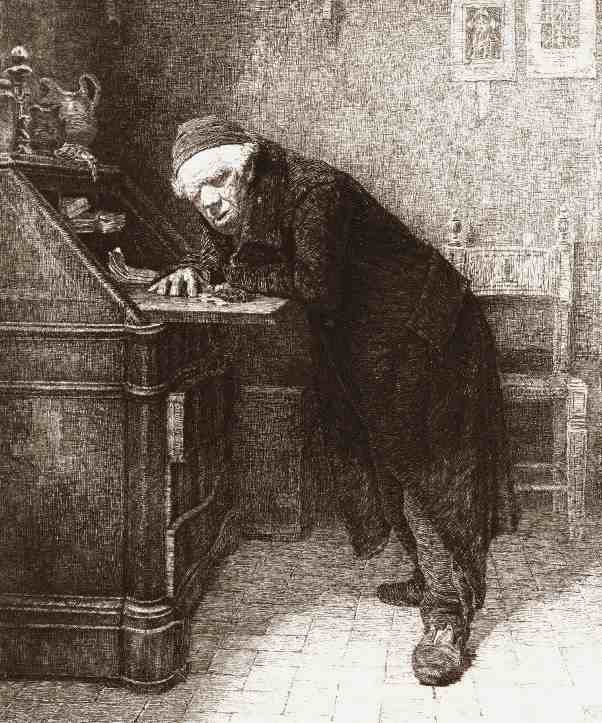
Detail from L'Avaro by Antonio Piccinni (1878)

Detail from L’Avaro by Antonio Piccinni (1878)

Ecclesiastes 6

1 There is an evil that I have seen under the sun, and it lies heavy upon humankind: 2 those to whom God gives wealth, possessions, and honor, so that they lack nothing of all that they desire, yet God does not enable them to enjoy these things, but a stranger enjoys them. This is vanity; it is a grievous ill. 3 A man may beget a hundred children, and live many years; but however many are the days of his years, if he does not enjoy life’s good things, or has no burial, I say that a stillborn child is better off than he. 4 For it comes into vanity and goes into darkness, and in darkness its name is covered; 5 moreover it has not seen the sun or known anything; yet it finds rest rather than he. 6 Even though he should live a thousand years twice over, yet enjoy no good– do not all go to one place?

 7 All human toil is for the mouth, yet the appetite is not satisfied. 8 For what advantage have the wise over fools? And what do the poor have who know how to conduct themselves before the living? 9 Better is the sight of the eyes than the wandering of desire; this also is vanity and a chasing after wind.

 10 Whatever has come to be has already been named, and it is known what human beings are, and that they are not able to dispute with those who are stronger. 11 The more words, the more vanity, so how is one the better? 12 For who knows what is good for mortals while they live the few days of their vain life, which they pass like a shadow? For who can tell them what will be after them under the sun?

Ecclesiastes can acknowledge that joy and the enjoyment of one’s toil, food, drink, prosperity and success are all gifts from God but then wonder about the lack of joy among those who have so much and perhaps the illusiveness of the Teacher’s own joy. To use Amy Plantiga Pauw’s clever phrase the unhappy person is described as a “biblical patriarch on steroids” (Pauw, 2015, p. 173) who has possessions, honor, wealth, an abundance of children and a life over twice as long as Methuselah (who lives 969 years according to Genesis 5:27). None of these things can exhaust the insatiability of the human appetite which continually needs to be fed and yet never seems to be satisfied. This insatiability is a great evil that weighs upon humankind and perhaps leads to perception of scarcity where one is continually competing with others for the perceived limited resources of land, possessions, time, family, honor and wealth. Without the gift of God to be able to enter the space of gratitude the insatiability and drive for acquisition continues to leave the person who applies their wisdom to gaining these things unsatisfied.

This illusiveness of joy which the author is describing is an affliction of both Ecclesiastes’ time and ours. Too often happiness is both marketed and believed to be the product of acquisition and the only cure for the insatiability is the continued consumption of things that at best satisfy us momentarily. This escalating quest in our time and the continued presentation before our eyes of the things we don’t have but we should want has led our society to be the most depressed, medicated, addicted and overweight in history. There is something missing that we keep trying to find, something wrong that we continue to try to cure, some empty place we continue to try to fill. We search for something new, something novel but even the new things are imitations or improvements of things that came before. There is nothing new under the sun that can satisfy. The vanity and chasing after wind that go with searching for this illusive joy may indeed be a part of the human condition, what is missing is the grace of gratitude. As mentioned before this gratitude and joy is a gift of God that allows one to enjoy the gifts one has, to be satisfied in the moment, to embrace the seasons of life as they come and go.

The place of humanity is not to dispute with the one who is stronger (NRSV here in verse 10 takes the singular one who is stronger, which probably refers to God, and makes it a plural). The original temptation in the narrative of Genesis is to attempt to be like God. Yet, just as Job is challenged with his own inability to stand before the immenseness of God’s power and work (Job 40-42) humanity as a whole is not in the place to wrestle with the Creator’s plans or limits. We know the experience that comes in the span of our own days and the wisdom we can acquire within them. We cannot control what the future will hold after our days or what our legacy will be, those things rest in the hands of the Creator and those who come after us. Our days can be gift or curse or perhaps both at once. Perhaps if we cannot embrace the joy of the moments and gifts that we have then we would be better off to never have been born. Yet, I’m not willing to fully give in to the pessimism of this turning point of Ecclesiastes, I still believe in the gift that the author found in the toil and relationships, in the eating and drinking, in the accepting of one’s place within the seasons. At the place where he turned away from the insatiable appetite for acquisition and rested in the moments of joy that were a gift of grace.

Ecclesiastes 5-The Gift of Mortality Before God and in the World

Samuel Cursing Saul by Hans Holbein the Younger (1530)

Samuel Cursing Saul by Hans Holbein the Younger (1530)

 Ecclesiastes 5:1-7 Silence Not Sacrifice

1 Guard your steps when you go to the house of God; to draw near to listen is better than the sacrifice offered by fools; for they do not know how to keep from doing evil. 2 Never be rash with your mouth, nor let your heart be quick to utter a word before God, for God is in heaven, and you upon earth; therefore let your words be few.

 3 For dreams come with many cares, and a fool’s voice with many words.

 4 When you make a vow to God, do not delay fulfilling it; for he has no pleasure in fools. Fulfill what you vow. 5 It is better that you should not vow than that you should vow and not fulfill it. 6 Do not let your mouth lead you into sin, and do not say before the messenger that it was a mistake; why should God be angry at your words, and destroy the work of your hands?

 7 With many dreams come vanities and a multitude of words; but fear God.

Perhaps it is my skeptical nature but I’ve always been wary of those who knew too clearly what God wanted from them and others. I think that sometimes the quest for certainty fills that uneasy quiet space of waiting for God to speak. In our own time there has become more common for people to claim they are spiritual but not religious, where that organized religion for various reasons may not speak to them. There are times where Christianity has tried to model itself after the ancient mystery religions where you did certain acts to try to appease a god or goddess to act on your behalf, but the LORD the God of Israel’s ways are not our ways. As Amy Plantiga Pauw can say memorably, “God does not exist to satisfy human aims and desires. God is not a mascot for our favorite causes.” (Pauw, 2015, p. 166) There are many times when people have used their religious piety as a way of bringing glory to themselves or securing their own sense of place within the chosen people. Qohelet encourages us to enter into that space of silence and waiting to draw near and listen to God.

It is possible that the narrative of 1 Samuel 15, where King Saul uses sacrifice as a way to cover up his disobedience to God’s command in the defeat of the Amalekites, informs this portion of Ecclesiastes. Saul is commanded to utterly destroy the people and the animals but when the battle is won in addition to sparing King Agag’s life the people also spared the best of the sheep, cattle, and other valuables. Capturing the spoils of war was a normal practice but here the Amalekites are dedicated as herem where they are consigned to destruction. (For much more about the understanding of war, herem, as well as an ethical reflection on how to address texts like 1 Samuel 15 see my post on Deuteronomy 20). When the next day King Saul is confronted by Samuel he claims that these best animals are to be a sacrifice to God. Samuel informs King Saul that he has earned the LORD’s disfavor and states:

“Has the LORD as great delight in burnt offerings and sacrifices, as in obedience to the voice of the LORD? Surely, to obey is better than sacrifice, and to heed than the fat of rams. For rebellion is no less a sin than divination, and stubbornness is like iniquity and idolatry. Because you have rejected the word of the LORD, he has also rejected you from being king.” 1 Samuel 15: 22f

Guarding one’s actions before God also involves the words that we say and the promises that we make. The misuse of the name of God was a serious offense for the people of Israel, enough so that it became enshrined within the ten commandments. When speaking about vows in verse four, Ecclesiastes begins with a direct parallel of Deuteronomy 23: 21. Making promises before God is a serious measure, in discussing Deuteronomy 23 I mentioned Jephthah’s rash oath and since I have just been discussing King Saul there is his rash oath in 1 Samuel 14: 24 which puts his son Jonathan’s life in danger. Ellen Davis shares, “To vow something before the priest (NRSV: “messenger”) that one has not considered carefully or, even worse, has no intention of fulfilling is to mock God” (Davis, 2000, p. 165)

Ecclesiastes has been pondering the place of humanity with its mortality within the seemingly timeless nature of creation and the eternity of God. Humanity, with all its limits, is placed in the position of listening to the wisdom of the eternal one. Ecclesiastes has striven to pay attention in the present moment to the gifts that God provides. It may be a paradox but a part of wisdom is learning to be patient with the finite gift of time. Making space and silence to be in that place where our words and wisdom fade before the words and wisdom of God.

Jesus, in Matthew’s gospel, can take the words of Ecclesiastes a step further. Ecclesiastes stated it is better to not vow than vow and not fulfill it but Jesus says not to swear an oath at all. For Jesus all words were to be faithful to what is said, whether they are under oath or not, and as in Ecclesiastes our power to fulfill these vows is often limited by the reality that one ‘cannot make one hair on one’s head white or black.’ (Matthew 5: 33-37)

Ecclesiastes 5: 8-20

 8 If you see in a province the oppression of the poor and the violation of justice and right, do not be amazed at the matter; for the high official is watched by a higher, and there are yet higher ones over them. 9 But all things considered, this is an advantage for a land: a king for a plowed field.

 10 The lover of money will not be satisfied with money; nor the lover of wealth, with gain. This also is vanity.

 11 When goods increase, those who eat them increase; and what gain has their owner but to see them with his eyes?

 12 Sweet is the sleep of laborers, whether they eat little or much; but the surfeit of the rich will not let them sleep.

 13 There is a grievous ill that I have seen under the sun: riches were kept by their owners to their hurt,14 and those riches were lost in a bad venture; though they are parents of children, they have nothing in their hands. 15 As they came from their mother’s womb, so they shall go again, naked as they came; they shall take nothing for their toil, which they may carry away with their hands. 16 This also is a grievous ill: just as they came, so shall they go; and what gain do they have from toiling for the wind? 17 Besides, all their days they eat in darkness, in much vexation and sickness and resentment.

 18 This is what I have seen to be good: it is fitting to eat and drink and find enjoyment in all the toil with which one toils under the sun the few days of the life God gives us; for this is our lot. 19 Likewise all to whom God gives wealth and possessions and whom he enables to enjoy them, and to accept their lot and find enjoyment in their toil– this is the gift of God. 20 For they will scarcely brood over the days of their lives, because God keeps them occupied with the joy of their hearts.


Gratitude and joy are the gifts from God in Ecclesiastes, not wealth or wisdom (even though it is better than foolishness). Our desire for wealth, power, possessions, land, position, and numerous other things we think will make us happy is insatiable. When riches and status become the central quest in life they leave the seeker unsatisfied. Governments may be corrupt, the system may be unfair, riches may be lost suddenly and all may be vanity yet joy can be found.

Ecclesiastes can recognize the problems and corruption that are a part of government and bureaucracy and still believe they ultimately benefit the land and the people. The oppression of the poor and the violation of justice and right are real, and a person may not be in a position to change these things. Yet, the author is no revolutionary. Even with all of the government of his time’s flaws he still sees the king (and by extension the rest of the government) put in place to serve the land and the farmer. The people placed in positions of authority may be motivated by a quest for greed or power, yet in the balance there is justice in the midst of the injustice, protection of justice and right in the midst of the injustice and ultimately even a bad government is in service of its people. Ecclesiastes is wisdom literature, not prophetic literature, so do not be surprised that it is invested in the maintaining of the way things are. Yet, there is wisdom in learning the balance of where one can invest in change and where one learns to live in an imperfect system.

Wisdom that is applied to the increasing of goods or the increasing of position and power is never satisfied. The human appetite for acquisition is insatiable. Riches can be hoarded and lost and never enjoyed. The future is never guaranteed, permanent security is never guaranteed, one’s position in society is never guaranteed. If one lives one’s life only for the future never enjoying the food and drink that one has, never giving thanks for the banquets one can be a part of or host, then one lives impoverished. If one spends one’s nights continually plagued by insecurity over one’s possessions or plotting how to increase one’s wealth or stature, one lives an impoverished life. If one never is given the gift of enjoying their labor and their time of leisure, one lives an impoverished life. The paradox of Ecclesiastes wisdom is that it is by embracing one’s limits-one’s mortality, one’s possessions, one’s position, and one’s companions that one is able to be thankful. Gratitude and joy is a gift of God in the midst of our brief days, our limited resources, our imperfect situations and governments and in our families and friends. Ecclesiastes is not, as I once thought, dismissive of life but actively seeks to embrace life as it is lived in the present.

Ecclesiastes 4- The Things That Steal Our Peace

Ecclesiastes 4

1 Again I saw all the oppressions that are practiced under the sun. Look, the tears of the oppressed– with no one to comfort them! On the side of their oppressors there was power– with no one to comfort them. 2 And I thought the dead, who have already died, more fortunate than the living, who are still alive; 3 but better than both is the one who has not yet been, and has not seen the evil deeds that are done under the sun.

 4 Then I saw that all toil and all skill in work come from one person’s envy of another. This also is vanity and a chasing after wind.
 5 Fools fold their hands and consume their own flesh.
 6 Better is a handful with quiet than two handfuls with toil, and a chasing after wind.

 7 Again, I saw vanity under the sun: 8 the case of solitary individuals, without sons or brothers; yet there is no end to all their toil, and their eyes are never satisfied with riches. “For whom am I toiling,” they ask, “and depriving myself of pleasure?” This also is vanity and an unhappy business.

 9 Two are better than one, because they have a good reward for their toil. 10 For if they fall, one will lift up the other; but woe to one who is alone and falls and does not have another to help. 11 Again, if two lie together, they keep warm; but how can one keep warm alone? 12 And though one might prevail against another, two will withstand one. A threefold cord is not quickly broken.

 13 Better is a poor but wise youth than an old but foolish king, who will no longer take advice. 14 One can indeed come out of prison to reign, even though born poor in the kingdom. 15 I saw all the living who, moving about under the sun, follow that youth who replaced the king; 16 there was no end to all those people whom he led. Yet those who come later will not rejoice in him. Surely this also is vanity and a chasing after wind.

The Hebrew word shalom is only used in Ecclesiastes in the previous chapter in the contrast between war and shalom (peace). Yet, beneath all of the vanity and chasing after the wind is perhaps the search for this concept of shalom, which is far more than an absence of conflict. Shalom has the sense of harmony, balance, living at peace with God’s will for one’s life and world. It is a greeting and a wish for one’s friends and neighbors and for one’s own life and yet then and now it seemed illusive. Qohelet turns his wisdom to the things that rob us of the joy and shalom of how life should be. In the brief verses of chapter four he addresses in a form that moves towards proverbs the issues of oppression, comparison and competition, overwork, isolation and institutional incompetency.

Oppression robs us of our humanity, both the oppressed and the oppressor. For the oppressed it means living in a sick society where their lives and work seem to matter less than those who operate in a more privileged state. For the oppressor it often means unconsciously adopting the views of a sick society that have allowed them to prosper only at the (often unseen) expense of others. Wisdom has opened the eyes of the privileged author of Ecclesiastes and it sickens him. The reality of oppression makes death better than life for him because it is not simply that an oppression can be stated and once brought into the open it dies under the light of day. Oppression involves a lifetime of learned and observed behaviors that require patience, prayer, struggle and dis-ease if the disease is ever to be healed. Oppression can be learned in families, in economic structures and in political systems and they in their own way are demonic. They so weave their ways into the thoughts and actions of ordinary people that they become a part of us. When the demons speak through us they reveal the uglier side of our lives and the inability to see one another as a gift, but instead we begin to see others as people who are to be oppressed or are our oppressor.

In the United States there has been a long struggle among people of color, women and people who because of race, sexuality, economic status, religion (or lack of religion), manner of dress, or numerous other reasons have felt their voices and lives did not matter. While I hope that the struggles of the last several years may eventually lead to a society that moves towards greater equality, for now there is no one to console the tears of the oppressed or the comfort those in power as they deal with the ways privilege has stolen a piece of their humanity as well. Perhaps there may come a day when those who have not been born yet don’t have to wonder if black lives, to use one of the red hot points of struggle in our time, matter less than other lives. There are places where our society is sick and its disease has infected all of us making our lives less human and less worth living. The oppression has possessed the soul of our society in the way it allows us to demonize others and to not see or hear them. The conflict that oppression creates robs our lives and our society of the shalom that wisdom seeks. Ecclesiastes does not offer the cure, only the diagnosis of the thing that steals our joy and peace, both the privileged and the excluded.

Envy is what Ecclesiastes names the second element that steals our joy and peace. This seems to encompass the ways we compare and contrast ourselves with one another. One the one hand toil and skill in work come from learning from and measuring oneself from the work of others. The author of Ecclesiastes can find joy in his labor, yet it can also become a source of anxiety. If our lives are continually measured by the gifts, talents and abilities of others then we will rarely, if ever, be satisfied. Our gifts and talents are not another’s gifts and talents. There is joy in learning to do what one is able with one’s gifts and abilities, for seeking what excellence might look like with one’s talents. Yet, envy of another’s gifts can steal the joy we find in our skills and work.

In a transition it appears that Ecclesiastes pulls from some preexisting form of proverbs about laziness and overwork. There are reasonably close parallels within the book of Proverbs:

A little sleep, a little slumber, a little folding of the hands to rest, and poverty will come upon you like a robber, and want, like an armed warrior. Proverbs 24: 33-34

Do not wear yourself out to get rich, be wise enough to desist. Proverbs 23: 4

Which Amy Plantiga Pauw (Pauw, 2015, p. 162) points out as possible connections with Proverbs, but for the second I actually find Proverbs 17: 1 closer

Better a dry morsel with quiet than a house full of feasting with strife. Proverbs 17:1

Especially when one takes into account the following verse about the slave who deals wisely and the child who acts shamefully in the context of the end of chapter four.

Ecclesiastes looks at the contrast between overwork and strife on the one hand and laziness and poverty on the other. Neither pole holds the answer, the wisdom is to find the balance point in the middle. A person who only applies their wisdom and knowledge in the quest for goods, wealth, and the insatiable quest for more will have to face the injustice that others will use the goods and wealth they have acquired. Overwork leads to an inability to the enjoy the gift of joy that God grants to the worker in their toil. Idleness also leads to a different type of challenge when the person doesn’t have what they need to feel filled or fulfilled. In our society being busy is a mark of success and achievement, as if the work of business is the work of busy-ness. As Ellen Davis can highlight,

“We regard work as primary, while the rest of what we do is “time-off.” But it was the opposite in the ancient world. The Latin word for “business” is neg-otium, literally, “not leisure”; the time when one does not have to work is the norm by which other activities are measured.” (Davis, 2000, p. 191)

There is wisdom in the practice of Sabbath, the practice of resting from one’s labor and toil. There is wisdom in finding joy in one’s work and pleasure in one’s leisure and knowing the balance of both. The wisdom of not wearing oneself out to be rich, of knowing when to desist but also not folding one’s hands only to consume one’s own flesh.

Isolation can also be a source that can rob us of joy. Sharing our labor with another, being able to share in the triumphs and the travails is one of the joys of life. Isolation can take many forms in life, isolation in the home, at work, in our leisure time and in our public time. A life that is driven by competition and envy shatters our community with one another. We were built for lives of partnership in our various vocations to support, strengthen and renew one another. In a world of increasing connection through digital media we face the struggle of maintaining the physical and personal connections that once formed the communities of our ancestors. In an unfair and often unjust world we need our solidarity with one another so that together we might be a cord not easily broken by the injustices and oppression of the world.

Qohelet seems to have little faith in the institutional structures of his day to provide wise, fair and just governance and a place where a life of shalom comes naturally. We live in an age where people have also become wary of the institutional structures of government, religion, and economics. There are some who still wonder, like Jesus’ disciples, that if a rich young man cannot easily enter the kingdom of God, then who can be saved, for the wealthy and powerful were supposed to be the blessed and the wise. Too many times we have seen the wealthy act only out of self-interest, the powerful act foolishly, and those supposed to be righteous commit horrible acts. Wisdom still has its place, even without power or wealth or fame, to navigate the way of the world. In the midst of oppression to find those moments of peace and the solidarity of one another. From the blindness of being the oppressor to cherish those moments, as difficult as they may be, when one’s eyes are opened and we can perhaps see a different future. Wisdom finds the balance between idleness and overwork and can find satisfaction in one’s own abilities and accomplishments. Like all things of shalom, they are transient. The seasons continue to turn and times of conflict do arise. The quest for permanence, security, and a lasting name ultimately give way to mortality and the turning of the seasons. These evanescent moments may not last for long but they are the gift of God that gives meaning to the toil and the struggle.