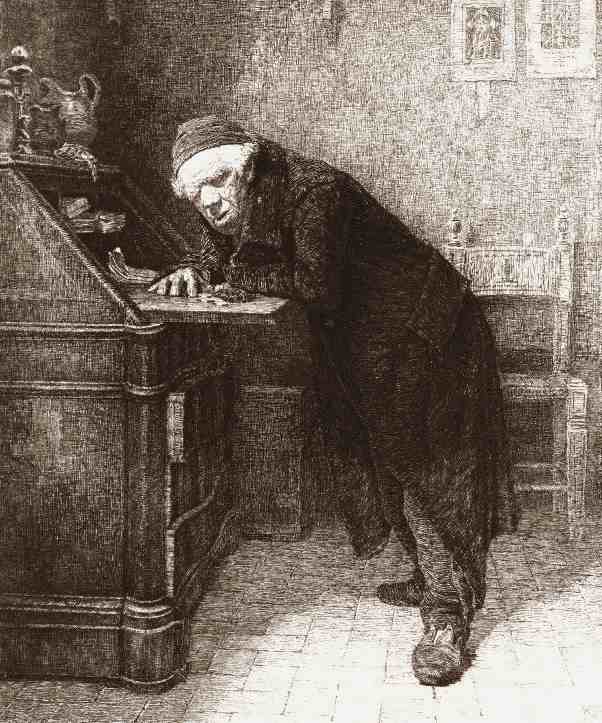
Detail from L’Avaro by Antonio Piccinni (1878)
Ecclesiastes 6
1 There is an evil that I have seen under the sun, and it lies heavy upon humankind: 2 those to whom God gives wealth, possessions, and honor, so that they lack nothing of all that they desire, yet God does not enable them to enjoy these things, but a stranger enjoys them. This is vanity; it is a grievous ill. 3 A man may beget a hundred children, and live many years; but however many are the days of his years, if he does not enjoy life’s good things, or has no burial, I say that a stillborn child is better off than he. 4 For it comes into vanity and goes into darkness, and in darkness its name is covered; 5 moreover it has not seen the sun or known anything; yet it finds rest rather than he. 6 Even though he should live a thousand years twice over, yet enjoy no good– do not all go to one place?
7 All human toil is for the mouth, yet the appetite is not satisfied. 8 For what advantage have the wise over fools? And what do the poor have who know how to conduct themselves before the living? 9 Better is the sight of the eyes than the wandering of desire; this also is vanity and a chasing after wind.
10 Whatever has come to be has already been named, and it is known what human beings are, and that they are not able to dispute with those who are stronger. 11 The more words, the more vanity, so how is one the better? 12 For who knows what is good for mortals while they live the few days of their vain life, which they pass like a shadow? For who can tell them what will be after them under the sun?
Ecclesiastes can acknowledge that joy and the enjoyment of one’s toil, food, drink, prosperity and success are all gifts from God but then wonder about the lack of joy among those who have so much and perhaps the illusiveness of the Teacher’s own joy. To use Amy Plantiga Pauw’s clever phrase the unhappy person is described as a “biblical patriarch on steroids” (Pauw, 2015, p. 173) who has possessions, honor, wealth, an abundance of children and a life over twice as long as Methuselah (who lives 969 years according to Genesis 5:27). None of these things can exhaust the insatiability of the human appetite which continually needs to be fed and yet never seems to be satisfied. This insatiability is a great evil that weighs upon humankind and perhaps leads to perception of scarcity where one is continually competing with others for the perceived limited resources of land, possessions, time, family, honor and wealth. Without the gift of God to be able to enter the space of gratitude the insatiability and drive for acquisition continues to leave the person who applies their wisdom to gaining these things unsatisfied.
This illusiveness of joy which the author is describing is an affliction of both Ecclesiastes’ time and ours. Too often happiness is both marketed and believed to be the product of acquisition and the only cure for the insatiability is the continued consumption of things that at best satisfy us momentarily. This escalating quest in our time and the continued presentation before our eyes of the things we don’t have but we should want has led our society to be the most depressed, medicated, addicted and overweight in history. There is something missing that we keep trying to find, something wrong that we continue to try to cure, some empty place we continue to try to fill. We search for something new, something novel but even the new things are imitations or improvements of things that came before. There is nothing new under the sun that can satisfy. The vanity and chasing after wind that go with searching for this illusive joy may indeed be a part of the human condition, what is missing is the grace of gratitude. As mentioned before this gratitude and joy is a gift of God that allows one to enjoy the gifts one has, to be satisfied in the moment, to embrace the seasons of life as they come and go.
The place of humanity is not to dispute with the one who is stronger (NRSV here in verse 10 takes the singular one who is stronger, which probably refers to God, and makes it a plural). The original temptation in the narrative of Genesis is to attempt to be like God. Yet, just as Job is challenged with his own inability to stand before the immenseness of God’s power and work (Job 40-42) humanity as a whole is not in the place to wrestle with the Creator’s plans or limits. We know the experience that comes in the span of our own days and the wisdom we can acquire within them. We cannot control what the future will hold after our days or what our legacy will be, those things rest in the hands of the Creator and those who come after us. Our days can be gift or curse or perhaps both at once. Perhaps if we cannot embrace the joy of the moments and gifts that we have then we would be better off to never have been born. Yet, I’m not willing to fully give in to the pessimism of this turning point of Ecclesiastes, I still believe in the gift that the author found in the toil and relationships, in the eating and drinking, in the accepting of one’s place within the seasons. At the place where he turned away from the insatiable appetite for acquisition and rested in the moments of joy that were a gift of grace.



 Sign of the Rose