Tag Archives: Psalms

Psalm 19- Creation, the Law and a Faithful Life

James Tissot, The Creation (between 1896 and 1902)

James Tissot, The Creation (between 1896 and 1902)

Psalm 19

 <To the leader. A Psalm of David.>
1 The heavens are telling the glory of God; and the firmament proclaims his handiwork.
2 Day to day pours forth speech, and night to night declares knowledge.
3 There is no speech, nor are there words; their voice is not heard;
4 yet their voice goes out through all the earth, and their words to the end of the world.
  In the heavens he has set a tent for the sun,
5 which comes out like a bridegroom from his wedding canopy,
  and like a strong man runs its course with joy.
6 Its rising is from the end of the heavens, and its circuit to the end of them;
  and nothing is hid from its heat.
7 The law of the LORD is perfect, reviving the soul;
  the decrees of the LORD are sure, making wise the simple;
8 the precepts of the LORD are right, rejoicing the heart;
  the commandment of the LORD is clear, enlightening the eyes;
9 the fear of the LORD is pure, enduring forever;
  the ordinances of the LORD are true and righteous altogether.
10 More to be desired are they than gold, even much fine gold;
  sweeter also than honey, and drippings of the honeycomb.
11 Moreover by them is your servant warned; in keeping them there is great reward.
12 But who can detect their errors? Clear me from hidden faults.
13 Keep back your servant also from the insolent; do not let them have dominion over me.
  Then I shall be blameless, and innocent of great transgression.
14 Let the words of my mouth and the meditation of my heart be acceptable to you,
   O LORD, my rock and my redeemer.

Psalm 19 as a psalm of praise brings together the wonder and mysterious natural knowledge of God uttered in the unheard speech of creation and the revealed wisdom of the LORD in the gift of the Torah (the law). Like Psalm 8, the other psalm of praise we have encountered at this point in the book of Psalms, it reflects upon the majesty of creation from a sense of wonder and awe. It can look at the heavens above, the earth below and the seas in their vastness and be amazed at the creator God who has done all of these things. Here in the first verse the word for God is the generic El which can be either God, a god, or in plural gods, but it is not a name like will be used beginning in verse seven. Yet, the heavens and day and night and sun are all poetically personified in the psalm, speaking in words that are unheard and voices that human ears cannot perceive. Perhaps the psalmist, just straining, can barely hear the silent resonance of the Creator echoing through the creation. Perhaps they can perceive the God that stands behind the creation where others have taken the created parts of creation and deified them. In verses four and five, it is possible that the Psalmist makes use of an existing Akkadian/Summerian bilingual hymn that refers to the sun as a hero, warrior and bridegroom (Nancy deClaisse-Walford, 2014, p. 208) yet instead of leaving the sun as a deity in its right (like the surrounding cultures) now the sun becomes a rejoicing servant reveling in the course that the creator God has set for it.  The first half of the Psalm revels with the song of creation in the artistry and majesty of the creator and the Psalmist lifts up in their own way an audible voice for the unheard creation’s song.

It may seem unusual to bring together creation and the law in a poem, and perhaps these originated in two different places, but bringing these two together makes sense of the broader understanding of how God works with the Hebrew people. Creation is a gift of God for all the world, but the law (the Torah) is the special revealed gift for God’s chosen people. The God referred to initially only with the generic El now receives the revealed name YHWH (frequently pronounced Yahweh, anytime you see LORD in the Hebrew Scriptures (Old Testament) the proper name of God revealed to Moses is behind that, it is typically pronounced Adonai when read (translates to Lord) to not take the LORD’s name in vain). Together with Psalm 1 and the much longer Psalm 119, Psalm 19 praises the law of the LORD. The revealed will of God in the law becomes the nourishment, which revives the faithful, brings wisdom and purity and clarity and are a rich gift fit for a king. The ideal leader was to have the law always before them and to diligently observe and follow it all the days of their life. (see Deuteronomy 17: 18-20) If the king is the one lifting up this prayer the wonder of the cosmos is combined with the revealed wisdom of the Torah to keep them in obedience to God’s will for their life and God’s people.

The Psalm ends with a petition to be kept in this way revealed by the LORD in the midst of all the temptations that life brings forward. There is a humility in realizing that even though the law may reveal the human may conceal from themselves the faults of their hands and hearts. Even with the wisdom of Solomon one may fail to see the divergence in one’s life from the way of the covenant which coheres with God’s law. The Psalmist petitions their LORD to clear them of hidden faults, to keep them away from the insolent and foolish and to allow them to be blameless. God is their rock and their redeemer, the word for redeemer is go’el the kinsman redeemer who is able to, and is expected to, purchase their enslaved kin from slavery. Here the LORD is the one who is able to set the Psalmist free to live the life they are called to live: a life that can revel in God’s creation and delight in God’s law.

Psalm 18 Royal Thanks at the End of the Journey

Matteo Rosseli, Triunfo de David (1620)

Matteo Rosseli, Triunfo de David (1620)

Psalm 18

<To the leader. A Psalm of David the servant of the LORD, who addressed the words of this song to the LORD on the day when the LORD delivered him from the hand of all his enemies, and from the hand of Saul. He said:>
1 I love you, O LORD, my strength.
2 The LORD is my rock, my fortress, and my deliverer, my God, my rock in whom I take refuge, my shield, and the horn of my salvation, my stronghold.
3 I call upon the LORD, who is worthy to be praised, so I shall be saved from my enemies.
4 The cords of death encompassed me; the torrents of perdition assailed me;
5 the cords of Sheol entangled me; the snares of death confronted me.
6 In my distress I called upon the LORD; to my God I cried for help. From his temple he heard my voice, and my cry to him reached his ears.
7 Then the earth reeled and rocked;
the foundations also of the mountains trembled and quaked, because he was angry.
8 Smoke went up from his nostrils, and devouring fire from his mouth;
glowing coals flamed forth from him.
9 He bowed the heavens, and came down; thick darkness was under his feet.
10 He rode on a cherub, and flew; he came swiftly upon the wings of the wind.
11 He made darkness his covering around him, his canopy thick clouds dark with water.
12 Out of the brightness before him there broke through his clouds hailstones and coals of fire.
13 The LORD also thundered in the heavens, and the Most High uttered his voice.
14 And he sent out his arrows, and scattered them; he flashed forth lightnings, and routed them.
15 Then the channels of the sea were seen, and the foundations of the world were laid bare at your rebuke, O LORD, at the blast of the breath of your nostrils.
16 He reached down from on high, he took me; he drew me out of mighty waters.
17 He delivered me from my strong enemy, and from those who hated me; for they were too mighty for me.
18 They confronted me in the day of my calamity; but the LORD was my support.
19 He brought me out into a broad place; he delivered me, because he delighted in me.
20 The LORD rewarded me according to my righteousness; according to the cleanness of my hands he recompensed me.
21 For I have kept the ways of the LORD, and have not wickedly departed from my God.
22 For all his ordinances were before me, and his statutes I did not put away from me.
23 I was blameless before him, and I kept myself from guilt.
24 Therefore the LORD has recompensed me according to my righteousness, according to the cleanness of my hands in his sight.
25 With the loyal you show yourself loyal; with the blameless you show yourself blameless;
26 with the pure you show yourself pure; and with the crooked you show yourself perverse.
27 For you deliver a humble people, but the haughty eyes you bring down.
28 It is you who light my lamp; the LORD, my God, lights up my darkness.
29 By you I can crush a troop, and by my God I can leap over a wall.
30 This God– his way is perfect; the promise of the LORD proves true; he is a shield for all who take refuge in him.
31 For who is God except the LORD? And who is a rock besides our God?–
32 the God who girded me with strength, and made my way safe.
33 He made my feet like the feet of a deer, and set me secure on the heights.
34 He trains my hands for war, so that my arms can bend a bow of bronze.
35 You have given me the shield of your salvation, and your right hand has supported me; your help has made me great.
36 You gave me a wide place for my steps under me, and my feet did not slip.
37 I pursued my enemies and overtook them; and did not turn back until they were consumed.
38 I struck them down, so that they were not able to rise; they fell under my feet.
39 For you girded me with strength for the battle; you made my assailants sink under me.
40 You made my enemies turn their backs to me, and those who hated me I destroyed.
41 They cried for help, but there was no one to save them; they cried to the LORD, but he did not answer them.
42 I beat them fine, like dust before the wind; I cast them out like the mire of the streets.
43 You delivered me from strife with the peoples; you made me head of the nations; people whom I had not known served me.
44 As soon as they heard of me they obeyed me; foreigners came cringing to me.
45 Foreigners lost heart, and came trembling out of their strongholds.
46 The LORD lives! Blessed be my rock, and exalted be the God of my salvation,
47 the God who gave me vengeance and subdued peoples under me;
48 who delivered me from my enemies; indeed, you exalted me above my adversaries; you delivered me from the violent.
49 For this I will extol you, O LORD, among the nations, and sing praises to your name.
50 Great triumphs he gives to his king, and shows steadfast love to his anointed, to David and his descendants forever.

Psalm 18 is nearly identical to 2 Samuel 22 and both probably share a common source. The narrative superscription of Psalm 18 also makes sense when linked to the ending of the story of David (1 Samuel 22 is directly before the last words of David in the books of Samuel). It is a Psalm that looks backwards at the ways in which the LORD has been present in the midst of a life of faith and now at the end of the journey the Psalmist is thankful. Even though the great commandment of Deuteronomy states that a person is to love the LORD their God with all their heart, soul and strength it is unusual for the Psalms to speak of a person loving God and Psalm 18 unique to use loving the LORD as an opening for the words of praise. Most often, throughout the Psalms it is the LORD’s love that is lifted up but now in response to all of the actions reflected upon throughout the Psalm, the singer gushes about the way that the LORD, having protected and cared for them, having rescued them from death and hearing their distress, is now the object of the Psalmist’s love. Like St. Augustine could state in Confessions, “Thou hast made us for thyself, O Lord, and our heart is restless until it rest in Thee.” If David is the author of this Psalm then perhaps this is an illustration of what it means to consider David ‘a man after God’s own heart.’

In several of the preceding Psalms the petitioner has asked God to see and to hear, and now looking backwards they reflect upon the ways that God saw, heard and acted. In that time of crisis, the place where it seems like God may not be listening, it is often hard to perceive the ways in which God may already be at work. Yet, in hindsight the poet can see the movements of God as earth shatteringly powerful. The poet takes up the colorful language of mountains trembling and pulling the rescued one from the cords of Sheol (not hell but the place of the dead-concepts of heaven and hell as dwelling places for the dead are not a part of the early Hebrew expectations).  God is the rock, deliverer, fortress, shield, horn of salvation, the warrior who comes with smoking nostrils and devouring fire, who bends the heavens and brings darkness to the earth, and who can ride upon the cherubs (not the chubby little baby angels we imagine, but creatures that are both terrifying and whose few mentions in the scriptures seem to defy easy definition but they are definitely not human and are used for example to guard the tree of life in the garden of Eden in Genesis 3).

I have written about the image of God as the Divine Warrior in other places (here, here, and here). And while this is an image which can be abused and twisted to any number of negative expressions of religion (especially when that religion is linked to the power of the state and the state becomes enforcer of Orthodoxy) it can also become a potent image for liberation. If we were to look at the story of David, the period where his life is threatened by King Saul or the numerous points in his reign where he was under threat from external or internal forces, the belief that God sustained and watched over him and was able to act in ways against his enemies was a powerful one. This imagery has often been used in positive ways by the righteous in times of persecution. In a world where many people assume God is benign or unconcerned (the opposite view of the Psalmist) the belief that God sees, hears and can act powerfully is a beacon of hope for the faithful.

Much of the language of the Psalms is hyperbolic (exaggerated language which is common in poetry- the mountains, for example, didn’t literally have to shake) and that language can also extend to the Psalmists own righteousness. If we take the story of David, even though he did seek after the LORD, he was far from perfect and his reign was far from always righteous. Yet, the language does echo the desire for what a king should be in Deuteronomy 17: 14-20. The Psalms will wrestle with the language of righteousness and unrighteousness and here the Psalmist feels they are in a state of peace with God. God has watched over their estate and prospered them. Perhaps it is an idealization of the difficult past but the trust is that God has viewed the writer as one who is worth saving and worth lifting up.

With the Psalms harkening back to David we need to remember that the poet is not a person who is distanced from the conflicts that were a part of the life of ancient Israel, but rather David and the other Psalmists were likely warrior poets. David was a warrior king, from early in his life he was not only the boy who slew Goliath of Gath but quickly became the leader of King Saul’s army and his exploits earned him both praise and the envy of his king at that point. In 1 Samuel 18: 7 the women can sing as they meet King Saul:
Saul has killed his thousands; and David his ten thousands.
Or as Deuteronomy 20 can discuss the expectation is that the people will be going forth to war and that God will act on their behalf. Psalms like Psalm 144 and Psalm 149 exult in the language of the warrior whose military prowess has been enhance by God. The triumphal language may make us uncomfortable in a context where we thankfully have known peace at home for several generations but this was not the ancient world.

The Psalmist’s faith is a faith that has endured in the midst of trial, conflict and hardship. In the midst of all of the challenges that their life has faced their belief and trust is that God has watched over and preserved them in the midst of all their challenges. Sometimes God has provided them the strength to conquer their enemies and enact vengeance (again even the vengeance is proclaimed in hyperbolic language- beating them fine as dust for example). Sometimes God rescues them in a condition of mortal peril. In all these things their experience is that the LORD is faithful. As St. Paul could say a millennium later:

31 What then are we to say about these things? If God is for us, who is against us? 32 He who did not withhold his own Son, but gave him up for all of us, will he not with him also give us everything else? 33 Who will bring any charge against God’s elect? It is God who justifies. 34 Who is to condemn? It is Christ Jesus, who died, yes, who was raised, who is at the right hand of God, who indeed intercedes for us. 35 Who will separate us from the love of Christ? Will hardship, or distress, or persecution, or famine, or nakedness, or peril, or sword? 36 As it is written,
“For your sake we are being killed all day long; we are accounted as sheep to be slaughtered.”
 37 No, in all these things we are more than conquerors through him who loved us. 38 For I am convinced that neither death, nor life, nor angels, nor rulers, nor things present, nor things to come, nor powers, 39 nor height, nor depth, nor anything else in all creation, will be able to separate us from the love of God in Christ Jesus our Lord. Romans 8: 31-39


Psalm 17- An Embodied Prayer


Eye_iris

Psalm 17
<A Prayer of David.>
1 Hear a just cause, O LORD; attend to my cry; give ear to my prayer from lips free of deceit.
2 From you let my vindication come; let your eyes see the right.
3 If you try my heart, if you visit me by night, if you test me,
   you will find no wickedness in me; my mouth does not transgress.
4 As for what others do, by the word of your lips I have avoided the ways of the violent.
5 My steps have held fast to your paths; my feet have not slipped.
6 I call upon you, for you will answer me, O God; incline your ear to me, hear my words.
7 Wondrously show your steadfast love,
   O savior of those who seek refuge from their adversaries at your right hand.
8 Guard me as the apple of the eye; hide me in the shadow of your wings,
9 from the wicked who despoil me, my deadly enemies who surround me.
10 They close their hearts to pity; with their mouths they speak arrogantly.
11 They track me down; now they surround me; they set their eyes to cast me to the ground.
12 They are like a lion eager to tear, like a young lion lurking in ambush.
13 Rise up, O LORD, confront them, overthrow them!
    By your sword deliver my life from the wicked,
14 from mortals– by your hand, O LORD– from mortals whose portion in life is in this world.
    May their bellies be filled with what you have stored up for them;
    may their children have more than enough; may they leave something over to their little ones.
 15 As for me, I shall behold your face in righteousness;
     when I awake I shall be satisfied, beholding your likeness.
 

I have been guilty at times of trying to restrict my faith to my mind and yet the great commandment from Deuteronomy 6: 5 involves not just the thinking part of our body but heart, soul and might. The Psalms involve the senses, the feelings, the gut, the senses of touch and smell, they sometimes come from the honest and visceral reactions to the struggles and stresses of the world the Psalmist lives in. The Psalms, like many songs, touch us in places other than the primarily rational and logical places of a systematic mind and perhaps that is why they can be so powerful. The Psalms, like many honest prayers, emerge out of an unsteady heart or the uneasy stomach and they may carry in them the bile of betrayal or the salt of sadness. The Psalms, like poetry, pay attention to the sensations, the feelings and the world around the poet and bring those into their relationship with their God who attends to their cries and gives ears to their prayers. The speak with the honesty from lips free of deceit in an embodied way because they are songs of the heart, prayers of the gut, and the poetry that brings to voice the perception of the senses. Read through this Psalm and notice the constant mention of the senses and body parts of the Psalmist, God, the enemy and the people. It is the embodied pray of an embodied faith.

The Psalmist’s walk of faith is that which treads the paths of righteousness, which avoids the ways of the violent and who does not follow the path of the wicked. Their faith is a journey of continually choosing the path spoken of by the LORD rather than the easier and more seductive ways of violence and lies, or acquisition and accumulation. Perhaps they are praying on their own or perhaps they are the leader of a faithful community attempting to live with justice in an unjust world. Their words and their walk are connected as they await their LORD’s answer and vindication. They have attempted to live a life congruous with their calling as the people of God and faithful to the covenant with the living LORD.

The contrast between their words, their ways and their actions and those of their adversaries is poetically striking. The enemy is deadly like a lion laying an ambush, their hearts are pitiless, their mouths speak boastful and arrogant words, they surround and despoil, their teeth tear and rend. They become the embodiment of wickedness, violence, injustice and in this they are transformed into predators who feed on the vulnerable. Psalm 17 fits well in this set of Psalms where the arrogant persecute the poor and boast of the designs of their heart (Psalm 10), and fit their arrow to shoot at the upright in heart (Psalm 11). Who utter lies and speak from a double heart (Psalm 12) and who believe they will be able to say they have prevailed over the righteous (Psalm 13). Who say in their heart, “There is no God.” (Psalm 14).

The Psalmist can believe that they are the ones who may abide in the LORD’s tent and dwell on the LORD’s hill (Psalm 15) because their faith is embodied in their actions and words towards their neighbors. They can trust in the midst of all the other gods they could put their trust in that the LORD is their portion and cup (Psalm 16). That God will see and hear and respond. That God views them as the apple of the eye and hides them in the shadow of the LORD’s wings. The LORD will turn things around where the wicked will stumble and the righteous will rise. The bellies of the righteous will be filled with good things, their children will not know the hunger they are knowing, and their eyes shall see the glory of their LORD.

Sometimes we modern people have forgotten that we do not merely ‘think and so we are,’ but rather we are feeling beings who sometimes think as well. Our bodies, all of them are a part of our life of faith. Even Lutherans, like myself, who are so famous for our unemotional and detached rationality can remember with our namesake that “God has given me and still preserves my body and soul: eyes, ears, and all limbs and senses; reason and all mental faculties. In addition, God daily provides shoes and clothing, food and drink, house and home, spouse and children, field and livestock, and all property—along with all the necessities and nourishment for this body and life.” (Luther, 1978, p. 25) Perhaps, we too can learn from these embodied psalms to appreciate the way that faith uses more than just reason and mental faculties but body and soul, eyes, ears and all limbs and senses.

Psalm 16- Remaining Faithful in a Pluralistic Setting

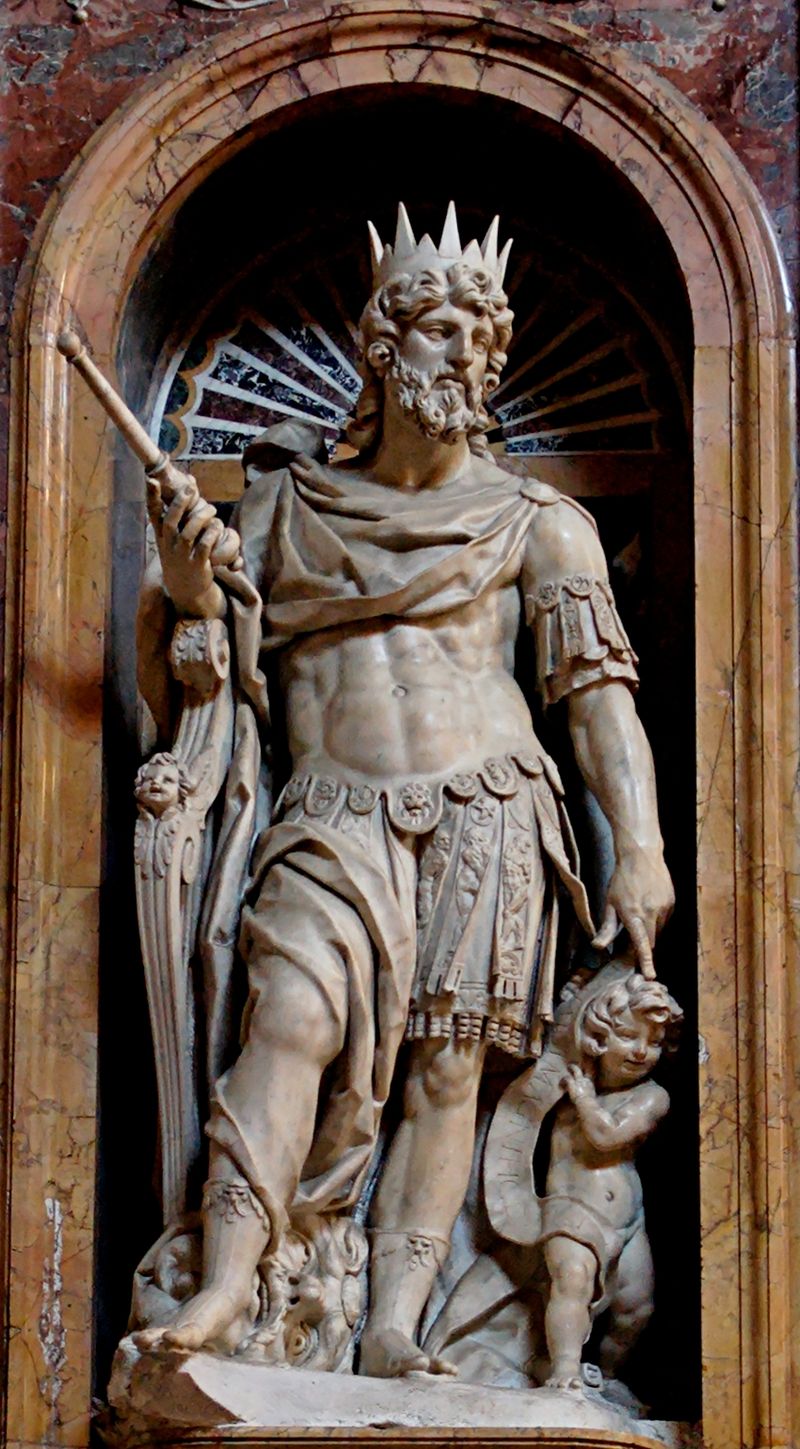
Giovanni Francesco Barberi (il Guercino), King David (1651)

Giovanni Francesco Barberi (il Guercino), King David (1651)

Psalm 16

<A Miktam of David.>
1 Protect me, O God, for in you I take refuge.
2 I say to the LORD, “You are my Lord; I have no good apart from you.”
3 As for the holy ones in the land, they are the noble, in whom is all my delight.
4 Those who choose another god multiply their sorrows;
their drink offerings of blood I will not pour out or take their names upon my lips.
5 The LORD is my chosen portion and my cup; you hold my lot.
6 The boundary lines have fallen for me in pleasant places; I have a goodly heritage.
7 I bless the LORD who gives me counsel; in the night also my heart instructs me.
8 I keep the LORD always before me; because he is at my right hand, I shall not be moved.
9 Therefore my heart is glad, and my soul rejoices; my body also rests secure.
10 For you do not give me up to Sheol, or let your faithful one see the Pit.
11 You show me the path of life. In your presence there is fullness of joy;
 in your right hand are pleasures forevermore.
 
When I was growing up I assumed that the world of the Hebrew Scriptures (or the Old Testament) which was written to the people of Israel and Judah was a world that was as monolithic as I assumed things were growing up in my own childhood. Just because everyone I knew growing up was associated with a Christian church and I think the church was still, at least the Lutheran churches I grew up within, operating out of a Christendom concept where everyone at least had a church that they belonged to (even if they didn’t regularly or ever attend). I was wrong about the world that I grew up in and I was wrong about the Hebrew Scriptures. Perhaps being a pastor I have a heightened awareness to the other things that have placed their claims upon people’s lives and I do believe that the church is losing the privileged place it once held in society. There are so many competing voices that the church deals with (and perhaps the church has always dealt with) and I know I spend a lot of time thinking about how I can address the questions that are a part of our world while remaining faithful to the core ideas of my faith.

In Psalm 16 the Psalmist is attempting to remain faithful in the midst of an atmosphere that has several religious choices. The Psalm itself may be from a priest or from David (as its it is attributed to) but in their attempts at faithfulness they feel isolated. The holy ones of the land, presumably those who are remaining faithful, seem to be in conflict with those who are either turning away to other religious options or who are trying to blend together the worship of the LORD with gods like Baal and Asherah (treating the LORD as one among many). Perhaps the Psalmist is trying to distinguish between himself and the others who are willing to present offerings to other gods and take their names upon their lips. The Psalmist in their gut (in verse seven where it speaks in the NRSV translation of my heart instructs me this is literally my kidneys, the guts-where feelings come from in Hebrew thought) knows that what they are doing is right, but it may be unpopular. The more I spend time with the Hebrew Scriptures, the more I realize that there were few, if any, times where the people exclusively worshipped the LORD.

In our own day we too have to struggle with how to remain faithful in a pluralistic world, where many of the other messages may not be associated with another religion but instead may be reflective of the consumeristic society, the allegiance to states, various political ideologies or the continued pressures of a society where entertainment and sports occupy a huge amount of the public’s loyalty. None of these are bad things but they are penultimate (less that ultimate, secondary things). There are many things that may demand our tribute, our own blood offerings. Yet, I think the challenge in this and every age is to trust in the LORD, to know in one’s gut that one’s faith in the LORD is well placed, and even in the midst of other alternatives to let our heart be glad, our soul rejoice and our body secure in the portion that the LORD has allotted to us.

Psalm 15- Entering the Sacred Presence of God

The Temple by Radojavor@deviantart.com

The Temple by Radojavor@deviantart.com

Psalm 15

 <A Psalm of David.>
1 O LORD, who may abide in your tent? Who may dwell on your holy hill?
2 Those who walk blamelessly, and do what is right, and speak the truth from their heart;
3 who do not slander with their tongue, and do no evil to their friends,
  nor take up a reproach against their neighbors;
4 in whose eyes the wicked are despised, but who honor those who fear the LORD;
  who stand by their oath even to their hurt;
5 who do not lend money at interest, and do not take a bribe against the innocent.
  Those who do these things shall never be moved.

How does one prepare to enter the sacred spaces of the world, those places where the presence of the divine makes holy the profane? In many cultures there are a number of rituals one must undergo to purify oneself and prepare to enter the holy places of the world-those places where heaven and earth seem to meet. Even within the Bible there are places where there are actions that the priest must do to prepare for their tasks and in places like Leviticus 21: 17-21 and Deuteronomy 23: 1-6 there are limits placed upon who may enter the tabernacle or the temple to serve. Yet here, in Psalm 15, as is frequently the case in the Psalms and prophets there is no physical requirements, exclusions or cultic actions that prepares one to enter into the house of the LORD, instead the focus is on the way one lives out one’s relationship with one’s neighbor. Perhaps echoing this Psalm, the prophet Micah can say:

“With what shall I come before the LORD, and bow myself before the God on high?
Shall I come before him with burnt offerings, with calves a year old?
Will the LORD be pleased with thousands of rams, with ten thousand rivers of oil?
Shall I give my firstborn for my transgression, the fruit of my body for the sin of my soul?
He has told you, O mortal, what is good; and what does the LORD require of you
but to do justice, and to love kindness, and to walk humbly with your God. Micah 6: 6-8

In contrast to the duplicitous hearts in Psalm 12 and those who say in their hearts “there is no God” as in Psalm 14, stand the righteous ones who speak truth from the heart and who honor and fear God are allowed to enter into the presence of God.  It is one’s life in relation to one’s neighbor that prepares one to enter into the temple or tabernacle, one’s life in the mundane life of community that is the preparation for the sacred encounter with God. Loving one’s neighbor and living as truthful and righteous people toward the community is preparation for encountering God in the promised communion. As Rolf Jacobson can state, “when the Lord extends an invitation for a person to enter the sacred space, God insists that one’s neighbors are also invited.” (Nancy deClaisse-Walford, 2014, p. 173)

This short Psalm has a number of phrases that point towards what a life that is prepared to see God’s presence not only in the holy spaces but in the normal secular spaces of life as well. Speaking truth from one’s heart refers both to a person whose speech reflect truly their own character but also their character is pure and peaceful as well. The refuse to speak of a neighbor in a way that compromises the person’s participation within the community but instead as Martin Luther can talk about in his explanation to the eighth commandment:

We are to fear and love God, so that we do not tell lies about our neighbors, betray or slander them, or destroy their reputations. Instead we are to come to their defense, speak well of them, and interpret everything they do in the best possible light. (Luther, A Contemporary Translation of Luther’s Small Catechism, 1978, p. 20)

While we may struggle a little initially with the language of, “in whose eyes the wicked are despised” there is a strong need for the community not to tolerate or ignore things that are contrary to the justice their God has called for. When we turn a blind eye or accept, for example, the abuse of children or the oppression of the homeless then we have also turned away from the God who cares for the children and the vulnerable. After wrestling with Deuteronomy and Jeremiah I’ve come to appreciate the urgency the people of Israel felt for attempting to create a society that lived into the vision God called them to. A trustworthy society where the words and actions represented the God’s dream for them and the world. A society where mercy for one’s neighbor was more important than profit one could make upon one’s neighbor by charging interest to them in their need.

The Psalm is a bold vision and a vision that is challenging in our time. It is a vision that looks at holiness in terms of how we treat our neighbors rather than some version of piety or orthodoxy. In this Psalm and in many other places, particularly in the Psalms and prophets, issues of proper attire or cultic actions are disregarded or at least given a far lower place than one’s relationship with the neighbor. In the Sermon on the Mount, Jesus can echo this sentiment when he talks about leaving one’s gift before the altar to be reconciled to one’s neighbor (Matthew 5: 23-24). In contrast to the previous three Psalms, where one finds oneself in the position where the wicked seem to be prospering, the Psalmist now returns to the vision of the first Psalm, where the LORD watches over the righteous and they will not be moved. Their words and their actions truthfully come out of their heart and even when their truthful words and actions or their willingness to stand with their neighbor causes them hurt they are not moved. They look at the world through the lens of mercy rather than profit, through the lens of love rather than acquisition and they are perhaps ready to enter into the sacred spaces of the world where God meets them because they lived a godly life in the secular places of life.

Psalm 14- The Wisdom of Holding to the Covenant

Jozsef Somogyi's statue of the Tired Man in Mako, Hungary

Jozsef Somogyi’s statue of the Tired Man in Mako, Hungary

Psalm 14

To the leader. Of David.
1 Fools say in their hearts, “There is no God.”
   They are corrupt, they do abominable deeds;
   there is no one who does good.
2 The LORD looks down from heaven on humankind
   to see if there are any who are wise,
   who seek after God.
3 They have all gone astray, they are all alike perverse;
   there is no one who does good,
   no, not one.
4 Have they no knowledge, all the evildoers
   who eat up my people as they eat bread,
   and do not call upon the LORD?
5 There they shall be in great terror,
   for God is with the company of the righteous.
6 You would confound the plans of the poor,
   but the LORD is their refuge.
7 O that deliverance for Israel would come from Zion!
   When the LORD restores the fortunes of his people,
   Jacob will rejoice; Israel will be glad.

In the ancient Middle East the idea of a godless world is unknown. However, in the Psalmist’s time and in every time there are those who functioned as practical atheists, whose spoken beliefs had little or no impact on their decisions throughout their lives. The heart in the Hebrew world view was not the seat of emotion but the seat of decision making and will. The heart is where actions spring from. Note that the Psalm does not say ‘Fools say with their mouths’ but ‘Fools say in their hearts.’ As the Psalm unfolds we see the way that the foolish actions are really actions against the covenant that God has made with the people of Israel. The LORD looks for those who are seeking the will of God. As Psalm 1 can state, “but their (the wise/righteous) delight is in the law of the LORD, and on his law they meditate day and night.” (Psalm 1.2)

The fool is known by what they do and their actions reflect a betrayal of the justice that was considered essential to the covenant.  The book of Deuteronomy dwells frequently on the fear that the people in prosperity will “forget the LORD their God, by failing to keep his commandments, his ordinances and his statutes,” (Deuteronomy 8. 11) and the poor, the widow, the orphan and the alien will be denied justice. When the acquisition of wealth becomes more important than the neighbor then the people have forgotten the LORD their God. When the people turn away from placing God at the center of their day to day actions and decisions the result is the perversion of the covenant people. They are no longer the salt of the earth but rather they are corrupt and their corruption spreads to everything around them. The actions of the people have consequences for not only themselves, but also for the community and the very land that they live upon.

The language of the Psalm also reaches into the language of the prophetic. The dark line speaking about the wicked “who eat up my people as they eat bread,” reaches a fuller exposition in Micah. In Micah, speaking to the rulers who have turned away from the covenant, the prophet can say:

you who hate good and love evil, who tear the skin off my people, and the flesh off their bones, who eat the flesh of my people, flay their skin off them, break their bones in pieces, and chop them up like meat in a kettle, like flesh in a caldron. (Micah 3. 2f.)

And yet these same leaders may use their words to cry upon the LORD, but God will not answer them.

Unlike Psalm 13 which cries out for immediate action, Psalm 14 takes more of a tone of the inevitability of God’s action on behalf of the poor. The hearer is cautioned to take the way of the wise and the side of the poor for that is the side of God. God hears and sees and protects the powerless and the vulnerable. Those wise whose hearts are turned to God know that their actions towards the vulnerable and the powerless are also seen and weighed by God.

A biblical image that comes to mind with this Psalm is the ending of Solomon’s reign and the beginning of his son, Rehoboam’s reign. Solomon is initially lifted up as being wise and following the way of the LORD but in 1 Kings 11 Solomon’s heart is turned away from the LORD. When he dies and his son takes the throne there is already conflict within the nation of Israel, the economic policies of Solomon have placed a heavy burden on the population and the assembly of Israel asks for relief from Rehoboam. Rehoboam refuses to relieve any of the economic burdens on the people and the kingdom is spit in two, never to be united again. (1 Kings 12) The book of Kings looks upon this split as God’s judgment upon the house of David for turning their heart away from the LORD, even though God did not act in supernatural ways but rather simply didn’t sustain the reign of the line of David over the entire house of Israel.

So how do we approach this Psalm in our secular world that is influenced by global economic corporations? For me the Psalm speaks to the faithful as a way of remembering what is it to set one’s heart upon the LORD and how loving the LORD with all one’s heart, soul, mind and strength is linked to loving and protecting one’s neighbor. When we forget this connection we too can become corrupt and allow the community and the environment around us to become corrupted by short term economic interests at the expense of our neighbor. Entering into the prophetic worldview of the scriptures forces us to consider the impact of the decisions we make upon the life of my neighbor’s and especially the lives of the vulnerable.

Psalm 13- The Cry from the God Forsaken Place

Job (oil on canvas) by Bonnat, Leon Joseph Florentin (1833-1922)

Job (oil on canvas) by Bonnat, Leon Joseph Florentin (1833-1922)

Psalm 13

To the leader. A Psalm of David
1 How long, O LORD? Will you forget me forever?
   How long will you hide your face from me?
2 How long must I bear pain in my soul,
   and have sorrow in my heart all day long?
   How long shall my enemy be exalted over me?
3 Consider and answer me, O LORD my God!
   Give light to my eyes, or I will sleep the sleep of death,
4 and my enemy will say, “I have prevailed”;
   my foes will rejoice because I am shaken.
5 But I trusted in your steadfast love;
   my heart shall rejoice in your salvation.
6 I will sing to the LORD,
   because he has dealt bountifully with me.
 
Psalm 13 is one of the examples used to talk about a Psalm of lament because it comes out of the experience of struggle and strife and calls upon God to act upon the crisis that the faithful one is experiencing. The crisis is not only a physical or emotional crisis but for the Psalmist, at its core, it is a theological crisis. The confident opening of the Psalter with Psalm 1 that sings about how the LORD watches over the righteous and the way of the wicked perishing is called into crisis by the moment of conflict where God seems to have forsaken the one lifting up this prayer. In the midst of the crisis the Psalmist cries out to the LORD and calls upon God to act.

This type of bold prayer, which calls upon God to act and to intervene, might seem unusual for many people. Many Christians were taught growing up that you didn’t accuse God or question God’s motives and that prayers were always to be polite and stoic. Although this view is common it has little to do with the Biblical model of prayer or the relationship of many of the faithful with God. Jeremiah, for example, makes numerous accusations towards God throughout the book of Jeremiah, Job also can cry out and expect God to act upon his complaints, and finally the Psalter is full of powerful, unfiltered emotions that are directed towards God and wrestle with the LORD who can bring about a resolution to the struggle. It takes courage to ‘gird up ones loins’ and stand before God in this manner, to be willing to accuse God in failing in God’s responsibility to maintain faithfulness and watchfulness as a covenant partner. The Psalmist views the relationship with God as pivotal for their life and if God turns God’s face away and removes God’s protection and allows the enemy to prosper and prevail then God is not fulfilling God’s part of the relationship. The Psalmist’s faith is strong enough to confront God that all is not right in God’s creation (Nancy deClaisse-Walford, 2014, p. 163) and that God is the responsible party to ensure that the righteous are protected and the wicked are punished.

How long, which is repeated four times in the first half of the Psalm is not asking for a time period but rather for an immediate intervention. It is a rhetorical device that is common in African-American preaching to increase the intensity of the expectation and hope that change is coming for the way things are cannot be sustained in a creation where the LORD is paying attention and is active. For example Martin Luther King, Jr. in his speech in Montgomery, Alabama on March 25, 1965:

How long? Not long, because no lie can live forever. How long? Not long, because you still reap what you sow. How long? Not long, because the arm of the moral universe is long but it bends towards justice. How long? Not long, ‘cause mine eyes have seen the glory of the coming of the Lord.’ (Brueggemann, 2014, p. 79)

How long will the Psalmist continue to cry out to God before God answers? The hope is certainly not long. In the God forsaken place that the Psalmist cries from they know that only the enemy’s triumph and the sleep of death wait for them. They are at the end of the strength and the end of their resources and despair is coldly creeping into their soul, and yet in an act of defiance the call out to their God to act on their behalf, to fulfill God’s promises and to rescue the righteous one from the triumph of the wicked.

The Psalm ends with a note of trust or perhaps, as many commentators believe, the Psalmist has seen God’s answer to their prayer. If the prayer is answered we have no way to know how long elapses between verse four and the final statements in verses five and six. Perhaps they come hours, days, weeks or even years later when the Psalmist now stands in a place where God’s face continues to shine upon them. Yet, perhaps the ending is not a triumphal as a final answer but the whisper of trust into the deafening depression of despair. From my own experiences there can be this type of internal dialogue in that place of hopelessness where one struggles with and for one’s faith. One can boldly cry out to God and call upon God to act in the situation. Even in that space where all one perceives is isolation there can still be that turning back to the foundations of one’s life. I have trusted in you before, your love has not failed in the past, the how long will be not long and even though I may not see it now I can trust that I will indeed sing the songs of the LORD again.

Psalm 12-Save Us from Ourselves

Bible Paintings in Castra center, Haifa- David and Batsheva, David and Avshalom

Bible Paintings in Castra center, Haifa- David and Batsheva, David and Avshalom

Psalm 12

To the leader: according to The Sheminith. A Psalm of David.
1 Help, O LORD, for there is no longer anyone who is godly;
   the faithful have disappeared from humankind.
2 They utter lies to each other;
  with flattering lips and a double heart they speak.
3 May the LORD cut off all flattering lips,
   the tongue that makes great boasts,
4 those who say, “With our tongues we will prevail;
   Our lips are our own—who is our master?”
 5 “Because the poor are despoiled, because the needy groan,
   I will now rise up,” says the LORD;
  “I will place them in the safety for which they long.”
6 The promises of the LORD are promises that are pure,
   silver refined in a furnace on the ground,
   purified seven times.
7 You, O LORD, will protect us;
   you will guard us from this generation forever.
8 On every side the wicked prowl,
   as vileness is exalted among humankind.
 
The Psalm begins as a cry for help and while the cry may come from an individual the cry goes forth on behalf of a community that no longer is the place it was intended to be. What was dreamed to be a place of faithfulness and trustworthy people has turned into a place where tongues have been loosed, boasts have been made and community has been destroyed. The double-hearted nature of the community has broken the heart of the Psalmist and sent them into a search for hope in the midst of the empty words they see in a community that was meant to be something much different. In a toxic environment where the tongues of those who are seeking their own interests rule the day the community of the faithful is in mortal peril.

Many leaders of communities have known times where the community, through conflict or by the actions of a bully, devolves into the opposite of its original intent. Unfortunately, it is all too common for churches and places of worship which preach forgiveness to become unforgiving. Sometimes the message of justice becomes perverted into a message of just-us, and sometimes the boastful words overpower the quiet insistence of those trying to follow whole heartedly. It is from this experience of disillusionment that the Psalmist cries for help. In a feeling of isolation and desolation where the faithful have been replaced by the duplicitous, the powerlessness of the Psalmist on their own is overpowering.

Family Systems Theory can talk about a Karpmann Drama Triangle where people are stuck into roles as the victim, oppressor or hero. Claus Westermann noted that in many of the Psalms of Lament that Israel or the speaker find themselves in the role of the victim where the LORD becomes the liberator of the speaker or Israel from their adversaries. (Brueggemann, 2014, p. 74) With the speaker in the role of the victim in the midst of their adversaries they are reliant upon God as their deliverer from their adversaries. This is the nature of the relationship that the people of God have with their deliverer. However, the danger is that these same people can easily move into the role of the oppressor where now the LORD must stand with the oppressed ones over against them. Perhaps, this is something that the Psalmist feels is now happening among their community. That the empty words have allowed the people to deny the contingency of their existence that is based upon their living into the covenant they have with the God of Israel.

The Psalmist sees those around him denying reality and doing violence to others in that denial. They have arrogated themselves into the position of being their own gods who no one can judge. (Nancy deClaisse-Walford, 2014, p. 156) Their tongues have become the small member that boasts of great exploits, setting fire to the world around them. (See James 3: 1-12) In claiming this place they have denied the reign of God feeling free to craft their own dominions.  Yet, as so often is the case, when the powerful and the boastful feel free to create their own realities it comes at the expense of the poor and the vulnerable. Whether the Psalmist can claim a spot among the alien, the widow and the orphan (the classic way that the Hebrew bible speaks of the vulnerable) or not they are aware of the way in which the law, the commandments and the ordinances of God attempt to create a society where the oppressed are cared for. Yet, as the community moves away from its groundings and devolves into a place where unpleasant truths are denied at the expense of a more convenient illusion it also becomes a place that loses its understanding of hospitality and mercy.

The Psalm rests on the confidence that God will see and God will intervene even when the immediate evidence may point in the opposite direction. In a place where vileness is exalted among humanity and the poor are despoiled and the needy groan the Psalmist sees beyond the present moment to a hopeful future where God sees and acts. The Psalms understand, like the rest of the Bible, that God acts on behalf of the powerlessness and has an ear for the cries of the poor and oppressed.  It is in the LORD’s answer, “I will now rise up” that the Psalmist trusts. The LORD has acted in the past; the LORD’s promises are true and precious. In comparison to the dross the Psalmist hears spoken around him the promises of God to them are like pure silver. As Mary can sing in Luke’s gospel the time is coming when:

He has shown the strength with his arm; he has scattered the proud in the thoughts of their hearts.
He has brought down the mighty from their thrones, and lifted up the lowly;
He has filled the hungry with good things, and sent the rich away empty.
He has helped his servant Israel, in remembrance of his mercy,
according to the promise he made to our ancestors, to Abraham and to his descendants forever. (Luke 1: 51-55)


Psalm 11: Confident Faith in the Midst of Trouble

Giovanni Francesco Barberi (il Guercino), King David (1651)

Giovanni Francesco Barberi (il Guercino), King David (1651)

Psalm 11

To the leader. Of David.
1 In the LORD I take refuge; how can you say to me,
“Flee like a bird to the mountains;
 2 for look, the wicked bend the bow,
they have fitted their arrow to the string,
to shoot in the dark at the upright in heart.
 3 If the foundations are destroyed, what can the righteous do?”
 4 The LORD is in his holy temple;
the LORD’s throne is in heaven.
His eyes behold, his gaze examines humankind.
 5 The LORD tests the righteous and the wicked,
and his soul hates the lover of violence.
 6 On the wicked he will rain coals of fire and sulfur;
a scorching wind shall be the portion of their cup.
 7 For the LORD is righteous;
he loves righteous deeds;
the upright shall behold his face.

This is another Psalm where we do not know the threat that David (Psalm 11 is attributed to David) faces, yet the advice to flee like a bird to the mountains because of the strength of those opposing the speaker poetically evokes a mortal threat. Yet there is a defiance in the initial line which sets the tone for the rest of the Psalm, “In the LORD I take refuge.” The Psalmist trusts that, even in the midst of a life threatening situation, the LORD sees and will act. This Psalm, like many of the Psalms, revolves around the active move to take refuge in the LORD and to trust that the LORD will act. It means relinquishing control over one’s future and to stand in the trust that even in the midst of the speaker’s powerlessness that God can indeed act on behalf of the righteous and against the wicked.

This defiant stance, of trusting the LORD in the presence of danger, is a frequent theme of the Psalmist. For the writers of the Psalms they trust that God does see, act and judge. That God sustains the righteous and will in time punish the wicked. The author’s trust in God enables them to place themselves into the position of danger even when they may feel powerless. This poetic approach to faith that trusts in the midst of crisis has been a balm for many of the faithful across the generations. Luther’s ‘A Mighty Fortress’, which is inspired by Psalm 46 is an echo of this type of faith. Yet, the Psalms are poetic and not dogmatic and just because the poet is able to appeal to the LORD in the midst of their situation does not condemn a person who may flee in a different situation.

In 1527, during the early reformation at Wittenberg, a case of Bubonic plague was discovered. The students were sent home but Luther remained in the city and was busy with pastoral and practical care of the sick. Late in the year Luther wrote an open letter on ‘Whether One May Flee From A Deadly Plague’ where Luther can endorse the type of faith that is stated here in the Psalm, because in times of death someone must stay: doctors, nurses, preachers and others necessary to care for the afflicted. But Luther also allows that there will be those whose faith is not at this place and they should be allowed to flee and that those who are unnecessary may be acting on a natural tendency, implanted by God to flee death and save one’s life. (Luther, 1989, pp. 736-755) Luther’s caution was not to condemn those whose walk of faith allowed them to flee like a bird to the mountains nor those who for the sake of the neighbor walked into the place where death seemed to reign.

Psalm 2 – The LORD’s Messiah

  Psalm 2

Why do the nations conspire, and the peoples plot in vain?
 2 The kings of the earth set themselves,
and the rulers take counsel together,
against the LORD and his anointed, saying,
 3 “Let us burst their bonds asunder, and cast their cords from us.”
 4 He who sits in the heavens laughs; the LORD has them in derision.
 5 Then he will speak to them in his wrath, and terrify them in his fury, saying,
 6 “I have set my king on Zion, my holy hill.”
 7 I will tell of the decree of the LORD: He said to me,
“You are my son; today I have begotten you.
 8 Ask of me, and I will make the nations your heritage,
and the ends of the earth your possession.
 9 You shall break them with a rod of iron,
and dash them in pieces like a potter’s vessel.”
 10 Now therefore, O kings, be wise; be warned, O rulers of the earth.
 11 Serve the LORD with fear, with trembling
 12 kiss his feet, or he will be angry, and you will perish in the way;
for his wrath is quickly kindled. Happy are all who take refuge in him.
  

Psalms 1 and 2 introduce the Psalter and while Psalm 1 highlights one of the major foci of the Jewish people, God’s law the Torah, Psalm 2 focuses on the Messiah, the Davidic King.  Perhaps this Psalm was at one point used in coronations or in some other ritual setting within the nation of Israel or later the kingdom of Judah, and it reflects back upon some mystical time when Israel was an empire that ruled over vassal kings. There is an idealization of the dominion and power of the Davidic kingship which reached its peak under Solomon and would from that point forward be a small kingdom caught among the rise and falls of empires in Egypt, Assyria and Babylon. Even with the focus on the Lord’s anointed (literally the Lord’s messiah) the focus, as through out the Psalter, is taking refuge in the Lord.

For Christians this is one of the Psalms that has often been read through the image of Jesus, particularly verse 7 “You are my son; today I have begotten you” and while Christians should not forget that this Psalm originally refers back to a Davidic king part of the living witness of scriptures allows people to hear the words echoed in a new way in a new era. Yet if one is going to listen to this Psalm in terms of Jesus one does have to wrestle with the militaristic language of verse 9 (You shall break them with a rod of iron, and dash them in pieces like a potter’s vessel) and yet this is not that much different from some of the triumphal language lifted up by Paul and others in the New Testament.

Bible paintings in the Castra center, Haifa-Samuel Annointing David and David and Goliath

Bible paintings in the Castra center, Haifa-Samuel Annointing David and David and Goliath


Psalm 1 and 2 taken together lift up the Torah and the Davidic King as two of the foci of the way of life outlined within the meditations contained within the Psalter and yet both Torah and King are to point back to the LORD. The linkage at the beginning of Psalm 1 (Happy are those who do not follow the advice of the wicked) and the end of Psalm 2 (Happy are those who take refuge in him) joins the king and the law together as ways in which God establishes God’s rule among God’s people. As in many of the other Psalms the LORD will laugh at the movements of the nations and empires and for a nation that frequently found itself under duress from other kings and rulers perhaps this Psalm was its own revelation of God’s rule in, with and under the movements of the kings and empires around them. Perhaps like King Arthur for the Anglo-Saxon time it reflects back to the time of the once and future king, the one who was a ‘man after God’s own heart.’ To a simpler or perhaps better time. Perhaps it is a part of the imagination and story that allows the people to maintain their identity in the midst of dispersion and exile, of disillusioned hopes of rebuilding the temple and their loss of power and status in the world. Perhaps this was one more way in which they were able to see the shade pulled back and trust that the LORD was the one who was in control rather than the other gods and lords and powers. And perhaps it is wise to remember that the Psalter is poetry which attempts to express truth that transcends the situation that the people may have found themselves in. Or perhaps a more cynical approach would look at this as a form of self-aggrandizement of the Davidic kings, granting themselves divine authority and  granting themselves a position of ‘sons of God’ in a way that the Caesars in Rome would later do in a different way.

I choose to read this in a non-cynical way. I am certainly influenced by the post-modern hermeneutic of suspicion but at a certain level I have had to learn to trust. To let the words wash over and to listen deeply for the wisdom in the poetry. The God of the Hebrew people, the same God the Christian people would come to know, was deeply involved in the world. Politics and power were not separate things but a part of the engaged and sacred reality of their God who engaged the world.  A God who can laugh at the movement of armies and empires and who is their refuge and strength as Psalm 46 and other places will remind them. Who when the kings of the earth seem to be taking counsel against the chosen people in Zion or in all times and places throughout the world, who still reigns and holds those who rebel against God’s rule in derision. The one who reads and approaches and meditates on the Psalter as a way of understanding how God approached them in the earth find the blessedness (happiness) by taking refuge in this hope, this poetry and this narrative.