Tag Archives: Justice

Deuteronomy 25: Punishment, Justice, and the Enemy

Deuteronomy 25: 1-3 The Limit of Punishment

1 Suppose two persons have a dispute and enter into litigation, and the judges decide between them, declaring one to be in the right and the other to be in the wrong. 2 If the one in the wrong deserves to be flogged, the judge shall make that person lie down and be beaten in his presence with the number of lashes proportionate to the offense. 3 Forty lashes may be given but not more; if more lashes than these are given, your neighbor will be degraded in your sight.

Deuteronomy believes in a harsh justice but it also sets limits on the execution of justice or revenge. This is one of those places where the dignity and reputation of the neighbor limit the maximum punishment of lashes the neighbor can receive as forty. The action takes place in the sight of the judge who orders the proportionate punishment so that the dignity of the offender is preserved. Although we may live in a society that has trouble with this type of corporal punishment, this is a relatively new thing in our society. The idea of submitting oneself to the measured discipline of the community seems to be an expectation for being a part of the society of Israel. The Apostle Paul in 2 Corinthians 11:24 can claim that five times he received the punishment of forty lashes minus one in addition to the other punishment he lists, and this is one of the many indications that Paul saw himself remaining as a part of the Jewish community since he submitted to the discipline.

In our own society we have become very litigious and often use fines or imprisonment as a means of discipline. Yet, when it comes to these fines and imprisonments which can often be excessive for certain crimes (particularly drug related offenses with harsh minimum sentences) in addition to the shame that comes with a criminal record we may want to relook at the idea of punishment that does not permanently diminish our neighbor in our eyes. Are judges enabled to give punishments that are proportional to the offense or are they bound by laws that are harsh allowing the guilty not chance at a non-degraded standing within society. These are difficult issues, but they are the type of big questions of a society that the book of Deuteronomy deals with.

Deuteronomy 25: 4 Care for the Working Animals

4 You shall not muzzle an ox while it is treading out the grain.

This is an acknowledgment that the working animals are not machines to be driven mercilessly, but even in small ways the lost grain that an ox eats while treading the grain is a part of its due. It is one of the windows into a worldview where animals and plants (see Deuteronomy 20 on trees in war for example) are given some protection as well. They all are a part of the creation of the LORD and are entitled to the benefits of striving with humanity to carve a living from the earth. Paul references this section in 1 Corinthians 9:9 in his discussion of his authority and that he could ask for a material benefit for his work among the Corinthians even though he states he made no use of those rights. 1 Timothy 5: 17-18 also uses this line of argument for the supporting of elders.

Deuteronomy 25: 5-10 Levirate Marriage

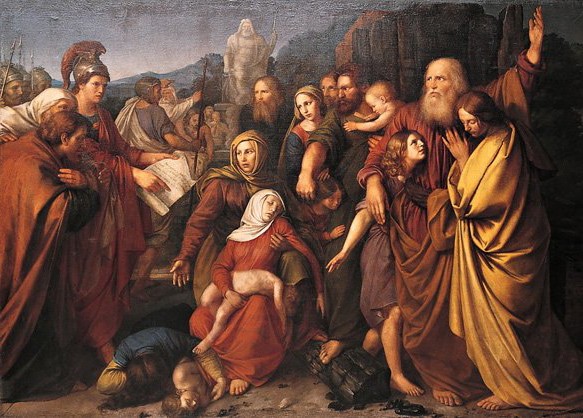
Francesco Hayez, A Portrait of a Woman as Ruth (1853)

Francesco Hayez, A Portrait of a Woman as Ruth (1853)

 5 When brothers reside together, and one of them dies and has no son, the wife of the deceased shall not be married outside the family to a stranger. Her husband’s brother shall go in to her, taking her in marriage, and performing the duty of a husband’s brother to her, 6 and the firstborn whom she bears shall succeed to the name of the deceased brother, so that his name may not be blotted out of Israel. 7 But if the man has no desire to marry his brother’s widow, then his brother’s widow shall go up to the elders at the gate and say, “My husband’s brother refuses to perpetuate his brother’s name in Israel; he will not perform the duty of a husband’s brother to me.” 8 Then the elders of his town shall summon him and speak to him. If he persists, saying, “I have no desire to marry her,” 9 then his brother’s wife shall go up to him in the presence of the elders, pull his sandal off his foot, spit in his face, and declare, “This is what is done to the man who does not build up his brother’s house.” 10 Throughout Israel his family shall be known as “the house of him whose sandal was pulled off.”

 This passage enters into the narrative of Israel in both the story of Tamar in Genesis 38 as well as the book of Ruth. Deuteronomy is written in an intensely patriarchal world where barrenness is a crisis because it threatens the perpetuation of the family’s name. Women were honored in their role as bearers of children and in their role in allowing for the continuance of the line. The idea of Levirate marriage is foreign to our time, where the idea of marrying the wife of a deceased brother seems out of place. Yet, in the world of Deuteronomy it is an expectation and an obligation. The brother is to ensure that there is an heir to inherit the deceased’s land and title. This also provided protection for the widow for she both has a family she is brought into and with the birth of an heir there is the promise that she will be provided for once her son inherits. In the ancient world, where no government safety net exists, children were the security of their parents in their old age. Even in the ten commandments this concern is addressed in the command to honor the father and the mother (Deuteronomy 5: 16).

In the story of Tamar, who gets herself pregnant by Judah when he denies her his youngest son, is a fascinating short story of a woman who boldly claims her rights to protection and inheritance however she needs to. As Judah can acknowledge at the end of the story, “She is more in the right than I, since I did not give her to my son Shelah.” (Genesis 38: 26) In the book of Ruth this passage serves as the law behind the meeting of Boaz and the unnamed next-of-kin where the issues of inheritance and marriage are tied together. The kinsman acknowledges that he cannot redeem the property, and marry Ruth with the property passing to her children, and so the ‘right’ passes to Boaz. It is uncertain how deep of a shaming was associated with the unwillingness or inability to care for the needs of a widow, as Deanna Thompson states, “This public shaming would give this family the reputation of not providing for its widows, thus making it more difficult for the family to contract marriages for their sons.” (Thompson, 2014, p. 183)

Deuteronomy 25:11 An Unfair Fight

  11 If men get into a fight with one another, and the wife of one intervenes to rescue her husband from the grip of his opponent by reaching out and seizing his genitals, 12 you shall cut off her hand; show no pity.

Deuteronomy is written from a male dominant perspective and to the author of Deuteronomy the idea of a woman ‘sexually shaming’ a man in public (Thompson, 2014, p. 184). The genitals of another man which are exposed and could potentially put the man and the woman on an equal footing are to be off limits in a fight. As we saw in Deuteronomy 23: 1-8 the damaging of the testicles or penis is enough to make a man no longer a man in the eyes of the assembly. For men sexual generativity is on par with sight and limbs and the punishment listed of mutilation is only prescribed for one other event (in Exodus 21: 22-25) where a man injures a woman and causes her to miscarry. The husband may demand whatever punishment he sees fit in that case. Martin Luther addresses this broadly with the maxim, “Evil should not be done that good may come of it.” (Luther, 1960 (1525), p. 9:249) where he talks about the woman wanting to do good on behalf of her husband and yet doing it in a ‘cowardly’ way.

Again this brings up issues centered around women’s rights compared to men’s rights and the rights of self-defense. There are times I am convinced we are more concerned with protecting men than women, and while we might want to protect the vulnerable areas of both men and women how do we also ensure that women are given the ability and permission to protect themselves in an unfair fight and do we accuse that woman of sexually shaming the man or simply attempting to protect herself or her family?

 Deuteronomy 25: 13-16 Fair and Just Weights and Measures

 13 You shall not have in your bag two kinds of weights, large and small. 14 You shall not have in your house two kinds of measures, large and small. 15 You shall have only a full and honest weight; you shall have only a full and honest measure, so that your days may be long in the land that the LORD your God is giving you. 16 For all who do such things, all who act dishonestly, are abhorrent to the LORD your God.

Justice is a critical part of the people’s life within the land. There will always be the temptation to make a business deal work to one’s advantage and if one can skew measurements and weights in one’s favor one can cheat one’s neighbor out of their fair share. This type of injustice is another of the things that obtain the stronger disapproval of being abhorrent to the LORD. Economic injustices would be a common cry of the prophets for example in Amos 8: 5-6: saying, “When will the new moon be over so we may sell grain; and the Sabbath, so that we may offer wheat for sale? We will make the ephah small and the shekel great, and practice deceit with false balances.

In a barter economy where grain and oil are traded it is easy to think of concrete ways where this type of imbalance could be used to create economic advantages and disadvantages. Yet, in our world sometimes the examples are a little harder to see. When a company uses an inferior material that produces an item that wears out quickly, or a corporation delays in repairing a safety concern because it is cheaper to allow the improper item to remain in use, or when practices are used that harm the land and environment and then others have to bear the cost of cleaning up the land. In our days, as in the ancient times, acting dishonestly and can affect how long our days are in our own land. With the crisis with the water supply in Flint, Michigan we can see the cost when individuals and a government are not honest in their measurements and allow things to become unsafe for their society.

Deuteronomy 25: 17-19 The Amalekites
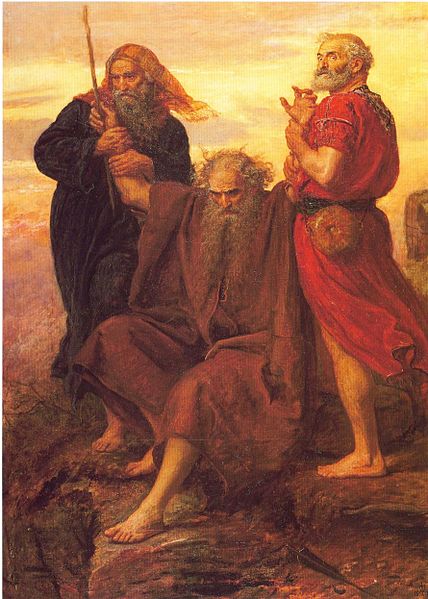
John Everett Millais (1829-1896), Victory O Lord!

John Everett Millais (1829-1896), Victory O Lord!

 17 Remember what Amalek did to you on your journey out of Egypt, 18 how he attacked you on the way, when you were faint and weary, and struck down all who lagged behind you; he did not fear God. 19 Therefore when the LORD your God has given you rest from all your enemies on every hand, in the land that the LORD your God is giving you as an inheritance to possess, you shall blot out the remembrance of Amalek from under heaven; do not forget.

The warrior God re-emerges here at the end of chapter 25 and demands revenge upon the Amalekites. In Exodus 17: 8-16 we hear the story of the conflict between the people of Israel, shortly after their emergence from Egypt, and Amalek. In the story Moses holds up his staff and the people prevail, but as Moses’ arms become tired the people falter, so Aaron and Hur hold up his hands and the battle is won. As Exodus states:

Then the LORD said to Moses, “Write this as a reminder in a book and recite it in the hearing of Joshua: I will utterly blot out the remembrance of Amalek from under heaven.” And Moses built an altar and called it, the LORD is my banner, He said, “A hand upon the banner of the LORD! The LORD will have war with Amalek from generation to generation.” Exodus 17: 14-16

The Amalekites become the enemy memorialized in a slogan, much as ‘Remember the Alamo’ or ‘Remember Pearl Harbor’ allowed for Texans or Americans to call to mind an earlier attack of an enemy. The people are to never forget this action and to never again allow it to happen. This memory sets the stage for a contentious history between the peoples and the people of Amalek enter the story of Israel again in the curses of Balaam in Numbers 24: 20, “First among the nations was Amalek, but its end is to perish forever,” in 1 Samuel 15 where King Saul defeats the Amalekites but leaves King Agag alive (disobeying the LORD) and probably in Esther 3:1 where Haman the Agagite is thought to be a descendent of Agag and the hatred between the remnant of Israel and the remnant of Amalek continues to burn.

We have seen many instances in history where ancient feuds emerge in surprising ways leading to acts of extreme violence and genocide. As Archbishop Desmond Tutu can state, “there is no future without forgiveness.” I talk more about this in the related passage of Deuteronomy 20 (or in the passages at the end of Esther, Esther 9:1-10 and 11-19). I spend more addressing the way passages like this would have been heard in the ancient world and how we talk about them today and don’t need to rearticulate them at this point. Deuteronomy is not a text that is always comfortable for us and passages like this where the people are commanded to blot out another people are passages we will have to struggle against if we are to embrace Christ’s call to love our enemies. In a time where many people want to use ‘Never forget’ in relation to the terrorist attacks of September 11th, we may also be condemning ourselves to a long history of warfare and hatred unless we can learn to remember rightly where the past violence does not define the totality of our future. I speak more about this idea of remembering rightly, influenced heavily by Miroslav Volf’s book The End of Memory here.

Deuteronomy 24: Divorce, Purity and Justice

"Ten Commandments by A.Losenko (?)" by Anton Losenko - http://www.university.kiev.uawww.uer.varvar.ru/arhiv/gallery/klassitsizm/losenko/losenko13.html. Licensed under Public Domain via Wikimedia Commons - https://commons.wikimedia.org/wiki/File:Ten_Commandments_by_A.Losenko_(%3F).jpg#/media/File:Ten_Commandments_by_A.Losenko_(%3F).jpg

“Ten Commandments by A.Losenko (?)” by Anton Losenko – http://www.university.kiev.uawww.uer.varvar.ru/arhiv/gallery/klassitsizm/losenko/losenko13.html. Licensed under Public Domain via Wikimedia Commons – https://commons.wikimedia.org/wiki/File:Ten_Commandments_by_A.Losenko_(%3F).jpg#/media/File:Ten_Commandments_by_A.Losenko_(%3F).jpg

Deuteronomy 24:1-5  Divorce, Remarriage and Wedded Bliss

1 Suppose a man enters into marriage with a woman, but she does not please him because he finds something objectionable about her, and so he writes her a certificate of divorce, puts it in her hand, and sends her out of his house; she then leaves his house 2 and goes off to become another man’s wife. 3 Then suppose the second man dislikes her, writes her a bill of divorce, puts it in her hand, and sends her out of his house (or the second man who married her dies); 4 her first husband, who sent her away, is not permitted to take her again to be his wife after she has been defiled; for that would be abhorrent to the LORD, and you shall not bring guilt on the land that the LORD your God is giving you as a possession.
 5 When a man is newly married, he shall not go out with the army or be charged with any related duty. He shall be free at home one year, to be happy with the wife whom he has married.

As a person who has gone through a divorce (I share some of my reflections on this here, here and here) I found it interesting that this is really the only place that divorce is discussed in the law for the general population. There are the prohibitions of a priest marrying a divorced woman in Leviticus 21 and the ability of a divorced daughter of a Levite to return to her father’s home and eat of his food in Leviticus 22: 13 but otherwise the reality of divorce is simply assumed. Numbers 30, for example can discuss that the vows a divorced woman makes are bound to her, while a married woman the husband (or if unmarried the father) may nullify the vows-but divorced women are an assumption as is their remarriage. We saw that in Deuteronomy 22: 13-30 a couple situations (the false accusation of lost virginity before marriage or a virgin who is violated and the man pays the bride price for her) where a woman cannot be divorced but in the Hebrew Bible divorce seems mainly to be an assumed option for men. Here the issue of divorce comes up in the complicated issue of a woman who is divorced, remarries, is either widowed or divorced again and a prohibition against her remarrying her first husband.

Here, as in the discussions of blood guilt in Deuteronomy 19, 21 and 22, the concern is for contaminating the land. The re-unification of first husband with the now defiled ex-wife (notice that the husband is not considered defiled since polygynous weddings were accepted in Israel). This is an issue that receives the strong condemnation of being ‘abhorrent to the LORD.’ In the author of Deuteronomy’s ordered world this is simply something that is not to be done.

Deuteronomy discusses things from a male-centered perspective and it is inconceivable that a woman would ask for a divorce. A husband may release the woman from the relationship, but not the other way around in the ancient world. In releasing the woman from the relationship he also removes her from her means of support. For women in the ancient world there were limited options of support, so a divorced woman would be property-less, and if she wasn’t accepted back into her father’s home (and this may have been an issue of shame so severe that a family would not re-accept their child) then she either must re-marry, or be reduced to begging, or prostitution. Even with the provisions to care for the vulnerable outlined below, being a divorced woman in the ancient world would put one at a severe economic disadvantage.

This passage takes on a life in two other significant places in the Bible, the first being Jeremiah 3 where God is cast in the role of the husband who wants to re-take the wife who abandoned her marriage.  God refuses to abandon God’s love for God’s adulterous people (using the language of Jeremiah) and is willing to set aside the past for the possibility of something new. The other place this passage comes up is in Mark 10, and its parallel in Matthew 19, where Jesus is asked by a group of Pharisees whether divorce is lawful. Jesus interestingly reframes the issue that the man who divorces commits adultery against the divorced wife and the woman who divorces (not a conceived possibility in Deuteronomy) commits adultery against her former husband.

Divorce is a difficult issue in ancient times and in modern times. The church has often been a place where divorced men and women were excluded or made to feel like second class citizens. In earlier times, even though my own divorce was not something I wanted or did anything to cause, I would not have been permitted to serve as a pastor within my denomination. There are other denominations where this still would be the case. I have certainly had verses like Titus 1: 6 where it refers to a bishop being, “someone who is blameless, married only once, whose children are believers, not accused of debauchery and not rebellious.” Texts like this are difficult, but essential to wrestle with in a world where we also find divorce as an assumed reality. As we as individuals and churches struggle with issues of relationship like divorce and sexuality it is important to exercise wisdom and compassion. Divorce is something I wouldn’t wish on my worst enemy, even in modern times it is an incredible emotional, financial and spiritual drain on a person. While a man or woman who is divorced in our society has opportunities to re-invent themselves they need communities to care for them while they and the affected families are in very vulnerable states.

The final line in this section links back to Deuteronomy 20 where a person who is recently married is exempted from military service. Here the issue is expanded slightly giving a one-year window where a newly married man is freed from military service.  Here the language can be read that the exemption is so that the wife may be happy, which would be an uncommon acknowledgment of the value of women’s feeling in the ancient world. From a person who served in the Army this is would have interesting implications if it were applied in modern times (and I would think in times of conflict the marriage rate would skyrocket to avoid wartime service), yet in the world of Deuteronomy it makes sense. It is essential for the man to have the ability to ensure a future descendent who will carry on his name and inheritance in Israel. I also wonder how effective this was in practice when the elites would have been able to marry multiple times, and perhaps prevent themselves the risk of military action. Again, very different from the experience of the modern military which is filled with stories of people being married immediately before deployment.

Deuteronomy 24: 6-22: Purity and Justice

  6 No one shall take a mill or an upper millstone in pledge, for that would be taking a life in pledge.
 7 If someone is caught kidnaping another Israelite, enslaving or selling the Israelite, then that kidnaper shall die. So you shall purge the evil from your midst.
 8 Guard against an outbreak of a leprous skin disease by being very careful; you shall carefully observe whatever the levitical priests instruct you, just as I have commanded them. 9 Remember what the LORD your God did to Miriam on your journey out of Egypt.
 10 When you make your neighbor a loan of any kind, you shall not go into the house to take the pledge. 11 You shall wait outside, while the person to whom you are making the loan brings the pledge out to you. 12 If the person is poor, you shall not sleep in the garment given you as the pledge. 13 You shall give the pledge back by sunset, so that your neighbor may sleep in the cloak and bless you; and it will be to your credit before the LORD your God.
 14 You shall not withhold the wages of poor and needy laborers, whether other Israelites or aliens who reside in your land in one of your towns. 15 You shall pay them their wages daily before sunset, because they are poor and their livelihood depends on them; otherwise they might cry to the LORD against you, and you would incur guilt.
 16 Parents shall not be put to death for their children, nor shall children be put to death for their parents; only for their own crimes may persons be put to death.
 17 You shall not deprive a resident alien or an orphan of justice; you shall not take a widow’s garment in pledge. 18 Remember that you were a slave in Egypt and the LORD your God redeemed you from there; therefore I command you to do this.
 19 When you reap your harvest in your field and forget a sheaf in the field, you shall not go back to get it; it shall be left for the alien, the orphan, and the widow, so that the LORD your God may bless you in all your undertakings. 20 When you beat your olive trees, do not strip what is left; it shall be for the alien, the orphan, and the widow. 21 When you gather the grapes of your vineyard, do not glean what is left; it shall be for the alien, the orphan, and the widow. 22 Remember that you were a slave in the land of Egypt; therefore I am commanding you to do this.
This portion of chapter 24 deals predominantly with protecting the vulnerable within the community from exploitation, but within this passage is also a provision for protection from skin disease. The guarding against the “leprous” skin disease, which we honestly don’t know what this disease is-it isn’t what would be medically categorized as leprosy (also known as Hansen’s disease).  The mention of Miriam and Aaron’s speaking against Moses where Miriam is afflicted with this skin disease (Numbers 12) is an interesting narrative linkage that the text makes. Miriam (not Aaron, perhaps because of his role as priest) is placed outside the community, yet the community waits for seven days when she is healed and is able to be re-united with the community. Leviticus 13 and 14 go into great detail for the priests on how they are to diagnose and deal with these skin diseases and it was a significant issue in the community. There are numerous places where lepers are lifted up as a part of the narrative throughout the bible, too many to address here, and apparently this was a significant issue among the people of Israel they had to guard against.

The remainder of the chapter deals with caring for the vulnerable in the community. Verse 6, dealing with taking a mill or millstone in pledge prevents a person’s livelihood from being taken which would not only prevent the repayment of the debt but also imperil the person’s ability to live. To take a person’s livelihood is to deprive them of life. In a similar way they are not to be a society where a person is taken captive or sold into slavery, this was not a practice the people of Israel were to tolerate and this is probably behind the command to not allow kidnapping. In verse 6 the people of Israel are prevented from depriving another Israelite of livelihood and in verse 7 they are prevented from depriving another person of freedom.

In Deuteronomy 23: 19-20 there is already a prohibition against charging interest on debt to another Israelite, but Deuteronomy spends even more time on the issue of debt here. This must have been a pressing issue among the people. As Deanna Thompson can state these laws reveal, “a fundamental respect for the dignity of the neighbor; even if he stands in need of money.” (Thompson, 2014, p. 178)  A person was to respect the neighbor’s property and to wait outside the home to receive a pledge (preventing the lender from voyeuristically deciding what among their neighbor’s property they would confiscate). Nor may a person’s means of being warm at night be taken away. As the prophet Amos can criticize in his time:

They lay themselves down beside every altar on garments taken in pledge;
 and in the house of God they drink wine bought with fines they imposed. Amos 2:8

In any society the poor and vulnerable are likely to be preyed upon by those in power and debt can become a burden that they cannot ever emerge from. Yet, Israel was to be a society that cared for the poor in their midst and did not allow a neighbor to become permanently enslaved or burdened by their debt. In a similar manner the following verses relating to paying the poor and needy laborers daily and not holding onto wages for it could put their livelihood at risk. In a society where the poor are preyed upon by ‘payday loans’ and high interest rates on purchases, higher prices for goods and pay schedules that benefit the business but may not benefit the employee we have a lot we could learn from this view of economic justice based upon being a covenant people.

When I first encountered liberation theology[i] the idea of a “preferential option for the poor” it troubled me, because it seemed that God was picking one group over another. The reality is that the God of the Bible does pick, and that this is a faithful witness to the God we come to know.  As Miroslav Volf can state eloquently:

Consider, second, God’s partiality. In the biblical traditions, when God looks at a widow, for instance, God does not see “a free and rational agent,” but a woman with no standing in society. When God looks at a sojourner, God does not see simply a human being, but a stranger, cut off from the network of relations, subject to prejudice and scapegoating. How does the God who “executes justice for the oppressed” act toward widows and strangers? Just as God acts toward any other human being? No. God is partial to them. God “watches over the strangers” and “upholds the orphan and the widow” (Psalm 147: 7-9) in a way that God does not watch over and uphold the powerful.
Why is God partial to widows and strangers? In a sense, because God is partial to everyone—including the powerful, whom God resists in order to protect the widow and the stranger. (Volf, 1996, p. 221f.)

God seeks justice, but not revenge. We live in a revenge culture, if a person harms me there is the desire to make sure that this could never happen again. In the United States, and much of the world, this also informs foreign policy. Revenge in interpersonal conflicts is addressed here, where the idea of “if you hurt me, I will not only hurt you but all those close to you” is forbidden. A person is to be penalized for their own offense, not their children or parents. Justice ultimately seeks to establish an end to the cycle of punishment. In our own society where children of parents who are in prison are often set up to follow in their footsteps by the lack of opportunities and support for a different path maybe we too can imagine how we could imagine a society where children are not punished for the mistakes of the parents and vice versa.

These commands to help the vulnerable, highlighted in the widow, alien and orphan, are brought into the narrative of liberation of the people from their slavery. In Exodus 23: 9 we hear for the first time this command brought into the narrative “You shall not oppress a resident alien; you know the heart of an alien, for you were aliens in the land of Egypt.” The people are to remember their own situation was not one where they ‘pulled themselves up by their bootstraps’ but instead a gift of their covenant identity with their LORD. They are given concrete ways to enact this justice towards the vulnerable. They are to be shown justice, not taken advantage of. These landless ones are to have a method of living off the plentiful harvest that the people are promised in the land. They are to be different than the world they knew in Egypt, or the societies they see around them. “The neighbor—especially the neighbor in need—lives in a world governed not by the ruthless “iron law” of the market or by the unencumbered autonomy of the powerful, but by the same God who curbed Pharaoh.” (Brueggemann, 2001 , p. 240f.) Throughout their life, they would struggle with this view of justice. The prophets would often cry about the way the widow, orphans and the resident aliens were being denied justice, being oppressed by practices designed to keep them poor and being denied their rights within the land. The vision was a noble one, and yet, justice is a hard dream to achieve. Yet, even though dreams of justice may be difficult to achieve in reality it does not free us from the struggle of attempting to live into the vision of justice that God calls us to.

[i] Liberation theology is a broad term for theological perspectives that came out of various experiences of oppression. Liberation theology started with the experience of base communities in Latin America among the poor, but also now are experienced in black liberation theology, feminist liberation theology and many other branches of theology which utilize the experience of oppression as a lens to encounter God and God’s action towards the world.

Deuteronomy 19: Justice, Refuge and Grace

"Bouguereau-The First Mourning-1888" by William-Adolphe Bouguereau - Art Renewal Center – description. Licensed under Public Domain via Commons - https://commons.wikimedia.org/wiki/File:Bouguereau-The_First_Mourning-1888.jpg#/media/File:Bouguereau-The_First_Mourning-1888.jpg

“Bouguereau-The First Mourning-1888” by William-Adolphe Bouguereau – Art Renewal Center – description. Licensed under Public Domain via Commons – https://commons.wikimedia.org/wiki/File:Bouguereau-The_First_Mourning-1888.jpg#/media/File:Bouguereau-The_First_Mourning-1888.jpg

Deuteronomy 19: 1-13: Cities of Refuge

1 When the LORD your God has cut off the nations whose land the LORD your God is giving you, and you have dispossessed them and settled in their towns and in their houses, 2 you shall set apart three cities in the land that the LORD your God is giving you to possess. 3 You shall calculate the distances and divide into three regions the land that the LORD your God gives you as a possession, so that any homicide can flee to one of them.

 4 Now this is the case of a homicide who might flee there and live, that is, someone who has killed another person unintentionally when the two had not been at enmity before: 5 Suppose someone goes into the forest with another to cut wood, and when one of them swings the ax to cut down a tree, the head slips from the handle and strikes the other person who then dies; the killer may flee to one of these cities and live. 6 But if the distance is too great, the avenger of blood in hot anger might pursue and overtake and put the killer to death, although a death sentence was not deserved, since the two had not been at enmity before. 7 Therefore I command you: You shall set apart three cities.

                8 If the LORD your God enlarges your territory, as he swore to your ancestors– and he will give you all the land that he promised your ancestors to give you, 9 provided you diligently observe this entire commandment that I command you today, by loving the LORD your God and walking always in his ways– then you shall add three more cities to these three, 10 so that the blood of an innocent person may not be shed in the land that the LORD your God is giving you as an inheritance, thereby bringing bloodguilt upon you. 11 But if someone at enmity with another lies in wait and attacks and takes the life of that person, and flees into one of these cities, 12 then the elders of the killer’s city shall send to have the culprit taken from there and handed over to the avenger of blood to be put to death. 13 Show no pity; you shall purge the guilt of innocent blood from Israel, so that it may go well with you.

                 With the roles that people will play within the community to ensure justice established in chapters 17 and 18 (judges, priests, king and prophets) now this section of Deuteronomy turns to expounding upon laws that continue to flesh out the ten commandments, particularly how the people of Israel are to relate to one another. There is less of a narrative and more of a didactic tone as the exposition of the law is intended to illustrate what the covenant life of the people is to look like and the manner in which they are interconnected with their God, the land and with one another. The author of Deuteronomy may not move systematically through the various commandments in articulating this exposition of the law, but is continually concerned to relate the adherence to the commandments to the people’s continuing life under the covenant with their LORD.

The setting up of cities of refuge assumes a situation very different from our modern legal system. In ancient honor bound agrarian societies if a member of the family was killed it was the family’s responsibility to enact justice. Deuteronomy assumes this type of system but also limits it with the provision of cities of refuge where a person who has killed another may flee to. Mentioned in Exodus 21: 13 and later designated in Joshua 20 they provide a place where the cycle of violence may be stopped providing the killing is accidental. If the killing is murder, the elders fill a judicial function in having the murderer turned over from the city of refuge to the family. The family remains the executor of judgment in this system.

Within this law setting aside both the cities of refuge and the method of justice to prevent a murder from remaining in sanctuary within these cities is an understanding of innocent blood which would contaminate the land and bring bloodguilt upon the people. Perhaps the understanding of this bloodguilt is similar to God’s response to Cain in Genesis 4:

And the LORD said, “What have you done? Listen; your brother’s blood is crying out to me from the ground! And now cursed you are cursed from the ground, which has opened its mouth to receive your brother’s blood from your hand. Genesis 4: 10-11

Innocent blood calls out to God who is ultimately the one who will have vengeance. There is an understanding that only blood can atone for blood and that the injury is not only against the individual but also the community and their holiness before God.

Issues of revenge and vengeance are huge threats to order within any society. There needs to be some manner that wrongs can be addressed. Yet, there also is a role for the legal system of a society to place a limit on the practice of revenge or vigilante justice. As much as Americans may love characters like Batman who are symbols of vigilante justice in a society where justice is perceived to be lacking. The reality of people creating their own systems of justice in a system where justice is not being carried out effectively (or rigorously enough) has led to many terrible acts throughout history. As will be outlined later in the chapter what is being sought is not vengeance but instead proportional justice. The lex talionis, (an eye for an eye, a tooth for a tooth, etc.) which probably was not enforced literally, provided a formula for justice that did not exceed the damage caused.


Deuteronomy 19:14 Honoring Boundaries

14 You must not move your neighbor’s boundary marker, set up by former generations, on the property that will be allotted to you in the land that the LORD your God is giving you to possess.


The gift of the land to the people of Israel was a part of their living out of the providence of their LORD. Within this society, where land is the primary means of producing food and ultimately wealth, the book of Deuteronomy has a very different understanding of land than our modern understanding derived from philosophers like John Locke or Adam Smith. For the people of Israel land was to remain with a family and was not viewed as private property that could be bartered or sold, it was to remain with the family for as long as the people remained faithful to God’s commandments. It was contingent on their relation to God, not to their ability to acquire more wealth.  Moving the boundary markers on a neighbor’s property is stealing from their neighbor in addition to failing to trust in the provision of God for their needs.


Deuteronomy 19: 15-21 Bearing False Witness

15 A single witness shall not suffice to convict a person of any crime or wrongdoing in connection with any offense that may be committed. Only on the evidence of two or three witnesses shall a charge be sustained. 16 If a malicious witness comes forward to accuse someone of wrongdoing, 17 then both parties to the dispute shall appear before the LORD, before the priests and the judges who are in office in those days, 18 and the judges shall make a thorough inquiry. If the witness is a false witness, having testified falsely against another, 19 then you shall do to the false witness just as the false witness had meant to do to the other. So you shall purge the evil from your midst. 20 The rest shall hear and be afraid, and a crime such as this shall never again be committed among you. 21 Show no pity: life for life, eye for eye, tooth for tooth, hand for hand, foot for foot.

Central to the pursuit of justice is truthfulness. Truth is not only about not telling falsehoods, but also about the damage it does to the neighbor and by extension the community. Fear of punishment is a part of the understanding for obedience in Deuteronomy. People are to fear the consequences of their actions both from God and from the community. Deuteronomy’s justice is a harsh justice but it is a proportional one, and here the lex talionis is applied to the concept of bearing false witness or perjury against another. The punishment is in relation to the damage the false witness intended to do to the neighbor.

Within any community people will act out of self-interest and look for advantages over their neighbor. Yet, Israel was intended to embody something different. They were to look out for and to care for their neighbor. Within the laws of Deuteronomy safe guards are put in place, like the provision of needing multiple witnesses to convict a person of any crime or wrongdoing and the important role of the judges and the priests in ensuring an impartial hearing. For Deuteronomy’s author the consequences are too high for justice to be corrupted. The bloodguilt would cry out against the community before God and the people would find themselves needing to atone for the wrongs done to the innocent.

Some Christians embrace this harsh judgment within Deuteronomy and would love to see a legal system that is as unforgiving and which embraces capital punishment for a number of crimes. They may also want to ensure that they can have the right to bear arms and have the ability to be enforcers of this system like the families in the ancient world would do in relation to a murder. Yet, Christians also have to wrestle with the way Jesus engages this text Matthew’s gospel for example:

“You have heard that it was said, ‘An eye for and eye and a tooth for a tooth.’ But I say to you, Do not resist and evildoer. But if anyone strikes you on the right cheek, turn the other also; and if anyone wants to sue you and take your coat, give your cloak as well; and if anyone forces you to go one mile, go also the second mile. Give to everyone who begs from you, and do not refuse anyone who wants to borrow from you.  Matthew 5: 38-42

Jesus was certainly concerned about a community that could live in justice but his manner of speaking about the way this community was centered more upon forgiveness than on justice. Perhaps Archbishop Desmond Tutu’s famous quote that, “there is no future without forgiveness.” Which came out of his experiences in South Africa, represent the challenge of constructing a society where forgiveness can lead to justice. But whether we talk about Jesus (see immediately before the above quote in Matthew 5: 33-37), or Archbishop Tutu, or Deuteronomy one of the prerequisites for a society that has justice is truthfulness.

Deuteronomy 17: A Society Structured Around One Lord

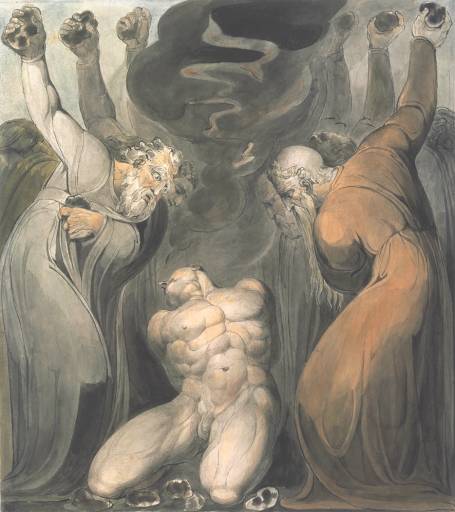
The Blasphemer, as in Leviticus 24: 13-23, by William Blake circa 1800

The Blasphemer, as in Leviticus 24: 13-23, by William Blake circa 1800

Deuteronomy 16:20-17:7 Only the LORD your God

1You must not sacrifice to the LORD your God an ox or a sheep that has a defect, anything seriously wrong; for that is abhorrent to the LORD your God.

                2 If there is found among you, in one of your towns that the LORD your God is giving you, a man or woman who does what is evil in the sight of the LORD your God, and transgresses his covenant 3 by going to serve other gods and worshiping them– whether the sun or the moon or any of the host of heaven, which I have forbidden– 4 and if it is reported to you or you hear of it, and you make a thorough inquiry, and the charge is proved true that such an abhorrent thing has occurred in Israel, 5 then you shall bring out to your gates that man or that woman who has committed this crime and you shall stone the man or woman to death. 6 On the evidence of two or three witnesses the death sentence shall be executed; a person must not be put to death on the evidence of only one witness. 7 The hands of the witnesses shall be the first raised against the person to execute the death penalty, and afterward the hands of all the people. So you shall purge the evil from your midst.

For the author of Deuteronomy the first and central commandment that the people are only to have the LORD as their God. It comes at the head of the Ten Commandments in Deuteronomy 5:6:

I am the LORD your God, who brought you out of the land of Egypt, out of the house of slavery; you shall have no other gods before me

and in Deuteronomy 6: 4-5:

Hear, O Israel: The LORD is our God, the LORD alone. You shall love the LORD your God with all your heart, and with all your soul, and with all your might.

Even before this Deuteronomy 4 emphasizes this same theme, as do Deuteronomy 7, 8, and 9. Deuteronomy 12 again addresses this issue in relation to destroying places of worship for other gods, and all of Deuteronomy 13 addresses this issue in stark terms of what the punishment is to be for violating this covenant relationship by individuals or by entire towns. It comes up here again at the end of 16 and beginning of 17 because it is such a central issue for the Deuteronomist that the author wants no chance for the hearer/reader to miss it. Being an aural culture the things that are central will be repeated over and over to ensure that they are heard by the listening audience. The death penalty for following other gods may seem harsh to us, and I address this question in greater detail when I talk about Deuteronomy 13, but this unique relationship with the LORD is to be at the center of the life of the people of Israel.

The LORD is not to be worshiped in the same way that the gods of the nations around the people are worshiped, there is to be no blending of the gods of the nations and the LORD. The people are also to bring their best to the worship of their LORD, not the animals that are defective. For the Deuteronomist these are life and death decisions, and yet they are still bound by the due process of the law. Justice is expected and a thorough investigation of any claims of idolatry are to be made. Deuteronomy 17 probably lays behind the command in Matthew 18.16 of wanting claims to be confirmed with the testimony of two or three witnesses and also behind the command for the one who is without sin to ‘cast the first stone’ in John 8 (even though this deals with adultery). In a contemporary fictional setting it is similar to the insistence of Ned Stark in the Game of Thrones that the one who passes the sentence should swing the sword, but instead here it is the witness who has testified against a person who must cast the initial stone of the community’s judgment. As Walter Brueggemann can state, “The book of Deuteronomy is committed to a rule of law even if it is a severe rule of law.” (Brueggemann, 2001 , p. 181) The nation of Israel is to be a theocracy where ultimately the LORD their God is at the center of their judicial, religious and political life and the central place of their LORD their God should, in the view of Deuteronomy, impact the way they structure the leadership and judicial life of their community

Deuteronomy 17:8-13 The Levitical Judicial Function

8 If a judicial decision is too difficult for you to make between one kind of bloodshed and another, one kind of legal right and another, or one kind of assault and another– any such matters of dispute in your towns– then you shall immediately go up to the place that the LORD your God will choose, 9 where you shall consult with the levitical priests and the judge who is in office in those days; they shall announce to you the decision in the case. 10 Carry out exactly the decision that they announce to you from the place that the LORD will choose, diligently observing everything they instruct you. 11 You must carry out fully the law that they interpret for you or the ruling that they announce to you; do not turn aside from the decision that they announce to you, either to the right or to the left. 12 As for anyone who presumes to disobey the priest appointed to minister there to the LORD your God, or the judge, that person shall die. So you shall purge the evil from Israel. 13 All the people will hear and be afraid, and will not act presumptuously again.

The vision of Deuteronomy is for a theocracy, a nation that is an extension of the covenantal relationship with the LORD their God, and so all of the functions of life are structured around trying to create that type of a nation. In many respects ancient Judaism and Islam share this desire to create nations that are structured in this manner and so in ancient Judaism, like some Muslim states, the highest court of appeals is a religious court and not a secular one. For people who live in Europe or the United States this may seem a strange concept because we live in a post-enlightenments modern society where religion is viewed as a private portion of a person’s life, but this is a relatively recent development. The law for the Jewish people was a reflection of their covenantal relationship with their God and it was viewed as a gift that God had given them. Even the judges that were a part of the tribes were expected to judge in accordance with the ideals outlined in the law. It doesn’t take long reading through books like Judges or 1 Samuel to find ways in which the judges often failed in this respect, but the ideal was that those entrusted with ministering to the LORD in the tabernacle or temple would be those most focused on the ideals of justice that the LORD called for. People are to obey the judgments of this religious and tribal courts, for a judge whose sentence holds no power is not going to be effective in enforcing this justice. So again, it is a harsh justice, where the penalty for disobeying a priest or a judge in their sentences is execution.

Deuteronomy 17: 14-20 The Model King

                14 When you have come into the land that the LORD your God is giving you, and have taken possession of it and settled in it, and you say, “I will set a king over me, like all the nations that are around me,” 15 you may indeed set over you a king whom the LORD your God will choose. One of your own community you may set as king over you; you are not permitted to put a foreigner over you, who is not of your own community. 16 Even so, he must not acquire many horses for himself, or return the people to Egypt in order to acquire more horses, since the LORD has said to you, “You must never return that way again.” 17 And he must not acquire many wives for himself, or else his heart will turn away; also silver and gold he must not acquire in great quantity for himself. 18 When he has taken the throne of his kingdom, he shall have a copy of this law written for him in the presence of the levitical priests. 19 It shall remain with him and he shall read in it all the days of his life, so that he may learn to fear the LORD his God, diligently observing all the words of this law and these statutes, 20 neither exalting himself above other members of the community nor turning aside from the commandment, either to the right or to the left, so that he and his descendants may reign long over his kingdom in Israel.

Willem de Poorter, 'De afgoderij van konig Solomo'-Solomon's decent into idolatry (between 1630 and 1648)

Willem de Poorter, ‘De afgoderij van konig Solomo’-Solomon’s decent into idolatry (between 1630 and 1648)

Most people assume that the monarchy, and particularly the Davidic monarchy, was universally embraced by scriptures and particularly King David and Solomon are the great kings where everything went well during their reign. The bible is not unanimous in endorsing having a king at all and for example in 1 Samuel 8, when the people are demanding of Samuel a king the LORD’s response is telling:

“Listen to the voice of the people in all that they say to you; for they have not rejected you, but they have rejected me from being king over them. Just as they have done to me, from the day I brought them up out of Egypt to this day, forsaking me and serving other gods, so also they are doing to you. Now then, listen to their voice; only—you shall solemnly want them, and show them the ways of the king who shall reign over them.” 1 Samuel 8: 7-9

The Deuteronomic history (the books beginning with Judges and stretching through 2 Kings) is pretty unromantic when it describes the failings of the kings that would rule over Judah and Israel, and it is telling the way that Deuteronomy describes the aspects of who the king is to be, they are the opposite of King Solomon. Most Christians know little of the story of Solomon, other than his request for wisdom and his building of the temple, but the way 1 Kings tells of his reign he quickly is drawn into a quest for wealth, military power and in making alliance is led astray from being faithful to the LORD, the God of Israel. Solomon imports horses from Egypt and has 12,000 horses and 1,400 chariots. Horses in the ancient world are a sign of military might. With power centralized and the military muscle to back up that power the king of Israel may begin to act like the Pharaohs of Egypt and the people become plunged into dependence under the burden of supplying for the hunger of a large military budget. 1 Kings goes at length into describing the wealth that Solomon accumulates as well as the incredible investment in projects beyond the temple, like his own palace. Solomon’s reign is reported to have brought in more than five tons of gold a year in addition to countless other resources. Finally Solomon is lifted up as having seven hundred princesses and three hundred concubines. All of these are direct counters to Deuteronomy’s vision of what a king is to be, and are ultimately blamed for the rising opposition to Solomon in his life and the splitting of the kingdom in two after his death. I tell about this briefly in the Place of Authority posts.

The title of the book of Deuteronomy comes from verse 18 where it refers to a copy of the law (in greek deutero nomos-second law) that the king is to read from each night and to be the way in which the king stays grounded in the covenantal life the people are called to.  Ultimately in the view of Deuteronomy the king is subservient to the will of the LORD. In reality, this rarely seemed to be the case in the story of the people of Judah and Israel. In a time where the majority of the population would be illiterate and not have access to written copies of the law they did rely upon the leaders including the king and the religious authorities guiding them in their actions. The bible evaluates the kings theologically: were they faithful to the LORD their God or did they lead the people to follow other gods?

I am writing from a Christian perspective, and in the church year we are approaching Christ the King Sunday and perhaps as Christians it might be worth examining how Jesus who we call Messiah or Christ (which means anointed king) lives into this identity. In Paul’s short statement of who Christ was in Philippians 2:

Who, though he was in the form of God, did not regard equality with God as something to be exploited, but emptied himself, taking the form of a slave, being born in human likeness. And being found in human form, he humbled himself and became obedient to the point of death—even death on a cross. Philippians 2: 6-8.

Many of the servant songs from Isaiah, which Christians read as talking about Jesus probably originally were trying to consider a monarch that might embody the vision of passages like Deuteronomy 17. Perhaps when the New Testament talks about explaining who Jesus was from the law and the prophets this is one of the places in the law where the early Christians went back to.

Deuteronomy 16: Celebrations, Remembrance and Justice

Painted Sukkah with a view of Jerusalem, Late 19th Century, Austria or South Germany

Painted Sukkah with a view of Jerusalem, Late 19th Century, Austria or South Germany


Deuteronomy 16: 1-17: Passover, the Festival of Weeks, and the Festival of Booths

1Observe the month of Abib by keeping the passover for the LORD your God, for in the month of Abib the LORD your God brought you out of Egypt by night. 2 You shall offer the passover sacrifice for the LORD your God, from the flock and the herd, at the place that the LORD will choose as a dwelling for his name. 3 You must not eat with it anything leavened. For seven days you shall eat unleavened bread with it– the bread of affliction– because you came out of the land of Egypt in great haste, so that all the days of your life you may remember the day of your departure from the land of Egypt. 4 No leaven shall be seen with you in all your territory for seven days; and none of the meat of what you slaughter on the evening of the first day shall remain until morning. 5 You are not permitted to offer the passover sacrifice within any of your towns that the LORD your God is giving you. 6 But at the place that the LORD your God will choose as a dwelling for his name, only there shall you offer the passover sacrifice, in the evening at sunset, the time of day when you departed from Egypt. 7 You shall cook it and eat it at the place that the LORD your God will choose; the next morning you may go back to your tents. 8 For six days you shall continue to eat unleavened bread, and on the seventh day there shall be a solemn assembly for the LORD your God, when you shall do no work.

9 You shall count seven weeks; begin to count the seven weeks from the time the sickle is first put to the standing grain. 10 Then you shall keep the festival of weeks for the LORD your God, contributing a freewill offering in proportion to the blessing that you have received from the LORD your God. 11 Rejoice before the LORD your God– you and your sons and your daughters, your male and female slaves, the Levites resident in your towns, as well as the strangers, the orphans, and the widows who are among you– at the place that the LORD your God will choose as a dwelling for his name. 12 Remember that you were a slave in Egypt, and diligently observe these statutes.

 13 You shall keep the festival of booths for seven days, when you have gathered in the produce from your threshing floor and your wine press. 14 Rejoice during your festival, you and your sons and your daughters, your male and female slaves, as well as the Levites, the strangers, the orphans, and the widows resident in your towns. 15 Seven days you shall keep the festival for the LORD your God at the place that the LORD will choose; for the LORD your God will bless you in all your produce and in all your undertakings, and you shall surely celebrate.

 16 Three times a year all your males shall appear before the LORD your God at the place that he will choose: at the festival of unleavened bread, at the festival of weeks, and at the festival of booths. They shall not appear before the LORD empty-handed; 17 all shall give as they are able, according to the blessing of the LORD your God that he has given you.


One of the gifts of the congregation being located next to a Hindu temple is seeing the way their community orders their lives around the various festivals that come up throughout the year. Especially since we share some of our parking spaces with them we can see the way their community swells around festivals like Diwali. The festivals we celebrate as a Christian church may look very different from our neighbors but our community is also significantly larger around our high festivals of Christmas and Easter. The Jewish festivals of Passover, weeks and booths were intended to be ways in which the community gathered together to share their story, to share their prosperity and give thanks to their LORD for the bounty of the previous year and to pass on the faith from generation to generation. It is an extension of the sabbatical way of living where the people are not to work on the Sabbath day, to forgive debts in the Sabbath year and then also there are these three weeks within the year set apart from the working in the fields to celebrate their identity as the people of Israel.

The Passover celebration is originally outlined in Exodus 13 and it is a ritual enactment of the beginning of the exodus journey out of Egypt and into the wilderness, away from slavery and into the dangerous freedom of being the people of the LORD. The people are called to enter into the story themselves, and much as the emphasis throughout the book of Deuteronomy insists that it was not a previous generation that the LORD gave the law to or spoke to or performed wonders on behalf of, so now the people who celebrate the Passover become a part of the story with their ancestors who were once slaves in Egypt. They are a people redeemed by the action of the LORD, not by their own military muscle or economic might. They are to gather together around the tabernacle or temple of the LORD.

The festivals remind the people each year of who they are and where their abundance comes from. They in their ritual action hope to reduce the amnesia that will come when the people enter into the abundance of the Promised Land and forget the way the LORD was present with them in the journey. They are symbols of hope as Rabbi Mark Dov Shapiro states when he says:

Our story is instead a vision that promises something better can always happen…True there is much sadness in our Jewish experience and the overall human experience. That is why you can’t have a Seder without salt water and maror. But you also can’t have a Seder without sweet charoset and freedom bread matza, without four cups of wine, and without the ultimate punch line-L’shana ha-ba-a b’Yershalayim (next year in Jerusalem). (Thompson, 2014, p. 133)

            The festival of weeks and the festival of booths are agricultural festivals which celebrate the harvest of the grain and the completion of the work of the harvest of the year. They are times to bring together the blessings of the year and an annual reminder that the harvest is a blessing of God rather than primarily a result of their own hard work or practices. Again they are to set aside a week of rest and celebration as they bring the harvest in and celebrate with those who are the vulnerable in their communities. The stranger, the orphan, the Levite and the widow are all to be included in the celebration of the landowners along with their children and their slaves. Everyone is to have a time of celebration and an ending of labor. Everyone is to share in the festival and the eating and drinking.

The early community of Israel did not come together every Sabbath to worship in the central place and while there was practices that probably did take place within the home these festivals were also intended to be a major part of the community’s act of passing on the traditions and faith. Amazingly the Hebrew Scriptures (or Old Testament as Christians sometimes refer to it) very rarely refer to the Passover, much less the other festivals. It seems probable that there were times where the celebrations were not widely practiced, and the narrative that runs from Judges through 2 Kings seems to be a narrative of amnesia with moments of remembrance. In the Christian calendar the festivals of Christmas, Easter and Pentecost also become festivals which enact central parts of the Christian story and serve as ritual reminders of the stories that Christians are a part of. Yet, as Christmas and Easter increasingly adopt a more secular tone in the United States there is the continued threat (and reality) of amnesia in the midst of our own prosperity.


Deuteronomy 16: 18-20: The Necessity of Justice

18 You shall appoint judges and officials throughout your tribes, in all your towns that the LORD your God is giving you, and they shall render just decisions for the people. 19 You must not distort justice; you must not show partiality; and you must not accept bribes, for a bribe blinds the eyes of the wise and subverts the cause of those who are in the right. 20 Justice, and only justice, you shall pursue, so that you may live and occupy the land that the LORD your God is giving you.

 21 You shall not plant any tree as a sacred pole beside the altar that you make for the LORD your God; 22 nor shall you set up a stone pillar– things that the LORD your God hates.

This is one of the places where the chapter break should be at a different place because verses twenty one and twenty two are more related to what comes at the beginning of chapter seventeen than what closes out chapter sixteen and I will address them in the next section.

From the very beginning of Deuteronomy (Deuteronomy 1: 9-18) there has been an emphasis on the need for a fair legal system to ensure that justice is done. One of the constant cries of the prophets is the way that justice is not being done for the people and particularly those who are vulnerable. Even today in our modern legal system it is difficult for people with limited economic means to receive the same type of treatment as those with the financial resources to ensure the best legal representation. Among the ancient world the people of Israel were to be a community of justice that did not favor the powerful over the powerless and ensured that the vulnerable communities, the orphans, widows, and the foreigners in their midst would receive justice as well. Even though bribes were common practice in the ancient world those entrusted with judging on behalf of Israel are not to accept them. The judges become an extension of God’s justice and the judges who are called upon to be a part of God’s law being lived out in community are to be unwilling to accept a bribe just as the God of Israel it.

Deuteronomy 15: A Life of Covenant Generosity

Roman collared slaves-Marble relief from Smyrna (Izmir, Turkey), 200 CE

Roman collared slaves-Marble relief from Smyrna (Izmir, Turkey), 200 CE

Deuteronomy 15: 1-18 Forgiveness of Debts

1 Every seventh year you shall grant a remission of debts. 2 And this is the manner of the remission: every creditor shall remit the claim that is held against a neighbor, not exacting it of a neighbor who is a member of the community, because the LORD’s remission has been proclaimed. 3 Of a foreigner you may exact it, but you must remit your claim on whatever any member of your community owes you. 4 There will, however, be no one in need among you, because the LORD is sure to bless you in the land that the LORD your God is giving you as a possession to occupy, 5 if only you will obey the LORD your God by diligently observing this entire commandment that I command you today. 6 When the LORD your God has blessed you, as he promised you, you will lend to many nations, but you will not borrow; you will rule over many nations, but they will not rule over you.

 7 If there is among you anyone in need, a member of your community in any of your towns within the land that the LORD your God is giving you, do not be hard-hearted or tight-fisted toward your needy neighbor. 8 You should rather open your hand, willingly lending enough to meet the need, whatever it may be. 9 Be careful that you do not entertain a mean thought, thinking, “The seventh year, the year of remission, is near,” and therefore view your needy neighbor with hostility and give nothing; your neighbor might cry to the LORD against you, and you would incur guilt. 10 Give liberally and be ungrudging when you do so, for on this account the LORD your God will bless you in all your work and in all that you undertake. 11 Since there will never cease to be some in need on the earth, I therefore command you, “Open your hand to the poor and needy neighbor in your land.”

12 If a member of your community, whether a Hebrew man or a Hebrew woman, is sold to you and works for you six years, in the seventh year you shall set that person free. 13 And when you send a male slave out from you a free person, you shall not send him out empty-handed. 14 Provide liberally out of your flock, your threshing floor, and your wine press, thus giving to him some of the bounty with which the LORD your God has blessed you. 15 Remember that you were a slave in the land of Egypt, and the LORD your God redeemed you; for this reason I lay this command upon you today. 16 But if he says to you, “I will not go out from you,” because he loves you and your household, since he is well off with you, 17 then you shall take an awl and thrust it through his earlobe into the door, and he shall be your slave forever. You shall do the same with regard to your female slave.

                18 Do not consider it a hardship when you send them out from you free persons, because for six years they have given you services worth the wages of hired laborers; and the LORD your God will bless you in all that you do.


There is a narrative that is heard frequently in some political circles and among many conservative religious groups that reflects a privatized view of reality. The belief that an individual’s prosperity is possible without any obligation to the neighbor or the safety net for the vulnerable among us. Sometimes this privatized view of reality and faith is endorsed with the idea that, “there will never cease to be some in need on the earth,” (see verse 11) or Jesus’ saying in John’s gospel, “You always have the poor with you, but you do not always have me.” Pastors who preach with an emphasis on social justice issues, or who advocate for legal protections for vulnerable portions of the society are often accused of being too political. And perhaps this is on my mind after seeing several of my colleagues in Houston who were brokenhearted at the failure of the Houston Equal Rights Ordinance after actively working to assist with addressing some of the fear based misinformation that often was circulated by other Christian groups. Perhaps this particular ordinance may not align with what Deuteronomy 15 is talking about, but Deuteronomy’s call for a society that practices debt forgiveness is opposite of a community that can endorse a privatized view of economics or of a religion that is uninvolved in advocating on behalf of those who are economically and politically at risk.

The type of economic forgiveness that is outlined here in Deuteronomy challenges the privatized world of economic gain. The people are called to live a life that is generous towards their neighbors, lending to them and providing for them in the time of need but not allowing for people to become bondservants into perpetuity. The life of the community is not to be tied to the ability of the people to acquire more property and wealth at the neighbor’s expense or parsimoniously trying to address the need of the neighbor because a time of remission of debt is near. Their identity is tied to the story of the Exodus, they were once enslaved and were liberated by the LORD of Israel and now they are not to return to the economic system of Egypt that they were liberated from but rather are to liberate their fellow Hebrews every seventh year. Also they are not to send them out empty handed but rather to give them the resources they need to not immediately be returned into slavery.

The demands of Deuteronomy 15 were a challenge for the people of Israel to enact. The enticement of being able to secure one’s own wealth and future by increasing one’s holdings or having more slaves to bring in more agricultural produce in ancient times (or the ability to keep people perpetually indebted through high interest in many people’s lives today) are difficult issues to address. An example from the book of Jeremiah tells about the people of Judah releasing their slaves only to enslave them once again during the days leading up to the exile in Babylon (Jeremiah 34: 8-22). It is much easier to allow amnesia to set in and believe that “My power and the might of my own hand have gotten me this wealth.” (Deuteronomy 8:17). Yet for the people of Israel, and Christians who are also bearers of this story and message it is the LORD who provides. As the Lord’s Prayer can remind us we are to forgive our debtors as we want our debts to be forgiven.

What does this look like in a contemporary secular setting? This is a challenging question since the society that Deuteronomy envisions is not a secular society but a unified society where the people shared in a common covenantal identity. But perhaps in the secular and privatized society there is a great need for people of faith who take seriously the need to advocate for a just society. There will be disagreements about what this type of society might look like and there will be those who advocate for similar things for non-religious reasons. Yet, this vision that Deuteronomy shares (which may or may not have every been realized) is a vision that echoes throughout both the Old and New Testament and still continues to come back into public discourse today.  Yet even more than advocating for humane policies, which is important, perhaps we need to learn to be humane people. Rather than giving up because “there will never cease to be some in need on the earth,” as people of faith perhaps the first response is learning to “Open your hand to the poor and needy neighbor in your land.”


Deuteronomy 15: 19-23 Giving the Best To God

19 Every firstling male born of your herd and flock you shall consecrate to the LORD your God; you shall not do work with your firstling ox nor shear the firstling of your flock. 20 You shall eat it, you together with your household, in the presence of the LORD your God year by year at the place that the LORD will choose. 21 But if it has any defect– any serious defect, such as lameness or blindness– you shall not sacrifice it to the LORD your God; 22 within your towns you may eat it, the unclean and the clean alike, as you would a gazelle or deer. 23 Its blood, however, you must not eat; you shall pour it out on the ground like water.


Sometimes working in a church you get used to receiving castaways. A friend told a story how a woman drove up to church, dropped off a box and was irritated when they flagged the woman down to find out what was going on. The woman had dropped off a large box of water damaged books and very ratty toys figuring they could go in the church library or nursery. They were not good enough to be in her own home anymore but maybe they were good enough for the church. Yet, one of the reasons this discussion about sacrifices comes up multiple times throughout the book of Deuteronomy is to address various issues around the eating of these animals. While the animals are to be eaten together in community as a part of the festival, it is also not to be done with the ‘runt of the liter’ or the animal that is damaged in some way. The people were charged to bring their best to God and the community. Their actions in celebration and worship were to model their calling to love the Lord their God with all their heart, soul and might. (Deuteronomy 6:5)


Gracefully Unfair

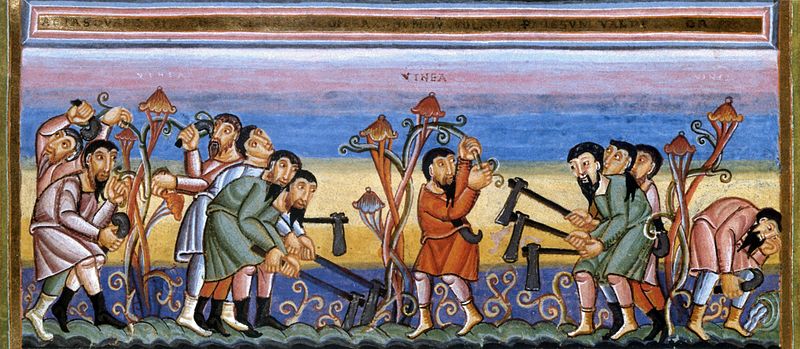
The Parable of the Workers in the Vineyard, Codex Aureus Epternacensis, 11th Century

The Parable of the Workers in the Vineyard, Codex Aureus Epternacensis, 11th Century

It’s not fair, this may be what I signed up for but it’s not fair
That in this crazy mixed up world of grace the last are first and the first last
Where a person can work from sunup to sundown laboring in the vineyard
Bearing the brutal rays of the sun beating down upon their backs
Getting up early to be the early bird that gets called out into the fields
Being the ant who works all day every day unlike those others
Those others who might look different, party different, act different, smell different
So that they get left behind among the other laborers, for it is about my skills
The sweat of my brow, the skill of my hands, the pain in my back from the harvest
And yet others work less, coming in later, leaving earlier, getting the same recompense
In a world of continually increasing worker productivity and efficiency
What is this inefficient master doing in the distribution of grace
Don’t I deserve more for my labor, for my conscientious and diligent striving
For I could manage the field better than this crazy master and the world would know no rest
For everyone would work as hard as I do or they would never work at all.
Yet maybe in this crazy and gracious world a new and strange master emerges
One who challenges the lords of commerce and time or wage and resource
One who sees the people left behind in the world of competition
Those in the market at 9 o’clock and noon and even at 3 or 5 o’clock
Those who no one sees or cares about, those who no one will hire
Those who wait all day in the hope that they too might enter into the fields
Perhaps in this crazy mixed up world of grace they are seen and valued and fed
They receive the same in some injustly and unfairly gracious manner
And why does my heart grow angry against those for whom the master’s heart breaks
Neil White, 2014

Corrupted Justice: Jeremiah 5:18-31

Icon of Jeremiah

Icon of Jeremiah

Jeremiah 5: 18-31

18 But even in those days, says the LORD, I will not make a full end of you. 19 And when your people say, “Why has the LORD our God done all these things to us?” you shall say to them, “As you have forsaken me and served foreign gods in your land, so you shall serve strangers in a land that is not yours.”
 20 Declare this in the house of Jacob, proclaim it in Judah:
 21 Hear this, O foolish and senseless people,
 who have eyes, but do not see,
 who have ears, but do not hear.
 22 Do you not fear me? says the LORD;
Do you not tremble before me?
I placed the sand as a boundary for the sea, a perpetual barrier that it cannot pass;
 though the waves toss, they cannot prevail, though they roar, they cannot pass over it.
 23 But this people has a stubborn and rebellious heart;
they have turned aside and gone away.
 24 They do not say in their hearts,
 “Let us fear the LORD our God, who gives the rain in its season,
 the autumn rain and the spring rain, and keeps for us the weeks appointed for the harvest.”
 25 Your iniquities have turned these away, and your sins have deprived you of good.
 26 For scoundrels are found among my people; they take over the goods of others.
 Like fowlers they set a trap; they catch human beings.
 27 Like a cage full of birds, their houses are full of treachery;
therefore they have become great and rich, 28 they have grown fat and sleek.
They know no limits in deeds of wickedness;
they do not judge with justice the cause of the orphan, to make it prosper,
 and they do not defend the rights of the needy.
 29 Shall I not punish them for these things? says the LORD,
 and shall I not bring retribution on a nation such as this?
 30 An appalling and horrible thing has happened in the land:
 31 the prophets prophesy falsely, and the priests rule as the prophets direct;
 my people love to have it so, but what will you do when the end comes?
 
In a brief interlude in the poetry (v. 18-19) we see some hope in the future, it is a dim hope, but it is a hope nonetheless when people after all the destruction ask ‘why has this happened’ and the answer is simply you chose to serve strange gods, so you have gone to serve strangers in another land. In a broken home sometimes someone has to leave, but God has not closed the door to a return, in fact it seems to be God’s continual hope through all the pain, yet God will not be tame or mocked. The relationship will not be one where God will bend to whatever the people think is right. God has not given up on God’s vision of justice and shalom. Yet the people are not in a place where their eyes can see or their ears can hear yet because their heart is in the wrong place and one the wrong things. Literally they are heart-less or empty hearted (NRSV senseless) and their heart is no longer in the relationship with God.

Justice has been so corrupted towards the wealthy that the cause of the orphan and the needy are neglected. The way things are remain irreconcilable with God’s vision of justice, and yet the very mouthpieces that should be calling for faithfulness and correction are behind the corruption. Prophets and priests rule and direct falsely and the people love the falseness. Patrick Miller speaks truth about this passage when he states:

This is a strong indictment of a community in which the politically powerful and the well-to-do amass possessions and wealth at the expense of the marginal and those in society who do not have the protection and power, in which flagrant manipulation of the socioeconomic system to the advantage of the advantaged is simply ignored. The picture is as familiar at the beginning of the third millennium CE as it was in the first millennium BCE. (NIB 6:621)

The Bible often has harsh words for those who are wealthy and in power, especially among the prophets. Most people assume wealth in the Bible is primarily viewed as a source of blessing, and that is one theology present within the Bible, but more commonly in the prophets and throughout most of the New Testament power and wealth are temptations and things that may distort one’s relationship with God. This is difficult for most people to accept, and I struggle with it myself but God does have a vision of a society that all can live in justice and peace and everyone has enough. Perhaps it is a utopian dream, perhaps it is naïve, and perhaps looking at the world through a dream like this opens a person to see the dystopia within the reality they live in, but at the same point just because the way that the people love and the prophets and priests in Jeremiah’s time proclaim may be easier, it doesn’t mean it is the right way.

purple rose 01 by picsofflowers.blogspot.com

The Poetry of Death and Destruction: Jeremiah 4: 11-18

The Prophet Jeremiah by Michelangelo

The Prophet Jeremiah by Michelangelo

Jeremiah 4: 11-18

 11 At that time it will be said to this people and to Jerusalem: A hot wind comes from me out of the bare heights in the desert toward my poor people, not to winnow or cleanse- 12 a wind too strong for that. Now it is I who speak in judgment against them.
 13 Look! He comes up like clouds, his chariots like the whirlwind;
his horses are swifter than eagles– woe to us, for we are ruined!
 14 O Jerusalem, wash your heart clean of wickedness so that you may be saved.
 How long shall your evil schemes lodge within you?
 15 For a voice declares from Dan and proclaims disaster from Mount Ephraim.
 16 Tell the nations, “Here they are!”
Proclaim against Jerusalem, “Besiegers come from a distant land;
they shout against the cities of Judah.
 17 They have closed in around her like watchers of a field,
 because she has rebelled against me, says the LORD.
 18 Your ways and your doings have brought this upon you.
This is your doom; how bitter it is! It has reached your very heart.”
 
The prophet lapses into his deathly poetry again, trying desperately with his words to shake his people out of what Brueggeman calls their “religious indifference and covenantal recalcitrance”  (Brueggemann 1998, 56) Yet the words seem to be falling on deaf ears, the party continues and nobody wants to sober up and go home. Yet the Northern tribe of Dan is proclaiming the disaster that is coming.

Though it will be the Babylonian army that will come and lay siege to Jerusalem and take the people into exile, they are not named. The people and the prophet live in different theological realities.  The prophet sees the way in which God is sovereign over not just Israel or Judah, but over the besiegers and conquerors as well, and that God is indeed moving in judgment towards the people of Judah for the ways they have not kept their covenantal faith.

The people are presented with two conflicting realities. The rulers and the priests pass on the platitudes that things are ok, as well as apparently many of those looked upon as prophets. They continue to prop up the Davidic regime and the temple hierarchy, and the people really have no reason to question the way things are. It is a much different world, where most people are illiterate and do not have anything beyond their oral memory to challenge the king and the priests who not only bear the recorded word of God, they are the only ones who are educated enough to be able to approach the words we take for granted. Also worship has become focused on the temple, and so most people may make it to the temple for the festivals (much as people who come at Christmas and Easter) and may have their own practices which may or may not line up with the temple ideology, but they are reliant upon the priests and the king to point them to what covenantal faithfulness looks like. Jeremiah, the prophet and poet, is one of the few voices of dissent pointing to the way in which the leaders have failed to be the exemplars of covenantal faithfulness that may lead the people back into God’s way of justice and shalom.

purple rose 01 by picsofflowers.blogspot.com

The Place of Authority: A Brief History Part 4: Re-establishment, Disillusionment and Germination

Wojceich Stattler, Machabeusze (Maccabbes) Public Domain Art

I think I need to be clear at this point that while I am doing a historical trek through Israel’s story, I am not trying to do a history of Israel at this point, or even of the Hebrew Scriptures.  I am intentionally trying to locate where authority rested within their story.  Within key transitions the places of authority do change and how the people react to that authority changes and see how that might inform our current questions of authority.  Hence, while it might be interesting to focus in greater detail on particular events, or to spend more time interpreting what is going on within a particular piece of scripture or what the theology of a particular author might be, that will have to be for another time and place as we continue on through the story.

A humorous illustration before we proceed. The Hebrew people remain deeply suspicious of external authorities which exercise authority over them, and so there will remain an antagonism between them and those who come to occupy their land.  In another Monty Python reference we have the scene of the French Castle where the French refuse to recognize Arthur’s authority. For this period the Hebrew people will stubbornly resist assimilation by the empires that they are a part of.

Beginning around 538 BCE, during the reign of Cyrus of Persia, there is the beginnings of the return to Jerusalem and Judea.  There are at least four major stages of the return which span a period of roughly 80 years, longer than the original period of exile, and even with the final return many of the people choose to remain settled and scattered throughout the empires of the day.  The diaspora (the dispersion) those Jewish people scattered throughout the empire continue to at various levels maintain their practices and stories that make them distinguishable from the nations around them, but I will be focusing in on the remnant that returns to the promised land since that is where the final pieces of the remembered story of the Hebrew Scriptures (or Old Testament) come from.

Over the eighty years of re-establishment, many of the people return and their first concern is the reclamation of their land (or perhaps in some cases the claiming of land for their family).Remember that in an agrarian society land is the primary source of wealth and power. It takes a great deal of effort by the leaders and prophets to get the people to focus on the effort to rebuild the temple, and even once it is rebuilt it cannot compete with the memory of the former temple.  In the memory of the people it is a shadow of the greatness of their past.  Even with the codification of the Torah (law-quite possibly Deuteronomy) by Ezra and the completion of the city wall under Nehemiah, Jerusalem and what remains of the former nation are completely dependent on the will of the nations around them.  The temple worship does regain some of its former status as one authority figure, but in the absence of a true monarch-temple authority that has the power to authorize the story of the people, the written and oral set of practices begin to take on a greater and greater role of what it means to be the chosen people.

Internal fault lines begin to emerge, not that they didn’t exist previously, but issues of purity and justice come into conflict with one another.  At least, in the remembered story it seems that in the time of re-establishment purity becomes the dominant issue, the removal of foreign influences—even when it means disbanding families—and being a ‘purer’ Hebrew people who worship the one Lord in holiness. This is the mark of a society intent on establishing and maintaining boundaries between the insider and the outsider—and I don’t mean this to sound as critical as it may sound—when one feels the world is out to destroy you it is natural for an us/them (or Jew/Gentile) dichotomy to emerge. Yet even though this seems to be the dominant voice a counter-voice emerges, the prophetic voice that never went away and attempts to refocus the central focus on justice.  Although there is a strong presence of the prophetic voice in the collected scriptures, it also never seems to gain the influence to reframe the story to create the type of society the prophets imagine.

Certainly within the prophetic voice, but also within the population there is disillusionment with the way things are.  Things are not the way people hoped they would be, the temple is a shell of its former self, different religious groups vie for power and influence among the people, various incarnations of leaders try to rally the people with varying levels of success-but the reality is that for most of this 500 year stretch they are a people under the rule first of the Persians, then briefly under Greece. When the Greek empire splits up into the Ptolemaic Empire (in the South) and the Seleucid Empire (in the North) Jerusalem will find itself firmly at the middle of the struggle for power.

A final defining moment comes in 167 BCE with the Maccabean revolt, an event commemorated by Hanukkah today and remembered in the books named Maccabees, where the pressure of the outside influence to conform to a Hellenistic (Greek) culture causes a religious revolt which for a brief moment grants Jerusalem its independence.  It is short lived, but it gives the people a memory of their practices defining themselves as a people who are willing to die for what they believe in.  Again this is not universal, there are certainly those willing to accommodate, but there are also those willing to revolt, and that fire will not go out again for some time.

Deep divisions continue to grow within Judaism. They will not be fully in control of their own destinies after the fall of the Maccabees , but the hope for a new king, a new David, a messiah will persist.  Religious authority will split between Saducees, who predominantly control the temple and accommodate with the kings like Herod, or whichever government official Rome places to govern Judea.  With Herod the Great (who rules from 40 BCE-6 CE) reconstructing the temple in magnificent fashion (at a magnificent cost) the Sadducees are able to operate from a position of privilege.  The Pharisees in contrast are more of a people’s movement focused on maintaining their identity through purity and right practice of the Torah. There are other groups, the Essenes who pull away and isolate themselves to remain pure, the zealots intent on driving the foreign influence from the promised land.  Herod and Rome have the military authority, the Saducees in partnership with the Roman authorities run the temple and all is in a state of tension at the turning of the ages.  We are approaching a great turning point in the story, from one group will emerge two-one that is new and one that will be completely reshaped.  It is to the turning of the ages that we turn next.

purple rose 01 by picsofflowers.blogspot.com