Tag Archives: idolatry

2 Kings 16 King Ahaz and the Syro-Ephraimite War

Charles-Antoine Bridan, Relief on the Wall of Notre Dame Cathedral in Chartres (1786-1789) Isaiah speaking to King Ahaz

2 Kings 16

 1In the seventeenth year of Pekah son of Remaliah, King Ahaz son of Jotham of Judah began to reign. 2Ahaz was twenty years old when he began to reign; he reigned sixteen years in Jerusalem. He did not do what was right in the sight of the LORD his God, as his ancestor David had done, 3but he walked in the way of the kings of Israel. He even made his son pass through fire, according to the abominable practices of the nations whom the LORD had driven out before the people of Israel. 4He sacrificed and made offerings on the high places, on the hills, and under every green tree.
  5
Then King Rezin of Aram and King Pekah son of Remaliah of Israel came up to wage war on Jerusalem; they besieged Ahaz but could not conquer him. 6At that time King Rezin of Aram recovered Elath for Edom and drove the Judeans from Elath, and the Edomites came to Elath, where they live to this day. 7Ahaz sent messengers to King Tiglath-pileser of Assyria, saying, “I am your servant and your son. Come up and rescue me from the hand of the king of Aram and from the hand of the king of Israel, who are attacking me.” 8Ahaz also took the silver and gold found in the house of the Lord and in the treasures of the king’s house and sent a present to the king of Assyria. 9The king of Assyria listened to him; the king of Assyria marched up against Damascus and took it, carrying its people captive to Kir; then he killed Rezin.
  10
When King Ahaz went to Damascus to meet King Tiglath-pileser of Assyria, he saw the altar that was at Damascus. King Ahaz sent to the priest Uriah a model of the altar and its pattern exact in all its details. 11The priest Uriah built the altar; in accordance with all that King Ahaz had sent from Damascus, so did the priest Uriah build it, before King Ahaz arrived from Damascus. 12When the king came from Damascus, the king viewed the altar. Then the king drew near to the altar, went up on it, 13and offered his burnt offering and his grain offering, poured his drink offering, and dashed the blood of his offerings of well-being against the altar. 14The bronze altar that was before the LORD he removed from the front of the house, from the place between his altar and the house of the LORD, and put it on the north side of his altar. 15King Ahaz commanded the priest Uriah, saying, “Upon the great altar offer the morning burnt offering and the evening grain offering and the king’s burnt offering and his grain offering, with the burnt offering of all the people of the land, their grain offering, and their drink offering; then dash against it all the blood of the burnt offering and all the blood of the sacrifice, but the bronze altar shall be for me to inquire by.” 16The priest Uriah did everything that King Ahaz commanded.
  17
Then King Ahaz cut off the frames of the stands and removed the laver from them; he removed the sea from the bronze oxen that were under it and put it on a pediment of stone. 18The covered portal for use on the Sabbath that had been built inside the palace and the outer entrance for the king he removed from the house of the Lord. He did this because of the king of Assyria. 19Now the rest of the acts of Ahaz that he did, are they not written in the Book of the Annals of the Kings of Judah? 20Ahaz slept with his ancestors and was buried with his ancestors in the city of David; his son Hezekiah succeeded him.

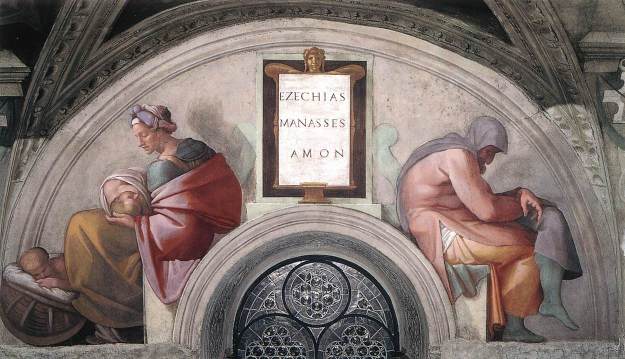
King Ahaz son of Jotham bears the same name as Jehoahaz son of Josiah (Ahaz is the shortened form of the name) but unlike the recent kings of Judah he receives a judgment by the narrator which is harsher than any other king in Judah or Israel. King Ahaz reigns at a critical juncture in the story of Judah and Israel and the surrounding region and the prophet Isaiah provides an additional witness to this time of conflict known as the Syro-Ephraimite War by historians. 2 Kings 16 and its parallel in 2 Chronicles 28, which is even harsher in its evaluation of Ahaz, point to an unfaithful king who is spared only by God’s continuing faithfulness to the line of David.

The theological judgment of King Ahaz in both 2 Kings and 2 Chronicles contrasts with the qualified faithfulness of his ancestors with the idolatrous practices of his reign. The reference to walking in the ways of the kings of Israel may refer to the crafting of new images to worship like the frequently mentioned sins of Jeroboam (1 Kings 12: 25-33) and 2 Chronicles 28:2 indicates that Ahaz cast images of the Baals. Also indicated in both 2 Kings and 2 Chronicles is passing his sons through fire, imagery associated with the worship of Molech the god of the Ammonites in the bible. Passing a child through fire (presumably sacrificing the child to a god) is prohibited in Deuteronomy 18:10. Many scholars have hypothesized that “Ahaz sacrificed his first-born during the pressing hours of the siege of Jerusalem by the Syro-Ephraimite armies, as Mesha, king of Moab, had once done under similar circumstances” (Cogan, 1988, p. 186) (see 2 Kings 3:27 for Mesha, king of Moab) but this can only be hypothesized and 2 Chronicles indicates that one of the king’s sons is captured in the conflict. 2 Chronicles also heightens the depravity of Ahaz by indicating that “he sacrificed and made offerings on the high places, on the hills, and under every green tree.” (2 Chronicles 28:4) From the theological perspective of both 2 Kings and 2 Chronicles King Ahaz has a disastrous impact upon Judah, and Judah’s defeats are directly attributed to his apostacy in 2 Chronicles.

The prophet Isaiah points to the intent of the Syro-Ephraimite war at the beginning of Isaiah 7:

1In the days of Ahaz son of Jotham son of Uzziah, king of Judah, King Rezin of Aram and King Pekah son of Remaliah of Israel went up to attack Jerusalem but could not conquer it. 2When the house of David heard that Aram had allied itself with Ephraim, the heart of Ahaz and the heart of his people shook as the trees of the forest shake before the wind.
3
Then the LORD said to Isaiah, “Go out to meet Ahaz, you and your son Shear-jashub, at the end of the conduit of the upper pool on the highway to the fuller’s field, 4and say to him: Take heed, be quiet, do not fear, and do not let your heart be faint because of these two smoldering stumps of firebrands, because of the fierce anger of Rezin and Aram and the son of Remaliah. 5Because Aram—with Ephraim and the son of Remaliah—has plotted evil against you, saying, 6Let us go up against Judah and terrify it and conquer it for ourselves and make the son of Tabeel king in it’ (Isaiah 7:1-6)

Isaiah is sent to King Ahaz to provide him reassurance that God is not going to allow the forces of Aram and Israel to remove him and put another more compliant ruler in his place. This is the background of Isaiah’s famous Immanuel prophecy: “Therefore the Lord himself will give you a sign. Look, the young woman is with child and shall bear a son and shall name him Immanuel.” (Isaiah 7:14) Within the original context of this time of King Ahaz the message of hope from Isaiah was that within two years the threat of Israel and Aram would be eliminated, but this section of Isaiah also had an important voice in later Jewish messianic hope and Christianity. Isaiah encourages Ahaz not to fear and to stand firm in faith, ultimately Ahaz chooses a different path that both 2 Kings and 2 Chronicles point to.

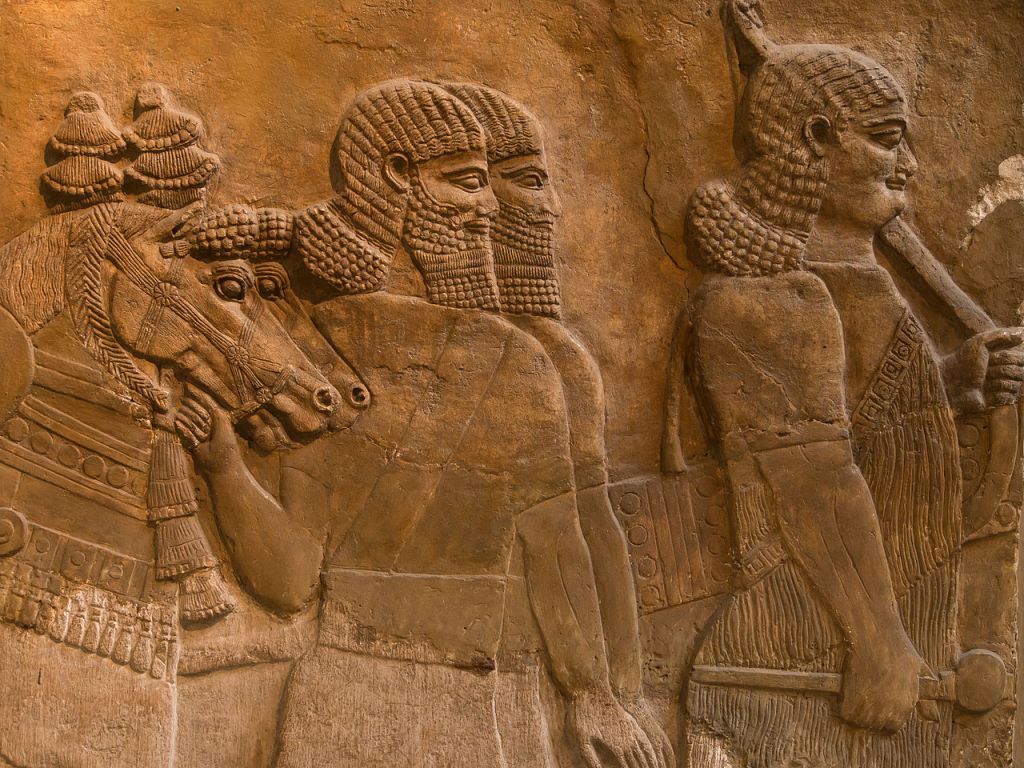
The Syro-Ephraimite War (736-732 BCE) was the result of a shifting power dynamic in the region. The Assyrian forces under Tiglath-Pileser III have become a dominant force in the region and Aram and Israel are attempting to build a coalition to resist this rising threat. In this regional struggle for power Judah stands unaligned as Aram, Israel, Philistia, and Edom attempt to both seize power in Judah and promote a regime change that will bring Judah into this alliance against Assyria. 2 Chronicles narrates a catastrophic defeat of Judah. As Alex Israel summarizes:

The battle statistic reinforce the magnitude and severity of the attack: 120,000 casualties in a single day of fighting, 200,000 Judahite women and children captured as prisoners of war, and the king’s son as well as other key governmental officials among the dead. (Israel, 2019, p. 244)

Ahaz is caught between forces coming from multiple directions. Israel and Aram have frequently been against Judah in recent history. Judah loses control of Elath, under Judah’s control since the time of Uzziah/Azariah and is clearly unable to manage conflict on multiple military fronts.  Ahaz may have already failed the theological evaluation of 2 Kings, but he makes a fateful choice in his military vulnerability. King Ahaz sends tribute to King Tiglath-Pileser III of Assyria.

Although 2 Chronicles states that Assyria refuses to help Judah, 2 Kings gives the impression that Assyria was eager to take advantage of the situation. Alex Israel summarizes again:

One imagines that Assyria is only too happy to accept the offer. They are securing an ally, a foothold, in the sought-after region, and undermining the enemy coalition. (Israel, 2019, p. 245)

While Aram and Israel attack Judah, Assyria attacks and conquers Damascus, the capital of Aram taking Aram out of the fight.

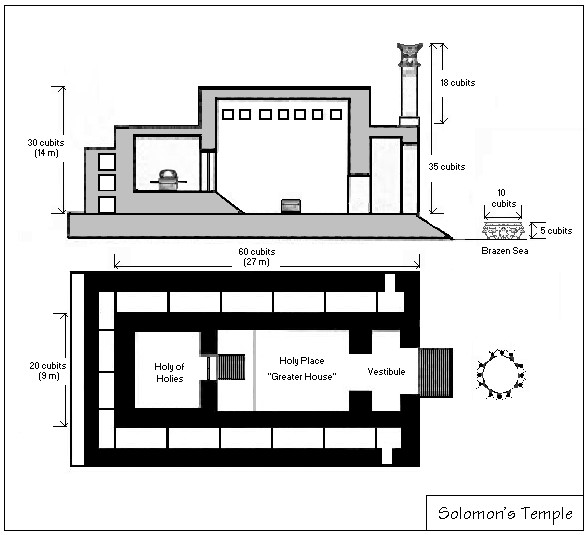
King Ahaz remains in power as a vassal of Assyria and the chapter concludes with Ahaz traveling to Damascus to pay tribute to Tiglath-Pileser III. Abraham Heschel in his work The Prophets indicates that for Assyria, “Political subservience involved acceptance of her religious institutions.” (Heschel, 1962, p. 72) and this may form a part of Ahaz’s adoption of this design for a new altar. Yet, the priest Uriah is assumed to be a supporter of the prophet Isaiah (Isaiah 8:2) and one would assume faithful to the LORD the God of Israel so his immediate compliance with the king on this altar has led some interpreters to wonder if the new altar was not idolatrous, but merely offensive because it displaced Solomon’s original altar described in 1 Kings 8:64. The stands, lavers, the bronze oxen, and the covered portal may have been removed and melted down as payment to Assyria, but bronze was not a highly valuable metal at the time so that is not certain. 2 Kings indicates these changes were made because of the king of Assyria, but why the king of Assyria desired these changes is uncertain. Interpreters are divided about Ahaz’s intent and the role of Uriah the priest in these changes in the temple, but for the narrator of 2 Kings the time of Ahaz has been a disaster for the faithfulness of the people of Judah and for the welfare of the nation.

Ezekiel 20 Retelling Israel’s Story in a Negative Light

Ezekiel 20: 1-32

1 In the seventh year, in the fifth month, on the tenth day of the month, certain elders of Israel came to consult the LORD, and sat down before me. 2 And the word of the LORD came to me: 3 Mortal, speak to the elders of Israel, and say to them: Thus says the Lord GOD: Why are you coming? To consult me? As I live, says the Lord GOD, I will not be consulted by you. 4 Will you judge them, mortal, will you judge them? Then let them know the abominations of their ancestors, 5 and say to them: Thus says the Lord GOD: On the day when I chose Israel, I swore to the offspring of the house of Jacob — making myself known to them in the land of Egypt — I swore to them, saying, I am the LORD your God. 6 On that day I swore to them that I would bring them out of the land of Egypt into a land that I had searched out for them, a land flowing with milk and honey, the most glorious of all lands. 7 And I said to them, Cast away the detestable things your eyes feast on, every one of you, and do not defile yourselves with the idols of Egypt; I am the LORD your God. 8 But they rebelled against me and would not listen to me; not one of them cast away the detestable things their eyes feasted on, nor did they forsake the idols of Egypt.

Then I thought I would pour out my wrath upon them and spend my anger against them in the midst of the land of Egypt. 9 But I acted for the sake of my name, that it should not be profaned in the sight of the nations among whom they lived, in whose sight I made myself known to them in bringing them out of the land of Egypt. 10 So I led them out of the land of Egypt and brought them into the wilderness. 11 I gave them my statutes and showed them my ordinances, by whose observance everyone shall live. 12 Moreover I gave them my sabbaths, as a sign between me and them, so that they might know that I the LORD sanctify them. 13 But the house of Israel rebelled against me in the wilderness; they did not observe my statutes but rejected my ordinances, by whose observance everyone shall live; and my sabbaths they greatly profaned.

Then I thought I would pour out my wrath upon them in the wilderness, to make an end of them. 14 But I acted for the sake of my name, so that it should not be profaned in the sight of the nations, in whose sight I had brought them out. 15 Moreover I swore to them in the wilderness that I would not bring them into the land that I had given them, a land flowing with milk and honey, the most glorious of all lands, 16 because they rejected my ordinances and did not observe my statutes, and profaned my sabbaths; for their heart went after their idols. 17 Nevertheless my eye spared them, and I did not destroy them or make an end of them in the wilderness.

18 I said to their children in the wilderness, Do not follow the statutes of your parents, nor observe their ordinances, nor defile yourselves with their idols. 19 I the LORD am your God; follow my statutes, and be careful to observe my ordinances, 20 and hallow my sabbaths that they may be a sign between me and you, so that you may know that I the LORD am your God. 21 But the children rebelled against me; they did not follow my statutes, and were not careful to observe my ordinances, by whose observance everyone shall live; they profaned my sabbaths.

Then I thought I would pour out my wrath upon them and spend my anger against them in the wilderness. 22 But I withheld my hand, and acted for the sake of my name, so that it should not be profaned in the sight of the nations, in whose sight I had brought them out. 23 Moreover I swore to them in the wilderness that I would scatter them among the nations and disperse them through the countries, 24 because they had not executed my ordinances, but had rejected my statutes and profaned my sabbaths, and their eyes were set on their ancestors’ idols. 25 Moreover I gave them statutes that were not good and ordinances by which they could not live. 26 I defiled them through their very gifts, in their offering up all their firstborn, in order that I might horrify them, so that they might know that I am the LORD.

27 Therefore, mortal, speak to the house of Israel and say to them, Thus says the Lord GOD: In this again your ancestors blasphemed me, by dealing treacherously with me. 28 For when I had brought them into the land that I swore to give them, then wherever they saw any high hill or any leafy tree, there they offered their sacrifices and presented the provocation of their offering; there they sent up their pleasing odors, and there they poured out their drink offerings. 29 (I said to them, What is the high place to which you go? So it is called Bamah to this day.) 30 Therefore say to the house of Israel, Thus says the Lord GOD: Will you defile yourselves after the manner of your ancestors and go astray after their detestable things? 31 When you offer your gifts and make your children pass through the fire, you defile yourselves with all your idols to this day. And shall I be consulted by you, O house of Israel? As I live, says the Lord GOD, I will not be consulted by you.

This chapter in Ezekiel is one of the most uncomfortable passages I have wrestled with in the twelve years since I began this discipline of working through scripture on signoftherose. My goal was to pay particular attention to the passages of scripture I was less familiar with. For me this was more difficult than Ezekiel 16 with its portrayal of Jerusalem as God’s faithless bride because that imagery has resonance with imagery used in Jeremiah, and I was able to view it through my personal experiences of heartbreak and the emotions that evoked. I was glad to find I was not alone in my assessment of this passage, for example Katheryn Pfisterer Darr states:

Ezekiel 20: 1-44 is one of the Bible’s most troubling texts. What are we to make of an oracle that intentionally portrays a people’s history in the most pejorative of terms, in order utterly to erode any sense of integrity, any basis of hope? (NIB VI: 1290)

This text goes against many modern notions of independence. Israel cannot be Israel without living in the covenantal relationship with God. God chose them and the critical verse which forms the pivot for this chapter is verse thirty-two, “What is in your mind shall never happen — the thought, “Let us be like the nations, like the tribes of the countries, and worship wood and stone.”  Ezekiel has throughout the previous nineteen chapters attempted to demonstrate the apostasy of Israel as the cause for the LORD’s just action of condemnation. Now this rhetorical retelling of the history of Israel attempts to portray the total depravity of Israel throughout its history.

The prophet Ezekiel may be a poet, but he has little interest in ideas expressed in Emily Dickinson’s poem “Tell All the Truth But Tell It Slant”

Tell all the truth but tell it slant —

Success in Circuit lies

Too bright for our infirm Delight

The Truth’s superb surprise

As Lightning to the Children eased

With explanation kind

The Truth must dazzle gradually

Or every man be blind —[1]

Ezekiel’s message to a people who no longer have ears to hear is not told with an explanation kind, instead it is a brutally direct confrontation with the long running patterns of disobedience which have, in Ezekiel’s view, characterized the relationship between the people and their God. Or as Daniel Block states:

Far from being a story of election and salvation, Israel’s story is one of apostasy…Ezekiel’s “theology of history” is revisionist in the extreme. Other prophets had recognized the historical roots of Israel’s sins, but Ezekiel perceives the nation as corrupt as no other prophet did. (Block, 1997, p. 614)

Nor is Ezekiel’s primary concern at this point repentance, from early on God has communicated to Ezekiel that his role is to communicate the message so that, “Whether they hear or refuse to hear (for they are a rebellious house), they shall know that there has been a prophet among them.” (Ezekiel 2:5)

The prophecy is dated August 14, 591 BCE based on the information in verse one. This is two years before the siege of Jerusalem, almost a year after the prophecy in chapter eight, and two years after Ezekiel’s initial call. (Ganzel, 2020, p. 146) There have been several suggestions for why the elders approach Ezekiel at this point. One suggestion is that words of the false prophet Hananiah’s prophecy[2] had reached the exiles which suggested that the exile would be ending at this point. This is possible, but it is also possible that the elders are attempting to seek the LORD as mentioned in Deuteronomy 4:29, “From there (exile among the nations) you will seek the LORD your God and you will find him if your search after him with all your heart and soul (nephesh-life).” Yet, in Ezekiel’s view these elders are not wholeheartedly turning to the LORD. Like in chapter fourteen when certain elders come and the LORD considers whether he will answer them, only to answer in judgment, now the prophet is commanded to judge or arraign[3] the elders and the people.

The narrative begins in Egypt when the LORD chose (Hebrew bahar) Israel, swears to them and makes Godself known to them. The use of the Hebrew bahar reflects the language of Deuteronomy 7: 6-8:

For you are a people holy to the LORD your God; the LORD your God has chosen you out of all the peoples on earth to be his people, his treasured possession. It was not because you were more numerous than any other people that the LORD set his heart on you and chose you — for you were the fewest of all peoples. It was because the LORD loved you and kept the oath that he swore to your ancestors, that the LORD has brought you out with a mighty hand, and redeemed you from the house of slavery, from the hand of Pharaoh king of Egypt.

Being chosen by the LORD involves casing away the detestable things and the ‘idols’[4] of Egypt but from the very beginning they failed, in Ezekiel’s retelling of the story, to change their practices or to turn away from the idols they had in Egypt.

Throughout the narrative, their disobedience evokes a strong reaction from the LORD and God considers pouring out his wrath and spending his anger against them but refrains so that the name of God will not be profaned among the nations. The idea of God acting so that God’s name may be recognized and honored among the nations is reflected in the aftermath of the golden calf when Moses interceded for the people (Exodus 32: 11-14) and in the LORD’s declaration of identity in the thirteen attributes of God (Exodus 34: 1-9). A similar pattern is repeated when the people refuse to enter the promised land for fear of its occupants and Moses again has to intercede with the LORD (Numbers 14: 13-25). Throughout this retelling of history, the refrain reoccurs, Then I thought I would pour out my wrath upon them and spend my anger against them in the wilderness. But I withheld my hand, and acted for the sake of my name, so that it should not be profaned in the sight of the nations, in whose sight I had brought them out. This points to the LORD’s continual forbearance with the people in the past, but also highlights the anger and pain that the LORD bears from this continued pattern of disobedience.

Ezekiel’s retelling of Israel’s story continues from God’s choosing of the people in Egypt, even in their disobedience, to the leading of the people out of Egypt into the wilderness to give them the law and to lead them to the promised land. Ezekiel views this period as a time of continued rebellion[5] but now as the LORD makes the covenant expectations clear the rebellion takes on a more strident stance. The LORD has provided the statutes and ordinance by which everyone should live and gave them the practice of sabbath as a sign between God and the people. The people did not observe the statutes, rejected the ordinances, and greatly profaned the sabbath. In addition to the pursuit of idols and detestable things they have now added disobedience to the laws, decrees, and practices that are a part of the covenant. Yet, God’s anger is once again restrained by acting for the sake of the name of the God. Even though one generation never emerges from the wilderness their children inherit the promised land. Yet, the LORD warns them in the wilderness, probably referencing Deuteronomy where Moses warns the people before entering the land, to not follow the ways of their parents or to defile themselves with idol. Instead, they are charged to live by the law (statutes and ordinances) and to hallow the sabbath day.

The children who enter the promised land and the generations that follow fail in these practices. Ezekiel’s narration of God’s response produces a passage that, “Students of Scripture have struggled with…through the centuries.” (Block, 1997, p. 637)

because they had not executed my ordinances, but had rejected my statutes and profaned my sabbaths, and their eyes were set on their ancestors’ idols. Moreover I gave them statutes that were not good and ordinances by which they could not live. I defiled them through their very gifts, in their offering up all their firstborn, in order that I might horrify them, so that they might know that I am the LORD. (v. 24-26)

This is a difficult group of verses, and we are going to slow down and spend some time with this discomfortable passage. As Ellen Davis explains,

The statement resists all attempts at domestication. Its power lies precisely in the fact that it cannot be conformed to human reason. The verse reasserts, indeed, carries to its illogical extreme what is Ezekiel’s constant theme: the indisputable authority of God to determine and interpret the course of human history. (Davis, 1989, p. 114)

As I mentioned in my reflection A Split in the Identity of God, one of the difficult things for most Christians readers of scripture to reconcile is the all-encompassing view of the prophetic witness of God being responsible for all things. The adoption of idolatrous practices and non-covenant rules, and even the offering of children are now placed within the divine purview. The law was a gift, and now these not good laws become an anti-gift. The accusations of Ezekiel 16:20 of child sacrifice are now a way in which the LORD can horrify[6] the people. Throughout the narration of the Deuteronomic history[7] the people of Israel adopt idolatrous practices, fail to live according to the covenant, and at some points appear to engage in child sacrifice to Molech. It is impossible to know whether child sacrifice is occurring in the context of the exile in Babylon or in Jerusalem at the time. Yet, the theological implication of assigning the disobedience of the people, even to the point of, in the best light, misreading the provision for redeeming firstborns in Exodus 13: 11-16 or Exodus 22:29 to God is theologically troubling. Ezekiel is not a systematic theologian, nor is his message one of logical coherency. Ezekiel is providing a way to make sense of the future cataclysm for the people of Jerusalem while attempting to maintain God’s justice. Yet, most readers throughout history have struggled to reconcile these verses.

One of the insights I had in studying Jeremiah was that the God of Jeremiah, and by extension Ezekiel, is a brokenhearted God. The God portrayed in the bible has a surprisingly human set of emotions including anger, pain, desire, and loss. The LORD loves deeply and hurts deeply at the unfaithfulness of the people, and this hurt has been constrained by the concern for the honor of the divine name. Yet, generations of pain have compounded and the release of the pain—at least in words—is not always logical or easy to understand. The prophet stands between the wounded God and the wounding people and is the mediator of that pain from God to the people. The language of pain is attempting to shake the people from their long pattern of disobedience, or at least to give them language to explain the consequences when the LORD no longer saves them from the consequences of their actions. As modern people we might narrate this history differently from a different theological perspective, but Ezekiel (like his contemporary Jeremiah) has no choice but to pour out the emotion he receives from a brokenhearted God to a people who refuses to hear.

Deuteronomy 12 states to the people when they enter the land that they were to destroy the high places and shrines that the nations they pushed out created. Yet here Ezekiel narrates that instead of destroying these high places and shrines they adopted them for their own idolatrous practices. The play on words of “What is the high place (bamah) to which you go? So it is called Bamah to this day” adds one more way the people give the honor due to the LORD to the other gods of the nations.  Ezekiel argues that all the practices of the past continue to be built upon and practiced by the people in the present. The narration of the story of Israel has gotten progressively worse until the LORD’s anger can no longer be contained and the consequences of disobedience can no longer be averted.

There is no hope, at this point in Ezekiel, that the people will repent and save Jerusalem, the temple, the king, and the land from the consequences of this long pattern of disobedience. He is attempting to help the people understand their current crisis. His rhetorical retelling of the story of Israel as a story of continual and progressive disobedience and depravity is a difficult piece of scripture, but it is also a window into the pain of a brokenhearted God who has long delayed the consequences of the disobedience of the people.  Yet, Israel does not have the free will to choose to follow the gods of Egypt, Canaan, or Babylon. As we will see in the section that follows this will never happen. Israel can only be Israel in relation to the LORD the God of Israel.

Ezekiel 20: 33-44

32 What is in your mind shall never happen — the thought, “Let us be like the nations, like the tribes of the countries, and worship wood and stone.”

33 As I live, says the Lord GOD, surely with a mighty hand and an outstretched arm, and with wrath poured out, I will be king over you. 34 I will bring you out from the peoples and gather you out of the countries where you are scattered, with a mighty hand and an outstretched arm, and with wrath poured out; 35 and I will bring you into the wilderness of the peoples, and there I will enter into judgment with you face to face. 36 As I entered into judgment with your ancestors in the wilderness of the land of Egypt, so I will enter into judgment with you, says the Lord GOD. 37 I will make you pass under the staff, and will bring you within the bond of the covenant. 38 I will purge out the rebels among you, and those who transgress against me; I will bring them out of the land where they reside as aliens, but they shall not enter the land of Israel. Then you shall know that I am the LORD.

39 As for you, O house of Israel, thus says the Lord GOD: Go serve your idols, everyone of you now and hereafter, if you will not listen to me; but my holy name you shall no more profane with your gifts and your idols.

40 For on my holy mountain, the mountain height of Israel, says the Lord GOD, there all the house of Israel, all of them, shall serve me in the land; there I will accept them, and there I will require your contributions and the choicest of your gifts, with all your sacred things. 41 As a pleasing odor I will accept you, when I bring you out from the peoples, and gather you out of the countries where you have been scattered; and I will manifest my holiness among you in the sight of the nations. 42 You shall know that I am the LORD, when I bring you into the land of Israel, the country that I swore to give to your ancestors. 43 There you shall remember your ways and all the deeds by which you have polluted yourselves; and you shall loathe yourselves for all the evils that you have committed. 44 And you shall know that I am the LORD, when I deal with you for my name’s sake, not according to your evil ways, or corrupt deeds, O house of Israel, says the Lord GOD.

There is no free will for Israel. They do not get to opt out of being the people of God or self-select into being a different people. As Ellen Davis states,

Israel cannot be like the nations, no matter how assiduously it seeks to deny the association with YHWH by departing from anything recognizable as the law of God. (Davis, 1989, p. 114)

On the one hand this is the gracious promise that they will be brought out from the people to be gathered. On the other hand, there is no escape from their identity as the people of God and the judgment that they will endure. They will be brought back under the covenant and the rebels among the people will be purged. The only future is as a people obedient to the LORD. They will be sanctified, and in the future they will practice the laws and statutes and ordinances in a way that brings honor to the name of God. They will remember and regret their practices of the past. Everything hangs on the LORD’s control over history and the future of Israel. There is hope in the future, but it does not rest upon the practices of faithfulness of the people. As Ezekiel has narrated the story of Israel is a story of apostasy and depravity. Yet, with the LORD there is the promise of a gracious new beginning where a purified people will return to the land and properly honor their God. God is remaining faithful to God’s promises for the sake of God’s name. It is a difficult justice for most modern people to comprehend, but it is still gracious. Israel will have a future as Israel because of God’s action to make that future manifest.

Ezekiel 20: 45-49

45 The word of the LORD came to me: 46 Mortal, set your face toward the south, preach against the south, and prophesy against the forest land in the Negeb; 47 say to the forest of the Negeb, Hear the word of the LORD: Thus says the Lord GOD, I will kindle a fire in you, and it shall devour every green tree in you and every dry tree; the blazing flame shall not be quenched, and all faces from south to north shall be scorched by it. 48 All flesh shall see that I the LORD have kindled it; it shall not be quenched. 49 Then I said, “Ah Lord GOD! they are saying of me, ‘Is he not a maker of allegories?'”

These final five verses of chapter twenty are related to the imagery that will come in chapter twenty-one and set the stage for a new set of imagery organized around a sword. Yet, since in our bible they are a part of chapter twenty I will address them as they stand in the chapter. Now Ezekiel is to set his face[8] towards the south. He is to set his face toward Teman (either a place name for a northern district of Edom or may simply refer to south), Darom (either a place name between Beersheba and Beth-Gubrin or another term for south), and the ‘scrubland’[9] of the Negeb (negeb as a common noun also means south, or dry) (NIB VI: 1294) and declare that a blazing fire is coming upon these lands and it will scorch the land from south to north. Ezekiel answers the LORD that he is being accused of being a “maker of allegories.” The Hebrew doubling of the word masal (proverb, parable) probably indicates to Ezekiel that his message is not being received as seriously as he believes it merits. He may feel that the people are failing to understand his message, or that perhaps they view his words and actions as entertainment, but they do not yet understand that a prophet has been among them. The people may be taunting Ezekiel because his words have not come to pass and that his view of reality seems too divergent from the views of others, even others who claim the title of prophet, in his time and previously. It is difficult to walk through the first twenty-four chapters of Ezekiel, and it is only in the aftermath of the destruction of Jerusalem and the temple, the ending of the line of Davidic kings, and the exile that the prophet’s words make sense. Even those in exile with Ezekiel are looking forward to a homecoming to Jerusalem rather than the extension of their exile to the entire nation. Ezekiel’s words are difficult to stomach in the aftermath of the Babylonian exile and were probably unpalatable beforehand. It is only afterwards that people will understand that this maker of allegories was the prophet in their midst they failed to listen to.


[1] https://www.poetryfoundation.org/poems/56824/tell-all-the-truth-but-tell-it-slant-1263

[2] Jeremiah 28:1-4.

[3] “The interrogative particle often conveys an indignant affirmation.” (Block, 1997, p. 618)

[4] Ezekiel’s frequently used term gillum which is a derogatory term best rendered as something like ‘shit gods.’

[5] Daniel Block notes that Jeremiah views the Exodus romantically while Ezekiel views this time in Israel’s story as a continued example of their total depravity and abandonment to sin. (Block, 1997, p. 630)

[6] Hebrew samen is actually harsher than horrify. Katheryn Pfisterer Darr suggests, “that I might desolate them.” (NIB VI: 1284)

[7] The books between Joshua and 2 Kings in the bible. Referred to as the Deuteronomic history because they share the theological perspective of Deuteronomy.

[8] Which indicates judgment.

[9] It is doubtful the Negeb, which is desert-like, was ever in its history forested.

Ezekiel 14 Unfaithful Elders, Deceived Prophets, and Representative Righteous Ones

Ezekiel 14: 1-11

1 Certain elders of Israel came to me and sat down before me. 2 And the word of the LORD came to me: 3 Mortal, these men have taken their idols into their hearts, and placed their iniquity as a stumbling block before them; shall I let myself be consulted by them? 4 Therefore speak to them, and say to them, Thus says the Lord GOD: Any of those of the house of Israel who take their idols into their hearts and place their iniquity as a stumbling block before them, and yet come to the prophet — I the LORD will answer those who come with the multitude of their idols, 5 in order that I may take hold of the hearts of the house of Israel, all of whom are estranged from me through their idols.

6 Therefore say to the house of Israel, Thus says the Lord GOD: Repent and turn away from your idols; and turn away your faces from all your abominations. 7 For any of those of the house of Israel, or of the aliens who reside in Israel, who separate themselves from me, taking their idols into their hearts and placing their iniquity as a stumbling block before them, and yet come to a prophet to inquire of me by him, I the LORD will answer them myself. 8 I will set my face against them; I will make them a sign and a byword and cut them off from the midst of my people; and you shall know that I am the LORD.

9 If a prophet is deceived and speaks a word, I, the LORD, have deceived that prophet, and I will stretch out my hand against him, and will destroy him from the midst of my people Israel. 10 And they shall bear their punishment — the punishment of the inquirer and the punishment of the prophet shall be the same — 11 so that the house of Israel may no longer go astray from me, nor defile themselves any more with all their transgressions. Then they shall be my people, and I will be their God, says the Lord GOD.

Elders from among the exiles again approach Ezekiel and sit down before him. These elders, the text informs us, are coming to Ezekiel to consult the LORD, but the text also indicates that these elders who are seeking the LORD’s guidance have been unfaithful to their God. Ezekiel is brought into the LORD’s musings about how to respond to these elders who approach the prophet of the Lord GOD while still taking idols into their heart. The LORD’s deepest desire is for repentance among the people and so the LORD responds to these elders even though he views their divided loyalties as making their corrupted hearts unwilling to hear and repent.

As Daniel Block notes the parallels between the text dealing with these elders who have idols on their heart and the persistent problems of idolatry leading to the judgment in Jerusalem in Ezekiel 8:1-11:25 are numerous. (Block, 1997, pp. 422-423) The shared problem of idolatry both in Judea and in exile leads to a common response from God. The initial portion of the chapter lets us overhear Ezekiel being invited into God’s musings about how to respond to the elders’ approach to Ezekiel for consultation. The idolatry of the elders in God’s view would be enough reason to deny these elders a hearing and to only respond to any appeals with silence, but despite the repeated experience of Israel not hearing and responding to the words God imparts through the prophets, God still desires to take hold of their hearts and wrest their allegiance away from these idols they hold close.

These elders likely worshipped the LORD the God of Israel alongside other gods. This was a recurring problem in the story of Israel. The first commandment indicates that the people are to have no other gods before the LORD. Most modern readers would understand the first commandment to point to a practice of giving one’s sole allegiance to the LORD, but the practices reflected in the telling of Israel’s story point to multiple times where the LORD was one among several options that the people worshipped. They may have considered their practices faithful by putting the LORD in the first but not exclusive position, but continuation of the Ten Commandments and the witness of the prophets make clear that the expectation of the God of Israel is exclusive devotion rather than being a first among many for the people.

The LORD desires the people to repent and turn their hearts to their God. The LORD answers in hope that they may turn, but continuing in these idolatrous practices will not go unpunished. Even those in exile are not exempt from further judgment. There is a window into a hopeful future where the people no longer go astray from their God or defile themselves with breaking the commandments of God, but at this point it remains a hopeful future for those who emerge from this time of judgment. There will be those who persist in their unfaithfulness and they will at least be excluded from the community of the faithful (although in the context of Ezekiel being cut off from the community may also include death) but there is a window for a remnant.

The deceived prophets who speak brings up a difficult set of reflections upon Ezekiel’s view of God. As mentioned in my reflection, A Split in the Identity of God, in the prophets there is an all-encompassing view of God being responsible for everything, and so even false prophets are reflected on in light of God being responsible for their activity. There are narratives where there are deceived prophets[1]and whether this deception is a test for the leaders to determine if they will remain faithful, they are still uncomfortable passages. Here the prophet who is deceived and the people who are deceived are both punished, but later generations of faith would be uncomfortable with a God who deceives. For example, Martin Luther when talking about the Ten Commandments would state:

It is true that God tempts no one, but we ask in this prayer that God would preserve and keep us, so that the devil, the world and our flesh may not deceive us or mislead us into false belief, despair, and other great and shameful sins, and that, although we may be attacked by them, we may finally prevail and gain the victory. (Luther, 1978, p. 38)

Yet, Luther and all Christians shaped by the New Testament cosmology where the deceiving forces are now forces actively aligned against God, while in Ezekiel God is still the all-encompassing cause for all that the people of God encounter.

Ezekiel 14: 12-23

12 The word of the LORD came to me: 13 Mortal, when a land sins against me by acting faithlessly, and I stretch out my hand against it, and break its staff of bread and send famine upon it, and cut off from it human beings and animals, 14 even if Noah, Daniel, and Job, these three, were in it, they would save only their own lives by their righteousness, says the Lord GOD. 15 If I send wild animals through the land to ravage it, so that it is made desolate, and no one may pass through because of the animals; 16 even if these three men were in it, as I live, says the Lord GOD, they would save neither sons nor daughters; they alone would be saved, but the land would be desolate. 17 Or if I bring a sword upon that land and say, ‘Let a sword pass through the land,’ and I cut off human beings and animals from it; 18 though these three men were in it, as I live, says the Lord GOD, they would save neither sons nor daughters, but they alone would be saved. 19 Or if I send a pestilence into that land, and pour out my wrath upon it with blood, to cut off humans and animals from it; 20 even if Noah, Daniel, and Job were in it, as I live, says the Lord GOD, they would save neither son nor daughter; they would save only their own lives by their righteousness.

21 For thus says the Lord GOD: How much more when I send upon Jerusalem my four deadly acts of judgment, sword, famine, wild animals, and pestilence, to cut off humans and animals from it! 22 Yet, survivors shall be left in it, sons and daughters who will be brought out; they will come out to you. When you see their ways and their deeds, you will be consoled for the evil that I have brought upon Jerusalem, for all that I have brought upon it. 23 They shall console you, when you see their ways and their deeds; and you shall know that it was not without cause that I did all that I have done in it, says the Lord GOD.

A second message comes to Ezekiel which addresses the land. I have reflected on the connection between the people of God and the land in The Connection Between Humanity and the Earth in Scripture, and here the land sins against God as a consequence of the unfaithfulness of the people. Now humans and animals are cut off from the land, leaving it a desolate ruin. Even if there were multiple paragons of righteousness present among the people they could not reverse the judgment coming upon the land as a whole. The righteous, like those ‘moaning and groaning’ over the state of Jerusalem in Ezekiel 9: 4-6 will be set apart, but they cannot save others by their righteousness in this declaration.

Abraham intercedes with God on behalf of Sodom and Gomorrah asking if God will sweep away the righteous with the unrighteous. Abraham starts with asking God to spare the city on behalf of fifty righteous and eventually bargains God down to ten righteous being all that is required to save the city. (Genesis 18: 22-33) Yet, on encountering Sodom the LORD only spares Abraham’s relative Lot and his family. The comparison in this story paints the land of Judah as more unredeemable than Sodom, since the presence of three of the most righteous people wouldn’t even be able to redeem their own family, but only themselves. God is determined to send these four agents of judgment: famine, wild beasts, sword, and pestilence against the land yet surprisingly survivors will emerge. There is a hope beyond judgment and there will be a remnant to rebuild the covenant people.

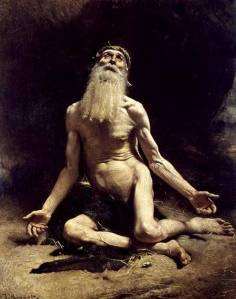
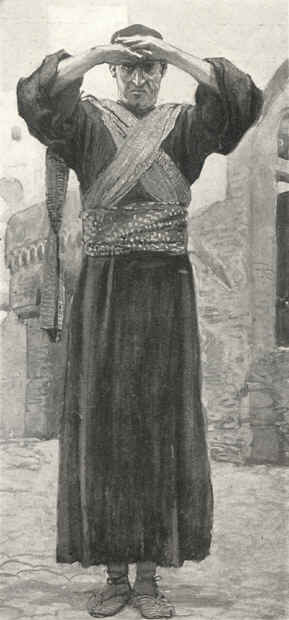
Job by Leon Bonnat (1880)

There is some debate around the person Daniel among the righteous named in this passage. Noah (Genesis 6-9) and Job are both biblical figures from the distant past who are both acclaimed as righteous men who stand out in their generations. Noah is before the people of Israel are constituted but as one saved from an unrighteous generation he could be a symbol for hope. Job is from the land of Uz as reflected in the poetic book of Job who goes through a time of extreme testing and remains faithful to God. Scholars believe the book of Daniel to be written much later than the book of Ezekiel and this has led some scholars to believe that the person referred to here must be Dan’el the grandfather of Methuselah and may have a tradition of being a wise judge in Phoenician and north Canaanite tradition. (Block, 1997, p. 448) Yet, the book of Daniel relates the story of Daniel who would be a younger contemporary of Ezekiel in the exile in Babylon and many of the early stories in the book occur during the reign of Nebuchadrezzar. It is plausible that Daniel, even at this early stage, has become a symbol of what faithfulness to God in the midst of the Babylonian empire looked like.

The unfaithfulness of the people of Judah has wounded the land and brought about their own devastation. Yet, the Lord GOD will save some even with the faithlessness of the people and the land. In Ezekiel’s view the action of the LORD is justified even if harsh. Yet, even within the wrath expressed in Ezekiel there is a space of grace that prevents the people from being completely destroyed by the famine, wild bests, sword, and pestilence that is unleashed upon the land.

[1] 1 Kings 13 where the man of God from Judah who speaks out against the altar at Bethel and then an old prophet at Bethel deceives this man of God by declaring that an angel of the LORD has given him a message and 1 Kings 22 where Micaiah talks about a spirit who with the LORD’s permission deceives the prophets of King Ahab.

Ezekiel 8 The Corruption of the Temple and the People

James Tissot, Solomon Decicates the Temple (1896-1902)

Ezekiel 8

1 In the sixth year, in the sixth month, on the fifth day of the month, as I sat in my house, with the elders of Judah sitting before me, the hand of the Lord GOD fell upon me there. 2 I looked, and there was a figure that looked like a human being; below what appeared to be its loins it was fire, and above the loins it was like the appearance of brightness, like gleaming amber. 3 It stretched out the form of a hand, and took me by a lock of my head; and the spirit lifted me up between earth and heaven, and brought me in visions of God to Jerusalem, to the entrance of the gateway of the inner court that faces north, to the seat of the image of jealousy, which provokes to jealousy. 4 And the glory of the God of Israel was there, like the vision that I had seen in the valley.

5 Then God said to me, “O mortal, lift up your eyes now in the direction of the north.” So I lifted up my eyes toward the north, and there, north of the altar gate, in the entrance, was this image of jealousy. 6 He said to me, “Mortal, do you see what they are doing, the great abominations that the house of Israel are committing here, to drive me far from my sanctuary? Yet you will see still greater abominations.”

7 And he brought me to the entrance of the court; I looked, and there was a hole in the wall. 8 Then he said to me, “Mortal, dig through the wall”; and when I dug through the wall, there was an entrance. 9 He said to me, “Go in, and see the vile abominations that they are committing here.” 10 So I went in and looked; there, portrayed on the wall all around, were all kinds of creeping things, and loathsome animals, and all the idols of the house of Israel. 11 Before them stood seventy of the elders of the house of Israel, with Jaazaniah son of Shaphan standing among them. Each had his censer in his hand, and the fragrant cloud of incense was ascending.12 Then he said to me, “Mortal, have you seen what the elders of the house of Israel are doing in the dark, each in his room of images? For they say, ‘The LORD does not see us, the LORD has forsaken the land.'” 13 He said also to me, “You will see still greater abominations that they are committing.”

14 Then he brought me to the entrance of the north gate of the house of the LORD; women were sitting there weeping for Tammuz. 15 Then he said to me, “Have you seen this, O mortal? You will see still greater abominations than these.”

16 And he brought me into the inner court of the house of the LORD; there, at the entrance of the temple of the LORD, between the porch and the altar, were about twenty-five men, with their backs to the temple of the LORD, and their faces toward the east, prostrating themselves to the sun toward the east. 17 Then he said to me, “Have you seen this, O mortal? Is it not bad enough that the house of Judah commits the abominations done here? Must they fill the land with violence, and provoke my anger still further? See, they are putting the branch to their nose! 18 Therefore I will act in wrath; my eye will not spare, nor will I have pity; and though they cry in my hearing with a loud voice, I will not listen to them.”

Ezekiel’s prophecies as reported in the book of Ezekiel have been directed first at Jerusalem, then at the land of Judah, and now the next two chapters orient on the temple and prepare us for the departure of the LORD’s presence from the temple. Ezekiel from his exile in Babylon is transported by God to view the actions of idolatry which have aroused the LORD’s passion so violently. During this time where the prophet is given a look within the walls of the temple the LORD shows four different examples of idolatrous practices among the people which cause the God of Israel disgust. These syncretistic[1] practices by themselves are enough, in the book of Ezekiel’s view, to justify God’s anger. The anger of God is increased by the way the infection of idolatrous worship is leading to practices of violence which further provoke God.

The beginning of this oracle fixes the date of this vision precisely: September 18, 592 BCE (by our calendar), fourteen months after the inaugural vision. This is close to the number of days that Ezekiel is instructed to lie on his right and left side (if this occurs immediately after the initial vision) outlined in Ezekiel 4: 4-8. Yet, even in this short time the prophet’s actions have attracted the notice of the elders in exile with Ezekiel and they sit before Ezekiel. Perhaps they have come to Ezekiel seeking an oracle or they are watching the performance of his sign act of lying on his side, but during this time when the elders are present Ezekiel is transported to Jerusalem. There is no indication of what the elders perceive during this event, whether they perceive Ezekiel having a prophetic episode or whether they see him lifted up and transported. The description of the LORD’s appearance does not have the divine chariot that is described in the first two chapters and only focuses on the image of the humanlike but divinely bright character who lifts the prophet up. One reason the chariot may not be present is that God is picking Ezekiel up in Babylon and transporting him to the place where the LORD’s presence is supposed to rest in Jerusalem. The prophet is taken by a lock of hair, but the spirit at the same time is lifting the prophet up so it is plausible that the experience is not one of being lifted by one’s hair, but instead of being carefully picked up by what can be described as the hand of God and the spirit of God simultaneously. Yet, the method of divine transportation is merely the prelude to the vital imagery of idolatry that God desires the prophet to see and communicate.

Ezekiel is transported to the altar gate of the temple to see the ‘image of jealousy’ which has clearly aroused the LORD’s passionate anger. I am not certain whether Ezekiel is standing near the entrance to the holy of holies, where the ark of the covenant resides and where God’s presence is expected to rest, or whether he is perhaps between the holy place and the vestibule, nearer to where the altar would be, but the presence of a statue to a different god within the temple complex would have been a shocking abomination to this prophet concerned with the holiness of the temple.

The description of the abominations in Ezekiel 8 parallel the pattern of prohibitions laid out in Deuteronomy 4: 15-20:

15 Since you saw no form when the LORD spoke to you at Horeb out of the fire, take care and watch yourselves closely, 16 so that you do not act corruptly by making an idol for yourselves, in the form of any figure — the likeness of male or female, 17 the likeness of any animal that is on the earth, the likeness of any winged bird that flies in the air, 18 the likeness of anything that creeps on the ground, the likeness of any fish that is in the water under the earth.19 And when you look up to the heavens and see the sun, the moon, and the stars, all the host of heaven, do not be led astray and bow down to them and serve them, things that the LORD your God has allotted to all the peoples everywhere under heaven. 20 But the LORD has taken you and brought you out of the iron-smelter, out of Egypt, to become a people of his very own possession, as you are now.

This image of jealousy is likely one of the Canaanite gods that continually work their ways into the practices of the people of Israel and Judah and the Canaanite gods often appear as figures or male of female likeness as prohibited in Deuteronomy 4:16. King Manasseh of Judah placed a carved image of Asherah within the house of the LORD (2 Kings 21:7) but Josiah destroyed this idol during his reforms (2 Kings 23:6). Yet, Josiah’s reforms did not endure long after his death in battle and it is possible that a later king or individual had the audacity to place another image like Manasseh’s Asherah within the temple. It is also possible that with the physical transportation of the prophet to the temple that there is a temporal transportation to this time when the statue of Asherah existed within the temple grounds. While the temporal transportation is possible with God, and there is an element where we are seeing a compilation of offenses that may not all be occurring simultaneously, it is also likely that the people of Judah continued to revert to syncretistic practices of worshiping other gods alongside the LORD that are continually indicated in the Deuteronomic history.[2]

The second abomination that the LORD wants the prophet to see involves the elders offering incense to their rooms of images. The prophet is shown a recess or hiding place (NRSV hole) in the wall that the prophet is instructed to dig through.[3] The excavation of this hiding place takes Ezekiel into a secret room where seventy elders including Jaazaniah son of Shaphan are conducting their secretive incense offerings before walls decorated with images in a way prohibited by Deuteronomy 4:17-18. In addition to the misplaced actions of offering incense before the creeping things and loathsome animals is the reality that it is the elders and not the priests who are conducting this offering. The images may be like the walls in Egyptian burial chambers or the Ishtar gate in Babylon, but it also may indicate the conglomeration of personal shrines that are in the households of the elders of Israel. The presence of seventy elders echoes the presence of seventy elders in Exodus 24: 9-18 and Number 11:16-30 where the elders are gathered to share in Moses in the burden of leading the people. In contrast these seventy elders, distinct from the elders gathered around Ezekiel in exile, are one of the causes of the condemnation of the people. If Jaazaniah son of Shaphan, the recognized and named elder, is a son of the Shaphan mentioned in 2 Kings 22, a court official involved in the reforms of Josiah, then as Kathyrn Pfister Darr indicates, “the presence of this elder within the secret chamber signaled not only the failure of the reform (of Josiah), but also the ubiquity of Israelite idolatry.” (NIB VI: 1176) The elders may state that the LORD does not see them and that the LORD has forsaken the land, but the prophet is shown that the LORD does see and wants the prophet to see as well. These secretive mysterious rituals being conducted in the dark have been unearthed by the prophets excavation, and what they conducted in darkness has now been brought into the light.

Detail from the Ishtar Gate (Reconstruction in Berlin’s Pergamon Museum)

The third abomination the prophet sees is the practice of women weeping for Tammuz. Tammuz is not mentioned elsewhere in scripture, but we do know about this practice comes from existing inscriptions from the surrounding region. Tammuz is a Sumerian myth involving the decent of Tammuz into the underworld and then rebirth corresponding to the agricultural seasons. If this practice is corresponding to the practices of the surrounding culture, then the timing would be off for this lament to be given during September (the time of the vision) but as mentioned above there is likely some element of temporal transport along with the physical transport to highlight multiple practices that the LORD finds offensive.

The final transport takes the prophet to the temple again where twenty-five men have turned their backs on the LORD to bow down to the rising sun. This again follows the prohibitions of Deuteronomy 4:19 against bowing down to the sun, moon, or any astral body. These practices are seemingly present in every portion of society in Judah: within the temple, practiced by the elders, by women and by men. The temple has not prevented the spiritual deterioration of the people because the temple itself has been corrupted by the ‘image of jealousy’ and the practices of the elders, the women, and the men within the temple compound.

Yet, the idolatrous acts of worship have also corrupted the way of life of the people of Judah. Although the idolatrous worship is enough, the people have gone further and committed acts of violence (Hebrew hamas).[4] Rimon Kasher explains the meaning of the Hebrew word hamas as:

Ĥamas is violent social injustice… The expression occurs in the story of the Flood, so what we have here is more than merely a hint of the punishment that awaits Judah. What the verse means is that God’s anger towards Israel arises not only from their religious abominations, but also from their sins in the moral and social sphere. (Ganzel, 2020, p. 76)

The idolatrous and violent actions of the people have grieved God’s heart like the story of the flood, and now Judah has put the branch to the God’s nose. The enigmatic phrase ‘sticking the branch up my nose’  has been described by interpreters as everything from a phallic symbol to the actions involved in the worship of one of the indicated idols, or simply an insulting gesture, but as Daniel Block indicates it is used to describe how the LORD feels his subjects have treated him disrespectfully. (Block, 1997, p. 299) This place that was to be a place reserved for the worship of the LORD and honoring the divine name has become transformed into a place where idolatrous practices obscure the worship of their God and have caused God to feel disgust towards the temple and those who are misusing it.


[1] Syncretism is the merging or combining of various religious practices. The theology of the Hebrew Scriptures is continually opposed to syncretism but it also narrates numerous instances of syncretic practice throughout the story of Israel and Judah.

[2] The Deuteronomic history, so called by scholars because the theological perspective echoes the book of Deuteronomy, includes the books Joshua, Judges, 1 & 2 Samuel, and 1 & 2 Kings.

[3] As Katheryn Pfister Darr notes if there was already a hole in the wall why would God command the prophet to dig a hole. (NIB VI:1175)

[4] The Hebrew word hamas is not the root of the Palestinian group Hamas. The Hamas currently involved in the Hamas-Israel conflict derives its name from an acronym of Harakata al-Muqawama al-Islamiya (translated as Islamic resistance Movement).

Ezekiel 6 Judgment Against the Land of Israel

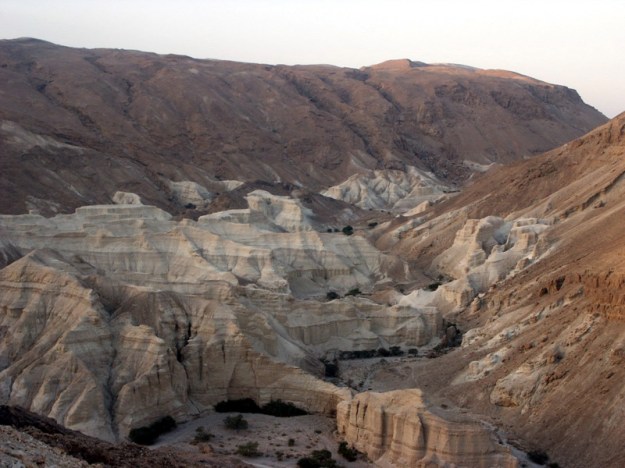
Judean Hills viewed from the Dead Sea by Kreecher at Russian Wikipedia – Transferred from ru.wikipedia to Commons., Public Domain, https://commons.wikimedia.org/w/index.php?curid=4241172

Ezekiel 6

1 The word of the LORD came to me: 2 O mortal, set your face toward the mountains of Israel, and prophesy against them, 3 and say, You mountains of Israel, hear the word of the Lord GOD! Thus says the Lord GOD to the mountains and the hills, to the ravines and the valleys: I, I myself will bring a sword upon you, and I will destroy your high places. 4 Your altars shall become desolate, and your incense stands shall be broken; and I will throw down your slain in front of your idols. 5 I will lay the corpses of the people of Israel in front of their idols; and I will scatter your bones around your altars. 6 Wherever you live, your towns shall be waste and your high places ruined, so that your altars will be waste and ruined, your idols broken and destroyed, your incense stands cut down, and your works wiped out. 7 The slain shall fall in your midst; then you shall know that I am the LORD.

8 But I will spare some. Some of you shall escape the sword among the nations and be scattered through the countries. 9 Those of you who escape shall remember me among the nations where they are carried captive, how I was crushed by their wanton heart that turned away from me, and their wanton eyes that turned after their idols. Then they will be loathsome in their own sight for the evils that they have committed, for all their abominations. 10 And they shall know that I am the LORD; I did not threaten in vain to bring this disaster upon them.

11 Thus says the Lord GOD: Clap your hands and stamp your foot, and say, Alas for all the vile abominations of the house of Israel! For they shall fall by the sword, by famine, and by pestilence. 12 Those far off shall die of pestilence; those nearby shall fall by the sword; and any who are left and are spared shall die of famine. Thus I will spend my fury upon them. 13 And you shall know that I am the LORD, when their slain lie among their idols around their altars, on every high hill, on all the mountain tops, under every green tree, and under every leafy oak, wherever they offered pleasing odor to all their idols. 14 I will stretch out my hand against them, and make the land desolate and waste, throughout all their settlements, from the wilderness to Riblah. Then they shall know that I am the LORD.

The sign-acts of the previous two chapters have been directed against the city of Jerusalem, but now the judgment is expanded to the mountains of Israel. The city of Jerusalem, the temple, the Davidic king, and the land have all been pillars upon which the people’s false sense of security rested. Just as chapters four and five were directed against Israel, now the focus shifts to the land. In this chapter we also begin to see the reason for the fractured relationship between God and God’s people. The worship at the high places of other gods by the people has broken the LORD’s heart and led to this broken relationship.

This oracle begins with the characteristic address to the prophet as mortal (literally son of man) and then immediately proceeds to what Daniel Block calls the ‘hostile orientation formula’ (Block, 1997, p. 34) when Ezekiel is instructed to ‘set his face towards’ the mountains of Israel. It may derive from the idea that a person delivering a curse must be facing the object of cursing[1] or it may generally refer to the common practice of facing the one who you are addressing. Yet, Ezekiel’s address of the mountains of Israel from the exile in Babylon would’ve been merely directional like the Islamic practice of facing Mecca to pray. The command to set one’s face towards an place, person or object is universally used throughout the book of Ezekiel to denote the LORD’s hostility towards the object that the face is set towards.

The religious problems of the people of Judah are not concentrated only in the temple. The high places (Hebrew bamot) have existed throughout Israel’s time in the land and although there are positive references in the time prior to the construction of the temple, the majority of references are viewed from the perspective of the author of 1 and 2 Kings as a source of embarrassment once Solomon’s temple is built. Yet even Solomon constructed high places late in his reign. Josiah’s attempts to purge the nation of Israel of these high places ends with his death and the worship at these high places resumed shortly afterwards. Most of the high places noted in the scriptures are not out in the wilderness places but are in inhabited areas where the people could easily access them.

The altars, incense stands, and idols in these high places indicate the misdirected faith of the people of Israel. Altars and incense stands can be used properly in the worship of the LORD in the temple, but they can also be used in the worship of these other images for other gods. Daniel Block argues that the word often translated idols or images should be harsher:

Modern sensitivities prevent translators from rendering the expression as Ezekiel intended it to be heard, but had he been preaching today, he would probably have identified these idols with a four-letter word for excrement.[2] (Block, 1997, p. 226)

The continued presence of these high places, altars, incense stands, and idols have left the LORD brokenhearted (NRSV crushed) at the way Israel has failed to be faithful to God. Like in the Genesis narrative of the flood (Genesis 6-7) when God is sorry to have created humanity, the result is the same: God resolved to blot out (expunge) humanity in Genesis and here the towns and high places will be ruined (expunged).[3]

God’s words may be harsh in this portion of Ezekiel, but they are not without hope. There is a future for a remnant and a possibility for renewal, but the renewal will occur in a new place. For this renewal to happen the people must remember the LORD and know the LORD. When the pillars on which the peoples’ false sense of security are broken down the people will remember their God and they will loathe their previous unfaithfulness. The words of this prophecy are clearly aligned with the curses of Leviticus 26:30-33 and the consequences of disobedience long delayed have not been spoken in vain.

The God of Israel is a passionate God who desperately wants to abide among the people, but this God will not be taken for granted. The land, the temple, the city, the stable line of Davidic kings are all conditioned on loyalty to the LORD as articulated in the covenant. The painful words of the heartbroken God of the people of Israel may be difficult to hear, and the loss of the land, the death of many of the people, and the need for the remnant to begin again as strangers in a strange land must have been challenging. Yet, Ezekiel’s words do not seem to change the direction of the people until after the

[1] For example the actions of Balaam in Number 22-24.

[2] Block’s argument is based on the practice of looking at the words a new word is constructed from. If the hypothesis of Block and others is correct the images or idols are representative of ‘shitgods.’ Ezekiel is responsible for 39 or the 48 occurrences in the Hebrew Scriptures of the Hebrew word gillum which is what is translated idols or images here.

[3] The same Hebrew verb maha is used in both Genesis 6-7 and here.

1 Kings 14 The End of Kings Jeroboam and Rehoboam

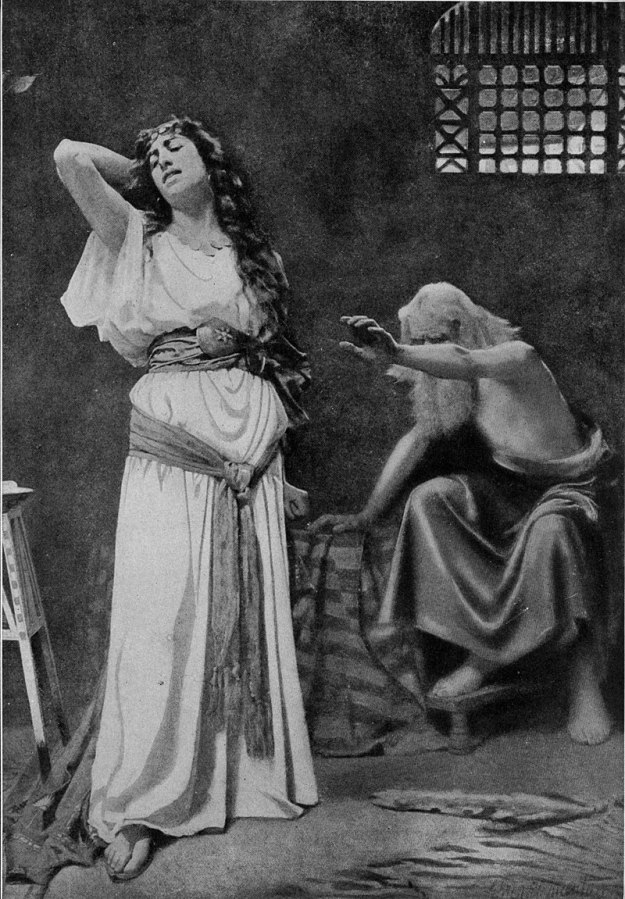
By Charles Horne – [2], Public Domain, https://commons.wikimedia.org/w/index.php?curid=9390700

1 Kings 14:1-20

1 At that time Abijah son of Jeroboam fell sick. 2 Jeroboam said to his wife, “Go, disguise yourself, so that it will not be known that you are the wife of Jeroboam, and go to Shiloh; for the prophet Ahijah is there, who said of me that I should be king over this people. 3 Take with you ten loaves, some cakes, and a jar of honey, and go to him; he will tell you what shall happen to the child.”

4 Jeroboam’s wife did so; she set out and went to Shiloh, and came to the house of Ahijah. Now Ahijah could not see, for his eyes were dim because of his age. 5 But the LORD said to Ahijah, “The wife of Jeroboam is coming to inquire of you concerning her son; for he is sick. Thus and thus you shall say to her.”

When she came, she pretended to be another woman. 6 But when Ahijah heard the sound of her feet, as she came in at the door, he said, “Come in, wife of Jeroboam; why do you pretend to be another? For I am charged with heavy tidings for you. 7 Go, tell Jeroboam, ‘Thus says the LORD, the God of Israel: Because I exalted you from among the people, made you leader over my people Israel, 8 and tore the kingdom away from the house of David to give it to you; yet you have not been like my servant David, who kept my commandments and followed me with all his heart, doing only that which was right in my sight, 9 but you have done evil above all those who were before you and have gone and made for yourself other gods, and cast images, provoking me to anger, and have thrust me behind your back; 10 therefore, I will bring evil upon the house of Jeroboam. I will cut off from Jeroboam every male, both bond and free in Israel, and will consume the house of Jeroboam, just as one burns up dung until it is all gone. 11 Anyone belonging to Jeroboam who dies in the city, the dogs shall eat; and anyone who dies in the open country, the birds of the air shall eat; for the LORD has spoken.’ 12 Therefore set out, go to your house. When your feet enter the city, the child shall die. 13 All Israel shall mourn for him and bury him; for he alone of Jeroboam’s family shall come to the grave, because in him there is found something pleasing to the LORD, the God of Israel, in the house of Jeroboam.

14 Moreover the LORD will raise up for himself a king over Israel, who shall cut off the house of Jeroboam today, even right now! 15 “The LORD will strike Israel, as a reed is shaken in the water; he will root up Israel out of this good land that he gave to their ancestors, and scatter them beyond the Euphrates, because they have made their sacred poles, provoking the LORD to anger. 16 He will give Israel up because of the sins of Jeroboam, which he sinned and which he caused Israel to commit.”

17 Then Jeroboam’s wife got up and went away, and she came to Tirzah. As she came to the threshold of the house, the child died. 18 All Israel buried him and mourned for him, according to the word of the LORD, which he spoke by his servant the prophet Ahijah.

19 Now the rest of the acts of Jeroboam, how he warred and how he reigned, are written in the Book of the Annals of the Kings of Israel. 20 The time that Jeroboam reigned was twenty-two years; then he slept with his ancestors, and his son Nadab succeeded him.

Jeroboam’s rise to power over ten of the twelve tribes of Israel began with the prophet Ahijah tearing his new robe into twelve pieces and symbolically giving Jeroboam ten to represent God handing ten tribes over to Jeroboam and away from the house of David. The downfall of the house of Jeroboam begins with Jeroboam’s unnamed wife approaching the prophet Ahijah with ten loaves of bread, cake and honey, the offering of a poor person to inquire about the health of their son. Ahijah has disappeared from the narrative until his reemergence as an elderly prophet whose eyesight is failing but is still able to discern the voice of the LORD when God speaks to him. Jeroboam may be aware that Ahijah is at Shiloh, but this prophet seems to have been otherwise neglected during the reign of Jeroboam.

If Jeroboam had realized that Ahijah’s eyes were failing him it would have been unnecessary to instruct his wife to go in disguise. Yet, this prophet of failing eyesight is given clear insight by the LORD into both the identity of his visitor, her quest, and God’s pronouncement to her. My impression of prophets as a youth was that they were holy and proper figures, but this is not reflective of the biblical prophets. Whether it is a direct relaying of the message from God which carries God’s disgust or whether the tone of the message is reflective of this elderly prophet who has lost his sense of awe towards the king, the language that Ahijah uses to relay God’s judgment is more vulgar than English translations show. While the NRSV is correct that God promises to cut off every male in verse ten, the Hebrew for male (mustin bequir) is literally ‘one who pisses against the wall’ (NIB III: 112) and later they are compared to dung. There is a parallel with the language of the song of Moses in Deuteronomy 32 (particularly verse 5-6), and the distinction of bond and free may be related either to slavery and freedom or being still under parental control and being an adult. Jeroboam’s wife has the unfortunate task of bearing both the message of her own son’s impending death as well as the dynasty of Jeroboam.

Unlike the dynasty of David, where the LORD seems content to allow the offspring of that line to continue despite their own abominable practices (see below) the LORD will continue to “tamper with dynastic politics” (Brueggemann, 2000, p. 179) in Israel by selecting new kings and allowing an air of instability of persist in Israel. In a somewhat heretical line of thought I wonder if the LORD is really bad at picking qualified leaders for the people, or what causes these kings to fail to live into the vision that God has for them. But during this time of multiple dynasties in Israel we will see the rise of the prophets who challenge the actions of the kings and attempt to bring the people back to the worship of the LORD and the way of the Torah. God and Ahijah’s disappointment with Jeroboam goes back to his practices which violated the commandments and introduced images into the worship of God.

The death of Abijah, the son of the king, in the manner which the prophet spoke should be a call to Jeroboam’s family to repentance. Like with Solomon, the LORD seems willing to delay the judgment to the following generation as Jeroboam sleeps with his ancestors and his son, Nadab succeeds him. Yet, God has spoken through the rough words of the prophet about the impending doom upon Jeroboam’s household. But before we can learn the fate of the household of Jeroboam we will revisit the kingdom of Judah under Solomon’s son, Rehoboam.

1 Kings 14: 21-31


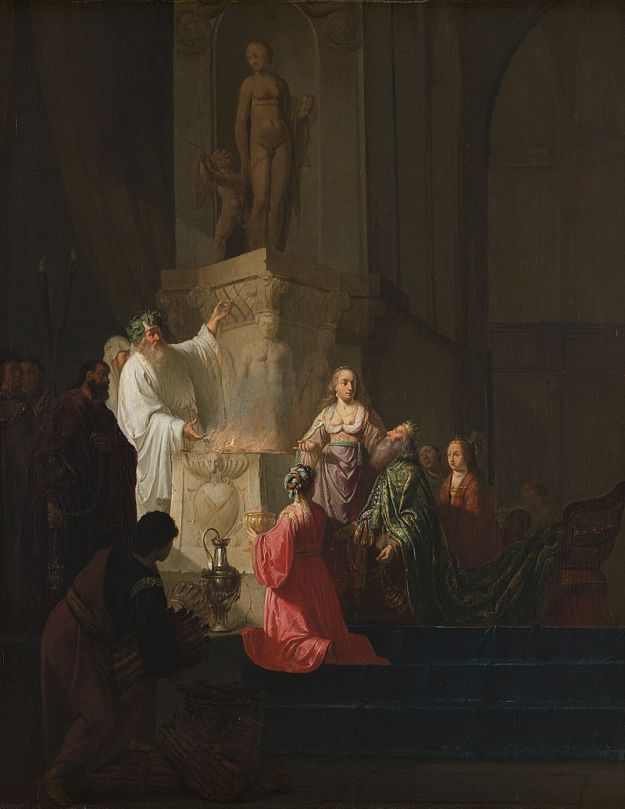
21 Now Rehoboam son of Solomon reigned in Judah. Rehoboam was forty-one years old when he began to reign, and he reigned seventeen years in Jerusalem, the city that the LORD had chosen out of all the tribes of Israel, to put his name there. His mother’s name was Naamah the Ammonite. 22 Judah did what was evil in the sight of the LORD; they provoked him to jealousy with their sins that they committed, more than all that their ancestors had done. 23 For they also built for themselves high places, pillars, and sacred poles on every high hill and under every green tree; 24 there were also male temple prostitutes in the land. They committed all the abominations of the nations that the LORD drove out before the people of Israel.

25 In the fifth year of King Rehoboam, King Shishak of Egypt came up against Jerusalem; 26 he took away the treasures of the house of the LORD and the treasures of the king’s house; he took everything. He also took away all the shields of gold that Solomon had made; 27 so King Rehoboam made shields of bronze instead, and committed them to the hands of the officers of the guard, who kept the door of the king’s house. 28 As often as the king went into the house of the LORD, the guard carried them and brought them back to the guardroom.

29 Now the rest of the acts of Rehoboam, and all that he did, are they not written in the Book of the Annals of the Kings of Judah? 30 There was war between Rehoboam and Jeroboam continually. 31 Rehoboam slept with his ancestors and was buried with his ancestors in the city of David. His mother’s name was Naamah the Ammonite. His son Abijam succeeded him.

The wisdom of Solomon had been used to accumulate vast amounts of gold, create trading networks, acquire and trade in chariot and horses and dramatically reshape the tribes of Israel into a unified kingdom that was admired by Solomon’s neighbors. Five years later under Rehoboam the kingdom has split in two, the trading networks seem to have evaporated, and the military might and gold are returned to Egypt. The golden king is now succeeded by the son of brass and the sins of the father to create the high places where the Canaanite gods could be worshipped are continued by the son to disastrous consequences. Solomon’s peace has dissolved into Rehoboam’s continual warfare with Israel and his humiliation by King Shishak of Egypt.

Naamah, the mother of Rehoboam, is mentioned twice and may indicate the powerful role of the queen mother. It is possible that the author of 1 Kings views this Ammonite mother as a negative influence who encourages the religious practices that are labeled as abominations. These religious practices are labeled in two of the most rhetorically extreme terms: male prostitution and abominations. Although the meaning of the term that is rendered ‘male prostitution’ is debated it clearly refers to a practice that worshipers of the LORD found deeply offensive. (Brueggemann, 2000, p. 181) Yet, even though the practices in Judah may receive a harsh rhetorical judgment the line of David is allowed to continue.

Five years into the reign of Rehoboam the former trading partner of Solomon has become a military invader. King Shishak of Egypt rolls into Judah, humiliates the forces of Judah and pillages the golden stores of Solomon. Although the text does not explicitly indicate this is God’s judgment on the reign of Rehoboam[1] the positioning of this humiliation after the narration of the unfaithfulness of the people implies it. Yet, the LORD does not allow Judah to be overthrown, merely humiliated. The golden shields are replaced by bronze ones and they continue their conflicts with Israel. Yet, the seventeen-year reign of Rehoboam is not worth much consideration by the author of 1 Kings. He lives in the aftermath of Solomon’s glories and Solomon’s sins and dies the bronze son of the golden father.

[1] 2 Chronicles 12 does make this explicit link, but Rehoboam and the people 2 Chronicles humble themselves and submit to God, where 1 Kings has no indication of Rehoboam making any changes.

1 Kings 11 The Foolish End of Solomon

Willem de Poorter, ‘De afgoderij van konig Solomo’-Solomon’s decent into idolatry (between 1630 and 1648)

1 Kings 11: 1-13 The Foolishness of Solomon

1 King Solomon loved many foreign women along with the daughter of Pharaoh: Moabite, Ammonite, Edomite, Sidonian, and Hittite women, 2 from the nations concerning which the LORD had said to the Israelites, “You shall not enter into marriage with them, neither shall they with you; for they will surely incline your heart to follow their gods”; Solomon clung to these in love. 3 Among his wives were seven hundred princesses and three hundred concubines; and his wives turned away his heart. 4 For when Solomon was old, his wives turned away his heart after other gods; and his heart was not true to the LORD his God, as was the heart of his father David. 5 For Solomon followed Astarte the goddess of the Sidonians, and Milcom the abomination of the Ammonites.

6 So Solomon did what was evil in the sight of the LORD, and did not completely follow the LORD, as his father David had done. 7 Then Solomon built a high place for Chemosh the abomination of Moab, and for Molech the abomination of the Ammonites, on the mountain east of Jerusalem. 8 He did the same for all his foreign wives, who offered incense and sacrificed to their gods. 9 Then the LORD was angry with Solomon, because his heart had turned away from the LORD, the God of Israel, who had appeared to him twice, 10 and had commanded him concerning this matter, that he should not follow other gods; but he did not observe what the LORD commanded.

11 Therefore the LORD said to Solomon, “Since this has been your mind and you have not kept my covenant and my statutes that I have commanded you, I will surely tear the kingdom from you and give it to your servant. 12 Yet for the sake of your father David I will not do it in your lifetime; I will tear it out of the hand of your son. 13 I will not, however, tear away the entire kingdom; I will give one tribe to your son, for the sake of my servant David and for the sake of Jerusalem, which I have chosen.”

In many divorces there may be a critical crisis where rupture in the relationship becomes readily apparent to both partners, but normally there has been a slow degradation of the relationship before this critical crisis. Many casual readers of First Kings’ report of Solomon’s reign will realize the critical crisis in the relationship between Solomon and God here as Solomon begins to turn away from the ways of his father and follow other gods. Yet, as I’ve tried to illustrate, Solomon’s focus on gold, military might, political alliances, and luxury items have already shown a drift away from the covenantal ways of the law towards the practices of King Hiram of Tyre, Pharaoh of Egypt, and the other kings of the surrounding region. Solomon has become a king deeply enmeshed in trade, building a capital city like that of Egypt, and he is the opposite of the model king lifted up in Deuteronomy 17: 14-20. At the ending of the previous chapter he had acquired large numbers of horses and chariots from Egypt and massive quantities of gold and silver (to the point silver was no longer valued) and now he also has a thousand wives and concubines.

First Kings is considered by our Jewish ancestors as a prophetic book and it shares with Joshua, Judges, First and Second Samuel, and Second Kings a theological perspective which resonates strongly with the book of Deuteronomy. This covenantal understanding of the relationship between Israel’s king, Israel’s temple, the people of Israel, and the God of Israel is a central theme of the Hebrew Scriptures, yet it also is neglected by the leaders of the people of Israel. As Walter Brueggemann can insightfully state:

The editorial practice of the book of Kings is to provide a theological assessment of each king by the criterion of Torah-obedience, a criterion in which kings characteristically are not at all interested. The kings are evaluated by norms that they themselves would consider irrelevant. (Brueggemann, 2000, p. 141)

Solomon’s self-evaluation would probably be oriented around his piety in constructing the temple, his success in international trading relations, his acquisition of wealth, his construction of Jerusalem and other walled cities, and his transition of the people from a disunified tribal society to a unified monarchy which for a brief moment occupies a place on the world stage. Solomon’s evaluation by other leaders like King Hiram of Tyre, the Queen of Sheba, and Pharoah of Egypt is that he is a wise son of David who administers his kingdom in a way they find praiseworthy. Yet, the LORD’s power has been notably absent from the narrative of Solomon. God has granted wisdom, wealth, and freedom from enemies but then the narrative shifts to Solomon’s achievements occasionally interrupted by divine warnings. Solomon’s story up to this point has been one of self-reliance and achievement but the connection to the commands, statutes, and ordinances of God has been lost. Solomon has exchanged God’s wisdom for the wisdom of the other nations. Solomon’s values had already shifted by this point in the narrative, his allowance or adoption of the worship of the gods of his wives is merely the critical crisis.

Solomon’s wives are almost certainly an extension of his vast network of diplomatic and trading networks he embarks upon. Marriages in the ancient world were primarily economic relationships rather than relationships of love or lust. This does not mean that Solomon is not emotionally attached to some or all of his wives and concubines, but they were brought into his household as a way of strengthening relationships between neighboring kingdoms in addition to regional leaders in Israel. Even if the foreign women among his wives and concubines formally accepted the worship of the LORD, the God of Israel, they never adopted a Torah based value system. (Israel, 2013, p. 127) and they may have encouraged Solomon’s own drift from that value system. Early in First Kings we heard that “Solomon loved the LORD” (3:3) but now that love is in tension with Solomon’s love of many foreign women.

The law as stated in Deuteronomy is highly aware of the competing value systems that it will encounter among the surrounding people in the promised land. The people were not to make covenants with them, to intermarry with them,[1]and they were to be excluded from the assembly of the faithful. (Deuteronomy 7: 2-4, 23: 2-7) Not only were they not to worship these other deities, they were also not to blend the practices of gods like Astarte, Chemosh, and Molech with the practices of the LORD. For example there are instances where the worship of the LORD in the book of Judges is indistinguishable from the worship of the Canaanite gods. Now Solomon allows the establishment of places of worship in close proximity to the temple itself, including on the Mount of Olives[2] directly opposite the temple mount.

Solomon’s heart has turned away from the LORD. The NRSV indicates that Solomon’s mind has moved but the Hebrew indicates that this is Solomon’s will.[3] Solomon who was granted wisdom has now directed his will and heart towards things that the LORD views as foolish. It may be wise in the view of the world, but in God’s eyes and in light of the covenant it is foolishness that breaks the relationship between God and Solomon and leads to a rupture in the kingdom. Yet the LORD does not act immediately. God has repeatedly warned Solomon and I believe still desires Solomon’s return and grants time and space for repentance. There is also a promise that God made to David in 2 Samuel 7:15 where the LORD promises not to take his love away like he did with Saul. Even at this critical crisis which brings a rupture to the relationship between God and the king, the LORD continues to extend grace in the midst of judgment for the sake of David and Jerusalem. God continues to honor the temple, the hope of what a Davidic king could be and to leave open a future where return to God’s ways could bring a reunited relationship. The LORD continues to seek the misplaced love of Solomon.

1 Kings 11: 14-40 Conflict in the Peaceful Reign

14 Then the LORD raised up an adversary against Solomon, Hadad the Edomite; he was of the royal house in Edom. 15 For when David was in Edom, and Joab the commander of the army went up to bury the dead, he killed every male in Edom 16 (for Joab and all Israel remained there six months, until he had eliminated every male in Edom); 17 but Hadad fled to Egypt with some Edomites who were servants of his father. He was a young boy at that time. 18 They set out from Midian and came to Paran; they took people with them from Paran and came to Egypt, to Pharaoh king of Egypt, who gave him a house, assigned him an allowance of food, and gave him land. 19 Hadad found great favor in the sight of Pharaoh, so that he gave him his sister-in-law for a wife, the sister of Queen Tahpenes. 20 The sister of Tahpenes gave birth by him to his son Genubath, whom Tahpenes weaned in Pharaoh’s house; Genubath was in Pharaoh’s house among the children of Pharaoh. 21 When Hadad heard in Egypt that David slept with his ancestors and that Joab the commander of the army was dead, Hadad said to Pharaoh, “Let me depart, that I may go to my own country.” 22 But Pharaoh said to him, “What do you lack with me that you now seek to go to your own country?” And he said, “No, do let me go.”

23 God raised up another adversary against Solomon, Rezon son of Eliada, who had fled from his master, King Hadadezer of Zobah. 24 He gathered followers around him and became leader of a marauding band, after the slaughter by David; they went to Damascus, settled there, and made him king in Damascus. 25 He was an adversary of Israel all the days of Solomon, making trouble as Hadad did; he despised Israel and reigned over Aram.

26 Jeroboam son of Nebat, an Ephraimite of Zeredah, a servant of Solomon, whose mother’s name was Zeruah, a widow, rebelled against the king. 27 The following was the reason he rebelled against the king. Solomon built the Millo, and closed up the gap in the wall of the city of his father David. 28 The man Jeroboam was very able, and when Solomon saw that the young man was industrious he gave him charge over all the forced labor of the house of Joseph. 29 About that time, when Jeroboam was leaving Jerusalem, the prophet Ahijah the Shilonite found him on the road. Ahijah had clothed himself with a new garment. The two of them were alone in the open country 30 when Ahijah laid hold of the new garment he was wearing and tore it into twelve pieces. 31 He then said to Jeroboam: Take for yourself ten pieces; for thus says the LORD, the God of Israel, “See, I am about to tear the kingdom from the hand of Solomon, and will give you ten tribes. 32 One tribe will remain his, for the sake of my servant David and for the sake of Jerusalem, the city that I have chosen out of all the tribes of Israel. 33 This is because he has forsaken me, worshiped Astarte the goddess of the Sidonians, Chemosh the god of Moab, and Milcom the god of the Ammonites, and has not walked in my ways, doing what is right in my sight and keeping my statutes and my ordinances, as his father David did. 34 Nevertheless I will not take the whole kingdom away from him but will make him ruler all the days of his life, for the sake of my servant David whom I chose and who did keep my commandments and my statutes; 35 but I will take the kingdom away from his son and give it to you — that is, the ten tribes. 36 Yet to his son I will give one tribe, so that my servant David may always have a lamp before me in Jerusalem, the city where I have chosen to put my name. 37 I will take you, and you shall reign over all that your soul desires; you shall be king over Israel. 38 If you will listen to all that I command you, walk in my ways, and do what is right in my sight by keeping my statutes and my commandments, as David my servant did, I will be with you, and will build you an enduring house, as I built for David, and I will give Israel to you. 39 For this reason I will punish the descendants of David, but not forever.” 40 Solomon sought therefore to kill Jeroboam; but Jeroboam promptly fled to Egypt, to King Shishak of Egypt, and remained in Egypt until the death of Solomon.

Solomon’s name comes from the Hebrew word shalom which is often translated ‘peace’ and until this point in the narrative his reign has been mainly peaceful. There may have been bloody proceedings at the beginning, but for most of Solomon’s forty year reign the nation has enjoyed peace and prosperity. Now in light of Solomon’s foolishness the LORD begins to act by introducing adversaries which bring conflict to the edges and eventually to the heart of the kingdom of Solomon.  The first adversary[4] is Hadad the Edomite. Hadad’s antagonism towards Solomon originates in the actions of his father David’s military commander, Joab. Solomon has Joab killed in the temple at the beginning of his reign but his murderous actions against the Edomites (2 Samuel 8: 13-14) on behalf of David leave an enemy for Solomon. In the narrative of First Kings Hadad typologically becomes like Moses (escapes a purge of a murderous king, raised in Pharoah’s household) and in combination with the previous narrative where we hear of Solomon’s forced labor, building of storage cities and the depiction of his son Rehoboam “whipping” the nation in the next chapter we see Solomon typologically as a Pharaoh like tyrant. (Israel, 2013, pp. 136-137) Hadad’s words to Pharaoh are also similar to Moses’ words to ‘let my people go’ but now it is Hadad asking Pharoah permission to ‘let me go”  on behalf of my people. This was may have been awkward for Pharaoh who has allied himself with Solomon now having to restrain an opponent within his own household who wants to oppose Solomon’s reign. The ‘sins’ of his father David and his servants are now falling on Solomon’s head just like his own ‘sins’ will fall on the head of his son.

The second adversary is Rezon whose rise to power as a strongman leading a marauding band is also facilitated by David’s military actions against the Arameans (2 Samuel 8:3-7, 10:1-19). David’s expansion of his territory and defeat of King Hadadezer enabled this former servant to rise up and become the leader of a marauding band much like David had been when Saul still reigned. The emergence of Rezon may illustrate that Solomon is beginning to lose a grip on the territory that his father claimed by conflict. Solomon has already sold a part of his inheritance to Hiram King of Tyre (1 Kings 9: 10-14) and these two external adversaries may be the beginning of troubles on the edge of Solomon’s kingdom.

Yet, the most significant threat is internal and, as indicated in God’s words to Solomon in verse eleven and here, it comes from a servant of Solomon. Just as David was once a servant of Saul and was God’s hand chosen replacement, now Jeroboam the servant of Solomon is God’s chose one to lead Israel. Jeroboam we are told is the son of a widow named Zeruah, which probably indicates an upbringing that was less secure than many of his fellow Israelites. Widows are one of the vulnerable groups, with orphans and resident aliens, that the law lifts up for protection, but the highlighting of these groups probably indicates that they were often taken advantage of. The naming of Jeroboam as a widow’s son may also be a way of discrediting him in the eyes of the Judean line of kings, but he rises to be viewed as a mighty one.[5] He is placed over the forced labor (corvee) of the houses of Joseph (the tribes of Ephraim and Manasseh) or the administrative replacement for the tribes that Solomon designated (1 Kings 4: 7-19). This is in contrast to 1 Kings 9:15-22 which attempts to state that the forced labor comes only from captured nations. Jeroboam’s upbringing may make him sensitive to the burdens that Solomon’s reign is placing upon the common people of his region of Israel, something Solomon may have been blinded to by his increasing separation from the people and his acquisition of wealth. The critical moment comes when a word of God comes through the prophetic voice of Ahijah from the northern shrine at Shiloh. It is possible that at this point the priests at Shiloh are more focused on Torah than the priests at the temple in Jerusalem, but the prophet comes from the same holy place that Solomon once received his visitation from God where God granted him wisdom (1 Kings 3). There are similarities between this scene and the scene in 1 Samuel 15: 27-29 where the tearing of Saul’s robe indicates that the kingdom will be torn away from Saul. Two foreigners may have ripped at the edges of the kingdom, but like the newly torn robe of Ahijah, now Jeroboam will be the cause of the internal rupture where ten tribes separate from the line of David and the city of Jerusalem. These three adversaries become the forces that begin to tear at the seams of Solomon’s kingdom which will be ripped apart after his death. Jeroboam, like Hadad, flees to Egypt while Shishak is Pharaoh. The harboring of enemies of Israel by Pharaoh also foreshadows the breakdown of relations between Egypt and Israel that will end in King Shishak of Egypt attacking Jerusalem when Rehoboam is king and taking away many of the golden things that Solomon acquired during his reign.

1 Kings 11: 41-43 The Death of Solomon

41 Now the rest of the acts of Solomon, all that he did as well as his wisdom, are they not written in the Book of the Acts of Solomon? 42 The time that Solomon reigned in Jerusalem over all Israel was forty years. 43 Solomon slept with his ancestors and was buried in the city of his father David; and his son Rehoboam succeeded him.

As mentioned at the beginning of the chapter First Kings is a narration of the story of Solomon and later kings from a perspective they may have considered irrelevant. It is a theological evaluation of each ruler in terms of their fidelity to the LORD the God of Israel and the covenant as outlined in the commandments, statutes and precepts of God. Solomon may have been a success in every measure to the nations around him, but in the view of First Kings he is ultimately a failed king. His divinely granted wisdom slowly turned into foolishness as it adopted the practices of kings like King Hiram of Tyre, the Queen of Sheba, and the Pharaoh of Egypt and in the critical crisis where Solomon’s love for the LORD is challenged by his love for his many foreign wives which leads him to allow idolatry to take hold in Israel. Solomon is warned numerous times in the text and I do believe that God continued to yearn for his repentance and the renewal of his fidelity, but even in the absence of that he continues to provide some grace in the midst of judgment. At his death the eyes of the people and of God shift to his son Rehoboam to see if he will be a worthy leader. There still is a chance for repentance and reconciliation between Rehoboam and God as well as Rehoboam and the people. There will be wise voices calling for Rehoboam to listen, but the ‘sins’ of his father as well as his own adoption of his father’s foolishness will lead to the rupture in the kingdom.

[1] This is not primarily about sexual relations but instead a fear that mixing with the daughters and sons of these nations will lead to the adoption of their practices and idolatry. (Cogan, 2001, p. 326)

[2] This is the mountain referred to when the text mentions the mountain east of Jerusalem.

[3] Hebrew ‘im. The heart is the organ of will in Hebrew thought not the mind. (Cogan, 2001, p. 328) Hence the use of the word heart in verse nine paired with the Hebrew word for will in verse eleven.

[4] The word behind adversary is the Hebrew word satan, where the name Satan comes from. There is no understanding in 1 Kings of Satan being a personified force against the LORD of Israel, instead that is the other gods of the nations. Satan appears as a personified being for the first time in the book of Job.

[5] The Hebrew gibbor hayil which occurs frequently in the book of Judges is often translated as a ‘mighty warrior’ but can also indicated a person of means (like Boaz in Ruth). The NRSV’s translation as industrious places a western valuation of work upon the concept of one who has either economic, military or physical strength.

Judges 18 A World Where Might Makes Right

Micah and the Danites. Woodcut by Johann Christoph Weigel, 1695

Judges 18

In those days there was no king in Israel. And in those days the tribe of the Danites was seeking for itself a territory to live in; for until then no territory among the tribes of Israel had been allotted to them. 2 So the Danites sent five valiant men from the whole number of their clan, from Zorah and from Eshtaol, to spy out the land and to explore it; and they said to them, “Go, explore the land.” When they came to the hill country of Ephraim, to the house of Micah, they stayed there. 3 While they were at Micah’s house, they recognized the voice of the young Levite; so they went over and asked him, “Who brought you here? What are you doing in this place? What is your business here?” 4 He said to them, “Micah did such and such for me, and he hired me, and I have become his priest.” 5 Then they said to him, “Inquire of God that we may know whether the mission we are undertaking will succeed.” 6 The priest replied, “Go in peace. The mission you are on is under the eye of the LORD.”

7 The five men went on, and when they came to Laish, they observed the people who were there living securely, after the manner of the Sidonians, quiet and unsuspecting, lacking nothing on earth, and possessing wealth. Furthermore, they were far from the Sidonians and had no dealings with Aram. 8 When they came to their kinsfolk at Zorah and Eshtaol, they said to them, “What do you report?” 9 They said, “Come, let us go up against them; for we have seen the land, and it is very good. Will you do nothing? Do not be slow to go, but enter in and possess the land. 10 When you go, you will come to an unsuspecting people. The land is broad — God has indeed given it into your hands — a place where there is no lack of anything on earth.”

11 Six hundred men of the Danite clan, armed with weapons of war, set out from Zorah and Eshtaol, 12 and went up and encamped at Kiriath-jearim in Judah. On this account that place is called Mahaneh-dan to this day; it is west of Kiriath-jearim. 13 From there they passed on to the hill country of Ephraim, and came to the house of Micah.

14 Then the five men who had gone to spy out the land (that is, Laish) said to their comrades, “Do you know that in these buildings there are an ephod, teraphim, and an idol of cast metal? Now therefore consider what you will do.” 15 So they turned in that direction and came to the house of the young Levite, at the home of Micah, and greeted him. 16 While the six hundred men of the Danites, armed with their weapons of war, stood by the entrance of the gate, 17 the five men who had gone to spy out the land proceeded to enter and take the idol of cast metal, the ephod, and the teraphim. The priest was standing by the entrance of the gate with the six hundred men armed with weapons of war. 18 When the men went into Micah’s house and took the idol of cast metal, the ephod, and the teraphim, the priest said to them, “What are you doing?” 19 They said to him, “Keep quiet! Put your hand over your mouth, and come with us, and be to us a father and a priest. Is it better for you to be priest to the house of one person, or to be priest to a tribe and clan in Israel?” 20 Then the priest accepted the offer. He took the ephod, the teraphim, and the idol, and went along with the people.

21 So they resumed their journey, putting the little ones, the livestock, and the goods in front of them. 22 When they were some distance from the home of Micah, the men who were in the houses near Micah’s house were called out, and they overtook the Danites. 23 They shouted to the Danites, who turned around and said to Micah, “What is the matter that you come with such a company?” 24 He replied, “You take my gods that I made, and the priest, and go away, and what have I left? How then can you ask me, ‘What is the matter?'” 25 And the Danites said to him, “You had better not let your voice be heard among us or else hot-tempered fellows will attack you, and you will lose your life and the lives of your household.” 26 Then the Danites went their way. When Micah saw that they were too strong for him, he turned and went back to his home.

27 The Danites, having taken what Micah had made, and the priest who belonged to him, came to Laish, to a people quiet and unsuspecting, put them to the sword, and burned down the city. 28 There was no deliverer, because it was far from Sidon and they had no dealings with Aram. It was in the valley that belongs to Beth-rehob. They rebuilt the city, and lived in it. 29 They named the city Dan, after their ancestor Dan, who was born to Israel; but the name of the city was formerly Laish. 30 Then the Danites set up the idol for themselves. Jonathan son of Gershom, son of Moses, and his sons were priests to the tribe of the Danites until the time the land went into captivity. 31 So they maintained as their own Micah’s idol that he had made, as long as the house of God was at Shiloh.

Israel is in a precarious state. They have had judges who were able to rally individual tribes or groups of tribes to confront the crisis of the moment but there has not been a political leader who could unify the tribes since Joshua. The individual tribes have had very different experiences of this time, and the current story unfolds with Dan being a weak tribe without a territory. The religious landscape has also devolved to the point where the worship of the LORD is indistinguishable from the practices of the nations that the people of Israel live among. Israel is a group of unconnected tribes that may share some common stories of their path and may remember some aspects of the covenant faith of their God, but increasingly they have lost their identity as a people of the LORD.

The book of Judges begins with an overview of each tribe’s success in occupying the land promised to them. While several tribes are not completely successful in claiming their new homes, only the Danites are completely driven away by the Amorites in the area and forces to live in the hill country. The book of Joshua also points to the claiming of the city they will rename Dan in Joshua 19:47 and the two stories share a common background.[1] The sending of the spies also is similar to the sending of spies into the land of Canaan in Numbers 13, although the reaction to the spies’ report is different in this story. The five men take shelter in the house of Micah and recognize the young Levite. It is possible that they merely recognize the way he speaks as different from the native Ephraimites of the region but the identity of the Levite later in the narrative probably indicates that this Levite may have been well known and recognizable. The Levite’s explanation of his presence in Micah’s household as, “he hired me,” may indicate a different understanding than the “consecration” that Micah did for the priest in the previous chapter, but it also may reflect the reality that this wandering Levite had looked for work and Micah provided work that was fitting with his family and gifts. The shrine with its idol, ephod, and teraphim and, as we shall soon learn, a priest with a famous ancestor probably made the house of Micah a place of local prominence to seek the will of God (or the gods). The request for an oracle of God’s intention and the seeking of a divine blessing on their mission is sought and received as this priest sends the spies on their way.

The spies discover a city which is both prosperous and unprotected which becomes the target for this weak clan. The city may have some affiliation with Sidon, but they are geographically isolated from them and have no other alliances with groups like the Arameans who could provide them protection. There is no indication, other than the Levite’s blessing, that God has ordained this city for the Danites, but the spies present this as an appealing option for immediate action to their clan. Six hundred armed men,[2] along with the families that will resettle the land, depart the hill country in route to Laish.

This cluster of armed men stops at the house of Micah and seizes the idol, ephod, and teraphim and convinces the priest to come and minister to their group rather than remaining with Micah. There is no intertribal loyalty. In a time without a king, might seems to make right. The priest accepts the offer and departs with the group. It is possible that the Levite viewed the ministry to the Danites as an upgrade, but it is also possible that he viewed this as the way to survive the threat of violence. Regardless of motive the priest participates in the removal of the objects of worship from the house of Micah and sets off with the Danites. When Micah pursues the Danites with the men he can gather to try to reclaim his gods and his priest he is met with the threat of violence and retreats before a larger and more violent force. The corrupted religious practices and the employment of a Levite as priest have not led to Micah’s prosperity in the long term but instead to his humiliation.

The Danites conquer and raze the peaceful city of Laish and rebuild it as Dan. There is no indication of God’s activity on their behalf and the text remains neutral about the implications of this conquest. Yet, the text leaves space for one final bombshell. We learn that the Levite is a grandson of Moses and that they maintain a shrine in Dan until the exile under the Assyrians (734 BCE) even though the idol of Micah may have been removed after the house of God (tabernacle) at Shiloh fell in the eleventh century BCE. (Webb, 2012, p. 449) The shrine starts as a place of worship practices that seem very distant from the ideal laid forth in Exodus, Leviticus, Numbers, and Deuteronomy and continues to reflect the decentralized and disparate practices that future kings will struggle with (or embrace).

The identity of Israel as a people is in question. As Berry Webb can state, “In such a confused environment religion becomes merely a means of self-advancement, and provides fertile soil for a host of other evils to take root and flourish.” (Webb, 2012, p. 452) The lack of any type of moral center or covenant identity among the people lays the groundwork for the near dissolution of Israel that will occur in the final narrative of Judges. In a world where ‘might makes right’ the tribes of Israel are indistinguishable from any other group. They are violent and ‘hot-tempered’ men (and women) who are attempting to force their will on a violent world without the guidance or protection of their God. A world where ‘everyone does what is right in their own eyes’ and where the way of the LORD has been forgotten is a dangerous place for women and the vulnerable. Israel may have lost sight of their identity and may have forgotten its God, but in the view of Judges it is only by the steadfast love of God that Israel has any chance at a future beyond the violent present which they are creating.

[1] In Joshua 19:47 the town they fight against is Leshem instead of Laish but it is clear that this narrative in Judges is an expanded telling of the same beginnings of the territory the Danites occupy. As mentioned in the previous chapter the narrative of Micah, the Levite, and the Danites probably does not come chronologically after all the Judges but is placed thematically at the end to show the desperate situation of Israel prior to the time when the people ask for a king.

[2] Although the men are ‘armed for war’ it is important to differentiate that these are not professional warriors. There may be men who have experience as bandits and raiders but there is no organized military force in Israel at this time.

Judges 17 The Idol of Micah

The altar of Micah. Located in the village of Givat Harel in Samaria.

Judges 17

There was a man in the hill country of Ephraim whose name was Micah. 2 He said to his mother, “The eleven hundred pieces of silver that were taken from you, about which you uttered a curse, and even spoke it in my hearing, — that silver is in my possession; I took it; but now I will return it to you.” And his mother said, “May my son be blessed by the LORD!” 3 Then he returned the eleven hundred pieces of silver to his mother; and his mother said, “I consecrate the silver to the LORD from my hand for my son, to make an idol of cast metal.” 4 So when he returned the money to his mother, his mother took two hundred pieces of silver, and gave it to the silversmith, who made it into an idol of cast metal; and it was in the house of Micah. 5 This man Micah had a shrine, and he made an ephod and teraphim, and installed one of his sons, who became his priest. 6 In those days there was no king in Israel; all the people did what was right in their own eyes.

7 Now there was a young man of Bethlehem in Judah, of the clan of Judah. He was a Levite residing there. 8 This man left the town of Bethlehem in Judah, to live wherever he could find a place. He came to the house of Micah in the hill country of Ephraim to carry on his work. 9 Micah said to him, “From where do you come?” He replied, “I am a Levite of Bethlehem in Judah, and I am going to live wherever I can find a place.” 10 Then Micah said to him, “Stay with me, and be to me a father and a priest, and I will give you ten pieces of silver a year, a set of clothes, and your living.” 11 The Levite agreed to stay with the man; and the young man became to him like one of his sons. 12 So Micah installed the Levite, and the young man became his priest, and was in the house of Micah. 13 Then Micah said, “Now I know that the LORD will prosper me, because the Levite has become my priest.”

This begins a “collection of unhappy stories” (Mobley, 2005, p. 225) which illustrate the precarious position of the tribes and families of Israel during the ending of the narrative of Judges. The final two stories which make up the final five chapters of Judges demonstrate how far Israel has strayed from its identity as the people of God and how confused and chaotic this lawless time had become. In a time when, “They did it their way.” (Webb, 2012, p. 421) we see all of the Ten Commandments systematically broken (NIB II: 864) in these unhappy stories as Israel stands in danger of dissolving into the surrounding Canaanite and Philistine community. While it is possible that both stories happen chronologically after the death of Samson it is likely that the editor of Judges placed these two stories as a conclusion of the book to prepare the reader for the people’s desire for a king to unite this scattered people and to unite them in their identity.

The initial story shows how the worship of the LORD the God of Israel has been corrupted to where it becomes patterned after the worship of the Canaanites and other nations. Names are often important in Hebrew stories and the name Micah means “Who is like God?” It is a name that implies that no god or idol is a substitute for the LORD, and yet this man named Micah will capture God in a cast image and use the image as a focus of worship. He has taken an exceptionally large sum of money, eleven hundred pieces of silver-the same amount each Philistine lord promised to Delilah to betray Samson, from his mother but when his mother utters a curse he confesses his guilt and returns it. Micah’s mother attempts to turn the curse into a blessing and to consecrate the silver to the LORD but then we immediately see the corruption of this by consecrating it for an idol. Worship of the LORD has lost one of its essential elements, that they are not to create an image of God. The story becomes even more confounding when two hundred of the eleven hundred pieces are turned over to a silversmith and the remaining nine hundred are held back. In a shrine Micah places this idol alongside an ephod and teraphim (household gods). The idol is placed as one image among multiple images and his son is set up to preside over this corrupted version of worship of the LORD the God of Israel. In a time and place where everyone does what is right in their own eyes and the laws and the covenant seem to have been forgotten we end up with a parody of what the devotion to the LORD was intended to be.

When a Levite looking for a new place to reside comes to the house of Micah he is offered the position of being a priest in this shrine. Micah’s son recedes to the background as this Levite becomes priest and becomes like a father to Micah. The annual pay of the Levite, ten silver a year plus home and clothing, illustrates how rich Micah’s household is where eleven hundred pieces of silver can be ‘consecrated to the LORD.’ The creation of a shrine presided over by a Levite gave Micah’s household a great deal of status in the hill country of Ephraim and yet his desire that it will make him prosper is contrasted by the confused combination of the practices the LORD commanded with the Canaanite and other religious practices the LORD forbade the people to follow. This strange story of a household in Israel is reflective of the loss of distinctive practices and identity that we have seen throughout Judges. The religious practices of the people have been corrupted and despite Micah’s confidence that in his own eyes he is doing the right thing, it will not lead to his future prosperity.

Exodus 32: The Golden Calf Threatens the Covenant

 Exodus 32: 1-6 The People Ask for Gods

When the people saw that Moses delayed to come down from the mountain, the people gathered around Aaron, and said to him, “Come, make gods for us, who shall go before us; as for this Moses, the man who brought us up out of the land of Egypt, we do not know what has become of him.” 2 Aaron said to them, “Take off the gold rings that are on the ears of your wives, your sons, and your daughters, and bring them to me.” 3 So all the people took off the gold rings from their ears, and brought them to Aaron. 4 He took the gold from them, formed it in a mold and cast an image of a calf; and they said, “These are your gods, O Israel, who brought you up out of the land of Egypt!” 5 When Aaron saw this, he built an altar before it; and Aaron made proclamation and said, “Tomorrow shall be a festival to the LORD.” 6 They rose early the next day, and offered burnt offerings and brought sacrifices of well-being; and the people sat down to eat and drink, and rose up to revel.

Being the people of God involves learning patience: patience with the LORD and patience with the leaders who mediate between the people and their God. While Moses has been up with the LORD receiving the instructions for the tabernacle where God can dwell among the people, the people and Aaron go against the covenant they have made and cast the golden calf and prepare to worship it. This is a pivotal scene in the relationship between the people and God. The covenant has been broken by the people and the next couple chapters must reconcile the brokenness of relationship between God and the people.

The people heard the prohibition of creating an idol at the head of the decalogue in Exodus 20 and in Exodus 24 they sealed the covenant ritually as the people when the blood of the sacrificed oxen was dashed on them. The people have heard the LORD’s commandments and agreed to them and yet the absence of Moses creates a crisis of faith for them. Whether the cast image of the calf was meant to represent the LORD the God of Israel whose voice they had heard or whether the calf is not clear, it could be read either way. In either case the people have either, with Aaron the high priest’s assistance, abandoned the LORD their God or attempted to make an image for the God who refuses to be limited to any image on the earth or above the earth or under the earth.

One of the threads in this reading is control. The people and Aaron want an image for god, something they can carry and use as a symbol but there is also a limiting function to having a god in the image of a calf or any other form. Yet, fundamentally the LORD refuses to be limited or controlled by an image. Images of the LORD or any other god were not to be made by the Israelites, even the name of the LORD was only spoken in the greatest of care. From chapters 25-31 we have seen how God has worked with Moses to set aside a space where a little bit of heaven can come down to earth and where the LORD would meet with the people. In contrast the people have attempted to create an earthly god to replace the LORD of heaven and earth.

The golden calf is an incredible resonant image. It can become in any age and time the safe gods we choose instead of the LORD the God of Israel that Exodus presents us with. Even in our time the image continues to hold power. It is perhaps the height of irony that the largest amount paid to a living author for a piece of art was to Damien Hirst for ‘the Golden Calf’ a week before the financial collapse of 2008. (Sacks, 2010, p. 259) During the time while the initial draft of this sat these lines were written by me:

Security may be the golden calf we sacrifice to and worship
We dance in the glow of the images of fertility and strength
Following the masses in the shadow of Sinai as they celebrate
That which they can cast and control, tame gods that don’t speak
Metallic beings of the valley rather than the master of the mountain

There will always be the temptation to worship that which we can see or to model the things we worship upon that which we value. As a religious leader there is the temptation to provide that which the crowd desires rather than to be the prophet in the uncomfortable position of standing between a wounded God and a stiff-necked people. Yet, the golden calves of every age tend to lead to our fragmenting into tribes of like-minded worshippers and sometimes to intertribal warfare like we see at the end of this chapter as Moses and the Levites attempt to bring the people back to the LORD and the LORD’s ways.

Exodus 32: 7-14 Moses Between God and the People

7 The LORD said to Moses, “Go down at once! Your people, whom you brought up out of the land of Egypt, have acted perversely; 8 they have been quick to turn aside from the way that I commanded them; they have cast for themselves an image of a calf, and have worshiped it and sacrificed to it, and said, ‘These are your gods, O Israel, who brought you up out of the land of Egypt!'” 9 The LORD said to Moses, “I have seen this people, how stiff-necked they are. 10 Now let me alone, so that my wrath may burn hot against them and I may consume them; and of you I will make a great nation.”

11 But Moses implored the LORD his God, and said, “O LORD, why does your wrath burn hot against your people, whom you brought out of the land of Egypt with great power and with a mighty hand? 12 Why should the Egyptians say, ‘It was with evil intent that he brought them out to kill them in the mountains, and to consume them from the face of the earth’? Turn from your fierce wrath; change your mind and do not bring disaster on your people. 13 Remember Abraham, Isaac, and Israel, your servants, how you swore to them by your own self, saying to them, ‘I will multiply your descendants like the stars of heaven, and all this land that I have promised I will give to your descendants, and they shall inherit it forever.'” 14 And the LORD changed his mind about the disaster that he planned to bring on his people.

Moses stands between the people and the LORD and he is the one unbroken strand in the covenant. For the LORD this is a betrayal that threatens not only the relationship of the people and their God, but a betrayal that threatens to overcome the people with God’s anger. The LORD takes this relationship seriously! There are many things that can be said about the portrayal of the LORD the God of Israel depending on one’s perspective but this God is never the enlightenment’s unmoved mover. The LORD is engaged in the redemption of the people of Israel from slavery and is invested in this people and the people’s actions can wound God emotionally. Yet, the LORD’s tie to Moses also remains strong and the LORD considers starting over with Moses and even presents this offer to Moses, the same offer that Abraham received.

Moses stands between the people and the LORD, that is where the prophet stands. In the coming verses we will see Moses’ anger but in this time before God Moses is the logical one calling to mind not only God’s honor but also God’s promises to Abraham, Isaac, and Israel. Moses calls upon God, even in God’s anger and grief, to honor the promises that have been made. Moses calls God back to the covenant, even though the covenant has been broken in a spectacular way by the people. Prophets stand between God and the people and God listens even when God wants to be left alone. When the LORD desires silence, for the sake of the people the prophet speak so that they might change God’s mind and avert disaster for the people.

Image from Rt. Rev. Richard Gilmour, Bible History Containing the Most Remarkable Events of the Old and New Testaments, with a Compenduim of Church History (1904)

Exodus 32: 15-24 Broken Covenant, Broken Relationships

15 Then Moses turned and went down from the mountain, carrying the two tablets of the covenant1 in his hands, tablets that were written on both sides, written on the front and on the back. 16 The tablets were the work of God, and the writing was the writing of God, engraved upon the tablets. 17 When Joshua heard the noise of the people as they shouted, he said to Moses, “There is a noise of war in the camp.” 18 But he said, “It is not the sound made by victors, or the sound made by losers; it is the sound of revelers that I hear.” 19 As soon as he came near the camp and saw the calf and the dancing, Moses’ anger burned hot, and he threw the tablets from his hands and broke them at the foot of the mountain. 20 He took the calf that they had made, burned it with fire, ground it to powder, scattered it on the water, and made the Israelites drink it.

21 Moses said to Aaron, “What did this people do to you that you have brought so great a sin upon them?” 22 And Aaron said, “Do not let the anger of my lord burn hot; you know the people, that they are bent on evil. 23 They said to me, ‘Make us gods, who shall go before us; as for this Moses, the man who brought us up out of the land of Egypt, we do not know what has become of him.’ 24 So I said to them, ‘Whoever has gold, take it off ‘; so they gave it to me, and I threw it into the fire, and out came this calf!”

Moses risked entering the furnace of the LORD’s anger for the people but now his own anger burns hot. Moses knows the danger the people have put themselves into, he knows the consequence of the broken covenant with the LORD. He has seen not only the LORD’s hopes but his own hopes dashed in this sudden act of rebellion. The tablets, the work of God, have been made worthless by the work of the people. A broken dream and a shattered covenant. The object which Moses had waited to bring to the people now lies shattered at the base of the mountain.

The tablets are broken, the calf is destroyed and scattered on the waters for the Israelites to drink in the bitter taste of their betrayal. Yet, it is Aaron who in this moment receives Moses’ first attention. Aaron who will be the high priest of the people, whose role will be to atone for the people has been active in their betrayal. In a manner like Adam and Eve in Genesis 3, Aaron immediately attempts to deflect Moses’ anger onto the people. Yet, Moses and Aaron here are in strong contrast: Moses interceded for the people while Aaron blamed them. In one way this is oversimplified since Aaron is down the mountain with the people and feels pressured by them, yet the role of leaders is to restrain the people from a path that would lead to their destruction. Aaron minimizes his role within the creation of the golden calf (I threw the gold into the fire and out popped the calf). Atonement will need to be made for Aaron before he can make atonement for the people. The only one able to make the needed atonement is Moses.

Exodus 32: 25-35 Sin, Brokenness and Consequences

25 When Moses saw that the people were running wild (for Aaron had let them run wild, to the derision of their enemies), 26 then Moses stood in the gate of the camp, and said, “Who is on the LORD’s side? Come to me!” And all the sons of Levi gathered around him. 27 He said to them, “Thus says the LORD, the God of Israel, ‘Put your sword on your side, each of you! Go back and forth from gate to gate throughout the camp, and each of you kill your brother, your friend, and your neighbor.'” 28 The sons of Levi did as Moses commanded, and about three thousand of the people fell on that day. 29 Moses said, “Today you have ordained yourselves1 for the service of the LORD, each one at the cost of a son or a brother, and so have brought a blessing on yourselves this day.”

 30 On the next day Moses said to the people, “You have sinned a great sin. But now I will go up to the LORD; perhaps I can make atonement for your sin.” 31 So Moses returned to the LORD and said, “Alas, this people has sinned a great sin; they have made for themselves gods of gold. 32 But now, if you will only forgive their sin — but if not, blot me out of the book that you have written.” 33 But the LORD said to Moses, “Whoever has sinned against me I will blot out of my book. 34 But now go, lead the people to the place about which I have spoken to you; see, my angel shall go in front of you. Nevertheless, when the day comes for punishment, I will punish them for their sin.”

35 Then the LORD sent a plague on the people, because they made the calf — the one that Aaron made.

Moses and the sons of Levi violently restore order to the camp. I struggle with the violence unleashed in this scene even though I can appreciate the seriousness of the situation. For Moses this is a struggle of life or death. If order cannot be restored he knows the consequences of the LORD’s wrath continuing to burn and break out against the people. The Levites here are set aside for their future ministry in the service of the LORD. The cost of the earlier celebrations has been high indeed. This is nothing short of intertribal warfare and its conclusion determines the direction of the people of Israel.

In what, to me, is one of the most courageous scenes in the book of Exodus and perhaps in all of scriptures, Moses returns to the LORD and still stands with the people. He dares to ask God to forgive the people, but if God cannot forgive the people then Moses stands with them and asks for his own name to be removed. Moses refuses to give the LORD the option of starting over with him. There is consequence to this sin and brokenness but it is not immediate. God has turned aside from the threat of letting God’s anger consume the people, even though there is the plague which comes at the end of the chapter. There is judgment but not annihilation. The relationship and the promise of the land continue but trust has been broken and the relationship is not the same.