Tag Archives: identity

The Irrational Pieces of Our Identity: A Reflection on the Departure of the San Diego Chargers

la-chargers

Today I’m heartbroken. It isn’t for any particularly rational reason. Others today are worrying that they may lose their health coverage as congress continues its movement to repeal the ACA (Affordable Care Act known as Obamacare to its foes). Some are worried about the approval hearings for many of the Trump cabinet picks who if approved may prove threatening to their civil rights. Both of those are rational fears that some of my friends have today. Yet, today my heartbreak comes from that irrational part of my identity that comes from that almost tribal affiliation that a person has with a sports team. For those who enjoy sports it can be an uplifting and heartbreaking drama as you root for a team, a place, individual players and ultimately you give something of yourself to them. My affiliation has been irrational from the beginning. Even though I have never lived in San Diego, have only been in their stadium once and have only visited the city a couple of times I have been a San Diego Chargers fan for decades. How did a person who grew up in Texas and who has never lived on the West Coast end up rooting for a California team? I’ve told the story to many people, and I believe it is true, that I really think that sometime in my preteen or teenage years I decided I liked the uniform. Growing up in Texas in the 80s, and now living in Frisco, Texas where the Dallas Cowboys have their training facility I should, by all rights, be a Dallas Cowboys fan but somehow through living in Louisiana, Iowa, Wisconsin, Arkansas, Oklahoma, Nebraska and once again in Texas that loyalty has stuck. I have rooted for individual players like LaDainian Tomlison or Philip Rivers. I have wanted to like their coaches even though by the end of both Norv Turner and Mike McCoy’s tenures I was beginning to lose patience. I rooted for them to get the new stadium that someday I dreamed of being able to finally afford a trip to San Diego and tickets to a game to enjoy. Even though I have multiple jerseys, many shirts and hats and have paid to have coverage of their games here I know that I am not the type of fan that finances NFL teams anymore. Yet, even still, some part of my irrational identity was and to some level still is invested in them.

The decision to move the San Diego Chargers away from the city of San Diego after 56 years must have been a difficult one and I can at some detached level understand the frustration the team’s ownership has felt for the last several years attempting to find a way to build a stadium that is comparable to the other stadiums that are either built or being built across the NFL, not to mention the large stadiums built for college teams. I do believe that part of the appeal for me with the Chargers was San Diego and not only the beautiful location of the city and the tourist orientation of the city but also the similarities between it and my city I grew up in, San Antonio. Both are military cities, San Antonio is an Air Force/Army city while San Diego is Navy/Marine Corps, both have tourism as primary industries and both were large enough to support a professional team and yet still small enough to feel smaller than the Los Angeles, New York, Chicago, and even the Dallas/Fort Worth Metroplex where I currently live. I like rooting for the smaller market team, it felt a little like rooting for the underdog. I suppose having lived on the opposite side of Louisiana from New Orleans I could’ve picked up rooting for the Saints in the early 90s, or living in southern Wisconsin in 2002-03 I could’ve picked up rooting for the Packers. I know what it is like to be on the receiving end of a new team arriving since I lived in Oklahoma City when the Thunder arrived and they became one of the teams I rooted for and at times I would feel torn as they played the Spurs which I grew up rooting for.

What comes next for this unsettled irrational piece of my identity? At this point I don’t know. Perhaps as this year unfolds it will become clearer. Will I become the fan of the LA Chargers that I have been of the San Diego Chargers or will I migrate to some other team and some other group of players? I enjoy the game and the strategy of football and the level of play that is a part of the professional game so I doubt I’ll stop watching all together. But there is a sense of loss today. I can only imagine what those who live in San Diego and who regularly attended the games, even over the last couple dismal seasons, must feel.

Dan Fouts, the hall of fame San Diego quarterback said today that “the San Diego Chargers are dead” and today that is what it feels like. I was fortunate to have them going through one of their great stretches in a challenging time in my personal life and my career and I have a lot of memories of coming home and looking forward to that three to four hours where I could plug into their game with thousands of other fans and root for them in a time where they dominated the AFC West. Even the past two years with all the injuries and inconsistencies I have doggedly seen the potential in this team which seemed to fight hard each game, even when they seemed to find uncanny ways to lose in the end. I’m not going to go out and throw away my Chargers gear, at least not at this point but I am frustrated. I know that at the end of the year I intentionally did not buy any new jerseys or hats or gear knowing that this might happen. Like many in the San Diego Chargers tribe there is a sense of being heartbroken, betrayal and grief. Ultimately life will go on, but as with all grief it changes things.

The Actor

Various Balinese Topeng Masks, Photo by Gunawan Kartapranata shared under Creative Commons Attribution- Share Alike 3.0

Various Balinese Topeng Masks, Photo by Gunawan Kartapranata shared under Creative Commons Attribution- Share Alike 3.0

I wear the costume and take my place upon the stage of the world
Waiting for the moments when the spotlight shines my way
Learning my role, rehearsing my lines, hiding in my mask
Inhabiting an identity that fuses me and what is expected of me
Measuring pitch and tone and learning the moves to each dance
For that moment at center stage when the masses watch
And while in the that moment I become another thing
There is a small voice that wonders if they can really see me
The pretender trying to be something that he is not
Pulling people into the role I take on under the mask
Desperately wanting to fit in, to please, to hear the applause
And hoping the acclaim can fill the darkness once the lights go down
For when my time on stage ends who will I be?
Among all the roles I’ve played and the masks I’ve worn
My life that I have poured out as a libation for the audience
And the little pieces of each mask that refused to be left behind
While I wait for the next role where I can live someone else’s life
So that the world may delight in what they see through me
And wondering yet again if this time it is me or the mask I wear

The People We Wish We Were

Love is Not a Victory March by Marie -Esther@deviantart.com

Love is Not a Victory March by Marie -Esther@deviantart.com

Admiration can so quickly turn to envy and self deprecation
When we see someone else who in the sliver of their life we see
Inspires us and yet reflects back the part of us we like the least
We desire that which we are not yet and perhaps cannot be
And in our infatuation with the people we wish we were
We fail to fall in love with the people that we truly are
And the long and sometimes painful journey that forged our story
Not that we don’t continue to change and grow and evolve
But that our lives are not lived in the pursuit of some ideal person
Bound by expectations that are not ours and roles we don’t fit
 
Perhaps, it is the very piece of that personality which others note
Sometimes in a remark they intend to be helpful or constructive
That reconfirms in ourselves our own unresolved identity issues
Re-awakening the voice that tells us that we don’t fit or belong
Yet, that very trait in the right setting becomes the gift we bring
The key that unlocks the possibility of the moment that once was closed
From the well of our souls we pull forth the living water to bring life
And perhaps that moment goes unseen and unheard even by us
 
When I reflect upon the crucible that formed and shaped me
The white hot forge where the steel was folded and shaped
And the stone that slowly honed the edges of my life for its fight
Or the continual use that dented and dulled my blade
Sending me back again to the blacksmith’s forge and stone
And how that strength was used again and again and again
Yet, somehow wanting to be something different, another tool
But it is that form and shape, the gifts and the limitations
That come together in this form and I am who I am
 
Maybe someday the smith will shape me to be something new
Some softer tool forged from more malleable materials
Perhaps, someday, the task for which I was shaped will be complete
But until that day, I was created and honed and wonderfully made
A masterwork of sweat and long labor pounded into form
And the person I am for all the imperfect edges I may see
For all the admiration of the other tools in the creator’s workspace
I can still wonder at the labor and the struggle that forged me
And rather than longing for the person I wish I was
I can learn celebrate to celebrate, with the smith, the person I am 
 
Neil White, 2014

The Need to Remember Rightly

170px-911_Tribute_(perspective_fixed)

On a day when there will be a number of calls to ‘Never Forget’ I want to add a caution that we need to be willing to remember rightly. The destruction and violence of September 11, 2001 cost the 19 hijackers and 2,977 victims their lives and impacted the lives of many others physically, emotionally and economically. Remembering rightly we can pause and remember the emotions of the day, the sadness the confusion, the fear and the desire to put things right that many people felt, in fact you cannot remember an event rightly without the emotion that goes with the event. However, sometimes the call to ‘Never Forget’ can be transformed into a call to ‘Never Forgive’ and as a follower of Christ that is a place that I cannot remain. In Christ I am called to love my enemies, to pray for those who persecute me so that I may live into my identity as a child of God. (Matthew 5.44f) ‘Never Forget’ can also become transformed into ‘Never Again’ where any numbers of actions are justified by the fear of some other entity or individual causing harm or destruction. Remembering may have the function of a shield to protect us from easily allowing harm to come to us again, but as Miroslav Volf insightfully says:

It is because they remember (emphasis original) past victimization that they feel justified in committing present violence. Or rather, it is because they remember their past victimization that they justify as rightful self-protection what to most observers looks like violence born of intolerance of even hatred. So easily does the protective shield of memory morph into a sword of violence. (Volf 2006, 33)

If we are to remember, to grieve, to mark the day then let us also remember who we were on that day. The events in our life matter to our identity but we should never allow an act of senseless violence to transform our identity into something different. We have had a dozen years of acting on the memory of September 11, 2001 and having the memory act upon us, of stealing our attention for both good and ill. But we do not need to allow the beast of this tragic memory to shape us in its image or allow it to impact our own ability to interact with others, to love and to trust. If we do that terror has won, and in attempting to ‘Never Forget’ we become trapped into a cycle of violence. If we remember September 11, 2001 we also need to reflect upon our own reactions to that day as a people. In our responses in many ways (militarily, economically, security, etc.) we need to examine: are we allowing the fear that the events of that day to transform our identity as a people into something different?

Our memories and stories define us as individuals and as a people and as important as the events of September 11, 2001 are they are not the central events in either our nations’ story or specifically to me as a Christian and as a pastor to the story of our lives in Christ. To allow the memories of September 11, 2001 to take over that central part of our identity would be to neglect the other central stories of our identity. Within my own calling I follow a God who is both just but who justifies the ungodly, who can love me and my enemy, who meets me most concretely at the very point of injustice and rejection (in the crucifixion). As Martin Luther said in The Freedom of a Christian:

A Christian lives not in himself (sic), but in Christ and his neighbor. Otherwise he is not a Christian. He lives in Christ through faith, in his neighbor through love. By faith he is caught up beyond himself into God. By love he descends beneath himself into his neighbor. Yet he always remains in God and in his love. (Volf 2006, 198)

So as we remember this day may we remember in the light of love and reconciliation. May we remember rightly in light of our own identities and not allow the terror of the day to redefine who we are.

purple rose 01 by picsofflowers.blogspot.com

An Authentic People: Being the Body of Christ- A Sermon from July 28, 2013

Aime Nicolas Morot, Le bon Samaritain (1880)

Aime Nicolas Morot, Le bon Samaritain (1880)

Last week I talked about who we are, that at our root we are baptized children of God, marked with the cross of Christ and sealed by God’s Holy Spirit. That nothing can separate us from the love of God in Christ Jesus our Lord and nothing can take that away from us, nothing can change who we are, that we are God’s chosen people. So I guess the next logical question to come out of this is so now what do I do with this? How do I live out of this?You see for a lot of Christian traditions the way they understand the journey of faith is it ends when they make a choice for God and that is the high point and you have reached the goal, but as Lutherans Christians we understand it differently…God made a choice for us and we spend the rest of our lives trying to live out of that incredibly gracious calling that God has for us, to make sense of the new world of possibilities that creates for us. And God does have a dream for us and a calling for each of us in the midst of our lives. And God has always had this dream and vision for working through God’s people. Of us being the body of Christ, to use Paul’s language, of being the hands and feet of Christ reaching out into the world. If you remember through the Story that we went through last year God begins by setting a family and then a people aside to be a blessing to the world. As we recall from Genesis 12: 1-4

Genesis 12:1 The LORD had said to Abram, “Leave your native country, your relatives, and your father’s family, and go to the land that I will show you. 2 I will make you into a great nation. I will bless you and make you famous, and you will be a blessing to others. 3 I will bless those who bless you and curse those who treat you with contempt. All the families on earth will be blessed through you.”

James Tissot, Abraham and the Three Angels

James Tissot, Abraham and the Three Angels

Abram, later renamed Abraham was not set apart for his own benefit, but so that all the families on earth would be blessed through him. His life was to be a blessing to others and he was to live out of this calling and adventure that God set before him. Did Abram lose sight of this vision at times, yes, did he focus on his own understanding and his own strength, yep, but God kept calling him back to the vision that God had, to the adventure God had laid before him. God never abandons Abraham and Sarah or leaves them. Later when it was no longer just a family, but an entire nation Moses reminded them (Deuteronomy 4: 37)

37 Because he loved your ancestors, he chose to bless their descendants, and he personally brought you out of Egypt with a great display of power.

And in Isaiah we see some of the vision that the people were to be if they could live into God’s vision of shalom and peace:

Isaiah 2: 2-5
2 In the last days, the mountain of the LORD’s house will be the highest of all– the most important place on earth. It will be raised above the other hills, and people from all over the world will stream there to worship. 3 People from many nations will come and say, “Come, let us go up to the mountain of the LORD, to the house of Jacob’s God. There he will teach us his ways, and we will walk in his paths.” For the LORD’s teaching will go out from Zion; his word will go out from Jerusalem. 4 The LORD will mediate between nations and will settle international disputes. They will hammer their swords into plowshares and their spears into pruning hooks. Nation will no longer fight against nation, nor train for war anymore. 5 Come, descendants of Jacob, let us walk in the light of the LORD!

Paul captures this vision in Romans when he speaks of creation’s redemption is waiting on us:

Romans 8: 18 Yet what we suffer now is nothing compared to the glory he will reveal to us later.
19 For all creation is waiting eagerly for that future day when God will reveal who his children really are.
20 Against its will, all creation was subjected to God’s curse. But with eager hope,
21 the creation looks forward to the day when it will join God’s children in glorious freedom from death and decay.
22 For we know that all creation has been groaning as in the pains of childbirth right up to the present time.
23 And we believers also groan, even though we have the Holy Spirit within us as a foretaste of future glory, for we long for our bodies to be released from sin and suffering. We, too, wait with eager hope for the day when God will give us our full rights as his adopted children, including the new bodies he has promised us.
24 We were given this hope when we were saved. (If we already have something, we don’t need to hope for it.
25 But if we look forward to something we don’t yet have, we must wait patiently and confidently.)
Creation is waiting on us to become the people we have been created and called to be. Paul has a lot of confidence in this vision of what we as a gracious people can be and how powerful that would be, but as I think about it-Paul has every reason not to trust people, Paul who has seen the very churches he founded bicker and squabble over leadership, spiritual gifts, money, power, becoming intoxicated with the way things are in the world, becoming impatient for God to come and act now, and yet, in the midst of all of this, Paul has an amazing confidence in God to take these people with all their problems and addictions, these people who don’t know their right hand from their left and for them to be transformed by God’s love and turned into a gracious people who can reflect this transforming love of God into the world by being transformed into the people they were always created to be. People who can love the Lord their God with all their heart and soul and mind and strength and to love their neighbor as themselves. Yet I think often we are like the lawyer in Luke’s gospel, we come in asking the wrong question:

Luke 10: 25-37
25 One day an expert in religious law stood up to test Jesus by asking him this question: “Teacher, what should I do to inherit eternal life?”

Now to be fair, when the people of Jesus time talk about what we translate as eternal life they are talking about a very earthly reality, it is the new creation and it is something that God going to do on earth and it is tied in with Jesus’ vision of the kingdom of God. In effect this lawyer or scribe asks, “what must I do to be a part of what is going on with this kingdom of God you are always talking about.” It is something Jesus’ has pointed to so many times that he lets the lawyer answer the question:

26 Jesus replied, “What does the law of Moses say? How do you read it?”
27 The man answered, “‘You must love the LORD your God with all your heart, all your soul, all your strength, and all your mind.’ And, ‘Love your neighbor as yourself.'”
28 “Right!” Jesus told him. “Do this and you will live!”

I think we also know the right answer, if you listened last week you know that for Jesus love is the law, you shall love the Lord your God with all you heart and soul and mind and strength, from the very heart of the Jewish understanding of the law (Deuteronomy 6:5) and love your neighbor as yourself ( Leviticus 19:18). Jesus had been calling people back to this throughout his ministry, it wouldn’t have been a surprise and it wouldn’t even have been very controversial, yet doing it-that is another matter, and how far does it extend, who can I justify excluding from this, who is my neighbor and who isn’t

29 The man wanted to justify his actions, so he asked Jesus, “And who is my neighbor?”

Where can I put up fences, where can I draw a line between holy people and unholy people, between righteous and sinners, between insiders and outsides, who can I eliminate, help me see where the boundaries are. You certainly can’t mean everyone…not the Samaritans, the Romans, the revolutionaries, the Greeks, the Egyptians, the sinners and tax collectors, the prostitutes, the uneducated, the out of work, the poor, those who speak different, who believe different, who act different, who worship other gods, surely not them. Who can I leave out?

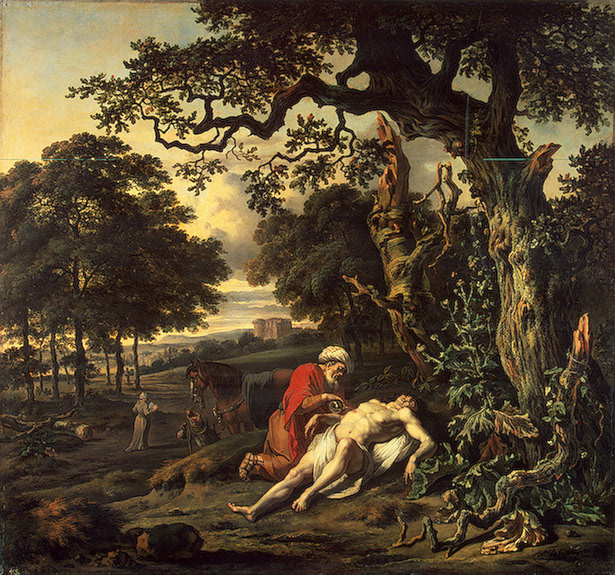
Jan Wijnants, The Parable of the Good Samaritan (1670)

Jan Wijnants, The Parable of the Good Samaritan (1670)

30 Jesus replied with a story: “A Jewish man was traveling from Jerusalem down to Jericho, and he was attacked by bandits. They stripped him of his clothes, beat him up, and left him half dead beside the road. 31 “By chance a priest came along. But when he saw the man lying there, he crossed to the other side of the road and passed him by. 32 A Temple assistant walked over and looked at him lying there, but he also passed by on the other side. 33 “Then a despised Samaritan came along, and when he saw the man, he felt compassion for him. 34 Going over to him, the Samaritan soothed his wounds with olive oil and wine and bandaged them. Then he put the man on his own donkey and took him to an inn, where he took care of him. 35 The next day he handed the innkeeper two silver coins, telling him, ‘Take care of this man. If his bill runs higher than this, I’ll pay you the next time I’m here.’ 36 “Now which of these three would you say was a neighbor to the man who was attacked by bandits?” Jesus asked.
37 The man replied, “The one who showed him mercy.” Then Jesus said, “Yes, now go and do the same.”

Go and live like this, and you will know what the kingdom is all about, live in a world where you build walls to separate us from them and you will never know. Live in mercy and grace, unafraid of what might happen, unafraid of the contamination of unholiness, willing to risk that in caring for someone else: a stranger, a beaten down one left on the side of the road that you also might be looked upon as the ceremonially unclean social outcast and religious heretics that most of the Jews believed the Samaritans to be. They were in many ways worse than the rest of the gentiles for in their eyes they were an unholy mingling of the chosen people with the other nations and they worshipped the same God in the wrong way at the wrong places and they refused to admit that the ways that the real Jews did it was right. Generations of hostility marked the border between Jew and Samaritan, Yet Jesus calls us to imagine a world beyond walls, where our own actions make neighbors of those in need and our love is a part of the healing of humanity and the rest of the world.

I want to invite you to imagine with me what the body of Christ, as Paul called the early church would look like if we could be captured by this kind of a vision. I want you to imagine what it would be like if everyone was here not because they felt they were supposed to be, or that they were trying to take care of the afterlife, or that they were here because mom or dad, of husband or wife, or friends thought they should be but rather imagine for just a moment if everyone was really here because they loved God with all their heart and soul and mind and strength and every song sung was a love song toward the God who loved us and would not allow us to be separated from that love, every prayer was in the confidence that God not only heard but cared for the words that were said, and we trusted that we were here in this place because as the Greeks in Jerusalem said to the disciples, “Sir, we want to see Jesus”. And what would it look like for the body of Christ to live out of that love, carrying it out into the world unafraid of the boundaries that had been set up between righteous and unrighteous, between classes and races and sexes, between us and them and we really were planted like the trees of life around the trees on each side of the river of God in the new creation with leaves for the healing of the nations. Where we are so grounded in the love of God that we really can love ourselves and from that place of love we can risk going out to love our neighbors. Where we begin to lean into the new creation and we begin to heal ourselves and heal the world, for as Paul points to the world is indeed waiting on the revelation of these children of God. And it begins with acts of love, caring for the man on the side of the road or the person going through a divorce, or the child who doesn’t seem to fit in, or the mother dealing with a screaming infant, or the person who doesn’t speak English or who can’t seem to find a job. It means being willing to be a part of Christ’s reaching out into the world through us to be a foretaste of the feast to come in the new creation. Sometimes it means bearing the disbelief of a society that cannot believe that we would give away some of our money to someone else, or that we would reach out to talk to and touch those who no one wants to touch. There is a story of a young priest who went to see Mother Teresa in Calcutta and after following her around during the day was struck by how unreligious her work seemed and then when he remarked to her how unclean and unholy it seemed she reached down and picked up a man dying who weighed very little and turned towards the this young priest and said here is the body of Christ given for you, for it was there in the poor that Christ was appearing and she was able to serve him.

purple rose 01 by picsofflowers.blogspot.com

Freedom for Fear and Shame: Grace in our Lives-A Sermon from July 21,2013

I don’t think it is a coincidence that the most common command in the bible is “do not be afraid.” And yet fear is a very real force in all of our lives and it causes us to do some things we are often not proud of. Fear causes us to shut ourselves off from others and even from God, and shame does this as also. Fear and shame are a little different, fear is related to something external, it can be another person, something in our environment, something that might happen, but it is fixed on something outside of oneself. Shame is focused internally, it focuses on the fear that someone else will not accept us if they know something about us, that they won’t like or love or care about me anymore. That they won’t want to be near me, it is the fear of disconnection with other people. Both fear and shame have a profound impact on our lives, they begin to tell us “we aren’t good enough” or “who are you to believe that you can do this” and they can keep us trapped inside that which is known and safe. We may shut ourselves off from other things or other people.

There has been a lot of coverage in the news over the last couple of weeks of the George Zimmerman trial, and I’m not going to go back into the trial itself, nor am I going to try to guess what the jury should or should not have decided. But the incident between George Zimmerman and Travoyn Martin was an episode based out of fear. You see, it arose out of one man seeing another man walking through the neighborhood on a stormy night, reacting out of fear and confronting him and eventually killing him. George Zimmerman believed Trayvon was a threat and he reacted out of that. Now we can’t go back and change the past, we can’t wave a magic wand and make everything better, but can we imagine a better future.  This one of the things posted last week that I really liked was from Jermaine Paul, who is a singer, but he wrote, “How cool would it be to live in a world where George Zimmerman offered Trayvon a ride home to get him out of the rain that night.” That’s a different world than what we live in, but it is a world worth imagining and a world worth fighting for. I think it is a world that Jesus envisioned and  we are going to hear more about as we go through the sermon today, but it is not the world I grew up in.

Those who know my story know that I spent four years in the Corps of Cadets and another 4 ½ years in the Army and they taught me a lot of the same things. They taught me a lot of what we commonly think about as courage, but courage as they taught is was to be bigger, badder and stronger than whoever else might be a threat. So instead of someone else being a threat you then you can be a threat to them but over the last thirteen years I’ve had to learn about a much different type of courage. The word courage comes from the latin word for heart ‘cur’ and courage literally means to be able to tell the story of one’s heart. That’s vulnerability, that being able to open up to who you really are. To be honest in my time in the Army you didn’t open up who you are but you pushed it down inside and you built up your own little suit of armor around yourself so that you were impervious to anything anyone might say or do about you. But real courage is being willing to take off that armor and to be open and vulnerable knowing that you are able to show who you really are. Knowing that you can be hurt and wounded because your armor is down, that someone might not accept you or the things you create or do. It is the courage to be who you are because who you are is valuable.

We live in a culture that doesn’t understand the very well, we live in a culture where our biggest idol is not money or power, at least as I’m coming to believe our biggest idol is security. We are so desperate to feel safe and secure. A lot of these things come in different forms and we are afraid to have enough to retire, afraid that someone might break into our house, someone might strike as a terrorist in the heart of our city. Yet, I think we have become more and more willing to surrender pieces of who we are to feel safe. We begin to give away pieces of our identity in order to feel safe. Yet, I need to be honest with you: security is a cruel, cruel god. If security is your god, then faith becomes transformed into certainty. There is no longer any room to question or to doubt, and yet when faith is transformed into certainty you are a short, short step from extremism. Faith as the bible understands it is about relationship and a journey, and if you notice from the stories of the bible the disciples often don’t get it and yet they keep following behind Jesus and in the journey they learn and grow. Love becomes trumped by the law. We begin to lock things down, making it more about absolutes and less about getting to know and love others. The world becomes transformed into them and us and we build up walls between us and them. Some of the walls are physical and some of the walls are emotional and social. This was the image of the wall I grew up with:

Berlin Wall

This is the Berlin Wall, it was built before I was born and while I was in college I got to see it come down, it was the wall that everyone knew about as I was growing up. The Berlin Wall separated East from West Berlin, two groups of people who were not really separate ethnically, sometimes even a family was split apart by the wall, but they were divided by two political systems. The wall separated two groups of people and it kept one group in and one group out and it was built out of fear, for security and honestly I believe it also was built out of a sense of shame.

But we come to know a very different God in Jesus, you see for Jesus faith is learned by following and we are following the one for whom love is the law. If you remember Jesus’ two great commandments, you shall love the Lord your God with all your heart, with all your soul, with all your mind and with all your strength and you shall love your neighbor as yourself. Jesus goes even further in the Sermon on the Mount when he tells them “you shall love your enemies” or in John’s gospel when the disciples are gathered around the table and he says, “I give you a new commandment, that you are to love one another.”And love comes up again and again and again as what Jesus commands and that is much different than trying to get it all locked down into a particular way. And as we follow Jesus we realize the world is no longer broken down into them and us, but rather as Paul can say in Galatians:

28 There is no longer Jew or Gentile, slave or free, male and female. For you are all one in Christ Jesus. (Galatians 3: 28)

All these things that in Paul’s life that had been the defining things became unimportant. Are you a Jew like or are you a Gentile, not a Jew, are you like us or are you not. Are you a slave or are you free, are you a man or are you a woman, rich or poor, college educated or not and we can put all those things in there, but ultimately in Christ all those things no longer matter. And Paul had to learn this in his own life. If you remember Paul’s story, he started out as a Pharisee and he understood that there were certain things that made him right with God and he was so convinced that these early followers of Jesus were wrong that he was out to wipe them out. He stood there looking on as they stoned Stephen and then he was on his way to Damascus to find any of Jesus early followers he could and bring them back to Jerusalem in chains. Until Jesus met him on the way. Paul recounts this way of thinking in Philippians 3:

4 though I could have confidence in my own effort if anyone could. Indeed, if others have reason for confidence in their own efforts, I have even more! 5 I was circumcised when I was eight days old. I am a pure-blooded citizen of Israel and a member of the tribe of Benjamin– a real Hebrew if there ever was one! I was a member of the Pharisees, who demand the strictest obedience to the Jewish law. 6 I was so zealous that I harshly persecuted the church. And as for righteousness, I obeyed the law without fault.

Paul may have been righteous, and I don’t think Paul had any sense of guilt for the way he followed the law, but it was a righteousness without love. And Paul realizes that now everything has changed because of what is now important in his life. Paul continues:

7 I once thought these things were valuable, but now I consider them worthless because of what Christ has done8 Yes, everything else is worthless when compared with the infinite value of knowing Christ Jesus my Lord. For his sake I have discarded everything else, counting it all as garbage, so that I could gain Christ

You see Paul had to go through this transformation in his own life, from a world where he was separated from those who were not like him: I am a Jew and beyond that I am a Pharisee and a very zealous Pharisee, so zealous I persecuted these early Christians. I’m righteous, these other people are unrighteous, I’m a saint, they are a sinner, I am good they are bad.

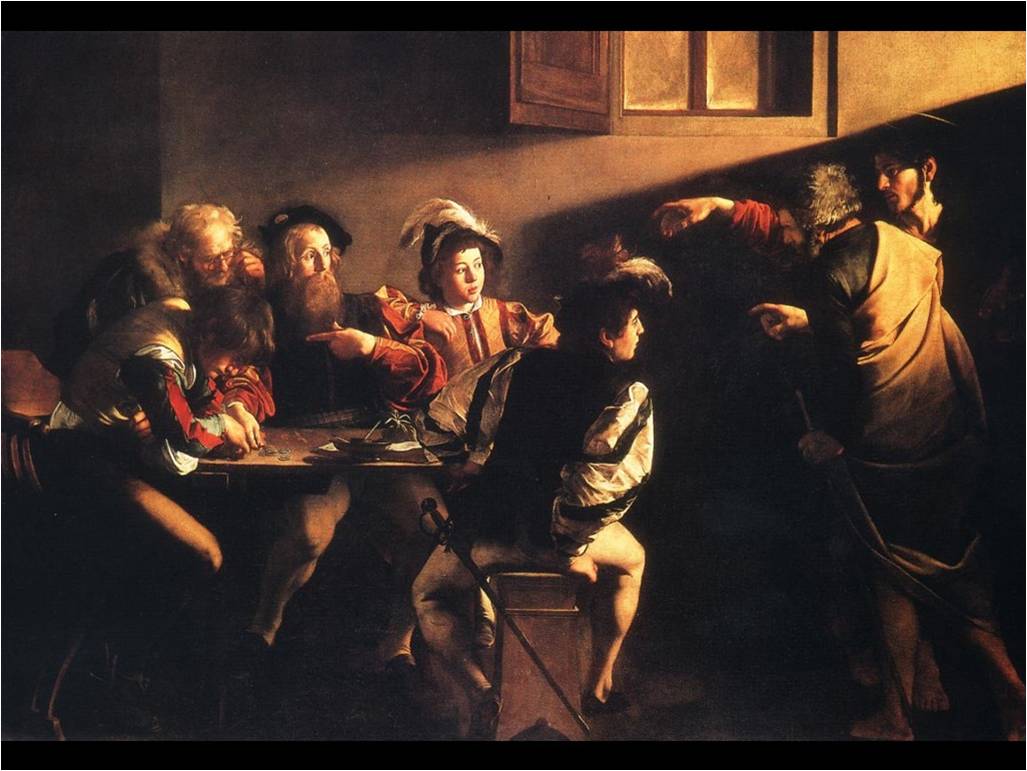
And then we encounter Jesus, and have you ever noticed that Jesus is always getting in trouble for being with the wrong people at the wrong? Almost all his controversies are because he either is healing on Sabbath or he is touching and eating with the wrong people. He touches a leper, that should make him unclean- and yet instead it makes the leper clean. He is sitting at the house of a Pharisee and then a woman comes in and anoints him with perfume and washes his feet with her tears, and while the Pharisee is thinking, ‘if this Jesus was really a prophet he would know what kind of woman this is and not let her touch him’ but instead Jesus says to him ‘do you see this woman, when I came in you didn’t anoint me nor did you wash my feet, but she anointed me and has washed my feet with her tears and her sins which are many are forgiven.’ Or he hangs out with sinners and tax collectors, like Matthew. This is Carvaggio’s painting of the calling of Matthew:

The Calling of St. Matthew by Carvaggio (1599-1600)

The Calling of St. Matthew by Carvaggio (1599-1600)

Jesus is on the right pointing and Matthew is in the center of the table with a bewildered look on his face, with his fingers pointing to himself as if to say, ‘me, you are calling me.’ This is how Matthew records it in the 9th chapter:

9 As Jesus was walking along, he saw a man named Matthew sitting at his tax collector’s booth. “Follow me and be my disciple,” Jesus said to him. So Matthew got up and followed him.

10 Later, Matthew invited Jesus and his disciples to his home as dinner guests, along with many tax collectors and other disreputable sinners. 11 But when the Pharisees saw this, they asked his disciples, “Why does your teacher eat with such scum?”


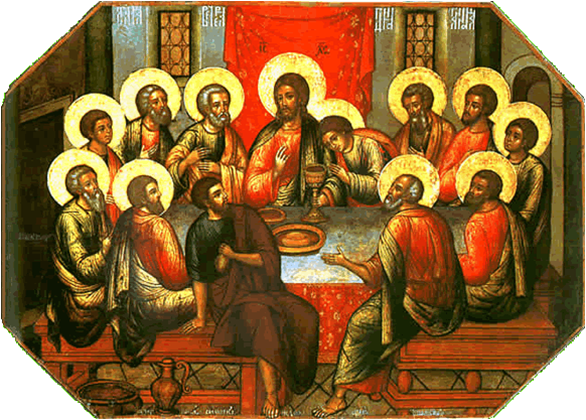
I actually like that translation, even though they take a little freedom with the word there, for I think we often think of being at the table with Jesus being like this:

Picture1

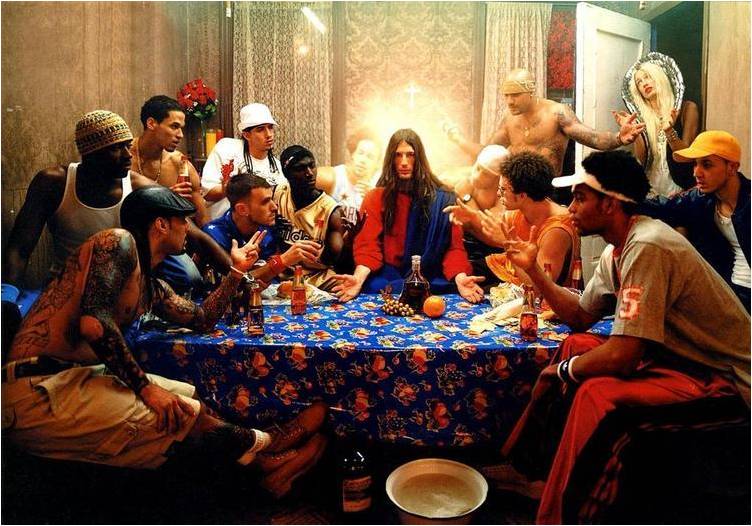
Where everyone is holy and righteous and good, yet people in Jesus day saw it being more like this:
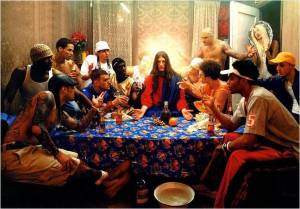
 

Lords supper modernWhere Jesus is there with the sinners, tax collectors, all the wrong people the people they didn’t want to hang out with. Sinners and tax collectors in Jesus day were no less likely than the people in the picture above. In my own experience I keep being stretched as I encounter Jesus among the least likely people I expected. Matthew continues the story

12 When Jesus heard this, he said, “Healthy people don’t need a doctor– sick people do.” 13 Then he added, “Now go and learn the meaning of this Scripture: ‘I want you to show mercy, not offer sacrifices.’ For I have come to call not those who think they are righteous, but those who know they are sinners.”


We come from a tradition, the Lutheran tradition, that gives us a great place to wrestle with this because the person we take our name from, Martin Luther, wrestled mightily with this. Luther started out as an Augustinian monk, the most rigorous of the religious orders of his day, and Luther strove to do everything the right way, to live according to all the rules to try to be right with God and Luther never felt he could achieve that. Staupitz who was Luther’s superior in the order as well as his confessor, after sitting through hours and hours of hearing Luther confess is reported to have said, ‘Luther you come in here confessing every little thing you have done, you can’t so much as fart without coming here fearing condemnation and yet I’ve never once heard you confess anything remotely interesting.’ Yet Luther was afraid that he couldn’t keep all the commandments and love God. He was convinced that God didn’t love him, at least before the reformation breakthrough where he realized that God loved him well before he ever began his journey that led him to monasticism. It transformed him so much that later in his life he could tell his friend and younger colleague, Philip Melancthon who was trying to get everything right and was afraid of making a mistake, “Be a sinner and sin boldly, but believe and rejoice in Christ evermore boldly, for he is victorious over sin, death and the world.”

Paul also had to come through this transformation from being viewing righteousness as being a part of the law to being transformed by the righteousness of God that comes through the love of Christ. As he writes in Romans 8:

So now there is no condemnation for those who belong to Christ Jesus. 2 And because you belong to him, the power of the life-giving Spirit has freed you from the power of sin that leads to death.

There is no condemnation for those who are in Christ. Who can take that away from you? Nobody. You have been freed from the power of sin and death, now that doesn’t we don’t find ourselves struggling, but the victory has already been decided. Paul continues

3 The law of Moses was unable to save us because of the weakness of our sinful nature. So God did what the law could not do. He sent his own Son in a body like the bodies we sinners have. And in that body God declared an end to sin’s control over us by giving his Son as a sacrifice for our sins. 4 He did this so that the just requirement of the law would be fully satisfied for us, who no longer follow our sinful nature but instead follow the Spirit. 5 Those who are dominated by the sinful nature think about sinful things, but those who are controlled by the Holy Spirit think about things that please the Spirit.


So who gets to say who we are, who gets to have that word. Is it others who say that we should be afraid of those who are different from us, who ask us to build walls between ourselves and others. No. Is it our own selves telling us that we are not good enough, smart enough, worthy enough. No. It is the God who made us the baptized children of God, who marked us with the cross of Christ forever and sealed us by the Holy Spirit. That God who promises that nothing will be able to separate us from the love of God in Christ Jesus our Lord, nothing in our lives, nothing in heaven or on earth, no rulers or powers, nothing.Who are you, you are baptized children of God and no one, nothing can take that away from you, and you are loved. And it is in that love that we can imagine the way the world looks in light of that love, Jesus spends most of his ministry talking about the kingdom of God, talking about his vision of the way life should be. This was not a new thing, in the Old Testament this would have been talked about in terms of living in God’s shalom, God’s peace and vision for the world and harmony with God and the world around them. That is why the two great commandments are you shall love the Lord your God with all your heart, with all your soul, with all your mind and with all your strength and you shall love your neighbor as yourself. And as we begin to claim who we are in light of this love and identity those things like fear and shame which cause us to give away potions of who we are begin to lose their hold on us. Now this isn’t easy, I certainly don’t claim to be the one who has mastered this. There are times in my own life where fear kept me paralyzed or shame made me believe that I was unloveable. I can own that, and the reality is that I didn’t earn it. Martin Luther would say that “God’s love doesn’t find that which is pleasing to it; God’s love creates that which is pleasing to it.” We weren’t right with God on our own, God went out and made us right, God goes out seeking us because that is who God is. That gives us a great opportunity. You see, in the midst of Jesus ministry he never built any walls, but he sat at a lot of tables and tables bring us together. He sat at tables with those many in his day would have excluded. I had the opportunity to hear Bishop Mark Hanson, the Bishop of the ELCA a couple years ago and he related a story how when he was elected bishop a colleague who he trusted told him, ‘your calling is to take the walls that divide us and turn them into tables for conversation.’ I think that is what Jesus did, he took the walls that divided Matthew from the rest of the community, ‘he’s a sinner, he’s a tax collector’ and he brought him to the table where he was included as well as the other sinners and tax collectors. That’s what Paul did in going from the ministry that divided Jew and Gentiles to being the apostle to the Gentiles. And grace frees us from that shame, that fear that we need to create a different and better past, indeed grace is freedom from having to seek a better past. The reality is that who you are is accepted right now, God has made you and claimed you. So take down the walls and join those at the table. Amen.


 

 purple rose 01 by picsofflowers.blogspot.com

What I Learned About Myself, Life and God from My Divorce: Part 1

Apophysis-Betrayal (1footonthedawn at deviantart.com)

Apophysis-Betrayal (1footonthedawn at deviantart.com)

On July 1, 2010 my marriage of almost 13 years with two children officially ended. For those who have been through or are going through the process of divorce you know that this journey, which for me was unwanted, begins much earlier than that, but now over three years later I finally sat down to think about what I learned from this journey. Much like some of my earlier posts about my learning about myself, the world and God from my son who is on the autistic spectrum I hope that perhaps others may be able to find some light in the midst of their dark times in their own journey. An unwanted divorce causes a crisis that I wouldn’t wish upon my worst enemy, but even though it is an unwanted journey there are gifts that do come along the way.

1.       There is some wisdom that is only learned through pain and suffering. My divorce was the third of three major transitions in my life in a very short period of time. In the spring of 2009 one of my personal dreams had died. I saw myself going on to do PhD work to teach at a university or seminary. For several years this had been a direction that I had put considerable time and energy into preparing for this possibility and had applied to several programs over the period of a couple years. In 2009 I received a rejection letter from the final program I had applied for, a program that I was fairly certain that I met all the criteria for, and I sensed that this dream was not going to happen. I attempted to care for myself during this time period, meeting with a counselor and trying to take good emotional care of myself yet even as resilient as I am this did take a toll on me personally. The second transition was due to the church I was serving at that time, it was a congregation that had experienced a lot of conflict in the previous four years and I knew that another conflict was on the horizon in the fall of 2009 due to decisions made within my denomination. Dealing with conflict, especially as a leader, for any extended period of time is very draining. It was in the fall of 2009 that I also learned that my wife was not satisfied with the relationship. In this time of broken dreams, conflict and a distancing spouse I went through an emotional breakdown, and just as Brené Brown can joke about her breakdown becoming a spiritual awakening, mine in its own way was very much a spiritual awakening. The experiences of heartbreak, betrayal, depression and anxiety, shame and weakness forced me to go through a process of re-learning who I was, how I related to others and the world, the process of forgiveness, the way in which I would relate to God, and the sympathy I was able to show others.

The wisdom that comes from going through a time of intense pain or suffering is a slow process, and it is not the type of learning that we actively seek on our own. It is not the reason we go through a difficult journey, instead it is a gift that we realize along the way. It takes a while to be able to accept it as a gift because it comes at a cost-a cost that involves re-examining who you are from bile to bones, to the very core of your identity. It is not a gift that comes all at once, rather it is more like a slow process of awakening physically, spiritually and emotionally and which I will touch on in many of my other points. You didn’t ask for this wisdom that came at a cost but it is now a part of you, a gift that you can share with others.

2.      The process of rediscovering yourself. For fifteen years (two years of dating, thirteen years of marriage) I had invested so much of my identity into my relationship with my ex-wife and my relationship with my children. I was deeply in love with my ex-wife and still love my children more than words can express and to make the relationship work I had given away a number of pieces of myself over the years, it wasn’t intentional-we all make sacrifices for the sake of relationships. I feel that I was a good husband and a loving father who had poured himself into the family and I didn’t realize how much of me was defined by my sense of living out these roles. When first my wife began to distance herself from me and later left the relationship and later when the agreement we came to on parenting left my son living with me and my daughter living with my ex-wife and we would have times where both kids would be with one parent or the other-I found myself for the first time in fifteen years having to live with just me for times. I had poured so much of myself into raising kids and into my work as a pastor I had not made space (nor felt I had the money at the time) to pursue hobbies, to take part in many of the activities I enjoyed and without either my family around me or, initially, a congregation to be a minister to I had to find who I was again. I had to learn new things, I had to learn how to date again (honestly, not sure I figured it out the first time and I certainly have had my share of lessons this time around), to learn how to take care of myself and to give myself permission to spend money on myself. I had been a natural giver who found his joy making other people happy but I rarely would allow myself to do the things I wanted to do or to buy the things that I wanted. In hindsight I probably hoped that my wife and children would want to give back to me the way I enjoyed giving to them, but that wasn’t the case. I also came from a family that one of their primary ways of expressing love was to give gifts and so I didn’t understand that not everyone has that same experience.

 Three years later, and I came to this realization well before three years, I genuinely like who I am. I’m far from perfect and I still have the occasional dark day, but most of the time I’m comfortable in my own skin. Nice guys may finish last, but it is more important to be who you are than to win. I am a nice guy, I am always looking out for other people. Don’t get me wrong I am a very mentally, physically and most of the time emotionally strong and resilient person, but I have always had a soft heart. One of the reasons I don’t carry and use cash very often is that if I had cash in my wallet I would give it away. Because I am a nice guy there have been many times in relationships and in my work life that I have been taken advantage of because I genuinely have wanted to make other people happy. I could become a jerk and say I’ll never be taken advantage of in the same way again, but that wouldn’t be me (nor would it be healthy-even if it is a common male way of avoiding vulnerability). I had to come to the point where I could admit to myself, I genuinely like who I am most days. I am proud of the way I have handled adversity, I am proud of the father I am and I am enough. I also had to arrive at the point where I was OK being alone and not trying to fill the emptiness with someone else. I would love to find someone I can share my life with again, but I’m not willing to settle just to have someone next to me.

3. You can do everything right and still fail.  This may sound like a really depressing lesson to learn, but failure is not the end of the world and it doesn’t define the future, in fact it may open up new possibilities. Marriage for example takes two people committed to working at it, no matter how one person tries they cannot by themselves hold a marriage together. You can go the extra mile and the mile beyond that, and perhaps even the marathon beyond that and things may not work. And maybe this sounds self-centered, but most people have been in the situation where you’ve had to try to make something work and failed. Sometimes the best thing you can take out of a situation is what did you learn about yourself, your gifts, your weaknesses, your habits, etc. that you can use in the future. I can look back without any regrets that I didn’t try hard enough to save my marriage. Yet, before going through my own divorce I did think that, ‘if someone just tried harder, loved more, was more patient, etc.’ they could have made the relationship work. I have no such illusions anymore and it has helped me numerous times in the last several years as I have worked with people not only in the midst of divorce but in the midst of many other crises that come up in life.

purple rose 01 by picsofflowers.blogspot.com

The Names We Take and the Names We Give

I enjoy music, a wide range of music, and so one of my hopes was to take something that strikes me when I am listening to it throughout the week, take the lyrics and their meaning and then see what thoughts it evokes. Just because today’s offering comes from the world of Rock/Metal and it happened to be what got me thinking today…you never know what might provoke thought.

One note before going further, the song, My Name by Shinedown does contain profanity which some people may be offended by. I have removed much of the repetition of chorus and tags in the text of the lyrics. My comments will be below, I also deal with some offensive material in this post due to the nature of the subject.

My Name (Your Wearing Me Out)

My name is worthless like you told me I once was
My name is empty ’cause you drained away the love
My name is searching since you stole my only soul
My name is hatred, and the reasons we both know
 

Worthless, empty, searching, hatred 
Who am I right now?
 

You’re fuckin’ wearing me out! 
You’re always dragging me down!
 
You’re the fake fallen force of nature’s sick mind!
 
I don’t need a gun to take back what’s mine
 
It’s over
 
It’s over now
 
You’re done wearing me out
 

My name is screaming like the sound of your heart failing 
My name is loco like the motive that betrayed me
 
Screaming, loco, don’t say you know who I am right now
 

You’ll be ancient history 
But who am I right now?
 

My name is revenge and I’m here to save my name 

I’m sure somebody is thinking, “these are terrible” why would anyone want to focus any time on this, but we all give and take names, some that are honorable and good and some that are horrible. I say to people dealing with the aftermath of verbal and psychological trauma, “Sticks and stones may break my bones, but words will send me to therapy.” Names and words hurt, and even the most resilient person will occasionally take a label that someone else gives them into part of their personality. If you look back at some of the work I discuss from Brené Brown’s work on shame and vulnerability, you can see how powerful this is. Taking a name is a way that shame takes hold of us. In the song the person’s names become: worthless, empty, searching, hatred, screaming, loco, revenge…they may not be the names we want but sometimes they are the words we take and give.

Miroslav Volf in Exclusion and Embrace relates a story from his homeland from the perspective of a Muslim woman:

“I am a Muslim, and I am thirty five years old. To my second son who was just born, I gave the name “Jihad.” So he would not forget the testament of his mother—revenge. The first time I put my baby at the breast I told him, “May this milk choke you if you forget.” So be it. The Serbs taught me to hate. For the last two months there was nothing in me. No pain, no bitterness. Only hatred. I taught these children to love. I did. I am a teacher of literature. I was born in Ilijaś and I almost died there. My student, Zoran, the only son of my neighbor, urinated into my mouth. As the bearded hooligans standing around laughed, he told me: “You are good for nothing else, you stinking Muslim woman…” I do not know whether I first heard the cry of felt the blow. My former colleague, a teacher of physics, was yelling like mad, “Ustasha, ustasha…”And kept hitting me. Wherever he could. I have become insensitive to pain. But my soul it hurts. I taught them to love and all the while they were making preparations to destroy everything that is not of the Orthodox faith. Jihad—war. This is the only way… “(Volf 1996, 111)

Fortunately most of us are not literally named something as horrible as Jihad, although the family dynamics of hatred passed from one generation to another are very real, as does the reality of abuse: physical, psychological or sexual. The natural response for a wounded person is to wound another, if I am insulted the natural response is to bring someone else down to make myself feel better (even though this doesn’t work and only decreases my own self worth). Yet the cycle of naming continues.

How does the cycle end? How do we give new and better names to ourselves and others? It isn’t easy. It starts first with being clear about who we are, and what are the names we are willing to accept for ourselves, and even the type of self-talk we do. No matter how bone-headed some action may have been that doesn’t make a person an idiot-they are simply someone who did something dumb. A child who shoplifts can either take it into their identity that they are a thief or they can be ashamed of the action, I stole something, but that doesn’t change who I am. I’m a person with a fairly strong sense of who I am, but even I have to work at this.

I have a plaque in my office, given to me by Nate Frambach who was my advisor which says: “Neil Eric White you are a baptized child of God. Whatever else you are, remember you are that; for that is the basis of whatever else you are.” I go back to this often. At the root, that is a name I’ve taken that I desire to be the touchstone any other name is judged by. I’m not always there, there are times when another name seems to overwhelm that or any other name, but eventually I come back to this name that I claim this name that isn’t wearing me out. There is much more to say so perhaps I’ll spend some more time here next week.

purple rose 01 by picsofflowers.blogspot.com

The Place of Authority 2-4: The Practices of the Early Church

Baptism Fresco on the Catacombs of St. Marcellinus and Peter, Via Labicana, Rome, Italy

There are two ways, one of life and one of death, but a great difference between the two ways. The way of life, then, is this: First, you shall love God who made you; second, love your neighbor as yourself, and do not do to another what you would not want done to you. Didache (Chapter 1), 2nd Century Christian Writing

There are times I feel like Cuthbert Binns, the History of Magic Teacher from the Harry Potter series who one day falls asleep in the teacher’s lounge, dies and then as a ghost goes on teaching without seeming to realize the difference. I hope that unlike Cuthbert my approach to looking at authority within the history of Judaism and now Christianity is not incessantly boring, and is rather enlightening as we go back through time and examine the story of how we got where we are today. There are times where I want to take a shorter path, but I personally am learning a lot from going back and re-engaging material I haven’t studied since seminary-I have made some new connections that will impact some of my conclusions.

Practices are critical to the formation of identity and they help to shape what the people and any group come to believe. As Prosper of Aquitaine (390-455 CE), a Christian from a later era than I am currently discussing, memorably put it “the rule of prayer should lay down the rule of faith” (Pelikan, The Christian Tradition 1:339) and so the everyday practices of early Christians allowed them to make sense of the persecution they received from the Romans or the struggles they went through in their daily lives. It also gave them the basis of their community and bound them together with Christians across the empire and indeed across the world. Practices may not sound exciting to talk about, but their meaning will be discussed and debated for the millennia to come.

Love is the foundational idea that gets worked out in these practices, a love for neighbor and even for enemy that forms the basis for the actions of the early church. Certainly there will be many times where the early churches (like modern churches) will fail to live up to this ideal, yet in a society with no social safety net the vulnerable (the widows, orphans, immigrant and the elderly or disabled) were often taken in by many of the early churches and given identity and meaning. Certainly there were apologists and early thinkers like Justin Martyr or Origin who tried to make an intellectual case for Christianity, but most people came to Christianity through the example and witness of anonymous Christians, and they were invited into the journey of coming Christian by people who they encountered in the marketplace, their homes and their worksites.

With the persecution by the Roman Empire it was a dangerous thing to become a Christian, and early Christians wanted to make sure that potential converts were truly seekers and not spies. Often there would be a detailed process of catechesis, education in the faith, before a seeker would be admitted to the mysteries of the faith (baptism and then communion or Eucharist). Most of these communities were rather small, meeting in houses, cemeteries, catacombs  or in business places both because they could not have afforded a building dedicated for their meetings, but also for fear of being detected by authorities.

Baptism was the mystery of faith that led to identity with the church and mystically with Christ. A person in the waters was made clean, forgiven of sins, regenerated into a new person and received the Holy Spirit. Once a person was baptized they were a full participant in the life of the community, they could worship with all their new brothers and sisters in Christ, they could partake in the Eucharist. Even without any significant conflict the meaning of baptism was pretty much stabilized by the end of the second century with no real conflict over practice and thought (with one exception) until the time of the Reformation.

Eucharist, the Lord’s Supper or Communion was a community meal in which the people present celebrated their unity in Christ, remembered the actions of Jesus during the last week of his life and shared a meal that they understood having both spiritual and earthly realities. The precision of the debates that would emerge during the time of the reformation are not present, but the idea of the Eucharist having the power to transform the bodies of the early Christians from corruptible to incorruptible or they could call it the ‘flesh of Christ’ or even a sacrifice, but the fact that they didn’t nail down precisely what was happening did not stop them from trying to explain what it meant. It would take focusing in on Christology (who Christ was) before the early Church would have the language for the precision of later centuries.

 Around both of these realities was worship which focused on Jesus, eating together with the community, sharing their lives together and continuing to confess “Jesus as their Lord” even in the face of hardship. As the church moved into the third century it was still a persecuted group, the basics of structure had come into being (offices like bishop, presbyter and deacon were used-people set aside for helping the community function, but it was not a hierarchical as we are used to and there was not a specific class of clergy) and there was the beginning of movement towards what a canon would look like, what practices would be formational, and at least some commonality in what was to be believed, but a major change was on the horizon, a change that would transform the church from top to bottom. For some the early church was about to experience its triumph, for others it was making a deal with the devil, but in 312 CE the emergence of Constantine, an emperor favorably disposed to Christianity, the church would have to redefine itself yet again and ask itself the questions of authority that continually emerge.

purple rose 01 by picsofflowers.blogspot.com

The Place of Authority 2-3:The Early Church’s Identity Problem

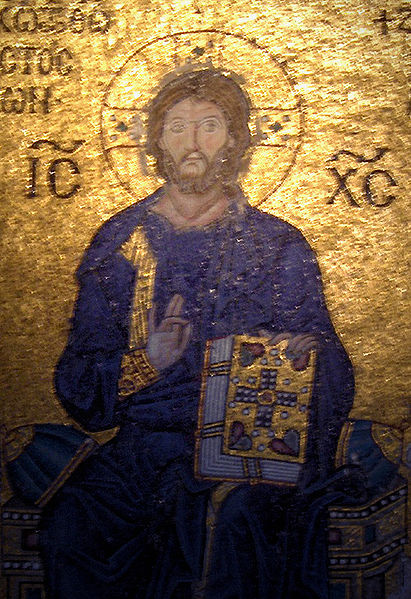
Image of Christ Pantocrator (Almighty or Lord of Hosts), Hagia Sopia, Istanbul, Turkey

When a movement is centered on one person who is no longer present in a corporeal (bodily) form that the members of that movement can continue to speak to and learn from eventually there will come an identity crisis where people begin to ask, “Are we following the right Jesus?” “Are we being faithful to his vision?” “Are we still following the God he pointed to?” As the church entered the second century it was dealing with heavy pressures from the empire around it and at the same time this early church had to figure out who it was from pressures from within.

It was still early in the church’s young life; the canon (the selections of works that would come to make up the bible) was not fixed. The four gospels, Matthew, Mark, Luke and John were in wide circulation as well as many of the letters associated with Paul, but depending where you went the Shepherd of Hermas or the Letters of Clement or the Didache may also be present (which would later be viewed a positive works but not held at the same level as scripture). The challenge to how to tell the story of being the people of Jesus arose from within and to react to this challenge the church adapted and changed.

One of Christianity’s greatest gifts was that it was not tied to one language or culture. As it spread across the known world at that time it would be quickly translated into Greek (the language of the Eastern half of the Roman Empire) and eventually into more and more languages and cultures. The reason that the books that are a part of the New Testament are in Greek, not Hebrew or Aramaic,  is that by the time the stories of Jesus are written down and as Paul and others wrote letters they were going to churches that primarily spoke Greek (at least as a second language). With this encounter with the Greek world and language also came an encounter with Greek thought which was much different from the Jewish or Hebrew worldview that Jesus and all the original apostles came out of. As Greek speaking and thinking individuals encountered Christianity and they translated the message they would both be changed by it and in their own way they would transform the message as well. The question has to emerge what is a valid transformation and what is not? Two long lasting assumptions that many Christians include as central to their thought: the immortality of the soul or the absoluteness of God are Greek ideas not Biblical ones and yet with the introduction of Greek culture they become a part of the thought of the early church.

One of the early challenges came from a wealthy Christian named Marcion. While Hebrew thought has no problem with contradictions and gaps, a Greek thinker like Marcion could not abide contradictions. Among other things, Marcion felt that the God of the Old Testament was not reconcilable with the God of Jesus. Marcion read how in the Old Testament that God called for wars which wiped out entire populations, called down judgments in a harsh and unforgiving manner and came to the conclusion that in combination with these things he read and the reality of suffering in the world that the creator must be evil and different from the God of Jesus. In contrast to almost every other church leader at the time, Marcion read Old Testament literally rather than allegorically. Marcion felt that the Old Testament should not be a part of the Christian scriptures and therefore it should be thrown out. In addition to this, in a Greek way of thinking that viewed sex, childbirth and the body in general as bad, Marcion could not accept that Christ was born of a woman-even if it was a virginal birth God could not be born of a woman. For the first time we begin to see in a very powerful way the emergence of theology more than narrative as formational for a way of thinking about God and Jesus. Marcion quickly identified the contradictions and the differences in the New Testament gospels that were being held in most churches, so he eliminated Matthew, Mark and John and seriously redacted Luke to try to remove anything “impure” to be put alongside of Paul’s letters (also purified of Jewish “interpolations”). These modifications were viewed to be unorthodox by the leaders of the church in Rome and in 144 CE he was expelled from the early church. Marcion became one of the earliest to try to put together a canon, a list of texts that would form the basis for the church’s authority and the church would continue to deal with his followers for decades.

Another threat to the view of who Christ was came from those often referred to as Gnostic Christians. Gnostics are so named because they believed that they had secret knowledge that others, including other Christians, did not have. I am not convinced that there is one direction among the groups and the scriptures that we might label Gnostic, in fact they seem to represent a wide range of things. We are the beneficiaries of the rediscovery of several of the Gnostic gospels at Nag Hammadi in 1945 which give us a window into what Gnosticism may have looked like. Some of these, like the Gospel of Thomas, are very similar to many of the sayings in Matthew and Luke and portray Jesus as a wisdom teacher. Others like the Gospel of Truth associated with the Gnosticism of the Valentinians develop a whole cosmology that put Jesus among many heavenly beings and looks very little like anything we would recognize as Christian. Like Marcion they held the body as bad and the soul as good (or divine spark would be a term you might see in Gnostic gospels) and the purpose of having the proper Gnostic knowledge is for that soul or divine spark to be liberated from the body.  Again the early church made the decision that this was not an accurate representation of the faith and the Gnostic gospels would not become a part of the canon.

Each time a crisis presented itself between a Greek way of thinking and a Jewish way of thinking the church attempted to remain with the Jewish way. At the same time, even while trying to remain close to the Jewish origins of the story, the questions that were being asked were no longer the questions of the Hebrew mind, they were the questions of the Greek world. The Bible began to be viewed in terms that were familiar to the Greek way of thinking, so God had to be omnipotent, omniscient and omnipresent (all powerful, all knowing and present everywhere) and this rather than the narrative became decisive for decisions. The biblical hope of a bodily resurrection at the return of Jesus, the participation in the new creation and all the images that populate the gospels and Paul’s letters began to be read in terms of the soul joining God in heaven. The story when it was read was often interpreted allegorically (there are gifts and challenges that come with this) and theology and a few common practices became the points where identity was formed for the early church. It is to these practices we will turn next.

purple rose 01 by picsofflowers.blogspot.com