Tag Archives: Hope

Lost Dreams

Child by fabii from http://www.deviantart.com/art/child-61251692

Sometimes I imagine you running through some unending shopping mall

Realizing that somewhere along the trip you lost hold of me in the crowd

Perhaps you stopped to gaze at some curiosity in a shop window for a moment

And I was gone, moved on by the crush of the crowd’s unending, unfeeling flow

Tears streaming down your cheeks for the companion no longer there

As both our futures were severed by forces beyond our control


Like a parent who came to a new country seeking hope for their family

Only to find that family ripped asunder at the border, children caged

Fighting bureaucrats and their cold, unfeeling mountains of paperwork

Fanning the embers of hope for some eventual reunification

Only to find out that you are gone, given to a new family to foster

Just a dream who has hopefully found a new father to be cherished by


Some part of me won’t accept that dreams die when reality shatters them

When life moves on, when circumstances change, when new dreams are born

Something makes me hope that they find a new heart that beats with theirs

Someone who cherishes them the way that I did as they grew and changed

That they have a future beyond the fracture, and that they find joy and love

That you may be the dream that another person raises up for the world to see

Barren Seeds

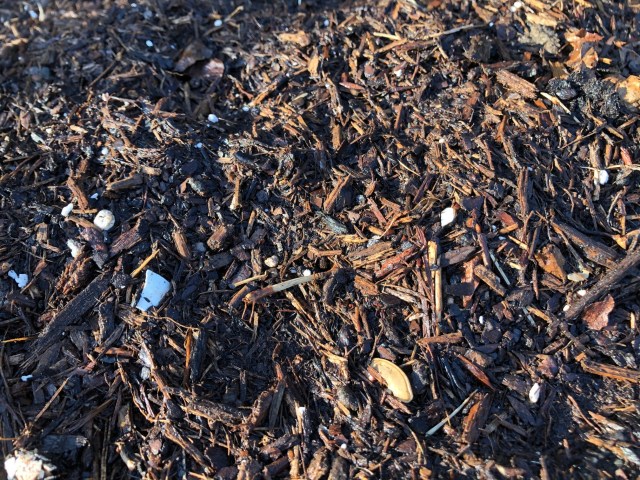
A close picture of soil in my gardenl

The soil was turned, the weeds and rocks removed
Seeds placed at the proper depth and thoroughly watered
So many have cast their seeds into the waiting earth
Seeing the germination, the growth and the eventual fruition
The earth giving birth to another healthy harvest

Sometimes after germination pests come and root in the garden
Floods and winds damage the plants or drought dries the roots
Struggling against the elements to shield the tender shoots
Yet, what can be done when plants miscarry before they can emerge?
The seeds rotting in the dirt, disintegrating in nature’s womb

Perhaps they are dust, and like the sower who sows, to dust they return
Some unknown problem with seed or soil, parasite or pest
Birds may have come to consume the seed on the ground
Rodent may have rooted in the fecund earth for the precious seed
Sun may have baked the seeds and made the ground infertile

With the termination of the germination the ground lies barren
The hopes reserved for this season are buried in the earth
Never to rise again. For the season’s seeds have been sown
The storehouse sits empty and the store shelves are bare
Until a new season emerges when new seeds can be sown
When the soil is turned again, and the seed placed lovingly inside

A Conversation Between Pastor Neil White and Pastor Chris King on Racism, Faith and Hope

This is a conversation that I made available for both my congregation and the Frisco Interfaith Alliance between myself and Pastor Chris King. As a white pastor and leader of a primarily white congregation I felt it was important to begin with listening in this moment.


Matthew 16: 21-28 The Way of the Cross Part 1

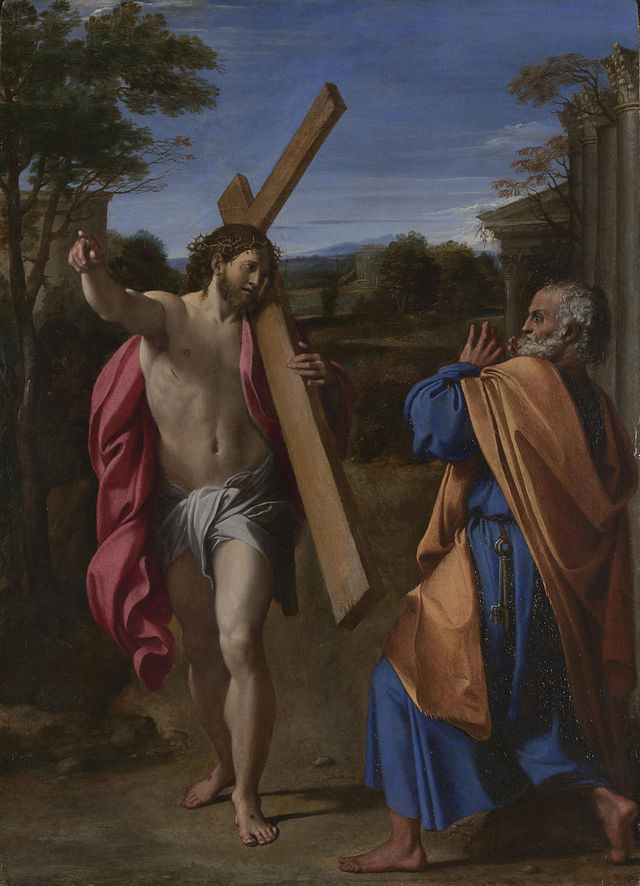
Domine, quo Vadis? by Annibale Carracci, 1062

Matthew 16: 21-28

21 From that time on, Jesus began to show his disciples that he must go to Jerusalem and undergo great suffering at the hands of the elders and chief priests and scribes, and be killed, and on the third day be raised. 22 And Peter took him aside and began to rebuke him, saying, “God forbid it, Lord! This must never happen to you.” 23 But he turned and said to Peter, “Get behind me, Satan! You are a stumbling block to me; for you are setting your mind not on divine things but on human things.”

24 Then Jesus told his disciples, “If any want to become my followers, let them deny themselves and take up their cross and follow me. 25 For those who want to save their life will lose it, and those who lose their life for my sake will find it. 26 For what will it profit them if they gain the whole world but forfeit their life? Or what will they give in return for their life? 27 “For the Son of Man is to come with his angels in the glory of his Father, and then he will repay everyone for what has been done. 28 Truly I tell you, there are some standing here who will not taste death before they see the Son of Man coming in his kingdom.”

Titles in Matthew’s gospel, while important and demonstrating some understanding of who Jesus is, can only take us so far. In the previous section we have the titles Son of Man, Messiah/Christ and son of the living God all applied to Jesus, as well as the prophetic identity assigned to Jesus by the crowds. But these titles only have meaning in the context of how Jesus will inhabit these titles: Jesus will be prophetic but is not limited to how John, Jeremiah or Elijah enacted that identity; Jesus will be Messiah/Christ/King but not in the way that Peter or many others expect; and Matthew continues to hint that the title Son of God and Son of Man reflect more than just one divinely appointed. People of great faith, like the Canaanite woman or the centurion may have unique insights into what Jesus’ presence means for their situation, but for those called to be disciples one can only understand Jesus’ identity in relation to his teaching and actions as they continue to follow his path.

The focus now turns to Jerusalem. Although the next couple chapters involve actions and teaching in Galilee, it becomes a farewell tour of places and locations where much of the ministry of Jesus has occurred, because now for the first time Jesus indicates Jerusalem as the final destination of his ministry. Peter has just declared that Jesus is the Messiah, and it is natural that the Messiah of the Jewish people should go to Jerusalem and take up the seat once occupied by David. Yet, Jesus does not describe the journey to Jerusalem as a coronation but rather a road of great suffering and death. This first of three predictions of Jesus’ suffering and death in Jerusalem drastically changes the triumphal scene of Peter’s confession. Even though we hear Jesus’ state he will rise after three days it isn’t surprising that this is not understood by his disciples any better than the sign of Jonah was understood by the Pharisees and Sadducees.

M. Eugene Boring insightfully recognized that Peter’s action of taking Jesus aside and rebuking him could be read as Peter misunderstanding what Messiahship meant to Jesus, personal love for the person of Jesus and wanting to spare him from suffering or both. (NIB VIII: 349) What Peter intends as a blessing, the Greek ileos is better translated ‘God be merciful’ rather than ‘God forbid’, asking God not to bring this suffering upon Jesus becomes instead a stumbling block. Words of mercy intended to protect God’s anointed instead become words of temptation to pull the chosen one from what is necessary. Peter may misunderstand, but his words evoke compassion for Jesus.

Yet, even these words of blessing can become twisted to attempt to alter the way that Jesus embodies the identity of Messiah and Son of God and to become a stumbling block (scandalon). The title of Satan returns us to the temptation of Christ in Matthew 4: 1-11, where the devil attempts to test Jesus’ identity as Son of God. The devil’s temptations to avoid suffering, to give a sign and to take up worldly power all seem at odds with this necessary path to Jerusalem where the only sign is the sign of Jonah and suffering will come from those who wield religious and political power. Satan as a title for the devil originates with ‘the satan’ which is used as a title in Job 1-2 for ‘the accuser.’ Now Peter, albeit unintentionally, occupies the role of accusing Jesus of misunderstanding his place. Now Jesus turns to Peter to correct him.

There is a contrast between Jesus’ dismissal of the devil in 4:10 and his words to Peter in 16:23. In both cases Jesus tells the tempting one to go away (hupage) but here Jesus adds a location “behind me.”  Peter is called to occupy the position of following Jesus as one who learns rather than being dismissed like the devil or left behind like Pharisees and Sadducees. Peter will have to learn that his understanding of divine and human things are incorrect and that God’s way will be learned by following this Messiah who moves towards the suffering and death rather than towards human conceptions of power and glory.

Jesus’ words to his followers about denying themselves, taking up their cross and following were challenging to his initial followers but perhaps even more so in our culture that avoids suffering at all costs. Leszak Kolakowsky’s description of our culture as “a culture of analgesics” where we are “entertaining ourselves to death” by our endless distractions (Case-Winters, 2015, p. 211) rings true. The modern world presents many ways to numb and distract ourselves away from our callings and to present us with alternatives to a life that is difficult but ultimately worth dedicating ourselves to. Martin Luther King, Jr.’s words in a Detroit speech in 1963 that, “I submit to you that if a man hasn’t discovered something that he will die for, he isn’t fit to live” resonates with this calling of the men and women who follow the path of Jesus to be willing to take up their own crosses, deny the distractions and stumbling blocks and well meaning friends who try to change their paths and to place their life in the service of something worth living and dying for.

In a culture of revenge, where violence is repaid with more violence, Jesus calls his disciples to a way of life that ‘turns the other cheek and loves one’s enemies.’ We, like Peter and the rest of the disciples, are called into a discipleship which walks the path that Jesus walks. The crosses we bear may be different, the suffering we endure may be unique to our position and our time, but we do this as part of a community of people who desire to follow Jesus. There may be times where those who are among us, often for well intentioned reasons, place a stumbling block before us or who point us to the myriad of distractions and numbing agents that are a part of our culture. There may be times where the tempter attempts to turn us away from the path that leads to the cross.  The word the NRSV translates as life is psuche which is normally rendered ‘soul.’ The Hebrew people didn’t have a concept of a ‘detachable’ soul which goes into the afterlife, but the ‘soul’ was the very essence of what one’s life. The concept of selling one’s ‘soul’ in Hebrew would be to betray the life one is called to live instead of being a transaction where one damned one’s immortal life.

Ultimately there is a hope beyond the present that this life of discipleship yearns towards, some experience of the kingdom of heaven’s infiltration into the earth. Jesus’ words about the coming of God to reward those who choose this life of denial to find their lives embodies a hope for God’s action to overturn the injustice of the world. In Jűrgen Moltmann’s memorable phrase, “A theology of the cross without the resurrection is hell itself.” (Moltmann, 1981, pp. 41-42) This path of suffering without hope would merely be some masochistic philosophy and this suffering should produce not only a hope, but in Paul’s words a ‘hope that does not disappoint us.’ (Romans 5:6) The path which involves taking up ones cross involves a hope that the follower will share in the glory of the Son of Man coming in his glory. How Jesus’ early disciples heard the promise that some of those standing there would not taste death before Jesus came in his kingdom could relate to the Transfiguration, paradoxically the cross, or the resurrection, but as those who still attempt to follow the path of the crucified Lord we also hope in our own way to experience both moments of insight into the glory of God and some future realization of the kingdom of heaven.

The Air is Heavy


The air is heavy as it fills my lungs with its leaden weight
For in this springtime of the year in addition to the pollen,
The heavy perfume of the earth reawakening from its slumber
The emergence of wildflowers and bees and leave on the trees
Comes the weight of our fears over the death of the world we know
While the rest of creation emerges from its wintry hibernation
We confine ourselves to our modern caves repaying sabbaths missed
While the bird songs fill the morning light, we sing a dirge
Like children caught between dance and death we are unsatisfied
And we grieve the world transformed in ways we didn’t forsee

The air is heavy as the alveoli slowly force it back into the sky above
Breathing out the pain and the sadness, the life and the death
As each lobe automatically works to push the moist carbon dioxide
Through the bronchi and trachea to be expelled out of the mouth
Carrying on its respiration a heavy prayer for some lighter air
When we gathered in great numbers to sing and dance and jump
Sitting at the banquet table eating rich food and drinking well aged wine
Eating the marrow of life and drinking the wine strained clear
Never thinking that death could swallow this up so quickly
And the shroud would lie over so many people from so many nations

The air that bears the unweighable virus can seem so heavy
As we try to launch our saline filled cries up into the heavens
Waiting behind the high fortifications of our walls for the day
When we can open the gates in joyous celebration and lightness
For the air is no longer heavy and we can breathe freely again
For the shroud has been removed and death is swallowed up
And prayers are finally answered as tears are wiped away
The city’s life which has been placed in a coma awakens
As our lungs fill with the warm but lighter air of summer

Bleeding Words

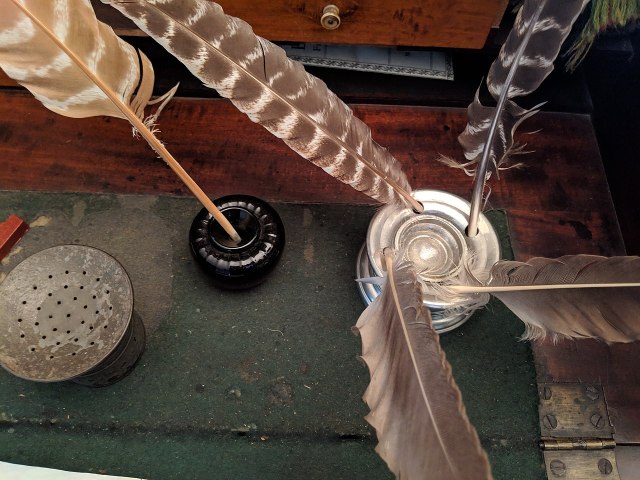
Captain Jay Ruffins, 17th Century Quills from Rufus King Manor museum in Jamaica, Queens shared under Creative Commons 4.0 Share Alike

Forgive the words that bleed out from this pen
For the ink that forms them is a torturous mixture
Of a wounded heart’s flow mixed with the saline
Of the river of tears which flow to the sea of grief
And the trembling hands which wield the implement
Shake as they attempt to record the wounds of the world
And like so much spilled blood it rushes like streams
To poison the wells of joy that once nourished

Perhaps like the prophets’ words later generations may see
That these harsh words were the fertilizer for some new growth
Where those who mourn may be comforted as the tears dry
And the poet’s heart is lovingly knit back together by time
Then perhaps the words will be the creative words of spring
But now those words are an unknown language strange to the ear
Words whose syllables have no meaning to the grieving soul
Who must drink of the putrid waters of their own well

For everything there is a time, a time to bleed and a time to heal
And I must speak the words of that bubble up from the well of the soul
Where the light of life seems a tremulous flame in the squall
Where the cold of winter penetrates into the marrow of the bones
And where the slow tick of the clock marks the passage of pain
While I wait for the pen to slowly run out of this tortured ink
For the rivers to dry up as the sun reemerges from its dormancy
Longing for the language whose sounds my tongue cannot form
Joyously drinking from the sweet waters of newly dug wells

New Growth

Vincent Van Gogh, Tree Roots, (1890)


Water washes away the sins of the night, pushing them downward to the gutters
Running back through the storm sewers and into the rivers and eventually into the sea
Where they sink down, deeper and deeper, into the abyss where no light shines
Blood is thicker than water, so in the deluge of the summer monsoon it sinks
As the rain washes away the chains that bind and the relations which smother
Allowing the newly baptized child to walk through the renewing waters as a new thing

Perhaps the blood will wash deep into the earth, passing on its life to the fecund ground
Reaching down towards hell with its roots, or perhaps rising towards heaven in the trees
Or perhaps doing both at once connecting the hell of the past and the reborn hope
Forming a perpetual reminder of the journey from darkness to light, from seed to sapling
That even new growth comes from the ground fertilized by the struggles we lived through
That only the killing frost of winter can prepare the earth for the new growth of spring

Death and life, bound together like the elements of ground and air and water and fire
Dying and rising, sin and salvation, blood, breath, water, new hope and long departed dreams
The past may no longer be seen, may have washed away in the rain and still it remains
Flowing through our veins, the blood of our forefathers and the sweat of our children
The earth gives its silent testimony of the blood it has ingested and the tears it drank
In the flowers, leaves and grass which cover it like a blanket, its bright quilt of resurrection

Psalm 40 Experienced Faithfulness and the Hope of Deliverance

Extract of Herbert Boeckl’s fresco “Saint Peter’s rescue from the Lake Galilee” inside the cathedral of Maria Sall, Carinthia, Austria

Psalm 40

<To the leader. Of David. A Psalm.>
1 I waited patiently for the LORD; he inclined to me and heard my cry.
2 He drew me up from the desolate pit, out of the miry bog, and set my feet upon a rock, making my steps secure.
3 He put a new song in my mouth, a song of praise to our God. Many will see and fear, and put their trust in the LORD.
4 Happy are those who make the LORD their trust, who do not turn to the proud, to those who go astray after false gods.
5 You have multiplied, O LORD my God, your wondrous deeds and your thoughts toward us; none can compare with you. Were I to proclaim and tell of them, they would be more than can be counted.
6 Sacrifice and offering you do not desire, but you have given me an open ear. Burnt offering and sin offering you have not required.
7 Then I said, “Here I am; in the scroll of the book it is written of me.
8 I delight to do your will, O my God; your law is within my heart.”
9 I have told the glad news of deliverance in the great congregation; see, I have not restrained my lips, as you know, O LORD.
10 I have not hidden your saving help within my heart, I have spoken of your faithfulness and your salvation; I have not concealed your steadfast love and your faithfulness from the great congregation.
11 Do not, O LORD, withhold your mercy from me; let your steadfast love and your faithfulness keep me safe forever.
12 For evils have encompassed me without number; my iniquities have overtaken me, until I cannot see; they are more than the hairs of my head, and my heart fails me.
13 Be pleased, O LORD, to deliver me; O LORD, make haste to help me.
14 Let all those be put to shame and confusion who seek to snatch away my life; let those be turned back and brought to dishonor who desire my hurt.
15 Let those be appalled because of their shame who say to me, “Aha, Aha!”
16 But may all who seek you rejoice and be glad in you; may those who love your salvation say continually, “Great is the LORD!”
17 As for me, I am poor and needy, but the Lord takes thought for me. You are my help and my deliverer; do not delay, O my God.

Any deliverance we may experience during our life is provisional. That doesn’t mean that the deliverance is insignificant or unimportant, merely that there will be future crises that we encounter in our lives. The experience of God’s faithfulness and the answer to one’s prayer does not grant us a life exempt from future struggles or conflict. Yet, these experiences of God’s faithfulness can give shape to the prayers that we state when we encounter a new crisis. Our history with God’s actions on our behalf teach us to trust that God does hear our prayer and respond and gives us a hope for deliverance in the future as we endure what hardships may come.

Psalm 40 moves from praise for a past time of salvation into a prayer in a moment of crisis. Some people have broken the psalm into two pieces and dealt with it as two distinct psalms, especially since verses 13-17 comprise the entirety of Psalm 70. Yet, here they are joined into one psalm and there is wisdom in the way Psalm 40 flows. The movement from the experience of faithfulness to praise to finding oneself needing to callon God’s deliverance is a movement that is frequent in the life of faith.

The psalm begins with recollection. The petitioner remembers a time when they waited on the LORD’s deliverance and their waiting was recognized. They were drawn out of a metaphorical pit and miry bog and placed in a secure place. God was their rock and a foundation which proved trustworthy to rely upon and to build their life around. Their response to this deliverance was one of praise, of singing and or testifying to others in the community what they LORD had done for them.

As the praise of the psalmist continues they can proclaim that ‘happy’ or ‘blessed’ is the one who makes the LORD their trust. Earlier the path of happiness was for those who do not follow the wicked and delight in the law of God (Psalm 1) or for those whose sin has been forgiven (Psalm 32) and now the path of happiness is for those who trust in the LORD instead of any other object of faith. Instead of trusting in their own strength or turning aside to follow other gods the faithful one finds peace and happiness in relying on their God. Their trust has been rewarded by seeing the wondrous deeds towards the faithful community in the past and they remind themselves of the blessings they have received. The path of the ‘happy’ one is a path of gratitude for the continued provision of God throughout their life and in the life of their community.

What the psalmist believes their LORD desires is a life that is lived according to the covenant rather than sacrifice and offering. Like the prophets (see for example 1 Samuel 15: 22; Isaiah 1: 12-17; Hosea 6:6 and Amos 5: 21-24), here the psalmist recounts that the LORD desires more than merely right worship. The God of the psalms is not swayed by lavish sacrifices or offerings or worship. No sacrifice meets what God truly wants for God’s people. Instead it is a life lived in trust, praise and obedience that is desired by God. While worship, sacrifice and offering are all a part of this life they are not sufficient.

Interpretations vary on the ‘scroll of the book of the law’ in verse seven. I read this as a way of talking about a life that conforms to God’s law. Perhaps the person brings in a scroll of either a narrative of the way in which God rescued them, or the psalm itself becomes the offering, or the scroll is an accounting of how the individual has lived in accordance with God’s will. As Rolf Jacobson can state

“the psalmist delights in doing what God truly does find acceptable. And what God delights in is a life that conforms itself to God’s teaching (tôr; see comment on Ps. 1:2)—a life so conformed to God’s teaching that the torah is alive deep (betôk mēāy) a person.” (Nancy deClaisse-Walford, 2014, p. 379)

Like Jeremiah 31: 31-34 and Ezekiel 36: 26-28 we have within this psalm a heart that has the covenant imprinted on it.  Their experience of living the law, of trusting in the LORD, and knowing the benefit of the LORD’s protection and provision form the content of their witness to the community of faith. Their life and their song become tied together into a public act of worship the God who has heard them.

Yet, the faithful life is not exempted from strife and trials and within this psalm the texture changes as the psalmist is again in a place where they need to call upon the LORD’s salvation. In the past they have called, and God has answered and here again they lift their cry for God’s mercy, steadfast love and faithfulness. Evils and iniquities have somehow occluded the psalmist’s ability to see God’s action on their behalf. Those who desire their hurt may be those actively working against them or seeking to profit from their misfortune or they may simply be those who take pleasure in another person’s suffering. But the psalmist prays out of the position of trusting in God’s deliverance, a trust that has been validated in the past. They are poor and needy, they are vulnerable and yet they trust that God sees their turmoil and hears their cry. They recounted waiting patiently in the past for the LORD’s deliverance and now they are in the space of waiting again. They ask for God to act quickly to restore them to the place where once again they can testify to God’s deliverance and how God has again set their feet upon the rock instead of being caught in the pit or the miry bog.


Prophesy to the Wind

The Knesset Memorial, Jerusalem (Detail) Ezekiel in the Valley of Dry Bones

O mortal can these bones live? This people who continues to dwell in the valley of death
This people who refuses to learn from the past, these ears that did not hear
These hands which did not help and the eyes that remain obstructed so that they do not see
The cataracts of hatred and privilege that blind them to the neighbor they sacrificed
The ears made deaf by the cacophony of shouting voices that no longer hear the victims cry
And yet the Lord says to prophesy to the bones and once again they will rise up again
Bone will join to bone, sinew to sinew, flesh and tendons and heart and muscle will grow anew
 
So dry bones hear the words the prophet proclaims, from one who stands in the valley of death
Daring to enter into that place where dreams have died and history is forgotten
Walking to the remains of a people whose heart and soul shriveled and died as they forgot love
These shambling remains of the people of a dream and a hope, to a nation which lost its way
Stand upon the graves of the present and shout at the top of your lungs about resurrection
Not to some distant heaven but a new creation where eyes and ears and hearts are opened
The death of the moment is not the end of the story for the prophet tells of new beginnings
 
The prophet whose voice strained as he tried to change their direction of yesterday’s winds
Now prophesies again to the four winds that blow upon the earth as they return the breath of God
Which enters into the nostrils and fills the lungs with the air of the new creation which doesn’t die
For the voices of hatred and death, of separation and war, the raised voices of angry men fall silent
As the still, soft, silent creative words are finally heard after the fire, thunder, winds and quakes
And with tears in his eyes the prophet sees the dry bones live, the blind eyes see and the deaf ears hear
As the new hearts learn how to love rather than hate and arms are raised to embrace rather than strike
 
Perhaps the prophet is a madman listening to the voices in his head and prophesying to the wind
To continue to cry out for the possibility of something new as demons dance in the graveyard
To believe that the dry bones might someday choose something other than the death they know
Or perhaps the stubborn prophet is the only sane one, the voice of life in the midst of devastation
The dreamer who refuses to give up in the midst of the nightmare and believes the darkness will end
Perhaps like Isaiah and Jeremiah and Ezekiel the prophet will become a beacon of hope in the night
O mortal can these bones live? Can this people be renewed? O Sovereign Lord, you know
 
Until that day the prophet’s voice goes out to the dry bones and prophesies into the wind.


Mosaic

Mosaic from the parish church of Saint Michael and Saint Peter, Antwerp

Mosaic from the parish church of Saint Michael and Saint Peter, Antwerp

Looking back on all the pieces of my life
Is not like looking at a picture composed on a canvas
That brings together the palette of colors and shades
To paint a portrait of a person who emerges whole
Stepping forth from the dreams and imagination
 
Nor is it like a sculpture chiseled out of the stone
Seeing the beauty that rested within the raw resources
Standing unchanging and immovable once complete
Where the finished product is merely a skilled refining
Calling forth the potential residing within the granite
 
No, the artist who worked on my life must love mosaics
Being able to pull together the discordant colors and jagged edges
Patiently arranging the broken pieces to see something larger
Seeing something of hidden beauty among the broken shards
Using the mortar of life to bring together the shattered stone