Tag Archives: Exodus

Exodus 3: The Calling of Moses and the Name of God

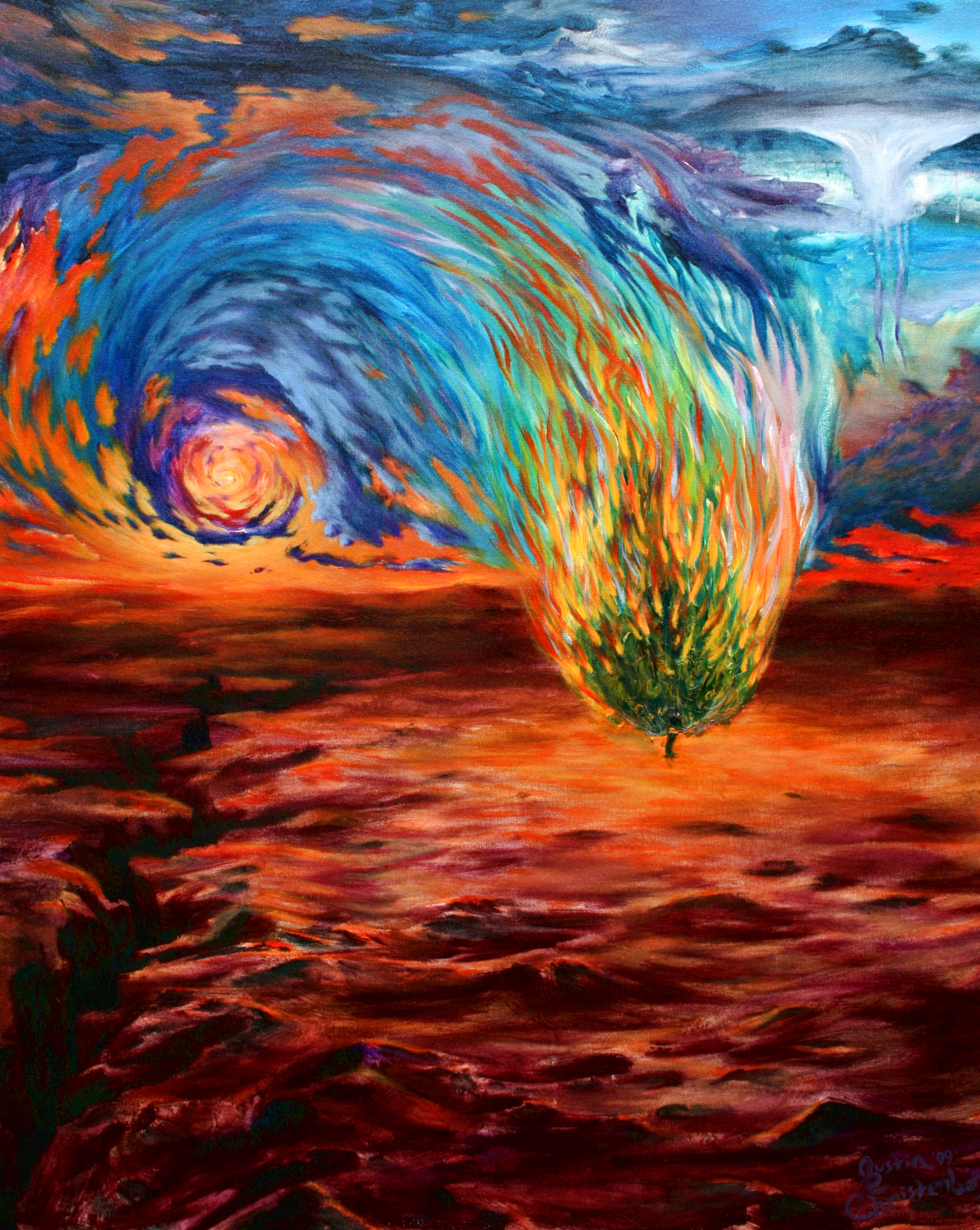
Burn by JustinChristenbery from deviantart.com

Burn by JustinChristenbery from deviantart.com

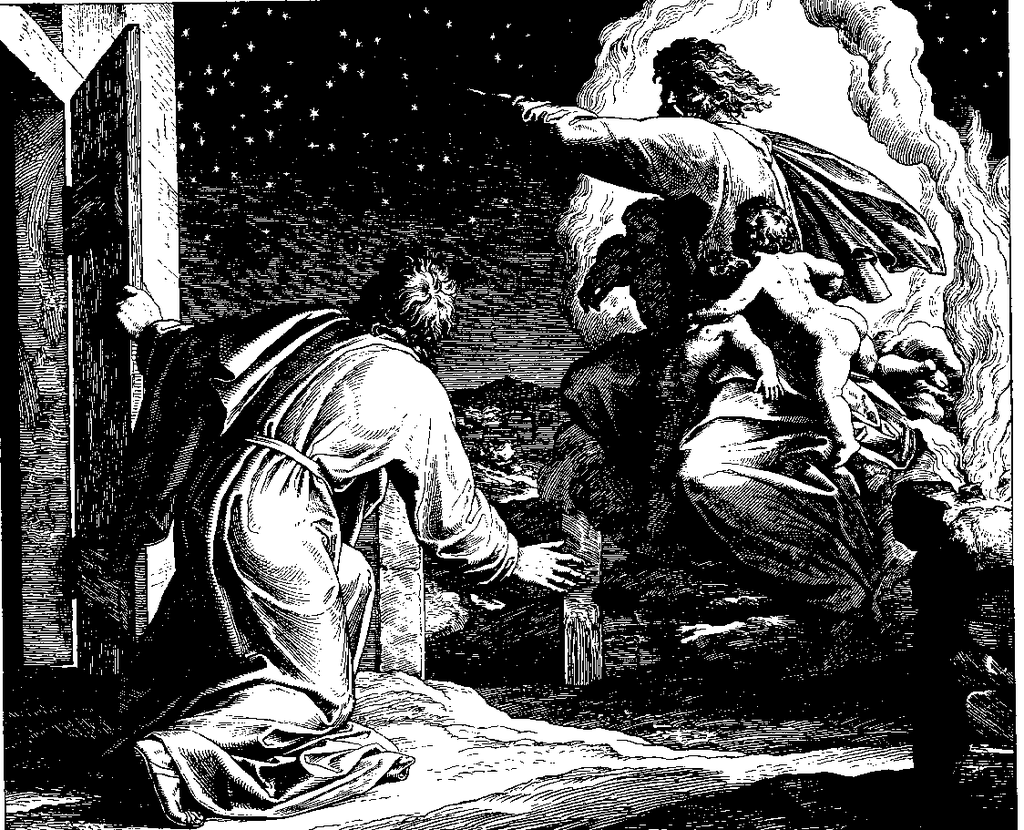
Exodus 3:1-12- Moses, the Mountain, the Burning Bush and the Voice of God

Moses was keeping the flock of his father-in-law Jethro, the priest of Midian; he led his flock beyond the wilderness, and came to Horeb, the mountain of God. 2 There the angel of the LORD appeared to him in a flame of fire out of a bush; he looked, and the bush was blazing, yet it was not consumed. 3 Then Moses said, “I must turn aside and look at this great sight, and see why the bush is not burned up.” 4 When the LORD saw that he had turned aside to see, God called to him out of the bush, “Moses, Moses!” And he said, “Here I am.” 5 Then he said, “Come no closer! Remove the sandals from your feet, for the place on which you are standing is holy ground.” 6 He said further, “I am the God of your father, the God of Abraham, the God of Isaac, and the God of Jacob.” And Moses hid his face, for he was afraid to look at God.

 7 Then the LORD said, “I have observed the misery of my people who are in Egypt; I have heard their cry on account of their taskmasters. Indeed, I know their sufferings, 8 and I have come down to deliver them from the Egyptians, and to bring them up out of that land to a good and broad land, a land flowing with milk and honey, to the country of the Canaanites, the Hittites, the Amorites, the Perizzites, the Hivites, and the Jebusites. 9 The cry of the Israelites has now come to me; I have also seen how the Egyptians oppress them. 10 So come, I will send you to Pharaoh to bring my people, the Israelites, out of Egypt.” 11 But Moses said to God, “Who am I that I should go to Pharaoh, and bring the Israelites out of Egypt?” 12 He said, “I will be with you; and this shall be the sign for you that it is I who sent you: when you have brought the people out of Egypt, you shall worship God on this mountain.”

Chapters three and four are the calling of Moses into his large task of being the leader, law bringer, prophet and teachers of the people of Israel. The call of Moses on the mountain with the burning bush, the angel of the LORD, the voice of God and Moses’ reluctance to take up the call is a very rich text densely condensed into the narrative we have handed on to us. Moses’ transition from tending the flock of his father-in-law to tending the people of the God of Abraham, Isaac and Jacob and the task of confronting the king of Egypt is a daunting one.

Moses’ father-in-law is here called Jethro instead of Reuel. There are multiple interpretations of why the name changes in this part of the story. One is that Jethro is a title, perhaps an honorary title given to a priest of Midian, while Reuel is the name of his father-in-law. Another theory comes from the source theory that was particularly popular in scholarly interpretations of the Pentateuch in the previous generation of scholars. Much as scholars in this vein would discern different source material behind the books of Genesis, Exodus, Leviticus, Numbers and Deuteronomy based on the way that the texts referred to God and their theology (the classic J-E-P-D, or Jehovah {or YHWH}, Elohist {primarily using the term Elohim to refer to God}, Priestly and Deuteronomist divisions that some may have learned in a bible class came out of this theoretical approach). According to this theory we see a seam where the compiler of the book of Exodus uses a different source to tell this part of the story. Regardless, in the narrative of Exodus we have Reuel and Jethro are referring to the same person, the father-in-law of Moses and the one out of whose household the LORD will call the leader to bring the Israelites out of Egypt.

Mountains in ancient literature are the typical places where a theophany (appearances of a divine being) occur, perhaps because of their proximity to the skies (the heavens) and perhaps because of their inaccessibility. Mount Horeb, Mount Sinai, the temple mount, the Mount of the Transfiguration or the mountain where the Sermon on the Mount and even Golgotha in its own way become places where the presence of the divine somehow encounters the people who are on the mountain when God appears. These mountaintop experiences of the immanent presence of the divine are both clarifying and terrifying. They often represent critical points within the communication of God with God’s people and so here, like in the giving of the law, God will set apart the people of Israel for a special purpose within the world and Moses for a special purpose with the people.

Many people of all ages are familiar with the story of the burning bush, where God speaks to Moses out of the fire but the story is more complex than that. Much as in the book of Genesis (example Genesis 22: 15) the angel of the LORD is the one who appears and speaks, and yet God’s voice is heard through this mediating messenger. The burning bush, which is not consumed by the fire, catches Moses’ attention. This magical moment is designed to lure Moses into this experience of the God’s words and call. The LORD is portrayed as watching for the moment when Moses is lured into this experience and encounters the fire and the angel of the LORD. Even though later in Exodus Moses will speak to God ‘face to face’ here the presence of God is mediated. Somehow the angel of the LORD is a messenger and yet an extension of the voice of God and here, even though mediated, the presence of God draws closer and makes this piece of mountainous property a holy place where God is present in a more immediate way. Much as the angel of the LORD will be the mediator of God’s presence to Moses, now Moses is being prepared to be the mediator of God’s presence to the people of both Israel and Egypt.

The fear of the LORD is the beginning of wisdom, and knowledge of the Holy One is insight” Proverbs 9:10 can state, and here Moses’ initial reaction to this intensified presence of the LORD is to hide his face and to fear.  Rabbi Jonathan Sacks has a fascinating discussion of ‘of what was Moses afraid?’ (Sacks, 2010, pp. 35-40) where he pulls on Rabbinic wisdom to draw several parallels in Moses’ life: Moses here hides his face and later the Israelites will see Moses’ face radiant after he talks with God and be afraid to approach him; he is afraid to look upon God here and later in Exodus he will see the form of God. And yet, why is the fear of the LORD the beginning of wisdom, or why is Moses afraid. Rabbi Sacks argument that to see the face of God is also to see ultimate justice of history and to understand why sometimes humans must suffer would be a wisdom whose price was too high. Whether these thoughts in any way parallel Moses’ thoughts we will never know but there is a perspective that we, no matter how broad minded we try to be, cannot see. Certainly, leaders at times must make choices that will cause pain for a portion of their followers to forward some greater good, or parents at times deny their children momentary pleasures for their health, security or well-being. Yet, we as people, while we can say with Martin Luther King, Jr. that ‘the moral arc of the universe is long, but it bends towards justice’ we still are, like Moses, called to become angry and upset about oppression and the injustice of this world. Moses is probably chosen because he could see the injustices, like those committed towards the Hebrew people or the daughters of Jethro in the previous chapter and felt compelled to act upon those injustices.

God has heard and seen the misery of the people and now God is going to act upon that observation. Moses will be the instrument that the LORD uses to bring the people from slavery to the promised land. God’s actions in the world often are mediated through the people God calls, indeed Israel as a people’s calling is to mediate God’s presence and blessing to the world. Being an instrument of God is both an incredible but also a fearful calling, perhaps this is one of the central reason why so often one of the first things said is ‘Do not be afraid’ but that is not said here. Instead the promise of God’s presence with Moses is to be the reassurance that he will need to boldly go before Pharaoh.

The land that the Israelites are to go to is here referred to for the first time as a land of milk and honey. As Carol Myers, can remind us this refers to, “The products of animal husbandry (represented by “milk”) and viticulture (represented by “honey,” or grape syrup) represent the productivity of a land that, in fact, has a difficult topography and chronic water shortages.” (Myers, 2005, p. 54) Honey in the bible is rarely bee honey, there are expectations like Judges 14 in the story of Samson, and mainly this fruit syrup. The land of milk and honey is only a productive land on the condition of the LORD of Israel granting fertility and rains at the appropriate time. It is not, like the American heartland, a comparatively easy place to grow crops and herds. The people’s prosperity, like their entire life will always be dependent upon the generative gift of the LORD their God.

Moses’ response to the call is one of self-doubt. It is easy to forget in the boldness that Moses will need to later embody before the people, before Pharaoh and before God that his initial response is one of self-doubt. Perhaps for most of us this is the natural response. We are unable to see within ourselves the very characteristics that God based God’s calling upon. The things that we may see as challenges, perhaps in Moses’ case his inability to see the injustices occurring without acting, may be the very characteristics that God sees as necessary for the calling we have. Moses will bargain with God here and in chapter four about Moses’ perceived insufficiencies and needs for reassurance and even when it may not be the way the LORD would prefer God accommodates Moses. Moses the man is critical to God’s work of liberation and even though he cannot see who he will become God sees within him the potential and the characteristics that God needs for him to be the instrument chosen for this task.

Hebrew Letters for the Name of God

Hebrew Letters for the Name of God

Exodus 3: 13-22 The Name of God

13 But Moses said to God, “If I come to the Israelites and say to them, ‘The God of your ancestors has sent me to you,’ and they ask me, ‘What is his name?’ what shall I say to them?” 14 God said to Moses, “I AM WHO I AM.” He said further, “Thus you shall say to the Israelites, ‘I AM has sent me to you.'” 15 God also said to Moses, “Thus you shall say to the Israelites, ‘The LORD, the God of your ancestors, the God of Abraham, the God of Isaac, and the God of Jacob, has sent me to you’:

This is my name forever, and this my title for all generations.

 16 Go and assemble the elders of Israel, and say to them, ‘The LORD, the God of your ancestors, the God of Abraham, of Isaac, and of Jacob, has appeared to me, saying: I have given heed to you and to what has been done to you in Egypt. 17 I declare that I will bring you up out of the misery of Egypt, to the land of the Canaanites, the Hittites, the Amorites, the Perizzites, the Hivites, and the Jebusites, a land flowing with milk and honey.’ 18 They will listen to your voice; and you and the elders of Israel shall go to the king of Egypt and say to him, ‘The LORD, the God of the Hebrews, has met with us; let us now go a three days’ journey into the wilderness, so that we may sacrifice to the LORD our God.’ 19 I know, however, that the king of Egypt will not let you go unless compelled by a mighty hand. 20 So I will stretch out my hand and strike Egypt with all my wonders that I will perform in it; after that he will let you go. 21 I will bring this people into such favor with the Egyptians that, when you go, you will not go empty-handed; 22 each woman shall ask her neighbor and any woman living in the neighbor’s house for jewelry of silver and of gold, and clothing, and you shall put them on your sons and on your daughters; and so you shall plunder the Egyptians.”

There is both power and necessity in a name. There is necessity in a name in being able to differentiate creatures, people, things and even God. Just as in Genesis 2: 19-20 where God brings Adam each of the different creatures to name, so there is a need to have a way to distinguish the God of Abraham, Isaac and Jacob from the gods of Egypt or Canaan. One of the things that people throughout the narrative of Genesis did was give names for the God they encountered (for example Hagar will name God ‘El-Roi’, Melchizedek will call God ‘El-Elyon’).  Here God is asked for what God’s name is and God’s response ‘I AM WHO I AM’ and its later four Hebrew Letter YHWH will be the one name that of God that is spoken rarely if ever among the Jewish people.

The divine name is behind the later commandment in Exodus 20:7 “You shall not make wrongful use of the name of the LORD your God, for the LORD will not acquit anyone who misuses his holy name.” Many Jewish people will not even write the word God, substituting G_d. Even in the translation of the Bible the name is not casually written. Only here is the name translated “I AM” and throughout the rest of the Hebrew Scriptures (or Old Testament) the four-letter name of God is translated LORD. A person reading in Hebrew would pronounce ‘Adonai’ the Hebrew word for Lord rather than Yahweh which is scholarship’s best guess at the proper pronunciation of the divine name.

In the fantasy series Eragon to know the true name of something is to have power over that item and magic was worked by knowing something’s true name. This is an ancient idea that Christopher Paolini picked up knowingly or unknowingly in those stories. For example, in an exorcism if one can call upon the name of the demon being exorcised it is a sign of power (an example of this is in the story of Jesus and the Gerasene demoniac in Mark 5: 1-20 and parallels). There is an entire tradition of Jewish mysticism based upon the names of God which have some resonance of magical power. Here the name of God is both necessary and powerful, in a certain sense God unveils a part of God’s identity in releasing this name. Yet, the name itself, “I AM,” has a certain veiling quality as well. Coming from the ‘to be’ verb of Hebrew it both reveals and refuses to reveal. The LORD says, “I exist” and perhaps I am behind all existence (which would fit with the Hebrew understanding of God as the creator of all things) and yet it is only four letters. Yet, those four letters would necessitate a commandment to prevent their misuse, the name of God is a powerful thing. This is also a dynamic that the Gospel of John uses in respect to Jesus’ numerous ‘I am’ sayings (I am the bread of life, I am the good shepherd, I am the gate, I am the way, the truth and the light, etc.)

God calls Moses to go and assemble the elders and then foreshadows much of what is to come in the remainder of Exodus through Joshua. The land to which they are going is now named as the land of the Canaanites, Hittites, Amorites, Perizzites, Hittites and Jebusites. The initial request is to go out for three days to sacrifice, a request that will be denied multiple times by Pharaoh. Also foreshadowed is the conflict between Pharaoh, and by extension the gods of Egypt, and the LORD. Finally, the Egyptians giving to the people of Israel as they begin their journey jewelry, wealth and clothing. God may see what is ahead for Moses and the people and yet Moses will still need to see some evidence from God how this may come about.


Exodus 2: Moses’ Story Begins

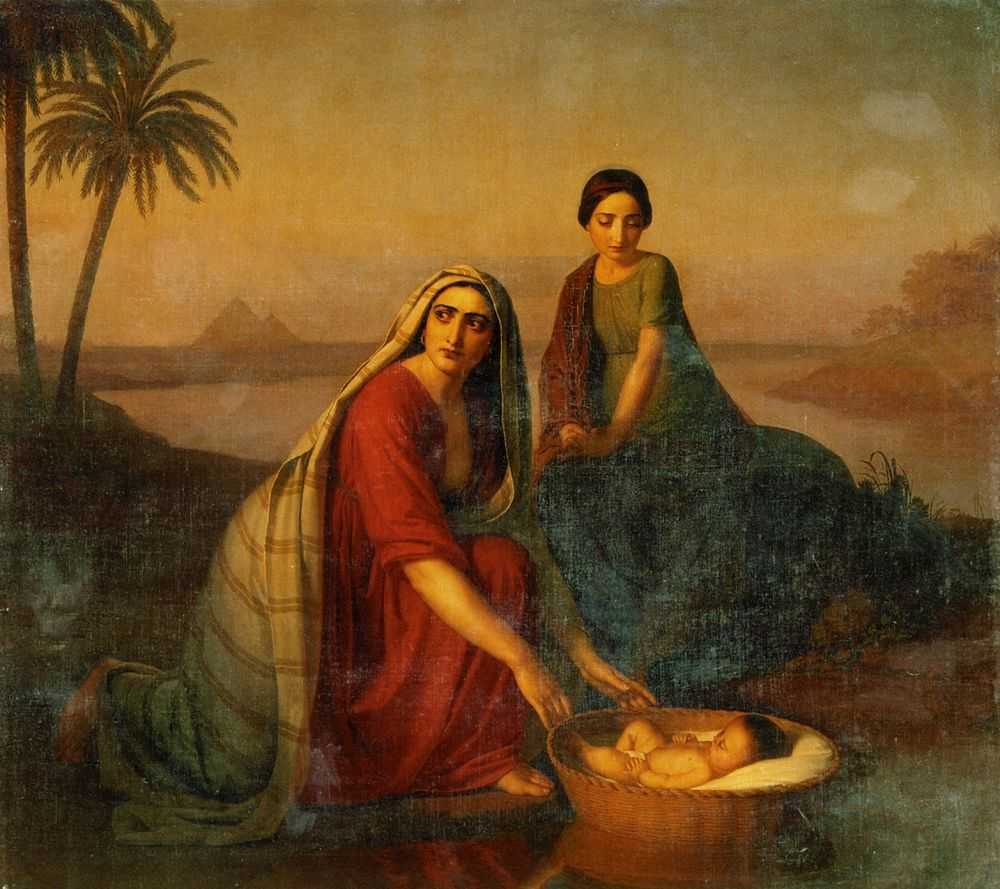
Alexey Tyranox, Moses Being Lowered into the Nile by His Mother (1839-1842)

Alexey Tyranox, Moses Being Lowered into the Nile by His Mother (1839-1842)

Exodus 2: 1-10 The Continued Resistance of Women

Now a man from the house of Levi went and married a Levite woman. 2 The woman conceived and bore a son; and when she saw that he was a fine baby, she hid him three months. 3 When she could hide him no longer she got a papyrus basket for him, and plastered it with bitumen and pitch; she put the child in it and placed it among the reeds on the bank of the river. 4 His sister stood at a distance, to see what would happen to him.

 5 The daughter of Pharaoh came down to bathe at the river, while her attendants walked beside the river. She saw the basket among the reeds and sent her maid to bring it. 6 When she opened it, she saw the child. He was crying, and she took pity on him, “This must be one of the Hebrews’ children,” she said. 7 Then his sister said to Pharaoh’s daughter, “Shall I go and get you a nurse from the Hebrew women to nurse the child for you?” 8 Pharaoh’s daughter said to her, “Yes.” So the girl went and called the child’s mother. 9 Pharaoh’s daughter said to her, “Take this child and nurse it for me, and I will give you your wages.” So the woman took the child and nursed it. 10 When the child grew up, she brought him to Pharaoh’s daughter, and she took him as her son. She named him Moses, “because,” she said, “I drew him out of the water.”

The resistance to the policies of the unnamed king of Egypt begins with Shiphrah and Puah, the Hebrew midwives, and continues with a mother, a daughter of the Hebrews and a daughter of the king’s own household. Even in the time of oppression the Israelites continue to marry and bear children, even though the lives of those children are now threatened by a command to all the people of Egypt. Yet, even in ancient Egypt we hear a memory of the subtle and artful resistance to the abhorrent policies of murder. This one child rescued from being thrown into the Nile will later lead the people out of slavery and into a new calling and identity.

A mother looks upon her newborn son and seeing that, in similar language to the creation narratives in Genesis, that he is good attempts to preserve this small piece of God’s creation she holds in her hands. For three months she manages to keep the child hidden but ultimately the wickedness of humanity forces her, like God sealing up Noah and his family in an ark (and the word for the basket here is the same used for the ark in Genesis), places him in the waters of the Nile-the same waters that Pharaoh demanded the Egyptians cast the Hebrew sons into, and hopes against hope for deliverance from those very waters. The mother moves away from the basket leaving a final hope in God’s unseen hands but his sister, perhaps Miriam but unnamed here, continues to watch.

Deliverance comes from the household of the man who ordered the death of the Hebrew children. This daughter of Pharaoh has nothing to gain by being involved in this story. She could’ve easily allowed the basket to remain undisturbed by human hands and still she sees, she acts, and she becomes the deliverance for this child and a medium God will use in the deliverance of the people. She is able to see in this child the human cost of her father’s oppression and she takes pity and acts. She realizes that this indeed must be one of the Hebrew’s children consigned to death and she hears his cries, much as God will later hear the Israelite’s cries. All throughout this beginning of Exodus it is women who prefigure the ways in which God will act.

The surprising nature of the story continues when the daughter of Moses’ mother speaks openly to the daughter of Pharaoh and together they conspire to save the child’s life. It is Moses’ sister who suggests a subtle resistance that allows the mother of Moses’ to be shielded from losing her son and to be compensated by Pharaoh’s household for resisting the deathly order of Pharaoh himself. Moses will grow to be a child of two worlds, both the world of the Hebrews still connected to his family of birth and connected to the household of Pharaoh where he receives not only protection and privilege but also his name. Yet, like Pharaoh’s daughter, his mother and his sister, he too will see the cost of the oppression around him as a young man and be compelled to act.

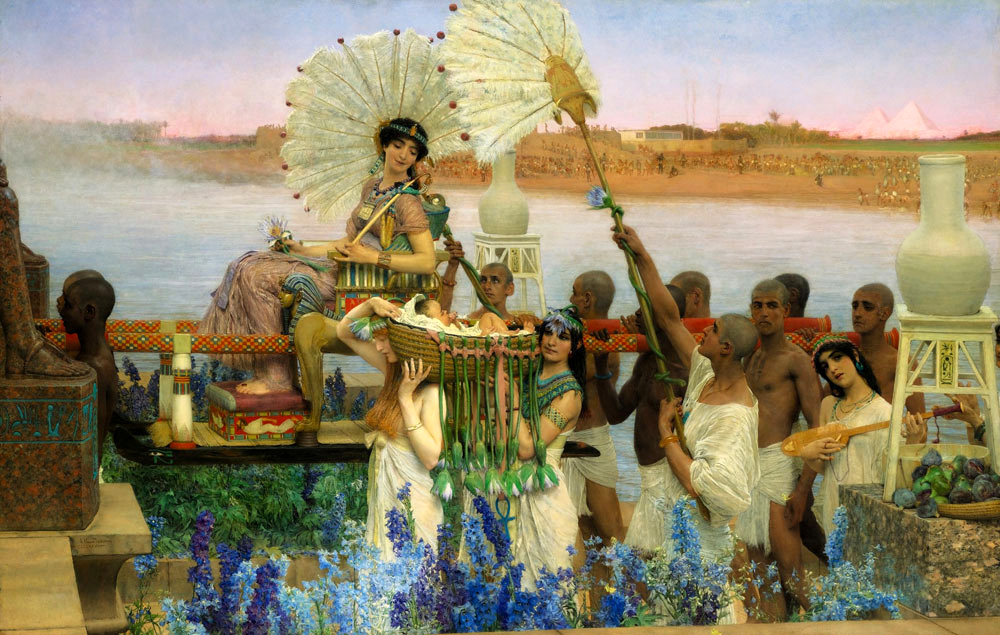
Lawrence Alma-Tadema, The Finding of Moses (1904)

Lawrence Alma-Tadema, The Finding of Moses (1904)


Exodus 2: 11-15a: Reacting to the Oppression

 11 One day, after Moses had grown up, he went out to his people and saw their forced labor. He saw an Egyptian beating a Hebrew, one of his kinsfolk. 12 He looked this way and that, and seeing no one he killed the Egyptian and hid him in the sand. 13 When he went out the next day, he saw two Hebrews fighting; and he said to the one who was in the wrong, “Why do you strike your fellow Hebrew?” 14 He answered, “Who made you a ruler and judge over us? Do you mean to kill me as you killed the Egyptian?” Then Moses was afraid and thought, “Surely the thing is known.” 15 When Pharaoh heard of it, he sought to kill Moses.

Moses has grown up as a person of two worlds. He has both his identity as a child brought into the household of Pharaoh as well as his identity as a Hebrew. Perhaps he was shielded during his upbringing from the friction between these two identities but upon seeing the oppression of his people he feels compelled, like God will at the end of chapter two, to act. Moses reacts violently, he feels his kinship with the Hebrew being beaten, and he commits murder. His action may not be a reasoned and calm reaction, most likely we would brand this type of action today a terrorist action, and yet he sees the oppression and feels compelled to act. Perhaps this is something that God sees in Moses, one who cannot stand aside while the powerful abuse the powerless. Moses believes that he is able to act without his action being seen and known, yet he soon finds he is now seen by both sets of peoples as a murder. His fellow Hebrew sees his quest for justice in a different manner, as yet another person who acts with violence to achieve his goals.

Moses’ resistance is more violent and less effective than the resistance of the women who came before him. Moses ultimately ends up fleeing to preserve his life and going from being a person of two people to a man without a people. Yet, he will continue to see and act when he sees those with power taking advantage of those without. Moses will be unable to be the liberator of the people from their oppression on his own, ultimately he, like God, needs to see and to choose how to act. For Moses his actions mean giving up the protection that Pharaoh’s daughter was able to provide for him and he identifies with a people who is not ready to accept him.

Ciro Ferri, Moses and the Daughters of Jethro (between 1660 and 1689)

Ciro Ferri, Moses and the Daughters of Jethro (between 1660 and 1689)

Exodus 2: 15b-22: An Alien Residing in a Foreign Land

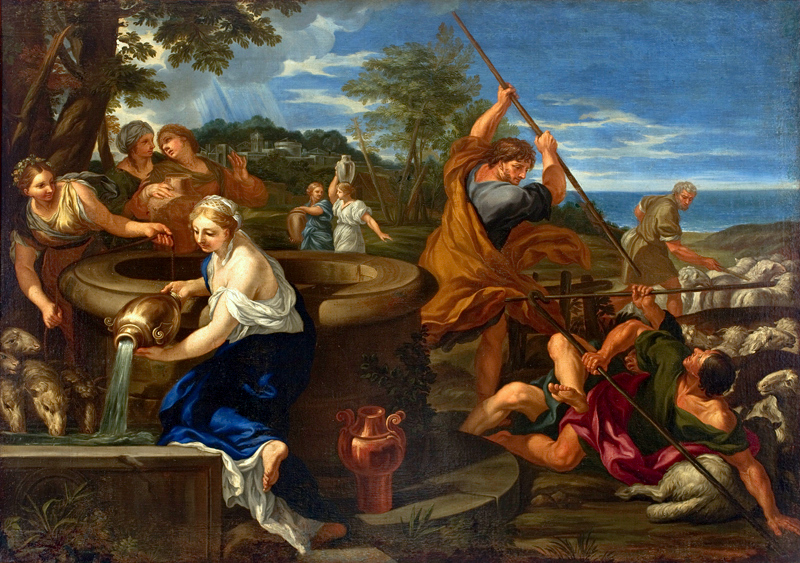
But Moses fled from Pharaoh. He settled in the land of Midian, and sat down by a well. 16 The priest of Midian had seven daughters. They came to draw water, and filled the troughs to water their father’s flock. 17 But some shepherds came and drove them away. Moses got up and came to their defense and watered their flock. 18 When they returned to their father Reuel, he said, “How is it that you have come back so soon today?” 19 They said, “An Egyptian helped us against the shepherds; he even drew water for us and watered the flock.” 20 He said to his daughters, “Where is he? Why did you leave the man? Invite him to break bread.” 21 Moses agreed to stay with the man, and he gave Moses his daughter Zipporah in marriage. 22 She bore a son, and he named him Gershom; for he said, “I have been an alien residing in a foreign land.”

Moses may have fled Egypt but he has not left his sense of justice behind. In Midian, where he comes to rest after his flight, he feels compelled this time to act on behalf of the daughters of Midian who are being harassed by the shepherd in that region and being made to wait until their flocks are watered so they can water their own flock. Moses again acts and breaks what was apparently an ongoing struggle. When their father is surprised by their early return he realizes something must have changed. Moses again sees and chooses to act and this action opens up a new home for the wanderer.

Reuel, the priest of Midian, after inquiring of his daughters about their early arrival challenges them to welcome in this stranger. “Where is he? Why did you leave the man? Invite him to break bread.” Reuel in extending his hospitality to Moses welcomes the alien residing in his land. This hospitality eventually transforms into a new kinship when he gives his daughter, Zipporah, to become Moses’ wife and later bear Moses his son Gershom. Moses now becomes a man of a third people and family and makes his home in the land of Midian away from the empire of Egypt and away from the oppression of the Hebrew people. His choices have led him to a new home away from the homes he knew. He once again is extended the unexpected saving hospitality of another and his life begins again. It will take God’s call to get him to reluctantly return to Egypt and become the one God uses to liberate the Israelites, and yet in his son’s name there is perhaps the longing for home and the identification of displacement he feels being an Egyptian and an Israelite in the household of the priest of Midian.

Exodus 2: 23-25: The God of the Israelites

 23 After a long time the king of Egypt died. The Israelites groaned under their slavery, and cried out. Out of the slavery their cry for help rose up to God. 24 God heard their groaning, and God remembered his covenant with Abraham, Isaac, and Jacob. 25 God looked upon the Israelites, and God took notice of them.

Up to this point in Exodus we have seen a human drama where the Israelites and Egyptians have struggled to live within the fear of Pharaoh. But the God of the Israelites is a God who, like the midwives, Moses’ mother and sister, Pharaoh’s daughter, and ultimately Moses, sees and acts. Unlike the gods of the Egyptians or the many gods of the nations than will surround the Israelites in the promised land the God of Israel has an eye for the oppressed. The pivot of Exodus is here where God hears their cry, God remembers the promises made to Abraham, Isaac and Jacob, God takes notice and God decides to act.

The death of the king of Egypt doesn’t change the position of the Israelite people. Individual policies may have changed and the order to kill infants may not have continued but the people are reduced to cries and groans. They may be numerous but they also feel powerless in their captivity. The God of the Israelites, who is ultimately the God of the whole earth, will challenge the gods of Egypt and their emissaries to bring out of the empire of the day a slave people who might learn to be the covenant people of God.

Exodus 1: Setting the Stage

Roman collared slaves-Marble relief from Smyrna (Izmir, Turkey), 200 CE

Roman collared slaves-Marble relief from Smyrna (Izmir, Turkey), 200 CE

 Exodus 1: 1-7 Setting the Stage

These are the names of the sons of Israel who came to Egypt with Jacob, each with his household: 2 Reuben, Simeon, Levi, and Judah, 3 Issachar, Zebulun, and Benjamin, 4 Dan and Naphtali, Gad and Asher. 5 The total number of people born to Jacob was seventy. Joseph was already in Egypt. 6 Then Joseph died, and all his brothers, and that whole generation. 7 But the Israelites were fruitful and prolific; they multiplied and grew exceedingly strong, so that the land was filled with them.

The book of Genesis, the preceding book in the Bible, spends the bulk of the book with God working through a specific family, the family of Abraham, Isaac and Jacob, to be God’s covenant partners and to be a blessing to all the nations. As Exodus begins we are joined to the ending of the book of Genesis where the sons of Jacob (Israel) have come down to Egypt and settled in the land of Goshen. Joseph was already in Egypt after being sold into slavery and rising to being second in command of all Egypt and Jacob and his remaining sons come to Egypt seeking relief from a severe famine throughout the land. Throughout the stories of Abraham, Isaac, Jacob, and Joseph God has continued to provide for them in unexpected ways. Yet, now we have left the time of Abraham, Isaac and Jacob and the original sons of Israel behind as that generation passes away.

One of the struggles of many of the stories of Genesis was the struggle against barrenness. Sarah, Rebekah and Rachel all struggle with infertility and these families of the promise struggle with the command in the first creation narrative to ‘be fruitful and multiply’ (Genesis 1. 28). At the end of Genesis and here at the beginning of Exodus there has been a slow increase from the original two of Sarah and Abraham to now a household of seventy born to Jacob. Yet now the increase becomes exceedingly fruitful, they begin to become numerous and this combined with a historical amnesia in the land of Egypt sets the stage for the initial crisis of Exodus and the transition from the people’s lives in Egypt to their journey to the promised land.

Exodus 1: 8-14 Historical Amnesia and the Politics of Fear and Oppression

 8 Now a new king arose over Egypt, who did not know Joseph. 9 He said to his people, “Look, the Israelite people are more numerous and more powerful than we. 10 Come, let us deal shrewdly with them, or they will increase and, in the event of war, join our enemies and fight against us and escape from the land.” 11 Therefore they set taskmasters over them to oppress them with forced labor. They built supply cities, Pithom and Rameses, for Pharaoh. 12 But the more they were oppressed, the more they multiplied and spread, so that the Egyptians came to dread the Israelites. 13 The Egyptians became ruthless in imposing tasks on the Israelites, 14 and made their lives bitter with hard service in mortar and brick and in every kind of field labor. They were ruthless in all the tasks that they imposed on them.

The initial reception in Egypt for the family of Israel was positive and as the book of Deuteronomy can remind the people: “You shall not abhor any of the Egyptians, because you were an alien residing in their land.” (Deuteronomy 23: 7) Yet, as time passes a sense of historical amnesia sets in. A new king, an unnamed king, arises in the land of Egypt. He may rule the superpower of the day but within this book that will become the ‘West’s meta-narrative of hope’ (Sacks, 2010, p. 1) his name remains unspoken and forgotten. He will not be linked to any of the massive construction projects of one of the Egyptian dynasties or to the culture of the land. This nameless ruler will be only remembered for the way in which the ruler of the most powerful empire of that age feared a subset of those in his land.

Until this point the Israelites were a family, they may have grown larger, but here it is the unnamed ruler who for the first time designates them as a unique people. Somehow the Israelites are distinct, they are unlike the people of the rest of the nation and that distinction gives rise to a politics of oppression. Ultimately, as Rabbi Sacks can remind us, “Pharaoh is driven by political motives, not hate.” (Sacks, 2010, p. 4) Throughout the book of Exodus the people of Egypt will be presented as one option, even a shrewd option for a type of society that can capitalize on the fear and distinction of a people to transform them from neighbors into forced laborers. Fear provides the opportunity to not only discriminate against a people but to build a civilization on their broken backs. The people of Israel will be challenged to learn a different way of organizing their lives rather than the manner of the Pharaohs of Egypt or the kings of the nations that surround them. Yet, the politics of fear and oppression continue to be used in our time to set one group of people against another and to transform neighbors into the ones to be feared.

The initial strategy to remove the threat of the Israelites through oppression fails because the more they were oppressed the more they multiplied. While the policy may have the desired effect in the near term by allowing the Egyptians to have a forced labor pool to build the monuments and houses of the empire it continues to create a fear and a dependence upon the very people they wish to eliminate. The oppression and violence has not yet reached its peak and yet it has already begun to change the oppressor. To maintain this separation between Egyptian and Israelite they become ruthless. Fear and oppression has changed them. Their placing of the projects of the empire above the needs of their neighbor changes their culture. Hospitality is replaced with brutality and yet the Israelites endure and continue to multiply even under the heavy burden of the empire’s imposed service.

Exodus 1: 15-22 The Disobedience of Women

15 The king of Egypt said to the Hebrew midwives, one of whom was named Shiphrah and the other Puah, 16 “When you act as midwives to the Hebrew women, and see them on the birthstool, if it is a boy, kill him; but if it is a girl, she shall live.” 17 But the midwives feared God; they did not do as the king of Egypt commanded them, but they let the boys live. 18 So the king of Egypt summoned the midwives and said to them, “Why have you done this, and allowed the boys to live?” 19 The midwives said to Pharaoh, “Because the Hebrew women are not like the Egyptian women; for they are vigorous and give birth before the midwife comes to them.” 20 So God dealt well with the midwives; and the people multiplied and became very strong. 21 And because the midwives feared God, he gave them families. 22 Then Pharaoh commanded all his people, “Every boy that is born to the Hebrews you shall throw into the Nile, but you shall let every girl live.”

This is the first of six stories in the book of Exodus of outstanding moral courage and they are all about women, two (Pharaoh’s daughter and Zipporah) are not Israelites and here with Shiphrah and Puah they may not be Israelites as well. (Sacks, 2010, p. 9) We don’t know whether these two women are simply midwives that are working with the Hebrew women or whether they are themselves Hebrews but they are named while the king of Egypt remains anonymous. They become examples of how women, who would not have a place within the power structures of men, are able to subvert the command of the king.

The king of Egypt asks these women to commit a crime against humanity. Perhaps the Hebrews are no longer valued as humans any longer by Pharaoh and they become a subhuman beast of burden where the master can decide upon their life and death. Yet, for these women it is not only a crime against humanity but also a crime against the LORD of the Hebrew women who keeps granting them the fertility to bring forth children. The Pharaoh has overstepped the line with these two servants and they work in their own way to find a way to allow life to occur when death has been ordered. Shiphrah and Puah have a calling, whether through morality or through faith, to not carry out this order to kill infants. When they are summoned they respond with a lie and it is a lie which also taunts the strength of the Egyptians. Hebrew women are able to deliver without a midwife present, they are much more robust than the more fragile Egyptian women who need to wait upon the ministering of the midwives. This is one of those times where God seems to delight in the craftiness of the servant. The midwives, who may have been in their role because they have no families of their own, are seen and they too are granted fertility and families. They also now have a place with the Hebrews and they become the first to resist the murderous impulses of the empire. Pharaoh, deciding that these women will not do his work for him now extends the murderous command to all his people. Now the murder of Israelites infant boys becomes the work of the nation and doubtless there will be those who are willing to embrace the politics of fear and division and be a part of the ordered purge. Yet, it is from within the oppression of the empire that something new will happen, that the people who were slaves to Pharaoh will be claimed as the first-born children by the God who is not bound to any place or nation but is instead the creator of the heaven and the earth.

Transitioning Into Exodus

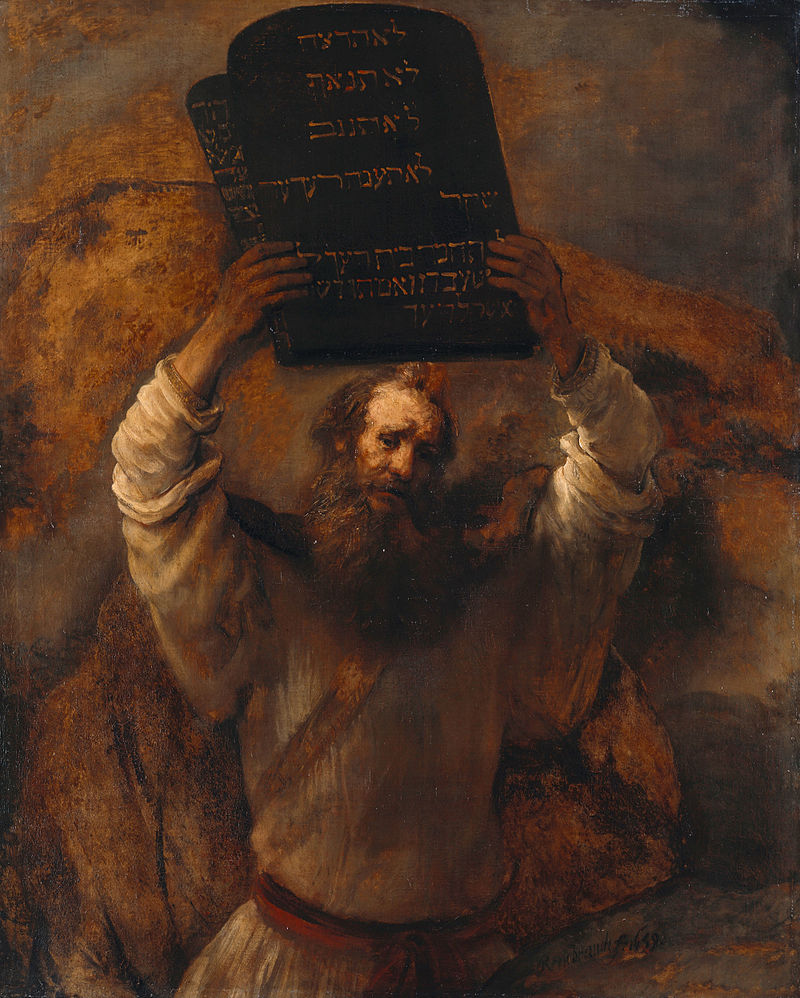
Rembrandt, Moses with the Ten Commandments

Rembrandt, Moses with the Ten Commandments

When I started the biblical reflections portion of this blog almost four years ago, I didn’t realize how much I would learn and how much it would shape my ministry. Many Christians don’t know how to approach the Hebrew Scriptures that many call the Old Testament, and as much as I love the gospels and the letters of Paul I am learning how to hear those writings much more fully as I become more and more familiar with the Psalms, Jeremiah, Deuteronomy, Ecclesiastes, Esther and Haggai. I am understanding more what Dietrich Bonhoeffer meant when he said,

I notice more and more how much I am thinking and perceiving things in line with the Old Testament; thus in recent months I have been reading much more the Old than the New Testament. Only when one knows the name of God may not be uttered may one sometimes speak the name of Jesus Christ. Only when one loves life and the earth so much that with it everything seems lost and at its end may one believe in the resurrection of the dead and a new world. Only when one accepts the law of God as binding for oneself may one perhaps sometimes speak of grace. And only when the wrath and vengeance of God against God’s enemies are allowed to stand can something of forgiveness and love of enemies touch our hearts. Whoever wishes to be and perceive too quickly and too directly in New Testament ways is to my mind no Christian. We have already, discussed this a few times, and every day confirms for me that it is right. One can and must not speak the ultimate word prior to the penultimate. We are living in the penultimate and believe the ultimate. (DBW 8: 213)

As I have wrestled with some difficult pieces of the Bible it has caused me to think about ethics, faith, our current world and so much more. For me this is the more challenging way but it has also been incredibly rewarding. Finishing Psalms 21-30 as a transition between books now I stand ready to begin another large piece. Next will be the book of Exodus, the second of the Pentateuch that I have approached. It is a book that I am more familiar with than I was with Jeremiah or Deuteronomy when I began and it is more of a narrative than any of the books I have done previously. I have two trustworthy companions for the journey. Since this is one of the central books of the Torah and the defining drama of the Jewish people I am delighted to have Rabbi Jonathan Sacks’, Covenant and Conversation: A Weekly Reading of the Jewish Bible as he reads through Exodus: The Book of Redemption as one of my primary dialogue partners. I will also be taking along Carol Meyers commentary on Exodus from the New Cambridge Bible Commentary Series. I have other resources that I have read in the past or that are on my shelf that may also be a part of this journey. With the forty chapters of Exodus the hope is to make the journey in approximately forty weeks, but as journeys go there are often unforeseen stops along the way. I am looking forward to this next exploration as I reenter the journey of the people of Israel from Egypt into the wilderness, from slavery into becoming the people of God and seeing how their journey and faith continue to shape and inform my own.

Deuteronomy 26: Bringing Story into Liturgy

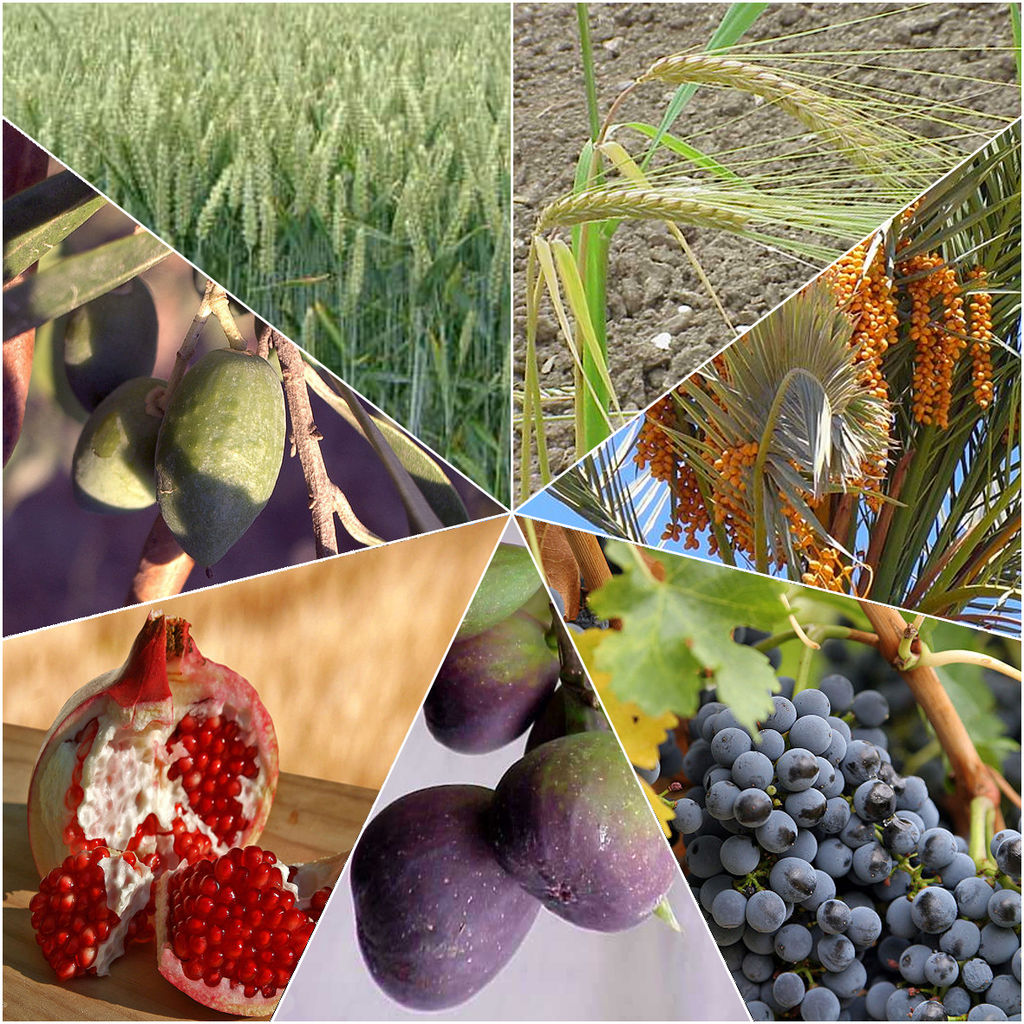
The Seven Species of the Land of Israel listed in Deuteronomy 8:8, Creative Commons Attribution 3.0

The Seven Species of the Land of Israel listed in Deuteronomy 8:8, Creative Commons Attribution 3.0

 Deuteronomy 26

1 When you have come into the land that the LORD your God is giving you as an inheritance to possess, and you possess it, and settle in it, 2 you shall take some of the first of all the fruit of the ground, which you harvest from the land that the LORD your God is giving you, and you shall put it in a basket and go to the place that the LORD your God will choose as a dwelling for his name. 3 You shall go to the priest who is in office at that time, and say to him, “Today I declare to the LORD your God that I have come into the land that the LORD swore to our ancestors to give us.” 4 When the priest takes the basket from your hand and sets it down before the altar of the LORD your God, 5 you shall make this response before the LORD your God: “A wandering Aramean was my ancestor; he went down into Egypt and lived there as an alien, few in number, and there he became a great nation, mighty and populous. 6 When the Egyptians treated us harshly and afflicted us, by imposing hard labor on us, 7 we cried to the LORD, the God of our ancestors; the LORD heard our voice and saw our affliction, our toil, and our oppression. 8 The LORD brought us out of Egypt with a mighty hand and an outstretched arm, with a terrifying display of power, and with signs and wonders; 9 and he brought us into this place and gave us this land, a land flowing with milk and honey. 10 So now I bring the first of the fruit of the ground that you, O LORD, have given me.” You shall set it down before the LORD your God and bow down before the LORD your God. 11 Then you, together with the Levites and the aliens who reside among you, shall celebrate with all the bounty that the LORD your God has given to you and to your house.

 12 When you have finished paying all the tithe of your produce in the third year (which is the year of the tithe), giving it to the Levites, the aliens, the orphans, and the widows, so that they may eat their fill within your towns, 13 then you shall say before the LORD your God: “I have removed the sacred portion from the house, and I have given it to the Levites, the resident aliens, the orphans, and the widows, in accordance with your entire commandment that you commanded me; I have neither transgressed nor forgotten any of your commandments: 14 I have not eaten of it while in mourning; I have not removed any of it while I was unclean; and I have not offered any of it to the dead. I have obeyed the LORD my God, doing just as you commanded me. 15 Look down from your holy habitation, from heaven, and bless your people Israel and the ground that you have given us, as you swore to our ancestors– a land flowing with milk and honey.”

 16 This very day the LORD your God is commanding you to observe these statutes and ordinances; so observe them diligently with all your heart and with all your soul. 17 Today you have obtained the LORD’s agreement: to be your God; and for you to walk in his ways, to keep his statutes, his commandments, and his ordinances, and to obey him. 18 Today the LORD has obtained your agreement: to be his treasured people, as he promised you, and to keep his commandments; 19 for him to set you high above all nations that he has made, in praise and in fame and in honor; and for you to be a people holy to the LORD your God, as he promised.

The twenty sixth chapter of Deuteronomy closes a long section which runs from chapter five (although many people move it back to the scene being set in Deuteronomy 4:44) through the end of this chapter. Here in the narrative Moses concludes his exposition of the commandments, statutes and ordinances of the LORD for the people of Israel. In this conclusion resides both ritual and liturgy that will continue to form the identity of the people for their life in the promised land. The manner in which the people of Israel bring in their offerings is mentioned several times throughout this portion of Deuteronomy but the way in which the author chooses to end this section liturgically explaining the significance of these practices is important to note.

In American Christianity there are several branches of the faith that are uncomfortable with the idea of a confessional creed. In a society based on individualism where the focus is on the individual’s faith and what they believe at each point in their lives the idea of a communal confession of faith seems unnecessary. I appreciate the gifts of the confessional tradition that I come out of and the way it binds me both to the manner Christians have understood the faith historically as well as locating me within a community that shares and wrestles with common confessions. Creeds have been used throughout the ages as summaries of a wider faith used in both catechetical (teaching future generations) and liturgical (worship) settings. The bible is full of these confessions of faith in both the Hebrew Scriptures and the New Testament (for example Philippians 2: 5-11) and various confessions of faith have been used as a part of the liturgy of faithful people for generations as a way of summarizing the faith. Deuteronomy 6: 21-25 is one example of a ‘credo’ a basic statement of belief to be used as a method of catechesis within the home. While in Deuteronomy 6 the focus is on the actions within the household that the parents will use to pass on the faith to their children and grandchildren and beyond, here we see confessions of faith used liturgically as a part of the telling of the story of the people of Israel. The practice of bringing the tithe and first fruits in Deuteronomy 14: 22-29 and in Deuteronomy 18:4 is now brought into a setting of worship with words that reinforce several basic parts of the understanding of the covenantal relationship the people would be expected to maintain in the promised land. Deanna Thompson outlines succinctly the key themes of the text as:
“the call for Israel to acknowledge God’s persistent care; the reminder that the land God is giving them is sheer gift; and the insistence that fundamental to Israel’s right relationship to God is the practice of attending to the needs of the stranger, the widow and the orphan.” (Thompson, 2014, p. 188)

As the offering are brought to the tabernacle or temple the people recite a brief exposition of their history which outlines their beginnings as a wandering people in Genesis, the journey to Egypt in the time of Joseph where they received the food they needed in the midst of famine, and then a brief synopsis of the Exodus experience including their oppression and liberation and being brought into the promised land. This short liturgical statement begins with the tenuousness of their situation as a landless people and later as slaves contrasted with their new but contingent identity as the covenant people of the LORD the God of Israel. The narrated history is now combined with the practice of giving which is intended to continue to form the identity of the people in their life in the land.

The liturgy in Deuteronomy 26: 1-11 focuses on re-telling the story of the people and the action of bringing the first fruit which is a result of God’s gracious provision for the people in the land. God has brought the people from being landless or oppressed to being in a land of milk and honey, therefore they are to bring in these gifts and celebrate and remember the provision of God. The focus on this first exhortation is on what God has done for Israel and now Israel is freed to enjoy the fruits of the land. In Deuteronomy 26: 12-15 the giving of the tithe Deuteronomy 14: 28-29 and a declaration that the individual has been faithful both in bringing the tithe (and not withholding a portion or using it in some other way) but also in the keeping of all of the commandments and asking the LORD to bless the peoples’ lives in the coming years.  Now the focus is on what Israel has done in response and their faithfulness to the covenant and understanding that because of their faithfulness the LORD will look down and allow them to prosper in the land. The section concludes with oaths that bind the people and the LORD the God of Israel together. The hope of this relationship is that “I will be your God, and you shall be my people; and walk only in the way that I command you, so that it may be well with you.” (Jeremiah 7: 23) As Brueggemann has helpfully outlined the italicized comments above and here now the people are to be utterly obedient to the LORD and the LORD will be utterly committed to Israel. (Brueggemann, 2001 , p. 249f)

This relationship between the LORD and the people as given in this giving and receiving of vows is to be a committed one, and perhaps the natural comparison is to the marriage vows that a couple make when they are married. This relation of the covenant to marriage will form a metaphorical background for Jeremiah (see for example Jeremiah 3) and Hosea (Hosea 2). Much of the remainder of Deuteronomy will call attention to the seriousness of Israel’s commitment in this covenant and the cost of disobedience as well as the LORD’s continuing commitment. As a people holy to the LORD their commitment is a calling. They will need to return to this covenant and recommit themselves several times throughout their story and yet there is the commitment that when they stumble and fall and recommit themselves that God will hear. They have been reminded of who they were and where they came from, how God acted to bring them graciously into this land filled with promise, how they are to respond to God’s faithfulness and the critical nature of their obedience.

Deuteronomy 11: Blessings and Curses

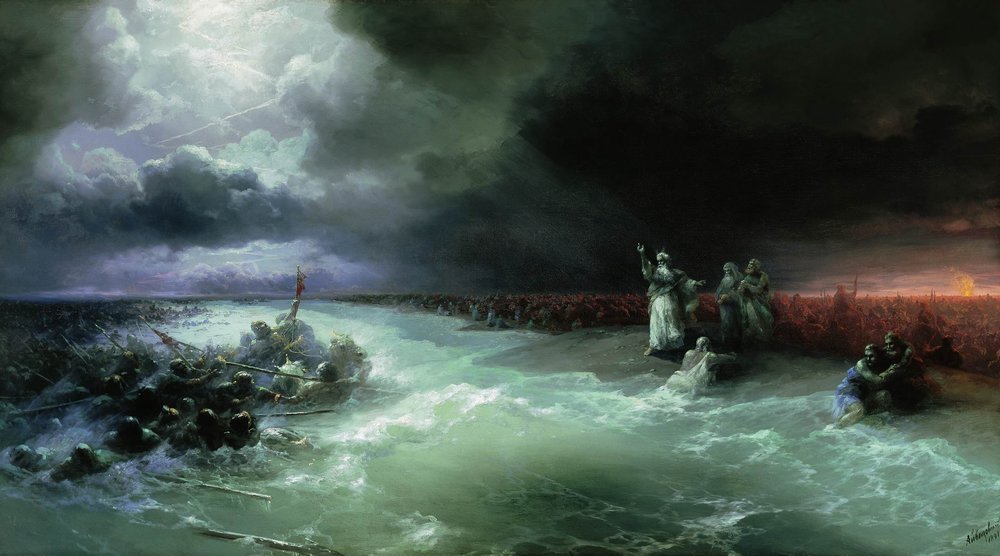
Ivan Aivazovsky, Passage of the Jews through the Red Sea (1891)

Ivan Aivazovsky, Passage of the Jews through the Red Sea (1891)

Deuteronomy 11

1 You shall love the LORD your God, therefore, and keep his charge, his decrees, his ordinances, and his commandments always. 2 Remember today that it was not your children (who have not known or seen the discipline of the LORD your God), but it is you who must acknowledge his greatness, his mighty hand and his outstretched arm, 3 his signs and his deeds that he did in Egypt to Pharaoh, the king of Egypt, and to all his land; 4 what he did to the Egyptian army, to their horses and chariots, how he made the water of the Red Sea flow over them as they pursued you, so that the LORD has destroyed them to this day; 5 what he did to you in the wilderness, until you came to this place; 6 and what he did to Dathan and Abiram, sons of Eliab son of Reuben, how in the midst of all Israel the earth opened its mouth and swallowed them up, along with their households, their tents, and every living being in their company; 7 for it is your own eyes that have seen every great deed that the LORD did.

8 Keep, then, this entire commandment that I am commanding you today, so that you may have strength to go in and occupy the land that you are crossing over to occupy, 9 and so that you may live long in the land that the LORD swore to your ancestors to give them and to their descendants, a land flowing with milk and honey. 10 For the land that you are about to enter to occupy is not like the land of Egypt, from which you have come, where you sow your seed and irrigate by foot like a vegetable garden. 11 But the land that you are crossing over to occupy is a land of hills and valleys, watered by rain from the sky, 12 a land that the LORD your God looks after. The eyes of the LORD your God are always on it, from the beginning of the year to the end of the year.

13 If you will only heed his every commandment that I am commanding you today– loving the LORD your God, and serving him with all your heart and with all your soul–14 then he will give the rain for your land in its season, the early rain and the later rain, and you will gather in your grain, your wine, and your oil; 15 and he will give grass in your fields for your livestock, and you will eat your fill. 16 Take care, or you will be seduced into turning away, serving other gods and worshiping them, 17 for then the anger of the LORD will be kindled against you and he will shut up the heavens, so that there will be no rain and the land will yield no fruit; then you will perish quickly off the good land that the LORD is giving you.

                18 You shall put these words of mine in your heart and soul, and you shall bind them as a sign on your hand, and fix them as an emblem on your forehead. 19 Teach them to your children, talking about them when you are at home and when you are away, when you lie down and when you rise. 20 Write them on the doorposts of your house and on your gates, 21 so that your days and the days of your children may be multiplied in the land that the LORD swore to your ancestors to give them, as long as the heavens are above the earth.

 22 If you will diligently observe this entire commandment that I am commanding you, loving the LORD your God, walking in all his ways, and holding fast to him, 23 then the LORD will drive out all these nations before you, and you will dispossess nations larger and mightier than yourselves. 24 Every place on which you set foot shall be yours; your territory shall extend from the wilderness to the Lebanon and from the River, the river Euphrates, to the Western Sea. 25 No one will be able to stand against you; the LORD your God will put the fear and dread of you on all the land on which you set foot, as he promised you.

                26 See, I am setting before you today a blessing and a curse: 27 the blessing, if you obey the commandments of the LORD your God that I am commanding you today; 28 and the curse, if you do not obey the commandments of the LORD your God, but turn from the way that I am commanding you today, to follow other gods that you have not known. 29 When the LORD your God has brought you into the land that you are entering to occupy, you shall set the blessing on Mount Gerizim and the curse on Mount Ebal. 30 As you know, they are beyond the Jordan, some distance to the west, in the land of the Canaanites who live in the Arabah, opposite Gilgal, beside the oak of Moreh.

                31 When you cross the Jordan to go in to occupy the land that the LORD your God is giving you, and when you occupy it and live in it, 32 you must diligently observe all the statutes and ordinances that I am setting before you today.

The author of the book of Deuteronomy approaches the same topics multiple times in similar ways over the first eleven chapters, and throughout the rest of the book. Because of this, on a topical level, there is not a lot of new material in this eleventh chapter, yet I also think it is important to consider the implied narrative that the book of Deuteronomy is set within. The book of Deuteronomy opens by telling us, “These are the words that Moses spoke to all Israel beyond the Jordan.” And the book portrays itself as primarily an oral speech rather than a written text. For most people in a literate or even post-literate context (post literate coming from the assumption that most people now receive information more through digital images rather than written text) our attention span for a spoken text is fairly short, but this is written for an aural culture (aural-information is received through hearing) where the majority of the hearers are not literate. Speech in an aural culture is repetitive so that is can be remembered and just as the words are connected to concrete actions to enhance remembrance (binding the words upon the forehead and on the hands, writing them on doorposts as a visual reminder of the spoken word) the repetition of certain critical words and phrases should continue to enhance the memory of the speech event. Music does this all the time by repeating a chorus or using certain patterns to fit words within. So while Deuteronomy may be an unwieldy written text as an aural presentation its continual re-narrating of the story, emphasis on the commandments, statutes and ordinances laid down for the people to live by serve to enhance its effectiveness.

Figurine of a Semitic Slave, Acient Egyptian figurine, Hecht Museum

Figurine of a Semitic Slave, Acient Egyptian figurine, Hecht Museum

There strong contrast set throughout Deuteronomy, and particularly here in chapter eleven between the people of Israel and the land they are to enter and their former masters and land in Egypt. Part of the story of their people is their being exploited as slave in the nation of Egypt. Egypt is the first major power and they are able to be a successful people because of the waters of the Nile. Yet to provide for food in this hot and arid land it required the irrigation of crops and this is a very labor intensive process. The Israelite people were probably a part of the slave labor force that used foot pumps to pull water out of the Nile to irrigate the fields of the Egyptians and to pull from a hot and unforgiving environment by the exertion of human will a harvest each year. Yet the system in Egypt was dependent upon slave labor and provided great agriculture riches for the owners and the elite on the backs of the enslavement of others. The Israelites are not to have this type of economic relationship where their culture is dependent upon the enslavement of other people. They are also entering a land of milk and honey, a land of abundance. The availability of water is not dependent upon the exertion of human labor but instead is dependent upon the God of Israel who provides the rains in their season and allows the waters of the heavens to provide for the crops of the Promised Land. In this land of abundance they are called to be attentive to the commands of their God, for the eyes of the LORD are always on the land but also always watching them as a people in their obedience.

The obedience to the commandments and to the words spoken here are a matter of blessing and curse for both the people and the land. They do not have a great river like the Nile that they can utilize to irrigate in the drought years, instead they are dependent upon their God granting them rain at the appropriate time. Obedience, as continues to be stressed over and over in Deuteronomy, means blessing for the people and their children and their children’s children. Disobedience means the loss of prosperity and ultimately the loss of the land. The book of Deuteronomy constructs a world of sharp alternatives in a tightly ordered universe. It is a matter of life or death importance that the people of Israel hear again their story, remember who they are and remember their LORD, and then live out of the commandments, statutes and ordinances of their God. They are to be a people who live in justice, not taking advantage of the exploitable to form a new class of slaves. They have this story and these words read to them again and again to reinforce the imperatives that Moses is putting before them in speech. It is speech that is reinforced by not only the emblem on their foreheads or sign on their hands but by the sight of Mount Gerizim and Mount Ebal where blessing and curse symbolically reside.

Deuteronomy 9: The Promise of God and the Stubborn People


Deuteronomy 9: 1-5 The Promise of God


Julius Schnorr von Carolsfeld woodcut for "Die Bibel in Bildern" (1860) God telling Abraham to Count the Stars

Julius Schnorr von Carolsfeld woodcut for “Die Bibel in Bildern” (1860) God telling Abraham to Count the Stars

1 Hear, O Israel! You are about to cross the Jordan today, to go in and dispossess nations larger and mightier than you, great cities, fortified to the heavens, 2 a strong and tall people, the offspring of the Anakim, whom you know. You have heard it said of them, “Who can stand up to the Anakim?” 3 Know then today that the LORD your God is the one who crosses over before you as a devouring fire; he will defeat them and subdue them before you, so that you may dispossess and destroy them quickly, as the LORD has promised you.

4 When the LORD your God thrusts them out before you, do not say to yourself, “It is because of my righteousness that the LORD has brought me in to occupy this land”; it is rather because of the wickedness of these nations that the LORD is dispossessing them before you. 5 It is not because of your righteousness or the uprightness of your heart that you are going in to occupy their land; but because of the wickedness of these nations the LORD your God is dispossessing them before you, in order to fulfill the promise that the LORD made on oath to your ancestors, to Abraham, to Isaac, and to Jacob.


In the first three chapters of Deuteronomy, Moses takes the people through a retelling of their failure the first time they explored the Promised Land and then the conquering of King Sihon of Heshbon and King Og of Bashan there is a continual reference to a fear of the Anakim, a group of people larger and stronger than the Israelites. Already in the narrative of Deuteronomy we have seen how this narrative of fear kept the people out of the Promised Land a generation before and how the people have already begun to conquer nations more powerful than themselves with great cities. Moses continues, in the narrative, to prepare the people to continue without him. Moses wants the people to understand that it is not because of their might (Deuteronomy 7) that they are chosen by God, or by their prosperity (Deuteronomy 8) or by their own righteousness or piety (Deuteronomy 9) that God is acting on their behalf. As a people their future is dependent upon their God and the promises that this God has made.

In seeking to make sense of the world the Deuteronomist provides his reason for the LORD’s action against the nations that currently occupy the land the people of Israel are preparing to occupy. It is not the righteousness of the people of Israel but the unrighteousness, or wickedness, of the people of the land. Israel has not merited God’s favor, but the nations of the land have somehow merited the divine disfavor. Much as in Romans 11, the Apostle Paul can make an argument against arrogance by the new Gentile Christians not to boast about their being grafted onto the tree of God’s faithful people, here Moses tells the people not to become arrogant over their new position in the Promised Land for their position is contingent upon God’s faithfulness to God’s promise. Moses casts back to the promise made to Abraham, Isaac and Jacob that their descendants would become a great nation. In Genesis 15 the LORD promises Abram (later Abraham) that his descendants shall be as numerous as the stars of heaven and in Genesis 12 there is the promise of the land to Abram’s descendants.


Deuteronomy 9: 6-29 An Unrighteous and Stubborn People

Antonio Molinari, Adoration of the Golden Calf between 1700 and 1702

Antonio Molinari, Adoration of the Golden Calf between 1700 and 1702

6 Know, then, that the LORD your God is not giving you this good land to occupy because of your righteousness; for you are a stubborn people. 7 Remember and do not forget how you provoked the LORD your God to wrath in the wilderness; you have been rebellious against the LORD from the day you came out of the land of Egypt until you came to this place.

8 Even at Horeb you provoked the LORD to wrath, and the LORD was so angry with you that he was ready to destroy you. 9 When I went up the mountain to receive the stone tablets, the tablets of the covenant that the LORD made with you, I remained on the mountain forty days and forty nights; I neither ate bread nor drank water. 10 And the LORD gave me the two stone tablets written with the finger of God; on them were all the words that the LORD had spoken to you at the mountain out of the fire on the day of the assembly. 11 At the end of forty days and forty nights the LORD gave me the two stone tablets, the tablets of the covenant. 12 Then the LORD said to me, “Get up, go down quickly from here, for your people whom you have brought from Egypt have acted corruptly. They have been quick to turn from the way that I commanded them; they have cast an image for themselves.” 13 Furthermore the LORD said to me, “I have seen that this people is indeed a stubborn people. 14 Let me alone that I may destroy them and blot out their name from under heaven; and I will make of you a nation mightier and more numerous than they.”

15 So I turned and went down from the mountain, while the mountain was ablaze; the two tablets of the covenant were in my two hands. 16 Then I saw that you had indeed sinned against the LORD your God, by casting for yourselves an image of a calf; you had been quick to turn from the way that the LORD had commanded you. 17 So I took hold of the two tablets and flung them from my two hands, smashing them before your eyes. 18 Then I lay prostrate before the LORD as before, forty days and forty nights; I neither ate bread nor drank water, because of all the sin you had committed, provoking the LORD by doing what was evil in his sight. 19 For I was afraid that the anger that the LORD bore against you was so fierce that he would destroy you. But the LORD listened to me that time also. 20 The LORD was so angry with Aaron that he was ready to destroy him, but I interceded also on behalf of Aaron at that same time. 21 Then I took the sinful thing you had made, the calf, and burned it with fire and crushed it, grinding it thoroughly, until it was reduced to dust; and I threw the dust of it into the stream that runs down the mountain.

22 At Taberah also, and at Massah, and at Kibroth-hattaavah, you provoked the LORD to wrath. 23 And when the LORD sent you from Kadesh-barnea, saying, “Go up and occupy the land that I have given you,” you rebelled against the command of the LORD your God, neither trusting him nor obeying him. 24 You have been rebellious against the LORD as long as he has known you.

 25 Throughout the forty days and forty nights that I lay prostrate before the LORD when the LORD intended to destroy you, 26 I prayed to the LORD and said, “Lord GOD, do not destroy the people who are your very own possession, whom you redeemed in your greatness, whom you brought out of Egypt with a mighty hand. 27 Remember your servants, Abraham, Isaac, and Jacob; pay no attention to the stubbornness of this people, their wickedness and their sin, 28 otherwise the land from which you have brought us might say, ‘Because the LORD was not able to bring them into the land that he promised them, and because he hated them, he has brought them out to let them die in the wilderness.’ 29 For they are the people of your very own possession, whom you brought out by your great power and by your outstretched arm.”


In C.S. Lewis’ classic book the Lion, the Witch and the Wardrobe there is a scene where the children are discussing Aslan, who they have not met yet, with Mr. and Mrs. Beaver. With Aslan being a lion one of the children asks if he is safe, to which Mr. Beaver replies, “Safe?…Don’t you hear anything that Mrs. Beaver tells you? Who said anything about safe? ‘Course he isn’t safe. But he’s good.” In that story the lion Aslan can be fierce but also gentle but is not domesticated. The LORD that the people of Israel come to know in their story is good but certainly not safe. Their narrative reminds them that they continually tested God throughout their Exodus and there were several times where their very existence was at risk because they offended their LORD and Moses had to intervene on behalf of the people and their leaders. The people often sought in the past and will continue to seek in the future more domesticated gods that provide for them without expecting who they are to change as individuals and as people. These gods of the nations around them that are placated by various offerings and activities rather than the LORD who demands their obedience and is never safe.

The narrative of Deuteronomy reminds the people of the story of their ancestors and gives a time period to the time Moses is up on the Mountain of Sinai (Horeb) receiving the ten commandments, the regulations for the priests, the design for the tabernacle, and several other ordinances.  This part of the story where Moses receives all of these things is laid out in Exodus 20-31. This story in Deuteronomy is used to show the contrast between Moses’ faithfulness and the people’s unfaithfulness. While Moses spends the forty days on the mountain fasting and receiving the stone tablets from the LORD, the people at the base of Mount Sinai (Horeb) are violating the very heart of the commands Moses is receiving. For the LORD declares that they are not to cast images or to follow other Gods, and the LORD their God is indeed a jealous God. Wonders and signs may make the people trust in the moment but they rarely in the bible seem to create a lasting sense of trust, and so Moses takes them back to the story again so they can remember how time after time they put their own future in jeopardy in the past by trusting other gods and tries to encourage them not to repeat this practice in the future.

Moses in this story represents what Israel is to be. Moses stands between God and the people and intercedes for them, fasts for them, places his own safety at risk with this unsafe God and reminds God again of the promises God has made, of God’s reputation, and daringly calls upon God to be God.  Moses wrestles with God (which is where the name Israel comes from) on behalf of the people and on behalf of Aaron and on behalf of God as well. Moses and the people stand in sharp contrast, Moses is engaged with the one LORD while the people craft an image of gold. Moses does not eat or drink for forty days twice while the emphasis is on the people eating and drinking and reveling in Exodus 32. Moses emphasizes that both they and Aaron where close to being consumed by the LORD’s wrath before this wrath turned away. Moses also lifts up Taberah, Massah and Kibroth-hattaavah (Numbers 11: 1-3; Exodus 17: 1-7 and Numbers 11: 31-34) as well as Kadesh-barnea (which was already highlighted in Deuteronomy 1: 19-45) as additional times where the LORD’s anger was kindled and with each of these stories the people failed in their calling to trust and obey the LORD. Moses argues like a lawyer laying out the case before the people that they are far from righteous on their own, but rather they are the beneficiaries of the divine provision in spite of their and their ancestor’s stubbornness. Their reception of the land is a result of God’s promise rather than their own abilities or piety.

For the people of Israel the god of moralism is not to be their god. They are a covenant people claimed by the LORD, the God of Israel and to be a covenant people is to be set aside because of God’s calling. If the book of Deuteronomy is compiled in the Babylonian exile, as many scholars believe, and the people are reflecting upon how they, with the temple and a Davidic king and the land, now found themselves in exile. They are reexamine their own story critically, trying to discover where they failed in their calling as the people of the God of Israel. Perhaps in the tradition of Jeremiah they are looking toward the time when the LORD will make a new covenant with them and put the LORD’s law within them and they shall all know the LORD (see Jeremiah 31; 31-34). They are a people who are ultimately dependent on their God’s righteousness and to use Martin Luther’s famous language about this righteousness it is an ‘alien righteousness’ that is given to them but does not belong to them. They are a people constituted by God’s calling. Perhaps Moses, in Deuteronomy, like many of the great revival preachers of the 1800s is trying to call the people back to the LORD, appealing to the fear of what would happen if their covenant with the LORD is dissolved. But they stand at the edge of the Promised Land due to the favor of a good but unsafe and not domesticated God. The narrative of Deuteronomy takes the reader back to this point and leaves them in this place and begs them to live in a way that is faithful to the calling they have received and the learn to trust and obey their LORD because their lives do depend upon it.

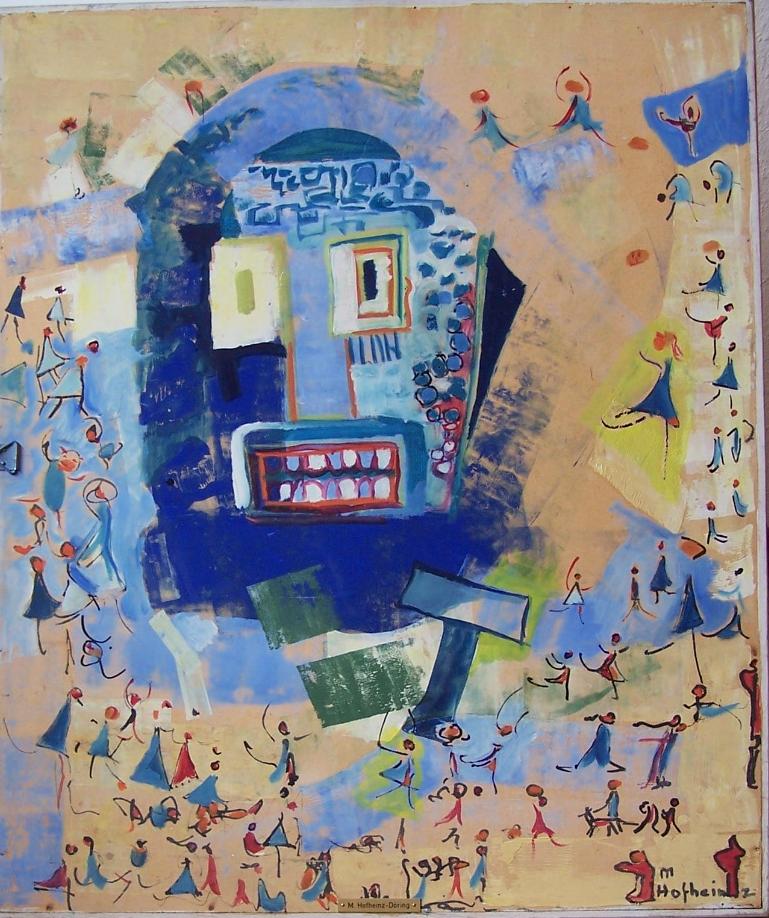
Margaret Hofheinz-Doring, Worship of the Golden Calf (1962)  shared under Creative Commons Attribution-Share Alike  3.0

Margaret Hofheinz-Doring, Worship of the Golden Calf (1962) shared under Creative Commons Attribution-Share Alike 3.0

Deuteronomy 2: The Warrior God

 Deuteronomy 2: 1-25 ‘Here There Once Were Giants’

(After you has stayed at Kadesh as many days as you did) we journeyed back into the wilderness, in the direction of the Red Sea, as the LORD had told me and skirted Mount Seir for many days. 2 Then the LORD said to me: 3 “You have been skirting this hill country long enough. Head north, 4 and charge the people as follows: You are about to pass through the territory of your kindred, the descendants of Esau, who live in Seir. They will be afraid of you, so, be very careful 5 not to engage in battle with them, for I will not give you even so much as a foot’s length of their land, since I have given Mount Seir to Esau as a possession. 6 You shall purchase food from them for money, so that you may eat; and you shall also buy water from them for money, so that you may drink. 7 Surely the LORD your God has blessed you in all your undertakings; he knows your going through this great wilderness. These forty years the LORD your God has been with you; you have lacked nothing.” 8 So we passed by our kin, the descendants of Esau who live in Seir, leaving behind the route of the Arabah, and leaving behind Elath and Ezion-geber.

When we had headed out along the route of the wilderness of Moab, 9 the LORD said to me: “Do not harass Moab or engage them in battle, for I will not give you any of its land as a possession, since I have given Ar as a possession to the descendants of Lot.” 10 (The Emim– a large and numerous people, as tall as the Anakim– had formerly inhabited it. 11 Like the Anakim, they are usually reckoned as Rephaim, though the Moabites call them Emim. 12 Moreover, the Horim had formerly inhabited Seir, but the descendants of Esau dispossessed them, destroying them and settling in their place, as Israel has done in the land that the LORD gave them as a possession.) 13 “Now then, proceed to cross over the Wadi Zered.”

So we crossed over the Wadi Zered. 14 And the length of time we had traveled from Kadesh-barnea until we crossed the Wadi Zered was thirty-eight years, until the entire generation of warriors had perished from the camp, as the LORD had sworn concerning them. 15 Indeed, the LORD’s own hand was against them, to root them out from the camp, until all had perished.

16 Just as soon as all the warriors had died off from among the people, 17 the LORD spoke to me, saying, 18 “Today you are going to cross the boundary of Moab at Ar. 19 When you approach the frontier of the Ammonites, do not harass them or engage them in battle, for I will not give the land of the Ammonites to you as a possession, because I have given it to the descendants of Lot.” 20 (It also is usually reckoned as a land of Rephaim. Rephaim formerly inhabited it, though the Ammonites call them Zamzummim, 21 a strong and numerous people, as tall as the Anakim. But the LORD destroyed them from before the Ammonites so that they could dispossess them and settle in their place. 22 He did the same for the descendants of Esau, who live in Seir, by destroying the Horim before them so that they could dispossess them and settle in their place even to this day.23 As for the Avvim, who had lived in settlements in the vicinity of Gaza, the Caphtorim, who came from Caphtor, destroyed them and settled in their place.) 24 “Proceed on your journey and cross the Wadi Arnon. See, I have handed over to you King Sihon the Amorite of Heshbon, and his land. Begin to take possession by engaging him in battle. 25 This day I will begin to put the dread and fear of you upon the peoples everywhere under heaven; when they hear report of you, they will tremble and be in anguish because of you.”

Sometimes when people ask me, “What does the bible say about this?” they assume that the Bible only speaks with one voice or has one answer and as a pastor I have to be sensitive to the situation the person is asking from how I answer the question. If the person is at a safe place where they can deal with the dialogue and variety of perspectives that emerge from the sixty six books collected together to form the Bible that many Christians use (Catholics and Orthodox would also include some additional books like Baruch, Wisdom of Solomon, 1&2 Maccabees and others as a part of their cannon) and I typically can do this in a way that allows the person to enter the questions of the people of God and their interaction with God. There are times of trauma and crisis where a person needs an immediate and certain answer to hold on to. Whether Deuteronomy emerges from its narrative context, where Moses is addressing the people of Israel prior to entering Israel, or as many scholars believe the trauma of the Babylonian exile, where all the things that once defined them have been taken away, it speaks from this need of an immediate and certain answer. For the author of Deuteronomy there are some bedrock truths that they want their readers in a situation of crisis to understand: God has been faithful, God is powerful and will act on their behalf and their previous defeats prior to entering the promised land were due to the unfaithfulness of their ancestors. There is strength and there is danger to this level of certainty and I will deal with the danger and the need for the broader perspective of scripture in the second half of this chapter.

Map Showing the Kingdoms of Israel and Judah in the 9th Century BCE

Map Showing the Kingdoms of Israel and Judah in the 9th Century BCE

The narrative that Deuteronomy leads us into has the people journeying peacefully through the lands of Seir, Moab and the Ammonites. Rather than approaching from the south as was done in chapter one the people move through these lands peacefully to approach from the east. There are a few really interesting things that the narrative highlights and the first is that there are other people who have land that has been given to them by the LORD. The descendants of Lot, who are distant kin according to Genesis; Esau, who are closer kin according to Genesis, both have land that has been entrusted to their heirs and even though these descendants of Lot and Esau presumably do not know the LORD, the LORD has enabled them to overcome whatever prevented them from coming into possession of the land. A new player is also introduced into the narrative, the Caphtorim who come from Caphtor, who are not mentioned in Genesis as having any link with the Hebrew people, instead they will become the Philistines who will factor into the later story of Israel, but as the prophet Amos will later state they too have a place given by the LORD:

                Are you not like the Ethiopians to me, O people of Israel? Says the LORD.
                Did I not bring Israel up from the land of Egypt, and the Philistines from Caphtor
                And the Arameans from Kir? Amos 9:7

And in the midst of the fear the people on this journey must be facing, Moses in the narrative reassures them over and over again that the LORD is not merely their tribal God but something much more. The LORD was able to bring them out of Egypt and settle all of these people because their LORD is a God above all gods.

The other side of this is that the narrative also lets us know that Israel is not the only people that the LORD is concerned with. As Walter Brueggemann says, “there are other communities on the horizon of YHWH’s specific beneficence. Israel’s entitlement gives it no permit to disrupt the entitlement of another people by YHWH.” (Brueggemann, 2001, p. 35f) This beneficence may or may not have been well received, but in the narrative the people journey onward peacefully through these lands. For the time being the most important thing is not their approval or disapproval but their obedience.

In the midst of this journey they have been provided with everything they have needed. They have the resources to pay for food and water for this part of their journey. They were able to barter for what they would need because, as throughout their sojourn in the wilderness, the LORD had provided for them. Another aspect of the LORD’s control in this narrative is the disposition of the people towards Israel. They are afraid and it is the LORD that has made them afraid but it is a fear that allows them to pass through the land without resistance rather than a fear that resorts to fighting and conflict. They walk through the lands of these former giant slayers and the giant slayers are afraid of them.

In Deuteronomy 1 their ancestor’s confidence failed when there were rumors of giants in the land.

The people are stronger and taller than we; the cities are large and fortified up to heaven! We actually saw there the offspring of the Anakim!” Deuteronomy 1. 28

The route prior to entering the conflict in the land leads them through the lands that were once possessed by related groups of giant people who were numerous but are no more. There were once giants here but the LORD worked with these other peoples to drive them out and if the LORD protected them, how much more will he protect the people who have this specific covenant with the God who took them out of Egypt, through the wilderness and now again to the precipice of the promised land. The narrative has done everything it can to build confidence and trust among the people as they prepare for the conflict ahead.


Deuteronomy 2: 26-37 The Defeat Of King Sihon And The Slaughter Of The People Of The Land

26 So I sent messengers from the wilderness of Kedemoth to King Sihon of Heshbon with the following terms of peace: 27 “If you let me pass through your land, I will travel only along the road; I will turn aside neither to the right nor to the left. 28 You shall sell me food for money, so that I may eat, and supply me water for money, so that I may drink. Only allow me to pass through on foot– 29 just as the descendants of Esau who live in Seir have done for me and likewise the Moabites who live in Ar– until I cross the Jordan into the land that the LORD our God is giving us.” 30 But King Sihon of Heshbon was not willing to let us pass through, for the LORD your God had hardened his spirit and made his heart defiant in order to hand him over to you, as he has now done.

31 The LORD said to me, “See, I have begun to give Sihon and his land over to you. Begin now to take possession of his land.” 32 So when Sihon came out against us, he and all his people for battle at Jahaz, 33 the LORD our God gave him over to us; and we struck him down, along with his offspring and all his people. 34 At that time we captured all his towns, and in each town we utterly destroyed men, women, and children. We left not a single survivor. 35 Only the livestock we kept as spoil for ourselves, as well as the plunder of the towns that we had captured. 36 From Aroer on the edge of the Wadi Arnon (including the town that is in the wadi itself) as far as Gilead, there was no citadel too high for us. The LORD our God gave everything to us. 37 You did not encroach, however, on the land of the Ammonites, avoiding the whole upper region of the Wadi Jabbok as well as the towns of the hill country, just as the LORD our God had charged.

One of the earliest heresies the early Christian church has to deal with was the followers of Marcion (more on Marcion and some of the early heresies of the church here) who could not reconcile the warrior God presented here and in many other places throughout the scriptures with the God he had come to know in Jesus Christ. Marcion approached the scriptures from a Greek perspective and wanted everything to line up systematically and give us easy answers. There can be great strength in a unified vision and a common cause but we also know all too well the dangers of such absolutism. This is a passage that will offend and I think should offend us and make us ask questions and go back to the scriptures and the dialogue they present and many other passages as we discern what God’s calling is for us at any given time. There are many places in the Old Testament where God seems to call for genocide and this is one. There are also many times where Christians have felt justified in their attempts to wipe out another people or persecute them because of a different religion or a different culture. I wrestled with this question much earlier when I was going through the book of Esther here.

We have the scriptures we have and as uncomfortable as this passage may be it is a part of our scriptures and our stories. I would rather wrestle with what is uncomfortable than ignore it. The image of the warrior God can be a great source of strength for people who are oppressed. Luther’s ‘A Mighty Fortress’ comes out of this picture of God and it is not a coincidence that the narrative that many of the preachers of the civil rights movement went back to was the people of Israel being led by the warrior God out of Egypt and to the promised land. I served for five years as a soldier prior to beginning my training for ministry and we live in a different time but the conflicts in Iraq and Afghanistan opened our eyes again to the challenge of close warfare. In contrast with the conflict in 1991 where it was a maneuver war fought primarily with airpower and artillery and armored vehicles firing at long range, in both Iraq and Afghanistan this long term conflict involved infantry and non-uniformed combatants in close quarters with urban populations. This is a type of conflict that quickly becomes ugly and distasteful, there is no glory in this type of war and many of the technological advantages become neutralized. I think if nothing else these conflicts have reminded us that war is an ugly, brutal and costly thing in lives and longer term psychological damage. The experiences of the Holocaust, Bosnia, and Rwanda have reminded us of what genocide looks like. We come to passages like this where the people strike down men, women and children leaving no survivors and it makes us wonder why, and that is a question we cannot answer satisfactorily.

I also worry about inscribing our values on the lives and times of ancient peoples. As I have told my congregation many times, “we are offended by the violence of ISIS when they behead people, but we need to understand that in the ancient world beheading was an honorable death. We should be horrified by it now, but it also reflects where our world has come.” The ancient world was a brutal place and the scriptures are a part of that world and will reflect that world. The God of Israel is a loving God but not a controllable one. Perhaps a line from the chronicles of Narnia fits here, when Lucy is wondering about Aslan she asks if he is safe, and the response is ‘Safe! He is a lion, of course he is not safe, but he is good.’ And perhaps that may be all the resolution we can come to as we approach the LORD as presented throughout the Exodus narrative. The LORD is good and passionate and hears the people but they never mistake the LORD is safe and perhaps as we go through the narrative we need this side of the LORD’s presence which complements our too easy accommodation to a God who is safe and doesn’t intervene in our world.

Approaching the scriptures is not easy. To hold together the God who hardened the heart of King Sihon , like Pharoah, and prevented peace here with what St. Paul labels God as the God of peace (Romans 15.33) is challenging and some would say impossible. Others will need to come up with systems to contain what God is like, but the God of scriptures always challenges any easy answers. This is a part of the mystery of faith and the journey of faith that we make with God. There will be times where we understand and times where we don’t but as a part of the people of this story and the story of the cross I pray for the wisdom to pray for both the people of Israel and the people of Sihon, to love my neighbor and my enemy. This is one of the many images of God that I have come to know, but for me it is not the dominant one.