Tag Archives: Book of Psalms

Psalm 89 Shattered Worlds and Broken Symbols

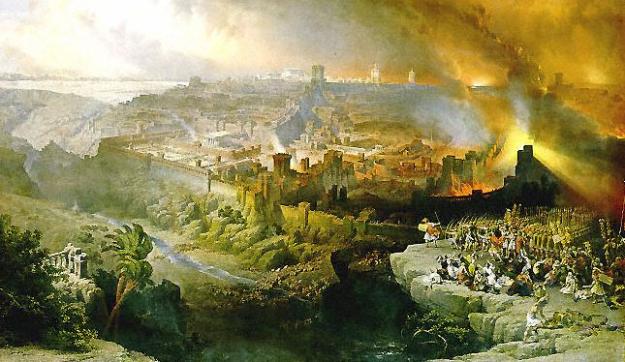
The Siege and Destruction of Jerusalem by Romans Under the Command of Titus, A.D. 70 by David Roberts 1850

Psalm 89

<A Maskil of Ethan the Ezrahite.>
1 I will sing of your steadfast love, O LORD, forever; with my mouth I will proclaim your faithfulness to all generations.
2 I declare that your steadfast love is established forever; your faithfulness is as firm as the heavens.
3 You said, “I have made a covenant with my chosen one, I have sworn to my servant David:
4 ‘I will establish your descendants forever, and build your throne for all generations.'” Selah
5 Let the heavens praise your wonders, O LORD, your faithfulness in the assembly of the holy ones.
6 For who in the skies can be compared to the LORD? Who among the heavenly beings is like the LORD,
7 a God feared in the council of the holy ones, great and awesome above all that are around him?
8 O LORD God of hosts, who is as mighty as you, O LORD? Your faithfulness surrounds you.
9 You rule the raging of the sea; when its waves rise, you still them.
10 You crushed Rahab like a carcass; you scattered your enemies with your mighty arm.
11 The heavens are yours, the earth also is yours; the world and all that is in it — you have founded them.
12 The north and the south — you created them; Tabor and Hermon joyously praise your name.
13 You have a mighty arm; strong is your hand, high your right hand.
14 Righteousness and justice are the foundation of your throne; steadfast love and faithfulness go before you.
15 Happy are the people who know the festal shout, who walk, O LORD, in the light of your countenance;
16 they exult in your name all day long, and extol your righteousness.
17 For you are the glory of their strength; by your favor our horn is exalted.
18 For our shield belongs to the LORD, our king to the Holy One of Israel.
19 Then you spoke in a vision to your faithful one, and said: “I have set the crown on one who is mighty, I have exalted one chosen from the people.
20 I have found my servant David; with my holy oil I have anointed him;
21 my hand shall always remain with him; my arm also shall strengthen him.
22 The enemy shall not outwit him, the wicked shall not humble him.
23 I will crush his foes before him and strike down those who hate him.
24 My faithfulness and steadfast love shall be with him; and in my name his horn shall be exalted.
25 I will set his hand on the sea and his right hand on the rivers.
26 He shall cry to me, ‘You are my Father, my God, and the Rock of my salvation!’
27 I will make him the firstborn, the highest of the kings of the earth.
28 Forever I will keep my steadfast love for him, and my covenant with him will stand firm.
29 I will establish his line forever, and his throne as long as the heavens endure.
30 If his children forsake my law and do not walk according to my ordinances,
31 if they violate my statutes and do not keep my commandments,
32 then I will punish their transgression with the rod and their iniquity with scourges;
33 but I will not remove from him my steadfast love, or be false to my faithfulness.
34 I will not violate my covenant, or alter the word that went forth from my lips.
35 Once and for all I have sworn by my holiness; I will not lie to David.
36 His line shall continue forever, and his throne endure before me like the sun.
37 It shall be established forever like the moon, an enduring witness in the skies.” Selah
38 But now you have spurned and rejected him; you are full of wrath against your anointed.
39 You have renounced the covenant with your servant; you have defiled his crown in the dust.
40 You have broken through all his walls; you have laid his strongholds in ruins.
41 All who pass by plunder him; he has become the scorn of his neighbors.
42 You have exalted the right hand of his foes; you have made all his enemies rejoice.
43 Moreover, you have turned back the edge of his sword, and you have not supported him in battle.
44 You have removed the scepter from his hand, and hurled his throne to the ground.
45 You have cut short the days of his youth; you have covered him with shame. Selah
46 How long, O LORD? Will you hide yourself forever? How long will your wrath burn like fire?
47 Remember how short my time is —  for what vanity you have created all mortals!
48 Who can live and never see death? Who can escape the power of Sheol? Selah
49 Lord, where is your steadfast love of old, which by your faithfulness you swore to David?
50 Remember, O Lord, how your servant is taunted; how I bear in my bosom the insults of the peoples,
51 with which your enemies taunt, O LORD, with which they taunted the footsteps of your anointed.
52 Blessed be the LORD forever. Amen and Amen.

The approach to Psalm 89 will be different than my approach to most of the other psalms because it evokes for me an important question that continues to be wrestled with in communities of faith. This psalm likely originates in the collapse of the Davidic line of kings in the aftermath of Babylon’s destruction of Jerusalem in 587 BCE and wrestles with the contrast between the psalmist’s understanding of God’s promises and their present experience. It is plausible that Psalm 89 may be a combination of one (or more) psalms which expressed the royal theology of the Davidic kings with the tough questions of verse thirty-eight onward. Like Psalm 88 it takes us into the darkness of the psalmist’s experience where no light appears on the horizon, but unlike the previous psalm this is the experience of the community of the faithful questioning how the God’s faithfulness proved unfaithful. The psalm is still processing the anger, grief, and the disillusionment over the loss of institutions they thought would continue perpetually.

The language of Psalm 89 weaves together the kingdom of God and the monarchy of David into a common tapestry. Psalm 89 is built upon the words through the prophet Nathan to David in 2 Samuel 7: 8-17, but the rough edges of this prophecy where the ‘seeds of arrogance’ (Nancy de Claisse-Walford, 2014, p. 681) seen in David are smoothed out. Like Psalm 2 the strength of the Davidic kings is directly linked to the strength of the LORD. Their victories are the LORD’s victories, their enemies are the LORD’s enemies, their unfaithfulness is punished but they are never separated from God’s steadfast love and faithfulness (unlike King Saul or the Kings of Northern Israel). The first seventy percent of the psalm weaves God’s reign which is founded on steadfast love and faithfulness into experience of life under David’s descendants. The royal theology is expressed through the temple, and the temple, Jerusalem, and the Davidic kings all become important symbols of God’s reign on earth. The covenant language of Psalm 89 leaves no space for God to change God’s mind despite the unfaithfulness of many of the kings in Jerusalem. Yet, when the seam holding God’s reign and the Davidic king’s reign unravels in verse thirty-eight, the psalmist now takes God to task for renouncing the covenant. The situation of humiliation that the people experience now moves the psalmist to the dangerous and perhaps blasphemous conclusion that God whose reign is built on steadfast love and faithfulness has now proven unfaithful. God who was once Father and Rock who exalted David’s horn and strengthened his arm now strengthens the arms of the foes of the people, has rejected God’s children, and has renounced the covenant.

Moving beyond the psalm for the moment, the close alliance of God’s kingdom with any individual or government always presents the danger of idolatry. King David occupies an almost mythical role in the story of Israel as the ‘once and future king’ who was a man after God’s own heart. The narrative of David in First and Second Samuel, and the experience of the Davidic kings in First and Second Kings is often disconnected from the interwoven theology which connects the stability of the kings in Jerusalem with a larger vision of God’s cosmic reign over the forces of creation and the nations of the world. When the destruction of Jerusalem by Babylon occurs and the Davidic line of kings seems to be a stump which is cutdown and never to rise again the Jewish people would have to reckon with their relationship with God in a new way and to discover their new identity as a people of God in exile without king, temple, or land. They would have to reimagine the role of David within their life of faith and to reexamine how the hopes of 2 Samuel 7 and Psalm 89: 1-36 ended in the desolation of 2 Kings 25 and Psalm 89: 37-51.

Although the United States there is the concept of the ‘separation of the church and the state’ there is also a semi-religious understanding of manifest destiny and exceptionalism which exists within the political language of the country. Recently there has been a strong movement among both individuals and churches towards a Christian nationalism which weaves these ideas of manifest destiny and exceptionalism into a religious retelling of the story of the United States which ignores many aspects of the country’s past and present. This Christian nationalism has coalesced around the Republican Party in the United States and is still wielded by former President Trump to link his presidency with the faith of many of his followers. The almost messianic fervor that some have placed upon him and the sharp polarization between adherents and opponents highlights the danger of this interweaving of God’s reign and any individual or political group.

As an heir of the Lutheran reformation, I am a part of what is sometimes referred to as the magisterial reformation. The magisterial reformation includes the Lutheran, Reformed, and Anglican reform movements that still believed that secular authority should be followed (in contrast to the radical reformers who rejected any secular authority). Yet, the Lutheran (as well as Reformed and Catholic churches) in Germany had to struggle with the demands for loyalty from the National Socialist party as they assumed power in the 1930s. Many prominent Lutheran scholars, like Paul Althaus,[1] welcomed the rise of the National Socialist and Althaus viewed the government of the state as an order of God’s creation which was given by God. If the government of the state was an order of creation it was not subject to critique by the church, but there were others in the church who would criticize the National Socialist. Dietrich Bonhoeffer is the most well known of these resisters to the demands of loyalty. For Bonhoeffer he viewed the government as a vessel God uses to preserve life and when the government fails in its responsibility the church has a responsibility to speak. Many in Germany in the 1930s were able to combine their practice of Christianity with the demands of the state. Looking back upon this time it is easy to wonder how many people of faith were able to participate in or tolerate actions which seem antithetical to the scriptures, yet it is amazing how malleable peoples’ interpretation of scripture can be to fit their political dispositions.

Within Psalm 89 the kingdom of God and the reign of the Davidic kings is woven together until the tapestry is ripped apart by the experience of the present. There were Christians during the Third Reich who viewed Adolf Hitler as God’s gift to Christianity[2] and I fear there are many Christians in the United States making a similar mistake today. Unfortunately for many in Germany and in the United States participation in these movements has drowned out critical voices that questioned this interweaving of God and nationalism. For Judaism the crisis of exile in Babylon led to a reexamination of their faith in light of their new situation. I fear that for many Christians the eventual collapse of Christian nationalism will lead to an abandonment of their faith.

For me the conclusion of this psalm in verse fifty-two is also a moment of hope. It closes the third book of the psalter and brings this open question into the continued act of praise. Even when there are no easy answers for shattered symbols, broken communities, and even a broken nation there is a community that sits in the discomfort and still brings these questions into the blessing of their God. It closes with a double ‘amen’ which acknowledges the still unanswered questions of the prayers while allowing them to be lifted up to the God who may be Father, may be opponent but still remains connected to the community of the faithful. Elie Wiesel in his memoirs All Rivers Run to the Sea captures the relationship of these faithful crying out to God when he says of his own experience of the Holocaust:

I have never renounced my faith in God. I have risen against His justice, protested His silence and sometimes His absence, but my anger rises up within faith, not outside of it. (Wiesel, 1994, p. 84)

[1] Paul Althaus was not an isolated example, but he was in the 1930s viewed as the leading scholar on Luther’s theology. When I was studying in seminary in the early 2000s his works The Theology of Martin Luther and The Ethics of Martin Luther were still used.

[2] Paul Althaus in 1933 stated, “Our Protestant churches have greeted the turning point of 1933 as a gift and miracle of God” (Ericksen, 2012, p. 37)

Psalm 88 Only Darkness Knows Me

Marc Chagall, Solitude (1933)

Psalm 88

<A Song. A Psalm of the Korahites. To the leader: according to Mahalath Leannoth. A Maskil of Heman the Ezrahite.>
1 O LORD, God of my salvation, when, at night, I cry out in your presence,
2 let my prayer come before you; incline your ear to my cry.
3 For my soul is full of troubles, and my life draws near to Sheol.
4 I am counted among those who go down to the Pit; I am like those who have no help,
5 like those forsaken among the dead, like the slain that lie in the grave, like those whom you remember no more, for they are cut off from your hand.
6 You have put me in the depths of the Pit, in the regions dark and deep.
7 Your wrath lies heavy upon me, and you overwhelm me with all your waves. Selah
8 You have caused my companions to shun me; you have made me a thing of horror to them. I am shut in so that I cannot escape;
9 my eye grows dim through sorrow. Every day I call on you, O LORD; I spread out my hands to you.
10 Do you work wonders for the dead? Do the shades rise up to praise you? Selah
11 Is your steadfast love declared in the grave, or your faithfulness in Abaddon?
12 Are your wonders known in the darkness, or your saving help in the land of forgetfulness?
13 But I, O LORD, cry out to you; in the morning my prayer comes before you.
14 O LORD, why do you cast me off? Why do you hide your face from me?
15 Wretched and close to death from my youth up, I suffer your terrors; I am desperate.
16 Your wrath has swept over me; your dread assaults destroy me.
17 They surround me like a flood all day long; from all sides they close in on me.
18 You have caused friend and neighbor to shun me; my companions are in darkness.

Psalms 88 and 89 stand together at the end of book three of the book of Psalms and take us into the darkest despair of the entire book. (Nancy de Claisse-Walford, 2014, p. 668) Both prayers are appeals for help that have no resolution within the psalm and while Psalm 89 is a prayer grieving the destruction of Judah and the loss of the promises to the line of David, Psalm 88 is the prayer of an individual who is either metaphorically or physically at the point where, “Death is so near and so real that it becomes the subject of the lament.” (Mays, 1994, p. 282) This is not the type of prayer that was taught in Sunday school, nor is this psalm used in the worship of most churches. Its vision of the world is darker than many churches are comfortable with but it also speaks honestly to the experience of deep darkness that many both inside and outside the church experience. The daring language of the psalm, which is willing to declare that God is responsible for their dire circumstance, turns on the head the vision of Psalm 56:4 or Romans 8:31 as it wonders, “if God is against me, who can be for me?” The psalmist’s words break forth from the dark night of the soul where their abandonment by God and their companions leaves only darkness to know them.

The psalm is attributed to Heman the Ezrahite. It is possible that the intent is to attribute the psalm to Heman who is listed as one of the wise men who Solomon surpasses in 1 Kings 4:31 or Heman the singer, one of the Kohathites appointed by David in 1 Chronicles 6:33. It is also possible that it is the same individual referred to in both 1 Kings and 1 Chronicles (singers/psalmists would be considered wise in Hebrew society) but it is also likely that the Heman referred to in the psalm is a different person unmentioned elsewhere in scripture. Regardless of the authorship of the psalm, it speaks in the brutally honest language of the Hebrew Scriptures that many contemporary Christians have little exposure to.

The psalm begins in a pious cry out to God, crying out to God for God’s attention to the prayers of the one dependent on God’s salvation. The prayer uses three different words for ‘crying out’ to God in verse 1, 9b and 13 (NIB IV: 1027) exhausting the language of prayer as they desperately seek an answer from the God who is both their only hope of salvation and the source of their troubles. The psalm begins with language that would is the traditional language of prayer learned in worship. Yet, once the prayer begins the dam holding back the psalmist’s words breaks and their desperation and abandonment cannot be contained. The pain of the psalmist rushes forth from the shattered walls of convention and flows into an irresistibly honest prayer that emerges from the space of death, darkness, and despair.

The stakes of this prayer are incredibly high for the psalmist. The very center of their life[1] is threatened. The psalmist deploys an incredible number of words for death: Sheol, the Pit, like the dead, slain, grave, those you remember no more, cut off from your hands, in the regions dark and deep, shades (Hebrew Rephaim), Abaddon, darkness, the land of forgetfulness. Almost every line has the presence of death within this prayer. This deployment is especially striking when compared to the rest of the Hebrew Scriptures which rarely talk about death and the afterlife. In verses three to five the mentions of death indicate the serious nature of the psalmist’s petitions but the jarring realization comes in verse six when the psalmist turns their invective to God and declares that God is the one responsible for the psalmist’s situation. God may be the psalmist’s salvation but God is also, in this psalm, the psalmist’s oppressor.

The psalmist girds up their loins and stands before God in accusation declaring that God has put them at death’s door, that God’s wrath is actively overwhelming the psalmist in waves, and God has caused the alienation of the psalmist from their companions. Many Christians are not familiar with this type of accusatory language directed at God and are surprised at the directness of this psalm or Jeremiah’s accusations of God.[2] As mentioned in my comments on Psalm 86 there is a relationship between the servant and their Lord, and here the servant boldly claims that their Lord has violated their relationship. Where the servant needed protection, their Lord has overwhelmed them with wrath. Where the servant looks for a compassionate answer, the answer[3] they receive is unbearable. The actions of God have alienated the servant from both God and their companions making them, like Job, one despised and one cursed by God.

The psalmist’s eyes growing dim is not a statement of eyesight, but indicates that their vitality is failing. Physically and mentally, they are dying and yet they continue to cry out to God. They cry out from a place of “abandonment and lostness…so great that it saturates the soul so there is room for nothing else.” (Nancy de Claisse-Walford, 2014, p. 671) But it is heartbreaking that for the psalmist it is God who has cast them into this space of darkness and death and then turns away from their cries. In a series of six rhetorical questions: Do you work wonders for the dead? Do the shades rise up to praise you? Are your wonders known in the darkness, or your saving help in the land of forgetfulness? Is your steadfast love declared in the grave, or your faithfulness in Abaddon? The answer to each of these rhetorical questions in the vision of the psalmist is no! As mentioned above the Hebrew scriptures rarely talk about death and the afterlife and there is no conception of heaven and hell as destinations for the people of God in the psalms. Psalm 88 deploys this shocking set of questions to the God of life to get their either unresponsive or oppressive God to relent and deliver their servant from death or the relationship will be broken and God will be the unfaithful one who broke it. In the Psalms when the concept of death, Sheol, the Pit, or Abaddon are mentioned it is assumed that there is no longer any communication between the deceased and God.[4] The only freedom this psalm offers the psalmist is the freedom of the dead where God either does not remember or has actively cut off God’s servant. (Nancy de Claisse-Walford, 2014, p. 671) Yet the psalmist cries out to their Lord as a servant desiring to continue to serve their God in the land of the living.

The psalmist cries out one final time in verse thirteen. Their prayers come before God and even boldly confront[5] God asking God to relent. God’s anger has left the psalmist in the space of darkness and death. There is no escape for the servant from the anxiety filled and deathly state of the servant’s life. There is no answer as the psalm reaches its final gasp, there is only the cry of the servant thrown “against a dark and terrifying void” (Nancy de Claisse-Walford, 2014, p. 669) The final word of the psalm is darkness.[6] The sad final phrase is obscured by the NRSV’s translation. The NIV’s “darkness is my closest friend” or Beth Tanner’s “only darkness knows me” (Nancy de Claisse-Walford, 2014, p. 670) better captures the isolation and abandonment that the psalm closes with. We may rebel against a psalm where death and darkness have the final word, but the book of Psalms reminds us that there are times where the faithful ones of God may find themselves in the God forsaken place where God seems silent, absent, or angry; where relationships prove themselves unfaithful, and where the agonizing prayer breaks forth to God from the death’s door where no light seems to be able to penetrate the darkness of the faithful one’s world.

Nobody would choose to walk into the place of depression and suffering where death and darkness seem to be their only companion, but even people of faith may find themselves in these spaces that appear devoid of God’s steadfast love and compassion. Depression can make the world feel like a place where darkness is the sufferer’s only companion and death may cry out to them. Even faithful people can suffer from bouts of depression so deep that suicide and death seem closer than God. God does not condemn these words of the psalmist as faithless, instead they are placed within the scriptures of God’s people. From a Christian perspective we may answer the rhetorical questions of Psalm 68 differently than the psalmist: from a Christian perspective, to quote Paul, “If we live, we live to the Lord, and if we die, we die to the Lord; so then, whether we live or whether we die, we are the Lord’s.” (Romans 14:8) Yet, this psalm invites us to walk into the swampland of the soul, pitch a tent, and get to know the lay of the land. It invites us to dwell in the God forsaken place of the crucifixion without immediately jumping forward to the surprise of the resurrection. Sometimes resurrection takes time, sometimes prayers end in darkness as they await a response from God, and sometimes faithful ones walk through the valley of the shadow of death. This uncomfortable psalm invites us into an honest relationship with God that demonstrates a confrontational or defiant calling upon God to act in compassion and love rather than abandonment or wrath.  We may not like that darkness has the last word and we may want a happy ending to occur within eighteen verses, but sometimes we dwell in darkness and hope for a light which we cannot see but our faith longs for.

[1] The NRSV’s ‘soul’ in verse 3 is the Hebrew nephesh which occurs frequently in the psalms but the modern idea of ‘soul’ comes from Greek thought instead of Hebrew thought. The Hebrew nephesh is closer to ‘life itself’ or ‘the essence of life.’

[2] For example: Jeremiah 15: 17-18, 20: 7-10. Particularly in Jeremiah 20 our English translations often soften the shocking language or Jeremiah.

[3] The Hebrew word translated ‘waves’ also can means ‘answer.’

[4] See for example Psalm 6:5, Psalm 30:9. The contrary point will be argued by Psalm 139:8 where even if the psalmist makes their bed in Sheol, God is present there.

[5] The Hebrew verb qdm can mean either come before or confront.

[6] The final word of the psalm is the Hebrew hoshek (darkness).
Psalm 87 Mother Jerusalem

James Tissot, Reconstruction of Jerusalem and the Temple of Herod, painted between 1886 and 1894

Psalm 87

<Of the Korahites. A Psalm. A Song.>
1 On the holy mount stands the city he founded;
2 the LORD loves the gates of Zion more than all the dwellings of Jacob.
3 Glorious things are spoken of you, O city of God. Selah
4 Among those who know me I mention Rahab and Babylon; Philistia too, and Tyre, with Ethiopia — “This one was born there,” they say.
5 And of Zion it shall be said, “This one and that one were born in it”; for the Most High himself will establish it.
6 The LORD records, as he registers the peoples, “This one was born there.” Selah
7 Singers and dancers alike say, “All my springs are in you.”

This short psalm is more confusing in Hebrew than the polished English translations make it appear, but there are two primary directions that interpreters follow. The first direction that translators tend to follow is what appears in most English translations like the NRSV (above) where the song lifts up the exceptionalism of Jerusalem, and the psalmist, as a native of Jerusalem feels they are worthy of special status throughout the world. As a person born in San Antonio, Texas it reflects a similar love for their hometown that Bob Willis and the Texas Playboys do for my hometown in their classic song ‘Home in San Antone’

Haven’t got a worry, haven’t got a care
I haven’t got a thing to call my own
Though I’m out of money, I’m a millionaire
I still have my home in San Antone.

There is another tradition which Thijis Booji suggests by comparing the psalm with ancient Near Eastern parallels using the Hebrew text which suggests that the psalm may be indicating that Zion is not only a favorite of the LORD, but that Zion is the birthplace of the other nations listed in the text. (Nancy de Claisse-Walford, 2014) If you follow this translation the song would be closer to the old song:

Father Abraham had many sons, and many sons had Father Abraham
And I am one of them, and so are you, so lets all praise the Lord.

Either translation views Jerusalem as a special place and its residents as a special people. Both translations offer two interesting possibilities of viewing the world through a Jerusalem-centric lens.

If the psalm is viewing the world through the lens of Jerusalem being exceptional but not making the connection that the nations are ‘birthed’ from Zion, it is a bold statement, like the Bob Willis song, that may be without any power or prestige of the individual or the nation. Jerusalem is lifted up as more loved than all the dwellings of Jacob, and if this is written (as seems likely based upon the other nations listed) in a time after the division between Judah and Israel it would set Jerusalem above the northern tribes. It would also place Jerusalem as a place known by the superpowers (Rahab-Egypt and Babylon), regional opponents (Philistia and Tyre) and the ends of the earth at the time (Ethiopia). Assuming the speaker in verse four is God’s voice then Egypt and Babylon and the other nations “know God.” Exodus uses the language that Egypt will, “know that I am the LORD.” (Exodus 14:4)[1] The psalmist shares in the reputation of Zion as the special place protected by the Most High and rejoices in both the city and its place in God’s heart.

If the second translation is correct the psalm celebrates the familial bonds of all the earth that originate in God’s people and God’s city. In Abraham all the nations were to be blessed (Genesis 12:3) including Egypt and Babylon and to the ends of the earth.  Zion is the mother who gave birth to the psalmist, but if Zion also gave birth to the nations, then the many sons and daughters of Zion share a common bond throughout the earth. When translated in this way the psalm resonates with vision of the New Jerusalem which is a common home for all the people of God in Revelation 21:9-27. Either song celebrates the centrality of the psalmist’s home in their vision of the world and is worthy of celebration by the singers and dancers among the people. Both are visions that appear at different points in the life of the people of God and both are songs worth singing.

[1] See also Exodus 10:2, Psalm 46: 10 and 59:13 also use the powerful works of God as ways in which Egypt or the nations come to know the LORD through demonstrations of the LORD’s power.

Psalm 86 A Servant’s Plea For Their Lord’s Deliverance

Love is Not a Victory March by Marie -Esther@deviantart.com

Psalm 86

<A Prayer of David.>
1 Incline your ear, O LORD, and answer me, for I am poor and needy.
2 Preserve my life, for I am devoted to you; save your servant who trusts in you. You are my God;
3 be gracious to me, O Lord, for to you do I cry all day long.
4 Gladden the soul of your servant, for to you, O Lord, I lift up my soul.
5 For you, O Lord, are good and forgiving, abounding in steadfast love to all who call on you.
6 Give ear, O LORD, to my prayer; listen to my cry of supplication.
7 In the day of my trouble I call on you, for you will answer me.
8 There is none like you among the gods, O Lord, nor are there any works like yours.
9 All the nations you have made shall come and bow down before you, O Lord, and shall glorify your name.
10 For you are great and do wondrous things; you alone are God.
11 Teach me your way, O LORD, that I may walk in your truth; give me an undivided heart to revere your name.
12 I give thanks to you, O Lord my God, with my whole heart, and I will glorify your name forever.
13 For great is your steadfast love toward me; you have delivered my soul from the depths of Sheol.
14 O God, the insolent rise up against me; a band of ruffians seeks my life, and they do not set you before them.
15 But you, O Lord, are a God merciful and gracious, slow to anger and abounding in steadfast love and faithfulness.
16 Turn to me and be gracious to me; give your strength to your servant; save the child of your serving girl.
17 Show me a sign of your favor, so that those who hate me may see it and be put to shame, because you, LORD, have helped me and comforted me.
 
Psalm 72 (and Book II of the Psalter) ends with the note that “The prayers of David son of Jesse are ended.” The notation at the beginning of Psalm 86 has led many writers to assume this is a psalm which comes from a later time which does use several themes that are a part of the psalms of David. Whether David or a later author composed this prayer asking for God’s help in their crisis, it does use well known words and themes to articulate their dependence and trust in God. This prayer uses the language of faith learned in the worshipping community to provide the words needed to speak to God and appeal for God’s intervention.

The prayer comes from a poor and needy servant of God who needs their Lord to hear their words and preserve their life.[1] Throughout the psalm the speaker is ‘your servant’ (Hebrew ‘ebed) and God is frequently referred to as Lord (Hebrew ‘adon).[2] Servant and lord are paired roles in the culture of Israel. As James Mays explains:

An ‘ebed was a person who belonged to an ‘adon, who lived and worked in the sphere of the purposes and decisions of the ‘adon and who had the right to the support and protection of the ‘adon. (Mays, 1994, p. 279)

The servant and lord dynamic in the psalm is inherited where the psalmist is the ‘child of your serving girl. ´ The dependance on their God as a faithful Lord is something that the psalmist learned from his family and has been a part of their life from the very beginning.

The characteristics of God are the characteristics of God that Israel has always relied upon. The LORD is a God of forgiveness and steadfast love (hesed), is merciful and gracious, and slow to anger and abounding in steadfast love (hesed) which alludes back to the thirteen attributes of God which originates in Exodus 34: 6-7.  God is also incomparable with any other gods and the psalmist trusts that in time the nations will also see and prostrate themselves before the LORD. The psalmist trusts that the God of Israel can and will help God’s faithful servant in their time of need.

The servant is ‘devoted’[3] to their Lord, while those who oppose them are insolent and a band of ruffians. The language of the servant’s plea indicates that they are facing an existential threat with enemies who threaten their life. Their deep need is matched by their deep trust in their faithful Lord who will protect and deliver them. Their life depends upon God’s steadfast love for the servant of the Lord. The sign the psalmist desires is to see their deliverance from their present danger and to see their enemies put to shame. Yet, the psalmist also asks for their Lord to grant them “an undivided heart to revere your name “. The servant desires to be shaped to be more faithful to their Lord.

The language learned in the congregation shapes the language of our prayers that we speak in the time of need. The faithful speaker does not need to find novel phrases to communicate their needs to their Lord. The language of prayer is the familiar language articulated in scripture and shared in the community of the faithful. The speaker leans into the familiar characteristics of God and into the experience they learned in both their family and the household of faith to speak to God in their moments of crisis. The experience of the faithful one and the memory of the community of the faithful give them the confidence that their Lord will incline the ear to hear the cry of the faithful servant and will deliver them in their time of need.

[1] The word used for ‘life’ in verse 2 and ‘soul’ in verse 4 is the Hebrew nephesh. The Hebrew idea of ‘nephesh’ is not the Greek idea of soul, but ‘self’ or ‘life.’

[2] When LORD is in all capital letters in the Hebrew Scriptures it refers to the Divine Name (YHWH-which the reader is given indications in the Hebrew text to say as Adonai (translated Lord). This psalm uses both LORD and Lord (‘adon or Adonai) to highlight the servant/master (lord) relationship.

[3] Hebrew hasid which is related to hesed. The speaker is living in faithfulness to the covenant God made with God’s people and in dependence on God upholding God’s hesed (steadfast love) towards the servant.

Psalm 85 Waiting For God’s Kingdom to Come

Kiss of Peace and Justice by Laurent de La Hyre (1654) – The figures of Peace (burning the weapons of war) and Justice (holding a sword and scales) embrace in a quiet landscape. The Latin inscription under the antique urn reads “Justice and Peace kissed” (referring to an Old Testament verse, Psalms 85:11). The subject may have had political significance: the painting’s date coincides with the end of the Fronde, a period of civil war in France during which the parliament (courts of appeal) and the nobility sought—unsuccessfully—to limit the power of the monarchy, Taken in 2012, CC0, https://commons.wikimedia.org/w/index.php?curid=18176364

Psalm 85

<To the leader. Of the Korahites. A Psalm.>
1 LORD, you were favorable to your land; you restored the fortunes of Jacob.
2 You forgave the iniquity of your people; you pardoned all their sin. Selah
3 You withdrew all your wrath; you turned from your hot anger.
4 Restore us again, O God of our salvation, and put away your indignation toward us.
5 Will you be angry with us forever? Will you prolong your anger to all generations?
6 Will you not revive us again, so that your people may rejoice in you?
7 Show us your steadfast love, O LORD, and grant us your salvation.
8 Let me hear what God the LORD will speak, for he will speak peace to his people, to his faithful, to those who turn to him in their hearts.
9 Surely his salvation is at hand for those who fear him, that his glory may dwell in our land.
10 Steadfast love and faithfulness will meet; righteousness and peace will kiss each other.
11 Faithfulness will spring up from the ground, and righteousness will look down from the sky.
12 The LORD will give what is good, and our land will yield its increase.
13 Righteousness will go before him, and will make a path for his steps.

Throughout the psalms there is a rhythm that moves between the memory of God’s actions in the past, the crisis of the present, and a hopeful vision of the world that God brings when God acts on behalf of the psalmist and the people. God has acted in the past, God hears the cries of God’s people as they endure a time of judgment, but God’s anger will always yield to God’s steadfast love and faithfulness. The crisis which is a part of the people’s wanderings into a spiritual wilderness will be resolved by God’s shalom (peace) and righteousness which are united in embrace. The poetry of hope emerges out of the reservoir of memory which calls the people to return to the practices of faithfulness and to a life in covenant with the LORD.

The narrative of Israel is filled with times when the people turned from the ways of God and do evil in the sight of the LORD and then their God in anger abandons them to their enemies. From the construction of the golden calf and the reestablishment of the covenant (Exodus 32-34) to the pernicious pattern which repeats continually through the book of Judges, David’s betrayal with Bathsheba, Solomon’s adoption of the worship of other gods, and then the various kings of Israel and Judah who do evil and lead the people away from the way of the God of Israel there are numerous touchpoints in the people’s history where they can reflect on how God was anxious to receive their repentance. The LORD has proven that their God does forgive and pardon, does withdraw wrath and turn from hot anger, and does restore the people.

The petitioners ask for what their ancestors have received in the past. God’s anger may be justified but the people cannot endure it much longer. They present no argument for God’s restoration of the people other than God’s history of doing so. They appeal to the steadfast love of God to grant them the salvation they need and to overcome God’s indignation. Yet, the psalmist also desires more than a temporary return to the LORD’s ways. The poet trusts that God will speak shalom to the people. Yet, the end of verse eight in Hebrew is “but let them not return to stupidity.”[1]

The hoped for “renewal, restoration, and revival of the community is completely a gift from God.” (Brueggemann, 2014, p. 369) Poetry moves beyond a tame hope for the restoration of the past and leaps into a beautiful and lyrical vision of a world where the ways of God and the ways of the world unite. They trust that God’s salvation is at hand and that the longed-for reunion will occur after the desperate time of separation. God’s presence and glory will again dwell among the people. God’s hesed (steadfast love) meets with faithfulness among the people. Righteousness (living in the way of the law) and shalom[2] (God’s gift of peace and harmony) embrace in a kiss of reconciliation. Faithfulness grows like the grain from the earth while righteousness comes down like the sun and rain from the heavens. The reconciliation between God and God’s people doesn’t just mean peace for the people, but restoration for the creation as the land yields its increase. This is a beautiful lyrical imagination of what God’s kingdom arriving on earth as in heaven looks like through the poet’s words. Righteousness goes before God on the journey as God’s arrival with steadfast love and peace are at hand.

[1] The NRSV follows the Septuagint (LXX, the Greek translation of the Hebrew Scriptures) by stating “to those who turn to him in their hearts.” But as Beth Tanner points out the Hebrew (MT) is readable and there isn’t a compelling reason to adopt the LXX reading instead. (Nancy deClaisse-Walford, 2014, p. 656)

[2] Shalom is not just the absence of conflict. It also includes the idea of wholeness or harmony where people and creation live in comfort without fear. (Nancy deClaisse-Walford, 2014, p. 658)

Psalm 84 Better is One Day in the House of God

A Song Sparrow (Melospiza melodia) feeding on the ground. Photo taken with a Panasonic Lumix DMC-FZ50 in Caldwell County, North Carolina, USA. Photo by Ken Thomas, March 3, 2008. Image released by creator to public domain.

Psalm 84

To the leader: according to The Gittith. Of the Korahites. A Psalm.
1 How lovely is your dwelling place, O LORD of hosts!
2 My soul longs, indeed it faints for the courts of the LORD; my heart and my flesh sing for joy to the living God.
3 Even the sparrow finds a home, and the swallow a nest for herself, where she may lay her young, at your altars, O LORD of hosts, my King and my God.
4 Happy are those who live in your house, ever singing your praise. Selah
5 Happy are those whose strength is in you, in whose heart are the highways to Zion.
6 As they go through the valley of Baca they make it a place of springs; the early rain also covers it with pools.
7 They go from strength to strength; the God of gods will be seen in Zion.
8 O LORD God of hosts, hear my prayer; give ear, O God of Jacob! Selah
9 Behold our shield, O God; look on the face of your anointed.
10 For a day in your courts is better than a thousand elsewhere. I would rather be a doorkeeper in the house of my God than live in the tents of wickedness.
11 For the LORD God is a sun and shield; he bestows favor and honor. No good thing does the LORD withhold from those who walk uprightly.
12 O LORD of hosts, happy is everyone who trusts in you.

The journey to the temple is made in expectation of encountering God within the space. The temple, the dwelling place of the LORD of hosts, may indeed be beautiful but the expectation of encountering the divine presence in the experience of worship is what the pilgrim longs for. The temple in Zion is the sacred destination at the end of the pilgrim’s journey and they desire nothing more than to dwell in the house of the LORD forever. This beloved[1] space occupies a special place in the heart and desires of the faithful one who journeys from their daily home to the place where their soul[2] finds its dwelling place. This meaningful space where the divine can encounter the faithful one is where life finds its joyous culmination.

In the pilgrim imagines what life would be like if the extraordinary moment of approaching the temple became the everyday experience of dwelling in the temple. The sparrow and swallow who make their nest within the building have found their home. The priests who work in the temple are ‘happy’[3]in the psalmist’s vision because the dwell in proximity to God. Yet, the psalmist also finds ‘happiness’ in their own trust in God and the pull of their heart back to God’s dwelling place in Zion. The psalmist’s joyous song of their impending homecoming to their spiritual home and expectant encounter with the LORD of hosts.

Throughout this psalm the LORD the God of Israel is referred to as the LORD of hosts, or the LORD of armies.[4] This militaristic imagery is now paired with the imagery of the military might of God’s anointed king when the psalmist declares “Behold our shield, O God; look on the face of your anointed.” God has provided protection for this pilgrim. Perhaps this scene is a military homecoming from conflict to rejoice at the temple of God. Yet, for Israel their military might is always contingent upon the divine protection of their God and the psalmist continues to appeal to God to see these meager forces of the king of Israel and to protect both God’s temple and God’s people.

One day in the presence of God is worth a thousand elsewhere and this expected time of worship where God is encountered gives meaning to every other time. Being a ‘doorkeeper’ would probably be a position of honor among the Korahites and while the exact meaning of the Hebrew here is uncertain, I find the suggestion of ‘standing on the threshold’ (Nancy deClaisse-Walford, 2014, p. 652) poetically opposite to ‘dwelling in the tents’ of the wicked ones. The pilgrim would rather have the experience of not being fully allowed inside the house of God rather than the full inclusion in the tents of wickedness. The pilgrim psalmist is attempting to walk the path of wisdom that leads to the ‘happiness’ found in trusting in the LORD of hosts and encountering God in God’s house.

Psalm 84 refers to a sacramental understanding of reality in the temple of the LORD. It is a place where God promises to be present among the people. In the world of the psalmist the journey to the temple involves a pilgrimage that may only be made once annually, and so for this pilgrim they approach Jerusalem in joyous expectation. Many contemporary Christians whose churches believe in a sacramental reality where God approaches the gathered community in worship would occupy an incredibly privileged space to the psalmist, like the sparrow and swallows who dwell in the temple and the priests who minister there. Yet, I wonder if the relative ease of the journey to the threshold of the congregation has diminished the hopeful expectation of the faithful to encounter God’s presence within the space of worship. The ability to regularly worship may have dulled our joy at spending a day in this place that the psalmist claims is better than a thousand elsewhere.

[1] Hebrew yedidot translated by the NRSV as ‘lovely’ involves more than visual admiration. As J. Clinton McCann Jr. indicates: “the experience creates a bond between person and place that might be better expressed with the word “beloved.”” (NIB IV: 1013)

[2] Reminder that the Hebrew nephesh translated soul here is not the Greek conception of the ‘eternal soul’ differentiated from the physical body. The Hebrew idea of nephesh is better understood as the essence of life.

[3] Hebrew asre, an important word in wisdom literature. Can be translated ‘blessed’ or ‘happy.’

[4] Referring to God as the LORD of hosts is literally: ““YHWH of armies,” with the armies or hosts referring to angelic heavenly host, the heavenly hosts of sun, moon, and stars, or the hosts of Israel’s armies. The title suggests the great God of military might and victory, who is powerfully present in Zion.” (Brueggemann, 2014, p. 365)

Psalm 83 A Fearful Prayer for Deliverance

From Susan Harris Anger and art// A Rage to Paint https://www.susanharrisart.com/blog

 Psalm 83

<A Song. A Psalm of Asaph.>
1 O God, do not keep silence; do not hold your peace or be still, O God!
2 Even now your enemies are in tumult; those who hate you have raised their heads.
3 They lay crafty plans against your people; they consult together against those you protect.
4 They say, “Come, let us wipe them out as a nation; let the name of Israel be remembered no more.”
5 They conspire with one accord; against you they make a covenant —
6 the tents of Edom and the Ishmaelites, Moab and the Hagrites,
7 Gebal and Ammon and Amalek, Philistia with the inhabitants of Tyre;
8 Assyria also has joined them; they are the strong arm of the children of Lot. Selah
9 Do to them as you did to Midian, as to Sisera and Jabin at the Wadi Kishon,
10 who were destroyed at En-dor, who became dung for the ground.
11 Make their nobles like Oreb and Zeeb, all their princes like Zebah and Zalmunna,
12 who said, “Let us take the pastures of God for our own possession.”
13 O my God, make them like whirling dust, like chaff before the wind.
14 As fire consumes the forest, as the flame sets the mountains ablaze,
15 so pursue them with your tempest and terrify them with your hurricane.
16 Fill their faces with shame, so that they may seek your name, O LORD.
17 Let them be put to shame and dismayed forever; let them perish in disgrace.
18 Let them know that you alone, whose name is the LORD, are the Most High over all the earth.

One of the gifts of the book of psalms is the range of situations these poems address and the emotions they embrace. The potency of poetry can be uncomfortable, especially when it comes out of a space of fear or anxiety to call upon God to turn God’s power upon an enemy. Many of the psalms in book three of the psalter (Psalms 73-89) reflect the experience of suffering paired with the expectation of God’s response to the cry of the suffering one. The hope of the psalmist is for a God who can provide hope in the midst of the hopeless situation for the individual or the nation. This is the final Psalm of Asaph, a group of psalms which expect God to execute judgment on the situation of the individual or (as in this psalm) the nation. (Brueggemann, 2014, p. 360)

In the threatening situation that Israel encounters the psalmist asks for God’s silence to cease and for God not to be still. In contrast to the perceived silence of God there is the tumult[1] of Israel’s threatening enemies. Even beyond the threat to Israel, these enemies have raised themselves to oppose the God of Israel. The plans to wipe out Israel and take possession of the land are paired with the unusual action of making a covenant against God.[2] The situation in the poem is deadly serious with a group of enemies promising to destroy the population and the memory of Israel.

The enemies listed in the middle of the psalm geographically encircle Israel. Edom, Moab, Ammon and Amalek, Philistia and Tyre are all common opponents of the Israelites in the time of both judges and throughout the monarchy of Israel. Assyria may indicate a later date for the psalm since the Assyrian empire rises as a regional power that begins to impact Israel during the Omri dynasty in Israel[3] and a century later will defeat Israel[4] decisively. There is no known alliance of Assyria with the listed nations. Two nations are rarely mentioned: the Hagrites and Gebal. The Hagrites are mentioned in 1 Chronicles 5 as a group in the northern Transjordan, Gebal is associated with the city of Byblos on the coast of modern Lebanon. (Brueggemann, 2014, p. 361) Israel finds itself surrounded by a numerically and militarily superior enemy which is determined to destroy them so completely that not even their memory remains.

The mention of Assyria may indicate a later date for the psalm, but the history that the psalmist appeals to all occur in the time of Judges and early in the monarchy of Israel at the latest.. God’s action against Midian occurs through Gideon (Judges 6-8), Sisera and Jabin are the general and king that oppose Deborah as judge and Barak as the military leader of the Israelites (Judges 4-5). En-dor is mentioned twice in the Hebrew Scriptures: once when Saul consults a medium (1 Samuel 28) but the reference in the psalm is probably to the people of Manasseh taking possession of the land in Joshua 17:11.[5] Oreb and Zeeb are two of the captains of Midian killed when Gideon fought against the Midianites (Judges 7:25) and Zebah and Zalmunna are the final leaders of Midian pursued and killed by Gideon (Judges 8:1-21). The final psalm may build upon an early psalm which arose out of the experiences of the time of judges or early in the monarchy. Regardless of its history of composition the psalm echoes the experiences of God’s deliverance of the people in the past to cast a hopeful vision for God’s deliverance in the present.

Frequently psalms that call upon God to act against a military threat portray God as a divine warrior, but here the psalm calls upon God to be a force of nature. God is a wind that scatters their enemies like tumbleweeds, a consuming fire that consumes the forests and mountains, and a mighty storm that terrifies those who are in its path. Perhaps the psalmist expects the presence of God to be preceded by these things, like the wind, earthquake, and fire that precede the still small voice in 1 Kings 19.The experience of war is brutal and the language of this psalm expresses that brutality with the image of bodies littering the earth like fertilizer.[6] The psalmist does not anticipate that God acting as a force of nature will be painless for their enemies or that their oppressors will change their behavior without God’s forceful action. Yet, Israel here does not seem to embody the same genocidal tendencies of their oppressors. The desire is for the enemies to be shamed but with the ultimate goal of the enemies know that the LORD the God of Israel is the Most High over all the earth.

For people who are not the victims of oppression the idea of calling upon God to terrify and eliminate our enemies may seem uncomfortable. Psalm 83 is one of the imprecatory psalms[7] and these psalms are rarely used in the worship of the church. Yet, these psalms are a part of the honest dialogue of faith that emerges from those moments in life where enemies are oppressing the faithful and they ask for God’s response amidst the clamoring of their enemies. The gift of the psalter is its ability to contain the breadth of human emotions and bring those emotions into the dialogue with the promise of God hearing the concerns of God’s people. The God of the scriptures is not an uninvolved or detached God. The psalmist expects God’s silence to end and for God to be a force of nature which delivers God’s people from the violent enemies that surround them.

[1] Growling in Hebrew (Nancy deClaisse-Walford, 2014, p. 647)

[2] As Beth Tanner notes this is the only place in the Hebrew Scriptures where a covenant is made against a person or entity instead of with. (Nancy deClaisse-Walford, 2014, p. 647)Normally covenants bind individuals and peoples together, but the alliance made here is in aggression against both God and God’s people.

[3] Particularly in the time of King Ahab 869-850 BCE

[4] Israel here refers to the northern kingdom of Israel as opposed to Judah after the split of the nations in the time of Jeroboam and Rehoboam (1 Kings 12)

[5] Although the text seems to indicate that Dor and En-dor are cities that Manasseh were unable to take full possession of and that the Canaanites remained within. It is possible there is a memory of a victory that is not recorded in Joshua or Judges that is remembered in the psalm.

[6] This word in Hebrew is frequently used for bodies left on the ground (2 Kings 9:37, Jeremiah 8:2; 9: 22; 16:4; 25:33) but seems to be more associated with debris or fertilizer than dung which would be an offensive way to refer to the dead. (Nancy deClaisse-Walford, 2014, p. 646)

[7] Other psalms of this type include psalms 7, 35, 55, 58, 59, 69, 79, 104, and 137.

Psalm 82 The God Who Upholds Justice for the Vulnerable

Council of the Gods Giovanni Lanfranco (1582–1647), Galleria Borghese By Architas – Own work, CC BY-SA 4.0, https://commons.wikimedia.org/w/index.php?curid=70138442

Psalm 82

<A Psalm of Asaph.>
1 God has taken his place in the divine council; in the midst of the gods he holds judgment:
2 “How long will you judge unjustly and show partiality to the wicked? Selah
3 Give justice to the weak and the orphan; maintain the right of the lowly and the destitute.
4 Rescue the weak and the needy; deliver them from the hand of the wicked.”
5 They have neither knowledge nor understanding, they walk around in darkness; all the foundations of the earth are shaken.
6 I say, “You are gods, children of the Most High, all of you;
7 nevertheless, you shall die like mortals, and fall like any prince.”
8 Rise up, O God, judge the earth; for all the nations belong to you!

The vision of a council of gods presided over by the God of Israel seems strange to many modern readers who view the world through a secular lens. The activity of one God who remains active in the midst of the creation may seem difficult to imagine, much less numerous gods responsible for various regions or powers. Despite the distance between the ancient view of the world and our own this short poetic vision of a divine council reiterates the central Hebrew idea of justice and the role of God in ensuring justice for the vulnerable. The foundations of the creation are sunk into this justice for the weak and needy. The neglect of justice by these gods has undermined the foundations upon which the world rests.

Most modern readers of the bible assume that the Jewish monotheism meant that they did not believe the gods of the other nations existed, but throughout the Hebrew scriptures it assumes the existence of the gods of the nations while maintaining the superiority of the God of Israel. The signs and wonders[1] that the LORD the God of Israel used to bring the people out of Egypt are written in a way that demonstrates the LORD triumphing over the gods of Egypt. Elijah’s victory over the prophets of Baal likewise demonstrates the superiority of the LORD over Baal. Elijah may ridicule Baal for being busy or asleep, but Elijah never claims that Baal does not exist. There are moments where the Hebrew scriptures do move towards a monotheism where the idols of the nations are merely the work of human hands, but the faith of Israel grows in a polytheistic world where different nations worshiped a collection of gods and where the people of Israel continually struggled to maintain their trust in the LORD the God of Israel when these other gods were viewed as attractive alternatives.

Psalm 82 is a vision that presumes the superiority of the LORD, the God of Israel, over the gods. The God of Israel summons all these deities, asks them how long they will remain unjust and partial to the wicked, and charges them to maintain justice. For Israel The role of leaders in society was to be modeled on God’s role of protecting the vulnerable. As Brueggemann and Bellinger state:

The proper role, so defining for Israel’s faith and ethics, is to be guardian, protector, and guarantor of the vulnerable—the weak, the widow, the orphan, the lowly, the destitute—all those who lack the resources to sustain and protect themselves. (Brueggemann, 2014, p. 355)

Yet, one of the persistent dangers of religion and its proximity to power is to reimagine the ‘gods’ of the nations as authorizing the rule of the powerful. The gods, and by extension their servants in the nations, have served the powerful and those who have not upheld justice. Instead, these gods and their representatives on earth have become powers of oppression instead of justice. They have corrupted their calling and now they are called to judgment in the divine council.

In verse five the pronoun changes from second person plural to third person plural (you to they) and this may represent a change in tone or a change in voice. I am reading this as a change in voice, where we see the entrance of an unnamed accuser[2] who declares that these gods are so corrupted that they lack the knowledge to change. These gods exist in darkness unable to see how their unjust ways jeopardize the foundations of the creation. It is possible that the poet stays with the God of Israel speaking and changes the tone moving from charge to realization of the gods’ inability to embody the justice they are called to defend.

The voice shifts in verse six back to the God of Israel pronouncing judgment upon the assembled gods. They are all lifted up as children of the Most High, but they will not reign forever. Being ‘gods’ has not granted them immortality and they are told they will perish like mortals. They have been unfaithful in their administration and appear unable to change. Rather than continually imperiling the foundations of the earth and the practice of judgment their time they, and the systems they represent, will come to an end. Finally, another voice, perhaps the poet who has this vision revealed to them or a member of the LORD’s party, calls for the God of Israel to rise up and judge the earth and the nations in the ways of justice. The LORD is to establish justice for all the nations.

Neil Gaiman’s creative fantasy American Gods imagines the American landscape as a polytheistic space where the ‘old gods’ which the immigrants brought with them from their homeland come into conflict with the ‘new gods’ of technology and power. All of the gods in Gaiman’s story are interested in their own power and often stand behind the powerful and authorize their actions. The God of Israel has a ‘preferential option for the poor’ to use the famous phrase of Liberation theology. The biblical witness points to the God of Israel as the protector of the lowly and destitute and the one who brings down the might from their thrones when they become the oppressors of the vulnerable. Within this brief poem any religion whose gods authorize the oppression of the powerless by the powerful is a danger to the foundation of the earth and stands under God’s judgment.

[1] Most people refer to these as the plagues, but Exodus continually articulates these as being signs and wonders.

[2] This is the role of Satan in the book of Job, but it could be any member of the council of the LORD. This short poem leaves the figure unnamed and merely suggested.

Psalm 81 Hear! O People

The Temple by Radojavor@deviantart.com

Psalm 81

<To the leader: according to The Gittith. Of Asaph.>
1 Sing aloud to God our strength; shout for joy to the God of Jacob.
2 Raise a song, sound the tambourine, the sweet lyre with the harp.
3 Blow the trumpet at the new moon, at the full moon, on our festal day.
4 For it is a statute for Israel, an ordinance of the God of Jacob.
5 He made it a decree in Joseph, when he went out over the land of Egypt. I hear a voice I had not known:
6 “I relieved your shoulder of the burden; your hands were freed from the basket.
 7 In distress you called, and I rescued you; I answered you in the secret place of thunder; I tested you at the waters of Meribah. Selah
 8 Hear, O my people, while I admonish you; O Israel, if you would but listen to me!
 9 There shall be no strange god among you; you shall not bow down to a foreign god.
 10 I am the LORD your God, who brought you up out of the land of Egypt. Open your mouth wide and I will fill it.
 11 “But my people did not listen to my voice; Israel would not submit to me.
 12 So I gave them over to their stubborn hearts, to follow their own counsels.
 13 O that my people would listen to me, that Israel would walk in my ways!
 14 Then I would quickly subdue their enemies, and turn my hand against their foes.
 15 Those who hate the LORD would cringe before him, and their doom would last forever.
16 I would feed you with the finest of the wheat, and with honey from the rock I would satisfy you.”

The central commandment for Israel is for the people to hear:

Hear, O Israel: The LORD is our God, the LORD alone. (Deuteronomy 6:4)

Now within the event of a festal gathering and worship of the LORD the voice of God comes to the assembly asking them to hear the LORD’s appeal to them and to turn away from the foreign gods they have allowed to influence their life. The God who delivered their ancestors from Egypt is again ready to quickly subdue their enemies if they will listen and return faithfully to their God. This brief bit of poetry opens a window into the pained cry of a God whose people have chosen other gods or tried to combine the way of the LORD with the ways of other peoples and nations.

Psalm 80 implored the God of hosts to restore Israel in the midst of their trouble. Israel’s hope depended on God’s hearing the cry of the people and turning God’s face towards them. Now in Psalm 81 the gathered people are told to hear and turn their face once again toward God, and when they hear and listen and walk in the ways of God their enemies will be subdued and the storehouses of God’s abundant provisions will be opened. Israel’s future depends on God’s grace, but their God also desires their faithfulness. Grace and obedience are not mutually exclusive. Israel remains God’s people, yet God will not shield them as their stubborn hearts choose paths which lead away from the LORD.

This psalm begins within the context of a festival. It could be any of the major festivals in the year and scholars have argued for the Day of Atonement, Passover, Tabernacles, or the New Year. Regardless of the festival that the psalm occurs within it is a time of worship and song, a time where the people have gathered together to praise and probably sacrifice to the LORD. In this time of turning towards their God, God responds. Within the context of worship, perhaps through a priest or worship leader, God’s appeal to the people is heard and God’s broken heart is revealed.

The divine voice narrates that long-ago God heard the voice of the people in Egypt and how God responded by removing the burden from their shoulders. In liberating the people from slavery and leading them into the wilderness they were created as a new people. Instead of the people testing God at Meribah, the psalm indicates this as a time where God tested the people. Yet, the divine voice recalls the central memory of the people: the memory of God saving them from Egypt and providing for them in the wilderness in their sojourn to the promised land. In the context of this festival worship, they are called again to hear from the God who delivered them from Egypt, spoke to them at Sinai, and tested them at Meribah.

Israel is again called to hear! The shema[1] (Deuteronomy 6:4 referenced above) and the first commandment (Exodus 20:2, Deuteronomy 5: 6-7) form the background of this divine appeal. The people of God are not to worship the LORD alongside other gods, nor are they to give their allegiance to these foreign gods or their ways. The LORD has provided for their needs in the path and will continue to provide in the present if they will hear and remain faithful. The LORD’s plea comes because the people have not listened, nor have they remained faithful. The language of verse eleven is not merely that Israel did not submit to God, but they did not want[2] the LORD. The LORD speaks out of the pain of the rejection by Israel as they either wandered between the LORD and other gods or abandoned their God completely. God has cared passionately for the people and even after their rejection God still desires for the return of God’s people. Within this space of worship there is a divine invitation for those people to hear and return.

If the people hear and walk in the LORD’s ways then their God is waiting to subdue their enemies and provide the nourishment they need. Their wandering has consequences. God has passively allowed their stubborn hearts to lead them into their current crisis, but God is actively waiting and hoping for the return of the people of God. Those hating the LORD would realize their mistakes too late as the LORD becomes both the fearsome protector of Israel as well as the generous host providing the finest wheat and honey. God’s cry goes out to the people and their LORD desires for them to hear and return to the way of their God.

Eighteen years ago, the professor of preaching Richard Lischer stated:

The average American is subjected to approximately six thousand messages per day. Why should one of them called “gospel” stand out? What is one little message among so many? (Lischer, 2005, p. 13)

The number of messages that a contemporary person hears only seems to increase and the challenge of people hearing God’s message of grace and hope was not unique to the people of Israel. Yet in the sea of words and images that most people continue to be deluged by, the faithful are called to hear and attend to the divine words which call God’s people to return generation after generation. It is a call which sharply contradicts the consumeristic calls to create our own happiness and salvation. It opposes the radical independence that rests in our stubborn hearts and the numerous things that continually call for our allegiance and trust. Yet within the space of worship the people of God strain to hear the voice of God speak to them in the midst of the prayers and songs. Perhaps this time where the community of the faithful gathers is the last remaining space where the cacophony of the numerous other competing claims is silenced so that the God, so often rejected, may be heard by God’s people and their lives may be reoriented. Those with ears to hear will understand that God is both fearsome protector and generous host providing a world that is both safe and abundant and that the other forces which promise protection and prosperity are merely the idols we have created.


[1] Shema is the Hebrew word for “Hear” or “Listen” which begins Deuteronomy 6:4 (hence the passage is commonly known as the shema) and is behind the frequent occurrences of “hear” and ‘listen” throughout Psalm 81.

[2] The Hebrew verb ‘bh “has more of a meaning of “be willing to” or “want to” (Nancy deClaisse-Walford, 2014, p. 637)

Psalm 80 A People Waiting For God’s Forgiveness

By Hans Peter Feddersen – anagoria, Public Domain, https://commons.wikimedia.org/w/index.php?curid=47028911

Psalm 80

<To the leader: on Lilies, a Covenant. Of Asaph. A Psalm.>
1 Give ear, O Shepherd of Israel, you who lead Joseph like a flock! You who are enthroned upon the cherubim, shine forth
2 before Ephraim and Benjamin and Manasseh. Stir up your might, and come to save us!
3 Restore us, O God; let your face shine, that we may be saved.
4 O LORD God of hosts, how long will you be angry with your people’s prayers?
5 You have fed them with the bread of tears, and given them tears to drink in full measure.
6 You make us the scorn of our neighbors; our enemies laugh among themselves.
7 Restore us, O God of hosts; let your face shine, that we may be saved.
8 You brought a vine out of Egypt; you drove out the nations and planted it.
9 You cleared the ground for it; it took deep root and filled the land.
10 The mountains were covered with its shade, the mighty cedars with its branches;
11 it sent out its branches to the sea, and its shoots to the River.
12 Why then have you broken down its walls, so that all who pass along the way pluck its fruit?
13 The boar from the forest ravages it, and all that move in the field feed on it.
14 Turn again, O God of hosts; look down from heaven, and see; have regard for this vine,
15 the stock that your right hand planted.
16 They have burned it with fire, they have cut it down;  may they perish at the rebuke of your countenance.
17 But let your hand be upon the one at your right hand, the one whom you made strong for yourself.
18 Then we will never turn back from you; give us life, and we will call on your name.
19 Restore us, O LORD God of hosts; let your face shine, that we may be saved.

Over the years I have done a lot of work with couples preparing for a marriage or dealing with conflict in a marriage. One of the things I will remind them is that for a relationship to work it takes both parties working on the relationship. Both parties have to be willing to enter the dance, to move in complement to one another. In a time where forgiveness is needed and where trust is broken, both parties have to be willing to reenter into the relationship and enter into the hard work of offering and receiving forgiveness. Although the metaphor of marriage is not one of the images used in this psalm, these words revolve around a call to God to restore the relationship. It is a commitment that the people turned away from. In the aftermath of God’s act of turning away from the people and removing their protection they call upon God for forgiveness and a renewal of the relationship. Yet, the repentance of the people is not enough. They ask for a change in God’s stance towards them because there is no renewing of the relationship without God’s participation.

Psalm eighty deploys several images for God’s relationship with the people. God is the shepherd of Israel who leads the people like a flock, the one seated among the cherubim, the God of hosts, and the vintner who cultivates a vineyard. Shepherds are those responsible for the care and feeding of the flock and in the poetic dualism of the poem the feeder of Israel is now allowing it to be consumed. God who has been the faithful shepherd has turned away from caring for the flock as Ephraim, Benjamin, and Manasseh now wander in the wilderness unprotected. Being a shepherd in the bible is also a common metaphor for kings/rulers. The flock stands in desperate need of God’s protection and provision as a shepherd or king. God as one seated among the cherubim is an image often associated with the ark of the covenant, which has two cherubim on the lid. Within the space of worship or within the tabernacle (or temple) God’s absence has been felt where God’s presence is expected. The LORD God of hosts is an image of God’s military might. The common translation of ‘God of hosts’ often obscures that what is being referred to is the God of armies.[1] The power of the ‘God of hosts’ is contrasted to the weakness of the ‘child of humanity’[2] Finally a second agricultural image is introduced as God is the vintner who transplants the vine from Egypt to the land of Canaan, clears the ground and allows for it to grow only to remove the walls protecting it allowing travelers and wild animals to leave it fruitless.

The reference to Ephraim, Benjamin, and Manasseh may refer to a time when the northern kingdom of Israel is encountering a crisis where they feel abandoned by God, perhaps the conquest of Assyria in 721 may form the backdrop of this psalm, but the words would provide language to call upon God to renew the relationship with the people of God in multiple situations. The psalmist asks three times for people to be restored with the full understanding that any reconciliation in the relationship now rests in God’s hands. The image of the vine transplanted, tended, and now abandoned calls attention to all the work God has put into the people as a motivation to resume God’s care. As Beth Tanner skillfully distills the question of these verses: “Why have you, God, destroyed what you have worked so hard to build?” (Nancy deClaisse-Walford, 2014, p. 634) Now God must decide whether the sunk cost into this relationship and the promise of faithfulness in the future is enough to overcome God’s broken heart and grief.

This psalm exists in the space between the confession and repentance of people of God and the broken heart of God. The people have begun to experience the consequences of the sins of the past as God’s countenance has turned away from them. They are fruitless without God’s protection, they are vulnerable without God’s guidance, and they are powerless without the might of the God of hosts. Yet in the aftermath of the broken covenant the congregation’s actions can only wait for a response in God. They can only hope for a turning in God: a turning back to them in grace, an assumption of the mantle of shepherd to the flock, returning to the space of worship, resuming the protection of the children of humanity and the rebuilding of the wall of the vineyard. They long, in the words of the priestly blessing given to Aaron, for a time when:

The LORD bless you and keep you; the LORD make his face to shine upon you and be gracious to you; the LORD lift up his countenance upon you, and give you peace. Numbers 6:24-26

But they speak from an experience where God’s countenance has turned away and they wait for God’s gracious turning towards them again.

[1] This is what ‘hosts’ refers to. God as a leader of military might whether heavenly or earthly. The divine warrior is expanded to the divine general.

[2] Hebrew ben’adam literally ‘son of Adam, son of humanity, or son of man.’ Like the usage of the ‘son of man’ imagery in Daniel and the New Testament it is in the recognition of God that the ‘one’ is given authority or power.