A Brief Forward to the Prophet Jeremiah

The Prophet (nogard86 at deviantart.com)

The Prophet (nogard86 at deviantart.com)

Jeremiah is one of the more challenging books to approach, both for its content, its length, the fact that it is not organized linearly on a specific timeline but rather skips and jumps to different times and places, and the general unfamiliarity of most people with the context that the prophet (and most prophets are written in). Prophets for many people either are considered fortune tellers or their use is limited to foretelling the birth and ministry of Christ in the New Testament, but that is not how even the authors of the New Testament would have seen the prophets. The prophets were:

-re-interpreters of the story and tradition of God’s relation with the Jewish people. Scripture was not fixed at this point, and even scripture is present would be mediated through  the priestly and kingly offices (since they would be the literate people- there is no general interpretation of scripture by the majority of the population at this point in history, nor would there be for millennia)

-A voice that often spoke in sharp contrast to the priests and kings of their time. Prophets often deal with not only religious but concrete economic and political injustices. It is a mistake to assume that we can separate religion from political power in the ancient world, they are linked. The prophets become the counter-voice that often (although not always) speaks against power and they often are persecuted for their words and actions.

-The actions and words of the prophets may seem strange to us, and I’m sure that even in their time they were looked upon as abnormal, but they also were seen as having a role. Many prophets came from the priestly side (although not all, for example Amos is not a priest) but they in taking up the call of the prophet may lose the safety of the priestly role they are born into.

Jeremiah is born and does his ministry in a time leading up to the defining crisis of this point of the Jewish story, the Babylonian exile. For a better understanding of that time you may want to look at  The Place of Authority A Brief History Part 3a: The Exile, The Crisis of Collapse. Which I wrote as part of a different project but which briefly addresses this part of the story.  Being a prophet who is pronouncing the impending destruction of the way that things are is not an easy calling. But enough of that for the moment, let’s approach Jeremiah and walk with the prophet through the destruction and the hope and examine the God who he encounters throughout that journey. This is a long journey, since Jeremiah is 52 chapters long-many of them quite lengthy. I actually wrote the first three chapters prior to the posts on Haggai and Esther and rather than rewrite them, I have left them largely intact (hence they cover larger pieces, sometimes entire chapters in a single post) but since I know this is a long journey I have continued to move forward rather than going back and starting over again. I will attempt to do at least one chapter per week in addition to my other posts (due to the length of several chapters that may be all there is space for).

For me this is a discipline, it is a way of training myself to listen and see better. If you are reading this I hope you are able to benefit from this journey with Jeremiah through the darkness and towards hope. There will be times when the darkness seems overwhelming in this book (it is a book set at the ending of the world that the prophet knew, the ending of the kingdoms of Israel and Judah and the taking of the people into exile) and yet in the midst of the darkness, hope will come forth.

purple rose 01 by picsofflowers.blogspot.com

Betrayal- A Poem

Apophysis-Betrayal (1footonthedawn at deviantart.com)

Apophysis-Betrayal (1footonthedawn at deviantart.com)

A friend, a lover, a confidant, the one who I let down my armor to
I accepted the blame for another’s actions
And I slowly let the blade of betrayal slide between my ribs and into my heart
How could someone who once brought such joy cause such pain
And not shed a tear over the ruins of a relationship that took years to build

Were you ever what I saw in you? Or was it all just an illusion
Some spell conjured to confound and confuse
Or did someone remove the heart that once beat within your breast
Did some earlier wound fill your heart and soul with scar tissue
How else can you stand there unmoved as my life essence pools on the ground
Drowning the dreams of the future and the joy of the present
How could I be so blind?

As I journey through the wasteland of broken dreams, a shadow of my former self
To the world I stood strong, withstanding every challenge and melee
Little did I know where the true danger lay, where the sword that would pierce my soul resided
Yet it is not anger I feel, maybe somewhere down the road, but rather I still find myself unable to believe
The wound and the wounder, the blade and its wielder
And within it all my own trust lying shattered on the floor

Composed Neil White 2013

purple rose 01 by picsofflowers.blogspot.com

The Final Chapter: Esther 10: 1-3

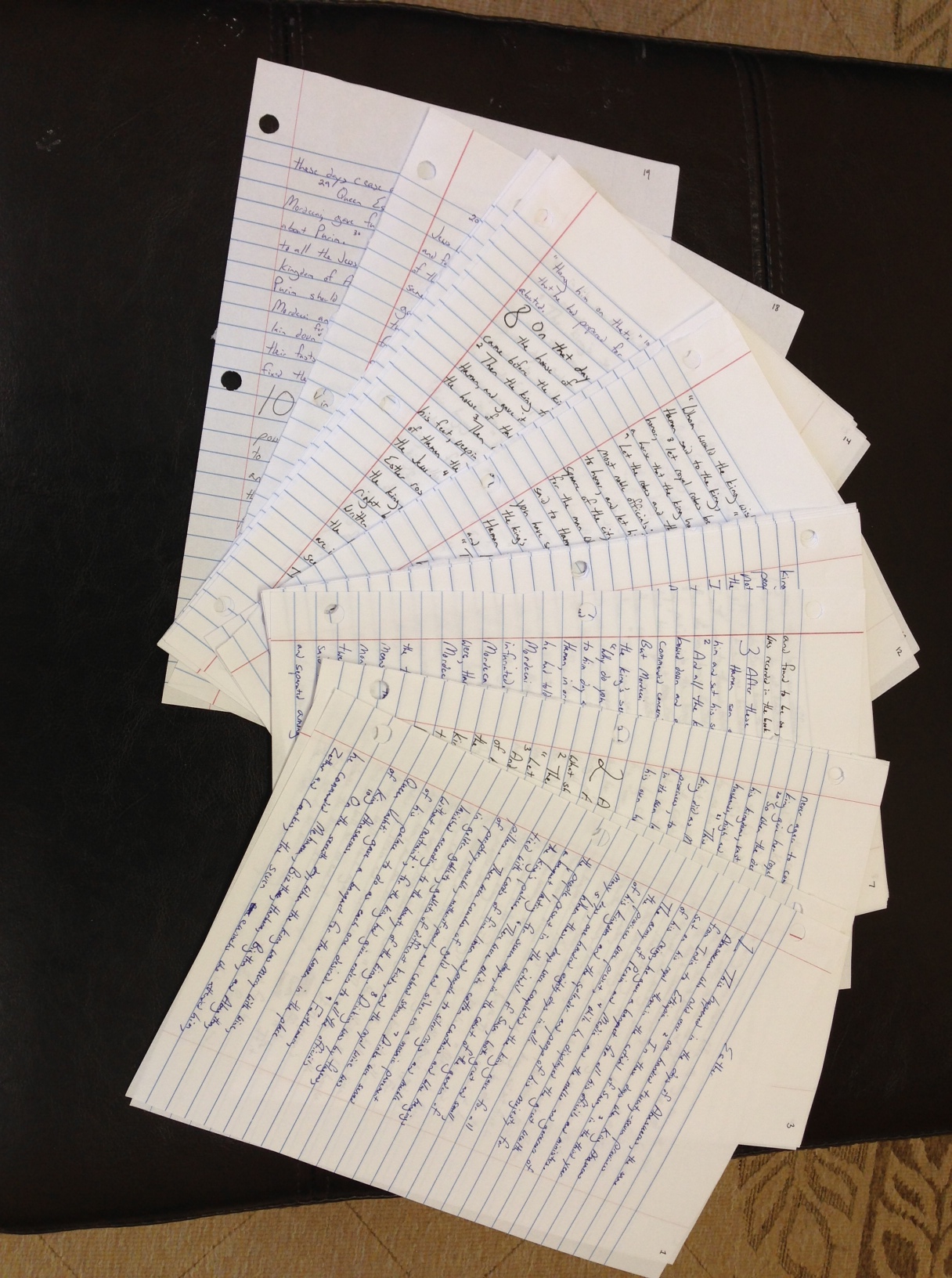
Esther Handwritten

This is the book of Esther written out in my hand, it spans 19 pages. This has been a part of my discipline as I write these posts.

Esther 10: 1-3

King Ahasuerus laid tribute on the land and on the islands of the sea. 2 All the acts of his power and might, and the full account of the high honor of Mordecai, to which the king advanced him, are they not written in the annals of the kings of Media and Persia? 3 For Mordecai the Jew was next in rank to King Ahasuerus, and he was powerful among the Jews and popular with his many kindred, for he sought the good of his people and interceded for the welfare of all his descendants.

                 And they all lived happily ever after, isn’t that how we want the story to end? For Mordecai he is afforded power and position and honor, and it is great for him and his people and his kindred.  As with the previous chapters, many scholars will argue these are additions to what the original story was. Without going into a lot of detail for Esther there are three primary ancient documents: The Masoretic Text (MT) written in Hebrew late 4th or early 3rd Century BCE, the Alpha Text (AT) which is a greek translation of the Hebrew Text (which is roughly 20% shorter than the MT) and the Septuagint which is also a Greek translation used by most early church fathers and probably most of the writers of the New Testament which comes from the Second century BCE. There are differences in each of the texts, with the Septuagint adding quite a lot (if you look in the Apocrypha in most Bibles that contain them, this is where The Additions to Esther come from). Most translations of the Bible go back to the MT, which contains chapters 9 and 10, while the AT does not. Anyways, it really matters little since the text most people read is the translation of the MT from Hebrew into English (or whatever your favorite language is) and this is the communal memory of the book.

The book end on the note of living happily ever after, and that is where we will leave it. I don’t feel a strong desire to spend any time with the Additions to Esther, but Sidnie-White Crawford, whose commentary in The New Interpreter’s Bible I’ve been reading along with as a write does cover this in depth. (Elizabeth Acthemeier, et.al 1999, 3:945-972)

If you have followed through this journey with me, I hope you have enjoyed it and it has provoked thought. Next we are heading into one of the longer books and more challenging books of the Bible, Jeremiah. I am doing this because it is one of the books I don’t know well, like Haggai and Esther, and I want to know more. If you join me on the journey perhaps together we shall see where it leads us.

purple rose 01 by picsofflowers.blogspot.com

The Practice Forms the Faith: Esther 9: 20-32

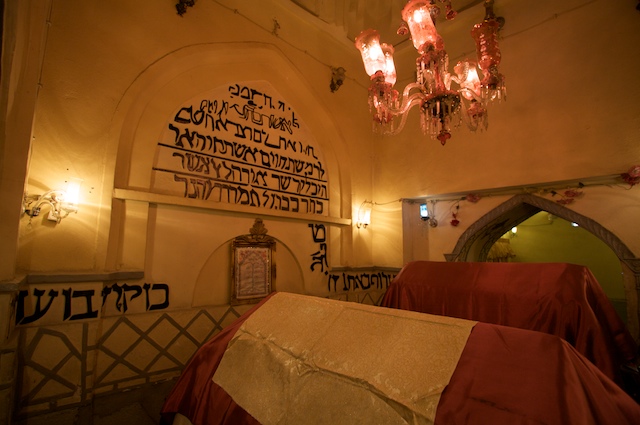
Tomb of Esther and Mordecai, Hamadan, Iran

Tomb of Esther and Mordecai, Hamadan, Iran

Esther 9: 20-32

                20 Mordecai recorded these things, and sent letters to all the Jews who were in all the provinces of King Ahasuerus, both near and far, 21 enjoining them that they should keep the fourteenth day of the month Adar and also the fifteenth day of the same month, year by year, 22 as the days on which the Jews gained relief from their enemies, and as the month that had been turned for them from sorrow into gladness and from mourning into a holiday; that they should make them days of feasting and gladness, days for sending gifts of food to one another and presents to the poor. 23 So the Jews adopted as a custom what they had begun to do, as Mordecai had written to them.

 24 Haman son of Hammedatha the Agagite, the enemy of all the Jews, had plotted against the Jews to destroy them, and had cast Pur– that is “the lot”– to crush and destroy them; 25 but when Esther came before the king, he gave orders in writing that the wicked plot that he had devised against the Jews should come upon his own head, and that he and his sons should be hanged on the gallows. 26 Therefore these days are called Purim, from the word Pur. Thus because of all that was written in this letter, and of what they had faced in this matter, and of what had happened to them, 27 the Jews established and accepted as a custom for themselves and their descendants and all who joined them, that without fail they would continue to observe these two days every year, as it was written and at the time appointed. 28 These days should be remembered and kept throughout every generation, in every family, province, and city; and these days of Purim should never fall into disuse among the Jews, nor should the commemoration of these days cease among their descendants.

 29 Queen Esther daughter of Abihail, along with the Jew Mordecai, gave full written authority, confirming this second letter about Purim. 30 Letters were sent wishing peace and security to all the Jews, to the one hundred twenty-seven provinces of the kingdom of Ahasuerus, 31 and giving orders that these days of Purim should be observed at their appointed seasons, as the Jew Mordecai and Queen Esther enjoined on the Jews, just as they had laid down for themselves and for their descendants regulations concerning their fasts and their lamentations. 32 The command of Queen Esther fixed these practices of Purim, and it was recorded in writing.

Paschasius Radbertus (785-865), a medieval Catholic theologian gave voice to an ancient principle of how doctrine is sometimes formed by the practices of prayer and worship when he said, “the rule of prayer should lay down the rule of faith.” (Pelikan 1978, 159) Our practice informs what we believe, and within the practices of Purim, and the feasting and celebrating combined with the reading of Esther. Purim has some of the feasting and hilarity of Mardi Gras and people often dress up as Esther, Mordecai, Ahasuerus, etc. and this practice shapes the way the Jewish people approach the story in a way that Christians do not have. Esther is a beloved story as a part of this celebration, and so it is not surprising that we have in the closure two different  commands, one from Mordecai and one from Esther that establish the festival. Which came first, the chicken or the egg? You can debate back and forth does the edict establish the festival or does the edict give justification for a practice that was already ongoing.

At one point in my life, I took myself and the world way too seriously, and the life of faith is often looked upon as one of austerity, seriousness and moderation-but that has little to do with the Bible or Jesus. The world of the bible is a world of festivals and feasts, of celebrations and parties, of people enjoying participating and being a part of the story. My personal opinion is we celebrate too little. Mardi Gras for example evolved as an act of rebellion against being continually told by priests (Mardi Gras evolved in predominantly Catholic areas) of all the things they were to give up and to avoid having fun. And yet both of the primary festivals of the Christian church (Christmas and Easter) have evolved to where there is an element of feasting and celebration-but this is done with family and not with any connection to the story of the day. One of the challenges for the church as it enters the twenty first century perhaps we need to learn to celebrate and feast, to begin to live out of abundance rather than scarcity. Now one critical difference is the Christian church, at least in the United States, tells its story from a place of relative privilege, we are not (predominantly) a marginalized group. Many of our members occupy places of authority throughout the society, unlike the experience of the Jewish people throughout much of their history. Nonetheless, especially in a postmodern world which places a high value on story, we would do well to consider how our practices could be informing our faith and how we too can use these feasts throughout the year to do just that: to feast and to celebrate.

purple rose 01 by picsofflowers.blogspot.com

The Horror Conclude: Esther 9: 11-19

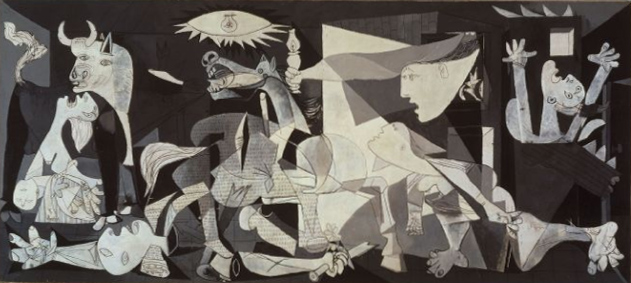
Pablo Picasso, Guernica

Pablo Picasso, Guernica

Esther 9:11-19

                11 That very day the number of those killed in the citadel of Susa was reported to the king. 12 The king said to Queen Esther, “In the citadel of Susa the Jews have killed five hundred people and also the ten sons of Haman. What have they done in the rest of the king’s provinces? Now what is your petition? It shall be granted you. And what further is your request? It shall be fulfilled.” 13 Esther said, “If it pleases the king, let the Jews who are in Susa be allowed tomorrow also to do according to this day’s edict, and let the ten sons of Haman be hanged on the gallows.” 14 So the king commanded this to be done; a decree was issued in Susa, and the ten sons of Haman were hanged. 15 The Jews who were in Susa gathered also on the fourteenth day of the month of Adar and they killed three hundred persons in Susa; but they did not touch the plunder.

 16 Now the other Jews who were in the king’s provinces also gathered to defend their lives, and gained relief from their enemies, and killed seventy-five thousand of those who hated them; but they laid no hands on the plunder. 17 This was on the thirteenth day of the month of Adar, and on the fourteenth day they rested and made that a day of feasting and gladness. 18 But the Jews who were in Susa gathered on the thirteenth day and on the fourteenth, and rested on the fifteenth day, making that a day of feasting and gladness. 19 Therefore the Jews of the villages, who live in the open towns, hold the fourteenth day of the month of Adar as a day for gladness and feasting, a holiday on which they send gifts of food to one another.

The bloodthirsty tone continues, and again this is probably (hopefully) hyperbole, for if it is not then we have an event of horrific proportions-over seventy five thousand dead and the Emperor merely shrugs his shoulders and allows it to continue. Even though the population of the United States is many times the population of the Persian empire at its height, imagine if in one day even a thousand people lost their lives, or by way of comparison-the bloodiest days on American soil were the days where the Union and Confederate army battled at Gettysburg (over 3 days 46,286 people died). This hopefully puts some scale to the type of numbers that are thrown into the story here. Some scholars suggest the last couple chapters are additions to the book of Esther.  Regardless of how and when they become a part of the book, they become a part of the community’s memory. As I’ve mentioned in earlier posts, this probably gave hope to a people who were often the victims of oppression and hatred-it gives them a place where they can vent their frustrations at their powerlessness. A desired striking back, long suppressed may indeed give voice to horrific fantasies of violence. In the presence of their own people they can through stories give vent to the desire for revenge that in public society they could never do without severe reprisal. (Scott 1990, 37-44)

Esther again enters the story, the king continues to give the authority to someone else to make the decisions. Esther’s request for one more day in the city of Susa sounds cold and heartless, and the additional three hundred that die as a result may seem tiny in comparison to the seventy five thousand, but they continue to send a message along with the hanging or impaling of Haman’s sons. They are public demonstrations of power, meant to send a message to anyone who may still harbor the desire to wipe out the Jewish people. Impaling or hanging, like crucifixion in later times, makes a public spectacle of the one’s being executed in this manner and it is also a statement of shame. It dishonors the family, it denies the individual an honorable death-it is a striking statement that Haman and his sons are impaled because of their standing and wealth, it indicates a different culture than the Roman empire when crucifixion was reserved for those who were without status.

The purge comes to an end, and then comes celebration. The story is winding down, the victory is won. The remainder of the story will be codifying the celebration of Purim and lifting up the status of Mordecai and Esther. It has been a long journey through this close of the book, but we are almost there.

purple rose 01 by picsofflowers.blogspot.com

Living a Godly Life-A Sermon on Trusting

sparrow
“No one can serve two masters; for a slave will either hate the one and love the other, or be devoted to the one and despise the other. You cannot serve God and wealth.
“Therefore I tell you, not to worry about your life, what you will eat, or what you will drink, or about your body, what you will wear. Is not life more than food, and the body more than clothing? Look at the birds of the air; they neither sow nor reap nor gather into barns, and yet your heavenly Father feeds them. Are you not of more value than they? And can any of you by worrying add a single hour to your span of life. And why do you worry about clothing? Consider the lilies of the field, how they grow; they neither toil nor spin, yet I tell you, even Solomon in all his glory was not clothed like one of these. But if God so clothes the grass of the field, which is alive today and tomorrow is thrown into the oven, will he not much more clothe you—you of little faith? Therefore do not worry saying, ‘What will we eat?’ or ‘What will we drink?’ or ‘What will we wear?’ For it is the Gentiles who strive for these things and indeed your heavenly Father knows that you need all these things. But strive first for the kingdom of God and his righteousness, and all these things will be given to you as well.
So do not worry about tomorrow, for tomorrow will bring worries of its own. Today’s trouble is enough for today. Matthew 6: 24-34
I really wrestled with this during the week, mainly because I had to get to the point where I could hear this graciously. Where I started out hearing it was in a condemning way, bringing up all the shortcomings in the places where I was trusting God, and I found myself placing a heavier and heavier burden on my shoulder. I began to feel like Martin Luther before the reformation when he was struggling with an image of God who placed heavy burdens on people’s shoulders that they couldn’t lift and then condemned them for it. I also had to reach my breakthrough moment when I could realize that God’s grace was there all along, but I didn’t start out there.
When I listened to this the first time I found myself struggling against it, my muscles got tighter as I read it, I found myself becoming a little anxious, and I honestly found myself angry at these words. I know Martin Luther said we are to “fear, love and trust God above all things.” And on one level I know I desperately have tried to live my live where I do trust God above all things, but I have to be honest—this passage is both terrifying and comforting at the same time because I find myself caught between two worlds. I live with one foot in this world and one foot in the kingdom of God. In this harsh way of hearing this I acknowledge that I live in a world where roughly 20% of my income goes to taxes, 25% goes to housing, 15% goes to other debts, 10 % goes to the church, another 10% goes to things like phone, cable, insurance and so on a good month I have 20% to spend on gas, groceries, the pants for my son who seems to continually be outgrowing everything I buy him and if there is anything left, maybe something I wanted to buy, and while there may be (and have already been) things that I’ve cut the reality is that as much as I don’t like it I am dependent on receiving a paycheck twice a month. I may not like it but if that paycheck didn’t come in, it would change a lot of things in my life very quickly. I also have to be honest that I have always been on the more meticulous side of how I dressed, and even though I don’t spend very much money on clothes each year for I try to make myself look as good as I can because I legitimately like to look and dress well. Maybe it is the time I spent in the Army and the family I grew up in, but I am still one of these people who tries to make sure my shirts are pressed and my shoes are polished, and that as much as I can, that I look good. And for whatever reason I was coming up against this text and I was hearing, “Don’t worry about how you dress” and “Don’t worry about where your next meal is going to come from” and I wanted to say back to God, “God how much more do you want?” I mean God when you called me to give up a really good paycheck as an officer in the army, doing something I enjoyed to go to for four years in seminary where I wasn’t going to have much of an income, or when I accepted first call well below the guideline for compensation for a pastor and then when I was going through the difficulties with my last call and divorce, giving up that position (even though it was killing me) and trusting that somehow it would work. I began thinking “What more do you want me to give up?” and yet that wasn’t what Jesus was trying to say to me, I was loading that upon my own shoulders. Yet, I think it is very natural for us to slip back into this image of a God who is a harsh taskmaster, who continues to demand more and more out of us, and I think this text can very easily be heard in this way and sometimes English doesn’t help because something as simple as the translation saying “you of little faith” which is hard to hear any way other than condescending, or as in some translations, like the NLT “why do you have so little faith”, but what is there is my little faith ones. It is a different tone, even though the words are the same. It may be nitpicking, but how you hear and read something matters, if you hear Jesus coming off harsh and condemning it affects the way you receive this, so much of communication is more than just words, even on paper we assign emotion to words. Yet the entire section is set within the words of “don’t worry” and when I hear this it is Jesus coming to us and saying in a comforting was, “God takes care of the sparrows and you’re more important than they are, and the wildflowers which only last a season, God cares more about you than them.”
Jesus is speaking primarily to people who are not very wealthy. Most of the people hearing this will go back to their fields, or fishnets, or households. They will plant their crops, drop their nets, bake the bread for their families, and Jesus is not telling them, at least not most of them, to abandon their fields and farms, to give up their boats and fishnets, to turn away from their families. There may be other points where people like Peter and James and John walk away from their boats, and Matthew away from his job as a tax collector, but most people will hear him, and they like his disciples will be little faith ones in the midst of the world. I think the point in the midst of this “who are you?” Ultimately we are God’s little faith ones, we are people marked with the sign of the cross and sealed with the Holy Spirit in our baptism, we are precious to God, more precious than sparrows or flowers, we are people who God has placed value on, and God will watch over us. Yet in the midst of our lives things change. I’m forty, and so I can still do many of the things I did when I was twenty, I just pay for them more. And I know there are things that if I make it to eighty, that I will not be able to do that I do now. Or maybe you lose a job, or a house burns down, or a thief breaks in and steals something precious, or you go through a divorce, or you lose a parent or a child, or something else happens in your life and it feels like it changes everything. And we invest a lot of our lives in our jobs and our relationships, but if the job goes away are you anything else? When things around us change, can we realize that who we are is ultimately children of God, people who are precious to God, more valuable than sparrows and flowers and that God will take care of us? In the times of feast and the times of famine God walks with me. I’ve been through both the experience of losing a job and losing a divorce, and in that time you don’t have to say, “this is where I’ll be six months from now.” No where you are is in that moment. We live in a society where anxiety and depression are rampant, and there is no magic wand that makes it all better, but sometimes we find ourselves living so much in the fears of the futures that may come that we lose the joy of the moment that we are living in. Or you get plugged into the 24 hour new cycle and you let it depress you, because even though the news will not tell you this, there is a lot that is right in the world. We can and will go through a lot of changes throughout our life, but in God’s eyes who we are hasn’t changed. God may not be calling us to seek these things out, but when they happen we can realize that who we are in God’s eyes has not changed. God never promises to make it easy, just possible, and we will have what we need to eat, or drink, or wear…not always what we want, but what we need.
I know when I was going through seminary, and I am a proud person, and I had to use WIC or the food pantry I didn’t like it, I didn’t like that I needed help even when it was available-I didn’t want to feel like I was somehow a drain on the system. And when I look back on that time, it was a time in my life when I had the least, but I was the happiest because I was surrounded by a community of people who were my friends who were sharing the same experience and we were all learning to trust God together.
And Jesus throughout the scriptures cautions people about money, and we hear today that you cannot serve God and money, and one of the things money can do to us is that it affects our relationships. There have been numerous stories, for example, about lottery winners whose lives were ruined because their relationships became defined by their new found wealth. Everybody wanted them to buy something for them, or lend them $5,000 or $10,000. And I know a lot of people yearn for this type of fame, but I couldn’t imagine being someone like Justin Bieber or Taylor Swift where everything you do is watched, and you can’t go to the grocery store without someone taking pictures or wanting an autograph. I couldn’t imagine being the president where you need a large security detail everywhere you go to separate you from everyone else. Yet in the midst of all the distractions it can be so easy to forget who we are, that we are precious, that God has claimed us and named us in the waters of baptism and that we are precious in his sight. Even when everything else around us changes, that does not.
Throughout this time of lent we have been talking about things that have to do with trust. Giving relies on trusting that there will be enough, prayer allows us to grow into the relationship with the loving God who wants us to come to him as loving and trusting children and it is in that communication with God that we build trust. Forgiving involves trusting, because it opens you up to the possibility that you may be hurt again in the relationship, but there is no way to continue a relationship without forgiveness, and as we forgive others we begin to understand God’s forgiveness. I talked about fasting last week, and that involves a deep level of trust, for I struggle against my most basic urge, to eat, so that I may learn that I am more than just a consumer. And we walk along this journey and God continues to shape and mold us to be people who can live in trust. I wrestle with this just like everyone else, I also have to hear for myself that I am precious and loved, I have to get beyond my own tendency to judge myself as unworthy and hear once again that I don’t need to worry, for God has called me God’s own.

purple rose 01 by picsofflowers.blogspot.com

Horror or Celebration in Susa:Esther 9: 1-10

Alfred P Murrah Federal Building after it was bombed in Oklahoma City April 19, 1995

Alfred P Murrah Federal Building after it was bombed in Oklahoma City April 19, 1995

Esther 9: 1-10

Now in the twelfth month, which is the month of Adar, on the thirteenth day, when the king’s command and edict were about to be executed, on the very day when the enemies of the Jews hoped to gain power over them, but which had been changed to a day when the Jews would gain power over their foes, 2 the Jews gathered in their cities throughout all the provinces of King Ahasuerus to lay hands on those who had sought their ruin; and no one could withstand them, because the fear of them had fallen upon all peoples. 3 All the officials of the provinces, the satraps and the governors, and the royal officials were supporting the Jews, because the fear of Mordecai had fallen upon them. 4 For Mordecai was powerful in the king’s house, and his fame spread throughout all the provinces as the man Mordecai grew more and more powerful. 5 So the Jews struck down all their enemies with the sword, slaughtering, and destroying them, and did as they pleased to those who hated them. 6 In the citadel of Susa the Jews killed and destroyed five hundred people. 7 They killed Parshandatha, Dalphon, Aspatha, 8 Poratha, Adalia, Aridatha,9 Parmashta, Arisai, Aridai, Vaizatha,10 the ten sons of Haman son of Hammedatha, the enemy of the Jews; but they did not touch the plunder.

We are at the part of Esther where one has to make a choice on how they will hear this. Many Christians throughout history have come upon this section with distaste, this is certainly one of the reasons Martin Luther didn’t like the book. The slaughter of over five hundred people, an event that would dwarf events like the Oklahoma City Bombing, Sandy Hook Elementary, or Columbine, in fact by percentage of population it would probably rival the loss of life on the September 11th attack on the World Trade Center. If you take the numbers as literal, this is a horrific event (at least if you are not a Jew). In my opinion the numbers are probably hyperbolic, but in either case this is another of those events of violence in the Old Testament that can be difficult to stomach. This is definitely a mindset of retributive justice (you threatened me, so I will do violence to you) that still plays out in wars and genocides even in recent history.

On the other hand, this does reflect a world where anti-Semitism continues to be a real and present force in the lives of Jewish people. This was probably one memory where, instead of being victim, the Jewish people were feared because they actually had power through Mordecai and Esther. Much like Ahasuerus becomes a foil for whatever king they find themselves under and Haman becomes the oppressors they have, this victory probably becomes a counter story in the midst of their lives. When they are weak and powerless they can look back to a time when they were strong.

It is so easy for the oppressed, when given power, to become the oppressor-and even many Christians, who should take Jesus’ teaching on forgiveness and non-violence seriously, have become the worst offenders. One doesn’t need to know much history to pull up events like the Holocaust (a “Christian” nation attempting to wipe out the Jews), Bosnia/Kosovo (Serbs, who are predominantly Christian attempting to wipe our Croats who were predominantly Muslim), or Rwanda (predominantly Christian), or Sudan (Muslim north vs. a Christian south) and the list could go on and on. Violence and death are here to stay with us, and in America we are very sheltered from the horror, we in the past year grieved the events in Sandy Hook and that was a major domestic event for us.

purple rose 01 by picsofflowers.blogspot.com

Violence and the Bible

Battle of Gilboa by Jean Forquet (1420-1480)

Battle of Gilboa by Jean Forquet (1420-1480)

If you spend much time with scripture you have to come to some sense of resolution about how you will approach the question of violence within the Bible. If you are following what I am writing about Esther, we are entering a portion where when you take seriously the violence that is being talked about, which I will do, it should force you to ask some really difficult questions.

Probably the simplest answer that many people come to is to simply ignore it.  The bible like so much of the media we consume simply assumes violence is a part of life. In the book of Esther the violence is never ascribed to God or God’s will, it is simply a result of the way things are and the characters in the book work and live out of the societies assumption towards violence and revenge.  At other times the violence is directly attributed to God’s will, for example this is the prophet Samuel speaking to King Saul to get him to go and wipe out the Amalekites:

Thus says the Lord of hosts, ‘I will punish the Amalekites for what they did in opposing the Israelites when they came up out of Egypt. Now go and attack Amalek, and utterly destroy all that they have; do not spare them, but kill both man and woman, child and infant, ox and sheep, camel and donkey. 1 Samuel 15: 2-3

I choose this one because it may have some relevance to the story of Esther since the villan in the story is an Agagite (King Agag is the one Saul did not kill, but Samuel the prophet did and perhaps some think this is the cause of the animosity). But this is one of many throughout the Old Testament where God seems to tell the people in effect ‘wipe them out, all of them.’ At other times God is behind the violent action, whether in the plagues in Egypt or even God being behind the armies of Assyria and Babylon taking the people into exile. Yet on the other hand Jesus effectively argues for non-violent lifestyle, and throughout much of the Old Testament, particularly in the prophets, we see a hope for a vision of peace and harmony where swords are turned into plowshears and nations no longer train for war. The contrast was such that one of the earliest heresies in the church, Marcionism, argued that there were two gods, the New Testament God of Jesus and the Old Testament demiurge who was the violent and evil creator (more about Marcion in the Place of Authority 2-3: The Early Church’s Identity Problem).

At some level, I have had to reconcile how I approach this issue because within it rests a broader question on how we approach and value scripture:

An approach, but not one I advocate, followed by many conservative Christians is to fully embrace the picture of the violent God, hence God’s wrath and holiness become central parts of their theology. Within this approach violence may have a divine sanction, especially towards the other. This was the way of thinking that was operative during the crusades or the colonization of the Americas where the options presented were convert or die. This is in my opinion a very dangerous ideology and ripe for abuse in many ways, where the other is de-humanized and can be eliminated as offensive to God. Within this theology the spokesman (and it typically is a man-although not always) gets to determine what is holy and what is profane and as a mouthpiece of their god. Much violence, abuse, and destruction has been sanctioned by advocates of this theology and while one can make a biblical justification for it-it goes completely against the vision of Christianity I practice.

Another approach which tries to engage the question faithfully, is represented by the Old Testament scholar Walter Brueggemann, who states God is in recovery from violence. Brueggemann attempts to take the Old Testament witness very seriously as a whole and is a phenomenal interpreter of texts and theologian, yet this is still not the approach I would advocate. You can see Brueggemann talk about this way of thinking here.

As a Lutheran pastor there are several pieces of my tradition that form my approach to this question:

  1. Ultimately as a Lutheran I am focused on God’s action of coming down in the life and ministry of Jesus of Nazareth, or Jesus the Christ, as the lens through which the rest of scripture is viewed. Jesus words and ministry interpret and critique the rest of scripture, and so it is here that I look to find what God is like.
  2. Lutheran interpretation of scripture has always advocated for ‘a cannon within the cannon’ which is a fancy way of saying not all scripture has equal weight or value. As I mentioned a couple times going through Esther, Martin Luther didn’t like Esther (or James or Revelation for that matter) because what was important was what reveals Christ.
  3. Finally from a Lutheran perspective God is ultimately a gracious God and so while I would not go the direction of Marcion and eliminate the Old Testament, rather I read the bible back and forth, and even in the times of darkness and violence to ask the question of ‘where is the God of love in the midst of this’ and there may be parts where we say ‘the God of love does not seem to be in this’ at least at this point as we read, but sometime later we may see something different.

The scriptures are in dialogue with each other and are not one unified voice, but rather a chorus of different voice trying to point to God. I attempt to take scripture very seriously, but there will be times when I struggle against a certain piece (as I will with the ninth chapter of Esther) because it seems to go against the grain of the ultimate direction of where scripture is hearing, it may be out of tune with the rest of the chorus. Yet my own voice is just one voice within the larger chorus of voices trying to wrestle with the God scripture tries to point us to. The Old Testament in particular deals with the parts of life that we may not think God has much part of, yet it puts the place of God right in the middle of the messiness of life (violence, broken families, living in exile and many other situations). I think Ellen Davis does a very nice job talking about this here and I would like to think my way is similar to hers. Sometimes it means we will wrestle with scriptures and the pictures of God  it paints, but to me that is a part of our vocation as the people of God.

The perfectionist part of me struggles with putting out such a rough reflection, and I may come back and do some more work on this at another point, but I am also trying to put limits to how long I spend on any one project.

purple rose 01 by picsofflowers.blogspot.com

The Return of the Robins

robins02172007

The winter winds scream against the walls of the house
Blowing frozen crystals from the sky
But the sentinels of spring have arrived
Their orange breasts foreshadowing the warmer times to come
A time of new life, a season of new colors and sounds

The winter has muted the pallet that the world was painted in
For three months the world has born its coat of white and grey
But the days are coming when new life will emerge from the compost of the preceding year
When greens and yellows, blues and reds emerge in the earth and the sky
Flowers will burst forth, leaves will again cover the naked branches of the trees
The earth will yield the bounty of its life in the fruit of the field

The skies will fill with birds and insects, chirping and buzzing over the lake
The squirrels and rabbits will chase each other around my backyard
And black soil stands ready for the bounty to come
The robins have returned, the advance guard of the army of life that will invade our slumbering land
Spring is coming, life begins anew

Composed Neil White, 2013

purple rose 01 by picsofflowers.blogspot.com

Mordecai’s Rise: Esther 8:15-17

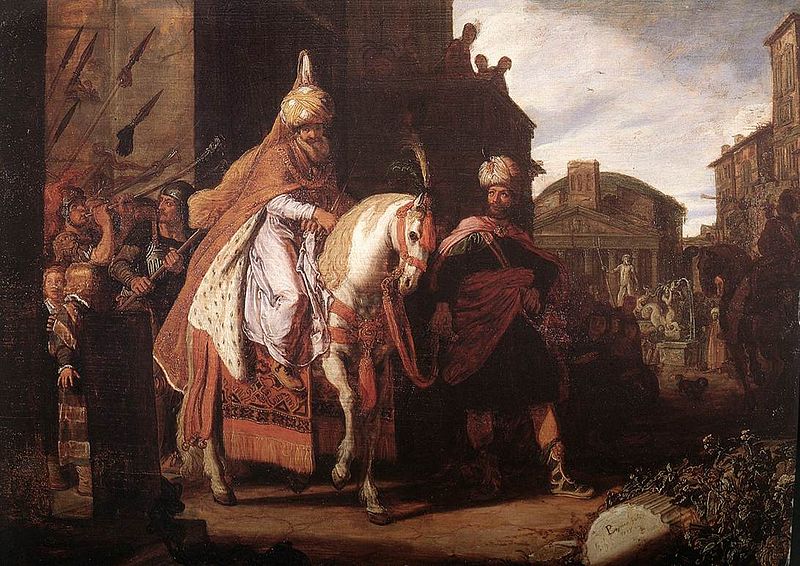
Pieter Lastman, The Triumph of Mordecai (1624)

Pieter Lastman, The Triumph of Mordecai (1624)

Esther 8: 15-17

 15 Then Mordecai went out from the presence of the king, wearing royal robes of blue and white, with a great golden crown and a mantle of fine linen and purple, while the city of Susa shouted and rejoiced. 16 For the Jews there was light and gladness, joy and honor. 17 In every province and in every city, wherever the king’s command and his edict came, there was gladness and joy among the Jews, a festival and a holiday. Furthermore, many of the peoples of the country professed to be Jews, because the fear of the Jews had fallen upon them.

The similarities to the Joseph story continue, take a look at Genesis 41:41-43 (also the previous scene where the king has Mordecai paraded around town), and yet it is amazing (at least to a modern mind)in a story that centers around Esther, now the glory goes to yet another man. The text comes from an androcentric (man-centered) world, and while Esther may be the one who took the risks it will be Mordecai who is lifted up here. Once again he is honored and elevated, once again wearing royal robes. Esther will again return to prominence in the next chapter, but here it is Mordecai who will bear the honor and light and gladness of the people.

As I mentioned in an earlier post, this reminds me a lot of the partisanship we find where it is a win/loss proposition. If your candidate/agenda/party happens to be in office it is a win for you and a loss for the others, in this case for the Jewish people it is a time of light and gladness, of joy and honor to the point where people are falling over themselves to become Jewish because the political clout of Mordecai (and indirectly Esther). I wonder if there were those who were willing to go as far as circumcision (at other points in history some were willing to undergo a reverse circumcision as painful as that sounds to avoid being immediately identified as Jewish). If nothing else it gives me a reason to go to this fun little scene from Robin Hood: Men in Tights.

Yet, this has been a story of reversals, as is much of scripture, and Mordecai has gone from being and exile and his identity as a Jew being the cause of his oppression to being put in royal robes, being a Jew being a title of honor, and Haman (and we will soon see his family) will find themselves destroyed, killed and annihilated.

purple rose 01 by picsofflowers.blogspot.com