Catching Fire- A Poem for Pentecost

holy-spirit-pentecost-wind

We stayed locked behind closed doors
Safe from the rest of the world
Wondering what the future held
Would things ever be the way they were?
Should we just give up? Return home
And pretend like our worlds had not changed
Get on the with the business of our normal lives
Or do we dare to dream of God’s kingdom?

Our Lord came down to the water
And fished us out, calling us from our lives
To journeys we hadn’t imagined
The kingdom was near, the blind saw, the deaf heard
The demons were cast out and the religious were afraid
We had no wealth, no security, but we had him
This man who pulsated with the presence of the living God
Who dared to dream, speak and enact God’s kingdom

Our Lord took us outside the world we knew
To the other side of the lake, to Samaria, and into the city
He touched the unclean, welcomed the sinners
Ate with the tax collectors, and called us all to follow
Building this kingdom of outcasts and unholy into something divine
He opened our eyes, our ears and our hearts
Sometimes we heard, sometimes we were still deaf
Sometimes we trusted, sometimes we failed
But we relied on his faithfulness, his trust
His vision of the kingdom of God drawn near

His vision of the kingdom of love met the hatred
Of men who had lost their dreams, of rulers trapped by fear
So they hung him on a tree, cursed before the world
And laid him in a tomb, killing the dream
Scattering his followers to the four winds
As we ran away in our fear and disillusionment
Hiding away behind locked doors
Fasting where once we feasted
Mourning the loss of the kingdom of God incarnate

But the dream didn’t die
Love overcame hatred; the bars of death were shattered
And with this one, this Jesus, resurrection became reality
We saw him, touched him, ate with him, were taught by him
Yet still we didn’t understand how dead could be not dead
How to overcome the scandal of the crucifixion
How to move beyond our fears and beyond the walls
Our fear keeps the insiders in and the outsiders as strangers
As we argue, debate and question the future of God’s kingdom

We stayed locked behind closed doors
Safe from the rest of the world
Wondering what the future held
Would things ever be the way they were?
Should we just give up? Return home
And pretend like our worlds had not changed
Get on the with the business of our normal lives
Or do we dare to dream of God’s kingdom?

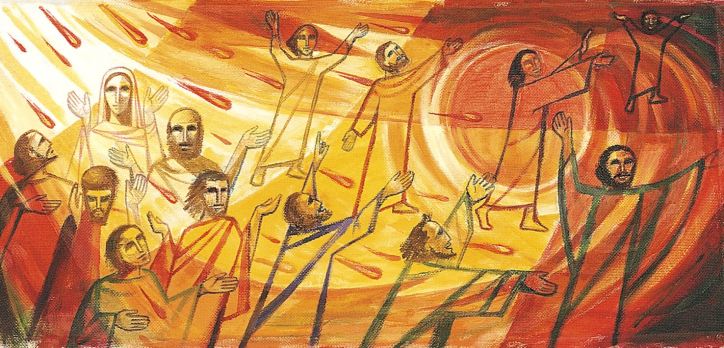
Light and life, wind and fire, tongues and messages
The same Spirit that drove Jesus into the wilderness
The same Spirit that went forth from him to heal the sick
Cast out the demons, open the eyes of the blind and the ears of the deaf
Comes down and casts us outside
No longer behind closed doors, no longer trapped in fear
No longer caught in the illusion of our own control
No longer fearing death or persecution
But caught up in the moment, catching fire
Not knowing what the future holds
But captured by the pulsating power of God’s presence
That we are not alone, that we go forth in love
Witnesses to the kingdom of God

Our problems are not gone, they are new
As we are cast out by the Spirit into God’s world
We meet the outsiders, the gentiles, the strangers
The sinners, the broken, the hurt and the healing
We see the way God’s kingdom is at work in them
And it changes us, it rekindles our own flames
Stoking the fire of the Spirit that breaks down the walls of our fear
Proclaiming the arrival of the kingdom of God

In an age of fear we are captured by the creating Spirit
In the face of hatred and prejudice we are called to love
In insecurity we bring a dream of a world renewed
Yet at times our own fires grow dim
We find ourselves locked behind our own doors
Trapped within our cathedrals
Fearing the outsiders, the strangers and even our neighbors
Then may that same Spirit that moved the frightened few
Into the marketplace, the workplace and to the ends of the earth
Open our eyes, our ears and our hearts to the work of God in our midst
Pushing us towards the kingdom of God

Neil White, 2013

In part this was sparked by David Lose’s video “it’s Pentecost” 

purple rose 01 by picsofflowers.blogspot.com

Railing Against the Temple: Jeremiah 7:1-15

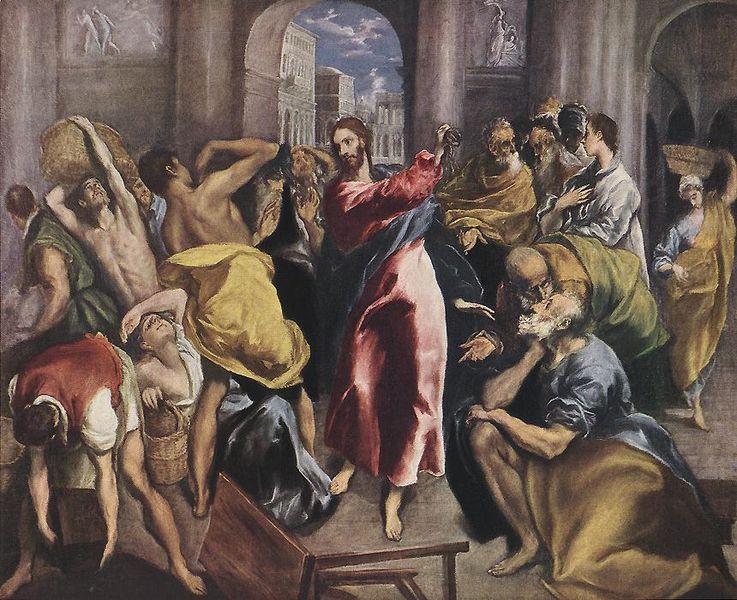
Christ Driving the Traders from the Temple by El Greco (1600)

Christ Driving the Traders from the Temple by El Greco (1600)

Jeremiah 7:1-15

The word that came to Jeremiah from the LORD: 2 Stand in the gate of the LORD’s house, and proclaim there this word, and say, Hear the word of the LORD, all you people of Judah, you that enter these gates to worship the LORD. 3 Thus says the LORD of hosts, the God of Israel: Amend your ways and your doings, and let me dwell with you in this place. 4 Do not trust in these deceptive words: “This is the temple of the LORD, the temple of the LORD, the temple of the LORD.”

                5 For if you truly amend your ways and your doings, if you truly act justly one with another, 6 if you do not oppress the alien, the orphan, and the widow, or shed innocent blood in this place, and if you do not go after other gods to your own hurt, 7 then I will dwell with you in this place, in the land that I gave of old to your ancestors forever and ever.

                8 Here you are, trusting in deceptive words to no avail. 9 Will you steal, murder, commit adultery, swear falsely, make offerings to Baal, and go after other gods that you have not known,

 10 and then come and stand before me in this house, which is called by my name, and say, “We are safe!”– only to go on doing all these abominations? 11 Has this house, which is called by my name, become a den of robbers in your sight? You know, I too am watching, says the LORD. 12 Go now to my place that was in Shiloh, where I made my name dwell at first, and see what I did to it for the wickedness of my people Israel. 13 And now, because you have done all these things, says the LORD, and when I spoke to you persistently, you did not listen, and when I called you, you did not answer, 14 therefore I will do to the house that is called by my name, in which you trust, and to the place that I gave to you and to your ancestors, just what I did to Shiloh. 15 And I will cast you out of my sight, just as I cast out all your kinsfolk, all the offspring of Ephraim.

Jeremiah 7:1-8:3 is generally thought of by scholars as Jeremiah’s temple sermon, it breaks from the form of poetry in 4-6 and places Jeremiah at the gate of the temple proclaiming against the temple authority. Long before Karl Marx and other modern philosophers talked about religion serving to legitimate the dominant class the prophets railed against the priestly and monarchical authorities propping up their own positions with claims of divine right. To use the language of Liberation theologians God is exercising a preferential option for the poor and oppressed (if you do not oppress the alien, the orphan and the widow-these are those without a method of support in the society) and God is not willing to be in competition with other gods-idolatry and injustice are the two rallying cries of the prophet. Specifically appealing to the ten commandments as a central part of the covenant that the people are to live out of and contrasting that to the appearance of trusting in the temple and land rather than the Lord.

Jesus also had significant issues with the temple establishment in his own day, and it is not by chance that Jesus quotes Jeremiah 7:11 when he comes into the temple and throws out the moneychangers. Often there is a focus on the moneychangers, but if you read the context of this within Matthew, Mark and to a lesser extent Luke you can see that the issue is with the temple establishment in general. There is always the danger of any religion becoming a way of authorizing the status quo and it is the prophets who come and upset and challenge this. God has strong words for the temple authority in Jeremiah’s and Jesus’ time and in both cases that temple would be in ruins in the generation that followed.

The position taken by Jeremiah would be viewed as treason by the state, it would be challenging the ideological underpinnings of the religious and the monarchical authorities, it calls people not to trust in the temple.  It attempts to show the people that the temple and the sacrifices they offer cannot cover up a destructive way of life that is out of alignment with God’s covenant with them.  In the gate of the temple Jeremiah is called to challenge the foundations of the way of life of the people and God once again cries out for the people to return to the covenant so once again God may dwell in their midst.

purple rose 01 by picsofflowers.blogspot.com

Upcoming Projects and an Offer

purple rose 01 by picsofflowers.blogspot.com

I know people have come to my blog from various places and with various interests and I think that is a wonderful thing, and I know that most people won’t read everything I write but sometimes it is nice to know what is coming (at least as close as I can guess at this point):

  1. I will continue to work my way through the book of Jeremiah, currently I am working on chapter 11 (even though only through 6 is published on the blog) and I have a couple later chapters done but this is my own practice of learning and working through a book. I know for many people this is not what they are most interested in and that is OK. Jeremiah is a tough book and it can get a little repetitive but I am also becoming more and more convinced as I work through it that with the exceptions of Isaiah and perhaps the Psalms no other book is as critical for understanding both Jesus and Paul.
  2. One of the projects that I am just starting on that hopefully the first work will start coming out next week is the Creativity Project which was prompted by a light bulb moment when I was writing my autism posts. I’m going to spend some time exploring creativity, spirituality, imagination and inspiration and I’ve got some both psychological and philosophical works I am reading to explore these thoughts. I’m excited to see what I learn and to share.
  3. One of the projects that comes out of my congregation is a Basics of Faith series. One of my experiences is that many people in my congregation don’t have a way of thinking about God and issues of faith, even though they may have encountered many of these ideas in confirmation or other types of instruction.  Using Luther’s Small Catechism as a template I’m planning to work through things like Baptism, the Ten Commandments, The Creeds, the Lord’s Prayer and Communion from a Lutheran perspective.
  4. I still plan to get back to the Place of Authority historical posts and I have the reading on hand to continue that work, so it will come as well.
  5. Poetry comes and goes with its inspiration and time, and my life has been a little crazy lately , but when ideas come I try to capture them and write them down so that hopefully I can return to them when there is time, and I’ve got several written down on pieces of paper and notebooks at home and at work that need a little attention (or in some cases they are just vague ideas at this point) but as I get time they will get attention as well.
  6.  Finally I’m going to make an offer to you as readers. If you have a question or topic you would like me to respond to or answer I’m going to take the risk and make that option available. Some of you I know and some I don’t, but one of the things I like to do with the communities I’ve served is to have intentional times where people can bring whatever question they like and I answer on the spot (and sometimes the most honest answer is I don’t know). But I do have the privilege of spending more time thinking about spiritual, philosophical and, to a point, psychological issues than the average person. You don’t have to agree with me, and I typically don’t give short answers but my post on Templars, Gnostic Gospels and Conspiracy Theories came out of one of those questions. So the offer is there, and just post as a comment either here or on the About page or email a question to me at chargerneil@gmail.com (just let me know it is a signoftherose question). I enjoy the challenge of this in person and I don’t know if anyone will take me up on the offer here, but it is available. You can either just comment or use the comment form on this post and the About page, and I will respond as soon as I can.

Perhaps I’m overly ambitious and more than a bit geeky when it comes to a lot of this stuff, but I enjoy the writing and the learning that goes along with it.

Neil


Not Precious Metal, Fools Gold: Jeremiah 6: 22-30

Jeremiah Lamenting the Destruction of Jerusalem by Rembrandt van Rijn 1630

Jeremiah Lamenting the Destruction of Jerusalem by Rembrandt van Rijn 1630

22 Thus says the LORD: See, a people is coming from the land of the north,
a great nation is stirring from the farthest parts of the earth.
23 They grasp the bow and the javelin, they are cruel and have no mercy,
their sound is like the roaring sea; they ride on horses,
equipped like a warrior for battle, against you, O daughter Zion!
24 “We have heard news of them, our hands fall helpless;
anguish has taken hold of us, pain as of a woman in labor.
25 Do not go out into the field, or walk on the road;
for the enemy has a sword, terror is on every side.”
26 O my poor people, put on sackcloth, and roll in ashes;
make mourning as for an only child, most bitter lamentation:
for suddenly the destroyer will come upon us.
27 I have made you a tester and a refiner among my people
so that you may know and test their ways.
28 They are all stubbornly rebellious, going about with slanders;
they are bronze and iron, all of them act corruptly.
29 The bellows blow fiercely, the lead is consumed by the fire;
in vain the refining goes on, for the wicked are not removed.
30 They are called “rejected silver,” for the LORD has rejected them.
We finally come to the end of a long poem that has run from chapter 4-6, and it is the language of pain, or worlds ending, of rejection and yet throughout all of it is the desire for things to be different. Imagine if you would a scenario where a couple has been married for several years, and one spouse has not only been having an affair but has decided that they no longer wants to be married, yet they want to remain in the house. How would the partner react? The partner may want to keep the marriage intact, but would probably not be willing to keep things the way they are, to have invested so much in a relationship and to desire it’s reconciliation only to see their efforts flaunted and then to live with a constant reminder of the brokenness under their roof. Even the most gracious person is going to seek a necessary change to the way things are. Throughout this poem God has desired the people to turn, to change, and yet they do not hear (and perhaps cannot hear). There are too many people proclaiming peace in a time when war is at the gates, prosperity in a time of famine is on the doorstep. The enemy is near, and here at the end of the poem the rumor of their approach has set the people into panic and God or the prophet still desires for them to repent, to put on sackcloth, to roll in ashes, to mourn as for the loss of an only child, yet we hear only the silence about any repentance. They are so corrupted that even switching to the image of metal working, they are all dross and no longer have precious metal left. They are rejected silver or something more familiar to many of us iron pyrite, fool’s gold. The people may look great, but when you find out what they really are the appearance betrays their real nature, and so they are unable to be refined and in the language of the poem they are rejected.
This may be the end of the poem, but this is not the end of the story. There is a long way to go as we walk through the desolation, and I know at times this is a difficult journey for me, but I know that in the distance hope is on the horizon. I cannot imagine remaining in the desolation without the knowledge of the hope that will come.

purple rose 01 by picsofflowers.blogspot.com

On Templars, Gnostic Gospels and Conspiracy Theories

400px-Templar_Flag_6.svg

I was asked to read Steve Berry’s The Templar Legacy because the person who read it really enjoyed it but it provoked a lot of questions for them. Steve Berry’s book took me a while to get through because I never felt engaged in the storyline, partially because I probably do have enough historical background to laugh at some of the claims the story makes and because he wasn’t as good of a story teller as Dan Brown who writes in the same genre (Devils and Angels and The DaVinci Code among others). We love that which is secretive, we enjoy a good conspiracy theory and too often we have encountered our lives in a sense that either one point of view is true or another is so a discrepancy in a source, for example, is enough to discredit everything about a view (which is simply not true) but let’s get into the heart of the controversies of the book:

The Knights Templar: occasionally the heroes, but more frequently the nemesis in these stories a secret shadowy organization with roots back to the crusades and at least The Templar Legacy gets the time period of their dissolution right with the conflict with Philip IV and Clement V. This is a complicated part of history where that is commonly referred to as the Babylonian Captivity of the Church or the Avignon Papacy where the French King basically controlled the Clement V who never visited Rome during his 9 years as pope. The templars, a military order of the church, did go through what many consider a shameful set trials which were indeed motivated by power and wealth and their pope never interceded for them but rather allowed them to be tortured and then dissolved. Many people want the story to pick up again, to reincarnate the Templars in the Free Masons or many other modern organization or to make them a shadowy society still existing in practice and wealth 700 years later. It makes for a good story and plot, but it stretches the limits of credibility to the breaking point to think of a medieval organization suited for the crusades continuing to exist and flourish in modern society.

Contradictions in the Gospel Stories: Are there contradictions in the accounts in the four gospels that are a part of the Christian cannon? Absolutely! That is one of the many reasons that biblical fundamentalism doesn’t work, but was not a significant source of conflict for the church. The Christian church never felt compelled to create a harmonized gospel, but rather to let the gospels we label Matthew, Mark, Luke and John stand as authorized windows to seeing what Jesus is like. They are different-Mark is probably the oldest and reflects the characteristics of oral storytelling by its structure. It is designed to be memorized by its structure and so events are probably not in strictly the order they happened but arranged in a way that help memory (remember that at the time of its composition most people couldn’t read-but their ability to listen and remember was probably far superior to today). Mark probably recorded the stories in the time around 70 CE, a time when some of the original witnesses to the stories were beginning to die or be executed so there would be a written memory that the community could go back to. Mark has no birth or resurrection stories, it simply tries to narrate predominantly the actions of what Jesus did. Matthew and Luke both follow Mark’s pattern and then add some material (predominantly teachings) that they both shared in common as well as individual stories which are specific to each gospel. Mark, Matthew and Luke are often called the synoptic gospels because they share a similar pattern and although each has its own points of emphases, they share a lot in common. John was probably the last of the gospels written which is less concerned with what Jesus does and much more with who Jesus is and what Jesus means. John tends to go into long dialogues where Jesus will say things like, “I am the bread of life, I am the gate, I am the good shepherd, I am the way, the truth and the life” and many more almost philosophical sounding monologues. One minor note that I got a kick out of in the story was that it got it backwards saying that John has no time period and the synoptic narrate a three year pattern of ministry which is exactly the opposite. John with its patterns of Jesus appearing a different festivals is where we get the standard three year time period of Jesus ministry.  One of the great gifts was that the early church never felt the need to iron out all the differences but was willing to live with the tensions that are present as a part of the mystery of the faith.

The Gnostic Gospels: As Christianity spread throughout the ancient world and encountered more and more cultures and people and it got farther away from its Jewish roots people began to understand Jesus in light of their own expectations and previous experiences creating an identity crisis (I write about this in the Place of Authority 2-3: The Early Church’s Identity Problem). The Gnostic gospels are frequently brought up as another great conspiracy theory of the church pushing out the authentic view of who Jesus was in favor of a Jesus that favored the formation of the church the way it became-honestly I wish the people who write things like this would actually bother to read the Gnostic gospels which are readily available on Amazon or Barnes and Noble. But let me spend a little time with the Gnostic gospels and maybe demystify them a little bit. Many ‘Gnostic gospels’ were discovered at Nag Hammadi in 1945 and they are not all part of some unified group. The Gospel of Thomas gets a lot of attention and has been made out in movies (like Stigmata) and books (like The DaVinci Code) to reflect the true words of Jesus. Now where this comes from is actually some scholarly work that is not near as controversial as it sounds: I mentioned above that Matthew and Luke share a lot of material in common, a lot of Jesus’ sayings and there has been a long running hypothesis that there was some common written source for these materials that both Matthew and Luke had access to, and the predominantly German scholars working on this called this common source Quelle which is the German word for common. And because we are often lazy Quelle became shortened to Q and so this is the mysterious Gospel of Q you will sometimes see referred to in culture (I remember an X Files episode where they walk into this church and they are flipping through these additional gospels and one of the ones is Q-not so controversial when you know what it is).

200px-Synoptic_problem_two_source_colored

Some scholars think The Gospel of Thomas is old because it is more of a wise sayings of Jesus without any stories and it does share a lot of material in common with Matthew and Luke, other scholars think Thomas takes the material from Matthew and Luke. Regardless when you read Thomas there just isn’t a lot there that is new to get excited about and frequently little snippets are quoted out of contexts to make Jesus sound like he is anti-institutional to which I respond read Mark, Matthew and Luke and see how many problems Jesus had with the organized religion of his own day and his own protest against it which is far more radical than anything in Thomas. Sometimes authors will try to bring in some of the other Gnostic Gospels, for example Dan Brown makes use of a particular snippets from the Gospel of Philip and the Gospel of Mary which help his story, but like prooftexting often does, do not coincide with the general portrayal of even these gospels. When you read some of these gospels you quickly realize that this sounds little like the Jesus in the earlier gospels and sounds a lot like something that comes out of the Greek Culture. I know I’m a geek that I actually have read these sources and can retain a lot of this, but it also keeps me from getting too uptight about a lot of these things.

Is Christianity dependent upon the resurrection?: Yes it is and I think we need to be OK with that. We may never be able to prove historically the resurrection, but if Jesus was just a wise person who could tell a good story and utter wise sayings then we place him up with people like Plato, Aristotle and many other great orators and philosophers-but at the heart of the Christian story is that in Jesus we say, “this is what God is like” as controversial and strange as that is. Now I’m not saying that if a person cannot accept the resurrection that there is nothing to be learned from Christianity, I am convinced that as a way of life it does have a lot to offer, but Paul in 1 Corinthians says it well in his extended argument about the resurrection (the early church struggled with this too) when he argues if Christ wasn’t raised then our hope in resurrection is false and:

If for this life only we have hoped in Christ, we are of all people most to be pitied.  1 Corinthians 15: 19

Granted many people do not make a lot of sacrifices for their faith, but for those who do it is living in light of a hope for something greater-that God is indeed active in the midst of the world and they are a part of what God is doing in the midst of that.

Conspiracy Theories: They can be fun and make for a good story, and It is OK to question the broadly received story, but conspiracy theories often have little relation to anything recognizable as reality and the thrive in ignorance. I enjoy the stories as much as anyone else, but I also hope that more churches would be places where we can ask difficult questions and pastors would feel adequate to engage them or to ask others who may be able to help them engage these questions. Ultimately questions like this should be fun and not threatening because they give us an opportunity to ask some of the challenging questions of what we believe.

purple rose 01 by picsofflowers.blogspot.com

The Disconnect Between Worship and Obedience:Jeremiah 6: 15-21

Jeremiah Lamenting the Destruction of Jerusalem by Rembrandt van Rijn 1630

Jeremiah Lamenting the Destruction of Jerusalem by Rembrandt van Rijn 1630

15 They acted shamefully, they committed abomination;
yet they were not ashamed, they did not know how to blush.
Therefore they shall fall among those who fall;
at the time that I punish them, they shall be overthrown, says the LORD.
16 Thus says the LORD: Stand at the crossroads, and look, and ask for the ancient paths, where the good way lies; and walk in it, and find rest for your souls. But they said, “We will not walk in it.”
17 Also I raised up sentinels for you: “Give heed to the sound of the trumpet!”
But they said, “We will not give heed.”
18 Therefore hear, O nations, and know, O congregation, what will happen to them.
19 Hear, O earth; I am going to bring disaster on this people,
the fruit of their schemes, because they have not given heed to my words;
and as for my teaching, they have rejected it.
20 Of what use to me is frankincense that comes from Sheba, or sweet cane from a distant land?
Your burnt offerings are not acceptable, nor are your sacrifices pleasing to me.
21 Therefore thus says the LORD:
See, I am laying before this people stumbling blocks against which they shall stumble;
parents and children together, neighbor and friend shall perish.

Apparently the reality that some people may be faithful church attenders while they live lives that are fundamentally out of touch with God’s desire for their lives is not a new reality. As Walter Brueggemann states:

In place of torah, Israel has substituted cultic action (Jer. 6:20-21): frankincense, cane, sacrifices. Israel has devised a form of religion that reflects affluence, which can be safely administered, and which brackets out all questions of obedience.” (Brueggemann 1998, 73)

It is a nice, safe, easy religion that has allowed the people to slip into a sense of cultic complacency. So long as we have the temple and we keep bringing our offerings to God nothing will happen to us. This is the picture of gods that are common in the ancient world, that you bring pleasing offerings to the gods to entreat their favor and to get them fight for you in your battles, allow your crops to prosper, etc. But this is to fundamentally misunderstand the relationship God wants for God’s people. It is not coincidence that the Old Testament prophets frequently rail against the sacrificial system (and Jesus also directly confronts the temple in his own day). The way things are will not continue indefinitely, God is speaking through the prophet. God is taking away the things that people have placed their trust in, and the temple and the priestly sacrificial system is one of these things.

purple rose 01 by picsofflowers.blogspot.com


More than Mothers

Guido Reni (1575-1642)-The Penitent Magdalene

Guido Reni (1575-1642)-The Penitent Magdalene

I first want to say that I think Mother’s Day is a fine holiday and that mothers often play one of the most important roles in the lives of their children. That being said, I do think that Mother’s Day can become a time when we see the expectations of women limited to child bearing and child raising and women are more than that. What got me thinking about this was an exchange I overheard between a mother and her grown daughter with another woman. After wishing a happy Mother’s Day to the mother, this woman turned to the daughter wishing her the same, and when the daughter replied that she isn’t a mother the woman’s response was, “Oh, but you will be someday.” I have no idea if being a mother is a part of this young woman’s hopes and dreams for her future, but she is very successful and gifted in her own right. In her late twenties she is both working and working towards and advanced degree in the medical field, continues to remain active within the church and I am sure is active in many other things. I would hope that we can value her, and many other women for who they are as individuals.

There was a time when a woman’s value was tied to her ability to bear children. Countless stories in the Bible rotate around the struggle of women who are barren and have their shame removed through an intervention of God: think of Sarah who in her 90s finally bears Isaac, or the struggles between Rachael and Leah, or Hannah, or Elizabeth just to name a few. Yet even in each of these ancient stories, with a worldview over two millennia old, these women did have value both to God and the people most important in their lives well before they bore children. It was society that placed the expectation upon them that their worth was tied to the future they ensured through children (and in particular male children). I chose the image of Mary Magdalene to start this post because she is one of the women in scripture and tradition never mention bearing children and yet she is valued as one of Jesus followers and becomes one of the first witnesses of the resurrection. One of the gifts of our time has been the greater opportunities afforded to women to define themselves in ways that wouldn’t have been allowed a couple generations ago. I look forward to my own daughter being able to make choices that will help define the life she will live as she grows and to carve out her own role within the world.

One of the gifts of my vocations is getting to know and be a part of people’s stories and valuing people as individuals, for who they are. I do think it is important to value mothers, but I also think it is important to value the 97 year old woman who never had any children of her own, or the fromer teacher in her late 80s that never had a family of any type, the women I know who never wanted to get married or have children, those who may want to have children but infertility or miscarriages have prevented this from becoming a reality, those who at this point in their lives are dedicating themselves to their education or their career, or those who gave a child up for adoption for whatever reason or lost custody of their children. I do think this is an issue where we still treat men and women a little differently, but my plea in the midst of all of this is can we value people first and foremost for who they are, and on days like Mother’s day if they happen to be a mother then celebrate that and if not please don’t make them feel guilty for not being one.

purple rose 01 by picsofflowers.blogspot.com

Are we willing to ask the difficult questions?

sunrise

As the world continues to change at a dynamic pace and the church continues to attempt to minister faithfully in that changing world it will force us to ask difficult questions, questions that reach right to the heart of our identity. One of the earliest questions we learn as toddlers is “why?” and I think that as the church continues to evaluate what we are called to do going forward we need to be willing to go back and ask that question of why are we doing the things we are doing. Do we even understand why we do many of the actions and say many of the things we do? I am convinced that there is a lot of wisdom in the actions that have been passed down from generation to generation-but if we are unable to ask the why questions what was passed down as a tradition, which to use Jaroslav Pelikan’s famous way of talking about it is the living faith of the dead, can calcify into traditionalism, which Pelikan referred to as the dead faith of the living. Our actions do have meanings but if we find ourselves going through the motions do we have a dead faith? What is the end that we are seeking?
Even Protestant Christians rested for a long time on Cyprian of Carthage’s( a 3rd Century Catholic Bishop) famous dictum “extra Ecclesiam nulla salus” (No salvation outside the church) if not in theology in practice. People came to church because it was a way of earning their salvation (and what people mean by salvation may differ widely, but that is a topic for another time). Attendance in worship was something that people were expected to do, now certainly not everyone attended all the time but there was a societal expectation to attend worship. I remember one of my instructors in Marriage and Family Dynamics at the University of Central Oklahoma whose father had been a minister and who had members of the mob in his community who were at worship every Sunday. That expectation is no longer there in society, and officially in most protestant churches it has not been theologically there since the time of Luther, and so in a time of change maybe we need to be willing to ask the difficult questions of what are people getting out of the time they spend in worship. Reggie McNeal, who I have referred to in other posts, tells of a time when he had to confront the question:

I remember it as if it were yesterday, even though it was over twenty years ago. We had just comleted a midweek leader luncheon at the two-year-old church where I served as founding pastor. Everyone else had left the building. I sat alone in the fellowship hall And the Lord spoke to me. It was in the form of a question: “Are people better off for being a part of this church, or are they just tireder and poorer?” …The question bothered me. A lot. Not only did I not know the answer, I feared knowing! (McNeal 2009, 89)
I am convinced that worship has meaning, that the church as an organization has a purpose and meaning, that we have a mission and things that God calls us to be a part of in the world. Yet, I am also aware that sometimes it is so easy to become distracted by things that are not important. Working my way through Jeremiah, like I am currently, you can’t help but see the disconnect between the cultic practice of the people of Jerusalem in Jeremiah’s time and the ways in which they were not living out of God’s vision of shalom (peace, harmony). If we are merely coming to worship out of a sense of duty, doing the same things we have always done then perhaps we are just tireder and poorer, perhaps it is a traditionalism, a dead faith of the living and God is doing what God does in the midst of death. God is creating new life!
There is meaning in the things that we do, the words that we say, but ultimately our work should be an expression of love. The two great commandments, “you shall love the Lord your God with all your heart, and with all your soul, and with all your mind, and with all your strength” and “you shall love your neighbor as yourself” should be at least one of the ends of our worship-to help us to learn to love. In a world where spirituality and our religious lives have become one segment of our increasingly busy lives perhaps we as church leaders and members need to be asking questions on how our worship and our investment of time and resources are helping us integrate who we are as people of faith into the rest of our lives. It will not be an easy transition, but the bible itself is concerned with life much more than it is with afterlife. We may be the people who to use Dietrich Bonhoeffer’s language from his Letters and Papers from Prison are keeping the archane disciplines-these ancient practices that help us make sense of our faith and our lives-in a world that has come of age. As faithful people and congregations we will continue to wrestle with the difficult questions of how to be faithful in our time and place, and hopefully in the midst of that wrestling we will be shaped by the love of the one we come together to worship so that we may be a blessing to the world we are called to serve.

purple rose 01 by picsofflowers.blogspot.com

Peace, Peace When There Is No Peace: Jeremiah 6: 9-14

The Door of the Castle Church in Wittenburg where Martin Luther posted the 95 Theses. The Theses are now engraved in the metal doors.

The Door of the Castle Church in Wittenburg where Martin Luther posted the 95 Theses. The Theses are now engraved in the metal doors.

9 Thus says the LORD of hosts: Glean thoroughly as a vine the remnant of Israel;
like a grape-gatherer, pass your hand again over its branches.
10 To whom shall I speak and give warning, that they may hear?
See, their ears are closed, they cannot listen.
The word of the LORD is to them an object of scorn; they take no pleasure in it.
11 But I am full of the wrath of the LORD; I am weary of holding it in.
Pour it out on the children in the street,
and on the gatherings of young men as well;
both husband and wife shall be taken, the old folk and the very aged.
12 Their houses shall be turned over to others,
their fields and wives together;
for I will stretch out my hand against the inhabitants of the land, says the LORD.
13 For from the least to the greatest of them, everyone is greedy for unjust gain;
and from prophet to priest, everyone deals falsely.
14 They have treated the wound of my people carelessly, saying,
“Peace, peace,” when there is no peace.
The posting of the 95 Theses by Martin Luther for debate in Wittenberg touched off a firestorm in Europe that would rage for a century, and most people think of the beginning of the reformation as a theological movement, which it was, but the 95 theses gained the immediate attention they did because they addressed an economic reality. I think it is telling that thesis 92 (which sets up the final three theses) explicitly refers to Jeremiah 6: 14:
92. Away then with the prophets who say to the people of Christ, “Peace, peace,” and there is no peace! [Jer. 6:14]
93. Blessed be all those prophets who say to the people of Christ, “Cross, cross,” and there is no cross!
94. Christians should be exhorted to be diligent in following Christ, their head, through penalties, death, and hell;
95. And thus be confident of entering into heaven through many tribulations rather than through the false security of peace [Acts 14: 22] (Luther 1989, 29)

Luther felt that the people had placed their trust in the wrong place; in the reformation context they had placed their faith in the church and not in Christ. In Jeremiah’s context the people have trusted the rulers and the temple, but not God- and the consequences of that misplaced trust are devastating. Rather than making a single pass over the grapevine of Israel, Jeremiah is told to make a second pass so there is very little remaining for the people do not hear the prophet’s warning-others have told them a more pleasant message. The prophet is at the point where he has been the bearer of this message that has fallen on deaf ears, and he feels ready to break, even though he knows the result will be devastation. The litany of children, husband and wives, old and aged, least to greatest, prophet and priest, everyone is to be caught up in the tide of wrath.
We live in a culture that doesn’t deal with God’s wrath very well. Churches in the United States that tend to talk about God’s wrath tend to direct it towards primarily moralistic (and particularly sexual) behaviors. But in the Bible God’s wrath is a function of God’s grief over the turning of the people away from their vocation as the people of God and the ways in which injustice and greed have taken over the narrative of who they are.

purple rose 01 by picsofflowers.blogspot.com

The World Turned Upside Down: Jeremiah 6: 1-8

Jeremiah Lamenting the Destruction of Jerusalem by Rembrandt van Rijn 1630

Jeremiah Lamenting the Destruction of Jerusalem by Rembrandt van Rijn 1630

Flee for safety, O children of Benjamin, from the midst of Jerusalem!
Blow the trumpet in Tekoa, and raise a signal on Beth-haccherem;
for evil looms out of the north, and great destruction.
2 I have likened daughter Zion to the loveliest pasture.
3 Shepherds with their flocks shall come against her.
They shall pitch their tents around her; they shall pasture, all in their places.
4 “Prepare war against her; up, and let us attack at noon!”
“Woe to us, for the day declines, the shadows of evening lengthen!”
5 “Up, and let us attack by night, and destroy her palaces!”
6 For thus says the LORD of hosts:
Cut down her trees; cast up a siege ramp against Jerusalem.
This is the city that must be punished; there is nothing but oppression within her.
7 As a well keeps its water fresh, so she keeps fresh her wickedness;
violence and destruction are heard within her; sickness and wounds are ever before me.
8 Take warning, O Jerusalem, or I shall turn from you in disgust,
and make you a desolation, an uninhabited land.

Things have gone so wrong in the relationship between God and God’s people, and the poetry of pain continues. Things are so bad that a city will become a field again, the urban elite will give way to the poorest of shepherds. There is an undertone of severe economic injustice that it finally coming to its head, and in the coming crisis the poor rather than standing with the leadership will set up their tent against them. Things are so dire that the daytime is not enough for the building of siege works and prosecuting the attack. For unlike the modern U.S. military which does a great deal of its fighting at night, throughout history the setting of the sun meant an end to the day’s hostility. Not so here, “up and let us attack by night and destroy her” says the enemy from the north. Their world has been turned upside down.  The Lord is no longer the strength and shield for people of Judah, in fact Psalm 46 is turned on its head for the Lord of hosts is no longer on their side and the God of Jacob is no longer their refuge. God no longer can dwell in the midst of the betrayal of the city.The prophet sounds the alarm in the hope that the people will turn, and yet God still seems to want to avoid this path, this still seems to be a warning, “take warning, O Jerusalem, or I shall turn from you in disgust, and make you a desolation, an uninhabited land.”

There are many who may not know what to do with the picture of the wounded God that Jeremiah presents us with, a God who doesn’t want to turn his people over to the desolation that is coming but can no longer abide with the way things are. God is in the midst of God’s own process of grief, and in one way it seems trivial to anthropomorphize (assign human characteristics) to God-yet the picture of God in the Bible displays a wide range of emotions and has little to do with the Greek philosophical God who is the unmoved mover who is purely rational, nor does the Hebrew mindset trivialize emotions the way modern society does.

purple rose 01 by picsofflowers.blogspot.com