Damien Hirst, The Golden Calf image: http://www.nytimes.com/2008/09/17/arts/design/17auct.html
Ezekiel 20: 1-32
1 In the seventh year, in the fifth month, on the tenth day of the month, certain elders of Israel came to consult the LORD, and sat down before me. 2 And the word of the LORD came to me: 3 Mortal, speak to the elders of Israel, and say to them: Thus says the Lord GOD: Why are you coming? To consult me? As I live, says the Lord GOD, I will not be consulted by you. 4 Will you judge them, mortal, will you judge them? Then let them know the abominations of their ancestors, 5 and say to them: Thus says the Lord GOD: On the day when I chose Israel, I swore to the offspring of the house of Jacob — making myself known to them in the land of Egypt — I swore to them, saying, I am the LORD your God. 6 On that day I swore to them that I would bring them out of the land of Egypt into a land that I had searched out for them, a land flowing with milk and honey, the most glorious of all lands. 7 And I said to them, Cast away the detestable things your eyes feast on, every one of you, and do not defile yourselves with the idols of Egypt; I am the LORD your God. 8 But they rebelled against me and would not listen to me; not one of them cast away the detestable things their eyes feasted on, nor did they forsake the idols of Egypt.
Then I thought I would pour out my wrath upon them and spend my anger against them in the midst of the land of Egypt. 9 But I acted for the sake of my name, that it should not be profaned in the sight of the nations among whom they lived, in whose sight I made myself known to them in bringing them out of the land of Egypt. 10 So I led them out of the land of Egypt and brought them into the wilderness. 11 I gave them my statutes and showed them my ordinances, by whose observance everyone shall live. 12 Moreover I gave them my sabbaths, as a sign between me and them, so that they might know that I the LORD sanctify them. 13 But the house of Israel rebelled against me in the wilderness; they did not observe my statutes but rejected my ordinances, by whose observance everyone shall live; and my sabbaths they greatly profaned.
Then I thought I would pour out my wrath upon them in the wilderness, to make an end of them. 14 But I acted for the sake of my name, so that it should not be profaned in the sight of the nations, in whose sight I had brought them out. 15 Moreover I swore to them in the wilderness that I would not bring them into the land that I had given them, a land flowing with milk and honey, the most glorious of all lands, 16 because they rejected my ordinances and did not observe my statutes, and profaned my sabbaths; for their heart went after their idols. 17 Nevertheless my eye spared them, and I did not destroy them or make an end of them in the wilderness.
18 I said to their children in the wilderness, Do not follow the statutes of your parents, nor observe their ordinances, nor defile yourselves with their idols. 19 I the LORD am your God; follow my statutes, and be careful to observe my ordinances, 20 and hallow my sabbaths that they may be a sign between me and you, so that you may know that I the LORD am your God. 21 But the children rebelled against me; they did not follow my statutes, and were not careful to observe my ordinances, by whose observance everyone shall live; they profaned my sabbaths.
Then I thought I would pour out my wrath upon them and spend my anger against them in the wilderness. 22 But I withheld my hand, and acted for the sake of my name, so that it should not be profaned in the sight of the nations, in whose sight I had brought them out. 23 Moreover I swore to them in the wilderness that I would scatter them among the nations and disperse them through the countries, 24 because they had not executed my ordinances, but had rejected my statutes and profaned my sabbaths, and their eyes were set on their ancestors’ idols. 25 Moreover I gave them statutes that were not good and ordinances by which they could not live. 26 I defiled them through their very gifts, in their offering up all their firstborn, in order that I might horrify them, so that they might know that I am the LORD.
27 Therefore, mortal, speak to the house of Israel and say to them, Thus says the Lord GOD: In this again your ancestors blasphemed me, by dealing treacherously with me. 28 For when I had brought them into the land that I swore to give them, then wherever they saw any high hill or any leafy tree, there they offered their sacrifices and presented the provocation of their offering; there they sent up their pleasing odors, and there they poured out their drink offerings. 29 (I said to them, What is the high place to which you go? So it is called Bamah to this day.) 30 Therefore say to the house of Israel, Thus says the Lord GOD: Will you defile yourselves after the manner of your ancestors and go astray after their detestable things? 31 When you offer your gifts and make your children pass through the fire, you defile yourselves with all your idols to this day. And shall I be consulted by you, O house of Israel? As I live, says the Lord GOD, I will not be consulted by you.
This chapter in Ezekiel is one of the most uncomfortable passages I have wrestled with in the twelve years since I began this discipline of working through scripture on signoftherose. My goal was to pay particular attention to the passages of scripture I was less familiar with. For me this was more difficult than Ezekiel 16 with its portrayal of Jerusalem as God’s faithless bride because that imagery has resonance with imagery used in Jeremiah, and I was able to view it through my personal experiences of heartbreak and the emotions that evoked. I was glad to find I was not alone in my assessment of this passage, for example Katheryn Pfisterer Darr states:
Ezekiel 20: 1-44 is one of the Bible’s most troubling texts. What are we to make of an oracle that intentionally portrays a people’s history in the most pejorative of terms, in order utterly to erode any sense of integrity, any basis of hope? (NIB VI: 1290)
This text goes against many modern notions of independence. Israel cannot be Israel without living in the covenantal relationship with God. God chose them and the critical verse which forms the pivot for this chapter is verse thirty-two, “What is in your mind shall never happen — the thought, “Let us be like the nations, like the tribes of the countries, and worship wood and stone.” Ezekiel has throughout the previous nineteen chapters attempted to demonstrate the apostasy of Israel as the cause for the LORD’s just action of condemnation. Now this rhetorical retelling of the history of Israel attempts to portray the total depravity of Israel throughout its history.
The prophet Ezekiel may be a poet, but he has little interest in ideas expressed in Emily Dickinson’s poem “Tell All the Truth But Tell It Slant”
Tell all the truth but tell it slant —
Success in Circuit lies
Too bright for our infirm Delight
The Truth’s superb surprise
As Lightning to the Children eased
With explanation kind
The Truth must dazzle gradually
Or every man be blind —[1]
Ezekiel’s message to a people who no longer have ears to hear is not told with an explanation kind, instead it is a brutally direct confrontation with the long running patterns of disobedience which have, in Ezekiel’s view, characterized the relationship between the people and their God. Or as Daniel Block states:
Far from being a story of election and salvation, Israel’s story is one of apostasy…Ezekiel’s “theology of history” is revisionist in the extreme. Other prophets had recognized the historical roots of Israel’s sins, but Ezekiel perceives the nation as corrupt as no other prophet did. (Block, 1997, p. 614)
Nor is Ezekiel’s primary concern at this point repentance, from early on God has communicated to Ezekiel that his role is to communicate the message so that, “Whether they hear or refuse to hear (for they are a rebellious house), they shall know that there has been a prophet among them.” (Ezekiel 2:5)
The prophecy is dated August 14, 591 BCE based on the information in verse one. This is two years before the siege of Jerusalem, almost a year after the prophecy in chapter eight, and two years after Ezekiel’s initial call. (Ganzel, 2020, p. 146) There have been several suggestions for why the elders approach Ezekiel at this point. One suggestion is that words of the false prophet Hananiah’s prophecy[2] had reached the exiles which suggested that the exile would be ending at this point. This is possible, but it is also possible that the elders are attempting to seek the LORD as mentioned in Deuteronomy 4:29, “From there (exile among the nations) you will seek the LORD your God and you will find him if your search after him with all your heart and soul (nephesh-life).” Yet, in Ezekiel’s view these elders are not wholeheartedly turning to the LORD. Like in chapter fourteen when certain elders come and the LORD considers whether he will answer them, only to answer in judgment, now the prophet is commanded to judge or arraign[3] the elders and the people.
The narrative begins in Egypt when the LORD chose (Hebrew bahar) Israel, swears to them and makes Godself known to them. The use of the Hebrew bahar reflects the language of Deuteronomy 7: 6-8:
For you are a people holy to the LORD your God; the LORD your God has chosen you out of all the peoples on earth to be his people, his treasured possession. It was not because you were more numerous than any other people that the LORD set his heart on you and chose you — for you were the fewest of all peoples. It was because the LORD loved you and kept the oath that he swore to your ancestors, that the LORD has brought you out with a mighty hand, and redeemed you from the house of slavery, from the hand of Pharaoh king of Egypt.
Being chosen by the LORD involves casing away the detestable things and the ‘idols’[4] of Egypt but from the very beginning they failed, in Ezekiel’s retelling of the story, to change their practices or to turn away from the idols they had in Egypt.
Throughout the narrative, their disobedience evokes a strong reaction from the LORD and God considers pouring out his wrath and spending his anger against them but refrains so that the name of God will not be profaned among the nations. The idea of God acting so that God’s name may be recognized and honored among the nations is reflected in the aftermath of the golden calf when Moses interceded for the people (Exodus 32: 11-14) and in the LORD’s declaration of identity in the thirteen attributes of God (Exodus 34: 1-9). A similar pattern is repeated when the people refuse to enter the promised land for fear of its occupants and Moses again has to intercede with the LORD (Numbers 14: 13-25). Throughout this retelling of history, the refrain reoccurs, Then I thought I would pour out my wrath upon them and spend my anger against them in the wilderness. But I withheld my hand, and acted for the sake of my name, so that it should not be profaned in the sight of the nations, in whose sight I had brought them out. This points to the LORD’s continual forbearance with the people in the past, but also highlights the anger and pain that the LORD bears from this continued pattern of disobedience.
Ezekiel’s retelling of Israel’s story continues from God’s choosing of the people in Egypt, even in their disobedience, to the leading of the people out of Egypt into the wilderness to give them the law and to lead them to the promised land. Ezekiel views this period as a time of continued rebellion[5] but now as the LORD makes the covenant expectations clear the rebellion takes on a more strident stance. The LORD has provided the statutes and ordinance by which everyone should live and gave them the practice of sabbath as a sign between God and the people. The people did not observe the statutes, rejected the ordinances, and greatly profaned the sabbath. In addition to the pursuit of idols and detestable things they have now added disobedience to the laws, decrees, and practices that are a part of the covenant. Yet, God’s anger is once again restrained by acting for the sake of the name of the God. Even though one generation never emerges from the wilderness their children inherit the promised land. Yet, the LORD warns them in the wilderness, probably referencing Deuteronomy where Moses warns the people before entering the land, to not follow the ways of their parents or to defile themselves with idol. Instead, they are charged to live by the law (statutes and ordinances) and to hallow the sabbath day.
The children who enter the promised land and the generations that follow fail in these practices. Ezekiel’s narration of God’s response produces a passage that, “Students of Scripture have struggled with…through the centuries.” (Block, 1997, p. 637)
because they had not executed my ordinances, but had rejected my statutes and profaned my sabbaths, and their eyes were set on their ancestors’ idols. Moreover I gave them statutes that were not good and ordinances by which they could not live. I defiled them through their very gifts, in their offering up all their firstborn, in order that I might horrify them, so that they might know that I am the LORD. (v. 24-26)
This is a difficult group of verses, and we are going to slow down and spend some time with this discomfortable passage. As Ellen Davis explains,
The statement resists all attempts at domestication. Its power lies precisely in the fact that it cannot be conformed to human reason. The verse reasserts, indeed, carries to its illogical extreme what is Ezekiel’s constant theme: the indisputable authority of God to determine and interpret the course of human history. (Davis, 1989, p. 114)
As I mentioned in my reflection A Split in the Identity of God, one of the difficult things for most Christians readers of scripture to reconcile is the all-encompassing view of the prophetic witness of God being responsible for all things. The adoption of idolatrous practices and non-covenant rules, and even the offering of children are now placed within the divine purview. The law was a gift, and now these not good laws become an anti-gift. The accusations of Ezekiel 16:20 of child sacrifice are now a way in which the LORD can horrify[6] the people. Throughout the narration of the Deuteronomic history[7] the people of Israel adopt idolatrous practices, fail to live according to the covenant, and at some points appear to engage in child sacrifice to Molech. It is impossible to know whether child sacrifice is occurring in the context of the exile in Babylon or in Jerusalem at the time. Yet, the theological implication of assigning the disobedience of the people, even to the point of, in the best light, misreading the provision for redeeming firstborns in Exodus 13: 11-16 or Exodus 22:29 to God is theologically troubling. Ezekiel is not a systematic theologian, nor is his message one of logical coherency. Ezekiel is providing a way to make sense of the future cataclysm for the people of Jerusalem while attempting to maintain God’s justice. Yet, most readers throughout history have struggled to reconcile these verses.
One of the insights I had in studying Jeremiah was that the God of Jeremiah, and by extension Ezekiel, is a brokenhearted God. The God portrayed in the bible has a surprisingly human set of emotions including anger, pain, desire, and loss. The LORD loves deeply and hurts deeply at the unfaithfulness of the people, and this hurt has been constrained by the concern for the honor of the divine name. Yet, generations of pain have compounded and the release of the pain—at least in words—is not always logical or easy to understand. The prophet stands between the wounded God and the wounding people and is the mediator of that pain from God to the people. The language of pain is attempting to shake the people from their long pattern of disobedience, or at least to give them language to explain the consequences when the LORD no longer saves them from the consequences of their actions. As modern people we might narrate this history differently from a different theological perspective, but Ezekiel (like his contemporary Jeremiah) has no choice but to pour out the emotion he receives from a brokenhearted God to a people who refuses to hear.
Deuteronomy 12 states to the people when they enter the land that they were to destroy the high places and shrines that the nations they pushed out created. Yet here Ezekiel narrates that instead of destroying these high places and shrines they adopted them for their own idolatrous practices. The play on words of “What is the high place (bamah) to which you go? So it is called Bamah to this day” adds one more way the people give the honor due to the LORD to the other gods of the nations. Ezekiel argues that all the practices of the past continue to be built upon and practiced by the people in the present. The narration of the story of Israel has gotten progressively worse until the LORD’s anger can no longer be contained and the consequences of disobedience can no longer be averted.
There is no hope, at this point in Ezekiel, that the people will repent and save Jerusalem, the temple, the king, and the land from the consequences of this long pattern of disobedience. He is attempting to help the people understand their current crisis. His rhetorical retelling of the story of Israel as a story of continual and progressive disobedience and depravity is a difficult piece of scripture, but it is also a window into the pain of a brokenhearted God who has long delayed the consequences of the disobedience of the people. Yet, Israel does not have the free will to choose to follow the gods of Egypt, Canaan, or Babylon. As we will see in the section that follows this will never happen. Israel can only be Israel in relation to the LORD the God of Israel.
Ezekiel 20: 33-44
32 What is in your mind shall never happen — the thought, “Let us be like the nations, like the tribes of the countries, and worship wood and stone.”
33 As I live, says the Lord GOD, surely with a mighty hand and an outstretched arm, and with wrath poured out, I will be king over you. 34 I will bring you out from the peoples and gather you out of the countries where you are scattered, with a mighty hand and an outstretched arm, and with wrath poured out; 35 and I will bring you into the wilderness of the peoples, and there I will enter into judgment with you face to face. 36 As I entered into judgment with your ancestors in the wilderness of the land of Egypt, so I will enter into judgment with you, says the Lord GOD. 37 I will make you pass under the staff, and will bring you within the bond of the covenant. 38 I will purge out the rebels among you, and those who transgress against me; I will bring them out of the land where they reside as aliens, but they shall not enter the land of Israel. Then you shall know that I am the LORD.
39 As for you, O house of Israel, thus says the Lord GOD: Go serve your idols, everyone of you now and hereafter, if you will not listen to me; but my holy name you shall no more profane with your gifts and your idols.
40 For on my holy mountain, the mountain height of Israel, says the Lord GOD, there all the house of Israel, all of them, shall serve me in the land; there I will accept them, and there I will require your contributions and the choicest of your gifts, with all your sacred things. 41 As a pleasing odor I will accept you, when I bring you out from the peoples, and gather you out of the countries where you have been scattered; and I will manifest my holiness among you in the sight of the nations. 42 You shall know that I am the LORD, when I bring you into the land of Israel, the country that I swore to give to your ancestors. 43 There you shall remember your ways and all the deeds by which you have polluted yourselves; and you shall loathe yourselves for all the evils that you have committed. 44 And you shall know that I am the LORD, when I deal with you for my name’s sake, not according to your evil ways, or corrupt deeds, O house of Israel, says the Lord GOD.
There is no free will for Israel. They do not get to opt out of being the people of God or self-select into being a different people. As Ellen Davis states,
Israel cannot be like the nations, no matter how assiduously it seeks to deny the association with YHWH by departing from anything recognizable as the law of God. (Davis, 1989, p. 114)
On the one hand this is the gracious promise that they will be brought out from the people to be gathered. On the other hand, there is no escape from their identity as the people of God and the judgment that they will endure. They will be brought back under the covenant and the rebels among the people will be purged. The only future is as a people obedient to the LORD. They will be sanctified, and in the future they will practice the laws and statutes and ordinances in a way that brings honor to the name of God. They will remember and regret their practices of the past. Everything hangs on the LORD’s control over history and the future of Israel. There is hope in the future, but it does not rest upon the practices of faithfulness of the people. As Ezekiel has narrated the story of Israel is a story of apostasy and depravity. Yet, with the LORD there is the promise of a gracious new beginning where a purified people will return to the land and properly honor their God. God is remaining faithful to God’s promises for the sake of God’s name. It is a difficult justice for most modern people to comprehend, but it is still gracious. Israel will have a future as Israel because of God’s action to make that future manifest.
Ezekiel 20: 45-49
45 The word of the LORD came to me: 46 Mortal, set your face toward the south, preach against the south, and prophesy against the forest land in the Negeb; 47 say to the forest of the Negeb, Hear the word of the LORD: Thus says the Lord GOD, I will kindle a fire in you, and it shall devour every green tree in you and every dry tree; the blazing flame shall not be quenched, and all faces from south to north shall be scorched by it. 48 All flesh shall see that I the LORD have kindled it; it shall not be quenched. 49 Then I said, “Ah Lord GOD! they are saying of me, ‘Is he not a maker of allegories?'”
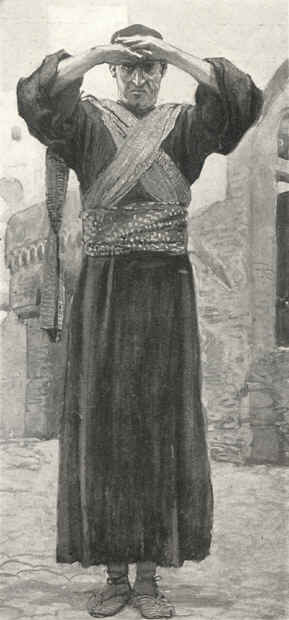
These final five verses of chapter twenty are related to the imagery that will come in chapter twenty-one and set the stage for a new set of imagery organized around a sword. Yet, since in our bible they are a part of chapter twenty I will address them as they stand in the chapter. Now Ezekiel is to set his face[8] towards the south. He is to set his face toward Teman (either a place name for a northern district of Edom or may simply refer to south), Darom (either a place name between Beersheba and Beth-Gubrin or another term for south), and the ‘scrubland’[9] of the Negeb (negeb as a common noun also means south, or dry) (NIB VI: 1294) and declare that a blazing fire is coming upon these lands and it will scorch the land from south to north. Ezekiel answers the LORD that he is being accused of being a “maker of allegories.” The Hebrew doubling of the word masal (proverb, parable) probably indicates to Ezekiel that his message is not being received as seriously as he believes it merits. He may feel that the people are failing to understand his message, or that perhaps they view his words and actions as entertainment, but they do not yet understand that a prophet has been among them. The people may be taunting Ezekiel because his words have not come to pass and that his view of reality seems too divergent from the views of others, even others who claim the title of prophet, in his time and previously. It is difficult to walk through the first twenty-four chapters of Ezekiel, and it is only in the aftermath of the destruction of Jerusalem and the temple, the ending of the line of Davidic kings, and the exile that the prophet’s words make sense. Even those in exile with Ezekiel are looking forward to a homecoming to Jerusalem rather than the extension of their exile to the entire nation. Ezekiel’s words are difficult to stomach in the aftermath of the Babylonian exile and were probably unpalatable beforehand. It is only afterwards that people will understand that this maker of allegories was the prophet in their midst they failed to listen to.
[1] https://www.poetryfoundation.org/poems/56824/tell-all-the-truth-but-tell-it-slant-1263
[3] “The interrogative particle often conveys an indignant affirmation.” (Block, 1997, p. 618)
[4] Ezekiel’s frequently used term gillum which is a derogatory term best rendered as something like ‘shit gods.’
[5] Daniel Block notes that Jeremiah views the Exodus romantically while Ezekiel views this time in Israel’s story as a continued example of their total depravity and abandonment to sin. (Block, 1997, p. 630)
[6] Hebrew samen is actually harsher than horrify. Katheryn Pfisterer Darr suggests, “that I might desolate them.” (NIB VI: 1284)
[7] The books between Joshua and 2 Kings in the bible. Referred to as the Deuteronomic history because they share the theological perspective of Deuteronomy.
[8] Which indicates judgment.
[9] It is doubtful the Negeb, which is desert-like, was ever in its history forested.