Shame…on you

Shame is a feeling that everyone struggles with, men and women of all ages, social status, education level and perceived levels of success. We all struggle with shame. “Shame is the intensely painful feeling or experience of believing that we are flawed and therefore unworthy of love and belonging.” (Brown, 68) Shame is not guilt, where we realize we have done something wrong and can’t believe we did whatever we did. It is not humiliation where we feel like we are receiving treatment we don’t deserve. It is not embarrassment where we can see others having made the same embarrassing thing. Shame becomes a part of the story we tell about ourselves, we begin to believe that we are the issue. Shame moves beyond I have done something wrong to believing that I am something wrong.

Men and women experience shame differently. For women the primary trigger is how they look, followed by motherhood. It sounds like this:

  • Look perfect. Do perfect. Be perfect. Anything less is shaming.
  • Being judged by other mothers.
  • Being exposed—the flawed parts of yourself that you want to hide from everyone are revealed.
  • No matter what I achieve or how far I’ve come, where I come from and what I survived will always keep me from feeling like I’m good enough.
  • Even though everyone knows that there’s no way to do it all, everyone still expects it. Shame is when you can’t pull it off looking like it’s under control.
  • Never enough at home. Never enough at work. Never enough in bed. Never enough with my parents. Shame is never enough.
  • No seat at the cool table. The pretty girls are laughing (Brown, 85)

For men it is organized around the perception of being weak, and this comes from both men and women. If you haven’t watched the video, I know I can really resonate with the man who exclaims, “but when we reach out and share our stories, we get the emotional shit beat out of us.” And not just by other guys, women play into this as well. Men learn young how to pretend to be vulnerable.

Shame for men sounds like:

  • Shame is failure. At work. On the football field. In your marriage. In bed. With money. With your children. It doesn’t matter—shame is failure.
  • Shame is being wrong. Not doing it wrong, but being wrong.
  • Shame is a sense of being defective
  • Shame happens when people think you’re soft. It’s degrading and shaming to be seen as anything but tough.
  • Revealing weakness is shaming. Basically, shame is weakness.
  • Showing fear is shameful. You can’t show fear. You can’t be afraid—no matter what.
  • Shame is being seen as the “guy you can shove up against the lockers.”
  • Our worst fear is being criticized or ridiculed—either one of those is extremely shaming. (Brown, 92)

The experience of shame is the same but the way it is received is different between the sexes. We never become immune to shame, but we can learn to become resilient. Shame prevents us from risking and being creative. It tells us we are not good enough, not smart enough, not popular enough…you can fill in whatever possible fear you like. It keeps us out of the arena, keeps us from sharing things that are important to us and keeps us imprisoned in our own shame. It thrives in an environment of secrecy and judgment.

I know I haven’t done justice to Brené Brown’s Daring Greatly, which is an incredible book-better even than the videos, but it is time for me to move on to something else. Enjoy the video and may you develop resilience to the power of shame.

purple rose 01 by picsofflowers.blogspot.com

Cultures of Scarcity

Narcissism, you would think we are surrounded by it, that every person is self absorbed:politicians, movie stars, young people, athletes, police, parents, CEOs, and the list could go on and on, it is ‘those people’ who are self absorbed, but it is rarely me.  “If only we could cut these people down to size, put them in their right place, make them realize that they need to work for a living” might be some people’s response to those people they dub as narcissists, but the reality is that narcissism is an outgrowth of shame.  It is the fear of being ordinary, of not being noticed or being loveable, belonging, being cool. Often it grows from trying to cultivate a sense of purpose in what may seem to be the hollowness in their lives.

We live with scarcity, the never enough problem. Fill in the blank never _________enough:

  • Never good enough
  • Never perfect enough
  • Never thin enough
  • Never powerful enough
  • Never successful enough
  • Never smart enough
  • Never certain enough
  • Never safe enough
  • Never extraordinary enough (this list comes from Brown’s Daring Greatly, 24)

We get scarcity because we live in a world where we believe it and live it. And scarcity strives in a culture where you are hyper aware of what you lack, now the flip side is that scarcity can blind you to what you have. How big of a paycheck is big enough, how much money do you really need, and yet we live in a culture where we are measured by impossible standards and we have visions of perfection put before our eyes-visions of what we should have, what our family should be, how our marriages should be, how we should look and the list goes on and on.  “Scarcity doesn’t take hold in a culture overnight. But the feeling of scarcity does thrive in a shame-prone cultures that are deeply steeped in comparison and fractured by disengagement” (Brown, 26) Wow, we eat, breathe and drink comparison-we measure ourselves against others and alienation or disengagement is one of the words that when you ask people about how they feel that often sums up there experience. We have much greater access to what is going on in the world, but that engagement often focuses heavily on the negative…school shootings, corporate scandals, wars, natural disasters, famines, unemployment-and even when we are not directly involved we feel that these events “out there” are stealing our sense of security “here.”

There are three components to a culture of scarcity:

  1. Shame: is fear of ridicule and belittling used to manage people and/or keep people in line? Is self worth tied to achievement, productivity or compliance? Are blaming and finger pointing norms? Are name calling and finger pointing rampant? What about favoritism? Is perfectionism an issue?
  2. Comparison: Healthy competition is beneficial, but is there constant overt or covert comparing and ranking? Has creativity been suffocated? Are people held to one narrow standard rather than acknowledged for their unique gifts and contributions? Is there an ideal way of being or one form of talent that is used as measurement of everyone else’s worth?
  3. Disengagement: Are people afraid to take risks and try new things? Is it easier to stay quiet than to share stories, experiences, and ideas? Does it feel as if no one is really paying attention and listening? Is everyone struggling to be seen and heard? (Brown,27)

Scarcity is not cured by abundance. There are many people who are convinced that there is never enough money, never enough time, never enough sleep, never enough health, they will never be beautiful enough or smart enough or popular enough. If you live from a perspective of scarcity it is never enough, no matter what abundance you have. The opposite of scarcity is enough, it is a different way of looking at the world. Scarcity breeds shame and fear, but enough allows you to take the risks involved with being vulnerable.  It is not easy to believe you have enough in a culture that thrives on scarcity, just like it is not easy to remain calm when everyone else may seem anxious.

I think we all seek a feeling of being worthy and nobody wants to live a life based on fear. Courage involves risk and perhaps the greatest risk is vulnerability.

Note: I’m doing this because I am trying to internalize some of what I have learned from Brené Brown’s Daring Greatly which is a phenomenal book and this is a part of a series of posts that pull very heavily from that work.

purple rose 01 by picsofflowers.blogspot.com

Daring Greatly

Sometimes you read something that is just really cool and you need to share some of the ideas with others who may not have read it yet, that is what I feel like after reading Brené Brown’s Daring Greatly. So I’m taking a little time away from where I was going with the authority questions and I’m going to turn inward a little bit and spend some time here…

If you haven’t encountered Brené Brown before this is one of her TED talks that if you can spare 20 minutes is well worth the time

I love psychology, I love to learn in general and so much of what she says rings true to me. At the core we are all seeking connection with others, we seek it out and yet

“…when asked to tell about their most important relationship and experiences of connection, (participants) kept telling me about heartbreak, betrayal and shame—the fear of not being worthy of real connection. We humans have a tendency to define things by what they are not. This is especially true of our emotional experiences” (Daring Greatly, 7)

Brené Brown comes at this from the perspective of a researcher and social worker, and I come at this from the perspective of a pastor where we come face to face with people who seem to be able to handle anything that comes their way and others who are miserable even in the best of circumstances. I’m going to talk about what she reveals about shame in my next post, but to begin with here are some of her basic statements in my paraphrase:

1. We are all seeking love and acceptance, we all want to be like, valued, cared for-it gives meaning to our lives and its absence leads us to question our worth, value and it leads to a great deal of suffering for us (this may be why rejection hurts so much)

2. If you divide people into groups that feel love and belonging and those who struggle with it the key difference is those who feel loveable, who love and who experience belonging simply believe they are worthy of love and belonging. There lives are not easier that people who struggle with it, they are just able to hold onto the belief that they are worthy of love, belonging and joy.

3. This belief of being worthy of love, belonging and happiness doesn’t just happen, it is cultivated (we can learn how to do this in our own lives)

4. Living in a whole-hearted way (Professor Brown’s way of talking about the people who believe they are worthy) leads to being courageous, compassionate and connected

5. The willingness to be vulnerable is the single value attributed to the people that feel loveable

(This is a paraphrase of Daring Greatly, 10)

I’m going to be working through this material to help myself integrate some of these things, but as a pastor there is so much to what she says that really rings true for me. Who we are as a people are people who are worthy of God’s love, we are enough, we are forgiven, loved, cared for, valued, use whatever word you want there, but at the core of our identity is the reality that before anything else we are valued and enough and from there we can begin to live in a way that is courageous, compassionate and connected. More to come…

purple rose 01 by picsofflowers.blogspot.com

Climbing Out of the Rabbit Hole: Walking Away from Post-Modernity

cheshire cat

I’ve probably been spending too much time with philosophy lately, and I know that many people don’t ask the same type of questions that I do, but I am curious-I like a good challenge. I am willing to take an intellectual journey intentionally wrestling with some of the deep questions that are asked by philosophers and historians and artists, but I’m also willing to, after taking seriously what they have to say, walk away unconvinced and disappointed that good questions often can lead to answers that are indeed poor and shallow. I was first made aware of post-modern thought around the turn of the millennia when I began studying at seminary, and I guess that it would be hard to study any liberal arts discipline without being exposed in significant, if not always obvious, ways to the questions of postmodern philosophy, and while I am thankful for many of the perspectives that these questions exposed me to, it is time to climb out of the rabbit hole and to begin to reconstruct a different way of looking at the world.

I am taking the climbing out of the rabbit hole comment from a series of movies that was quite intentionally shaped by a postmodern viewpoint, The Matrix.(The link will take you to one of the more famous and most representative scenes of the movie) If one can get past the huge amount of violence that is present in all three of the films they ask some very deep philosophical questions about the nature of knowledge, of truth, of authority and power, of free will and volition and in almost parabolic form the main character Neo become the one, a Christ-type figure that liberates a portion of humanity to their enslavement to a system of illusion and lies, but the reality that he has to offer is a brutal, ugly and equally ambiguous one…it may be the truth (or at least closer to it) but it is an uncomfortable one.

So first, what is this postmodernism I am talking about walking away from? It is a reaction to the optimistic worldview that eventually we would be able to fix all of our problems through science, society, technology and information. In the words of Morpheus from the video above they became aware that “there is something wrong with the world…like a splinter in their mind driving them mad.” Not a unified group, they began to question the progressive hope that humanity could and would continue to get better and better off, because despite the privileged status of many of the early postmodern thinkers and artists (most of these were members of the academic and artistic portions of society in the 1950s and later)they viewed the world critically and often felt betrayed by this optimistic worldview. Instead they viewed art, language, society, history, science and technology all serving the political ends of those in power, while those without power were victims of progress. Postmodern thought is certain in its uncertainty, in an information society it views most information needing to be distrusted because it is merely  being utilized to create a narrative to benefit those in power, and in reality taken to extremes it borders on paranoia. For a postmodern person all meta-narratives (the big stories that help us make sense of our lives-whether Christianity or national identity or history) lost their authority and that truth, at least a universal truth, is impossible and some manner of relativism is what we are left with. Truth instead of being something that is true for everyone is instead dependent on one’s standpoint (i.e. am I viewing this question as a woman, as Hispanic, as poor, as an immigrant, as a person in the third world, etc.) and even language itself is a cultural construct.  Ultimately we live in our constructions of reality, our world and our truth revolve around us. Everything from art and literature to science and technology became subject to an endless set of qualifications and limitations. If you go down the rabbit hole very far it can become very disabling, it is a type of cynicism that makes you question every foundation that you try to place something upon, it allows a person to be a great critic but denies the narratives and structure in which to create. Honestly, most postmodern artwork is ugly, much of its thought is highly depressing and in its quest to liberate people intellectually it managed to take away their tools to bring together people for societal change.

Many of the questions that postmodern thinkers asked needed to be asked, but it is one thing to be a critic and another to be a constructive critic which helps frame a way forward. The hermeneutic of suspicion, where everything is viewed with a sense that it might not be trustworthy, cannot be the system any sane person lives their lives out of. We need narratives, big stories that help us make sense of ourselves and our world. Do those narratives need to be trustworthy, absolutely and in particular some of the feminist and post-colonial critiques of biblical studies, theology and politics have helped me re-evaluate my own approach to these narratives, but I am also unwilling to collapse into a relativism that has no sense of truth that is universal. We need history and art and beauty, and perhaps a pre-modern sense of wonder and mystery. The world needs truth more than it needs facts and data, it needs a set of inter-related stories to help us make the tough ethical and economic decisions that we as individuals and society have to navigate. We need big stories of who we are as people, our past and our present and our hopes for the future as we engage in difficult decisions related to war and peace, crime and punishment, medical care and technological innovation as well as our everyday relationships with one another. So in my own way this is a walking away,a climbing out of the rabbit hole if you will, not unchanged by the experience and the questions, but rather in a sense that it is time to grow up, to put childish things aside, to realize that even in its imperfections that the we all need stories to make sense of our lives and that my story and the stories of those around me have more in common than I had been led to believe.

purple rose 01 by picsofflowers.blogspot.com

From Sermon to Text: Following Jesus in an ADD world-Sermon from July 22, 2012

One thing I have learned is that for me a sermon is never complete in its evolution until the final time I give it. I don’t preach every week, but on the weeks I do I am going to try to go backwards from sermon to text to complete the cycle before moving on, so here is the sermon from July 22:

  Psalm 23 (NRSV)

   The LORD is my shepherd, I shall not want.

 2 He makes me lie down in green pastures; he leads me beside still waters;

 3 he restores my soul. He leads me in right paths for his name’s sake.

 4 Even though I walk through the darkest valley, I fear no evil;

   for you are with me; your rod and your staff– they comfort me.

 5 You prepare a table before me in the presence of my enemies;

   you anoint my head with oil; my cup overflows.

 6 Surely goodness and mercy shall follow me all the days of my life,

   and I shall dwell in the house of the LORD my whole life long.


Mark 6 (NRSV)

30 The apostles gathered around Jesus, and told him all that they had done and taught. 31 He said to them, “Come away to a deserted place all by yourselves and rest a while.” For many were coming and going, and they had no leisure even to eat. 32 And they went away in the boat to a deserted place by themselves.33 Now many saw them going and recognized them, and they hurried there on foot from all the towns and arrived ahead of them. 34 As he went ashore, he saw a great crowd; and he had compassion for them, because they were like sheep without a shepherd; and he began to teach them many things.

53 When they had crossed over, they came to land at Gennesaret and moored the boat. 54 When they got out of the boat, people at once recognized him, 55 and rushed about that whole region and began to bring the sick on mats to wherever they heard he was. 56 And wherever he went, into villages or cities or farms, they laid the sick in the marketplaces, and begged him that they might touch even the fringe of his cloak; and all who touched it were healed.


One thing I’ve learned in my eight years of ministry as a pastor is that God definitely has a sense of humor, and I quickly thought after reading these texts initially-‘great I’m going to preach on all the distractions that make it challenging to follow God’ to which God responded, ‘OK distractions, you want distractions I can give you distractions!’ And so in a week with a wedding and a funeral, where I spent more time in the hospital visiting people than at my desk trying to work on all the things that I felt like I needed to get done, and my first week back from vacation where I have both my kids with me I set off to write on set of ideas, but God and sitting with Psalm 23 and the 6th chapter of Mark changed that.

Now I am a person who grew up with the rise of computer technology and so I am very comfortable with digital media. I don’t think for example that texting has made us unable to have face to face conversations or that most people have substituted friend on Facebook for real friendships, but I do know how many distractions there can be out there.
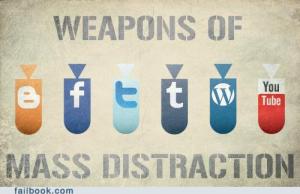
Richard Lischer, a Lutheran pastor who teaches at Duke, in his 2005 book the End of Words makes the statement that the average American is subjected to over 6,000 messages per day, which may sound like a lot, but when you take into account all the advertisements you hear and see on billboards, the computer, radio and television, the songs you listen to on whatever media you use, the websites you visit, the shows you watch on TV, movies you watch, conversations you have verbally or digitally, as well as all the emails, tweets, blogs, facebook posts, etc. you see in a typical day, and maybe that number is too low. Yet as a Christian we talk about a group of stories we call gospel and we hope that they can pierce all the noise and become a part of other people’s stories. We are still at the stage where we may know how to use all the technology that surrounds us in our daily lives, but we are still trying to figure out what it means—and yet this is not a new phenomena. In the 1960s Martin Luther King, Jr. could state that “we have allowed our technology to outpace our theology.” And we find ourselves in that continual struggle to make sense of ourselves and our relationship to God and others in a rapidly changing world. We try to make sense of our theology, but there are so many distractions, so much that has changed (even if not consciously) how we think about ourselves. Sometimes I think we have all these wonderful tools for information and communication, but we sometimes find ourselves addicted to them. I know I have certainly had times where I have looked at my smart phone wondering if there was a personal or work email I needed to check, something on facebook that someone had messaged me, some text I was waiting for, or (novel idea for a phone) whether I had missed any calls and I find myself checking it even on vacation even when I know that most of what will show up is not very important.

Another of Richard Lischer’s insightful statements was that the ‘first casualty of the information age was truth.’ We are surrounded my facts, opinions, data and yet we have lost much of the beauty, passion, experimentation and honestly the ability to accept failure in this world of data. Most of us have had the experience of trying to make a decision and then going back, even once we are pretty sure of what the course of action we are going to take is, and getting more data…but the reality is that beyond a point data does not help us make better decisions, it becomes a tool to postpone making a decision. Sometimes data also can be construed in a way that is deceptive or sensationalized in order to attract attention. In an earlier post I look at the data behind the article in the Omaha World-Herald “Are We Losing Faith in Religion?” but the reality when you look at the data there has been a loss of faith in everything they surveyed in recent years, even the military, police and small businesses which are the only three institutions that scored better than organized religion. Yet we live in a world where we like data, and Gallup is one of the many sources that help us gather data (in the hope that we can make better decision) but there has been a shift to where we are the decision makers, we are the center, the world revolves around us.

Psalm 23 is one of the most familiar passages of scripture, but also one of the most alien to most of us. The idea that God is our shepherd sounds nice, but ultimately we view ourselves as the decision makers. We are not worried about what we are going to eat, where we are going to sleep, our own protection and security: we build our lives around providing these things for ourselves. If you are like me you know where the next week’s worth of meals are coming from because you went to the grocery store and your freezer is stocked. In addition to this the rent is paid, so we know where we will sleep. It is only when something shakes up our life and we feel like we aren’t in control that we can understand what it means for the Lord to be our shepherd.
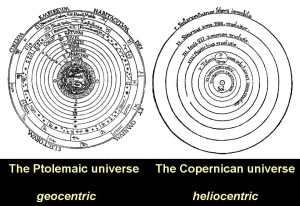
In a way it is like we’ve gone back in time. In the 1500s, it was a time of great change, in 1492 Columbus sailed the ocean blue so in the 1500s the new world was being explored. In Europe a monk named Martin Luther was stirring up what would become the reformation which would drastically change not only religion but education and the political structure of Europe. Finally there was this guy named Copernicus who had the audacity to suggest and demonstrate that instead of the sun and stars and planets revolving around the earth that instead the sun was at the center and the earth revolved around it. Most people of his time thought he was crazy, Luther included, but it is very rare to find an adult today that doesn’t understand the earth as a planet in rotation around the sun. Yet I think all the data we find ourselves surrounded by allows us to think we are the center and everything rotates around us and is held together by our own gravitational pull. But if the Lord is my shepherd, then God is at the center and we rotate around God and we are just one of the many who are caught up in the gravitational field that God exerts.

To spend a little more time with the agricultural image of Psalm 23, when I was on vacation with my family at their home in Bandera my sister Kelly has horses and goats and some other animals as well, but with animals if you have food you (or more precisely the food you hold) are the most critical things in the world. Well, Kelly and I had brought back some oats from the feed store for the horses and the horses were in another part of their property and we thought maybe we can sneak in and put the feed away without them noticing, so we drove my sisters truck onto the property all the way to the buildings where she stores the feed, begin unloading and then we are noticed. The horses realize the truck is here, they’re unloading something out of it, and they must have FOOD!!! And so the horses come at a gallop across the yard, desperate for some of the food we are unloading. Kelly manages to keep the horses away while we I finish unloading, but there is something to this…and this is where I think we come into the reading for Mark from today, because even though we may not become single minded for food like a horse or goat might, when we have a need if someone can provide that we will do anything to get there.

I think if we go back to the image of the planets rotating around the sun for a second we also need to understand that it isn’t just planets out there, there is a lot of other stuff, and not everything has a nice elliptical orbit where is stays at roughly the same distance from the earth. There are asteroids, comets and other bodies that get pulled close to the sun for a time and then draw away and they cross the orbits of the planets and sometimes there are collisions. Well if the Lord is our center of gravity, it would make sense that there are people who in times of need are drawn closer, they know they have a need for food, for healing, to make sense of something in their lives and so they are drawn close and sometimes they cross our path. Now among planets there is a collision, but among people they call this ministry.

As I approach Mark 6, the disciples have just returned from where Jesus sent them out to the surrounding towns and communities to proclaim the kingdom of God has drawn near, to heal their sick and cast out demons, and they stayed wherever they were welcomed. Now they have returned and they are tired, they want a break and yet people keep coming. They are drawn to Jesus, they have needs, they want to be around him, and they don’t even have time to eat because so many people have been drawn near, and you can almost hear in the text the disciples saying, “MAKE THEM GO AWAY!” and Jesus tries to break away but the need is so great and the people are looking for the Lord who is their shepherd.

Now I approach the disciples’ position based on my own experiences and when I hear they didn’t even have time to eat I am taken back to my time in the Army when I was a staff officer for 3rd Squadron, 2nd Cavalry and I was both one of the officers that ran then Tactical Operations Center (TOC) and I was one of the primary planning officers-which is a really bad combination. You see when you aren’t running operations you are planning and when you aren’t planning you are typically running an operation and if we went on a rotation to one of the training centers, you would typically spend 14 days actively involved in what is called ‘the box’ where you were fighting against another unit and it would be broken into a 9 day and 5 day portion. During the first 9 days there are numerous battles, and although I am sure I may have dosed off at times, I never laid down to go to sleep, and there were times when the meals were delivered but if I was planning I wouldn’t take a break, and by the end of the first nine days I was physically and mentally exhausted and they gave us a 14 hour break (because the next five days are live fire with real bullets, shells, and missiles) and I remember lying down and I remember someone shaking me to wake me up. Now I’m not saying the disciples are that tired, but they want a break, they want to get away.

All these people they are drawn to Jesus, and these are the distractions that God places in our way to pay attention to. I remember a story that Nate Frambach, my advisor from seminary told me where in his first call he felt he had to get a sermon completed, or a class ready or be ready for a meeting that night and then someone would come into the office and want to talk, of someone would call needing to pray, or someone would be in the hospital needing to be visited. Initially he thought of these to the ministry he was supposed to be doing but at some point he realized that these were his ministry. These were the place where he and Jesus and another person had been brought together and sometimes more than any sermon or class that was his ministry. Now I’m not going to say that I understood that coming out of seminary but I do now.

One thing I have learned is that for God people are more important than our border, boundaries, ideas, projects or anything else we may want to place in a higher position. This was reinforced for me back in 2009, I was at a synod assembly and it was one of those meetings where an issue that was important to the church I was serving was being debated and yet I also knew that Bill Johnston was back in Edmond, Oklahoma and his artificial heart was failing him. Bill had an artificial heart the entire time I served in Oklahoma up to that point, and he was a big man- a former basketball player and so the odds of an donor heart becoming available were slim and so I was caught between the debate (even an important debate) and Bill and his family. Now even though I agonized over this at this point, I’m more certain than even that I made the right choice to journey back from Tulsa to Edmond, to be there with Bill and Velta and his family in his last days and then to be with them and the congregation as they grieved. No matter what issue it is, people are more important.

One last story and then I’ll close (if you’ve read my blog before it is the story that is in Something Different a Farm without Fences). In Kendra Creasy Dean’s book, Almost Christian: What the Faith of our Teenagers is Telling the American Church (which is an interesting book in its own right) she includes this story from an African Christian:

You Americans think of Christianity as a farm with a fence. Your question is, ‘Are you inside the fence or outside of it?’ We Africans think differently. We think of Christianity as a farm with no fence. Our question is, ‘Are you heading towards the farm or away from it?’ “The church’s identity is not defined primarily by its edges, but by its center: focused on Christ, the sole source of our identity, no intruder poses a threat. No alien hops the fence, because there is no fence.

I think there is something to this, and going back to the image of the solar system, if the center is Christ our orbits are probably not going to keep us the same distance away all the time, we will be drawn closer and drift farther away and in the midst of our journey we will encounter others. So I suppose the issue is not whether we are distracted or not, but what are the things we are allowing to distract us? Are they people that God has placed in our path? Or is it the unending noise and data that can distract us and make us think everything revolves around and depends upon us.  In the last verse of Psalm 23 I think we find one more important note and it is a note that can get lost in translation: Surely the Lord’s goodness and mercy (this is the Hebrew word Hesed, the word that is used to talk about God’s compassion, love , mercy and grace) shall Pursue (this is one of those words that is more about actively seeking or pursuing rather than merely following) me all the days of my life. Flipping one more time to the sun and the solar system, the planets and comets and asteroids are all drawn inward by the force of the sun’s gravity, and even at point where we may be drifting away from the center God’s goodness and mercy continue to pursue us and draw us in.


purple rose 01 by picsofflowers.blogspot.com

Something Different: Are We Losing Faith in Religion?

On the front page of yesterday’s Omaha World-Herald the central story was “Are We Losing Faith in Religion?” The article highlights Gallup’s 2012 survey on the Confidence of Institutions which has been taken annually since 1973. To me this is not surprising, honestly I am surprised that organized religion scored as well as it did, with the way in which the perception of authority is changing. In general people have become much more skeptical of the political process, the economic world, the medical system, news sources, and big business. Organized religion scored better than any institution other than the military, small business and the police.

Gallup does not report reasons, only breaks down responses into six categories of confidence in institutions:

                 Great Deal of Confidence
                Quite a Lot
                Some
                Very Little
                None
                No Opinion

 But since I’ve been doing a fair bit of thinking about authority lately here are some of my reflections:

This is a part of a broader cultural and philosophical trend to distrust authority, as Eileen Burke-Sullivan (who is quoted in the article) says there is “a general malaise in the United States about leadership of any kind.” There has always been some level of questioning of authority built into the type of governmental system that we have, but we live in a time of increasing polarization in many institutions. Television news, for comparison to organized religion’s 44%, only received a 21% great deal/quite a lot of confidence and newspapers only 25%. Even the people communicating the news to us are not to be trusted. Postmodernism’s hermeneutic of suspicion (the idea that every source of information needs to be evaluated suspiciously) is firmly imbedded in our sub consciousness. As the X-Files used to say, “Question everything.”

There are many ways in which each of these organizations have failed to live up to the standards they set for themselves. Probably the two most common examples are sexual and fiscal impropriety. In religion there are certainly numerous scandals across denominations, from the Catholic Church’s continued struggle with priests who sexually abused minors to the indiscretions of mega-church pastors. Financial mismanagement, fraud and theft are not new but it receives more news coverage and visibility than at other times in history. This is not merely a function of religious organizations; it applies in government, economic institutions, and medical. Ultimately the increased visibility of these very real moral failings continues to feed the perception that those in various positions of authority are not looking out for our best interest.

Even though authority of religious institutions has been affected by both of the above criteria, there is a broader set of re-evaluation going on as the church (along with society) enters into a period of re-examining what it believes in light of a rapidly changing world. This is not always an easy process and there will be conflict which sometimes elevates into combat. The way the church has dealt with controversial issues (and it has done this rather frequently since the 1960s) as well as trivial issues has often not been healthy and many have walked away from the conflict wounded and with a deep mistrust of the organization.

For me this is a challenging but exciting time to try to re-think what is means to be Church. I am convinced that at the center are the questions of authority-which ultimately has to do with the ability to narrate the stories in which we make sense of our world. There are a lot of stories out there, Richard Lischer in The End of Words makes the claim that the average American is exposed to 6,000 messages per day (conversations, advertisements, stories, songs, tweets, texts, etc…) and honestly that is one of the primary reason I am doing the work of relooking how the story was told across time and who got to tell it. I’m not convinced I have the answers yet, but I am convinced I am asking the right questions.

On a different note, why did the military, the police and small businesses score as well as they did? Here are my thoughts on that, which are by no means scientific. In contrast to the Vietnam War where the military was lumped in with people’s feelings about authority in general and the war in particular, since the 1980s, regardless of the public’s feelings about a war or a political leader, the perception of the military has remained high. Partially this may be guilt related; since people no longer have the threat of being drafted to serve there is a feeling that the military is making sacrifices that the rest of us are not. Even though the police have had times where they are viewed negatively, for the most part people have a fairly positive attitude towards police officers who they believe put their lives in danger for their protection. Small business has been trumpeted across the political spectrum as the group that will save us from recession and so who doesn’t like small business? Even each of these groups has seen some small declines in recent years, but they still enjoy broad confidence.

purple rose 01 by picsofflowers.blogspot.com

The Place of Authority Part 3-1: The Fall of the Western Empire and the Rise of the Bishop of Rome

Raphael's Meeting Between St. Leo and Attila the Hun, 1514, Public Domain Artwork

Meeting Between Leo the Great and Attila the Hun, Raphael (1514), Public Domain Artwork

The reason that the western half of the Roman Empire collapsed are legion (pardon the pun). Although the eastern half of the empire and the Eastern Church would survive mainly intact for another thousand years, in the western half of the empire (which comprised much of Europe and Northern Africa) the relative peace, many of the roads and aqueducts, and much of the literature, art and knowledge of the previous centuries would be lost. In the place of the emperor and the legions various groups of “barbarians”, some Christian (whether orthodox or Arian) and some pagan came in to fill the vacuum. With the collapse of the Western Roman Empire the one constant was the church.

In 378 CE the Goths delivered a great blow to the Roman Empire at the battle of Adrianople. For centuries the legions had managed to keep the Germanic Peoples behind the Rhine and the Danube Rivers. At the battle of Adrianople the legions failed to repel the incoming Goths, the emperor was killed and the floodgates were open. Vandal, Goths, Gauls, Angels and Saxons and more would all settle into parts of the Empire they had sacked over the next century. By 410 CE the Goths sacked Rome, but even before this the formerly united Roman Empire had been divided into an eastern and western half. Theodosius I (379-395 CE) was the last emperor who controlled both halves of the empire but there were significant struggles internally and externally well before Theodosius.  With struggles within and struggles without the Roman Empire lost its control of most of Europe and North Africa, and what remained was based out of Constantinople and we will examine this group in the next blog.

What remained in the midst of the wreckage of the Empire was the Church, and over the next several centuries the invaders who were either pagan or Arian would be converted to Nicene Orthodoxy as it existed in the West. The exception is North Africa which I will deal with in a later blog which found itself conflicted between multiple groups. It is during this period where the rise of the Bishop of Rome (or the Pope) escalates. The Bishop of Rome had been a powerful position before, but Antioch (in Syria) and Alexandria (in Egypt) as well as key leaders from North Africa had also held equivalent power. Partially because there was no one else who would step into the role, partially due to a handful of very capable leaders, and partially due to the need for someone to act as a uniting figure the papacy emerged as one of the major sources of authority for the next 1,000 years.

In 452 CE when Attila the Hun invaded Italy, the western emperor did not have the ability to prevent Attila from marching into Rome and the eastern emperor gave indications that he was unwilling to assist, so it was Pope Leo who went out to meet with Attila. What Leo said to Attila is unknown, but Attila turned north and died soon afterwards. Leo could not prevent the Vandals from invading the city in 455 CE, but Leo led the negotiations with Genseric, the Vandal leader, and was able to prevent the Vandals from burning the city.[i] There would still be tensions between the Pope and the Eastern Emperor, but by 565 CE the Eastern Empire no longer was able to influence events in Italy. With the danger of yet another invasion (this time by the Lombards) as well as an epidemic in Rome Popes Pelagius II and his successor Pope Gregory (the Great) would become the leaders of Rome by default.

Pelagius II would pay the Lombards not to invade the city and with the help of monks, like Gregory who would become his successor, he organized the feeding of the hungry, burial of the dead, sanitation and other essential functions. When Pelagius became ill and died Gregory was elected as Pope and he adopted the responsibility zealously. Gregory oversaw the rebuilding of the city defenses and garrison, took measures to guarantee the shipment of wheat from Sicily, ensured food was distributed, supervised the rebuilding of the aqueducts, and generally restored order. In addition to this Gregory would be instrumental in converting the Visigoth king in Spain to Nicene Catholicism as well as extending the authority of Rome to the British Isles. The Bishop of Rome changed from being one of the powerful bishops to the patriarch of the West charged with both ecclesial (churchly) and secular responsibility. In the midst of the change in the West the Roman Church’s leadership emerged stronger than ever and they would be one of the primary sources of authority for the next 1,000 years in the west.

purple rose 01 by picsofflowers.blogspot.com


[i] Prosper of Aquitaine is the only fifth century report of this meeting between Leo and Genseric so some scholars are skeptical that this meeting occurred. Regardless of whether it was Leo who was able to convince Genseric to be satisfied with only pillage the legend would be firmly there. The whole story of the dysfunctional nature of Roman politics that led to this point is an interesting story as well, maybe for another time.

The Place of Authority 2-6: The Constantinian Revolution Part 2-Councils, Canons and Creeds

Icon of the Council of Nicea

I mentioned in an early post (see the Place of Authority 2-3) that Christianity came into contact with the Greek culture and even though Christianity attempted to remain true to its Jewish roots, the questions and the terms of the dialogue were set by the Greek culture. The arguments and theology of early church leaders like Justin, Clement of Alexandria and Origen had conducted the debate with the surrounding culture in terms the culture was familiar with. Especially in the Eastern (Greek speaking) half of the church there was an emerging conflict between the philosophical ideas of what God should be like and various readings of Scripture. Remember that almost all of the early Christian leaders read the scriptures allegorically, and just as there are multiple ways of reading scripture today the early church had this struggle with this as well.

In 325 CE Emperor Constantine called the leaders of the early church together at Nicea, a city in modern day Turkey near Constantinople (Istanbul). Many of the issues dealt with were practical, having to do with which leaders and position would carry the greatest authority, how to readmit lapsed Christians, and how to elects individuals to fill the various leadership roles within the church. These were all essential tasks for an organization which had moved from being decentralized and rather small to a much more organized and broad church. It was within this meeting that some of the theological differences present came to the surface and had to be dealt with.

The controversy is named Arianism for a presbyter named Arius who found himself in conflict with the bishop of Alexandria (appropriately named Alexander) over the relation of Jesus and the Father. At the council of Nicea an Alexandrian controversy became a controversy that consumed the first council when a few convinced Arians, led by Eusebius of Nicomedia attempted to have the assembly rebuke Alexander for his condemnation of Arius’ teachings. At stake was whether the person of the Christ was divine with the Father or whether he was a created creature. Originally the assembly wanted to create a confession stringing together biblical texts, but they found it difficult to unmistakably refute Arianism using only scripture, but would eventually create a creed heavily dependent on a mixture of biblical and philosophical language to reject Arianism. This would be the beginning of the Nicene Creed (the Nicene Creed we use today would effectively be finished at the council of Constantinople in 381 CE but the first two paragraphs come from the Council of Nicea). This is the language agreed on in Nicea about Christ:

And in one Lord Jesus Christ, the Son of God, the only-begotten of the Father, that is, from the substance of the Father, God of God, light of light, true God of true God, begotten, not made, of one substance (homoousios) with the Father, through whom all things were made, both in heaven and on earth, who for us humans and for our salvation descended and became incarnate, becoming human, suffered and rose again on the third day, ascended to the heavens, and will come to judge the living and the dead.

The controversy was all about the person of Christ, and I find it interesting that the controversy stays there throughout this period and never moves to consider the work or the teaching of Christ. This creed, begun in a council called and presided over by an emperor not yet baptized, would be the one statement of faith that would be agreed upon by the Western and Eastern Church and would at a later point be a part of the controversy that would split the two, but that is a later story.

Even though the canon was not fixed at the Council of Nicea, as many people believe, the canon had taken the decisive shape by this point. Revelation and Hebrews would eventually gain enough acceptance to be viewed by most as a part of the New Testament. Yet the gospels and the letters of the New Testament began to be used more as a tool for theological ideas rather than understood in their own right. Christianity, like its predecessor Judaism, was moving on its own temple and monarchy trajectory-except now the temple was the church and the monarch was the Roman Emperor. Creeds would begin to become more influential than story, councils would become the interpreter of scriptures and although with the translation of the Bible in to Latin by Jerome made it available in the language of the Western half of the empire both illiteracy and the unavailability of copies of the scriptures in either the Greek or Latin would make the authority rest with the educated elite of both the ruling and clerical class.

There is certainly much to criticize about this era of Christianity’s struggle with authority from many people’s standpoints, especially as we find ourselves coming into a post-Christendom era (according to many commentators) but there is also much to admire. This was a time of theological giants: Athanasius, Eusebius of Caesarea, Athanasius, the Cappadocian Fathers (Basil the Great, Gregory of Nyssa and Gregory of Nazianzus), John Chrysostom, Jerome, Ambrose and perhaps the greatest of this group (from a Western Church perspective) Ambrose’s student Augustine of Hippo. The shape of the church in both the West and the East would be shaped for the next 1,000 years during this era. At the beginning of the fifth century the political climate would change as Rome’s loses its position as the sole imperial authority and we enter what is commonly called the Medieval Era. Much will be lost in the coming era, but the church will be the authority that many look to in the midst of the crisis Christianity will continue to spread throughout Europe, although in the Middle East and Africa a new player will emerge on the scene. It is to this era we will turn next.

purple rose 01 by picsofflowers.blogspot.com

The Place of Authority 2-5: The Constantinian Revolution Part 1-The Rise of Power and the Crisis of Authenticity

The Baptism of Constantine, 1520-1524 by students of Raphael, Public Domain Art

Then the devil led him up and showed him in an instant all the kingdoms of the world. And the devil said to him, “To you I will give their glory and all this authority; for it has been given over to me, and I give it to anyone I please” Luke 6.5f NRSV

In 312 CE when Emperor Constantine adopts a favorable stance towards the church and ends roughly 150 years of various levels of persecution a major change takes place. Christianity moves from the position of powerless to powerful, from being viewed as atheistic to becoming the religion of the empire (although this move is not completed under Constantine, it begins here) from being a persecuted and scattered minority to being an institution able to build large buildings, gather and deliberate in public and to freely communicate back and forth. In short the world that the church knows is turned upside down and it raises a lot of questions then and now. For some the church sold its soul to the devil and aligned itself with Rome, was corrupted and would never be the same. For others this was the Church’s great triumph and it ushered in the new age for the Christian Church. Reality is probably somewhere between these two extremes, but this was an era of such remarkable change in the church’s identity and authority that we need to spend a little time here.

People flocked into the now suddenly popular church. Church buildings became large structures like the temples of other religions, priests and leaders who had previously dressed in common clothes began to wear formal dress, and even incense once the province of the Imperial court became an aspect of the church’s worship. There also is a sense in which the leaders began to model themselves after the Old Testament priesthood and to occupy more of a priestly role within the church and society. Those in the church who viewed the emperor’s favor as a positive thing began to look upon the emperor as the one anointed by God to bring both history and the empire to its apex. But this sudden rise was certainly not without its own set of crises and problems.

There was a major crisis of authenticity within the church. Many Christians had faithfully endured shame, suffering and in several cases death and had not renounced their faith-but others, including some leaders had under the pressure of interrogation or the threat of death sworn an oath of allegiance to Caesar, had handed over Christian scriptures or in some other way renounced their faith. Others had simply fled away from the persecution rather than to become a martyr for various reasons. Now that Christianity was no longer a persecuted religion it raised many new questions: “Do those members and leaders of the community who renounced their faith still have a place within the community?” “Does the work of leaders who renounced their faith still have a valid standing (for example does a person baptized by a leader who renounced the faith need to be re-baptized)?”  “How do we accept new members who have not had to go through the struggles we went through when we became Christians?” “Are these new converts to the faith doing this for reasons of social advancement or are they doing it because of a sincere devotion to God?” These were not questions answered easily or quickly.

One of the early controversies within this change has to do with leaders who failed to remain faithful through the persecution. The Donatist controversy, where the question of “did the faithfulness of the leader impact the efficacy of an act (like baptism or eucharist or forgiveness) or not?” Paired with this question was the secondary question of whether a lapsed or unfaithful leader could return to leadership within the church. Ultimately the church answered that the ministry they did was valid and that it was possible (although not necessarily automatic) that a leader who under pressure had renounced his faith (and it was almost always a male leader at this point) could return to an active role in the leadership of the church.  With this new members were welcomed and many quickly joined the Christian church now that it was no longer a persecuted minority. When in 380 CE Christianity becomes the official religion of the Roman Empire under Emperor Theodosius the church is still trying to sort through the effects of the transition to being the dominant religion.

For some this was a severe dilution of the holiness of the church and they would in many cases flee from the cities and attempt to live a holy life in isolation or in communities. This is not the beginning of Monasticism, where monks and nuns would retreat from the world around them in order to live holy lives, but it certainly marked an escalation in the number of people trying to pull away in order to be faithful.  In contrast to the regality that clergy and worship throughout the empire were beginning to adopt, the monks and nuns fled into the wilderness or out of the cities to practice a simpler and more constant devotion. These monks and nuns would provide one of the major institutions that would be important for the centuries to come. The monks and sisters would evolve into one of the major reforming voices in the church. Monks would both pose a challenge to the bishops and their sometimes very worldly lives and at other times they would find themselves called upon to be leaders of the church. The monks would also be responsible for preserving much of the knowledge that would otherwise be lost in the conflicts of the coming centuries.

Even with all of these challenges the position of the church had changed dramatically. With that change came the ability to focus internally on how it would determine what it would believe, to formalize its doctrine and its cannon, and to move towards becoming the authority the society would look to in the coming collapse. The authority of the church would not go unchallenged, but as the church addressed these challenges it would centralize its authority, its doctrine, and in this age of the theologian bishops two major authorities would hold power-the emperor and the council and it is to this reality that we will turn next.

purple rose 01 by picsofflowers.blogspot.com

The Place of Authority 2-4: The Practices of the Early Church

Baptism Fresco on the Catacombs of St. Marcellinus and Peter, Via Labicana, Rome, Italy

There are two ways, one of life and one of death, but a great difference between the two ways. The way of life, then, is this: First, you shall love God who made you; second, love your neighbor as yourself, and do not do to another what you would not want done to you. Didache (Chapter 1), 2nd Century Christian Writing

There are times I feel like Cuthbert Binns, the History of Magic Teacher from the Harry Potter series who one day falls asleep in the teacher’s lounge, dies and then as a ghost goes on teaching without seeming to realize the difference. I hope that unlike Cuthbert my approach to looking at authority within the history of Judaism and now Christianity is not incessantly boring, and is rather enlightening as we go back through time and examine the story of how we got where we are today. There are times where I want to take a shorter path, but I personally am learning a lot from going back and re-engaging material I haven’t studied since seminary-I have made some new connections that will impact some of my conclusions.

Practices are critical to the formation of identity and they help to shape what the people and any group come to believe. As Prosper of Aquitaine (390-455 CE), a Christian from a later era than I am currently discussing, memorably put it “the rule of prayer should lay down the rule of faith” (Pelikan, The Christian Tradition 1:339) and so the everyday practices of early Christians allowed them to make sense of the persecution they received from the Romans or the struggles they went through in their daily lives. It also gave them the basis of their community and bound them together with Christians across the empire and indeed across the world. Practices may not sound exciting to talk about, but their meaning will be discussed and debated for the millennia to come.

Love is the foundational idea that gets worked out in these practices, a love for neighbor and even for enemy that forms the basis for the actions of the early church. Certainly there will be many times where the early churches (like modern churches) will fail to live up to this ideal, yet in a society with no social safety net the vulnerable (the widows, orphans, immigrant and the elderly or disabled) were often taken in by many of the early churches and given identity and meaning. Certainly there were apologists and early thinkers like Justin Martyr or Origin who tried to make an intellectual case for Christianity, but most people came to Christianity through the example and witness of anonymous Christians, and they were invited into the journey of coming Christian by people who they encountered in the marketplace, their homes and their worksites.

With the persecution by the Roman Empire it was a dangerous thing to become a Christian, and early Christians wanted to make sure that potential converts were truly seekers and not spies. Often there would be a detailed process of catechesis, education in the faith, before a seeker would be admitted to the mysteries of the faith (baptism and then communion or Eucharist). Most of these communities were rather small, meeting in houses, cemeteries, catacombs  or in business places both because they could not have afforded a building dedicated for their meetings, but also for fear of being detected by authorities.

Baptism was the mystery of faith that led to identity with the church and mystically with Christ. A person in the waters was made clean, forgiven of sins, regenerated into a new person and received the Holy Spirit. Once a person was baptized they were a full participant in the life of the community, they could worship with all their new brothers and sisters in Christ, they could partake in the Eucharist. Even without any significant conflict the meaning of baptism was pretty much stabilized by the end of the second century with no real conflict over practice and thought (with one exception) until the time of the Reformation.

Eucharist, the Lord’s Supper or Communion was a community meal in which the people present celebrated their unity in Christ, remembered the actions of Jesus during the last week of his life and shared a meal that they understood having both spiritual and earthly realities. The precision of the debates that would emerge during the time of the reformation are not present, but the idea of the Eucharist having the power to transform the bodies of the early Christians from corruptible to incorruptible or they could call it the ‘flesh of Christ’ or even a sacrifice, but the fact that they didn’t nail down precisely what was happening did not stop them from trying to explain what it meant. It would take focusing in on Christology (who Christ was) before the early Church would have the language for the precision of later centuries.

 Around both of these realities was worship which focused on Jesus, eating together with the community, sharing their lives together and continuing to confess “Jesus as their Lord” even in the face of hardship. As the church moved into the third century it was still a persecuted group, the basics of structure had come into being (offices like bishop, presbyter and deacon were used-people set aside for helping the community function, but it was not a hierarchical as we are used to and there was not a specific class of clergy) and there was the beginning of movement towards what a canon would look like, what practices would be formational, and at least some commonality in what was to be believed, but a major change was on the horizon, a change that would transform the church from top to bottom. For some the early church was about to experience its triumph, for others it was making a deal with the devil, but in 312 CE the emergence of Constantine, an emperor favorably disposed to Christianity, the church would have to redefine itself yet again and ask itself the questions of authority that continually emerge.

purple rose 01 by picsofflowers.blogspot.com