Category Archives: Psychology and Philosophy

Metaphors of Reality

Newton by William Blake (1795)

Newton by William Blake (1795)

One of the sets of vows that is commonly used when I do weddings includes the words “to better understand ourselves, the world and God.” One of the things we do as humans with our language to better understand ourselves, the world and God is we attempt to describe objects and actions and their interactions. All of these words, symbols and ideas are constructed within a system to give meaning and sense to them, for example in the world of mathematics 1 + 1 = 2, if the rules of the system were different 1 +1 could equal a different number, but the rules that the system works within allow 1 + 1= 2 to be the correct answer while 1 + 1= 3 would not make sense within the system. The systems we understand the world within are attempts to describe the reality we observe and know, and yet they are always metaphors or propositions of reality. As Jacob Bronowski states:

I believe that all the kind of scientific descriptions that we can make about one another are perfectly real. And yet, I believe that any theory that we as human beings make at any point in time is full of provisional decodings which to some extent are as fictitious as the notion of force in Newton. (Bronowski, 1978, p. 58)

As Bronowski alludes to, Newton’s description of force, particularly the force of gravity where “the gravitational attraction is proportional to the mass of the two bodies divided by the square of the distance between some point in each mass.” Or in the symbolic language of science:

G=  k ( m m’) / r2

Which as a description of reality worked well in a system of Newtonian based physics, but when Albert Einstein published his first paper on relativity in 1905 it demonstrated the flaw in the concept and proposed a new way of describing the reality,  and yet even Einstein’s theory is no longer held to be an ultimate description of reality- yet both the work of Newton and Einstein and countless other scientists (just to stay within the scientific realm of creativity) work well for describing reality as it is encountered and it is only when we find exceptions to the rule where we begin to wonder what might cause these anomalies, is the way we have constructed reality inaccurate in some manner and we begin to wonder if perhaps there is some new way to understand the world our senses observe and to describe it so that others can encounter the world in a new way.

Science is not the only discipline that works this way, think for example in the realm of religion. At various point in history different metaphors have served as a dominant metaphor for understanding God. For example, at the beginning of the enlightenment where the clocks and watches were one of the most complicated pieces of technology available that most people would encounter in their world there was the common image of God as the clockmaker who constructed the world and then allowed it to run. It is not coincidental that this was a time in which deism was the primary philosophical tool for talking about God and the deist view of God was a God that was for the most part uninvolved in the day to day undertakings of the world. This is not the dominant picture of God today and there are a number of problems with this image, but it was how many religious people of that time tried to make sense of God in a way they could imagine.

Here I think is where the mystical tradition of talking about God can help us out: on the one hand there is the cataphatic tradition which in a positive manner says that our language can point to God while, on the other hand, there is the apophatic tradition which states that our language is never adequate to describe God. Moving back to our world and ourselves there is a sense in which our language describes reality, for example I can say that I have hazel eyes or that I am around 6’2” tall but ultimately my descriptions, even of myself, will never be completely adequate to convey all of who I am. Our understanding of the world around us is also provisional or metaphorical, that doesn’t mean it is incorrect-but it may not be complete. I think the French language has a helpful construct here with its two words that we can translate into the English ‘to know.’ The French word savior refers to knowing a fact, knowing how to do something or to know something by heart. The French word connaître refers to knowing a person or being familiar with a person or thing. There is a sense where we can know about and describe individual things but people, for example, are not reducible to a set of facts. We can describe others, ourselves, the world and even God, but that sense of knowing is always based upon our relation to those things and is in its own way contingent on the systems we understand them within. Each of these systems are really theories about the nature of the world and there may be times where we find our own metaphors of reality are inadequate and need to be reexamined as we attempt to make sense of our relationship to the reality we encounter.

purple rose 01 by picsofflowers.blogspot.com

Creativity for Fun

Jay Silver’s fun little video is really about the joy of discovery and interacting in new and playful ways with the world around us. The creativity he shows in the video is from manipulating and combining things that normally don’t go together and just experimenting (which is often how many discoveries come). Something as simple as the Makey-Makey circuit allowed for others to take this basic circuit and use it in numerous ways. Sometimes the discoveries and uses were unexpected, like the dad who decided to use the circuit to help create a controller for his son with cerebral palsy-a very useful invention. Many were just for fun and the delight of trying to create music, sound and interactions in new and creative ways.

Play is an under recognized form of learning, but it is something that all mammals do to learn, experiment and interact with their world. There is a sense of joy with playfully interacting with the world around us and exploring and discovering. Sometimes in the midst of the journey we encounter a problem that we have never had to answer before and we have to rethink a solution based upon the tools that are available. Necessity often can become the mother of invention, but so can playfulness. Not to take away from the work, research and knowledge that goes into the process of creation, or the frustration of failures (which all to often deter people) but as when boundaries are pushed there is often a sense of wonder at the discoveries that are eventually made.

I’m going to bring in some of these discussions on creativity as I go along. Take your own lessons and wonder from them, and hopefully you can also have something playful sparked in your own life.

purple rose 01 by picsofflowers.blogspot.com

In The Beginning Was The Sentence

Creation by Selfish Eden (deviantart.com)

Creation by Selfish Eden (deviantart.com)

Human beings have an incredible sense of perseverance when you think about it. We will take complex tasks, think them through, experiment, learn and then try to be prepared for the next time we use things. Now, on the one hand, this can lead to some unhealthy behaviors of hoarding or becoming pack rats but, at the same time, we don’t discard a tool that has become useful like animals will do. A chimpanzee may realize that it works well, for example, to use a stick to poke into an ant mound but they don’t store sticks for this use, when the chimpanzee comes upon the need he finds a stick and the same way with other tool using animals. Humans are unique in their ability to predict a future need based upon a past need and within language this also is a crucial development. (Bronowski, 1978, p. 32f.)

Now it is possible that there have been breakthroughs in animal communication that I am unaware of, but the way Bronowski illustrates this breakthrough is the concept that animals communicate not in words but sentences or ideas. For example a chipmunk may has a different signal based on danger from a snake, danger from the air, or danger from a large ground animal, but you can’t deconstruct and recombine these signals into components of danger and the type of animal-they are one unit. They paint in a way a limited verbal picture of their environment and the immediate need they need to respond to. Yet human language is different, and the way our language is structured relying on words and not sentences as the building block of communication allows for the sharing of knowledge and imagination in ways not possible otherwise. For example “Jack loves Jill” and “Jill loves Jack” even though they share the same components do not mean the same thing. Language becomes an incredibly powerful tool for conveying and sharing images, thoughts and even worldviews, a picture may be worth a thousand words but only if it is done well and the person viewing the picture can understand what it is. It is not a coincidence that early languages began with characters that represented pictorially the ideas they were trying to express, but as ideas became more and more complex and the communication of thoughts and ideas contained more and more words language evolved to use letters to create words reflecting the sound of the word. For a word either read or heard to be transformed into a visual image is an act of imagination and it may evoke different images for different readers/hearers. For example if I say “bird” someone may think of a sparrow or an eagle or an ostrich, or perhaps even an obscene gesture, words on their own begin to paint the picture and then when combined within a sentence with actions and descriptions we refine the picture.

Imagination and creativity may help with survival and with creating new tools and ideas that help an individual, but if they are going to make any lasting impression they need to be able to be communicated. The evolution of language, first spoken and later written, has made it possible to pass on and build upon the ideas of others. But there is always a process of taking the information we receive in terms of letters and sounds and reconstituting them in our mind in terms of images (and these images are often moving images-videos if you will) as we translate representations into a mental vision.

purple rose 01 by picsofflowers.blogspot.com

The Image And The Imagination

New Era by Aeon Lux on deviantart.com

New Era by Aeon Lux on deviantart.com

Humanity practices both science and art, two incredibly unique and imaginative processes where we attempt to make sense of the world and our relationship to it. Both science and art rely on imagination and vision. Jacob Bronowski highlighted to me something in our language that is very illuminating about imagination when he says, “I want you to think of the following words: visual, vision, and visionary; and image, imagery and imagination….Almost all the words we use about experiences of the kind that go into visions or images are words connected with the sense of sight.” (Bronowski, 1978, p. 10) That somehow there is something to the way we visually interact with our world is an important part of imagination, since the word image is the root of the word. It is a word that comes from crafting and shaping and playing with images in our own mind. The way we interact with our world is, of course, mediated by our senses: vision, sound, touch, taste and smell and certainly for most of our interactions we rely heavily on vision and sound. Bronowski argues that there are essentially two types of art: those dominated by sight (painting and sculpture for example) and those dominated by sound (music for example) and I would argue that there are some that are reliant on the interaction of both senses (drama, movies, etc.). Science on the other hand is dominated by the visual sense, so we can speak of observations, which refers back to the art of seeing. So perhaps one of the most critical things to imagination is the ability to see, or to interpret the senses in a way that allows the person to make sense of their world and to see alternatives and interpret interactions with it.

The visual process itself is a process of decoding, since our eyes on their own apparently don’t just take a picture and project it into the brain like an old style camera projecting onto film, but rather if Bronowski is correct (and I’m now curious since this is an older work) it would be more like the process that goes on in a digital camera where individual rods and cones in our eyes develop a level of stimulation to the light it receives and sends all the signals back to our brain which then interprets all these signals and assembles the picture in a way that is far more accurate than the individual cellular receptors in the eyes are capable of making. The very process of seeing relies upon the visual part of the brain making inferences about the world it is seeing to make up for the shortcomings in the visual organs, and that compared to most other animals we have a phenomenal portion of our brain dedicated to the process of interpreting visual input.

Combined with this process of interpreting the visual input we receive from our eyes, our brains also allow us to imagine differently-to see alternatives and to attempt to predict based what we currently see and what we have seen before. Part of what makes us such curious animals is our ability to take the images we have and to imagine possible futures, alternatives if you will. In one sense the idea of free will goes back to the idea of “visualizing alternatives and making a choice between them.” (Bronowski, 1978, p. 18) There is a lot to unpack with this revelation that imagination is a function of the process of seeing and interpreting our world and imagining other possible worlds, and that will come but perhaps part of learning to imagine is learning to pay close attention to sight (as well as sound and the other senses) and attend to the images and the possibilities.

purple rose 01 by picsofflowers.blogspot.com

Creativity, Spirituality and Shame

creativity

As I embark on the thought experiment I call the creativity project which will not be in any way systematic, but a set of explorations from various perspectives around topics of creativity, spirituality, and imagination I am going to start in what many will initially think is an unusual place: shame. Brené Brown’s work on shame has been one of the most revealing perspectives in what limits or destroys our capacity for creativity. Shame as Brené defines it is:

Shame is the intensely painful feeling or experience of believing that we are flawed and therefore unworthy of acceptance or belonging. (Brown, 2007, p. 4)(emphasis author’s)

Shame is that emotion that tells us that we are unworthy, unloved or unloveable, it can allow an action or another’s perspective to define who we are in our own eyes. It shouldn’t be surprising that this incredibly powerful fear can dampen if not kill creativity for an individual or an organization and that it can also by extension powerfully effect spirituality.  In Brené Brown’s book I Thought It Was Just Me she makes this insightful comment which is well worth the two paragraphs it spans:

I did see important patterns and themes in terms of how women experienced their faith and spirituality. For example, the women who talked about feeling shame used the words church and religion more. The women who talked about resilience used the terms faith, spirituality and beliefs more. At first I wondered if there was a connection between “organized religion” and shame. I didn’t find one. At least half of the women who used the terms faith, spirituality, and beliefs attended church and were members of an organized religion.

What did become clear to me is this: It is the relationship that women have with God, their higher power or their spiritual world that often serves as the source of resilience. The essence of resilience, in a spiritual sense, is about relationship, spirit and faith. For many women, spiritual connection is essential to shame reliance. In fact, over half of the women, who, as children, experienced deep shame around religion developed shame resilience by forging new spiritual paths. They may have changed churches or their beliefs, but spirituality and faith remain an important part of their lives. Another pattern that emerged is the belief that faith is about nurturing our best selves and shame moves us away from that purpose. The sources of shame seem much more connected to earthly, man-made and interpreted rules and regulations and social-community expectations around religion (Do you go to church regularly? Are you loyal to your family religion? Are you raising your kids a certain way? Are you breaking rules that might shame the family or the community? Do you know your place as a woman?). (Brown, 2007, p. 259f)

Brené’s later two works, The Gift of Imperfection (Brown, 2010) and Daring Greatly (Brown, 2012) (which I blogged about in the posts Daring Greatly, Cultures of Scarcity, and Shame on You) she moves to the concept of vulnerability as the characteristic that people who feel loveable (and are able to move beyond their shame) share. This vulnerability allows people to be courageous, compassionate and connected with others. In contrast fear, disengagement and yearning for more courage may come out of an environment’s or an individual’s shame. For example when shame is a management style “engagement dies. When failure is not an option we can forget about learning, creativity and innovation.” (Brown, 2012, p. 14)

As we think about the type of community’s that will nurture creativity and spirituality for the coming generations we need to pay close attention to the ways shame, fear, manipulation and coercion are used. Do we have communities where people are valued for their conformity or for their individuality? Do we have communities where people feel they need to fit in (shame is the fear of being disconnected)? Can we be a place where not only failure but forgiveness is an option? Do churches begin to reflect the culture of scarcity we experience in the world around us or can we dare greatly and trust greatly in the abundance that is found in our own faith?

The reality is that many if not all communities and individuals have a long way to go in nurturing a climate of acceptance, connection, resilience and support, faith and spirituality. It is a journey that we must undertake if we are really going to be about helping people in their relationship with God and with one another. The likelihood is that on the journey there will be many failures, many times where we will need to be forgiven for returning to shame for motivation, and hopefully on the way we may all grow both more courageous and more vulnerable and more resilient to the shame which dampens our creativity and spirituality.

I’ve included another of Brené Brown’s talks and I love the comment she makes that “Faith-vulnerability=extremism, that faith is the vulnerability that flows between the shores of certainty…spirituality is inherently vulnerable.”

purple rose 01 by picsofflowers.blogspot.com


What I learned about myself, life and God from my child on the Autistic Spectrum: Part 4

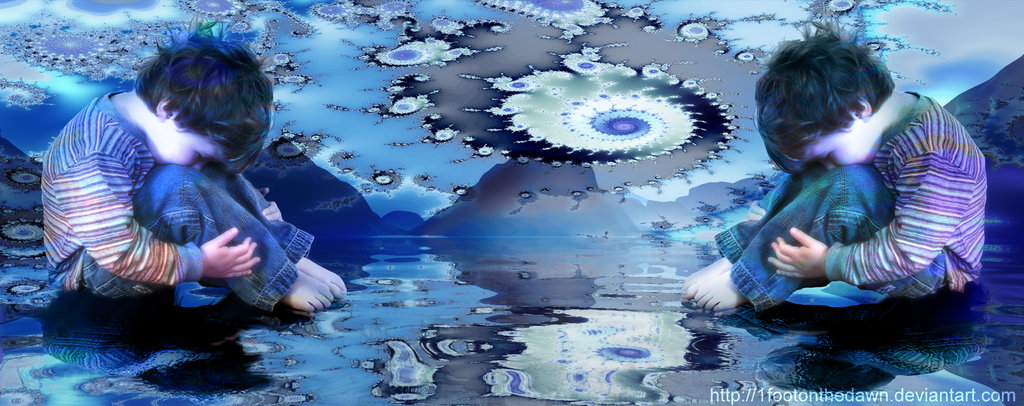
Autism by 1 footonthedawn(deviantart.com)

Autism by 1 footonthedawn(deviantart.com)

This is my final installment on this for the time being. There are certainly more things I have learned but for now this is enough to say.

8.  Familial Image of God, this comes more from the experience of being a father in general, rather than the father of my son in particular, but being a father made me realize the amount of personal investment I have in my own son—and that would not be something I would be able to walk away from, nor would my son be able to end his relationship to me as his father. Aren will always, no matter what he does throughout his life, have a place in my heart and nothing will change that. There is nothing he could do that would make me disown him. So long as I live I will not give up on him. I will always attempt to support him as best I can. On the other hand, he is his own person and I want him to grow up and continue to develop his own personality and identity. I want him to have the ability to follow his own dreams and make his own mistakes. I want him to have the freedom to fail, to stumble and to get back up and I think that is part of what the concept of grace is all about. Who he is as my son will never change, he will always be that, but who he is as a person I want him to determine on his own, and I will be his biggest cheerleader throughout that process but I will not force him to follow in my footsteps. The more I encounter God, the more I think there is something to this picture of God as a Father who is not uninvolved, but who is gracious. A God who wants us to find our own identity, but we also never lose our identity as children of God.  I try to as best I can to be the type of father who models the way Martin Luther talks about God the Father who want us to come to him as loving children come to a loving father.

9. Dealing with the dark side of reality. I have been accused of being the eternal optimist, that even in the darkest experiences of life (which I have had my share of) I still seek for the gift in the suffering, the lesson in the pain and I know this does not come immediately, yet my son wrestles with the self destructive and environmentally destructive nature of humanity with a very different lens. One of the most profound conversations I have had with my sons a couple times over the last year is , “With all the evil that people do, what right do we have to exist?” No otherworldly vision of Christianity has an answer to this, yet the faith of the early Christians was very worldly, and they took very serious the reality that God indeed loved the world, and in strong contrast to many modern Christian belief systems the entire purpose of life was not to escape the world (actually that was the worldview of one of the early Christian heresies called Gnosticism) but rather that as followers of Christ (or more generally God) they were caught up in the dream of God for the renewal and reconciliation of the world.  Both the Jewish people and early Christians had the audacious view that they were a part of God’s plan for the renewal of creation, this is the reason Paul can write in Romans that “the creation waits with eager longing for the revealing of the children of God.” The dark side of reality is present, real and painful and yet part of the Christian hope is that it is not the final answer and in hope we yearn (and work) for something better.  

10. The reality that even when we are unable to receive love, love is still given. I think most parents have times throughout their childrens’ lives where they have trouble connecting, where the advice, care, support and love are not able to be accepted because the children themselves are in a process of growing up and becoming their own selves. My son in his own way is navigating the early teenage years where his journey is different than mine was, and yet there is definitely a change. He no longer needs or honestly wants the same level of attention, he is becoming more self sufficient and I am proud of him for that. Are there times I grieve the type of relationship we had earlier, yes, but I try to let him know that he is loved and valued but there are times where he doesn’t seem to want to hear this anymore.  I think many of us go through this in our relationship with others and with God as well. I think many, and I certainly did, go through a phase where we have to figure out who we are as individuals, and individuals trying to negotiate different and new relationships and sometimes (at least for a time) the old relationships get put to the side and the ones that are valued are come back to. I also have had several points in my own journey with God where I have had to argue something through, I’ve gone through several difficult things in my life that I had to make sense of, and part of making sense of that was arguing with God about it for me. In those times when I may have been arguing with God and may not have always wanted to hear what God had to say, when I may have wanted to push God away I found God waiting patiently through the process.

purple rose 01 by picsofflowers.blogspot.com

What I learned about myself, life and God from my son on the Autistic Spectrum: Part 3

Autism by 1 footonthedawn(deviantart.com)

Autism by 1 footonthedawn(deviantart.com)

5. We often value people for very superficial reasons part 1: There are a whole set of criteria that people are judged by constantly by those around them including, but not limited to: physical appearance and dress, weight, proportions, muscle tone, skin coloration, the manner in which a person carries themselves, appropriate social interactions and even smell plays into game of subconscious evaluation of others based on appearance. In less formal language we quickly determine who is cool and who is not within a group of peers, which people are noticed for being popular, who are the geeks, who are the outcast and who are the invisible members of a group. One of the gifts of learning to see things through my son’s eyes is that none of these things matter to him, he would say that he honestly doesn’t care about other’s evaluation of him even though he is entering an age where these things are very important to his peers. I found it interesting that his first real friend at his current school is another student who is also very smart but has Cerebral Palsy, and so is also unable to interact in the same manner as many of their peers. In fact Aren finds most of the social games played by his classmates as not only distracting but annoying. To me one of the gifts of the Christian tradition is the practice of communion or the Lord’s Supper where we gather around the table with others who have been drawn to be a part of the fellowship we share in Christ and around the table none of the typical valuations matter. All come on an equal footing to share in the foretaste of the feast that God promises us God’s kingdom. In the community I serve we have a number of people who may not rank very high on the social ladder for many of the reasons listed above and yet they are all people of value in the body of Christ.

6. We often judge people for very superficial reasons part 2: I am a very smart, tough and capable person and throughout my experience in schooling, the army and even within the church I learned quickly to judge a person based upon how competent they were. Competence looks like different things in different environments but this reduces a person’s worth to their functionality. My son is a very smart and capable young man but in a world that judges by physical attraction and social interaction he is at a disadvantage, on the other hand he tends to view the world even more harshly in terms of functionality than I ever did. There may be ways in which we use metrics to measure a person’s competence at a skill or a task, this is the whole world of testing in both the academic and business world, but we should never confuse competence with value. People have value regardless of their level of competence or physical or social traits. Within the world of competence also falls status, wealth, education, political power and fame which we also learn increase the value of a person in our eyes, yet this is precisely the type of valuation that Christians should be immune to (but apparently even the early church struggled with this due to the frequency it is addressed in the letters within the New Testament). I have on my wall a plaque that Nate Frambach, my advisor in seminary, gave me upon my graduation which states, “Neil Eric White, you are a baptized child of God, whatever else you are remember you are that for that is the basis of all that you are.” My valuation comes not from my own personal competence, wealth, power, physical appearance, social prowess or any other measure-it is a gift from God that I am valued (and not only me, and I would argue not only Christians).

7. Just because someone doesn’t seem to be paying attention doesn’t mean they aren’t listening and watching what you are doing. Now this applies to people regardless, but I mention it because in learning to see the world through my son’s eyes I realized that not everyone has to look to pay attention. I was always taught (and yes, I realize this is a very masculine way of approaching things) to look a person in the eye when they talk to you and by extension that if a person did not look at you they weren’t paying attention. The eyes for most of us take in a lot of the information that we interpret in our brains and in a world where eye contact is not only a symbol of paying attention but at times a symbol of confidence (in contrast not looking a person in the eye was perceived as either dishonesty or lack of trust in one’s ability). Most autistic people do not like to make direct eye contact, it is uncomfortable for them, and they may be involved in one task that seems unrelated to what is going on around them yet be able to see, hear and perceive everything that is being said. In fact for my son he actually listens better when he is not directly looking at something. That being said he watches and listens to everything. I remember Nate Frambach once sharing, “don’t worry that your kids aren’t listening to you, worry intensely that they are watching everything you are doing.” Over the past ten years I have become increasingly aware of the number of ways that people listen and process information and I have learned to become much more aware of my own biases in the ways I learned to communicate.

Still not done, so stay tuned for at least one more installment

purple rose 01 by picsofflowers.blogspot.com

What I learned about myself, life and God from my son on the autistic spectrum: Part 2

Autism by 1 footonthedawn(deviantart.com)

Autism by 1 footonthedawn(deviantart.com)

This is part 2 of a reflection in honor of Autism awareness month.

3. We live in an incredibly complex world and human communication is even more complex. Because of what I do, as a pastor, I am constantly interacting with other people in various formats. I, like most people, took the process of communicating for granted because I naturally picked up the ability to read eyes, body language, vocal tone and inflection, pay attention to the environment selectively in addition to paying attention to the words being said. I am actually a fairly gifted watcher and listener, and this comes in particularly when I am counseling people (so much so that some people have remarked I am almost clairvoyant in reading not only messages but people). The entire process of communication involves knowing what to pay attention to and what not to pay attention to, and as I tried to understand the process of communication from my son’s perspective I began to realize how many incredible functions my eyes, ears, other senses and ultimately my mind was taking in, sorting and analyzing and responding to. For example, Aren has difficult understanding many types of verbal humor because it involves the way something is said as much as what is said  One example of how easy it is to misunderstand communication came up when he was in elementary school and we went to meet with Aren’s teachers because Aren felt he was being picked on by one student when this student had been wanting to play with Aren and Aren never responded (he is quite happy being on his own) and the student, who couldn’t understand this at this point, kept asking to play with him. This has made me more sensitive to the polyvalent character of communication, one group of words can have several sets of meaning based on context, environment, vocal inflection, body language and so much more. As an interpreter of texts, I have become increasingly aware of how important the reader’s predisposition is to what is actually being said, and we necessarily impose meaning on words to give them a broader picture. When I was growing up, one of the churches I attended tended to approach reading the Bible in a way that was flat and conveyed no emotion, so as not to impose meaning on the text (unfortunately they did impose meaning on the text, but it was a meaning that it was flat, dull and emotionless). People also have very different abilities to hear and to communicate, some have a natural talent for this and in general women are better at reading and responding to communication than men-yet everyone has something to contribute.

4. Spirituality is a function of imagination. This is a huge statement and something I am wrestling through and before people get up in arms about it let me explain what I am attempting to say. Spirituality (not religion, per se) involves the ability to wonder and to try to understand the world in a way that is not based entirely on empirical observations. A person in the modern world can understand the world, their existence and their values based entirely upon a scientific worldview and feel no need for anything more (this is not a new phenomenon). I find it interesting that both atheism and religious fundamentalism there is a huge need to convert others to their dogmatic view of the world and I believe that part of the common issue is a need to lock everything within a concrete system which often leaves little room for questioning and wonder. My son struggles with the concept of God (which is interesting and at time challenging as a pastor) but I also am aware of many autistic children and adults who are fundamentalist Christians who find great comfort in the dogmatic worldview. There is a desire for simplicity that is simply not there in the world (nor the Bible for that matter) and there tends to be less openness to a sense of spirituality which can doubt, question and wonder. I am by no means an expert at the relationship between imagination, wonder, doubt and the ability to ask questions that challenge preconceptions but my theory is that they are related. (Perhaps something to explore, another good question) We live in a world where imagination is viewed as a function of childhood, and therefore something which is not highly valued, but I believe that imagination is more vital part of our lives than we often understand. What I do know is that it is difficult for my son to understand and approach the world in the way I have learned to do, especially in the last couple years. This doesn’t make him any less valuable than me, but his view of spirituality will be different than mine (like the manners and ways in which he expresses emotions, love and communicates). My spirituality and the imaginative act of understanding God and the world doesn’t force me to be confined within my understanding. I have also learned to value those who feel more comfortable within a more rigid view of the world, much like the compression my son needed for emotional and cognitive stabilization when he was a child his worldview provides comfort for him in his life.

More to come…

purple rose 01 by picsofflowers.blogspot.com

What I learned about myself, life and God from my son on the autistic spectrum: Part 1

Autism by 1 footonthedawn(deviantart.com)

Autism by 1 footonthedawn(deviantart.com)

I remember vividly standing in the backyard of the parsonage in Blanchardville, Wisconsin the day we finally received my son’s diagnosis of PDD-NOS (Pervasive Developmental Disorder-Not Otherwise Specified) and yelling at God, “What more do you want from me, I’ve followed you to seminary, I’m trying to do what you tell me to do, what more do you want?”  For those who are not as familiar with the landscape of the autistic spectrum this is one of the diagnoses within the spectrum that falls under the autism umbrella. That was ten years ago, my son was four at that point and my ex-wife were pouring our time and effort into my son and his newborn baby sister, trying to make ends meet and get him the therapy he needed while in seminary and on internship prior to my ordination in 2004. At that point in my life I was dealing with too many broken dreams to see the gift that Aren has become, but now ten years later I realize how much he has taught me about love, being human and in a strange way I have learned to see God in a different light through these experiences.

1.       Broken dreams do not necessarily mean a broken relationship. As I stood there yelling at God, I was in the process of mourning a broken set of dreams and expectations for my son. We all have a set of expectations for our children, that in some ways they will follow in our footsteps and make us proud. Prior to going into the ministry I had graduated from the Corps of Cadets at Texas A&M and then served for four and a half years as an officer in the military. Aren was born while I was stationed at Ft. Polk, Louisiana and as a proud father I dreamed of one day seeing my son put on his senior boots at Texas A&M. It had been such a rich and formative opportunity for me at that stage in my life and I wanted the same for him, and that was one of the dreams that laid there on the floor shattered that day. I never stopped loving and caring for my son, even in the midst of his worst temper tantrums at that stage, or at the moments where I couldn’t understand how or why his speech wasn’t developing like most children’s speech just naturally did. Yet, somehow that dream for him had to die so that I could accept him where he was. Ten years later, as my son is on the threshold of entering high school, I am very proud of him for who he is. Even though he is incredibly smart and very well behaved and will probably do very well with his life there are still times where I watch his peers and grieve a little because there are things that I just can’t share with him because they are not important to him. Over the last ten years I have come to know more about Thomas the Tank Engine, Spongebob Squarepants, Fairly Odd Parents, Phineas and Ferb and countless other cartoons as he has recited to me entire episodes (which I have already seen anyways), I have become the subject matter expert on dinosaurs, sea creatures, space exploration, monsters and mythology and the latest video game on the Wii or DS or PS3. These are the places I can meet him and see what brings him joy, and so I learn about things that may not be of great interest to me, because I value my son and I want him to know that he is loved and valued.

2.       Relationships do not have to be reciprocal. Every parental relationship starts with the parents pouring love into their children when they are born. At the earliest stages of life children are not able to reciprocate the love and emotion and nurturing that their parents pour into them, but as children develop there is the expectation that there will be a reciprocation of the love they have received. It is not that autistic children do not love, or even that they do not express love, but they are not hardwired to provide the love and feedback in the same way that most children will. It doesn’t mean that their parents love them less—in fact most parents of autistic children have invested more in their children to try to set them up for success even without the reward of the hugs and kisses that other children begin to give. As I have tried to learn, as best I can, to see the world through my sons eyes and to attempt to understand things the way he might. I have learned to love him for who he is and to value the ways in which he is able to express his affection. He will always be my son, and that relationship is not dependent on any reciprocity. It reminds me of the baptism service which end with the child (or adult) is marked with oil and the words of promise are “name, child of God, you have been sealed by the Holy Spirit and marked with the cross of Christ forever.” Parents and even God may desire reciprocity in their relationship with their children, but the relationship is not contingent on that reciprocity. We are who we are by the relationship because by birth or by adoption we have been joined to be a part of a family and we will be valued for who we are.

More to Come…

purple rose 01 by picsofflowers.blogspot.com

Anxiety: A Poem

The Abyss by Alexiuss at deviantart.com

The Abyss by Vitaly S. Alexiuss (alexiuss) at deviantart.com

I stare into the abyss of a future created by the demons of depression

It is not reality, it is not what will happen,

And yet as I cling to the precipice of sanity it is all I see

A nightmare that roams in the day consuming the green meadows of springtime

It saps the passion of the blood and fills my veins with ice

My heart pounds in rebellion, confined within the cage of my chest

Yet I move not

The very things that would free me are denied me

Hope is consumed by the illusion of despair

For it is not real…it is not real…it is not real

You are a liar granting me titles and names that are not mine

I am not worthless or weak or crazy but for your lechery

You are a parasite feeding off my life energy

Consuming the power of my dreams


You are a murderer and my soul is your mark

Locked into your arena, you call on me to yield

To proclaim you the victor

To give up

But you will not last

You will not steal this day and so I fight against my own mind

I name thee, I know thee, and again I rise

Sapped but still standing

Weakened but stronger than thou

For as I walk through your illusion, into the present that is present

I will again find hope and joy

And you shall be vanquished back to the depths of the pit you dwell in

Composed Neil White, 2013

purple rose 01 by picsofflowers.blogspot.com