Category Archives: Psalms

Psalm 64 Protect the Innocent One for the Words of the Wicked

By Rashid al-Din – “History of the World” by Rashid al-Din. Photograph by German image bank AKG-Images, published in “The Mongols and the West”, Peter Jackson, 2005., Public Domain, https://commons.wikimedia.org/w/index.php?curid=3237525

Psalm 64

<To the leader. A Psalm of David.>
1 Hear my voice, O God, in my complaint; preserve my life from the dread enemy.
2 Hide me from the secret plots of the wicked, from the scheming of evildoers,
3 who whet their tongues like swords, who aim bitter words like arrows,
4 shooting from ambush at the blameless; they shoot suddenly and without fear.
5 They hold fast to their evil purpose; they talk of laying snares secretly, thinking, “Who can see us?
6 Who can search out our crimes? We have thought out a cunningly conceived plot.” For the human heart and mind are deep.
7 But God will shoot his arrow at them; they will be wounded suddenly.
8 Because of their tongue he will bring them to ruin; all who see them will shake with horror.
9 Then everyone will fear; they will tell what God has brought about, and ponder what he has done.
10 Let the righteous rejoice in the LORD and take refuge in him. Let all the upright in heart glory.

This portion of the psalter is full of petitions to God to deliver the one crying out from the malicious action of those who oppose them. Most people have encountered a time when they felt unfairly targeted by a group that threatened to ruin their reputation and may have even threatened physical violence. We don’t have to look far in our modern world to see people who wield words as weapons and who gather together to seek the advancement of their own power, fame, or fortune while thinking themselves immune to any consequences from their words or actions. The faith of the psalmist, which has been handed down to us, is that God hears and sees the injustice of the world and that God will eventually set the world back in balance. The dangerous words and scheming plots of the wicked may wound but God will rise to defend those who call for deliverance.

The psalm begins with an urgent call for God to hear and act to guard the life of the one praying for God’s preservation. This righteous one is dealing with many enemies who are gathering together and plotting against them. The NRSV translates the gathering together or the enemies as a ‘secret plot’ but the Hebrew sod is a gathering of a company of persons (Nancy deClaisse-Walford 2014, 522) and so the actions of the enemies is more like a gathering mob rather than a quiet conspiracy. The actions of these ‘scheming evildoers’ is intentionally unfair, and the psalmist feels ambushed by their words which have been weaponized like swords and arrows. The cry for help goes up when the psalmist feels exposed and unable to defend themselves against the onslaught of words and clever snares laid for them. These wicked ones are convinced that they have laid out a clever plot which the petitioner cannot escape from and have probably manipulated things to make themselves appear righteous in their assassination of the character and reputation of the righteous one.

The psalmist trusts that God will respond to the words and actions of the wicked ones and will guard their life. Just as the wicked ones aimed their bitter words like arrows, now they are wounded by God’s arrows, and they find that their tongues which they sharpened like swords cut both ways. They intended to bring about the destruction of the reputation and life of the righteous one, but now they find themselves as objects of horror. Their cunning plots unravel and and now they stand exposed before the community. They become the example of the ‘wicked’ whose punishment becomes an example to others who would follow their foolish ways. The psalmist trusts that God will put the world back in balance and the righteous will rejoice in God’s protection while the wicked are revealed before the community.

The persistent reality of those who are willing to use words as weapons and whose schemes often cause damage both lives and reputations causes many to continue to lift up their complaints to God. It is difficult to deny that many of these schemers seem to act without consequences in the present, but faith calls the one praying to trust in the power of God to ultimately overcome the scheming of humans. Sometimes the action of God may be violent, like the archer shooting arrows to defend one ambushed, but often it may be to allow the actions of the ‘evil ones’ to be revealed and their cunning plots to become known. Yet, the petition is for God to act and the psalmist entrusts that God can use the tools at God’s disposal to put the world back in balance and to guard the righteous ones.


Psalm 63 Hungering and Thirsting for God’s Presence

Trinity River in Texas

Psalm 63

<A Psalm of David, when he was in the Wilderness of Judah.>
1 O God, you are my God, I seek you, my soul thirsts for you; my flesh faints for you, as in a dry and weary land where there is no water.
2 So I have looked upon you in the sanctuary, beholding your power and glory.
3 Because your steadfast love is better than life, my lips will praise you.
4 So I will bless you as long as I live; I will lift up my hands and call on your name.
5 My soul is satisfied as with a rich feast, and my mouth praises you with joyful lips
6 when I think of you on my bed, and meditate on you in the watches of the night;
7 for you have been my help, and in the shadow of your wings I sing for joy.
8 My soul clings to you; your right hand upholds me.
9 But those who seek to destroy my life shall go down into the depths of the earth;
10 they shall be given over to the power of the sword, they shall be prey for jackals.
11 But the king shall rejoice in God; all who swear by him shall exult, for the mouths of liars will be stopped.

Trust in the midst of trouble has been a common theme in this portion of the book of Psalms. Sometimes the trouble precedes a turning to trust in the life of the psalmist, but sometimes the psalmist begins in trust and then addresses their troubles to God. This Psalm, which is attributed to David’s time in the wilderness when he was hunted by Saul, begins with a thirst and hunger to experience God’s presence like the psalmist experienced in the past. Yet, even though the psalmist longs for God’s presence and desires to share a rich feast in the security of God’s love and protection, they trust that their life is upheld by the power and protection of God.

We have previously seen the metaphor of thirsting for God’s presence at the beginning of Psalm 42, where the nephesh[1]pants for God like a deer pants for water. Once again the nephesh thirsts for God and the flesh faints for God. The psalmists entire being is weakened by the perceived absence of God’s presence like a person wandering in a hostile wilderness may be threatened by the harsh sun, unforgiving winds, and the lack of water. The psalmist is able to look back on times where they encountered the presence of God in the tabernacle or temple and came to know the hesed (steadfast love) of God. This encounter with the presence and love of God made a powerful impression on the psalmist, causing them to understand that the proper response was to dedicate their life to blessing and living in prayerful thanksgiving to their God.

The metaphor now shifts from thirst to hunger as the nephesh is satisfied with a rich feast.[2] Much as the feast of Thanksgiving in the United States was intended to give thanks to God for the abundance of harvest, now the psalmist participating in this festive meal, probably understood as taking place within the context of sacrifice, responds with lifting up praises with joyful lips. Hunger and thirst sated, now the psalm moves to the bed where the psalmist can rest in the peace provided by God’s protection and can lay down with a joyful song on their lips. They may experience hunger and thirst, but they trust that God will provide for the needs of their body and life. They can go to sleep even in the midst of their enemies continuing to make trouble because their God is a God of steadfast love and protection.

Only in the final three verses does the external threat of the enemy make its appearance, but in contrast to the experience of the faithful one their future is, through the eyes of the psalmist, one of shame and silence. The psalmist trusts that they will be surrounded by the presence of God, but their enemies will ‘go down’ to the depths of the earth-a place perceived to be distant from God. Their lives may have been lived violently, and the psalmist trusts that they will end violently, and they will end up the prey of scavengers who wander the wastelands. The voice of the psalmist will be lifted up in praise but the mouths of the liars who oppose him shall be silenced. Perhaps the ending of the psalm seems vengeful, but vengeance is left in God’s hands. Ultimately the threat of the psalmist’s enemies are real but they trust in the protection of their God to deal with these threats and they look forward to being in the holy spaces and lifting up their voice as they wonder and marvel at the presence and steadfast love of God which satisfies their thirst and sates their hunger.

[1] The Hebrew nephesh is often translated soul, but a Hebrew understanding of this word is closer to ‘my life’ or ‘my whole being.’

[2] Literally fat and fatness.

Psalm 62 Truly Faith Surrounds My Troubles

Wartburg Castle, Eisenach, Germany. Photo by Robert Scarth shared under creative commons 2.0

Psalm 62 Truly Faith Surrounds My Troubles

<To the leader: according to Jeduthun. A Psalm of David.>

1 For God alone my soul[1] waits in silence; from him comes my salvation.
2 He alone is my rock and my salvation, my fortress; I shall never be shaken.
3 How long will you assail a person, will you batter[2] your victim, all of you, as you would a leaning wall, a tottering fence?
4 Their only plan is to bring down a person of prominence. They take pleasure in falsehood; they bless with their mouths, but inwardly they curse. Selah
5 For God alone my soul waits in silence, for my hope is from him.
6 He alone is my rock and my salvation, my fortress; I shall not be shaken.
7 On God rests my deliverance and my honor; my mighty rock, my refuge is in God.
8 Trust in him at all times, O people; pour out your heart before him; God is a refuge for us. Selah
9 Those of low estate are but a breath, those of high estate are a delusion; in the balances they go up; they are together lighter than a breath.
10 Put no confidence in extortion, and set no vain hopes on robbery; if riches increase, do not set your heart on them.
11 Once God has spoken; twice have I heard this: that power belongs to God,
12 and steadfast love belongs to you, O Lord. For you repay to all according to their work.

In poetry structure can frequently be used to help those familiar with the medium understand the words at a deeper level. In this psalm there are a number of structural elements that are often missed in the English translations that help provide emphasis in the psalm of trust amidst trouble. The placement of this psalm between Psalm 61 and Psalm 63 (also psalms which declare the psalmist’s trust in God above all other things) also emphasizes this common theme. The “trilogy of trust” within the psalms, as J. Clinton McCann labels Psalm 61-63, (NIB IV:922) stand near the end of the petitions for help in this portion of the book of psalms. Even though the psalmist’s world is full of people who murder reputations with their duplicitous ways, the way of faith knows that God’s steadfast love will outlast the scheming of mortals.

Invisible to most English translations of this psalm is the repetition of the Hebrew ‘ak which begins verses 1,2,4,5,6 and 9. This word, translated ‘alone’ and ‘only’ in the NRSV, is used four times in relation to God and twice in relation to the working of humans. There is a strong emphasis on God ‘alone’ providing strength which thwarts the ‘only’ plans of those who are but a breath. In addition to this structural repetition is the nearly identical wording of verses 1-2 and 5-6. The complaints about the enemies who are assailing the psalmist and attempting to bring them down from prominence are structurally surrounded by God alone, who they wait for in silence. The psalmist may appear like a leaning wall or a tottering fence, but they are surrounded by their rock, salvation, and fortress. The faithful one can remain in silence while the wicked ones utter falsehoods for they know that this struggle takes place within the sheltering space of their God who will not allow them to be shaken. Even trouble is surrounded by faith and the deliverance from the ephemeral evils produced by the wicked rests in the hands of God who rescues not only life but also honor and reputation.

In verse eight the psalm transforms from personal trust to testimony. Now the psalmist takes on the role of the instructor to the people handing on the trust they have learned. What humans can do alone without God (in verse 9 this is the final time the Hebrew ‘ak occurs) is to be a breath or a puff of air. God alone can be salvation, rock, fortress, deliverance, and honor. Placing trust in human scheming, extortion, robbery, and even riches is foolishness. It is in God, not humans and their schemes, where power rests. It is God’s hesed (steadfast love) that is the guarantee of the future for the faithful. The actions of the faithful and the foolish are seen by God and the psalmist trusts that ultimately God’s steadfast love and power will lift up the righteous and bring down those who are working in falsehood to destroy the honor and perhaps even the life of the faithful ones.


[1] Although the Hebrew nephesh is often translated ‘soul,’ the Hebrew understanding of ‘soul’ is closer to ‘life’ than the Greek conception of soul most English speakers assume. The Hebrew idea is inseparable from the life of the individual.

[2] A more literal translation of the Hebrew rasah here would be ‘kill’ or ‘murder’ (NIB IV:923)

Psalm 61 A Life Dependent on God

Wartburg Castle, Eisenach, Germany. Photo by Robert Scarth shared under creative commons 2.0

Psalm 61

<To the leader: with stringed instruments. Of David.>
1 Hear my cry, O God; listen to my prayer.
2 From the end of the earth I call to you, when my heart is faint. Lead me to the rock that is higher than I;
3 for you are my refuge, a strong tower against the enemy.
4 Let me abide in your tent forever, find refuge under the shelter of your wings. Selah
5 For you, O God, have heard my vows; you have given me the heritage of those who fear your name.
6 Prolong the life of the king; may his years endure to all generations!
7 May he be enthroned forever before God; appoint steadfast love and faithfulness to watch over him!
8 So I will always sing praises to your name, as I pay my vows day after day.

In C. S. Lewis’ classic parable, The Great Divorce, the experience of hell is a grey city where the inhabitants choose to live a life that is increasingly joyless and friendless as they move further and further away from their neighbors. An escape from this grey city is readily available if the people of the place let go of their own security and accept their reliance on God’s grace (which is both a painful and healing process in the dream that forms the book) but most sullenly either remain or return to this increasingly private hell which they choose instead of heaven. One of the paradoxes of our current time is that we live in a time in society where we have resources and comforts unavailable to people at any other time in history and yet as our affluence has increased our depression and anxiety have also increased. Perhaps this poem that the psalmist lifts up from the end of the earth has something to speak to a people who have lived in the anxiety of attempting to make meaning for oneself and finding, in the words of Ecclesiastes, that it is all vanity. That perhaps Augustine’s confession that ‘our heart is restless until it rests in you” may be the gospel we need to lead us back home.

This psalm is the appeal of an individual for God’s help in the midst their trouble. The psalmist cries to God from ‘the end of the earth’ which could be a geographical location, being far away from the temple, but more likely is a perception of the psalmist’s distance from God. In the midst of the trouble, they are experiencing they have found their own resources insufficient. They are in need of a place they can escape from the rising floodwaters. They are faint of heart and fading fast.[1] The appropriate place to turn in their distress is to their God who in a flourish of images of strength is the psalmist’s refuge, strong tower, tent to abide within, and wings to be sheltered under. The crisis of the psalmist has shaken them out of their self-reliance, demonstrated their distance from their God, and caused them to cry out to return to their God’s presence.

The psalm moves from trouble to trust. The God of the psalmist is one who hears their petitions and vows. The heritage, or inheritance, mentioned in verse five is often associated with the land that God has promised. In an agricultural society one’s security is intimately linked to the land and the provision of weather at the appropriate time. Yet, one’s security is also determined by the actions of the leaders of that land. The king, and here it would refer to a Davidic king, would provide the physical security for the land. But theologically the king is merely a means by which God provides for the covenant people and the military security of Israel is ultimately provided not by swords and spears but by God’s protection. Martin Luther captures this idea when expounding on the petition asking God for our daily bread in the Lord’s Prayer noting that it not only includes food and drink but also, “upright and faithful rulers, good government, good weather, peace, health, decency, honor, good friends, faithful neighbors, and the like.” (Luther 1978, 36) The psalmist realizes that the way of self-sufficiency is vanity and that their life is dependent upon God’s gracious provision which comes in many forms.

The psalm promises a grateful response to God’s act of provision. A skeptical reader may view this as an attempt to bribe God to get one’s way, but the psalms have stated in other places that God needs nothing that the psalmist can give.[2] As Walter Brueggemann and William Bellinger can state, “Israel, however, was not aware that the transaction could be reduced to a quid pro quo, an attempt to bribe YHWH.” (Brueggemann 2014, 272) The appropriate response to God’s provision is praise, thanksgiving, promising to serve one’s God with whatever one has to offer. Self-reliance has led to isolation from God and trouble. Repentance has allowed one to return to reliance upon God’s provision and a response of gratitude for God’s gracious protection, provision, and shelter.

[1] As Beth Tanner notes, the root Hebrew word translated faint demonstrates a serious distress and proximity to death. (Nancy deClaisse-Walford 2014, 511)

[2] For example Psalm 50: 8-13.

Psalm 60 A Plea for God’s Return to the People

The Ruins of Holyrood Chapel by Louis Daguerre (1824)

Psalm 60

<To the leader: according to the Lily of the Covenant. A Miktam of David; for instruction; when he struggled with Aram-naharaim and with Aram-zobah, and when Joab on his return killed twelve thousand Edomites in the Valley of Salt.>
1 O God, you have rejected us, broken our defenses; you have been angry; now restore us!
2 You have caused the land to quake; you have torn it open; repair the cracks in it, for it is tottering.
3 You have made your people suffer hard things; you have given us wine to drink that made us reel.
4 You have set up a banner for those who fear you, to rally to it out of bowshot. Selah
5 Give victory with your right hand, and answer us, so that those whom you love may be rescued.
6 God has promised[1] in his sanctuary: “With exultation I will divide up Shechem, and portion out the Vale of Succoth.
7 Gilead is mine, and Manasseh is mine; Ephraim is my helmet; Judah is my scepter.
8 Moab is my washbasin; on Edom I hurl my shoe; over Philistia I shout in triumph.”
9 Who will bring me to the fortified city? Who will lead me to Edom?
10 Have you not rejected us, O God? You do not go out, O God, with our armies.
11 O grant us help against the foe, for human help is worthless.
12 With God we shall do valiantly; it is he who will tread down our foes.

While writing to his friend Eberhard Bethge from Tegel military prison in 1944, Dietrich Bonhoeffer wrote, “The same God who is with us is the God who forsakes us (Mark 15:34!)” (DBWE 8: 479) Though Bonhoeffer was discussing how he, and other faithful Christians, were to live before God in a world that seems to manage without God, his phrasing could also apply to this psalm where the critical issue is the perceived abandonment of the covenant people at a critical moment by their God. The psalms are theological enough to rest on the conviction of God’s active presence and participation, but they are poetic enough to speak eloquently about the experience of God’s absence, abandonment, and rejection.

The superscription of this psalm seems to be disconnected from the content of the psalm itself. The superscription refers to a string of events in 2 Samuel 8 (and 1 Chronicles 18) when David and his armies are experiencing a time of the LORD’s favor and, “the LORD gave victory to David wherever he went.” (2 Samuel 8:14) Yet the psalm is clearly about a time where the people are not experiencing the LORD’s favor and are speaking in the aftermath of defeat searching for answers. This communal prayer contrasts the experience of God’s previous provision with the brokenness of their current plight.

In the theological world of the Bible the existence of the covenant people is contingent upon the continued provision and care of the God of Israel. They may have suffered a defeat from one or multiple of the surrounding kingdoms of Moab, Edom, or Philistia, but the theological claim that the psalmist makes is that this defeat is symptomatic of their rejection by their God. It is not better military technology or strategy that will change the plight of the defeated covenant people. Their need as expressed in this prayer is that God to return to their side and protect them. There are numerous incidents in the story of Israel where the scriptures narrate a military defeat theologically as a judgment by God or a time where God’s presence has not gone with the people.[2] The bible consistently provides a theological interpretation of history, judging kings and times for their faithfulness to the covenant instead of their wealth, power, or military prowess. In this psalm, it is God who has rejected the people, breached their defenses and broken the land itself. Although the people may have external opponents it is God who has caused them to suffer and given them the ‘wine of reeling.’[3]

There is an abrupt transition in verse four where God’s role changes to being once again the one who provides a safe place for the people to rally under. Perhaps this is the psalmist speaking in hope or perhaps it is a desperate plea, but it remains consistent with the psalmist’s worldview that the problem is God’s rejection which can only be resolved by God’s initiative. In Hebrew verse five ends with the imperative “answer” setting up what “God has spoken.” God’s answer reinforces the psalmist’s worldview that God is not merely the God of Israel, but the God of all the nations. Not only are the places of Israel (verses 6-7) but also Israel’s opponents (verse 8) under God’s authority. The language about Moab, Edom, and Philistia may be intended as an insult of these nations or they may simply be extending the image of God’s possession and claiming of each of these nations that surround Israel as well.

The nation still finds themselves in conflict and unable to oppose their foes. They are not going to enjoy success against the defenses of their opponents until God’s rejection ends and God once again goes out with the armies of the covenant people. It would be easy to dismiss this prayer as an appeal to divine authorization of the wars of the people, and in a conflicted history of Israel there are times where it would be appealing to combine military might and strategy with a divine mandate. Yet, Israel has never been a superpower and they were to rely upon God for their survival in the ancient world. As J. Clinton McCann Jr. can articulate.

Their prayer is not that of the powerful, who seek to claim God’s sanction of the status quo. Rather, their prayer is the desperate prayer of those who turn to God as the only possible hope in an apparently hopeless situation (v. 11) (NIB IV:918)

In a violent world the covenant people were to learn to rely upon their God’s continual strength, protection, and provision. In this moment of crisis, in the psalmist’s view, God has not upheld God’s responsibility to the covenant and no justification for this absence is given. This psalm boldly calls upon God to act on behalf of the covenant people and to restore them once again and grant them victory over the foes that oppose them.

[1] The NRSV takes a less literal approach here in its rendition of these words as God has promised from his sanctuary. There is the possibility of understanding this as a ‘brief sermon’, but the more literal reading of the Hebrew rendered by the NIV as “God has spoken from the sanctuary” places this as a plea for an answer responded to by God’s voice from the sanctuary. (NIB IV:916)

[2] Examples of this include Numbers 14:41-45, and Judges 2: 11-15. This theological interpretation of history permeates the narration of Israel’s story throughout historical books (Joshua-Esther) and also often appears in the prophets.

[3] This theme of the wine of reeling or cup of judgment also appears in Isaiah 51:22 (where this wine is to be passed now to the enemies of the people) and Jeremiah 25:15-17(although the language in Jeremiah is slightly different the image is employed in the same manner).

Psalm 59 God’s Steadfast Love as an Alternative to the Dog-Eat-Dog Worldview

Battle between Cimmerian cavalry, their war dogs, and Greek hoplites, depicted on a Pontic plate

Psalm 59 God’s Steadfast Love as an Alternative to the Dog-Eat-Dog World

<To the leader: Do Not Destroy. Of David. A Miktam, when Saul ordered his house to be watched in order to kill him.>

1 Deliver me from my enemies, O my God; protect me from those who rise up against me.
2 Deliver me from those who work evil; from the bloodthirsty save me.
3 Even now they lie in wait for my life; the mighty stir up strife against me. For no transgression or sin of mine, O LORD,
4 for no fault of mine, they run and make ready. Rouse yourself, come to my help and see!
5 You, LORD God of hosts, are God of Israel. Awake to punish all the nations; spare none of those who treacherously plot evil. Selah
6 Each evening they come back, howling like dogs and prowling about the city.
7 There they are, bellowing with their mouths, with sharp words on their lips — for “Who,” they think, “will hear us?”
8 But you laugh at them, O LORD; you hold all the nations in derision.
9 O my strength, I will watch for you; for you, O God, are my fortress.
10 My God in his steadfast love will meet me; my God will let me look in triumph on my enemies.
11 Do not kill them, or my people may forget; make them totter by your power, and bring them down, O Lord, our shield.
12 For the sin of their mouths, the words of their lips, let them be trapped in their pride. For the cursing and lies that they utter,
13 consume them in wrath; consume them until they are no more. Then it will be known to the ends of the earth that God rules over Jacob. Selah
14 Each evening they come back, howling like dogs and prowling about the city.
15 They roam about for food, and growl if they do not get their fill.
16 But I will sing of your might; I will sing aloud of your steadfast love in the morning. For you have been a fortress for me and a refuge in the day of my distress.
17 O my strength, I will sing praises to you, for you, O God, are my fortress, the God who shows me steadfast love.

Many of the Psalms in this section of the psalter are attributed to the time when David’s life is continuously under threat from his king and father-in-law Saul.[1] These desperate pleas to God, which can fit a number of circumstances that people encounter in a world, are an underutilized portion of Psalms. They are perhaps overlooked because they may appear too vengeful for some Christians, but they point to a resilient faith in the reality of God’s steadfast love in the midst of a world of dogged opposition. The psalmist trusts that God’s protection will allow them to see their opponents punished for their unjust violence they have done and will vindicate their continued trust in their God which allows them to opt out of the dog-eat-dog mindset of competitive violence.

God is the one who must deliver the psalmist from their situation. The psalm is a series of imperatives directed at God: deliver, protect, deliver, save, (1-2) rouse, come, see, awake, spare none, (4-5) make them totter, (11) and consume (twice in verse 13). Immediately the psalmist begins with an impassioned appeal for God to save them from dire circumstances that are created by enemies who are conspiring against them. These evil working and bloodthirsty ones continually create a world of conflict and violence for the poet despite their innocence. The psalmist emphasizes their innocence by utilizing the three major Hebrew words for ‘sin’[2] and declaring they are without fault, transgression, or sin. This three-fold appeal to the psalmist innocence is followed by a three-fold titling of God: LORD (the divine name of God) God of hosts (a militaristic image of God as the leader of armies) and God of Israel (the God of the chosen people). God is one who can be called upon by name, and yet has the power to aid in conflicted situation, and is also the God who stands with the chosen people in the midst of the nations. The psalmist trusts that the God that they call upon is able to save and deliver them from this world of trouble created by their persistent and unjust enemies.

The metaphor used in this psalm for the enemies is dogs. They prowl like a pack, and they wound with their words. They continue to prowl the city and utter their threatening howls which inform the poet that there is no time when they are free of their presence. These enemies consider themselves strong but all their growling, prowling, and howling ultimately evoke laughter from God. In Psalm 52:6 the righteous laughed at the foolish and violent enemies, but here it is God who laughs at these violent ones who take themselves and their power so seriously. Their strength when compared to the protective and sheltering strength of the God of Israel or the liberating strength of the God of Hosts is laughable, and their boasts are hollow. The faithful and innocent one trusts that God’s steadfast love (hesed) will ultimately be the final word and will put these dogged opponents in their place.

This prayer comes from the perspective of one who is struggling in an unjust world and is calling upon God to act decisively against their oppressors. Perhaps one of the reasons this Psalm is seldom used is the desire for vengeance against one’s enemies and there is some danger when those in a privileged position view themselves as oppressed and use that narrative to justify their own actions of oppression. Yet, in the Psalms the actor who restores the oppressed one to justice is always God. Here the psalmist wishes not for a quick removal of the enemy, but a staggering but not fatal blow where the enemy becomes the unwitting example of God’s justice that is not quickly forgotten. As Bellinger and Brueggemann can say appropriately, “even in its most confident faith Israel can be honest about its resentments and its hope for vengeance and retaliation.” (Brueggemann 2014, 266) The psalmist is maintaining their innocence and committing themselves to God’s steadfast love and justice.

This psalm again confronts us with the distance between the world as it is experienced by the psalmist in this moment of their life and the world as it should be under the steadfast love of God. As J. Clinton McCann can aptly summarize the world the psalmist experiences, “What we end up with is a dog-eat-dog world, a culture of cut-throat competition in which we’re convinced that no one will look out for us if we don’t look out for ourselves.” But the psalm points to “a deeper reality, an alternative world, which is drive not by the lust for power but by the power of love.” (NIB IV:914) In the belief of the psalmist, we may begin with the need for deliverance from the dog-eat-dog mindset of competitive violence. The final words in this psalm and in worldview of the psalmist is God’s steadfast love (hesed). The wise live their lives oriented towards this deeper reality where the lust for power will be proven foolish and the power of God’s steadfastlove will endure.

[1] The superscription refers 1 Samuel 19: 8-17 when Saul has David’s home watched and Michal (David’s wife and Saul’s daughter) helps David escape and deceives her father.

[2] NRSV translates these words as ‘transgressions,’ ‘sin,’ and ‘fault’ in verses three and four.

Psalm 58 A Jagged Prayer for Vengeance

From Susan Harris Anger and art// A Rage to Paint https://www.susanharrisart.com/blog

Psalm 58

<To the leader: Do Not Destroy. Of David. A Miktam.>

1 Do you indeed decree what is right, you gods?[1] Do you judge people fairly?
2 No, in your hearts you devise wrongs; your hands deal out violence on earth.
3 The wicked go astray from the womb; they err from their birth, speaking lies.
4 They have venom like the venom of a serpent, like the deaf adder that stops its ear,
5 so that it does not hear the voice of charmers or of the cunning enchanter.
6 O God, break the teeth in their mouths; tear out the fangs of the young lions, O LORD!
7 Let them vanish like water that runs away; like grass let them be trodden down and wither.
8 Let them be like the snail that dissolves into slime; like the untimely birth that never sees the sun.
9 Sooner than your pots can feel the heat of thorns, whether green or ablaze, may he sweep them away!
10 The righteous will rejoice when they see vengeance done; they will bathe their feet in the blood of the wicked.
11 People will say, “Surely there is a reward for the righteous; surely there is a God who judges on earth.”

Many people who actually read the words of this psalm would be surprised that these words would be found inside their sacred scriptures.[2]  These words are never appear in the Revised Common Lectionary, and this psalm (along with Psalm 59 and 60) were never included in the Psalms in the hymnal I grew up with (the Lutheran Book of Worship). They do appear in the newer hymnal for my denomination (Evangelical Lutheran Worship) but in most churches they are ignored and most people reading the bible simply read over these words without stopping to reflect on these harsh and jarring words spoken about one’s enemy. I attempt to approach every piece of scripture with honesty and respect, trying to listen for the wisdom it has to speak. While I would agree with what 2 Timothy states about all scripture being inspired by God and being useful for teaching, reproof, correction, and training in righteousness, I would add the caveat that not all scripture is useful at all times in one’s life or experience and these jagged words crying out for vengeance may do harm to the unintended hearer who is dealing with a trauma or a miscarriage. The psalms frequently paint with the language of emotion and here the dark reds of anger, frustration, and hatred form a dangerous song that longs for blood. Though it may be uncomfortable to look at, these words have something to say into the bland and safe palette of language that Christians have often used.

The bible is a strange document among the holy writings of the world. Much of the bible is written by people who find themselves in a world where they are suffering because of the violence that is practiced on the earth and in the moment there seems to be a lack of justice on those perpetrating the violence. There are portions of scripture that are written by those in power, but it is also balanced by those prophets, poets, and pariahs who find themselves challenging the injustice of those charged to judge or rule in righteousness.  I think many Christians have been taught to suppress their anger and to attempt to hide it from God, but here we see the psalmist giving full voice to their desire for vengeance in their prayer and placing that uncomfortable emotion into God’s listening ears. The world is not as it should be. It is unjust. The righteous are suffering. The wicked are powerful. God needs to act.

Unlike most Psalms, God is not addressed until verse six. The initial focus is on the ‘mighty ones’ who have used wicked words and violence in a way that arouses this heated response from the poet. These ‘mighty ones’ have corrupted the practice of judgment among the people, they have reigned by violence, they have birthed a world of lies, they are like snakes that are unable to be restrained by the snake charmer. Their venom and violence now flow unrestrained into the world of the psalmist. How does one reconcile a vision of justice with the experience of injustice? The answer the psalmist gives in this moment is this jagged prayer for God’s action in vengeance towards those who have destroyed their world.

The seven imprecations (verses 6-9) may be difficult to read from a comfortable place. Praying for God to violently break the teeth or the jaws and defang those who attack may seem unchristian. Desiring our enemies to be transitory like flowing water or trodden grass may seem like a strange prayer. Wanting our enemies to feel the hot flame of thorns once they catch fire, or to dissolve like the snail into slime or to be like a miscarried fetus may seem like harsh and unforgiving language and yet here these words exist in the middle of our scriptures. Yet, vengeance belongs to God and not to the one who utters these words. Perhaps we may never utter these exact words to God. We may have been taught that anger or sadness are to be erased from our prayers by those who taught us our faith, but the scriptures bear witness to the complete palette of emotions in the life of the faithful with God. The life of faith in the bible is often more colorful than the life we encounter in the congregations where the religious gather.

The image of bathing one’s feet in the blood of the wicked may seem triumphal and uncomfortable. Yet, as uncomfortable as talking about the judgment of God may be in many modern churches, sometimes the only way beyond the current world of oppression and violence is for the Pharaohs, Caesars, princes, kings, and rulers who reign over the unrighteousness to be removed along with those who support them. As much patience as God shows throughout the bible, there are those who resist God’s ways and God’s will until the end. We may recoil at this violent language which also emerges in Psalm 68, the prophets (ex. Isaiah 63: 1-6 and Ezekiel 39) and particularly in Revelation (see Revelation 14).   Yet, these words rest within our scriptures and commit this violence into God’s hands so that the faithful may continue to hope for a world beyond oppression.

I come from a privileged life. I am a white heterosexual well educated male living in an affluent area of the United States. I also understand that my experiences are not universal. Although it would be easy to take a razor to our scriptures and, like Ben Franklin, excise all the parts that don’t agree with our experience or worldview, I would caution that these uncomfortable words do have something to speak to us. Almost twenty years ago I encountered Miroslav Volf’s powerful challenge to the privileged worldview which wants to excise the judgment from the scriptures:

                Most people who insist on God’s “nonviolence” cannot resist using violence themselves (or tacitly sanctioning its use by others). They deem the talk of God’s judgment irreverent, but think nothing of entrusting judgment into human hands, persuaded presumably that this is less dangerous and more humane than to believe in a God who judges! That we should bring “down the powerful from their thrones” (Luke 1: 51-52) seems responsible; the God should do the same, as the song of that revolutionary Virgin explicitly states, seems crude. And so, violence thrives, secretly nourished by belief in a God who refuses to wield the sword.

My thesis that the practice of nonviolence requires a belief in divine vengeance will be unpopular with many Christians, especially theologians in the West. To the person who is inclined to dismiss it, I suggest imagining that you are delivering a lecture in a war zone (which is where a paper that underlies this chapter was originally delivered). Among your listeners are people whose cities and villages have been first plundered, then burned and leveled to the ground, whose daughters and sisters have been raped, whose fathers and brothers have had their throats slit. The topic of the lecture: a Christian attitude toward violence. The thesis: we should not retaliate since God is perfect noncoercive love. Soon you would discover it takes the quiet suburban home for the birth of the thesis that human nonviolence corresponds to God’s refusal to judge. In a scorched land, soaked in the blood of the innocent, it will invariably die. And as one watches it die, one will do well to reflect about many other pleasant captivities of the liberal mind. (Volf, 1996, pp. 303-304)

Even when we can acknowledge that these violent words belong within our scriptures, what possible ‘teaching, reproof, correction and training in righteousness’ can they offer to those who do not find themselves in the position of oppression crying out for God’s vengeance? Ellen Davis proposes three possible uses for psalms like this one when we are angry, and one, if we have the courage to encounter these words when we are not. First, they can give us words to wrap around our anger when we are not able to find adequate words on our own. She shares the advice a professor once gave her after a betrayal, “Go into the chapel when no one else is around and shout these at the top of your lungs.” This practice allowed her to both vent and release the anger but hearing herself speak these words she also could hear the self-righteousness and pettiness in her petitions. Secondly, the psalms function as divinely given ‘counselors’ and teach us that vengeful anger is one mode of access to God. We can come to know that God who created us for life together is also outraged by those who destroy community or deny justice. Thirdly, the cry is a cry for God to act which allows the petitioner to bypass acting personally against the one who harmed us. We demand our enemy be driven into God’s hands, but we are not in control of what happens there or how God brings about this justice and reconciliation. Finally, she suggests if we are reading when we feel none of the feelings in the psalm to turn it around and to ask if there is anyone in the community or among God’s people who may want to pray these words about me? (Davis 2001, 26-29) I may want to shrink away from the language of the prayer at times, but there may be other times when I need these very words to pass my lips so they may exit my heart. Sometimes I need to commit judgment to God so that I do not take vengeance into my own hands. When I am courageous enough, I may wonder who I may have wronged by judging unfairly, speaking poisonously concerning, refusing to listen, or the ways I have either actively dealt out violence or passively benefited from the violence dealt out by those who sat in a privileged place that I share. These are hard words that may be hard to speak. Yet sometimes we need to access the whole spectrum of emotions we experience in life.


[1] The word here is ‘elem which means silence. It bears the same root letters as the Hebrew ‘elohim (‘mighty ones’ or a generic term for gods) as gods. The NRSV and most other translations view this as ‘elohim and translate based on this assumption. The NRSV translates this as the common ‘gods.’ While this is a possible reading (see Psalm 82:1), mighty ones can also refer to warrior or powerful individuals. Within the context of this poem the opponents seem to be other humans so the more generic ‘mighty ones’ seems appropriate here. If you choose to translate using ‘elem the accusation is closer to, “Do you indeed declare what is right in silence?”

[2] Although Psalm 58 is full of challenging choices for a translator (of which I am highlighting only a few) the words in doubt are not the most graphic ones.

Psalm 57 Fleeing to the Steadfast Love and Faithfulness of God

James Tissot, Moses and Joshua in the Tabernacle (1896-1902)

Psalm 57

<To the leader: Do Not Destroy. Of David. A Miktam, when he fled from Saul, in the cave.>
1 Be merciful to me, O God, be merciful to me, for in you my soul[1] takes refuge; in the shadow of your wings I will take refuge, until the destroying storms pass by.
2 I cry to God Most High, to God who fulfills his purpose for me.
3 He will send from heaven and save me, he will put to shame those who trample on me. Selah God will send forth his steadfast love and his faithfulness.
4 I lie down among lions that greedily devour human prey; their teeth are spears and arrows, their tongues sharp swords.
5 Be exalted, O God, above the heavens. Let your glory be over all the earth.
6 They set a net for my steps; my soul was bowed down. They dug a pit in my path, but they have fallen into it themselves. Selah
7 My heart is steadfast, O God, my heart is steadfast. I will sing and make melody.
8 Awake, my soul![2] Awake, O harp and lyre! I will awake the dawn.
9 I will give thanks to you, O Lord, among the peoples; I will sing praises to you among the nations.
10 For your steadfast love is as high as the heavens; your faithfulness extends to the clouds.
11 Be exalted, O God, above the heavens. Let your glory be over all the earth.

Many of the psalms deal with common themes and use common language. Already in the psalter we have seen psalms repeated[3] and verses 7-11 of Psalm 57 are identical with the beginning of Psalm 108. Well chosen words can make sense within multiple contexts, and the ending of a psalm spoken from the place of trouble (Psalm 57) can be the beginning of a prayer for victory (Psalm 108). For the psalmist, the steadfast love (Hebrew hesed) and faithfulness of God are “the pervasive, fundamental realities of the universe.” (NIB IV, p. 906) The present experience of trouble does not prevent the faithful poet from relying on these realities to provide hope beyond the present moment and meaning in the storms of life they are currently experiencing. With the fundamental realities of the universe being the steadfast love God and the faithfulness of God, the wicked ones which inflict harm and threaten death will find themselves unable to destroy the one finding shelter in the shadow of the wings of God.

The faithful one flees to the presence of God who is their refuge. The powerful image of being sheltered under the wings of God appears for a second time[4] in the psalter and now these wings provide shelter in the midst of the destructive storms (physical or metaphorical) occurring in the psalmist’s life. God provides a safe place in the midst of the troubles, God still has a purpose for the psalmist to fulfill, God will intervene between the faithful one and those who are currently oppressing them. God will send forth the restorative powers of steadfast love and faithfulness which will transform the reality the poet is experiencing and bring an end to the destructive storms.

The opponents here are portrayed metaphorically as lions who devour prey with their sharp teeth and sword like tongues. Perhaps what the psalmist is experiencing is a world where malicious gossip is destroying their name and bringing them shame. If this is the case, those who wound with tongue and tooth and trample with feet to bring shame will be put to shame themselves. Those who set (verbal or physical) snares will find themselves caught within their own snare. The harm the words and actions of these enemies portrayed as lions and hunters are real, and while the poem may speak in metaphors they are not talking about abstract concepts, but the experience of living in a world where individuals wound with words, set traps for the righteous, and use shame to attempt to bring down the faithful.

The psalmist who flees to God’s protective presence, who rests under God’s sheltering wings, and who longs for the expected steadfast love and faithfulness of God knows that their future depends upon God answering their cry. They call upon God to be the God who sees the trampled one and to deliver them. God’s faithful action on their behalf is a demonstration of the reign of God over the earth. They remain steadfast in their heart, the organ of the will in Hebrew thought. Those who have shamed them have now been shamed and their honor (see note 2) now awakens along with their song. They cry out in hope to the dawn, lifting up their song of thanksgiving among their own people and the nations. The steadfast love of God has proven to be as high as the heavens, the faithfulness of God surpasses the earth and extends to the clouds of the sky. The glory of God is over all the earth, and the steadfast love and faithfulness of God have proven to be “the pervasive, fundamental realities of the universe.”

[1] What the NRSV translates ‘soul’ throughout this psalm (with the exception of verse 8) is the Hebrew nephesh which refers to ‘the whole self’ or that which makes a person a person rather than the Greek idea of soul which is separate from life. The Hebrew way of thinking is not about an escape to heaven, but the engagement with the whole of life in the present.

[2] Here the Hebrew kabod refers to ‘honor.’ The NRSV reads this as the similar sounding kabed ‘liver’ in its translation of the word as soul.

[3] Psalm 53 is a close twin of Psalm 14

[4] This imagery is also used in Psalm 17:8, 61:4, 63:7 and 91:4.

Psalm 56 Trusting God in the Midst of Trouble

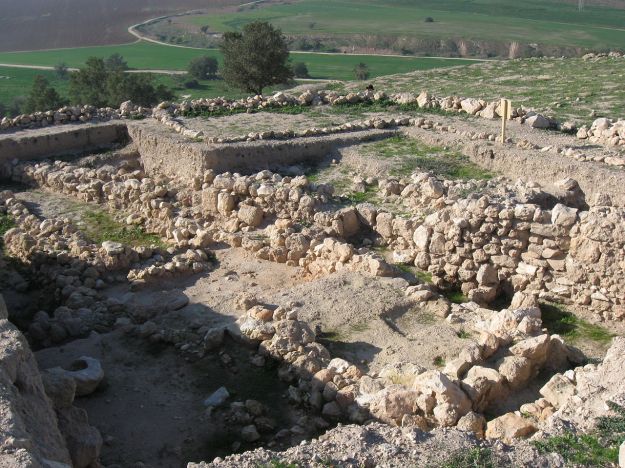
Archaeological finds at Gath (Tell es-Safi) By Ori~ – Own work, Attribution, https://commons.wikimedia.org/w/index.php?curid=8945813

Psalm 56

<To the leader: according to The Dove on Far-off Terebinths. Of David. A Miktam, when the Philistines seized him in Gath.>
1 Be gracious to me, O God, for people trample on me; all day long foes oppress me;
2 my enemies trample on me all day long, for many fight against me. O Most High[1],
3 when I am afraid, I put my trust in you.
4 In God, whose word I praise, in God I trust; I am not afraid; what can flesh do to me?
5 All day long they seek to injure my cause; all their thoughts are against me for evil.
6 They stir up strife, they lurk, they watch my steps. As they hoped to have my life,
7 so repay them for their crime; in wrath cast down the peoples, O God!
8 You have kept count of my tossings; put my tears in your bottle. Are they not in your record?
9 Then my enemies will retreat in the day when I call. This I know, that God is for me.
10 In God, whose word I praise, in the LORD, whose word I praise,
11 in God I trust; I am not afraid. What can a mere mortal do to me?
12 My vows to you I must perform, O God; I will render thank offerings to you.
13 For you have delivered my soul from death, and my feet from falling, so that I may walk before God in the light of life.

In God we trust was adopted in 1956 as the official motto of the United States and was placed on all government currency the following year. Yet, these official words of a community trusting in God have not prevented the people of the United States from being afraid. For the psalmist the statement, “In God I trust” is a statement which moves them from being afraid to a defiant stance of faithful endurance in the midst of suffering. The God of the psalmist is trustworthy and sees the strife of the righteous ones. Their tears have not been shed in vain, their suffering and strife are not meaningless because God has treasured them, and God will deliver them from their turmoil.

The superscription of the Psalm places it within the same time period as Psalm 52 but focuses on the brief narrative of David in Gath in 1 Samuel 21: 10-15. David has fled King Saul and goes to the King of Gath to attempt to find safety. The servants of the King of Gath wonder if they have a valuable hostage they can use, but David feigns madness, and the King of Gath sends him away. David finds himself unwelcome both in Israel and among the enemies of Israel. He is on the run and trying to survive. This time of uncertainty makes sense as a framework for this Psalm which focuses on trusting God in the midst of fear and the militaristic language of this poem could apply to David and his followers, but this psalm, like the rest of the psalms, can find meaning beyond the context of their superscription.

Like the previous psalm, there are several words that have caused troubles for translators and have produced multiple readings of individual verses, but the overall direction of the psalm is not in doubt. The complaint of the psalmist which is voiced in verse 1-2 and 5-6 revisits the common theme of this portion of the psalter, a righteous one oppressed by a group who cause them trouble. The militaristic language reflected in the complaint where the righteous one finds themselves trampled by warriors who oppose them. These ones opposing the righteous one is set against them. They are creating strife, watching their words and movements, seeking to injure their cause, and aligning their thoughts against them for evil. The righteous one finds themselves in a struggle against others in a time where they cannot rely upon other people.

This psalm pivots on the words ‘afraid’ and ‘trust.’ Both words appear three times in parallel with each other

When I am afraid, I put my trust in you. (3)
In God I trust; I am not afraid; (4)
in God I trust; I am not afraid. (11)

In this psalm, their trust in God is what moves them from fear to not being afraid. The trustworthiness of the LORD their God transforms their fear into fearlessness. The one sustaining them is God, the ones who oppose the righteous are mere mortals. As Paul would later echo, “If God is for us, who is against us?” (Romans 8:31) The poet trusts that God is one who sees their situation and will deliver their soul from death. Their God not only knows about their sufferings but can measure the physical manifestations of that suffering. Their tossings are counted, their tears are bottled and recorded, and God will not continue to allow these offering of pain to go unanswered. The God of the people of Israel is one who has “observed the misery of my people…I have heard their cry…Indeed, I know their sufferings, and I have come down to deliver them.” (Exodus 3:7-8) This God who the psalmist trusts will not allow their suffering to go unanswered.

The psalm ends on a confident note: they trust in God, they will perform their vows obediently, they will offer up offerings of gratitude, and they will walk before God. The psalmist may not be delivered by the end of the psalm, but they stand in the confidence that God will act, and they will be able to enter a future with gratitude for how God has delivered them. Their opponents may remain, but their fear is gone. They stand in a defiant trust in their God who hears their cries and delivers them, so what can a mere mortal do to them.

[1] The Hebrew marom here is problematic and led to very different translations. The NIV translates “many are attacking me in their pride”. While the NRSV sees this as a designation of God, hence the translation “many fight against me O Most High. Both translations can make sense in the context of the psalm.

Psalm 55-A Desperate Prayer from an Unsafe Environment

Apophysis-Betrayal (1footonthedawn at deviantart.com)

Psalm 55

To the leader: with stringed instruments. A Maskil of David.
1 Give ear to my prayer, O God; do not hide yourself from my supplication.
2 Attend to me, and answer me; I am troubled in my complaint. I am distraught
3 by the noise of the enemy, because of the clamor of the wicked. For they bring trouble upon me, and in anger they cherish enmity against me.
4 My heart is in anguish within me, the terrors of death have fallen upon me.
5 Fear and trembling come upon me, and horror overwhelms me.
6 And I say, “O that I had wings like a dove! I would fly away and be at rest;
7 truly, I would flee far away; I would lodge in the wilderness; Selah
8 I would hurry to find a shelter for myself from the raging wind and tempest.”
9 Confuse, O Lord, confound their speech; for I see violence and strife in the city.
10 Day and night they go around it on its walls, and iniquity and trouble are within it;
11 ruin is in its midst; oppression and fraud do not depart from its marketplace.
12 It is not enemies who taunt me — I could bear that; it is not adversaries who deal insolently with me — I could hide from them.
13 But it is you, my equal, my companion, my familiar friend,
14 with whom I kept pleasant company; we walked in the house of God with the throng.
15 Let death come upon them; let them go down alive to Sheol; for evil is in their homes and in their hearts.
16 But I call upon God, and the LORD will save me.
17 Evening and morning and at noon I utter my complaint and moan, and he will hear my voice.
18 He will redeem me unharmed[1] from the battle that I wage, for many are arrayed against me.
19 God, who is enthroned from of old, Selah will hear, and will humble them — because they do not change, and do not fear God.
20 My companion laid hands on a friend and violated a covenant with me
21 with speech smoother than butter, but with a heart set on war; with words that were softer than oil, but in fact were drawn swords.
22 Cast your burden on the LORD, and he will sustain you; he will never permit the righteous to be moved.
23 But you, O God, will cast them down into the lowest pit; the bloodthirsty and treacherous shall not live out half their days. But I will trust in you.

This Psalm is filled with unusual Hebrew words that account for the differences in wording among translations. Although individual words may present challenges the overall message of the words are clear. This is a desperate prayer for deliverance from an unsafe environment where human relationships have failed, trust has been violated, and the psalmist feels unsafe. It is a petition for God’s help. It is a cry for God to condemn those who have brought such pain. It bears witness to the psalmist grasping to their faith in God’s justice when others have proven faithless.

Many people can reflect on moments in their life when they can identify strongly with the words of this Psalm. For me, the words of this psalm take me back to a time when a dream had died, I was leading a congregation that was splitting apart due to conflict, and even home was no longer a healthy place as I attempted to deal with a betrayal by one I loved. It was a time where it felt like all the things that defined me had rejected me. My hopes for the future, my work, my place of worship, and even my family all had been impacted and the only thing I had left to hold on to was the faith that God would hear my cry in that moment, that the pain would eventually end, and that God would save me in a time when I could not save myself.

Perhaps the reason that the words in this Psalm are so difficult to translate is that the poet has to grasp for words in the midst of their pain which seem just out of reach. Deep pain seems to shatter our ability to narrate what is happening, the events become unspeakable. Yet, it is precisely this inability to speak about the trauma that one endures which can trap us within it. One of the gifts of scripture, particularly the Psalms and the prophets, is honest language which attempts to bear witness to the pain and suffering that are often a part of the life of the faithful. Being a religious person does not prevent one from experiencing conflict, betrayal, anxiety, fear, and even desiring to run away from one’s home or one’s vocation.

The Psalm begins with four verbs asking God to pay attention to the desperate prayer (Give ear, do not hide, attend, and answer) followed by a long list of troubles caused to this faithful one by the actions of the enemy/wicked. The righteous one is troubled, distraught, experiencing anguish in their heart and the terrors of death, fear, trembling. and horror overwhelm them, and their desire is to flee from the city, their home, and their responsibilities to some wilderness retreat. These early descriptions of the psalmist’s current condition seem in tension the affirmation later in the Psalm that “the LORD…will never permit the righteous to be moved” but they need to voice the full extent of their affliction before they can enter into the trust in God’s provision. J Clinton McCann highlights that many of the things the righteous one is experiencing are exactly what those opposed to God’s way and experiencing God’s judgment have experienced in the past:

“Terrors” (v.4) and “trembling” (v.5) are what the Egyptians experienced as a result of opposing God (see Exod 15: 15-16), and overwhelming horror is what Ezekiel promises as a result of God’s judgment (see Ezek 7:18). (NIB IV, 898)

Now in a world turned upside down by violence and betrayal the righteous are experiencing this at the hands of the wicked and only God can reestablish justice in this unjust environment. The psalmist, like the prophet Jeremiah in Jeremiah 9:1-6, desires to be away from this place of betrayal and pain.

The city itself has become unsafe because of the actions of the wicked. There is no safe time and there is no safe place. Morning to night and from the walls of the city to the marketplace and even in the heart of the city the enemy cannot be avoided. The features of the city that are supposed to bring security are occupied by the enemy, commerce has been corrupted, and there is no place to go where violence, strife, and ruin have not transformed the city which was once a home into a prison for this petitioner. God must act in the midst of this injustice and the psalmist echoes God’s judgment of Babel in Genesis 11:1-9 where the languages of the city are confused.

It is only in the middle of the psalm that we learn that the betrayer who has made their world unsafe is, “my equal, my companion, my familiar friend.” This intimate friend who has shared times both mundane and sacred with the speaker has become their oppressor. The transformation from friend to enemy has broken the petitioner’s world and they cry out for God to judge them like God judged Korah and his company that were taken alive into the realm of death. (Numbers 16: 30-33) Although Sheol as a place of the dead does not have the same meaning as Hell in much Christian thought, the injustice committed by this former close friend and companion has damaged the petitioner so deeply they want them removed from the sphere of the living. As uncomfortable as these words crying out for judgment may be, they need to be spoken and lifted up to God so that they can leave the speaker’s heart. Like Jeremiah 9:1-6 mentioned above, it is neighbors and kin who bring about, “Oppression upon oppression, deceit upon deceit!” (Jeremiah 9:6) and now the fate of these friends turned enemy belongs to God. The companion who laid hands on the psalmist and violated their covenant now finds themselves in the hands of the God who is faithful to the covenant.

God will judge the wicked and restore the just. The redemption which the psalmist longs for is not merely a removal of the wicked but also a relief from their anxiety and a complete return to wholeness and happiness. The only life after this experience of betrayal and oppression can come from the LORD who sustains the righteous. Ultimately for the healing to begin the environment must change and the only way the petitioner sees for that to happen in their current state is for the violent betrayer to be removed. There is no trust in one whose speech was smoother than butter and whose words were smoother than oil which hid a heart set on conflict and actions which cut deeply.  For the psalmist human beings have proven untrustworthy, and it has driven this righteous one towards God. Perhaps in a place and time where the poet’s center of life has been returned to peace and wholeness there will be a space for reconciliation and forgiveness, but in the immediate aftermath of betrayal as the poet lives in fear and anxiety their horizon can only embrace a future without their betrayer.


[1] Literally “he will ransom in shalom (peace-wholeness) my nephesh (soul-center of life)” As Beth Tanner notes, “my very life will be protected, not just from harm, but will be restored to complete wholeness and happiness. (Nancy deClaisse-Walford 2014, 475)