Category Archives: Biblical Reflections

Ezekiel 46 Daily, Weekly, and Monthly Sacrifices, Land, and Sanctified Food

James Tissot, Solomon Decicates the Temple (1896-1902)

Ezekiel 46: 1-15 The Sabbath and New Moon

1Thus says the Lord GOD: The gate of the inner court that faces east shall remain closed on the six working days; but on the sabbath day it shall be opened and on the day of the new moon it shall be opened. 2The prince shall enter by the vestibule of the gate from outside, and shall take his stand by the post of the gate. The priests shall offer his burnt offering and his offerings of well-being, and he shall bow down at the threshold of the gate. Then he shall go out, but the gate shall not be closed until evening. 3The people of the land shall bow down at the entrance of that gate before the LORD on the sabbaths and on the new moons. 4The burnt offering that the prince offers to the LORD on the sabbath day shall be six lambs without blemish and a ram without blemish; 5and the grain offering with the ram shall be an ephah, and the grain offering with the lambs shall be as much as he wishes to give, together with a hin of oil to each ephah. 6On the day of the new moon he shall offer a young bull without blemish, and six lambs and a ram, which shall be without blemish; 7as a grain offering he shall provide an ephah with the bull and an ephah with the ram, and with the lambs as much as he wishes, together with a hin of oil to each ephah. 8When the prince enters, he shall come in by the vestibule of the gate, and he shall go out by the same way.
9When the people of the land come before the LORD at the appointed festivals, whoever enters by the north gate to worship shall go out by the south gate; and whoever enters by the south gate shall go out by the north gate: they shall not return by way of the gate by which they entered, but shall go out straight ahead. 10When they come in, the prince shall come in with them; and when they go out, he shall go out.
11At the festivals and the appointed seasons the grain offering with a young bull shall be an ephah, and with a ram an ephah, and with the lambs as much as one wishes to give, together with a hin of oil to an ephah. 12When the prince provides a freewill offering, either a burnt offering or offerings of well-being as a freewill offering to the LORD, the gate facing east shall be opened for him; and he shall offer his burnt offering or his offerings of well-being as he does on the sabbath day. Then he shall go out, and after he has gone out the gate shall be closed.
13He shall provide a lamb, a yearling, without blemish, for a burnt offering to the LORD daily; morning by morning he shall provide it. 14And he shall provide a grain offering with it morning by morning regularly, one-sixth of an ephah, and one-third of a hin of oil to moisten the choice flour, as a grain offering to the LORD; this is the ordinance for all time. 15Thus the lamb and the grain offering and the oil shall be provided, morning by morning, as a regular burnt offering.

The reestablishment of the temple enables a resumption of the weekly and monthly offerings to the LORD. One of the first things that a careful reader of the Hebrew Scriptures will notice is the differences between the offerings in Ezekiel and in the Mosaic torah (Numbers 28:9-15). The quantity of sacrificial animals and the type of additional items offered with the sacrifice has changed between Numbers and Ezekiel. Although the sense of order is very important for the prophet, it is also possible that he does not have access to the torah scrolls. When the temple is reestablished under Nehemiah and Ezra, they explicitly indicate they are utilizing the Mosaic torah and may be unaware of this portion of Ezekiel. Yet to understand the prophet Ezekiel’s ordered world these sacrifices weekly and monthly are important.

The Mosaic torah on the sabbath dictates two lambs, 2/10 ephah of flour mixed with oil and the drink offering compared to Ezekiel’s ram and six lambs, with an ephah of flour with a hin of oil for the ram and ‘the gift of his hand’[1] for the grain offering with the lambs. The drink offering of wine is omitted by Ezekiel, and this may be intentional to prevent the priests from becoming intoxicated while performing their duty.[2] In Ezekiel’s vision everything occurs in an orderly manner. These sabbath offerings are provided by the prince on behalf of the people and the prince enters with the people and oversees the offerings he has provided on their behalf. The eastern door of the inner court is opened on the sabbath, and new moon festivals and it is at this door (at the post of the gate) he watches the offerings. The prince prostrates himself before the offerings which is the appropriate position for a mortal in the presence of the holy, yet even the prince does not enter this holy space. He remains in the outer courtyard looking through the gate at the inner courtyard. He arrives with the people and when the ceremony is over, he departs with the people.

The Jewish calendar is a lunar calendar, and so the ‘new moon’ festival is a monthly commemoration and not associated with the worship of the moon. The offering for this festival is reduced from the two bulls, one ram, and seven lambs in Numbers 28:11-15 to one bull, one ram, and six lambs here, but the amount of grain offering increases.  For both sabbath and the festivals the eastern gate to the inner court is opened for the sacrifice and then closed when the people and prince depart and remains closed throughout the non-sabbath, non-celebration days. Perhaps this is to prevent the people from being observed by the LORD at their work when they are not physically clean from working in the fields, but it also is likely an additional barrier between the holiness of God and the lack of holiness among the people.

For the daily offering the pronoun shifts from third person to second person (not reflected in the NRSV) and this may indicate that now the prophet is being addressed. The prince would not be present at the temple on the non-sabbath days and so the prophet or priest would be responsible for the conduct of the morning offerings, yet the prince likely was the patron who provided the animals. For Ezekiel a perfectly ordered world has a role for the priests every day but delineates ceremonially the sabbath and monthly festivals. Yet, as Tova Ganzel notes:

The book of Numbers enumerates the sacrifices to be brought at other times: Shavuot, Rosh HaShana, Yom Kippur, and Shemini Atzeret. Ezekiel mentions none of these. Each of these holidays lasts for a single day, and perhaps the book of Ezekiel does not mention any of them because Ezekiel’s prophecy makes no change in any of them. However, this may be a deliberate omission – implying no future commemoration of these holidays. (Ganzel, 2020, p. 391)

For both Jewish and Christian scholars the differences between the calendar and offerings of Numbers and Ezekiel are perplexing. Ezekiel’s world is a highly ordered world, yet it seems disconnected from the ordering of the world laid out in Torah. As mentioned above Ezekiel may not have had access to the torah when he recorded his vision, but the differences between the Mosaic torah and Ezekiel’s visions continue to cause interpreters to puzzle over which takes precedence in which circumstance. Ezra utilized the Mosaic torah in the reconstruction of the temple, but without the temple these discussions may be academic to concrete action. Yet, they remain important to understanding this prophet’s view of the world.

Ezekiel 46:16-18 The Prince, Inheritance and Land Protection

16Thus says the Lord GOD: If the prince makes a gift to any of his sons out of his inheritance, it shall belong to his sons, it is their holding by inheritance. 17But if he makes a gift out of his inheritance to one of his servants, it shall be his to the year of liberty; then it shall revert to the prince; only his sons may keep a gift from his inheritance. 18The prince shall not take any of the inheritance of the people, thrusting them out of their holding; he shall give his sons their inheritance out of his own holding, so that none of my people shall be dispossessed of their holding.

A central conviction of both the Mosaic torah and the prophet Ezekiel is that the land is a gift from God, and that God is the owner of the land. In the torah and in Joshua the intent is for inheritance to remain in families and now this ideal for all Israel is concentrated on the prince’s family. The prince may hand down an inheritance to his sons, but anything granted to a servant must be returned in the year of liberty (or Jubilee) every fifty years. The land granted to the prince in 45:1-8 is to remain in the prince’s family so that the prince can continue to be a patron for the temple and not need to take advantage of the people of Israel. The princes and nobles of Israel preying on the best land and best resources of the people has been a fear from Samuel’s initial warning in 1 Samuel 8: 10-18. The prophets have continually protested the actions by kings, princes, and nobles to exercise power over the people and deprive them of their inheritance. Here the protection of the royal lands is linked with the princes honoring the lands of the people.

Ezekiel 46:19-24 Set Aside Kitchens for Holy People

19Then he brought me through the entrance, which was at the side of the gate, to the north row of the holy chambers for the priests; and there I saw a place at the extreme western end of them. 20He said to me, “This is the place where the priests shall boil the guilt offering and the sin offering, and where they shall bake the grain offering, in order not to bring them out into the outer court and so communicate holiness to the people.”
21Then he brought me out to the outer court, and led me past the four corners of the court; and in each corner of the court there was a court — 22in the four corners of the court were small courts, forty cubits long and thirty wide; the four were of the same size. 23On the inside, around each of the four courts was a row of masonry, with hearths made at the bottom of the rows all around. 24Then he said to me, “These are the kitchens where those who serve at the temple shall boil the sacrifices of the people.”

Ezekiel’s ordered world separates into different gradients of holiness. The priest who are engaged in the holiest of work and occupy the holiest space have a place inside the holy chambers to prepare a meal. There is one kitchen inside this space for the priests to eat as they perform their work, so they do not communicate holiness to the people. Similarly, there are four kitchen-like structures in the outer court where the Levites likely prepare the food that the people will eat during the sacrifices. Within the temple there is a place for the priests, a place for the Levites, and a place for the people. Sacrifices were times of gathering to worship but also eat, and the portion of the priests must be separated from the portions of the people. The holiness of God is too dangerous for the majority of the population to approach.


[1] This is a literal rendering of the idiom translated ‘as much as he wishes to give’ by the NRSV. Block renders this as ‘Whatever he can afford.’ (Block, 1998, p. 668)

[2] Ezekiel 44:21.

Ezekiel 45 Land, Justice, Sacrifices, and the Passover

Grigory Mekheev, Exodus (2000) artist shared work under Creative Commons Attribution-Share Alike 3.0

Ezekiel 45: 1-8 The Set Aside Portions of the LORD and the Prince

1When you allot the land as an inheritance, you shall set aside for the LORD a portion of the land as a holy district, twenty-five thousand cubits long and twenty thousand cubits wide; it shall be holy throughout its entire extent. 2Of this, a square plot of five hundred by five hundred cubits shall be for the sanctuary, with fifty cubits for an open space around it. 3In the holy district you shall measure off a section twenty-five thousand cubits long and ten thousand wide, in which shall be the sanctuary, the most holy place. 4It shall be a holy portion of the land; it shall be for the priests, who minister in the sanctuary and approach the LORD to minister to him; and it shall be both a place for their houses and a holy place for the sanctuary. 5Another section, twenty- five thousand cubits long and ten thousand cubits wide, shall be for the Levites who minister at the temple, as their holding for cities to live in.
6Alongside the portion set apart as the holy district you shall assign as a holding for the city an area five thousand cubits wide, and twenty- five thousand cubits long; it shall belong to the whole house of Israel.
7And to the prince shall belong the land on both sides of the holy district and the holding of the city, alongside the holy district and the holding of the city, on the west and on the east, corresponding in length to one of the tribal portions, and extending from the western to the eastern boundary 8of the land. It is to be his property in Israel. And my princes shall no longer oppress my people; but they shall let the house of Israel have the land according to their tribes.

As a modern Protestant Christian entering the worldview of Ezekiel the experience can seem disorienting or alien. The focus on holiness contrasts strongly with the modern Protestant Christian emphasis on the closeness and even intimacy of the relationship with God. The need to set aside holy space separated from the rest of the world has been lost to most modern people, but perhaps even stranger to us is Ezekiel’s focus on the land belonging to the LORD. The allotment of the land (literally casting lots for the land) indicates that all the land belongs to God and God can allocate the land however God chooses. The priests and Levites are highlighted for relying on God for their inheritance.

This section will be more fully developed in chapter forty eight (48:8-22) with the allocation of land to all the tribes, yet here we are given a way of looking at the holy space of the sanctuary with its bordering regions of buffer from the rest of the population. The location of this portion will be shown in chapter forty-eight, but here the focus is on the dimensions of this space surrounding the temple. This portion of land set aside by the LORD for the temple, the priests, and the Levites is slightly more than eight miles in length and six and a half miles in width, fifty square miles or 33,500 acres. (Block, 1998, p. 652) At the heart of this large section of the land is the 500 cubit square of the sanctuary and the fifty cubit buffer zone around the sanctuary.[1] The next layer of buffer is provided by the living area that the LORD provides for the priests. One half of this space (minus the area dedicated to the temple) is for the priests and their families who minister before the LORD. The remaining half of the space is for the Levites and their families. This space, designated as ‘arim which recollects the Levitical cities of Numbers 35:1-8, yet now instead of towns spread throughout the territory there is a concentrated space for the Levites to dwell. There are numerous changes throughout this section of Ezekiel to the original design of territory allocated in Numbers and Joshua, but worship is centralized in a common location in Ezekiel’s vision so the concentration of the priests and Levites in proximity to the temple is logical.

The next section that separates the holy space of the temple, priests, and Levites from the people is the ‘ahazzat ha’ir which is set aside for the whole house of Israel. This may have been a designated place for pilgrims to come to offer sacrifices or participate in the festivals to stay for the celebrations. Although there may have been a vision for structures to serve as temporary housing for the pilgrims that come, it may have also been an open space for people to set up camps or booths. Finally, there is a large section of land given to the prince (nasi) of Israel. The two sections of land for the prince should be sufficient that the prince does not need to claim the land of the people while still being able to provide for the proper sacrifices and festivals around the temple.

Ezekiel 45: 9-12 Just Expectations of Leaders and Trade

9Thus says the Lord GOD: Enough, O princes of Israel! Put away violence and oppression, and do what is just and right. Cease your evictions of my people, says the Lord GOD.
10You shall have honest balances, an honest ephah, and an honest bath. 11The ephah and the bath shall be of the same measure, the bath containing one-tenth of a homer, and the ephah one-tenth of a homer; the homer shall be the standard measure. 12The shekel shall be twenty gerahs. Twenty shekels, twenty-five shekels, and fifteen shekels shall make a mina for you.

We live with the expectation of common standards for measurement where governments maintain the standards for economic commerce. That was also expected in the practice of Hebrew society, but the lack of common measurements that allowed merchants or nobles to exploit the population were a common protest of the prophets. The best-known example is probably Amos:

Hear this, you that trample on the needy, and bring ruin to the poor of the land, saying, “When will the new moon be over so that we may sell grain; and the sabbath, so that we may offer wheat for sale? We will make the ephah small and the shekel great, and practice deceit with false balances, buying the poor for silver and the needy for a pair of sandals, and selling the sweepings of the wheat. Amos 8:4-6

Even Proverbs opines that, “A false balance is an abomination to the LORD, but an accurate weight is his delight.” Proverbs 11:1.

The prince of Israel has just received a sizeable grant of land from the LORD, and now the attention turns to the unjust ways the princes of Israel have preyed upon the people.[2] This new future for a reordered people centered around a holy temple will also be expected to be a just people. Sometimes holiness and justice, or righteousness, are looked upon as contradictory impulses but in the prophets, both are expectations of covenantal faithfulness to the LORD. Rather than preying upon the people and evicting them from their land, the LORD has provided a substantial portion for the prince with the expectation of righteousness by these princes of Israel.

The ephah and the bath are the dry and liquid units of measurement for the people. An ephah is one tenth of a homer, a unit that comes from what a donkey could carry (NIB VI: 1583)[3] Both the ephah and the bath are roughly 22 liters (5.8 gallons). The unit of measure also needs to correspond to a consistent unit of payment in the shekel and mina. Ezekiel’s shekel would be 11.4 g (0.4 oz), and the sixty-shekel mina probably is inspired by Babylon’s “sexagesimal system.” (Block, 1998, p. 657)

Ezekiel 45: 13-17 The Temple Offerings

13This is the offering that you shall make: one-sixth of an ephah from each homer of wheat, and one-sixth of an ephah from each homer of barley, 14and as the fixed portion of oil, one-tenth of a bath from each cor (the cor, like the homer, contains ten baths); 15and one sheep from every flock of two hundred, from the pastures of Israel. This is the offering for grain offerings, burnt offerings, and offerings of well-being, to make atonement for them, says the Lord GOD. 16All the people of the land shall join with the prince in Israel in making this offering. 17But this shall be the obligation of the prince regarding the burnt offerings, grain offerings, and drink offerings, at the festivals, the new moons, and the sabbaths, all the appointed festivals of the house of Israel: he shall provide the sin offerings, grain offerings, the burnt offerings, and the offerings of well-being, to make atonement for the house of Israel.

A rebuilt and rededicated temple exists for the sacrifice of the offerings of the people. Although instruction was undoubtably a part of the activities of the temple, much of the actions and learning is associated with the cultic practices of sacrifice of well-being, to atone for sin, and to give thanks for the prosperity of the people. Just as the land is a grant from God that can be rescinded, so is the prosperity the people enjoy. The requested sacrifices are modest as a percentage of the bounty of the field and flock:

To provide for these offerings wheat and barley are to be taxed at the rate of 1/6 of an ephah for every homer of grain, which amounts to a 1/60 levy, or 1.6 percent. The rate for olive oil is 1/10 a bath for every homer, or 1 percent. Sheep are to be taxed at one animal per 200, that is, at the rate of 0.5 percent. (Block, 1998, p. 659)

The people participate in bringing in the offering, but ultimately it is the responsibility of the prince to collect or provide for the actions of the temple and supply the sacrifices for the festivals as well as the regular offerings. The actions of worship are centralized in the temple and the prince centralizes the provision of offerings.

Ezekiel 45: 18-25 First Month Purification of Temple and Passover

18Thus says the Lord GOD: In the first month, on the first day of the month, you shall take a young bull without blemish, and purify the sanctuary. 19The priest shall take some of the blood of the sin offering and put it on the doorposts of the temple, the four corners of the ledge of the altar, and the posts of the gate of the inner court. 20You shall do the same on the seventh day of the month for anyone who has sinned through error or ignorance; so you shall make atonement for the temple.
21In the first month, on the fourteenth day of the month, you shall celebrate the festival of the passover, and for seven days unleavened bread shall be eaten. 22On that day the prince shall provide for himself and all the people of the land a young bull for a sin offering. 23And during the seven days of the festival he shall provide as a burnt offering to the LORD seven young bulls and seven rams without blemish, on each of the seven days; and a male goat daily for a sin offering. 24He shall provide as a grain offering an ephah for each bull, an ephah for each ram, and a hin of oil to each ephah. 25In the seventh month, on the fifteenth day of the month and for the seven days of the festival, he shall make the same provision for sin offerings, burnt offerings, and grain offerings, and for the oil.

Calendars matter in the ancient world. My one reading of the Old Testament Pseudepigrapha was enough to reinforce that reality since many of the documents struggle over calendar. The beginning of a year, particularly the beginning of a year in this new temple, requires a purification of the site for its utilization throughout the year. Although there is some debate about whether the purification done here is an annual event or an initial event with the opening of the temple at the beginning of the new year, my gut tells me that Ezekiel intends this as an annual event. The closest analogue is Exodus 40:2 where the tabernacle is set up on the first day of the first month, and the echo is likely intentional. This parallel lends support to readers who view this as an initial event, but the beginning of the year is a significant event in most cultures and an annual purification in a worldview concerned with the holiness of this space seems appropriate. The offering of the young bull without blemish on the first and seventh day of the month seems reasonable accommodation to make atonement for the temple.

Ezekiel’s brief description of the Passover is shocking for its differences from the original celebration. Passover as initially outlined in Exodus 12: 1-28 is an event that occurs at the familial level, but now the event is centralized and is a festival that people are expected to make a pilgrimage for. In Exodus 34:21-24 it appears that the Passover is one of the three times the people are to gather and Deuteronomy 16: 1-8 does envision a central place where the people would gather for the Passover, but now the prince takes the central role in providing for the Passover rather than the family and the sacrifice moves from lamb to bull, ram, and goats. “Ezekiel retains the label of the ancient rite as Passover, his ordinances call for a dramatic transformation of the festival.” (Block, 1998, p. 667) Both Hezekiah and Josiah in their reforms bring the people together to celebrate the Passover and add bulls and goats to the offering of lambs (2 Chronicles 30, 35). Yet here the lamb, so central to the imagery and story of the original Passover, is gone as is the familial role in the celebration.

Ezekiel’s perspective values a centralization of worship and activities around the temple. In addition, there is a value for the role of the prince of Israel as a provider for the festival. This may look back fondly on the times of Hezekiah and Josiah where these two kings reestablished the festival from their own resources. Another factor may be the inability of families to ensure the faithful execution of the festival in the past. The practice of the Passover in Israel seems to quickly disappear without royal and priestly encouragement. For Ezekiel, who has seen the disastrous results of the people’s idolatry and their abominable practices, a return to a less centralized celebration of this critical festival may be unthinkable.


[1] This agrees with the dimensions of 42:20.

[2] See Ezekiel 19.

[3] A homer is approximately four to six bushels.

Ezekiel 44 The Sealed Gate, the Levites, and the Priests

The Temple by Radojavor@deviantart.com

Ezekiel 44: 1-3 The Sealed Gate of the Temple

1Then he brought me back to the outer gate of the sanctuary, which faces east; and it was shut. 2The LORD said to me: This gate shall remain shut; it shall not be opened, and no one shall enter by it; for the LORD, the God of Israel, has entered by it; therefore it shall remain shut. 3Only the prince, because he is a prince, may sit in it to eat food before the LORD; he shall enter by way of the vestibule of the gate, and shall go out by the same way.

The eastern gate of this temple is to remain closed for all human traffic because it is the path that the LORD has utilized to enter the temple. Even the priests and the prince (mentioned here for the first time in Ezekiel 40-48) must enter by the north or south gateways. The repetition of this gate remaining shut emphasizes the important nature of this command for the sanctity of the temple and the safety of the people. It also may serve as a polemic against the Babylonian New Year’s festival where Marduk is paraded from the temple and then reenters in procession to that temple’s central space. On the one hand, the LORD the God of Israel does not need human hands to carry the presence of God into the temple. Additionally, this permanent closing reinforces the LORD’s intention to be among the people forever and not to depart as the LORD’s presence did in Ezekiel 10.

The presence of the prince (Hebrew nasi) in this section will be expanded on later in Ezekiel 45:21-46:12 as the provider of offerings at festivals and a participant in those celebrations. Yet even this expansion does not offer a lot of specificity about the role of this prince of the people. On the one hand, the prince is permitted to eat before the LORD and has a special relation to the LORD. The presence of a new prince has been promised in both in Ezekiel 34: 23-24 and 37: 24-25 as a new David and one who is a faithful shepherd. Yet, this prince does not construct this temple like Solomon and Ezekiel’s focus is less upon this prince who shepherds the people, and more on the Levites and Zadokite priests who will keep the people from defiling the temple. This prince may have an honored role in God’s future but Ezekiel’s concern is primarily with priestly things and not princely things.

Ezekiel 44:4-31 The Levites and the Zadokite Priests

4Then he brought me by way of the north gate to the front of the temple; and I looked, and lo! the glory of the LORD filled the temple of the LORD; and I fell upon my face. 5The LORD said to me: Mortal, mark well, look closely, and listen attentively to all that I shall tell you concerning all the ordinances of the temple of the LORD and all its laws; and mark well those who may be admitted to the temple and all those who are to be excluded from the sanctuary. 6Say to the rebellious house to the house of Israel, Thus says the Lord GOD: O house of Israel, let there be an end to all your abominations 7in admitting foreigners, uncircumcised in heart and flesh, to be in my sanctuary, profaning my temple when you offer to me my food, the fat and the blood. You have broken my covenant with all your abominations. 8And you have not kept charge of my sacred offerings; but you have appointed foreigners to act for you in keeping my charge in my sanctuary.
9Thus says the Lord GOD: No foreigner, uncircumcised in heart and flesh, of all the foreigners who are among the people of Israel, shall enter my sanctuary. 10But the Levites who went far from me, going astray from me after their idols when Israel went astray, shall bear their punishment. 11They shall be ministers in my sanctuary, having oversight at the gates of the temple, and serving in the temple; they shall slaughter the burnt offering and the sacrifice for the people, and they shall attend on them and serve them. 12Because they ministered to them before their idols and made the house of Israel stumble into iniquity, therefore I have sworn concerning them, says the Lord GOD, that they shall bear their punishment. 13They shall not come near to me, to serve me as priest, nor come near any of my sacred offerings, the things that are most sacred; but they shall bear their shame, and the consequences of the abominations that they have committed. 14Yet I will appoint them to keep charge of the temple, to do all its chores, all that is to be done in it.
15But the levitical priests, the descendants of Zadok, who kept the charge of my sanctuary when the people of Israel went astray from me, shall come near to me to minister to me; and they shall attend me to offer me the fat and the blood, says the Lord GOD. 16It is they who shall enter my sanctuary, it is they who shall approach my table, to minister to me, and they shall keep my charge. 17When they enter the gates of the inner court, they shall wear linen vestments; they shall have nothing of wool on them, while they minister at the gates of the inner court, and within. 18They shall have linen turbans on their heads, and linen undergarments on their loins; they shall not bind themselves with anything that causes sweat. 19When they go out into the outer court to the people, they shall remove the vestments in which they have been ministering, and lay them in the holy chambers; and they shall put on other garments, so that they may not communicate holiness to the people with their vestments. 20They shall not shave their heads or let their locks grow long; they shall only trim the hair of their heads. 21No priest shall drink wine when he enters the inner court. 22They shall not marry a widow, or a divorced woman, but only a virgin of the stock of the house of Israel, or a widow who is the widow of a priest. 23They shall teach my people the difference between the holy and the common, and show them how to distinguish between the unclean and the clean. 24In a controversy they shall act as judges, and they shall decide it according to my judgments. They shall keep my laws and my statutes regarding all my appointed festivals, and they shall keep my sabbaths holy. 25They shall not defile themselves by going near to a dead person; for father or mother, however, and for son or daughter, and for brother or unmarried sister they may defile themselves. 26After he has become clean, they shall count seven days for him. 27On the day that he goes into the holy place, into the inner court, to minister in the holy place, he shall offer his sin offering, says the Lord GOD.
28This shall be their inheritance: I am their inheritance; and you shall give them no holding in Israel; I am their holding. 29They shall eat the grain offering, the sin offering, and the guilt offering; and every devoted thing in Israel shall be theirs. 30The first of all the first fruits of all kinds, and every offering of all kinds from all your offerings, shall belong to the priests; you shall also give to the priests the first of your dough, in order that a blessing may rest on your house. 31The priests shall not eat of anything, whether bird or animal, that died of itself or was torn by animals.

Charles Taylor, in his massive work A Secular Age, talks about the way the ancient world was viewed by its inhabitants as a ‘porous’ place with specific thin places where the holiness of the divine or the profanity of the demonic could come into contact with the people. These spaces were both places of great blessing and great danger, and it required the actions of the entire community to maintain a proper relationship with the divine to prevent the holiness of the God the community worshipped from either abandoning the protection of the community or actively inflicting punishment on the community. (Taylor, 2007, pp. 25-90) The purpose of the ordinances and regulations, the Levites, the priests, and the prophets within this world is to protect the holiness of the temple, the holy place for the city and people, as well as the life and prosperity of the people. Proximity to the LORD the God of Israel is a fraught reality and careless trespassing of the LORD’s holy space, in addition to the other ethical covenant violations of the people led to the departure of the LORD from the previous temple and the exile of the people. In this reconfigured world where the LORD will be present in the temple, the priests and Levites must maintain this holy space in a proper and respectful manner to the powerful God who resides at the center of the temple.

Up to this point in the temple vision Ezekiel has been asked to see and observe, but now Ezekiel’s focus moves to hearing and reporting. As Katheryn Pfisterer Darr states:

Until this point in the vision, Ezekiel has been called to focus attention upon everything his guide shows him (40:4); now, he is told to focus attention upon everything Yahweh tells him (44:5)… attention turns from the visual revelation of Yahweh’s glory filling the Temple (v.4) to God’s aural revelation in the form of ordinances and instructions concerning access to the Temple and its personnel. (NIB VI:1573)

Ezekiel is now giving actions that prescribe and prohibit activities within the temple to ensure that the temple remains undefiled and the people are protected from the holy and yet dangerous presence of God. The Levites, the priests, and the structure all separate the mundane from the holy, the clean from the unclean.

This temple vision which includes the return of the LORD to Israel is a renewal of Ezekiel’s call. The people have been receiving messages of hope from the prophet but now his role is to form a new way of being for the people to operate in this hopeful and reordered future. To ensure this future Ezekiel becomes a new lawgiver providing critical actions the people must do to remain in a good relationship with their God and covenant partner. The departure of the people from Mosaic Torah has been drastic, and even the Levites have followed the people in their abandonment of the LORD. Now the reorganized temple and people have restated laws and ordinances to order their lives.

Although foreigners working in the temple was not mentioned earlier in Ezekiel 8 when the previous temple was examined the influence of foreigners on the policies and worship of Israel and Judah has been a regular part of the narration of Israel’s history. These foreigners may have been visiting dignitaries who participated in the celebrations of the people, but they may also have had some official function in the temple. It is conceivable that they would serve as guards since most kings of this time had foreigners who served in their household and military.[1] It is also possible that Israel and Judah, in their fascination with their neighbors, brought other religious leaders into the temple. Leviticus rejects even offerings coming from a foreigner as unacceptable,[2] yet this seems to be one of many ordinances that were either forgotten or ignored in the practice of the people. Now a reordered temple requires the right people performing the right tasks to ensure that the LORD’s offerings are holy.

The Levites were originally set apart for responding faithfully to Moses when the rest of the people abandoned themselves to the worship of the golden calf.[3] Now as the people strayed from following the covenant of the LORD the Levites followed the people and some may have led the people astray. The Levites are to bear responsibility for the space of worship and bear the responsibility for their own offenses and the offenses that happen within that space.[4] They stand between God and Israel and the consequences for their actions. Daniel Block quotes Jacob Milgrom’s note on the implications of this position for the Levites:

the Levites function as a “lightning rod to attract God’s wrath upon themselves” for Israel’s sin… for their own failure to guard the house against encroachment, the Levites will experience Yahweh’s punishment. Because of their guilt they may not perform the most sacred aspects of the temple ritual. (Block, 1998, p. 629)

The Levites serve as a focal point for God’s punishment and they become the ones who must bear it for the people. They also are charged with the security of the temple and ensuring the separation of the holy from the mundane. They will not participate in the full work of the Zadokite priests, but they do serve as a buffer between the people and the priests. The access of the people to the inner court has been removed and the priests now stand in this place securing the sanctuary but also preparing the burnt offerings and other sacrifices for the people.

The priests were originally Aaron and his family, referred to as the Elide line of the priesthood. The descendants of Aaron by the time of Eli had become corrupt and were eliminated by God (1 Samuel 3-4). Zadok becomes high priest under David and is one of the people who backs Solomon in his ascension to kingship at the end of David’s life.[5] Ezekiel may come from this line of Zadok and Ezra who will lead the renewal of the temple in a rebuilt Jerusalem is also from this line.[6] Ezekiel implies that the Zadokites never departed from the covenant while the Levites did, and because of their faithfulness they are given the central role in the ministry of the temple. We encountered the Zadokites previously in 40:46 as the priests who have charge of the altar and in 43:19 in the purification of the altar. Now these Zadokite priests have the privilege and responsibility of ministering before the LORD.

To minister before the LORD requires attention to the care of one’s body and clothing. The vestments, mentioned earlier in 42:14 where these vestments are to be stored, are to be linen, and the priest is not to wear any wool that would cause perspiration before the LORD. Sweat or any bodily excretion was viewed as a defiling thing.[7] In a similar manner the regulations on cutting hair or disfigurement are brought forward from Leviticus 21. Just as the animals brought for the sacrificial acts were to be unblemished, those who were to stand before God were not to be sweaty, not to have shaved their heads nor have unkempt hair. They also were not to drink and by their inebriation do something that would bring defilement to the space and offend the presence of God. For these priests there is an element of cleanliness being required to be in the space of godliness. Everything in this reordered temple among the reestablished priesthood was to have its proper actions and places. The Zadokites have no inheritance among the land, they are to trust in the LORD and the people of God to provide for them. They have no other responsibility than the maintenance of the holy temple. These priests are given the privilege of eating the offerings provided for the LORD, and that should satisfy them.

The priests are also to be holy in their relationships. Priests are only allowed to marry a virgin from the house of Israel or the widow of another priest. Their presence in this critical role before God requires a certain distance from the people. This concern for purity was also behind Ezra’s denunciation of mixed marriages for both priests, Levites, and even the people of Israel.[8] The priest were also not allowed to be in the presence of a dead person unless it is a very close relative (father, mother, son, daughter, brother, or unmarried sister) and even in the case of a close relative they must undergo a week for purification before they can resume priestly duties. Their job before the LORD is of critical importance in the life of the people and it impacts every aspect of their lives and relationships.

The priestly role has three components. First, they are commanded to educate the people in matters holy and profane, unclean and clean. Second, the priests are charged with responsibility for the administration of justice according to the law. The priests and religious leaders in Israel have been the ones with access to the law of God and are charged with ensuring that judgments are handled according to God’s law. Finally, the priests were to be models of obedience to the will of God. (Block, 1998, pp. 642-643) The temple was to be the center of life for the people, and the priests who ministered in the temple were to ensure that the actions that defiled the temple and the people in the past are not repeated.


[1] For example many of David’s mighty men are foreigners (2 Samuel 23:8-38).

[2] Leviticus 22:25.

[3] Exodus 32:28.

[4] Numbers 18:23.

[5] 1 Kings 1.

[6] Ezra 7:2.

[7] Deuteronomy 23:9-14 discusses nocturnal emissions and the necessity of covering excrement. For Ezekiel sweat likely falls under this type of consideration for defiling this holy space. Sweat is not prohibited in the camp, but only in this place in close proximity to the LORD.

[8] Ezra 9: 1-4.

Ezekiel 43 The Presence of the LORD Returns and the New Altar

The Temple by Radojavor@deviantart.com

Ezekiel 43: 1-12 The Return of God’s Presence to the Temple

1Then he brought me to the gate, the gate facing east. 2And there, the glory of the God of Israel was coming from the east; the sound was like the sound of mighty waters; and the earth shone with his glory. 3The vision I saw was like the vision that I had seen when he came to destroy the city, and like the vision that I had seen by the river Chebar; and I fell upon my face. 4As the glory of the LORD entered the temple by the gate facing east, 5the spirit lifted me up, and brought me into the inner court; and the glory of the LORD filled the temple.
6While the man was standing beside me, I heard someone speaking to me out of the temple. 7He said to me: Mortal, this is the place of my throne and the place for the soles of my feet, where I will reside among the people of Israel forever. The house of Israel shall no more defile my holy name, neither they nor their kings, by their whoring, and by the corpses of their kings at their death. 8When they placed their threshold by my threshold and their doorposts beside my doorposts, with only a wall between me and them, they were defiling my holy name by their abominations that they committed; therefore I have consumed them in my anger. 9Now let them put away their idolatry and the corpses of their kings far from me, and I will reside among them forever.
10As for you, mortal, describe the temple to the house of Israel, and let them measure the pattern; and let them be ashamed of their iniquities. 11When they are ashamed of all that they have done, make known to them the plan of the temple, its arrangement, its exits and its entrances, and its whole form — all its ordinances and its entire plan and all its laws; and write it down in their sight, so that they may observe and follow the entire plan and all its ordinances. 12This is the law of the temple: the whole territory on the top of the mountain all around shall be most holy. This is the law of the temple.

The divine presence departed the temple and Jerusalem in chapter ten and the previous three chapters have been preparing a space for the divine presence to return to. God’s desire for Israel was to be a community where God could dwell among them, yet God’s presence is a dangerous and holy thing. God will not inhabit a defiled place, and the God of Israel will not be taken for granted. The mistakes of the previous generations are not to be repeated in this newly reorganized people gathered around a newly constructed people where God’s holiness is separated by walls and gates from the corruption that may be present among the people. Previously the glory of God departed through the east gate of the earlier temple, now God’s presence comes back from the east to enter the eastern gate and move along the spine of sacrality into the holiest place. The approaching presence of God is the same overwhelming visual and auditory experience that the prophet had both in his initial calling at the river Chebar and that he saw depart the temple in chapter ten. Here the departure in chapter ten is reimagined as when the LORD came to destroy the city and the temple, rather than utilizing the Babylonians to accomplish this work. Ezekiel’s response to the divine presence is the appropriate one, he prostrates himself before the glorious presence of God.

At the dedication of both the tabernacle (Exodus 2540) and Solomon’s temple (1 Kings 6-8) the presence (Hebrew kabod) of God comes and fills the space in an overwhelming manner. Now this new temple becomes a place where God’s presence inhabits the space and demonstrating divine approval of the new building. God claims this place as both throne and footstool, language familiar from 1 Chronicles 28:2 where David desires to build a holy place for the ark that can be a footstool for God. This place where God’s presence can rest on earth among the people is a place of great holiness that must not be defiled. The action of profaning God’s name before the nations and the action of Israel defiling by their actions this holy space are two different things as Tova Ganzel illustrates:

Unlike the concept of “profaning (ĥillul) of God,” which, in the book of Ezekiel, always refers to God’s status in the eyes of the other nations, the “defiling (tuma) of God’s name” arises from the actions of Israel – actions whose gravity causes a more profound desecration of God’s name than any outward apparent damage to His standing. (Ganzel, 2020, p. 371)

The unfaithfulness of Israel previously to the Torah as well as the actions of the kings of Israel and Judah have provoked God by their defiling actions. The ‘whoring’ refers to their practices of idolatry but may also have other covenantal implications. The corpses of kings at their death being in the presence of God may refer to the actions of Manasseh and Amon who are buried in the ‘gardens in his house’ (2 Kings 21:18, 26) presumably close to the temple. It may also refer to some unknown practice of having the deceased king lying in state before the temple prior to their committal to their burial place with the other kings of Israel or Judah. Regardless, the presence of a corpse would be a defiling presence in this holy space. In addition, the presence of the household of the kings of Judah directly beside the temple (with only a wall separating) would be dangerously proximity for these kings whose actions have previously defiled the place and the people. The presence of God among the people requires a separation of the holy space where God’s presence inhabits and the mundane space where the people, even the kings, inhabit.

God has acted to reestablish a newly reordered people around a new temple building where God’s presence and glory can inhabit. God is the actor throughout this section, there is no indication of a human builder. Even the presence of the human-like individual acting as a surveyor of the temple is clearly a figure from the heavenly realm. Israel has nothing to claim in this new beginning. As Katheryn Pfisterer Darr highlights the ending of this section:

Here as elsewhere, God’s restorative action elicits shame from the people for their past iniquities. True to form, Ezekiel permits no glimpse of a restored community celebrating the return of Yahweh’s glory in their midst. (NIB VI: 562)

Ezekiel 43: 13-27 The Dimensions and Purification of the Altar

13These are the dimensions of the altar by cubits (the cubit being one cubit and a handbreadth): its base shall be one cubit high, and one cubit wide, with a rim of one span around its edge. This shall be the height of the altar: 14From the base on the ground to the lower ledge, two cubits, with a width of one cubit; and from the smaller ledge to the larger ledge, four cubits, with a width of one cubit; 15and the altar hearth, four cubits; and from the altar hearth projecting upward, four horns. 16The altar hearth shall be square, twelve cubits long by twelve wide. 17The ledge also shall be square, fourteen cubits long by fourteen wide, with a rim around it half a cubit wide, and its surrounding base, one cubit. Its steps shall face east.
18Then he said to me: Mortal, thus says the Lord GOD: These are the ordinances for the altar: On the day when it is erected for offering burnt offerings upon it and for dashing blood against it, 19you shall give to the levitical priests of the family of Zadok, who draw near to me to minister to me, says the Lord GOD, a bull for a sin offering. 20And you shall take some of its blood, and put it on the four horns of the altar, and on the four corners of the ledge, and upon the rim all around; thus you shall purify it and make atonement for it. 21You shall also take the bull of the sin offering, and it shall be burnt in the appointed place belonging to the temple, outside the sacred area.
22On the second day you shall offer a male goat without blemish for a sin offering; and the altar shall be purified, as it was purified with the bull. 23When you have finished purifying it, you shall offer a bull without blemish and a ram from the flock without blemish. 24You shall present them before the LORD, and the priests shall throw salt on them and offer them up as a burnt offering to the LORD. 25For seven days you shall provide daily a goat for a sin offering; also a bull and a ram from the flock, without blemish, shall be provided. 26Seven days shall they make atonement for the altar and cleanse it, and so consecrate it. 27When these days are over, then from the eighth day onward the priests shall offer upon the altar your burnt offerings and your offerings of well-being; and I will accept you, says the Lord GOD.

For Ezekiel obedience to the LORD is central and Israel who was supposed to uphold the holiness of the temple instead defiled it. Now Israel is ashamed of their past as God creates a new future for them.

The examination of the altar may make sense to occur prior to the return of the glory of God, but Ezekiel, nor most ancient authors, are not concerned about our modern sense of organization. Previous generations of scholars saw the previous section as coming from a different time and place than this examination of the altar, but that is not necessary. Throughout my reflections I have focused on the text as we have received it and not some earlier generations of scholars’ quest for the original text.

Ezekiel’s altar is a large structure measuring roughly thirty-four feet on each side when you include the bottom gutter and lip which would catch any blood and other fluids from the animal. The altar proper is twenty-four feet on each side with horns at each corner. The horns are a common feature in ancient altars and previously had been a place a person could come to for sanctuary. I’m not sure in Ezekiel’s vision that the sanctuary of the horns would remain a crucial function with the focus on holiness throughout this section.

For the altar to conduct its holy function it must be sanctified by sacrificial offerings of goats, rams, and bulls for a period of seven days as outlined in the text. Ezekiel has been focused on the impurity of the people and although there is not an equivalent action prior to the dedication of the tabernacle or temple, any altar constructed for this space must be set aside and consecrated for its use. Both the prophet and the priests from the family of Zadok are to be a part of this week-long process of preparing to offer the sacrifices of the people in an acceptable manner.

Daniel Block notes that later when Ezra and Nehemiah build the temple after the return of the exiles to Jerusalem, they do not use Ezekiel’s vision. As he states, “Either the returned exiles were ignorant of Ezekiel’s vision, or they rejected it as normative Torah for themselves.” (Block, 1998, p. 602) Both are viable options. In the ancient world it would be surprising for there to be a complete collection of the scrolls we now consider scripture in one place, and it is plausible that Ezra and Nehemiah were not familiar with Ezekiel’s writings, but with both the focus of Ezra and Nehemiah on reestablishing the Torah they would likely privilege Moses over Ezekiel. As a modern reader we can see the way that Ezekiel in the book of Ezekiel is functioning as a new Moses, but for the exiles trying to begin again they likely tried to focus on the law received from Moses.

Ezekiel 42 Concluding the Survey of the New Temple

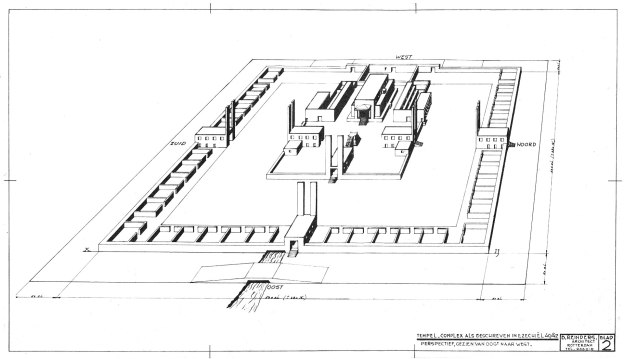
Schematic of Ezekiel’s Temple drawn by Dutch architect Bartelmeüs Reinders, Sr. (1893–1979) released into public domain by artist.

Ezekiel 42:1-14

1 Then he led me out into the outer court, toward the north, and he brought me to the chambers that were opposite the temple yard and opposite the building on the north. 2 The length of the building that was on the north side was one hundred cubits, and the width fifty cubits. 3 Across the twenty cubits that belonged to the inner court, and facing the pavement that belonged to the outer court, the chambers rose gallery by gallery in three stories. 4 In front of the chambers was a passage on the inner side, ten cubits wide and one hundred cubits deep, and its entrances were on the north. 5 Now the upper chambers were narrower, for the galleries took more away from them than from the lower and middle chambers in the building. 6 For they were in three stories, and they had no pillars like the pillars of the outer court; for this reason the upper chambers were set back from the ground more than the lower and the middle ones. 7 There was a wall outside parallel to the chambers, toward the outer court, opposite the chambers, fifty cubits long. 8 For the chambers on the outer court were fifty cubits long, while those opposite the temple were one hundred cubits long. 9 At the foot of these chambers ran a passage that one entered from the east in order to enter them from the outer court. 10 The width of the passage was fixed by the wall of the court.

On the south also, opposite the vacant area and opposite the building, there were chambers 11 with a passage in front of them; they were similar to the chambers on the north, of the same length and width, with the same exits and arrangements and doors. 12 So the entrances of the chambers to the south were entered through the entrance at the head of the corresponding passage, from the east, along the matching wall.

13 Then he said to me, “The north chambers and the south chambers opposite the vacant area are the holy chambers, where the priests who approach the LORD shall eat the most holy offerings; there they shall deposit the most holy offerings — the grain offering, the sin offering, and the guilt offering — for the place is holy. 14 When the priests enter the holy place, they shall not go out of it into the outer court without laying there the vestments in which they minister, for these are holy; they shall put on other garments before they go near to the area open to the people.”

Holy space and holy things are important in the life of a people whose life is centered around a holy God. Holiness is an under appreciated concept in many Christians, particularly in protestant traditions. For many Christians we expect the intimacy of God drawing close to us in Christ and the Spirit without appreciating the terrifying nature of God’s power and holiness. Most of the early followers of Jesus and even the Reformers understood the mystery of God’s was, to use the words of Rudolph Otto, were both fascinating (fascinans) and terrifying (tremendum). There was a deep understanding for reformers like Martin Luther of their own unworthiness to be in the holy presence of God, but in a world where intimacy has eclipsed holiness Ezekiel’s visions of holy space and holy vestments seem strange and alien to many modern readers.

Throughout the bible there is a concern about holiness and its opposite impurity or defilement. Impurity desecrates holy places and things. The idolatrous practices in the previous temple (Ezekiel 810) have led to God abandoning that people and by extension this defiled people. God’s vision was for Israel to be a priestly kingdom and a holy nation (Exodus 19:6) where God’s presence could dwell among them in the temple that bore God’s name. Instead, the people, places and things became corrupted by the abominations that Ezekiel has continually protested.

The recreation of sacred space has been the focus of this and the previous two chapters, a place where God’s presence can again dwell among the people. The text is full of rarely used words and so even the translation is provisional and any visual portrayal lacks both the necessary dimensions and precision, but the complete visualization of the space is probably not the intent. As Daniel Block states:

The burden of the present account is to show that the holiness of the sacred space extends beyond the concentric design of the temple complex to the form of the auxiliary structures, and the conduct of humans within those structures. (Block, 1998, p. 568)

For the priests to work in the presence of the holy God, they must be separated from the rest of the people of Israel. These concentric rings of increasing holiness provide a buffer between the complete holiness of God, the set aside Levites and priests, the people and ultimately the nations. Even the clothing worn in the service of God is not to depart the place and risk contamination beyond the walls. The priests are to dress and eat in this holy place they inhabit before the God of the people.

In the New Testament, particularly with Jesus, holiness will be ‘contagious’ and overwhelm uncleanness and unholiness. A prime example of this is Jesus healing leper who are unclean due to their illness. Yet, throughout the law and the prophets the primary fear is the unclean coming into the presence of the holy. Many scholars use the language of uncleanness contaminating the holiness of God, but I prefer to think of it as offending or perhaps being repellant to God. That is the entire thrust of Ezekiel’s frequent highlighting of the abominations and desecrations of the people that have made all of Israel, even the holy space of the previous temple, abhorrent to the God of Israel.

Ezekiel 42: 15-20

15 When he had finished measuring the interior of the temple area, he led me out by the gate that faces east, and measured the temple area all around. 16 He measured the east side with the measuring reed, five hundred cubits by the measuring reed. 17 Then he turned and measured the north side, five hundred cubits by the measuring reed. 18 Then he turned and measured the south side, five hundred cubits by the measuring reed. 19 Then he turned to the west side and measured, five hundred cubits by the measuring reed. 20 He measured it on the four sides. It had a wall around it, five hundred cubits long and five hundred cubits wide, to make a separation between the holy and the common.

The vision of the new temple moved from the exterior walls, through the gates into the outer courtyard, through a second set of gateways into the inner courtyard and the temple itself along the “central spine of sacrality” (Block, 1998, p. 571) leading to the most holy place. Then remaining in holy space are the places and spaces for the set aside priests to do their work on behalf of the LORD without being contaminated by the people. Now as the description of this holy space is completed we are taken to the exterior of the temple structure to view the total dimensions of the space. This five hundred cubit (eight hundred sixty feet) long walls on each side structure separate the mundane exterior from the holy spaces within these walls.

The walls, which are more like the walls of a fortified city than most temples in the ancient world, could be used as a defensive structure. Yet, for Ezekiel’s purposes they are primarily to separate holy space from mundane space. The walls prevent the unholiness of the people from coming into contact with the holiness of the LORD. Ultimately these walls and gates protect the people from defiling this sacred space and lead to a perfectly ordered temple for a reordered people to assemble around. The return of the divine presence will also need a reestablished priesthood, a renewed practice of the practices of faith, and ultimately a reordered land. Yet, in a Jewish view, this holy space where the presence of God dwells among the people is a central part of this renewed people of God.

Ezekiel 41 The Center of the New Temple

Schematic of Ezekiel’s Temple drawn by Dutch architect Bartelmeüs Reinders, Sr. (1893–1979) released into public domain by artist.

Ezekiel 41: 1-15a

1 Then he brought me to the nave, and measured the pilasters; on each side six cubits was the width of the pilasters. 2 The width of the entrance was ten cubits; and the sidewalls of the entrance were five cubits on either side. He measured the length of the nave, forty cubits, and its width, twenty cubits. 3 Then he went into the inner room and measured the pilasters of the entrance, two cubits; and the width of the entrance, six cubits; and the sidewalls of the entrance, seven cubits. 4 He measured the depth of the room, twenty cubits, and its width, twenty cubits, beyond the nave. And he said to me, This is the most holy place.

5 Then he measured the wall of the temple, six cubits thick; and the width of the side chambers, four cubits, all around the temple. 6 The side chambers were in three stories, one over another, thirty in each story. There were offsets all around the wall of the temple to serve as supports for the side chambers, so that they should not be supported by the wall of the temple. 7 The passageway of the side chambers widened from story to story; for the structure was supplied with a stairway all around the temple. For this reason the structure became wider from story to story. One ascended from the bottom story to the uppermost story by way of the middle one. 8 I saw also that the temple had a raised platform all around; the foundations of the side chambers measured a full reed of six long cubits. 9 The thickness of the outer wall of the side chambers was five cubits; and the free space between the side chambers of the temple10 and the chambers of the court was a width of twenty cubits all around the temple on every side. 11 The side chambers opened onto the area left free, one door toward the north, and another door toward the south; and the width of the part that was left free was five cubits all around.

12 The building that was facing the temple yard on the west side was seventy cubits wide; and the wall of the building was five cubits thick all around, and its depth ninety cubits.

13 Then he measured the temple, one hundred cubits deep; and the yard and the building with its walls, one hundred cubits deep; 14 also the width of the east front of the temple and the yard, one hundred cubits.

15 Then he measured the depth of the building facing the yard at the west, together with its galleries on either side, one hundred cubits.

Ezekiel is brought into the center of this new temple complex, which is similar in description to the temple of Solomon in 1 Kings 6, although the dimensions here are larger (assuming I am reading the layout correctly) than what 1 Kings indicates. The description of the temple, especially in verse five and beyond, is full of rarely used architectural expressions and translation is uncertain. The description, even if all the words are translated correctly, is difficult to fully comprehend and once again is lacking the details to fully realize this structure. This may be intentional to prevent someone from attempting to replicate this vision, but enough pieces are clear to give an overall idea of this central section of the temple.

The ’nave’ or ‘great hall’ which stands before the most holy place was a space that only the priests would enter to place the showbread on the table before the holiest place daily. This twenty by forty cubit[1] rectangular space is larger than the space in Solomon’s temple if the measurements are for the internal space of the room. For both the ‘nave’ and the most holy place the thickness of the walls is massive, equivalent to the wall surrounding the entire structure, six cubits (roughly ten feet) thick. Along this wall which spans three stories are a total of ninety chambers, presumably for storage. This structure, which is similar to Solomon’s temple, is difficult to visualize because it is unclear whether there is some type of stairway to access these side chambers. The most holy space is half the size of the nave as a twenty cubit square. On the outside was another large building, larger than the nave and most holy space combined: seventy cubits by ninety cubits.[2] The purpose of this final structure is not indicated here.

The primary concern throughout this structural description is the setting aside of spaces that separate the mundane from the holy. As we proceed from the outer doors of the structure to the most holy space the doorways decrease in size to restrict admittance and to demarcate the increasing sacredness of the intended space. With the smaller doors also comes the physical ascent to this holy space. Although there will be some description of the furnishings and decorations below, this is significantly different from the descriptions of the lavish resources committed to the construction of the tabernacle and Solomon’s temple.

Ezekiel 41: 15b- 26

The nave of the temple and the inner room and the outer vestibule 16 were paneled, and, all around, all three had windows with recessed frames. Facing the threshold the temple was paneled with wood all around, from the floor up to the windows (now the windows were covered), 17 to the space above the door, even to the inner room, and on the outside. And on all the walls all around in the inner room and the nave there was a pattern. 18 It was formed of cherubim and palm trees, a palm tree between cherub and cherub. Each cherub had two faces: 19 a human face turned toward the palm tree on the one side, and the face of a young lion turned toward the palm tree on the other side. They were carved on the whole temple all around; 20 from the floor to the area above the door, cherubim and palm trees were carved on the wall.

21 The doorposts of the nave were square. In front of the holy place was something resembling 22 an altar of wood, three cubits high, two cubits long, and two cubits wide; its corners, its base, and its walls were of wood. He said to me, “This is the table that stands before the LORD.” 23 The nave and the holy place had each a double door. 24 The doors had two leaves apiece, two swinging leaves for each door. 25 On the doors of the nave were carved cherubim and palm trees, such as were carved on the walls; and there was a canopy of wood in front of the vestibule outside. 26 And there were recessed windows and palm trees on either side, on the sidewalls of the vestibule.

The temple is decorated with cherubim and palm trees, although each cherub has only two faces instead of the four in the initial visions.[3] This decorative paneling covers the entire space from floor to above the door. The table seems to serve as the table for showbread (Exodus 25: 23-30) but Ezekiel needs to have it explained because it is double the size of the previous table. It is not a table for burnt offerings since a wooden altar would burn with the offering. The final detail is the doors which are similar to the doors in Solomon’s temple (1 Kings 6: 33-36). In comparison with both the tabernacle and the temple there is surprisingly little focus on ornamentation or the usage of gold and other precious resources. Perhaps Ezekiel, like the narrative of 1 Kings, is critical of the ostentatious nature of Solomon’s expenditure of wealth on both the temple and his own household but it is also likely that the primary purpose of this nature is not to focus on furnishings but the dimensions to set aside a sacred space.

[1] Thirty-four feet by sixty eight feet.

[2] One hundred twenty feet by one hundred fifty feet.

[3] Ezekiel 1 and 10.

Ezekiel 40 A New Temple for a New Beginning

Schematic of Ezekiel’s Temple drawn by Dutch architect Bartelmeüs Reinders, Sr. (1893–1979) released into public domain by artist.

Ezekiel 40:1-4 Beginning the Final Vision

1 In the twenty-fifth year of our exile, at the beginning of the year, on the tenth day of the month, in the fourteenth year after the city was struck down, on that very day, the hand of the LORD was upon me, and he brought me there. 2 He brought me, in visions of God, to the land of Israel, and set me down upon a very high mountain, on which was a structure like a city to the south. 3 When he brought me there, a man was there, whose appearance shone like bronze, with a linen cord and a measuring reed in his hand; and he was standing in the gateway. 4 The man said to me, “Mortal, look closely and listen attentively, and set your mind upon all that I shall show you, for you were brought here in order that I might show it to you; declare all that you see to the house of Israel.”

When looking at ancient manuscripts you can often tell what was important to the author and the community that continued to transmit the author’s work by the amount of space dedicated to the subject. In a world before printers and copiers where words were copied by hand it is clear that the description of sacred spaces is extremely important in the life of the community. Although it is not the last vision of Ezekiel by date[1] its position at the end of Ezekiel’s collected words is significant. It is also much longer than any of Ezekiel’s other visions. In a time of great disorder this vision of hope points to a perfectly ordered future.

This vision is given two reference points, the beginning of Ezekiel’s exile and the Destruction.[2] This is the only vision dated from the destruction of Jerusalem, and it is fourteen years after the remnant of Jerusalem and Judah arrived in exile in Babylon. Now as the nation is becoming accustomed to life in exile there emerges a vision of a new possibility beyond exile. In the disorienting reality of life as strangers in a strange land the prophet, in Katheryn Pfisterer Darr’s words,

describes a perfectly ordered homeland under the leadership of a perfectly ordered homeland under the leadership of a perfectly ordered priesthood serving in a perfectly ordered Temple complex. (NIB VI:1532)

The date of the vision, the tenth day of the first month, would coincide with the Passover celebration:

This month shall mark for you the beginning of months; it shall be the first month of the year for you. Tell the whole congregation of Israel that on the tenth of this month they are to take a lamb for each family, a lamb for each household. Exodus 12: 2-3

But as the people resided in Babylon it would also occur during the Babylonian akitu festival which celebrated the enthronement of Marduk. The religion of the conquerors may have been a powerful draw to many of the Judeans who felt their God had abandoned them. The danger of settling in the land of Babylon was adopting the practices and worship of their neighbors. Here the dual setting of the worship of Marduk and the promise of liberation by the God of Israel form a dramatic tension.

This final vision of Ezekiel has numerous parallels to the Torah attributed to Moses to order the society in their journey from slavery to becoming the people of God. Both the tabernacle and the temple were expected to be places where God’s presence could dwell among the people. Previously in chapter eight, the desecration of the previous temple was revealed, and now that temple lies in ruins and God’s presence abandoned that structure.[3] This new and perfectly ordered temple guarded from the abominable practices which cause the LORD’s fury once again provides a hope for God’s presence in the midst of the people.

The man, whose appearance shines like bronze or copper, is obviously an individual from the divine rather than the human realm. This unusual man functions both like the guide in chapter eight, but also is outfitted as a surveyor. Ezekiel now takes on the role of a recorder of measurements for this orderly structure at the center of a reordered world. Briefly mentioned is ‘a city to the south’  but this note is echoed at the end of the vision where the city is named  Yahweh Shammah (Yahweh is there). This vision is to be recorded and communicated to the people of Israel, a vision of hope in a hopeless time, a vision of order in disorder, a new future from shattered past. The new beginning begins with a new sacred space.

Ezekiel 40: 5-16 The Wall and Outer Gate

5 Now there was a wall all around the outside of the temple area. The length of the measuring reed in the man’s hand was six long cubits, each being a cubit and a handbreadth in length; so he measured the thickness of the wall, one reed; and the height, one reed. 6 Then he went into the gateway facing east, going up its steps, and measured the threshold of the gate, one reed deep. There were 7 recesses, and each recess was one reed wide and one reed deep; and the space between the recesses, five cubits; and the threshold of the gate by the vestibule of the gate at the inner end was one reed deep. 8 Then he measured the inner vestibule of the gateway, one cubit. 9 Then he measured the vestibule of the gateway, eight cubits; and its pilasters, two cubits; and the vestibule of the gate was at the inner end. 10 There were three recesses on either side of the east gate; the three were of the same size; and the pilasters on either side were of the same size. 11 Then he measured the width of the opening of the gateway, ten cubits; and the width of the gateway, thirteen cubits. 12 There was a barrier before the recesses, one cubit on either side; and the recesses were six cubits on either side. 13 Then he measured the gate from the back of the one recess to the back of the other, a width of twenty-five cubits, from wall to wall. 14 He measured also the vestibule, twenty cubits; and the gate next to the pilaster on every side of the court. 15 From the front of the gate at the entrance to the end of the inner vestibule of the gate was fifty cubits. 16 The recesses and their pilasters had windows, with shutters on the inside of the gateway all around, and the vestibules also had windows on the inside all around; and on the pilasters were palm trees.

Most modern readers will look at the description of the structure and either be overwhelmed by the description or those with engineering or construction backgrounds will be perplexed by the missing details that would be required to construct the temple. In a world where literacy was relatively rare and copying a document was a labor, resource, and time intensive process.[4] Yet, like the previous descriptions of the tabernacle and temple, there is nowhere near enough information to actually construct the temple Ezekiel is shown. Tova Ganzel speculates that the “opacity of the verses and the futility of trying to base the construction on them is deliberate” to prevent anyone from attempting to carry out the temple construction at any point in the future. (Ganzel, 2020, p. 361) At the same time it is important for the prophet to convey a vision of the temple that the people can envision to give specificity to this image of hope.

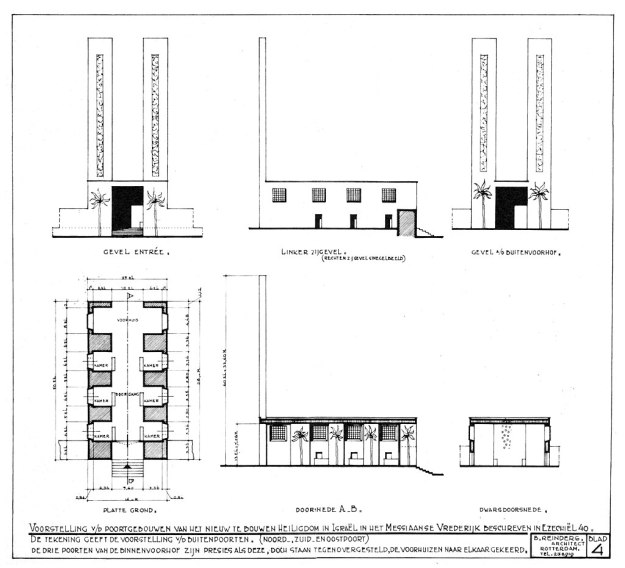
Gateways of Ezekiel’s Temple, as described in the Book of Ezekiel, drawn by the Dutch architect Bartelmeüs Reinders (1893–1979) released into public domain by artist.

The temple is oriented to the east, and this is a common practice across religions in temple construction (the temple faces towards the direction of the rising sun). It is surrounded by a ten-foot tall and ten-foot thick wall. The temple is walled off from the surrounding world and even the city to the south and much of the external structure is similar to what is expected in walled cities rather than temples. This eastern gate is a large structure, the gate opens to be roughly seventeen feet in width, but the gateway itself is about twenty-two feet wide. The width of the gate is later stated to be twenty-five feet. When you add the length of the gateways vestibules, pilasters which lead from the outside of the temple into the inner courtyard it is fifty cubits, or roughly eighty-six feet. Like ancient, fortified cities, the vestibules and ‘windows’[5] may be for defensive purposes.

This temple is created to be a place where God can dwell among the people in a reestablished relationship, and the creation of the temple is the setting aside of a holy space. In creating this holy space there is a need to separate it from the mundane space surrounding the temple, and this exterior wall forms an initial and likely guarded barrier between the people and God’s space at the center of the temple. Most Christian worship spaces have significantly reduced the space between the people and God, but for our Jewish ancestors this separation was essential. God was holy, the people were not. To defile God’s holy place was to invite God to abandon the people or to lash out at the defilement, as we have seen throughout Ezekiel. Now a new beginning begins with a new structure walled off and protected from the outside world’s interference.

Ezekiel 40: 17-27 The Outer Court

17 Then he brought me into the outer court; there were chambers there, and a pavement, all around the court; thirty chambers fronted on the pavement. 18 The pavement ran along the side of the gates, corresponding to the length of the gates; this was the lower pavement. 19 Then he measured the distance from the inner front of the lower gate to the outer front of the inner court, one hundred cubits.

 20 Then he measured the gate of the outer court that faced north — its depth and width. 21 Its recesses, three on either side, and its pilasters and its vestibule were of the same size as those of the first gate; its depth was fifty cubits, and its width twenty-five cubits. 22 Its windows, its vestibule, and its palm trees were of the same size as those of the gate that faced toward the east. Seven steps led up to it; and its vestibule was on the inside. 23 Opposite the gate on the north, as on the east, was a gate to the inner court; he measured from gate to gate, one hundred cubits.

24 Then he led me toward the south, and there was a gate on the south; and he measured its pilasters and its vestibule; they had the same dimensions as the others. 25 There were windows all around in it and in its vestibule, like the windows of the others; its depth was fifty cubits, and its width twenty-five cubits. 26 There were seven steps leading up to it; its vestibule was on the inside. It had palm trees on its pilasters, one on either side. 27 There was a gate on the south of the inner court; and he measured from gate to gate toward the south, one hundred cubits.

There are two additional outer gates that lead into the courtyard, one facing north and one facing south, of identical description to the eastern gate. There is no western gate, since the inner court of the structure is at the western edge of the complex and separated by the court and the wall from the surrounding people. As the temple sections become closer to the space where God’s presence is expected the elevation increases. The architecture ascending reflects the increasing holiness of this space and the closer proximity to the divine.  The thirty chambers which surround the outer court are not given any specific function here, but Jeremiah 35: 2-4 suggests that they were places for meeting, eating and drinking, and Nehemiah 13: 4-14 indicates they were to be used for storage of grain offerings, frankincense, and tithes of grain, wine, and oil.[6] Once a person passed the outer gates there was a separation of one hundred cubits (roughly one hundred seventy feet) from the outer gates to the inner gates.

Ezekiel 40: 28-47 The Inner Court

28 Then he brought me to the inner court by the south gate, and he measured the south gate; it was of the same dimensions as the others. 29 Its recesses, its pilasters, and its vestibule were of the same size as the others; and there were windows all around in it and in its vestibule; its depth was fifty cubits, and its width twenty-five cubits. 30 There were vestibules all around, twenty-five cubits deep and five cubits wide. 31 Its vestibule faced the outer court, and palm trees were on its pilasters, and its stairway had eight steps.

32 Then he brought me to the inner court on the east side, and he measured the gate; it was of the same size as the others. 33 Its recesses, its pilasters, and its vestibule were of the same dimensions as the others; and there were windows all around in it and in its vestibule; its depth was fifty cubits, and its width twenty-five cubits. 34 Its vestibule faced the outer court, and it had palm trees on its pilasters, on either side; and its stairway had eight steps.

35 Then he brought me to the north gate, and he measured it; it had the same dimensions as the others. 36 Its recesses, its pilasters, and its vestibule were of the same size as the others; and it had windows all around. Its depth was fifty cubits, and its width twenty-five cubits. 37 Its vestibule faced the outer court, and it had palm trees on its pilasters, on either side; and its stairway had eight steps.

38 There was a chamber with its door in the vestibule of the gate, where the burnt offering was to be washed. 39 And in the vestibule of the gate were two tables on either side, on which the burnt offering and the sin offering and the guilt offering were to be slaughtered. 40 On the outside of the vestibule at the entrance of the north gate were two tables; and on the other side of the vestibule of the gate were two tables. 41 Four tables were on the inside, and four tables on the outside of the side of the gate, eight tables, on which the sacrifices were to be slaughtered. 42 There were also four tables of hewn stone for the burnt offering, a cubit and a half long, and one cubit and a half wide, and one cubit high, on which the instruments were to be laid with which the burnt offerings and the sacrifices were slaughtered. 43 There were pegs, one handbreadth long, fastened all around the inside. And on the tables the flesh of the offering was to be laid.

44 On the outside of the inner gateway there were chambers for the singers in the inner court, one at the side of the north gate facing south, the other at the side of the east gate facing north. 45 He said to me, “This chamber that faces south is for the priests who have charge of the temple, 46 and the chamber that faces north is for the priests who have charge of the altar; these are the descendants of Zadok, who alone among the descendants of Levi may come near to the LORD to minister to him.” 47 He measured the court, one hundred cubits deep, and one hundred cubits wide, a square; and the altar was in front of the temple.

As Ezekiel is led further into the heart of the temple he continues to pass through large gates and ascends an additional eight stairs increasing the elevation of the inner court. The gateways into the inner court are also twenty-five by fifty cubits, the same dimensions as the outer gateways. These gateways separate the outer courtyard from the inner courtyard and presumably restrict access to only those set apart for the ministry in the temple. The temple’s function is to bring offerings to God, rather than a place of gathering like most modern worship spaces. In this gateway to the inner courtyard is a room for the preparation and offering of sacrifices. The description of the tables and pegs is functional and a person of priestly heritage, like Ezekiel, probably would be familiar with the proper layout of the temple, the proper preparation of offerings, and the utilization of this space.

The priests who have ‘charge’ of the temple and the altar are likely charged with guarding these spaces for their proper use by the proper people. The Hebrew word samar behind the English ‘charge’ is normally used in relation to guard duty or keeping watch over something in order to protect it. In chapter eight we saw the defilement of the temple by the elders of Judah, and now these priests are charged to ensure that the temple, particularly the inner court, remains a holy space undefiled by improper worship or idolatrous figures.

Ezekiel 40: 48-49 Entering the Temple

48 Then he brought me to the vestibule of the temple and measured the pilasters of the vestibule, five cubits on either side; and the width of the gate was fourteen cubits; and the sidewalls of the gate were three cubits on either side. 49 The depth of the vestibule was twenty cubits, and the width twelve cubits; ten steps led up to it; and there were pillars beside the pilasters on either side.

Although these final two verses of the chapter would fit better with the following chapter which focuses on the temple itself, I will keep with the chapter divisions and comment briefly on the entrance into the temple. Now the gate structure is twenty cubits total, fourteen cubit entry and three cubits on either side. The vestibule (room) is twenty cubits by twelve cubits[7] with an additional ten steps moving us up into a higher space (reflecting architecturally a holier space).  In addition to the pilasters (pillars built on the wall) there are two free standing pillars in the entry, probably copying the two bronze pillars, Jachin and Boaz, of Solomon’s temple mentioned in 1 Kings 7: 15-22. Any priest familiar with the design of Solomon’s temple would have noticed these large brass pillars in the past and they were likely a visible reminder of the opulence of the now destroyed temple. This vision of a new temple has not focused on the gold and other resources expended on the construction like 1 Kings, but this original temple likely shaped the imaginations of Ezekiel and his later readers.

[1] Ezekiel’s last by date prophecy begins in Ezekiel 29:17 (April 26, 571 BCE) two years after this date.

[2] The destruction of both Jerusalem and the temple.

[3] Ezekiel 10.

[4] One of my personal practices is hand copying the texts that I am working through (in English) just to accommodate myself to the reality of the transmission of these texts over thousands of years. Scrolls and later codices (ancient books) also would have used vellum, parchment, or papyrus rather than paper. These resources were much more expensive than modern paper. The preservation of a book like Ezekiel, which takes most of a modern 100 sheet composition book to write out, is a significant investment of time and resources in the ancient world.

[5] The ‘windows’ (Hebrew hallonot atumot) are the source of a lot of exegetical speculation. They may be ‘false windows’ with stones set in the relief, (Ganzel, 2020, p. 361) or slotted windows for archers, cupboards for utensils or tools for temple guards. (Block, 1998, p. 522)

[6] The controversy in Nehemiah is when one of these rooms is prepared as a room for Tobiah, which Nehemiah vehemently disapproves of.

[7] Roughly thirty-five feet by twenty-one feet.

Ezekiel 39 The Disposal of Gog and the Glorification of the LORD

Gog and Magog besiege the City of Saints. Their depiction with the hooked noses noted by Paul Meyer.[28] —Old French Apocalypse in verse, Toulouse MS. 815, fol. 49v

Ezekiel 39: 1-10 The Destruction of the Armies of Gog

1 And you, mortal, prophesy against Gog, and say: Thus says the Lord GOD: I am against you, O Gog, chief prince of Meshech and Tubal! 2 I will turn you around and drive you forward, and bring you up from the remotest parts of the north, and lead you against the mountains of Israel. 3 I will strike your bow from your left hand, and will make your arrows drop out of your right hand. 4 You shall fall upon the mountains of Israel, you and all your troops and the peoples that are with you; I will give you to birds of prey of every kind and to the wild animals to be devoured. 5 You shall fall in the open field; for I have spoken, says the Lord GOD. 6 I will send fire on Magog and on those who live securely in the coastlands; and they shall know that I am the LORD.

7 My holy name I will make known among my people Israel; and I will not let my holy name be profaned any more; and the nations shall know that I am the LORD, the Holy One in Israel. 8 It has come! It has happened, says the Lord GOD. This is the day of which I have spoken.

9 Then those who live in the towns of Israel will go out and make fires of the weapons and burn them — bucklers and shields, bows and arrows, handpikes and spears — and they will make fires of them for seven years. 10 They will not need to take wood out of the field or cut down any trees in the forests, for they will make their fires of the weapons; they will despoil those who despoiled them, and plunder those who plundered them, says the Lord GOD.

Gog of Magog, the great leader of the worldwide forces arrayed against Israel is portrayed both as a powerful avaricious leader and as a powerless disarmed creature utilized by God to demonstrate the superiority of the LORD. Similar to the image of the Pharoah of Egypt as a great river ‘dragon’ hooked and pulled out of his residence in the Nile River, now Gog is driven out of its home in the north to its place of slaughter in the mountains of Israel. This leader who could rouse the armies of north, south and east to attack and plunder helpless Israel now finds himself helpless and being pulled into a trap by the Holy One in Israel. This conqueror of nations now looses the bow and arrows in their hands and his armies are reduced to carrion for the birds of the air and the wild animals. The mighty opponent of Israel has been brought low by the Divine Warrior, the God of Israel who both draws the opponent to the mountains of Israel and destroys this enemy to the land and people. Not only is the army of Gog destroyed, but even the homeland is destroyed by fire. Even those who perceive themselves safe from the consequences of war discover that the reach of the LORD can impact them in their safe places in the north and along the coastline.

Those who have been walking through Ezekiel will not be surprised that the motivation of the LORD is the reputation of the holy name of God. The LORD’s name has suffered by the exile of the people, even though for Ezekiel the punishment was justified, and now the defeat of Gog becomes a means by which the divine reputation is restored and the nations come to know the LORD. Never again would the LORD tolerate the disrespect and desecration of the holy name. In verse seven the attribute of holiness is lifted up three times, twice in relation to the name of God and once in the title the Holy One in Israel. The title the Holy One in Israel is similar to Isaiah’s Holy One of Israel[1] but rather than using the relation of a genitive case Ezekiel uses the locative ‘in.’ Ezekiel’s title locates God in the midst of the land of Israel, and although there is a restored relationship in the previous chapters the locative linkage is probably stronger in Ezekiel’s conception.

In the name Jerusalem is the Hebrew word for peace shalom, yet this city of peace has rarely known a peaceful generation. As New Testament scholar N.T. Wright can remind us about Israel,

Every forty-four years out of the last four thousand, on average, an army has marched through it, whether to conquer it, to rescue it from someone else, to use it as a neutral battleground on which to fight a different enemy, or to take advantage of it as the natural route for getting somewhere else to fight. (Wright, 1992, p. 3)

Even today Israel remains a contested space where many long for an elusive peace. It is not surprising that throughout the scriptures of Israel there are numerous images of the LORD bringing an end to war.[2] Now the weapons of war are utilized as the wood for the fires for cooking and heating for seven years. In contrast to many other images creating a bonfire where spear and shield are consumed, now the dropped shield, bows, arrows, javelins,[3] and spears provide a sabbath for the war-torn land allowing seven years for the trees to regrow and recover after war.[4] Those who came to conquer are conquered, those who hoped to pillage are now pillaged, and the people and land in this image have a much needed rest from war.

Ezekiel 39: 11-16 The Burial of Gog and The Purification of the Land

11 On that day I will give to Gog a place for burial in Israel, the Valley of the Travelers east of the sea; it shall block the path of the travelers, for there Gog and all his horde will be buried; it shall be called the Valley of Hamon-gog. 12 Seven months the house of Israel shall spend burying them, in order to cleanse the land. 13 All the people of the land shall bury them; and it will bring them honor on the day that I show my glory, says the Lord GOD. 14 They will set apart men to pass through the land regularly and bury any invaders who remain on the face of the land, so as to cleanse it; for seven months they shall make their search. 15 As the searchers pass through the land, anyone who sees a human bone shall set up a sign by it, until the buriers have buried it in the Valley of Hamon-gog. 16 (A city Hamonah is there also.) Thus they shall cleanse the land.

There has always been a connection between humanity and the earth in the Hebrew scriptures, and for the Jewish people the burial of a corpse was not merely a sanitation requirement, it was placed in the law as a requirement for a right relationship with the land. That is why Deuteronomy 21: 23 refuses to allow for a person executed to remain unburied overnight. The removal and burial of the bones of the forces of Gog is a required portion of the purification of the land. Bones have played an important part of this section of Ezekiel, in chapter thirty-seven Ezekiel found himself amidst the bones of Israel which were regenerated into a large host of a reborn people but now Ezekiel and the people must deal with the bones of the army of Gog which are the remnants of a large host littering and contaminating God’s land.

Like many aspects of chapters thirty-eight and thirty-nine, the location of the burial of the forces of Gog has prompted various speculations about the ‘Valley of Travelers’ which becomes the ‘Valley of Hamon-gog.’ The ‘Valley of Travelers’ may be a variant spelling of the Valley of Abarim (Valley East of the Sea-in this instance the Dead Sea).[5] But this mass of graves may be intended as a blockage of transit through Israel by the nations. The title the ‘Valley of Hamon-Gog” (ge hamon gog) may be a play on the Valley of Hinnom (ge hinnom) which in both the books of Kings and Chronicles is a place where child sacrifice was practiced in Molech worship. Jeremiah references this valley:

And they go on building the high place of Topheth, which is in the valley of the son of Hinnom, to burn their sons and their daughters in the fire—which I did not command, nor did it come to my mind. Therefore, the days are surely coming, says the LORD, when it will no more be called Topheth, or the valley of the son of Hinnom, but the valley of Slaughter: for they will bury in Topheth until there is no more room. Jeremiah 7: 32-33.

Regardless of whether the Valley of Hamon-Gog and the Valley of Hinnom are the same, these places become graveyards that are filled with the dead until there is no more room.

The land previously received a seven-year sabbath from the need of the people to cut wood, now the people spend seven months gathering and burying the bodies of the armies of Gog. A group of people are set aside for the purpose of gathering, transporting, and burying these bodies. The entire people is to participate in the identification of remains that need burying, and it is only once this period of burial is completed that the land can be cleansed from the defilement of death.

Ezekiel 39: 17-20 The Feast of the Carrion Eaters

17 As for you, mortal, thus says the Lord GOD: Speak to the birds of every kind and to all the wild animals: Assemble and come, gather from all around to the sacrificial feast that I am preparing for you, a great sacrificial feast on the mountains of Israel, and you shall eat flesh and drink blood. 18 You shall eat the flesh of the mighty, and drink the blood of the princes of the earth — of rams, of lambs, and of goats, of bulls, all of them fatlings of Bashan. 19 You shall eat fat until you are filled, and drink blood until you are drunk, at the sacrificial feast that I am preparing for you. 20 And you shall be filled at my table with horses and charioteers, with warriors and all kinds of soldiers, says the Lord GOD.

Both the ordering and the presence of commemoration of the feast for the carrion eaters is strange. Ezekiel does not shy away from grotesque subjects but he does also have a pretty strong orientation towards priestly ideas of purity and the language of ‘the sacrificial feast’ or zebah meal points to the meals shared around the sacrifices done in the temple. Here the zebah meal is turned on its head, instead of sacrificial animals feeding both the priests and the community, now animals gather to feast on this sacrificed community of Gog. In addition, this section follows a time of gathering together the bones of the army of Gog for burial in the valley of Hamon-gog, and would probably make better sense before that section. Yet, ancient writers are not bound by the same expectations of linear progression that most modern authors utilize.

In spite of the strange placement and the inverting of the sacrificial imagery it does point to a normal process in the aftermath of a battle where bodies cannot be swiftly buried. The language also continues to bring down the mighty where kings become carrion and the mighty the meat for the scavengers including vultures, eagles, ravens and crows along with the wild animals, presumably jackals, hyenas, wolves, and lions. Mighty warriors and princes are now linked with the sacrificial animals: lambs, goats, bulls. The bulls of Bashan are frequently mentioned throughout scriptures and are a highly valued animal for sacrifice and food. In addition to the warriors who are left on the field are the horses and other animals utilized by the army.

War is a destructive process and death and the animals who feed on dead corpses have always evoked a range of emotions from discomfort to disgust. Yet, these birds and wild animals are fulfilling an essential function in helping to remove the bodies from the battlefield. For Ezekiel, who viewed the world through the priestly lens of clean and unclean, this focus on both corpses and corpse eaters (both unclean) was probably distasteful. Yet, for Ezekiel there is also a desire to demonstrate God’s unopposed power. Even still, the sacrificial feast being comprised of unclean bodies for unclean animals may have been a challenging vision for Ezekiel and continues to be uncomfortable for those reading these words.

Ezekiel 39: 21-29 The Glorification of God and the Renewal of Israel

21 I will display my glory among the nations; and all the nations shall see my judgment that I have executed, and my hand that I have laid on them. 22 The house of Israel shall know that I am the LORD their God, from that day forward. 23 And the nations shall know that the house of Israel went into captivity for their iniquity, because they dealt treacherously with me. So I hid my face from them and gave them into the hand of their adversaries, and they all fell by the sword. 24 I dealt with them according to their uncleanness and their transgressions, and hid my face from them.

25 Therefore thus says the Lord GOD: Now I will restore the fortunes of Jacob, and have mercy on the whole house of Israel; and I will be jealous for my holy name. 26 They shall forget their shame, and all the treachery they have practiced against me, when they live securely in their land with no one to make them afraid, 27 when I have brought them back from the peoples and gathered them from their enemies’ lands, and through them have displayed my holiness in the sight of many nations. 28 Then they shall know that I am the LORD their God because I sent them into exile among the nations, and then gathered them into their own land. I will leave none of them behind; 29 and I will never again hide my face from them, when I pour out my spirit upon the house of Israel, says the Lord GOD.

Throughout the book of Ezekiel there has been a focus on the reputation of the LORD. The holy name of the God of Israel has been defiled and desecrated throughout the book, but now before both Israel and the nations the honor has been restored to God’s name and the LORD will jealously defend this honor. The nations who have assumed that Israel’s captivity and exile demonstrated the weakness of the LORD now understand that Israel’s exile was a result of their disobedience. God chose to allow the Assyrians and Babylonians to take the people of Israel away as a consequence for their sins. Yet, within the law there is always an ending to the consequences of disobedience. Deuteronomy 4: 30-31 is a good representation of this:

In your distress, when all these things have happened to you in time to come, you will return to the LORD and heed him. Because the LORD your God is a merciful God, he will neither abandon you nor destroy you; he will not forget the covenant with your ancestors that he swore to them.

In contrast to the language of Deuteronomy, the prophet Ezekiel rarely utilizes mercy as a characteristic of God, and here in verse twenty-five is the only occurrence of the word mercy (Hebrew rhm) in the entire book. Here God’s merciful action towards Israel is not motivated by Israel’s return to the LORD, but instead is a result of God being jealous for God’s holy name. Regardless, it does bring about a restoration of the fortunes of Jacob[6] and a regathering of the people from their exile back to the land of Israel. Ezekiel likely anticipates the people of Israel receiving the new heart and spirit he mentioned in chapter thirty-six as the spirit of God if poured out upon Israel. A restored reputation of the divine name requires a people of a new spirit of obedience so that God never hides God’s face in the future.

[1] Isaiah 12:6, 43:5, 55:5, 60:9,14.

[2] Isaiah 2:2-5, 9:5, Micah 4:3-4, and Psalm 46:9 are some of the images that resonate with Ezekiel’s imagery of the weapons of war being used as fuel for the fire.

[3] NRSV handpikes.

[4] In ancient warfare the trees of an invaded land were used for both the creation of weapons, but also siege works and the fires of the armies. Trees which bore fruit may also be destroyed as a way of denying produce to an invading enemy or to punish the people. Warfare has always exacted a heavy price on the land it occurs on.

[5] Numbers 33: 47-48 has the people of Israel camped in the mountains of Abarim before they enter the plains of Moab by the Jordan Sea at Jericho. (NIB VI: 1525)

[6] A phrase used only here and in Psalm 85:1.

Ezekiel 38 The Forces of Gog and the Divine Warrior

Gog and Magog besiege the City of Saints. Their depiction with the hooked noses noted by Paul Meyer.[28] —Old French Apocalypse in verse, Toulouse MS. 815, fol. 49v

Ezekiel 38

1 The word of the LORD came to me: 2 Mortal, set your face toward Gog, of the land of Magog, the chief prince of Meshech and Tubal. Prophesy against him 3 and say: Thus says the Lord GOD: I am against you, O Gog, chief prince of Meshech and Tubal; 4 I will turn you around and put hooks into your jaws, and I will lead you out with all your army, horses and horsemen, all of them clothed in full armor, a great company, all of them with shield and buckler, wielding swords. 5 Persia, Ethiopia, and Put are with them, all of them with buckler and helmet; 6 Gomer and all its troops; Beth-togarmah from the remotest parts of the north with all its troops — many peoples are with you.

7 Be ready and keep ready, you and all the companies that are assembled around you, and hold yourselves in reserve for them. 8 After many days you shall be mustered; in the latter years you shall go against a land restored from war, a land where people were gathered from many nations on the mountains of Israel, which had long lain waste; its people were brought out from the nations and now are living in safety, all of them. 9 You shall advance, coming on like a storm; you shall be like a cloud covering the land, you and all your troops, and many peoples with you.

10 Thus says the Lord GOD: On that day thoughts will come into your mind, and you will devise an evil scheme. 11 You will say, “I will go up against the land of unwalled villages; I will fall upon the quiet people who live in safety, all of them living without walls, and having no bars or gates”; 12 to seize spoil and carry off plunder; to assail the waste places that are now inhabited, and the people who were gathered from the nations, who are acquiring cattle and goods, who live at the center of the earth. 13 Sheba and Dedan and the merchants of Tarshish and all its young warriors will say to you, “Have you come to seize spoil? Have you assembled your horde to carry off plunder, to carry away silver and gold, to take away cattle and goods, to seize a great amount of booty?”

14 Therefore, mortal, prophesy, and say to Gog: Thus says the Lord GOD: On that day when my people Israel are living securely, you will rouse yourself 15 and come from your place out of the remotest parts of the north, you and many peoples with you, all of them riding on horses, a great horde, a mighty army; 16 you will come up against my people Israel, like a cloud covering the earth. In the latter days I will bring you against my land, so that the nations may know me, when through you, O Gog, I display my holiness before their eyes.

17 Thus says the Lord GOD: Are you he of whom I spoke in former days by my servants the prophets of Israel, who in those days prophesied for years that I would bring you against them? 18 On that day, when Gog comes against the land of Israel, says the Lord GOD, my wrath shall be aroused. 19 For in my jealousy and in my blazing wrath I declare: On that day there shall be a great shaking in the land of Israel; 20 the fish of the sea, and the birds of the air, and the animals of the field, and all creeping things that creep on the ground, and all human beings that are on the face of the earth, shall quake at my presence, and the mountains shall be thrown down, and the cliffs shall fall, and every wall shall tumble to the ground. 21 I will summon the sword against Gog in all my mountains, says the Lord GOD; the swords of all will be against their comrades. 22 With pestilence and bloodshed I will enter into judgment with him; and I will pour down torrential rains and hailstones, fire and sulfur, upon him and his troops and the many peoples that are with him. 23 So I will display my greatness and my holiness and make myself known in the eyes of many nations. Then they shall know that I am the LORD.

The introduction of a new enemy Gog of the land of Magog for some future conflict between the LORD the God of Israel, and this previously unknown enemy has fascinated readers across the millennia since it was recorded. Gog and Magog will reappear in Revelation 20:8, now as two separate entities, as the nations gathered by Satan for the final conflict in a scene indebted to Ezekiel 38-39. This war to end all wars occurring amidst the mountains of Israel at the ‘end of days’ forms a termination of the threats against the people of God in Ezekiel.

Gog, and Magog, have taken on a place in the imagination of readers far beyond the initial narrative in Ezekiel. From the author of Revelation to Stephen King authors have been attracted to these names for a dark shadowy force that opposes the people of God.  Interpreters have attempted to discern who the ruler or nation referred to here is and their answers across history have included Ethiopia, the Goths, Muslim invaders to Europe, Stalin, or Hitler. (NIB VI: 1512) Martin Luther, using Revelation’s splitting of Gog and Magog into two powers, viewed it as the papacy and the Turks who were in Luther’s view enemies of the gospel. It is possible that Gog is merely a personification of the forces of darkness, evil and chaos.[1] My best guess is that Ezekiel is using Gog as a cypher for Babylon, but this is a controversial view. Most writers on Ezekiel will note that Ezekiel never speaks against Babylon because he both lives as an exile in Babylon and views Nebuchadrezzar and the larger Babylonian army as instruments of God. Although these are important to note, it may also explain why Ezekiel is using a cypher rather than naming a future judgment of Babylon explicitly. Jeremiah, Ezekiel’s older contemporary, also viewed Babylon as an instrument utilized by God but that did not keep the book of Jeremiah including two chapters related to the judgment of Babylon at the end. I do find it plausible that the great army in the north who is being summoned to a future showdown in Israel could be Babylon, but ultimately we will never be able to state any particular identity with certainty.

Meshach and Tubal appear in the list of nations that Tyre traded with in Ezekiel 27:13 as well as among the slain in Sheol that Egypt encounters in Ezekiel 32:28. Persia (or Peres) may or not refer to Persia (modern day Iran) but Ethiopia and Put are nations to Israel’s South. Magog, Tubal, Meshech, and Gomer are all listed as descendants of Noah’s son Japheth in Genesis 10:2-3.[2] Regardless of the specific identities of these nations, the intention is that the threat comes from both the north and the south and it is the nations of the world aligned against Israel. A well-equipped and dressed army comes from across the known world to take advantage of the relatively defenseless people of Israel. These armies advance upon the unwalled towns of Israel like an approaching storm. Yet the battle is not between Israel and the forces of Gog, but between the LORD the protector of Israel and these armies of darkness.

This malevolent Gog and the nations that follow him (here Gog is a person, and Magog is the nation or city their power rests) conspire against a perceived weak opponent. Israel, now living at peace in the mountains of Israel has not fortified their cities.[3] It is possible that Ezekiel perceives that Israel, now returned to the land, has been unable to rebuild its walls and army but I think it is more likely that Ezekiel imagines a future where the people live in safety because they are trusting in the LORD as their protector rather than walls, horses, chariots, and armies. In contrast to Israel’s perceived weakness is the strength of the nations gathered to assault the nation, and even the traders of Sheba, Dedan and Tarshish look at the assault of the nations under Gog on Israel as a chance to participate in the accumulation of the spoils of war. Here Israel is referred to as the ‘center of the earth’[4] and this may be Ezekiel’s perception of Jerusalem, the temple, or the land of Israel being at the center of concern for the earth[5] but it also may reflect the central location of Israel on the trade routes that run between the empires of the north and east and the northern African nations.

The movement of Gog and the coalition of armies from nations across the world arriving at the mountains of Israel rouses the LORD to act as a divine warrior protecting the land and the people. Previously the LORD had placed the divine sword in the hands of Nebuchadrezzar of Babylon to act as an agent of judgment, but now the sword is in the hands of God to demonstrate God’s power over these armies opposed to God’s protected people. In language resonant with the psalms, God’s movement among the lands causes the earth to quake and both the creatures and the human residents respond in fear. Sword, pestilence and bloodshed, all previously utilized against Judah, are now mobilized against these armies. In addition, torrential rains, hailstones, and fire and sulfur (probably imagining some type of volcanic event or resonating with the judgment of Sodom and Gomorrah) also rain down upon these assembled armies made impotent against the divine warrior.

At this point in Ezekiel the people have been restored to the land, but the exile of the people has caused the honor given to the LORD’s name by the nations to suffer. The invasion of Gog and the nations gives a place where the power of the LORD can be demonstrated and that all the nations can know the greatness and holiness of the LORD. The divine reputation and honor are central concerns in Ezekiel and although the portrayal of God in this book may seem harsh to us, it probably was comforting to a people in exile. The image of God as the divine warrior roused to protect the people, regardless of motivations, would be a welcome one for a people who felt powerless in their exile. The following chapter will double some of the language from this chapter and see to the destruction and disposal of Gog and their armies but also the restoration of Israel to the land and the safety of the people in the future.

[1] As Katheryn Pfisterer Darr notes Gog may come from the Sumerian word for darkness gȗg. (NIB VI: 1512)

[2] Also repeated in 1 Chronicles 1: 5-6.

[3] Walled cities were the defensive technology of the day and they made an assault on a city extremely costly. Most walled cities had to be conquered by siege warfare where the city supplies of water and food are cut off.

[4] Literally navel of the earth.

[5] Ezekiel has previously referred to Jerusalem as the center of nations. Ezekiel 5:5.

Ezekiel 37 The Valley of the Dry Bones and a Sign of Reunification

Vision of Ezekiel 1640-1650 by Leonhard Kern By Anagoria – Own work, CC BY 3.0, https://commons.wikimedia.org/w/index.php?curid=79010820

Ezekiel 37: 1-14 The Vision of the Valley of Dry Bones

1 The hand of the LORD came upon me, and he brought me out by the spirit of the LORD and set me down in the middle of a valley; it was full of bones. 2 He led me all around them; there were very many lying in the valley, and they were very dry. 3 He said to me, “Mortal, can these bones live?” I answered, “O Lord GOD, you know.” 4 Then he said to me, “Prophesy to these bones, and say to them: O dry bones, hear the word of the LORD. 5 Thus says the Lord GOD to these bones: I will cause breath to enter you, and you shall live. 6 I will lay sinews on you, and will cause flesh to come upon you, and cover you with skin, and put breath in you, and you shall live; and you shall know that I am the LORD.”

7 So I prophesied as I had been commanded; and as I prophesied, suddenly there was a noise, a rattling, and the bones came together, bone to its bone. 8 I looked, and there were sinews on them, and flesh had come upon them, and skin had covered them; but there was no breath in them. 9 Then he said to me, “Prophesy to the breath, prophesy, mortal, and say to the breath: Thus says the Lord GOD: Come from the four winds, O breath, and breathe upon these slain, that they may live.” 10 I prophesied as he commanded me, and the breath came into them, and they lived, and stood on their feet, a vast multitude.

11 Then he said to me, “Mortal, these bones are the whole house of Israel. They say, ‘Our bones are dried up, and our hope is lost; we are cut off completely.’ 12 Therefore prophesy, and say to them, Thus says the Lord GOD: I am going to open your graves, and bring you up from your graves, O my people; and I will bring you back to the land of Israel. 13 And you shall know that I am the LORD, when I open your graves, and bring you up from your graves, O my people. 14 I will put my spirit within you, and you shall live, and I will place you on your own soil; then you shall know that I, the LORD, have spoken and will act, says the LORD.”

The valley of the dry bones along with the imagery of Ezekiel’s initial call are the two portions of this large book that many people are familiar with. For both Jewish and Christian readers this reading appears at critical points in the life of the communities of faith. For Jewish readers this is the reading to accompany the Torah reading (Exodus 33: 12-34:26) on the sabbath of Passover week. Christians who utilize the revised common lectionary encounter it on the fifth Sunday of Lent in year A and the day of Pentecost in year B.[1] Beyond the utilization in worship is this passage in the memory and imagination of people who come back to its imagery of life out of death and hope from hopelessness.

Ezekiel is moved by the powerful force of the hand of the LORD coming upon him and transporting him to an unidentified valley. The valley is not named but it is presumably known to Ezekiel since he refers to it as ‘the’ valley. This valley full of ‘very many’ bones that are laying unburied would be a shocking scene for a person from a priestly household that would know the importance of the proper treatment of the human corpses for the people. Yet in this image he walks through a boneyard of a vast number of people who were unburied and have been long left to be picked over by scavengers whose bones have lost all their connective tissue and internal life.  As Daniel Block states, “the picture is one of death in all its horror, intensity, and finality.” (Block, 1998, p. 374)

We cannot know the inflection of Ezekiel’s answer to the LORD on whether these bones can live, whether his answer to God is delivered with conviction or resignation, whether it is immediate or whether the prophet struggles to answer this question. From the perspective of a mortal these dried out bones in this valley of death are as far removed from life as could be imaginable. Yet, as Tova Ganzel also notes Ezekiel’s answer also is an encapsulation of the prophetic message throughout the book. (Ganzel, 2020, p. 323) Ezekiel has throughout the book been the obedient and submissive prophet, and throughout the book God has known what Ezekiel and other mortals have not.

Bones that are without life have been an image of despair in the scriptures[2] and yet here the prophet is to be a part of a movement from despair to hope. The prophet is commanded to speak the words that come from God and participate in God’s act of recreation. Just as God creating the world by speaking in Genesis 1, now the prophet is involved in the recreation of a people through sharing these creative words. Initially dry bones become bodies, enfleshed and whole again but without breath. The words have done what they could do on their own, but for life to return the breath/wind/spirit is needed.

Throughout this passage the Hebrew ruach is behind the words for breath, wind, or spirit and can mean all three. The prophet calls out to the ruach to come from the four directions and come into the mouths and nostril and enter into the lungs reanimating these newly regenerated bodies. From dry bones of conquered people to a new beginning for the people of Israel. The very large and uncountable number of bones has become a vast multitude that we learn is the whole house of Israel, both those who suffered recently under Nechuadrezzar’s conquest as well as those who were exiled by the Assyrians a century and a half earlier.

Ezekiel’s imagery is probably not imagining the generalized resurrection that Daniel 12:1-2 and later the New Testament would utilize, but it does significantly expand the imagery of life from death in the Hebrew Scriptures.[3] Ezekiel’s reference for the imagery of the dry bones likely emerges from the curses of Deuteronomy 28: 25-26:

The LORD will cause you to be defeated before your enemies; you shall go out against them one way and flee before them seven ways. You shall become an object of horror to all the kingdoms of the earth. Your corpses shall be food for every bird of the air and animal of the earth. There shall be no one to frighten them away.

2 Samuel 21 shares the story of David allowing the Gibeonites to enact revenge against the sons of Saul by impaling them and allowing the birds and animals to feed on them, but Rizpah (the mother of two of the seven sons exposed this way) chases the birds and animals away and the bones are eventually buried. The desolation of the people in the aftermath of the fall of Jerusalem, and the inability to provide proper burials for so many people who lost their lives would have been viewed as a curse upon both the people and the land. But now there is a reversal of the curse. Where previously the people moaned the rhyming (in Hebrew) three-line lament: Our bones are dried up, and our hope is lost; we are cut off completely now bones and flesh are renewed, and hope is restored. A people who lost hope in their future and God now through the prophet are given a vision of a new and vibrant life back on their own soil.

Most of Ezekiel’s visions are dated but this one is left without a date. Elie Wiesel, a well-known holocaust survivor, claimed that this vision has no date because every generation needs to hear in its own time that these bones can live once again. (NIB VI: 1504) Christians and Jewish faithful need to remember that God’s creative words and spirit can take the hopeless valley full of death in all its horror and regenerate both a people and hope. Bones can once again become bodies, bodies can once again breathe, boneyards become filled with a vast multitude making a new beginning as God’s reconstituted people.

Ezekiel 37: 15-28 Two Sticks As A Sign of a Reunified People

15 The word of the LORD came to me: 16 Mortal, take a stick and write on it, “For Judah, and the Israelites associated with it”; then take another stick and write on it, “For Joseph (the stick of Ephraim) and all the house of Israel associated with it”; 17 and join them together into one stick, so that they may become one in your hand. 18 And when your people say to you, “Will you not show us what you mean by these?” 19 say to them, Thus says the Lord GOD: I am about to take the stick of Joseph (which is in the hand of Ephraim) and the tribes of Israel associated with it; and I will put the stick of Judah upon it, and make them one stick, in order that they may be one in my hand. 20 When the sticks on which you write are in your hand before their eyes, 21 then say to them, Thus says the Lord GOD: I will take the people of Israel from the nations among which they have gone, and will gather them from every quarter, and bring them to their own land. 22 I will make them one nation in the land, on the mountains of Israel; and one king shall be king over them all. Never again shall they be two nations, and never again shall they be divided into two kingdoms. 23 They shall never again defile themselves with their idols and their detestable things, or with any of their transgressions. I will save them from all the apostasies into which they have fallen, and will cleanse them. Then they shall be my people, and I will be their God.

24 My servant David shall be king over them; and they shall all have one shepherd. They shall follow my ordinances and be careful to observe my statutes. 25 They shall live in the land that I gave to my servant Jacob, in which your ancestors lived; they and their children and their children’s children shall live there forever; and my servant David shall be their prince forever. 26 I will make a covenant of peace with them; it shall be an everlasting covenant with them; and I will bless them and multiply them, and will set my sanctuary among them forevermore. 27 My dwelling place shall be with them; and I will be their God, and they shall be my people. 28 Then the nations shall know that I the LORD sanctify Israel, when my sanctuary is among them forevermore.

Ezekiel continues his hopeful message with a sign act joining two sticks[4] into one symbolizing the reunification of the tribes of Israel into one nation under one ruler. Judah and ‘Joseph’ or ‘Ephraim’ were the designations for the twelve tribes unified as Israel under King Saul, David, and Solomon. In the aftermath of Solomon’s reign, the nation split with the northern tribes, with Ephraim being the strongest tribe that the kings of ‘Israel’ or ‘Samaria’ emerged from splitting from the people of Judah who remained under the line of Davidic kings. Many prophets had hoped for the reunification of the people into one people, one kingdom, but the people of ‘Joseph’ had disappeared among the nations a century and a half ago. Yet, the concern here is to reinforce the reunification of the people as one nation, hence the use of the Hebrew goy.[5] One people under one king in one kingdom.

It is unusual for Ezekiel to refer to a leader of the people as king (melek) but a restored nation without a restoration of a common ruler was probably beyond Ezekiel’s imaginative capacity. Even in this passage he will revert to his preferred ‘prince’ (nasi). Yet, just as God was the one who would reinvigorate dry bones into a vast multitude or give the people a new heart and new spirit, now God will bring together two nations long divided into one and will not divide them again. They will return to the land, they will be cleansed from their past transgressions, apostasies, and they will never return to the idols of the other nations. The covenant of peace will be an everlasting covenant, and God will dwell among them.

The placement of God’s sanctuary among them is a means for God to dwell among God’s people. It is from this central place in the midst of the people that the people will be made holy, and that God shall be with them. For Ezekiel the people are now one kingdom under one king (who serves as God’s prince) living in obedience with one sanctuary. Ezekiel’s conclusion of his book will be dedicated to this new temple with a new sanctuary, but here we have a renewed people in the land reunited into a covenant of peace.

[1] It is also utilized on the Easter vigil, but relatively few churches still do a liturgical vigil of Easter and even fewer members participate in this liturgically important but underattended service.

[2] See for example Proverbs 17:22, Psalm 31:10, 102:3.

[3] Isaiah 26:19 and Hosea 6:1-3 do utilize ‘resurrection’ imagery but Ezekiel’s vision is much longer engagement with this language.

[4] There is some debate about how best to translate this word which could refer to trees, branches, scepter, staff, or even tablets. Many commentaries go into exhaustive detail on this while I am intentionally noting this and moving on.

[5] The Gentiles, or the nations, are often referred to as the goyim in Hebrew, and it is common to speak of the people or land of Israel, but here Ezekiel is emphatic that it is one nation.