Category Archives: Biblical Reflections

Matthew 11: 1-15 Jesus and John the Baptist: Identity, Time and Authority

Saint John the Baptist in Prison Visited by Salome, Guercino (1591-1666)

Matthew 11: 1-15

Parallel Luke 7: 18-28

1 Now when Jesus had finished instructing his twelve disciples, he went on from there to teach and proclaim his message in their cities.

2 When John heard in prison what the Messiah was doing, he sent word by his disciples 3 and said to him, “Are you the one who is to come, or are we to wait for another?” 4 Jesus answered them, “Go and tell John what you hear and see: 5 the blind receive their sight, the lame walk, the lepers are cleansed, the deaf hear, the dead are raised, and the poor have good news brought to them. 6 And blessed is anyone who takes no offense at me.”

7 As they went away, Jesus began to speak to the crowds about John: “What did you go out into the wilderness to look at? A reed shaken by the wind? 8 What then did you go out to see? Someone dressed in soft robes? Look, those who wear soft robes are in royal palaces. 9 What then did you go out to see? A prophet? Yes, I tell you, and more than a prophet. 10 This is the one about whom it is written,

‘See, I am sending my messenger ahead of you, who will prepare your way before you.’

11 Truly I tell you, among those born of women no one has arisen greater than John the Baptist; yet the least in the kingdom of heaven is greater than he. 12 From the days of John the Baptist until now the kingdom of heaven has suffered violence, and the violent take it by force. 13 For all the prophets and the law prophesied until John came; 14 and if you are willing to accept it, he is Elijah who is to come. 15 Let anyone with ears listen!

Jesus concludes the instructions for his disciples, and we return to narrative where we are again confronted with the question of Jesus’ identity and authority. In chapters eight and nine we were drawn in a rhythm of stories of acts of power which disclosed Jesus’ identity and authority combined with stories interjected which point to the character of discipleship under Jesus. After Jesus completes his instructions for his disciples his encounter with a group of John’s disciples returns us to the reflections upon Jesus’ identity in chapter eleven which will use language strikingly similar to some other New Testament authors and link into themes in Paul (in this section), John (in the next section) and again Paul (in the final section). While Matthew may not develop these themes in the same what that Paul or John will it does at least allude to some common language and understandings about Jesus’ identity already being present in the time of the compilation of Matthew’s gospel and continues to point to Jesus’ identity being greater than even a title like Messiah (or Christ) can encompass.

The opening verse of chapter eleven transitions us from the instruction to narrative in a pattern commonly used in Matthew’s gospel (see also 7:27; 13:53; 19:1 and 26:1). The language of this transition is also similar to the language that Deuteronomy narrates Moses using at the end of each of his teaching of the twelve tribes of Israel (Deuteronomy 31:1, 31:24 and 32:45) and further heightens the connection between the twelve tribes of Israel and the twelve disciples.  The translation of the Greek teleo here as ‘finished’ is appropriate and contrasts to the normal translation of the same term in Matthew 5:48 as ‘perfect’ which I address at length in that section. The word translated ‘instruction’ (Greek diatasso) has a firmer sense of commanding, ordering or directing and it reinforces the position of Jesus as one to give orders and to send out these followers into the prepared fields for harvest. Jesus may have completed giving instructions to his disciples, but he now moves towards the continued proclamation of the kingdom of heaven and teaching about how to live as a community under that kingdom to the cities on his journey.

Jesus has sent forth his disciples but in the presence of the crowds he receives the disciples of John who come to him and question his identity. John has heard in prison of what Jesus is doing, and the words behind the ‘what the Messiah is doing’ is literally the work of Christ (Greek erga tou Christou). Christ and Messiah are the same word (Messiah is the transliterated Hebrew and Christ is the transliterated Greek) and it refers to one who is anointed to rule. While Christ or Messiah or the Latin Rex all refer to kingship and John the Baptist’s reference to the work of the Christ probably indicates an understand Jesus in terms of the awaited king to reestablish the Davidic line and bring about the renewal of Israel. Yet, the works that Jesus is doing is not the work of a warrior king, like David, (at least not against the armies of Rome) but rather there is a different quality to the work of Jesus. John’s query through his disciples asking, “are you the one?” provides another query into the identity of Jesus and its meaning.

Jesus’ answer refers to the works narrated in chapters eight and nine, but their form also points back to language of Isaiah, particularly 35: 5-6:

Then the eyes of the blind shall be opened, and the ears of the deaf unstopped; then the lame shall leap like a deer, and the tongues of the speechless sing for joy.  Isaiah 35: 5-6a

Being the Messiah or the Son of David is redefined in terms of healing rather than military conflict. In fact, the opposition to the kingdom of heaven’s approach will be by those who use violence to bring about peace. The kingdom of heaven is not the violently maintained Pax Romana which is enforced (often brutally) by the legions of the empire or the kings and rulers of the various provinces of the empire. The Christ as embodied by Jesus embodies both the characteristics of a prophet like Elijah or Elisha (who would heal and even raise the dead), a Moses who can give instructions to the nation of Israel but also a king with authority.

Jesus’ answer to John’s disciples ends in another beatitude, like the beginning of the Sermon on the Mount, where “blessed (happy) is anyone who takes no offense at me.” As I mentioned when discussing the beatitudes in Matthew 5, this takes us into the rhythm of wisdom literature where one is ‘blessed’ to be like the saying illustrates. Wisdom is going to be introduced in our next section, but here we are also by the Greek skandalizo which is the verbal form of skandalon used by Paul, for example in 1 Corinthians 1: 23:

but we proclaim Christ crucified, a stumbling block (skandalon-scandal) to the Jews and foolishness to the Greeks.

Paul will in 1 Corinthians allude to the wisdom of God, which is Christ crucified, and as we will see as the conversation continues between Jesus and the crowd we will also be brought into an identification with Jesus and the character of wisdom. Here it is worth having one’s ear open to the identity being alluded to as Jesus redefines the expectations of Messiah initially in terms of healing and then highlighting the ‘offense’ that will cause many to choose the path of foolishness rather than wisdom.

As John’s disciples depart Jesus returns to the crowd to talk about the identity of John by extension his own identity. Jesus rhetorically negative responses about what the people went into the wilderness to encounter John the Baptist is a pretty direct jab at Herod Antipas. A reed shaken by the wind probably alludes to the coinage Herod Antipas issued which uses reeds on them. Reeds are common in Israel and while they are blown about by the wind because they are unreliable for strength. Jesus may be referring to the way Herod Antipas was ‘battered’ by John’s prophetic condemnation of his relationship with Herodias. This is sharpened by the ‘soft robes’ description. The word ‘soft’ can also be translated ‘effeminate’ which would be a strong criticism indeed in the ancient world. Herod is subtly accused of being weak, unreliable and non-masculine. John the Baptist is the contrast to Herod Antipas (even though he is imprisoned by him) and his role is that of a prophet and specifically the prophet sent to prepare the way.

Matthew uses scripture to point us to the identity of Jesus in surprising ways. Here he uses the same passage Mark quotes in relation to John the Baptist (see Mark 1:2 where Mark misquotes this as Isaiah). The reference is to Malachi 3: 1:

See I am sending my messenger to prepare the way before me, and the Lord whom you seek will suddenly come to his temple.

The use of Malachi is important because it is the end of Malachi where the hope for a return of Elijah comes:

Lo, I will send you the prophet Elijah before the great and terrible day of the LORD comes. He will turn the hearts of parents to their children and the hearts of children to their parents, so that I will not come and strike the land with a curse. Malachi 4: 5-6

John the Baptist’s identity is linked to Elijah who prepares the way for the coming of the LORD, the God of Israel, and by at least allusion Jesus is linked to the LORD. Messiah as a title is insufficient for who Jesus is in Matthew’s gospel. It, like the Son of David, Son of God, and Son of Man it points to a portion of Jesus’ identity but ultimately needs to be redefined in the terms of the ‘works of the Messiah.’ John the Baptist may be greater than any who came before him, but in the dawning kingdom of heaven even the least of its citizens are now greater than John for they are a part of a new thing. The crowd hearing the proclamation of Jesus stand at a critical time for they are seeing what the prophets and the law and John the Baptist all prepared the way for. What they are seeing and hearing is the fulfillment of the prophetic and covenantal hope of Israel.

Verse twelve and thirteen can be read multiple ways. The NRSV renders ‘the kingdom of heaven has suffered violence, and the violent take it by force. For all the prophets and the law prophesied until John came.’ In translating this there are two significant issues: first in the kingdom of heaven’s ‘suffering violence and being taken by force’ and secondly in the sense the prophets and the law ‘prophesied until John came.’ The first passage the Greek biazetai kai biastai arpazoousin auten is behind this phrase. Biazetai and biastai are a related verb and noun. While the NRSV’s translation of third person singular passive biazaetai as ‘has suffered violence’ is the traditional rendering of a verb that indicates entering by force it can also mean that the kingdom of heaven has entered forcefully or entered in power and in resistance to that power violent men have tried to force their way into the kingdom. The kingdom of heaven does come in power as illustrated by the healings and Jesus’ authority of sin, the demonic, creation and even death demonstrated in the previous chapters, but it will not be established by violence. There are conflicting visions between those who are looking to Jesus in terms of a traditional king or emperor whose peace is maintained by military force. Jesus himself will be seized by violent men and they will attempt to maintain their power through their violence. There is a conflict between the kingdom of heaven and those violent men who maintain the kingdoms of the earth, and the kingdom of heaven is not powerless, but it will not respond like a king or emperor. The second translational issue is whether the law and prophets have ceased their function after John came and that prophesy is at an end. I would keep the Greek word order and render the phrase ‘the law and the prophets up to John prophesied.’ There is a temporal aspect to this Greek phrase but the way the English rearranges the words in the NRSV can be read as John the Baptist bringing an end to prophecy where the Greek simply states that those who came before John and including John prophesied.

Moving back out of the translational reeds we do have in this exchange between the disciples of John, the crowds and Jesus a continued reflection on who John the Baptist is and by extension who Jesus is. John the Baptist, for those willing to hear is Elijah, and Jesus is the one for whom Elijah is preparing the way. Messiah or Christ as it is applied to Jesus needs to be understood in relations to the ‘works of the Messiah’ demonstrated by Jesus. The kingdom that Jesus proclaims and reigns over is not a kingdom created by violent men like the conquests by David or Caesar, but it is not without power. Its power may seem like foolishness to the Greeks and a stumbling block to the Jews in Paul’s language. Continuing in Paul’s language in 1 Corinthians and preparing us for the next section this ‘Christ Jesus, who became for us the wisdom of God’ is the Jesus who will be the one crucified by violent men is also the one in whom this paradoxical power of the kingdom of heaven resides. This power that allows, “the blind receive their sight, the lame walk, the lepers are cleansed, the deaf hear, the dead are raised, and the poor have good news brought to them.

Matthew 10: 34-42 Conflict, Wages and Hospitality for the Followers of Jesus

James Tissot, The Exhortation to the Apostles (between 1886 and 1894)

Matthew 10: 34-42

Parallels Luke 22: 36; Luke 14: 25-27; 17:33; Luke 10: 16; Mark 9: 41

34 “Do not think that I have come to bring peace to the earth; I have not come to bring peace, but a sword.

35 For I have come to set a man against his father, and a daughter against her mother, and a daughter-in-law against her mother-in-law;

36 and one’s foes will be members of one’s own household. 37 Whoever loves father or mother more than me is not worthy of me; and whoever loves son or daughter more than me is not worthy of me; 38 and whoever does not take up the cross and follow me is not worthy of me. 39 Those who find their life will lose it, and those who lose their life for my sake will find it.

40 “Whoever welcomes you welcomes me, and whoever welcomes me welcomes the one who sent me. 41 Whoever welcomes a prophet in the name of a prophet will receive a prophet’s reward; and whoever welcomes a righteous person in the name of a righteous person will receive the reward of the righteous; 42 and whoever gives even a cup of cold water to one of these little ones in the name of a disciple — truly I tell you, none of these will lose their reward.”

As the followers of Jesus are sent out as herald of the approaching kingdom of heaven, they will meet resistance from those who have aligned themselves with the kingdom of the world. Although Jesus will practice non-violence his reception by others will not always be peaceful and for the disciples who will follow him they also must be prepared for the reality that their vocation could cost them their families, their security, their reputation and even their lives. For a community that is experiencing persecution for their faithfulness to Jesus’ call this, like the rest of this chapter, could be heard as a gracious affirmation of their faithfulness amid their struggle. It may help them link their suffering with the suffering of Jesus and may encourage them to hope, in Paul’s language, that if they have suffered the loss of all things, they may regard the things lost as rubbish so that they may gain Christ and be found in him. (Philippians 3: 8-9)

Although Matthew 21: 34 (and the similar command in Luke 22: 36) have sometimes been taken out of context for Christians who wanted an authorization for owning weapons or using violence to read the text in this way is to misunderstand who Jesus is and what Jesus represents. In the Lukan passage, which is set immediately before Jesus’ betrayal, Jesus’ response when the disciples take his words literally and point to the two swords that they have is probably ironic when he says, “It is enough.” I read this passage as one of the times where Jesus does become perplexed by his followers inability to understand he is not talking about using swords to impose one’s will (this is heightened in Luke 22: 49-51 when Jesus responds to the disciple’s use of a sword by rebuking him and saying “No more of this” and then healing the injured slave). Violence is not Jesus’ way, but neither will his message literally throw peace upon the earth. The sword here refers to the conflict which will occur between the disciples and those who they interact with. Even the foundational relationships of family are not exempt from rupture and betrayal over differing receptions of Jesus’ proclamation.

Family may be important for many modern people, but familial relationships were central to one’s identity in the ancient world. Throughout most of history one’s identity was handed on from one’s family, and this is one of the reasons Matthew spends the first seventeen verses of the gospel narrating Jesus’ family tree.  Yet, in this new community where one’s relationship comes from Christ and brothers and sisters and mothers are those who are in the presence of Jesus this displaces the central position of family in one’s identity. Relationships between parents and children and daughters and mothers-in-law may be places where disciples experience the heartbreak of betrayal and brokenness. Jesus is demanding the central place in his followers’ lives. The familial love (this is the Greek phileo type of love, where Philadelphia, the city of brotherly love gets its name) between parents, children and siblings is to come second to the commitment to Jesus.

Those who follow Jesus may have to suffer for that willingness to follow. Just as Jesus may be slandered by being associated with Beelzebul and those associated with him will also be slandered, so those who follow the one who goes to the cross may find their own crosses waiting for them. Most of the twelve disciples named at the beginning of this chapter are crucified in some manner. The famous paradox of those who find their life will lose it and those who lose their life for Christ’s sake will find it is a little more direct in the Greek. The word translated ‘life’ is the Greek psuche which is normally translated ‘soul.’ In Hebrew thought the ‘soul’ was not detachable from one’s life but was the center of who one is (it would not have the body/soul dichotomy of later Greek and even Christian thought). If one attempts to find one’s soul, one’s raison d’etre (reason for existing) one ironically destroys it (Greek apollumi-to destroy, ruin, kill) but if one’s original reason for existing is destroyed because of Christ they find their reason for life.  In Martin Luther King Jr.’s memorable quote from a speech in Detroit on June 23, 1963, “There are some things so dear, some things so precious, some things so eternally true, that they are worth dying for. And I submit to you that if a man has not discovered something that he will die for, he isn’t fit to live”

These sayings are placed in a narrative context where the disciples are being sent forth to be received into peoples’ homes, and in a culture where hospitality has a high value, what Jesus states that receiving an emissary of the kingdom of heaven is equivalent to receiving God. Whoever welcomes a disciple of Jesus welcomes Jesus, and whoever welcomes Jesus welcomes the God who sends Jesus. This is a theme that will come back in Matthew 25:31-46 where receiving one of the ‘least of these’ is equivalent to receiving Jesus. Jesus is found among the little ones who need to receive care and hospitality from the households and communities they encounter. In addition to the high honor of receiving God there is also a sharing in the wages (Greek misthos is better translated wages than reward here) of the prophet or righteous person. The wages of a prophet or righteous person may not be pleasant in terms of what they receive when they are acting as a prophet or acting righteously in a world that doesn’t practice Jesus’ understanding of righteousness. Those who shelter a prophet or a righteous person may also receive the ‘wages’ delivered by the society towards the prophet. But wages here has a primarily positive sense in the light of the approaching kingdom of God where God will ultimately be the one who rewards both those sending and those receiving the messengers.

Even though there is not the verbal linkage in the Greek between little one (Greek mikros) and the ‘little faith ones’ (Greek oligopistos) there is still a thematic parallel, especially when linking little ones and disciples.  Little ones here probably goes beyond just the scope of welcoming the messengers of Jesus and probably extends to the broader ideas of hospitality grounded in the vision of what Israel and now the community of the faithful is to be towards the rest of the world. The community of little faith ones gathered around Jesus are to be those who offer water as a sign of compassion to those who need water. Welcoming a disciple in hospitality means welcoming Jesus but as we will be reminded in Matthew 25: 31-46 the followers of Jesus will be those who welcome those who are hungry, thirsty, a stranger, naked, sick or in prison. Sometimes the ones in need will be disciples needing hospitality extended to them because they are strangers coming into towns they do not know. Other times the ones in need will be the poor in spirit, the mourning, the meek, those hungering and thirsting for righteousness, and those who are persecuted. The community which Jesus is sending the disciples out to find is the community that the people of Israel were set apart to embody. The disciples are to go looking among the lost sheep of Israel for the remnant still practicing the hospitality that the law expected them to practice.

Matthew 10: 24-33 Hope in the Midst of Resistance

James Tissot, The Exhortation to the Apostles (between 1886 and 1894)

Matthew 10: 24-34

Parallels Mark 13: 9-13; Luke 21: 12-19, Luke 12: 2-9

24 “A disciple is not above the teacher, nor a slave above the master; 25 it is enough for the disciple to be like the teacher, and the slave like the master. If they have called the master of the house Beelzebul, how much more will they malign those of his household!

26 “So have no fear of them; for nothing is covered up that will not be uncovered, and nothing secret that will not become known. 27 What I say to you in the dark, tell in the light; and what you hear whispered, proclaim from the housetops. 28 Do not fear those who kill the body but cannot kill the soul; rather fear him who can destroy both soul and body in hell. 29 Are not two sparrows sold for a penny? Yet not one of them will fall to the ground apart from your Father. 30 And even the hairs of your head are all counted. 31 So do not be afraid; you are of more value than many sparrows.

32 “Everyone therefore who acknowledges me before others, I also will acknowledge before my Father in heaven; 33 but whoever denies me before others, I also will deny before my Father in heaven.

­The relation of the disciple to Jesus can’t be captured in a single image. There is the element where they are like the disciple/student who learns from the teacher: listening to what the teacher says, imitating what the teacher does, practicing what the teacher preaches, living like the teacher invites their students to live. But there is also the slave (and this is better than softening the term to servant) and lord relationship (the word translated master is the word often translated lord in relation to Jesus) where the relationship is not one of equals but of master and subordinate. Modern people who tend to think of themselves as free willed individuals may chafe at the lord/slave dynamic and it also has the additional baggage, particularly in the United States, of our standing in the continuing long shadow of centuries of brutal slavery in the new world. As uncomfortable as the term slave may be to our ears, I do think we need to accept that for Matthew this was an appropriate metaphor to understand the relationship of the disciple to Jesus. The yoke that Jesus may offer is lighter than the yoke offered by others, but it still involves submission to the way of the Christ. But finally, the image is also the image of a member of the household, a child of father and one whose identity is bound to this new household of God. One’s identity as a disciple involves learning, serving, submission, but also inclusion as a part of a family which imputes a new identity to the household of Christ.

Becoming a herald of the kingdom of heaven and being identified with Jesus will also bring on conflict with those who have set themselves up in opposition to the kingdom of heaven. Jesus mentions that they will call the lord of the house Beelzebul (which we encounter later in Matthew 12: 22-32) they will also encounter those who label them (mistakenly) as those serving demonic forces rather than divine. Much of the resistance will come from those who occupy some type of religious authority, whether Pharisees, Scribes, Sadducees, and eventually the priests in Jerusalem. Jesus’ proclamation of the kingdom of heaven, his teaching, his practices and those he draws into his household will not fit within their understanding of what it means to be faithful. For Jesus, their judgment and punishment are not what ultimately matters. They may revile and persecute and they may even be able to order death of the followers of Jesus, but the followers of Jesus who hear these words after the resurrection trust that the one who speaks these words is stronger than the ones who can threaten death. I’ve written about the concept of Gehenna/Hell in the New Testament earlier when we first encountered Jesus using this language in chapter five. Matthew uses this language more than the other gospels and does have a concept of punishment beyond this life, but never dwells upon it. Gehenna is the place where those opposed to the kingdom of heaven find themselves. In a choice where the foolish end up in Gehenna and the wise in the kingdom of heaven the followers of Jesus are expected to know the wise path.

These followers of Jesus are never alone in this confrontation. One of the bookend themes of Matthew’s gospel is the presence of God (in Jesus) with us. Even sparrows, which can be acquired cheaply, are highlighted as being seen and valued by God. Earlier in the Matthew 6: 25-34 the birds of the air where used as an illustration of God’s providence for these humble creatures and now the theme is reinforced again by encouraging disciples not to be afraid for not only is every hair on their head known, but again that they are more valuable than many sparrows.

What the disciples have heard, they are now to bear witness to. What was spoken in secret they are to make known. Those being sent out are to be those who reveal the truth that has been unseen. While Matthew may not use Mark’s secrecy motif where what was covered up was covered up in order to be revealed, Matthew does see the necessity for the hearers of the words to Jesus’ followers being proclaimed. They were not formed to be merely private practitioners of Jesus’ ideas, but the process of discipleship is connected to the necessity of proclamation. They are the heralds sent forth to acknowledge their Lord. There is a need for these workers to go out into the mission field, to risk the danger of those who will oppose them and to confess faithfully before others what they have learned. There is a need for the message to go forth so that people may align themselves with the approaching kingdom of heaven, so that they may be ready to receive the Son of Man as he comes. For those who have been disciples, slaves and members of the household of God the wise choice is to turn towards the kingdom of the Father of their Lord. To deny this would be to risk finding oneself, with the others who opposed the kingdom of heaven dwelling in Gehenna.

These passages may sound stark to our modern ears and that speaks to our distance from the early hearers of this message. This is intended as a message of comfort and just as the blessings at the beginning of the Sermon on the Mount speak to people who most individuals would not consider blessed, so these warnings of persecution reinforce that the resistance they encounter are signs of their faithfulness. These passages speak to people who may be experiencing persecution by those with religious or political authorities and it reminds them that the persecution they are experiencing does not negate the reality of their inclusion in the household of God. Their experience of scarcity and rejection is like what the prophets received, and yet they serve a God who provides for the sparrows and knows each hair on their heads and will provide them what they need. It speaks of judgment for those who are judging them currently, much like the language of the prophets or the psalms, and that may sound harsh to modern followers of Jesus who are not judged, excluded, persecuted or killed but would have been essential for those persecuted by an unjust world and crying out for God’s intervention. As the following passage will highlight, the approach of the kingdom of heaven is an unsettling thing for the established order. Aligning one’s faith and one’s life with the community of disciples sent out at Jesus’ command doesn’t promise an easy life, it promises that one will take up one’s own cross and follow their crucified Lord and yet in that call and in that community there is grace even in the midst of persecution, hope in the midst of rejection and God’s provision of enough in the experience of scarcity.

Matthew 10: 1-23 Summoning and Sending the Twelve

James Tissot, The Exhortation to the Apostles (between 1886 and 1894)

 Matthew 10: 1-23

Parallels Mark 3: 13-19a; 6: 6-11; 13: 9-13; Luke 9: 1; 6: 12-16; 9: 2-5; 12: 11-12; 6: 40

Highlighted words will have comment on translation below

 Then Jesus summoned his twelve disciples and gave them authority over unclean spirits, to cast them out, and to cure every disease and every sickness. 2 These are the names of the twelve apostles: first, Simon, also known as Peter, and his brother Andrew; James son of Zebedee, and his brother John; 3 Philip and Bartholomew; Thomas and Matthew the tax collector; James son of Alphaeus, and Thaddaeus; 4 Simon the Cananaean, and Judas Iscariot, the one who betrayed him.

5 These twelve Jesus sent out with the following instructions: “Go nowhere among the Gentiles, and enter no town of the Samaritans, 6 but go rather to the lost sheep of the house of Israel. 7 As you go, proclaim the good news, ‘The kingdom of heaven has come near.’ 8 Cure the sick, raise the dead, cleanse the lepers, cast out demons. You received without payment; give without payment. 9 Take no gold, or silver, or copper in your belts, 10 no bag for your journey, or two tunics, or sandals, or a staff; for laborers deserve their food. 11 Whatever town or village you enter, find out who in it is worthy, and stay there until you leave. 12 As you enter the house, greet it. 13 If the house is worthy, let your peace come upon it; but if it is not worthy, let your peace return to you. 14 If anyone will not welcome you or listen to your words, shake off the dust from your feet as you leave that house or town. 15 Truly I tell you, it will be more tolerable for the land of Sodom and Gomorrah on the day of judgment than for that town.

16 “See, I am sending you out like sheep into the midst of wolves; so be wise as serpents and innocent as doves. 17 Beware of them, for they will hand you over to councils and flog you in their synagogues; 18 and you will be dragged before governors and kings because of me, as a testimony to them and the Gentiles. 19 When they hand you over, do not worry about how you are to speak or what you are to say; for what you are to say will be given to you at that time; 20 for it is not you who speak, but the Spirit of your Father speaking through you. 21 Brother will betray brother to death, and a father his child, and children will rise against parents and have them put to death; 22 and you will be hated by all because of my name. But the one who endures to the end will be saved. 23 When they persecute you in one town, flee to the next; for truly I tell you, you will not have gone through all the towns of Israel before the Son of Man comes.

The narrative in Matthew pushes us into these moments where the words of Jesus are used to reveal what the nature of discipleship will be for those called to follow (or in this case be sent by) Jesus. This block of teaching, sometimes called the ‘missionary discourse’ or the ‘apostolic discourse’ forms a cohesive unit of instruction for Matthew while Mark and Luke scatter these words throughout their gospels. Matthew remains a skilled editor, bringing together units in a way that is easy to remember and in sections that can easily be used to instruct future generations of those entrusted to proclaim the message of the kingdom of heaven’s presence among the earth. While this portion of the story is directed towards the ‘lost sheep of Israel’ it will continue to resonate for those who read this passage post-resurrection where apostles are sent beyond Israel to Samaria, the surrounding region of the Gentiles and to all the nations with the message and authority of the risen Christ.

The number twelve is symbolic in Israel, representing the twelve tribes named for the twelve sons of Jacob (Israel). In summoning twelve disciples Jesus symbolically has chosen one person to represent each of the lost tribes of Israel. The authority Jesus shares with them has been demonstrated in the previous two chapters of healings and exorcisms by Jesus and now the disciples are to exercise the same authority. The naming of the twelve disciples/apostles has a few interesting notes: we are introduced to the two sets of brothers in Matthew 4: 18-22, and unlike Mark and Luke we learn that  Matthew is noted to be the tax collector introduced in Matthew 9: 9-13. Even though the ministry is to the lost sheep of Israel, the second Simon is noted as ‘the Cananaean’ (Luke titles presumably the same Simon as Simon the Zealot) and finally there is the oft discussed title of Judas, Judas Iscariot. We often think of people having last names, but when someone is given a second addition to their name in ancient times it is a way of linking either to family (typically proceeded by son of…) or some other descriptor. Iscariot could be a linkage to the Sicarii, a group of Jewish Zealots prior to the fall of the temple in 70 CE who strongly opposed Rome’s rule in Judea (the name comes from the daggers they concealed under their cloaks). If Judas is linked to the Zealots then it could explain his later betrayal of Jesus and would make this group that Jesus called a diverse group: uniting fishermen, tax collectors, zealots and perhaps even a non-Jew. Regardless of origins, the twelve disciples will be instrumental in the continued witness of Jesus’ ministry and meaning in the time after the resurrection.

These twelve apostles (apostle means ‘one sent out’) are now joined to this continued reconstitution of the people of God. The title ‘lost sheep’ echoes Jeremiah:

My people have been lost sheep; their shepherds have led them astray, turning them away on the mountains; from mountain to hill they have gone, they have forgotten their fold. All who found them have devoured them, and their enemies have said, “We are not guilty, because they have sinned against the LORD, the true pasture, the LORD, the hope of their ancestors.   Jeremiah 50: 6-7, see also the language of Ezekiel 34 (although the term lost sheep is not used)

The Greek term for lost, apollumi, is a word that normally means destroyed, killed, or perished (the Hebrew term in Jeremiah can also have these meanings in addition to lost). In combination with the later message about being lambs going among the wolves, those who have devoured, the language poetically evokes, like Jeremiah and Ezekiel, both a God who can bring new life out of death, can re-gather a decimated flock and whose presence makes new realities possible, but also that these activities will be resisted. Yet, the sending is a message of hope, not judgment. As Richard B. Hays can state:

Matthew 10, however, show no interest in pronouncing judgment on the people for straying from the fold. Rather, Jesus is portrayed as sending the disciples out to rescue and regather them, because “the kingdom of heaven has come near” (10:7). (Hays, 2016, p. 129)

The proclamation that the ‘kingdom of heaven has come near’ is identical to the gospel that Jesus proclaims in Matthew 4: 23 but the word euangellion which is translated gospel or good news is not present in the Greek. Regardless the apostles are sent as heralds of the approaching kingdom of God in both words and actions which are identical to those already demonstrated by Jesus. “Cure the sick, raise the dead, cleanse the lepers, cast out demons” evokes the healing narratives in Matthew 8-9 which those reading the gospel, or hearing it read, have just encountered. They are to do this not for financial gain, they are not to use these powers entrusted to them to accumulate wealth or power, but instead (in the order the Greek renders it) “without cost you received, without cost give.”

The word translated take in verse 9 is ktaomai which is better translated acquire, and probably has less to do with what the disciples may take for their journey than continuing to emphasize that they received without cost and they are to give without cost. Laborers deserve their food, but they are not to accumulate precious metals, additional clothing or items for their journey. They are to rely on the hospitality of the people to be provided for during their stay with them, but they are not to use this commissioning as a means to accumulate. They are to find a worthy person to receive their message and to be their host, they are to offer their blessing of peace to that home so long as the home is worthy and shows them hospitality. They are the heralds of the message, but they cannot ensure its reception and if they are not received with hospitality then they are to depart without even the dust of the town or home that wouldn’t receive them. Those places are guilty of the same violation that Sodom made when the angels visited their town and Lot’s home in Genesis 19, they did not extend hospitality and they were hostile to the emissaries of God’s kingdom. While the apostles carry a message of hope, Jesus’ words point to the necessity of receiving this message for the approach of the kingdom of heaven is joyous for those who receive it with joy but judgment for those aligned against it.

Just as verse seven looked back to chapters eight and nine with the apostles now doing the very things that Jesus did, now in verses 16-23 the persecutions that those sent out with the message entrusted to them by Jesus will encounter the same reception that Jesus receives. Being handed over to councils and synagogues (26: 1-5; 26: 57-68), dragged before governors and kings (27: 1-2, 11-26), being betrayed by brothers (which can also reference not only physical connection but also may reference being betrayed by other believers as with Judas 26: 47-51). (Allen, 2013, p. 105) They are sent out to the lost sheep of Israel as sheep themselves, subject to the same dangers from those who have previously devoured the flock. They are called on to be shrewd and at the same time not to adopt the practices of those who have left the flock in such a decimated state. They will receive the same treatment that Jesus did, and though Matthew doesn’t share the gospel of John’s imagery of Jesus being the ‘Lamb of God who takes away the sin of the world’ these sheep, like Jesus will be handed over to death for the sake of the world.

Those carrying this proclamation will be hated because they represent a challenge to those who have been the shepherd, both political and religious, to the flock and have fattened themselves off the flock. The shepherd have turned out to be wolves, brothers may become betrayers and in the acidic words of Johnathan Swift these wolves or shepherds or brothers have “just enough religion to make us hate one another—but not enough to make us love one another” (Case-Winters, 2015, p. 159) The disciples are to be something different, to have enough ‘religion’ or faith to make us love one another, to perceive the advance of the kingdom of heaven against the forces that keep people enslaved, possessed, sick and injured. They are not to practice the ways of the shepherds who became wolves by accumulating the possessions and wealth of the sheep they were to care for, but instead to trust that they have what they need for the ministry they are sent into. The world may be a dangerous place but there are worthy homes and people who are willing to practice hospitality and to hear their proclamation. These apostles have no time for places unreceptive to their message and resistant to the kingdom of heaven. They merely are to shake off the dust and walk (or flee) to the next town, for there are more towns in Israel than they can cover. The harvest is indeed plentiful, but the laborers are relatively few.

The Son of David, Son of God, and Son of Man Titles in Matthew’s Gospel

Stained Glass window at the Melkite Catholic Annunciation Cathedral in Roslindale, MA depicting Christ the King with the regalia of a Byzantine Emperor

The gospels use several titles when talking about Jesus. When looking at Matthew’s gospel the particular title that is used may give important clues about the disposition of characters in the story in relation to Jesus, but since so many of these titles are deployed in chapters eight and nine it may be helpful to examine each one in a little more detail.

The ‘Son of’ titles: Son of David, Son of God, Son of Man

Son of David or relation to David:

When your days are fulfilled and you lie down with your ancestors, I will raise up your offspring after you, who shall come forth from your body, and I will establish his kingdom. He shall build a house for my name and I will establish the throne of his kingdom forever…But I will not take my steadfast love from him, as I took it from Saul, whom I put away from before you. Your house and your kingdom shall be made sure forever before me; your throne shall be established forever. (2 Samuel 7: 12-13, 15-16)

A shoot shall come out from the stump of Jesse, and a branch shall grow out of his roots. (Isaiah 11: 1)

The land, the temple and the Davidic line of kings were significant pillars of Judaic identity for centuries. The destruction of Jerusalem by Babylon in the years around 586 BCE brings an end to the reign of Davidic kings over Judah, but one of the hopes is that in the post-exilic years there will be a reestablishment of the line of Davidic kings and with that reestablishment will be a return to the ‘golden era’ of the Hebrew people. After Babylon the land of Israel is, with the short exception of the time after the Maccabean revolt, ruled by a foreign empire either directly or through vassal kings. The Son of David title in relation to this existing hope is the desire for a King of the Jews that will be God’s anointed one that will bring the people back to their glory days when they were not ruled over by Rome or the Herodian kings. In this way the title is close to the Christ/Messiah title.

Matthew spends longer on the genealogy of Jesus than on narrating the birth of Jesus, and one of the primary linkages in the genealogy is to David. From the first verse we learn that Jesus is the Son of David, the Son of Abraham and David stands at the transition from one set of fourteen generations to the next. The lineage of David is also highlighted both at the end of the genealogy in verse 17 and in the address to Joseph, Son of David in the birth narrative in verse 20. While the continuity with the person and story of David in important to Matthew, the Son of David title is never used by Jesus to refer to himself and the only time Jesus mentions David he implies or states that we are seeing one who is greater than David. In Matthew 12: 3, when responding to the Pharisees complaint about Jesus’ disciples plucking grain on Sabbath, Jesus replies to the Pharisees complaint, “Have you not read what David did when he and his companions were hungry?” and he proceeds to imply that he is greater than David, greater than the temple and, using his chosen title states that, “the Son of Man is lord of the sabbath.” Additionally in conflict with the Pharisees in Matthew 22:41-45 when Jesus asks, “What do you think of the Messiah, whose Son is he?” the Pharisees’ response is “the Son of David” but then Jesus quotes Psalm 110:1 and again states that David calls the Messiah (and by implication himself) Lord.

Several of the uses of Son of David are related to requests for healing, which is surprising because David is not thought of as a healer (with the possible exception of playing the harp to calm the evil spirits in Saul). In the closely related stories of the two blind men in Matthew 9:27 and the two blind men in Matthew 20: 30 the request for healing comes in the identical form, “Have mercy on us, Son of David.” Similarly, the Canaanite woman asking for the demon to be cast out of her daughter in Matthew 15:22 asks, “Have mercy on me, Son of David.” The combined usage of this title with both the blind and an outsider paradoxically imply that the blind and the outsider perceive what others do not. The crowds will initially ask “Can this be the Son of David?” in Matthew 12: 23, which will bring about another conflict with the Pharisees where Jesus will again claim the title Son of Man and link his healings and work to the Spirit and the Kingdom of God. Finally, in Matthew 21:9 and 21: 15 the crowds will shout, “Hosanna to the Son of David.”

While Jesus will almost always use the Son of Man title (see below) to refer to himself, the linkage with David and the hope of a renewal of the Davidic line is present in Matthew. Jesus’ actions also enhance the linkage with David as we will see when we look at the ‘triumphal entry’ into Jerusalem in Matthew 21: 1-11. Matthew regularly taps into the prophetic hope surrounding the reestablishment of a Davidic king who will be the awaited messiah. Yet Matthew, along with the rest of the New Testament, attempts to deploy a wide range of titles and narratives to describe the central importance that Jesus of Nazareth will occupy in the hope and faith of the disciples who make up Matthew’s community.

Son of Man (Son of Humanity)

As I watched in the night visions, I saw one like a human being (Son of Man—this is a place where the NRSV’s desire for inclusivity unfortunately obscures the textual linkage) coming with the clouds of heaven. And he came to the Ancient One and was presented before him. To him was given dominion and glory and kingship, that all peoples, nations, and languages should serve him. His dominion is an everlasting dominion that shall not pass away, and his kingship is one that shall never be destroyed. Daniel 7: 13-14

The Son of Man, or one like a human being as the NRSV renders this figure, appropriates the connection between the Davidic king and God and places it within a cosmic context. Daniel, where this title emerges from, is probably one of the later books of the Hebrew scriptures but it operates in a world where God reveals how God is active in the midst of the rise and fall of empires and kings. The worldview of Daniel, sometimes called an apocalyptic worldview, believes that the God of Israel is ultimately in control in the world and the God will judge the nations and restore the faithful ones to their proper place once God acts in judgment toward the nations. In place of the domination of the nations the cosmic Son of Man assumes a dominion that will not end. Although there is a strong resonance with the Son of Man and the Son of David, the Son of David is closely linked to Israel while the Son of Man’s dominion is over all peoples, nations and languages.

Among the ‘Son of’ titles Jesus, in Matthew, uses the Son of Man exclusively in referring to himself. The Son of Man title is often used to refer to both the suffering of the Son of Man and the authority or glory of the Son of Man while other times it simply seems to be a self-reference to Jesus as he describes either what it means to follow him or how he is received. The title Son of Man is first used in Matthew 8:20 when a scribe approaches Jesus as a ‘Teacher’ and offers to follow him wherever he goes. Here Jesus describes the manner of his life, and by implication the life of those who would follow him wherever he goes by stating, “The Son of Man has nowhere to lay his head.” Similarly, Jesus uses the title for description of how he is received in Matthew 11: 19, “the Son of Man cam eating and drinking, and they say, ‘Look, a glutton, and a drunkard, and a friend of tax collectors and sinners!’ And finally, in Matthew 20: 28, “The Son of Man came not to be served, but to serve and to give his life as a ransom for many.” Finally, when Jesus asks his disciples about how he is perceived he uses this title again, “Who do people say the Son of Man is?” (Matthew 16: 13) but then immediately follows that question with asking his disciples “But who do you say that I am?”

Most of the usages of the Son of Man title are explicitly tied to either Jesus’ authority or his suffering. Many of the texts of suffering are explicitly tied to the handing over of Jesus to those with religious and political authority and his crucifixion (Matthew 12: 40; 17:12, 17:22, 20: 18, 20:28, 26:2, 26:24, 26:45) repeatedly tying Jesus’ embodiment of this title with suffering, crucifixion and death. Yet suffering and glorification are linked in this title both in terms of resurrection (17:9) in manners that have a strong resonance with Daniel’s vision of the Son of Man receiving authority and coming on the clouds of heaven (Matthew 19: 28, 24: 27-44, 25: 31-46, and in response to the accusation of being the Messiah the Son of God in Matthew 26: 64). But it can also be used in more mundane ways to justify the authority Jesus exercises to forgive sins (9:6) or to have greater authority than his opponents concerns about Sabbath regulations (12:8). The Son of Man title is closely tied to the authority, suffering, resurrection, glorification and self-identification of Jesus. Matthew, with seeing Jesus’ authority extending beyond Israel to include all the nations, probably hears in this title a more universal claim to authority and power than the Son of David title carries.

Son of God

I will tell of the decree of the LORD: He said to me, “You are my son; today I have begotten you.” Ask of me, and I will make the nations your heritage, and the ends of the earth your possession.” Psalm 2: 7-8

Most modern readers assume that the Son of God title automatically assumes divinity, but in the ancient world being called a son of a god was associated with being king. Caesar Augustus, emperor of Rome at the birth of Christ was often referred to on inscriptions and coins as ‘the son of the divine Julius’ (Julius Caesar being afforded divinity upon his death) but this practice also has strong ties in the Hebrew Scriptures, especially in the language of the book of Psalms. As one whose authority was derivative from the LORD the God of Israel, and one who reigned on God’s behalf the anointed king could be referred to, as in Psalm 2 above, as the son.

In Matthew this title probably has the most surprising application. On the one hand it is implied twice from the voice from heaven of a cloud where the implied speaker is God (Matthew 3:17, 17:5) declaring Jesus as the Son, the beloved. On the other hand it is most frequently found in the mouth of forces in resistance to Jesus: the devil in the temptation (Matthew 4: 1-11), 2 demon possessed men (8:29), the high priest at Jesus’ trial (26: 63) and mockers at the cross (27: 30-34).  Yet, it can also be found on the mouth of Jesus’ disciples in general (14:33) and Peter specifically in his answer to the question “But who do you say I am” when he responds, “You are the Messiah, the Son of the living God.” (16:13) In Peter’s answer we see Messiah (anointed king) and Son of the living God tied together. While the Son of God title in both Jewish and empire context are linked closely to the authority of a king, Matthew is probably hinting with both the title from the voice from heaven and its ironic usage by both the devil and demoniacs that something greater is at play. This is also alluded to in Matthew 14:33 when the disciples not only declare Jesus the Son of God but also worship him.

The three ‘Son of’ titles overlap in their understanding of the kingly role of Jesus. Jesus at a minimum in Matthew is linked to the hope for a Davidic king and to God’s action to act on behalf of God’s people and to reign over the nations. The titles in their usage are also tied to the title of Jesus as Christ/Messiah and his proclamation of the kingdom of heaven/God. In Matthew, Jesus intentionally uses the Son of Man title for self-reference with its more universal application than the Son of David or Son of God titles. Yet, all three titles link Jesus to the hope for a divinely anointed leader who would rescue the people and through the narrative of Matthew we see how Jesus both accepts and changes the expectations for these hopes.

Faith in Matthew’s Gospel

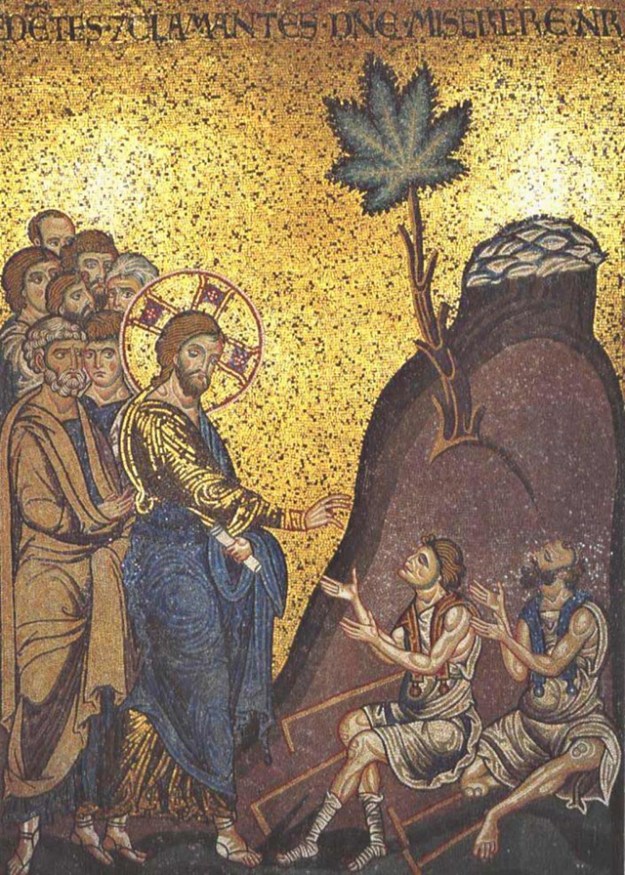
Jesus Healing the Blind From 12th Century Basilica Catedrale di Santa Maria Nouva di Monreale in Sicily.


Faith, believing, and unbelief are frequently used terms in Matthew, all originating with the Greek pistis. When modern people use terms like faith or belief they typically are referring to some type of cognitive assent-I believe certain things to be true, but the frequent usage of faith related terms in Matthew indicates definitions closer openness or trust than some type of cognitive assent to certain beliefs. There is a certain elasticity to how Matthew employs these terms but when we think about faith in Matthew it is not belief in the dogmatic sense.

As I’ve alluded to several times while discussing portions of Matthew that we view the world differently than the people that Matthew’s gospel is written to. I still find one of the more helpful ways to think of this difference comes from the philosopher Charles Taylor in his work A Secular Age where he differentiates between our ‘disenchanted’ world and the ‘enchanted’ world of our ancestors. Most ancient cultures, and the readers of Matthew’s gospel certainly fit within this characterization, believed there were times, places and individuals where the spiritual side of reality permeated their reality. Divine and demonic forces were actively at work in the world and responsible for sickness, famine, war, acts of nature and could be at work for or against the individual living in this enchanted world. Demons might cause a person to be mute or have a seizure, they might cause a storm to come upon the sea or the crops to fail. God or another deity might bring a bountiful harvest or hold back the rains as a judgment on the lack of ‘faithfulness’ of the chosen people. Ritual, when done by the priests, or magic, when done by others, often tapped into these people, times, and places where the spiritual world drew close to our own.

The gospel of Matthew is written from the perspective that the spiritual realm of the LORD the God of Israel, the Kingdom of Heaven, has now drawn near and turning towards the approaching Kingdom of Heaven is the proper response. (Matthew 4: 17) Although this is a minimalistic way of putting things, in Jesus we have a person where the spiritual side of reality associated with the God of Israel is able to act upon the earth and against the demonic forces that enslave, the sin that condemns and the lack of holiness that excludes. Faith or belief in Matthew’s gospel seems to reflect an openness or an awareness of this reality that some have while others do not. Some, like the centurion and the Canaanite woman, seem to perceive this reality in Jesus without having the background of the Jewish scriptures and practices, but instead use their own frameworks to understand who Jesus is and what Jesus means.

A special usage of this term, oligopistoi, what I’ve translated ‘little faith ones’ is always used in relation to Jesus’ disciples. They may not demonstrate the moments of clarity or openness that those coming to Jesus requesting a healing or exorcism may, but their faith is enough to recognize the call that Jesus extends to them. Traditionally translators and commentators have viewed ‘little faith’ as a criticism but Jesus, even asked to increase the disciples’ faith in Matthew 17: 20 (after they were unable to exorcize the demon of the son the father brings to them) tells that if they have ‘faith the size of a mustard seed’ they can command mountains to move. Being a ‘little faith one’ is not a crisis, for indeed these little faith ones will be sent out with the authority to heal and cast out demons and carry out the mission in chapter ten as emissaries of the kingdom and workers in the harvest. Jesus seems to be indicating that those with a small amount of faith can still do incredible things. As Mark Allan Powell can state,

So, Jesus seems to be saying, the amount of faith is not what’s important; you just need to know what to do with the faith you have. Quit worrying about whether you have enough faith and start asking, “Which mountains does God want me to move?” (Powell, 2004, p. 112)

Jesus may be able to expound about people like the Canaanite woman or the centurion that they have ‘great’ faith (in contrast to the little faith of the disciples) and they may simply have a greater openness to what God is doing in the world. This is not limited to Jesus’ time. There are many who are outside of organized religion who demonstrate a greater openness to God’s action than those who have been shaped by congregations. That doesn’t mean that faith and understanding cannot coexist, merely that they are not the same thing. I do think when Matthew invites the disciples who come to hear his gospel into the world of Jesus, he is also trying to invite us into a world where God’s kingdom is active and present, where in Jesus we meet the ‘God who is with us’ and to invite us, whether our faith is great or little, to hear about the people whose faith enabled them to see in Jesus the opportunity for God’s healing, forgiveness, and even resurrection.

Matthew 9: 32-38 Never Has Anything Like This Been Seen in Israel part 3

James Tissot, Healing the Blind and Mute Man, late 19th Century

Matthew 9: 32-38

Parallels Mark 3:22, Luke 11: 14-15; Mark 6:6b, 34; Luke 8:1; 10:2

32 After they had gone away, a demoniac who was mute was brought to him. 33 And when the demon had been cast out, the one who had been mute spoke; and the crowds were amazed and said, “Never has anything like this been seen in Israel.” 34 But the Pharisees said, “By the ruler of the demons he casts out the demons.”

35 Then Jesus went about all the cities and villages, teaching in their synagogues, and proclaiming the good news of the kingdom, and curing every disease and every sickness. 36 When he saw the crowds, he had compassion for them, because they were harassed and helpless, like sheep without a shepherd. 37 Then he said to his disciples, “The harvest is plentiful, but the laborers are few; 38 therefore ask the Lord of the harvest to send out laborers into his harvest.”

This third miraculous story of the third set of stories brings this section to a close and prepares us for the time when the apostles are sent out into the fertile fields to collect the waiting harvest. Even though Jesus has ordered people not to discuss the healing they have received the word has been shared and the crowd is now watching Jesus. With this final story of an exorcism in this section we also see the Pharisees again enter the scene and challenging the authority that Jesus is demonstrating. The seeds have been planted, the good news of the kingdom is gaining a hearing, the demons holding people in bondage are being expelled and surrounding Jesus is the harassed and helpless crowd looking for a shepherd to lead them in their confusion. Like a skilled composer Matthew has brought us to this point in the narrative, rhythmically setting us up to contemplate what following Jesus will mean, preparing us for the calling to go out with the apostles as laborers in the harvest, as shepherds helping to gather the harassed and confused flock, and as emissaries of the kingdom of heaven.

The man’s muteness is attributed to demon possession, and while we in our scientific worldview might look for medical explanations of a person being unable to speak the narrative views the man’s muteness as symptomatic of demonic possession. Whether we consider this narrative a healing or an exorcism matters little in relation to the person healed, but it is key to the question of authority that is put to Jesus by the Pharisees. In Mark’s gospel this challenge is met by Jesus’ response about Satan casting out Satan and brief parable of binding the strong man, but in Matthew the Pharisees challenge merely contrasts with the amazement of the crowds. In each of the reflections on discipleship that come after each trio of miracle stories in these chapters the scribes and Pharisees find themselves on the outside looking in at Jesus and his disciples. They, unlike the crowd, remain unconvinced that Jesus’ authority is coming from God and they continue to find themselves unable to see Jesus as one who can act as the shepherd of the lost sheep of Israel. Jesus, in Matthew’s telling, seems unperturbed by the resistance of the Pharisees and doesn’t consider their challenge worthy of an answer.

Jesus has already been in motion but here the pace quickens as the intensity increases. The narrative speeds up as the we learn that the harvest time approaches, and we quickly move to the instruction Matthew feels is important for these heralds of the kingdom.

The identification of the crowd as ‘sheep without a shepherd’ echoes Moses’ concern in Numbers about the need for a leader for the people after he is no longer with them:

“Let the LORD, the God of the spirits of all flesh, appoint someone over the congregation who shall go out before them and come in before them, who shall lead them out and bring them in, so that the congregation of the LORD may not be like sheep without a shepherd. Numbers 27: 16-17

This language gets echoed in Isaiah, Jeremiah, Ezekiel, Amos, Micah and Zechariah[1] where the image of the shepherd is sometimes the faithless leaders, sometimes the hoped-for Davidic leader and frequently the LORD acting as the shepherd (often to gather and sometimes to scatter). Matthew probably hears not only Jesus acting in concert with Moses and the hoped-for Son of David but also probably in terms similar to Ezekiel 34:

I myself will be the shepherd of my sheep, and I will make them lie down, says the LORD God. Ezekiel 34: 15

In addition to the image of the Lord acting as shepherd is the additional image of the Lord of harvest. The harvest is often an image of hope in the midst of judgment where there is both accountability for those who have led the people astray and a hope for a new beginning. For example, Hosea can state:

For you also, O Judah, a harvest is appointed. When I would restore the fortunes of my people. Hosea 6:11

 Joel can see the image of harvest as a time where God restores Israel and judges all the surrounding nations that have oppressed Israel in the midst of a very militaristic hope where plowshares are turned into swords and pruning hooks into spears for the warriors of the LORD (Joel 3). Yet, Jesus’ vision of the kingdom is a place where violence is not resisted, and where shepherds are both leaders and healers. It isn’t like anything that has been seen in Israel previously and perhaps that is why it is so difficult for those reading scripture in light of a different hope to understand Jesus’ proclamation and work. Yet, in spite of the resistance the seeds have been sown, the harassed crowds have found a shepherd and the harvest awaits laborers called to go forth into the harvest. As we have moved back and forth between Jesus’ actions that invite us to ponder his authority and identity and the calls into following him which invite us to wonder what this calling will mean,  Matthew will now take us into Jesus’ commissioning of his called laborers to participate in the awaiting harvest.

[1] Isaiah 41: 11; Jeremiah 23: 2,4; 31:4; Ezekiel 34; 37:24; Amos 3: 12; Micah 7: 14; Zechariah 10: 2; 11; 13:7

Matthew 9: 27-31 Never Has Anything Like This Been Seen in Israel part 2

Matthew 9: 27-31

Jesus Healing the Blind From 12th Century Basilica Catedrale di Santa Maria Nouva di Monreale in Sicily.

Parallels Mark 10: 46-52, Luke 18: 35-43 but these are closer to Matthew 20: 29-34

27 As Jesus went on from there, two blind men followed him, crying loudly, “Have mercy on us, Son of David!” 28 When he entered the house, the blind men came to him; and Jesus said to them, “Do you believe that I am able to do this?” They said to him, “Yes, Lord.” 29 Then he touched their eyes and said, “According to your faith let it be done to you.” 30 And their eyes were opened. Then Jesus sternly ordered them, “See that no one knows of this.” 31 But they went away and spread the news about him throughout that district.

Irony is strong in these two chapters which are preparing us for the sending out of the followers of Jesus into the plentiful harvest. Untouchable and unclean lepers have been touched and made clean, a Centurion can express a trust in terms of his understanding of authority that Jesus has not seen in all Israel, disciples may wonder ‘what sort of man is this’ but demon possessed men can speak truthfully about Jesus being the Son of God, a scribe who will follow Jesus anywhere may not but a disciple will get in the boat even as a father is needing burial, sins can be forgiven a paralytic and sinners can become disciples, two daughters (one of the leader, one who Jesus addresses as daughter) are beyond touch but through their own or a parent’s faith are enabled to ‘rise up’ and have a new opportunity at life. Now two blind men see what others cannot and once again Jesus, the Son of David, is called as a healer who can bring sight to the trusting blind men.

The report has spread throughout the district that Jesus has done incredible things to those who have asked of him. Most recently a girl who was dead has been raised to life, and if Jesus is capable of restoring life or healing a flow of blood then it would be reasonable to assume that Jesus can bring sight to the blind. The number of blind men also links us to the two demoniacs in Matthew 8: 28-34 and this story’s close counterpart of the two blind men at Jericho in Matthew 20: 29-34. The Son of David title for Jesus in Matthew often occurs in contexts where healing occurs (Matthew 12: 23, 15: 22, and 20: 31) which is interesting because David is never lifted up as a healer in the stories and poetry about or attributed to him and this title is related to his role as the expected messianic figure from the line of David that brings about this new connection with God. (Hays, 2016, p. 147)

Within this short healing story faith/belief plays a strong role. The words for faith and believe are both from the Greek pistis and, as mentioned before, this word has the connotation in trusting that Jesus is powerful enough/capable of doing what is asked. Jesus says to the blind men, “Do you believe (pistis) I am able (dunamai-literally powerful) to do this?” Their response beginning with “Yes, Lord” indicates by both affirmation and title they choose to address Jesus by an understanding that is favorable in Matthew. These blind men can see that Jesus is Lord, not merely a teacher. They are healed according to the faith/trust they have in Jesus.

Eyes can be opened but tongues can apparently not be stilled. Eyes have been opened and the faithful and newly non-blind followers of the Lord the Son of David are told to see that others do not see. They are commanded to say nothing to anyone but instead they go away and spread the news throughout the district. The command for silence leads to proclamation, secrets are shouted from the rooftops, and the seeds of the upcoming harvest continue to be planted. Those who have never seen now see what no one in Israel has seen before and there are others who need to hear the good news of the kingdom to have their eyes opened, to receive healing from their diseases and sickness and to have their demons exorcised.

Matthew 9: 18-26 Never Has Anything Like This Been Seen in Israel part 1

Gabriel von Max, The Raising of the Daughter of Jairus *(1881)

Matthew 9: 18-26

Parallels Mark 5: 21-43, Luke 8: 40-56

18 While he was saying these things to them, suddenly a leader of the synagogue came in and knelt before him, saying, “My daughter has just died; but come and lay your hand on her, and she will live.” 19 And Jesus got up and followed him, with his disciples. 20 Then suddenly a woman who had been suffering from hemorrhages for twelve years came up behind him and touched the fringe of his cloak, 21 for she said to herself, “If I only touch his cloak, I will be made well.” 22 Jesus turned, and seeing her he said, “Take heart, daughter; your faith has made you well.” And instantly the woman was made well. 23 When Jesus came to the leader’s house and saw the flute players and the crowd making a commotion, 24 he said, “Go away; for the girl is not dead but sleeping.” And they laughed at him. 25 But when the crowd had been put outside, he went in and took her by the hand, and the girl got up. 26 And the report of this spread throughout that district.

Matthew is an efficient narrator bringing together stories and structure to attempt to prepare us to be sent out as bearers of the good news. Comparing how Mark and Matthew construct their narratives, which are both designed to be heard and remembered, Mark often spends significantly longer in stories, like this one, where Jesus is bringing healing to those who need to receive it. Matthew’s narration of this story is roughly half the size of Mark’s because Matthew is moving quickly to what is commonly know as the ‘Mission discourse’ in Matthew 10. Matthew wants us to hear these final three healing stories as planting the seeds for the plentiful harvest that is coming at the end of the chapter.

Most hearers are familiar with the longer Markan and Lukan narration of this story, and some of the deletions that Matthew makes simply make the story shorter, others are interesting because they change the possible ways of hearing the story. The first major change is not reflected in most translations because in Matthew it is a merely leader who comes to Jesus, not necessarily a leader of the synagogue (of the synagogue is not in the Greek text, most translations harmonize this with the Mark and Luke parallels). The father here comes with an incredible request, to raise a daughter from the dead and although he doesn’t comment on the father’s faith it links the story to two others who ask on behalf of their children: the Centurion in Matthew 8:5-13 and the Canaanite woman in Matthew 15: 21-28. It is possible that Matthew wants us to hear this story in terms of a leader who is not a Jewish leader (although there isn’t the resistance that both the Centurion and the Canaanite woman receive so I view this as less likely), but it also may be Matthew using the bonds of parent to child in a powerful bond that makes us willing to ask the incredible and to believe on their behalf. The other instance of a father bringing a child occurs after the Transfiguration where a father brings his son who has seizures to Jesus and his disciples and bows down to Jesus asking for healing.

Jesus rises up and follows the father with his disciples but is interrupted on his journey. This first healing story, of the familiar pattern of three, actually involves two individuals seeking incredible things: a man on behalf of his daughter and a woman for her own healing. Matthew notes that the woman has been suffering for twelve years but deletes the age of the daughter (which in Mark and Luke is twelve structurally linking the two healings and the two suffers). The woman trusts that merely touching Jesus’ clothing will bring about healing. In both cases, the flow of blood and death, to touch the person would render a person unclean according to the law. By being out among those in the presence of Jesus this woman risks, in the views of the ancient world, contaminating anyone who comes into contact with her. Much like we have at times had erroneous ideas about the spread of diseases, the ancient world believed that contamination was spread by physical contact. The woman would have lost her place in society and in her desperate situation she dares to come up behind Jesus and touch the fringe of his garment. Even as Jesus ignores that taboos of purity violations of blood or death in the law, we have Matthew highlighting the fringe of the garment, a specifically Jewish custom in clothing. Jesus sees her, he doesn’t have to seek her out as in the other gospels’ narration of this scene, but his response is one of encouragement and announcing the healing that is done in her. It is her faith, her trust that Jesus can do that which she asked, which has, in the presence of Jesus, made her whole again.

The crowd in their mourning does not respond to Jesus as the father of the deceased girl does or the woman with the flow of blood. When Jesus tells them to cease their activities of mourning and to depart, ‘for the girl is not dead but sleeping’ they laugh at him. The crowd knows death when they behold it but unlike the girl’s father, they do not trust that Jesus or any other person can have power over death.  Yet, the father’s faith has caused Jesus to rise up and he will not be deterred by the crowd’s lack of faith. Instead he drives them out and proceeds to the girl and takes her by the hand and causes her to rise up. Jesus can do what Elijah and Elisha had done in bringing a child back to life, but Matthew is not content with us hearing Jesus as merely a prophet or wonder worker like Elijah or Elisha. Part of the cumulative effect of these three groups of miraculous stories and the introduction of titles is to draw the disciples and soon the crowds into wondering who this is who is in their midst because, “Never has anything like this been seen in Israel.” The word of this begins to pass throughout the land and the seeds are planted for the future harvest.

Matthew 9: 14-17 The Nature of Discipleship Part 2B

Carvaggio, The Calling of St. Matthew (1599-1600)

Matthew 9: 14-17

Parallels Mark 2: 18-22, Luke 5: 33-39

14 Then the disciples of John came to him, saying, “Why do we and the Pharisees fast often, but your disciples do not fast?” 15 And Jesus said to them, “The wedding guests cannot mourn as long as the bridegroom is with them, can they? The days will come when the bridegroom is taken away from them, and then they will fast. 16 No one sews a piece of unshrunk cloth on an old cloak, for the patch pulls away from the cloak, and a worse tear is made. 17 Neither is new wine put into old wineskins; otherwise, the skins burst, and the wine is spilled, and the skins are destroyed; but new wine is put into fresh wineskins, and so both are preserved.”

I’ve been a pastor long enough and have seen enough conflicts among people to know that sometimes the action of welcoming someone into a congregation who is viewed as an outsider can create a schism in the fabric of the community. Sometimes the people who are the most invested in the community will be the ones who tear away when the community no longer looks or acts like they expect. In this continuation of the reflection about what the nature of the community of disciples will look like we see some older groups, like the disciples of John and the Pharisees, who are uncomfortable in the way in which this community of Jesus’ disciples practice their righteousness. The question the disciples of John ask about fasting identifies one of the differences in practice between Jesus and these other two groups of people attempting to faithfully embody their relationship to but the two portions of Jesus answer point to a different understanding of time and the inability to fit Jesus’ merciful conception of righteousness in the established practices of righteousness of either John’s disciples or the disciples of the Pharisees.

Jesus did address fasting in the Sermon on the Mount (Matthew 6: 16-18) and as I mentioned there fasting is often conceived in terms of a personal piety, but even though most translations of Matthew 6 refer to practicing piety before others the term translated piety is righteousness. One thing to notice is the difference in the practice, the disciples of John are looking for a visible practice of fasting, while in the community of Jesus’ disciples the fasting does not exempt one from interacting with the community in a normal fashion. Their righteousness is practiced in their relationship with their Father who sees their action done in private and their interaction with the community in public ways. They may be those who hunger and thirst for righteousness who enter this time in the hope that they will be filled, but not so that their practice of righteousness is seen by others.

Jesus’ answer to the disciples of John consists in two parts, one focuses on the time in which the disciples of Jesus find themselves and the second takes the two images of old things being incompatible with new. In relationship to time, the time is now a time of celebration, like a wedding. Jesus is metaphorically cast as the bridegroom, an image that in both Psalm 19:5 and Isaiah 62:5 use to refer to God’s presence and Matthew may want us to hear this echo. Weddings are a time of joy in the ancient world, a time of feasting and celebration where the community is invited to share in the joy of the bridegroom and the bride. There are times that are inappropriate for the joyous feasting and celebration of a wedding, like the context of judgement we see in texts like Jeremiah 7:34, 16:9, 25: 10 and Joel 2: 16, but in Jesus’ view the time when he is present with the disciples is a time for eating and drinking and rejoicing rather than a time of mourning and fasting. The Pharisees and John’s disciples may view the times they find themselves in differently. They may look at the continued occupation of Galilee and Israel by Rome or the reign of Herod Antipas over Galilee, who will later execute John the Baptist (Matthew 14: 1-12), as indicative of a time closer to Jeremiah and Joel where feasting is inappropriate. Yet, Jesus views this as a time where tax collectors and sinners are welcomed to recline around the table with him as evidence of the kingdom of heaven continued expansion to those previously excluded.

The two images of an unshrunk patch on old clothing and new wine in old wineskins also point to the inability to fit Jesus’ practices and authority into old patterns of piety or old conceptions of righteousness. The way of Jesus is not the way of John or the Pharisees. The forgiveness of sins and the eating with sinners is bound to create a schism in among the religious community. The word translated tear is the Greek schisma where our English schism comes from. Like a wineskin without the ability to stretch with the release of gas that is a part of the fermentation process or a fabric which shrinks and tears away from the fabric it is sewn onto, sometimes the old is unable to contain the new. Yet, Jesus doesn’t try to force this new wine into the existing wineskins of the disciples of John or the Pharisees. Instead for those who are able to receive this new wine he allows them to receive it rather than attempting to patch up the existing movements that Jesus encounters. Perhaps in God’s economy there is a place where both have value and meaning and both can be preserved. As a person who has seen a church go through a schism in the past, I can only hope that those who viewed the practices and boundaries of the community differently still have a place in the coming of God’s kingdom. Jesus will have conflicts with the Pharisees and different practices than John’s disciples, and yet he seems content with welcoming the sinners and tax collectors that have been previously excluded rather than expecting the Pharisees and followers of John the Baptist to join him in the practice of this manner of righteousness.