Category Archives: Biblical Reflections

Song of Songs 4 A Dance of Desire

Song of Songs, a Cycle of Paintings no. 16 by Egon Tschirch (1923) Permission to use provided by his heir Wolfgang Adler under Creative Commons Attribution-Share Alike 3.0

Song of Songs 4

Bolded is the woman’s voice, the man’s voice is not bolded in the poem (my interpretation)

1 How beautiful you are, my love, how very beautiful! Your eyes are doves behind your veil. Your hair is like a flock of goats, moving down the slopes of Gilead.
2 Your teeth are like a flock of shorn ewes that have come up from the washing, all of which bear twins, and not one among them is bereaved.
3 Your lips are like a crimson thread, and your mouth is lovely. Your cheeks are like halves of a pomegranate behind your veil.
4 Your neck is like the tower of David, built in courses; on it hang a thousand bucklers, all of them shields of warriors.
5 Your two breasts are like two fawns, twins of a gazelle, that feed among the lilies.
6 Until the day breathes and the shadows flee, I will hasten to the mountain of myrrh and the hill of frankincense.
7 You are altogether beautiful, my love; there is no flaw in you.
8 Come with me from Lebanon, my bride; come with me from Lebanon. Depart from the peak of Amana, from the peak of Senir and Hermon, from the dens of lions, from the mountains of leopards.
9 You have ravished my heart, my sister, my bride, you have ravished my heart with a glance of your eyes, with one jewel of your necklace.
10 How sweet is your love, my sister, my bride! how much better is your love than wine, and the fragrance of your oils than any spice!
11 Your lips distill nectar, my bride; honey and milk are under your tongue; the scent of your garments is like the scent of Lebanon.
12 A garden locked is my sister, my bride, a garden locked, a fountain sealed.
13 Your channel is an orchard of pomegranates with all choicest fruits, henna with nard,
14 nard and saffron, calamus and cinnamon, with all trees of frankincense, myrrh and aloes, with all chief spices —
15 a garden fountain, a well of living water, and flowing streams from Lebanon.
16 Awake, O north wind, and come, O south wind! Blow upon my garden that its fragrance may be wafted abroad. Let my beloved come to his garden, and eat its choicest fruits.

The intertwined voices of the lovers weave together very different sets of imagery to describe and compliment their partner in this lover’s dance of attraction. The majority of the fourth chapter is the man’s response to the woman’s seeking and compliments in the previous chapter and his voice begins by describing her attributes. The man begins his descriptions of the woman’s attributes by stating, “how beautiful you are, my love, how very beautiful’ and ends by stating, “You are altogether beautiful, my love; there is no flaw in you.” Between these two statements are metaphorical descriptions of her attributes. The use of seven in scriptural poetry is a way of designating completion and so both the descriptions, the structure and the bracketing of these compliments reinforce in the poem how completely beautiful this woman is to the man.

The imagery the man uses may seem strange to us in describing a woman’s body, but just because they use imagery that would be alien to our language to describe the object of our affection does not make them any less valued by the hearer of the poem. The images all come from the natural world and probably express the experiences of a person who works in the field and who may have been drawn into the military for service at times. Eyes being doves, hair being like a flock of goats, teeth like shorn ewes leave us wondering how the images are compliments but these animals are all viewed positively in an agrarian world where flocks and birds are a part of the life, particularly the life of a shepherd. Perhaps hair like a flock of goats is long and brown and moves with the wind, while teeth like shorn ewes each bearing a twin are white teeth in proper alignment with no missing teeth, but whatever the compliments were intended to mean the woman values them. Lips like a crimson thread are probably easier to envision as well as round cheeks like a half pomegranate. The militaristic image of the tower of David where one thousand shields hang could simply indicate a long, strong neck or it may, as Carey Ellen Walsh states,

suggests a fairly strong defensive system, namely, of a thousand infantry men manning the tower. In addition, it may reveal the lover’s insecurity over the woman’s other suitors: a thousand armed men may have beaten may have beaten him to her. (Walsh 2000, 97)

The man’s final attribute he compliments is her breasts, but even here the image is one from nature, and one she has used to talk about him, gazelles. The poetry is seductive but not pornographic, and the man as he is poetically describing the woman’s attributes instead of sexualizing her body uses the images from the natural world to express how altogether beautiful she is in his eyes.

There is a distance that exists throughout the Song. The woman is often seeking the man or beckoning him to come inside the place where she is while the man when he speaks invites her to join him outside. After complementing the beauty of the woman, he invites her again to come away. The man induces her to come away from Lebanon, the mountaintops, from the dens of lions and leopards. Perhaps the place where the woman resides is dangerous for the man, it is a place where he is out of his element. Perhaps the presences of other suitors make his approach as treacherous as going into a den of lions or the mountain lair of leopards. In approaching this dark-skinned woman, he may find himself as a stranger in a strange land and yet, in the language of the poem, he comes to entice her to journey from Lebanon and the mountains to join him.

The man’s heart has been captured by the woman. She has either ‘ravished’ or ‘stolen’ his heart, but regardless of which translational choice is made for the ‘heartening’[1] effect she has on the man, his will belongs wholly to her. The pairing of, “my sister, my bride” is strange in English but ‘sister’ is a common term of endearment in Egyptian love poetry (NIB V:405) and would probably be understood that way in Hebrew poetry. Calling the woman his bride picks up the image of the wedding procession at the end of chapter three and invites us to hope for an approach of the man to come and join the woman. Her glance, her jewelry, her scent (or the smell of her perfume/ointment), her kiss (or words), and her love are all intoxicating to the man. The woman is a garden or a fountain that only those who are privileged to be invited to view may admire, but this man knows that behind her walls are all the precious fruits and spices that he could want and the living water that can quench his thirst.

The man beckons the woman to come with him, the woman desires the man to come to her. She asks the wind to spread her fragrance so that the man might smell her and be entranced. She wants him to come to her and to enjoy and explore the garden that she is and to sample the harvest of love that awaits. The scent of this woman, the promise of exploring her beauty and tasting her love should draw her beloved to come to her. He has declared her altogether beautiful. She has ravished him with her glance, put on her best jewelry, perfumed herself and extended an invitation for her beloved to view her garden. We now wait with her for his response.

Christian and Jewish interpreters of the Song have often heard the man’s declaration of the woman’s beauty as an echo of the love of God for humanity, Israel, or the church. This woman, who is declared as the bride, has a resonance with the imagery of the land that is called Married in Isaiah 62: 4-5

You shall no more be termed Forsaken, and your land shall no longer be termed Desolate; but you shall be called My Delight Is In Her, and your land Married; for the LORD delights in you, and you land shall be married. For as a young man marries a young woman, so shall your builder marry you, and as the bridegroom rejoices over the bride, so shall your God rejoice over you.

Many interpreters have understood the locked garden and sealed fountain as an allusion to the lost garden of Eden, and the invitation of God for the hearer to re-enter this lost garden where the beloved can encounter God without fear. The seeker is invited to come to a place that is hidden to the world, but a place where the desired intimacy with God can be achieved. Yet, in poetry the images can flow in multiple directions and the lesser taken path is hearing the woman representing the divine. Many of the images here in this chapter that the man uses to describe the woman echo what other cultures in the region of Israel have used to describe a goddess.[2] The woman’s looks and attraction are overwhelming to the man, and as Stephanie Paulsell notes, “If she views him as a king, he sees her as something even more awe inspiring.” (Cox 2012, 237) If the woman poetically is representing God, the God desires the seeker to come to the place where God dwells and sends out the alluring fragrance upon the winds to draw and entice the seeking ones. While the seeker attempts to draw the divine from the mountains, the sought one invites the seeker into the place into their home to come and know their presence. Either reading has its limits, as all poetry does, but whether speaking of human love or divine love we stand in the tension between these two parties who continue their dance of attraction and distance, desire and hope, and love and delight.


[1] The Hebrew is literally ‘to hearten’, the verbal form of the Hebrew word for heart.

[2] Stephanie Paulsell (Cox 2012, 237) cites Marvin H. Pope as making this claim (Pope 1977, 474)

Song of Songs 3 Seeking the King of Her Heart

Edward Poynter, The Visit of the Queen of Shebe to King Solomon (1890)

Song of Songs 3

Bolded is the woman’s voice, the man’s voice is not bolded in the poem (my interpretation)

1 Upon my bed at night I sought him whom my soul loves; I sought him, but found him not; I called him, but he gave no answer.
 2 “I will rise now and go about the city, in the streets and in the squares; I will seek him whom my soul loves.” I sought him, but found him not.
 3 The sentinels found me, as they went about in the city. “Have you seen him whom my soul loves?”
 4 Scarcely had I passed them, when I found him whom my soul loves. I held him, and would not let him go until I brought him into my mother’s house, and into the chamber of her that conceived me.
 5 I adjure you, O daughters of Jerusalem, by the gazelles or the wild does: do not stir up or awaken love until it is ready!
 6 What is that coming up from the wilderness, like a column of smoke, perfumed with myrrh and frankincense, with all the fragrant powders of the merchant?
 7 Look, it is the litter of Solomon! Around it are sixty mighty men of the mighty men of Israel,
 8 all equipped with swords and expert in war, each with his sword at his thigh because of alarms by night.
 9 King Solomon made himself a palanquin from the wood of Lebanon.
 10 He made its posts of silver, its back of gold, its seat of purple; its interior was inlaid with love. Daughters of Jerusalem,
 11 come out. Look, O daughters of Zion, at King Solomon, at the crown with which his mother crowned him on the day of his wedding, on the day of the gladness of his heart.

During the day the woman sent the man away, presumably in this reading to deal with the issues that keep them apart, but now in the night she desires his presence. Although the translation of the Hebrew nephesh as soul has helped many traditional commentators see this as an allegory for the relationship with God, the meaning of nephesh would be closer to ‘with all my being.’ The very essence of the woman loves and desires the beloved and departs from the bed and the house to seek him. We join the woman in her desperate search for her beloved. Perhaps she regrets telling him to flee earlier or realizes that her desire for him is more powerful than her need for public acceptance of their relationship. Her search for him is desperate. This one whom she loves with all her being must be found and brought into her home.

Many readers hear of the sentinels finding the woman and anticipate this being a threatening scene for the woman. There are certainly many instances of men with power and authority taking advantages of a vulnerable woman and an unmarried woman walking through the city at night may be taking a risk. Yet, the sentinels here are not viewed by the woman as a danger but rather as a resource. They are someone who may have seen her beloved in their rounds, and so she asks them for information. The woman’s desperate search for the beloved overcomes any sense of danger these sentinels may pose, and she passes beyond them without harm or any additional information on the beloved’s location.

The desperate search in the night leads the woman to the one whom she loves with all her being and now she will not let him go again. Shortly after the encounters with the sentinels she finds him and brings him into her home. She brings him to the place where no other man is present, no brothers or fathers, and she brings him into a place where our lovers can close the door and keep the rest of the world outside. Perhaps previously she desired him to bring her into his own home, but for now she refuses to let go of him and brings him into her own home.

This passage presents an interesting contrast to the description of the dangerous woman in Proverbs 7. In Proverbs the dangerous woman also will not stay at home and:

Now in the street, now in the squares, and at every corner she lies in wait. She seizes him and kisses him, and with an impudent face she says to him: “I had to offer sacrifices, and today I have paid my vows; So now I have come out to meet you, to seek you eagerly, and I have found you! Proverbs 7:12-15

Proverbs would probably find the woman’s desperate search for the beloved distasteful, her seeking through the streets and the squares and her bold seizing of the man and bringing him back to her household as the antithesis to that book’s more chastened view of relationships. As Stephanie Paulsell states, “Proverbs tells this story with the woman in the role of the villain, the Song places the woman in the role of the brave heroine.” (Cox 2012, 222) I find it helpful that our scripture can embrace both a male and feminine perspective on a similar story. It is also ironic perhaps that the male perspective in Proverbs is threatened by the presence of daring (dangerous in Proverb’s view) women.

The second half of the chapter shifts into the language of metaphor and may initially seem out of place within this portion of the poem.  Verse six can be read in either voice, as the man complementing the woman which is answered by her long compliment of the man, or as the woman beginning her extended metaphor about her beloved. I read this entire chapter as the woman’s voice, and her question about “What (or who) is that coming up from the wilderness…” being answered by the exclamation “Look, it is the litter of Solomon.” In our culture we may think of women being the primary ones perfumed or wearing scents like “myrrh, and frankincense, with all the fragrant powders of the merchant” but especially with the metaphor of the beloved as Solomon this fragrant procession which produces a column of smoke makes sense in the poem.

The beloved one is probably not actually Solomon, or even the king, but instead it is a way of referring to the majesty, strength, and power of the beloved in the woman’s eyes. The normal procession for a wedding would be the bringing of the woman in the man’s household, but perhaps there is something in the ancient culture we have missed. Jesus tells a parable in Matthew 25: 1-13 of the bridesmaids waiting for the arrival of the bridegroom, where it is the bridegroom that approached the place where the wedding occurs. Here Solomon approaches in all his glory and wealth to the place where the woman is so they can experience the joy of their mutual love.

There is an absence of fathers in the Song. First the woman brings the man into her mother’s home and chamber, and then it is Solomon’s mother who crowns him. This is a pattern throughout the poem, but here is also makes sense within the metaphor. In 1 Kings 1, when Solomon is anointed and declared king, his father David is very old and feeble and apparently unable to participate in the coronation of his son. It makes sense in the logic of the story that it is Bathsheba who crown her son and rejoices with him in his role as the king of Israel and in his, in the poem, upcoming wedding.

The progression of the poem takes the woman’s search for the beloved and her action of bringing him back to her mother’s home into a metaphorical procession of Solomon departing his father’s house with his mother to come to a place where he can celebrate his love for this woman. The man is both the one whom she loves with all her being and metaphorically one who embodies the majesty, strength, and power of Solomon. At the very least this man is the king of her heart, and her desire is to be the queen of his. The poem continues to bring the lovers close together, but still builds upon the anticipation of a rendezvous that is not final.

This portion of the Song has a number of echoes throughout the scriptures and also has a rich history within the allegorical and mystical interpretations of the Song of Songs. The image of a pillar of smoke moving through the wilderness evokes the pillar of cloud and fire that is the physical manifestation of God’s leading of the people of Israel through the wilderness in the Exodus. (Exodus 13:17-22) Frankincense and myrrh are used in the temple as a part of the act of lifting up offering to God, and frankincense in particular in the Hebrew Scriptures is always used (outside of the Song of Songs) in reference to the cultic practices in the temple.[1] Myrrh can have the connotation of worship, royalty and lovemaking in the scriptures.[2] This divine royal connotation also is part of the imagery in Matthew’s gospel when the magi present frankincense and myrrh to Jesus.[3] Myrrh also enters into another ‘love song’ in Psalm 45, where the king’s robes are fragrant with myrrh. If verse six is read in the feminine voice referring to the male character, the male character adopts several kingly but also divine attributes.

The one seeking her beloved here forms a contrast to the frequent pattern of Israel failing to seek God who is their partner. One example of this would be Isaiah’s inviting us into God’s frustration and heartbrokenness over Israel’s continue unfaithfulness:

I was ready to be sought out by those who did not ask, to be found by those who did not seek me. I said, “Here I am, here I am.” To a nation that did not call on my name. Isaiah 65:1

Yet, the mystics have sometimes turned this around when God has been difficult to find.  Ellen Davis points to the Spanish mystic Teresa of Avila (1515-1582) and she confronts God saying,

How is this compatible with Your mercy? How can the love You bear me allow this? I believe Lord, that if it were possible for me to hide from You as it is for You to hide from me, that the love You have for me would not suffer it; but You are with me and see me always! Don’t tolerate this, my Lord! I implore You to see that it is injurious to one who loves You so much. (Davis 2000)

On both sides of the relationship between the seeker and the divine there are moments of deep intimacy and closeness and those frustrating moments of distance and division. One of the gifts of Hebrew wisdom literature is its ability to live in the complex reality of multiple perspectives. Wisdom can include the perspective where a woman seeking a lover in the streets can be a dangerous lure away from the relationship with one’s partner (as in Proverbs and metaphorically speaking of the relationship between God and Israel in Hosea) but she can also be an image for a love that will not be denied and something that moves the hearers beyond their complacency with the way things are. The woman wants everything her lover, her king, and even her God can offer her and will not settle for less. As others fail to seek, she leaves her bed in the night and is unwilling to settle for anything less than bringing her beloved into her presence.

[1] Exodus 30:34, Leviticus 2:1,2,11,15, 16; 5:11, 6:15, 24:7, Numbers 5:15, Nehemiah 13:5, 9, Isaiah 60:6, 66:3, Jeremiah 6:20, 17:26.

[2] Exodus 30:23, Esther 2:12, Proverbs 7:17

[3] Matthew 2:11.

Song of Songs 2 Desire and Distance

Tulipa Agenensis, Israel. One of the possible botanical references for the Rose of Sharon photo by Zachi Evenor shared under Creative Commons Attributions-Share Alike 4.0

Song of Songs 2 

Bolded is the woman’s voice, the man’s voice is not bolded in the poem (my interpretation)

1 I am a rose of Sharon, a lily of the valleys.
2 As a lily among brambles, so is my love among maidens.
3 As an apple tree among the trees of the wood, so is my beloved among young men. With great delight I sat in his shadow, and his fruit was sweet to my taste.
4 He brought me to the banqueting house, and his intention toward me was love.
5 Sustain me with raisins, refresh me with apples; for I am faint with love.
6 O that his left hand were under my head, and that his right hand embraced me!
7 I adjure you, O daughters of Jerusalem, by the gazelles or the wild does: do not stir up or awaken love until it is ready!
8 The voice of my beloved! Look, he comes, leaping upon the mountains, bounding over the hills.
9 My beloved is like a gazelle or a young stag. Look, there he stands behind our wall, gazing in at the windows, looking through the lattice.
10 My beloved speaks and says to me: “Arise, my love, my fair one, and come away;
11 for now the winter is past, the rain is over and gone.
12 The flowers appear on the earth; the time of singing has come, and the voice of the turtledove is heard in our land.
13 The fig tree puts forth its figs, and the vines are in blossom; they give forth fragrance. Arise, my love, my fair one, and come away.
14 O my dove, in the clefts of the rock, in the covert of the cliff, let me see your face, let me hear your voice; for your voice is sweet, and your face is lovely.
15 Catch us the foxes, the little foxes, that ruin the vineyards — for our vineyards are in blossom.”
16 My beloved is mine and I am his; he pastures his flock among the lilies.
17 Until the day breathes and the shadows flee, turn, my beloved, be like a gazelle or a young stag on the cleft mountains.

The distance between the two lovers in the poem makes the woman yearn for her beloved’s presence. Many of the botanical references in this passage are not certain, even if their poetic use in English has achieved wide recognition. The rose of Sharon and the lily of the valleys are wildflowers that are native to the region, the ‘rose’ may be the tulipa agenesis (pictured above) or the tulipa montana a red flower native to the hills of the Middle East and the lily may be a crocus or the Madonna lily. (lilium candidum) Beyond the precise botanical designation is the poetic function of the self-declaration of the woman of her beauty and flattering response of the man. Her usage points to its ordinariness, she is a wildflower-something pretty but common. Her beloved counters that she is exceptional. She is set apart from the other maidens who may attempt to attract his attention. She is something special. She responds by describing her beloved, using botanical imagery again, this time as a fruit tree. Though apple trees are well known in our context there is the objection that they may not be native to Israel. As Ellen Davis can also insightfully state,

At any rate, wild apples are acid, not sweet. The apricot has been suggested as a substitute. The scientific issue remains uncertain, but the suggestion makes good poetic sense. A sun-ripened apricot is a sensual delight, being rich in color, scent, taste and even touch, as it almost literally melts in the mouth (“his fruit was sweet to my palate,” v. 3). (Davis 2000, 251)

The woman and man use natural imagery to describe one another. She is beautiful and stands out as extraordinary among all the other maidens like a beautiful flower among the prickly vines. Her beloved stands out among other men as a sweet fruit tree among all the other trees, yet only he produces the sweet fruit this ‘rose of Sharon’ desires.

The poem abruptly shifts from botanical references to a scene of a ‘banqueting house’ (literally ‘wine house’) where the man invites the woman. This is supposed to be a place where their love can be fully sated. Yet, even within this time of invitation we are aware that the desire of the woman has not been satisfied. Previously she wanted to taste the fruit that came from his tree upon her palate, now she asks for the fruit of the vine and the fruit of the tree to sustain her because she is faint with love. Her love and her desire are awakened, and these emotions are powerful and threatens to overwhelm her in her waiting. Yet, even in this invitation to a place where passions can be embraced we as the readers have to wait with the woman. She wants to be wrapped up in the embrace with her beloved with his left hand under her head and his right hand around her, but we are still waiting for that embrace to occur. She is present in the banqueting house at the invitation of the beloved, but he is not yet there.

We dwell in the anticipation of the two lovers. The beloved man may not be there yet, but he is close enough that his voice is heard, and his movements can be observed. The man is pictured as a gazelle or stag quickly bounding over mountains and hills to close the distance between himself and the woman. He is near to the house, but not inside it. Instead, we wait as he looks longingly in through the windows and peeks through the lattice for a glimpse of the woman. Something keeps him from crossing the threshold of the banquet house where she is and embracing her, perhaps someone is obstructing the consummation of their love for one another. Perhaps someone in his or her family is keeping them apart, or perhaps there is some societal expectation that make their love unable to occur in a public place. We are caught with the two lovers on opposite sides of the wall until the man’s voice beckons the woman to leave the house behind and come away.

In the man’s voice we hear an invitation once again into nature. The man may have brought the woman to the banqueting house, but the nourishment they both seek seems to occur away from the confines of the wall or city. This beloved man speaks in imagery of the natural world. The time of winter and of the rains has past and now is the time to be out in the world. In the earth’s awakening for spring and songs of the migrating birds, and in the fragrant flowers and figs comes the invitation to embrace among the beauty of the creation. There is an invitation to a secret, hidden place: a small cave in the rocks or a thicket among the cliffs. A place where the lovers can be away from all others and be with one another without the interference of others.

Verse fifteen with the invitation to catch the foxes which ruin the vineyard has received a wide variety of interpretations and can be heard from either the woman or the man. Some options for understanding this verse include: 1) It is another invitation from the man for the woman to come outside and join him in a joyous chase after these quick animals. 2) Cheryl Exum suggests that this is the woman’s response to the man and the meaning is that she wants to capture him so that she can have her as her own. 3) Ariel and Chana Bloch interpret the foxes as the woman’s brothers who are preventing the two lovers from being together. (Davis 2000, 216) My personal interpretation follows the direction of the third option, but without indicating those interfering with the two lovers. I feel that the woman, frustrated by the boundaries separating them is calling out to the man to capture and remove those who are obstructing and attempting to ruin their love. I agree that the woman wants her beloved for herself and is not satisfied with attempting to steal these moments where they can be together. Her love is in blossom and is ready to bear fruit, and now it is his responsibility to move beyond the walls that keep them apart.

The chapter closes with the woman’s famous words, “my beloved is mine and I am his,” and yet she beckons him to flee. Her beloved approached her like a stag or a gazelle and now he is told to flee in the same manner to the mountains. Their meeting continues to be delayed and shadows continue to lurk over their relationship. They belong to one another, but his inability to come into the house where she lies fainting for love needs to change. She doesn’t merely want to hear his voice or see him peeking in through the windows, she wants his arms to embrace her and to allow their love to grow. Her love is awake, and it causes her to ache, yet there is something the man must do to make their love possible. Perhaps this one who is ‘black and beautiful’ is unwilling to remain in the shadows any longer. If she is truly a lily among the brambles then she wants to be more than just one more pretty flower. She wants all of her beloved and so we are caught with her, waiting on his action to remove the barriers that obstruct their love.

Moving into the mystical and allegorical tradition of reading this portion of Song of Songs has traditionally viewed the believer in terms of the feminine character and God in terms of the masculine character. In this reading God is able to say to the believer that they are beautiful and exceptional and not merely ordinary. I find the almost playful and lovestruck image of God leaping like a gazelle or peeking in through the windows and looking through the lattice as an attractive image and far different from the classical portrayals of God. Perhaps just as critical in the poetry is the distance that needs to be bridged between the beloved one and the woman, and that bridging needs to occur by the action of the masculine character in the poem. Only this beloved one has the power to overcome the obstacles which separate them so that they can share in the intimate relationship they were created for. Within the Christian idea of grace (which emerges from the Hebrew idea of hesed– steadfast or covenant love) is the understanding that the distance in the relationship is something that God must overcome because the believer is unable to do that on their own. One of the powerful things about poetry is the way it can embrace multiple perspectives, and since Song of Songs is primarily written in a feminine voice, perhaps the roles traditionally assigned in the poem can also be reversed with God now occupying the feminine voice unwilling to be settle for pretty words, wanting to be desired above all other options and sending the beloved one out until they are willing to leave behind all else and cross the threshold of the banqueting house of God. God in this role would be unwilling for merely an admirer who watches through the lattice but wants God’s beloved to be fully God’s as God fully shows God’s covenant love to the beloved one. Poetry is language that reaches for metaphors to express meaning and it is a different way of expressing things than doctrine or story. Perhaps the gift that this poem can grant us is an expansive set of images that can help our imaginations see both the way our relationship with our human lovers should be and to give us words to point to the desire and distance within our relationship with God.

Song of Songs 1 An Embodied Desire

Virgin’s Monastery (Benedictine) Petropolis, Rio de Janeiro, Brazil by Claudio Pastro, photo by Eugenio Hansen, OFS shared under Creative Commons Attribution-Share Alike 3.0

Song of Songs 1

Bolded is the woman’s voice, the man’s voice is not bolded in the poem (my interpretation)

1 The Song of Songs, which is Solomon’s.
 2 Let him kiss me with the kisses of his mouth! For your love is better than wine,
 3 your anointing oils are fragrant, your name is perfume poured out; therefore the maidens love you.
 4 Draw me after you, let us make haste. The king has brought me into his chambers. We will exult and rejoice in you; we will extol your love more than wine; rightly do they love you.
 5 I am black and beautiful, O daughters of Jerusalem, like the tents of Kedar, like the curtains of Solomon.
 6 Do not gaze at me because I am dark, because the sun has gazed on me. My mother’s sons were angry with me; they made me keeper of the vineyards, but my own vineyard I have not kept!
 7 Tell me, you whom my soul loves, where you pasture your flock, where you make it lie down at noon; for why should I be like one who is veiled beside the flocks of your companions?
 8 If you do not know, O fairest among women, follow the tracks of the flock, and pasture your kids beside the shepherds’ tents.
 9 I compare you, my love, to a mare among Pharaoh’s chariots.
 10 Your cheeks are comely with ornaments, your neck with strings of jewels.
 11 We will make you ornaments of gold, studded with silver.
 12 While the king was on his couch, my nard gave forth its fragrance.
 13 My beloved is to me a bag of myrrh that lies between my breasts.
 14 My beloved is to me a cluster of henna blossoms in the vineyards of En-gedi.
 15 Ah, you are beautiful, my love; ah, you are beautiful; your eyes are doves.
 16 Ah, you are beautiful, my beloved, truly lovely. Our couch is green;
 17 the beams of our house are cedar, our rafters are pine.

Song of Songs, often called the Song of Solomon in many modern translations, may seem like a strange book to include within the wisdom literature of the bible. The name of the book, which is a long poem, is Song of Songs. The opening line serves the same purpose as the superscription on many of the psalms, and here it gives both the title and the attributed author. Song of Songs is a superlative declaring that what follows is the greatest of all songs or the ultimate song. Although it may be composed of poems that are collected together in some historical reconstructions the intended meaning of this title is not that it is a song made up of songs, but rather that here is a masterpiece that surpasses other songs. Although Solomon is mentioned in the title and occasionally is used as a description in the Song of Songs, many people who spend a lot more time with the Hebrew language than I do will tell you that the Hebrew represented by the Song of Songs is more recent than Solomon’s reign. Regardless of authorship, the text was collected and celebrated as a part of both the Jewish and Christian scriptures and it is both a source of strength and discomfort for both traditions.

When I began spending time delving deeply into the Hebrew scriptures, or Old Testament, I was amazed at how earthy they are. This collection of books has little concern about the afterlife which had dominated my early formation in faith and were concerned about a life lived on earth. These writings speak to the experience of being a human, with human needs and desires, in a covenant with a God of steadfast love and faithfulness who is jealous for their fidelity. Learning from these books have caused me to look at life and faith in an embodied way. Much of Christianity has viewed desire and passion suspiciously and in much Christian theology there is a schism between soul and body. This is not the view of the bible. The bible celebrates that way that we as humans are created to be and Song of Songs revels in the sensual and embodied poetry of attraction and desire as wisdom worth celebrating.

Song of Songs begins and is dominated by the female voice longing passionately for her beloved. The first three verses of the poem summon four of our five senses: touch (kiss me with the kisses of your mouth), taste (your kisses are better than wine), smell (your anointing oils are fragrant and metaphorically your name is perfume), and hearing (the unnamed name itself). Only sight is not immediately invoked, and that will come. Immediately we are brought into the intimate and passionate desire of the woman for her desired one’s kiss. In the language of metaphor love becomes better than wine, a loved name on the tongue is like a sweet smell in the nostrils. Others can see and recognize the desirability of the beloved, but the woman wants his attentions all for herself. She wants to touch, taste, hear, smell, and savor this lover who is like a king to her. Her lover may be royalty, or he may not, but in her eyes he rules every part of her.

Every culture in every time has expectations of beauty and the woman does not fit within what is expected. She is black and beautiful in her own words, and the word (Hebrew sehora) is not merely dark as some older translations would state but black. Skin color has often been an attribute that denotes privilege and which limits which relationships are acceptable. Even though she may not meet the societal standards of acceptability and beauty her response is one of affirmation of her body rather than rejection. Within her poetic response there is also the possibility that her references to her working in her brother’s vineyards and inability to keep her own vineyard may be a poetic way to state that she has not been able to safeguard her own virginity, which would also make her less desirable as a marriageable woman, Yet, if this is the case, the woman is able to accept her past along with her skin and declare that in spite of all of this she is black and she is beautiful.

Throughout the poem the woman will be seeking her beloved, and for the first time she asks where she can find him. She asks the one who her soul[1] loves where she can meet him when he pastures his flock and has some free time, presumably for her affections, in the middle of the day. She doesn’t want to waste her time having to seek him out and find him or having to remain veiled around others. She would rather spend her time in his presence. In response we hear the man speak for the first time not to answer where he will be but to encourage her to seek him out. The man in the Song of Songs may be elusive but the woman is determined and passionately persistent.

The man’s description of the woman highlights a very different set of metaphors. The first image is a militaristic one: a mare among the chariots. In the tactics of the ancient world sending a mare out among your enemies’ chariots, pulled by stallions, would make it challenging for the enemy to control their horses. In the metaphor the woman drives the man wild. Then the man begins to praise individual portions of her body. He begins with her cheek and her neck and also pays attention to the adornments which accentuate these features. The man desires to give her silver and gold to adorn herself and to highlight her already maddening beauty.

The woman has been seeking her beloved out in the pastures, but now the metaphor shifts again to being in the place of dining (meals were eaten reclining on the couch). The fragrance of nard could be the rich perfume imported to attract her lover (who is now a king instead of a shepherd) or it could be smells her own body is producing in anticipation of time spent passionately with her lover. The imagery becomes even more sensual as she inverts the man’s desire to give her adornments to now wear her beloved as an adornment between her breasts. He is that pleasant smelling thing that rests on this space unseen by all but her beloved. He is the flower that rests in the vineyard, which is probably a sexual allusion.  Verses 15-17 can be read as two voices (as I do) or as all in the woman’s voice. Verse 15 seems to me characteristic of the male voice in describing her attributes: you are beautiful, my love, your eyes are like doves. If I am reading this correctly the woman responds to her beloved that he also is beautiful, truly lovely. Poetry loves to mix metaphors and while the description of where they are can sound like a grand house the green couch and cedar beams and pine rafters may point to an encounter on the ground beneath the trees where two lovers are stealing some time for one another in the midst of nature.

On the one hand it is important to hear Song of Songs in a literal sense, as poetry between two lovers and its affirmation of the attraction and desire that humans were meant to experience. Yet I also believe there is something to the mystical and allegorical path that has dominated both Jewish and Christian appropriations to this book. The relationship between God and God’s beloved has often been one of passionate seeking. The woman whose role we take on in this reading may not fit societal standards of beauty or purity but remains lovely to God. Much of the path of the faithful is longing for a closer encounter with the beloved who is king and shepherd and beloved and yet still remains elusive and needs to be sought out. The gift of poetry is its expansiveness. It can playfully and passionately attempt to describe the object of its desire, and yet that language only highlights aspects of the beloved. Yet, even in his elusiveness the beloved one still lets the seeker know that they are seen as beautiful and valuable beyond treasure.

[1] Remember that the Hebrew idea of soul nephesh is much different from how many modern people think of soul. The Hebrew idea is closer to saying, “you whom every part of me loves.”

Transitioning into Song of Solomon

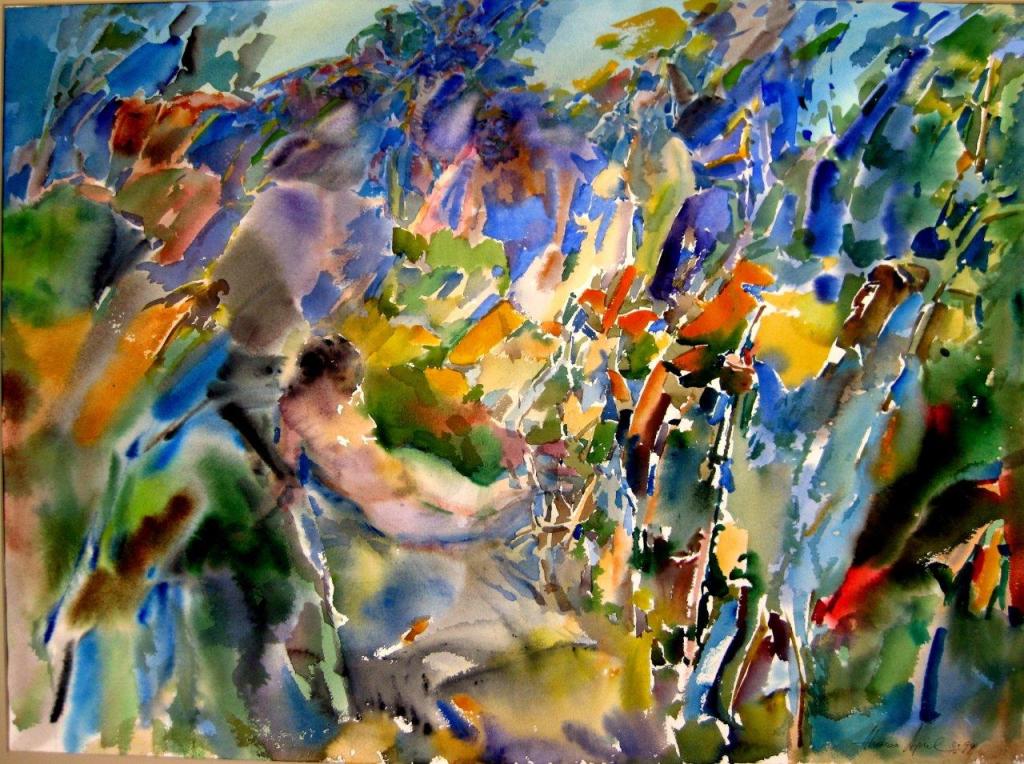
Aharon April, The Song of Songs-Last 2005 Shared under Creative Commons-SA 4.0 https://commons.wikimedia.org/wiki/Category:Song_of_Solomon#/media/File:Aharon_April_Song_of_Songs-Last.jpg

Psalm 62 may seem like a strange place to pause in the midst of the psalms, but there is a logic behind pausing here. The book of Psalms is subdivided into five books, with book two ending at Psalm 72. My pattern has been to do roughly 10 psalms between other books, and this sets me up to complete book two of the psalms following the next book I work through. I planned to work through Song of Solomon, or Song of Songs, prior to beginning Matthew but that project refused to wait. So now, after a long delay, I am finally turning to this strange love song which falls in the heart of the bible.

Song of Solomon has always been a controversial book within the scriptures. When our Jewish ancestors were debating which books would be included in their sacred scriptures opinions were sharply divided on this book. Ultimately its attribution to Solomon and the allegorical interpretation of the book’s poetry allowed Rabbi Akiba (ca. 50-135 CE) to defend it stating, “all the scriptures are holy, but the Song of Songs in the Holy of Holies.” (Paulsell 2012, 172) Within Medieval Christianity it was one of the most frequently read and written about book with over one hundred commentaries appearing by the year 1200. (Davis 2000, 231) Yet in modern times the Song of Solomon has fallen into disuse and many modern interpreters struggle once again to find an appropriate way of integrating this poem into the broader library of scriptures.

On the one hand, Song of Solomon is poetry about two lovers and their passionate desire for the other. Unique among the bible is the prevalence of the feminine voice throughout the poetry and it gives voice to a female perspective on desire in relationships in the bible. Like Esther, God is not mentioned in this book nor are there allusions to any religious traditions. On the other hand, the placement of this love poem within the scriptures assumes that it has something to speak about God, the world, relationships, and the people of God.  Within the organization of Christian scriptures, Song of Solomon is the final book of Wisdom Literature and like Ecclesiastes, which precedes it, it is not a religious or churchy type of wisdom.

Eighteen years ago, I was asked to give my senior sermon before the worshipping community at my seminary on a text from the Song of Solomon. I was struck then by the placement of this very unique book near the geometric center of the bible. I was fascinated by imagining God in the person of the lover leaping like a stag or looking through the lattice. (2:9) My intention as I go through this short book is to hold the sensual literal reading and the church’s historical reading alongside each other. I think there is wisdom in reading this book as simply a passionate poem of love and allowing it to rekindle some of the desire within us. Yet, I also believe that our own experiences of love at its best come from and in some way shape our understanding of God’s love for us as well. I’m curious to see where this unique book takes me over the next couple months.

Psalm 62 Truly Faith Surrounds My Troubles

Wartburg Castle, Eisenach, Germany. Photo by Robert Scarth shared under creative commons 2.0

Psalm 62 Truly Faith Surrounds My Troubles

<To the leader: according to Jeduthun. A Psalm of David.>

1 For God alone my soul[1] waits in silence; from him comes my salvation.
2 He alone is my rock and my salvation, my fortress; I shall never be shaken.
3 How long will you assail a person, will you batter[2] your victim, all of you, as you would a leaning wall, a tottering fence?
4 Their only plan is to bring down a person of prominence. They take pleasure in falsehood; they bless with their mouths, but inwardly they curse. Selah
5 For God alone my soul waits in silence, for my hope is from him.
6 He alone is my rock and my salvation, my fortress; I shall not be shaken.
7 On God rests my deliverance and my honor; my mighty rock, my refuge is in God.
8 Trust in him at all times, O people; pour out your heart before him; God is a refuge for us. Selah
9 Those of low estate are but a breath, those of high estate are a delusion; in the balances they go up; they are together lighter than a breath.
10 Put no confidence in extortion, and set no vain hopes on robbery; if riches increase, do not set your heart on them.
11 Once God has spoken; twice have I heard this: that power belongs to God,
12 and steadfast love belongs to you, O Lord. For you repay to all according to their work.

In poetry structure can frequently be used to help those familiar with the medium understand the words at a deeper level. In this psalm there are a number of structural elements that are often missed in the English translations that help provide emphasis in the psalm of trust amidst trouble. The placement of this psalm between Psalm 61 and Psalm 63 (also psalms which declare the psalmist’s trust in God above all other things) also emphasizes this common theme. The “trilogy of trust” within the psalms, as J. Clinton McCann labels Psalm 61-63, (NIB IV:922) stand near the end of the petitions for help in this portion of the book of psalms. Even though the psalmist’s world is full of people who murder reputations with their duplicitous ways, the way of faith knows that God’s steadfast love will outlast the scheming of mortals.

Invisible to most English translations of this psalm is the repetition of the Hebrew ‘ak which begins verses 1,2,4,5,6 and 9. This word, translated ‘alone’ and ‘only’ in the NRSV, is used four times in relation to God and twice in relation to the working of humans. There is a strong emphasis on God ‘alone’ providing strength which thwarts the ‘only’ plans of those who are but a breath. In addition to this structural repetition is the nearly identical wording of verses 1-2 and 5-6. The complaints about the enemies who are assailing the psalmist and attempting to bring them down from prominence are structurally surrounded by God alone, who they wait for in silence. The psalmist may appear like a leaning wall or a tottering fence, but they are surrounded by their rock, salvation, and fortress. The faithful one can remain in silence while the wicked ones utter falsehoods for they know that this struggle takes place within the sheltering space of their God who will not allow them to be shaken. Even trouble is surrounded by faith and the deliverance from the ephemeral evils produced by the wicked rests in the hands of God who rescues not only life but also honor and reputation.

In verse eight the psalm transforms from personal trust to testimony. Now the psalmist takes on the role of the instructor to the people handing on the trust they have learned. What humans can do alone without God (in verse 9 this is the final time the Hebrew ‘ak occurs) is to be a breath or a puff of air. God alone can be salvation, rock, fortress, deliverance, and honor. Placing trust in human scheming, extortion, robbery, and even riches is foolishness. It is in God, not humans and their schemes, where power rests. It is God’s hesed (steadfast love) that is the guarantee of the future for the faithful. The actions of the faithful and the foolish are seen by God and the psalmist trusts that ultimately God’s steadfast love and power will lift up the righteous and bring down those who are working in falsehood to destroy the honor and perhaps even the life of the faithful ones.


[1] Although the Hebrew nephesh is often translated ‘soul,’ the Hebrew understanding of ‘soul’ is closer to ‘life’ than the Greek conception of soul most English speakers assume. The Hebrew idea is inseparable from the life of the individual.

[2] A more literal translation of the Hebrew rasah here would be ‘kill’ or ‘murder’ (NIB IV:923)

Psalm 61 A Life Dependent on God

Wartburg Castle, Eisenach, Germany. Photo by Robert Scarth shared under creative commons 2.0

Psalm 61

<To the leader: with stringed instruments. Of David.>
1 Hear my cry, O God; listen to my prayer.
2 From the end of the earth I call to you, when my heart is faint. Lead me to the rock that is higher than I;
3 for you are my refuge, a strong tower against the enemy.
4 Let me abide in your tent forever, find refuge under the shelter of your wings. Selah
5 For you, O God, have heard my vows; you have given me the heritage of those who fear your name.
6 Prolong the life of the king; may his years endure to all generations!
7 May he be enthroned forever before God; appoint steadfast love and faithfulness to watch over him!
8 So I will always sing praises to your name, as I pay my vows day after day.

In C. S. Lewis’ classic parable, The Great Divorce, the experience of hell is a grey city where the inhabitants choose to live a life that is increasingly joyless and friendless as they move further and further away from their neighbors. An escape from this grey city is readily available if the people of the place let go of their own security and accept their reliance on God’s grace (which is both a painful and healing process in the dream that forms the book) but most sullenly either remain or return to this increasingly private hell which they choose instead of heaven. One of the paradoxes of our current time is that we live in a time in society where we have resources and comforts unavailable to people at any other time in history and yet as our affluence has increased our depression and anxiety have also increased. Perhaps this poem that the psalmist lifts up from the end of the earth has something to speak to a people who have lived in the anxiety of attempting to make meaning for oneself and finding, in the words of Ecclesiastes, that it is all vanity. That perhaps Augustine’s confession that ‘our heart is restless until it rests in you” may be the gospel we need to lead us back home.

This psalm is the appeal of an individual for God’s help in the midst their trouble. The psalmist cries to God from ‘the end of the earth’ which could be a geographical location, being far away from the temple, but more likely is a perception of the psalmist’s distance from God. In the midst of the trouble, they are experiencing they have found their own resources insufficient. They are in need of a place they can escape from the rising floodwaters. They are faint of heart and fading fast.[1] The appropriate place to turn in their distress is to their God who in a flourish of images of strength is the psalmist’s refuge, strong tower, tent to abide within, and wings to be sheltered under. The crisis of the psalmist has shaken them out of their self-reliance, demonstrated their distance from their God, and caused them to cry out to return to their God’s presence.

The psalm moves from trouble to trust. The God of the psalmist is one who hears their petitions and vows. The heritage, or inheritance, mentioned in verse five is often associated with the land that God has promised. In an agricultural society one’s security is intimately linked to the land and the provision of weather at the appropriate time. Yet, one’s security is also determined by the actions of the leaders of that land. The king, and here it would refer to a Davidic king, would provide the physical security for the land. But theologically the king is merely a means by which God provides for the covenant people and the military security of Israel is ultimately provided not by swords and spears but by God’s protection. Martin Luther captures this idea when expounding on the petition asking God for our daily bread in the Lord’s Prayer noting that it not only includes food and drink but also, “upright and faithful rulers, good government, good weather, peace, health, decency, honor, good friends, faithful neighbors, and the like.” (Luther 1978, 36) The psalmist realizes that the way of self-sufficiency is vanity and that their life is dependent upon God’s gracious provision which comes in many forms.

The psalm promises a grateful response to God’s act of provision. A skeptical reader may view this as an attempt to bribe God to get one’s way, but the psalms have stated in other places that God needs nothing that the psalmist can give.[2] As Walter Brueggemann and William Bellinger can state, “Israel, however, was not aware that the transaction could be reduced to a quid pro quo, an attempt to bribe YHWH.” (Brueggemann 2014, 272) The appropriate response to God’s provision is praise, thanksgiving, promising to serve one’s God with whatever one has to offer. Self-reliance has led to isolation from God and trouble. Repentance has allowed one to return to reliance upon God’s provision and a response of gratitude for God’s gracious protection, provision, and shelter.

[1] As Beth Tanner notes, the root Hebrew word translated faint demonstrates a serious distress and proximity to death. (Nancy deClaisse-Walford 2014, 511)

[2] For example Psalm 50: 8-13.

Psalm 60 A Plea for God’s Return to the People

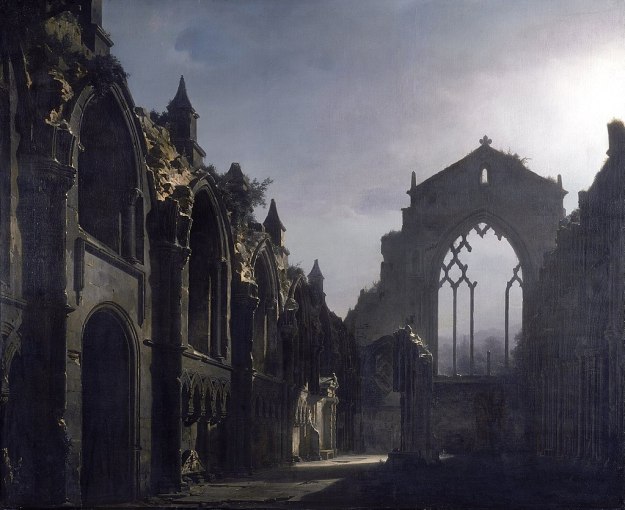
The Ruins of Holyrood Chapel by Louis Daguerre (1824)

Psalm 60

<To the leader: according to the Lily of the Covenant. A Miktam of David; for instruction; when he struggled with Aram-naharaim and with Aram-zobah, and when Joab on his return killed twelve thousand Edomites in the Valley of Salt.>
1 O God, you have rejected us, broken our defenses; you have been angry; now restore us!
2 You have caused the land to quake; you have torn it open; repair the cracks in it, for it is tottering.
3 You have made your people suffer hard things; you have given us wine to drink that made us reel.
4 You have set up a banner for those who fear you, to rally to it out of bowshot. Selah
5 Give victory with your right hand, and answer us, so that those whom you love may be rescued.
6 God has promised[1] in his sanctuary: “With exultation I will divide up Shechem, and portion out the Vale of Succoth.
7 Gilead is mine, and Manasseh is mine; Ephraim is my helmet; Judah is my scepter.
8 Moab is my washbasin; on Edom I hurl my shoe; over Philistia I shout in triumph.”
9 Who will bring me to the fortified city? Who will lead me to Edom?
10 Have you not rejected us, O God? You do not go out, O God, with our armies.
11 O grant us help against the foe, for human help is worthless.
12 With God we shall do valiantly; it is he who will tread down our foes.

While writing to his friend Eberhard Bethge from Tegel military prison in 1944, Dietrich Bonhoeffer wrote, “The same God who is with us is the God who forsakes us (Mark 15:34!)” (DBWE 8: 479) Though Bonhoeffer was discussing how he, and other faithful Christians, were to live before God in a world that seems to manage without God, his phrasing could also apply to this psalm where the critical issue is the perceived abandonment of the covenant people at a critical moment by their God. The psalms are theological enough to rest on the conviction of God’s active presence and participation, but they are poetic enough to speak eloquently about the experience of God’s absence, abandonment, and rejection.

The superscription of this psalm seems to be disconnected from the content of the psalm itself. The superscription refers to a string of events in 2 Samuel 8 (and 1 Chronicles 18) when David and his armies are experiencing a time of the LORD’s favor and, “the LORD gave victory to David wherever he went.” (2 Samuel 8:14) Yet the psalm is clearly about a time where the people are not experiencing the LORD’s favor and are speaking in the aftermath of defeat searching for answers. This communal prayer contrasts the experience of God’s previous provision with the brokenness of their current plight.

In the theological world of the Bible the existence of the covenant people is contingent upon the continued provision and care of the God of Israel. They may have suffered a defeat from one or multiple of the surrounding kingdoms of Moab, Edom, or Philistia, but the theological claim that the psalmist makes is that this defeat is symptomatic of their rejection by their God. It is not better military technology or strategy that will change the plight of the defeated covenant people. Their need as expressed in this prayer is that God to return to their side and protect them. There are numerous incidents in the story of Israel where the scriptures narrate a military defeat theologically as a judgment by God or a time where God’s presence has not gone with the people.[2] The bible consistently provides a theological interpretation of history, judging kings and times for their faithfulness to the covenant instead of their wealth, power, or military prowess. In this psalm, it is God who has rejected the people, breached their defenses and broken the land itself. Although the people may have external opponents it is God who has caused them to suffer and given them the ‘wine of reeling.’[3]

There is an abrupt transition in verse four where God’s role changes to being once again the one who provides a safe place for the people to rally under. Perhaps this is the psalmist speaking in hope or perhaps it is a desperate plea, but it remains consistent with the psalmist’s worldview that the problem is God’s rejection which can only be resolved by God’s initiative. In Hebrew verse five ends with the imperative “answer” setting up what “God has spoken.” God’s answer reinforces the psalmist’s worldview that God is not merely the God of Israel, but the God of all the nations. Not only are the places of Israel (verses 6-7) but also Israel’s opponents (verse 8) under God’s authority. The language about Moab, Edom, and Philistia may be intended as an insult of these nations or they may simply be extending the image of God’s possession and claiming of each of these nations that surround Israel as well.

The nation still finds themselves in conflict and unable to oppose their foes. They are not going to enjoy success against the defenses of their opponents until God’s rejection ends and God once again goes out with the armies of the covenant people. It would be easy to dismiss this prayer as an appeal to divine authorization of the wars of the people, and in a conflicted history of Israel there are times where it would be appealing to combine military might and strategy with a divine mandate. Yet, Israel has never been a superpower and they were to rely upon God for their survival in the ancient world. As J. Clinton McCann Jr. can articulate.

Their prayer is not that of the powerful, who seek to claim God’s sanction of the status quo. Rather, their prayer is the desperate prayer of those who turn to God as the only possible hope in an apparently hopeless situation (v. 11) (NIB IV:918)

In a violent world the covenant people were to learn to rely upon their God’s continual strength, protection, and provision. In this moment of crisis, in the psalmist’s view, God has not upheld God’s responsibility to the covenant and no justification for this absence is given. This psalm boldly calls upon God to act on behalf of the covenant people and to restore them once again and grant them victory over the foes that oppose them.

[1] The NRSV takes a less literal approach here in its rendition of these words as God has promised from his sanctuary. There is the possibility of understanding this as a ‘brief sermon’, but the more literal reading of the Hebrew rendered by the NIV as “God has spoken from the sanctuary” places this as a plea for an answer responded to by God’s voice from the sanctuary. (NIB IV:916)

[2] Examples of this include Numbers 14:41-45, and Judges 2: 11-15. This theological interpretation of history permeates the narration of Israel’s story throughout historical books (Joshua-Esther) and also often appears in the prophets.

[3] This theme of the wine of reeling or cup of judgment also appears in Isaiah 51:22 (where this wine is to be passed now to the enemies of the people) and Jeremiah 25:15-17(although the language in Jeremiah is slightly different the image is employed in the same manner).

Psalm 59 God’s Steadfast Love as an Alternative to the Dog-Eat-Dog Worldview

Battle between Cimmerian cavalry, their war dogs, and Greek hoplites, depicted on a Pontic plate

Psalm 59 God’s Steadfast Love as an Alternative to the Dog-Eat-Dog World

<To the leader: Do Not Destroy. Of David. A Miktam, when Saul ordered his house to be watched in order to kill him.>

1 Deliver me from my enemies, O my God; protect me from those who rise up against me.
2 Deliver me from those who work evil; from the bloodthirsty save me.
3 Even now they lie in wait for my life; the mighty stir up strife against me. For no transgression or sin of mine, O LORD,
4 for no fault of mine, they run and make ready. Rouse yourself, come to my help and see!
5 You, LORD God of hosts, are God of Israel. Awake to punish all the nations; spare none of those who treacherously plot evil. Selah
6 Each evening they come back, howling like dogs and prowling about the city.
7 There they are, bellowing with their mouths, with sharp words on their lips — for “Who,” they think, “will hear us?”
8 But you laugh at them, O LORD; you hold all the nations in derision.
9 O my strength, I will watch for you; for you, O God, are my fortress.
10 My God in his steadfast love will meet me; my God will let me look in triumph on my enemies.
11 Do not kill them, or my people may forget; make them totter by your power, and bring them down, O Lord, our shield.
12 For the sin of their mouths, the words of their lips, let them be trapped in their pride. For the cursing and lies that they utter,
13 consume them in wrath; consume them until they are no more. Then it will be known to the ends of the earth that God rules over Jacob. Selah
14 Each evening they come back, howling like dogs and prowling about the city.
15 They roam about for food, and growl if they do not get their fill.
16 But I will sing of your might; I will sing aloud of your steadfast love in the morning. For you have been a fortress for me and a refuge in the day of my distress.
17 O my strength, I will sing praises to you, for you, O God, are my fortress, the God who shows me steadfast love.

Many of the Psalms in this section of the psalter are attributed to the time when David’s life is continuously under threat from his king and father-in-law Saul.[1] These desperate pleas to God, which can fit a number of circumstances that people encounter in a world, are an underutilized portion of Psalms. They are perhaps overlooked because they may appear too vengeful for some Christians, but they point to a resilient faith in the reality of God’s steadfast love in the midst of a world of dogged opposition. The psalmist trusts that God’s protection will allow them to see their opponents punished for their unjust violence they have done and will vindicate their continued trust in their God which allows them to opt out of the dog-eat-dog mindset of competitive violence.

God is the one who must deliver the psalmist from their situation. The psalm is a series of imperatives directed at God: deliver, protect, deliver, save, (1-2) rouse, come, see, awake, spare none, (4-5) make them totter, (11) and consume (twice in verse 13). Immediately the psalmist begins with an impassioned appeal for God to save them from dire circumstances that are created by enemies who are conspiring against them. These evil working and bloodthirsty ones continually create a world of conflict and violence for the poet despite their innocence. The psalmist emphasizes their innocence by utilizing the three major Hebrew words for ‘sin’[2] and declaring they are without fault, transgression, or sin. This three-fold appeal to the psalmist innocence is followed by a three-fold titling of God: LORD (the divine name of God) God of hosts (a militaristic image of God as the leader of armies) and God of Israel (the God of the chosen people). God is one who can be called upon by name, and yet has the power to aid in conflicted situation, and is also the God who stands with the chosen people in the midst of the nations. The psalmist trusts that the God that they call upon is able to save and deliver them from this world of trouble created by their persistent and unjust enemies.

The metaphor used in this psalm for the enemies is dogs. They prowl like a pack, and they wound with their words. They continue to prowl the city and utter their threatening howls which inform the poet that there is no time when they are free of their presence. These enemies consider themselves strong but all their growling, prowling, and howling ultimately evoke laughter from God. In Psalm 52:6 the righteous laughed at the foolish and violent enemies, but here it is God who laughs at these violent ones who take themselves and their power so seriously. Their strength when compared to the protective and sheltering strength of the God of Israel or the liberating strength of the God of Hosts is laughable, and their boasts are hollow. The faithful and innocent one trusts that God’s steadfast love (hesed) will ultimately be the final word and will put these dogged opponents in their place.

This prayer comes from the perspective of one who is struggling in an unjust world and is calling upon God to act decisively against their oppressors. Perhaps one of the reasons this Psalm is seldom used is the desire for vengeance against one’s enemies and there is some danger when those in a privileged position view themselves as oppressed and use that narrative to justify their own actions of oppression. Yet, in the Psalms the actor who restores the oppressed one to justice is always God. Here the psalmist wishes not for a quick removal of the enemy, but a staggering but not fatal blow where the enemy becomes the unwitting example of God’s justice that is not quickly forgotten. As Bellinger and Brueggemann can say appropriately, “even in its most confident faith Israel can be honest about its resentments and its hope for vengeance and retaliation.” (Brueggemann 2014, 266) The psalmist is maintaining their innocence and committing themselves to God’s steadfast love and justice.

This psalm again confronts us with the distance between the world as it is experienced by the psalmist in this moment of their life and the world as it should be under the steadfast love of God. As J. Clinton McCann can aptly summarize the world the psalmist experiences, “What we end up with is a dog-eat-dog world, a culture of cut-throat competition in which we’re convinced that no one will look out for us if we don’t look out for ourselves.” But the psalm points to “a deeper reality, an alternative world, which is drive not by the lust for power but by the power of love.” (NIB IV:914) In the belief of the psalmist, we may begin with the need for deliverance from the dog-eat-dog mindset of competitive violence. The final words in this psalm and in worldview of the psalmist is God’s steadfast love (hesed). The wise live their lives oriented towards this deeper reality where the lust for power will be proven foolish and the power of God’s steadfastlove will endure.

[1] The superscription refers 1 Samuel 19: 8-17 when Saul has David’s home watched and Michal (David’s wife and Saul’s daughter) helps David escape and deceives her father.

[2] NRSV translates these words as ‘transgressions,’ ‘sin,’ and ‘fault’ in verses three and four.

Psalm 58 A Jagged Prayer for Vengeance

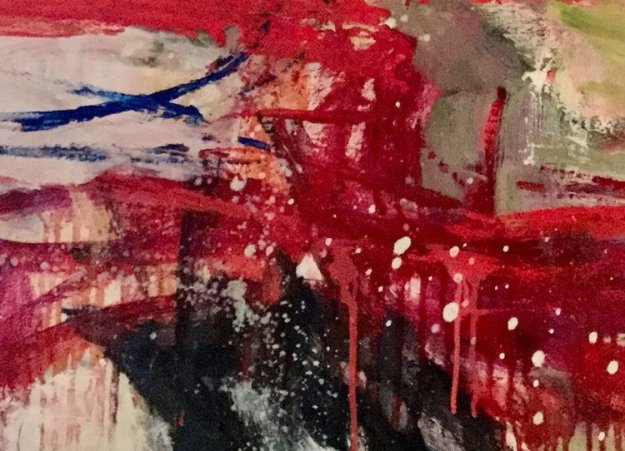
From Susan Harris Anger and art// A Rage to Paint https://www.susanharrisart.com/blog

Psalm 58

<To the leader: Do Not Destroy. Of David. A Miktam.>

1 Do you indeed decree what is right, you gods?[1] Do you judge people fairly?
2 No, in your hearts you devise wrongs; your hands deal out violence on earth.
3 The wicked go astray from the womb; they err from their birth, speaking lies.
4 They have venom like the venom of a serpent, like the deaf adder that stops its ear,
5 so that it does not hear the voice of charmers or of the cunning enchanter.
6 O God, break the teeth in their mouths; tear out the fangs of the young lions, O LORD!
7 Let them vanish like water that runs away; like grass let them be trodden down and wither.
8 Let them be like the snail that dissolves into slime; like the untimely birth that never sees the sun.
9 Sooner than your pots can feel the heat of thorns, whether green or ablaze, may he sweep them away!
10 The righteous will rejoice when they see vengeance done; they will bathe their feet in the blood of the wicked.
11 People will say, “Surely there is a reward for the righteous; surely there is a God who judges on earth.”

Many people who actually read the words of this psalm would be surprised that these words would be found inside their sacred scriptures.[2]  These words are never appear in the Revised Common Lectionary, and this psalm (along with Psalm 59 and 60) were never included in the Psalms in the hymnal I grew up with (the Lutheran Book of Worship). They do appear in the newer hymnal for my denomination (Evangelical Lutheran Worship) but in most churches they are ignored and most people reading the bible simply read over these words without stopping to reflect on these harsh and jarring words spoken about one’s enemy. I attempt to approach every piece of scripture with honesty and respect, trying to listen for the wisdom it has to speak. While I would agree with what 2 Timothy states about all scripture being inspired by God and being useful for teaching, reproof, correction, and training in righteousness, I would add the caveat that not all scripture is useful at all times in one’s life or experience and these jagged words crying out for vengeance may do harm to the unintended hearer who is dealing with a trauma or a miscarriage. The psalms frequently paint with the language of emotion and here the dark reds of anger, frustration, and hatred form a dangerous song that longs for blood. Though it may be uncomfortable to look at, these words have something to say into the bland and safe palette of language that Christians have often used.

The bible is a strange document among the holy writings of the world. Much of the bible is written by people who find themselves in a world where they are suffering because of the violence that is practiced on the earth and in the moment there seems to be a lack of justice on those perpetrating the violence. There are portions of scripture that are written by those in power, but it is also balanced by those prophets, poets, and pariahs who find themselves challenging the injustice of those charged to judge or rule in righteousness.  I think many Christians have been taught to suppress their anger and to attempt to hide it from God, but here we see the psalmist giving full voice to their desire for vengeance in their prayer and placing that uncomfortable emotion into God’s listening ears. The world is not as it should be. It is unjust. The righteous are suffering. The wicked are powerful. God needs to act.

Unlike most Psalms, God is not addressed until verse six. The initial focus is on the ‘mighty ones’ who have used wicked words and violence in a way that arouses this heated response from the poet. These ‘mighty ones’ have corrupted the practice of judgment among the people, they have reigned by violence, they have birthed a world of lies, they are like snakes that are unable to be restrained by the snake charmer. Their venom and violence now flow unrestrained into the world of the psalmist. How does one reconcile a vision of justice with the experience of injustice? The answer the psalmist gives in this moment is this jagged prayer for God’s action in vengeance towards those who have destroyed their world.

The seven imprecations (verses 6-9) may be difficult to read from a comfortable place. Praying for God to violently break the teeth or the jaws and defang those who attack may seem unchristian. Desiring our enemies to be transitory like flowing water or trodden grass may seem like a strange prayer. Wanting our enemies to feel the hot flame of thorns once they catch fire, or to dissolve like the snail into slime or to be like a miscarried fetus may seem like harsh and unforgiving language and yet here these words exist in the middle of our scriptures. Yet, vengeance belongs to God and not to the one who utters these words. Perhaps we may never utter these exact words to God. We may have been taught that anger or sadness are to be erased from our prayers by those who taught us our faith, but the scriptures bear witness to the complete palette of emotions in the life of the faithful with God. The life of faith in the bible is often more colorful than the life we encounter in the congregations where the religious gather.

The image of bathing one’s feet in the blood of the wicked may seem triumphal and uncomfortable. Yet, as uncomfortable as talking about the judgment of God may be in many modern churches, sometimes the only way beyond the current world of oppression and violence is for the Pharaohs, Caesars, princes, kings, and rulers who reign over the unrighteousness to be removed along with those who support them. As much patience as God shows throughout the bible, there are those who resist God’s ways and God’s will until the end. We may recoil at this violent language which also emerges in Psalm 68, the prophets (ex. Isaiah 63: 1-6 and Ezekiel 39) and particularly in Revelation (see Revelation 14).   Yet, these words rest within our scriptures and commit this violence into God’s hands so that the faithful may continue to hope for a world beyond oppression.

I come from a privileged life. I am a white heterosexual well educated male living in an affluent area of the United States. I also understand that my experiences are not universal. Although it would be easy to take a razor to our scriptures and, like Ben Franklin, excise all the parts that don’t agree with our experience or worldview, I would caution that these uncomfortable words do have something to speak to us. Almost twenty years ago I encountered Miroslav Volf’s powerful challenge to the privileged worldview which wants to excise the judgment from the scriptures:

                Most people who insist on God’s “nonviolence” cannot resist using violence themselves (or tacitly sanctioning its use by others). They deem the talk of God’s judgment irreverent, but think nothing of entrusting judgment into human hands, persuaded presumably that this is less dangerous and more humane than to believe in a God who judges! That we should bring “down the powerful from their thrones” (Luke 1: 51-52) seems responsible; the God should do the same, as the song of that revolutionary Virgin explicitly states, seems crude. And so, violence thrives, secretly nourished by belief in a God who refuses to wield the sword.

My thesis that the practice of nonviolence requires a belief in divine vengeance will be unpopular with many Christians, especially theologians in the West. To the person who is inclined to dismiss it, I suggest imagining that you are delivering a lecture in a war zone (which is where a paper that underlies this chapter was originally delivered). Among your listeners are people whose cities and villages have been first plundered, then burned and leveled to the ground, whose daughters and sisters have been raped, whose fathers and brothers have had their throats slit. The topic of the lecture: a Christian attitude toward violence. The thesis: we should not retaliate since God is perfect noncoercive love. Soon you would discover it takes the quiet suburban home for the birth of the thesis that human nonviolence corresponds to God’s refusal to judge. In a scorched land, soaked in the blood of the innocent, it will invariably die. And as one watches it die, one will do well to reflect about many other pleasant captivities of the liberal mind. (Volf, 1996, pp. 303-304)

Even when we can acknowledge that these violent words belong within our scriptures, what possible ‘teaching, reproof, correction and training in righteousness’ can they offer to those who do not find themselves in the position of oppression crying out for God’s vengeance? Ellen Davis proposes three possible uses for psalms like this one when we are angry, and one, if we have the courage to encounter these words when we are not. First, they can give us words to wrap around our anger when we are not able to find adequate words on our own. She shares the advice a professor once gave her after a betrayal, “Go into the chapel when no one else is around and shout these at the top of your lungs.” This practice allowed her to both vent and release the anger but hearing herself speak these words she also could hear the self-righteousness and pettiness in her petitions. Secondly, the psalms function as divinely given ‘counselors’ and teach us that vengeful anger is one mode of access to God. We can come to know that God who created us for life together is also outraged by those who destroy community or deny justice. Thirdly, the cry is a cry for God to act which allows the petitioner to bypass acting personally against the one who harmed us. We demand our enemy be driven into God’s hands, but we are not in control of what happens there or how God brings about this justice and reconciliation. Finally, she suggests if we are reading when we feel none of the feelings in the psalm to turn it around and to ask if there is anyone in the community or among God’s people who may want to pray these words about me? (Davis 2001, 26-29) I may want to shrink away from the language of the prayer at times, but there may be other times when I need these very words to pass my lips so they may exit my heart. Sometimes I need to commit judgment to God so that I do not take vengeance into my own hands. When I am courageous enough, I may wonder who I may have wronged by judging unfairly, speaking poisonously concerning, refusing to listen, or the ways I have either actively dealt out violence or passively benefited from the violence dealt out by those who sat in a privileged place that I share. These are hard words that may be hard to speak. Yet sometimes we need to access the whole spectrum of emotions we experience in life.


[1] The word here is ‘elem which means silence. It bears the same root letters as the Hebrew ‘elohim (‘mighty ones’ or a generic term for gods) as gods. The NRSV and most other translations view this as ‘elohim and translate based on this assumption. The NRSV translates this as the common ‘gods.’ While this is a possible reading (see Psalm 82:1), mighty ones can also refer to warrior or powerful individuals. Within the context of this poem the opponents seem to be other humans so the more generic ‘mighty ones’ seems appropriate here. If you choose to translate using ‘elem the accusation is closer to, “Do you indeed declare what is right in silence?”

[2] Although Psalm 58 is full of challenging choices for a translator (of which I am highlighting only a few) the words in doubt are not the most graphic ones.