Category Archives: Biblical Reflections

Psalm 83 A Fearful Prayer for Deliverance

From Susan Harris Anger and art// A Rage to Paint https://www.susanharrisart.com/blog

 Psalm 83

<A Song. A Psalm of Asaph.>
1 O God, do not keep silence; do not hold your peace or be still, O God!
2 Even now your enemies are in tumult; those who hate you have raised their heads.
3 They lay crafty plans against your people; they consult together against those you protect.
4 They say, “Come, let us wipe them out as a nation; let the name of Israel be remembered no more.”
5 They conspire with one accord; against you they make a covenant —
6 the tents of Edom and the Ishmaelites, Moab and the Hagrites,
7 Gebal and Ammon and Amalek, Philistia with the inhabitants of Tyre;
8 Assyria also has joined them; they are the strong arm of the children of Lot. Selah
9 Do to them as you did to Midian, as to Sisera and Jabin at the Wadi Kishon,
10 who were destroyed at En-dor, who became dung for the ground.
11 Make their nobles like Oreb and Zeeb, all their princes like Zebah and Zalmunna,
12 who said, “Let us take the pastures of God for our own possession.”
13 O my God, make them like whirling dust, like chaff before the wind.
14 As fire consumes the forest, as the flame sets the mountains ablaze,
15 so pursue them with your tempest and terrify them with your hurricane.
16 Fill their faces with shame, so that they may seek your name, O LORD.
17 Let them be put to shame and dismayed forever; let them perish in disgrace.
18 Let them know that you alone, whose name is the LORD, are the Most High over all the earth.

One of the gifts of the book of psalms is the range of situations these poems address and the emotions they embrace. The potency of poetry can be uncomfortable, especially when it comes out of a space of fear or anxiety to call upon God to turn God’s power upon an enemy. Many of the psalms in book three of the psalter (Psalms 73-89) reflect the experience of suffering paired with the expectation of God’s response to the cry of the suffering one. The hope of the psalmist is for a God who can provide hope in the midst of the hopeless situation for the individual or the nation. This is the final Psalm of Asaph, a group of psalms which expect God to execute judgment on the situation of the individual or (as in this psalm) the nation. (Brueggemann, 2014, p. 360)

In the threatening situation that Israel encounters the psalmist asks for God’s silence to cease and for God not to be still. In contrast to the perceived silence of God there is the tumult[1] of Israel’s threatening enemies. Even beyond the threat to Israel, these enemies have raised themselves to oppose the God of Israel. The plans to wipe out Israel and take possession of the land are paired with the unusual action of making a covenant against God.[2] The situation in the poem is deadly serious with a group of enemies promising to destroy the population and the memory of Israel.

The enemies listed in the middle of the psalm geographically encircle Israel. Edom, Moab, Ammon and Amalek, Philistia and Tyre are all common opponents of the Israelites in the time of both judges and throughout the monarchy of Israel. Assyria may indicate a later date for the psalm since the Assyrian empire rises as a regional power that begins to impact Israel during the Omri dynasty in Israel[3] and a century later will defeat Israel[4] decisively. There is no known alliance of Assyria with the listed nations. Two nations are rarely mentioned: the Hagrites and Gebal. The Hagrites are mentioned in 1 Chronicles 5 as a group in the northern Transjordan, Gebal is associated with the city of Byblos on the coast of modern Lebanon. (Brueggemann, 2014, p. 361) Israel finds itself surrounded by a numerically and militarily superior enemy which is determined to destroy them so completely that not even their memory remains.

The mention of Assyria may indicate a later date for the psalm, but the history that the psalmist appeals to all occur in the time of Judges and early in the monarchy of Israel at the latest.. God’s action against Midian occurs through Gideon (Judges 6-8), Sisera and Jabin are the general and king that oppose Deborah as judge and Barak as the military leader of the Israelites (Judges 4-5). En-dor is mentioned twice in the Hebrew Scriptures: once when Saul consults a medium (1 Samuel 28) but the reference in the psalm is probably to the people of Manasseh taking possession of the land in Joshua 17:11.[5] Oreb and Zeeb are two of the captains of Midian killed when Gideon fought against the Midianites (Judges 7:25) and Zebah and Zalmunna are the final leaders of Midian pursued and killed by Gideon (Judges 8:1-21). The final psalm may build upon an early psalm which arose out of the experiences of the time of judges or early in the monarchy. Regardless of its history of composition the psalm echoes the experiences of God’s deliverance of the people in the past to cast a hopeful vision for God’s deliverance in the present.

Frequently psalms that call upon God to act against a military threat portray God as a divine warrior, but here the psalm calls upon God to be a force of nature. God is a wind that scatters their enemies like tumbleweeds, a consuming fire that consumes the forests and mountains, and a mighty storm that terrifies those who are in its path. Perhaps the psalmist expects the presence of God to be preceded by these things, like the wind, earthquake, and fire that precede the still small voice in 1 Kings 19.The experience of war is brutal and the language of this psalm expresses that brutality with the image of bodies littering the earth like fertilizer.[6] The psalmist does not anticipate that God acting as a force of nature will be painless for their enemies or that their oppressors will change their behavior without God’s forceful action. Yet, Israel here does not seem to embody the same genocidal tendencies of their oppressors. The desire is for the enemies to be shamed but with the ultimate goal of the enemies know that the LORD the God of Israel is the Most High over all the earth.

For people who are not the victims of oppression the idea of calling upon God to terrify and eliminate our enemies may seem uncomfortable. Psalm 83 is one of the imprecatory psalms[7] and these psalms are rarely used in the worship of the church. Yet, these psalms are a part of the honest dialogue of faith that emerges from those moments in life where enemies are oppressing the faithful and they ask for God’s response amidst the clamoring of their enemies. The gift of the psalter is its ability to contain the breadth of human emotions and bring those emotions into the dialogue with the promise of God hearing the concerns of God’s people. The God of the scriptures is not an uninvolved or detached God. The psalmist expects God’s silence to end and for God to be a force of nature which delivers God’s people from the violent enemies that surround them.

[1] Growling in Hebrew (Nancy deClaisse-Walford, 2014, p. 647)

[2] As Beth Tanner notes this is the only place in the Hebrew Scriptures where a covenant is made against a person or entity instead of with. (Nancy deClaisse-Walford, 2014, p. 647)Normally covenants bind individuals and peoples together, but the alliance made here is in aggression against both God and God’s people.

[3] Particularly in the time of King Ahab 869-850 BCE

[4] Israel here refers to the northern kingdom of Israel as opposed to Judah after the split of the nations in the time of Jeroboam and Rehoboam (1 Kings 12)

[5] Although the text seems to indicate that Dor and En-dor are cities that Manasseh were unable to take full possession of and that the Canaanites remained within. It is possible there is a memory of a victory that is not recorded in Joshua or Judges that is remembered in the psalm.

[6] This word in Hebrew is frequently used for bodies left on the ground (2 Kings 9:37, Jeremiah 8:2; 9: 22; 16:4; 25:33) but seems to be more associated with debris or fertilizer than dung which would be an offensive way to refer to the dead. (Nancy deClaisse-Walford, 2014, p. 646)

[7] Other psalms of this type include psalms 7, 35, 55, 58, 59, 69, 79, 104, and 137.

Psalm 82 The God Who Upholds Justice for the Vulnerable

Council of the Gods Giovanni Lanfranco (1582–1647), Galleria Borghese By Architas – Own work, CC BY-SA 4.0, https://commons.wikimedia.org/w/index.php?curid=70138442

Psalm 82

<A Psalm of Asaph.>
1 God has taken his place in the divine council; in the midst of the gods he holds judgment:
2 “How long will you judge unjustly and show partiality to the wicked? Selah
3 Give justice to the weak and the orphan; maintain the right of the lowly and the destitute.
4 Rescue the weak and the needy; deliver them from the hand of the wicked.”
5 They have neither knowledge nor understanding, they walk around in darkness; all the foundations of the earth are shaken.
6 I say, “You are gods, children of the Most High, all of you;
7 nevertheless, you shall die like mortals, and fall like any prince.”
8 Rise up, O God, judge the earth; for all the nations belong to you!

The vision of a council of gods presided over by the God of Israel seems strange to many modern readers who view the world through a secular lens. The activity of one God who remains active in the midst of the creation may seem difficult to imagine, much less numerous gods responsible for various regions or powers. Despite the distance between the ancient view of the world and our own this short poetic vision of a divine council reiterates the central Hebrew idea of justice and the role of God in ensuring justice for the vulnerable. The foundations of the creation are sunk into this justice for the weak and needy. The neglect of justice by these gods has undermined the foundations upon which the world rests.

Most modern readers of the bible assume that the Jewish monotheism meant that they did not believe the gods of the other nations existed, but throughout the Hebrew scriptures it assumes the existence of the gods of the nations while maintaining the superiority of the God of Israel. The signs and wonders[1] that the LORD the God of Israel used to bring the people out of Egypt are written in a way that demonstrates the LORD triumphing over the gods of Egypt. Elijah’s victory over the prophets of Baal likewise demonstrates the superiority of the LORD over Baal. Elijah may ridicule Baal for being busy or asleep, but Elijah never claims that Baal does not exist. There are moments where the Hebrew scriptures do move towards a monotheism where the idols of the nations are merely the work of human hands, but the faith of Israel grows in a polytheistic world where different nations worshiped a collection of gods and where the people of Israel continually struggled to maintain their trust in the LORD the God of Israel when these other gods were viewed as attractive alternatives.

Psalm 82 is a vision that presumes the superiority of the LORD, the God of Israel, over the gods. The God of Israel summons all these deities, asks them how long they will remain unjust and partial to the wicked, and charges them to maintain justice. For Israel The role of leaders in society was to be modeled on God’s role of protecting the vulnerable. As Brueggemann and Bellinger state:

The proper role, so defining for Israel’s faith and ethics, is to be guardian, protector, and guarantor of the vulnerable—the weak, the widow, the orphan, the lowly, the destitute—all those who lack the resources to sustain and protect themselves. (Brueggemann, 2014, p. 355)

Yet, one of the persistent dangers of religion and its proximity to power is to reimagine the ‘gods’ of the nations as authorizing the rule of the powerful. The gods, and by extension their servants in the nations, have served the powerful and those who have not upheld justice. Instead, these gods and their representatives on earth have become powers of oppression instead of justice. They have corrupted their calling and now they are called to judgment in the divine council.

In verse five the pronoun changes from second person plural to third person plural (you to they) and this may represent a change in tone or a change in voice. I am reading this as a change in voice, where we see the entrance of an unnamed accuser[2] who declares that these gods are so corrupted that they lack the knowledge to change. These gods exist in darkness unable to see how their unjust ways jeopardize the foundations of the creation. It is possible that the poet stays with the God of Israel speaking and changes the tone moving from charge to realization of the gods’ inability to embody the justice they are called to defend.

The voice shifts in verse six back to the God of Israel pronouncing judgment upon the assembled gods. They are all lifted up as children of the Most High, but they will not reign forever. Being ‘gods’ has not granted them immortality and they are told they will perish like mortals. They have been unfaithful in their administration and appear unable to change. Rather than continually imperiling the foundations of the earth and the practice of judgment their time they, and the systems they represent, will come to an end. Finally, another voice, perhaps the poet who has this vision revealed to them or a member of the LORD’s party, calls for the God of Israel to rise up and judge the earth and the nations in the ways of justice. The LORD is to establish justice for all the nations.

Neil Gaiman’s creative fantasy American Gods imagines the American landscape as a polytheistic space where the ‘old gods’ which the immigrants brought with them from their homeland come into conflict with the ‘new gods’ of technology and power. All of the gods in Gaiman’s story are interested in their own power and often stand behind the powerful and authorize their actions. The God of Israel has a ‘preferential option for the poor’ to use the famous phrase of Liberation theology. The biblical witness points to the God of Israel as the protector of the lowly and destitute and the one who brings down the might from their thrones when they become the oppressors of the vulnerable. Within this brief poem any religion whose gods authorize the oppression of the powerless by the powerful is a danger to the foundation of the earth and stands under God’s judgment.

[1] Most people refer to these as the plagues, but Exodus continually articulates these as being signs and wonders.

[2] This is the role of Satan in the book of Job, but it could be any member of the council of the LORD. This short poem leaves the figure unnamed and merely suggested.

Psalm 81 Hear! O People

The Temple by Radojavor@deviantart.com

Psalm 81

<To the leader: according to The Gittith. Of Asaph.>
1 Sing aloud to God our strength; shout for joy to the God of Jacob.
2 Raise a song, sound the tambourine, the sweet lyre with the harp.
3 Blow the trumpet at the new moon, at the full moon, on our festal day.
4 For it is a statute for Israel, an ordinance of the God of Jacob.
5 He made it a decree in Joseph, when he went out over the land of Egypt. I hear a voice I had not known:
6 “I relieved your shoulder of the burden; your hands were freed from the basket.
 7 In distress you called, and I rescued you; I answered you in the secret place of thunder; I tested you at the waters of Meribah. Selah
 8 Hear, O my people, while I admonish you; O Israel, if you would but listen to me!
 9 There shall be no strange god among you; you shall not bow down to a foreign god.
 10 I am the LORD your God, who brought you up out of the land of Egypt. Open your mouth wide and I will fill it.
 11 “But my people did not listen to my voice; Israel would not submit to me.
 12 So I gave them over to their stubborn hearts, to follow their own counsels.
 13 O that my people would listen to me, that Israel would walk in my ways!
 14 Then I would quickly subdue their enemies, and turn my hand against their foes.
 15 Those who hate the LORD would cringe before him, and their doom would last forever.
16 I would feed you with the finest of the wheat, and with honey from the rock I would satisfy you.”

The central commandment for Israel is for the people to hear:

Hear, O Israel: The LORD is our God, the LORD alone. (Deuteronomy 6:4)

Now within the event of a festal gathering and worship of the LORD the voice of God comes to the assembly asking them to hear the LORD’s appeal to them and to turn away from the foreign gods they have allowed to influence their life. The God who delivered their ancestors from Egypt is again ready to quickly subdue their enemies if they will listen and return faithfully to their God. This brief bit of poetry opens a window into the pained cry of a God whose people have chosen other gods or tried to combine the way of the LORD with the ways of other peoples and nations.

Psalm 80 implored the God of hosts to restore Israel in the midst of their trouble. Israel’s hope depended on God’s hearing the cry of the people and turning God’s face towards them. Now in Psalm 81 the gathered people are told to hear and turn their face once again toward God, and when they hear and listen and walk in the ways of God their enemies will be subdued and the storehouses of God’s abundant provisions will be opened. Israel’s future depends on God’s grace, but their God also desires their faithfulness. Grace and obedience are not mutually exclusive. Israel remains God’s people, yet God will not shield them as their stubborn hearts choose paths which lead away from the LORD.

This psalm begins within the context of a festival. It could be any of the major festivals in the year and scholars have argued for the Day of Atonement, Passover, Tabernacles, or the New Year. Regardless of the festival that the psalm occurs within it is a time of worship and song, a time where the people have gathered together to praise and probably sacrifice to the LORD. In this time of turning towards their God, God responds. Within the context of worship, perhaps through a priest or worship leader, God’s appeal to the people is heard and God’s broken heart is revealed.

The divine voice narrates that long-ago God heard the voice of the people in Egypt and how God responded by removing the burden from their shoulders. In liberating the people from slavery and leading them into the wilderness they were created as a new people. Instead of the people testing God at Meribah, the psalm indicates this as a time where God tested the people. Yet, the divine voice recalls the central memory of the people: the memory of God saving them from Egypt and providing for them in the wilderness in their sojourn to the promised land. In the context of this festival worship, they are called again to hear from the God who delivered them from Egypt, spoke to them at Sinai, and tested them at Meribah.

Israel is again called to hear! The shema[1] (Deuteronomy 6:4 referenced above) and the first commandment (Exodus 20:2, Deuteronomy 5: 6-7) form the background of this divine appeal. The people of God are not to worship the LORD alongside other gods, nor are they to give their allegiance to these foreign gods or their ways. The LORD has provided for their needs in the path and will continue to provide in the present if they will hear and remain faithful. The LORD’s plea comes because the people have not listened, nor have they remained faithful. The language of verse eleven is not merely that Israel did not submit to God, but they did not want[2] the LORD. The LORD speaks out of the pain of the rejection by Israel as they either wandered between the LORD and other gods or abandoned their God completely. God has cared passionately for the people and even after their rejection God still desires for the return of God’s people. Within this space of worship there is a divine invitation for those people to hear and return.

If the people hear and walk in the LORD’s ways then their God is waiting to subdue their enemies and provide the nourishment they need. Their wandering has consequences. God has passively allowed their stubborn hearts to lead them into their current crisis, but God is actively waiting and hoping for the return of the people of God. Those hating the LORD would realize their mistakes too late as the LORD becomes both the fearsome protector of Israel as well as the generous host providing the finest wheat and honey. God’s cry goes out to the people and their LORD desires for them to hear and return to the way of their God.

Eighteen years ago, the professor of preaching Richard Lischer stated:

The average American is subjected to approximately six thousand messages per day. Why should one of them called “gospel” stand out? What is one little message among so many? (Lischer, 2005, p. 13)

The number of messages that a contemporary person hears only seems to increase and the challenge of people hearing God’s message of grace and hope was not unique to the people of Israel. Yet in the sea of words and images that most people continue to be deluged by, the faithful are called to hear and attend to the divine words which call God’s people to return generation after generation. It is a call which sharply contradicts the consumeristic calls to create our own happiness and salvation. It opposes the radical independence that rests in our stubborn hearts and the numerous things that continually call for our allegiance and trust. Yet within the space of worship the people of God strain to hear the voice of God speak to them in the midst of the prayers and songs. Perhaps this time where the community of the faithful gathers is the last remaining space where the cacophony of the numerous other competing claims is silenced so that the God, so often rejected, may be heard by God’s people and their lives may be reoriented. Those with ears to hear will understand that God is both fearsome protector and generous host providing a world that is both safe and abundant and that the other forces which promise protection and prosperity are merely the idols we have created.


[1] Shema is the Hebrew word for “Hear” or “Listen” which begins Deuteronomy 6:4 (hence the passage is commonly known as the shema) and is behind the frequent occurrences of “hear” and ‘listen” throughout Psalm 81.

[2] The Hebrew verb ‘bh “has more of a meaning of “be willing to” or “want to” (Nancy deClaisse-Walford, 2014, p. 637)

The Book of 1 Kings

By Hans Holbein the Younger – Christian Müller; Stephan Kemperdick; Maryan Ainsworth; et al, Hans Holbein the Younger: The Basel Years, 1515–1532, Munich: Prestel, 2006, ISBN 9783791335803., Public Domain, https://commons.wikimedia.org/w/index.php?curid=5977456

Transitioning into 1 Kings
1 Kings 1 An Uneasy Transition from David to Solomon
1 Kings 2 Bloody Beginnings
1 Kings 3 The Wisdom of Solomon
1 Kings 4 A Prosperous Beginning of Solomon’s Reign
1 Kings 5 The High Cost of Construction
1 Kings 6 The Construction of Solomon’s Temple
1 Kings 7 The Halls of Solomon and the Furnishing of the Temple
1 Kings 8 The Dedication of the Temple
1 Kings 9 Solomon’s Second Vision and Continued Reign
1 Kings 10 The Queen of Sheba and the Golden King
1 Kings 11 The Foolish End of Solomon
1 Kings 12 A Divided Kingdom
1 Kings 13 A Man of God, the King, and a Prophet: A Strange Story
1 Kings 14 The End of Kings Jeroboam and Rehoboam
1 Kings 15: 1-31 Kings Abijam and Asa of Judah, King Nadab of Israel and the Unending Conflict Between the Two Nations
1 Kings 15: 32-16:34 Unrest in Israel
1 Kings 17 Elijah the Prophet Emerges
1 Kings 18 Elijah’s Showdown with the Prophets of Baal
1 Kings 19 Elijah Encounters the LORD at Mount Horeb and the Appointment of Elijah
1 Kings 20 King Ahab and the Conflict with Aram
1 Kings 21 Naboth’s Vineyard
1 Kings 22 The End of King Ahab
Resources on the Book of 1 Kings
Reflections After a Journey Through 1 Kings

Reflections After a Journey Through 1 Kings

By Hans Holbein the Younger – Christian Müller; Stephan Kemperdick; Maryan Ainsworth; et al, Hans Holbein the Younger: The Basel Years, 1515–1532, Munich: Prestel, 2006, ISBN 9783791335803., Public Domain, https://commons.wikimedia.org/w/index.php?curid=5977456

I have been reading scripture for much of my life, but it wasn’t until I was in my second year of seminary that I had any background to understand the narrative of 1 Kings. Over twenty years later it was still a portion of scripture I rarely utilized. I was aware of Solomon, the split between Israel and Judah in the time of Rehoboam and Jeroboam, and the conflicts between Elijah and King Ahab but there are always insights gained from the sustained reflection of working through a book. The world of scripture is far more ancient and alien to our world than most people realize and working through both Judges and 1 Kings has helped me peel back some of the modern assumptions I have placed on these books.

The story of Solomon forms a large portion of the book of 1 Kings. The reign of Solomon is the pattern that many later leaders will attempt to follow but from the theological perspective of 1 Kings Solomon is a failed king. Solomon from an external perspective, and in the view of many Christians, is a paragon of wisdom, the builder of the great temple to the LORD, a person whose policies of trade make Israel a significant and wealthy player on the world scene. Yet, Solomon’s wisdom is directed towards acquisition and Solomon’s policies begin to model the policies of the nations that Solomon becomes partners with. Solomon from the theological perspective of 1 Kings is one who ‘gained the world at the cost of his life.’ Throughout Solomon’s story there is a tension between who he is and the model king of Deuteronomy 17: 14-20. Solomon ultimately walks into the path of idolatry as he is influenced by his numerous wives who are a part of his policy of alliance building. Solomon’s aggressive concentration of power, wealth, and the heavily utilization of forced labor begin to look like Pharoah and set the conditions for the rebellion under his son.

Once the Northern tribes break away under Jeroboam the focus of the narrative moves with the northern tribes (or Israel) instead of Judah. Even though Rehoboam and Abijam will be judged as evil kings who reigned over Judah their transgressions will be passed over for the sake of David and their mentions in the narrative are brief. When Asa and Jehoshaphat bring reforms to help bring Judah a long period of stability and faithful leadership they also receive only passing mentions in the narrative. Although 1 Kings is compiled by an author from Judah, the focus throughout the first book is on Israel. The reason for this focus is both the idolatry of the kings of Israel, but also the emergence of the prophets as a major voice in the story. Although the book is named the Book of Kings, it could just as easily be the book of prophets. The kings of Israel are the primary markers of time while the prophets are the primary markers of meaning. The prophets, both named prophets like Elijah and Micaiah and the unnamed prophets, continue to enact the LORD of Israel’s guidance and often are key manipulators of the rising and falling of the dynasties of Israel.

1 & 2 Kings together narrate the journey from Israel at the height of its power when it has fully come into possession of the promised land to its split and then the long journey towards the loss of the promised land in Israel under Assyria and in Judah under Babylon. As a historical reflection it attempts to answer the question why Israel and Judah failed. It evaluates the kings from the perspective of covenant loyalty/faithfulness which is a perspective that the kings probably would not have considered central. Yet, it enables the editor of 1 & 2 Kings to answer the question by showing that Israel and Judah are eventually defeated because they were unfaithful to the LORD the God of Israel who brought them out of Egypt and into the promised land. This God of Israel continually sent messengers to warn the people to return to their ways and these messengers, even with their acts of power, rarely were able to achieve lasting change. As Elijah would say to God, “I am no better than my ancestors.” (1 Kings 19: 4) The prophets for all their strangeness will encounter numerous others claiming to be prophets of God (or a god) while representing the interests of the king of the time. Throughout 1 Kings, Judah still has the Levitical priests and the temple which maintain the connection between the people and their God, but in Israel the kings from Jeroboam to Ahab have set up other images, altars and sometimes have explicitly brought in prophets of the gods of other nations like Baal or Asherah.

Although it is an ancient story, 1 Kings narrates the struggle of remaining faithful to the LORD the God of Israel in a world of numerous alternatives. Israel and Judah struggled to maintain their distinctiveness among the nations and kings often influenced their people to follow the practices of the nations they traded and made alliances with. Even when the prophets, like Elijah, may be ready to give up on Israel the God of Israel continues to act through the slow working of history to remove the unfaithful kings and to give new leaders a chance to be faithful. Even in the midst of the failures that are a part of the story it narrates a God who is slow to give up on this people and who eagerly looks for repentance.


Resources on the Book of 1 Kings

This is a list of the major sources I used on this seven-month journey through the book of 1 Kings. I selected each resource for a reason and below is a brief evaluation of each source. It is not a comprehensive evaluation of the literature on 1 Kings, but it is a useful place to start for those interested in learning more about this book of scripture.

Brueggemann, Walter. 1 & 2 Kings. Macon, GA: Smith & Helwys Publishing Incorporated. 2000

Walter Brueggemann is one of the most prolific Christian writers on the Hebrew Scriptures and brings a wide breadth of knowledge on both the collection of scripture as whole. His writing is consistently readable and insightful and tends to explore challenging perspectives. The Smith & Helwys Bible Commentary series is a very attractive resource bringing together commentary and discussion with artwork, maps, and other visual resources. This resource is closer to the blogging format which I write in than many books. More of a thematic commentary which is useful for preaching and teaching.

Cogan, Mordechai. 1 Kings: A New Translation with Introduction and Commentary. New Haven and London: Yale University Press. 2001

Mordechai Cogan’s commentary on 1 Kings is a part of the Anchor Yale Bible Commentary which is primarily a textual commentary which focuses on the translation with some notes on historical context. This is the longest and most detailed of the works I used for this journey through 1 Kings. Very insightful about translation, structure, and context. This is a volume more directed to the specialist rather than the preacher or teacher and some knowledge of Hebrew is helpful in using this resource.


Israel, Alex. 1 Kings: Torn in Two. Jerusalem. Maggid Books. 2013

I have tried to consult at least one Jewish voice when examining the Hebrew Scriptures since it often opens avenues that Christian scholars have neglected since we share two different interpretation traditions. I received Alex Israel’s volume on 1 Kings as a review copy in 2014 and wrote a fuller review on the piece here. Rabbi Israel’s skill as a teacher is on display in this volume as he writes an approachable text which brings 1 Kings into dialogue with the historical context and rabbinic interpretation. A clear and insightful perspective on the people and events of 1 Kings.

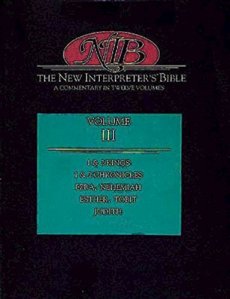
Seow, Choon-Leong. “The Books of 1 and 2 Kings.” In New Interpreter’s Bible III: 1-295.12 Vols. Nashville: Abingdon Press. 1999.

The NIB (New Interpreter’s Bible) is a solid resource as a resource for preaching and teaching that covers the entire bible and goes into some textual issues, but it primarily is focused on giving a fuller context to the story. Choon-Leon Seow’s contribution on the 1 and 2 Kings goes into a little more depth on translational issues than some other portions of this commentary set I’ve utilized, and this was a positive since it identified some interesting things to explore in the Hebrew text. This was another solid portion of the NIB and it is a resource worth having on the shelf for a pastor.


1 Kings 22 The End of King Ahab

The Death of Ahab from Gustave Dore’s English Bible (1866)

1 Kings 22: 1-28 King Ahab and King Jehoshaphat Prepare for War with Aram

1 For three years Aram and Israel continued without war. 2 But in the third year King Jehoshaphat of Judah came down to the king of Israel. 3 The king of Israel said to his servants, “Do you know that Ramoth-gilead belongs to us, yet we are doing nothing to take it out of the hand of the king of Aram?” 4 He said to Jehoshaphat, “Will you go with me to battle at Ramoth-gilead?” Jehoshaphat replied to the king of Israel, “I am as you are; my people are your people, my horses are your horses.”

5 But Jehoshaphat also said to the king of Israel, “Inquire first for the word of the LORD.” 6 Then the king of Israel gathered the prophets together, about four hundred of them, and said to them, “Shall I go to battle against Ramoth-gilead, or shall I refrain?” They said, “Go up; for the LORD will give it into the hand of the king.” 7 But Jehoshaphat said, “Is there no other prophet of the LORD here of whom we may inquire?” 8 The king of Israel said to Jehoshaphat, “There is still one other by whom we may inquire of the LORD, Micaiah son of Imlah; but I hate him, for he never prophesies anything favorable about me, but only disaster.” Jehoshaphat said, “Let the king not say such a thing.” 9 Then the king of Israel summoned an officer and said, “Bring quickly Micaiah son of Imlah.” 10 Now the king of Israel and King Jehoshaphat of Judah were sitting on their thrones, arrayed in their robes, at the threshing floor at the entrance of the gate of Samaria; and all the prophets were prophesying before them. 11 Zedekiah son of Chenaanah made for himself horns of iron, and he said, “Thus says the LORD: With these you shall gore the Arameans until they are destroyed.” 12 All the prophets were prophesying the same and saying, “Go up to Ramoth-gilead and triumph; the LORD will give it into the hand of the king.”

13 The messenger who had gone to summon Micaiah said to him, “Look, the words of the prophets with one accord are favorable to the king; let your word be like the word of one of them, and speak favorably.” 14 But Micaiah said, “As the LORD lives, whatever the LORD says to me, that I will speak.”

15 When he had come to the king, the king said to him, “Micaiah, shall we go to Ramoth-gilead to battle, or shall we refrain?” He answered him, “Go up and triumph; the LORD will give it into the hand of the king.” 16 But the king said to him, “How many times must I make you swear to tell me nothing but the truth in the name of the LORD?” 17 Then Micaiah said, “I saw all Israel scattered on the mountains, like sheep that have no shepherd; and the LORD said, ‘These have no master; let each one go home in peace.'” 18 The king of Israel said to Jehoshaphat, “Did I not tell you that he would not prophesy anything favorable about me, but only disaster?”

19 Then Micaiah said, “Therefore hear the word of the LORD: I saw the LORD sitting on his throne, with all the host of heaven standing beside him to the right and to the left of him. 20 And the LORD said, ‘Who will entice Ahab, so that he may go up and fall at Ramoth-gilead?’ Then one said one thing, and another said another, 21 until a spirit came forward and stood before the LORD, saying, ‘I will entice him.’ 22 ‘How?’ the LORD asked him. He replied, ‘I will go out and be a lying spirit in the mouth of all his prophets.’ Then the LORD said, ‘You are to entice him, and you shall succeed; go out and do it.’ 23 So you see, the LORD has put a lying spirit in the mouth of all these your prophets; the LORD has decreed disaster for you.”

24 Then Zedekiah son of Chenaanah came up to Micaiah, slapped him on the cheek, and said, “Which way did the spirit of the LORD pass from me to speak to you?” 25 Micaiah replied, “You will find out on that day when you go in to hide in an inner chamber.” 26 The king of Israel then ordered, “Take Micaiah, and return him to Amon the governor of the city and to Joash the king’s son, 27 and say, ‘Thus says the king: Put this fellow in prison, and feed him on reduced rations of bread and water until I come in peace.'” 28 Micaiah said, “If you return in peace, the LORD has not spoken by me.” And he said, “Hear, you peoples, all of you!”

King Ahab has occupied a significant place in the narrative of 1 Kings since his introduction in 1 Kings 16:29. Ahab as portrayed in 1 Kings serves Baal when it served his interest, strengthening the alliances with Tyre and Sidon and his marriage with Jezebel, has served the LORD when it was beneficial. His reign has seen both remarkable prosperity and crippling drought, miraculous military victories, and continual prophetic condemnation. Ahab seems to have modeled his reign after Solomon. Like Solomon he is led astray to worship other gods by his Phoenician wife. Elijah, other unnamed prophets, members of the sons of prophets, and finally Micaiah will be God’s messengers to this king who reigns over Israel for twenty-two years. In the eyes of many of Ahab’s contemporaries he was a successful king who acquired wealth, military power, land, and who benefited from trade. In the eyes of the narrator of 1 Kings:

Indeed, there was no one like Ahab, who sold himself to do what was evil in the sight of the LORD, urged on by his wife Jezebel. He acted most abominably in going after idols, as the Amorites had done, whom the LORD drove out before the Israelites. 1 Kings 21: 25-26

No amount of worldly success can mask the pestilence of idolatry and the ways in which the reign of Ahab adopts the practices of the surrounding nations instead of the covenant of God. Now after twenty-two years in power the LORD has decided to entice Ahab into a battle where will fall.

Three years[1]after the LORD delivered a crushing defeat to King Ben-hadad of Aram and King Ahab’s negotiation of a treaty with the humiliated Ben-hadad (see 1 Kings 20) the situations are reversed. Now King Ahab feels like he has the military might to be the aggressor and claim the land that was supposed to be returned in the treaty. The longstanding conflict between Judah and Israel has been settled and now King Jehoshaphat of Judah is called upon to be an ally in the coalition to retake Ramoth-gilead. King Ahab has been successful against the emergent Assyrian force to the north and now seems to be in a position of power to reclaim land that was once a part of the territory of Israel. The text suggests an unequal alliance between Jehoshaphat and Ahab, where Jehoshaphat is subservient to Ahab. It is likely that Israel is the stronger power, and that Jehoshaphat has negotiated peace with his northern neighbor at least initially by military alliance where the men and horses of Judah will fight under the King of Israel. Even after the negative prophecy by Micaiah, Jehoshaphat will not pull out of the fight.

The role of the prophet has increased throughout the narrative of 1 Kings. Prophets existed prior to 1 Kings in Hebrew society, the most well-known example is Nathan who confronts David, but in Northern Israel after separation from the temple in Jerusalem prophets are central to the story. There are probably several factors for this including the loss of access to the temple in Jerusalem where priests performed many of the ‘divination’ functions of discerning God’s will that now prophets will fill. Prophets also are portrayed as a part of the surrounding culture and throughout the narrative of 1 Kings there are prophets of Baal and Asherah and the rise of the prophetic may evolve out of the experience of the surrounding cultures having people who have the role of speaking on behalf of their gods. Finally, the narrative of Israel after the separation from Judah is one where the priestly functions have been taken over by non-Levite members appointed by the kings who have introduced the use of images like the golden calves of Jeroboam (1 Kings 12: 25-33) or directed towards other gods like Baal or Asherah. The rise of the prophetic role (both for the LORD and other gods) may explain why for the first-time prophets are asked to discern God’s will before going to battle instead of priests. Previously the priests would use the Urim and Thummim (part of the priestly breastplate built for Aaron) to discern God’s will. (Numbers 27:20, 1 Samuel 30:7-8)

The four hundred prophets of Ahab echo the four hundred prophets of Asherah which were mentioned in 1 Kings 18:19. The NRSV’s translation of this passage seems to indicate that Ahab’s prophets are all ‘prophets of the LORD’ but there are several variations of this text in Hebrew and the affiliation of these prophets with the LORD the God of Israel is often ambivalent in these texts. For example, the interpreters of the NIV show the ambivalence of the text in several choices. King Jehoshaphat asks for an inquiry for guidance from the LORD the God of Israel whom he faithfully follows. When these four hundred prophets answer the NRSV goes with the translation of the name of the God of Israel (YHWH) which is indicated by the capitalized LORD.[2] Yet the NIV in contrast goes with some of the best manuscripts which render Adonai here instead and thus translates it as Lord, which may not refer to the God of Israel. The NIV also follows the Septuagint and Vulgate[3] by translating Jehoshaphat’s response to Ahab as, “Is there not a prophet of the LORD here whom we can inquire of?” Choon-Leong Seow in the NIB translates the Hebrew literally as, “Is there not here a prophet of the LORD anymore of whom we may inquire?” (NIB III:162) At best the linkage of Ahab’s four hundred prophets with the God of Israel is ambiguous. Even if they are linked to the God of Israel they clearly are aligned with the royal desires of the king and are intent on promoting Ahab’s expansionist policies. To appease Jehoshaphat the prophet Micaiah is sent for who is unambiguously a prophet of the LORD.

Micaiah is instructed when he is summoned to align his words with the prophets already assembled outside of Samaria. Micaiah declares that he will only declare what the LORD the God of Israel shares for him to speak. When Micaiah responds initially to the king to, “Go up and triumph” we are unable to read his mannerisms or tone into the text, but whether it is the positive words or some combination of mannerism and tone it is immediately apparent to King Ahab that he is being mocked. King Ahab in making Micaiah swear to tell the truth by the LORD seems to indicate he is aware that is prophets are not speaking truthfully by divine inspiration. Micaiah’s later reference to Israel being scattered on the mountains is a reference to Ramoth-gilead which is literally ‘the height of Gilead.” The shepherd is a common symbol for the king in Israel, and the reference to sheep without a shepherd is a people without a king or leader.

Micaiah’s vision of a heavenly council debating how to entice[4] Ahab to go to battle at Ramoth-gilead to cause his death indicates the point of the narrative from the divine perspective. The conflict as Ramoth-gilead is a place where the God of Israel is using the conflict between nations to eliminate King Ahab after twenty-two years of leading the people astray. This is a strange story for modern readers who often question the morality of God working through a lying or deceitful spirit[5], but the text is not concerned with morality. As Brueggemann states:

The text does not argue for morality. Rather it argues for willful inscrutability that operates in, with, and under human events in order to curb and finally overthrow excessive human ambition. (Brueggemann, 2000, p. 280)

A spirit in the council argues for a plan to entice Ahab by placing a lying spirit in the words of his prophets, and the LORD declares that this enticement will succeed because Ahab will be hearing what he wants to hear. The truthful message of Micaiah is an uncomfortable truth in the midst of pleasant royal propaganda which is forcefully and graphically articulated by the four hundred prophets of Ahab.

Zedekiah son of Chenaanah has graphically illustrated the message of victory over Aram by placing iron horns on his head and declaring that Israel with gore the Arameans. This imagery of a bull being linked with the northern kingdom goes back to the blessing of Moses in Deuteronomy:

A firstborn bull—majesty is his! His horns are the horns of a wild ox; with them he gores people, driving them to the ends of the earth; such are the myriads of Ephraim, such the thousands of Manasseh. Deuteronomy 33: 17

The association of the image of the bull with Ephraim and Manasseh (the largest tribes of the north) is probably one of the major reasons for the image of the golden calves that Jeroboam uses in 1 Kings 12: 25-33. Yet, the image of the bull is also associated with the golden calf made during the Exodus. (Exodus 32) The prophetic theater between Zedekiah and Micaiah is similar to the conflict between Jeremiah and Hananiah in Jeremiah 27-28. There are two conflicting voices declaring that they are the faithful messengers of the divine will. Zedekiah’s slap of Micaiah is likely a backhanded strike which is gesture meant to humiliate. Like Jeremiah, Micaiah is imprisoned for speaking the unpopular truth and placed in the hands of Joash the ‘king’s son.’[6]

The narrative with its prophetic theater, alliances between kings is all setting the stage for the conflict at Ramoth-gilead where Ahab will be killed. The king has chosen to listen to the lying spirits sent to entice him into the conflict. From the point of view of 1 Kings the primary mover in this scene is the God of Israel who is working in, with, and under the workings of Israel, Judah, and Aram. Ahab and Jehoshaphat seem to know that the words of the four hundred prophets are not true, but they go into battle anyways. Jehoshaphat may not be in a position where he can back out of the conflict without endangering his peace with Israel, but the political consideration of the kings is far less important to the narrative of 1 Kings. What matters in the movement of the LORD of Israel to bring about the death of Ahab.

1 Kings 22: 29-40 The Disastrous Conflict with Aram and the Death of Ahab

29 So the king of Israel and King Jehoshaphat of Judah went up to Ramoth-gilead. 30 The king of Israel said to Jehoshaphat, “I will disguise myself and go into battle, but you wear your robes.” So the king of Israel disguised himself and went into battle. 31 Now the king of Aram had commanded the thirty-two captains of his chariots, “Fight with no one small or great, but only with the king of Israel.” 32 When the captains of the chariots saw Jehoshaphat, they said, “It is surely the king of Israel.” So they turned to fight against him; and Jehoshaphat cried out. 33 When the captains of the chariots saw that it was not the king of Israel, they turned back from pursuing him. 34 But a certain man drew his bow and unknowingly struck the king of Israel between the scale armor and the breastplate; so he said to the driver of his chariot, “Turn around, and carry me out of the battle, for I am wounded.” 35 The battle grew hot that day, and the king was propped up in his chariot facing the Arameans, until at evening he died; the blood from the wound had flowed into the bottom of the chariot. 36 Then about sunset a shout went through the army, “Every man to his city, and every man to his country!”

37 So the king died, and was brought to Samaria; they buried the king in Samaria. 38 They washed the chariot by the pool of Samaria; the dogs licked up his blood, and the prostitutes washed themselves in it, according to the word of the LORD that he had spoken. 39 Now the rest of the acts of Ahab, and all that he did, and the ivory house that he built, and all the cities that he built, are they not written in the Book of the Annals of the Kings of Israel? 40 So Ahab slept with his ancestors; and his son Ahaziah succeeded him.

From the perspective of the narrator of 1 Kings the physical battle’s result has already been determined by the LORD. Ahab will die, the coalition of forces to recapture Ramoth-gilead will collapse and the people will return like sheep without a shepherd. Ahab seems aware of the danger to himself when he disguises himself as a common soldier while telling Jehoshaphat to fight wearing his royal robes. The king of Aram has also declared that King Ahab of Israel is the primary target of his chariot corps. Yet, the scheming of all these kings will be undone by an accidental shot.

The dynamic of Ahab being the primary leader of the army and Jehoshaphat being the subordinate is indicated both by Ahab using Jehoshaphat as a decoy by having him dressed in royal robes while Ahab is disguised as a common soldier, and by the army remaining engaged in the conflict once the chariots of Ben-hadad pursue Jehoshaphat. It is unclear how exactly the chariots of Aram determine that King Jehoshaphat is not their intended target, whether his exclamation is something that indicates he from Judah rather than Israel or whether they get close and identify by sight, but Jehoshaphat’s life is delivered by this realization. From the perspective of 1 Kings the important decision is the divine decision which has determined that Jehoshaphat shall live, and Ahab shall die.

An unknown soldier’s arrow finds the weak point in King Ahab’s armor and wounds him. The soldier ‘innocently’ or ‘unknowingly’ strikes the king of Israel, and it is possible this could be a friendly fire incident where he is wounded by one of his soldiers.[7]Although Ahab orders his driver to take him out of the fighting, the king does not receive the medical attention the wound requires. Perhaps to maintain the momentum of the battle he tries to continue to direct the conflict, but by nightfall blood loss, heat, and exertion have exhausted his strength and he dies. Without the leadership of King Ahab the forces of Israel and Judah disperse and return to their homes.

King Ahab’s reign ends with his blood pooling in a chariot only to be washed in the pool of Samaria where the dogs will drink his blood and prostitutes wash themselves in it. There is some tension between this description and the prophecy of Elijah in 1 Kings 21: 19-24 and the text does not attempt to fully harmonize between the words of Elijah and the testimony of Ahab’s death. Instead, it is content to report the return of the dead king who is buried as a king of Israel, but still who is dishonored by dogs drinking his blood as it is washed away of people (including prostitutes) bathing in the waters which have his royal blood in them.

King Ahab’s reign may be prosperous for Israel’s military and financial might, but it also leads the people further from the ways of the God of Israel. He is able to develop Israel into a military power in the region and through trade to build up Samaria and several other cities into walled cities with significant buildings. The house of ivory is likely an ostentatious structure, perhaps with panels and appointments of ivory (Cogan, 2001, p. 495) where ivory is one of the many signs of wealth in the ancient world. Ultimately the Book of the Annals of the Kings of Israel would probably paint a prosperous picture of the reign of Ahab, but 1 Kings views Ahab as a king who was repeatedly confronted by the prophets and demonstrations of the power of the LORD and chose to continually attempt to find his path to self-reliance through his military might, trading partnerships, and diplomatic maneuvering. Regardless of the prosperity Israel may find under Ahab, the narrator of 1 Kings views his reign as a time that brings evil to the land.

1 Kings 22: 41-50 The Faithful Reign of King Jehoshaphat of Judah

41 Jehoshaphat son of Asa began to reign over Judah in the fourth year of King Ahab of Israel. 42 Jehoshaphat was thirty-five years old when he began to reign, and he reigned twenty-five years in Jerusalem. His mother’s name was Azubah daughter of Shilhi. 43 He walked in all the way of his father Asa; he did not turn aside from it, doing what was right in the sight of the LORD; yet the high places were not taken away, and the people still sacrificed and offered incense on the high places. 44 Jehoshaphat also made peace with the king of Israel.

45 Now the rest of the acts of Jehoshaphat, and his power that he showed, and how he waged war, are they not written in the Book of the Annals of the Kings of Judah? 46 The remnant of the male temple prostitutes who were still in the land in the days of his father Asa, he exterminated.

47 There was no king in Edom; a deputy was king. 48 Jehoshaphat made ships of the Tarshish type to go to Ophir for gold; but they did not go, for the ships were wrecked at Ezion-geber. 49 Then Ahaziah son of Ahab said to Jehoshaphat, “Let my servants go with your servants in the ships,” but Jehoshaphat was not willing. 50 Jehoshaphat slept with his ancestors and was buried with his ancestors in the city of his father David; his son Jehoram succeeded him.

Jehoshaphat was introduced in the conflict at Ramoth-gilead, but now we are finally introduced to him in the typical format of 1 Kings. Since the split of Israel and Judah, the majority of the attention of 1 Kings has been focused on Israel, and the trend continues as the report of the positively evaluated reign of Jehoshaphat is dwarfed by the reports of the shorter reigns of Ahab and Ahaziah. Although the books of 1 and 2 Kings are named for the procession of kings, the interest of the narrator is drawn to the prophets who are mainly active in Israel instead of Judah at this point. As Israel continue to know instability, even while it may be militarily and financially prosperous, Judah will know sixty-six combined years of good Davidic rulers (as evaluated by 1 Kings) under Asa and his son Jehoshaphat.

Jehoshaphat continues his father’s religious reforms and does eliminate the cultic prostitutes[8] and his reign is viewed (from the perspective of 1 Kings) as a faithful one. His major achievement is ending the long-standing war with Israel. This may be viewed ambivalently by the text since there are multiple times where his alliance with Israel leads to disaster. We will learn that a part of this alliance is marrying his son Jehoram to the daughter (or granddaughter) of Ahab and Jezebel which will later lead to disaster in 2 Kings. Judah is able to reign over Edom as well and the possession of Ezion-geber leads Judah to create a trading fleet to reconnect with Solomon’s trade for the gold of Ophir. We do not know why Jehoshaphat rejected the offer of King Ahaziah to send his people with the ships of Judah, but Ahaziah’s trading expertise was probably significantly greater due to their linkage with Tyre and Sidon. Jehoshaphat attempts to bring the prosperity of Solomon back to Israel but despite the loss of ships, and the frustrating defeats when he partners with Israel his long and faithful reign is summarized by only nine verses in the text.

1 Kings 22: 51-53 The Brief Reign of King Ahaziah of Israel

51 Ahaziah son of Ahab began to reign over Israel in Samaria in the seventeenth year of King Jehoshaphat of Judah; he reigned two years over Israel. 52 He did what was evil in the sight of the LORD, and walked in the way of his father and mother, and in the way of Jeroboam son of Nebat, who caused Israel to sin. 53 He served Baal and worshiped him; he provoked the LORD, the God of Israel, to anger, just as his father had done.

1 Kings ends in an awkward place with the brief notation on the beginning of the brief reign of Ahaziah. 2 Kings will begin with Elijah denouncing Ahaziah as he continues to oppose God’s ways in Israel. The kings of Israel may be the primary markers of time, but the primary markers of meaning are the prophets. Elijah has been absent from the scene at various moments in Ahab’s reign, but he will return for one final condemnation as Ahaziah seeks the intercession of Baal-zebub instead of the LORD of Israel. But for now, I am ending this journey through the books of Kings at the ending of 1 Kings. The canonical division of the story is at an odd place since it pauses in the midst of the reign of Ahaziah. Although this is the pause in the middle of a story, it is also the completion of a journey through 1 Kings. I will be taking a break from the narrative of the history of Israel for a time but will likely return to complete the second half of the book of Kings in the future.

[1] Three is a ‘typological number’ indicating a short period of time in Hebrew so the conflict may not be literally three years after the defeat of Ben-hadad in 1 Kings 20. Historical scholars who have tried to fix a date for this based on Ahab’s participation with Aram in the conflict against Shalmaneser III at Qarqar have said that if Ahab is the king it would take place in 852 BCE.

[2] Throughout the Hebrew Scriptures the divine name YHWH is always marked with vowels to indicate the reader is to say Adonai instead of uttering the name of God (the commandment of honoring God’s name is behind this practice), but the consonants are left to indicate the name of God. This is reflected in English translations by the word LORD written in all capital letters. When the consonants for the word Adonai is present in Hebrew it is written Lord with the only the first letter capitalized when appropriate.

[3] The Septuagint is the Greek translation of the Hebrew Scriptures, and the Vulgate is the Latin translation which are both ancient translations of the text. Mordechai Cogan notes this (Cogan, 2001, p. 490)

[4] Hebrew patah throughout this passage.

[5] Reference to a deceitful spirit seems to come from the LORD are rare but they are present in scripture. See for example Ezekiel 14:9 and 2 Thessalonians 2:11

[6] The title ‘king’s son’ may refer to a person who is literally an offspring of the king but may also refer to various court officials and servants loyal to the king. (Cogan, 2001, pp. 492-493)

[7] Even with disciplined professional soldiers, friendly fire occurs in the chaos of combat. Much of the armies of Israel, Judah, and Aram would not be professional soldiers. Whether this is a ‘lucky shot’ by an Aramean or an ‘unlucky shot’ from the army of King Ahab is ultimately irrelevant because this innocent shot accomplishes the divine will.

[8] There is some controversy over the translation of the Hebrew qedesim as male prostitutes. It is unclear exactly what role these individuals had and whether it was sexual in nature, but it is definitely viewed in the text as a sign of idolatry. I am following Choon-Leong Seow’s recommendation of translating this as cultic prostitutes which may not be exclusively male. (NIB III: 168)

1 Kings 21 Naboth’s Vineyard

1 Kings 21: 1-16 Two Competing Worldviews: Naboth and Ahab/Jezebel

1 Later the following events took place: Naboth the Jezreelite had a vineyard in Jezreel, beside the palace of King Ahab of Samaria. 2 And Ahab said to Naboth, “Give me your vineyard, so that I may have it for a vegetable garden, because it is near my house; I will give you a better vineyard for it; or, if it seems good to you, I will give you its value in money.” 3 But Naboth said to Ahab, “The LORD forbid that I should give you my ancestral inheritance.” 4 Ahab went home resentful and sullen because of what Naboth the Jezreelite had said to him; for he had said, “I will not give you my ancestral inheritance.” He lay down on his bed, turned away his face, and would not eat.

5 His wife Jezebel came to him and said, “Why are you so depressed that you will not eat?” 6 He said to her, “Because I spoke to Naboth the Jezreelite and said to him, ‘Give me your vineyard for money; or else, if you prefer, I will give you another vineyard for it’; but he answered, ‘I will not give you my vineyard.'” 7 His wife Jezebel said to him, “Do you now govern Israel? Get up, eat some food, and be cheerful; I will give you the vineyard of Naboth the Jezreelite.”

8 So she wrote letters in Ahab’s name and sealed them with his seal; she sent the letters to the elders and the nobles who lived with Naboth in his city. 9 She wrote in the letters, “Proclaim a fast, and seat Naboth at the head of the assembly; 10 seat two scoundrels opposite him, and have them bring a charge against him, saying, ‘You have cursed God and the king.’ Then take him out, and stone him to death.” 11 The men of his city, the elders and the nobles who lived in his city, did as Jezebel had sent word to them. Just as it was written in the letters that she had sent to them, 12 they proclaimed a fast and seated Naboth at the head of the assembly. 13 The two scoundrels came in and sat opposite him; and the scoundrels brought a charge against Naboth, in the presence of the people, saying, “Naboth cursed God and the king.” So they took him outside the city, and stoned him to death. 14 Then they sent to Jezebel, saying, “Naboth has been stoned; he is dead.”

15 As soon as Jezebel heard that Naboth had been stoned and was dead, Jezebel said to Ahab, “Go, take possession of the vineyard of Naboth the Jezreelite, which he refused to give you for money; for Naboth is not alive, but dead.” 16 As soon as Ahab heard that Naboth was dead, Ahab set out to go down to the vineyard of Naboth the Jezreelite, to take possession of it.

The story of competing worldviews about land has occurred many times throughout history. As white settlers moved across the United States they understood land ownership as something that could be bought legally while the Native Americans understood their relationship with the land very differently, they were tied to the land. Similarly in this story the understanding of land as inheritance comes into conflict with the view of land as commodity. Modern readers live in a commodity-based understanding of land, and yet the covenant that Israel was to live under was always an alternative to this worldview.

The story of Naboth and Ahab takes place in Jezreel, a town in the tribal holding of Issachar roughly nine miles east of Megiddo. (Cogan, 2001, p. 477) It is unclear whether the Omri family (which king Ahab is a member of) had land in Jezreel prior to becoming a royal family or if this is land acquired after their dynasty began, but there is some royal compound here that Ahab hopes to expand. The lower elevation in comparison to Samaria has led some to label this as a ‘winter palace’ which would be warmer in the winter season (NIB III: p. 155) but Jezreel has already figured prominently in the story as the location where King Ahab returned to after Elijah’s duel with the prophets of Baal.

The last of the Ten Commandments addresses coveting that which belongs to the neighbor, and here the importance of this commandment becomes demonstrated through the injustice of the story. Ahab desires the vineyard of Naboth to be converted into a vegetable garden for his own possession. From a commodity-based perspective he offers a fair exchange for the value of the vineyard either in money or in property. The key feature of the vineyard is its proximity to the property that Ahab already owns; he will be joining his neighbor’s property to his own. It is possible that Ahab’s indication that it will be a ‘vegetable garden’[1] may be a subtle way to suggest the land is less value since the only other time this word is used in the Hebrew Scriptures is Deuteronomy 11: 10 which contrasts the bountiful promised land with the ‘vegetable gardens’ which require irrigation in Egypt to be productive. Regardless of appraised value Ahab’s desire to obtain the vineyard is frustrated by Naboth’s adherence to the view that the land is an inheritance which cannot be sold.

Within the law of Israel there is a deep understanding of the land as a gift from God that cannot be sold. Leviticus 25: 23-24 for example states:

The land shall not be sold in perpetuity, for the land is mine; with me you are but aliens and tenants. Throughout the land that you hold, you shall provide for the redemption of the land.

Leviticus 25 outlines the expectation for families to redeem the land of their kin who have fallen into a position where they sell a piece of property. Even if the land is sold it is to revert back to the original family in Jubilee years. This concept of redeeming land underlies the actions of Boaz in the book of Ruth. The prophets often protest against the wealthy who acquire the inheritance of their neighbors and who, in the words of Isaiah: “Ah, you who join house to house, who add field to field, until there is room for no one but you, and you are left alone in the midst of the land.” (Isaiah 5: 8, see also Micah 2:2) Naboth stands in the tradition of the law of Israel when he proclaims that to sell his land would be a profanation of the LORD because it would be viewing the land as his possession to dispose of rather than the land that God has provided for him to work. Yet, Solomon viewed the land as a possession which could be sold off to King Hiram to pay his debts (1 Kings 9:11-13) and the kings of the Omri dynasty parallel many of the actions of Solomon which model their wisdom off the wisdom of the nations which is based on trade and accumulation rather than trusting the provision of the LORD.

Jezebel, who learned the Phoenician values of her family and nation, views the lands as a commodity which can be acquired and royal power as an implement to be used to take what the king desires. The narrative does not include Ahab explaining the rationale for Naboth’s rejection to Jezebel, he merely relates his refusal. Jezebel acts on the king’s behalf, telling him to get up[2] eat and be cheerful as she gifts him the desire of his heart. Whether Ahab is involved in Jezebel’s action of coordinating the fall of Naboth is unclear, but she is acting in Ahab’s name and utilizes his seal to give weight to her letters. Writing letters is a way in which nobles have distanced themselves from being the instrument of death but it is clear that Jezebel and Ahab are behind the death of Naboth. Similar to David sending a letter to his general Joab with instructions that lead to Uriah’s death, Jezebel’s instructions to place two belial[3] men opposite Naboth at the fast and to accuse him cursing God and the king. Exodus 22:28 declares that one is not to revile God or curse a leader of the people, yet the death penalty in the law seems to be reserved for someone who blasphemes the name of God. (Leviticus 24: 16) It does take two witnesses to testify against another, thus the need for two ‘scoundrels’, but the plan involves the knowing consent of the elders and nobles to put the ‘scoundrels’ in place and being complicit in the accusations that these men make at the instructions of Jezebel in the name of Ahab. It takes many accomplices for the innocent man to be declared guilty and stoned outside of town and possibly left unburied.[4]

Ahab’s coveting of Naboth’s vineyard has led to these two ‘scoundrels’ bearing false witness while the elders and nobles maintain a conspiracy by their silence which allowed for the unjust murder of an innocent man. The death of an innocent in the land contaminates the land. Just as the blood of Abel cried out from the ground, the blood of Naboth cries of to God. This is why there is a method of making atonement for an unsolvable death (Deuteronomy 21: 1-9) so that innocent blood may not continue to testify against the people. Now the innocent blood of Naboth speaks against the entire conspiracy of the rulers that have schemed to join field to field and who have disregarded the ways of the God of Israel.

The land is not for Ahab to take, just as the booty from the LORD’s victory was not Ahab’s to spare. (NIB III: 156) Ahab and Jezebel chafe at the way the Israelite way of viewing land which constrains their power to acquire what they desire. Ahab is told to “go”[5] and take possession, which Ahab does. Ahab, Jezebel, and the elders and nobles may feel that their actions have no consequences, but the LORD is ready to respond to the protest of the innocent blood of Naboth which cries out from the land. Desiring has led to death and death is answered by the proclamation of God’s prophet.

1 Kings 21: 17-29 Elijah Confronts Ahab and Ahab’s Repentance

17 Then the word of the LORD came to Elijah the Tishbite, saying: 18 Go down to meet King Ahab of Israel, who rules in Samaria; he is now in the vineyard of Naboth, where he has gone to take possession. 19 You shall say to him, “Thus says the LORD: Have you killed, and also taken possession?” You shall say to him, “Thus says the LORD: In the place where dogs licked up the blood of Naboth, dogs will also lick up your blood.”

20 Ahab said to Elijah, “Have you found me, O my enemy?” He answered, “I have found you. Because you have sold yourself to do what is evil in the sight of the LORD, 21 I will bring disaster on you; I will consume you, and will cut off from Ahab every male, bond or free, in Israel; 22 and I will make your house like the house of Jeroboam son of Nebat, and like the house of Baasha son of Ahijah, because you have provoked me to anger and have caused Israel to sin. 23 Also concerning Jezebel the LORD said, ‘The dogs shall eat Jezebel within the bounds of Jezreel.’ 24 Anyone belonging to Ahab who dies in the city the dogs shall eat; and anyone of his who dies in the open country the birds of the air shall eat.”

25 (Indeed, there was no one like Ahab, who sold himself to do what was evil in the sight of the LORD, urged on by his wife Jezebel. 26 He acted most abominably in going after idols, as the Amorites had done, whom the LORD drove out before the Israelites.)

27 When Ahab heard those words, he tore his clothes and put sackcloth over his bare flesh; he fasted, lay in the sackcloth, and went about dejectedly. 28 Then the word of the LORD came to Elijah the Tishbite: 29 “Have you seen how Ahab has humbled himself before me? Because he has humbled himself before me, I will not bring the disaster in his days; but in his son’s days I will bring the disaster on his house.”

Elijah emerges on the scene once more to carry the condemnation of the LORD to Ahab. Elijah becomes the LORD’s voice to advocate for Naboth. Naboth’s condemnation is similar to the condemnation that David receives when he manipulates the battlefield by letters to cause Uriah’s death and takes ‘possession’ of Bathsheba as his wife. (2 Samuel 12:9) The short declaration to Elijah is essentially blood will pay for blood, the blook of the king for the blood of the innocent Naboth. One may attempt to defend the distance that Ahab introduces into the situation since Jezebel wrote the letters and the elders and nobles put the ‘scoundrels’ in place and carried out the sentence on Naboth, but in God’s view the king is ultimately responsible. His actions and his allowing Jezebel to use his name and seal are leading the elders and the nation astray.

Elijah is viewed by Ahab as his enemy, and Elijah’s role throughout his ministry has been to confront Ahab when he has turned away from the ways of the LORD. His actions are evil, and they are modeling these evil ways for the people of Israel. The LORD is repaying ‘evil’ for ‘evil.’[6] Ahab will bear the same fate as his predecessors who deviated from the way of the LORD, and his punishment parallels the declarations against their houses. (1 Kings 14:11, 16: 4) Some believe that the declaration about Jezebel is a later addition which parallels the story of 2 Kings 9: 30-37. Regardless Elijah’s declaration to Ahab pierces his bluster, perhaps it is the parallels with what happened to his predecessors or the thought of his own life being the cost of ‘purchasing’ the field of Naboth. Jezebel tried to make her king cheerful, but now after the confrontation with Elijah he goes about dejectedly.

The text makes a side note to indicate that Ahab, from the point of view of 1 Kings, is the singular example of doing evil in the sight of the LORD. Yet, the LORD quickly responds with mercy towards Ahab when he fasts, puts on sackcloth, and shows signs of repentance. Like David, the LORD wants to forgive Ahab. The consequences are delayed until the next generation as Ahab is given yet another chance to amend his ways. Elijah has been sent multiple times to the king to get him to change his ways, and this seems to be the nature of God. God does not want to give up on these kings, but when the choose to follow the ways of acquisition and exploitation the God must answer the blood that testifies from the land. God’s forgiveness and God’s justice are always in tension, but it is the tension of a God of hesed (covenant faithfulness) and mercy.

[1] Hebrew gan yaraq

[2] Hebrew qum  (rise, get up, arise)

[3] This is the Hebrew word (beliya’al)that will eventually become one names for the devil or a demon (2 Corinthians 6:15). “It refers to an act that is sinful (Deuteronomy 15:9) and evil (1 Sam 30: 22; cf. Nah 1:11) that upsets “a basic behavioral norm…the violation of the relationship between the individual, community and God.” (Cogan, 2001, p. 479)

[4] Later in verse 19 the indication is that dogs lick up the blood of Naboth and the parallelism with the accusation in verse 24 indicate that Ahab’s curse is to be left unburied and consumed by dogs.

[5] Again, the Hebrew qum. The parallelism between the first time Jezebel tells Ahab to ‘arise’ and here when she again tells him to ‘arise’ is obscured by the NRSV using two words to translate this verb.

[6] The NRSV’s translation: I will bring ‘disaster’ obscures the parallelism in the text.

1 Kings 20 King Ahab and the Conflict with Aram

1 Kings 20: 1-21 The Conflict with King-Hadad of Aram Begins

1 King Ben-hadad of Aram gathered all his army together; thirty-two kings were with him, along with

Assyrian stela of Shalmaneser that reports battle of Qarqar By Yuber – from en wiki, Public Domain, https://commons.wikimedia.org/w/index.php?curid=869262

horses and chariots. He marched against Samaria, laid siege to it, and attacked it. 2 Then he sent messengers into the city to King Ahab of Israel, and said to him: “Thus says Ben-hadad: 3 Your silver and gold are mine; your fairest wives and children also are mine.” 4 The king of Israel answered, “As you say, my lord, O king, I am yours, and all that I have.” 5 The messengers came again and said: “Thus says Ben-hadad: I sent to you, saying, ‘Deliver to me your silver and gold, your wives and children’; 6 nevertheless I will send my servants to you tomorrow about this time, and they shall search your house and the houses of your servants, and lay hands on whatever pleases them, and take it away.”

7 Then the king of Israel called all the elders of the land, and said, “Look now! See how this man is seeking trouble; for he sent to me for my wives, my children, my silver, and my gold; and I did not refuse him.” 8 Then all the elders and all the people said to him, “Do not listen or consent.” 9 So he said to the messengers of Ben-hadad, “Tell my lord the king: All that you first demanded of your servant I will do; but this thing I cannot do.” The messengers left and brought him word again. 10 Ben-hadad sent to him and said, “The gods do so to me, and more also, if the dust of Samaria will provide a handful for each of the people who follow me.” 11 The king of Israel answered, “Tell him: One who puts on armor should not brag like one who takes it off.” 12 When Ben-hadad heard this message — now he had been drinking with the kings in the booths — he said to his men, “Take your positions!” And they took their positions against the city.

13 Then a certain prophet came up to King Ahab of Israel and said, “Thus says the LORD, Have you seen all this great multitude? Look, I will give it into your hand today; and you shall know that I am the LORD.” 14 Ahab said, “By whom?” He said, “Thus says the LORD, By the young men who serve the district governors.” Then he said, “Who shall begin the battle?” He answered, “You.” 15 Then he mustered the young men who serve the district governors, two hundred thirty-two; after them he mustered all the people of Israel, seven thousand.

16 They went out at noon, while Ben-hadad was drinking himself drunk in the booths, he and the thirty-two kings allied with him. 17 The young men who serve the district governors went out first. Ben-hadad had sent out scouts, and they reported to him, “Men have come out from Samaria.” 18 He said, “If they have come out for peace, take them alive; if they have come out for war, take them alive.”

19 But these had already come out of the city: the young men who serve the district governors, and the army that followed them. 20 Each killed his man; the Arameans fled and Israel pursued them, but King Ben-hadad of Aram escaped on a horse with the cavalry. 21 The king of Israel went out, attacked the horses and chariots, and defeated the Arameans with a great slaughter.

This story of conflict between King Ben-hadad of Aram and King Ahab of Israel has puzzled many readers of 1 Kings.  Several historical scholars have argued that this conflict between Aram and Israel may actually have occurred during the reign of King Jehohaz (2 Kings 13: 1-9) at least thirty-five years later when Ben-hadad continues his father King Hazael’s work of oppressing Israel. It is possible that a later story was brought forward to make a point about King Ahab, but it is also plausible that a Ben-hadad attempted to oppress Israel at different times (names were often repeated in families).[1] Perhaps even more perplexing than the historical question is the vastly different allegiances of King Ahab from the previous chapters where he was in conflict with Elijah. Baal and the prophets of Baal are absent, a lone prophet of God becomes a central advisor, and the king is well acquainted enough with the prophets of the LORD to recognize a member of the ‘sons of the prophets’ when they speak to him later. (Israel, 2013, p. 273) Also missing in action are Elijah and Elisha. The ‘sons of the prophets’ will feature heavily in the Elisha stories, and it is possible that Elijah is preparing Elisha to assume the mantle of his work. Yet, as a foreign oppressor comes and the LORD promises to demonstrate God’s power by handing over a vastly superior force into the hands of Ahab these key prophets are absent.

Despite all the perplexing elements for the narrative the central theological point is clear: the fate and security of Israel rests in the LORD’s hands and not in the hands of the king or his limited military. King Ahab is not going to deliver Samaria by his military might, his political acumen, or his leadership through the conflict. The victory is a demonstration of the sovereignty of the LORD the God of Israel and the proper response is obedience. Ahab will ultimately fail, like many previous leaders, in this final test of obedience and will trust in his own ability to negotiate a favorable peace rather than trusting in the LORD who provided the victory. In the eyes of 1 Kings this is a critical theological error.

King Ben-hadad of the Arameans gathers a large coalition of leaders and sends a large force of chariots and horsemen which besiege Samaria. His initial demand is received as a demand that King Ahab become a vassal king of this large well-equipped coalition,[2] paying tribute and surrendering captives to ensure his loyalty. King Ahab initially consents to this proposal seeing it as a way to avoid a larger conflict and his initial response declares his willingness to subjugate himself to King Ben-hadad, yet the second demand is a more arduous invasion of King Ahab’s sovereignty and the kingdom. Ben-hadad’s promise to send his servants to take whatever pleases them is viewed as a provocation because it strips Ahab of his power to protect the people and his household. Ahab and the elders refuse to consent and in the initial war of words Ben-hadad taunts that he will reduce Samaria to destruction so completely that his followers will not be able to gather a handful of dust from their remains. Ahab replies with a taunt that one who is just preparing to fight should not boast like a victor taking off his armor. The negotiations are over, King Ahab has failed to avoid conflict with a superior coalition and the siege begins in earnest as the Aramean forces take positions around Samaria.

An unnamed prophet enters the narrative. Unlike previous times when the prophets of the LORD were hunted by Jezebel and those loyal to her, now a prophet has access to the king. The prophet declares that the upcoming victory is another demonstration to Ahab of the power of the LORD. This improbably victory is not due to the skill of the vastly outnumbered forces that Ahab can command, but instead is a way for Ahab and the people to know ‘that I am the LORD.’  Knowing that the God of Israel is the LORD is to acknowledge the sovereignty of the LORD the God of Israel also means obedience to the LORD’s expectations. The prophet does not invoke that this falls under the rules of a ‘holy war’[3] but instead answers the king’s questions about how to initiate the battle and how the king is to lead. The identity of the two hundred thirty-two men who serve the district governors[4] is not clear from the context and has been a source of debate. It is unlikely that they are ‘professional soldiers’ as we think of people who are a part of a standing military, and they may be the personal protectors or enforcers for the regional leaders. Regardless of their identity they will be the first ones sent out, followed by the seven thousand Israelites that will engage the Arameans. The number seven thousand intentionally links the reader to the seven thousand who have not bent their knee to Baal who are the faithful remnant that the LORD identifies to Elijah. (1 Kings 19:18)

When the initial representatives of Israel emerge from the city an already drunk King Ben-hadad gives the order to capture them alive whether they are seeking peace or conflict. In the early stage of a siege the expectation is that there is not much that the leaders need to supervise so the drunken kings may not be as surprising as it would be for a modern leader to be drunk on the battlefield. From a military perspective the Israelites have the element of surprise, and the momentum of the battle quickly springs in their favor as they encounter an opponent who focused on a later clash rather than the emergence of an immediate threat. The leaders of the Aramean coalition are inhibited from leading their forces by their heavy drinking and Ahab’s forces take advantage of this surprised force. Yet, 1 Kings writes from a theological perspective and from that perspective the entire strategy, execution and victory is the work of the LORD and a demonstration of the LORD’s power over a superior military force.

1 Kings 20: 22-30a The Defeat of King-Hadad

22 Then the prophet approached the king of Israel and said to him, “Come, strengthen yourself, and consider well what you have to do; for in the spring the king of Aram will come up against you.”

23 The servants of the king of Aram said to him, “Their gods are gods of the hills, and so they were stronger than we; but let us fight against them in the plain, and surely we shall be stronger than they. 24 Also do this: remove the kings, each from his post, and put commanders in place of them; 25 and muster an army like the army that you have lost, horse for horse, and chariot for chariot; then we will fight against them in the plain, and surely we shall be stronger than they.” He heeded their voice, and did so.

26 In the spring Ben-hadad mustered the Arameans and went up to Aphek to fight against Israel. 27 After the Israelites had been mustered and provisioned, they went out to engage them; the people of Israel encamped opposite them like two little flocks of goats, while the Arameans filled the country. 28 A man of God approached and said to the king of Israel, “Thus says the LORD: Because the Arameans have said, ‘The LORD is a god of the hills but he is not a god of the valleys,’ therefore I will give all this great multitude into your hand, and you shall know that I am the LORD.” 29 They encamped opposite one another seven days. Then on the seventh day the battle began; the Israelites killed one hundred thousand Aramean foot soldiers in one day. 30 The rest fled into the city of Aphek; and the wall fell on twenty-seven thousand men that were left.

The surprising victory at Samaria buys some time for King Ahab, but the survival of King Ben-hadad means that in the spring the Arameans will return to continue the fight. Again, the unnamed prophet is the central advisor in the story giving King Ahab advice which follows. Yet, on the opposite side of the conflict Ben-hadad’s advisor also gave him advice to prepare for the next battle. Both sets of advisors are coming from different theological perspectives as they provide military guidance for their respective leaders.

The advisors of Ben-hadad follow pretty conventional military advice for the technology of the day couched in a theological proposition about the God of Israel. There is a distinct advantage for a military force which depended on chariots as a key maneuver element to fight on level ground. Military planners often look for ground that will enhance their technological advantage or reduce their disadvantages. The Arameans will be the ones who choose the next battlefield, and they choose Aphek. There are multiple places in the region named Aphek, but this is most likely the Transjordan site near the modern day Golan Heights.[5] (Cogan, 2001, p. 466) Yet, the theological rationale for encouraging King Ben-hadad to make these decisions is that they believe the gods of Israel is are ‘gods of the hills’ whose ability to influence the fight will be negated by moving the location of the conflict.[6]

A second man of God comes to the king of Israel with a promise that the LORD will deliver this force into the hands of Israel both to demonstrate to the Arameans the error in their thinking and to demonstrate once again to Ahab that ‘I am the LORD.’ Even though the Arameans fill the country, and the Israelites look like two little flocks of goats, Israel is not reliant upon its military might but the LORD’s deliverance. The seven days wait before the conflict echoes the six days of marching and the fall of Jericho on the seventh day.[7] Like Jericho the defeat for the Arameans is massive. The number of one hundred twenty-seven thousand dead seems impossibly large, but the theological effect is that this massive army is removed by God’s action on the battlefield and at the wall of Aphek. Although the battle is never declared a ‘holy war’ the parallels with Jericho begin to give the battle that feel which will prove crucial in Ahab’s decision in the aftermath of the LORD’s triumph.

1 Kings 20: 30b-43 King Ahab’s Political Choice and Theological Blunder

Ben-hadad also fled, and entered the city to hide. 31 His servants said to him, “Look, we have heard that the kings of the house of Israel are merciful kings; let us put sackcloth around our waists and ropes on our heads, and go out to the king of Israel; perhaps he will spare your life.” 32 So they tied sackcloth around their waists, put ropes on their heads, went to the king of Israel, and said, “Your servant Ben-hadad says, ‘Please let me live.'” And he said, “Is he still alive? He is my brother.” 33 Now the men were watching for an omen; they quickly took it up from him and said, “Yes, Ben-hadad is your brother.” Then he said, “Go and bring him.” So Ben-hadad came out to him; and he had him come up into the chariot. 34 Ben-hadad said to him, “I will restore the towns that my father took from your father; and you may establish bazaars for yourself in Damascus, as my father did in Samaria.” The king of Israel responded, “I will let you go on those terms.” So he made a treaty with him and let him go.

35 At the command of the LORD a certain member of a company of prophets said to another, “Strike me!” But the man refused to strike him. 36 Then he said to him, “Because you have not obeyed the voice of the LORD, as soon as you have left me, a lion will kill you.” And when he had left him, a lion met him and killed him. 37 Then he found another man and said, “Strike me!” So the man hit him, striking and wounding him. 38 Then the prophet departed, and waited for the king along the road, disguising himself with a bandage over his eyes. 39 As the king passed by, he cried to the king and said, “Your servant went out into the thick of the battle; then a soldier turned and brought a man to me, and said, ‘Guard this man; if he is missing, your life shall be given for his life, or else you shall pay a talent of silver.’ 40 While your servant was busy here and there, he was gone.” The king of Israel said to him, “So shall your judgment be; you yourself have decided it.” 41 Then he quickly took the bandage away from his eyes. The king of Israel recognized him as one of the prophets. 42 Then he said to him, “Thus says the LORD, ‘Because you have let the man go whom I had devoted to destruction, therefore your life shall be for his life, and your people for his people.'” 43 The king of Israel set out toward home, resentful and sullen, and came to Samaria.

Throughout the conflict agents of the LORD the God of Israel have informed King Ahab that by these victories that Ahab will know that “I am the LORD.” These surprising military events should demonstrate to Ahab that God is the only refuge and support that the king needs. Yet, when presented with an opportunity to negotiate the reclamation of territory and trading rights for Israel, Ahab chooses to rely upon his skills in making a treaty. Ahab makes a political choice and a theological blunder. In the end Ahab trusts in crafting a commonsense deal rather than a zealous adherence to trusting in God and the results are disastrous for his household and Israel.

Ben-hadad’s servants convince their king to allow them to attempt to negotiate for his life. When they declare that the kings of Israel are ‘merciful’ kings they reference a central theological word often related to God: The Hebrew word hesed. Hesed is a rich word which can be rendered covenant faithfulness, grace, or mercy. It is God’s hesed that Israel relies upon. Now Ahab is to be manipulated by this property of hesed. The servants come out in sackcloth and with ropes on their heads to indicate their subservience to the Israelites. This has echoes of the way the Gibeonites trick the Israelites into sparing them in Joshua 9. These servants who may have been the same ones that would have been sent to plunder the house of Ahab, now come to make a humble appeal for the life of their king. Even though Ahab was previously treated with disdain by Ben-hadad, he extends the courtesy of calling him ‘brother’ and this allows Ben-hadad and Aram to negotiate terms of peace. With territory restored and trading rights promised King Ahab makes the political choice to allow his enemy to live. Peace between Aram and Israel will only last for three years.

King Ahab may have several political reasons to negotiate with the king of Aram. The return of land and the ability to expand trade with a neighbor are powerful incentives on their own. Ahab is also aware of the emergence of the Assyrians which will pose a threat to both Israel and Aram and may be looking for a military alliance with Aram to bolster the nations security. (Israel, 2013, p. 282) There is also the possibility that ‘class solidarity’ may play a part in Ahab’s considerations. (Brueggemann, 2000, p. 250) It may be fine for thousands of soldiers to be slaughtered but kings may be seen as ‘brothers.’ Ahab and Ben-hadad make a covenant[8] and the battle has ended.

Yet, the messengers of the LORD have to relay God’s displeasure at Ahab’s covenant which spares the life of Ben-hadad. We see the ‘sons of the prophets’ (NRSV company of prophets) appear for the first time. The sons of the prophets will feature heavily in the Elisha cycle, but now we encounter an unnamed prophet who declares to another to strike him. The failure of the first man to strike this prophet results in his death in a similar manner to the prophet who disobeyed in 1 Kings 13:24. Once the second man strikes the prophet and wounds him he departs to wait for the king. He is disguised with a bandage over his eyes because he is apparently known by sight to the king and portrays himself as a wounded soldier from the battle.

The prophet tells the king a ‘juridical parable’ where the offender is caught in the trap thinking the narrative is about someone else and then finding it refers to them. The most famous example of this type of parable is when the prophet Nathan confronts King David after sleeping with Bathsheba and ordering Uriah’s death.[9] Here the disguised prophet portrays himself as responsible for a man’s life and allows him to disappear in the chaos of the battlefield. Aram allows the words of the narrative to condemn the prophet only to find himself the one who has release one he was responsible for. King Ben-hadad was to be ‘devoted to destruction’ which translates the Hebrew herem. Herem is the practice of war referred to for the people that the Israelites were to eliminate in Deuteronomy 20: 16-18 (see also Deuteronomy 7: 1-5, 25-26). The story bears striking similarities to King Saul sparing King Agag of the Amalekites (1 Samuel 15) which results in the LORD’s rejection of Saul-although in the battle with the Amalekites the prophet Samuel invokes this concept of herem where they are to be completely committed to destruction. Only at the end of the narrative do we hear that the King of Aram was ‘devoted to destruction’ but like Saul, Ahab’s life and lineage are now marked.

This is a difficult passage to wrestle with. The theological blunder of Ahab is clear: he trusted in his own ability to bring about a better settlement for Israel even in the demonstration of the LORD’s might. The LORD wanted Ahab to acknowledge his power, authority, and protection and to respond with obedience and trust.  Even if the number of deaths here are significantly inflated, one of the difficult challenges for any reader of scripture is reconciling the God of hesed with the God who calls for herem. How does one balance mercy with obedience, political realism with faithfulness. These are not easy questions. I’ve wrestled with Violence and the Bible in other places in these reflections. But the overarching message that I believe the narrator of 1 Kings wants us to understand is that we are to orient our trust to be in the LORD and the LORD’s provision and protection and not in our own ability to negotiate.

[1] The prefix ‘Ben’ in names means ‘Son of’. Ben-hadad is literally the son of Hadad, likewise the common name Benjamin means ‘son of my right hand.’

[2] Chariots and horses were still viewed as the central military advantage in warfare of this time period.

[3] Hebrew herem, see the discussion of below on 20: 30b-43.

[4] Hebrew naari sarei hamedinot. This term not used at other times to help provide contextual clues for these ‘young men.’

[5] The Golan Heights is still a contentious piece of land that both Israel and Syria claim. Israel captured most of this territory in 1967 and annexed it in 1981. Syria still claims that the land is theirs.

[6] Judges also makes note of the Israelites being unable to clear the Canaanites and Philistines from the planes because of their iron chariots. (Judges 1:19) See also Joshua 17:16-18.

[7] Joshua 6

[8] Hebrew b’rith another key theological concept in the Hebrew Scriptures often linked with hesed.

[9] 2 Samuel 12, see also 2 Samuel 14 for another example when the woman of Tekoa confronts King David.

1 Kings 19 Elijah Encounters the LORD at Mount Horeb and the Appointment of Elisha

Elijah in the Wilderness By Frederic Leighton (1877-78) – uQG9WGfbc10kDw at Google Cultural Institute maximum zoom level, Public Domain, https://commons.wikimedia.org/w/index.php?curid=21878932

1 Kings 19: 1-18

1 Ahab told Jezebel all that Elijah had done, and how he had killed all the prophets with the sword. 2 Then Jezebel sent a messenger to Elijah, saying, “So may the gods do to me, and more also, if I do not make your life like the life of one of them by this time tomorrow.” 3 Then he was afraid; he got up and fled for his life, and came to Beer-sheba, which belongs to Judah; he left his servant there.

4 But he himself went a day’s journey into the wilderness, and came and sat down under a solitary broom tree. He asked that he might die: “It is enough; now, O LORD, take away my life, for I am no better than my ancestors.” 5 Then he lay down under the broom tree and fell asleep. Suddenly an angel touched him and said to him, “Get up and eat.” 6 He looked, and there at his head was a cake baked on hot stones, and a jar of water. He ate and drank, and lay down again. 7 The angel of the LORD came a second time, touched him, and said, “Get up and eat, otherwise the journey will be too much for you.” 8 He got up, and ate and drank; then he went in the strength of that food forty days and forty nights to Horeb the mount of God. 9 At that place he came to a cave, and spent the night there.

Then the word of the LORD came to him, saying, “What are you doing here, Elijah?” 10 He answered, “I have been very zealous for the LORD, the God of hosts; for the Israelites have forsaken your covenant, thrown down your altars, and killed your prophets with the sword. I alone am left, and they are seeking my life, to take it away.”

11 He said, “Go out and stand on the mountain before the LORD, for the LORD is about to pass by.” Now there was a great wind, so strong that it was splitting mountains and breaking rocks in pieces before the LORD, but the LORD was not in the wind; and after the wind an earthquake, but the LORD was not in the earthquake; 12 and after the earthquake a fire, but the LORD was not in the fire; and after the fire a sound of sheer silence. 13 When Elijah heard it, he wrapped his face in his mantle and went out and stood at the entrance of the cave. Then there came a voice to him that said, “What are you doing here, Elijah?” 14 He answered, “I have been very zealous for the LORD, the God of hosts; for the Israelites have forsaken your covenant, thrown down your altars, and killed your prophets with the sword. I alone am left, and they are seeking my life, to take it away.” 15 Then the LORD said to him, “Go, return on your way to the wilderness of Damascus; when you arrive, you shall anoint Hazael as king over Aram. 16 Also you shall anoint Jehu son of Nimshi as king over Israel; and you shall anoint Elisha son of Shaphat of Abel-meholah as prophet in your place. 17 Whoever escapes from the sword of Hazael, Jehu shall kill; and whoever escapes from the sword of Jehu, Elisha shall kill. 18 Yet I will leave seven thousand in Israel, all the knees that have not bowed to Baal, and every mouth that has not kissed him.”

Elijah’s triumph over the prophets of Baal and triumphal run before King Ahab quickly dissolves before the vengeful fury of Jezebel. Jezebel becomes the primary opponent of Elijah, not King Ahab, and although she may be unable to act openly on the day of Elijah’s triumph when the rains have returned and the memory of the fire of the LORD consuming the altar and the sacrifice still is fresh on Ahab and the crowd’s memory, she acts through a messenger.[1] The messenger relays Jezebel’s promise of death. Her threat has already eliminated many prophets of the LORD and has sent many others into hiding.[2] Ultimately Jezebel’s warning enables Elijah’s escape, but as Alex Israel points out, “She need not actually kill him; she is happy to see him disappear for another three years!” (Israel, 2013, p. 260) Jezebel views Elijah as a singular threat to the values she represents.

Jezebel as she is represented in the narrative of 1 Kings is the antithesis of the values of the covenantal way of the Torah (the law of Israel). Some have speculated that the canonical portrayal of Jezebel is another example of a patriarchal silencing of a powerful woman, but the issue for the author of 1 Kings is not the power Jezebel wields but how her use of it leads people away from the ways of covenantal faithfulness. Jezebel’s name will become a symbol for all that leads away from faithful adherence to the way of God in both Jewish and Christian thought. For example, Jezebel’s name will later be used in the book of Revelation for a figure who is leading the faithful astray. [3] For the narrative of 1 Kings, Jezebel and Elijah represent the opposing poles which Israel continues to ‘limp’ between. Jezebel represents faithfulness to the Phoenician gods and values of her family while Elijah represents fidelity to the worship and covenantal values of the LORD the God of Israel. Israel often attempted to combine elements of both into their communal life but both Elijah and Jezebel are violently opposed to this accommodation.

There have been many who have speculated on Elijah’s mental state as he flees the threat of Jezebel and heads into the wilderness outside the territory of Israel. He passes over the border into Jerusalem and then leaves behind his servant and heads alone on his journey. In Brueggemann’s words,

He arrives in the wilderness completely spent. He has mustered enormous energy for the dispute at Carmel. And though he has won, he is permitted no chance of exultation. His wish-prayer of v.4 is for death. He is distressed and dismayed. And then he sleeps. He has no energy for anything else. (Brueggemann, 2000, p. 234)

It is possible that after the contest with the prophets of Baal and the run to Jezreel that Elijah is physically, emotionally, and spiritually exhausted but the scriptures rarely share these details in their narration of the story. Others have speculated that Elijah is in a deep bout of depression as he asks God to end his life, and that is possible although ancient people would not have thought of depression as a clinical issue but merely as a state of melancholia. I would suggest another alternative, one that does not rule out exhaustion or depression, Elijah’s heart is broken. Elijah presided over the defeat and destruction of the prophets of Baal, rallied the people, ran before the king, and still, no one in Israel seems to be able to protect him from Queen Jezebel. Israel’s turn back towards the LORD the God of Israel seems to Elijah to have been washed away by the returning rains and forgotten once they left Mount Carmel. Three years of drought and hiding, the people’s suffering, the prophets’ death all seems to count for nothing and Elijah, for all his zeal, has not managed to change the course of the people. In his words he is no better than those who came before him and failed to change things.

The journey[4] of Elijah has been difficult. The journey that takes him into the wilderness is merely one part of this exhausting journey, but now alone he is content to leave the people behind and appeal to his God for death. Finding a solitary tree in the wilderness, Elijah is ready to renounce his vocation and his life. A messenger set him on this flight, and now another messenger replies to his plea for his journey and his life to end. One messenger threatens death, the second brings nourishment and comfort that brings the prophet back from his wish for death. This angelic messenger from God meets him as he sleeps. Sleep is often a time where God or God’s messengers interact with the faithful. We often discount this space of sleep and dreams but in the scriptures it is often a place where the divine draws close. Yet, this angelic messenger does not bring just guidance but brings tangible food and drink to help restore the prophet’s strength. This passage uses a number of uncommon Hebrew words to talk about the cake, ‘hot stones,’ and jar of water that link us to other critical scenes in the scriptures. The words for ‘cake’ and ‘jar’[5] are the same words that are used when Elijah asks the widow for water and a cake of bread in 1 Kings 17: 8-16, and now Elijah is like the widow and her son nearing the point of death and needing divine provision in a place where no food grows. ‘Hot coals’ or ‘hot stones’[6] is only used here and in Isaiah 6:6 when the seraphs bring a hot stone to purify Isaiah’s lips. (NIB III: 140) Food, drink, and rest are the divine answers to the prophets who has been worn out on the way. The second time the angel awakens Elijah he encourages him to eat again “or the way will be too much for you.” The NRSV’s translation indicates that the food is for the journey ahead to Mount Horeb, but the Hebrew is more ambiguous.[7] It may refer to the forty day and forty-night journey to and sojourn on Mount Horeb[8] but it also may refer more broadly to the way that Elijah will be called to walk as the prophet of God.

Mount Horeb is a sacred space in the imagination of Israel. Mount Horeb and Mount Sinai refer to the same mountain, the mountain where God first spoke to Moses, where the people receive the commandments of the LORD, and critically where Moses goes to appeal to God after the people worshipped the golden calf. The cave that Elijah journeys to is likely the same cleft where Moses hid while God passed by (Exodus 33:22). Elijah is coming to a place where he can encounter God directly. God is bringing Elijah to a place where he can be reoriented to the way of Moses.

In the commandments, the explanation for making not making an idol is, “for I the LORD your God am a jealous God,” and the words[9] translated ‘zealous’ when referring to Elijah is the same word in the commandment for God’s ‘jealousy.’ A close reader might begin to question if Elijah is taking too much responsibility on his shoulders, attempting to be ‘jealous’ in God’s stead. As mentioned above I do believe that Elijah is heartbroken over the seeming inability of Israel to maintain faithfulness to God his own seeming ineffectiveness as a prophet. Elijah is jealous on behalf of God and perhaps angry at feeling left alone to complete this work. Although we know that there are at least one hundred prophets who were rescued by Obadiah, Elijah’s complaint that he is alone to bear the burden of Israel’s unfaithfulness and it is a burden he can no longer bear.

The LORD grants Elijah’s wish for an audience, but it does not transpire as Elijah probably hoped. Baal is a storm god in Canaanite mythology and so the approach of a great wind would be associated with a god of storms, but the LORD was not in this wind which breaks rocks apart. The earthquake and the fire are also forces of immense power and places where God’s presence may be expected but God appears in none of these destructive forces. These things are driven before the LORD as the LORD approaches[10] but when they have passed the LORD is present in the ‘sound of sheer silence.’ The ‘sound of sheer silence’ comes from three Hebrew words: kol -voice or sound, demama- silence, and daka-thin, withered, or granular. The voice can be emerging from the silence or present in the silence, but it is not the terrifying, destructive thing that preceded it. Elijah wraps his mantle around his face and walks into the sound and silence.

Twice Elijah is asked “What are you doing here?” and twice he responds, “I have been zealous for the LORD, the God of hosts; for the Israelites have forsaken your covenant, thrown down your altars, and killed your prophets with the sword. I alone am left, and they are seeking my life to take it away.” Unlike Moses who goes up the mountain to plead for the people, Elijah goes up the mountain to accuse the people. Elijah had earlier mocked the prophets of Baal for their god’s inactivity, now Elijah is frustrated with the LORD’s response to the unfaithfulness among the people.

He cannot stand that God will sit by and watch as the nation adopts Baal as its deity… God wishes to function in the world via the “still, small voice”; Elijah wants fire, thunder, and earthquake. He cannot accommodate a world in which Jezebel can rule with a free hand, and does not understand why god will not bring the world to order. (Israel, 2013, pp. 266-267)

Elijah is brokenhearted with both the LORD and with Israel and stands caught between both. The world no longer makes sense to this prophet who sees his work on behalf of God met with threats of violence. Elijah is seeking a world where either the LORD acts against Jezebel and those who oppose the prophets or he no longer bears this burden.

The LORD will act and will grant what Elijah wishes, but not in the way that Elijah expects. Elijah does receive a mandate to return to his way, but it is a journey where he will be setting in motion the forces that end the reign of Ahab and Jezebel. The LORD is not going to act through wind, earthquake and fire, nor will the LORD summon the heavenly host, instead the LORD is going to work through the movement of forces within and external to Israel. God will work behind the scenes of history in the transitions of power. Elijah has perhaps in his jealousy overestimated his own significance in feeling that he is the only faithful one left, while God discloses a remnant of seven thousand and has designated another to bear his mantle. Elijah’s wish for his service and life to be at an end will be granted by God, but he is given three final tasks to prepare the way for the future. Ironically, the prophet who has complained about the unfaithfulness of Israel will not fulfill his final directive in the way the LORD directs.

1 Kings 19: 19-21

19 So he set out from there, and found Elisha son of Shaphat, who was plowing. There were twelve yoke of oxen ahead of him, and he was with the twelfth. Elijah passed by him and threw his mantle over him. 20 He left the oxen, ran after Elijah, and said, “Let me kiss my father and my mother, and then I will follow you.” Then Elijah said to him, “Go back again; for what have I done to you?” 21 He returned from following him, took the yoke of oxen, and slaughtered them; using the equipment from the oxen, he boiled their flesh, and gave it to the people, and they ate. Then he set out and followed Elijah, and became his servant.

Elijah never makes it to Damascus. Instead he approaches his replacement first and casts his mantle upon him. Abel-meholah is closer to Mount Horeb than Damascus and it may reflect an exhausted and broken-hearted prophet ready to pass the mantle of prophecy to another. Elisha, whose name means ‘God is my salvation’, is presumably coming from a wealthy household since he has twelve yoke of oxen to plow with. Yet, when Elijah throws the mantle over him Elisha is willing to leave this life behind, he only asks Elijah’s permission to say farewell. Although Jesus will later say to a disciple who wishes to bury his father, “let the dead bury their own dead.” (Matthew 8:21), there is no judgment expressed by Elijah. There may be a note of regret as Elijah says to Elisha, “Go back again; for what have I done to you?” The brokenhearted prophet may not wish for another to leave behind a life of prosperity for a life of deprivation and hardship, a life hunted by those in power. Yet, Elisha in saying farewell not only to his parents, but also the community, sacrifices the oxen and sets out to join Elijah on the way.

[1] The Hebrew mal’ak is used for both the messenger of Jezebel and the angel of the LORD in this passage.

[2] Notably the 100 prophets hidden by Obadiah in the previous chapter.

[3] Revelation 2:20

[4] Journey and way throughout this passage are the Hebrew derek which generally means way, road, distance, or journey.

[5] Hebrew ‘uga and shappahat

[6] Hebrew reshapim

[7] Hebrew mimmeka haddarek (NIB III: 140)

[8] The forty-day journey can be literal, but forty days is also frequently a way that the scriptures refer to a long and complete time. The number forty in Jewish thought often designates completeness, hence forty years in the wilderness, forty days Moses spends on Mount Sinai receiving the law, forty days of temptation, and many other examples.

[9] Quanno qunneti

[10] This imagery is common in scriptures, for example Judges 5: 4-5, Psalm 18:7-10, and Isaiah 29:6